❌

Reading view

From Black Power to hip hop: The evolution of Mopreme Shakur

Mopreme Shakur attends the premiere of FX's "Dear Mama" at Academy Museum of Motion Pictures on April 18, 2023 in Los Angeles, California. (Photo by Araya Doheny/FilmMagic)

How are hip hop and Black Liberation connected? In this special Black August edition of Rattling the Bars, former political prisoner and Black Panther Mansa Musa sits down with artist, producer, and “Panther Cub” Mopreme Shakur on the rooftop of a hotel in the nation’s capital. Together, they explore Shakur’s memoir, This Thug’s Life, tracing the trajectory from the rise and fall of Black Power to the birth of hip hop through the eyes of the son of a Panther and the stepbrother of a legend.

Additional links/info:

Credits:

  • Producer / Videographer / Editor: Cameron Granadino
Transcript

The following is a rushed transcript and may contain errors. It will be updated.

Mansa Musa:

Welcome to this district rather than your host Mansa Musa. Today we are joined by Mopreme Shakur, the son of the late great political prison with Tulu Shakur and the older stepbrother of the legendary rapper Tupac Shakur. Mopreme has recently published a memoir titled This Thug Life: A Poet Narrative Spanning the Rise of the Black Liberation Movement, The Birth of Hip-Hop in New York, and its expansion to the West Coast. Mopreme, thank you for joining

Mopreme Shakur:

Us. What’s happened, Kevin?

Mansa Musa:

Appreciate you though. I know they got you on Hustle and Bustle, and this is a good thing. What compelled you to write this particular memoir?

Mopreme Shakur:

Well, I am Mopreme Shakur, Thug Life Outlaw, Immortal. I am the son of Dr. Matou Shakur, stepson of Afeni Shakur, brother of Tupac Shakur, nephew of Asada Shakur. That’s my fam, as well as my sister Setua. A lot of people are familiar with the struggles and the triumphs of our family and the movement. A lot of sacrifices made, but a lot of comments is made too. And that’s often overlooked because it’s hard to ignore the struggle. My father was a political prisoner, served 37 years in federal prison. We fought hard to bring him home, but we were able to finally bring him home, but he was ill with cancer, and he passed away in 2023.

Mansa Musa:

Now you say Motulu Shakur ancestor served an astronomical amount of time, a political prisoner. But we just hold Shakur. When you say Shakul, that claim in and of itself is political in and of itself. Panther 21, organizing New York chapter, heavily organizing around goals, the aspirations, and the vision of the Black Panther Party. So let’s talk about the process of bringing this book to life. When did you first begin writing it one? Did you speak to other family members and close friends to piece together the memoir, the memories rather, or were you just drawing strictly on your own experience in growing up?

Mopreme Shakur:

I didn’t ask too many people much first because it’s my story. It ain’t their story, it’s my story. And a lot of times a lot of other people weren’t even there. But the process began after we lost pot and had me reflecting on a lot of things you did. And along with the loss of my brother, I was thinking about our accomplishments. I was locked up for a skid bid. I was doing something stupid, sitting there thinking about myself. And I also though about the rest of the family, the accomplishments we all have made, sacrifices. We all have made border movement, border family.

And so that’s when the process started, got my first 80 pages, and then life be life ain’t. Stop, start, stop, start. Eventually got my co-writer, Talia Shakur, she and I finally got a poser together because we didn’t want to self-publish. We felt like the story was important and it needed to have a farther reach. And so I wanted a book deal. So you got to have certain things in order to get that book deal. So that’s what we did. And as time went on, it became more urgent for me to get this done because I was becoming one of the last ones left Between family and crew, family and crew. It’s been painful, a lot of sacrifices. We just had the homegoing ceremony for Auntie Astata up in Harlem a few weeks ago. Pops past 2023. Been 10 years since The Lost of Fainting. Akti Falani, Baba Balao, Baba Saku.

And it’s like once they’re gone, you can’t ask them no questions no more. And I was like, oh, I started panicking on the music side too. Shaq G just passed away. Young Noble just passed away. Along with Pac, Fatal, Big Psych. Come on, man. Yeah. Come

Mansa Musa:

On, man. And you know what? And as you unpacking that, how important, and this just came about this space right here, how important is it for you to be able to control that narrative about your legacy? It is.

Mopreme Shakur:

Because

Mansa Musa:

You just outlined, okay, we hear pop. We hear a lot of things associated with the Shakur clan. We hear a lot of things associated with the movement. But then when you get in a space where you hear somebody say something that you know is misinformation, or if you not in a position to refute it, then it takes on life. So how is it important? Why do you think it’s important for you to be able to refute for safe? Because you give auticity to the information, whether a person agree with it or disagree with it, whether they like it or don’t like it, it’s coming out the baby’s mouth. It ain’t coming secondhand.

Mopreme Shakur:

Once you become a public figure, anybody could write about you. And that’s what a lot of people don’t know. Pac and I are public figures, of course, because of entertainment game, but our actual relatives are public figures because they end up in the damn news. And you got to preserve your own stories. You know what I mean? Because as Black and brown people disenfranchised poor people, what we are is rich and experience. Maybe poor and finance is what we are rich in life and life experience and pain. There’s a value to that. You got to turn pain to profit. Turn your pain to profit. And we’ve been enduring the pain and while other people here make the profit on it. You dig. So I’m out there in LA, I’m in Hollywood and all that, so I’ve learned the game. And it’s the power of the parent.

We had to get this down because I felt like my story is important because it’s at the crossroads of Black history and Black music history. Okay.

Mansa Musa:

Yeah.

Mopreme Shakur:

Black history and Black music history. We touch on both sides. And we’re disappearing. So we as my generation, the Obafamis, the Sunni Alis, our family, our connected family and the struggle and the revolution, we have the kids of it because it’s our elders that did a whole bunch of the work and sacrifice. So oh, the best we could do is preserve it and tell the story to our people because these stories are important. Members of our family and other brothers and sisters in a struggle are heroes, folk heroes, icons. But if no one knows the stories, they won’t see it that way.

Mansa Musa:

Okay. And this mark is the 60th year anniversary of the Black Panther Party and they dub most of the children of party members club. Panther

Mopreme Shakur:

Clubs.

Mansa Musa:

Panther club. So as a Panther club, and actually witnessed the struggle and see firsthand the repression that was being inflicted, seeing firsthand the torment your father went through because of his political view, seeing the fact that your aunt was forced in the exile for no reason of political views. Talk about what does the legacy mean to you? The party, your family’s legacy, but more important, how do you feel that the party made a contribution to social justice? If you can speak on that.

Mopreme Shakur:

The party made a significant impact to social justice. My father, the Black Panthers, the Young Lords, Lincoln Detox, Detoxification Clinic – A Lagun. And the Bronx. That work that they did was established patients’ rights as a human right. For that incident up in the Bronx is the reason why this country has patients’ rights to this day. You know what I’m saying? But no one will know that story unless we tell it because we’ve already been suppressed to a great degree as it is. So they want to suppress our stories. As we see what’s going on in this administration right here, you know what I’m saying? They’re messing with Harriet Tubman. Jack, what the hell Harry Tubman did to you? Why y’all leave Jackie Robinson look? You know what I’m saying? I’m like, whoa. So it is very important and significant that we try to do our best we can to preserve our stories because we help make this motherfucker too.

I don’t know. Can I curse on almost Man, you can

Mansa Musa:

Do what you do.

Mopreme Shakur:

Oh, shit. Okay. All right. I ain’t want to be rude. You know what I’m saying?

Mansa Musa:

No, no. Like I told you before, we don’t give you a voice. We turn the volume up on your voice. However you want to express your voice, we turn the volume up. Let’s talk about, because you made mention of this, and this is something I think that you can unpack as much as you want.Because you made an observation that you’re dealing with the struggle and the music. And so you dealing with two things issue. And most people, when they think of Shakur, they think of Tupac. They think of you. But now we at a crossroad where what role do this music play, hip-hop music play in raising people’s consciousness, elevating people’s perspective about struggle. But more importantly, how do you see the landscape, man?

Mopreme Shakur:

We truly cared about the people. In the midst of the entertainment was a vehicle to be able to reach the people. But people know Pac fans know he really cared about the people. Keep your head up. Brenda’s Got a Baby. Pop a song. Dear Mama. We’re addressing issues in our communities. You know what I mean? And people be feeling, they tell me all the time. They tell me all the time, man, thank you for making this song. Thank you for making that song. And because we were trying to talk about something. Us being popular in the general market helped because we were able to reach with more and more people. Being a movie star helped. We were able to reach more and more people with some of the messages that we were trying to deliver. Thug life, you know what I’m saying? That was our shit.

That was our contribution because it was actually, a lot of people got the message, a lot of people didn’t. My pops helped us by creating a thug code so it wasn’t just some ignorant shit. The hate you gave little infants fucks everyone. Because if you don’t take care of them babies, they will go into the monsters you fear today. That

Mansa Musa:

Was the acronym.

Mopreme Shakur:

The hate you gave little infants, fuck everyone. All these jackets they’d be wanting to put on us, we taking them and flipping them. We was taking them and flipping Pac’s second album stripping for my nigga. People have an issue with the word nigga. We flipped it, put an A on it. Never ignorant getting goals accomplished. Yeah,

Mansa Musa:

Yeah, yeah. You

Mopreme Shakur:

Did?

Mansa Musa:

Yeah,

Mopreme Shakur:

Man.

Mansa Musa:

Jon, you don’t hear that though, right? No, you don’t. Keep on that. And it makes sense though. And when people say. And the reason why I’m asking this is why we got the opportunity for somebody to myth bust. You know what I’m saying? About your family and the myth bust about who y’all are and what y’all thinking. Because when you come out like Latulu Shaku is a giant and an ancestor and we praise him for his contribution. We honor his work. And we know that he. Ella Baker say, “We who believe in freedom must not rest.” They not rest. They not resting in power. They’re not resting in peace. They not

Mopreme Shakur:

Resting,

Mansa Musa:

Period. Exactly.

Mopreme Shakur:

So

Mansa Musa:

That’s why it’s

Mopreme Shakur:

Important to you. Pac,

Mansa Musa:

Why you acting like this? Why are you so angry?

Mopreme Shakur:

Because we are not at rest. As long as our people still struggling, the struggle continues.

Mansa Musa:

Yeah, exactly. You know what I

Mopreme Shakur:

Mean?

Mansa Musa:

The

Mopreme Shakur:

Struggle continues.

Mansa Musa:

Talk about the underground railroad and third. Okay, the artistic foundation clearly influenced your musical career.

Mopreme Shakur:

We came from community organizers. You know what I’m saying? And we were trying to present our version for our generation. We started with the underground railroad because Pac was already with Digital Underground. And it made sense. Our crew be the underground railroad. We come from the underground, and for so many reasons it made sense for our ideology, it made sense. And then that morphed into 50 niggas. One good nigga, 50 representing the states, one good nigga in every state. We could accomplish anything

Mansa Musa:

And

Mopreme Shakur:

Stick together. Yeah, right there.

Mansa Musa:

You

Mopreme Shakur:

Did. That’s what Pac had too. We was real about it. And that morphed into Thug Life.

Mansa Musa:

Okay. You know

Mopreme Shakur:

What I mean? So

Mansa Musa:

It really had a political undertone.

Mopreme Shakur:

Exactly. That’s why we pulled my father in with it. He was a part. He made Thug Cole, which is we were getting some help from a sister Erica Ford up in New York. We had brothers behind the wall, comrades behind the wall pushing it, trying to explain it. But some of the people got the message and some of the people did. But then you

Mansa Musa:

Had like, well dude, you got opposition because you got the state. Exactly. You got the government. The last thing the government want is somebody that has that kind of influence to be able to speak truth to power and be able to galvanize people, galvanize people around. Because everybody was into hip hop. So this is why you have, just my belief, this is why you have the push on corporate America to create an image of gangster rap. But the more important part of the image, the more important part of the image is that it’s the image.

Mopreme Shakur:

It’s that whoever’s a leader. Whoever’s a leader in whatever kind of way, because they did it to Martin. They did it to Malcolm. They weren’t rappers. You know what I’m saying? Whoever’s a leader. Oh, they did it to Fred. They were trying to take out all our leaders using COINTELPRO. CONTELPRO, you know what I’m saying? They was doing that. They didn’t necessarily get rid of those methods as time went on. They just refined them. They’re

Mansa Musa:

Fine. Yeah, I agree.

Mopreme Shakur:

Dr. Robin DG Kelly, a historian, told me that, “Man, your father is one of the top five civil rights leaders in the country. Top five. Put him in the top five.” And that important, they wanted stifled. They wanted stifled. They didn’t want him to have the impact, so they locked him up. We were pleased. Actually, oddly enough, we were pleased when he got captured because we was hearing that he was saying he wasn’t going to be taken alive. So when he was captured, at least he was alive.

Mansa Musa:

And

Mopreme Shakur:

We could communicate through them years at Lompoc, that’s where he helped us put the thug code together. You

Mansa Musa:

Write about specific songs you and Tupac performed at concerts, but never officially released. Can you tell us about that and how your music resonated with incarcerated people?

Mopreme Shakur:

One of them that did get out is Papa Song. We got to do Papa Song because that was really about Matul. It was all a lack of a father in the household. So that’s what that was about. But there was many others that were supposed to be on the Thug Life album. Thug Life Project was a project that Pac recorded, spent the most time on almost three years recording Thug Life album. But they wouldn’t let certain songs through. They thought it was too hard at the time. They was killing crooked cops, you know what I mean? And so it almost didn’t come out. I had to tamper down the album in order for it to even come out.

Mansa Musa:

And I guess that’s the price. If you ain’t independent, that’s the price you have. If you trying to get your information out and be conversated. And

Mopreme Shakur:

It was a time where censorship was a big thing because they were doing it to live cool. They were doing it to ice tea. They were doing it to things face, facing them, doing it to us.

Mansa Musa:

Engage the public.

Mopreme Shakur:

They didn’t want that reality because we was calling it reality rap. They call it gangst rap. We call it reality rap. We the niggas that lived around that shit for real. We know somebody that happened to if it didnt happen to you. So the truth hurts. But give me one more, Musa. It’s getting hot out here, baby. No,

Mansa Musa:

This is the last one right here. What you want to tell our audience about your project, about the book, and how they can become more involved with your work.

Mopreme Shakur:

Well, thank you for that one. I’m here in lovely DC at the lovely Vice Royal Hotel. I hope you dig it. I think you will. It also has photos in it. So never before seen pics of me, my brother, my father, the family, like 24 pics in it. I try not to cheat the people. It’s that Barnes & Nobles, Amazon, thisthuglife.com, audiobook, ebook. I’m grinding, man. I’m South Side Jamaica Queens. All the way to the west side. There

Mansa Musa:

You have it. We got Mo Pre.

Mopreme Shakur:

Best Mo you’ll ever know. Best

Mansa Musa:

Mo you’ll ever know out here in the hat, son. They’ve been stomping the ground, trying to get the word out on his book. We ask that you really look at this interview because as Mo Pree put it out there. We’re in a struggle for our life and it’s only through us telling our story. He made this quote. Might not have a lot of money, but we got a lot of story. We got a lot of experience. And here go an example of someone that’s taking that experience and using it for the goodness, the betterment of mankind and humans by educating people on the struggle. Thanks, Mopree. Appreciate you, big bro. You

Mopreme Shakur:

Too, man. Power to the people. All power. Free all political

Mansa Musa:

Free.

💾

“[Tupac] fans know—he really cared about the people. ‘Keep Ya Head Up,’ ‘Brenda's Got a Baby,’ ‘Papa’z Song,’ ‘Dear Mama’ were addressing issues in our communities. You know what I mean?”
  •  

Surging book demand leaves NC libraries struggling with long waitlists, pricey content

Trends of public library book use since the pandemic and the rapid increase in population in NC cities are creating headaches for libraries.

Surging book demand leaves NC libraries struggling with long waitlists, pricey content is a story from Carolina Public Press, an award-winning independent newsroom. Our breakthrough journalism shines a light on the critical overlooked and under-reported issues facing North Carolina’s more than 11 million residents. Please consider making a contribution to support our journalism.

  •  

Hong Kong's Stone Wall Trees

One of Hong Kong’s most unusual sights is the stone wall tree—a mature tree growing directly out of a masonry retaining wall.

These remarkable trees first appeared during the colonial era when thousands of stone retaining walls were built to stabilize Hong Kong's steep hillsides. Over time, seeds carried by birds and wind became lodged in cracks between the granite blocks. Dust, decaying leaves, and moisture accumulated in these crevices, creating tiny pockets of soil where the seeds could germinate.


Credit: Wikimedia Commons


© Amusing Planet, 2026

  •  

Buzzkill: How to defend Europe against drones

Ein Foto zeigt ein rotes 'No Drone Zone'-Schild im Vordergrund, ein Flugzeug landet im Hintergrund am Flughafen.
Cover image: picture alliance / NurPhoto | Jonathan Raa

Summary

  • Europe faces a dual drone threat, and it is escalating. Small drones regularly disrupt airports and hover over Europe’s critical infrastructure; at the eastern flank, larger military drones are crossing ever more often into EU and NATO territory.
  • EU member states are struggling to mount an effective response to the drones spotted over their critical infrastructure, and those countries farther from the eastern flank tend to focus disproportionately on this side of the threat.
  • At the flank, efforts to defend against military drone incursions are resulting in a hotch-potch of NATO, EU and national projects. This risks duplicating efforts and stalling progress towards a common operating picture.
  • National initiatives at the eastern flank seem the most promising, but the EU still has a role to play in funding and incentivising these efforts. The bloc should also help establish the common operating picture and best practice for legal regulations, and work to improve data sharing.
  • The EU and member states should then apply lessons from the eastern flank to the related but different threat to their critical infrastructure. That way, they can help Europe move closer to a continent-wide response to both sides of this continent-wide problem.

Today’s problem

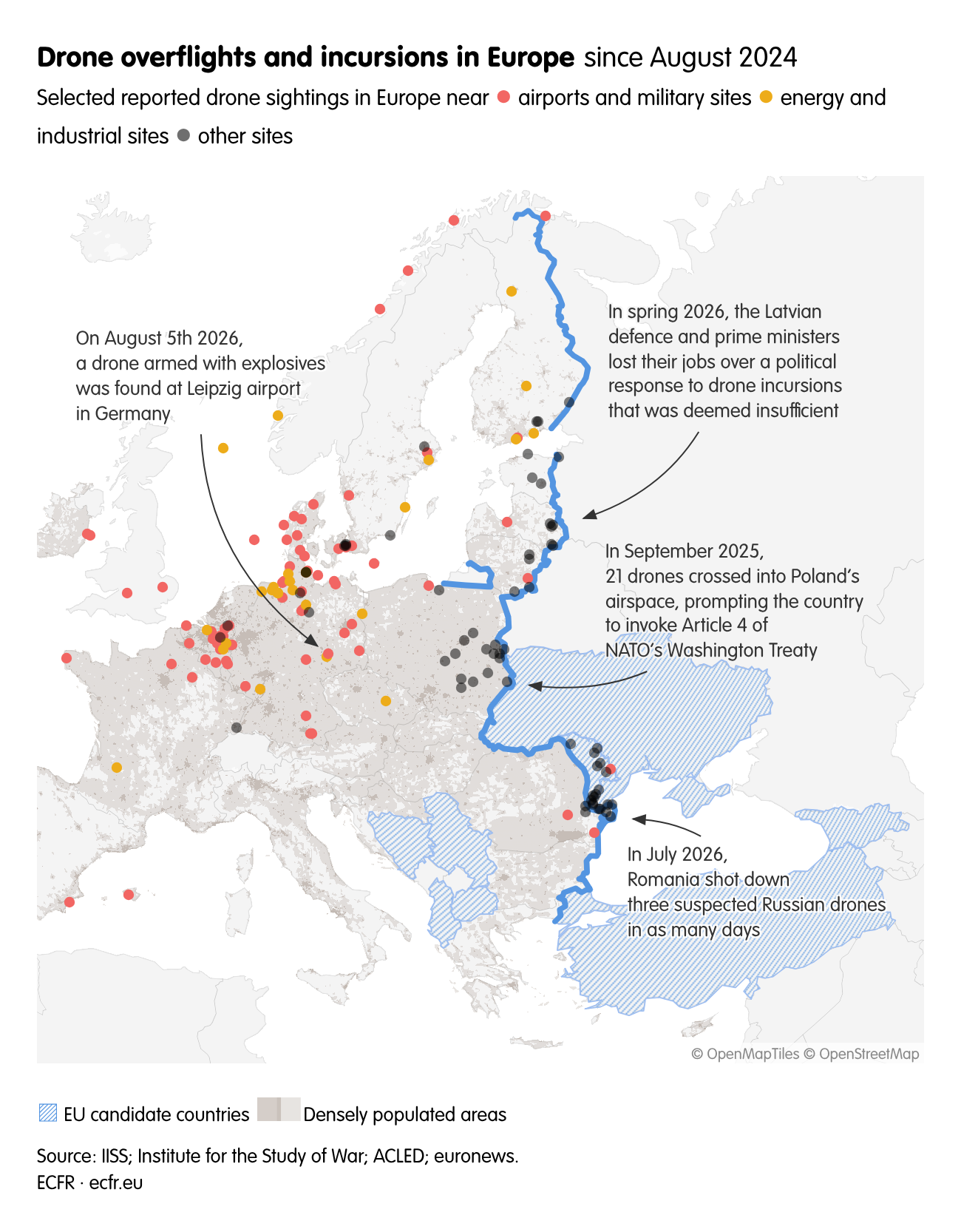
On August 5th 2026, a small drone armed with explosives was found at Leipzig airport in Germany. The presence of explosive material marks this out from previous incidents at airports, as does the fact that authorities recovered the drone. But Europe’s new normal is for small drones to disrupt its airports and buzz around other critical infrastructure, including French nuclear submarine bases, Belgian nuclear power plants and German liquefied natural gas terminals. Some of these sightings are likely part of Russia’s hybrid war against Europe. Yet the drones are probably flown from inside European countries or from ships in the North and Baltic seas, and definitive attribution to Russia or any other actor remains elusive.

The countries along Europe’s eastern flank have another new normal to contend with. This entails the connected but different threat of military drones crossing into EU and NATO territory from Russia, Belarus and, because of the Russian aggression against it, Ukraine. The most egregious incursion so far took place in September 2025, when around 20 Russian military drones crossed into Poland’s airspace, leading it to invoke Article 4 of NATO’s Washington Treaty. That episode also prompted NATO to launch Operation Eastern Sentry to increase its vigilance at the border.

Unlike the small drones hovering over critical infrastructure, the origin of the military drones crossing into EU and NATO territory is no mystery. The attribution problem here relates to intention, as Russia can claim—sometimes plausibly, sometimes less so—that incursions at the eastern flank are accidents resulting from its war against Ukraine.

The eastern flank

Russia and Belarus are acting antagonistically towards European countries, while Ukraine is a partner nation and an EU candidate country. But incursions of military drones into EU and NATO territory come from all three countries. The term “eastern flank” thus refers to the EU’s 4,000km border with Russia, Belarus and Ukraine, as well as the Black Sea coast. The flank extends through nine countries: Finland, Estonia, Latvia, Lithuania, Poland, Slovakia, Hungary, Romania and Bulgaria. 

Almost a year on from the Poland incident, the member states that line the eastern flank face military drone incursions with alarming (and increasing) regularity. The end of July, for example, saw Romania shoot down three suspected Russian drones in as many days. This followed another incursion in the country in May when a drone crashed into the roof of a ten-storey building in Galati and exploded, starting a fire in one of the apartments. A 14-year-old and his mother were injured, and 70 residents were evacuated. The Romanian military had tracked the drone and deployed two F-16 fighter jets in response to the threat. But the jets were unable to fire at the target for “operational reasons and [because of] certain legal limitations”.

The incidents in Romania lay bare some of the difficulties for Europe in defending its eastern flank against military drones. Over the past year, NATO’s operation has swiftly been joined by a hotch-potch of national and EU projects, including the bloc’s ambitious and wide-ranging European Drone Defence Initiative. But as things stand, military drones still either fly unhindered into EU and NATO territory or are intercepted through the costliest means possible, namely missiles fired from fighter jets.

Police forces across the continent, meanwhile, are struggling to mount an effective response to the problem of the small drones over their critical infrastructure. And countries farther from the eastern flank tend not to make the link between this largely civil threat and the military threat in the east: when the EU first proposed its initiative, for example, western European states were unconvinced that the bloc should fund drone defences at the eastern flank.

But, as this paper argues, all European countries need to act to secure the eastern flank—both to defend EU and NATO territory against military drones and to inform Europe’s response to small drones flying over its critical infrastructure. National efforts at the flank are promising but will likely prove insufficient. The EU will therefore have to spread the costs of defending the eastern flank, as efforts there contribute to the defence of the entire continent against military drone attacks. That small drones flying over critical infrastructure are a problem everywhere should further incentivise all Europeans to speed up their work on drone defence. And as this paper shows, the EU and member states can apply lessons learned at the eastern flank across Europe and reuse technology battle-tested in the east to protect their critical infrastructure.

The dual threat

The two sides of Europe’s drone threat are different, but they still share important similarities: they involve the same tools—drones of one type or another—and some likely have the same perpetrator—Russia. Mapping just a selection of drone overflights of critical infrastructure and incursions at the eastern flank since August 2024 lays bare the extent of the dual drone threat Europe is facing. And every time an overflight of critical infrastructure or incursion at the eastern flank happens, wherever it comes from, Russia learns something about Europe’s ability to fight (or otherwise) against these systems.

Drone overflights and incursions in Europe

Drones over critical infrastructure

Drones are regularly spotted over critical infrastructure across Europe. The German aviation agency reported 227 drone sightings by pilots in 2025. These numbers have been rising steadily since reporting began in 2020, and the 2026 numbers are well on track to surpass last year’s.[1] Such incidents are largely a civil matter, which means responsibility for recording, identifying and countering them falls on local authorities such as police forces.

The overflights near airports tend to grab the most attention for three reasons. First, drones pose an extreme risk to aircraft and have the potential to cause mass casualty events, with the incident in Leipzig perhaps the closest call so far. German newspaper Die Zeit reports that CCTV footage from the airport shows the drone flying towards an Antonov cargo plane parked on the runway, hitting one of the wings and then falling to the ground. It was later discovered on the tarmac by a bus driver, who alerted security. Had the explosives detonated, the consequences could have been catastrophic. But even without explosives, drones have the potential to cause an air disaster if they collide with a plane, particularly if it is taking off or landing. Second, drones near airports cause significant economic harm: Copenhagen airport had to close for four hours in September 2025, while more than 30 flights were cancelled in Munich following drone sightings in March 2025. Third, airport closures tangibly affect citizens, which is likely why they are such common targets in the first place.

But from a security standpoint, equally concerning are sightings over other critical infrastructure like energy hubs and military installations. Drones can, for instance, help hostile operators gather intelligence about the security arrangements at these installations. They could then use this to enable future sabotage or attacks.

Among these sites, drone activity around military installations could be highly consequential. In early 2025, the German ministry of defence logged six instances of drone overflights at Schwesing airbase, a Bundeswehr base where Ukrainian soldiers were trained to use Patriot air-defence missile systems. It is plausible that the drones carried signals-intelligence equipment that could identify soldiers’ mobile phones. Once it had identified the phones, Russia may have been able to locate them again months later at the Ukrainian front line—and with them, the valuable and increasingly scarce Patriot batteries. This is a direct concern for the Ukrainian defence effort. But it also points to a larger problem for Europe, as it illustrates the type of information Russia could be collecting about European armed forces.

It remains unproven where most of the drones used in overflights come from and who controls them. But it is probable that at least some of the drones flying over critical infrastructure are part of Russia’s hybrid war against Europe. For years, Russia has conducted attacks against military and civil infrastructure as well as government entities. Some attacks take place in the cyber-realm; some involve physical sabotage, like igniting air freight packages in Britain, Germany and Poland, and damaging submarine cables in the Baltic Sea. US intelligence also helped Germany foil a plot to assassinate Armin Papperger, the CEO of arms manufacturer Rheinmetall. Sweden, meanwhile, has faced attacks on its telecommunications network. And disinformation campaigns have targeted the whole of Europe for years, including in the aftermath of drone sightings and disruption.

German chancellor Friedrich Merz has noted that Russian agents may be behind at least some of the overflights; Danish prime minister Mette Frederiksen said she could not “rule out in any way that it [was] Russia” behind the airport disruptions in Copenhagen; and Ukraine’s president, Volodymyr Zelensky, has argued that “the drone incidents across Europe clearly show that Russia is prepared to escalate this war and that it has never been just about Ukraine.” Moreover, in 2025 investigative journalists traced several drone flights back to Russian ships in the North and Baltic seas. Since then, a June 2026 report from the International Institute for Strategic Studies has assessed it is “highly likely” Russia conducted a drone campaign against Europe, largely towards the end of 2025. This research also found that the source of some of these drones may have been Russian shadow fleet vessels.

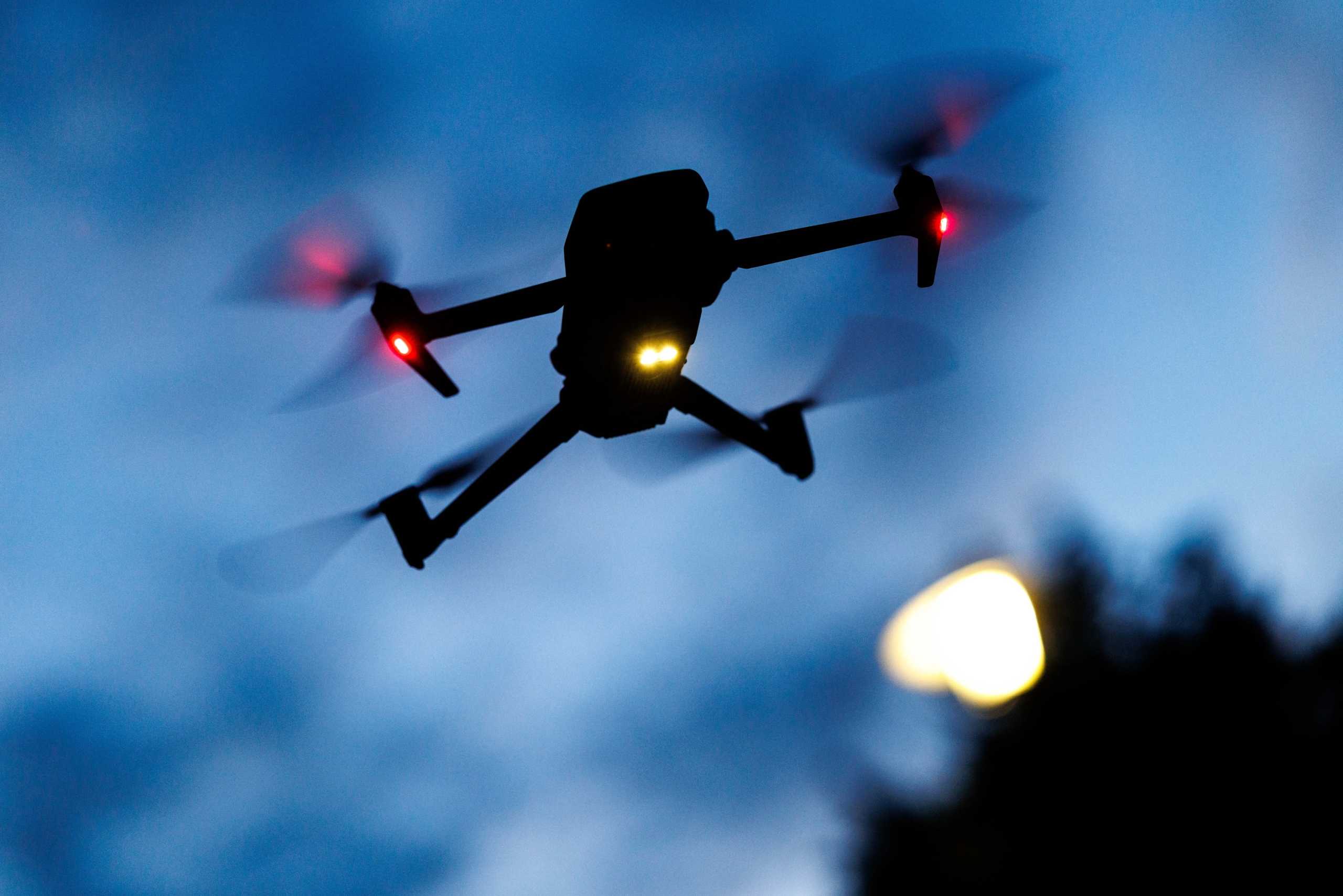
The types of drones used in these operations have not been definitively identified. However, analyses of images as well as eye-witness accounts point to fixed-wing surveillance drones, as well as quadcopter systems. In at least one incident there were reports of a “mothership” drone, a larger fixed-wing system which carries smaller quadcopter drones. The Leipzig drone has been identified as a quadcopter, roughly the size of a microwave oven.

A camera drone at dusk. [picture alliance / dpa | Matthias Balk]

Quadcopter drones

Quadcopter drones are systems with four rotors, which enable them to take off and land vertically, without any type of runway. They are flown via handheld console or smartphone app. Quadcopters have been the typical model for hobbyist drones as they are easy to use and do not require additional equipment. They are also particularly good at hovering in one place and flying slowly, making them the ideal system to follow and surveil people.

Their main vulnerabilities are endurance and range limitations due to weight: unlike fixed-wing systems which can glide, quadcopters require a continuous power supply to fly, thus draining their batteries quickly. As batteries are also their heaviest part, their range is limited. And heavier systems require more power, which means they need larger and heavier batteries. As more civilian systems have entered the military drone space, quadcopters and other multicopters have multiplied on the battlefield.

Still, definitive proof of the types of drone used in overflights or where they come from will depend on police forces apprehending more of them. The fact that local authorities across Europe have been unable to do this could compound a feeling among the public of failure by the state and leave the information vacuum wide open. The lack of information also means it is impossible to distinguish between real sightings and false alarms—like the 2016 case of a drone sighting from an aeroplane which turned out most likely to have been a plastic bag.

European authorities should also be able to stop drones around their critical infrastructure regardless of who flies them. The context of the Russia-Ukraine war has turned the drone threat into a geopolitical problem, yet non-state actors pose their own threat. Given the availability of drones, drone terrorism is a rising security concern—and far-right groups in the US, for example, are reportedly looking into first-person view drones to target law enforcement. But to date no major terrorist attacks by drone have taken place, only some thwarted plans, which is surprising.

But Europe’s drone problem also has a military side, and the continent seems equally unprepared to counter it efficiently and effectively.

Drones crossing the eastern flank

Alongside dealing with overflights, countries along the eastern flank must contend with military drones threatening EU and NATO territory from the east. Such incursions have taken place regularly since Russia began its war of aggression against Ukraine in 2022 and have intensified since 2025.

Only two weeks after the full-scale invasion, a drone (most likely Ukrainian) flew undetected for hundreds of kilometres over Romania and Hungary, before crashing near Zagreb in Croatia. Russian drones came down in Romania in 2023, and in Poland and Lithuania in 2025.

But the number of incidents has grown significantly in 2026. Russian and (more frequently) Ukrainian drones have veered off course since the start of the year, coming down in Finland, Lithuania, Estonia and elsewhere. In May, people took shelter in Lithuania when a drone alert brought Vilnius to a standstill; and across the border in Latvia, both the defence minister and the prime minister lost their jobs over a political response to drone incursions that was deemed insufficient. When the UN Security Council held an emergency meeting over the Galati incident in June, Romania’s minister for foreign affairs noted that it was just one of more than 40 incursions into the country’s airspace in 2026 alone—a number which has grown significantly since then.

Initially such incidents appeared to be accidents, caused by guidance-systems failures, operating errors and interference by electronic countermeasures. But the September 2025 incident in which around 20 military drones entered Poland from different places raised concerns that some might be deliberate provocations. The increasing intensity since then has done nothing to alleviate those concerns. After one May incursion in Latvia, Ukrainian foreign minister Andrii Sybiha said that Russian electronic warfare systems “deliberately diverted Ukrainian drones from their targets in Russia”—not going quite as far as to argue Russia was deliberately sending drones over NATO and EU territory, though this is a possible conclusion.  

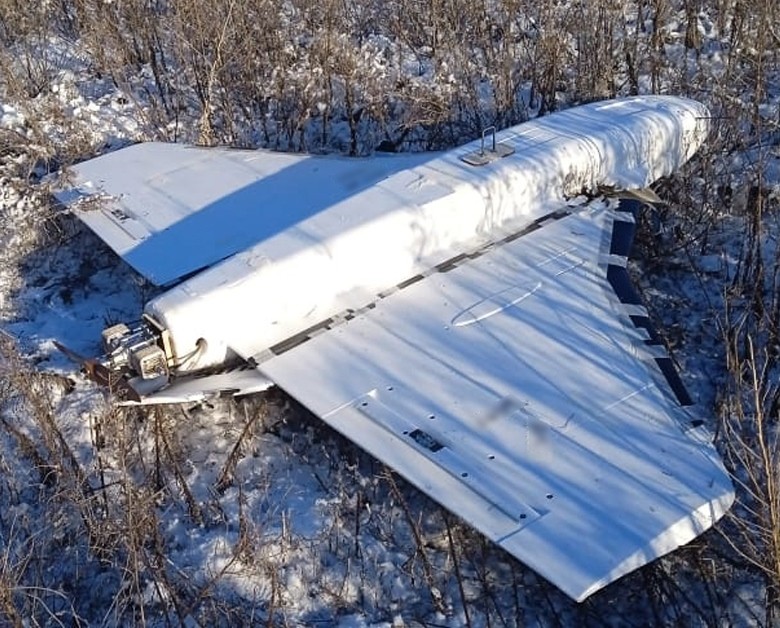
The drones that crashed in Poland were later identified as Russian Gerberas, an unarmed variant of what was originally the Iranian Shahed-136 loitering munition.

Russian drone Gerbera, downed in Ukraine (2025 01 05)
A Gerbera drone downed in Ukraine similar to those that entered Polish airspace in September 2025. [Wikimedia Commons]

Gerans and Gerberas

Russia manufactures its own version of the Iranian Shaheds in the Geran and Gerbera variants.

These are “kamikaze drones”, or one-way loitering munitions, which explode upon reaching their target. Russia is using the drone in ever greater numbers in Ukraine: since 2025, almost 1000 drones have been used in single-night attacks on Ukrainian cities and energy infrastructure. The current Geran iteration, the Geran-3, is a turbo-engined variant that can fly up to 800km, but many different variants exist. When employed in large numbers, they can overwhelm Ukrainian defences. The Gerbera is a lesser-known variant which is generally used as a decoy, or to relay signals for other, armed drones. The average price tag of drones like these is around €10,000.

In response to the incursions, Poland scrambled F-16 fighter jets and several military helicopters. Other NATO states provided support with aerial assets, most notably Dutch F-35s. Together they shot down three of the drones, with the rest crashing on Polish territory, luckily not causing any casualties. Debris was later found in an area spanning hundreds of square kilometres.

While NATO has not disclosed the exact costs of the operation, the missiles the jets fired cost between several hundred thousand and a million euros, depending on the type. Flight hours of F-16s and the much more expensive F-35s run into the tens of thousands of euros. So a single, only partly successful, counter-drone operation cost European countries millions, while Russia likely forked out less than €250,000 to prompt that response. 

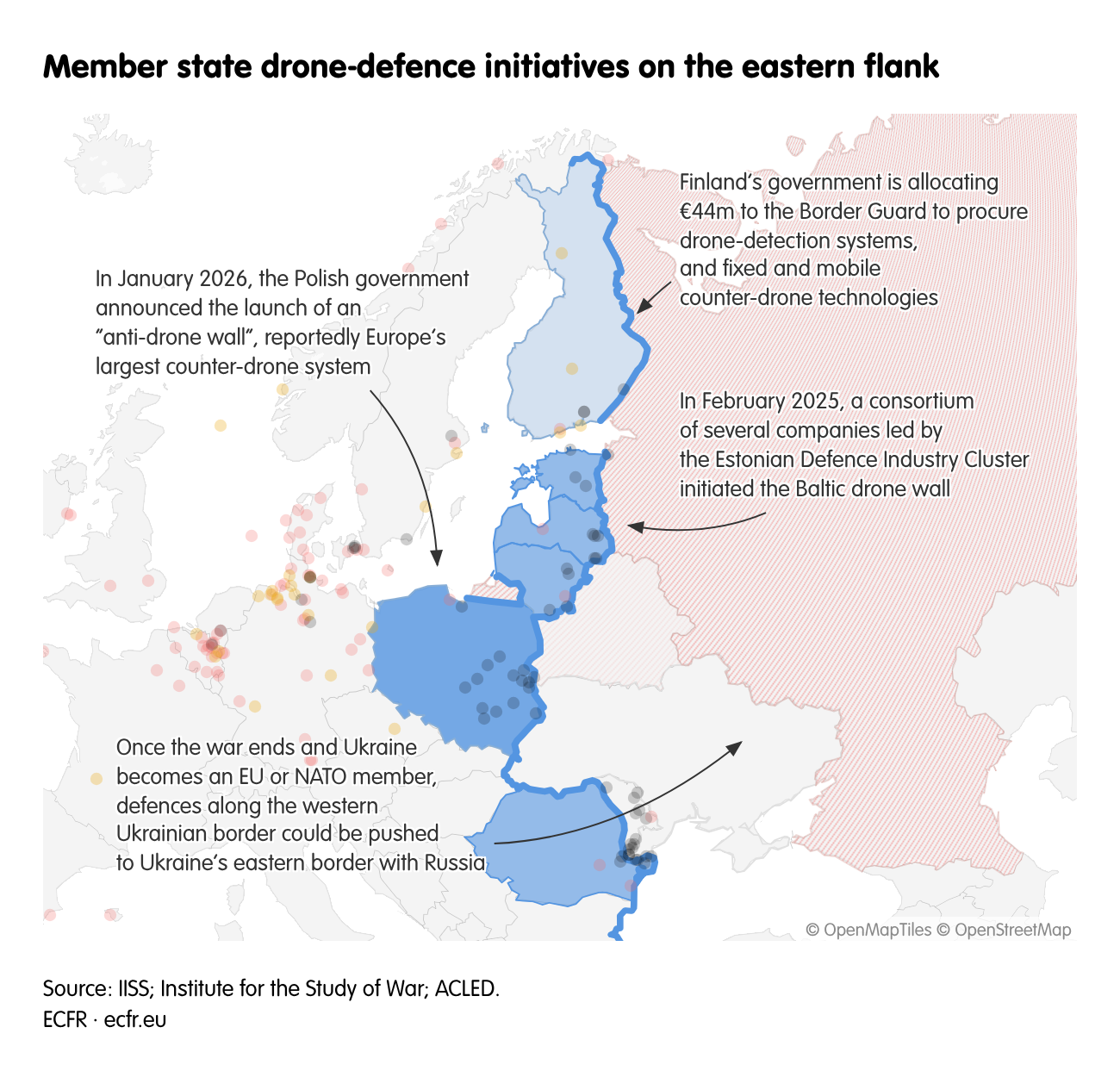
Drones continue to cross into NATO and EU territory. Sometimes they are intercepted, but more often they simply crash into the ground, occasionally even going undetected until they do. Were European countries to face an attack involving even a fraction of the numbers Ukraine regularly faces, the consequences would likely be catastrophic—and preventing them would be prohibitively expensive. Once the war ends, and if and when Ukraine becomes an EU or NATO member, defences along the western Ukrainian border—with Poland, Slovakia, Hungary and Romania—can move to Ukraine’s eastern border with Russia. In the meantime however, the EU, NATO and member states need to learn from Ukraine to secure the flank themselves.

Drones are a whole-of-Europe problem, which means all European countries need to invest in counter-drone capabilities. But starting at the eastern flank makes sense. Compared with the overflights of critical infrastructure, the flank is a more defined threat in a geographically bounded area. If the EU and member states can build an effective response here, it could inform efforts across the rest of the continent, both in terms of what can transfer to that different context and what cannot.

What a protected eastern flank looks like  

Europe’s eastern flank spans different climate zones and topography, urban and rural territory, and forests and agricultural land. Given this and the drone threat discussed above, drone defences will have to be multi-layered. The eastern flank will need a detector layer with several sensor options, a defensive layer with several different countermeasures (“multi-effector”), and the ability to engage several drones at the same time (“multi-shot”). All these systems would ideally feed their data into a common operating picture to create a comprehensive view of the eastern flank. This element will be crucial to detect attacks that may be happening at the same time but hundreds if not thousands of kilometres apart.

Detector layer

The detector layer will comprise various radar and sensor systems. These will have to be spaced along the eastern flank depending on the topography and the presence of buildings, forests, agriculture and similar criteria. Today the eastern flank is monitored primarily through NATO assets and national systems, which focus more on the threat from missiles and aircraft, rather than smaller and slower drones.

Radars offer long-range coverage but can struggle to track smaller drones. Their sensitivity is improving all the time but birds still cause false positives; and as drones can be made from an array of materials, it is possible to manufacture them with minimal, or unusual, radar signatures. Moreover, traditional active radar systems that send an electromagnetic pulse and capture its return signal can be too easy for adversaries to identify. To overcome this problem, passive radar systems that work by sensing changes in the electromagnetic spectrum as objects move through space are in development.

Electro-optical sensors would complement radar. These can identify drones based on visual and temperature identifiers, which helps operators establish what kind of drone they are dealing with. But they require a clear line of sight, making them less usable in urban or forest environments. Unless they are AI-enabled, electro-optical sensors also require human intervention in real-time to verify whether an image is showing a drone or not, and thus increase staffing requirements. Radio frequency scanning, meanwhile, identifies drones by monitoring common frequency bands, though its accuracy is limited.

Finally, Ukraine has had considerable success with acoustic sensors and has installed thousands across the country. But Ukrainian experiences have also shown that these sensors do not work equally well in all contexts: environments with lots of sounds, like forests, urban areas and agricultural land, can hinder their usefulness.

Defensive layer

As with detection sensors, the defensive layer will have to incorporate several different features, from electronic countermeasures to kinetic solutions.

Electronic countermeasures include spoofing of positioning systems like GPS, and radio frequency jamming that blocks the connection between drone and operator. But these systems can be quite disruptive as they often interfere with all systems in range, making them less useful in urban contexts and near airports. Their effectiveness also often depends on continuous transmission, and they only work on drones that require a connection to the operator. This means they would be ineffective against autonomous, pre-programmed and tethered systems.

Electronic countermeasures have proven highly effective in Ukraine. But Russia has developed several workarounds to Ukraine’s efforts since the start of the war, and vice versa. Today Ukraine’s entire front line is GPS denied, so all drones operating there do so without relying on satellite guidance. Electronic countermeasures are also being circumvented by drones carrying with them up to 40km of fibre-optic cable through which signals are sent. This underlines the need for drone defences at the eastern flank to involve multiple systems.

Radio-frequency-based “cyber takeover” aims to take command of unwelcome drones and safely land them. This is a particularly desirable option as it preserves the drone for analysis. Yet it hinges on the cyber takeover’s ability to work on every drone system, including unknown ones.

Finally, Europe’s eastern flank will require a range of kinetic counter-drone tools—as a last resort for when electronic measures have failed to take down drones. These should include rifle-mounted systems, larger cannon-type systems, guided missiles and drones to fight drones. While generally effective, most kinetic solutions create the danger of collateral damage, as both projectile and drone come crashing down. During the Polish drone incursion in September 2025, the only property damage was caused by a missile that aimed to shoot down the drones.

Ukraine is now using interceptor drones, or drones that take out other drones. These include several systems, like drones with nets or those that ram hostile drones or blow up warheads that come near. (Incidentally, the existence of these systems has led to some confusion over the term “drone wall”, as some reports have suggested that it would be a wall made of drones, a misunderstanding helped along by the fact that a German firm had proposed such a project previously.)

Other countermeasures such as lasers, electromagnetic pulses, strong light and microwave weapons exist, but have not yet matured sufficiently and face similar limitations to those mentioned above, such as the need for line-of-sight or the risk of collateral damage.

Command and control

Crucially, Europe needs a command-and-control node to collect data. For drone defence to be truly integrated and European, the goal should be for this data to feed into a common operating picture that covers the entire flank, from Nuorgam in northern Finland to Burgas in southern Bulgaria. How to respond to a given threat should remain a more local decision, but information-sharing will still be crucial to understand any attack situation. It is equally desirable for European countries to exchange information with NATO’s Integrated Air and Missile Defence. AI and automation may also prove useful, though it will be necessary to heed the lessons of over-reliance on technology and automation, for instance, from the October 7th attacks against Israel.

*

Building a multi-layered system of systems like this on the eastern flank may seem a daunting task, not to mention an expensive one. But as the alternative is for EU and NATO countries to continue spending tens of thousands of euros to shoot down a single drone, or not to detect or shoot it down at all, it is a task in which the EU and all European countries have a stake.

The progress so far

The work has already begun. The European Commission has been most vocal about its plans to build up an ambitious “drone wall”, now rebranded as the European Drone Defence Initiative. NATO launched Operation Eastern Sentry in September 2025 and runs counter-drone trials with companies. At the national level, many border states are pursuing counter-drone efforts of varying ambition and scope. But the eastern flank remains a long way away from the defences described above, and the lack of coordination could undermine both the initiatives’ efficacy and their cost-efficiency.

Member state drone-defence initiatives on the eastern flank

The EU

By accident of the calendar, European Commission president Ursula von der Leyen’s State of the Union address took place just a day after the Poland incident in 2025. In her speech, she called for the EU to establish a “drone wall” that would be the “foundation of a credible European defence” and announced the “Eastern Flank Watch” to conduct real-time surveillance of the eastern border.

Von der Leyen offered more details in another speech at the European parliament a few weeks later, noting that using expensive fighter jets to take down cheap, mass-produced drones was “absolutely not sustainable”. Instead, the drone wall should be a system that performs “swift detection, swift interception, and when needed, swift neutralisation”. In October 2025, the informal European Council meeting in Copenhagen endorsed these projects.

Almost a year on, and the European Drone Defence Initiative and Eastern Flank Watch are two of four EU readiness flagship efforts, alongside the European air and space shields. Yet the Drone Defence Initiative and the Eastern Flank Watch are linked in a way that makes it difficult to distinguish between the two. The official commission communication notes, for example, that “anti-drone capabilities will form a core component of the Eastern Flank Watch flagship”. In any case, the projects aim to reach initial capacity by end of this year, and full capacity by end of 2027 and 2028, respectively.

While the intention of the EU’s effort is good, its stated scope sounds overly ambitious. For example, the October 2025 Defence Readiness Roadmap 2030 notes that “the counter-drone network will be adaptable for civ-mil and dual use purposes and help deal with non-defence related threats or other hazards common to every EU border. This includes border protection, weaponisation of migration, protection of critical infrastructure and transnational organised crime.” Von der Leyen expressed similarly wide-ranging aspirations in her speech to parliament, and added guarding the southern flank to the mix as well as countering the Russian shadow fleet—all with the aid of autonomous systems.

Such an all-encompassing proposal appears set for failure, however, and likely only became so inflated in the first place to placate member states away from the eastern flank.

NATO

Today, NATO is the most active body in fighting drone incursions. After Poland invoked Article 4, the alliance launched Operation Eastern Sentry which increased vigilance along the eastern flank. In many instances when drones have been shot down, it was by fighter jets under NATO command.

NATO also plays a useful role in testing counter-drone technologies for member states to procure. The alliance is, for example, running exercises under its “Layered Counter-Uncrewed Aerial System (UAS) Initiative Crucible”. The first of these took place in Romania and focused on how various sensors, effectors and command-and-control systems could operate as a single, layered defence. Over 250 systems were involved, including radars, acoustic and radio-frequency detectors, electronic warfare tools, and kinetic and non-kinetic effectors. The exercise’s scenario involved drone swarms flown over the Black Sea and included representatives from Ukraine who advised on drone tactics and evolving threats.

Still, NATO’s approach remains primarily focused on fighter jets, as they are at the alliance’s disposal. Any longer-term, more cost-effective solution will depend on member state buy-in and member state efforts.

National efforts

For the moment, national-level counter-drone efforts look most promising. Yet the level of development varies significantly along the eastern flank.

Poland’s plans seem most advanced. In January 2026, the Polish government announced the launch of an “anti-drone wall”, reportedly Europe’s largest counter-drone system. The project is estimated at €3.8bn and brings together a consortium of three companies: the state-owned Polska Grupa Zbrojeniowa, the Norwegian firm Kongsberg and the Polish company Advanced Protection Systems.

According to Poland’s defence minister, the system will include 18 anti-drone batteries, 52 firing platoons, 18 command platoons, and 703 military trucks and reconnaissance vehicles. The sensor layer will include short- and medium-range radars, passive electronic detection sensors and electro-optical systems. The defensive layer will be based on Kongsberg’s “Protector” family of weapons and include 35mm anti-aircraft guns, capable of firing programmable and high-velocity ammunition; 30mm cannons; 12.7mm multi-barrel heavy machine guns, intended for short-range threats; laser-guided rockets; and interceptor drones. It will also include non-kinetic defences, including electronic warfare capabilities. Deputy defence minister Cezary Tomczyk noted that different systems would be used in different contexts. Referring to the danger from debris, he said: “Some of this is for use only in extreme or war conditions. For example, these multi-barrel machine guns are difficult to use in peacetime, because everything that goes up must go down.”

The Polish initiative’s command-and-control layer integrates fire control, system management and tactical situational awareness, enabling real-time coordination of sensors and effectors. Initial operational capabilities are scheduled for delivery before the end of 2026, with the aim of it being fully operational by the end of 2027. For Poland, the drone wall is only one element of stronger fortifications on its borders with Belarus and the Russian Kaliningrad exclave.

In cooperation with the European Commission, Poland has also announced the creation of a “drone valley”, a hub of drone-related research and testing in the south-east of the country, in Rzeszow—a city that has become the hub for logistical support to Ukraine. Companies are increasingly entering the defence field, so such a hub will host some of the trade fairs and hackathons on counter-drone measures that are becoming more common in Europe.

Further north in the Baltic countries, in February 2025, a consortium of several companies led by the Estonian Defence Industry Cluster initiated the “Baltic drone wall”. The effort includes companies from Poland and Finland, but a request for funding from the EU was rejected in March 2025. Media sources report a multi-layered short-range drone countermeasure system, and efforts to build a common operational picture. But so far, nothing comprehensive has come to pass. Still, in June Estonia began deploying its first fixed drone detection and monitoring systems along its border with Russia. The systems are installed on three sections of the border between the Luhamaa crossing and the tri-border area where Estonia, Latvia, and Russia meet.

Finland’s government announced in April 2026 that it is allocating €44m to the Border Guard to procure drone detection systems, and fixed and mobile counter-drone technologies. It has also been working on drone detection along the border for several months.

As of summer 2026, Romania is experiencing the most frequent incursions. But it only recently began looking into counter-drone systems. The country is now investing heavily in its defences, specifically its aerial defences, which include counter-drone systems. These initiatives are in part financed by EU loans through the re-armament initiative SAFE. The country has also turned to NATO as well as allied countries to help it fight against drone incursions.

In Bulgaria, drone defences have not yet become a priority. The country is, however, looking into the acquisition of counter-drone systems, funded through the EU loan mechanism. Hungary and Slovakia were absent from initial EU drone defence discussions with the other eastern flank states. Slovakia joined later exchanges and has looked into the acquisition of counter-drone systems, but it does not appear to have a more comprehensive counter-drone initiative. In July, Slovakia hosted a NATO test of emerging capabilities which included counter-drone technology, though this was not its main focus.

How to turn the hotch-potch into a whole

It is positive that the EU, NATO and the eastern flank states are working on solutions. But too many initiatives exist, which risks duplicating conceptual work and creating uncertainty for companies that do not know who to work with. The further along individual projects are, the harder it will be to combine them and to facilitate the kind of information exchange needed for a common operating picture. To ensure coherence and interoperability, especially at the data-exchange level, more coordination needs to happen now.

The EU should view this as an opportunity to fulfil its ambitious goal. Although it should drop the aim to create a drone wall that can do just about everything, it can play the coordinating role of bringing the relevant actors together. To do so, the EU should focus on the following five priorities:

  1. Support more ambitious and advanced efforts like the Polish and Baltic state counter-drone initiatives. The EU should, for example, identify where gaps or barriers remain in these efforts and where there may be risk of duplication. This would enable the EU to direct its funding, as well as its regulatory and legal expertise, in ways that accelerates those efforts.
  2. Fund and incentivise counter-drone efforts in eastern states that are not yet pursuing drone defences with the required urgency: Bulgaria, Hungary and Slovakia, but also Romania, would benefit from European finance and guidance in scaling up the ambition and scope of their defences.
  3. Encourage member states to share best practices, including on regulation and questions of jurisdiction, and establish links between actors and companies already in the field. For example, Germany has reworked its national law to allow the armed forces to intercept drones in extreme cases. In France, a new law allows private companies to ensure protection against drones for civilian infrastructure. There is no reason why every EU member state needs to work out these laws for itself.
  4. Create, in cooperation with NATO, common standards and certifications for quality control and to ensure products from different companies are interoperable. This could take the form of a suitability certificate for companies whose systems have proven their usefulness in exercises.
  5. Establish a joint operating picture by building a command-and-control node in which data from all eastern flank detection stations are collected. This would enable truly European coordination to bring together national efforts and turn a piecemeal effort into a militarily useful whole.

The EU is already organising virtual meetings between the involved states. It should now develop this coordinating role to share legal best practices and develop common rules regarding when and how military drones can be intercepted in a civilian setting. For example, one reason the drone flying into Romanian airspace in May was not intercepted was uncertainty over the legality of interception: “Ukraine is at war, but Romania is at peace”, a military representative said. All eastern flank states share the same situation. And the fact that many of the national efforts are funded with the help of the SAFE defence loan programme boosts the EU’s legitimacy in taking on this role.

And apply the lessons to the rest of Europe

Organisationally, national police forces deal with drones over critical infrastructure. And the EU is well-placed to help spread insights from counter-drone operations at the eastern flank farther west. Technologically, member states’ experiences at the eastern flank also hold several lessons for the rest of the continent: which systems work and in which environments, for example, and how different technologies can work together. Again, the EU can help to compile and share this valuable information, reducing the burden on member states to collect it themselves.    

Countering drones flying over critical infrastructure will not require something quite as elaborate and unified as defences at the eastern flank:

  1. Detector layer: Lessons from the eastern flank on how best to install detection layers and which systems work best can inform local authorities’ decisions about what would work near critical infrastructure. Here, the EU and local authorities will need to take different environments into account: critical infrastructure is often in more urban areas, whereas the eastern flank is generally more rural. Yet the flank includes a multitude of different environments, including forests and swamps, and agricultural and some urban areas, which means detection systems will be tested in numerous areas that can still inform how they might perform nearer cities. 
  2. Defensive layer: The EU and local authorities should apply a similar principle to the defensive elements. This includes lessons on how to best layer countermeasures, and which systems work best in which environment. Not all systems that operate at the eastern flank will qualify for deployment in civilian contexts: kinetic systems in particular, would only be used in the most extreme cases to protect critical infrastructure from an immediate threat. But insights from electronic countermeasures and cyber takeover may be transferable to a civilian context.
  3. Information exchange: The EU and member states should establish an information exchange on drone incidents near critical infrastructure throughout the union. Countering the threat to critical infrastructure does not require the joint operating picture that military defence does. But collecting and sharing information on drone overflights (as well as other hybrid attacks) over critical infrastructure would allow authorities to detect concerted attack operations.

Today’s solution

Europeans face a dual drone threat over their critical infrastructure and at the eastern flank. They need to address both sides of this problem. While there is no wall to be built and no umbrella to open over the entire continent, insights from one side of the threat can inform the other.

The EU should start by turning its overly ambitious Drone Defence Initiative into something operable. To do so, it should focus on supporting existing national initiatives on the eastern flank and incentivising budding ones. It should also prioritise data-sharing and establishing a joint operating picture, and collecting information on which systems work in what context. The EU should then use this information to help all member states counter drones beyond the eastern flank.

This policy brief focused drone defence—a crucial skill for all European states as drones are without question a threat they will continue to encounter. Yet, with regard to the drone threat from Russia, a better option than to defend against overflights and incursions is to stop them from happening in the first place: no build-up of European defences can replace diplomatic, political and military efforts to end the Russian aggression against Ukraine and Russia’s hybrid attacks against European nations; even if better defences would contribute to deterrence by denial in the meantime.

About the author

Dr Ulrike Franke is a senior policy fellow at the European Council on Foreign Relations, based in the Paris office. Her areas of focus include German and European security and defence, the future of warfare, and the impact of new technologies such as drones and AI on geopolitics and warfare.


[1] DFS Deutsche Flugsicherung, Drone Report, July 2026.

Source

  •  

‘Most dangerous man in Germany’ – Local mayor threatens to fire firefighters for posing with AfD politician

A casual snapshot with a prominent Alternative for Germany (AfD) politician has ignited a massive political firestorm in a small German town, leaving four volunteer firefighters facing potential expulsion from service.

The controversy centers on the market square of Egeln – a town of 3,000 residents in Saxony-Anhalt – where local volunteers chose to pose for a photograph with AfD lead candidate, Ulrich Siegmund.

For those readers unfamiliar with Siegmund, he is arguably public enemy number one in the country at the moment. With upcoming state elections in Saxony-Anhalt, much is at stake, with Siegmund’s AfD party is close to capturing an absolute majority of the vote. Due to the popularity of Siegmund in the state, Spiegel Magazine has now famously released a cover featuring the AfD politician while labeling him the “most dangerous man in Germany.” In the article, which describes Siegmund as good looking, polished, and excellent at connecting with voters, his photo is presented as if it were a police mugshot.

The magazine article comes almost at the same time as the incident with the firefighters, which was captured on video last week by “Weichreite TV.” According to the video footage, an active fire truck pulled up near an AfD information booth. The crew, still wearing portions of their official fire department uniforms, approached the politician.

The interaction began cordially, with Siegmund greeting the emergency responders warmly. Shaking their hands, the politician remarked, “Boys, call it a day, you deserve it. Thank you for your efforts.” Seeking to connect further, Siegmund later asked, “Is there anything else I can do for you?”

One of the volunteers responded, “We just wanted to take a look, we wanted to meet in person.”

The group then gathered in front of their department vehicle to take a commemorative photo with the AfD candidate.

Egeln’s long-standing mayor, Michael Stöhr, reacted with fury. The fact that Siegmund’s party is polling at 43 percent, which means nearly half of all voters support him, did not stop the enraged mayor from threatened to fire volunteer firefighters – a move that could leave his community vulnerable during peak wildfire season.

In a detailed, sharply worded Facebook statement, the independent politician expressed that he was “stunned” by the crew’s actions, arguing that their conduct inflicted “enormous damage” on the reputation of the volunteer fire service.

“As mayor of the municipality and head of the volunteer fire department, I expressly clarify that such behavior by members of our volunteer fire department in the line of duty cannot be tolerated,” Stöhr wrote. He further announced his intention to “evaluate the action internally and of course draw appropriate consequences.”

He even implied that taking a photograph with one politician could mean their political alignment could compromise their impartiality during emergency operations. Thus, he is implying these firefighters may refuse to put out a fire simply because they posed with an AfD politician.

“Our population must be able to rely on our fire department to provide assistance in an emergency, regardless of political opinion, religion, or origin. Should this be even remotely questioned by members of the volunteer fire department, then they have no business being in the fire department anymore.” Stöhr claimed.

Concluding his public statement, Stöhr stated that he could only “therefore, explicitly apologize to all volunteer helpers in the fire departments,” while stating “that something like this will not happen again in our local fire brigades of the Egelner Mulde municipality.”

Mayor’s reaction is slammed on social media

The mayor’s strict disciplinary stance has triggered an intense wave of public criticism. Rather than garnering widespread community support, the Facebook post quickly became a lightning rod for controversy, accumulating nearly 8,500 comments.

The vast majority of online users expressed deep shock over how the volunteer first responders were being publicly treated by local leadership. In the wake of the uproar, several commentators have begun demanding the resignation of Mayor Stöhr, who has held his office for 16 years.

The post ‘Most dangerous man in Germany’ – Local mayor threatens to fire firefighters for posing with AfD politician appeared first on Remix News.

  •  

Italy: Young girl in critical condition after boat carrying illegal migrants strikes her with propeller

A teenage girl is in critical condition after a boat carrying ten illegal migrants struck her off Su Giudeu beach in Chia, Italy, yesterday afternoon. The boat was transporting migrants from North Africa.

The victim sustained severe injuries, including fractures and lacerations, after being caught by the boat’s propeller. The injuries led her to lose consciousness, but she was rescued by lifeguards before she could drown. Once they could drag her to shore, they began to administer first aid.

The horrifying incident happened at approximately 4:30 p.m. in the bathing area in front of Su Giudeu beach where the 118 air ambulance landed, according to TGR.

Due to the severity of her injuries, emergency medical personnel intubated the young woman on-site. She was then airlifted via air ambulance to Brotzu Hospital in Cagliari, where she was admitted in critical condition.

While it remains unclear exactly how the young woman became trapped by the engine propeller, boats carrying undocumented migrants have increasingly appeared directly on popular swimming beaches across Europe over recent years. Often, these vessels offload their passengers right in front of shocked beachgoers.

The risk of a serious accident during these landings is high. Smugglers are often desperate to quickly unload their cargo and escape, creating high-tension situations where they fail to notice swimmers. Additionally, after grueling journeys at sea, the arriving passengers are frequently eager to scramble ashore as fast as possible.

The post Italy: Young girl in critical condition after boat carrying illegal migrants strikes her with propeller appeared first on Remix News.

  •  

Now VOLCANO ETNA Really Frightens Italy as CAMPI FLEGREI! Intense Explosive Activity After the August Earthquake. (VIDEO). US Hiker Dies in the Summit

The eruption of the Siphon crater is pictured in a screenshot from a video by the State Forestry Corps of the Sicily Region, which is closely monitoring the volcano’s activity and safely accompanying numerous tourists on excursions.

By Gospa News Editorial Staff

VERSIONE IN ITALIANO


POSTED ON AUGUST 17, 2026

Etna: Red alert for aviation returns, ash cloud to the southeast

A new surge in activity on Etna has triggered a renewed red alert for air traffic. The National Institute of Geophysics and Volcanology, Etna Observatory, has issued a new VONA (Volcano Observatory Notice for Aviation) warning of intense explosive activity.

This follows the August 15 earthquake on the mountain, which occurred just days after the more powerful one that caused extensive damage to the Campi Flegrei supercaldera, where a devastating resumption of volcanic activity is feared.

Another EARTHQUAKE in CAMPI FLEGREI. The Tremor more Terrifying (4,7 – VIDEO) as a Nightmare of a Foretold Disaster. Many Studies on the High Risk of the SuperVolcano Explosion

The bulletin highlights ashfall in the area southeast of the volcano, with an ash cloud constantly moving in the same direction. The phenomenon, constantly monitored by thermal and visible surveillance cameras, marks an increase in alertness compared to previous warnings, which were at code orange.

Restrictions on Flights Arriving in Catania

“Due to Etna’s eruptive activity and the associated emission of volcanic ash into the atmosphere, the areas corresponding to sectors B1 and B2 have been closed. Incoming flight activity is limited to five aircraft per hour until 2:00 PM today. No restrictions on departures.”

SAC (Catania Airport) announced this morning in a statement, urging “passengers to check the status of their flights with their airlines before traveling to the airport.”

Etna is making its voice heard again with a new and intense eruptive phase. According to the monitoring system of the National Institute of Geophysics and Volcanology (INGV) – Etna Observatory in Catania, a sharp increase in volcanic activity was recorded at the summit craters throughout the day on August 16th.

Earthquake on Etna: Increase in Volcanic Tremor

The findings show a resumption of Strombolian activity at the Voragine crater, accompanied by an intensification of ash emission from the northeast crater. Forecast models indicate that the ash plumes generated by the explosions have dispersed in a southeasterly direction across the volcano’s summit area.

From a seismic perspective, technicians report a sharp increase in volcanic tremor, culminating in the mid-August earthquake (read below).

Etna, US hiker struck by lightning on volcano dies: he had ventured into restricted area

The extraordinary influx of people continues near Etna’s lava flow, which continues to be fed. Meanwhile, disruptions to air travel in Sicily continue due to the eruption and the resulting volcanic ash emission, but a thirty-year-old hiker has lost his life after being struck by lightning while on Etna.

According to initial reports, the hiker was a US citizen who had ventured into the restricted area to observe the volcano’s summit up close. At midday, when a violent thunderstorm struck the area where he was located, he was reportedly struck by an electrical discharge.

He was found in agony a few hours later. Despite emergency medical services, he was taken by helicopter by firefighters, but was already dead.

Earthquake on Mount Etna on August 15th: Magnitude 3.9 shock in Linguaglossa

At 12:24 p.m. on August, 15, 2026, the earth shook in the province of Catania.

The National Institute of Geophysics and Volcanology (INGV) recorded a magnitude 3.9 earthquake with its epicenter near Linguaglossa. The hypocenter, located just 1 kilometer below the surface, amplified the perception of earthquake movement among the population.

The magnitude 3.9 earthquake felt in the late morning in the Catania area, with its epicenter 7 kilometers from Linguaglossa, was “triggered by the opening of the Pernicana fault linked to volcanic activity.” Salvo Cocina, head of the Sicilian Civil Protection Department, explained this on his social media channels.

Cocina also lists the initial damage reported: “The road to Piano Provenzana, in the Ragabo Clan dei Ragazzi area, is broken.” “The restaurants in the area have been evacuated as a precaution,” he adds. “There are no reports of further damage. Investigations are underway. Civil Protection, Forestry, the Municipality, and the Province are on site.”


RELATED POST

VOLCANOES’ NIGHTMARES in RUSSIA as in ITALY (videos). Huge Eruption linked to previous Record Earthquake in Kamchatka. Ongoing Tremors in Campi Flegrei

The FURY of RING of FIRE STRUCK AGAIN! 7.7 Earthquake in Indonesia (VIDEO) after the ones in Colombia, Japan, Venezuela and other 93 ones in Pacific. Wild Weather and Geoengineering Nightmares inside HARP, US Pentagon partner

ESCALATION of ERUPTION RISKS by EUROPEAN SUPERVOLCANO. Alarming Study on Nature Geoscience about Campi Flegrei after Strong EarthQuakes


  •  

L’aliénation spirituelle des Africains – Par AMA MAZAMA

@afro_spirit01 l’aliénation spirituelle des noirs par AMA MAZAMA #malembo_kama #mwanamboka01 #amamazama #eveilspirituel #cultureafricaine #spiritualité #spirituality #pourtoi #fyp #viral ♬ son original – AFRO_SPIRIT

L’article L’aliénation spirituelle des Africains – Par AMA MAZAMA est apparu en premier sur .

  •  

Il Cammino Neocatecumenale, cavallo di Troia nella Chiesa

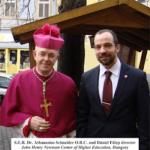
Mons. Athanasius Schneider, durante un’intervista dello scorso 6 marzo 2016 (il cui testo completo in italiano è su Chiesa e postconcilio), ha parlato anche del Cammino Neocatecumenale.

Original English text: here on Rorate Caeli blog.

Il Cammino Neocatecumenale è una comunità Protestante-Ebraica

Mr. Fülep: mentre la tradizione viene perseguitata, ci sono certi nuovi movimenti moderni che vengono invece sostenuti parecchio. Uno di questi è la comunità di Kiko. Quale è la sua opinione sul Cammino Neocatecumenale?[11]

Mons. Schneider: si tratta di un fenomeno molto triste e complesso. Per dirla apertamente: è un cavallo di Troia nella Chiesa. Li conosco molto bene perché per loro sono stato delegato apostolico per parecchi anni in Kazakhstan, a Karagandà. Ed ho assistito alle loro Messe e ai loro incontri, e ho letto gli scritti di Kiko, il loro fondatore, per cui li conosco bene. Parlando apertamente, senza diplomazia, dico che il Neocatecumenato è una comunità Protestante-Ebraica[12] all’interno della Chiesa, che di cattolico ha solo la decorazione. L’aspetto più pericoloso riguarda l’Eucarestia, poiché l’Eucarestia è il cuore della Chiesa. Quando il cuore è in pessimo stato, l’intero corpo è in un pessimo stato. Per il Neocatecumenato, l’Eucarestia è principalmente un banchetto fraterno. Quest’attitudine è Protestante, tipicamente Luterana.[13] I neocatecumenali rigettano il concetto e l’insegnamento che l’Eucarestia sia un vero sacrificio. Addirittura affermano che l’insegnamento tradizionale, e il credere che l’Eucarestia sia un sacrificio, sarebbe qualcosa di non cristiano ma pagàno.[14] Questo è completamente assurdo, questo è tipicamente Luterano e Protestante. Durante le loro liturgie eucaristiche trattano il Santissimo Sacramento in una maniera talmente banale, che certe volte è orribile.[15] Si siedono mentre ricevono la Santa Comunione, e disperdono frammenti perché non se ne curano, e dopo la Comunione ballano anziché pregare e adorare Gesù in silenzio. È questo che è realmente mondano, pagàno, naturalistico.

Mr. Fülep: il problema potrebbe non essere solo pratico…

Mons. Schneider: il secondo pericolo è la loro ideologia. L’idea principale del Neocatecumenato, stando al loro fondatore Kiko Argüello, è la seguente: la Chiesa avrebbe avuto una vita ideale solo fino all’epoca di Costantino, nel quarto secolo – solo questa sarebbe stata la vera Chiesa. E con Costantino la Chiesa avrebbe cominciato a degenerare: degenerazione dottrinale, liturgica e morale.[16] E la Chiesa avrebbe raggiunto il peggio di questa degenerazione dottrinale e liturgica nei decreti del Concilio di Trento. In realtà è vero l’esatto contrario di tale opinione: il Concilio di Trento è stato uno dei più alti momenti della storia della Chiesa proprio a causa della chiarezza dottrinale e disciplinare. Secondo Kiko, l’epoca oscura della Chiesa sarebbe durata dal quarto secolo fino al Concilio Vaticano II. Sarebbe stato solo grazie al Vaticano II che la luce sarebbe giunta nella Chiesa. Questa è un’eresia perché vorrebbe insinuare che lo Spirito Santo avrebbe abbandonato la Chiesa. Ed è davvero settario e molto in linea con Martin Lutero, il quale disse che fino a lui stesso la Chiesa era nell’oscurità e che solo attraverso lui stesso la luce sarebbe tornata nella Chiesa. La posizione di Kiko è fondamentalmente uguale, solo che Kiko postula l’epoca oscura della Chiesa da Costantino al Vaticano II. Così i neocatecumenali fraintendono il Concilio Vaticano II. Dicono di essere apostoli del Vaticano II, per giustificare tutte le loro pratiche eretiche e gli insegnamenti eretici. Questo è un grave abuso.

Mr. Fülep: com’è possibile che questa comunità sia stata ufficialmente ammessa dalla Chiesa?

Mons. Schneider: questa è un’altra tragedia. Hanno costituito una potente lobby in Vaticano da almeno trent’anni. E c’è un altro inganno: in molti eventi ostentano ai vescovi parecchi frutti di conversione e molte vocazioni. Molti vescovi sono resi ciechi da tali “frutti”, e non notano gli errori e non li esaminano. I neocatecumenali hanno famiglie con molti figli, ed hanno un alto livello morale nella vita familiare. Questo è certamente un buon risultato, ma c’è anche la pratica esagerata di imporre alle famiglie di avere quanti più figli è possibile. Questo non è salutare. Loro affermano di accettare la Humanae Vitae,[17] e questo è certamente un bene. Ma in fin dei conti è certamente un’illusione, perché ci sono anche moltissimi gruppi Protestanti nel mondo di oggi con un alto livello morale, che hanno anche un gran numero di figli, e che vanno a protestare contro l’ideologia gender e l’omosessualità, e che pure accettano la Humanae Vitae. Per me, perciò, non è un criterio decisivo di verità! Esistono un sacco di comunità Protestanti che convertono tanti peccatori, gente che viveva nei vizi come alcolismo e droga. Per cui i frutti di conversione non li ritengo un criterio decisivo e non inviterei questi buoni gruppi Protestanti a fare apostolato nella mia diocesi. Cosa che è invece l’illusione di tanti vescovi, che sono ammaliati dai cosiddetti frutti.

Mr. Fülep: quanto alla dottrina, quale è la pietra d’inciampo?

Mons. Schneider: è la dottrina sull’Eucarestia. È quella il cuore. È un errore guardare prima ai frutti e poi non preoccuparsi della dottrina e della liturgia. Sono sicuro che verrà il tempo in cui la Chiesa oggettivamente esaminerà questa organizzazione in profondità, senza la pressione delle lobby del Cammino Neocatecumenale, e i loro errori dottrinali e liturgici verranno davvero alla luce.


Note – di Dániel Fülep

[11] Il Cammino Neocatecumenale (talvolta detto “neocatecumenato”) è un’organizzazione dedita alla formazione religiosa dei fedeli. È stato fondato a Madrid nel 1964 da Kiko Argüello and Carmen Hernández.

[12] Le comunità neocatecumenali mescolano nella liturgia della Chiesa elementi Protestanti ed Ebraici.

[13] Il movimento neocatecumenale per lungo tempo ha desiderato ricevere dalla Congregazione per il Culto Divino e la Disciplina dei Sacramenti l’approvazione dei propri abusi liturgici. Ma in seguito a consultazioni con la Congregazione, fu il Pontificio Consiglio per i Laici ad approvare prima lo Statuto e poi il Direttorio Catechetico e le pratiche non liturgiche. Il decreto del 20 gennaio 2012, infatti, non ha nulla a che vedere con le “innovazioni” liturgiche del Cammino Neocatecumenale, che dovrebbero essere immediatamente terminate perché sono contro le leggi universali della Chiesa e contro la pratica della Chiesa.

“Prima Comunione” neocatecumenale:
l’Eucarestia trattata come se fosse uno snack

[14] Il Concilio di Trento (1545–1563) dichiarò come dogma di fede, in opposizione alla concezione Protestante, che il Sacrificio della Santa Messa comprende un elemento propiziatorio (Enchiridion Symbolorum Denzinger-Schönmetzer, nr. 1743, 1753, cioè la sess. XXII, in particolare il cap. II). Il sacrificio è stato ordinato da Cristo stesso. Non è semplicemente commemorazione, glorificazione e rendimento di grazie, ma un vero sacrificio propiziatorio per i vivi e per i defunti. Tuttavia il fatto che la Messa è un vero sacrificio non significa che deve essere ripetuto esattamente il sacrificio di Cristo: la Chiesa non trasforma il sacrificio di Cristo in un sacrificio umano pagano. Il sacrificio della Santa Messa non è la replica del sacrificio della Croce, ma è l’unico sacrificio di Cristo reso presente sotto i segni sacramentali. In questo senso è “commemorazione”, in cui la realtà del sacramento stesso è presente (DS 1740). Cristo è lo stesso sacerdote nella Santa Messa così come sulla croce (DS 1743).

[15] La liturgia del Cammino Neocatecumenale non segue l’Ordinamento Generale del Messale Romano, né le altre norme liturgiche, ma contiene delle proprie “innovazioni”. La pratica liturgica del Cammino è zeppa di abusi: infatti il Vaticano ha richiamato il movimento neocatecumenale su problemi quali le omelie dei laici durante la Messa, il ballo dei fedeli durante la liturgia, il fatto di star seduti durante la ricezione della Santa Comunione, il passarsi di mano in mano un enorme calice col sangue di Cristo… Le norme sulla musica sacra vengono totalmente ignorate. Un altro problema è che il Cammino separa i fedeli dalla parrocchia e dalla Chiesa: la Santa Messa domenicale, già piena di abusi, viene celebrata di sabato sera come “messa privata” della comunità neocatecumenale, tipicamente non in chiesa ma in un posto profano, come le salette comunitarie.

[16] Il 13 giugno 313 Costantino promulgò l’Editto di Milano che terminò le persecuzioni dei cristiani e riconobbe il cristianesimo come una religione lecita nell’impero romano. Nel 315 terminò anche l’uso delle esecuzioni mediante crocifissione, e garantì alla Chiesa tutti i privilegi di cui già godevano le religioni pagane. Nel 321 Costantino dichiarò festivo il giorno della domenica. In qualità di monarca assoluto, permise lo stabilirsi di una base istituzionale per la Chiesa in tutto l’impero a partire dal 324: la struttura istituzionale della Chiesa e il suo rafforzarsi nel campo sociale e politico, così come l’alleanza fra trono e altare, vennero considerati dai Protestanti come una vittoria del paganesimo.

[17] La Humanae vitae è un’enciclica di Paolo VI promulgata il 25 giugno 1968 in cui viene riaffermato l’insegnamento tradizionale della Chiesa Cattolica riguardo l’amore coniugale, la paternità responsabile e il rifiuto di pressoché tutte le forme di controllo delle nascite.

147 commenti:

  1. Giova ricordare che il Kazakhstan era un tempo una delle terre che Kiko vantava come successi spaziali, delle sue missio ad gentes. La presentava come una terra completamente scristianizzata, e quindi le famiglie come eroi martiri.
    Mi ricordo che nella mia immaginazione le famiglie vivevano nella steppa a fare catechesi in una capanna. Ovviamente anche in quel caso erano “invitati” dal vescovo.
    Menzogne, menzogne, menzogne! Ora di scopre che il più importante vescovo e Cardinale del Kazakhstan invece è giunto esattamente alle stesse conclusioni di tutti quelli che onestamente hanno giudicato il cammino.
    Voce forte e chiara c che nomina le cose col loro nome r senza mezzi termini. Altro che il Papa li ha approvati!!

    Rispondi

  2. Insomma, mons. Schneider afferma le stesse cose che in tanti su questo blog – in primis coloro che hanno dato vita allo stesso – pensano e dicono. E dice due cose abbastanza gravi, che anch’io ho avuto modo di evidenziare: 1) Che i NC sono fondamentalmente potenti economicamente, e per questo sono “accettati” dalla Chiesa; 2) Che la Chiesa stessa non ha mai veramente analizzato questo movimento e i suoi documenti. E il secondo punto, a mio parere, è più grave del primo, perché da questo discendono tutti i problemi che il CNC ha creato e continua a creare!

    Rispondi

  3. ho assistito alle loro Messe e ai loro incontri
    Ecco un altro cardinale che ha celebrato Messa con i neocatecumenali eppure decisamente NON li approva.
    Direi che questa intervista possa essere citata ogniqualvolta (locuzione non casuale!) l’aver celebrato l’eucaristia nc da parte di un qualsiasi prelato venga propagandato come una adesione de facto alla loro liturgia ed in generale al cammino.

    Rispondi

  4. L’intervista non è tanto importante per i neocatecumenali, per loro è solo un altro faraone. I Kiko-bots che hanno annegato il cervello nel Kiko Arguello Kool Aid non faranno un alzata di sopracciglio, forse i dubbiosi: è importante per tutti i cattolici che non conoscono il cammino.
    Per me è una splendida intervista, che conferma in pieno tutto quello che diciamo e conferma la scelta che ho fatto.
    Grazie al cardinale che non ha paura di andare la voce contro i lupi!

    Rispondi

  5. Una intervista che coglie i punti salienti della questione neocatecumenale, in primo luogo l’Eucarestia. La “participatio actuosa” per il fedele del Cammino è diventata attività indispensabile ai fini del Miracolo Eucaristico temporizzato (il Signore che “passa” come nella Merkavah) per consentire il passaggio dalla morte alla vita del neocatecumenale. Concezione ribadita dal balletto, che perlomeno dal punto di vista simbolico è parte integrante del rito NC.

L'articolo Il Cammino Neocatecumenale, cavallo di Troia nella Chiesa proviene da Blondet & Friends.

  •  

ZIONISTS’ Neverending WAR CRIMES, as GENOCIDES. Iran: “US, Israel GUILTY of gravest MASSACRES since 1949”. Children’s Murdering in Lebanon, Qeshm, Minab

The cover image shows Netanyahu and Trump on the list of those wanted for war crimes published by an Iranian newspaper.

by Carlo Domenico Cristofori

Iran’s Ministry of Foreign Affairs (MFA) denounced the US and the Zionist regime for the most severe violations of international humanitarian law

«On the 77th anniversary of the adoption of the Four Geneva Conventions, Iran’s Ministry of Foreign Affairs (MFA) has issued a statement denouncing the United States and the Zionist regime for committing some of the most severe violations of international humanitarian law in modern history through their ongoing military aggression against the Islamic Republic» Iranian Press TV has reported.

The statement, released on Thursday, August, 13, 2026, by recalls that on August 12, 1949, the four Geneva Conventions established binding principles for armed conflict, including the distinction between military and civilian targets, proportionality, military necessity, and the prohibition of unnecessary suffering.

Common Article 1 of the conventions obliges all states parties not only to respect these rules “in all circumstances” but also to ensure their respect by others. These principles now form an integral part of customary international humanitarian law binding on every nation.

FREEMASONRY & ZIONISM – 4. How SYNAGOGUE OF SATAN was LICENSED to KILL! It arose from Conspiracy behind the Heretical Catholic text “Nostra Aetate”

«Yet the world continues to witness unprecedented breaches. The Zionist regime, the ministry declared, remains the single greatest violator of international humanitarian law. Over the past eight decades it has perpetrated the most serious international crimes — war crimes, genocide, and crimes against humanity — in occupied Palestine, Lebanon, Syria, and across West Asia» Press TV wrote reporting Abbas Araghchi sentences..

The statement identifies the Zionist regime’s aggressive operations against Iran in 2025 and 2026, carried out with the full complicity and participation of the United States, as among the gravest violations of humanitarian law since the conventions were adopted.

IntelDrop – “ISRAEL ASKED FB to CENSOR Iran War Content, GENOCIDE”. Help Us to Fight vs Zionist Censorship on All Social

And Gospa News previous investigations that we published and we recalled below can prove that this denounce is really true and founded so much so as to configure, as denounced by several nations of the world, brutal genocides in various countries of the Middle East.

Trump: “I’ll never apologize” on War Crimes in Iran

We recall that in the latest days US president Donald Trump, never quoted in the statement as the Israeli prime minister Benjiamin Netanyahu by Iranian Minister Araghchi, said that after the completion of the military operation against Iran, he intends to declare the Strait of Hormuz the territory of the United States.

“I’ll never apologize. I did the right thing. What we’re doing is a great service for — not only for ourselves, for the world” Trump added on his war-crime spree in Iran where US-Israeli preventive attacks started on Febryuary, 28, killed around 7,000 people among wich the most part civilians and children.

“The war crimes committed by the terrorist US army and the genocidal Zionist regime during their military aggression against Iran over the past year and a half have pushed the boundaries of savagery and barbarity,”the ministry said one day before another massacre perpetrated by Israel Defense Forces (IDF) in Southern Lebanon.

The Latest War Crimes by IDF in Southern Lebanon: Children within Family Massacre

Lebanese President Joseph Aoun condemned on Saturday the Israeli attacks on southern Lebanon, stressing that these violations constitute a “clear message to the negotiating process and to US efforts aimed at implementing the framework agreement”.

The Israeli escalation began with an Israeli airstrike on an inhabited home in Ansar, in the Nabatieh district, killing seven people, including three children and two women, while two others were wounded, according to the Health Ministry.

The Lebanese Parents of Child Martyrs Association on Saturday condemned a new Israeli massacre in the southern town of Ansar that killed a family of six, including four children, and called on Lebanese authorities to document the attack and pursue accountability through regional and international legal channels.

People check a destroyed home that was hit by an Israeli airstrike in Ansar village, southern Lebanon, Saturday, Aug. 15, 2026. (AP Photo:Mohammed Zaatari via Al Manar Lebanese TV)

«In a statement, the association condemned the Israeli occupation army’s pre-dawn attack on a family in Ansar on August 15, 2026, which killed Ali Al-Hajj Hassan, his wife, Zeinab Nassereddine, and their children Zahraa, Hassan, Hussein, and Abbas» Al Manar Lebanese TV has reported (more details here in the Daily Updates on WARS in VIDEO)

The One-Ton Bunker-Bomb on residential homes in Qeshm

It cited specific atrocities: the massacre of students and teachers in Minab with Tomahawk missiles; the attack on the Lamerd stadium with cluster munitions on February 28, 2026; and the bombing of residential homes in Qeshm with one-ton bombs on July 30, 2026. These, it stressed, represent only a fraction of the thousands of war crimes inflicted on the Iranian people.

«The US military used one of its most powerful non-nuclear bombs to strike a residential building on the Iranian island of Qeshm, killing three people on Thursday night, The New York Times reported, quoting satellite imagery and an expert opinion»

TASS Russian news agency has reported confirming the first report by Gospa News International on July, 30 (read below update “Two children rescued from the rubble of the Trump’s Evil Bombs – VIDEO”) which specified that bunker-busting explosives had been used to destroy two family homes.

ARCHIVE PHOTO – In the frame the meeting between US Secretary of State Marco Rubio and the Israeli PM Benyamin Netanyahu, in the image a US-made MK-84 heavy aerial bomb – previous poston bomb supply here

It said that the diameter of the crater and fragments of ammunition indicate the use of a heavy MK-84 aerial bomb weighing 2,000 pounds (about 907 kg). The newspaper said that it was not possible to find any evidence of military installations nearby. The strike was carried out in a densely populated area, the newspaper adds.

Captain Tim Hawkins, a spokesman for the US Central Command (CENTCOM), told The New York Times that the US military leadership is aware of the strike and is looking into it. He also said the United States never targets civilians.

Open and Systematic contempt shown by the US ruling establishment vs international humanitarian law

The ministry pointed to the open and systematic contempt shown by the US ruling establishment for the fundamental rules of international humanitarian law.

Explicit statements by high-ranking American officials — including the president, the secretary of war, and the secretary of state — together with a repeated pattern of strikes on civilians and civilian infrastructure, demonstrate a clear intent to commit grave, severe, and organized violations of the laws of armed conflict.

ZIONIST SATANIC WARRIORS DESTROY and KILL in HOSPITALS and SCHOOLS. Iran and Red Crescent claim Justice to UN

Attacks by the United States and the Zionist regime on hospitals, universities, schools, residential areas, bridges, airports, and fire stations, along with the deliberate killing of civilians, women, and children in places such as Minab, Lamerd, and Qeshm, fall squarely under the grave breaches listed in Article 147 of the Fourth Geneva Convention. These include willful killing, the infliction of great suffering, and the extensive destruction of property. Both the material and mental elements of these crimes have been fully established.

The FIRST MASSACRE made by AI & TRUMP in the HUMAN HISTORY. FT: “Schoolgirls Killing in Iran by US Missiles shows the Artificial Intelligence Dangers”

Repeated admissions by US officials of a policy of “no quarter, no mercy,” open threats to strike Iranian infrastructure, bridges, and power plants, and rhetoric about “returning Iran to the Stone Age” or “completely destroying Iranian civilization,” combined with the systematic targeting of civilian objects, provide irrefutable evidence of premeditated intent and a deliberate pattern of grave breaches under Article 147.

Once attribution, causation, and the other legal elements are confirmed in each case, criminal responsibility attaches to the perpetrators and those who ordered the acts under Article 146 of the Fourth Geneva Convention, which requires states parties to search for and prosecute those responsible for such violations.

«The continued commission of these serious breaches by the United States and the Zionist regime, coupled with the inaction of the United Nations, the states parties to the Geneva Conventions, and Switzerland as depositary, has normalized violations of humanitarian law and fostered a culture of impunity for war crimes. This trend, the ministry warned, is not merely a threat to one nation but a catastrophic regression for the entire legal order that humanity constructed to civilize conflict and restrain violence» Press TV highlighted.

DEVIL NETANYAHU’s HOLOCAUST. Explosive UN findings: “Israel DELIBERATELY TARGETED Gaza CHILDREN”

UNICEF says one child killed per day in Gaza since ‘ceasefire’

At least 300 children have been killed in Gaza in the roughly 300 days since a so-called “ceasefire” was announced on October 10, 2025 – an average of one child a day, the United Nations children’s agency says.

Hundreds more have been wounded, many severely, UNICEF said in a statement on Thursday as it pressed parties to a proposed US-led peace plan to translate pledges into action.

“A ceasefire that leaves an average of one child dead each and every day is failing children,” said Edouard Beigbeder, UNICEF regional director for the Middle East and North Africa. “Children in Gaza are still waiting for the end to the violence they were promised.”

Families are now confined to about a third of the enclave, sheltering among destroyed buildings, rubble and uncleared waste, the agency said.

Children continue to face acute malnutrition, disease, unsafe water and damaged sanitation, while a shortage of incubators has left some premature newborns sharing machines.

VITAL VIDEO – Prof. John Mearsheimer: Between 1971 and 2021, the US murdered 38 million people

Prof. John Mearsheimer: Between 1971 and 2021, the US murdered 38 million people.

John Joseph Mearsheimer born December 14, 1947) is an American political scientist and international relations scholar. He is the R. Wendell Harrison Distinguished Service Professor of Political Science at the University of Chicago.

Mearsheimer developed the neorealist (or structural realist) theory of offensive realism, which describes the interaction between great powers as being primarily driven by the rational desire to achieve regional hegemony in an anarchic international system.

In accordance with his theory, in the 2001 book The Tragedy of Great Power Politics, Mearsheimer says that China’s growing power will likely bring it into conflict with the United States.

In his 2007 book The Israel Lobby and U.S. Foreign Policy, Mearsheimer argues that the Israel lobby wields disproportionate influence over U.S. foreign policy in the Middle East.

CHRISTIAN ZIONISM: A Fake Religion as Zionism of Talmud and Star of David without Biblical Roots. Orthodox Priest, American Pastors Explain (VIDEO)

His more recent work focuses on criticism of the “liberal international order” (laid down in his 2018 book The Great Delusion: Liberal Dreams and International Realities) and why he believes that the West is to blame for the Russo-Ukrainian War.

Carlo Domenico Cristofori


MAIN SOURCES

GOSPA NEWS – WAR DAILY UPDATES

PRESS TV


RELATED POSTS

“I WILL NEVER SERVE THE UNITED STATES OF ISRAEL”. Disruptive Analysis by Scott Ritter, Ex US Navy Intel Official, on Trump-Netanyahu Affairs

“The CHRISTIAN ZIONISM Threatens CHRISTIANITY in HOLY LAND”. As in WEST! Apocalyptic Analysis on Jerusalem Orthodox Patriarch’s Prophetic Alarm

THE WAR OF THE ZIONIST ANTICHRISTS vs IRAN HAS BEGUN. Israel Attacks (VIDEOs): Genocidal and Devilish Netanyahu Forces Trump to Break the Stalemate

“ISRAEL added in the UN’s BLACKLIST of Perpetrators of SEXUAL VIOLENCE in WAR”. Ambassador said (VIDEO). France urges to investigate on Flotilla abuse by Israel

“GENOCIDE IN GAZA WITH ISRAELI RAPES EVEN TO CHILDREN”. Chilling UN Dossier on Netanyahu’s Army supported by Zionist Trump


  •  

Cambridge Professor Jason Arday Found Dead After Fraud Allegations, Political Controversies

Jason Arday, a former sociology professor at Cambridge University and the recent subject of a controversial plagiarism investigation, was found dead on Friday.

The Details: First responders found Arday, 41, unresponsive in Battersea, south London, where he had reportedly died on scene. The Metropolitan Police later stated, "At this time ​his death is being treated as unexpected but is not believed to be suspicious. The ​case is being investigated by officers from the Met's Central South Command Unit."

RELATED: Star Cambridge Professor Resigns After Mainstream Media Reveal Fraud, Sparking Dialogue on DEI and Academia | AllSides

Family Statement: "The campaign of misinformation was ​too much ⁠for Jason, who was a gentle man and who always wanted to see the best in everyone. We ⁠won't ​comment further at this point beyond asking the press ​to leave us alone now, and to stop the campaign of harassment which has been waged against Jason ​and his family for too long."

How The Media Covered It: The initial plagiarism investigations resulted in staunch media criticisms in recent weeks, sparking debates about university ethics and diversity initiatives (Arday became the youngest black professor at Cambridge in 2023 and was raised by Ghanaian immigrant parents). Coverage of his death, however, was largely similar across the political spectrum, likely due to the sensitivity of the news. Associated Press (Lean Left bias) did still note Arday's race in its headline, while Washington Examiner (Lean Right) did not.

RELATED: AllSides Analysis: How News Outlets Stylize "Black" and "White" in Coverage of Race

For Context: Several major British outlets released investigation findings about Arday in recent weeks. He resigned on August 5. The Telegraph (Center) reported that he repeatedly lied about authoring the book, "Being Young, Black and Male: Challenging the Dominant Discourse," and labeled Arday "a poster boy for the university's diversity drive."

RELATED: Cambridge Dictionary Updates its Definitions of 'Man' and 'Woman'

The Guardian (Left) cited a keynote address of Arday's in which he called conservatives "the cancer that we need to eradicate from academia." It reported, "Prominent academics of color that the Guardian spoke to said the claims of plagiarism were legitimate, and that Arday's alleged actions risked undermining others who study race." The University of Cambridge subsequently announced its own investigation following the outlets' reports.

Arday told The Times (Center) on July 31, "I am accountable for the mistakes I've made. I hold myself accountable, and other people should hold me accountable. We're talking about academia here. I didn't murder somebody. I think the cruelty that I've experienced – and the positioning of me as this kind of liar and fantasist – is totally unacceptable." Read more context of this story here.

Written by the AllSides staff (of humans). Learn more. Support our mission. Suggest an improvement to this summary.

  •  

WNBA Officials Discuss Transgender Athlete Rules, Make No Immediate Changes

A Women's National Basketball Association (WNBA) "anti-hate" task force consisting of team presidents and general managers met Wednesday to discuss eligibility rules for transgender athletes without reaching any conclusive decisions.

The Meeting: According to ESPN (Lean Left bias), a league spokesman said the "meeting covered a wide range of topics, including ongoing discussions on transgender athletes and the continued hate and vitriol directed at players online. We will continue to engage all league stakeholders in the coming weeks and months. We will approach these important conversations thoughtfully and in alignment with the values of our league. There are no immediate eligibility matters affecting the WNBA and we strongly denounce the bad-faith efforts to use these topics to demean or marginalize others."

Create A Narrative: Outlets on the left, like The Guardian (Left) tended to highlight the WNBA criticizing "those trying to create a narrative about transgender women playing in the league." The article mentioned that a person familiar with the discussion said the "meeting focused on the online hate and abuse directed at WNBA players." The Guardian also cited the WNBA's collective bargaining agreement stating that "only players who are women are eligible to play in the WNBA," explaining however, that it "does not include any more specific language about gender identity or sex assigned at birth."

Keeping Boys and Men Out: Outlets on the right, like National Review (Lean Right) tended to frame coverage around Indiana Fever guard Sophie Cunningham, saying that "the topic has come to the forefront of the league" after she "told ESPN that she supports keeping boys and men out of girls' and women's sports." Cunningham said "I think I am here to extend love. But I also think with that love is truth, being honest. And I want to protect young girls in a locker room, or young girls in sport who shouldn't have to go against biological men."

Insanity: The New York Post Editorial Board (Right) criticized the WNBA, saying "An organization with the word 'women' in its name should be able to say what a woman is, but the Women's National Basketball Association can't bring itself to affirm something so basic, for fear of defying pieties about 'gender identity.'" According to the editorial board, "Letting men play would destroy the WNBA, and everyone knows it," adding that "the same is true of male rapists who claim to identify as female in order to be placed in women's prisons, and of other predators who seek to invade women's spaces." The board asserted that "It's insane to say such claims must not be denied, but the extreme 'pro trans' position is insane."

Culture War Dopamine or Calling Out Hypocrisy: Opinion writer for MS Now (Left) Mike Wise claimed that Enes Kanter Freedom and Royce White, two former NBA players who recently declared themselves eligible for the 2027 WNBA draft, are operating on "culture war dopamine." According to Wise, culture war dopamine is "that euphoric feeling that follows making an outrageous statement on the controversy du jour," and "addicts are known to swap logic and reason for Fox News appearances."  Wise explained that "These aren't merely political stunts mocking the league and the women who play in it, but maliscious attempts to demean a marginalized population in the apparent hope that a NewsNation or Fox News producer will call for an interview so these budding hot-takers can be given some attention on what is a non-issue." The New York Post article referenced above pushed back on this, saying "Kanter and White aren't acting in bad faith, exactly; they're calling out the hypocrisy of a women's sports league bowing to a perverse ideology that allows some depraved men to pose as women."

Related: Former NBA Player Enes Kanter Freedom Declares for 2027 WNBA Draft

Word Choice: Coverage from the left tended to choose language such as "assigned at birth" while outlets on the right elected to say, "biological male" or "biological female." 

Written by the AllSides staff (of humans). Learn more. Support our mission. Suggest an improvement to this summary.

  •  

Rep. Max Miller Faces Calls To Step Aside From Both Left and Right

Rep. Max Miller (R-OH) is facing calls to resign and end his reelection campaign following domestic abuse allegations from his ex-wife Emily Moreno.

How The Media Covered It: Outlets on the left framed Republicans' response to Miller as related to the party's purportedly shifting standards under President Donald Trump. On the right, sources examined the warning signs Republican leaders allegedly overlooked before helping Miller reach Congress, while some other outlets on the right emphasized the electoral risk of keeping him on the ballot.

A Test of the GOP's Standards: An opinion writer for The Atlantic (Left) tied Republicans' response to what she viewed as the party's changing standards under Trump. Contrasting the reaction to Miller with how Republicans treat allegations against political opponents, she wrote, "Perhaps only in President Trump's Republican Party does believing all women—or even some women, some of the time—become politically fraught."

The Warning Signs Republicans Overlooked: An opinion piece by The Dispatch (Lean Right) argued that Republicans helped elevate Miller despite earlier allegations and public accounts of troubling behavior. Pointing to Trump's endorsement of Miller against former Rep. Anthony Gonzales, McCormack concluded that Trump "ought to have known that Miller was a snake."

A GOP Seat at Risk: Washington Examiner (Lean Right) opinion writer Tiana Lowe Doescher argued that Miller's departure is both a moral and political necessity. Warning that his campaign could cost Republicans a competitive House seat, she wrote, "Miller probably cannot win even if he wanted to," and could "drag down the rest of the party with him."

For Context:

  • Miller won reelection in 2024 with just over 50% of the vote.
  • The Cook Political Report rates Ohio's 7th District as R +5, and has now moved the 2026 race from "likely Republican" to "Toss-Up."
  • Ohio redrew its congressional districts in October 2025, and the new boundaries will be used through the 2026 elections.

Written by the AllSides staff (of humans). Learn more. Support our mission. Suggest an improvement to this summary.

  •  

Surrogate Mother Refuses to Terminate Pregnancy at the Request of Legal Parents, Prompts Legal Battle Over Custody and Medical Care

Legal questions arise following a surrogate mother who refused to terminate the pregnancy at the request of the legal intended parents after the fetus was found to have hypoplastic left heart syndrome. Right and left media split in how they covered the story, with right outlets emphasizing anti-abortion stances and left outlets highlighting the legal intended parents' grief and rights.

The Details: Omar Ahmed and Nausheen Gilkar contracted McKenna West as their surrogate while West was living in Alaska. When the fetus was discovered to have hypoplastic left heart syndrome, the legal intended parents opted to terminate the pregnancy rather than have the child undergo multiple surgeries at birth to attempt to correct the life-threatening condition. The surrogate refused to have an abortion, instead traveling to Texas to birth the child. Texas Attorney General Ken Paxton has intervened to ensure the newborn receives the necessary medical care within the state. West is also seeking custody of the child.

For Context: The surrogacy contract between West, Ahmed, and Gilkar allowed the intended legal parents to end the pregnancy via abortion, according to New York Times (Lean Left bias). Paxton secured a temporary restraining order that requires the child to stay in Texas to receive medical care until a hearing in late August. The order also requires the legal parents to provide "medically indicated, lifesaving treatment" to the baby. The county also issued a restraining order against the surrogate mother, West, banning her from presenting herself as the child's parent in any circumstance. Texas law states a woman who gives birth to a baby is that child's legal parent, meaning that at the hearing in late August, a judge will decide whether the legal contract Ahmed and Gilkar signed with West gives them legal parental rights and the right to make medical decisions for the baby.

How the Media Covered It: The Post Millennial (Right) described the baby's condition as a "treatable heart defect," while New York Times described it as "rare and life-threatening." Post Millennial also referred to the baby as "Gabriel," which was a name chosen by West, despite the legal intended parents choosing a different name for the child. New York Times quoted Ahmed and Gilkar's attorney, saying, "As if the heartbreak of his condition were not enough, they are devastated to see their family tragedy transformed into political theater by the Texas Attorney General's office and McKenna West." It also quoted the president of anti-abortion group Live Action, who said, "They [the parents] were treating her baby like a product. The product had a defect, and so they were trying to send it back."

Written by the AllSides staff (of humans). Learn more. Support our mission. Suggest an improvement to this summary.

  •  

France: 108-year-old woman sexually assaulted and robbed in Lyon

A 108-year-old woman was sexually assaulted and robbed in the French city of Lyon on Aug. 7, 2026, in the Villeurbanne suburb of the city.

Around 10:30 a.m., a home caregiver arrived at the 108-year-old woman’s apartment to provide care. The caregiver found the elderly woman partially naked, in a state of shock, and sitting on her sofa. The victim was unable to explain what had happened. Reports note that, given her age and condition, she was a priori not able to undress herself alone.

Emergency services were alerted about the woman’s condition. She was taken to the hospital for examination and medical analyses, according to French news outlet CNews.

Investigators determined that a burglary had taken place. Several individuals allegedly forced open a kitchen window to enter the apartment. Several rooms were searched and ransacked, and bottles of perfume were stolen.

The Lyon prosecutor’s office opened an investigation for burglary by breaking and entering and sexual assault. The sexual assault qualification was retained specifically “given her state of nudity at the time of discovery.” No other details were provided about the woman’s condition.

There have been no announced arrests or identifications of suspects, who remain on the run.

No specific descriptions of the perpetrators, additional stolen items, forensic results, or precise circumstances of the undressing beyond the initial findings have been made public. The investigation is ongoing.

A police union spokesperson, Benjamin Camboulives of Alternative Police (CFDT), commented publicly that “the delinquents no longer have any limits,” but this added no new factual information about the case itself.

The post France: 108-year-old woman sexually assaulted and robbed in Lyon appeared first on Remix News.

  •  

The student movement for Palestine is not going away, but it is adapting to a new political reality

COLLEGE PARK, MD - NOVEMBER 9: Hundreds of University of Maryland students gather on Hornbake Plaza for a pro-Palestine walk-out and protest on Thursday, November 9, 2023. Julia Nikhinson/For The Washington Post via Getty Images

In 2024, at the height of Israel’s US-backed genocide of Palestinians in Gaza, one of the most widespread waves of college campus protests since the Vietnam War exploded across the United States. Then came the repressive backlash. Over the past two years, we’ve seen a harrowing assault on free speech and the right to protest from the federal government and Zionist organizations, and universities themselves have ramped up their own internal surveillance and repression machines, weaponizing them against their own students, grad students, and faculty.

Life, learning, and activism on American college campuses looks very different today than it did in 2024, but the student-led Palestine solidarity movement is not going away. As a new school year begins, we speak with four students at different college campuses across the University System of Maryland (USM), who are all organizers and members of the USM Divestment Coalition for Palestine, about how the movement is maintaining its demands and adapting its tactics in 2026.

Additional links/info:

Credits:

  • Audio Post-Production: Alina Nehlich
Transcript

The following is a rushed transcript and may contain errors. It will be updated.
Maximillian Alvarez:

Welcome back to the Real News Network. I’m Maximillian Alvarez. Two years ago at the height of Israel’s US-backed genocide of Palestinians in Gaza, we witnessed one of the most widespread waves of college campus protests in this country since the Vietnam War. Student-led Palestine solidarity encampments exploded from Columbia University in New York to UCLA to right here in Baltimore. And as we’ve been covering continuously here at The Real News, what we’ve seen since then has been a harrowing assault on free speech and the right to protest from the federal government and Zionist organizations. And we’ve also seen universities themselves, private and public, ramp up their own internal surveillance and repression machines and weaponize them against their own students, grad students, and faculty. Life, learning, and activism on America’s college campuses looks very different today. And today we’re talking with a number of student organizers across our home state of Maryland about how they are adapting their tactics today to continue their struggle to end the slaughter and ethnic cleansing of Palestinians and to hold supporters and enablers of the genocide accountable, including their own universities.

And I am really grateful to be joined today by four students from different institutions across the University System of Maryland who are all also organizers with the USM Divestment Coalition. Thank you all so much for being here. Please introduce yourselves to our listeners.

Khadeeja:

Hi everyone. We’re so excited to be here today and grateful for the opportunity to share a little bit about what the University System of Maryland Divestment Coalition does. My name is Khadeeja. I’m a student within the USM system. I’m also a member of the USM Divestment Coalition and I’m a former member of UMBCSJP. The USM Divestment Coalition is an organizing body of students, faculty, staff, alumni, and community members of the USM and the broader Maryland community organizing for the end of our university system’s complicity in violating Palestinian human rights and upholding the settler Zionist state. Hey

Zyad:

Everyone. We’re really grateful to be here. My name is Zyad and I’m one of the members of the USM Diveston Coalition and a former member of the UMDSJP. I got involved with the coalition after we at UMD finally had successfully achieved a divestment win via our referendum in the student government elections, which over 3,000 students voted in favor for calling UMD to divest from companies complicit in the genocide in Palestine. The university refused to take action on this. However, we knew that the power of divestment was really at the USM level and recognized this led to where we are today with multiple USM schools part of the coalition.

Mohammad:

Yeah. Hi, my name is Mohammad. I’m also a student at the University of Maryland College Park, involved in the SJP. Don’t want to reiterate what Zyad said too much, but similarly, we saw that there was only so much we could do at the school level. We’ve been meeting with our school administration for years and they would always just point their fingers and say, “Hey, we don’t have power over divesting the USM’s $2 billion endowment from weapons manufacturers and companies enabling the genocide in Palestine.” So yeah, that’s why we got involved just to shift the pressure onto the people who actually have decision-making power and to hopefully shift all of our activism back to gain back the momentum that we had during the encampments and actually start negotiating with the people that have the power to divest rather than just screaming it into a vacuum.

Fi:

My name is Fi. I am Towson YDSA’s incoming co-chair. I’m a Towson University student, and I got involved with the USM Divestment Coalition following a teach-in that they had at our university.

Maximillian Alvarez:

Well, thank you all so much for being here. It really, really is incredible to have you all here on the same call together. And I wanted to ask if y’all could just explain a little bit more for our listeners what this Divestment Coalition is, how it came to be, and how you personally got involved in it.

Khadeeja:

Yeah, so I was actually one of the founding members of this Divestment Coalition around two years ago, post-October 2023. A few of us started attending Board of Regents meetings to clarify how the university system of Maryland structure works. Essentially, there’s 12 Maryland public state universities, and they’re governed by one body, which is called the Board of Regents. And these are 21 governor-appointed individuals. So they’re not elected and they’re not necessarily paid for their positions by the state, although we can kind of elaborate further on how they benefit from the structure later. But essentially, they sit above the president. So most people think that university presidents actually control all university operations, but the presidents merely form one of multiple advisory councils to this Board of Regents that ultimately have final say. And these Board of Regents also govern over a $2 billion pooled endowment that is shared between all the schools.

So essentially in that first year, post-October 2023, a few of us started attending Board of Regents meetings and speaking during the public comment portion. And in the past year, we have done a lot of outreach and organized much more with Towson and UMD students. And we’ve developed a lot more internally and externally with a social media presence, as well as developing internal and external goals, increasing our presence at board meetings, and really built up a dedicated organizing body overall.

Fi:

I do want to say one small thing. Although this coalition has sort of united around the issue of Palestine, and that will always remain the core goal is liberation of the Palestinian people and the Palestinian cause. Divestment from weapons manufacturing is an issue that has much broader implications with other imperialist struggles in the world. In countries such as the Philippines, weaponry manufactured by Lockheed Martin, a corporation that the university does a lot of business with, has sort of been used to target certain student activists that have done work in the Philippines, humanitarian work in the Philippines, which I think we’re going to elaborate on more. But divestment is an issue that has very wide-reaching implications, and we are fighting for freedom for colonized and oppressed peoples around the world.

Maximillian Alvarez:

Well, let’s talk a bit more about that and what the USM Divestment Coalition does and why. From the organizing and advocating that y’all are doing on a week-to-week campus-to-campus basis to these larger actions and campaigns like the People’s Tribunal that y’all held earlier this year. Tell us more about what this coalition does and tell us how your universities have responded to the coalition and your demands.

Mohammad:

So I was talking before about how the divestment movement has been around on USM campuses for over a decade now. There have been huge pushes. I have friends who are around now who used to come to these divestment meetings urging the USM to divest from Israel back when they were in middle school. So it’s been going on for a while, but during the encampments era, it escalated and we got to the point where the university couldn’t ignore, or at least not entirely ignore, the calls of its students who overwhelmingly wanted to divest. And at first, the way that manifested was they established an inquiry process. So before, there was no formal way to request that the USM divest its endowment from anything, but they established an inquiry process where every semester there’s a deadline and you can submit something. Usually it’s like a student government at the university that’ll submit a resolution calling on them to divest from anything, whether it be fossil fuels or from Israel, from weapons manufacturers.

Unfortunately though, it wasn’t really legitimate. It was more so just a formal way for them to tell us no, and it wasn’t really being taken. We still weren’t being taken seriously at that point, which is why I think the coalition needed to be formed because all of us, we had the three biggest universities in the USM, University of Maryland College Park, UMBC and Towson University, all pass resolutions calling on the USM to divest, and they were still ignoring it. At that point, you have a substantial portion of the 180,000 students that you represent telling you that they want you to divest, and we still weren’t actually having negotiations with them or having the demand seriously considered or given a reason as to why we can’t divest. So the USM Coalition was basically just a way for us to bridge those concerns that people had and the call for divestment to the people who actually have the power to make it happen.

And we can talk more later about how the response has been on campuses to those calls and the repression we’ve seen. Yeah, essentially what we’ve seen is just them trying to give us more creative ways to deny the calls for divestment. Yeah.

Zyad:

And to add on to that, I think Mohammed mentioned and other people mentioned it as well, and I did as well, but I want to talk more specifically about UMD, at least at UMD and the divestment campaign there, which has a history dating back to actually 2017 where the calls for divestment and specifically for Palestine were made. So it’s clear that the organizing that we’re doing now isn’t new, it’s just how the strategy has shifted. For years, organizers would bring divestment bills to the Student Government Association. And again, like mentioned before, this was done at UMD, at Taos, and then also at UMBC. But at least at UMD, they were blocked by legislatures who weren’t willing to take the stance and didn’t have any morality because they were in there for their political gain. However, like I mentioned before, in spring of 2024, the strategy changed in the sense that instead of trying to persuade the legislatures that didn’t represent the opinions of the students, at UMD, at least we ran a pro-Palestine slate that ran strictly on being pro-Palestinian and being pro-divestment, and basically almost sweeping the entirety of the student government elections and building what became the first pro-Palestine super majority in UMDSJ history.

So with that super majority, we passed our BDS resolution, which went more specific into the other aspects of BDS, boycott divestment and sanctions that followed the demand from the referendum that over 3,000 students voted for. And like we kind of mentioned before, the administration acknowledged the referendum and the resolution, but choose to ignore both. That being because of how the structure is, they actually generally don’t have the power to divest, at least at the system level. And with that, the coalition, the form of the coalition, it was a necessity because the money wasn’t sitting in a place that each individual university has a say over. In fact, the investments are managed through the USM Foundation and the Common Trust Fund, which are governed, like we mentioned, by unelected board of regents that are appointed by the governor. So the campus organizing, the campus wins, they’re real, and we saw a lot of that post-October 2023 and post the encampments because of the escalate organizing that was done specifically with the genocide in Gaza and seeing that escalate.

And over the last two and a half years, we see these wins, but the actual target this entire time was the system itself.

Khadeeja:

So I did my first two years of my undergraduate degree at University of Maryland, Baltimore County, and I spent two years heavily involved in the SJP there. UMBC was always heavily invested in divestment efforts post-October 2023 as the genocide against CASDA accelerated and public consciousness simultaneously was raising. UMBC is actually a minority-serving institution, so the majority of our student body are minorities. So we did receive a lot of support amongst the student body for divestment, and we were the first university within the system to pass a divestment resolution within the Student Government Association. And it explicitly used the Palestinian Boycott Divestment Sanction Movement Framework, which was definitely a big win, and I think set UMBC apart early on within the USM. Not only that though, hundreds of students also signed a petition urging the university’s career center to stop inviting defense contractors to recruitment events.

And two of the main war profiteers in America, Lockheed Martin and Northrop Grumman, actually did stop coming to our career fairs in 2024 and have continued to stop. So UMBC’s student population has always been relatively easy to organize around. That being said, administrations are separate from the student body. We are lucky at UMBC. We’re definitely a bit better off than UMD. UMD is definitely more repressive. Our administration was definitely willing to hear us out a little more and even remove sober homeless off campus. So that was a BDS win. However, they did charge the students wrongfully with student conduct violations in 2024, although they lost the case. The students won that case, but they did release interim time, place, manner policies, which all the universities around that time actually released post-encampments across the nation. So there’s collaboration between universities across the nation and also between the states.

So universities serve as a mouthpiece of the state to repress us. And we saw that at a national scale after the encampments, despite these restrictive efforts, the student movement is constantly adjusting and growing despite their efforts to stall our clearly winning movement. In terms of, I mentioned the Sobrahamus and other divestment efforts at UMBC, but along with divestment also comes the academic and cultural complicity that our universities play in upholding the Zionist settler ideology. So for example, at UMBC, a couple of the campaigns that we are still working on is one of the professors, his name is Eli Lieberman. He teaches Jewish studies and has taught courses that are explicitly biased against the Palestinian people and their struggle for self-determination. He has released papers on deterring terrorism where he compares Palestinian people directly to terrorist groups. There has been a call to remove him, which has not happened yet.

The administration has largely ignored those calls. And then lastly, and also very horrible and shamefully, UMBC has been in a partnership with Israel’s Minister of Agriculture for an aquatics research partnership. And like I mentioned earlier, part of the divestment within the coalition is not only cessation of financial complicity, but also a cessation of academic complicity in the apartheid occupation. So UMBC students have been appealing to university admin to end this partnership. This minister, current minister has called the current genocide in Gaza as rolling out the second NECBA, which the NECBA was the expulsion of over 600,000 Palestinians from their homes in 1948. But regardless, the university has made no effort on that.

Fi:

I can say on Towson University’s campus students, there was one specific instance of students facing very clear repression for exercising their right to free speech, being attacked under these time, place, and manner policies. A die-in was organized shortly after October 7th where students mourned in the University Square and they were threatened with disciplinary action and some were even tracked to their vehicles as they were leaving. And recently there was an IDF soldier came to Towson’s campus unregistered. They showed up, they set up a table in a kind of Kirkian way, just sort of had this sign that was like, “I’m an ex – IDF soldier, ask me anything.” And they were able to bring their own security detail that was not vetted by the university. Their presence themselves was not vetted by the university. And it was a presence that was clearly very intimidating for Arab students.

And yeah, the university responded to. They have not released a statement on this as I am aware. And even in the moment, they did not kick him off campus even as he was in violation of the same sort of jurisdictions that caused very intense discipline to students for exercising similar rights. They just allowed him to be moved back to a different area a little further off campus. So there was very little solidarity for students and tolerance for this kind of rhetoric as well.

Maximillian Alvarez:

Let’s take a step back and put all of this in the context of the past few years. From the genocide in Gaza to the student encampment movement, to the wave of repression from the Biden and Trump administrations and from university administrations themselves. Firstly, I wanted to ask y’all if you could just describe for people out there who aren’t living or working on a college campus right now, what is it like to be a student and a student activist in the US in 2026? And what does the emergence of the USM Divestment Coalition say about the evolution of tactics and goals and strategies of the student movements against war and genocide and censorship?

Mohammad:

Yeah, of course. So I think the way that we’ve seen it at USM schools, and I would say College Park is probably the worst campus when it comes to repression, is they’ve done it very sneakily. So the Maryland SJPs didn’t host an encampment on any of their campuses. They participated in the DMV wide one, which was on a DC campus. So our universities didn’t have, I don’t think they had the same pretext as many other universities did to go in and directly suppress or ban any SJPs like we saw at other campuses. So the way that they went about it, as Katija mentioned earlier, was with these time, place, and manner restrictions that they rolled out on all campuses. But like I said before, College Park probably being the worst example. Yeah, I mean, just to give a few examples, amplified sound isn’t allowed at all.

During the week, you can only use it over the weekend. That obviously makes it harder to protest. You can’t have a group of over 10 students gathering together without a reservation made because it’s then considered an event and you need a reservation to be able to do an event. You’re not allowed to talk unless outside of three designated areas on campus, and you’re not allowed to put stickers up on university property. And what’s more disappointing than just the policies themselves is how selectively enforced they are. If you take a walk around the College Park campus, you’ll see stickers for just about everything. Lots of organizations create stickers. You’ll see them all over the place. Political, not political. It is a very casual thing. But I know personally of two students who put up stickers that actually had their faces covered, but were investigated and the university tracked them down just based on their height and their skin color.

So that’s how seriously they take it when it’s a pro-Palestine sticker is they’ll track the person down, give them student conduct charges, but any other type of sticker, it’s not treated as a big deal because it shouldn’t be a big deal. And obviously we’ve called the university out on this. Why did these really strict policies come about around the same time as the encampments were blowing up? And they have claimed that it isn’t indirect response to it, but we know it is. And we see it in other places. Even in my orientation when I was preparing to. I hadn’t even had my first class on campus yet. This was my first time summer before my freshman year. And for context, I was a freshman after the encampments. And we had the police talking to us, again, first day on campus about how they had prevented any of the.

They didn’t use the word encampment, but the chaos that they saw in other campuses, they were bragging about how they prevented it at UMD and how they wouldn’t let it happen. So it was very explicit. There’s also been repression when we actually go to Board of Regents meeting, this was more recently once who created the USM coalition, which I think Tadija can speak to.

Khadeeja:

Yeah, just really briefly, I’ve been attending the Board of Regents meetings since November 2023. I’ve attended eight Board of Regents meetings and these meetings, the Board of Regents are extremely inaccessible. They basically never meet with students, the Board of Regents and the chancellor. Even though that they’re in these public serving positions to serve the students, they never meet with us. But regardless, their meetings have a public portion, the beginning section, and then they have a public comment section. And people are limited to three minutes, which I know people who have attended meetings before we started attending, and they said that they never saw the time limit being enforced. We would go up there and they would stand behind us with a timer. They would cut us off if we spoke on anything that wasn’t explicitly on the agenda for that day. And mind you, again, these are 21 people, 21 adults, grown-up adults who are meant to serve the students.

And these are young 18, 19-year-olds coming with a prepared speech just for three minutes to talk about something that they care about, something that’s an ethical concern, which the USM claims to have a commitment to global justice. So this should be directly aligned with their mission and values, but it’s become increasingly apparent in the way that they have engaged with us at these meetings that it hasn’t necessarily been in good faith. Also, their security measures have amped up. So they always have security, but they have started searching through our bags, requiring us to open any posters that we have, searching through every single pocket, turning students down from speaking just because they got there a few minutes late. Just things like that have definitely been, I wouldn’t say discouraging, but definitely disappointing.

Zyad:

Back in October 2024, the UMDSJP were planning on organizing an AXGA vigil for the martyrs in Ghaza. And that was faced by a lot of backlash from the Zionist community of UMD, which is really large. And even threats were made to the president of the university threatening to lynch him and his family using racial slurs in emails sent to him unless the event was canceled. And again, this is a peaceful vigil that was being held, not even a protest, honoring the martyrs in Ghaza. And the university folded to the threats claiming that it was not safe for the students to organize that event, which in response to that, they created a blackout date to be held instead. So no student organizations were allowed to have any event regardless of what it was about, which is obviously repressive in the sense of the Palestinian organizing, but also repressive in the forms of freedom of speech.

Any other student organization wanted to have an event they were not allowed to. And this has never been done before. There’s never been a day where you’re not allowed to have an event at all. So the response with that was that UMDSGP sued the school and it’s turned out to be the UMDSGP won the lawsuit and ended with a $100,000 settlement with majority of that being donated directly back to Gaza and the people there. And then I also wanted to mention about doxing, which is very prevalent at UMD. It’s happened at UMBC as well. I’m not too sure in terms of Taos and how common it’s there, but doxing is a method used by Zionists students and just general Zionists to target students that are speaking out against the genocide and speaking against the apartheid system. This has been something that’s been done for almost 10 years now.

And students who were on student government like myself voting for divestment were doxed. Actually, I was doxed over a resolution that condemned the university for allowing the university to host three IOF soldiers who participated in the genocide in Gaza. And for the purpose of the event was to talk about their experience committing a genocide, which was appalling. The university claimed that this was not a security threat or safety threat to the students, but having a peaceful vigil was. And it shows you that clear bias that they have against Palestine. And so in response to that, calling for the university to change their policies to not allow people that have been complicit in genocide and war crimes to be banned from university resulted in being doxed. And many other students have been doxed as well. I think actually one of the people that leads the doxxing campaigns on a popular site that is used for doxing called Canary Mission actually was a UMD alumni.

So it kind of shows you those ties that it’s peer malice targeting students who are just speaking against genocide. And I also kind of want to touch upon the Board of Regents meeting. Hadijah touched on a lot of it, but just to say for any other students here, the meetings that they do are held on Fridays at 8:30 AM. I don’t know about you, but most students are not up at 8:30 AM on a Friday, let alone being held at different campuses. So students who want to raise their voices to the Board of Regents, the people that represent them, they have to wake up at 8:30, figure out a way, drive or figure out their own transportation to get to wherever they’re holding the meeting just to speak to them, which even that is limited. Before there wasn’t a time limit, but when in past and we have spoken, we’ve been given three minutes for time limit that actually moved down to two minutes for one of the meetings for no reason at all.

And they block out only 15 minutes to hear from the people that they represent. So that kind of shows you how they use their oppression, the tactics in terms of saying that there’s only 15 minutes allocated to that, that we’re going to only allow those students to speak for that long. And there’s also double standard in terms of any other people testifying to the USM where they have allowed speakers to go beyond the time as allocated for them. Whereas when students speaking out for divestment, speaking out for the university to cut complicity with the occupation and weapons manufacturers, they are not faced with that same opportunity. And

Fi:

Zaya did bring up Towson and the use of doxing over there. Although I can’t off the top of my head name any direct examples of doxxing. During testimonies for a SGA resolution calling for a divestment, an ex-faculty member named Richard Vatz, who actually has an auditorium named after him, testified against the resolution and advocated for doxing of students, which is incredibly. It’s a very bad look for the university to say the least. And the kind of message that it sends that an ex-faculty member who the university holds very dear is willing to advocate for the doxing and potentially putting these students in real harm underlines how unprotected students are who advocate for this cause.

Mohammad:

Yeah. And I think another important thing to highlight is just that as the student movement has been more successful, I think it’s really done a good job just exposing the underlying racism and agenda that the university upholds. As a Palestinian student myself, I can speak to just the double standards in how the university functions in terms of the curriculum that’s offered. There are no classes at UMD talking about the Palestinian experience. The closest thing there is there’s a class talking about the experience of the minority of Palestinians who live under Israeli society and have Israeli citizenship. So the only class even mentioning Palestinians is taught in the context of a very biased pro-Israel perspective of a specific portion of Palestinians who live with Israeli citizenship. We have Israel studies, Hebrew studies, and Jewish studies, but there isn’t anything about. There’s Arabic studies, but there’s no, like I said before, there’s just a lack of coverage of the Palestinian story and then Palestinian voices in the academics and even looking at the guest speakers that departments invite.

The business school has regularly invited. They’ve made it almost an annual thing at this point. They invite Israeli politicians and staunch pro-Israel advocates to come speak. And actually the one time that they did invite Palestinians, it was the two most sellout one in a thousand worst of the worst Palestinians that they could find. So they just have refused to platform Palestinians in academia in general while not just normalizing, but promoting pro-Israel narratives. And then I think the other area that we see a lot of bias is in their response to hate bias incidents. So they created after October of 2023 when they observed a rise across Across the country in both Islamophobia and antisemitic hate crimes. They created one committee to address both antisemitism and Islamophobia, but there was very clear bias. I’ve spoken to people on the committee who’ve talked about this. And also reading the report they published, they published a 60-page report and in it there was a list of antisemitic incidents.

They have a list of all the hate crimes. Of course, none of the many, many instances of Palestinian students being regularly harassed by Zionist students who were listed. Any Palestinian can speak to that. It is unfortunately very commonplace, but you had a long list of incidents that were literally a sighting of a free Palestine sticker or someone hearing someone else chant free Palestine. And students would call the police and report that and label it as an antisemitic hate crime. And the police not only kept a record of that, which was crazy in and of itself, but they published it somewhere in the 60-page report. So the fact that they’re associating these very mundane examples of people expressing their opposition to the genocide and support for Palestinian people with antisemitism is alarming. And when there’s a very real rise in anti-Palestinian racism and Islamophobia on campus, we see absolutely nothing.

Actually, in the last few weeks of just this past semester, we had two very good examples that highlight just that. So there was an instance of someone who did make an antisemitic post featuring a Jewish student’s face and posting it online with antisemitic symbolism in the back. And the school responded to that very quickly and with heavy condemnation. Within 24 hours, the president of the university had sent an email to everyone. The police department had sent an email to everyone saying that they were actively investigating it. And then not even a week after that, there was a pro-Israel influencer on campus who posted a Muslim girl’s face, visibly Muslim girl. She was wearing a hijab. He posted her face and called her a terrorist and posted it online. This wasn’t an anonymous post like the other one. This was on his personal account. We know who the student is, and multiple people reported this to the administration and were told nothing could be done.

We asked them, why did you just a week ago loudly and openly condemn an antisemitic post featuring a student’s face? But now a very similar incident is happening to a Muslim student and you’re doing nothing. And the explanation was that one was a hate bias incident and one was a hate crime. So it’s using this vague technical language to justify doing nothing when Muslim, Palestinian, Autumn students are being victimized and not necessarily for others. And that same student who posted the Muslim girl’s face went and did it again a week later to another Muslim girl calling her a terrorist and posting it online, which was, I mean, no need to say it is unacceptable, but the university has been unable to condemn or even acknowledge it outside of closed door meeting. So there’s that very clear inequity in how they address that. And aside from the administration, even just the Zionist presence on campus that Zaya talked about before has just got a lot more animalistic in the past two years.

They’ve gotten a lot more bold. There are too many examples to name, but I mean just walking around on campus with a kefia on or being visibly Palestinian or talking about Palestine, I have friends who’ve been shoved, physically attacked. I personally, during my freshman year, a group of friends and I were harassed by a group of 20 Zionists who came up to us because we were playing Arabic music on a speaker and leaving notes on our backpacks, accusing us of having ties to foreign terrorist organizations, even university officials. So for example, the director of Hillel, multiple Palestinian girls specifically have spoken out about being harassed by him at protests to the extent that UMPD, the police department has had to go and talk to him and tell him to stop coming to SJPA events, which to my knowledge he has since, but the fact it got to that point was insane.

And the university allowed him to maintain his position as an adjunct professor at the university. So he still teaches a class. Last semester, there was also a case where a business professor who was organizing an event where she invited some pro-Israel speakers, was confronted. And she actually, to my face and in front of other students, was accusing us of taking money from Iran and then foreign terrorist organizations. So these are people with faculty appointments in the university. It’s not just outside agitators or even random students. These are people who the university has direct ties to going and being able to say whatever they want. And disappointingly but unsurprisingly, the university does nothing, doesn’t treat those incidents the same as they treat others. And it’s really just a general lack of, I can’t even say lack of initiative, just lack of care when it comes to addressing the needs of students who are actually being targeted, whose families are being genocided overseas.

And yeah, I guess that’s just the student experience on campus over the last few years.

Maximillian Alvarez:

Well, let me ask y’all before we have to wrap up, where do things stand now with this coalition and where do they go from here? What are your ultimate goals and what do you think it’s going to take to achieve them?

Khadeeja:

Yeah, I would say at a broader scale, student organizers across the nation have become increasingly more aware of the university system structures and how they all nationally function as an arm of America’s military industrial complex. And that has created the need for centralized campaigns. I would say this is widely reflected within the USM Divestment Coalition. It was the decentralization of all of our university’s separate divestment efforts combined with a greater understanding of the system itself that revealed the necessity for us to shift our strategy. And that was the motivating effort for us coalescing our efforts. Not only has combined efforts strengthened our campaigns through numbers and resource sharing, but this formation of a coalition has allowed us to begin actively archiving our work. Students are only part of the system for around four years, give or take, and the structures are intentionally complicated. So it’s necessary that we have increased our internal research, we’ve increased our political education, we’ve increased our base building with other USM schools, as well as local Maryland campaigns such as the Break the Bonds campaign, which was recently successful that we were an official endorser of.

We’ve collaborated with unions and the broader community at large. And along with doing that work, we’ve institutionalized all of that. We’ve institutionalized the research, the education, and the relationship so that we are not reinventing the wheel every few years. And this strategic shift has allowed us to progress beyond the post-encampment stall where many student organizers were kind of left picking up the pieces and trying to figure out how to emulate a spark, but we’re not trying to do that. Ultimately, we’re concerned with our university’s material function as financial backers of genocide, and we’re strategizing how to achieve material wins because thus far the winds have been largely symbolic. To build off of that, I think as students, like I mentioned, we understand that our universities, they serve as landlords, they serve as extensions of US capitalist imperial society and to reproduce that. They were built on stolen land and they’re sustained on the extraction and exploitation of the global community.

I think it’s important and necessary that we recognize the systems for what they are and that we reject some of the social norms that come with it. And unless we reject them, we can’t really move forward. So although the material aspect is the most important, I mentioned earlier that the US is also uniquely complicit in the Zionist state and that it’s upholding it in a way beyond material, but also ideologically and culturally. Universities are not exempt for that, and so our complicity is unique as a result. So we recognize that true divestment means a dismantling of many of these structures as we currently know them. It would mean a dissolution of the Board of Regents, for example. It would mean the replacement with a popular elective body. It would mean the end of the university’s current volatile investment structure that prioritizes growth at any cost over human rights.

There was recently a position paper put out by National SJP. It’s only about 70 pages. I recommend anyone and everyone to read it. It’s called The University and the Reproduction of Capitalist Imperial Society. It’s publicly available, but it expands upon this idea of the so-called good student where students accept their own subordination within the system and keep their head down so that they may be accepted and receive the material and social benefits that come from the university. It is ultimately our responsibility to disrupt that structure. We are aiming to empower the student and broader community. We want to understand that there’s power within us. We don’t need to rely on the structures as heavily as we have before. And lastly, I want to mention in part of moving forward is, like I mentioned, empowering the student community, but also the larger, broader community. So if the USM, when we say that they control the universities, that really does affect all of us.

So the USM has recently put forth a proposal for a over $300 million development contract basically to turn the surrounding area of UMB, so University of Maryland, Baltimore, to gentrify, essentially to turn it into a college town. An interesting link is that Steven Sabell, who sits on the Board of Regents, is one of the, I think, main financial partners for, I think it’s called Caves Valley Partners, which is I think the largest gentrifier of Baltimore. That’s not a coincidence. There’s a reason that Lockheed Martin is one of the largest employers of the USM and recruiters, and that simultaneously the chair of the Board of Regents, Linda Gooden, is the retired VP of Lockheed Martin. Lastly, also that relates to Baltimore and the broader community. There was a proposal to spend over $300 million, again, on a COP training facility at Coppin University, which is an HBCU, which just further increases the over-militarization and criminalization of the Black community and marginalized communities in Baltimore.

So divestment truly involves all of us. It’s not just the students. It’s truly all of us, students and non-students alike, and the system benefits from us not interacting with each other and not recognizing that our struggles really are interconnected.

Zyad:

Yeah, to go off of that, like I was mentioned before, we are a coalition consisting of organizations across USM, and we really won’t stop until we reach each school and all types of organizations because we know that our demands are connected and that we will continue until demands a reality. In May, we saw the system-wide student council pass a divestment resolution, which was the first of its kind in the entirety of the US, calling for the divestment of arms manufacturing. And we know that the arms manufacturing that we’re targeting don’t only supply the IOF who have been committing an escalated genocide for the last two and a half years, legally stealing land and creating settlements. But these are the same companies that are supplying the human rights violations in Sudan that are armed by Saudi Arabia and other parties by companies like Lockheed Martin or in the Philippines.

And in the Philippines, we want to name this because of people like Chantal Anikoche, who was a UMBC alumni who was kidnapped by the AFP or the Negros 19 who were murdered by weapons used, weapons made by Lockheed Martin and other manufacturing. The weapons economy that killed them is the same economy that the endowment dollars are financing through the USM Common Trust. When we stay divest, we’re not making a statement about only one particular cause. We’re withdrawing material support from a global system of militarized violence. That is a long-term project, not just resolution. It’s not just one board meeting, it’s not just one disruption, but building a coalition of students, faculty, union, and community members who understand that these struggles are structurally connected and refuse to let our institutions be complicit in any of them.

Fi:

And to piggyback off what Zyad and Khadeeja have been saying about the material consequences of the investments that the USM is making into arms manufacturing, not only does this have international ripples in the human rights violations in Sudan and Palestine and the bombing of Mindoro and capture of Chantal and Akoche by the AFP and the murder of 19 activists in Negros in the Philippines, but even domestically, the USM is making decisions that financially disadvantage their workers and the people that are keeping these institutions going. Divestment is an issue that is for the workers as well. We’re advocating for more transparency of where the money is going. I believe it was AFSCME is a faculty and staff union that just suffered mass layoffs across the USM system. And at Bowie State University, they’re in a huge deficit right now due to a misappropriation of funds that haven’t been going toward upkeeping positions for workers that have been working there for a long time, but the creation of newer higher paid consultant positions that are sort of just replicating that sort of anti-worker pro-capitalist establishment where there’s this whole class of consultants and people who are getting paid these large amounts of money and disenfranchising the people that actually run to keep this university going.

We’re talking about healthcare professionals or students with mental health problems. We’re talking about cultural centers such as Norrenborough at UMD, which has faced ongoing structural issues and has consistently been advocating for reallocation of funds to create a more sustainable university that reflects the future that the students are advocating for. And the Board of Regents as an unelected body consistently again and again with the way they allocate the funds of the USM system show very little interest in representing the people. And yeah, it’s about time that students come together and form these strong coalitions. And we stand in solidarity with unions as well that are also getting screwed over by these same misappropriations and unethical decisions. Yeah, the issue of divestment, it’s very all-encompassing.

Mohammad:

Yeah. And I think just to round that out, you described it very well. When you look at it from a broader view tying in what Zaid and Fi said, when we’re talking about divesting for Palestine, obviously that is a moral obligation in itself. We should not be financing the suffering of any people overseas, but the same endowment that is being used to reinforce the suffering of Palestinians is upholding systems of oppression all over the world. And the same Board of Regents members claiming that they can’t pay their own workers despite being allocated money by the Maryland State legislature to do so are claiming they can’t. And all of this just ties back to the issue of the American universities in general, but we can see it very clearly here in the USM, which is that we have a for-profit university system. Even though these are our public institutions, they’re supposed to serve the people of Maryland.

They do not. If you look at the makeup of the Board of Regents, it’s not made up of academics or former university administrators or leadership. All of them are business people. The head of the Board of Regents, she was the former vice president of Lockheed Martin. The chancellor currently, well, he actually was an academic, but his legacy was a partnership program he established with a medical school in Israel. And all of the Board of Regents members, most of them are really just wealthy people who were appointed not to advance the university’s mission or to benefit the people of Maryland, but just to uphold our university’s corporate ties and make sure that we’re still doing research to help develop weapons for Lockheed Martin and Northrop Garden to make sure that we aren’t divesting our endowment from war profiteers, to make sure that we’re still inviting IDF soldiers and not taking a public stand against the suffering that our university is complicit in.

And that’s just why it’s important for us to fight on the USM level, as we’ve been saying before. We are still very optimistic. I mean, if you look at where the movement is now compared to two years ago, students would’ve been shocked that we passed resolutions at all. But now we’ve passed resolutions at the SGA level. The students have made very clear where they stand. We’ve gotten around all the red tape that was set in place. We’re escalating it at a higher level now. There’s the Break the Bonds campaign that Khadija mentioned. We’re seeing divestment actually happening and taking shape now, which is why it’s just more important than ever for us to continue pushing just as hard, harder than we ever have been and making noise.

Maximillian Alvarez:

Thank you for listening to this episode of the Real News Network Podcast. And thank you to our panel of guests, Khadija, Zaid, Mohammed and Fi, who are all student organizers with the University System of Maryland Divestment Coalition. If you want to get more coverage and hear more important conversations just like this, then we need you to become a supporter of The Real News Now. Share this podcast with people in your circles, your friends, your family, your coworkers. Sign up for the Real News newsletter so you never miss a story and go to therealnews.com/donate and become a supporter today. I promise you guys, it really makes a difference. For the Real News Network, this is Maximillian Alvarez signing off from Baltimore. Take care of yourselves and take care of each other.

  •  

Trump Admin Ends Federal Funding for Gender Care for Minors

The Trump administration has finalized a rule that ends the use of federal Medicaid and Children's Health Insurance Program (CHIP) funds for gender surgeries and treatments for minors.

The Details: The rule, released by the Centers for Medicare and Medicaid Services (CMS), prohibits Medicaid funding for "sex-rejecting procedures for children under 18" and blocks CHIP agencies from using funds for the same procedures for people under 19. Beneficiaries currently receiving hormone therapy can continue to claim benefits for six months after the rule comes into effect, which is expected on October 12. CMS projects that the move will save $235 million over a decade, with $138 million at the federal level and $97 million at the state level.

Key Quotes: CMS Administrator Mehmet Oz said, "Children deserve our protection, not experimental interventions that pose serious risks and convey no proven benefits. By cutting off federal funds for these sex-rejecting procedures, we're following the science, saving taxpayer dollars, and, most importantly, protecting children from potentially irreversible harm so they can truly flourish." Several outlets quoted Ma'ayan Anafi of the National Women's Law Center for an opposition perspective. Anafi called the move "politically motivated" and said it's "not about following the science. It's about promoting this administration's anti-transgender agenda. This stigma is really the primary function of this rule."

For Context: The Hill (Center bias) noted a 2024 study that found less than one percent of minors received some sort of gender surgery before adulthood. The Hill added that the study also found more cisgender male minors received gender surgeries than transgender minors. It cited breast reductions as an example, noting that 97% of them were males seeking treatment for gynecomastia. CMS projects that the move will save $235 million over a decade, with $138 million at the federal level and $97 million at the state level. In January 2025, a week after taking office, President Trump signed an executive order, "Protecting Children From Chemical and Surgical Mutilation."

Related Storylines: On Thursday, the Department for Health and Human Services (HHS) released a report that alleged hospitals used false diagnostic codes to bill insurance companies for gender-related care for minors. Subsequently, Vice President JD Vance ordered the Justice Department to investigate healthcare providers for fraud related to gender treatments.

How The Media Covered It: The Federalist (Right) referred to gender surgeries for minors as "​​child genital mutilation surgeries" and framed them as carrying significant risk. The publication also only included quotes from the Trump administration and framed the rule as final, with "​​the force and effect of law." The Guardian (Left), on the other hand, prominently said that "legal challenges could delay or block [the rule] entirely." Outlets from the left were more likely to refer to gender surgeries and treatment as "gender-affirming care."

Written by the AllSides staff (of humans). Learn more. Support our mission. Suggest an improvement to this summary.

  •  

FAA Hires 2,000 Gamers as Air Traffic Controllers Amid Shortages

The Federal Aviation Administration (FAA) hired more than 2,000 video gamers to serve as air traffic controllers amid ongoing shortages.

The Details: The accelerated hiring was part of a campaign launched in April by the Transportation Department to fill positions by recruiting gamers. In an X post, Transportation Secretary Sean Duffy announced the department has met 94% of its hiring goal.

Decline in Controllers: The number of air traffic controllers has declined 6% over the last decade, meanwhile there's been a 10% increase in the number of flights that rely on the air traffic control system, according to the US Government Accountability Office. The New York Post (Right) reported that the FAA has struggled to staff control towers since pandemic-era mass layoffs, which have coincided with an increase in plane collisions. In May, the FAA said it was reducing its target for air traffic control staffing from 14,633 to 12,563 in an effort to modernize scheduling and increase the time employees spend managing traffic. 

How the Media Covered It: The story was covered more by outlets in the center and on the right. AllSides found left-leaning coverage from only CBS News (Lean Left), USA Today (Lean Left), VICE (Left) and The Independent (Lean Left). CBS covered the story more objectively compared to other left coverage.

The Skills Needed: Outlets on the right emphasized Duffy's praise for the campaign. Zero Hedge (Lean Right), National Desk (Right), New York Post, Daily Caller (Right) and CBS all cited Duffy's claims that video gamers have skills like quick-thinking, focus and managing complex situations that are needed in air traffic control. They all also noted that additional training is needed and that controllers must meet federal eligibility requirements. Both Zero Hedge and CBS reported that the typical entry-level education for a controller is an associate's degree, with no related field work experience.

Safety Concerns: Vice covered the story more cynically, writing that the news was "surely meant to impress us but is actually deeply concerning." The outlet called the campaign a "half-cocked theory" and concluded with, "Maybe gaming skills help some people become good air traffic controllers, but planes are not video games, and passengers are not NPCs who can die and be save-scummed back to life." The Independent quoted a former FAA official who said video game experience "doesn't replace aptitude, or discipline, or decision making under pressure." It also cited anonymous online users who voiced concerns over safety, saying, "If they f*** up people die. They can't just restart a new game."

Written by the AllSides staff (of humans). Learn more. Support our mission. Suggest an improvement to this summary.

  •  
❌