❌

Reading view

Site Expansions Underpin Lockheed Martin’s Munitions Production Ramp

As spades went into the ground to signal the start of construction of the new Building 47 at Lockheed Martin’s Munitions Production Center in Troy, Alabama, it marked a significant development in accelerating production of the company’s Terminal High Altitude Area Defense interceptor, better known as THAAD. The expansion of factory space in Troy is a key element of the company’s $8-9-billion commitment to expand its munitions production footprint across the United States.

The Department of War’s Acquisition Transformation Strategy is part of a long-term plan that signals clear demand for critical munitions and it enables industry to confidently invest in facilities and workforce development, along with supply chain expansion and advanced manufacturing capabilities. In addition to enlarging the facility in Troy, Lockheed Martin is also growing its plant in Camden, Arkansas, which is another site that’s vital for building more munitions at a faster pace.

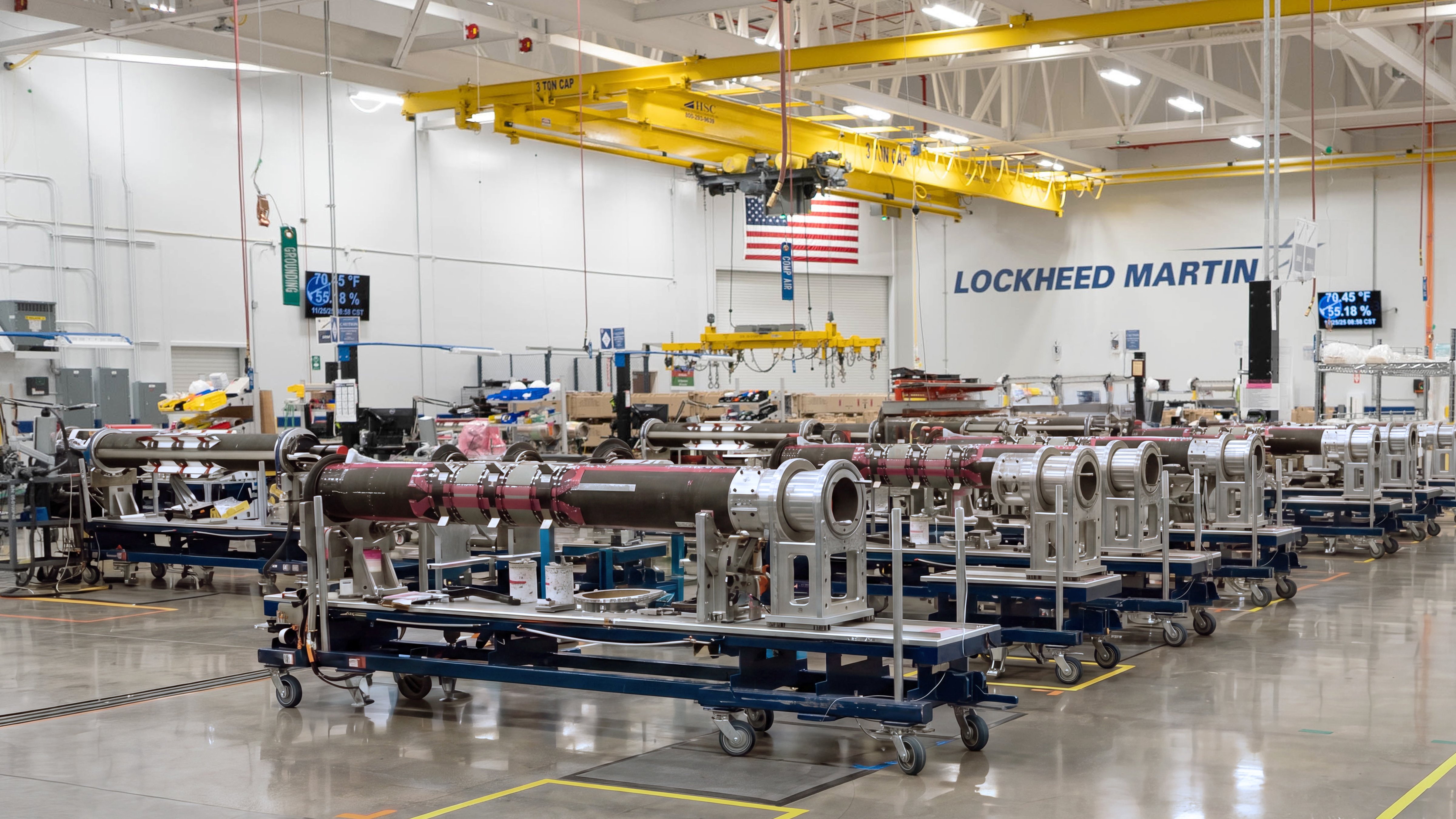
The THAAD production line in Troy, Alabama. Lockheed Martin

“My job is to interface and collaborate with the Department of War in achieving the call to action to produce these critical munitions, not only at speed but also at scale, multiplying the current production rates by two, three, or even four times the current rates,” Dan Nimblett, Lockheed Martin’s vice president for Munitions Acceleration Integration told TWZ on the ground in Troy during the groundbreaking event.

“Fundamentally what’s occurred changes how acquisition works [with] long term demand agreements. These long term procurement agreements enable Lockheed Martin and our supply base to make the necessary investments with confidence of the future demand. This allows us to make the investments not only in our people and our facilities, but in the technology necessary to build [these munitions] at a scale and a speed that’s relevant to the threat today,” explained Nimblett.

Lockheed Martin was the first company in the U.S. defense industry to announce a framework agreement with the DoW for munitions acceleration of high-demand missiles – initially tripling production capacity of the PAC-3 Missile Segment Enhancement (MSE) interceptor, followed by a second agreement to quadruple the production capacity of advanced THAAD interceptors. These two defensive missiles are cornerstones of a layered air and missile defense system, and both have been integrated together via Joint All-Domain Operations, including with the U.S. Army’s Integrated Air and Missile Defense Battle Command System (IBCS).

In response to the DoW’s call to action, the company has already invested more than $2 billion in its production facilities and in the related tooling, its key suppliers, and its workforce in order to accelerate production rates.

PAC-3 MSE in production in Camden, Arkansas. Lockheed Martin

Lockheed Martin plans to effectively double the factory footprint in Troy and dramatically increase the workforce. “We’re going to increase that [workforce] by drawing in college students, high school students, veterans, everybody’s welcome,” explains Jason Reynolds, vice president and general manager for integrated air and missile defense. “When they come to Lockheed Martin, they receive training, they get opportunity, and because these programs are on a ramp and in production in such high demand, this is where you come to start your career and you [can] work here for a long time.”

Lockheed Martin currently employs around 1,100 workers at its Camden site, but this is also growing. The Camden training center is seen as being critical in providing the swift increase in skilled operators needed to support this acceleration. “We work closely with the state of Arkansas as well on looking at what else we can do in the community and the infrastructure in that community to support people moving, hopefully into Camden as we ramp up,” says Reynolds.

“People here [in Troy] really know their work matters. It’s meaningful for both the community as well as for our national defense. So, we’re really proud of our employees and we’re on a growth trajectory. We’re hiring and we want as many qualified people to come join our team as possible.”

The Camden site is also accelerating its work on the long-range Precision Strike Missile (PrSM), which is also set to quadruple production over the next few years. Reynolds added that building missiles faster using automation and advanced manufacturing technologies, plus increasing the production line capacity, are some of the vital means for success.
Lockheed Martin is developing the new PAC-3 Adapted Capability Effector (ACE) to help build ammunition reserves faster. Lockheed Martin

“PAC-3 MSE and THAAD are the most capable air defense interceptors on the planet. They’re in extreme demand [and] we’re doing everything possible,” says Reynolds. “With PAC-3, we have been doubling that production over the last four years and now, like I said, we’re going to triple it. We’re working very carefully with our suppliers, with the U.S. government and with our partners and allies all around the world to get all the parts in and get them into factories like you see behind us today to assemble them and get them out to the warfighter as quickly as possible.”

Another way Lockheed Martin is accelerating the delivery of advanced air defense capabilities is the through the introduction this summer of the PAC-3 Adapted Capability Effector, or PAC-3 ACE. This new missile leverages the PAC-3 fire-control system and provides for full integration with the Patriot weapon suite.

The main differentiator of PAC-3 ACE is that it would be produced at less than half the unit cost of MSE and first flight could occur within 18 months. A core part of the rapid fielding strategy is an international, joint-development model. Lockheed Martin is partnering with both American and European industry, sharing production lines, supply chains and expertise.

Lockheed Martin says PAC-3  ACE provides a “cost-effective, multi-threat solution.” The interceptor is engineered to engage a broad spectrum of air-breathing threats, cruise missiles, and both short and medium-range ballistic missiles. By offering a low-cost “kill” per-engagement, it is designed to address the current climate that demands deeper ammunition reserves without compromising on performance.

The keys to munitions acceleration

This year, Lockheed Martin has made significant progress in a series of production acceleration projects for munitions programs under its Missiles and Fire Control division. “I was supposed to retire last year. I’m here because this is the most exciting time in the 30 years I’ve been in this industry,” says Dan Nimblett. “These long-term agreements provide us the certainty to enable us to make these investments.”

“What recent conflicts have demonstrated is that Lockheed Martin and the American defense industrial base never lost the technological edge. The technology and the capability has always been there – we have the best systems in the world. We’ve proven that through real world performance.”

Nimblett explained that Lockheed Martin’s supply chain is following suit, and that they are all now investing in similar ways to ensure they meet the demand signals. “We’re evaluating how we produce and increase additive manufacturing and robotics. We’re also looking at how we develop, which I think is a fundamental part of getting capability into the warfighters’ hands at a speed and scale that’s relevant to the threat.”

A PrSM test firing during the missile’s development. Lockheed Martin

Having received Milestone C approval from the U.S. Army in July 2025, PrSM manufacturing has relied on a high level of automation. PrSM was engineered from the start for automated, robot-driven production – automating tasks once done by hand – and that early-stage streamlining is paying dividends as Lockheed Martin seeks to accelerate output.

“We have a lot of robotics built into our munitions production,” explains Gaylia Campbell, vice president, Tactical Missiles. “A lot of times we use robotics to help increase the safety of the assembly, like an explosive charge that has to be integrated into a munition, and we have a robotic arm that places that and tests the placement. We also robotically paint and coat [PrSM]. So, we have a lot of robotics already in Camden and that’s really going to help us with this ramp-up in production – the fact that so much of it is [already] automated.”

Campbell emphasizes that PrSM entered production with a mindset of acceleration. “We got PrSM through preliminary and critical design reviews, and into first flight in times roughly half of what it would normally have taken us. We’ve been amazingly successful on all these flights. Those early [test] flights went off one after the other during the COVID-19 pandemic, at a time when there were a lot of challenges for all of us in our daily lives, and yet we were able to continue to fly and prove the operational performance.”

Lockheed Martin is reshaping the munitions supply chain with an unprecedented slate of manufacturing initiatives that pull together new facilities, strategic partnerships, and workforce development. The company is also expanding a number of its other production facilities, such as a $60-million investment in its complex in Archbald, Pennsylvania, that will add 700 jobs in support of high‑priority programs including PrSM, THAAD, PAC‑3, and Apache sensors. In Orlando, Florida, three legacy paint bays have been merged into a high‑performance shop that can retool a work cell in hours rather than weeks, while Ocala’s new Progressive Work Smart Assembly Line has cut seeker and mission control unit build times by roughly 50 percent.

Production capacity for THAAD is expanding in Troy, Alabama. Lockheed Martin

A partnership with General Motors will bring high‑rate commercial manufacturing expertise into Lockheed Martin’s production processes, and the new Rapid Fielding Center in Grand Prairie, Texas, is tasked to reduce traditional manufacturing development timelines. What once took years of design, testing and tooling is aimed to be prototyped, fabricated and validated in a matter of months.

Echoing endorsement of the DoW’s initiative, Campbell underscores that knowing what the demand signal will be is a critical differentiator when it comes to production ramp-up. “We can plan for some of those really critical rare earth minerals that we need, the batteries for example in our munitions, we need certain rare earth minerals for that. We need to know the total demand signal and that means we can negotiate with the suppliers and guarantee that we have access. That can really help us accelerate.”

To support the wider munitions efforts Lockheed Martin is also investing in solid rocket motor development and production, as well as lower-tier parts that go into solid rocket motors. “We’re working with different suppliers to develop new sources of supply for solid rocket motors,” says Campbell. “We’re investigating heavily right now in designing and prototyping several motors that we plan to test and take to production, and that really will develop a whole new supply chain and will really be critical for all munitions production.”

Having a five-year contract instead of annual contracts allows the manufacturer to have far more buying power to secure sub-components for a far better price point. “I can go and invest. Invest in more capacity, invest in my supplier’s capacity,” explains Campbell.

“Production is all about velocity. Keeping the line moving and not having to stop because we don’t have a part. Being able to order bigger quantities of things up front is really huge when it comes to acceleration.”

Contact the author: Jamie.Hunter@teamrecurrent.io

The post Site Expansions Underpin Lockheed Martin’s Munitions Production Ramp appeared first on TWZ.

  •  

Memory Architecture

In a beautiful and vivid essay on home, time, and family, Diane Roberts reflects on the house that her parents built, and their family’s land in Leon County, Florida, to which she feels deeply connected. I especially love Roberts’s thoughts on a home versus a house—the latter is composed of construction materials, but “home implies a complex neural network of family association and feeling, layers of experience, a shared past.” Despite the tragedies the home holds, it is ultimately a place of memory and meaning.

Home and time are as tangled as the skunk vine and Confederate jasmine choking my backyard fence. I suppose that’s to be expected. My house holds our history and the indispensable relics of former houses, objects cherished by the now-dead: the tiny rocking chair my grandfather made for my mother when she was three; the 1960 TR3 in the barn my brother never quite got around to fixing; the two old rosebushes dug up from the Washington County farm, replanted at Great-Aunt Rilla’s house in Chipley, then dug up again and transported to our front yard. The house didn’t simply belong to us, it was us—our mother, our father, Brad, and me.

  •  

An Experiment Records an Anomalous Signal That Could Be the First Detection of the Elusive Dark Matter of the Universe

The world’s most sensitive dark matter observatory, the LUX-ZEPLIN (LZ) experiment, has detected a particle interaction that cannot be explained by conventional background radiation models, a finding that, although still far from being confirmed as a definitive discovery, has sparked cautious optimism in the international scientific community. The event, recorded nearly a mile underground at […]

  •  

Pakistan to sign long-delayed refinery deals unlocking more than $6 billion in planned upgrades

ISLAMABAD: Pakistan is set to sign long-delayed agreements with five oil refineries, unlocking more than $6 billion in planned upgrades to modernize aging plants and cut reliance on fuel imports, officials said. But industry warnings that changes to the financial framework could derail the projects overshadowed the announcement. The agreements with Pak-Arab Refinery Ltd., Pakistan ... Read more

The post Pakistan to sign long-delayed refinery deals unlocking more than $6 billion in planned upgrades appeared first on BOL News.

  •  

Achilles Shield: Greece and Israel sign €3 billion defense deal

Greece and Israel signed on Monday a €3 billion deal for the massive “Achilles Shield” agreement, under which Israel will build Greece a multi-layered air defense array based on Israeli systems architecture. The intergovernmental agreement for the development of an anti-aircraft, anti-ballistic missile and counter-drone shield – known as the “Achilles Shield” – reportedly features […]

The post Achilles Shield: Greece and Israel sign €3 billion defense deal appeared first on Keep Talking Greece.

  •  

Fim da Escala 6×1 será votado no Senado em esforço concentrado antes do recesso eleitoral

O último esforço concentrado do Congresso Nacional para votações antes das eleições termina nesta semana. A principal disputa deve ficar em torno do fim da escala 6×1. Na quarta-feira, a Comissão de Constituição e Justiça (CCJ) do Senado deve analisar a Proposta de Emenda Constitucional (PEC) que reduz a jornada semanal de 44 para 40 horas e garante dois dias de descanso remunerado por semana, sem redução salarial. O relator, senador Omar Aziz (PSD-AM), apresentou na última quinta-feira (27) parecer favorável à manutenção do texto aprovado pela Câmara dos Deputados e rejeitou as 12 emendas apresentadas por outros senadores. Se passar pela CCJ, a PEC ainda precisará ser votada em dois turnos no plenário do Senado.

Também deve ser analisado pelo Senado nesta semana o PL 2.780/2024, sob relatoria do Senador Eduardo Braga (MDB-AM), que cria a Política Nacional de Minerais Críticos e Estratégicos. O tema ganhou peso diante do interesse estrangeiro pelas reservas brasileiras de terras raras e da preocupação em manter no país as etapas de maior valor agregado da cadeia produtiva. A proposta busca estimular a pesquisa, extração, beneficiamento e transformação desses minerais, importantes para setores como transição energética, tecnologia e defesa.

Também está no radar do Congresso a Medida Provisória (MP) 1.357/2026, que suspende temporariamente a cobrança do Imposto de Importação sobre compras internacionais de até 50 dólares, a chamada “taxa das blusinhas”. A medida perde a validade em 8 de setembro, e o presidente da Câmara, Hugo Motta (Republicanos-PB), pretende levar o texto rapidamente aos plenários das duas Casas.

Corrida Eleitoral

A próxima semana será a primeira com exibição todos os dias do horário eleitoral gratuito no rádio e na televisão. A propaganda começou na última sexta-feira (28) e seguirá até 1º de outubro, com programas para presidente às terças, quintas e sábados e inserções ao longo da programação. Além disso, a disputa presidencial também terá uma rodada de sabatinas da Jovem Pan.

A programação começa nesta segunda-feira, 31 de agosto, com Ronaldo Caiado (PSD). A terça será o dia de Renan Santos (Missão), e a quarta-feira terá o presidente Lula (PT). Na quinta-feira, 3 de setembro, a emissora recebe Romeu Zema (Novo) e fecha a programação com o senador Flávio Bolsonaro (PL), na sexta. As entrevistas serão exibidas sempre das 8h às 9h, durante o Jornal da Manhã.

STF e PF: encontro busca reduzir as divergências

Enquanto as campanhas avançam por todo o Brasil, o governo também tenta reduzir uma tensão entre a Polícia Federal (PF) e o Supremo Tribunal Federal (STF). O diretor-geral da PF, Andrei Rodrigues, deve se reunir nesta semana com o ministro André Mendonça. O encontro foi articulado pelo presidente Lula e deverá ser mediado pelo ministro da Justiça, Wellington César Lima e Silva, com possível participação do advogado-geral da União, Jorge Messias. A conversa ocorre em meio às divergências sobre investigações conduzidas pela PF e decisões do ministro em casos de forte repercussão política. Entre eles, as apurações sobre o Banco Master, as fraudes no INSS e as investigações envolvendo o filho do presidente, Fábio Luís Lula da Silva, o Lulinha.

Estão na agenda da semana de 31 de agosto a 4 de setembro:

  • TSE:
    • Consulta à seção eleitoral (1/9): A partir desta terça-feira (1º), eleitores poderão consultar, pelo e-Título ou pela internet, a seção onde irão votar, já com informações sobre eventuais transferências temporárias de local de votação. A data é diferente do que havia sido indicado anteriormente: o calendário oficial do TSE estabelece o dia 1º de setembro. 

DIREITOS HUMANOS

  • Câmara
    • Maioridade penal (Comissão Especial da PEC 32/2015, 1/9, 14h): Comissão especial analisa requerimentos para realização de audiência pública sobre a redução da maioridade penal. O debate deve abordar se a idade penal é protegida como cláusula pétrea da Constituição e os limites para alterar direitos e garantias individuais previstos na Carta de 1988.
    • Publicidade de bets nas redes sociais (CEXBRLEG, 1/9, 15h): Audiência discute os impactos da publicidade de apostas online e de jogos de azar, como o “tigrinho”, nas redes sociais e nas grandes plataformas de tecnologia. A audiência deve abordar também o papel das chamadas big techs no combate à pirataria e na circulação de publicidade do mercado de apostas.
    • Fortalecimento do INSS (CDHMIR, 1/9, 16h30): Parlamentares debatem a situação do Instituto Nacional do Seguro Social, com foco na falta de servidores, nas filas de atendimento e na demora na análise de benefícios. Entre os temas está a convocação de candidatos aprovados no cadastro de reserva do Concurso Público Nacional Unificado (CPNU2).
  • Senado
    • Tecnologias no combate à violência contra mulheres (CMCVM, 2/9, 14h30): Comissão Permanente Mista de Combate à Violência contra a Mulher discute como ferramentas tecnológicas podem ser usadas para prevenir agressões, facilitar denúncias e ampliar a proteção das vítimas. A audiência reúne representantes do Ministério das Mulheres, Defensoria Pública, polícias e organizações que desenvolvem aplicativos de proteção.
    • Inclusão de pessoas com deficiência nas eleições (CDH, 3/9, 9h): Comissão realiza audiência pública sobre as barreiras enfrentadas por pessoas com deficiência no processo eleitoral de 2026, incluindo acessibilidade para votar e se candidatar. 

MEIO AMBIENTE

  • Câmara
    • Multas do ICMBio em Minas Gerais (CFT, CINDRE e CPOVOS, 1/9, 16h): Três comissões realizam audiência conjunta sobre multas ambientais aplicadas pelo ICMBio, a expansão de unidades de conservação e a definição de áreas de amortecimento no Norte de Minas Gerais.
    • Combustível do Futuro e hidrogênio verde (CEENERG, 2/9, 14h): Comissão especial promove seminário sobre a implementação e os desafios do programa Combustível do Futuro e da produção de hidrogênio verde no país. O debate ocorre em meio à discussão sobre transição energética e novas fontes de energia.

SAÚDE

  • Câmara
    • Doenças raras (CDHMIR, 1/9, 10h): Parlamentares realizam audiência pública para discutir o atendimento a pessoas com doenças raras e condições crônicas. O debate trata de acesso a tratamentos, assistência especializada e garantia de direitos.

Agenda da semana da Pública é um serviço apresentado aos leitores, concebido com base nas informações dos portais da Câmara, Senado, TSE e STF.

  •  

Une Allemagne « prête à la guerre » ?

JPEG - 87.4 kio
Gerhard Silber. – « Die Verkündigung I » (L'Annonciation I), 2015
© Gerhard Silber - art-silber.de

De l'hégémonie allemande, les peuples européens — les Grecs en particulier — conservent le souvenir amer des années 2010. Mais à cette époque prévalait encore l'arrangement noué en 1990 lors de la réunification : moteur économique du Vieux Continent, étroitement enchâssée dans les rets de l'intégration européenne, l'Allemagne laissait la France revendiquer la suprématie militaire et diplomatique. Ce compromis a vécu.

Depuis l'invasion russe en Ukraine, Berlin restructure son économie, militarise son industrie et dorlote son marchand de canons national Rheinmetall. Ce grand réarmement marginalise Paris et ménage Washington. Car, malgré les camouflets infligés par M. Donald Trump, l'Allemagne espère que les États-Unis lui sous-traiteront la direction européenne de l'Alliance atlantique.

Voir en ligne : /2026/09/A/69892
  •  

Gasolio: meglio un cap europeo*

Il governo ha prorogato fino al 5 settembre lo sconto sul gasolio, spendendo altri 105,6 milioni. Ma il taglio fiscale non si trasferisce automaticamente alla pompa. Un’imposta sugli extraprofitti può finanziare gli aiuti, non correggere il prezzo: più coerente studiare in sede europea un tetto dinamico agli spread eccezionali, con salvaguardie per le importazioni.

L'articolo Gasolio: meglio un cap europeo* proviene da Lavoce.info.

  •  

I Went to the White House Brawl and Watched the Manosphere Go Limp

I found it easy to resist the early dispatches from “UFC Freedom 250,” the Ultimate Fighting Championship event held in June on the White House South Lawn. But Jon Ronson is the sort of writer I can’t help following into battle. Fresh off a new book about masculinity, Ronson brings a delightfully skewed perspective to the fights and the days that surrounded them. The result is a portrait of a planned media spectacle that can’t quite make sense of itself. The best battle here may be Ronson’s tussle with his own photographer, 79-year-old Bruce Gilden, who is a bit of a hugger.

“I’m pretty certain you hugged Stephen Miller first,” I say. “I don’t see Stephen Miller as initiating a hug.”

“You may be right,” he says. “I don’t remember. Look, I do things maybe other people aren’t comfortable doing, but I felt comfortable and I trust my instincts.”

He acknowledges that “nobody is immune to misreading a situation” and that because of him we were all forced back indoors, but he blames Miller’s entourage for not checking with their boss on whether he minded being hugged.

  •  

Eleitores gerados por IA fazem campanha no TikTok e põem em xeque regra do TSE

Em um vídeo no TikTok, uma repórter pergunta a vários jovens em quem eles pretendem votar para presidente nas eleições deste ano. Todos respondem Lula e apresentam justificativas que vão desde a expectativa por mais oportunidades até relatos sobre sua origem humilde e a percepção de que o petista ajuda “gente como a gente”.

Em outro registro, uma idosa é abordada com a mesma pergunta. “Vou votar no Flávio [Bolsonaro], minha filha, porque o Brasil precisa de uma renovação de verdade na política para garantir segurança e um futuro melhor para nosso país”, responde.

As cenas parecem aquelas entrevistas de rua em formato rápido, conhecidas no jargão jornalístico como “povo fala”. Popular em redes de vídeos curtos, o formato já foi apontado pelo próprio TikTok como uma das tendências de produção de conteúdo na plataforma em 2024.

A novidade é que, agora, nem os repórteres nem os eleitores desses vídeos são reais. Um levantamento do Aos Fatos identificou ao menos 50 conteúdos no TikTok que simulam entrevistas e depoimentos sobre os dois principais candidatos da corrida presidencial deste ano: Lula (PT) e Flávio Bolsonaro (PL).

Publicados antes do início oficial da propaganda eleitoral, nesta segunda-feira (17), os conteúdos acumulavam, até aquela data, 7,4 milhões de visualizações — e apresentavam como espontâneas opiniões produzidas artificialmente. Em 18% deles sequer havia indicação de que as pessoas retratadas haviam sido geradas por IA, contrariando as regras da plataforma sobre conteúdos manipulados.

Especialistas ouvidos por Aos Fatos afirmam que a legislação eleitoral proíbe o uso de personagens fictícios gerados por IA, mas a responsabilização se torna mais complexa quando os vídeos são produzidos por terceiros, sem vínculo aparente com as campanhas.

O TikTok disse nesta sexta-feira (21) que removeu todos os conteúdos identificados por Aos Fatos por violarem as diretrizes da plataforma sobre mídia editada e conteúdo gerado por IA. Veja a íntegra da resposta da empresa no final desta reportagem.

Plataforma recomenda lado a lado vídeos gerados por IA (os três primeiros) e uma entrevista de rua real (à direita)

‘Já decidiu seu voto?’

Nas falsas entrevistas, personagens declaram voto, elogiam candidatos ou explicam por que rejeitam determinado nome da disputa presidencial. Nos vídeos favoráveis a Lula, os eleitores artificiais se apresentam como beneficiários de políticas sociais ou atribuem ao petista melhorias em suas condições de vida.

Já nas peças pró-Bolsonaro, os falsos votantes associam o senador à renovação política e ao combate à corrupção e à criminalidade.

Falsos eleitores explicam os motivos para votar em Flávio Bolsonaro ou Lula

Outros conteúdos recorrem a estereótipos para atacar eleitores do PT. Neles, os personagens aparecem em locais insalubres — muitas vezes associados ao Nordeste —, vestem roupas sujas ou rasgadas e se dizem beneficiários de programas sociais, já que “não querem trabalhar”.

Os conteúdos manipulados também os representam como alheios à própria condição de vida: mesmo cercados por lixo ou vivendo em situações precárias, os falsos eleitores agradecem ao governo pelos benefícios recebidos e declaram apoio a Lula.

Falsos eleitores afirmam que votarão em Lula por terem sido beneficiados por programas sociais

Para Leandro Petrin, especialista em direito eleitoral e sócio do escritório Callado, Petrin, Paes & Cezar Advogados, vídeos de supostos cidadãos comuns apoiando ou rejeitando uma candidatura podem sugerir que determinada opinião é compartilhada espontaneamente por uma parcela da sociedade.

“Um vídeo que simula um eleitor que não existe e atribui a esse personagem fictício uma declaração de voto não é apenas propaganda: é a fabricação de um fato social que nunca ocorreu”, explica.

Rogério Silva de Vargas, secretário-judiciário do TRE-RS (Tribunal Regional Eleitoral do Rio Grande do Sul), vai além e classifica conteúdos do tipo como fraude lesiva ao processo eleitoral, pois visam “iludir, confundir ou ludibriar o eleitorado” para conferir vantagem indevida.

O levantamento do Aos Fatos reuniu conteúdos encontrados por meio de buscas no TikTok e de recomendações feitas pela própria plataforma durante o monitoramento. Embora a maioria das contas não reúna grandes audiências individualmente, os 50 vídeos analisados somavam 7,4 milhões de visualizações.

Os primeiros registros identificados foram publicados em março, meses antes do início oficial da propaganda eleitoral. O volume começou a aumentar em junho e se concentrou sobretudo em julho e na primeira quinzena de agosto, período que coincide com a intensificação do calendário das eleições.

Aos Fatos não encontrou indícios aparentes de que as contas responsáveis pelos conteúdos tenham ligações com as campanhas de Lula ou Flávio Bolsonaro. A maior parte deles foi publicada por páginas dedicadas à produção de vídeos com inteligência artificial, entre eles perfis que simulam podcasts.

Há também contas voltadas para a produção de conteúdo político ou de apoio a determinado candidato, mas sem vínculo aparente com partidos ou campanhas.

Um dos perfis se apresenta como um podcast — também gerado por IA — mas mescla o conteúdo central com falsos depoimentos de eleitores

O uso de personagens sintéticos na disputa já chegou à Justiça Eleitoral neste ano. Em abril, o PT acionou o TSE (Tribunal Superior Eleitoral) contra Dona Maria, personagem fictícia criada com IA que acumulou milhões de visualizações com críticas ao partido e ao governo Lula. A sigla pediu a suspensão do perfil sob a alegação de propaganda eleitoral antecipada negativa e disseminação de desinformação.

Legislação proíbe prática

O uso de inteligência artificial para simular depoimentos de votantes inexistentes não está fora do alcance das regras eleitorais. A Resolução 23.610/2019 do TSE proíbe o uso eleitoral de conteúdos sintéticos em áudio ou vídeo que criem ou manipulem a imagem ou a voz de pessoas vivas, falecidas ou fictícias.

A regra, portanto, não se restringe às deepfakes tradicionais, que atribuem falas ou comportamentos falsos a pessoas reais. “É uma irregularidade eleitoral, seja em formato de áudio ou de vídeo, seja para criar a imagem [ou a voz] de uma pessoa fictícia ou de uma pessoa real”, afirma Marcos Rafael Coelho, secretário-judiciário do TRE-MS (Tribunal Regional Eleitoral do Mato Grosso do Sul).

Isso não significa que qualquer vídeo com personagens gerados por IA deva ser automaticamente considerado ilícito. Marcos Jorge, coordenador jurídico do escritório Wilton Gomes Advogados, explica que é necessário verificar se o conteúdo foi produzido ou divulgado para favorecer ou prejudicar determinada candidatura.

A proibição também vale para conteúdos publicados antes do início oficial da propaganda eleitoral, em 16 de agosto. Segundo Jorge, durante a pré-campanha, a prática pode ser enquadrada como propaganda eleitoral por meio de proscrito — ou seja, pelo emprego antecipado de uma forma de propaganda que seria proibida durante a campanha.

A data da publicação tampouco impede que esses vídeos voltem a circular. O sistema de recomendação do TikTok seleciona conteúdos de acordo com as interações do usuário e informações do vídeo. Assim, uma gravação publicada meses antes pode voltar a ser recomendada já durante o período eleitoral.

Questionado por Aos Fatos, o TSE afirmou que não se manifesta sobre temas ou casos que possam vir a ser ou são objetos de análise na Justiça Eleitoral.

Responsabilidades

O fato dos conteúdos não terem vínculo aparente com candidatos ou campanhas não impede que haja irregularidade.

“Perfis de terceiros respondem civil e penalmente pelo conteúdo que produzem e publicam, independentemente de qualquer relação com candidatos. Sem esse vínculo, a resposta tende a ficar no campo da remoção de conteúdo e da responsabilização individual do autor, não alcançando as sanções mais severas do direito eleitoral (multa a candidato, cassação)”, afirma Petrin.

O cenário muda quando há evidências comprováveis de participação, contratação, financiamento, orientação ou conhecimento prévio da campanha. A depender da gravidade e da repercussão, o caso pode ser analisado pela justiça eleitoral sob a perspectiva de abuso de poder ou uso indevido dos meios de comunicação.

Rafael Maciel, sócio e head de inteligência artificial e proteção de dados do Lara Martins Advogados, pontua que há muitas dificuldades práticas para distinguir uma manifestação produzida de forma independente por um apoiador de uma ação coordenada com uma campanha.

Maciel explica ainda que as plataformas também estão sujeitas a obrigações previstas pelas regras eleitorais, como restrições à publicidade com IA, identificação de conteúdos sintéticos e deveres de diligência diante de publicações irregulares.

Segundo o especialista, as redes sociais não respondem automaticamente pelo conteúdo produzido por terceiros, mas podem ser responsabilizadas por falhas próprias, como o descumprimento de notificações ou decisões judiciais e deficiências nos mecanismos de segurança e moderação.

Aviso de IA não libera conteúdo

A presença de um aviso de que o vídeo foi produzido com inteligência artificial também não afasta a irregularidade, já que a resolução do TSE diferencia os usos permitidos de IA, sujeitos a regras de transparência, dos conteúdos sintéticos proibidos para fins eleitorais.

A regra exige que a fabricação ou manipulação seja informada de forma explícita e destacada, explica Coelho, secretário-judiciário do TRE-MS. “Mas quando se criam pessoas fictícias, como se fossem falsos eleitores dando depoimentos, aí a prática já entra na segunda camada porque ela é absolutamente proibida. Não importa se tem um rótulo falando que a inteligência é artificial”, ressaltou.

Marcos Jorge chama atenção ainda para outra questão: dizer apenas que um vídeo foi gerado por IA não necessariamente deixa claro ao usuário que o entrevistado não existe, que a entrevista nunca ocorreu e que a opinião apresentada não é de uma pessoa real.

Apesar da plataforma indicar que houve uso de IA, usuários demonstram acreditar que gravação mostra pessoas reais

As consequências podem se tornar mais graves quando o conteúdo sintético é empregado para disseminar desinformação ou atacar adversários.

Nesses casos, outras infrações podem se somar ao uso irregular de IA. Coelho explica que o emprego da tecnologia para atacar candidatos com desinformação ou discurso de ódio pode resultar em multas e, quando houver envolvimento ou responsabilização da candidatura beneficiada, ter consequências mais graves.

A depender das circunstâncias, a prática pode ainda ser entendida como uso indevido dos meios de comunicação social, com sanções que podem chegar à cassação de registro ou diploma e à inelegibilidade.

Porém, a aplicação dessas penalidades depende da comprovação da responsabilidade da candidatura e da gravidade da conduta.

Outro lado

Procurado pelo Aos Fatos, o TikTok informou que removeu todos os conteúdos enviados pela reportagem por violarem suas diretrizes sobre mídia editada e conteúdo gerado por inteligência artificial.

A plataforma afirmou que exige que os criadores sinalizem conteúdos sintéticos e que, mesmo quando rotulados, remove materiais que violem suas regras. Entre os conteúdos proibidos estão aqueles gerados ou significativamente editados por IA que possam induzir usuários ao erro sobre assuntos de interesse público ou simular material proveniente de uma fonte jornalística real.

A empresa também destacou as ações adotadas para as eleições de 2026 e afirmou que, durante o período eleitoral, seu foco “permanece em garantir a segurança das pessoas e proteger a integridade do TikTok”.

O caminho da apuração

Aos Fatos monitorou no TikTok vídeos que usam inteligência artificial para simular entrevistas e depoimentos de eleitores sobre Lula e Flávio Bolsonaro, por meio de buscas e do acompanhamento de conteúdos recomendados pela plataforma. A reportagem reuniu 50 vídeos. Também foram analisadas as contas responsáveis pelas publicações.

Em seguida, Aos Fatos consultou as regras do TSE sobre o uso de inteligência artificial nas eleições e entrevistou especialistas em direito eleitoral. Foram ouvidos Marcos Rafael Coelho, Rafael Maciel, Marcos Jorge, Leandro Petrin e Rogério Silva de Vargas, que contribuíram para a análise das práticas identificadas nos vídeos e de sua relação com as normas eleitorais.

Por fim, Aos Fatos entrou em contato com a assessoria de imprensa do TikTok e enviou todos os vídeos do levantamento, que foram excluídos posteriormente pela plataforma. O TSE também foi questionado sobre os achados da reportagem.

  •  

The Children a Scientist Took Home

Carleton Gajdusek won the Nobel Prize for his work on a disease in Papua New Guinea. But his biggest experiment was on the children he took from the field to the US—many of whom he sexually molested, with the knowledge and, in some cases, approval of his professional peers and colleagues:

In his journals and in letters to colleagues, Gajdusek was self-righteous, arguing that what he’d done was “no more serious than lying on the grass or picking a dandelion,” and he cited the Anga initiation rites as justification. These ceremonies had brought boys into their communities, as part of a shared passage into manhood, but Gajdusek treated them as a timeless license for the acts that he’d committed privately, one boy at a time. George Klein, a professor at the Karolinska Institute, in Stockholm, who was part of the Nobel Assembly for thirty-six years, validated Gajdusek’s opinions, telling him that he wondered if “the Western world can ‘catch up with you.’” He wrote, “I share your indignation about the typically Jewish-Christian-Moslem hypocrisy on sexual matters.” Gajdusek was troubled, though, by how many colleagues wrote letters saying that they knew the charges must be untrue. “I thought better of my friends,” he said. “They are dissimulating and lying.”


  •  

Horário eleitoral gratuito começa nesta sexta-feira com apenas 4 candidatos a presidente

Investigamos o que importa para os brasileiros além do que passa na campanha eleitoral. Leia mais reportagens como essa clicando aqui.

Já autorizados para fazer propagandas eleitorais nas ruas e na internet, os candidatos à Presidência terão disponível a partir desta sexta-feira, 28 de agosto, o horário eleitoral gratuito de rádio e de televisão. As veiculações seguirão até o dia 1.º de outubro, três dias antes do primeiro turno das eleições. O Tribunal Superior Eleitoral (TSE) divulgou na última quinta-feira, 20 de agosto, o tempo concedido à propaganda para cada partido.

O horário eleitoral gratuito será dividido em dois blocos de 12 minutos e 30 segundos para os candidatos à Presidência. A coligação de Lula, o Brasil Pronto para Mais, composta pelos partidos PT, PC do B, PV, PDT, PSB, PSOL e REDE, vai receber o maior tempo de propaganda, com 5 minutos e 31 segundos. Flávio Bolsonaro terá 4 minutos e 20 segundos; Ronaldo Caiado, 2 minutos e 2 segundos; e Augusto Cury terá 35 segundos de tela. Os demais candidatos à presidência não atingiram as exigências de cláusula de desempenho.

Seguindo com as sabatinas dos programas de televisão, a TV Globo inicia uma série de entrevistas com os candidatos à Presidência da República nesta segunda-feira, 24 de agosto. O primeiro entrevistado será Romeu Zema (Novo), que estará no programa nesta segunda-feira. Seguindo o cronograma, Ronaldo Caiado (PSD) é entrevistado nesta terça (25); Renan Santos (Missão), na quarta-feira (26); Lula (PT), na quinta-feira (27); Flávio Bolsonaro (PL), na sexta-feira (28) e Augusto Cury (Avante), no sábado (29).

As entrevistas serão transmitidas pelo canal a partir de 21h05, após o “Jornal Nacional”. Também será possível acompanhá-las pela TV a Cabo na “Globonews” ou pela internet no portal G1.

Uberização será tema no STF

No Supremo Tribunal Federal (STF), a “uberização” e o vínculo trabalhista entre motoristas de aplicativo e as plataformas de transporte voltam a ser discutidos pelo Plenário da Corte nesta quinta-feira, 28 de agosto. Os julgamentos do Recurso Extraordinário (RE) 1446336, que tem como relator o ministro Edson Fachin, e da Reclamação (RCL) 64018, com relatoria do ministro Alexandre de Moraes, poderão considerar a Convenção Internacional sobre o Trabalho Decente na Economia de Plataformas. O recurso relatado por Fachin aborda a relação de trabalho entre motoristas e plataformas digitais. Já a reclamação analisada por Moraes foi apresentada pela empresa Rappi, que contesta a decisão da Justiça do Trabalho em reconhecer vínculo empregatício entre a plataforma e o motorista.

A nova convenção sobre as plataformas digitais foi aprovada pelos estados-membros da Organização Internacional do Trabalho (OIT) em junho deste ano. Ela promove normas e garantias aos trabalhadores por aplicativo, como o pagamento dos valores a receber dentro dos prazos legais e, para aqueles que têm reconhecido o vínculo empregatício, um salário mínimo, além de uma compensação dos custos gerados pelo exercício da profissão.

Agenda da Semana de 24 a 28 de agosto:

TSE:

  • Juízo Eleitoral (25/8): último dia para partidos políticos e federações indicarem ao juízo eleitoral três pessoas para ocuparem a Comissão Especial de Transporte no primeiro e segundo turno.
  • Fusão de zona eleitoral (27/8): último dia para que a Justiça Eleitoral reúna, em uma mesma mesa receptora e mesmo local, as sessões eleitorais que possuem baixo número de eleitores.
  • Alteração e cancelamento de voto (28/8): último dia em que mesários, pessoas de apoio logístico, agentes penitenciários, policiais penais e servidoras ou servidores de estabelecimentos penais e de unidades de internação de adolescentes podem alterar ou cancelar a habilitação para votar em sessão diferente da que o título foi cadastrado.

STF:

  • Prevaricação no MP e Poder Judiciário (ADPF 881, 26/08, 14h): ministros julgam ação ajuizada pela Associação Nacional dos Membros do Ministério Público (Conamp), que julga se servidores do Ministério Público e do Poder Judiciário podem responder por prevaricação, quando um servidor público retarda, omite ou age contra uma lei durante o seu serviço por motivos pessoais.
  • Reforma Trabalhista (ADC 80, 26/8, 14h): vai a julgamento normas da Consolidação das Leis do Trabalho (CLT) que foram alteradas pela reforma trabalhista em 2017, como a concessão da justiça gratuita na Justiça do Trabalho e a autodeclaração de hipossuficiência para o recebimento de benefícios.
  • Caso Buser (RE 1506410, 26/8, 14h): ministros julgam a regulação dos transportes fretados coletivos em viagens municipais e intermunicipais em Minas Gerais.
  • Fim do voto de qualidade (ADIs 6399, 6403 e 6415, 26/8): Ministros discutem três ações de inconstitucionalidade sobre a determinação ao fim do voto de qualidade quando a empates nos julgamentos no Conselho Administrativo de Recursos Fiscais (Carf).

Agenda da semana da Pública é um serviço apresentado aos leitores aos domingos e segundas, concebido com base nas informações dos portais da Câmara, Senado, TSE e STF.

  •  

‘It’s terrible for us’ – Mohamed L. stabbed Alban Gervaise to death in front of his young children, and now just 4 years later, he’s being released

Mohamed L. is being released in France after just 4 years in detention, the same man who brutally murdered 40-year-old military doctor and father Alban Gervaise in front of his young children in 2022.

“It’s news that we’re trying to prepare for this early release after the murder, barely four years later. It’s news that is really hard to hear, that makes us really go back to our work of mourning for the children and me,” said Christelle Gervaise, the wife of Alban, in an interview with Legend TV.

“It’s true that it’s hard to imagine being able to be in the same city as him. It’s true that it’s quite unbearable for us.”

🇫🇷🔴 Mohamed L. is being released in France after just 4 years in detention, the same man who brutally murdered 40-year-old military doctor and father Alban Gervaise in front of his young children.

"It’s news that we’re trying to prepare for this early release after the murder,… pic.twitter.com/CdChf3u7A7

— Remix News & Views (@RMXnews) August 20, 2026

Alban was stabbed to death while waiting outside his children’s Catholic school to pick up his two sons, aged 3 and 7, while his 20-month-old daughter was inside his car, in Marseille in May 2022.

Now, the killer will enjoy partial release during evenings and weekends “at liberty.”

The mother, Christelle, is terrified, and the courts so far have refused to listen to her pleas to block Mohamed L. from being in the same city as her and her children.

“I find that it is an additional concern in our lives that we didn’t really need. And I had to announce to my children this early release. There is necessarily a feeling of injustice. How can he leave prison so early after the murder of their father? And then, yes, there is a great concern on the part of my children. That’s for sure.”

This clip is a condensed version of her full interview, but it showcases the horror a French family is facing, both from the murderer and from the French judicial system.

In the interview, Christelle describes the moment of disbelief and grief when she first learned her husband had been stabbed.

“This is not possible, this is not possible, what is happening,” she told herself.

But it did happen, just as it has happened to countless Europeans year after year. Upon arriving on scene, she is greeted with an empty car and no sign of her children.

“And in fact, I’m going to see a first policeman who is going to accompany me to see the principal this time, who reassures me, my children are safe inside the school, all three of them, but I learn from a policeman who comes that my husband is between life and death and has been transferred to the hospital for resuscitation,” she said.

Alban spent 17 days in a coma, where she tried to tell him over and over again that the children were not harmed and that they needed their father.

“And during those 17 days, I talked to him a lot and he … I hope he heard me. I will never know…. I kept repeating several times to Alban that our daughter is fine, that she is okay, that nothing happened at all. Because I imagine that as a father, for him, it was terrible to be attacked like that with a knife. And then to see that he was going to lose his consciousness. He must have felt it and imagined his daughter in danger.”

“I also tell him that he can’t leave, he can’t leave us. Our children are very small, and I need him, the children need him.”

Then, she describes the moment when she had to tell her young children that their father is gone.

“The death announcement to the children is something that I will never forget and I think it’s the hardest moment of my life, really.”

She was forced to sit her children down and let them know what happened to their father.

“So I told them that I had terrible news to tell them, but that unfortunately, their father had died the night before,” said Christelle.

Now, after the terrible ordeal of losing a father and a husband, the French court system is releasing their father’s killer with zero restrictions on him entering the same city as the family. While there is a direct contact ban, there is no guarantee they do not run into Mohamed L. on the street.

Mohamed L. never even faced a trial. Why? He smoked too much cannabis and had a “psychotic break.” The court experts confirmed this, and just like that, authorities deemed he could not be held criminally responsible. No trial and freedom after just four years.

“The fact that he is not imprisoned like a murderer for 15, 20 years in prison. It’s terrible for us. It’s terrible to know the violence Alban has suffered. And in addition, we must accept that after four years, his murderer is outside on evenings and weekends.”

“I am very worried, first of all, about the risk of recidivism. And then I find that for us, it is also a concern, since this person has the right to come to Marseille.”

She said that the authorities involved in the decision say Mohamed L. “must be able to benefit from it, he must have the necessary care.”

The murder already led the children to be forced from their own school. Now, they may have to leave their own city.

“My children have already had to change schools since it happened. They had to change friends. If, in addition, I tell them that we are leaving the city completely because the murderer and their father have the right to go where they want, I think that it is difficult to understand for them. I can’t help but say to myself, I don’t know where he is, I don’t know what he’s doing,” Christelle said.

She is fighting desperately with her lawyer to ensure this killer is no longer allowed in her city.

“The goal is that, is to have a measure that makes it forbidden for him to go to Marseille.”

“It is something that we carry on our shoulders with the children and that we will carry for a very long time.”

After his arrest, while held at Baumettes prison, he attempted to assault a guard, which contributed to his transfer to a psychiatric unit for difficult patients (UMD). This occurred after the murder and presumably, cannabis was not a factor in this assault.

Shockingly, during the trial, one of the psychiatrists openly said that they cannot predict whether the murderer will “relapse.”

“The question of the risk of a relapse. One of the psychiatrists had answered that it was a bit like predicting a plane crash, that it was impossible to predict. Psychiatrists who take care of this type of patient do not have a crystal ball to be sure that there will be no relapse. And this risk is still to be taken into account in the decisions to allow this person to be in the street today,” she said.

In other words, psychiatric experts admit Mohamed L. may murder again, yet, he is being allowed out on evenings and weekends anyway.

Christelle still has questions about how the man was deemed psychologically unfit to stand trial.

She said that after passersby tackled Mohamed L., he screamed: “In the name of Allah, I gave him 30 stab wounds!”

In response, Christelle said: “I always ask myself the question of something that was more premeditated than what you want to make me believe… We are talking about someone who can kill someone in the street. My husband only lasted a few moments. It’s not a fight, it’s a murder.”

“You think he’s going to go to prison. It doesn’t happen as planned. In relation to the trajectory of the murder of my husband,” she added.

“What is complicated, in fact, with this decision, is that we have no idea of the deadline. We don’t know how long he’s going to stay at the hospital in a closed unit. We don’t know how to answer this question. And despite everything, we can still hear that it is difficult to announce to his children that the murder of their father is not condemned to prison, but will have care for an undetermined duration. I also felt deprived of answers to certain questions,” she said.

Regardless, three children are now missing a loving father, with Alban’s wife describing a happy home life before his murder: “We had a life with Alban who was quite classic and very happy. We met in 2009. I was a medical student and he was an intern. We got engaged and then we got married. We had three children. We moved several times because Alban was a military doctor. So we met in Lorraine. Then we went to Paris for his work. Then to Marseille in July 2021. And we really had a very happy family life because Alban was a very loving husband, very loved and a father really present for his children and very invested in his role as a father.”

The post ‘It’s terrible for us’ – Mohamed L. stabbed Alban Gervaise to death in front of his young children, and now just 4 years later, he’s being released appeared first on Remix News.

  •  

Descubren que los enigmáticos natufienses, considerados los primeros sedentarios del Levante, comían lagartos y serpientes de manera habitual

Hace aproximadamente quince mil años, las comunidades de cazadores-recolectores que poblaban el sur del Levante experimentaron una transformación radical en su organización social y espacial. Aquellos grupos que hasta entonces habían mantenido un régimen nómada, desplazándose tras las manadas y las estaciones, redujeron drásticamente su movilidad y establecieron los primeros asentamientos permanentes de los que […]

  •  
❌