❌

Reading view

In the bear’s paw: How Europeans can loosen Russia’s grip on Belarus

BelaBear
Cover image: picture alliance / ASSOCIATED PRESS | Maxim Shipenkov

Summary

  • The disputed 2020 presidential election and Russia’s 2022 invasion of Ukraine accelerated Belarus’s integration into Moscow’s military strategy, with the country becoming a rear-operating base.
  • Since 2023, Russian deployments have increasingly positioned Belarus as a potential forward-operating base. Nuclear-capable systems, missile forces and military infrastructure on Belarusian territory mean that the Russian threat extends further along the EU’s eastern border.
  • Europe wants to preserve Belarus as a strategic buffer, yet sanctions and diplomatic isolation have not slowed Russian military entrenchment. Its continued path risks further binding Minsk to Moscow. Belarus has quietly become a major frontline security challenge for Europe.
  • The EU should move away from relying mostly on sanctions and economic pressure, and instead pursue a pragmatic strategy which aims to increase Minsk’s autonomy from Moscow. In the meantime, Europe must remain supportive of Belarusian exiles and its diaspora community.
  • The EU also needs to complement existing NATO deterrence with stronger support for countries on its eastern border, namely Poland, Latvia and Lithuania. This would reduce opportunities for Russian coercion and support Europe’s long-term plan for Belarus.

A satellite state

Take a map of Europe and find Belarus. Trace a finger clockwise, from the country’s northern borders and around to the east, where Russia is followed by Ukraine, Poland, Lithuania and Latvia. Belarus’s capital, Minsk, is itself almost at the exact geographic heart of the country, surrounded by hills, with vast forests sprawled out like capillaries beyond.

It is from here that Belarus’s longtime leader, Alexander Lukashenko, looks out from his “Palace of Independence” on Minsk’s Pieramozcau Avenue. To the east, in Russia, his fellow authoritarian Vladimir Putin continues to decimate Ukraine from its eastern borders and scheme to undermine European political interests. To the west, stretching hundreds of kilometres past Belarus’s western border with Poland and across Germany, lies Brussels. Faced with instability across the continent, the EU’s capital is increasingly unsure about what to do with its problematic Belarusian neighbour.

The EU downgraded its diplomatic relations with Belarus in 2020 after the latter’s disputed presidential election, which saw Lukashenko’s government violently repress protestors who took to the streets to oppose the president seizing victory by undemocratic means. Although bilateral trade between the EU and Belarus was largely undamaged in the subsequent years, the fall in trade with the bloc after Russia’s invasion of Ukraine in 2022 created an economic gap which Russia has exploited. For example, it has stepped up its own trading relationship with Belarus and become a key market for exports of Belarusian goods such as dairy products and petrochemicals—also allowing Moscow to evade EU sanctions. In doing so, Russia filled a vacuum for Belarus; Lukashenko, facing limited alternatives, deepened his dependence on Moscow.

Although Belarus did not formally commit troops to Russia’s war of aggression, it did allow the latter to house missiles, tanks, artillery, helicopters, aeroplanes and other military equipment in its territory prior to the invasion. It also provided military and civil infrastructure for Russia’s use, including airfields, hospitals and railway lines. This year alone, Russia has transferred more missiles—including dual-capable, hypersonic missiles—to Belarusian territory and conducted joint exercises encompassing the Belarusian Armed Forces. This, combined with a breakdown in dialogue between the EU and Belarus, gives Putin yet more sway in his quest to entrench Russia further into Belarusian structures.

Now that Belarus is apparently firmly committed to the supranational union of Belarus and Russia, known as the Union State, it has become a structural security concern for Europe. Russian deployment of nuclear-capable weapons on Belarusian territory makes Europe’s eastern flank more vulnerable, while Belarus’s already tense relations with neighbouring border states Poland, Latvia and Lithuania are at risk of deteriorating further. At the same time, Belarus has 879 political prisoners languishing, with Lukashenko’s regime having essentially outlawed any political or civic activity which the authorities see as a threat.

All this has compounded the breakdown in relations between Belarus and Europe. Russia is further emboldened to entrench its military deeper into Belarusian territory, tighten its economic dependencies and integrate the country further into its nuclear strategy.

This paper examines Belarus’s transformation from a problematic but stable buffer state between western Europe and Russia to a country which poses an increasing military and security threat to the EU. It argues that the EU should move away from relying solely on economic leverage and the blanket application of sanctions—which are pushing Belarus to rely more heavily on Russia—and develop a more targeted approach. Europeans need to actively contain the growing military and nuclear threat by finding new avenues of diplomatic negotiation, and by incorporating NATO-inspired approaches into its defence policy for its vulnerable eastern states.

Perhaps most importantly, Europeans need to assess to what extent they can treat Minsk as an autonomous actor capable of making decisions independently from Moscow. Europeans should take recent developments, such as Ukraine’s discovery of four signal relay stations in two Belarusian oblasts and their subsequent removal, as proof that Lukashenko retains the authority to make territorial-based decisions—especially under pressure from Russia.

However, for as long as Lukashenko remains in power, Belarus will never be entirely free of Moscow: he is an authoritarian, and Minsk remains sanctioned due to its breach of human rights clauses and mistreatment of its population. Belarus’s geopolitical position is also at least partly down to early decisions that Lukashenko made when he turned towards Moscow in the mid-1990s—a time when most other former Soviet nations chose real independence. Long before 2020, this posture led to missed opportunities with the EU, reinforced Lukashenko’s propensity to commit human rights violations and kickstarted Belarus’s deepening economic and military integration with Russia.

In its pursuit of a new strategy, the EU needs to recognise that—even if Belarus remains a stable, contained buffer zone—the country will not undergo a full democratic transformation. Europeans are thus searching for a Belarus which no longer presents an urgent security threat on its eastern border. They should aim to help shape a country whose stability reduces geopolitical risk without abandoning the EU’s long-standing commitment to democracy, human rights and the well-being of Belarusian society.

Belarus as a security actor

Belarus declared its independence from the Soviet Union in 1991. But, with what Russia perceived as the NATO and European sphere of influence shifting eastwards, Belarus became increasingly valuable to Moscow—especially because of the Suwalki Gap, which lies between the Russian exclave of Kaliningrad and Belarusian territory. The Russia-Belarus relationship became more entrenched once Lukashenko and Putin came to power in 1994 and 1999, respectively. The two leaders are hardly close personal friends—but they have nonetheless developed strong cultural and economic ties based on the similarity of their two anti-Western and authoritarian regimes, and their notion of a shared history.

Over the past 30 years, Belarus has moved closer to Russia in economy, trade and idea sharing. But it has gone beyond simply sharing a similar geopolitical outlook; now it is a militarised actor on the EU’s eastern flank. The first tipping point came with Russia’s invasion of Ukraine in February 2022. At this point, Lukashenko was already politically entangled with Moscow due to its support for Belarus’s trade network and economic sector after Minsk’s break with Europe in 2020. But the invasion meant that Belarus also became entrenched in the Russian military machine: in the early phase of Russia’s invasion, it became a launchpad for Russian ground offensives towards Kyiv and Chernihiv, and for missile strikes and combat aviation operations.
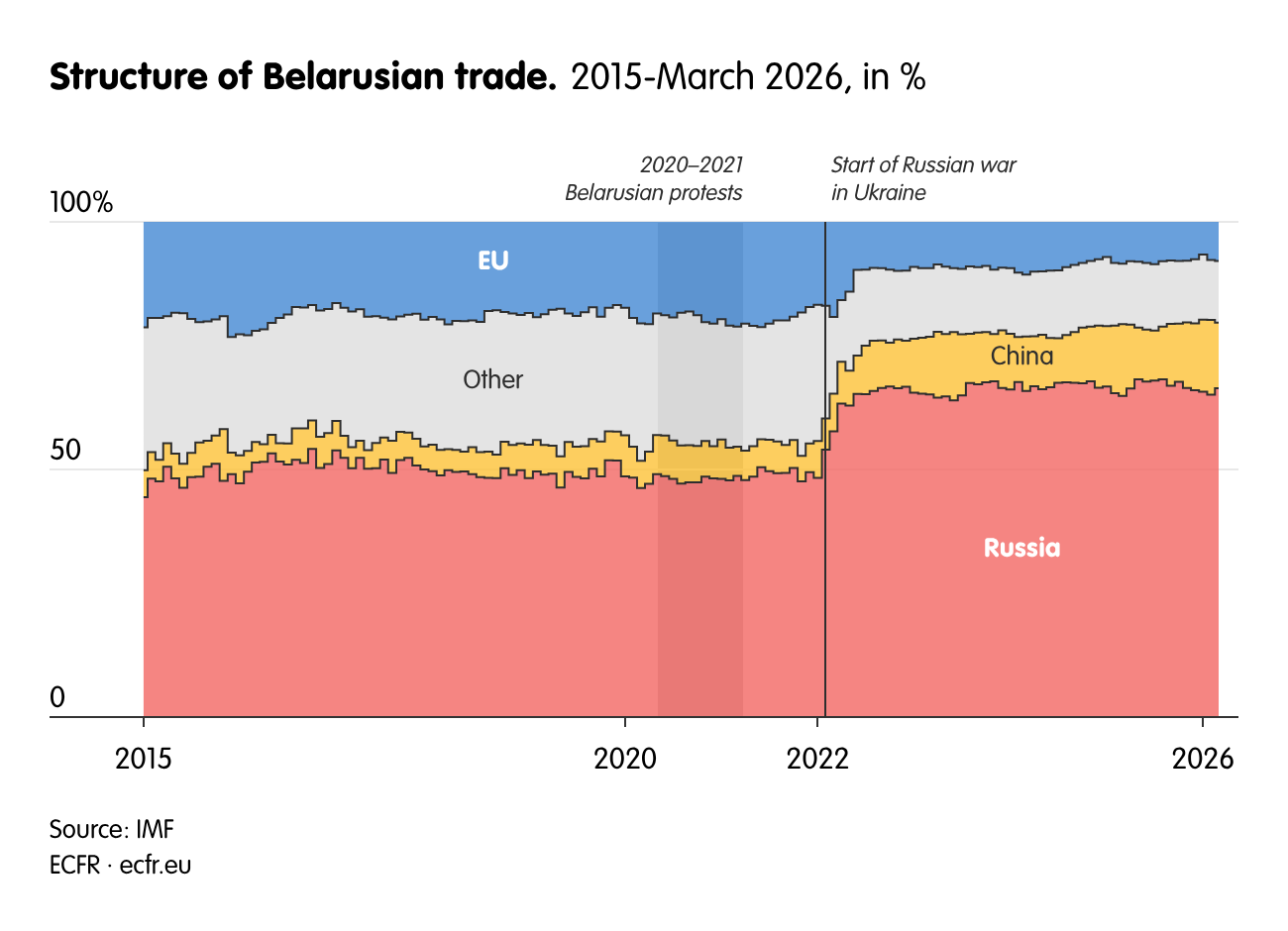
Structure of Belarusian trade.

Since this period, Russia has attempted to consolidate its control even further. Now it has approximately 2,000 troops concentrated around air-defence systems, training facilities, logistics hubs and long-standing Russian military installations. Between 2022 and 2023, ammunition transfers from Belarus to Russia exceeded 130,000 tonnes. Since then, joint training centres, storage bases and transport corridors (many inherited from the Soviet period) have been repurposed and modernised under Belarus-Russia Union State programmes to support Russian operational needs. Rail-linked depots, armament storage facilities and training grounds now serve as key infrastructure for Russian forces on its western flank.

The second tipping point came with the two countries regularly staging recurring joint military exercises that institutionalise operational integration, such as the Zapad military drills which have been taking place since before 2022. Now Russia is eyeing up Belarus as a key component of its nuclear ambitions and has also deployed Oreshnik intermediate-range missile systems in Belarus. In April this year, Belarus confirmed it would no longer allow Russian conscripts who desert the military to leave via its border. Belarus is also a staging post for Russian nuclear missiles and joint military exercises.

The country has thus become Russia’s territorial, militaristic and logistical resource, achieved through durability, military routinisation and institutional embedding. The military aspect of this entrenchment is also compounded through hybrid attacks. For example, as early as November 2021 the EU condemned Belarus for facilitating the weaponisation of migrants—predominantly from conflict areas such as Iraq and Syria—who it had apparently encouraged to breach the borders of Latvia, Lithuania and Poland.

This form of hybrid warfare has continued into 2026: recent reports say that Lithuanian authorities have discovered a cross-border tunnel from Belarus to Lithuania, which they suspect is to continue to facilitate the potential movement of migrants through European territories. Now, with the Union State increasingly functioning as a homogeneous force, there is a threat that Belarus will become more emboldened to facilitate further dangerous hybrid manoeuvring. It intends to check Europe’s readiness and destabilise it from the inside.

Belarus as a threat to Europe

The difference in the threat which Belarus now poses to Europe lies in its shift—which has taken place over the past six years—from being Russia’s “rear-operating base” to Russia’s “forward-operating base”.

As Russia’s rear-operating base, Belarus functioned as a non-combat zone for logistics and maintenance. While it supported Russian military activity and provided strategic depth by shifting military infrastructure and combat flashpoints away from Russian territory, as a rear-operating base Belarus avoided deploying its own forces into Ukraine and directly engaging in combat operations. This allowed Lukashenko to avoid many of the challenges that Putin is experiencing, including politically sensitive military mobilisation, high personnel casualties and mounting internal economic pressure. This approach had previously provided Lukashenko with the degree of political deniability and diplomatic leverage necessary to continue negotiating with Western economies on economic sanctions and market access. He was able to point to Belarus’s arm’s-length approach to the war in Ukraine as proof that he was willing to engage with Europeans at a diplomatic and economic level.
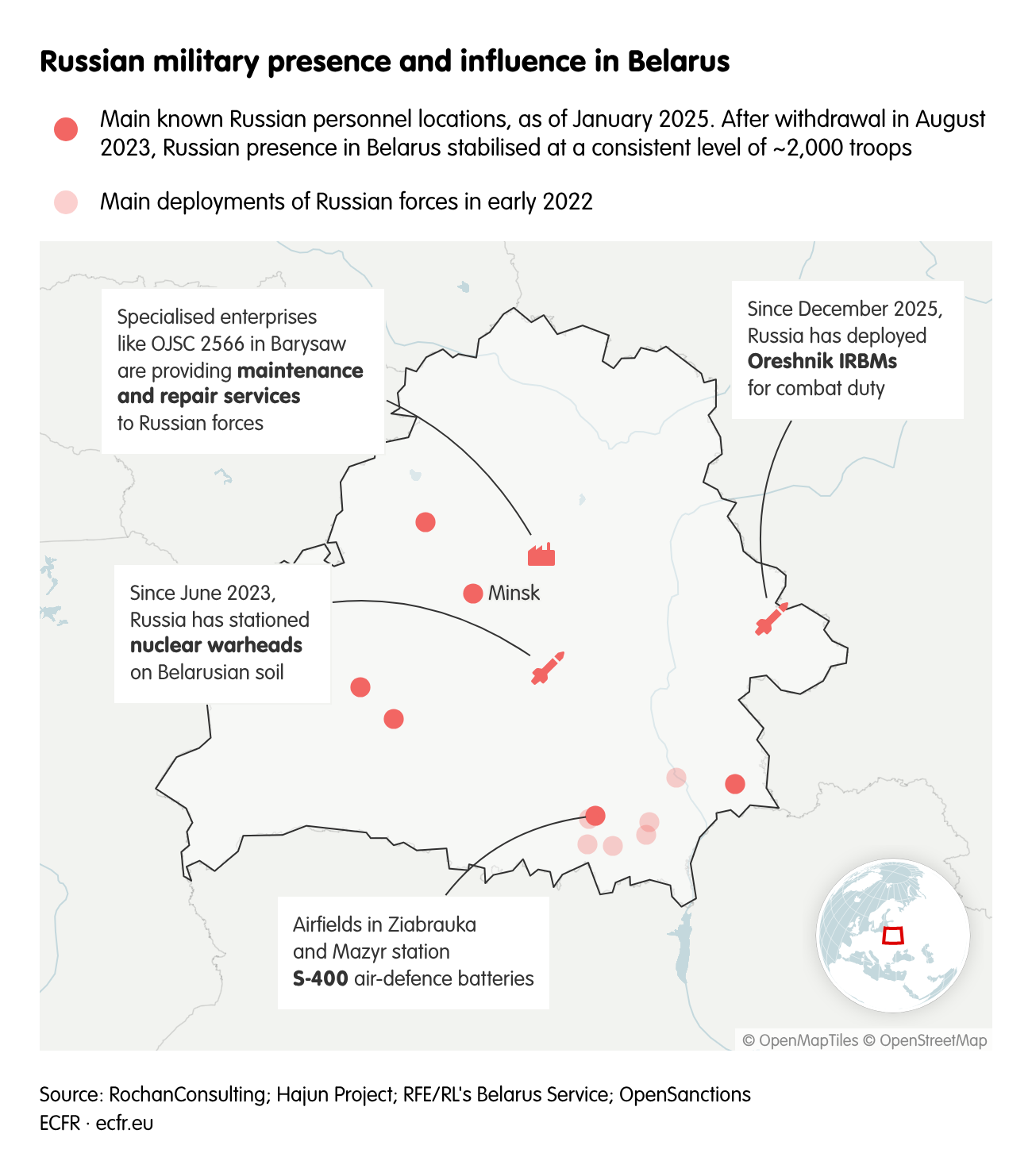
Russian military presence and influence in Belarus

However, Belarus’s position has changed since 2022. Evidence collected by the author demonstrates that Russia is increasingly establishing the country as a forward-operating base. Moscow is building on its routinisation and institutional embedding of military infrastructure to deploy personnel on Belarusian territory and undertake recurring joint military exercises, lately including nuclear forces preparation. Minsk’s rhetoric is changing to match these actions. In 2022, Belarus changed its constitution to allow Russia to store nuclear missiles on its territory; in a “Militarization of Europe” meeting held in June 2026, Belarus’s deputy minister of foreign affairs Igor Sekreta said he was “deeply concerned by… military exercises on NATO’s eastern flank” and “the EU and NATO… systematically promoting a militarist agenda at all levels.”

The Belarusian government is simultaneously becoming a component of Russian forward-military position and aligning ideologically with Russia’s view that Europe (and the West in general) constitutes an existential threat. Lukashenko himself reiterated this in May 2026, when he declared that “… [Belarus is] ready in every possible way to defend our common fatherland from Brest to Vladivostok.” The change is especially worrying for Ukraine, which is already fighting a war against Russia on several fronts. Its brow-beaten army could soon be required to deploy yet more resources to another defensive line on its northern border. Belarusian state media have suggested that Putin desires to open a “second front” against Ukraine, using Belarus as a launchpad for further attacks.

Indeed, evidence suggests that Russia is already using Belarusian infrastructure to gain an advantage in its drone warfare against Ukraine: in June 2026, Ukrainian intelligence services discovered four signal relay stations in the Belarusian oblasts of Homiel and Brest. Ukraine’s president, Volodymyr Zelensky, appealed directly to Belarus to dismantle the sites or face potential Ukrainian consequences. The Belarusian president apparently acquiesced—although no public statement or confirmation has been made.

Belarus’s transformation into a forward-operating base was further bolstered in 2023, when Russia deposited tactical Iskander nuclear-capable warheads on its territory. Then, in early 2025, Russia moved Oreshnik hypersonic missiles to a location which experts estimate to be around 60km south of Minsk. This has changed the calculus for the rest of Europe. Europeans must contend with an additional nuclear threat right on its border (aside from Kaliningrad) and consider how this could compromise security along its eastern flank.

Meanwhile, as noted above, Belarus is mixing concrete actions with rhetoric that suggests it sees Europe as a threat to its own sovereignty. In the same speech, Sekreta commented that Poland, Latvia and Lithuania have a combined defence expenditure of €52bn, which is apparently “25 times more than Belarus allocates for defence”. This suggests that Belarus increasingly views European and NATO defence investments through the lens of Russian military planning. If left unchecked, Russian influence will leave EU member states more vulnerable to further hybrid attacks from Union State forces.

For Europeans, there is also potential for escalation in how these border countries respond, and uncertainty about where escalation could lead. For example, the Zapad-2025 military drills, which took place on September 12th 2025, prompted Poland to close its border with Belarus due to “heightened security concerns”. Prior to this, on September 9th and 10th, Russia had flown several drones into Polish airspace during an attack on Ukraine. Lithuania also closed its border with Belarus for a whole month in October 2025 (and refused to enter negotiations to reopen it) after meteorological balloons travelled into its airspace from Belarus. The latter responded by accusing Lithuania of “pursuing an anti-Belarus policy”. Latvia, for its part, is struggling to deal with Belarus’s tactic of sending illegal migrants over its border. As of July 21st 2026, the Latvian government had recorded 8,413 instances of migrants attempting to cross into its territory this calendar year, stirring discontent prior to the parliamentary election in October. The country has also uncovered several sabotage operations that have appear to have been carried out by Belarusian and Russian spies.

European leaders heating up their confrontations in such critical areas is further adding to NATO’s headache. Belarus’s degradation as a buffer zone between western Europe and Russia means the potential for these flashpoints to drift further west is growing, not helped by a continually deteriorating diplomatic relationship between the Lukashenko government and the governments of neighbouring EU states. The proximity of Russian missiles and personnel to European territory could compromise NATO warning systems; it also suggests that the Union State is becoming increasingly willing to test European responses to its increasingly integrated deterrent.

Now the EU needs to reconfigure its strategy towards Belarus. The goal should be to ensure that Lukashenko does not limit his room for manoeuvre so much that he has no choice but to descend into a fully armoured satellite state; and that he has no choice but to react to any order Putin gives.

What Europe is doing…

On sanctions

Since Belarus’s flagrantly undemocratic 2020 presidential election, which sparked the country’s largest political crisis since independence, the EU and Belarus have downgraded their diplomatic relations. This is a cycle which Europe and Belarus have found themselves in since at least 2006: repression conducted by the regime triggers sanctions and isolation from Europe, which are followed by limited thaws and diplomatic re-engagement, which are then interrupted by renewed crackdowns—and so on. This time, however, the diplomatic downgrading was mutual: Lukashenko made Poland and Lithuania’s ambassadors leave Minsk in October 2020, and requested the EU ambassador return to Brussels.

In 2021, following Lukashenko’s contested re-election, Europe’s approach became more actively political. Belarusian opposition leader Sviatlana Tsikhanouskaya lobbied European governments to move beyond broad economic measures, such as existing targeted sanctions, to adopt harsher and broader sectoral sanctions. These were directed at, for example, specific officials, judges, prosecutors and police officers responsible for repression of Belarusian citizens. Belarus, for its part, suspended participation in the Eastern Partnership, an initiative which aims to strengthen political and economic relations between the EU, its member states and the partner countries of Armenia, Azerbaijan, Georgia, Moldova and Ukraine.

Europe’s response remains to take a blanket approach to sanctions towards Belarus. It reinforced its sanctions cycle even after Russia’s invasion of Ukraine in 2022 and the EU’s approach to Belarus is embedded within its anti-Russia packages. This means that the EU not only targets individuals involved in conflict operations, but also bundles Minsk in together with the trade restrictions, export controls and financial measures which it aims at Moscow. Europeans have fallen into the trap of treating their Belarus policy as an extension of their Russia policy, although some politicians—including French president Emmanuel Macron and, back in 2021, former German chancellor Angela Merkel—have also pursued limited efforts to test whether targeted incentives could shape Minsk’s behaviour.

However, some EU sources say that Minsk is an unwilling negotiating partner. It remains to be seen whether it will be explicit about the desire to reshape engagement with Europe. As of 2026, EU–Belarus relations remain largely frozen. They have seen only minimal diplomatic engagement and sustained sanctions, and only limited, transactional contact has emerged—for example, in negotiations over political prisoners and technical discussions over border management. In its latest sanctions announcement, the European Council extended its sanctions regime against Belarus until 2027.

The EU is thus in a difficult position when it comes to pursuing normalisation with Minsk. Since Europe’s Belarus policy is considerably shaped by Belarus’s neighbours, Lithuania and Poland—and Vilnius is especially reluctant to open any dialogue with Minsk—other member states are less emboldened to force through normalisation policies which are at risk of simply being blocked. What is clear is that, unless Belarus makes clear improvements in its human rights conditions and clearly distances itself from Russia’s war in Ukraine, European policy will remain structured around three aspects: progressive sanctions targeting regime elites and key economic sectors; political non-recognition of the legitimacy of Lukashenko’s rule; and support for Belarusian civil society and exiles.

Another problem for Europe is that continuing to heavily limit industrial trade and the transfer of dual-use goods and military equipment to Belarus could see Lukashenko rely more heavily on Putin’s open markets. But, if Europeans do not pursue sanctions, they indirectly aid Russia: Lukashenko supports Russia’s war against Ukraine by selling military and dual-use goods to Russia, thus helping it circumvent sanctions. This, in turn, creates a cycle of obligation whereby Minsk acquiesces to future military requests from Moscow and Russia further entrenches along Europe’s eastern flank.

The EU approach broadly treats Belarus as a subsidiary of Russia and narrows Europeans’ ability to develop a tailored security policy which directly targets Belarus as a forward-operating base. As things stand, sanctions on the economy and trade are not adequately addressing the developing threat that Belarus poses to European security. And they do not help alleviate the suffering of the ordinary Belarusians at home and in exile.

On the diaspora

Since 2020, Lukashenko has stepped up his repression and exile of Belarusian civil society actors opposed to his regime. Evidence collected by the author through focus groups carried out for ECFR suggests that, for Belarusians, exile is no longer perceived as a temporary or marginal condition. Rather, it has become a structural feature of Lukashenko’s authoritarian governance. Participants consistently described forced migration as a way for the Lukashenko regime to externalise dissent to maintain internal stability. The government pushes out political activists, journalists, researchers and civic organisers to reduce domestic pressure, while the regime projects an external image of control and normalisation.

This means that Belarus has shifted much of its political contestation into European societies. As a result, the EU has faced myriad challenges related to diaspora governance, transnational repression (including surveillance, intimidation, pressure on relatives and legal harassment across borders) and social cohesion. The EU has, particularly after 2020, provided unprecedented political recognition and support to Belarus’s democratic forces, including security guarantees and sustained funding. For Lukashenko, exile therefore functions as a strategic arena.

How Europeans govern this space—through legal regimes, funding structures or protection mechanisms—directly shapes whether repression through exile succeeds as a long-term strategy.

On its foreign policy approach

The EU’s treatment of Belarus as having limited sovereignty over its foreign policy is also at odds with the US approach. Washington’s current relationship with Minsk is based on President Donald Trump recognising Lukashenko as legitimate, and the US agreeing to negotiate sanctions relief in exchange for the release of political prisoners. America still casts Belarus as a strategic adversary; but it nonetheless accepts that the country needs careful handling to safeguard American and NATO interests in Europe. EU member states, which eye Washington’s approaches to Minsk with caution, have ramped up their scepticism further since Lukashenko joined Trump’s questionable “Board of Peace” (despite the Belarusian leader lending credence to Moscow’s campaign in Ukraine).

Overall, America is searching for “visible deals” whereby it can secure humanitarian wins via economic channels. The clearest example of this is its pursuit of calibrated sanctions relief: in 2025, Belarus released 123 political prisoners in return for the US easing sanctions on the Belarusian potash industry. And it could be argued that this has paid some dividends: lifting sanctions on Belarus helps ease the domestic economic pressure on Lukashenko, which leaves him less dependent on support from Russia for trade.

However, the thaw in America’s approach does nothing to address Belarus’s increasingly entrenched role as a Russian military staging post. Indeed, no approach taken by any American president ever has. And while former president Joe Biden synchronised Washington’s policy towards Belarus with that of Brussels, under his successor, Trump, the two approaches are disparate. Of course, the US does not have the major consideration of the security challenges which Belarus poses to Europe’s borders. But this divergence between America’s prioritisation of transactionalism and the EU’s prioritisation of security will only grow in the absence of a coordinated transatlantic framework towards Belarus.

There also exists the possibility that Lukashenko could exploit the gap between America’s leverage-based approach and Europe’s risk-based approach, to play each side against the other. From the US, Lukashenko has already achieved incremental sanctions relief and diplomatic rehabilitation while continuing to align Belarusian security with Russian territorial involvement and pursuing domestic repression. As it stands, all signs point to US bargaining having no impact on Belarus’s strategic alignment or its military cooperation with Russia. Human rights abuses remain.

What Europe can do next

Europe’s continued policy of isolating Belarus and imposing sanctions is turning the country towards Russia as a more attractive option for trade and investment. However, Europeans cannot simply restore diplomatic relations, even to their pre-2020 iteration: they need to hold Lukashenko accountable for his disregard of democratic norms and civilian abuse, and accountable militarily for his assistance to Russia’s war in Ukraine.

This requires developing an alternative approach which goes beyond the current binary choice of engagement or isolation and identifies as a priority exactly the type of Belarus that Europeans want to—or are willing to—work with. Europeans need to examine existing EU and US approaches to Belarus, and discover where Lukashenko could exploit gaps in their divergence—and where room for leverage and leeway exists.

This also requires Europeans to understand the type of pressure that Russia is exerting on Belarus. It is true that Russia continues to provide loans to Belarus, open its market to sanctioned Belarusian goods and give Belarus access to infrastructure through which it can continue exporting goods to Brazil, China and India. But this is illusory: Russia exerting “real” pressure would amount to trade wars, blockades of Belarusian goods, cutting off financial aid and propaganda attacking Lukashenko. Putin has exercised similar measures before, when Moscow was unhappy with Minsk. Now, in 2026, their actions might be well coordinated, but Russia has not established any real economic, financial, military, informational or political coercion against Lukashenko and his government.

Europeans could use this distinction to consider the type of Belarus they want to shape. This should be a Belarus which has secure, meaningful economic alternatives to Russia; a Belarus which sees the geopolitical and economic sense of having a choice of trading partners; a Belarus which has functioning communication channels. Overall, Europeans should expect that their future relationship with Belarus will go beyond mere transactionalism and value the voices of those who Lukashenko continues to silence. Europeans should seek a Belarus which retains a degree of political room for manoeuvre away from Putin’s military and political influence. The following recommendations set out how it can achieve this.

Support eastern border states

The EU has already made progress in strengthening its defence security arrangements for its eastern flank. For example, the 2022 Strategic Compass aimed to prevent crises in states most vulnerable to Russian (or indeed Belarusian) encroachment, and the EU has developed a targeted “Communication on the EU’s Eastern Regions Bordering Russia, Belarus and Ukraine” (or “Strong regions for a safer Europe”) programme. This includes the five priority areas of security and resilience; growth and regional prosperity; building on local strengths; connectivity; and empowering its people. The bloc is also channelling funds into shoring up transit routes and financing, including the customs infrastructure along its eastern border which is a target for Russian and Belarusian interference.

However, the EU should more deeply incorporate its support for states that border Belarus—which are facing hybrid pressure, border incidents and spillover risks—into a defence strategy which builds on the NATO model, particularly in its approach to deconfliction. This would mean better aligning military preparedness with diplomatic signalling and crisis-management channels.

For example, NATO maintains a partnership with the Organization for Security and Co-operation in Europe which promotes risk-reduction frameworks and transparency measures among signatory states—including the Vienna Document, which has been signed by the US, all European nations and Russia. Europeans could establish a similar partnership with selected states which builds on Lukashenko’s willingness—up to now—to notify his Western counterparts about activities such as Zapad military drills, where in some instances he has even invited them as observers.

Strengthen connections inside Belarus

To go one step further, however, Europeans—and especially EU border states—should maintain established working-level diplomatic contacts in Belarus, especially those located at EU member-state embassies in Minsk. These could also be third-party intermediaries or use technical-level communication formats, such as hotlines, to relay information about military movements or developments.

This could also rely on trusting selected contacts inside the country itself: for example, there are several initiatives which hold meetings which bring speakers and thinkers together to share both Western and non-Western perspectives, including from inside Belarus and Russia. By acting as a conduit for open communication—and by remaining open and depoliticised—protecting such channels encourages a more open dialogue. This, in turn, mitigates the risk of miscalculation and helps develop a diplomatic environment in Belarus which is less dependent on the relations created through the Union State. The aim for Europeans should be to build a pro-EU constituency inside Belarus through democratic initiatives—not with the intention of overthrowing the regime tomorrow, but rather to embolden those who see it in their interest for Belarus to have normal working relations with the EU.

Europeans could also continue to financially support or work with Belarus’s small- and medium-sized businesses, both inside and outside the country. Directing economic support and capacity building to enterprises within its borders would strengthen the country’s independent economic capacity by allowing it to gradually decouple from other trade relationships. At the external level, in 2022 the EU and the European Bank for Reconstruction and Development pledged €4bn for SMEs which had relocated their businesses abroad. The EU should explore ways in which it can strengthen Belarus’s SMEs inside the country, to help build a constituency which sees partnership with the West, not just Russia, as an advantage.

Opportunities exist for cooperation at the non-profit level, too. While not directly related to European security policy, concerted work by the EU to fund Belarusian NGOs and support apolitical initiatives can help strengthen the country’s national identity and foster conditions for a more fruitful working relationship. Europeans can connect with Belarusian youth and help shape a more democratic future of Belarusian leaders through the funding of communal projects such as Erasmus+ and the European Solidarity Corps for Belarusian students.

The European Commission is funding ArtPower Belarus, in collaboration with the Belarusian Council for Culture and Danish Cultural Institute, from 2022-2028. This demonstrates how outreach in Belarus—with willing internal institutions—can forge a common sense of purpose and prevent the “othering” of either side. The EU should continue to strive for flexible support for civic and political activism, especially at the grassroots level, through institutions such as the European Endowment for Democracy.

Engage with the Belarusian diaspora

Europeans should treat the Belarusian diaspora as a “strategic constituency” and help secure their participation in national and international civil life. For example, despite Belarus’s exit from the Eastern Partnership, the country’s civil society remains active in the initiative. This political knowledge and organisational capacity are vital for educating Europeans and ensuring that Lukashenko’s approach does not condemn the country and its people for any longer than it already has. Indeed, the EU needs to ensure that the Belarusian diaspora remains at the forefront of its policies regarding safe migration and access; it must avoid inadvertently reinforcing the regime’s strategy of repression through exile, lest any temporary or fragmented protections undermine diaspora members’ political and institutional capacity.

The EU should prioritise legal stability and predictability for Belarusian exiles. Where possible, longer-term residence pathways, access to labour markets and recognition of professional qualifications should be expanded and harmonised across member states. Indeed, Europeans need to take transnational repression seriously as a security issue, not only a human rights concern. Surveillance, digital harassment, pressure on family members remaining in Belarus and alleged monitoring activities in EU states challenge European sovereignty and social cohesion. To counter this, the EU should keep pursuing democratic initiatives such as the project “Towards a Local Democracy Agency (LDA) Belarus in Exile”. Its establishment has helped reinforce the notion that exile is not a temporary condition and encourages the need for “sustainable democratic infrastructure” which supports communities in exile. Addressing these practices strengthens both diaspora resilience and internal EU security norms.

In the long term, the EU should introduce more permanent diverse and sustainable funding streams, and move away from reliance on emergency or externally volatile sources. While several exile-based civil society institutions have benefited from multi-year EU funding frameworks—and the EU has committed €200m since 2020 in supporting the Belarusian people—recent reductions in US assistance have exposed structural vulnerabilities. The EU needs to use such funding streams to support independent media, research organisations and civic initiatives in exile, since they are repositories of political memory and organisational capacity.

Europeans should also continue to engage with Belarus’s political opposition on a more formal level, rather than treating it as a protest movement. For example, they generally treat Tsikhanouskaya as the de facto leader of Belarus from her base in Warsaw. This gives Europeans access to a political figure with different views and priorities, and could see the two sides shape future engagement with Belarus via insights from the country’s more civic-minded, democratic channels. The EU should be wary of treating her as the sole alternative to Lukashenko, especially because it is unlikely that Tsikhanouskaya will be installed as his successor—but openness to her influence will bolster trust between Europeans and Belarusian exiled civic society. It will also provide EU member states with an understanding of how the Belarusian state works.

Link diplomacy with action

EU engagement should focus on areas where European interests are directly implicated and where limited leverage still exists. Recent developments, including prisoner releases secured through negotiations with the US and Lukashenko inviting Western officials to observe military drills, suggest that Minsk remains open to selective forms of engagement.

But while targeted incentives can produce limited concessions, the EU should avoid simply replicating the American model. Instead, the bloc must approach conditional engagement as a security instrument rather than simply a human rights policy. Unlike Washington, it has long-term security interests in Belarus—regional stability, border security, migration management, securing its eastern frontier—and needs engagement to be more strategic than transactional.

Europeans should therefore try to couch any diplomatic, economic or symbolic concessions (such as forming high-level diplomatic contacts, limited sanctions relief or participation in dialogue formats) in measurable and verifiable actions. These could include independent verification of the release and treatment of named political prisoners, a sustained halt to politically motivated detentions and access for international humanitarian organisations.

This could build on Lukashenko’s demands for sanctions relief in exchange for Belarus releasing political prisoners and ceasing its aggravation towards Europe’s eastern borders by making such concessions with the conditionality just described. Such engagement with Belarus could help generate durable behavioural change and address underlying sources of regional insecurity.

Untangle Minsk from Moscow

Europeans can also adapt their approach to Minsk based on how America treats it: as a viable, autonomous actor, not an extension of Moscow. The fact that negotiations between Trump and Lukashenko led to the release of prisoners—albeit with hundreds still being held—suggests that the Belarusian leader remains sensitive to economic pressure and to the optics of his own international legitimacy. Trump’s recognition of Lukashenko as Belarus’s legitimate president has only served to reinforce the latter’s willingness to reestablish closer contacts between Minsk and Washington. The US can use this thaw to its advantage to leverage selective sanctions adjustments (for example, easing restrictions on Belarusian potash exports in response to global fertiliser market pressures) and further widen Lukashenko’s limited transactional opening.

Europeans should consider whether closer coordination with Washington, whereby both camps identify common red lines and incentives for better diplomatic ties with Minsk, would deter potential coercion by Lukashenko and prevent him playing the US and Europe against each other. Indeed, the two erstwhile allies finding common ground in their strategy towards Belarus could secure further progress on humanitarian issues and demonstrate to Lukashenko that the US remains key in the protection of Europe’s eastern frontier. It is worth noting that, in this event, the EU should strongly articulate its own priorities—particularly regarding border security and societal agency—and pursue pragmatic coordination at the level of officials, agencies and technical experts.

A practical example of Belarus demonstrating more autonomy is the recent ultimatum proposed to Belarus by Ukraine. Zelensky’s bold statement over the four signal relay stations in Belarus led to their quiet removal (or they were at least turned off), suggesting that Lukashenko can roll back certain decisions—even on military issues. And, even if reports that it was in fact Ukraine which destroyed them are true, Lukashenko has accepted this development without retaliation. His response suggests that he fears the consequences of escalation from Ukraine and other Western allies. But it also supposes that Putin is not yet able to dictate Lukashenko’s every move, not even in zones which Union State forces could view as fundamental to ensuring their continued sovereignty. This episode shows that Lukashenko still retains meaningful room for manoeuvre even in matters of security, and that calibrated pressure from neighbouring states can shape his decisions.

Europeans should exploit this hint of residual agency to discover in which other areas Lukashenko retains an interest in limiting escalation or preserving his room for manoeuvre. They should determine in which other areas calibrated diplomatic and economic pressure could shape Belarusian behaviour and complicate Russian military planning. This could help decouple Belarusian decision-making from Russian power structures and isolate Lukashenko into a more favourable position for further negotiations.

Shaping stabilisation on European terms

By reducing the opportunities for Russian coercion and Belarusian-enabled hybrid pressure on the eastern flank, Europeans can better counter the impact of Russian entrenchment on their neighbour. But Europeans should not frame the recommendations as a part of a rehabilitation for the Belarusian regime. Rather, these policy suggestions should function to safeguard against further deterioration of the stable buffer zone that Belarus once provided for western Europe. Most importantly, they need to address the Belarus that has been created since 2020 and seek to prevent its further entrenchment as a Russian satellite state.

To achieve this, the most important thing Europeans can do is move beyond the false dichotomy between isolation and engagement. Europe can still rebuke Belarus as an externally managed satellite state, for example by disavowing the Lukashenko regime, while providing incentives which help it shape the conditions under which stabilisation unfolds. Europe cannot force rapid change in Minsk’s strategic alignment, but it could help prevent the complete consolidation of a security order in which Europe has no voice.

Europeans should also focus on how their approach to Belarus differs in the short and the long term. In the short term, Europeans need to prioritise preventing Russia’s military configuration in Belarus from becoming permanent and irreversible, and work to limit the extent to which Russia has entrenched itself into Belarusian military institutions. They should aim to separate Belarus from Russia as much as possible by ensuring that Moscow ceases stationing its weapons (conventional or otherwise) on Belarusian territory. At the same time, Europeans need to be aware of continued escalation, such as further military deployments on Belarus’s territory, applying hybrid pressure on member states or facilitating cross-border incidents.

In the long term, Europeans should not aim for Belarus to be aligned with the West; nor should they expect that their intervention will transform Belarus into a democratic state. But the EU should work towards Belarus becoming a country that is sovereign enough to resist becoming a permanent forward base for Russian power, and open enough to maintain a managed relationship with both Europe and Russia. Ideally, Belarus should become sovereign enough that it can make rational decisions—based on the best interests of its country and its people—regarding with which power it wants to be aligned.

As it stands, Russia’s war of aggression in Ukraine shows no signs of abating. America, for its part, is increasingly reluctant to fund deterrence in EU countries, including those which border Belarus. It is, under Trump, using economic and political posturing to exert pressure on the Lukashenko regime. But Europeans can still find the avenues of cooperation which still exist in the allies’ fractured relationship. Most importantly, the EU needs to grant a degree of agency to its most problematic neighbour.

About the author

Vasil Navumau is a former visiting fellow at the European Council on Foreign Relations. He now works as a researcher at the University of Siegen, where he focuses on civic activism in eastern European countries, particularly Ukraine and Belarus, and its transformation via information and communication technologies.

Acknowledgments

The author would like to thank Pavel Slunkin and the ECFR editorial team (in particular Amy Sandys and Portia Kentish) for their valuable input and suggestions, as well as Nastassia Zenovich for her graphics.

This work was produced as part of the project “Portrait of Exiled Belarusians and the Role of Belarus in Russia’s War on Ukraine”, financed by the European Union under the EU4Belarus – Support to Advanced Learning and Training (SALT II) programme.

This document has been produced with the financial assistance of the European Union. The contents of this document are the sole responsibility of the European Council on Foreign Relations (ECFR) and can under no circumstances be regarded as reflecting the position of the European Union.
Source

  •  

Buzzkill: How to defend Europe against drones

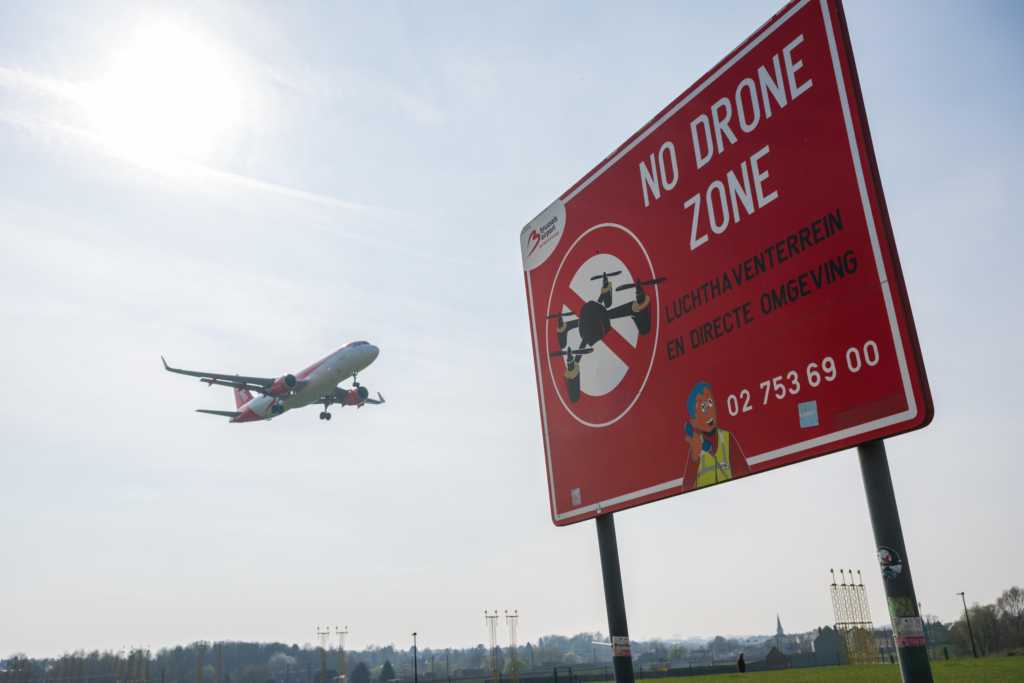
Ein Foto zeigt ein rotes 'No Drone Zone'-Schild im Vordergrund, ein Flugzeug landet im Hintergrund am Flughafen.
Cover image: picture alliance / NurPhoto | Jonathan Raa

Summary

  • Europe faces a dual drone threat, and it is escalating. Small drones regularly disrupt airports and hover over Europe’s critical infrastructure; at the eastern flank, larger military drones are crossing ever more often into EU and NATO territory.
  • EU member states are struggling to mount an effective response to the drones spotted over their critical infrastructure, and those countries farther from the eastern flank tend to focus disproportionately on this side of the threat.
  • At the flank, efforts to defend against military drone incursions are resulting in a hotch-potch of NATO, EU and national projects. This risks duplicating efforts and stalling progress towards a common operating picture.
  • National initiatives at the eastern flank seem the most promising, but the EU still has a role to play in funding and incentivising these efforts. The bloc should also help establish the common operating picture and best practice for legal regulations, and work to improve data sharing.
  • The EU and member states should then apply lessons from the eastern flank to the related but different threat to their critical infrastructure. That way, they can help Europe move closer to a continent-wide response to both sides of this continent-wide problem.

Today’s problem

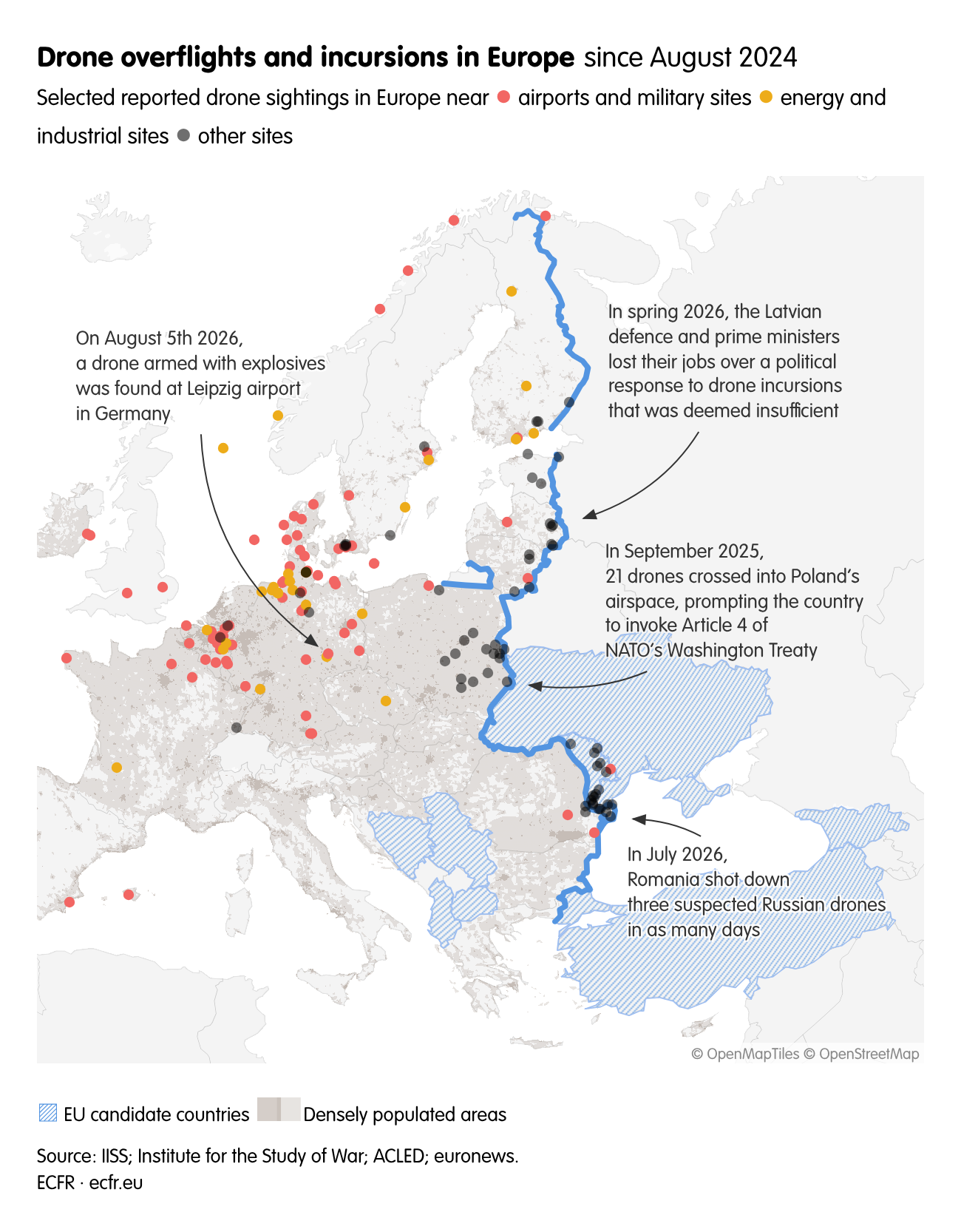
On August 5th 2026, a small drone armed with explosives was found at Leipzig airport in Germany. The presence of explosive material marks this out from previous incidents at airports, as does the fact that authorities recovered the drone. But Europe’s new normal is for small drones to disrupt its airports and buzz around other critical infrastructure, including French nuclear submarine bases, Belgian nuclear power plants and German liquefied natural gas terminals. Some of these sightings are likely part of Russia’s hybrid war against Europe. Yet the drones are probably flown from inside European countries or from ships in the North and Baltic seas, and definitive attribution to Russia or any other actor remains elusive.

The countries along Europe’s eastern flank have another new normal to contend with. This entails the connected but different threat of military drones crossing into EU and NATO territory from Russia, Belarus and, because of the Russian aggression against it, Ukraine. The most egregious incursion so far took place in September 2025, when around 20 Russian military drones crossed into Poland’s airspace, leading it to invoke Article 4 of NATO’s Washington Treaty. That episode also prompted NATO to launch Operation Eastern Sentry to increase its vigilance at the border.

Unlike the small drones hovering over critical infrastructure, the origin of the military drones crossing into EU and NATO territory is no mystery. The attribution problem here relates to intention, as Russia can claim—sometimes plausibly, sometimes less so—that incursions at the eastern flank are accidents resulting from its war against Ukraine.

The eastern flank

Russia and Belarus are acting antagonistically towards European countries, while Ukraine is a partner nation and an EU candidate country. But incursions of military drones into EU and NATO territory come from all three countries. The term “eastern flank” thus refers to the EU’s 4,000km border with Russia, Belarus and Ukraine, as well as the Black Sea coast. The flank extends through nine countries: Finland, Estonia, Latvia, Lithuania, Poland, Slovakia, Hungary, Romania and Bulgaria. 

Almost a year on from the Poland incident, the member states that line the eastern flank face military drone incursions with alarming (and increasing) regularity. The end of July, for example, saw Romania shoot down three suspected Russian drones in as many days. This followed another incursion in the country in May when a drone crashed into the roof of a ten-storey building in Galati and exploded, starting a fire in one of the apartments. A 14-year-old and his mother were injured, and 70 residents were evacuated. The Romanian military had tracked the drone and deployed two F-16 fighter jets in response to the threat. But the jets were unable to fire at the target for “operational reasons and [because of] certain legal limitations”.

The incidents in Romania lay bare some of the difficulties for Europe in defending its eastern flank against military drones. Over the past year, NATO’s operation has swiftly been joined by a hotch-potch of national and EU projects, including the bloc’s ambitious and wide-ranging European Drone Defence Initiative. But as things stand, military drones still either fly unhindered into EU and NATO territory or are intercepted through the costliest means possible, namely missiles fired from fighter jets.

Police forces across the continent, meanwhile, are struggling to mount an effective response to the problem of the small drones over their critical infrastructure. And countries farther from the eastern flank tend not to make the link between this largely civil threat and the military threat in the east: when the EU first proposed its initiative, for example, western European states were unconvinced that the bloc should fund drone defences at the eastern flank.

But, as this paper argues, all European countries need to act to secure the eastern flank—both to defend EU and NATO territory against military drones and to inform Europe’s response to small drones flying over its critical infrastructure. National efforts at the flank are promising but will likely prove insufficient. The EU will therefore have to spread the costs of defending the eastern flank, as efforts there contribute to the defence of the entire continent against military drone attacks. That small drones flying over critical infrastructure are a problem everywhere should further incentivise all Europeans to speed up their work on drone defence. And as this paper shows, the EU and member states can apply lessons learned at the eastern flank across Europe and reuse technology battle-tested in the east to protect their critical infrastructure.

The dual threat

The two sides of Europe’s drone threat are different, but they still share important similarities: they involve the same tools—drones of one type or another—and some likely have the same perpetrator—Russia. Mapping just a selection of drone overflights of critical infrastructure and incursions at the eastern flank since August 2024 lays bare the extent of the dual drone threat Europe is facing. And every time an overflight of critical infrastructure or incursion at the eastern flank happens, wherever it comes from, Russia learns something about Europe’s ability to fight (or otherwise) against these systems.

Drone overflights and incursions in Europe

Drones over critical infrastructure

Drones are regularly spotted over critical infrastructure across Europe. The German aviation agency reported 227 drone sightings by pilots in 2025. These numbers have been rising steadily since reporting began in 2020, and the 2026 numbers are well on track to surpass last year’s.[1] Such incidents are largely a civil matter, which means responsibility for recording, identifying and countering them falls on local authorities such as police forces.

The overflights near airports tend to grab the most attention for three reasons. First, drones pose an extreme risk to aircraft and have the potential to cause mass casualty events, with the incident in Leipzig perhaps the closest call so far. German newspaper Die Zeit reports that CCTV footage from the airport shows the drone flying towards an Antonov cargo plane parked on the runway, hitting one of the wings and then falling to the ground. It was later discovered on the tarmac by a bus driver, who alerted security. Had the explosives detonated, the consequences could have been catastrophic. But even without explosives, drones have the potential to cause an air disaster if they collide with a plane, particularly if it is taking off or landing. Second, drones near airports cause significant economic harm: Copenhagen airport had to close for four hours in September 2025, while more than 30 flights were cancelled in Munich following drone sightings in March 2025. Third, airport closures tangibly affect citizens, which is likely why they are such common targets in the first place.

But from a security standpoint, equally concerning are sightings over other critical infrastructure like energy hubs and military installations. Drones can, for instance, help hostile operators gather intelligence about the security arrangements at these installations. They could then use this to enable future sabotage or attacks.

Among these sites, drone activity around military installations could be highly consequential. In early 2025, the German ministry of defence logged six instances of drone overflights at Schwesing airbase, a Bundeswehr base where Ukrainian soldiers were trained to use Patriot air-defence missile systems. It is plausible that the drones carried signals-intelligence equipment that could identify soldiers’ mobile phones. Once it had identified the phones, Russia may have been able to locate them again months later at the Ukrainian front line—and with them, the valuable and increasingly scarce Patriot batteries. This is a direct concern for the Ukrainian defence effort. But it also points to a larger problem for Europe, as it illustrates the type of information Russia could be collecting about European armed forces.

It remains unproven where most of the drones used in overflights come from and who controls them. But it is probable that at least some of the drones flying over critical infrastructure are part of Russia’s hybrid war against Europe. For years, Russia has conducted attacks against military and civil infrastructure as well as government entities. Some attacks take place in the cyber-realm; some involve physical sabotage, like igniting air freight packages in Britain, Germany and Poland, and damaging submarine cables in the Baltic Sea. US intelligence also helped Germany foil a plot to assassinate Armin Papperger, the CEO of arms manufacturer Rheinmetall. Sweden, meanwhile, has faced attacks on its telecommunications network. And disinformation campaigns have targeted the whole of Europe for years, including in the aftermath of drone sightings and disruption.

German chancellor Friedrich Merz has noted that Russian agents may be behind at least some of the overflights; Danish prime minister Mette Frederiksen said she could not “rule out in any way that it [was] Russia” behind the airport disruptions in Copenhagen; and Ukraine’s president, Volodymyr Zelensky, has argued that “the drone incidents across Europe clearly show that Russia is prepared to escalate this war and that it has never been just about Ukraine.” Moreover, in 2025 investigative journalists traced several drone flights back to Russian ships in the North and Baltic seas. Since then, a June 2026 report from the International Institute for Strategic Studies has assessed it is “highly likely” Russia conducted a drone campaign against Europe, largely towards the end of 2025. This research also found that the source of some of these drones may have been Russian shadow fleet vessels.

The types of drones used in these operations have not been definitively identified. However, analyses of images as well as eye-witness accounts point to fixed-wing surveillance drones, as well as quadcopter systems. In at least one incident there were reports of a “mothership” drone, a larger fixed-wing system which carries smaller quadcopter drones. The Leipzig drone has been identified as a quadcopter, roughly the size of a microwave oven.

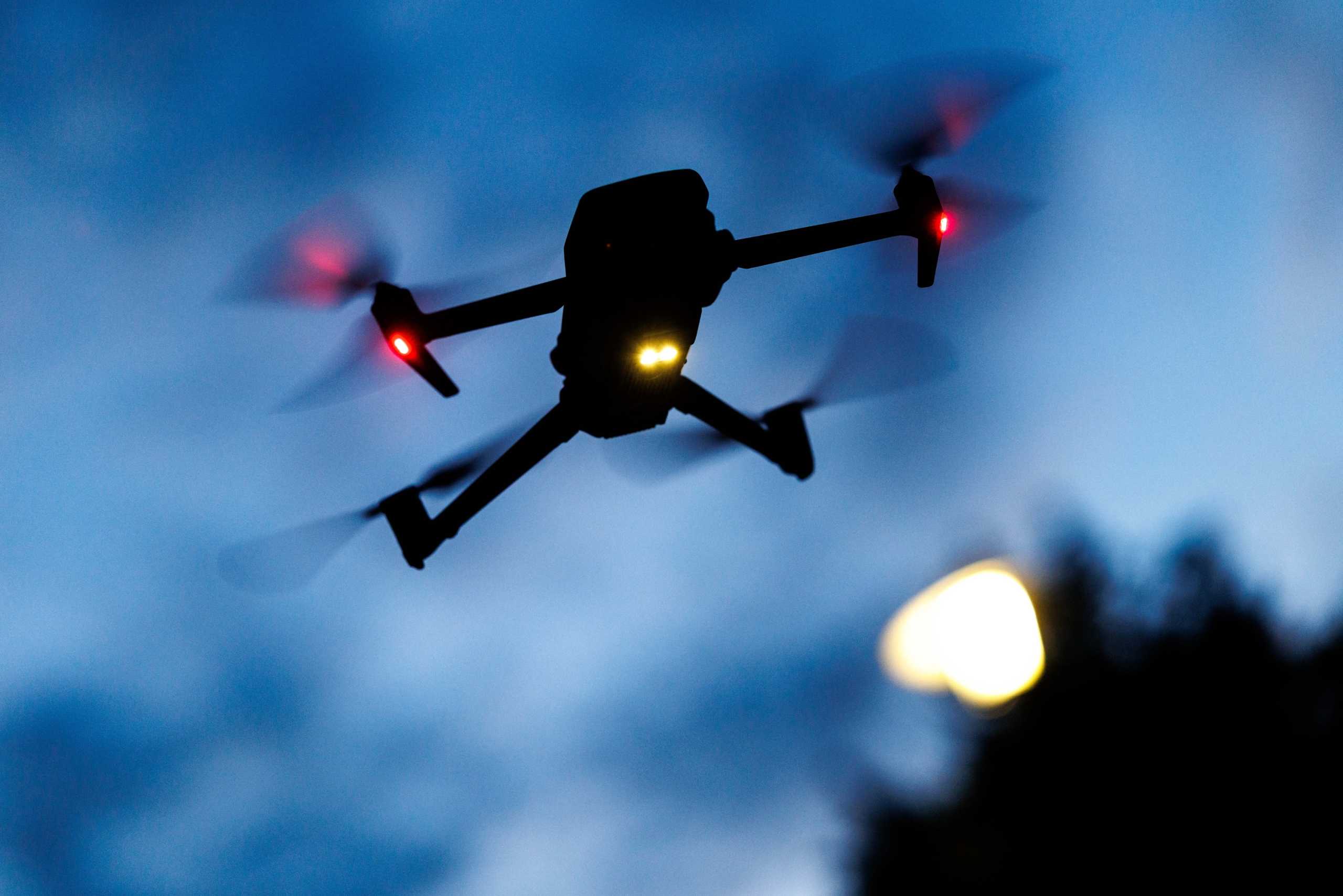
A camera drone at dusk. [picture alliance / dpa | Matthias Balk]

Quadcopter drones

Quadcopter drones are systems with four rotors, which enable them to take off and land vertically, without any type of runway. They are flown via handheld console or smartphone app. Quadcopters have been the typical model for hobbyist drones as they are easy to use and do not require additional equipment. They are also particularly good at hovering in one place and flying slowly, making them the ideal system to follow and surveil people.

Their main vulnerabilities are endurance and range limitations due to weight: unlike fixed-wing systems which can glide, quadcopters require a continuous power supply to fly, thus draining their batteries quickly. As batteries are also their heaviest part, their range is limited. And heavier systems require more power, which means they need larger and heavier batteries. As more civilian systems have entered the military drone space, quadcopters and other multicopters have multiplied on the battlefield.

Still, definitive proof of the types of drone used in overflights or where they come from will depend on police forces apprehending more of them. The fact that local authorities across Europe have been unable to do this could compound a feeling among the public of failure by the state and leave the information vacuum wide open. The lack of information also means it is impossible to distinguish between real sightings and false alarms—like the 2016 case of a drone sighting from an aeroplane which turned out most likely to have been a plastic bag.

European authorities should also be able to stop drones around their critical infrastructure regardless of who flies them. The context of the Russia-Ukraine war has turned the drone threat into a geopolitical problem, yet non-state actors pose their own threat. Given the availability of drones, drone terrorism is a rising security concern—and far-right groups in the US, for example, are reportedly looking into first-person view drones to target law enforcement. But to date no major terrorist attacks by drone have taken place, only some thwarted plans, which is surprising.

But Europe’s drone problem also has a military side, and the continent seems equally unprepared to counter it efficiently and effectively.

Drones crossing the eastern flank

Alongside dealing with overflights, countries along the eastern flank must contend with military drones threatening EU and NATO territory from the east. Such incursions have taken place regularly since Russia began its war of aggression against Ukraine in 2022 and have intensified since 2025.

Only two weeks after the full-scale invasion, a drone (most likely Ukrainian) flew undetected for hundreds of kilometres over Romania and Hungary, before crashing near Zagreb in Croatia. Russian drones came down in Romania in 2023, and in Poland and Lithuania in 2025.

But the number of incidents has grown significantly in 2026. Russian and (more frequently) Ukrainian drones have veered off course since the start of the year, coming down in Finland, Lithuania, Estonia and elsewhere. In May, people took shelter in Lithuania when a drone alert brought Vilnius to a standstill; and across the border in Latvia, both the defence minister and the prime minister lost their jobs over a political response to drone incursions that was deemed insufficient. When the UN Security Council held an emergency meeting over the Galati incident in June, Romania’s minister for foreign affairs noted that it was just one of more than 40 incursions into the country’s airspace in 2026 alone—a number which has grown significantly since then.

Initially such incidents appeared to be accidents, caused by guidance-systems failures, operating errors and interference by electronic countermeasures. But the September 2025 incident in which around 20 military drones entered Poland from different places raised concerns that some might be deliberate provocations. The increasing intensity since then has done nothing to alleviate those concerns. After one May incursion in Latvia, Ukrainian foreign minister Andrii Sybiha said that Russian electronic warfare systems “deliberately diverted Ukrainian drones from their targets in Russia”—not going quite as far as to argue Russia was deliberately sending drones over NATO and EU territory, though this is a possible conclusion.  

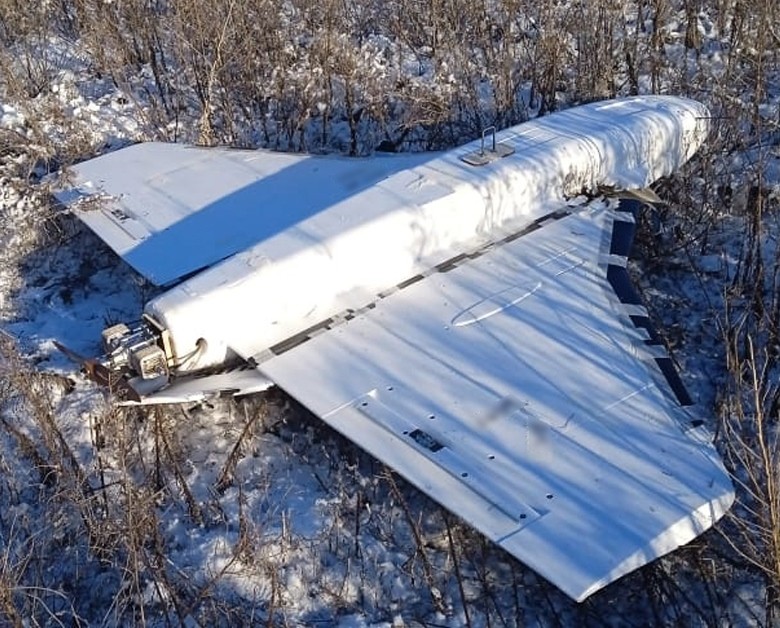
The drones that crashed in Poland were later identified as Russian Gerberas, an unarmed variant of what was originally the Iranian Shahed-136 loitering munition.

Russian drone Gerbera, downed in Ukraine (2025 01 05)
A Gerbera drone downed in Ukraine similar to those that entered Polish airspace in September 2025. [Wikimedia Commons]

Gerans and Gerberas

Russia manufactures its own version of the Iranian Shaheds in the Geran and Gerbera variants.

These are “kamikaze drones”, or one-way loitering munitions, which explode upon reaching their target. Russia is using the drone in ever greater numbers in Ukraine: since 2025, almost 1000 drones have been used in single-night attacks on Ukrainian cities and energy infrastructure. The current Geran iteration, the Geran-3, is a turbo-engined variant that can fly up to 800km, but many different variants exist. When employed in large numbers, they can overwhelm Ukrainian defences. The Gerbera is a lesser-known variant which is generally used as a decoy, or to relay signals for other, armed drones. The average price tag of drones like these is around €10,000.

In response to the incursions, Poland scrambled F-16 fighter jets and several military helicopters. Other NATO states provided support with aerial assets, most notably Dutch F-35s. Together they shot down three of the drones, with the rest crashing on Polish territory, luckily not causing any casualties. Debris was later found in an area spanning hundreds of square kilometres.

While NATO has not disclosed the exact costs of the operation, the missiles the jets fired cost between several hundred thousand and a million euros, depending on the type. Flight hours of F-16s and the much more expensive F-35s run into the tens of thousands of euros. So a single, only partly successful, counter-drone operation cost European countries millions, while Russia likely forked out less than €250,000 to prompt that response. 

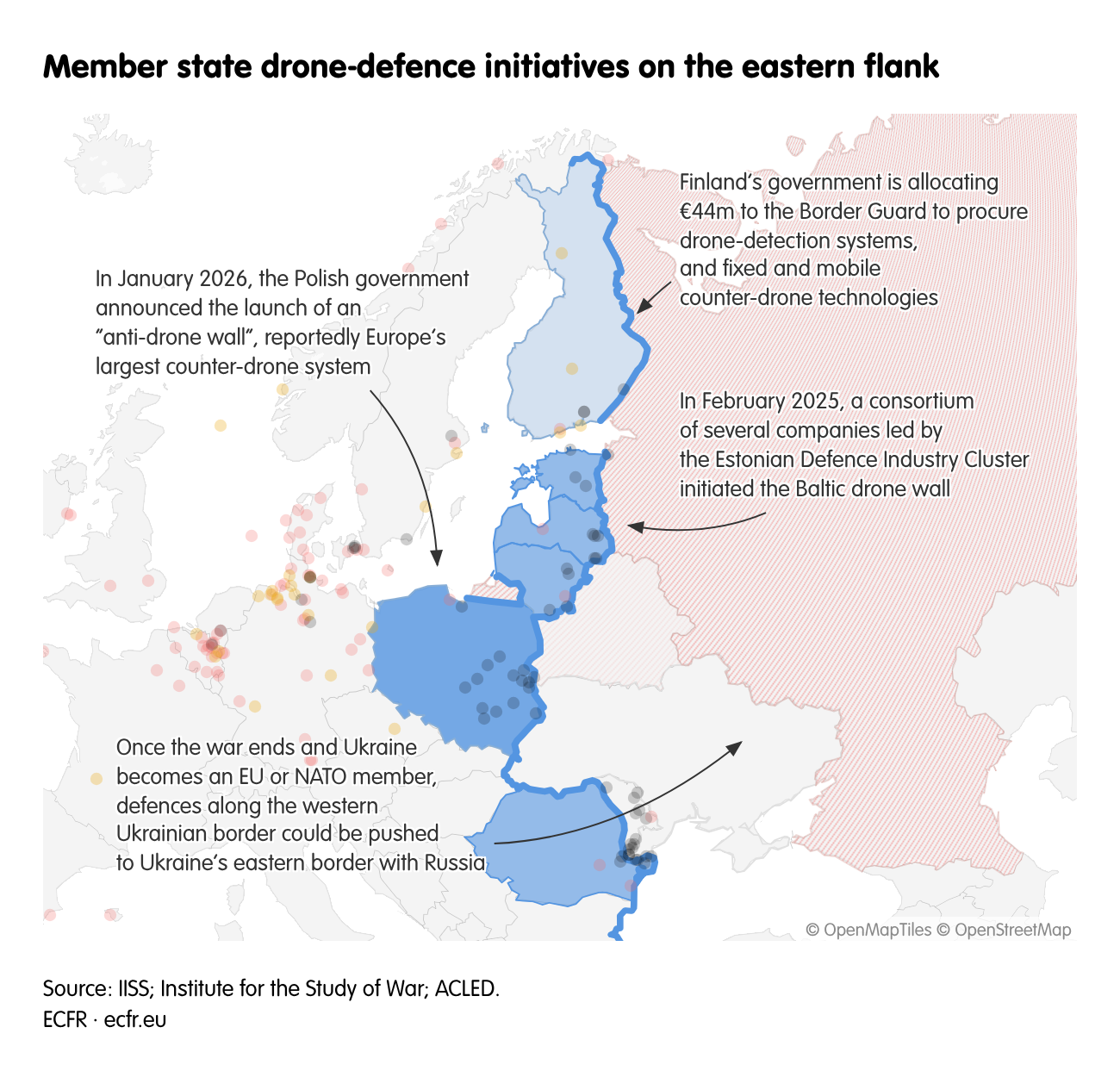
Drones continue to cross into NATO and EU territory. Sometimes they are intercepted, but more often they simply crash into the ground, occasionally even going undetected until they do. Were European countries to face an attack involving even a fraction of the numbers Ukraine regularly faces, the consequences would likely be catastrophic—and preventing them would be prohibitively expensive. Once the war ends, and if and when Ukraine becomes an EU or NATO member, defences along the western Ukrainian border—with Poland, Slovakia, Hungary and Romania—can move to Ukraine’s eastern border with Russia. In the meantime however, the EU, NATO and member states need to learn from Ukraine to secure the flank themselves.

Drones are a whole-of-Europe problem, which means all European countries need to invest in counter-drone capabilities. But starting at the eastern flank makes sense. Compared with the overflights of critical infrastructure, the flank is a more defined threat in a geographically bounded area. If the EU and member states can build an effective response here, it could inform efforts across the rest of the continent, both in terms of what can transfer to that different context and what cannot.

What a protected eastern flank looks like  

Europe’s eastern flank spans different climate zones and topography, urban and rural territory, and forests and agricultural land. Given this and the drone threat discussed above, drone defences will have to be multi-layered. The eastern flank will need a detector layer with several sensor options, a defensive layer with several different countermeasures (“multi-effector”), and the ability to engage several drones at the same time (“multi-shot”). All these systems would ideally feed their data into a common operating picture to create a comprehensive view of the eastern flank. This element will be crucial to detect attacks that may be happening at the same time but hundreds if not thousands of kilometres apart.

Detector layer

The detector layer will comprise various radar and sensor systems. These will have to be spaced along the eastern flank depending on the topography and the presence of buildings, forests, agriculture and similar criteria. Today the eastern flank is monitored primarily through NATO assets and national systems, which focus more on the threat from missiles and aircraft, rather than smaller and slower drones.

Radars offer long-range coverage but can struggle to track smaller drones. Their sensitivity is improving all the time but birds still cause false positives; and as drones can be made from an array of materials, it is possible to manufacture them with minimal, or unusual, radar signatures. Moreover, traditional active radar systems that send an electromagnetic pulse and capture its return signal can be too easy for adversaries to identify. To overcome this problem, passive radar systems that work by sensing changes in the electromagnetic spectrum as objects move through space are in development.

Electro-optical sensors would complement radar. These can identify drones based on visual and temperature identifiers, which helps operators establish what kind of drone they are dealing with. But they require a clear line of sight, making them less usable in urban or forest environments. Unless they are AI-enabled, electro-optical sensors also require human intervention in real-time to verify whether an image is showing a drone or not, and thus increase staffing requirements. Radio frequency scanning, meanwhile, identifies drones by monitoring common frequency bands, though its accuracy is limited.

Finally, Ukraine has had considerable success with acoustic sensors and has installed thousands across the country. But Ukrainian experiences have also shown that these sensors do not work equally well in all contexts: environments with lots of sounds, like forests, urban areas and agricultural land, can hinder their usefulness.

Defensive layer

As with detection sensors, the defensive layer will have to incorporate several different features, from electronic countermeasures to kinetic solutions.

Electronic countermeasures include spoofing of positioning systems like GPS, and radio frequency jamming that blocks the connection between drone and operator. But these systems can be quite disruptive as they often interfere with all systems in range, making them less useful in urban contexts and near airports. Their effectiveness also often depends on continuous transmission, and they only work on drones that require a connection to the operator. This means they would be ineffective against autonomous, pre-programmed and tethered systems.

Electronic countermeasures have proven highly effective in Ukraine. But Russia has developed several workarounds to Ukraine’s efforts since the start of the war, and vice versa. Today Ukraine’s entire front line is GPS denied, so all drones operating there do so without relying on satellite guidance. Electronic countermeasures are also being circumvented by drones carrying with them up to 40km of fibre-optic cable through which signals are sent. This underlines the need for drone defences at the eastern flank to involve multiple systems.

Radio-frequency-based “cyber takeover” aims to take command of unwelcome drones and safely land them. This is a particularly desirable option as it preserves the drone for analysis. Yet it hinges on the cyber takeover’s ability to work on every drone system, including unknown ones.

Finally, Europe’s eastern flank will require a range of kinetic counter-drone tools—as a last resort for when electronic measures have failed to take down drones. These should include rifle-mounted systems, larger cannon-type systems, guided missiles and drones to fight drones. While generally effective, most kinetic solutions create the danger of collateral damage, as both projectile and drone come crashing down. During the Polish drone incursion in September 2025, the only property damage was caused by a missile that aimed to shoot down the drones.

Ukraine is now using interceptor drones, or drones that take out other drones. These include several systems, like drones with nets or those that ram hostile drones or blow up warheads that come near. (Incidentally, the existence of these systems has led to some confusion over the term “drone wall”, as some reports have suggested that it would be a wall made of drones, a misunderstanding helped along by the fact that a German firm had proposed such a project previously.)

Other countermeasures such as lasers, electromagnetic pulses, strong light and microwave weapons exist, but have not yet matured sufficiently and face similar limitations to those mentioned above, such as the need for line-of-sight or the risk of collateral damage.

Command and control

Crucially, Europe needs a command-and-control node to collect data. For drone defence to be truly integrated and European, the goal should be for this data to feed into a common operating picture that covers the entire flank, from Nuorgam in northern Finland to Burgas in southern Bulgaria. How to respond to a given threat should remain a more local decision, but information-sharing will still be crucial to understand any attack situation. It is equally desirable for European countries to exchange information with NATO’s Integrated Air and Missile Defence. AI and automation may also prove useful, though it will be necessary to heed the lessons of over-reliance on technology and automation, for instance, from the October 7th attacks against Israel.

*

Building a multi-layered system of systems like this on the eastern flank may seem a daunting task, not to mention an expensive one. But as the alternative is for EU and NATO countries to continue spending tens of thousands of euros to shoot down a single drone, or not to detect or shoot it down at all, it is a task in which the EU and all European countries have a stake.

The progress so far

The work has already begun. The European Commission has been most vocal about its plans to build up an ambitious “drone wall”, now rebranded as the European Drone Defence Initiative. NATO launched Operation Eastern Sentry in September 2025 and runs counter-drone trials with companies. At the national level, many border states are pursuing counter-drone efforts of varying ambition and scope. But the eastern flank remains a long way away from the defences described above, and the lack of coordination could undermine both the initiatives’ efficacy and their cost-efficiency.

Member state drone-defence initiatives on the eastern flank

The EU

By accident of the calendar, European Commission president Ursula von der Leyen’s State of the Union address took place just a day after the Poland incident in 2025. In her speech, she called for the EU to establish a “drone wall” that would be the “foundation of a credible European defence” and announced the “Eastern Flank Watch” to conduct real-time surveillance of the eastern border.

Von der Leyen offered more details in another speech at the European parliament a few weeks later, noting that using expensive fighter jets to take down cheap, mass-produced drones was “absolutely not sustainable”. Instead, the drone wall should be a system that performs “swift detection, swift interception, and when needed, swift neutralisation”. In October 2025, the informal European Council meeting in Copenhagen endorsed these projects.

Almost a year on, and the European Drone Defence Initiative and Eastern Flank Watch are two of four EU readiness flagship efforts, alongside the European air and space shields. Yet the Drone Defence Initiative and the Eastern Flank Watch are linked in a way that makes it difficult to distinguish between the two. The official commission communication notes, for example, that “anti-drone capabilities will form a core component of the Eastern Flank Watch flagship”. In any case, the projects aim to reach initial capacity by end of this year, and full capacity by end of 2027 and 2028, respectively.

While the intention of the EU’s effort is good, its stated scope sounds overly ambitious. For example, the October 2025 Defence Readiness Roadmap 2030 notes that “the counter-drone network will be adaptable for civ-mil and dual use purposes and help deal with non-defence related threats or other hazards common to every EU border. This includes border protection, weaponisation of migration, protection of critical infrastructure and transnational organised crime.” Von der Leyen expressed similarly wide-ranging aspirations in her speech to parliament, and added guarding the southern flank to the mix as well as countering the Russian shadow fleet—all with the aid of autonomous systems.

Such an all-encompassing proposal appears set for failure, however, and likely only became so inflated in the first place to placate member states away from the eastern flank.

NATO

Today, NATO is the most active body in fighting drone incursions. After Poland invoked Article 4, the alliance launched Operation Eastern Sentry which increased vigilance along the eastern flank. In many instances when drones have been shot down, it was by fighter jets under NATO command.

NATO also plays a useful role in testing counter-drone technologies for member states to procure. The alliance is, for example, running exercises under its “Layered Counter-Uncrewed Aerial System (UAS) Initiative Crucible”. The first of these took place in Romania and focused on how various sensors, effectors and command-and-control systems could operate as a single, layered defence. Over 250 systems were involved, including radars, acoustic and radio-frequency detectors, electronic warfare tools, and kinetic and non-kinetic effectors. The exercise’s scenario involved drone swarms flown over the Black Sea and included representatives from Ukraine who advised on drone tactics and evolving threats.

Still, NATO’s approach remains primarily focused on fighter jets, as they are at the alliance’s disposal. Any longer-term, more cost-effective solution will depend on member state buy-in and member state efforts.

National efforts

For the moment, national-level counter-drone efforts look most promising. Yet the level of development varies significantly along the eastern flank.

Poland’s plans seem most advanced. In January 2026, the Polish government announced the launch of an “anti-drone wall”, reportedly Europe’s largest counter-drone system. The project is estimated at €3.8bn and brings together a consortium of three companies: the state-owned Polska Grupa Zbrojeniowa, the Norwegian firm Kongsberg and the Polish company Advanced Protection Systems.

According to Poland’s defence minister, the system will include 18 anti-drone batteries, 52 firing platoons, 18 command platoons, and 703 military trucks and reconnaissance vehicles. The sensor layer will include short- and medium-range radars, passive electronic detection sensors and electro-optical systems. The defensive layer will be based on Kongsberg’s “Protector” family of weapons and include 35mm anti-aircraft guns, capable of firing programmable and high-velocity ammunition; 30mm cannons; 12.7mm multi-barrel heavy machine guns, intended for short-range threats; laser-guided rockets; and interceptor drones. It will also include non-kinetic defences, including electronic warfare capabilities. Deputy defence minister Cezary Tomczyk noted that different systems would be used in different contexts. Referring to the danger from debris, he said: “Some of this is for use only in extreme or war conditions. For example, these multi-barrel machine guns are difficult to use in peacetime, because everything that goes up must go down.”

The Polish initiative’s command-and-control layer integrates fire control, system management and tactical situational awareness, enabling real-time coordination of sensors and effectors. Initial operational capabilities are scheduled for delivery before the end of 2026, with the aim of it being fully operational by the end of 2027. For Poland, the drone wall is only one element of stronger fortifications on its borders with Belarus and the Russian Kaliningrad exclave.

In cooperation with the European Commission, Poland has also announced the creation of a “drone valley”, a hub of drone-related research and testing in the south-east of the country, in Rzeszow—a city that has become the hub for logistical support to Ukraine. Companies are increasingly entering the defence field, so such a hub will host some of the trade fairs and hackathons on counter-drone measures that are becoming more common in Europe.

Further north in the Baltic countries, in February 2025, a consortium of several companies led by the Estonian Defence Industry Cluster initiated the “Baltic drone wall”. The effort includes companies from Poland and Finland, but a request for funding from the EU was rejected in March 2025. Media sources report a multi-layered short-range drone countermeasure system, and efforts to build a common operational picture. But so far, nothing comprehensive has come to pass. Still, in June Estonia began deploying its first fixed drone detection and monitoring systems along its border with Russia. The systems are installed on three sections of the border between the Luhamaa crossing and the tri-border area where Estonia, Latvia, and Russia meet.

Finland’s government announced in April 2026 that it is allocating €44m to the Border Guard to procure drone detection systems, and fixed and mobile counter-drone technologies. It has also been working on drone detection along the border for several months.

As of summer 2026, Romania is experiencing the most frequent incursions. But it only recently began looking into counter-drone systems. The country is now investing heavily in its defences, specifically its aerial defences, which include counter-drone systems. These initiatives are in part financed by EU loans through the re-armament initiative SAFE. The country has also turned to NATO as well as allied countries to help it fight against drone incursions.

In Bulgaria, drone defences have not yet become a priority. The country is, however, looking into the acquisition of counter-drone systems, funded through the EU loan mechanism. Hungary and Slovakia were absent from initial EU drone defence discussions with the other eastern flank states. Slovakia joined later exchanges and has looked into the acquisition of counter-drone systems, but it does not appear to have a more comprehensive counter-drone initiative. In July, Slovakia hosted a NATO test of emerging capabilities which included counter-drone technology, though this was not its main focus.

How to turn the hotch-potch into a whole

It is positive that the EU, NATO and the eastern flank states are working on solutions. But too many initiatives exist, which risks duplicating conceptual work and creating uncertainty for companies that do not know who to work with. The further along individual projects are, the harder it will be to combine them and to facilitate the kind of information exchange needed for a common operating picture. To ensure coherence and interoperability, especially at the data-exchange level, more coordination needs to happen now.

The EU should view this as an opportunity to fulfil its ambitious goal. Although it should drop the aim to create a drone wall that can do just about everything, it can play the coordinating role of bringing the relevant actors together. To do so, the EU should focus on the following five priorities:

  1. Support more ambitious and advanced efforts like the Polish and Baltic state counter-drone initiatives. The EU should, for example, identify where gaps or barriers remain in these efforts and where there may be risk of duplication. This would enable the EU to direct its funding, as well as its regulatory and legal expertise, in ways that accelerates those efforts.
  2. Fund and incentivise counter-drone efforts in eastern states that are not yet pursuing drone defences with the required urgency: Bulgaria, Hungary and Slovakia, but also Romania, would benefit from European finance and guidance in scaling up the ambition and scope of their defences.
  3. Encourage member states to share best practices, including on regulation and questions of jurisdiction, and establish links between actors and companies already in the field. For example, Germany has reworked its national law to allow the armed forces to intercept drones in extreme cases. In France, a new law allows private companies to ensure protection against drones for civilian infrastructure. There is no reason why every EU member state needs to work out these laws for itself.
  4. Create, in cooperation with NATO, common standards and certifications for quality control and to ensure products from different companies are interoperable. This could take the form of a suitability certificate for companies whose systems have proven their usefulness in exercises.
  5. Establish a joint operating picture by building a command-and-control node in which data from all eastern flank detection stations are collected. This would enable truly European coordination to bring together national efforts and turn a piecemeal effort into a militarily useful whole.

The EU is already organising virtual meetings between the involved states. It should now develop this coordinating role to share legal best practices and develop common rules regarding when and how military drones can be intercepted in a civilian setting. For example, one reason the drone flying into Romanian airspace in May was not intercepted was uncertainty over the legality of interception: “Ukraine is at war, but Romania is at peace”, a military representative said. All eastern flank states share the same situation. And the fact that many of the national efforts are funded with the help of the SAFE defence loan programme boosts the EU’s legitimacy in taking on this role.

And apply the lessons to the rest of Europe

Organisationally, national police forces deal with drones over critical infrastructure. And the EU is well-placed to help spread insights from counter-drone operations at the eastern flank farther west. Technologically, member states’ experiences at the eastern flank also hold several lessons for the rest of the continent: which systems work and in which environments, for example, and how different technologies can work together. Again, the EU can help to compile and share this valuable information, reducing the burden on member states to collect it themselves.    

Countering drones flying over critical infrastructure will not require something quite as elaborate and unified as defences at the eastern flank:

  1. Detector layer: Lessons from the eastern flank on how best to install detection layers and which systems work best can inform local authorities’ decisions about what would work near critical infrastructure. Here, the EU and local authorities will need to take different environments into account: critical infrastructure is often in more urban areas, whereas the eastern flank is generally more rural. Yet the flank includes a multitude of different environments, including forests and swamps, and agricultural and some urban areas, which means detection systems will be tested in numerous areas that can still inform how they might perform nearer cities. 
  2. Defensive layer: The EU and local authorities should apply a similar principle to the defensive elements. This includes lessons on how to best layer countermeasures, and which systems work best in which environment. Not all systems that operate at the eastern flank will qualify for deployment in civilian contexts: kinetic systems in particular, would only be used in the most extreme cases to protect critical infrastructure from an immediate threat. But insights from electronic countermeasures and cyber takeover may be transferable to a civilian context.
  3. Information exchange: The EU and member states should establish an information exchange on drone incidents near critical infrastructure throughout the union. Countering the threat to critical infrastructure does not require the joint operating picture that military defence does. But collecting and sharing information on drone overflights (as well as other hybrid attacks) over critical infrastructure would allow authorities to detect concerted attack operations.

Today’s solution

Europeans face a dual drone threat over their critical infrastructure and at the eastern flank. They need to address both sides of this problem. While there is no wall to be built and no umbrella to open over the entire continent, insights from one side of the threat can inform the other.

The EU should start by turning its overly ambitious Drone Defence Initiative into something operable. To do so, it should focus on supporting existing national initiatives on the eastern flank and incentivising budding ones. It should also prioritise data-sharing and establishing a joint operating picture, and collecting information on which systems work in what context. The EU should then use this information to help all member states counter drones beyond the eastern flank.

This policy brief focused drone defence—a crucial skill for all European states as drones are without question a threat they will continue to encounter. Yet, with regard to the drone threat from Russia, a better option than to defend against overflights and incursions is to stop them from happening in the first place: no build-up of European defences can replace diplomatic, political and military efforts to end the Russian aggression against Ukraine and Russia’s hybrid attacks against European nations; even if better defences would contribute to deterrence by denial in the meantime.

About the author

Dr Ulrike Franke is a senior policy fellow at the European Council on Foreign Relations, based in the Paris office. Her areas of focus include German and European security and defence, the future of warfare, and the impact of new technologies such as drones and AI on geopolitics and warfare.


[1] DFS Deutsche Flugsicherung, Drone Report, July 2026.

Source

  •  

NATO’s digital arsenal: How Europe can avoid a new dependence on America

Ein Foto zeigt zwei Männer in Anzügen, einer gestikuliert, während sie bei einer NATO-Tagung an einem Tisch sitzen.
Cover image: picture alliance / Anadolu | Rasit Aydogan

The NATO Summit in Ankara ended with a short but consequential declaration. Alongside commitments to develop a wide range of capabilities—such as drones, a warfighting cloud and AI models—the allies pledged to make them interoperable.

This is not a trivial statement. Weapons systems are becoming increasingly software-defined, and NATO standards need to keep pace. Interoperability would address a major problem of European armed forces: fragmented command-and-control systems that cannot easily share data. Yet the declaration also raises difficult questions. Interoperability requires common standards, and whoever defines these standards will control how allies operate and upgrade their militaries. Choosing the wrong architecture could replace one weakness with another.

Ukraine’s software edge

Russia’s war of aggression against Ukraine has demonstrated the importance of AI-assisted command-and-control systems. These are “systems of systems”, unified architectures that help aggregate and analyse vast amounts of battlefield data, thereby assisting in situational awareness, intelligence, mission planning and after-action review. Much commentary attributes Ukrainian battlefield progress in 2026 to certain drone models, underestimating the significance of Delta, Ukraine’s command-and-control system.

Compared to similar systems used by European armies, Delta offers significant advantages: it is the only one that provides a single digital architecture across the armed forces, integrating sensors, weapons and units regardless of the service branch or the system’s manufacturer. It can therefore rapidly coordinate different elements to achieve the desired effect on the battlefield, whether directing artillery and drone strikes, conducting air-defence operations or treating and evacuating casualties.

In contrast, EU militaries are much more fragmented. Different countries, and in many cases different service branches within the same country, operate different command-and-control systems, with limited interoperability. A French radar may be unable to exchange raw sensor data with an Israeli command-and-control system simply because they were built by different manufacturers and use different proprietary software.

NATO’s Link 16, a secure battlefield data-sharing standard, exchanges only relatively limited information, such as friendly positions or aggregated target tracks—meaning sensor observations that have already been processed into identified targets, such as aircraft or vehicles. Exchanging raw data would have overwhelmed the computing power available in the 1990s, when Link 16 was developed. Therefore, each system, whether a Patriot battery or a frigate, must first convert radar echoes (“plots”) into confirmed targets (“tracks”) before it can share them through that network. However, sharing only processed tracks comes at the cost of discarding potentially valuable data. Echoes that cannot be confidently identified are discarded as clutter, even though combining them with data from other sensors could reveal targets that an individual system cannot detect on its own.

Modern command-and-control systems overcome this limitation. Platforms like Delta can digest huge quantities of raw data, from drone footage to radar returns and electronic intelligence intercepts. Powerful data centres then aggregate these disparate inputs to extract patterns that individual systems and their operators could never detect alone. The result is a level of intelligence and situational awareness that in the past required a wide range of high-end surveillance equipment, such as satellite constellations and fleets of expensive intelligence aircraft or ships. Smaller militaries like Ukraine’s can now achieve results once reserved for great powers.

European governments have taken notice of the trend. As NATO seeks to shift a larger share of its military burden from the US onto European members, the challenge for Europe is to achieve self-sufficiency quickly. Recreating America’s globally oriented force structures would be very expensive and probably unnecessary. The Ukrainian model of dense networks of cheap sensors linked by sophisticated software is certainly more attractive.

Without integrated digital architecture and interoperability, a pan-European combat cloud and AI-assisted command-and-control system cannot work

However, to truly emulate Ukraine, Europeans need to do more than simply buying drones. They will need to dismantle the institutional barriers that separate different countries, service branches and defence-industrial ecosystems. Without integrated digital architecture and interoperability, a pan-European combat cloud and AI-assisted command-and-control system cannot work.

One code, one gatekeeper

The commitments made in Ankara reflect this ambition. The difficult question is what comes next. Which standards will underpin interoperability? Who will provide and maintain the software? What will be the terms and conditions of its use, adaptation and application? Washington naturally favours adopting American standards and software across the alliance. Yet other allies fear that dependence on US software will have commercial and operational costs, as well as limit their sovereignty.

Take for example the Government Reference Architecture (GRA), the new US software for operating and integrating drones. On paper, GRA is a hardware-agnostic, open-source software that allows different drones from different manufacturers to operate across a common foundation. It also allows operators to integrate new algorithms and software onto existing drones, enhancing their service life and making it easier to integrate new weapons and sensors, or to re-programme the drone for new tasks and missions.

But what does “open source” really mean in a military environment? In practice, the US Air Force is still the custodian of the software, managing integration, updates and distribution. European manufacturers involved in these discussions say the source code of substantial parts of GRA is not disclosed to them.[1] If European governments and armed forces were to adopt it straight from the box, they would not be able to verify exactly what the programme enables on their platforms—nor would they be able to freely adapt it to their specific operational and tactical needs.

Furthermore, elements of the architecture fall under America’s International Traffic in Arms Regulations (ITAR), which could constrain exports of European systems built around GRA, as well as complicate cooperation with non-NATO partners. And what happens if Europeans want to use it in operations which the US does not approve? Ukraine has already experienced how American restrictions on deep-strike systems affected deliveries of European weapons using US software and data: when Britain and France supplied Storm Shadow/SCALP cruise missiles, Kyiv was initially barred from using them against targets inside internationally recognised Russian territory because the mission-planning software and the data were subject to ITAR, requiring Washington’s approval.

America’s technological lead is undeniable. Outside Ukraine, no other ally has developed digital military integration on the same scale. But AI-powered command-and-control systems will be the backbone of modern warfare, the defining factor in a military’s ability to fight effectively. If Europeans­­­—and Canadians—sign up to the American standards, can they be certain that Washington will not abuse this power? The fact that the Trump administration has slapped tariffs on Europe despite existing commitments, threatened to invade and annex Greenland, and temporarily suspended intelligence and military assistance to Ukraine in March 2025 should give them pause.

A truly open cloud

There is no doubt that NATO needs integrated and AI-supported command-and-control systems, a common combat cloud, and a standardised architecture to integrate crewed and uncrewed platforms. But they need to be truly open. That means that their source code needs to be transparent to all participating governments, while certification, management and distribution should be entrusted to an independent multinational authority rather than a single state. The Linux ecosystem offers one possible model. Many companies use and adapt the same underlying open-source software, yet no single firm controls it. Even so, a central authority is needed to maintain and certify the software’s core—in this case, that role is played by the Linux Foundation.

If America resists such a solution, the EU and its closest allies (Canada, Norway, the UK and Ukraine) will need to build their own architecture. The cost of building a parallel architecture would be high, but the cost of surrendering control over the software that underpins military power could be higher still.


[1]     Interviews with system developers at two European drone manufacturers in May and July 2026.

Source

  •  

The magnificent ten: A coalition of the willing to drive the EU’s next enlargement

Ein Foto zeigt zwei Personen nebeneinander auf einem roten Teppich vor einem Gebäude, flankiert von Soldaten und Flaggen.
Cover image: picture alliance / ZUMAPRESS.com | Louis Lemaire-Sicre

Summary

  • The prospect of a peace settlement in Ukraine has prompted a flurry of activity among the EU and member states on how to carry out enlargement.
  • For now, the debate is contained among elites. But this will need to change.
  • Key “clusters” of member states can begin to address this. They should work together to create a new approach to enlargement and tailor messages to voters.
  • To drive an accession framework suitable to the geopolitical and domestic challenges of today, a “Team Enlargement” coalition of ten key EU states should come together.
  • This coalition, led by Germany, should work through a four-step timetable to deliver this strategy over the next 18 months.
  • The coalition should also promote a narrative that is flexible enough to reflect national and local contexts while sharing the benefits of enlargement for European security and prosperity.

Time to move

The EU lacks a strategy to get Ukraine quickly and safely through the door.

The question has surged to the fore because EU membership is highly likely to be essential to any peace settlement that Kyiv—and the Ukrainian people—would accept. America has also made clear it sees Ukrainian membership as an indispensable element of such a settlement. Ukraine itself is pushing to join as early as 2027.

But the EU and its member states are not ready. They have struggled for decades to absorb new members, and more recently failed to agree on how to bring in Ukraine, Moldova and others. In 2026, proposals have swirled around Brussels and member state capitals; and Berlin has shared a notable proposal that aims to answer the question of how to make accession happen.

It is time for the EU to move forward decisively. The geopolitical case for enlarging the EU to include Ukraine, Moldova and the Western Balkans has never been more compelling. Failing to integrate candidate countries bordering the bloc represents a growing vulnerability in economic, political and strategic terms. European leaders largely understand the geopolitical imperative for enlargement. Where they hesitate is over how to make it work in practice. They are faced with public scepticism, questions about the EU’s own preparedness, the rise of far-right parties as well as American transactionalism that undermines EU conditionality frameworks. Many are thus asking the same question: Can the EU successfully enlarge without overstretching itself?

This policy brief identifies the key challenges shaping the current enlargement debate within the EU. It acknowledges the array of competing enlargement models and explores the lack of alignment between the EU, its member states and candidate countries. The paper draws on the findings of more than 25 interviews conducted by the authors with officials and experts working on enlargement in Europe. Views and ideas shared in closed-door seminars and dinners in Berlin, Paris and Vienna also informed the paper, as did the expertise found in ECFR’s network of national offices across Europe.

Listening to policymakers, alongside studying public opinion data, enabled the authors to propose three distinct clusters of member states on enlargement. The “principled conditionalists”— Denmark, Germany and Sweden—support enlargement in principle but also provide its credibility backbone by insisting on rule of law safeguards and institutional reform. The “conditional sceptics”— Austria, France, Italy and the Netherlands—carry political weight but remain risk-averse, with their backing more subject to national concerns. The “security maximalists”—Lithuania and Poland—are driven less by unconditional enthusiasm than by an urgency rooted in their exposure to Russia. Hungary sits as an outlier that is nevertheless supportive of enlargement in the Western Balkans.

The clusters’ logics are not mutually exclusive, and a credible enlargement strategy will need to weave together narratives that appeal across many countries. On this basis, the paper offers solutions that are limited in number but potentially transformational if achieved. EU member states should agree a core, but sizable, Team Enlargement coalition to thrash out the issues. They must make a definitive proposal for a new enlargement framework, agree a timetable for 2026 and 2027, and work hand in hand with candidate countries to make the political case and allay fears about enlargement.

Member states have not yet converged around a single strategy. The moment to move is now; or enlargement may never happen.

Getting on the front foot

The EU debate over enlargement has entered a new, more dynamic phase. This is principally because discussions around an eventual peace settlement for Ukraine invariably presuppose EU membership for the country. This geopolitically driven situation led the European Commission to present member states with three options for enlargement at a dinner in Brussels in March this year. The options were:

  • The status quo: continue the existing, merit-based accession process, with all its strengths and weaknesses.
  • Enhanced gradual integration: a version of “gradual integration”—an established idea under which candidate countries would access specific EU policies and benefits progressively, but before they have completed full accession. The enhanced model would introduce new benefits and be linked to negotiation clusters.
  • Phased integration: also known as “reverse enlargement”, under this model new members would be initially integrated into a small number of selected EU policies, with full rights and obligations extended to them over time. It would make Ukraine a political member before it fulfils all the criteria.

But the commission found little support for reverse enlargement in particular among member states; in the words of an EU official, “this presented the real unity of member states”.[1] Member state representatives pushed back hard against what they saw as the commission developing new proposals without engaging them first, and indeed on a model they felt to be undeliverable. Nonetheless, member states still seem willing to explore the contours of an enhanced gradual integration model.

Merz’s letter

Following the backlash, the commission asked countries for their own ideas.[2] Small groupings of member states set about drawing up proposals.

One idea, initiated by Austria, came from the informal group of EU member states known as the Friends of Western Balkans. France and Germany each shared plans for Ukraine’s accession aiming mainly to develop the concept of gradual integration. France also floated “an integrated state status”, which it envisaged would be granted through a European Council decision to open all accession negotiations and provide access to EU funds available to third countries.

But the most influential proposal came in May when German chancellor Friedrich Merz sent a letter to European institutional leaders proposing associate membership for Ukraine. This would give Ukraine a presence in the European Council, European Commission and European Parliament, without voting rights but retaining the eventual aim of full membership. The proposal was unlike anything suggested for an accession country before. (Merz has also argued on several occasions that the EU cannot afford to frustrate the aspirations of Western Balkans countries.)

Among those most closely involved in planning for enlargement, the move was welcomed as a first step in the right direction.[3] Officials regard it as the most compelling proposal on the table, perhaps the only one with a realistic chance of building consensus.[4] It has yet to be developed into a full concept. But it has already ignited debate across Europe and could open the way to a feasible enlargement strategy.

Ahead of an EU summit with Western Balkans states held in Montenegro in June, France and Germany issued a joint proposal whose thrust was to simplify the joining process for Western Balkans countries and Moldova. At the European Council meeting in June, Germany pushed for a debate among member states on this idea and his Ukraine proposal. One major change in the first half of 2026 was the result of the Hungarian general election, after which Budapest lifted its veto over starting accession talks for Ukraine. The council duly agreed to open the first cluster on fundamentals for both Ukraine and Moldova.

Merz and Macron further institutionalised their joint proposal in their ministerial council meeting on July 17th, and emphasised enlargement’s contribution to building “a secure, prosperous and democratic Europe”. The two leaders further called on the EU to push for progress internal reforms and trailed an in-depth discussion at the October council meeting.

The politics of enlargement in an age of fragmentation

As they begin to peer over the precipice, domestic decision-makers know they need to create politically sustainable coalitions to see enlargement through.[5] To build a bridge to enlargement, they will have to tailor both policy design and political messaging to the concerns that dominate in member states. Security, rule of law safeguards, migration management, economic stability, identity and sovereignty concerns—all shape how enlargement is perceived and politically contested across the EU. But the next phase of EU enlargement will not be decided by technical accession criteria alone.

The enlargement debate has so far remained confined to policy circles. However, the lack of conversation with domestic audiences may leave fertile ground for populist and far-right narratives. Such narratives often frame enlargement and associated issues not as a strategic investment but as a source of risk: a driver of migration, a fiscal burden and a potential importer of instability. In particular, the prospect of Ukraine joining the EU is a potential flashpoint, with various forces—from Russian disinformation to European political players—portraying the country as a war risk, a reconstruction and economic liability and a governance challenge. This frames enlargement as something that will harm Europe and Europeans rather than something that will strengthen the EU and keep people safe.

Trump’s return to power, alongside the deepening political and ideological links between MAGA-aligned actors and European far-right parties, has given related movements in Europe a renewed sense of confidence and legitimacy. In candidate states, America’s transactionalism is eroding the very conditions candidate countries must meet to join the EU—even as Washington still expects Ukraine to become a member. In the Western Balkans, Washington has been actively undermining the EU’s rule of law conditionality by engaging with illiberal leaders, including lifting sanctions previously placed on them. Its focus on making money for American business has led to episodes such as the EU ambassador to Bosnia and Herzegovina warning that US antics were jeopardising the country’s EU accession process.

In this political environment, the fear of handing additional ammunition to populists, the spectre of divisive national referendums on future accessions, and the lingering trauma of dealing with Hungary deter decision-makers in EU capitals from openly engaging with the enlargement debate.[6]

Building a team

Enlargement can only succeed if the process, the chosen model and the accompanying politics all address the concerns outlined above. Member states remain divided over which model to adopt for acceding countries. But what commonalities could EU capitals converge around? What could give them a solid basis with which to go to their electorates?

To find out what plausible coalition could look like, the authors of this paper focused on the following ten EU members: France, Germany and the Netherlands (members that talk above all about the importance of merit-based accession and the rule of law); Austria and Italy (the driving forces in the existing Friends of Western Balkans group); Denmark, Poland, Lithuania and Sweden (which border Ukraine and the eastern neighbourhood and support the accession of Ukraine and other candidate states); and Hungary (an outlier, because it supports the integration of Western Balkans countries but long blocked Ukraine’s accession).

The authors then examined four key issues that could bring the ten member states together and enable consensus on enlargement. As noted, they drew on interviews with officials in Brussels and EU capitals, discussions with experts at different convenings and their own desk research.

Maintaining merit-based conditionality and adherence to the rule of law

The first of the four unifying issues is merit-based conditionality and the rule of law: they are the foundation of the enlargement process, and the one point on which none of the ten disagrees. European Council president António Costa and European Commission president Ursula von der Leyen reconfirmed the centrality of these issues at the most recent EU-Western Balkans summit. These principles are also firmly embedded in the 2020 revamped enlargement methodology. The “Fundamentals” cluster  covers core EU values and principles, the rule of law, fundamental rights and the democratic functioning of institutions. This cluster is first to open in accession negotiations, but it is also the last to close. This is to ensure rule of law conditionality is applied throughout other clusters and chapters.

Denying access to membership funds before full accession

The second issue is driven by fears that new members’ financial demands will reduce the amount of cohesion funding existing member states receive. The common agricultural policy (CAP) is often the main focus of policymakers because of worries about Ukraine’s massive agricultural potential. Although the commission has suggested pre-accession allocated funds for Ukraine and other accession countries, its new proposal for the new multi-annual financial framework omits any suggestion of allocated funds for new members. Since the recommencement of Russian aggression in 2022, the commission has increased the amount of pre-accession funds for the Western Balkans, Moldova and Ukraine. The growth plan for the Western Balkans aims to integrate countries into the single market and deepen EU-related reform.

Applying safeguards and reversibility

In June, Belgium, France, Germany, Luxembourg and the Netherlands suggested the accession treaties of new member states should include a new blueprint to support “sustained progress after enlargement”. The goal was to strengthen the rule of law but also to boost public support for the ratification of future accession treaties. The commission and member states are looking for ways to insulate the new enlargement framework from Orban-style regression in the rule of law and democratic practices after new members join. Aligning around this issue will reassure both policymakers and voters that the EU can enlarge without then being undermined from within.

Controlling migration

Migration is the top concern connected to enlargement according to the latest EU barometer on “Attitudes towards EU Enlargement”, at 40% (followed by corruption and organised crime at 39%, and the cost to European taxpayers at 37%). In Austria 47% of people express concern about uncontrolled migration arising from future enlargement, and the figures are similar in Denmark, France, Germany, Hungary, Italy, Lithuania, the Netherlands, Poland and Sweden. Although mobility concerns are driven more by Schengen arrangements and transition periods than by accession itself, this remains an under-communicated element of the accession debate. Parts of the accession process (Chapter 24, Justice and Home Affairs) are aimed at preventing migrants from transiting through candidate countries. Still, enlargement-sceptic countries refer to the issue of uncontrolled migration to slow-walk accession.

The only genuine common ground across all ten member states examined (including Hungary) is merit-based conditionality—it is the glue that holds this group together. No member state publicly opposes this; disagreement centres on what “merit” means in practice and how fast the bar can be cleared. What could keep the group divided is the tension between Ukraine becoming a member first, with Western Balkans states coming later (although a new enlargement approach open to all candidates could address this tension).

Three clusters on enlargement

The ten countries analysed can be clustered into three distinct groupings. Each has different primary drivers, domestic constraints and potential roles in building a coalition to drive enlargement.

ECFR polling shows that a big chunk of European voters are yet to make up their mind about enlargement in the current context. Space remains for opinions to change, either for or against enlargement. The following three clusters can help shape this trajectory. (The clusters are covered in more detail in the annex, including public opinion polling.)

Principled conditionalists, comprising Denmark, Germany and Sweden

These countries’ support for enlargement is genuine but calibrated by strong insistence on a merit-based approach, the rule of law and strict institutional quality. These member states provide credibility on governance standards without which an enlargement framework could appear to trade the rule of law and conditionality for geopolitical imperatives.

Conditional sceptics, comprising Austria, France, Italy and the Netherlands

These countries’ support for accession is real but determined through specific national concerns (decision-making safeguards for France, fiscal prudence for the Netherlands, migration for Italy and Austria).  It is unlikely the members of this group will proactively champion enlargement in the near term. But they could come along as supporters of an initial framework for future members, especially if they can secure specific gains.

Security maximalists, comprising Lithuania and Poland

These countries’ support for enlargement is not entirely unconditional, but it is urgency-driven and anchored in these countries’ existential threat perception of Russia. Lithuania and Poland articulate the geopolitical urgency and the eastern European solidarity essential to any future enlargement framework.

The outlier, comprising Hungary

Prime minister Peter Magyar’s government will not obstruct Ukraine’s accession and financial support like his predecessor, Viktor Orban, did. Moreover, with Budapest no longer providing a convenient shield, some member states may increasingly have to reveal their own rather sceptical positions on enlargement.

Clusters and coalitions

ClusterMain fearMain enlargement logicFar-right pressure pointWhat can be sold politicallyPreferred narrativeCoalition role
Principled conditionalists (Denmark, Germany, Sweden)Institutional dysfunction, democratic backslidingEnlargement with safeguards and credibility“EU cannot manage itself”, nationalism, sovereignty politicsRule of law, conditionality, reversibility, controlled enlargement“Credible and responsible enlargement”Provide legitimacy and governance credibility
Conditional sceptics (Austria France, Italy, the Netherlands)Migration, economic disruption, fiscal burdenEnlargement only if politically manageableEnlargement as chaos, unfair burden, instability, enlargement not desired by publicEconomic safeguards, transition periods, migration management, practical gains evident to voters“Managed enlargement with pragmatism and gains for the EU and its member states at its core”Support enlargement if reassured
Security maximalists (Lithuania, Poland)Russian aggression, geopolitical vacuumEnlargement as security architectureAnti-Brussels sovereignty politics, putting Ukraine above the needs of domestic audiencesDefence, resilience, strategic sovereignty, Ukraine as a security asset“Security through enlargement”Maintain urgency and momentum
Outlier (Hungary)Domestic backlashTransactional and domestically constrainedAnti-Ukraine narratives, anti-Brussels rhetoricNational-interest framing, gradual normalisation“Protecting sovereignty within Europe”Passive enabler in the best-case scenario

The clusters were constructed by the authors on the basis of an assessment of interviews, public opinion data, the public positioning of the countries on EU enlargement and analysis of the narratives surrounding EU enlargement. They reflect recurring themes identified across EU enlargement debates, including salient domestic public concerns and sensitivities, as well as framings advanced by political parties. As such, they help identify narratives and measures (such as safeguards and transition periods) with the greatest potential to resonate with both governments and their electorates, foster support for enlargement and explain each cluster’s role within the coalition.

The review and the summarising table display the different logics of the clusters and the roles each would play in a broader coalition. Those logics and roles are not mutually exclusive. If balanced correctly, these can be used to devise a credible, watertight (to the extent this is possible) enlargement strategy that respects the urgency of the matter while bringing EU citizens on board. For example, a French government can confidently say it is insisting on rigorous merit-based standards while retaining its influence in EU decision-making. A Dutch government can say it is applying strict rule of law principles as well as fiscal prudence. An Austrian or an Italian government can say it has secured migration management as a precondition.

The coalition’s centre of gravity is situated between the urgency felt in Lithuania and Poland and the emphasis placed on conditionality in countries like France and the Netherlands. The credibility insisted on by Denmark, Germany and Sweden can enable them to build bridges among the different clusters. Austria and Italy could be brought along provided some of their wishes, such as controlled migration and economic security, are met. The politics of Hungary could always prove difficult but the opportunity now exists to move ahead.

How to make enlargement happen

Set up a “Team Enlargement” coalition

The ten member states examined here should form a “Team Enlargement” coalition. Its goals would be to agree the parameters of the next phase of accession and actively shape domestic discourse on enlargement.

Germany would be a key player because of its support for merit-based accession, exploration of new approaches, and express political commitment to accession countries. Merz’s May letter set Germany apart as the member state willing to lead on this major question facing the EU. The principles set out in the letter encapsulated almost completely the issues that divide—but could unite—Team Enlargement: its stipulation that associate membership is intended as an interim step towards full membership; its insistence that candidate states must fulfil the criteria to become a fully-fledged member; its denial of access to funds reserved for EU states until full membership is achieved; its enshrining of reversibility should the country show signs of regress.  

A Team Enlargement coalition also aligns with evolving German policy more generally. In May 2026, the German federal foreign minister Johann Wadephul laid out six points on Germany’s role in Europe’s politics. The first point described forming coalitions of member states around topics where consensus cannot be found among all 27 EU member states.

Take four steps to lock in a durable enlargement strategy by 2027

Team Enlargement should take the following four steps to drive a new enlargement strategy.

Step one—Agree to develop the “Merz letter” into a full concept

Timeframe: From now until the October 2026 European Council meeting)

A German lead supported by the security maximalists and principled conditionalists should move forward and turn Merz’s letter into a fully developed enlargement concept. This would set out a framework of principles structured explicitly around the four key issues: merit-based conditionality, no access to certain funds before full membership, safeguards and reversibility, and migration. Next, Germany should circulate the concept to the remaining coalition members—conditional sceptics will have the ability to ensure it adequately addresses domestic concerns and is shaped with national sensitivities in mind, thereby strengthening its political viability. The concept would then be refined through iteration and broadened out to other supportive member states. Throughout, Germany should continually work with France as a co-shaper of the process. Meanwhile, discussions with Hungary would focus less on shaping the concept itself and more on mitigating potential veto risks and limiting future obstruction.

Step two—Share a new narrative on enlargement

Timeframe: From now until late 2026

Wherever they are starting from, each member state should recognise the inevitability—and potential urgency—of providing for Ukraine, and being seen to play their part in bringing about peace.

Member state governments would therefore be well advised to invest in domestic narrative work. This would include parliamentary debates, media and influencer outreach, civil society action, social media campaigns and expert analysis. But effective narrative preparation cannot be the responsibility of governments alone. The political sensitivity of enlargement means a whole-of-society approach is essential to ensure the conversation is credible and inclusive. Experts, academics and think-tanks can contribute evidence-based analysis that helps counter misinformation. Businesses and economic stakeholders would bring practical perspectives, highlighting opportunities for the economy. Civil society organisations can involve local communities, youth groups and underrepresented voices. Governments can share lessons learned and best practice among themselves, and especially so within the clusters.

On specific messaging, the principled conditionalists can lead and anchor the process in rule of law, safeguards and credibility. The conditional sceptics can demonstrate that enlargement can be managed in ways that protect economic stability and address public concerns. The security maximalists can set out the security rationale to their domestic audiences but also to the other coalition members. As such, rather than promoting a single rigid vision, a broad European narrative should allow member states to emphasise the aspects most relevant to their domestic realities.

Step three—Secure endorsement by the European Council

Timeframe: October and December 2026  

The coalition would propose the new enlargement framework as a formal position in the General Affairs Council ahead of the October European Council meeting, with coalition members working to gain the support of other member states. Coalition clusters should draw on their respective strengths in this effort: principled conditionalists should underline the framework’s credibility; conditional sceptics should help reassure more cautious governments that concerns related to migration, fiscal impacts and economic disruption have been adequately addressed; security maximalists should make the strategic and geopolitical case for enlargement. Acting in concert, the coalition would aim to demonstrate the framework combines security and geopolitical imperatives with responsible governance and risk management.

At the October 2026 European Council meeting, EU member states should endorse the new enlargement proposal. The Irish presidency would be charged with using the December 2026 European Council to agree political conclusions that endorse the framework.

Step four—Put the new framework into practice

Timeframe: Throughout 2027

The EU would apply the framework to candidates Albania, Moldova, Montenegro and Ukraine to demonstrate its use as a functional governance instrument. In particular, Montenegro’s accession treaty will provide the first opportunity to put the new framework into practice. This would build confidence among sceptical EU member states that enlargement can be both strategically necessary and responsibly governed. The accession treaty could then act as a final membership contract for Montenegro as it joins.

Work more closely with candidate states

Candidate states have an important role to play in helping reduce anti-enlargement sentiment across the ten member states analysed in this paper. Beyond aligning with formal accession requirements, candidate countries will need to adapt to a far more politicised and fragile enlargement environment inside the EU itself.

This means the governments of candidate states must prepare to take seriously the fears surrounding enlargement in existing members. They must of course demonstrate a clear and sustained commitment to implementing EU reforms in full and swiftly, particularly regarding the rule of law, anti-corruption measures, democratic governance and institutional resilience. They should also demonstrate openness to discussing safeguards, transitional arrangements, migration management mechanisms and other tools. This can help reassure sceptical member states and voters that enlargement would remain controlled and manageable.

Crucially, candidate states need to pay close attention to the domestic political realities within member states. Political leaders in member states operate within politically constrained environments and contend with strong domestic pressure on issues such as migration, economic security and agriculture. In turn, EU member states should signal how domestic sensitivities may obstruct the path to accession. With this two-way communication in place, candidate countries should work with member states to identify ways to make enlargement more politically sustainable across different national contexts.

This could include candidate state representatives speaking directly with audiences in member states. Citizens’ dialogues, town hall discussions and public debates on issues that matter to local communities should become the hallmark of a sustained public communications and outreach campaign. Business roadshows, investment forums, study visits, cultural initiatives and exchange programmes for community leaders—all these activities can make candidate countries more familiar and relatable to EU citizens. These should take place across all parts of a country, not just in capital cities.

Conclusion

The approach suggested by this paper can help build a broad European narrative around enlargement: one that combines enhanced security with enlargement that is credible, responsible and managed. The purpose of such a narrative would be not to erase national differences or political sensitivities—having a single grand and rigid vision on enlargement could be counterproductive. But it will allow different member states to emphasise the aspects of enlargement most relevant to their domestic political realities while remaining part of a coherent collective strategy.

European leaders must be ready to promote and defend stories and visions for a better future. They should also do this sooner rather than later, given the calendar of elections in the coming years. The opportunity for a newly minted enlargement framework will shrink as the months pass—France’s 2027 electoral cycle will freeze discussions and decision-making around enlargement, as will elections in other member states during the second half of 2026 and 2027. The uncertainty around when a ceasefire might take place in Ukraine only increases the pressure on the EU and member states to prepare.

While none of the candidate countries (with the possible exception of Montenegro) is ready to join the EU today, now is precisely the moment for the EU and its member states to act. This means seeing through reforms via a credible and strictly conditional accession process. The other main challenge will be for the EU to prepare itself internally—its institutions, politics, and, crucially, its publics—for the moment when candidates are ready to join. This, too, will require a specific, and urgent strand of work which must take place in parallel to the work lead by Team Enlargement.

Annex

Today, enlargement politics are rooted in different political logics competing over what kind of enlargement Europe can politically sustain. As such, enlargement can only succeed if it addresses multiple forms of insecurity simultaneously among the clusters of countries identified in the paper. The clusters provide a way to understand the dynamics at play, the commonalities between countries and domestic drivers within them.

Principled conditionalists (Denmark, Germany and Sweden)

This cluster favours EU enlargement in principle and brings a backbone of credibility and legitimacy to the process. For the states in this cluster, safeguards within the enlargement process are crucial, as they dread new dysfunction within the EU, do not want a repetition of dealing with Hungary in the Orban years, stress the importance of the rule of law and have fiscal concerns.[7] This group worries about the EU falling apart if enlargement is not carried out correctly. As such, the principled conditionalists may not fear enlargement itself, but they do fear enlargement without control.

This generally positive stance is strongly reflected in public opinion—75% of people in Denmark, 49% in Germany and 79% in Sweden back EU enlargement. In all these countries, respondents identify “complicated decision-making at EU level” as their biggest concern about enlargement. Worries around corruption, organised crime, terrorism and costs to European taxpayers follow. Unsurprisingly, respondents stress upholding the rule of law, the fight against corruption and protecting fundamental rights as the elements crucial to the success of future enlargement.

Such topics are often found among the narratives of the far-right—that new members would bring corruption with them into the EU, make European cities less safe through uncontrolled migration and worsen the already-bureaucratic monster of EU decision-making. In this context, the principled conditionalists cluster could help take on the challenge contained in these attacks by supporting the credibility of enlargement policy. The commitment to enlargement shown by the members of this cluster means they can play an important role as the broker between geopolitical urgency and ensuring the credibility and feasibility of the enlargement process.

Conditional sceptics (Austria, France, Italy and the Netherlands)

The states within this cluster carry significant political weight but are (domestically) politically risk-averse towards enlargement. The governments of these countries worry that enlargement would not be politically survivable with their electorates. As such, their politics often revolve around issues such as domestic stability, migration, economic security, social cohesion and fiscal concerns. Top concerns among conditional sceptics for both governments and publics centre on economic security, the costs of enlargement and the financial burden created by admitting new members. In countries such as France and Italy, these are the practical worries that likely include fears of reduction of cohesion funds, destabilisation in the labour market and the impact of Ukraine’s membership on the CAP given its massive agricultural sector. All that being said, voters in these countries could be further persuaded in either direction: 45% of people in Austria, 43% in France, 53% in Italy and 69% in the Netherlands are in favour of further EU enlargement.

Voters in the countries in this cluster also have other worries: respondents in France and Italy note uncontrolled migration as their main concern. In Austria, the costs to European taxpayers, corruption, organised crime and terrorism, downward pressure on employment or wages, and uncontrolled migration are the main concerns.

The conditional sceptics are unlikely ever to become enlargement enthusiasts. But they could find ways to secure reassurance for themselves and their voters and refrain from blocking the process. They do not respond well to moralising and share many of the ideas and worries of the principled conditionalists—they have a pragmatic approach that emphasises practical gains, control, predictability and risk management. Addressing these should thus be core to any enlargement strategy.

Security maximalists (Lithuania and Poland)

In Lithuania and Poland, enlargement is looked on very favourably: 74% of people in Lithuania and 70% of people in Poland indicate their support. When asked about the biggest benefit of future enlargement, a “more secure EU and better defence against foreign influence” is the top choice among respondents in both countries. Alongside this, the countries of this cluster and their publics stress the necessity for a merit-based approach and emphasise the rule of law. Nevertheless, the sense of urgency is palpable, which may allow the security maximalists to be creative in the solutions for enlargement they would accept. This could include being open to interim solutions for candidate states.

In Lithuania especially, Ukraine’s accession is considered a key element in Europea’s security architecture. Poland’s position is also supportive, with the added nuance that this support is driven by Ukraine’s integration into the West (and especially into NATO) being a strategic necessity for Poland. Concerns around domestic agricultural competition, labour markets and historical memory issues can induce a somewhat more cautious outlook regarding Ukraine’s EU accession. This leads many in Poland to favour a gradual approach, complete with safeguards, transition periods and carve-outs.

The tension is evident both within the public but also between the oft-diverging views of the Polish government, presidency and other political power centres. Just recently, a leader of the nationalist far-right Confederation party argued Poland should block Ukrainian accession over historical disputes, including a military unit name controversy and Volhynia massacre exhumations. Such anti-Ukraine sentiment is also reflected in ECFR polling, which shows that the voters of the two far-right parties in Poland see Ukraine as primarily a “rival” or an “adversary”. (Similar sentiments are shared by supporters of the Freedom Party of Austria, Fidesz in Hungary and Alternative for Germany.) 

Generally speaking, thinking about Ukraine, which of the following statements best reflects your view on what it is to the EU?
Generally speaking, thinking about Ukraine, which of the following best reflects your view on what they are to the EU*?

The security maximalists may lead on the geopolitical and security narrative of enlargement and present it as a crucial element of European security. Without the close involvement of this cluster, the whole process could slip into proceduralism or slowly disappear altogether. At the same time, this cluster can strongly relate to, and cooperate with, the principled conditionalists and conditional sceptics on the need to uphold the rule of law and obtain clear commitments to reforms from candidates.

Outlier (Hungary)

This year’s change of government in Hungary may well enable a reset between Budapest and Brussels on questions of enlargement. ECFR data reveal that the new prime minister’s mandate is not straightforward. While the new government aims to restore trust and ties with its European allies and partners, Magyar will be dealing with a society that expects domestic matters to come first. It is split on Ukraine following a decade of anti-Kyiv propaganda, with Fidesz voters being particularly opposed Ukraine’s accession bid moving forward.

To what extent would you support or oppose the next Hungarian government to unblock EU membership negotiations with Ukraine?
Generally speaking, thinking about Ukraine, which of the following statements best reflects your view on what it is to the EU?

A total of 64% of Hungarians say they favour further EU enlargement, for mainly pragmatic reasons: being part of a larger, more innovative market, and gaining more opportunities for work and skilled labour. Causes for worry include corruption, organised crime and terrorism, along with increased vulnerability to security challenges.

Hungary is unlikely to seek creative solutions around EU enlargement, especially when it comes to Ukraine. Its government will have to navigate turbulent waters and needs time to change public perceptions. Nevertheless, there is good reason to believe Budapest will drop its previous role as blocker-in-chief on Ukrainian membership. Domestically, enlargement could gain more sustainable traction if the economic and pragmatic benefits of welcoming new members are tangibly showcased to citizens, in a similar vein to the challenge facing members of the conditional sceptics cluster.

About the authors

Engjellushe Morina is a senior policy fellow with the European Council on Foreign Relations’ European Security programme, based in Berlin. Her work mainly addresses the geopolitics of EU enlargement, Kosovo-Serbia relations and Euro-Atlantic integration.

Gabrielė Valodskaitė is the European Security programme coordinator at the European Council on Foreign Relations, based in Berlin.

Acknowledgments

We are deeply grateful to all the interviewees who generously shared their time, expertise and candid insights with us. Their perspectives were invaluable to this research.

We would also like to thank ECFR’s European Security programme team for their thoughtful feedback and support throughout the development of this paper. Their insights helped sharpen our analysis at every stage, and their patience in listening to our reflections, debates and occasional frustrations about the intricacies of enlargement was greatly appreciated.

Special thanks go to Adam Harrison for his sharp editing and for helping transform a collection of ideas into a coherent argument. We are also grateful to Nastassia Zenovich, whose talent for turning data into clear and compelling visualisations greatly enhanced this paper.

This paper was made possible with support from the ERSTE Foundation but does not necessarily represent the views of the ERSTE Foundation.

Image

[1] ECFR closed-door high-level dinner, Berlin, May 2026.

[2] Author interviews with high-level EU officials, Brussels, March 2026.

[3] ECFR closed-door high-level dinner, Berlin, May 2026.

[4] ECFR closed-door high-level dinner, Berlin, May 2026.

[5] Author interview with officials, Paris, March 2026.

[6] Author interviews in Brussels, Paris and Berlin, March and April 2026.

[7] Author interviews in Brussels, March 2026, and Berlin, April-May 2026.

Source

  •  

The fallout of the fallout: Zelensky’s reshuffle and protests in Ukraine

Ein Foto zeigt zwei Männer beim Händedruck vor einem Tisch in einem Innenraum mit ukrainischer und deutscher Flagge.
Cover image: picture alliance / NurPhoto | Emmanuele Contini

The problem

For the second July running, a controversial decision from President Volodymyr Zelensky has sparked protests across Ukraine. Last year it was his attempt to weaken two anti-corruption bodies. This time it is the dismissal of his popular young defence minister, Mykhailo Fedorov, after just six months on the job. Zelensky cited a breakdown of relations between the ministry of defence and the military leadership as a key reason for his decision.

Fedorov was blunter. In a scathing statement, he criticised the commander-in-chief of the armed forces Oleksandr Syrsky for choosing loyalty over performance, sticking to outdated ways of war fighting, and sabotaging necessary reforms. “Instead of working out how to asymmetrically defeat Russia”, Fedorov said, “[Syrsky] has worked out how to split the country.” Such internal strife is the last thing Ukraine needs. But Fedorov’s allegations also call into question whether Western military assistance for Kyiv is being used in the best possible way. 

The solution

Zelensky has proposed Yevhen Khmara to replace Fedorov, subject to approval by parliament. Khmara is a respected military commander and the acting head of Ukraine’s security service, so has credentials as a military leader. But Ukraine’s parliament must also decide whether he can be a trustworthy manager in the job.

This is, of course, Ukraine’s sovereign decision to make. But it is a consequential one for the rest of Europe, too: at the end of the second quarter, defence accounted for roughly 80% of Ukraine’s annual budget, with almost a third of this coming from external partners (who also supply a lot of the country’s civilian needs). The EU and European countries are by far Kyiv’s biggest financial and miliary backers. And how these funds are spent matters for Ukraine’s success; as does whether its military strategy, supplies, recruitment and procurement are aligned. The resources also need to be used efficiently. Fedorov’s allegations thus deserve proper scrutiny.

Ukraine’s European partners should not back any one choice of new defence minister. But they should make clear that, whether it is Khmara or somebody else, Fedorov’s replacement must be a credible, competent and trusted partner. This means he or she should be proven as a commander, but also be able to continue Ukraine’s defence reforms and address problems related to mobilisation, relations with the military, and corruption in the sector. Fedorov’s replacement should also be committed to continuing to build up the country’s defence technology base.

Context

Before he became defence minister in January 2026, Fedorov headed Ukraine’s digital governance revolution. He transferred his tech-savviness to the ministry of defence and is widely credited with Ukraine’s recent advances in defence technology which helped turn the tide against Russia. Several military commanders have defended Fedorov’s work as defence minister and supported his claims against Syrskyi; others in the military have spoken in favour of the commander.

In his statement, Fedorov remained loyal to Zelensky but rumours about the outgoing official’s political ambitions have been circulating for weeks. Whether there is any truth in them or not, protesters see this as a motivation behind the president’s reshuffle. And the views of the public matter. Ukraine’s defence is a whole-of-society affair, partly sustained by volunteers and the private sector. So, Zelensky will need to dispel these rumours—a country at war can hardly afford to make decisions based on political preference at the expense of competence or defence logic.

The onus is now on Zelensky to convince everyone that Khmara is the man for the job. While parliament approved a new government led by Sergy Koretsky on July 15th, this did not include the names of the president’s (constitutionally required) proposals for defence and foreign ministers. Barring an extraordinary session, MPs will only reconvene in mid-August. This means they have time to reflect and engage in a dialogue. This should result in a defence minister who commands not just the president’s trust but also that of the military, society—and international partners.

Source

  •  

European defence after the NATO summit

This week, Mark Leonard welcomes Camille Grand, secretary general of ASD Europe and special adviser to ECFR’s European Security programme, and Marta Prochwicz Jazowska, deputy head of ECFR’s Warsaw office and policy fellow, to discuss what the outcome of the NATO summit in Ankara means for Europe’s security. They draw on ECFR’s recent policy brief “Making defence European again” to assess whether the alliance has emerged stronger—or simply avoided a crisis.

European leaders left Ankara relieved that US president Donald Trump has reaffirmed US support for NATO and avoided announcing major troop withdrawals, but fundamental questions about Washington’s long-term commitment remain unresolved. Mark, Camille and Marta explore how Europe can strengthen its own defence capabilities while maintaining NATO as the cornerstone of collective security.

Can Europe build the military capabilities it still lacks? How should responsibilities be divided between NATO, the EU and smaller coalitions of willing states? What would a more credible European nuclear deterrent look like? And can Europe strengthen its own defence without weakening the transatlantic alliance?

This podcast episode was recorded on July 9th 2026.

Bookshelf ·

The Sleepwalkers by Christopher Clark ·

The Great Delusion by John J. Mearsheimer

Source

  •  

Behind the curve: Britain’s defence investment plan in Trump’s world

603906965
Cover image: picture alliance / via REUTERS | Dan Kitwood

Britain finally has a published defence investment plan (DIP). Does it match the scale of the challenge facing Britain (and Europe)? Three questions can tell us. Readers will feel less optimistic as they proceed through the answers. But the good news is the British public are well ahead of the defence establishment on what needs to be done.

Question: Does the DIP match the Russian threat?

Answer: Somewhat.

Last year NATO’s secretary-general warned Russia would be ready to attack by 2030, if not earlier. The European Commission’s SAFE programme of massive defence loans is geared to that deadline. These prognoses presumably assumed Russia would make short work of Ukraine, and could then prepare itself for fresh aggression. But Ukraine has humiliated Russia’s navy and air force, and mauled its army. The tide of war may now be turning.

Still, if Russia looks like losing in Ukraine, Vladimir Putin may become even more dangerous. He would likely prioritise different ways of trying to coerce Ukraine’s allies—sabotage, subversion, cyber assaults, attacks on infrastructure (such as undersea cables and pipes), nuclear menaces and even the sort of air and missile attacks he has nightly rained on Kyiv. In this regard, the DIP rightly focuses on cyber/electromagnetic defence and prioritises underwater robotics as part of the new £5bn investment in drones.

However, the plan reaches the extraordinary conclusion that “Capable and effective Integrated Air and Missile Defence can only be accomplished as part of a NATO endeavour”. It took only one misdirected drone to bring down the Latvian government in May. Where are the proposals for an emergency ramp-up of production of air defence missiles by MBDA (Europe’s leading missile company, one third British-owned), and coordination with the plethora of “air shield” projects now springing up across Europe? Incoming British prime minister Andy Burnham may wish to consider whether, apart from a few RAF combat aircraft, he is content to rely for the defence of Britain’s skies on the kindness of others.

Question: Does the DIP reflect the lessons of Ukraine?

Answer: Not enough.

Those lessons are in effect the development of a new paradigm of warfare through the embrace of new technologies. The need for technological “transformation” was a major theme of Britain’s strategic defence review (SDR): and the DIP duly has a lot to say about drones and other robotics. But Ukrainian battlefield success has involved so much more: a fundamental move away from the cold war military currency of aircraft, ships and tanks (all now exposed as dangerously vulnerable) to a web of sensors and surveillance assets, identifying threats and targets for a panoply of different “kill” options, including missiles, drones, cyber and electronic counter-measures. These are connected through AI-assisted battle management systems and data clouds. Development and procurement cycles are shortened to weeks or even days; hardware and software updates take place within hours.

The DIP offers no sense of such radical transformation or urgency

The DIP offers no sense of such radical transformation or urgency. True, it envisages a new Digital Targeting Web, and drones are to be introduced alongside next-generation platforms: as uncrewed “wingmen” for the Tempest sixth-generation combat aircraft; as subsea robots controlled from mother ships; as constituents of local combat clouds operated by armoured vehicles.

But the balance of overall investment is still overwhelmingly directed towards those next-generation platforms: Tempest, the nuclear deterrent, the AUKUS programme with America and Australia for future nuclear-powered attack submarines, helicopters—the sort of stuff the traditional defence industry loves, and that governments like to term a “defence dividend” of regional job creation.

The DIP acknowledges defence must “ruthlessly prioritise and make tough short-term choices, disinvesting in [old] capabilities”. Yet it is hard to see where this is actually happening, apart from the sacrifice of some planned old-style destroyers and frigates. Predictably, mothballing the increasingly irrelevant aircraft carriers is not an option that has found favour. Overall the picture is one of “hybridisation”—grafting some of the new onto much of the old root-stock.

Question: Does the DIP reflect how Trump has changed the world?

Answer: Not at all.

President Donald Trump has sided with Putin over Ukraine, threatened NATO ally Denmark over Greenland and promised US troop reductions in Europe. But the DIP is happy to reaffirm that “the US remains the UK’s closest defence and security ally”. Faith in the “special relationship” is evidently undimmed in the British defence establishment.

Symptomatic is the DIP’s endorsement of last year’s bizarre decision to buy more American F35 aircraft to drop US free-fall nuclear bombs. Since half a dozen European NATO allies already provide this service, the additional deterrent value will be minimal. But the decision betrays an extraordinary insouciance about sovereign control of software-driven aircraft with source code the Americans have always refused to share, and that is now rumoured to contain a US-operated “kill switch”. (Compare the fate of American tractors stolen from Ukraine by the Russians, and promptly killed by the John Deere company—or the similar feature on Tesla cars.)

Continental Europeans are now taking the issue of excessive technological dependence on America with increasing seriousness. Calls for “strategic autonomy” and “buy European”, once viewed as Gaullist eccentricity, are now mainstream. Efforts to develop national alternatives to American big tech offerings for AI-assisted, data-driven command systems are proliferating. Little wonder that, as Keir Starmer has sought to strengthen ties with Europe, Britain has found its “defence card” commanding less respect than hoped: a year on from last year’s EU-UK summit, Britain’s anticipated quick admission to the EU’s main programme for defence industrial collaboration has yet to happen. With Palantir now well established with the UK’s defence transformation efforts, the next British prime minister needs to address European mistrust of Britain’s commitment to cross-Channel cooperation, Burnham can do this by ensuring the contract for the Digital Targeting Web does not go to US big tech.

The establishment trail the public

Overall, the picture emerges of a British defence establishment—an alliance of industry, armed forces and political interests—that expects its bills to be promptly paid by the government, without quibble; is ready to introduce some new capabilities battle-proven in Ukraine but while retaining much of the old; and has difficulty imagining a future not fundamentally dependent on America.

So the results thrown up by recent ECFR polling are striking. The “Briton in the street” is evidently well out in front of the elite consensus when it comes to internalising the implications of the Trump geopolitical earthquake. Polling respondents hold both EU member states and the EU itself in much greater esteem than they do the US. Many more Britons believe their continental neighbours would help them repel an attack than trust America to do so. When it comes to defence cooperation, fully 63% would prioritise relations with Europe, over 19% for the US.

When he takes office later this month, Burnham may find he has more political room for manoeuvre than he expects when defence investment next comes up for debate.

Source

  •  
❌