On September 6, 2026, voters in Saxony-Anhalt delivered a result that Germany’s political establishment will find difficult to process. The AfD secured 44.5 percent of the vote, more than doubling its 2021 result of 20.8 percent. The CDU, which had governed the state for years, collapsed to around 18 percent, losing more than half its […]
The Israeli Press Reports that Netanyahu knew in advance about the October 7 Hamas attack Caitlin Reports: https://caitlinjohnstone.com.au/2026/09/10/three-major-revelations-about-the-gaza-holocaust-in-the-israeli-press/
BREAKING NEWS: Another mRNA Vaccine Induced Turbo Cancer mechanism just published! Those brainwashed about vaccines are eliminating themselves. https://makisw.substack.com/p/breaking-news-another-mrna-vaccine?utm_source=post-email-title&publication_id=1385328&post_id=214003591&utm_campaign=email-post-title&isFreemail=true&r=6fupxd&triedRedirect=true&utm_medium=email
How Rockefeller Founded Modern Medicine and Killed Natural Cures https://www.globalresearch.ca/how-rockefeller-founded-modern-medicine-killed-natural-cures/5711818
Wer die Analysen der großen und mächtigen US-Thinktanks liest, stellt regelmäßig fest, dass deren Einschätzungen sehr stark von dem abweichen, was westliche Medien ihrem Publikum erzählen. Das hat nun wieder ein Artikel gezeigt, der in Foreign Affairs, die Zeitung des Council on Foreign Relations, erschienen ist. Ich bin längst nicht mit allem einverstanden, was der […]
Home to 5 million people, the EU's outermost regions - French Guiana, Guadeloupe, Martinique, Mayotte, Réunion, Saint-Martin (France), the Azores, Madeira (Portugal), and the Canary Islands (Spain) – are its most remote territories. They extend the EU’s presence across the globe and play a key geostrategic role. The Commission has put forward a new strategy that will ensure these remote regions can fully realise their potential, with stronger support, greater resilience and fairer opportunities for their people.
The Commission has also proposed targeted adaptations to EU laws to better reflect the outermost regions' unique realities and constraints. Tailored to the needs of the regions concerned, the proposals cover areas such as agriculture, forestry, fisheries, migration, and taxation.
The strategy is built around four objectives:
Harness geostrategic potential and strengthen regional integration: better align EU internal and external policies to deepen cooperation with neighbouring countries.
Increase competitiveness and access to the single market: support smart specialisation in local competitive areas, such as the blue economy, renewable energy, biotechnology, research and space.
Improve resilience and preparedness: improve climate adaptation and tackle environmental challenges while better protecting biodiversity. Strengthen disaster response, support energy autonomy, protect critical infrastructure like ports and submarine cables, and reinforce food security and self-sufficiency.
Promote social fairness and support people: help create jobs, improve access to education, affordable housing, clean water and healthcare, reduce poverty, while supporting people's right to stay in the place they call home – particularly for young people.
At a broader level, the EU is also ensuring its support to the outermost regions is more coherent overall. For instance, the Commission's proposal to review the EU Emissions Trading Systemincludes several important provisions for these regions. As does the proposedPublic Procurement Actthat allows for the tailoring of certain procurement rules to the outermost regions' specificities.
In future, the Commission will take the specific situation of the outermost regions into account when preparing future initiatives. It aims to foster a robust partnership between these regions, EU countries and the Commission, including through a yearly structured dialogue and a dedicated portal.
In 2026, Lebanon finds itself at a historic crossroads. Fighting rages in the south, while political instability grips the north. The once “Switzerland of the Middle East” is enduring its most severe crisis since the 1975 civil war. Since the start of Israel’s large‑scale military offensive against Lebanon on March 2, about 3,700 people have […]
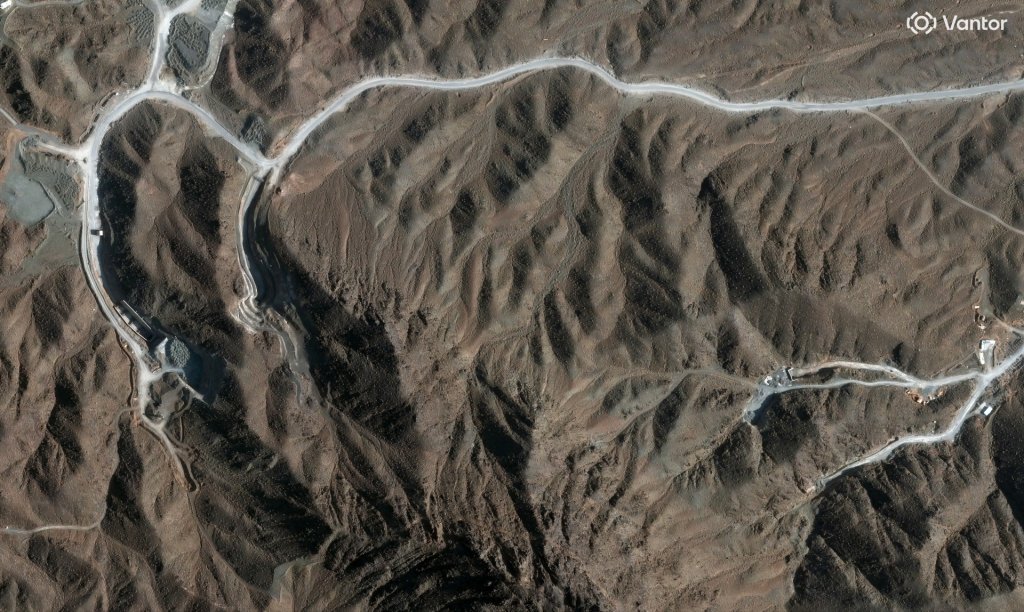
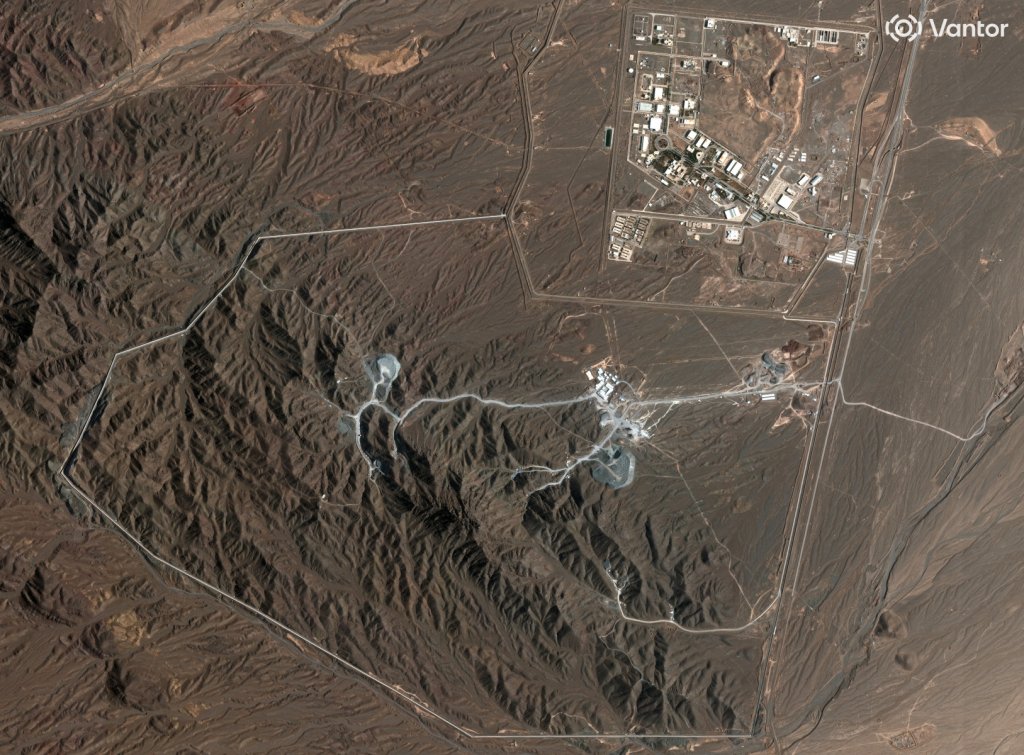
Work at a specialized underground weapons test site in New Mexico, contracted earlier this year, was linked to planning for a potential new operation targeting Iranian nuclear facilities, according to a report from CNN. The U.S. military has notably left Iran’s hardest-to-reach site under Pickaxe Mountain untouched so far, but President Donald Trump and other U.S. officials have been openly talking about striking it.
On February 27, the day before U.S. and Israeli forces launched their initial wave of strikes on Iran, the Pentagon’s Defense Threat Reduction Agency (DTRA) quietly announced it had awarded a sole-source deal to Pate Construction Co., Inc., for new construction at the so-called Alternate Seismic Hardrock in Situ Test (ALT-SHIST) site. The work was needed to support an upcoming classified live-fire test. ALT-SHIST is situated within the White Sands Missile Range (WSMR), a sprawling U.S. Army-managed complex in New Mexico’s Jornada del Muerto desert basin. DTRA is a relatively small and obscure organization that plays a leading role in U.S. military efforts to develop new and improved ways to respond to Weapons of Mass Destruction (WMD) threats.
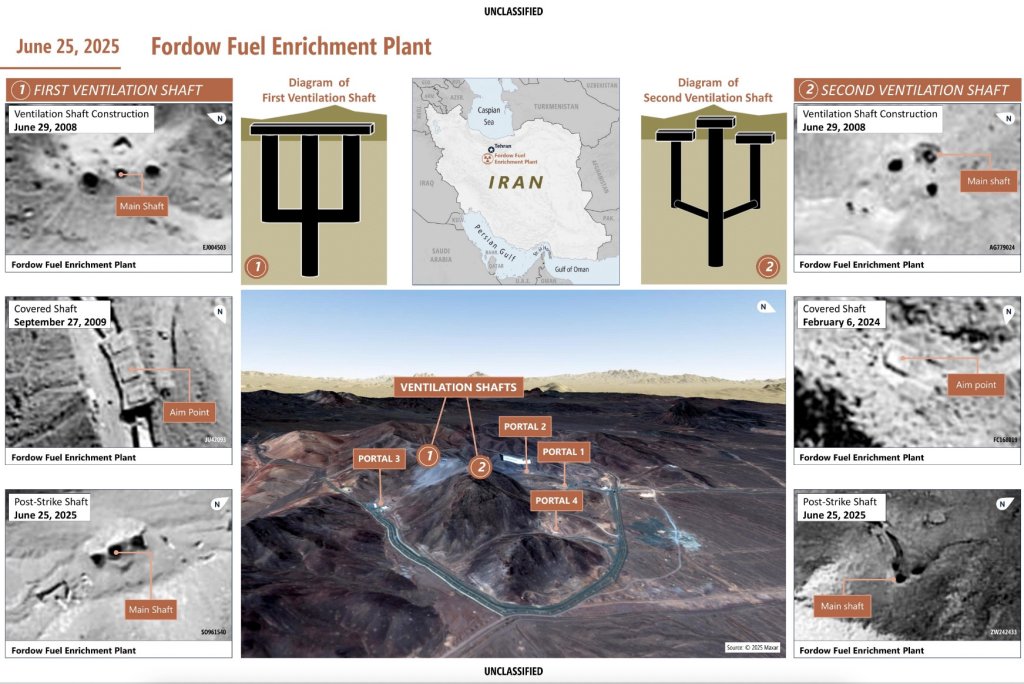
WSMR and DTRA have come up in discussions about strikes on Iran in the past. The U.S. military’s heaviest conventional air-dropped weapon, the 30,000-pound-class GBU-57/B Massive Ordnance Penetrator (MOP) bunker buster bomb, has been extensively tested at multiple sites there in the past. DTRA was also directly involved in its initial development. MOPs made their combat debut during U.S. strikes last year on underground Iranian nuclear facilities at Fordow and Natanz as part of Operation Midnight Hammer. The possibility has been raised that a different site within WSMR may have been used to test the plan of attack against Fordow, which involved two ventilation shafts being hit with six GBU-57/Bs each. The bombs were dropped in rapid succession, with each one burrowing deeper and deeper into the facility below. WSMR also happens to contain the site of the first atomic bomb test in 1945.
A map showing the general location of White Sands Missile Range, with an inset giving a better sense of how expansive it is. Holloman Air Force Base, which juts into the southern end of the range complex, is also highlighted. Google Maps
“The plans for the test [at ALT-SHIST] were connected to the Iran war,” CNN said in its story, published yesterday, citing unnamed sources “familiar with the matter.” Beyond that, the planned testing was tied to a “need to develop a way to target Iran’s deepest-buried underground facilities and, likely, simulate U.S. strikes against specific nuclear facilities.”
CNN said it was unable to independently verify whether or not the test in question had occurred.
A formal justification for the sole-source contract to Pate Construction that DTRA released in February did not mention Iran or elaborate on the need for the new testing at ALT-SHIST, but stressed there was an urgent requirement critical to U.S. national security.
“The services required are the immediate and mission-critical enabling services for a ‘real-world’ national security ordinance [sic; ordnance] test. This is not routine construction; it is the highly specialized remediation and operational preparation of a unique, subterranean test facility at White Sands Missile Range (WSMR),” according to the justification document, which DTRA officials had approved on February 24. “The work is a critical path dependency for a live-fire test designed to validate classified capabilities against rapidly emerging threats.”
“As the incumbent contractor for over a decade, Pate Construction Co., Inc. possesses unparalleled and non-transferable tacit knowledge of this specific subterranean test facility. This is a unique Government structure with complex geological and security considerations, and Pate Construction Co., Inc.’s direct, hands-on experience is a tangible asset that no other source possesses,” the document adds. “Pate Construction Co., Inc. is the only contractor that currently maintains a fully mobilized presence at WSMR with the specific heavy equipment and security-cleared operators required.”
CNN‘s piece says apparent work at ALT-SHIST was visible in satellite imagery of the site between mid-February and mid-March, but the outlet said it was unable to confirm whether or not this was related to the contract with Pate Construction.
We reviewed satellite imagery showing work at a remote DTRA/STRATCOM test site that coincided with this contracting action, but we couldn’t confirm its purpose.
The Pentagon didn’t respond to our questions regarding the test, and we couldn’t independently confirm it occurred. pic.twitter.com/k8zyvqWy56
ALT-SHIST is an active test site, and any work observed there earlier this year could well have been linked to other projects. For instance, additional publicly available DTRA contracting documents offer details about planned work on a specific part of the ALT-SHIST site, called Tunnel 7, tracing back to last year, as part of a project nicknamed Millstone Willemite 6 (MW-6).
“This task requires the construction contractor to repair and address the damage to Tunnel 7 caused by prior incidents, in accordance with government-provided designs, specifications, and other contract documents,” according to one contracting document dated September 15, 2025. “The contractor will also be responsible for providing support during testing activities, as well as safing after each test and general support between tests. All tunnel construction must be completed by 15 June 2027.”
“The contractor shall repair a D-shape tunnel and overburden using the D-shape of 20 feet depth and width, inside the tunnel. The contractor shall remove and repair any damage to the ribs, crown, and invert to Tunnel 7,” that same document continues. “After the repair of Tunnel 7, the contractor shall provide general construction support to instrument the tunnel in preparation for testing and then safe the tunnel for re-entry post-testing.”
The schedule for the MW-6-related work indicates that it is separate from what Pate Construction was hired to do at the site back in February.
A view out into a mountainous part of the White Sands Missile Range complex. USACE
ALT-SHIST, which was first established in 1995, is also not the only site DTRA makes use of within WSMR. As its name indicates, it is an alternate to the original SHIST site, use of which began in 1993.
“There was a small addition made to the SHIST site, but that area has been heavily used since 2007,” according to an environmental impact study the U.S. Army Corps of Engineers (USACE) completed in 2015. “The granite bedrock at these sites has been fractured and damaged by extensive testing. There are no existing granite areas adjacent to those sites where similar testing can be performed.”
A map showing the relative locations of SHIST and ALT-SHIST, as well as other test sites, at the northern end of the WSMR complex. USACE
USACE conducted that study in support of the establishment of a new test site at WSMR, simply called the Granite Test Site, to succeed the original SHIST. The Granite Test Site is now in use. There are many more sites within the range complex designed to simulate underground and otherwise hardened targets. This is also just one aspect of the wide array of testing that occurs on a daily basis at WSMR.
All three also appear to have been involved in the testing and development of the Massive Ordnance Penetrator (MOP). 5/10 pic.twitter.com/3aWSYXIZln
However, the presence of large areas of undisturbed granite is a key factor here, as that is particularly relevant for testing weapons designed to penetrate into extremely deeply buried facilities. CNN‘s piece yesterday noted that Iran’s Pickaxe Mountain site is built underneath a granite mountain.
“The mountain in White Sands, they specifically picked mountainous areas that were solid rock, and they used state-of-the-art tunneling technology to make the kind of cavities in the mountain that you would put this kind of [Iranian nuclear] facility in,” Gary Stradling, a retired scientist who previously worked for the Department of Energy’s Los Alamos National Laboratory (LANL), told TWZ in an interview last year. “I think that there is a lot of work that DOD has done in these kinds of facilities that is highly classified, and I couldn’t talk to you about it. This is very sophisticated work. It is not casual, and it’s not speculative. These are real experts who are doing the work. Careful, technical, quantitative work to be able to deliver this kind of war-fighting capability to the services.”
TWZ spoke to Stradling, who did work tied to earth-penetrating munitions at various points during his lengthy career, in the wake of Operation Midnight Hammer.
Me, standing at the edge of a MOP crater on a mountain top at White Sands Test Range, where detailed studies of massive earth penetrators were studied for effectiveness against deeply buried targets by the Defense Threat Reduction Agency (DTRA) —formerly Defense Nuclear Agency.… pic.twitter.com/JYq1V2xO6q
The U.S. military notably did not strike Pickaxe Mountain, which is situated immediately to the southwest of Iran’s nuclear facility at Natanz, during Operation Midnight Hammer. The site also went untouched by Israel during last year’s 12 Day War. American and Israeli forces did not target it during major combat operations earlier this year, either. All of this underscores the targeting challenge the site presents, even for strikes using MOPs, which TWZ explored in detail earlier this year and that has continued to make it a point of particular discussion.
CNN‘s report yesterday was primarily focused on a new assessment of ongoing construction at Pickaxe Mountain from the Center for Strategic and International Studies (CSIS) think tank in Washington, D.C.
Satellite “images reveal more road activity at Pickaxe Mountain in 2026 than at any point in the site’s history,” according to a report CSIS published yesterday. “There is a clear surge in construction activity in 2026 that corresponds to the raising and hardening of the portal accesses, paving of the internal road network, reinforcement around access areas, and the flattening and removal of excavation spoil.”
“This assessment can neither refute nor substantiate the Israeli intelligence claim that Iran moved centrifuges into Pickaxe Mountain,” CSIS’s report also noted. “The continuous construction, the absence of an increased internal security posture, and the lack of observed nonconstruction vehicles and equipment suggest the underground facility is not yet capable of enrichment work, if that is the intended purpose. Further analysis of daily activity would be needed to establish the site’s pattern of life beyond its current construction footprint.”
This is in line with TWZ‘s own previous reporting on Pickaxe Mountain back in July, when there were already signs of growing activity following the establishment of a shaky ceasefire between the United States and Iran the preceding month. As we wrote at that time:
“As with the strikes on Fordow, multiple bombs could be dropped on the same impact point to try to penetrate further down into Pickaxe Mountain. Whether there might be similar ventilation shafts or other weak points that could be exploited at Pickaxe Mountain is unknown. …”
A graphic with details about the employment of MOPs on strikes at Fordow during Operation Midnight Hammer. DOD
“A strike ‘right in the front door’ on the tunnel entrances at Pickaxe Mountain would be another option to at least hamper access to the facility inside for a time. This could be combined with strikes aimed at sections of the tunnel networks that run deeper inside the facility, but that are still close enough to the surface to be reachable by available conventional munitions. For instance, MOPs may not be able to hit the main cavern areas, but they could possibly hit certain tunnels that might lead to them.”
“Even a combined strike on entrances and shallow tunnels at Pickaxe Mountain could still present certain challenges. Firm intelligence on exactly where the tunnels snake under the mountain could be limited, making it difficult to select the best impact points. This is exactly why the U.S. military has been investing heavily in advanced, void-sensing fuzes for MOP and other bunker buster bombs for decades now. These fuzes detect when a munition has penetrated into a sufficiently large space, such as a room or tunnel in an underground facility, to help maximize damage. Fuzes that can effectively ‘count’ floors also help to ensure the munition has burrowed sufficiently deep before detonating.”
…
“…the U.S. military could conduct follow-on strikes on the entry points at Pickaxe Mountain to disrupt any attempt to regain access, as well.”
“Destroying Pickaxe Mountain will be a scientific and targeting challenge,” CSIS also noted in its report yesterday. “It is an underground fortress buttressed by granite. It is one of the only facilities in Iran’s nuclear program that the United States has not yet struck. Structurally degrading Pickaxe Mountain requires more than just kinetic force – it takes actionable high-confidence intelligence and sophisticated mathematical modeling.”
With all this in mind, it is not at all hard to imagine how new testing at ALT-SHIST, as well as other sites, would be essential for exploring additional options for striking Pickaxe Mountain and/or other deeply-buried targets in Iran using MOPs and/or other munitions.
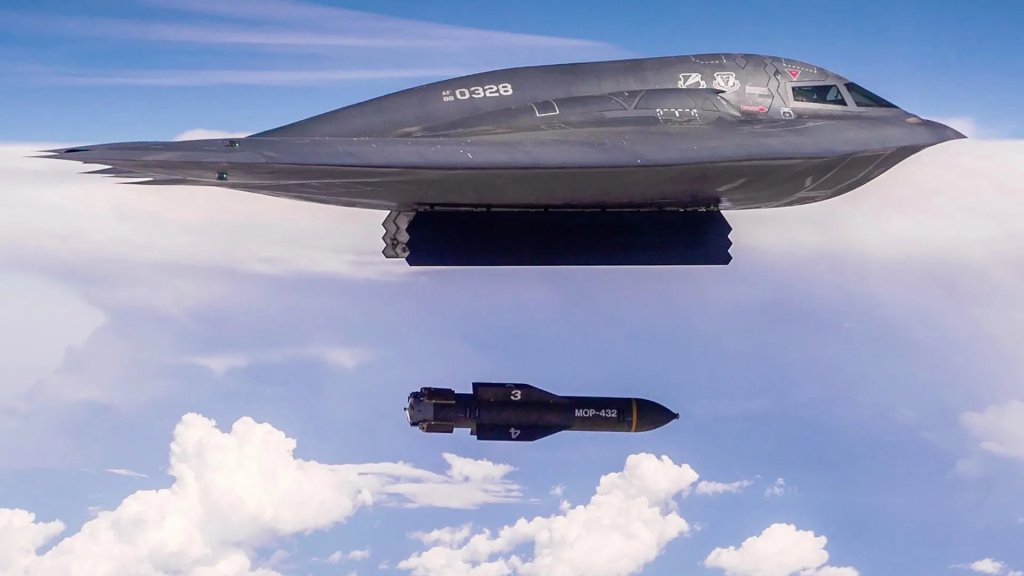
A US Air Force B-2 bomber drops a GBU-57/B MOP during a test. USAF
It’s also worth noting here that GBU-57/Bs are understood to be in relatively short supply, though it is unknown how many of them are currently in inventory. Furthermore, the U.S. Air Force’s B-2 Spirit bombers are currently the only aircraft certified to employ the huge MOPs operationally. There was a report in 2024 that prime contractor Boeing was working to expand its capacity to produce these bombs. A MOP successor, the GBU-76/B Next Generation Penetrator (NGP), is in development now, but prototyping work is expected to run through the end of Fiscal Year 2028.
President Donald Trump certainly has raised the prospect of a strike on Pickaxe Mountain publicly on several occasions since July. He has also repeatedly said that the site is being persistently surveilled, particularly from space.
“There’s another place called Pickaxe Mountain, another nice place. We may have to give them a shot there, too, because someone said there was a little movement at the site,” Trump said yesterday during a speech at a convention the Republican Party is hosting in Dallas, Texas, ahead of this year’s midterm elections. “We don’t need much. We see everything, you know, because of Space Force.”
“We may hit Pickaxe [Mountain] very soon,” the President also said while speaking to reporters at the White House last Friday.
Trump on Pickaxe Mountain: We may have to give them a shot there too. We see everything. We can the see tag on their coat. “Muhammad Al-Fayed” It’s never Muhammad Jones. pic.twitter.com/UQm939OruL
Whether growing activity at Pickaxe Mountain finally prompts a U.S. strike at the site, either alone or as part of a larger operation, remains to be seen. If and when such a mission is launched, past and future testing at sites like ALT-SHIST in New Mexico will all but certainly have played an important part.
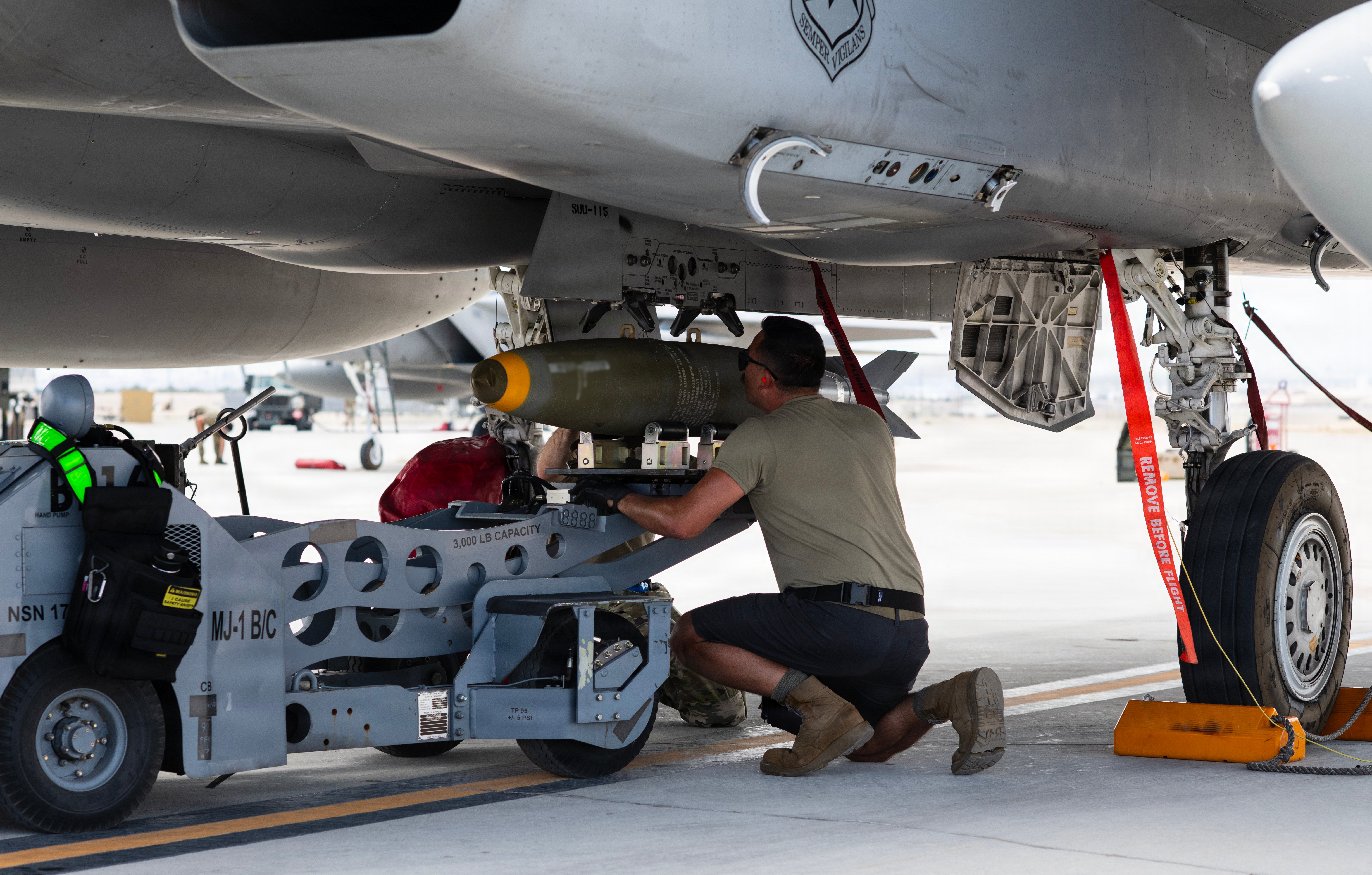
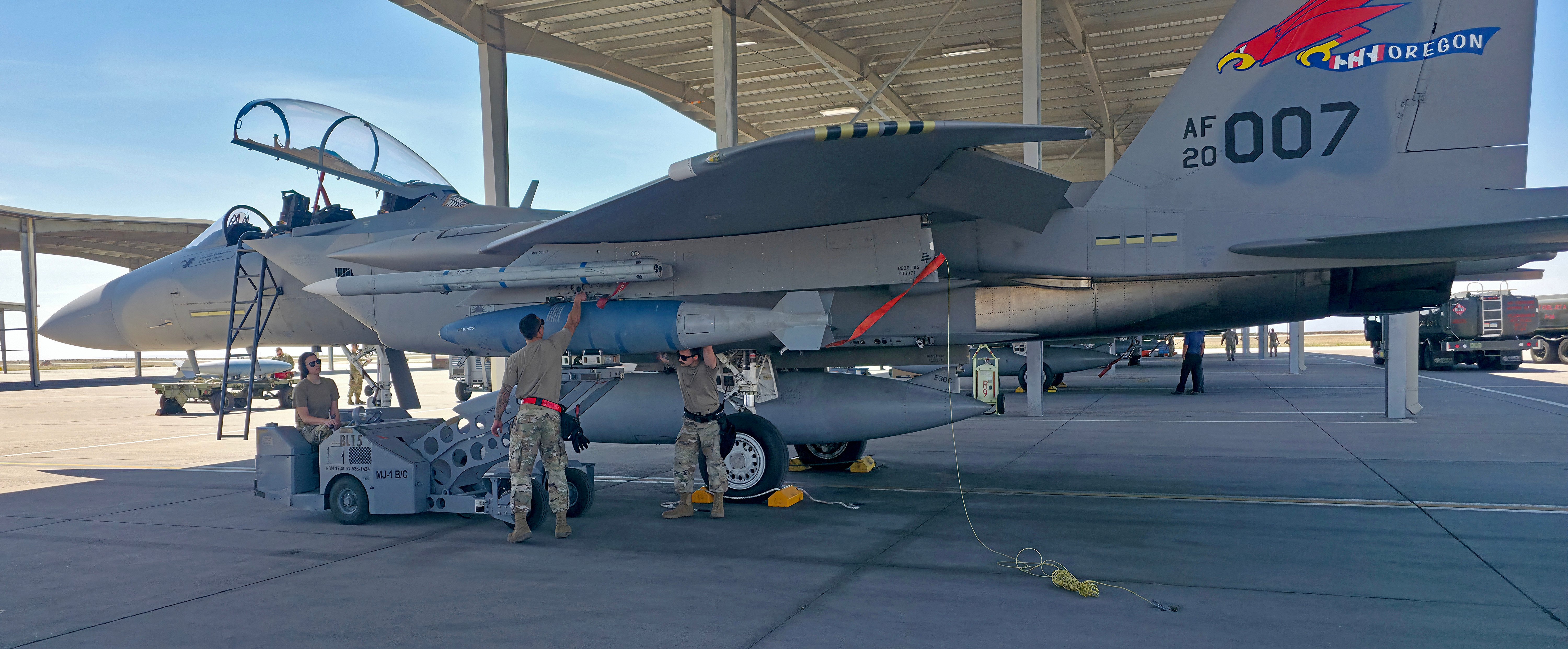
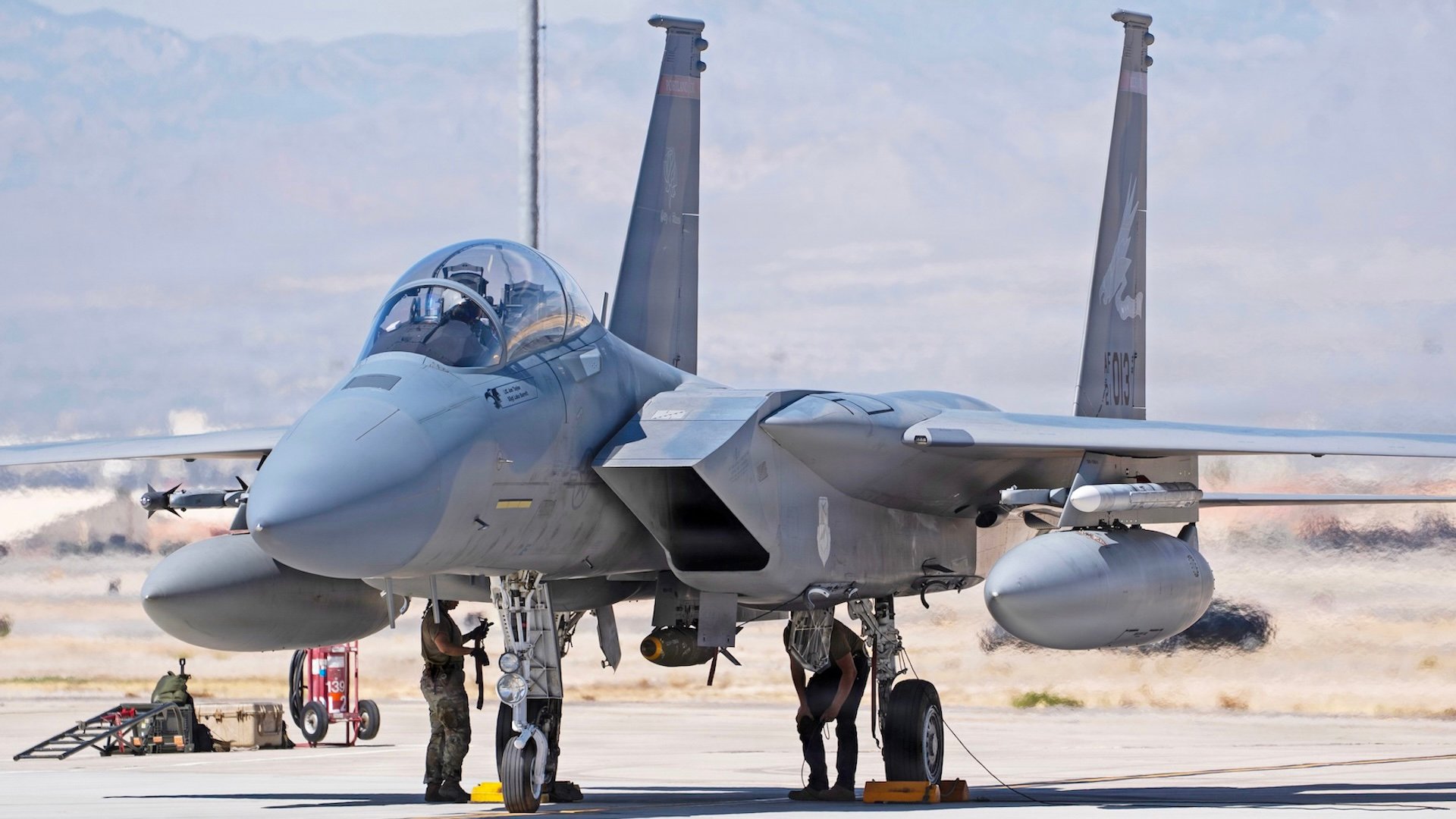
The Oregon Air National Guard’s 142nd Wing has taken another significant step toward turning the F-15EX Eagle II into a true multirole fighter, conducting the first live-bomb drops from operational F-15EXs during training at Nellis Air Force Base, Nevada. The milestone came during a roughly three-week deployment to Nellis in late August and early September in support of the U.S. Air Force’s Weapons Instructor Course (WIC).
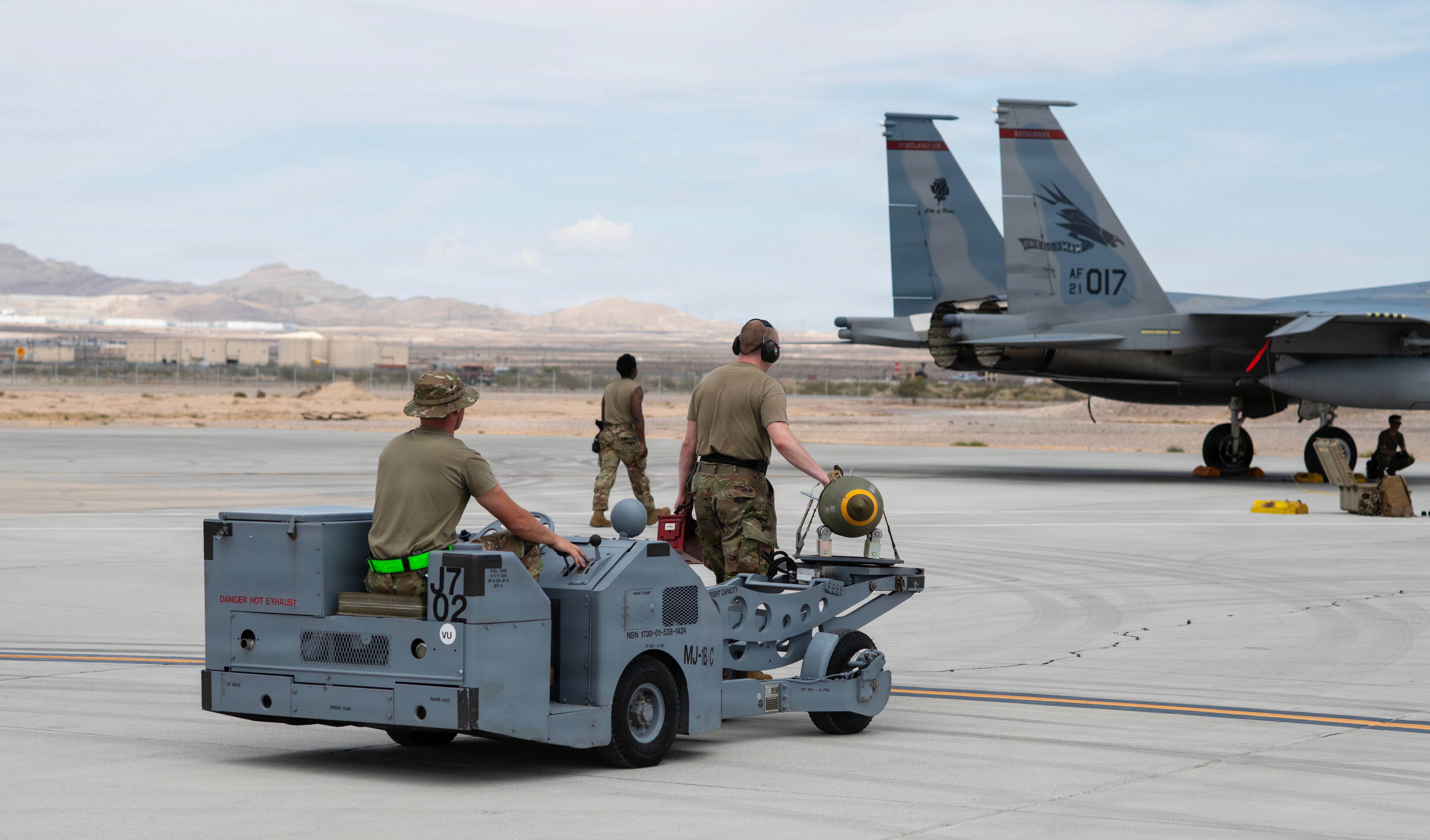
Weapons technicians from the 142nd Aircraft Maintenance Squadron load a bomb onto an F-15EX at Nellis Air Force Base, Nevada on August 27, 2026. U.S. Air National Guard photo by Master Sgt. Steph Sawyer
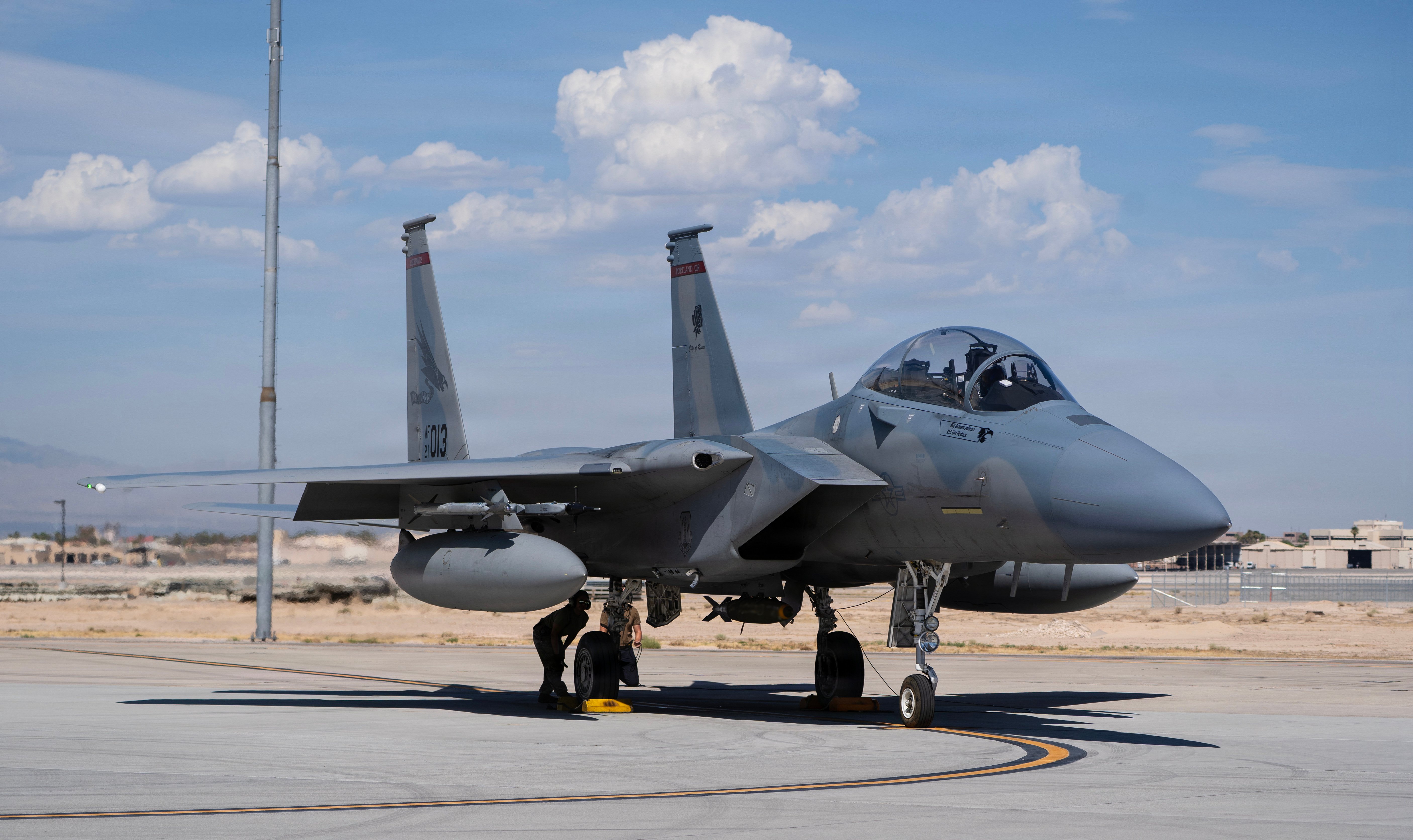
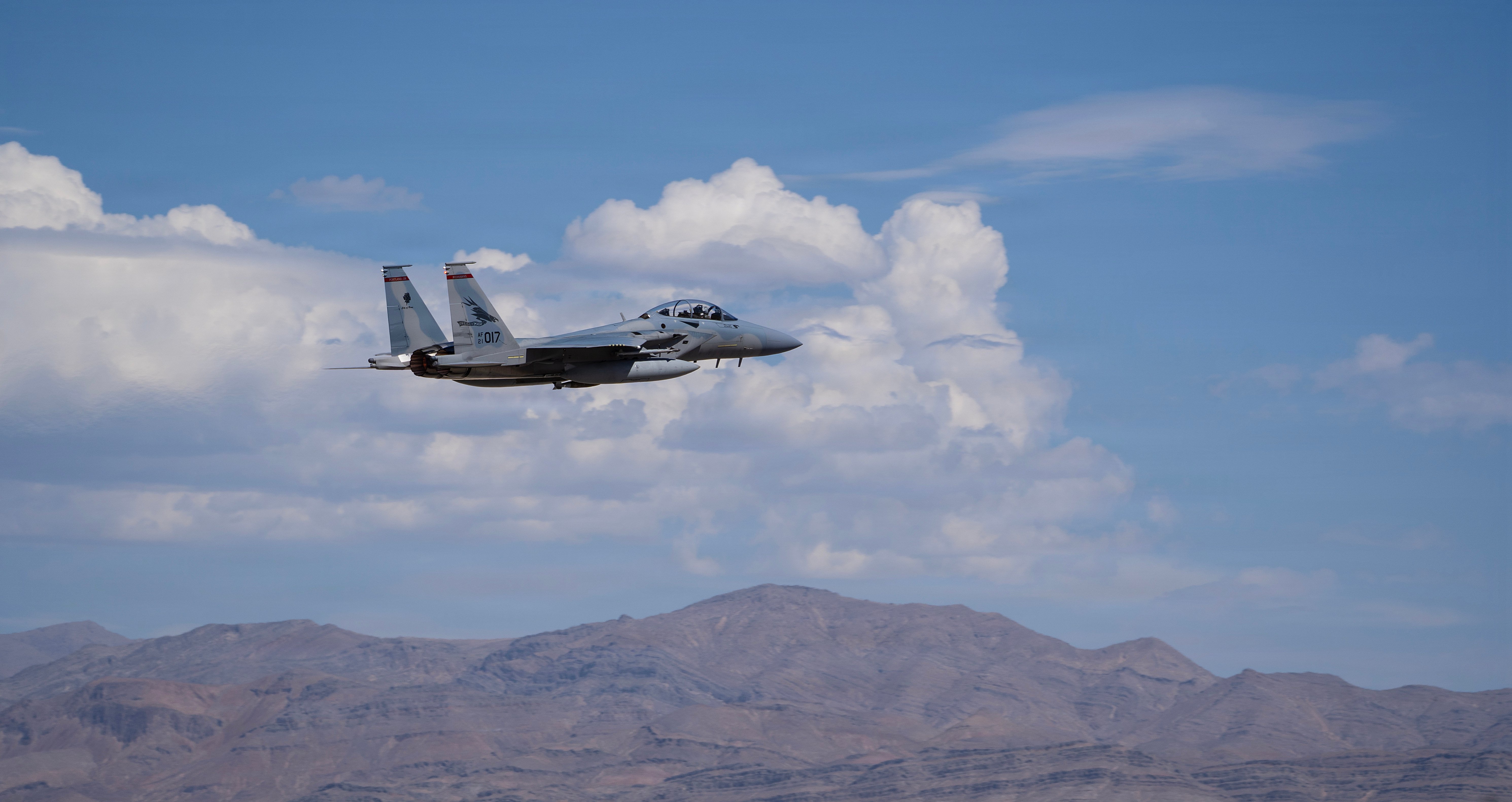
Photographs released by the Air National Guard yesterday show F-15EXs from the 142nd Wing carrying live bombs on the flight line and departing Nellis with the weapons loaded. Official imagery shows the jets armed with a single 500-pound Mk 82 freefall bomb on the fuselage centerline, while spotters also captured F-15EXs carrying a 2,000-pound Mk 84 freefall bomb in the same position.
The 142nd’s F-15EXs are only now acquiring a capability that was deliberately absent from the wing’s previous F-15C fleet. The Portland, Oregon-based unit was an air-superiority organization when it operated the F-15C, while the F-15EX is ultimately derived from the F-15E Strike Eagle and has considerably more inherent multirole potential.
As we reported in July, the wing had already begun laying the groundwork for this transition. In May, 142nd personnel traveled to Mountain Home Air Force Base, Idaho, where they loaded and dropped inert BDU-50 and BDU-56 training bombs from their F-15EXs. Those weapons replicate the size and weight of 500-pound-class Mk 82-series and 2,000-pound-class Mk 84-series bombs. Over 10 missions, the crews dropped 24 BDU-50s and 12 BDU-56s.
A BDU-56 is loaded onto an F-15EX assigned to the 142nd Wing during a training mission at Mountain Home Air Force Base, Idaho, in May 2026. U.S. Air Force
While the F-15EX had already been tested in an air-to-ground role by the Air Force’s test community, the Mountain Home deployment was the first time an operational Eagle II unit had loaded and dropped bombs. The next step, the wing said at the time, would be live weapons employment at Nellis.
The Air Force has emphasized that the F-15EX’s primary mission remains defensive and offensive counter-air, particularly in the homeland-defense role. At the same time, the service’s plans call for the aircraft to provide combatant commanders with strike packages capable of operating in contested environments.
An F-15EX fires an AIM-120D missile during a test mission near Eglin Air Force Base, Florida. The F-15EX can carry up to 12 AIM-120 missiles. U.S. Air Force photo by Tech. Sgt. John Raven
The F-15EX is inherently well suited to such a mission. Derived from the Strike Eagle lineage, it combines that aircraft’s large payload capacity and long range with substantially modernized avionics and electronic warfare systems. The aircraft’s design leaves considerable room for additional weapons and mission equipment, making an expansion into air-to-ground operations relatively straightforward compared with trying to add that capability to the F-15C.
The 142nd has been building the institutional knowledge required to make that transition. Three of its pilots underwent a nine-month course covering the science, tactics, and procedures associated with air-to-ground weapons employment before returning to help establish the wing’s training program. Weapons personnel also traveled to Nellis earlier this year to work with F-15Es assigned to the 59th Test and Evaluation Squadron and become certified in bomb loading procedures.
An F-15EX Eagle II assigned to the Oregon Air National Guard’s 142nd Wing sits on the flight line at Nellis Air Force Base, Nevada with a live bomb attached to its belly as it prepares for takeoff on August 27, 2026. U.S. Air National Guard photo by Master Sgt. Steph Sawyer \
As well as teaching pilots how to release a weapon, the wing had to develop an entirely new air-to-ground training pipeline for pilots, maintainers, and weapons personnel at a unit that had not previously operated an aircraft with an operational bombing mission.
Nellis is home to the Air Force’s Weapons School and is central to the Weapons Instructor Course, making it one of the most important locations in the service for developing and evaluating advanced tactics. The 142nd’s participation therefore places its emerging F-15EX air-to-ground capability in an environment specifically focused on integrating advanced weapons, tactics, and mission planning.
A weapons loader assigned to the 142nd Aircraft Maintenance Squadron prepares a bomb to be loaded onto an F-15EX at Nellis Air Force Base. U.S. Air National Guard photo by Master Sgt. Steph Sawyer
The wing’s new live bomb-dropping capability also comes as the Air Force continues to explore how broadly the Eagle II can be employed.
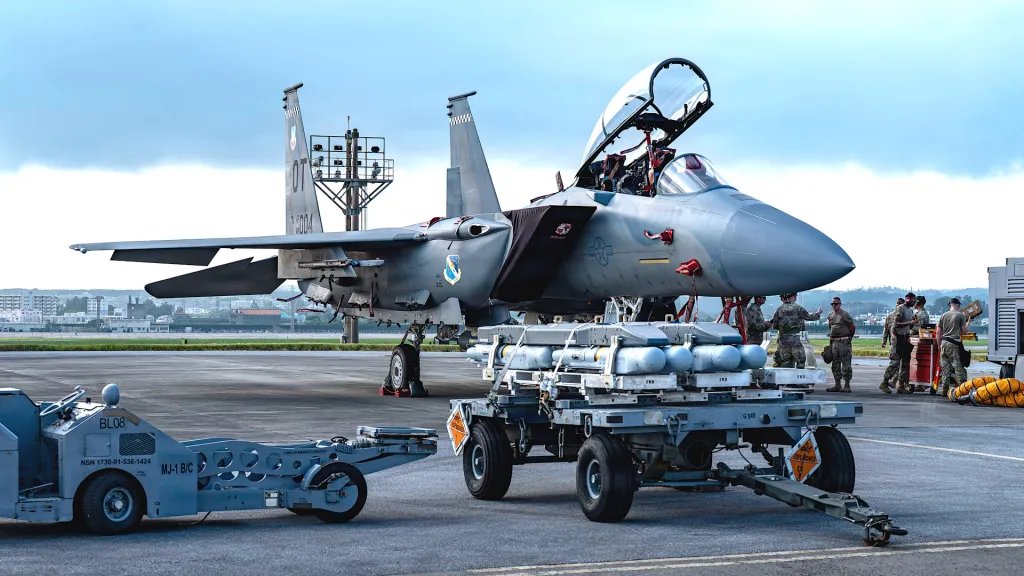
Test and evaluation units have already demonstrated that the aircraft can accommodate sophisticated air-to-ground weapons. Earlier this year, an F-15EX from the 85th Test and Evaluation Squadron participated in a munitions-load training event at Kadena Air Base in Japan, where Air Force personnel practiced loading live GBU-53/B Small Diameter Bomb IIs onto the aircraft.
GBU-53/B Small Diameter Bomb IIs sit on a dolly in front of an F-15EX from the 85th Test and Evaluation Squadron during a training event at Kadena Air Base, Japan, on July 8, 2026. U.S. Air Force
The F-15EX is also capable of carrying the conformal fuel tanks used by the F-15E, which can provide additional fuel as well as additional weapons stations. The operational F-15EXs delivered to the 142nd have so far been seen without CFTs, however, and the status of the plan to equip the Oregon aircraft with them remains unclear.
CFTs could become increasingly important if the Air Force moves toward more demanding air-to-ground missions for the Eagle II, particularly those requiring substantial weapons loads and long-range operations.
Another unresolved question is how the Air Force will ultimately crew F-15EXs when they are performing more complex multirole missions.
A weapons loader assigned to the 142nd Aircraft Maintenance Squadron loads a bomb onto an F-15EX at Nellis Air Force Base. U.S. Air National Guard photo by Master Sgt. Steph Sawyer
The Eagle II retains the F-15E family’s two-seat cockpit, although the Air Force’s initial operational concept has generally involved flying the aircraft with a single pilot. That leaves an unused cockpit that could potentially become an important asset as the mission set expands.
Former 142nd Wing commander Col. Michael Kosderka previously told TWZ that the addition of a weapons systems officer or other specialist in the rear cockpit could open the door to more air-to-ground capabilities.
“We can start talking about putting all kinds of air-to-ground capabilities into the airplane, potentially putting WSOs or other experts in the backseat as well to have us do any number of multi-role capabilities that it’s just physically not possible to in the C model,” Kosderka told TWZ in an interview back in 2024. “So the X has tremendous growth capability. It’s really exciting.”
The Weapons School has also been associated with developing two-seat F-15EX operations, indicating that the second cockpit’s utility is already being considered at the tactical-development level.
142nd Aircraft Maintenance Squadron weapons loaders transport a bomb to an F-15EX at Nellis Air Force Base. U.S. Air National Guard photo by Master Sgt. Steph Sawyer
For now, it would be premature to characterize the F-15EX as an operational replacement for the F-15E Strike Eagle in the air-to-ground role. The 142nd’s newly demonstrated bombing capability remains part of an ongoing training and development process.
The Air Force has announced plans to base F-15EXs at Seymour Johnson Air Force Base, North Carolina, where they will eventually replace older F-15Es, which, in turn, are slated to move to Whiteman Air Force Base, Missouri, as part of a broader realignment of the Eagle fleet.
Another two active-duty F-15EX squadrons are slated to replace the former F-15C force at Kadena. The first F-15EX for permanent assignment at Kadena recently departed Boeing’s St. Louis, Missouri, facility for the 142nd Wing, where it will undergo final preparations before its eventual deployment to sprawling Okinawa.
An F-15EX assigned to the 142nd Wing takes off from Nellis Air Force Base with a bomb attached to its belly, August 27, 2026. U.S. Air National Guard photo by Master Sgt. Steph Sawyer
The operational implications of the air-to-ground training therefore extend well beyond Portland.
The Eagle II’s generous weapons payload, long range, modern sensors and electronic warfare systems, and ability to carry both air-to-air and air-to-ground weapons give the Air Force a platform that can potentially perform several missions without sacrificing the characteristics that make the F-15 attractive for homeland defense and counter-air operations. The same characteristics are also extremely relevant to any export operator, which would expect to operate the Eagle II in a multirole capacity.
As well as a weapons-training milestone, the first live-bomb drops by the 142nd Wing provide more evidence that the F-15EX’s mission is continuing to evolve.
In a quiet corner of Hadrian’s Villa, wedged between the so-called Amphitheater and a low bench of volcanic tufa rock, sits a marble slab measuring roughly 40 by 35 centimeters (about 16 by 14 inches). It has not moved in some 1,900 years. Two lines of carved capital letters explain why archaeologists are excited: FVLGVR […]
Brazil is now in the last weeks before the presidential election on October 4, during a severe institutional crisis involving the Supreme Federal Court (STF), the Federal Police, and the government of President Luiz Inácio Lula da Silva. In the middle of the latest chapter of the crisis is Justice André Mendonça’s decision to suspend […]
Péter Magyar’s government has officially announced a foreign policy break with Viktor Orbán’s course; however, this rhetorical shift toward the European consensus poses serious risks for Hungary due to the country’s continued critical dependence on Russian energy resources. On August 25, 2026, the government of Hungarian Prime Minister Péter Magyar published guidelines for Hungary’s delegation […]
How Multiculturalism Disunites Us California Democrats Move to Blacklist ICE Agents from State and Local Jobs https://wltreport.com/2026/09/07/california-democrats-move-to-blacklist-ice-agents-from-state-and-local-jobs/
On September 12, New Delhi will host one of the year’s most long-awaited events, namely, the 18th BRICS Summit. How has India’s presidency unfolded, what can we expect from the meeting, and why have experts started discussing the seemingly impossible intersection of Indian and Chinese interests? Principles in Action “Humanity first” and a “new format […]
The AfD’s victory in Saxony-Anhalt is not a triumph of right‑wing extremism but a signal that German voters are tired of a system that spends billions on rearmament and Ukraine while forgetting its own citizens. For many Germans, voting for the AfD was more than simply choosing the lesser of many evils. It was a […]
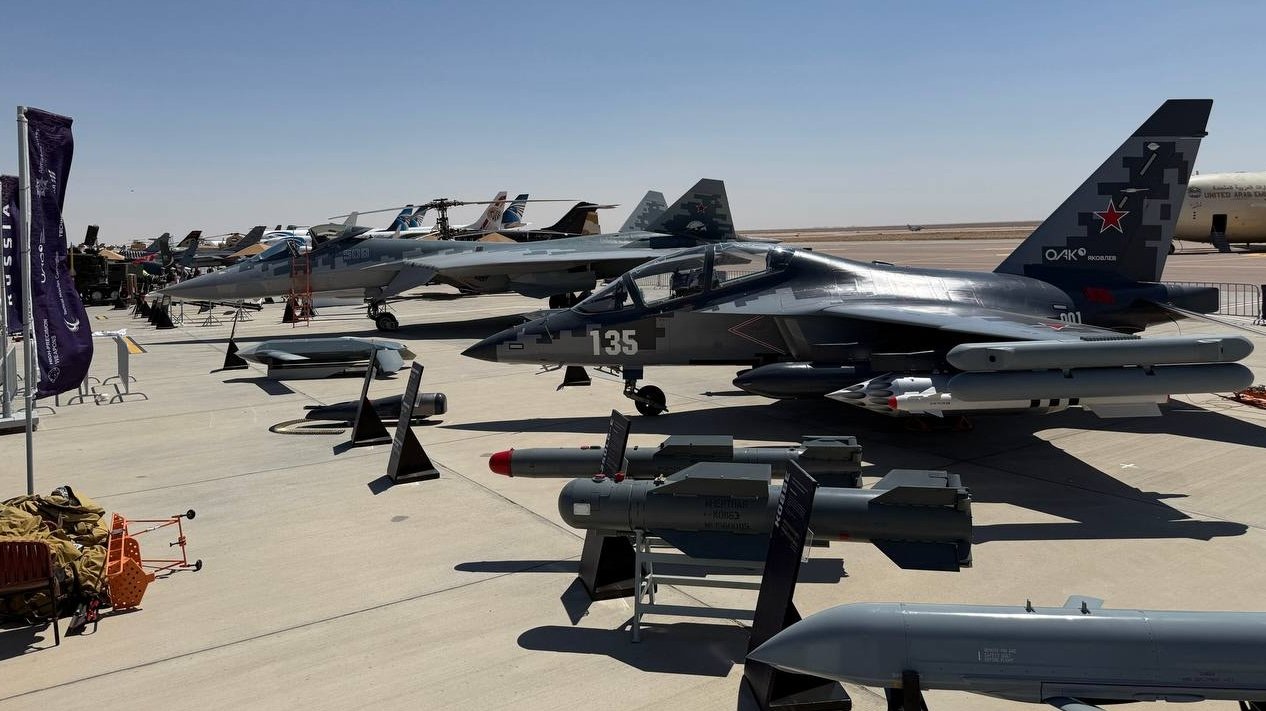
The weapons, seen in the tweet embedded below, comprise, clockwise from top left: S-71K Kovyor, an unknown smaller guided munition, S8000 Banderol, and S-71M Monokhrom:
For Russia, the requirement has become increasingly important as the war in Ukraine has evolved into a prolonged contest in which industrial capacity is as critical as technology. Russia has expended huge numbers of cruise and ballistic missiles against Ukrainian targets while also developing an enormous strike-drone campaign. At the same time, Ukrainian air defenses have become progressively more capable, forcing Moscow to use combinations of missiles, drones, decoys, and different flight profiles to penetrate or saturate the defensive network. One lesson is the fact that a weapon does not necessarily have to be as capable as a high-end cruise missile if it can be manufactured in much greater numbers and still present a credible threat to the target.
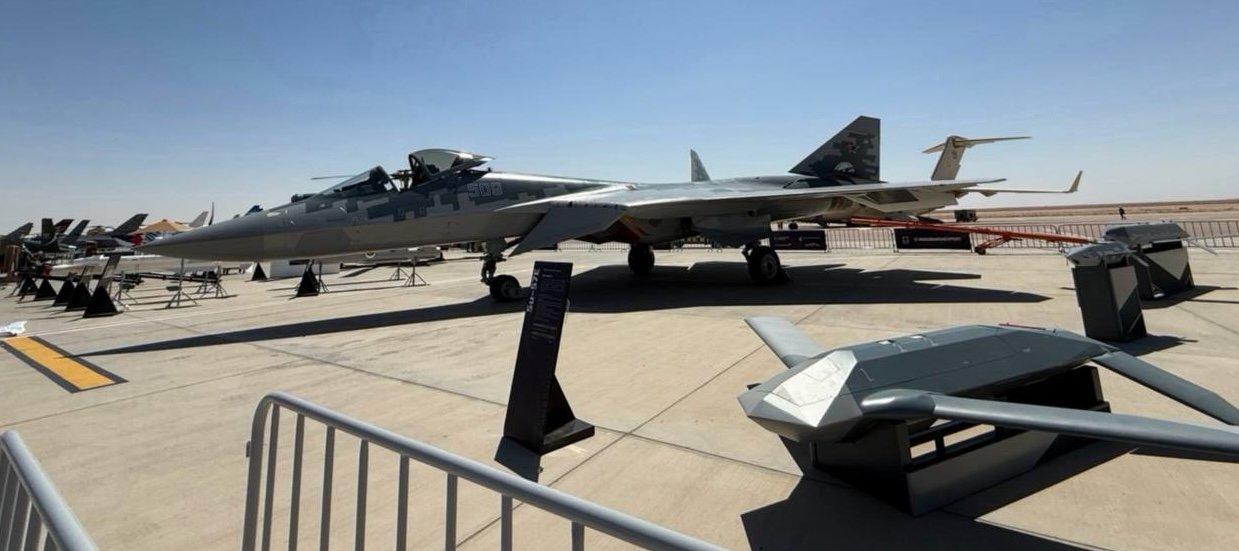
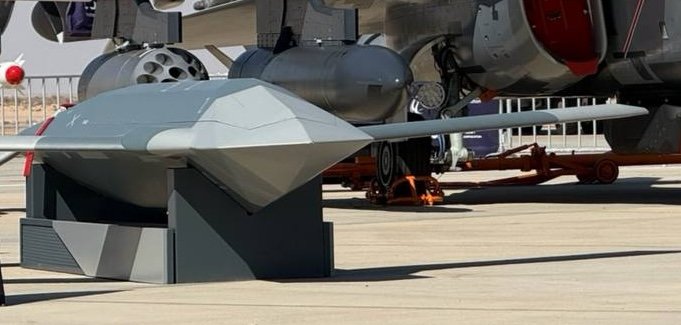
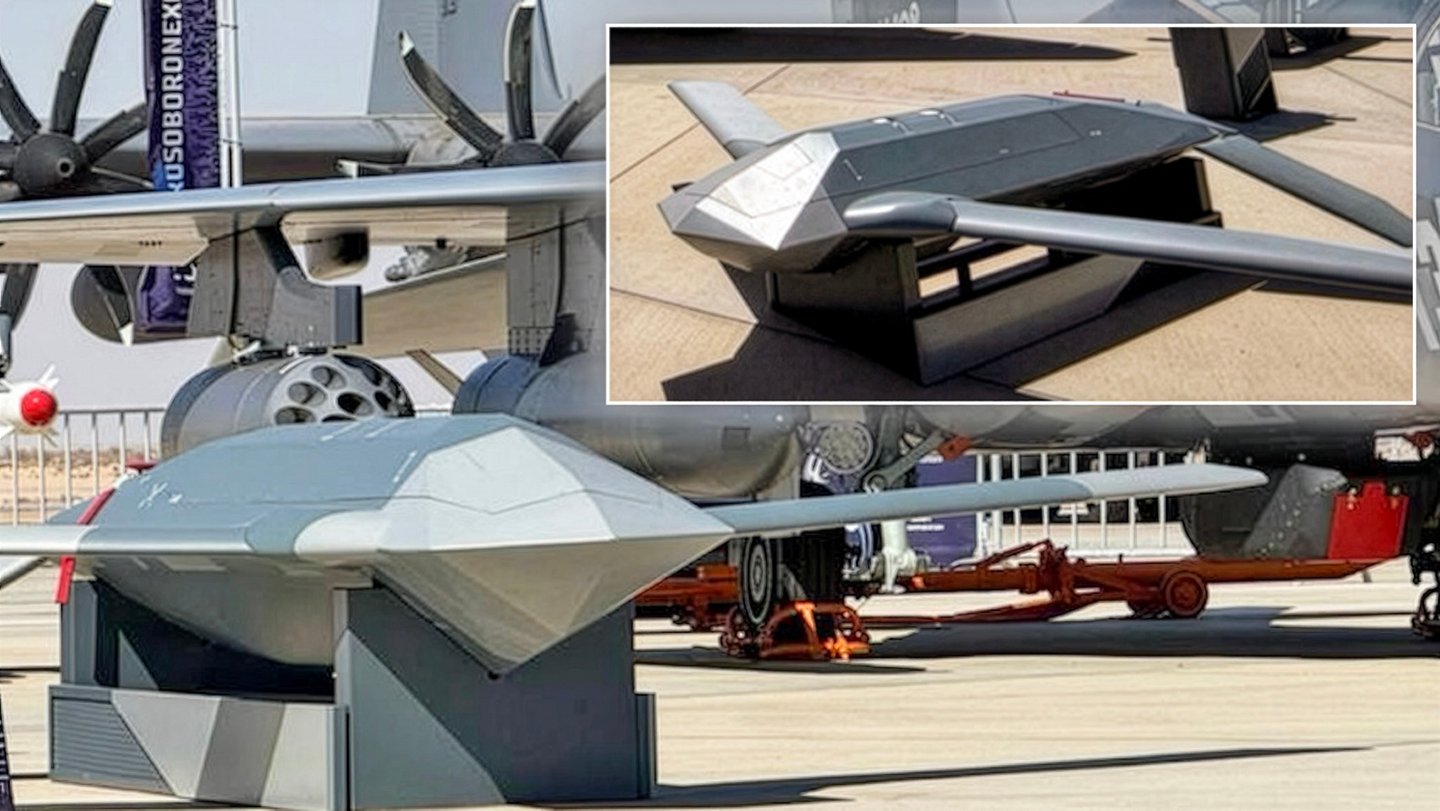
The S-71M, which TWZpreviously reported on in detail after Ukrainian intelligence obtained an example, is a compact, turbojet-powered weapon with a distinctly angular airframe intended to reduce its radar signature. Imagery from Egypt gives a better look at its front end, including a faceted nose flowing into a broad central fuselage. The nose has at least one optically flat transparency for an infrared or TV seeker. Its wings are sharply swept and fold against the belly of the weapon for carriage, while the rear of the weapon terminates in an inverted-V tail arrangement. The overall shape is notably different from Russia’s more conventional cruise missiles of the past.
An S-71M test article under the wing of a Su-57. via X
Ukrainian analysis found that the S-71M incorporates an OFAB-250-270 high-explosive fragmentation bomb as its warhead and relies primarily on inertial guidance, rather than carrying a sophisticated terminal seeker, although the seeker window raises questions about that.
Ukrainian intelligence also described its construction as being relatively straightforward, with fiberglass composite material making up much of the outer structure and no evidence identified of specialized radar-absorbing coatings.
As we noted previously, the weapon appears intended as a less expensive, but still survivable standoff weapon option that can be produced in significant numbers.
The S-71M has been tested from the Su-57 Felon fighter, also present at El Alamein. In a press release, the United Aircraft Corporation (UAC), responsible for the Su-57, said that the S-71M and the S-71K displayed alongside it “were designed for fifth-generation fighters,” although there is no reason why they couldn’t be launched from a wide variety of platforms.
A Su-57 performing at El Alamein, with one of its main internal weapons bays apparently loaded with Kh-69 standoff missiles:
T-50-9 in El-Alamein, opening both main weapon bays. Two, presumably, Kh-69 can be seen in the front one.
Regardless of launch platform, the nature of the war in Ukraine makes the S-71M particularly useful. Russia has increasingly relied on extemporized glide bombs for attacks against targets relatively close to the front, but those weapons require the launching aircraft to operate within a certain distance of Ukrainian defenses. At least in their earlier iterations, such weapons were also crude and prone to failure. Longer-range cruise missiles offer considerably greater standoff but are more complex and expensive. The S-71M sits somewhere between those categories, providing an air-launched, powered weapon with a relatively large warhead and some degree of low observability without the cost and complexity of a full-size, truly stealthy cruise missile.
The S-71K appears to represent a more capable version of the basic concept. Public information remains limited, but the weapon has been associated with electro-optical guidance and greater onboard processing, potentially giving it a capability to deal with targets in a more flexible manner than the largely pre-programmed S-71M. Exactly how that capability is employed, and how autonomous the weapon actually is, remain less clear from the imagery and information released to date.
An S-71K missile presented in front of a Su-57 Felon at El Alamein. UACA close-up of the same S-71K missile at El Alamein. UACA Su-57 undergoes trials with a pair of S-71K missiles under the wings. via X
As displayed at El Alamein, the S-71K retains the overall faceted, low-observable appearance of the S-71M but has a visibly different airframe and wing arrangement. Its body is notably broad and compact relative to its length, with folding wings that are relatively thick, and a more refined inverted-V tail giving it more the appearance of a small uncrewed aircraft than a conventional air-to-surface missile.
A rear view of a test S-71K under the wing of a Su-57. via X
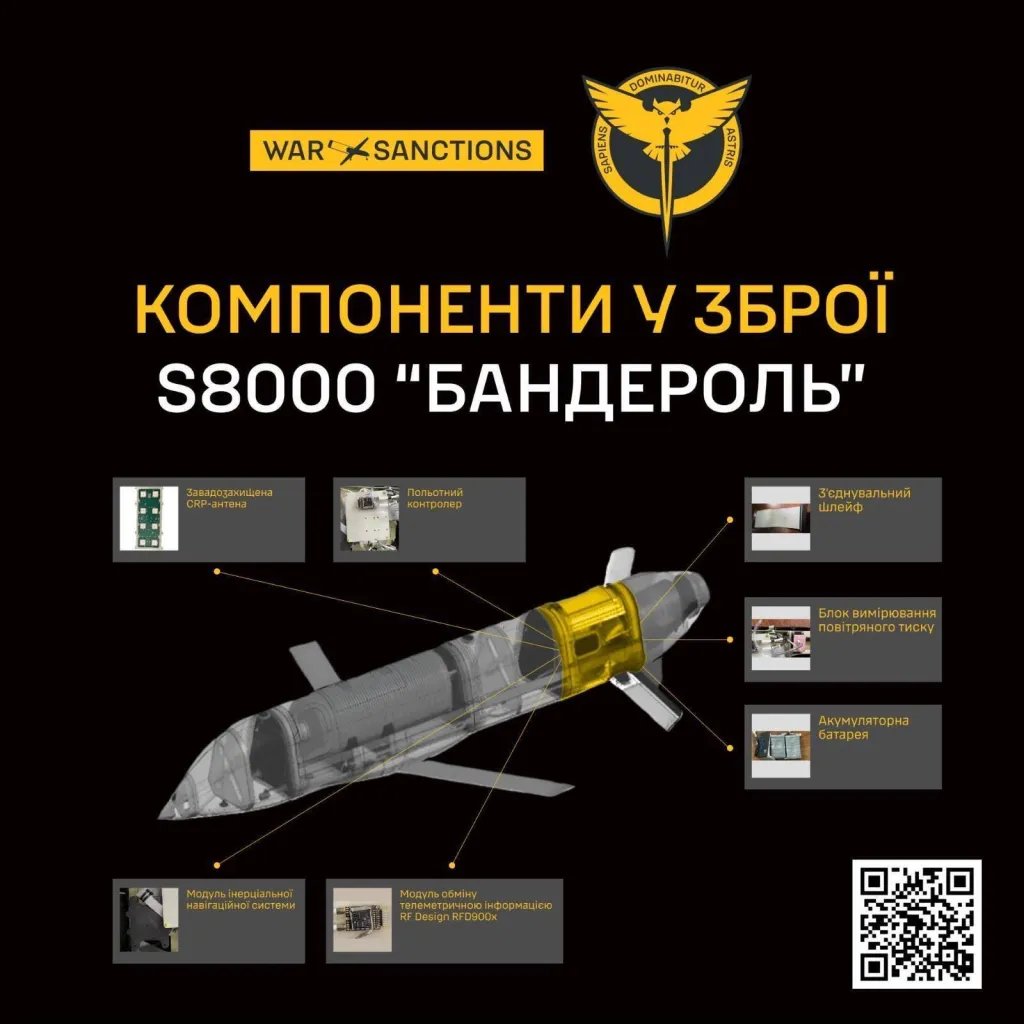
Meanwhile, the Banderol represents a somewhat different path to the same general problem. Ukraine’s intelligence service previously obtained and analyzed an example of the small jet-powered cruise missile, which TWZreported on last year. The weapon is considerably smaller than Russia’s principal cruise missiles and has been associated with launch from drones and helicopters. Its reported range of around 500 kilometers (311 miles) and relatively small warhead make it something of a complementary system intended to provide another, more economical way of putting a precision weapon onto a target from the air.
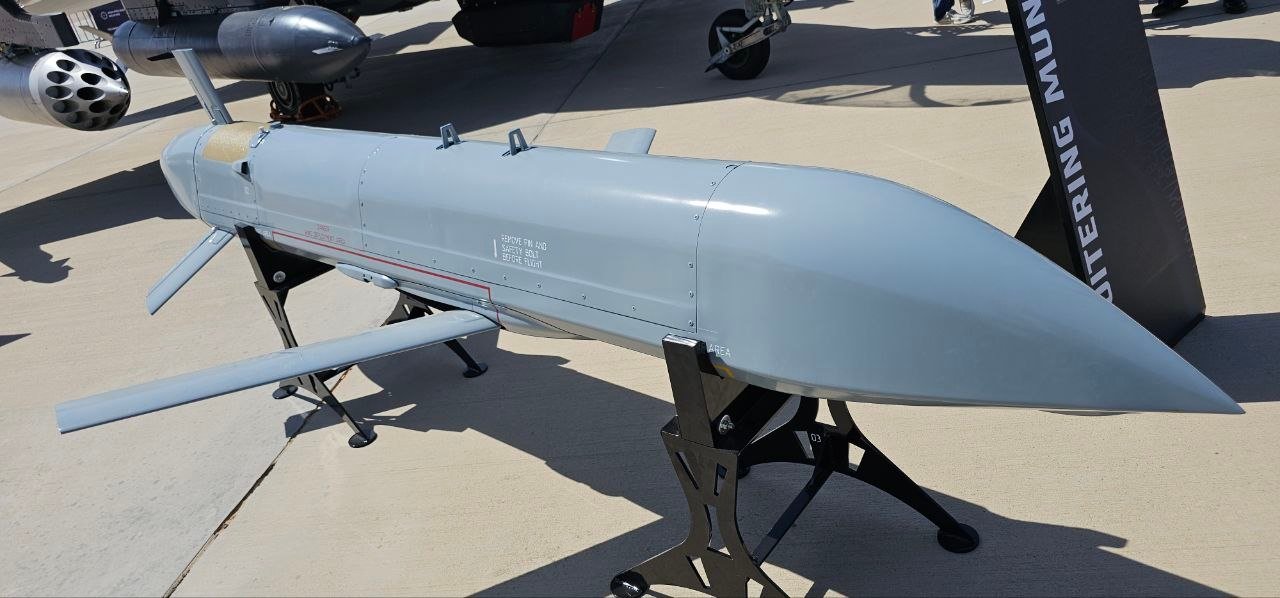
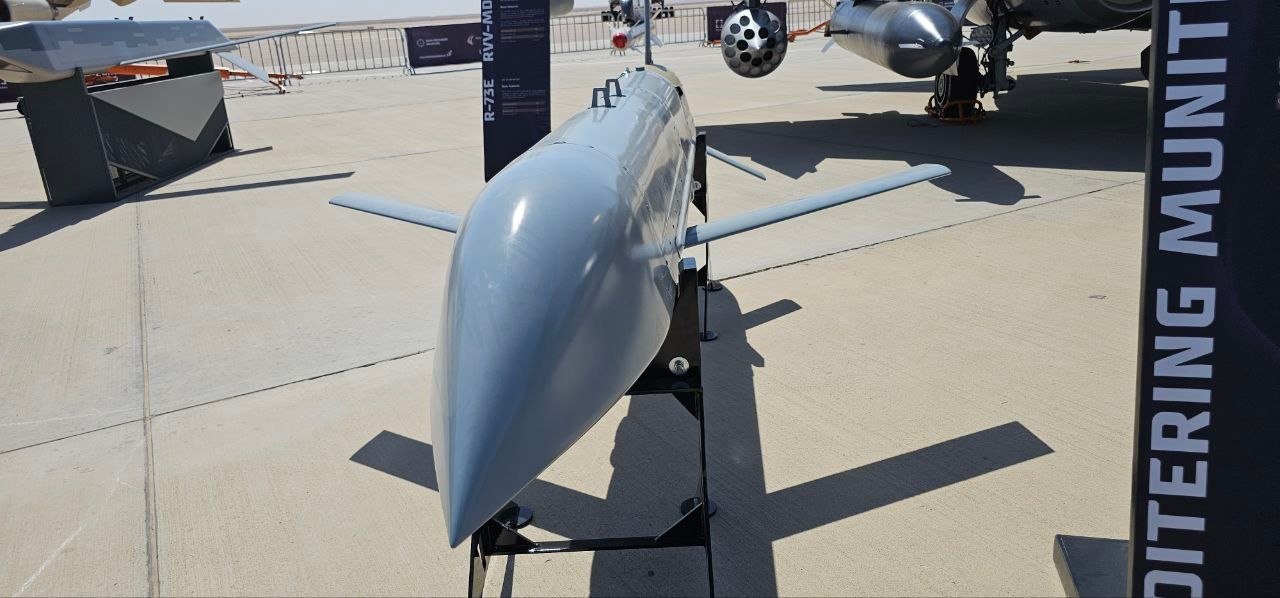
The front portion of a Banderol is seen nearest the camera in a line-up at El Alamein, which also includes a Yak-130M combat trainer and a Su-57. UAC
In terms of its appearance, the Banderol is more conventionally missile-like, with an ogival central fuselage, a pointed nose, and sharply swept folding wings. Its proportions underline just how small it is compared with Russia’s better-known air-launched cruise missiles.
An infographic prepared by Ukraine showing the Banderol cruise missile and some of its foreign-sourced components. GUR photo
The Banderol is particularly relevant in the context of the economics of the Ukraine conflict. Russian forces have increasingly used combinations of relatively inexpensive one-way attack drones and more expensive cruise and ballistic missiles. The drones can be produced in large numbers and used to complicate air-defense operations, while the more capable missiles provide greater speed, range, payload, or penetration capability. A small turbojet-powered weapon such as Banderol offers another point on that spectrum.
At least one image has recently emerged showing a Banderol carried by a Russian Mi-28NM Havoc attack helicopter. This would be in line with unconfirmed reports from Ukraine last month that Russia was using the Mi-28 as an additional launch platform for the weapon, including firing them from over the Sea of Azov to attack targets around Odesa.
An S8000 “Banderol” (“Dan-T”) small cruise missile mounted on a Russian Mi-28NM attack helicopter. pic.twitter.com/Xcx3MmFK3B
Its reported use also illustrates how the distinction between a cruise missile and a large one-way attack drone is becoming increasingly blurred. The Banderol incorporates a conventional missile-like airframe and jet propulsion but has been associated with drone operations and makes extensive use of commercially available components. TWZ’s earlier examination of the weapon also highlighted the extent to which modern Russian weapons programs can combine relatively simple airframes with foreign-sourced electronics and propulsion technology.
Russia has revealed an Orion (Inokhodets) UAV carrying the S8000 Banderol air-launched cruise missile, marking the clearest Russian footage yet of the weapon integrated with the drone. #Russia#Orion#CruiseMissile#Defensepic.twitter.com/yLHb7h1oW9
Likely Banderol loitering munition on the ground (perspective exaggerates it's size) and under Orion drone.
Banderol has been reported as one of the munition used in recent strikes and appears to use a jet engine and a FAB-100 warhead or similar. pic.twitter.com/j50DUsNuVe
Seen together at El Alamein, the three weapons provide an unusually useful snapshot of where Russian air-launched strike development is heading. They are presented alongside a fourth, so-far unidentified munition. This unnamed weapon is notably short and fat, with a cruciform tail, and an optical window in the nose. Its overall size and shape suggest it may have been developed specifically to arm drones.
The appearance of the weapons at an arms fair underscores the fact that Russia is not the only country confronting the problem of producing and fielding sufficient precision weapons at an acceptable cost. The growing interest in lower-cost cruise missiles, loitering munitions, attritable aircraft, and other forms of expendable precision strike is now evident well beyond Russia.
Russia is also clearly trying to make these weapons harder to intercept, an increasingly important consideration as Ukrainian air defenses have demonstrated an ability to shoot down even glide bombs in some circumstances. The S-71K in particular incorporates unusually pronounced low-observable shaping, suggesting that survivability was also a central requirement from the outset.
There is, however, a significant complication to Russia’s attempt to turn its wartime experience into an export opportunity. Buying any kind of weapons from Moscow has become considerably more difficult because of sanctions, restrictions on access to foreign technology and financing, and the wider political risks associated with maintaining a Russian defense relationship. Those factors matter just as much to a prospective customer as the performance of the weapon itself.
Author’s note: earlier reporting on the S-71 family appears to have transposed the S-71K and S-71M versions. Most authoritative accounts now indicate that the more refined, more stealthy version is the S-71K Kovyor (meaning carpet), while the simpler weapon is the S-71M Monokhrom.
Update, September 9:
Rostec, the Russian state-owned defense conglomerate, has provided more details of the weapon identified at El Alamein as the Banderol. Rostec calls this weapon the ‘Dan-T’ loitering munition, which is an export designation for Banderol.
According to Rostec:
The ‘Dan-T’ munition operates on a ‘fire-and-forget’ principle and is adapted for launch from Russian and foreign aircraft and helicopters. The munition is equipped with a compact jet engine and can strike targets at a range of hundreds of kilometers. The ‘Dan-T’ features a special flight mode designed to evade enemy air defence systems.
Rostec adds that the Dan-T has been combat-tested in the war in Ukraine, where it claims there have been “hundreds of successful launches” against enemy targets in the Special Military Operation zone. “We expect this munition to attract widespread interest from foreign customers,” said Rostec.
On 2 September, Norwegian authorities detained Russian state-owned research vessel Professor Molchanov at Barentsburg in Spitsbergen (Svalbard), following a lawsuit filed by Ukraine’s Naftogaz.
At first sight, the detention of the Russian research vessel appears as a routine event in Norway’s long-standing strategy to oust Russia from Spitsbergen and establish absolute sovereignty of the archipelago—free from the legal restrictions stipulated by the 1920 Spitsbergen (Svalbard) Treaty. At closer sight, it opens a loophole for expropriating Russian property on the archipelago. But more importantly, trying to accommodate the current geopolitical situation to its national legal proceedings and violating the 1920 Treaty by placing national law above international law, Norway has driven itself into a legal trap.
Article 32 of the 1982 UN Convention on the Law of the Sea (UNCLOS) states that state-owned vessels operated for non-commercial purposes enjoy sovereign immunity from foreign jurisdiction. Naftogaz, long pursuing Russian assets, claims that the research vessel’s visits to Spitsbergen had predominantly commercial purposes.
Norway portrays the incident as a purely technical matter based on national legislation. According to the Norwegian Ministry of Justice, its decision followed the 2023 ruling of the Permanent Court of Arbitration in the Hague as an enforcement of an approximately $4.22bn arbitral award from the Russian Federation to Naftogaz for its Crimean assets. The order for the enforcement of this ruling was issued by the District Court of Nord-Troms and Senja (in Tromsø, mainland Norway), and the Governor of Svalbard acted as a regular enforcer.
This seemingly flawless normative scheme falls apart when examined from the perspective of the basic principles of international law.
Norway’s sovereignty over Spitsbergen is based on the 1920 Spitsbergen Treaty—an international treaty that provides for the creation of a special international legal regime on the archipelago’s land territory and in its territorial waters. Essentially, the Treaty provides for the creation of a territorial enclave, similar to the Kaliningrad region but, unlike in the latter case, does not generate its own continental shelf and exclusive economic zone in the adjacent maritime areas.
The 1982 UN Convention assumes that a state has full sovereignty over its ports. However, under the 1920 Spitsbergen Treaty, Norway does not have such absolute rights and, accordingly, has no legal basis for applying the provisions of the Convention in the archipelago’s ports. Article 3 of the Spitsbergen Treaty states: “The nationals of all the High Contracting Parties shall have equal liberty of access and entry for any reason or object whatever to the waters, fjords and ports of the territories specified in Article 1;subject to the observance of local laws and regulations, they may carry on there without impediment all maritime, industrial, mining and commercial operations on a footing of absolute equality”.
It follows from this stipulation of the Treaty that:
The Treaty’s regime excludes the application of the provisions of the 1982 Convention, including Article 32, in Spitsbergen archipelago’s ports.
The Professor Molchanov research vessel has all grounds to engage in any of the activities listed in the Treaty, including commercial ones.
All states-signatories to the Spitsbergen Treaty, including Norway, agreed that the Norwegian government, in addition to exercising sovereign functions in the archipelago, is obliged to ensure the contracting parties’ rights as specified in the Treaty.
The Russian research vessel did not violate the law on the archipelago, which means that its detention is a direct violation of the powers granted to Norway by the parties to the Spitsbergen Treaty.
Furthermore, the third paragraph of Article 3 of the Treaty reads: “Notwithstanding any rules relating to coasting trade which may be in force in Norway, ships of the High Contracting Parties going to or coming from the territories specified in Article 1shall have the right to put into Norwegian ports.” This provision thus distinguishes between the archipelago’s local ports and ports on the Norwegian mainland, as well as between laws pertaining to the archipelago and those regulations that may be in force on the Norwegian mainland—the national legislation of the mainland, which incorporates the provisions of international agreements to which Norway is a party.
Claims that the 1958 Convention on the Recognition and Enforcement of Foreign Arbitral Awards, known as the New York Convention and ostensibly forming the legal basis for the detention of the Professor Molchanov vessel, and the UNCLOS are applicable to Svalbard because they are “merely part of Norwegian law” are inconsistent with the provisions of § 2, Part II of the Svalbard Act, which states: “Other legal provisions do not apply in Svalbard unless expressly provided”.
In the Norwegian legal system, an international treaty has no legal force for authorities until the Storting (parliament) passes a special law incorporating it or transforming it into national legislation, after which the treaty acquires the force of national law. The 1958 New York Convention was incorporated into Norwegian law through the Arbitration Act and the Enforcement Act. The 1982 UN Convention was incorporated through a series of laws, including the Maritime Boundary Act and the Act on the Management of Living Marine Resources. Upon ratification, these conventions became part of Norwegian law. When ratifying them, Norway made no reservations regarding their applicability to Spitsbergen, a territory with a special international legal regime.
The application of Norwegian national laws incorporating the provisions of international treaties immediately creates a conflict with Article 3 of the 1920 Treaty, which permits application of only local archipelago-related laws, but prohibits imposing restrictions on commercial and research navigation by Norway’s international obligations to third parties (whether the UN or Naftogaz) valid exclusively for the mainland.
In cases of collision of norms, the fundamental principle of international law—Pacta sunt servanda (Treaties must be observed)—takes unconditional effect. This is enshrined in Article 26 of the 1969 Vienna Convention on the Law of Treaties and reinforced by Article 27 of the same Convention, which states: “A party may not invoke the provisions of its internal law as justification for its failure to perform a treaty.”
By placing the procedural code of the continental part of the country and the material claims of the Ukrainian company above Article 3 of the 1920 Treaty, Norway committed an internationally unlawful act.
For the Russian side, this incident means disrupted scientific programs, canceled expedition tours, and other losses. Therefore, in accordance with Article 31 of Responsibility of States for Internationally Wrongful Acts, codified by the UN International Law Commission and approved by UNGA Resolution 56/83 in 2001, Norway, as the offending state, is obligated to fully compensate for the caused damage.
In accordance with Article 36 of the ILC Act, Moscow has the right to lay financial claims to the Kingdom of Norway for:
Actual damage: costs for the vessel’s forced demurrage at Barentsburg, maintenance of the crew and expedition members, port fees, and fuel costs to maintain the vessel.
Lost profit: compensation for the disruption of chartered voyages, obligations to refund tourists and scientists, and the disruption of subsequent commercial contracts.
Legal costs: Oslo must fully compensate for the costs of hiring Norwegian lawyers to appeal unlawful arrest of the vessel in the Hålogaland Court of Appeal.
The detention of the Professor Molchanov has also exposed long-standing problems in Russia’s legal approach to areas outside its sovereignty and a catastrophic imbalance in the parties’ legal preparedness.
Norway has a well-honed legal apparatus. For decades, Oslo has been deliberately and proactively using legal and administrative mechanisms to systematically emasculate the provisions of the 1920 Treaty and gradually strengthen its sovereignty. Every action has meticulously been calculated at the level of regulations and instructions for local implementers.
Since the Treaty’s very inception, beginning with the prior international agreement known as the Mining Regulations for Svalbard, Norway has actively employed manipulative legal and terminological engineering in developing the Treaty’s provisions. Specifically, it clearly used these methods to emasculate the provisions of Article 7 of the Treaty, which regulates the rights of the contracting parties to the archipelago’s natural resources.[1]
As for Russia, it could confront the Norwegian systemic rulemaking machine by accumulated academic knowledge, but for some inexplicable reason it lies idle. Russia has a robust research base,[2] but the results of fundamental applied research conducted by Russian scientists on the Spitsbergen track have been ignored for years.
Russian government agencies still lack a clear understanding that the legal response to the Norwegians’ actions should be symmetrical, systemic, and proactive, rather than belatedly reactive.
The incident with the Professor Molchanov vessel cries out for institutional change—it is time Russia moved from ad hoc reactions to continuous legal monitoring. For example, by establishing a permanent position for a leading international lawyer on Spitsbergen within the state-owned trust Arktikugol, which would monitor Norwegian lawmaking in real time, follow Oslo’s court practice, and promptly provide authorities with ready-made legal advice before another Russian vessel is arrested or a similar legal event occurs.
A similarly deficient legal policy is observed in the delimitation in the Arctic Ocean, to which Spitsbergen is directly related.[3] An analysis of the concluded bilateral treaties on delimitation in the Arctic and of national applications to the UN Commission on the Limits of the Continental Shelf shows that, before submitting applications with geological claims to the Arctic Ocean shelf, Russia should have established a permanent situation center at a dedicated research institute of the Russian Academy of Sciences. This has still not been done.
International law is a formidable weapon, and its proper use must be a powerful tool for protecting Russia’s national interests in the Arctic and other areas beyond its territorial sovereignty. Russia’s legally ineffective management, in the face the Ministry for the Development of the Russian Far East, has unwittingly opened a loophole for Norway to arrest the Professor Molchanov vessel, which may serve as a precedent for further confiscation of Arktikugol’s assets on the archipelago, which occupies a significant position in the geopolitical balance of power.
By detaining the Russian research vessel, Norwegian authorities have opened Pandora’s Box. If Spitsbergen becomes a testing ground for forced recovery of assets in geopolitical disputes involving third parties, its special international legal regime will be significantly damaged. Today, Oslo arrested a Russian research vessel following a lawsuit filed by Kyiv. Tomorrow, on the same grounds, courts in mainland Norway will begin detaining American, Iranian, Chinese, or Taiwanese vessels in Spitsbergen ports, following lawsuits filed by third parties. To avoid turning this international outpost into a zone of permanent legal chaos, Norway’s judicial system must return to the legal framework and immediately release the Professor Molchanov.
And it is time Russia learnt to use the expertise of its legal scholars and transform it into the competences of institutions that could effectively protect its national interests.

 Login