❌

Reading view

Ronda beyond help? NC town appears headed for dissolution.

Town officials have voted to move toward dissolving Ronda, based on advice from NC Local Government Commission. But some still hold out hope.

Ronda beyond help? NC town appears headed for dissolution. is a story from Carolina Public Press, an award-winning independent newsroom. Our breakthrough journalism shines a light on the critical overlooked and under-reported issues facing North Carolina’s more than 11 million residents. Please consider making a contribution to support our journalism.

  •  

Chairman Xi Comes To Washington

Last Sunday morning, the Treasury Secretary Bessent and the Vice Premier of China sat down to negotiate the commercial future of the two largest economies on earth. They did not meet at the Treasury or at a consulate, but rather at the Manhattan headquarters of JPMorgan Chase. This seems a little fishy to me.

The official explanation, given to Reuters by one unnamed person, is that UN security made the building convenient and that JPMorgan was not a party to the talks. But when two governments need a room and the room they choose belongs to the largest bank in America, you are looking at a picture of how the world actually works.

On Thursday, Xi Jinping arrives at the White House for a full state visit. In May, I wrote in The China Card that Trump’s trip to Beijing was not a trade summit but the merger of American and Chinese Technocracy into a single global order, with China coming to the table because it had run out of time. Xi’s visit closes that loop. Before he lands, here is what has held up since May, what is still hanging, and what to watch this week.

What I Told You in May

I wrote that three boards were being assembled to replace the post-UN, post-WTO order: a Board of Peace for conflict, a Board of Trade for commerce and a Board of Investment for capital. The two new boards had no charter and no members, and I said this is exactly how technocratic architecture gets built. The framework arrives first. The democratic debate never does.

I described five walls going up around Beijing, from Pax Silica to the energy squeeze. And I ended by saying that Xi Jinping, for all of China’s multipolar rhetoric, would decide for Technocracy.

The Boards Are Going Up

On June 5, the U.S. Trade Representative published a notice in the Federal Register asking for comments on the Board of Trade. The title of that notice describes it as a mechanism for “Reciprocal Managed Trade With China.” Managed trade is the phrase I used in May for what the Trilateral Commission built into the WTO. Now the government uses it about itself. The notice cites no legal authority for creating the board. It names no members, no chairman, and no role for Congress.

Yet when Scott Bessent and Jamieson Greer came out of that meeting on Sunday, Greer announced that the Board of Trade had been “operationalized.” A board with no charter, no members, and no vote of any legislature is now operating. He said its job is to find a “critical mass of goods” that can be set apart “when and if there are trade measures” down the road.

That is the Abraham Accords template I described in May, and now it comes from the Trade Representative’s own mouth. You lock in the commerce first. You wall it off from politics. Then the political questions, Taiwan above all, become too expensive to raise. The Chinese Embassy put it more bluntly, saying the boards move the relationship from “crisis response” to “mechanized management.” Technocrats on both sides of the Pacific speak the same language because they hold the same doctrine.

What Is Still Hanging

Jensen Huang was the last-minute addition to Air Force One in May. Trump personally called him over the objections of the China hawks in Congress, and I wrote that AI chips were on the table. They were. Washington had licensed about ten Chinese companies to buy Nvidia’s H200 chips. The terms were remarkable: a 25 percent cut of every sale paid to the U.S. Treasury, and every chip inspected on American soil before it shipped.

Beijing turned it down. Trump said so himself on the flight home, telling reporters that China “chose not to” buy because “they want to develop their own.” Chinese firms withdrew their orders and were pointed toward Huawei. Nvidia’s share of that market went from around 95 percent to essentially zero.

I said China was boxed in and would take the seat on American terms. On chips, it did not. In my judgment, Xi saw that the carrot had a leash attached. A chip that is taxed by Washington and inspected by Washington is a chip administered by Washington, and he chose to pay the price of building his own.

So why is Jensen Huang on the guest list for Thursday’s state dinner, alongside Jamie Dimon, Jane Fraser and Sam Altman? Because the offer is still on the table. What I want to know is whether the terms have changed.

Other threads are hanging as well. The Board of Investment stalled over the summer, yet Reuters reports new rules coming to let American drug companies invest in China, and Trump says he is open to Chinese automakers building plants here. The investment is moving even if the board is not.

He Lifeng is bringing a delegation of Chinese companies that Reuters says mirrors the group Trump took to Beijing. No names have been released. In May I showed that six of Trump’s executives sat on the Tsinghua University advisory board. When Beijing’s list comes out, I will be looking for the mirror image.

And Taiwan has not appeared in any readout I have seen. That fits a political question being walled off. It also fits ordinary caution before a summit.

The Sentence Nobody Noticed

Before Sunday’s meeting, Bessent put out a statement saying the United States is open to discussions on “avoiding shared risks and avoiding bifurcation of our two systems.” Afterward, he announced a proposed “U.S.-China AI Dialogue,” with a notification mechanism for AI incidents that threaten national security. He talked about transparency between “the number one and the number two AI powers in the world.”

The press keeps telling you this is an AI race. People in a race do not set up notification channels with each other, and they do not describe splitting into two systems as a risk they share. Pax Silica was designed to do precisely that — divide the world into an American stack and everybody else. If the Treasury Secretary now calls that division a danger, then Pax Silica was never the goal. It was the leverage. I said as much in May. One sentence does not prove it, but Thursday might.

What to Watch For This Week

Watch the chips first. If Beijing approves the blocked purchases, or Washington drops the 25 percent fee or loosens its rules, the deal I described in May is done.

Watch whether the Board of Trade gets a charter, named members or any role for Congress, or simply keeps operating without them. Watch whether the AI Dialogue becomes a permanent body, and notice that it is the Treasury Secretary running it, not anyone from defense. Watch for what is not said about Taiwan.

And watch the dinner. The White House reportedly turned down a formal CEO roundtable, which means the executives of both nations will do their talking over dessert, off the record.

If China takes the chips, my May conclusion stands, four months late. If it refuses again, we are looking at something I did not anticipate: one doctrine running on two separate infrastructures, coordinated at the top by boards and dialogues. Whatever comes out of that room, I will report it to you next week.

What I can tell you today is that it has never mattered which flag flies outside the building. The men inside believe the same thing: that the world is an engineering problem, and that they are the engineers.

Nobody in either country has been asked to vote on any of it, and nobody will be.

  •  

Three hot NC legislative races in Wake County

Growing pains, schools and property taxes are hot issues in each of the three close NC legislative contests in Wake County in 2026.

Three hot NC legislative races in Wake County is a story from Carolina Public Press, an award-winning independent newsroom. Our breakthrough journalism shines a light on the critical overlooked and under-reported issues facing North Carolina’s more than 11 million residents. Please consider making a contribution to support our journalism.

  •  

DOA: CLARITY Act Torched By Senate Vote, Technocrats Are Livid But Not Deterred

Failure of the CLARITY Act does not stop the tokenization train, but it will slow it down. The SEC and CFTC will now write the rules by exemption, no-action letter, and enforcement discretion. The GENIUS Act provided the settlement layer in 2025, and the banks have already caved to tokenization. The stock markets are already being tokenized. Get ready for my new book, CRUCIBLE OF TOKENS, to figure out what this means to you, so you can take evasive action. ⁃ Patrick Wood, Editor.

The Senate on Tuesday failed to advance the Digital Asset Market Clarity Act, falling short of the 60 votes needed to invoke cloture on the motion to proceed to H.R. 3633. The vote, held at about 2:15 p.m. ET, was the first floor test of comprehensive crypto market-structure legislation in the chamber. It was not a vote on final passage. It was a vote on whether debate could even begin. The answer was no, with 50 no votes and 49 yes votes.

Every Democrat voted against the measure. Three Republicans – Sens. Susan Collins of Maine, Josh Hawley of Missouri and Jerry Moran of Kansas – also voted against the measure

The Clarity Act is the market-structure half of the crypto legal framework Congress began building last year, the companion to the GENIUS Act’s stablecoin rules. It draws the line between digital assets regulated as commodities under the CFTC and those regulated as securities under the SEC, puts spot trading platforms under a federal registration regime for the first time, and sets statutory terms for self-custody, noncustodial software and rewards on stablecoin balances. It cleared the House last July with 78 Democrats and then spent a year in Senate rewrites.

That result effectively freezes the bill in place with almost no calendar left before the midterms. Republicans control 53 seats. They needed at least seven Democrats, and more if GOP holdouts peeled off over bank or law-enforcement concerns. They did not get them.

The House passed its version 294-134 in July 2025. The Senate Banking Committee reported a version 15-9 in May 2026, with Democrats Ruben Gallego of Arizona and Angela Alsobrooks of Maryland joining Republicans. Tuesday was supposed to be the moment those committee crossovers turned into a floor coalition. Both Gallego and Alsobrooks voted no on cloture. Instead, the first hurdle became the last one of 2026.

BREAKING: 🇺🇸 The Crypto CLARITY Act has failed to pass the Senate cloture vote. pic.twitter.com/0VAw1H9Eyl

— Bull Theory (@BullTheoryio) September 15, 2026

Aaaaand, Bitcoin isn’t happy.

How the deal collapsed in 48 hours

Senate Republicans released what they called their “last, best and final” text Sunday night. Sens. Cynthia Lummis of Wyoming, Banking Chair Tim Scott of South Carolina, and Agriculture Chair John Boozman of Arkansas said the draft folded in 126 substantive changes requested by Democrats. The package included new ethics language modeled on a Tillis-Gallego proposal, edits to the Blockchain Regulatory Certainty Act for noncustodial developers, Agriculture Committee guardrails on affiliate trading and tribal gaming, and a Treasury “circuit breaker” meant to address bank fears that stablecoin yield would drain community-bank deposits.

Lummis’s line was blunt: Democrats got what they wanted; now take yes for an answer.

Democrats did not. Late Monday they sent a counteroffer. According to people familiar with it, they did not reopen the stablecoin-yield fight – sources had described that as a “Republican-only” problem – but they did demand more on ethics (large holdings, dependent children, paid crypto promotions), a narrower BRCA that expressly does not modify criminal law, and tighter Ag-title rules on exchanges and conflicts. Sens. Mark Warner of Virginia, Ruben Gallego of Arizona, and Raphael Warnock of Georgia said the White House-approved ethics language still needed work. Sen. Elizabeth Warren of Massachusetts went further, arguing the enforcement design left the Trump administration too much control and left loopholes around existing presidential crypto interests.

Republicans rejected the counteroffer Tuesday morning. “In response to a significant step in their direction, Democrats have chosen to move the goalposts again,” Senate Banking Committee spokesman Jeff Naft said. “Yet we are hearing the same unreasonable asks and the same refusal to take yes for an answer. The final text is public.” Lummis’s office said the Democratic paper “looks identical to their opening position at the start of recess.”

White House Crypto Council Executive Director Patrick Witt had already signaled there was little room left. “If there are any changes, we’re talking about punctuation at this point or technical changes,” he told Crypto In America on Monday. “I view that as definitely a best and final offer.”

Three fights that never closed

Ethics. This was the political core. Democrats wanted restrictions on large crypto holdings by the president, vice president, members of Congress, judges, and family, plus limits on paid promotions. Republicans added language they said tracked the Tillis-Gallego framework and gave state attorneys general a role in enforcement. Critics said it still left gaps around existing ventures tied to the Trump family and put too much enforcement discretion in the Justice Department. Warren and others treated that as disqualifying. The Democrats who had spent months negotiating the bill, Kirsten Gillibrand, Mark Warner, Cory Booker, Raphael Warnock, Ruben Gallego, Angela Alsobrooks and Catherine Cortez Masto, all voted no, according to Crypto In America’s Eleanor Terrett.

Developer protections and DeFi. The BRCA language was meant to shield noncustodial software developers from money-transmitter registration. Sen. Catherine Cortez Masto of Nevada has been the Democratic face of that fight. Republicans already stripped explicit criminal safe harbors to satisfy her. Her camp still wanted the provision narrowed and a sentence stating that nothing in it changes criminal law. Industry and GOP negotiators called that a second move of the goalposts.

Banks and stablecoin yield. Eight banking trade groups, including the American Bankers Association and the Independent Community Bankers of America, attacked the new circuit breaker as “not a safeguard at all” because it would fire only after deposits had already left. They wanted tighter bans on interest-like payments on stablecoin balances. The White House Council of Economic Advisers published a tool arguing there is “no meaningful relationship between stablecoin growth and community bank deposit flight.” Witt accused the banks of acting in bad faith: “If you oppose the Clarity Act because you just hate crypto, that’s fine. Just say that.”

That bank fight mattered inside the GOP. Sen. John Curtis of Utah said he would vote to proceed but was a no on final passage. Sens. John Cornyn of Texas and Susan Collins of Maine – Collins called the bill a “moving target” and flagged community-bank deposits – were publicly undecided going into the vote. Sens. Rand Paul of Kentucky and Josh Hawley of Missouri were widely expected to oppose the bill on substance. Mitch McConnell of Kentucky returned to the floor Monday after a three-month absence and said he would “do my best to be present for tough votes.” Presence was not the same as 60 votes.

What the bill would have done

Clarity is market-structure legislation, the sequel to last year’s GENIUS Act on stablecoins. It would split digital-asset oversight between the SEC and the CFTC, keep securities law from being skirted by labeling tokens as something else, set rules for trading platforms, and try to write a statutory floor under self-custody and noncustodial development. Supporters at BlackRock, Fidelity, Schwab, Goldman, and Coinbase argued the alternative is agency-by-agency enforcement with no durable statute. Opponents argued the draft under-regulated conflicts, illicit finance, and bank-deposit competition.

Majority Leader John Thune framed Tuesday as the “next logical step” after GENIUS. Scott called it the day “everyone [had] to put their cards on the table.” They did. The table did not have 60 cards on it.

Cloture on a motion to proceed is not a funeral by Senate rules. Leadership can file again. Amendments can be rewritten. A lame-duck session still exists on paper.

The calendar does not. The House has already canceled late-September weeks. The Senate has a short September window, then October campaign recess, then a post-election lame duck that will be defined by midterm results. Prediction markets had already repriced the bill before the roll call: passage-this-year contracts on Polymarket and Kalshi ran between the high teens and the mid-30s in the hours before the vote, depending on the platform and the hour. Analysts at TD Cowen and Capital Alpha had the full-year odds in the same neighborhood.

If the 119th Congress does not pass Clarity, the next Congress writes a new bill. Agencies keep making policy by enforcement and rulemaking. The industry stays in the gap between a House-passed statute and a Senate that could not open debate.

Witt said Monday that whether the bill got 60 votes would be “a political calculation, not a policy calculation.” Tuesday proved him right. The policy text was 600-plus pages and a year of talks. The politics were ethics, banks, and a midterm clock. The politics won.

Read full story here…

  •  

Colombian president ends university autonomy policy, granting police access to campuses

A little over a month into his term, far-right President Abelardo de la Espriella continues to advance a security agenda that often conflicts with certain rights historically won by Colombians.

This time, De la Espriella has signed a decree allowing police access to university campuses. In several Latin American countries, the prohibition of police access to universities has been established through student struggle to prevent abuses by authorities against student movements.

Thus, universities have historically become places where students seek refuge from repression, arrest, and regroup during times of intense social mobilization.

This was evident during the 2021 protests, known as the “National Strike,” in which students, workers, left-wing political parties, young people, and others took to the streets to protest against the right-wing government of Iván Duque. The mobilization, which lasted several months, was considered a true “social upheaval,” and many experts have seen in it the consolidation of a democratic alternative (the government of Gustavo Petro) to decades and decades of right-wing rule.

During these protests, universities became hubs of popular mobilization, driven primarily by the youngest members of society. On university campuses, protesters were able to regroup, defend themselves against police repression, and coordinate new demonstrations – among other things – always protected by the fact that police are barred from entering university grounds.

De la Espriella calls popular protests “terrorism”

Clearly, De la Espriella seeks to nip this possibility in the bud – that is, to prevent universities from once again becoming coordination centers for the protests. Many have speculated that the president is signing this decree precisely because he knows that his radical neoliberal agenda could spark major protests, and in this way, he hopes to proactively undermine the protest movement.

Read more: One month of De la Espriella’s administration in Colombia

Whether or not this is De la Espriella’s primary intention, only time will tell. What is certain is that the president views university autonomy as an obstacle to the implementation of his security agenda, which also includes curtailing the ability of informal opposition political groups to participate in public life.

“Under no circumstances will I allow public universities to continue to be sanctuaries of violence. I respect and guarantee peaceful protest, but I will not allow universities to continue to be used as sanctuaries of vandalism and crime,” said De la Espriella on X.

Furthermore, true to his combative rhetoric, he compared social protests to terrorism – a common trope in the historical discourse of the Colombian right: “University autonomy is not a blank check for impunity: I have issued precise instructions for a national protocol of action that allows us to distinguish between the legitimate exercise of protest and acts of violence, flagrant offenses, danger, or extraordinary disturbances of public order that require intervention by the authorities. The university is for knowledge and ideas, not to serve as a refuge for violence and terrorism.”

A violation of the Constitution

However, the opposition has viewed this decision as a serious attack on university autonomy. Ana Erazo, a member of the House of Representatives from Valle del Cauca, wrote: “It is an ATTACK ON UNIVERSITY AUTONOMY and a direct threat to the young people at the country’s public universities. With this, Mr. Abelardo de la Espriella is beginning to reveal what could become a BRUTAL RETALIATION against the student movement, against its ability to organize and mobilize, and against thousands of young people who historically have not supported his political agenda.”

Some universities have joined in this criticism. One of them is the National Pedagogical University, whose academic council stated that in the past, “the serious consequences of resolving conflicts within public universities through militarization have been demonstrated on repeated occasions.” Furthermore, the council stated that university autonomy is one of the pillars of Colombian democracy, along with freedom of thought and research, among other things. Losing autonomy means jeopardizing these values of the republic, it stated.

For his part, former presidential candidate Iván Cepeda said that De la Espriella’s measure contradicts Article 69 of the Constitution, which guarantees university autonomy. Regarding the announcement, Cepeda also said: “Such an announcement is not only an affront to university autonomy. It also demonstrates, once again, the authoritarian and despotic nature of De la Espriella, who seeks to stigmatize, persecute, and violate the rights of Colombian youth and the university community. Colombia has not forgotten the victims of police abuse during the National Strike, nor the history of security forces intervening on university campuses, resulting in student deaths. Young people cannot once again be persecuted or treated as an internal enemy and an enemy of the state.”

  •  

What’s up with all these ballot questions in NC in 2026?

Voting in Rocky Mount 2018

From proposed constitutional amendments about taxes and voter ID to a range of local referendums, 2026 NC voters will face ballot questions.

What’s up with all these ballot questions in NC in 2026? is a story from Carolina Public Press, an award-winning independent newsroom. Our breakthrough journalism shines a light on the critical overlooked and under-reported issues facing North Carolina’s more than 11 million residents. Please consider making a contribution to support our journalism.

  •  

Ansar Allah seizes strategic Red Sea port city and liberates prisoners held by Saudi-backed forces

The Ansar Allah-led Yemeni Armed Forces seized the strategic Red Sea port city of Mokha on Yemen’s western coast on Thursday, September 10, pushing back Saudi-backed forces.

The development came one week after clashes over territorial dominance between the two sides escalated on September 3 and continued on the subsequent days.

Ansar Allah’s control of Mokha seaport represents a critical military and economic development, because of its close proximity to Bab al-Mandeb strait and due to serving as a key coastal staging ground along the Red Sea coast.

Because the Bab el-Mandeb Strait handles roughly 12% of global trade and vital energy supplies, the development would reshape regional and global geopolitics, particularly with maritime traffic in the Strait of Hormuz already restrained by the US-Iran war.

Read more: Iran warns South Korea against joining US military actions in Strait of Hormuz

Navigation in the Red Sea is safe for all except for Saudi ships, says Ansar Allah

Head of Yemen’s national delegation Mohammad Abdulsalam affirmed in a post he wrote on X that the freedom of navigation and international trade movement in the Red Sea and Bab al-Mandab “is safe and orderly”, reassuring that “there is no cause for any international concern regarding it, for it faces no danger from Yemen’s side.”

Meanwhile, Yemen’s Humanitarian Operations Coordination Center (HOCC) announced on Thursday that navigation in the Red Sea is safe for all global shipping companies, except for  Saudi ships, which are still subjected to the previous ban. 

Ansar Allah liberates all its prisoners from Saudi jail on Yemen’s western coast 

The head of Ansar Allah’s National Committee for Prisoners’ Affairs Abdul Qader Murtadha confirmed on Thursday that the movement succeeded in liberating all its prisoners from the detention facilities of the Saudi-backed forces on Yemen’s western coast.

  •  

Moore Co. DSS settles federal lawsuit with family of children with disabilities

Federal legal case stemmed from problematic Moore DSS placements of children while their mother was sick. County denies any wrongdoing.

Moore Co. DSS settles federal lawsuit with family of children with disabilities is a story from Carolina Public Press, an award-winning independent newsroom. Our breakthrough journalism shines a light on the critical overlooked and under-reported issues facing North Carolina’s more than 11 million residents. Please consider making a contribution to support our journalism.

  •  

What’s up with mail-in voting in NC in 2026?

Durham County Board of Elections staff process absentee ballots at the agency's warehouse on Sept. 29, 2020. Each blue bin holds ballots from a different precinct. The workers are removing ballots from absentee-by-mail envelopes and flatten them, to be scanned in batches later on. Jordan Wilkie / Carolina Public Press

Answers to frequently asked questions about mail-in voting in North Carolina, which gets underway Sept. 4, the earliest in the nation.

What’s up with mail-in voting in NC in 2026? is a story from Carolina Public Press, an award-winning independent newsroom. Our breakthrough journalism shines a light on the critical overlooked and under-reported issues facing North Carolina’s more than 11 million residents. Please consider making a contribution to support our journalism.

  •  

NC to withhold struggling town’s sales tax distribution

Littleton working to fix financial woes, but with audits in arrears, NC Local Government Commission to withhold town's sales tax distribution.

NC to withhold struggling town’s sales tax distribution is a story from Carolina Public Press, an award-winning independent newsroom. Our breakthrough journalism shines a light on the critical overlooked and under-reported issues facing North Carolina’s more than 11 million residents. Please consider making a contribution to support our journalism.

  •  

The NC elections rules that aren’t quite rules yet

mail A poll worker in Nash County scans 2020 primary election voters’ paperwork before giving them ballots at the Braswell Memorial Library polling place in Rocky Mount on March 3, 2020. Calvin Adkins / Carolina Public Press

Thanks to a sufficient number of objections, several proposed NC elections rules need further review and likely won't affect 2026 voting.

The NC elections rules that aren’t quite rules yet is a story from Carolina Public Press, an award-winning independent newsroom. Our breakthrough journalism shines a light on the critical overlooked and under-reported issues facing North Carolina’s more than 11 million residents. Please consider making a contribution to support our journalism.

  •  

Rising stars? Challengers to NC sheriffs bank on voters’ thirst for change.

Candidates trying to unseat sheriffs criticize tendency to reelect incumbents and appoint handpicked successors in many NC counties.

Rising stars? Challengers to NC sheriffs bank on voters’ thirst for change. is a story from Carolina Public Press, an award-winning independent newsroom. Our breakthrough journalism shines a light on the critical overlooked and under-reported issues facing North Carolina’s more than 11 million residents. Please consider making a contribution to support our journalism.

  •  

Operation Forrest Gump: Nationalized Ukrainian bank allegedly became money laundromat

An anti-corruption investigation reaching from Ukraine's Presidential Office into the management of state-owned Sense Bank has raised questions far beyond the alleged laundering of UAH 150 million. At stake are the governance of nationalised assets, the independence of Ukraine's anti-corruption institutions, a planned bank privatisation, an international arbitration worth more than $1 billion and Kyiv's credibility as it moves deeper into EU accession negotiations.

A week after Ukrainian anti-corruption investigators unveiled an operation carrying the improbable codename “Forrest Gump”, the affair has developed into one of the most consequential governance scandals to hit wartime Ukraine.

At its center is a deceptively simple question: Where did UAH 150 million — approximately $3.4 million — used to secure the release on bail of former Justice and Energy Minister Herman Halushchenko, a centerpiece of the biggest corruption scandal of Zelensky government, actually come from?

The answer alleged by Ukraine's National Anti-Corruption Bureau, NABU, and Specialised Anti-Corruption Prosecutor's Office, SAPO, is extraordinary.

Investigators say criminal proceeds under the supervision and manual management of deputy head of the Office of the president of Ukraine Iryna Mudra were converted into apparently legitimate funds through a series of companies and bank accounts. The source of the money is linked with the main suspect of another corruption scandal Timur Mindich, a close ally of president Zelensky, and the goal was to post bail for a suspect in the Operation Midas investigation into alleged corruption surrounding the state nuclear company Energoatom.

NABU's official account says members of a criminal organisation, acting with representatives and officials of a state-owned bank, arranged the laundering of UAH 150 million during June 2026. The cash was allegedly introduced into the legitimate financial system through accounts belonging to shell companies before being used for bail.

The most revealing evidence released by NABU is not just a bank transfer but Mudra’s own confessions, which give wider picture. In one recorded exchange, a female voice attributed to her says: “Corruption should be systematised and controlled… There is no need to fight it.” A male interlocutor adds: “And lead it.” This is said by one of the highest Ukrainian official in charge of judicial reform. Yet her own words are arguably more disturbing, presenting corruption not as an abuse to be eliminated but as a system to be organised and kept under political management.

Other recordings portray Mudra discussing state owned Sense Bank, where this money-loundering operation took place, as an asset to be under direct political control and used for enrichment. She recounts a proposed arrangement under which political figures politicians from Zelensky party Servant of the People would refrain from attacking the bank while “Sense Bank has to pay them”, and quotes an instruction she received from above to “take over the bank” because it contains “serious flows”. She then describes its managers as compliant figures who would carry money wherever a senior Presidential Office official instructed them, adding that they had “crawled” to her “like kittens” asking to be taken under protection.

NABU’s published recording also appear to show Mudra discussing protection from the institutions supposed to investigate such conduct. She asks how to mobilize votes for “our” candidates to NABU’s Public Oversight Council and describes SAP chief Oleksandr Klymenko as “not one of ours,” warning that if he secured a second term, “we’ll all be fucked.” Taken together, these phrases suggest something broader than participation in a single suspicious transaction: an alleged attempt to control a state-owned bank while influencing the bodies capable of investigating that control. If authenticated and confirmed in context, they would provide unusually direct evidence of political capture and consciousness of wrongdoing. Mudra denies criminal conduct and says the excerpts were released selectively and without their full context.

Taking over the bank  

Revelations are shocking in many dimension and will have influence for years to come. One of the most striking revelation is usage of the state-owned Sense Bank as systemic money-laundering machine.

Sense Bank carries unusual political and legal baggage. Until 2022 it was known as Alfa-Bank Ukraine and was owned through corporate structures associated with ABH Holdings. Among the beneficial shareholders were Russian businessmen including Mikhail Fridman and Petr Aven.

Ukraine subsequently imposed sanctions and, in July 2023, the government took Sense Bank into state ownership. Ukraine's Ministry of Finance says the measure was intended to maintain financial stability and protect depositors after sanctions were imposed on significant shareholders. The state today owns 100% of the bank.

It was therefore no ordinary commercial bank allegedly being exploited. It was an asset that Ukraine had taken into public ownership during wartime, in considerable part because of national-security concerns surrounding its previous ownership.

The source material examined by EU Reporter describes this as a crucial feature of the scandal: after nationalisation, the allegation is not simply that corrupt actors conducted transactions through Sense Bank, but that political influence was progressively established over the institution's governance.

That allegation remains contested and has not been established by a court. But documents released by NABU and widely reported by the Kyiv Independent and other leading Ukrainian media raise questions that are difficult for the Ukrainian authorities to ignore. The Kyiv Independent reported on 22 August that internal Nomination Committee records showed attempts to shape Sense Bank's supervisory board following nationalisation. The paper reported that Iryna Mudra, then deputy head of the Office of the President and chair of the committee involved in selecting supervisory-board members, strongly promoted Mykola Hladyshchenko for a place on the board despite objections concerning competence, potential conflicts of interest and previous employment. Hladyshchenko subsequently became chairman of the supervisory board.

The investigation also cited earlier leaked conversations in which prospective board candidates were allegedly described as “our guys”. Six people reportedly discussed in that context were subsequently appointed. EU Reporter has not independently authenticated those recordings or the leaked committee minutes, so their contents must remain attributed to the publications that obtained them.

However, now the anticorruption agencies established with support and guidance of the EU provide their findings suggesting that the bank was deliberately captured for criminal purposes. NABU says that by early June 2026 the alleged organisers had obtained de facto control of Sense Bank, enabling them to use accounts of controlled businesses in the laundering scheme. That allegation has now triggered action at the highest levels of financial regulation.

Bags of cash, shell companies and a banking bottleneck

The alleged mechanics of the operation read more like a crime thriller than a banking-compliance investigation. According to the investigative material compiled in the source document and subsequent Ukrainian reporting, cash was allegedly concentrated through businesses associated with former MP and developer Maksym Mykytas before being exchanged or routed through companies capable of putting apparently legitimate non-cash funds into the banking system.

The source describes alleged deliveries of cash in bags and boxes, routing through companies including Metrobud and other entities, and discussions about how transactions could pass financial-monitoring controls.

Ukraine's anti-money-laundering regime establishes a UAH 400,000 statutory threshold for certain financial-monitoring obligations, alongside wider risk-based requirements. It would be inaccurate to suggest that every payment above UAH 400,000 is automatically prohibited; rather, banks are expected to identify, scrutinise and where necessary report transactions according to statutory and risk criteria.

The significance of the NABU allegation is therefore not simply the size of the payment. Investigators allege that people involved in the transaction were actively discussing how to overcome or circumvent compliance barriers. Published recordings attributed to members of the alleged group include discussion of a Sense Bank compliance official who could prevent the transaction. Mudra in one recording says that she received demand “from above” to fire a bank official who refuse to clear transaction. The scheme released by NABU paint a shocking picture: to make the transfer the bank's automated monitoring arrangements were temporarily taken out of operation during the transaction.

Those are NABU allegations presented to the court. But the Ukrainian government has already treated them seriously enough to take immediate action. This confirms that NABU accusations are well grounded. 

Saving face

On 19 August, the Cabinet suspended supervisory-board chairman Mykola Hladyshchenko for six months and initiated the suspension of management-board chairman Oleksii Stupak. The Finance Ministry explicitly said that its intervention was designed to address risks including the possible use of Sense Bank for money laundering and inadequate oversight of AML procedures.

The following day, National Bank of Ukraine Governor Andriy Pyshnyi went further. The NBU concluded that Hladyshchenko no longer satisfied the statutory independence requirements for membership of the supervisory board and opened proceedings to examine the collective suitability of the entire board. On 21 August, the government terminated Hladyshchenko's powers altogether.  This regulatory reaction matters because it turns the episode from an allegation concerning individual criminal behaviour into a potential failure of corporate governance and banking supervision.

Sense Bank itself has said it is cooperating with the authorities. Following the NABU searches, the bank said it wanted the circumstances established “fully and objectively” and was providing investigators with the information required under legal procedures.

But the key question is different. There have been already multiple accusations of usage of nationalised Sense bank for allegedly corrupt or shadow schemes. NABU revelation did not come from nowhere and were not a separate incidental case. In previous NABU and journalistic investigations shocking facts of how bank has been used were presented. How was it possible that in time of war after nationalisation of one of the biggest banks  it could turn into money-laundering machine?

The Presidential Office role

The highest-profile suspect is Iryna Mudra. Mudra served as deputy head of the Office of the President and held responsibility for major legal and judicial-policy issues, including international mechanisms concerning Russian aggression and frozen Russian assets. President Volodymyr Zelenskyy dismissed her on 19 August. Presidential Decree No. 734/2026 confirms the dismissal but does not give a reason.  NABU and SAPO served Mudra with a notice of suspicion. On 25 August, Ukraine's High Anti-Corruption Court ordered her held in custody for 60 days while allowing release if UAH 20 million bail is posted. Prosecutors had requested considerably higher bail.

Mudra denies criminal wrongdoing. She has argued that the published recordings have been presented selectively and out of context. Through her lawyers, she has said that she is cooperating with investigators and is prepared to answer their questions through the proper legal process. The underlying source document expressly records those objections and cautions concerning the provenance and quality of some recordings.

On 24 August President Zelenskyy said the anti-corruption bodies had “no questions” for him regarding the investigation.

The billion-dollar shadow over Sense Bank

There is another legal dimension. Former shareholder ABH Holdings commenced ICSID arbitration against Ukraine after the 2023 nationalisation, seeking more than $1 billion and alleging unlawful expropriation. UNCTAD records the dispute as ABH v Ukraine, ICSID Case No. ARB/24/1, concerning the former ownership of Alfa-Bank/Sense Bank. A separate proceeding, EMIS v Ukraine, also concerns alleged unlawful expropriation of Sense Bank.

The government's 2023 decision was taken in the context of sanctions and financial-stability considerations. Whether it complied with the relevant investment treaties is a matter for international tribunals, not for a criminal investigation conducted three years later. Nevertheless, evidence about how the asset was governed after nationalisation could become relevant contextual material in those proceedings.

ABH's case alleges that the taking of Sense Bank was unlawful. Ukraine will defend the nationalisation on its own legal and national-security grounds. A subsequent allegation that politically connected actors exploited the nationalised institution does not answer that legal dispute, but it could make the factual history of the asset considerably more uncomfortable for Kyiv. The source analysis supplied to EU Reporter correctly identifies this potential intersection. Forrest Gump can raise a question about bad faith in the original nationalisation and the consequences might go much further than a bail for one allegedly corrupt official.

And the cherry on the top: Mudra was also one of the officials responsible for formulating and publicly defending Ukraine’s position against ABH Holdings, the former owner of Sense Bank, in its more than $1 billion ICSID claim over the bank’s nationalisation; she later chaired Ukraine’s delegation in other major international proceedings. This creates a particularly damaging contradiction: an official who defended the takeover as a lawful national-security and financial-stability measure is now accused of helping place the same bank under political control and use it to launder criminal proceeds. The allegations do not by themselves prove that the 2023 nationalisation was unlawful, but they seriously undermine the factual and moral credibility of Ukraine’s case and offer ABH a powerful argument that the bank was not transferred into genuinely independent state management, but into a system vulnerable to political capture.

Why Brussels should be watching

Forrest Gump is not an isolated investigation. Its roots reach into Operation Midas, NABU's investigation into alleged large-scale corruption at state nuclear operator Energoatom. NABU says Midas uncovered a criminal structure involved in substantial corruption and subsequent money laundering. Later investigative developments have continued into 2026.

The Forest Gump allegations concern money ultimately used as bail for an individual implicated in that wider investigation. This changes the character of the alleged conduct. If prosecutors prove their case, it would mean that money generated through criminal activity was not merely hidden or spent. It was allegedly recycled back into the criminal-justice system itself to secure the liberty of another suspect.

And here we come to the point vitally important for Brussels.

Ukraine formally opened negotiations on the EU's Fundamentals cluster on 15 June 2026. That cluster includes the judiciary, fundamental rights, justice and security, public procurement and financial control. Crucially, it is the first cluster opened and the last to close, and the European Commission has made clear that progress under it determines the overall pace of accession negotiations.

Ukraine is simultaneously receiving extraordinary financial support from the European Union. The Ukraine Facility provides up to €50 billion between 2024 and 2027, and support is tied to democratic mechanisms, the rule of law, sound financial management, anti-corruption safeguards and reform commitments.

The issue for Brussels is therefore not whether corruption exists in Ukraine. No serious accession process operates on the assumption that candidate countries are free of corruption.

The more important test is whether institutions can discover it, investigate it, prosecute it and correct the governance failures that allowed it without political obstruction. Viewed from that perspective, Forrest Gump presents two competing narratives. The negative interpretation is obvious: people occupying some of the highest positions in the Ukrainian state are alleged to have manipulated a nationalised bank and circumvented controls to launder criminal proceeds.

The more positive institutional interpretation is that Ukraine's own anti-corruption agencies investigated them, published evidence, served suspicion notices, triggered removals at a state bank and brought one of the country's most senior former presidential officials before an independent anti-corruption court.

Which narrative ultimately prevails will depend heavily on what happens next.

  •  

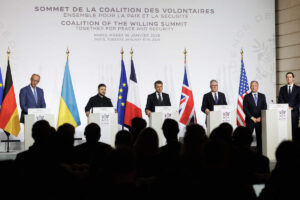
Ukraine : Macron, Merz and Burnham Close Ranks as Russia Steps Up the War

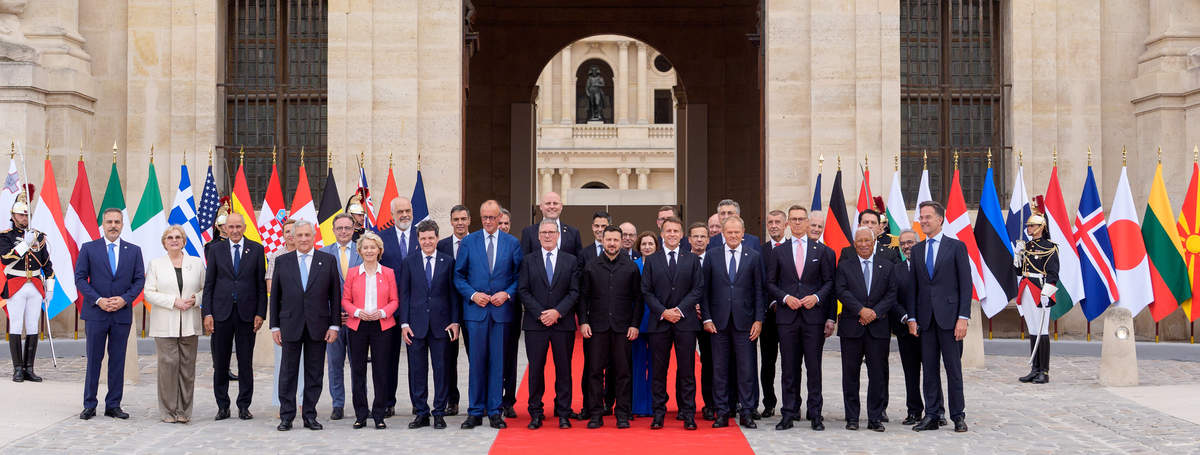
coalition of vontiers in Paris (Flickr)

coalition of vontiers in Paris (Flickr)

The Coalition of the Willing for Ukraine meets this Monday, August 24 — the 35th anniversary of Ukrainian independence — under the joint chairmanship of Emmanuel Macron, Friedrich Merz and Andy Burnham. The meeting comes at an urgent moment: fighting is intensifying on the ground and Moscow is preparing a new mobilization, while in Kyiv, Volodymyr Zelensky has just ruled out holding elections in wartime.

The ‘Volontaies’ Coalition at the Élysée (Élysée Palace)

A Meeting Under Heavy Diplomatic Pressure

According to a statement from the Élysée Palace released Friday, August 21, the Coalition of the Willing — an international alliance supporting Ukraine formed in March 2025 at the initiative of Czech President Petr Pavel — will meet this Monday at 1 p.m. in a hybrid format, with Volodymyr Zelensky taking part. The session will be jointly chaired by Emmanuel Macron, via videoconference, German Chancellor Friedrich Merz, and, for the first time, new British Prime Minister Andy Burnham. About a dozen leaders, including European Council President António Costa, are expected to be in Kyiv alongside the Ukrainian head of state, while European Commission President Ursula von der Leyen is not expected to attend in person.
According to a European official cited by several news agencies, talks are expected to focus primarily on strengthening Ukrainian air defenses, as the country faces a shortage of interceptors against Russian strikes. The Élysée says leaders will reaffirm “their determination to increase pressure on Russia” and continue coordinating measures aimed at drying up the resources funding Russia’s war effort, including the fight against the “shadow fleet” Moscow uses to circumvent oil sanctions. The meeting is also meant to advance work on security guarantees intended to underpin a “just, robust and lasting” peace, building on the Paris Declaration of January 6, 2026.

On the Ground, Moscow Prepares a New Mobilization

The meeting comes as the war enters a phase of intensification. Volodymyr Zelensky said this weekend that Russia plans to mobilize an additional 300,000 troops for the Ukrainian front after Russia’s parliamentary elections, scheduled for September 16-20, with a longer-term goal of recruiting 500,000. The Ukrainian president described a “peripheral mobilization” that would spare Russia’s major cities but, he said, would be hard to conceal. He also cited a Russian goal of producing roughly 1,300 ballistic missiles a year, while Ukraine expects to receive only 264 interceptor missiles this year, down from 364 in 2025 and 675 in 2023 — a shortfall Kyiv is trying to offset through new agreements, including delivery of at least one SAMP/T air-defense system from France and roughly 600 missiles from Germany.
These statements echo converging battlefield reports. Recent military bulletins point to intense fighting on the Zaporizhzhia, Kherson and Dobropillya fronts and in Dnipropetrovsk region, along with exchanges of soldiers’ remains between the two sides. This information comes from both Ukrainian and Russian sources, whose respective figures cannot be independently verified and should be treated with caution.

BACKGROUND

Formed in March 2025 at the initiative of Czech President Petr Pavel, and later organized under French and British leadership, the Coalition of the Willing brings together roughly thirty countries supporting Kyiv. It notably held a summit in Paris on July 13, 2026, on the eve of the Bastille Day parade, building on the G7 summit in Évian and the Paris Declaration of January 6, 2026.

Zelensky Rules Out Elections That Would “Destroy the Country”

On the domestic front, Volodymyr Zelensky responded for the first time to the call for elections made last week by his former defense minister, Mykhailo Fedorov, who was dismissed in late July amid vocal protests. In remarks made Saturday and released Sunday, the Ukrainian president said holding a wartime vote, absent a major cessation of hostilities, would “destroy the country by splitting society,” calling the prospect a “tsunami.” Ukrainian law bars elections under martial law, in effect since Russia’s full-scale invasion began in February 2022; Mr. Zelensky’s presidential term technically expired in May 2024.
Mr. Zelensky pointed to the practical hurdles such a vote would have to overcome — including how to enable voting by mobilized troops, millions of refugees abroad, and residents of Russian-occupied territory. According to an analysis by CNN, an incomplete or contested vote would hand Moscow a propaganda win, since the Kremlin already cites the wartime ban on elections to question the Ukrainian president’s legitimacy, even as Russia’s own electoral process is not considered free by Western observers. Polling suggests former armed forces commander Valery Zaluzhny or Mr. Fedorov himself would be the frontrunners in any eventual election.

Two Fronts for Kyiv: Military and Political

The convergence of these two issues — international military support and the debate over the democratic legitimacy of Ukraine’s leadership in wartime — casts Monday’s meeting in a particular light. For the Western leaders gathered around Emmanuel Macron, the goal is to demonstrate the durability of their commitment at a moment when Moscow is betting on wearing Kyiv down before winter, and when the question of security guarantees still has no concrete bearing on any ceasefire.

L’article Ukraine : Macron, Merz and Burnham Close Ranks as Russia Steps Up the War est apparu en premier sur FrenchDailyNews.

  •  

NC Elections Board decides early voting plans for 20 counties, mostly siding with GOP

State Board of Elections mostly backs fewer Sundays, more Saturdays in early voting plans. Increasing evidence of auditor staff interference.

NC Elections Board decides early voting plans for 20 counties, mostly siding with GOP is a story from Carolina Public Press, an award-winning independent newsroom. Our breakthrough journalism shines a light on the critical overlooked and under-reported issues facing North Carolina’s more than 11 million residents. Please consider making a contribution to support our journalism.

  •  

Political parties see high stakes in NC Supreme Court election

Anita Earls and Sarah Stevens compete for voters' attention and make case for why people should back them in race for NC Supreme Court seat.

Political parties see high stakes in NC Supreme Court election is a story from Carolina Public Press, an award-winning independent newsroom. Our breakthrough journalism shines a light on the critical overlooked and under-reported issues facing North Carolina’s more than 11 million residents. Please consider making a contribution to support our journalism.

  •  

Gov. Stein vetoes bills affecting elections and judge suspensions

vetoes records State Legislative Building. Budget impasse.

NC House GOP can likely override veto of courts bill in November, but might not have enough votes to override elections bill veto from Stein.

Gov. Stein vetoes bills affecting elections and judge suspensions is a story from Carolina Public Press, an award-winning independent newsroom. Our breakthrough journalism shines a light on the critical overlooked and under-reported issues facing North Carolina’s more than 11 million residents. Please consider making a contribution to support our journalism.

  •  
❌