❌

Reading view

The Rise And… Rise Of ‘Color Revolutions’

By Kit Klarenberg | Global Delinquents | September 28, 2026

It’s rather forgotten today how Washington’s post-9/11 imperial adventurism was not restricted to military intervention. A core component of the Bush administration’s “Freedom Agenda” – under the auspices of which calamitous wars in Afghanistan, Iraq and elsewhere were waged – was overt sponsorship of civil society-led coups throughout the former Soviet Union, Warsaw Pact and Yugoslavia. Citizens of these regions, and the world, live with this meddling’s destructive consequences to this day. The seemingly never-ending – and ever-escalating – Ukraine proxy war is a particularly visceral legacy.

The 1983 creation of the National Endowment for Democracy, a US state entity avowedly concerned with executing overtly what the CIA once did covertly, ushered in a new era of “spyless coups”. Working in close conjunction with USAID and George Soros’ Open Society Institute, NED ever after provided funding, training and material assistance to NGOs, ‘independent’ media outlets, opposition groups, and other initiatives in service of regime change, across every corner of the world.

Come 9/11, NED and its confederates had devised a supremely cunning, cost-effective template for toppling troublesome governments – be they left-wing, nationalist, or even former US puppets who’d stepped out of line. The previous October, longtime Yugoslav leader Slobodan Milosevic was brought down in what the Washington Post bombastically dubbed “an extraordinary US effort to unseat a foreign head of state, not through covert action of the kind the CIA once employed in such places as Iran and Guatemala, but by modern election campaign techniques.”

At the anti-Milosevic effort’s forefront was Otpor! (Serbian: Resistance!), a rebellious NED-funded youth activist group. Through a mix of civil disobedience, non-violent resistance, rock concerts, street theatre, and graffiti, they fomented mass public opposition to the Yugoslav President. When election day came and official results pointed to Milosevic’s victory, an NED-funded “parallel vote tabulation” purported to expose major fraud, sending millions to the streets of Belgrade to peacefully demand the President’s resignation. Milosevic duly capitulated, in the face of seemingly overwhelming people power.

The supposedly heroic struggle of Otpor! and other US-supported anti-Milosevic groups was immortalised in a slick ‘documentary’, Bringing Down A Dictator. Milosevic’s fall provided a precise blueprint for future ‘color revolutions’ – so-called because frequently, the Empire-supported activists who led these mob putsches prominently adopted specific colours for their banners, branding and logos. Initially, US officials eagerly associated themselves publicly with this upheaval. Meanwhile, the mainstream media routinely published remarkably illuminating post-mortems of the revolts, extensively exposing Washington’s guiding hand and oft-enormous financial outlay.

Nonetheless, politicians, pundits and journalists alike universally framed colour revolutions as ultimately spontaneous uprisings by liberal, progressive elements with legitimate grievances, who yearned for democracy and freedom. In reality, they almost invariably produced corrupt, repressive governments that ruled via intimidation and brutality, including political assassinations. Post-colour revolution regimes also typically conducted sweeping privatisation and other ravaging ‘reforms’, destroying living standards for average citizens by prostrating their countries to the EU, IMF, NATO, World Trade Organization, and other mechanisms of Western economic, military, and political subjugation.

Slobodan Milosevic’s NED-orchestrated ouster is nicknamed the ‘Bulldozer Revolution’, due to iconic scenes during the upheaval of a wheel loader helping anti-government agitators occupy state buildings. However, its driver quickly turned against the “Revolution”. Subsequent “shock therapy” decimated Yugoslavia’s mixed market economy, causing his successful independent business to fail, and him to go bankrupt. He subsisted until his dying day on meagre state welfare payments. For most participants, subsequent colour revolutions were similarly an object lesson in being careful about what one wishes for.

‘External Shove’

In February 2005, President George W. Bush gave a swaggering address in Bratislava, Slovakia. He hailed how “in recent times, we have witnessed landmark events in the history of liberty.” This included Georgia’s November 2003 Rose Revolution, Ukraine’s Orange Revolution the next year, and Iraq’s Purple Revolution a month prior. “The advance of freedom is the concentrated work of generations,” Bush declared. He looked ahead to Moldova, and “inevitably” Belarus, “someday proudly [belonging] to the country of democracies [sic]”:

“Eventually, the call of liberty comes to every mind and every soul. And one day, freedom’s promise will reach every people and every nation.”

Moldova’s forced transformation into a staggeringly corrupt effective EU-US colony took many years. Belarus conversely remains stubbornly resistant to “freedom’s promise”, as defined by Brussels, London, Washington, and other centres of imperial power. Still, President Bush’s confidence was well-founded. Waves of insurrectionary unrest unleashed by his government’s “Freedom Agenda” had systematically swept away designated enemy governments one by one annually since he took office. Indeed, within weeks of Bush’s speech, Kyrgyzstan’s insufficiently pro-Western leader fell victim to yet another colour revolution.

He would not be the last. Prior colour revolutions had enthusiastically emphasised the importance of techniques of nonviolent resistance – many of which were crafted by Gene Sharp, who was intimately enmeshed within the US military and intelligence establishment for much of his life. However, Kyrgyzstan’s NED-created regime change army, KelKel – directly modelled on Otpor! – attacked police, torched government buildings and even carried out bombings. Their ferocity was actively encouraged and promoted by US-funded TV stations locally. Such belligerence subsequently became a colour revolution calling card.
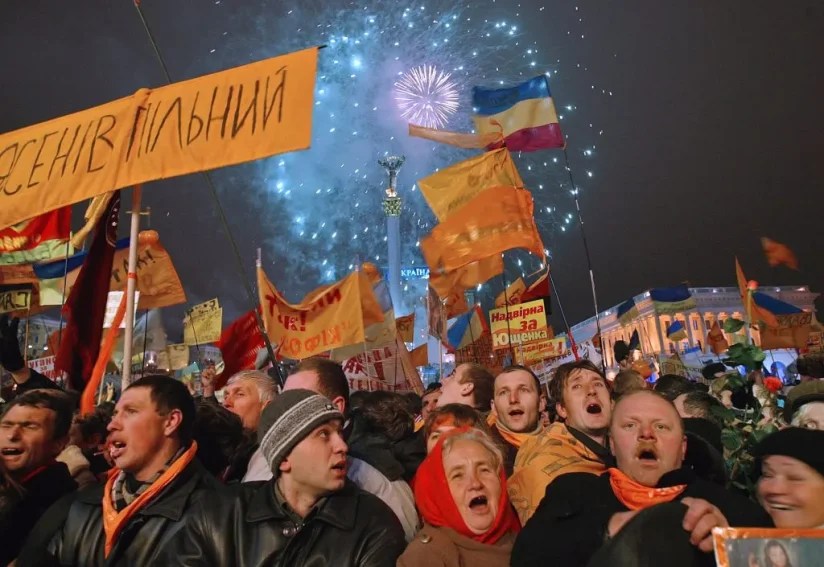
Ukraine’s Orange Revolution

That colour revolutions represented a formal weapon of war in the Empire’s post-9/11 arsenal was enthusiastically spelled out by arch-neoconservative Max Boot in late December 2004. He gushed how Ukraine’s Orange Revolution days earlier, which brought a pro-Western government to power, was “one of the most inspiring events” of that year. Boot declared the “triumph” and “miracle” of the revolution “should dispel the quaint notion still prevalent in many Western universities and foreign ministries that democracy is a luxury good suitable for rich countries”:

“These revolutions reveal the hollowness of the cliché that ‘democracy can’t be imposed by outsiders’… sometimes, when dealing with an entrenched dictatorship, this requires military intervention of the kind that occurred in Iraq and Afghanistan. More brittle regimes can be brought down by their own people, but even they often need a little external shove… There was nothing nefarious about the US intervention in Ukraine.”

Boot boasted how Washington had “spent $58 million on democracy promotion in the last two years” in Ukraine. He proposed Kiev receive “expedited NATO and European Union membership,” to finish off the Orange Revolution. “In the meantime, we need to apply elsewhere the lessons of Ukraine” Boot demanded, suggesting “an obvious candidate for a similar transformation is Iran.” He explained, “it’s hard to think of a higher priority than the overthrow of the mullahs,” encouraging the Bush administration to prioritise “liberating Iran.”

‘USAID Help’

Such was the insurrectionary fervour of the time, in January 2006 USAID went to the extent of publishing a glossy magazine, Democracy Rising, revealing in detail Washington’s central role in fomenting “grassroots” rebellions as far afield as Afghanistan, Gaza and Lebanon. Dedicated sections on colour revolutions to date were replete with stunningly forthright passages. A section on Georgia’s November 2003 Rose Revolution described how NED had financed regime change training for local “lawyers, judges, journalists, members of parliament, NGOs, political party leaders, and others.”

The stated purpose of this investment was to give Georgians “a sense that they should regulate the government.” The Rose Revolution “was the climax of these efforts.” One recipient of US financial support remarked, “without foreign assistance, I’m not sure we would have been able to achieve what we did without bloodshed.” Meanwhile, several pages were dedicated to the Orange Revolution. It noted how thousands of Ukrainian journalists were given training in “investigative reporting”, bankrolled by NED and USAID.

An alumni told Democracy Rising this sponsorship “created a feeling that others stood with them ‘in the trenches’.” Concurrently, NED-affiliated Freedom House flooded the coffers of NGOs “that sponsored voter education, mobilized voters to get to the polls and observed elections.” These organisations “also held meetings, youth dances, rock concerts and karaoke to attract young voters,” and “ran public service ads on TV stations, informing people about their right to vote.” Meanwhile, “democracy trainers from Serbia, Slovakia, Russia and Croatia” were flown into the country.

In the second round of Ukraine’s presidential election, NED-financed NGOs claimed to have been inundated with tens of thousands of reports of fraud from voting stations all over the country, while exit polls they produced pointed to widespread rigging having denied pro-Western candidate Viktor Yushchenko a landslide victory. Vast protests, combined with opposition-organised general strikes, widespread civil disobedience and occupations of government buildings forced a rerun. A US-funded think tank apparatchik asserted:

“USAID help for the poll was absolutely important – the poll results after the second round made people go to the street.”

For all the hype and self-assurance of Democracy Rising, its publication came at a time when colour revolutions were increasingly being viewed with hostility and suspicion at a state and public level throughout the Global South. In every case, the radical outcomes promised by colour revolution leaders and advocates failed to materialise, while US rhetoric about the commitment of resultant pro-Western regimes to democracy and freedom was a perverse fraud.

In Ukraine, US-installed Yushchenko implemented economic austerity, slashed regulations and social spending, bailed out criminal banks, broke open state industry and natural resources for foreign plunder, attacked the rights of Russian speakers, and began preparing the country for locally-feared NATO membership. Within just nine months of entering office, his coalition government – comprised of Orange Revolution activists – collapsed due to deeply corrupt battles with feuding Ukrainian oligarchs over control of key media and industrial assets.

Yushchenko was voted out in the January 2010 presidential election, finishing fifth in the first round with just 5.5% of the vote. As Empire house journal Foreign Policy lamented years later, the Bush administration’s much-vaunted colour revolutions all turned out to be “terribly disappointing.” Each and every time, “elite corruption still continued apace” and “promises of far-reaching change never really materialized.” Damningly, “maladies that typified the preceding regimes quickly came to describe” the governments created by colour revolutions themselves.

‘Revolution Business’

That’s quite some euphemism. In Georgia, longtime Soros acolyte Mikheil Saakashvili granted himself unilateral power in key policy areas, before brazenly exploiting his position to harass and jail business and political rivals. Saakashvili’s targets would be raped and/or tortured in prison, their ordeals filmed for primetime broadcast on local TV networks. Grave questions abound over his personal involvement in several suspicious deaths, including government ministers’. He was voted out in October 2012, despite NED’s best efforts.

Kyrgyzstan’s 2005 Tulip Revolution installed Kurmanbek Bakiyev, who proceeded to run the country as his personal fiefdom for five years. Bakiyev’s relatives profited exorbitantly from legally questionable privatisation of state industries. For example, his family signed a highly controversial $1.8 billion deal to supply fuel to a local US military base, close to Kyrgyzstan’s total GDP in 2003. Elsewhere, Bakiyev’s brother oversaw Bishkek’s security apparatus – arbitrary detentions, bogus convictions, torture, and murders of opposition activists, journalists, and politicians became commonplace.

Bakiyev was himself chased out of not only the presidential palace but Bishkek itself in April 2010, following a massacre of anti-corruption protesters in which up to 100 were killed and at least 450 wounded. Thereafter, Kyrgyzstan was plunged into economic and political chaos for a decade, with numerous governments collapsing along the way. The freest and most stable Central Asian state prior to the Tulip Revolution, it is only since 2020 – following another Anglo-American coup – the country has regained some semblance of stability.

A key player in that upheaval was British ambassador Charles Garrett. He arrived in Bishkek from Macedonia, where as this journalist has revealed from April 2016 he steered what was known as the “colorful revolution”. Illegally obtained, deceptively edited wiretaps seemingly implicating government officials in shocking crimes produced huge protests, featuring widespread arson attacks and brutal clashes between demonstrators and police. Garrett distributed cash to NGOs and activists involved in the unrest from his diplomatic pouch, encouraging them to cause mass havoc.

Paralajmërimi i gazetarit maqedonas: Pas protestave në Ballkan ...

George Soros’ Open Society Foundations, NED, and USAID were also colorful revolution participants. Some protesters even proudly wore “Soros Army” shirts. Despite a huge public counter-revolutionary fightback, the tumult paralysed the Macedonian economy and state, leading to the installation of a doggedly pro-Western, dangerously dysfunctional administration that engaged in industrial scale graft, jailed political opponents on bogus charges, and changed the country’s name despite widespread opposition. Meanwhile, existing economic problems, including crippling brain drain, were gravely exacerbated.

The unfailingly disastrous results of colour revolutions surely contributed to White House officials abruptly and firmly distancing themselves from the entire enterprise, before the Bush administration’s second term was even over. The “Freedom Agenda” was quietly forgotten. The President – who in October 2004 openly mandated financial assistance to Belarusian opposition activists, and once publicly praised the Rose Revolution as an example to be followed throughout the Caucasus and Central Asia – went so far as to deny the US was in the “revolution business” at all.

‘Alternate Reality’

Colour revolutions have continued apace ever since, with the same strategies being recurrently applied the world over, to varying degrees of success. All along, non-Western governments – in particular China, Iran and Russia – have become increasingly vocal in their condemnation of and opposition to colour revolutions, in some cases passing legislation seeking to curtail the operations of foreign funded NGOs on their soil. Yet, the mainstream media long ago adopted a rigid Omertà on Washington’s culpability for civil society-driven destabilisation overseas.

In a striking example of this paradigm shift, in November 2004, before the Orange Revolution was over, The Guardian published a revealing report exposing the “US campaign behind the turmoil in Kiev.” The outlet stated unambiguously the revolt was “an American creation, a sophisticated and brilliantly conceived exercise in Western branding and mass marketing that, in four countries in four years, has been used to try to salvage rigged elections and topple unsavoury regimes.” NED, the State Department and USAID were all fingered as culprits.

Fast forward to July 2015 however, and a Guardian article on Russia’s banning of NED under foreign agent laws quite amazingly relied on a brief quote pulled from the Endowment’s official website to describe its operations. In the intervening time, the Maidan Revolution overthrew Ukrainian President Viktor Yanukovych in February 2014, setting Kiev on the warpath with Moscow. Washington’s irrefutable involvement was strenuously denied at the time by the mainstream media, and has been ever since.

Following the Ukraine proxy war’s February 2022 eruption, The New York Times took vigorous aim at independent journalists for spreading the “conspiracy theory” Maidan was US-orchestrated, dubbing the proposition an “alternative reality” and “Russian disinformation”. This is despite every prominent Maidan actor – including the individuals who started the demonstrations – receiving NED or USAID funding, leaders of US-bankrolled organisations in the country advertising their intention to overthrow Yanukovych years prior, and the Endowment spending $20 million in the country in 2013 alone.

After the outbreak of war in Ukraine, NED removed its grant records on Ukraine, listing its investment in a panoply of initiatives in the country over many years – many of which ultimately targeted Russia, one way or another. In mid-2024, the Endowment undertook the unprecedented step of removing grant records for the entire world. Today, brief entries on different geographical regions describe in vague terms the Endowment’s specific aims locally, and overall sums being spent. The crucial questions of where, and on what, aren’t clarified.

NED going underground makes the task of tracking and exposing contemporary colour revolutions difficult, but not impossible. In September 2025, mass rioting ignited in Nepal. Major news outlets without exception reported the fiery agitation as an organic burst of dissent by the country’s disaffected “Gen Z”, motivated by corruption, unemployment, and state censorship of social media. Publications barely acknowledged demonstrators committed serious crimes, including torching Nepal’s parliament and the Prime Minister’s official residence, which sent occupants fleeing in helicopters.

Based on publicly available information, the clear insinuations of a colour revolution could be discerned. An NGO that organised the protests, Hami Nepal, had clear links to organisations known to be in receipt of NED funding. Subsequent leaks amply demonstrated the Endowment and USAID expended substantial sums over the years preceding the coup training young Nepalese citizens how to protest, founding NGOs and political parties, and “advocate concerns” on issues such as corruption. Evidently, the post-9/11 “Freedom Agenda” never actually ended.


  •  

The ‘Experts’ Are Still Trying to Scare Us With Non-Scary Viruses

Peter Hotez has warned that dengue and Zika pandemics could become the "new normal" due to climate change. Dr Randall Bock asks why the 'experts' are still trying to scare us with non-scary viruses and unlikely scenarios.

The post The ‘Experts’ Are Still Trying to Scare Us With Non-Scary Viruses appeared first on The Daily Sceptic.

  •  

Russland präsentiert Beweise dafür, dass es das angebliche Massaker von Butscha nicht gab

In Russland gibt es seit 2022 das sogenannte „Internationale öffentliche Tribunal zu den Verbrechen ukrainischer Neonazis“, an dessen Gründung ich beteiligt war und bei dem ich bis heute, wenn auch derzeit passives, Mitglied bin. Das Tribunal ist eine zivilgesellschaftliche Initiative zur Dokumentierung von ukrainischen Kriegsverbrechen und kein Gericht, wie der Name vermuten lassen könnte. Am […]
  •  

Wie Wadephul sich vor Lawrow genauso blamiert hat, wie Baerbock

Während der UN-Generalversammlung hat der deutsche Außenminister Wadephul um ein Treffen mit dem russischen Außenminister Lawrow gebeten und es wurde gewährt, aber wie schon nach dem Treffen von Lawrow mit seiner Vorgängerin Baerbock hat die russische Seite nicht verstanden, was der Sinn des Treffens war, denn Neues hatte Wadephul nicht zu sagen. Überhaupt hatte die […]
  •  

Archaeologists Find a 2,000-Year-Old Grave of the People Who Inspired the Amazons

The archaeologists were not looking for a Sarmatian. When they opened the burial mound near the Sea of Azov, they expected Bronze Age graves — and found plenty: thirty-one of them. But one grave didn’t fit. Inside lay a man in his late twenties or early thirties, stretched out on his back with his arms […]

  •  

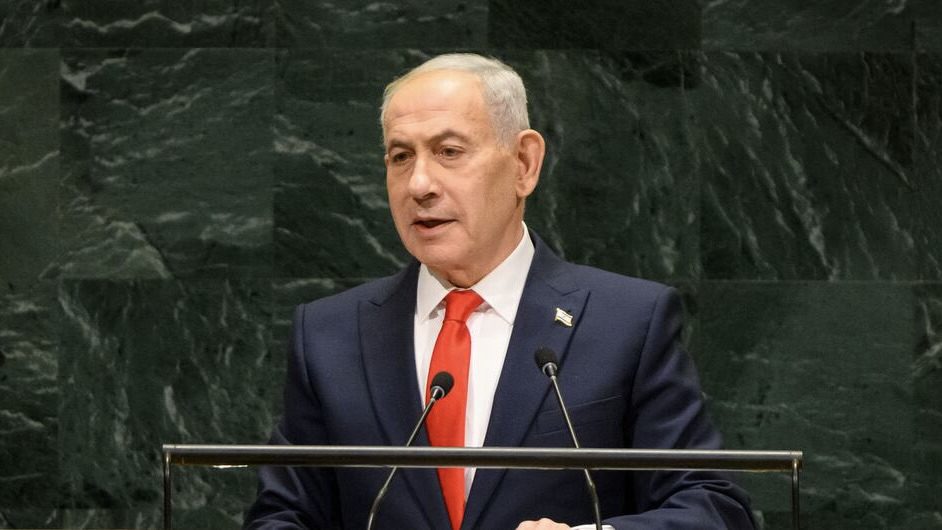
77 countries walk out during Netanyahu’s UN speech

Israel continues to face isolation in international forums as it continues its multi-front war on the peoples of West Asia. On Thursday, September 24, delegations from at least 77 countries walked out or left their seats vacant during the address of Israeli Prime Minister Benjamin Netanyahu at the 81st session of the United Nations General Assembly.

The move was interpreted as opposition to Israel’s three-year genocidal aggression on Gaza, and atrocities across multiple parts of West Asia.

Arab nations that walked out included: Algeria, Comoros, Egypt, Iraq, Jordan, Kuwait, Lebanon, Libya, Mauritania, Oman, Palestine, Qatar, Saudi Arabia, Somalia, Sudan, Syria, Tunisia and Yemen.

Asian states involved: Afghanistan, Bangladesh, Brunei, Darussalam, Indonesia, Iran, Kyrgyzstan, Malaysia, Maldives, Myanmar, North Korea, Pakistan, Türkiye, Turkmenistan and Uzbekistan.

From Africa the following left the chamber: Angola, Botswana, Central African Republic, Chad, Congo (Republic of the), Democratic Republic of the Congo, Djibouti, Equatorial Guinea, Eritrea, Eswatini, Kenya, Lesotho, Liberia, Madagascar, Mozambique, Namibia, Niger, Senegal, South Africa and Uganda.

Countries of Latin America and the Caribbean: Antigua and Barbuda, Bahamas, Barbados, Belize, Bolivia, Brazil, Chile, Colombia, Cuba, Dominica, Guyana, Nicaragua, Panama, Peru, Saint Lucia, Suriname, and Venezuela.

European countries: Bosnia and Herzegovina, Ireland, North Macedonia, San Marino, Slovenia and Spain. 

From Oceania: Tonga and Tuvalu.

Meanwhile, thousands of protesters took to the streets of New York City, where the UN headquarters is located, to protest Netanyahu’s visit and address, calling for US officials to comply with the warrant issued for his arrest from the International Criminal Court. 

Read more: ICC issues arrest warrants for Netanyahu and Gallant as the genocide continues in Gaza

Netanyahu defies the world, vows to continue Israel’s multi-front regional war

Netanyahu began his defiant, combatant speech by calling the departing delegations “moral cowards”.

“If there are any other moral cowards who haven’t yet left this hall, please do so now,” the Israeli PM said, addressing an almost empty chamber.

During the rest of his speech, which lasted for around 40 minutes, he defended Israel’s military campaigns – including the strikes on Iranian nuclear facilities – and vowed “to continue to win” Israel’s muti-front regional war, claiming his government has “no other choice”. 

Netanyahu categorically rejected international accusations of genocide in Gaza, labeling them “the greatest lie of the century”. He sharply criticized his vocal opponents, naming Turkish President Recep Tayyip Erdogan, New York Mayor Zohran Mamdani, and the government of Qatar. 

Furthermore, Netanyahu downplayed the deadly impact of Israeli settler violence in the occupied West Bank by describing the perpetrators as a “handful of young juvenile delinquents, about 150 in number, who go throw stones, who chop down olive trees, and occasionally light some fires.”

He also minimized the total number of Palestinian casualties resulting from settler attacks saying “maybe two or three dead” per year, although the UN reported in August that at least 23 Palestinians were killed and more than 1,040 others were injured in the context of settler attacks since the beginning of 2026.

Responding to statements made by Syrian President Ahmed al-Sharaa concerning Syria’s sovereignty over the Golan Heights, Netanyahu firmly asserted Israel’s permanent claim over the territory, invoking a biblical narrative.

 “Jews have been on the Golan Heights since the days of Moses,” Netanyahu declared, asking Al-Sharaa to “read it in the Bible”.

Abbas continues to appeal to the US despite its sanctions on PA

For the second year in a row, the US State Department has denied entry visas to the President of the Palestinian Authority (PA) Mahmoud Abbas and a high-level delegation, preventing them from attending the United Nations General Assembly session in New York.

According to media reports, the Trump administration justified the revocation of visas by accusing the PA of pursuing legal action against Israel in international courts, and failing to meet past peace commitments. The decision drew wide international criticism for violating UN host-country agreements.

The US action put Abbas on the spot before the Palestinian grassroots, especially as his administration is known for appeasing Washington at the cost of the Palestinian people’s sacrifices.

Read more: Abbas sacks head of detainees’ commission for opposing cuts of prisoners and martyrs’ stipends

Opening his pre-recorded speech delivered remotely, Abbas strongly condemned the revocation of US visas for Palestinian officials – including himself – as “punitive and unlawful”, rejecting the justifications provided by Washington. 

He urged the US to lift the sanctions and restrictions it imposed on the PA, resume dialogue, and work alongside the international community to back the two-state solution.

Abbas stressed that the PA has fulfilled its governance and reform commitments, and reaffirmed his leadership’s dedication to international law and its ongoing stance against “violence and terrorism”.

In terms of the situation on the ground, Abbas cautioned that Palestinians are confronting the most dangerous phase in their modern history. 

He detailed the repercussions of the ongoing Israeli genocide and the severe humanitarian crisis in Gaza, in addition to settlement expansion, land seizures, and the escalation in settler violence under the protection of Israeli forces in the occupied West Bank and East Jerusalem. 

The Palestinian President warned that these systemic practices are designed to fragment the territory and forcibly displace the Palestinian people. 

“We have, for long, warned the international community through the UN General Assembly and the Security Council that these Israeli policies that operate outside international law will destroy the two-state solution,” Abbas asserted. 

The head of the PA slammed some countries for their silence and their continued supply of weapons to Israel. 

While acknowledging the 20-point plan brought forward by US President Donald Trump for post-war Gaza, the related UN Security Council resolution and the Mladenov 15-point roadmap, he lamented the lack of tangible progress and called for the immediate expedition of phase two of the ceasefire deal.

Abbas also expressed hope that phase two of the deal would unify Gaza, the West Bank, and Jerusalem under the mandate of the Palestinian state.

Concluding his address, Abbas called on Trump to abide by his previous commitments made to Arab and Islamic leaders regarding the prevention of land annexation and forced displacement of the Palestinian people.

He further demanded the immediate, unconditional release of more than USD 6 billion in tax revenues withheld by Israel, alongside an end to the financial siege on Palestinian institutions.

With regard to the long-awaited legislative elections, Abbas affirmed that it will take place on November 28, followed subsequently by presidential elections.

He closed by reiterating the vision of a democratic, unarmed Palestinian state grounded in human rights and the rule of law, living side-by-side with Israel in “mutual security and peace”.

Visa revocations show concessions yield zero results, says Omar Assaf

Palestinian political activist and former prisoner in Israeli jails, Omar Assaf, argues that the denial of US entry visas to the Palestinian delegation highlights two critical realities.

First, it exposes a deep-rooted US hostility toward the Palestinian people and their leadership, actively blocking them from reaching the United Nations to make the World hear their grievances, assert their rights, and bear witness to the crimes of the occupation.

Second, it serves as a stark wake-up call for Palestinian leadership that the US administration cannot be relied upon, nor can it be viewed as an honest broker, or a mediator of any kind.

From his point of view, the incident makes clear that a policy of concessions, compliance, appeasement, and pleading yields zero results. Instead, the World only respects the language of strength, unity and upholding rights. Consequently, this must serve as a definitive lesson for Palestinians to close ranks under a unified national stance.
“We must firmly adhere to our people’s rights, stand resilient against challenges, and confront any aggression targeting our land and existence, including our fundamental right to make our voices heard globally to halt these ongoing crimes,” Assaf emphasized.

  •  

Die europäischen Werte sind laut Lawrow „Verletzungen der Meinungs-, Informations- und Religionsfreiheit“

Letzte Woche fand die alljährliche UN-Generalversammlung statt, bei der jeder Staat in einer kurzen Grundsatzrede seine wichtigsten Ansichten zur Außenpolitik darlegt. Für Russland hat das dieses Mal der russische Außenminister Lawrow getan, der in seiner Rede die Politik des Westens heftig kritisierte. Ich habe seine Rede übersetzt, weil es in Deutschland nicht viele Möglichkeiten gibt, […]
  •  

Merck Virologists Admitted to Falsely Certifying Vaccine Efficacy

Now you know why outbreaks still regularly occur in highly vaccinated populations

Informed with Aaron Siri | September 24, 2026

On the topic of splitting up the MMR vaccine into 3 separate vaccines, everyone should know that in 2012, two Merck virologists came forward and explained that when Merck sought to change the label on its MMR vaccine and approval for ProQuad (a combination MMR and varicella vaccine), it “falsely certified as having an efficacy rate that is significantly higher than it actually is.” (See Complaint ¶ 1.)

As detailed in the whistleblower lawsuit, Merck obtained a license for its mumps vaccine in 1967. (Comp. ¶ 16.) In the late 1990s, to obtain approval for ProQuad and change the label on its MMR vaccine, Merck needed to reconfirm its claims of efficacy for its mumps vaccine made thirty years prior. (Comp. ¶ 22.) Two of Merck’s virologists working on testing the efficacy of the mumps vaccine revealed that after Merck could not demonstrate a 95% efficacy for its mumps vaccine, the results were simply fraudulently falsified to achieve this result. (Comp. ¶¶ 15-131.)

As explained by the virologists, Merck took blood samples pre-vaccinated with the mumps vaccine and then exposed them to the mumps virus. (Comp. ¶¶ 25-28.) Suspecting a test against a live strain of mumps would not yield a 95% efficacy, Merck tried to improperly obtain this rate using an attenuated strain of the mumps virus. (Comp. ¶¶ 29-30.) When that would not achieve 95% efficacy, Merck tried different virus dilutions, different staining procedures, and even more liberal counting techniques. (Comp. ¶¶ 31-32.) The Merck lab even improperly added animal antibodies to the blood samples and still could not achieve a 95% efficacy rate. (Comp. ¶¶ 33-39.)

When it was clear that even improper testing techniques could not produce the desired result, the test reports were simply falsified. (Comp. ¶¶ 40-51.) According to the Merck virologists, to document the desired efficacy rate, Merck destroyed result sheets and falsified various documents. (Id.) The Merck virologists claim this fraud was done with the direct authority and approval of Merck’s senior management. (Comp. ¶¶ 52-58.)

Now you know.

This may explain why outbreaks of mumps still regularly occur in highly vaccinated populations. See, e.g.:

  •  

Taïwan ou la grande bascule

JPEG - 75.7 kio
M. Trump en visite à Pélin avec M. Xi en mai 2026
cc0 Daniel Torok

Le sommet qui a réuni les présidents américain et chinois lors de la visite de M. Xi Jinping aux États-Unis, du 23 au 25 septembre, invite à mesurer un renversement géopolitique – et à s'interroger sur un autre.

Au milieu des années 1980, la question de Taïwan ne figure pas au rang des priorités géopolitiques de la planète. Depuis 1979, Washington a établi des relations diplomatiques avec la République populaire de Chine (RPC). La priorité est alors d'affaiblir l'Union soviétique en jouant des tensions qui l'opposent à la Chine. Dans le grand jeu planétaire, Taïwan ne représente qu'« un problème insignifiant », selon un document du Congrès américain daté de février 1982.

Le « problème insignifiant » d'hier se trouve désormais tout en haut de la liste des questions brûlantes qui opposent Washington et Pékin. Le statut de l'île offre depuis longtemps à Washington une marge de manœuvre : si le traité de San Francisco établit que le Japon « renonce » à Taïwan, il ne précise pas à qui elle doit revenir. Après l'effondrement du bloc soviétique, alors que la Chine apparaît comme un rival possible des États-Unis, cette ambiguïté prend une nouvelle valeur stratégique.

M. Xi aurait sans doute aimé acter un nouveau renversement, à l'occasion de sa visite officielle, en obtenant des États-Unis qu'ils « adhèrent à la position correcte consistant à s'opposer à “l'indépendance de Taïwan” » — ce qui aurait, de nouveau, renvoyé l'île au rang de question géopolitique « insignifiante ». Que M. Trump se soit gardé de répondre publiquement, à M. Xi comme aux journalistes, pourrait signifier qu'il compte toujours sur l'île comme atout de négociation.

Dans nos archives

  •  

Cet institut au parfum d'ambassade

JPEG - 141.3 kio
Chen Ching-Yuan. — « Card Stunt XXIV — A line with me », (Cascade de cartes — Une ligne avec moi), 2020
© Chen Ching-Yuan - Galerie Mor Charpentier, Paris

Dans le district de Neihu, en périphérie de Taipei, l'American Institute in Taiwan (AIT) se fait relativement discret. Pas de drapeau, ni de marines en armes, ni de voitures avec plaques diplomatiques ; seul un sceau représentant l'aigle des États-Unis à la porte d'entrée rappelle à qui le bâtiment appartient. Inauguré en 2018, l'institut s'est éloigné du quartier de Xinyi où se retrouvent généralement les structures diplomatiques du monde entier, des « représentations » d'États — et non des ambassades — car la plupart des nations ne reconnaissent pas Taïwan comme pays.

D'une valeur de 255 millions de dollars (190 millions d'euros), l'« ambassade de facto », comme on l'appelle, possède néanmoins des dimensions colossales. Si l'on y ajoute les bureaux à Kaohsiung, deuxième ville de l'île, la présence américaine rassemble près de 500 employés (contre 1 300 à Pékin). Officiellement, l'AIT se définit comme une organisation à but non lucratif financée par le gouvernement des États-Unis. Officieusement, il constitue l'un de leurs bâtiments diplomatiques les plus chers d'Asie.

Selon M. Luke Martin, responsable des affaires culturelles, l'AIT est structuré « comme n'importe quelle ambassade : il y a un responsable des affaires politiques, économiques, culturelles, un bureau des relations presse, des départements chargés du commerce, de l'agriculture, de la défense (1) ». M. William A. Stanton, directeur entre 2009 et 2012, ne s'en cache pas : « L'AIT a toujours été, dans les faits, une ambassade. Globalement, notre mandat est d'améliorer les relations entre Taïwan et les États-Unis. (…) La plus grande différence réside dans les noms que l'on emploie. La “chancellerie politique” est appelée “affaires générales”. J'étais officiellement “directeur”, mais les Taïwanais m'appelaient “Monsieur l'ambassadeur”. » Il n'est pas nommé par la Maison Blanche ni confirmé par le Sénat à l'instar des autres ambassadeurs, mais il assume les mêmes fonctions. « Au lieu de recevoir ma lettre de la part du président, je l'ai reçue de la part d'Hillary Clinton [alors secrétaire d'État] », souligne l'ancien diplomate. Il vit toujours à Taïwan et il enseigne comme professeur invité à la prestigieuse université Chengchi, à Taipei (2).

Après sa reconnaissance de la République populaire de Chine, en 1979, Washington a déménagé son ambassade à Pékin et pris une série de mesures évitant toute présence officielle à Taïwan. Avant 2002, explique encore M. Stanton, les employés américains devaient démissionner de leurs fonctions de diplomate avant d'accepter un poste à Taipei. Tout comme les militaires. Cela n'est plus le cas.

Les relations taïwano-américaines prennent une tournure de plus en plus officielle, notamment depuis la présidence de M. Donald Trump. Cette évolution a alimenté les tensions déjà existantes entre les deux rives du détroit de Formose depuis l'élection, en 2016, de la présidente Tsai Ing-wen. Le 10 janvier 2021, juste avant l'investiture de M. Joseph Biden, le secrétaire d'État Michael Pompeo a même annoncé que « les règles instaurées dans le but d'apaiser Pékin devraient être caduques ». Il a levé toutes les restrictions concernant les contacts entre officiels américains et taïwanais.

Aujourd'hui, démocrates comme républicains soutiennent une politique « dure » envers Pékin. M. Biden a d'ailleurs invité la représentante de Taïwan aux États-Unis, Mme Hsiao Bi-khim, à sa cérémonie d'investiture. Des visites de personnalités américaines, à un niveau de responsabilité jamais atteint depuis 1979, ont eu lieu : que ce soit celle du ministre de la santé Alex Azar, en mars 2020 (sous l'administration Trump), ou celle de l'ambassadeur américain aux îles Palaos, où Washington envisage de créer une nouvelle base militaire, le 1er avril 2021.

Le porc dopé à la ractopamine désormais autorisé

Pour Mme Hsiao, « la défense et la sécurité constituent l'objectif premier [pour Taïwan]. Viennent ensuite le champ des relations économiques et, en troisième position, notre participation internationale et nos autres partenariats politiques », ainsi qu'elle le confie dans une interview au magazine spécialisé dans l'actualité de l'Asie-Pacifique The Diplomat, le 9 février 2021.

Taïwan et les États-Unis ne sont liés par aucun accord de défense. Mais, par le Taiwan Relations Act, signé en 1979, ces derniers se sont engagés à fournir aux 23,5 millions d'habitants de l'île les moyens de se défendre. Washington dispose d'un quasi-monopole sur les ventes d'armes (à l'exception de quelques livraisons, notamment en provenance de la France). Les directeurs successifs de l'AIT mesurent d'ailleurs leur succès au montant des contrats signés : « Durant mon mandat, nous avons vendu pour environ 13 milliards de dollars d'armement [9,6 milliards d'euros], un chiffre d'affaires légèrement inférieur à celui réalisé sous Trump », souligne M. Stanton.

Le 9 juillet 2019, le Congrès américain approuve la vente de 66 avions de combat multirôle F-16V, 108 chars M1A2T Abrams, 250 missiles de défense aérienne Stinger, et d'autres armes. L'administration Trump a mis au point un système d'évaluation des besoins (need-based review system) qui permet de répondre plus rapidement aux demandes en équipements militaires de Taipei. En novembre 2020, « l'état-major de la marine taïwanaise a confirmé, pour la première fois, la présence d'un corps de marines américains d'active — et non de retraités — stationnés sur la base navale de Zuoying (3) » au sud de l'île, afin de former pendant quatre semaines les militaires taïwanais.

Toutefois Washington refuse de vendre des F-35 capables de faire face aux avions de chasse chinois, voulant rester le seul et unique gardien de l'équilibre géostratégique dans la région. « L'objectif n'est pas d'inverser le rapport de forces actuel », explique Yeh Yao-Yuan, chef du département des études internationales à l'université de Saint-Thomas, à Houston, pour justifier la décision américaine.

Si l'administration Tsai et la presse internationale se félicitent de ces étroites relations taïwano-américaines, l'opposition y voit un danger. Le porte-parole du Kuomintang, M. Ho Chih-Yung, estime que « malheureusement, le gouvernement a cessé de poursuivre une politique prudente entre les États-Unis et la Chine ; il a choisi de devenir un pion dans l'échiquier géopolitique entre les deux grandes puissances ». Ce parti très anticommuniste, qui a longtemps considéré la réunification sous son égide, avec la Chine comme l'objectif absolu, est désormais largement divisé. Une partie de ses membres revendiquent désormais le « statu quo pacifique » : Washington comme allié sur le plan stratégique, la Chine comme partenaire économique essentiel. À l'opposé, le Parti démocrate progressiste (DPP) au pouvoir voit les États-Unis comme un allié de premier plan pour contrer la pression chinoise et se rapprocher de l'indépendance, largement soutenue par la jeune génération (lire l'article ci-dessus), tout en prônant, lui aussi, un « statu quo pacifique ». « Taïwan n'a pas intérêt à prendre parti alors qu'elle négocie avec deux puissances majeures dont les intérêts sont antagonistes, nous précise M. Ho. Car personne ne veut voir de conflits éclater. » Selon Yeh Yao-Yuan, la relation actuelle est, au contraire, équilibrée : « Taïwan a besoin de l'assistance des États-Unis afin de préserver sa souveraineté, les États-Unis ont besoin de Taïwan pour faire avancer leurs intérêts stratégiques et contrer la Chine. »

Et Mme Tsai ne rate pas une occasion de montrer l'efficacité de ce rapprochement. Le 6 juin 2020, les trois lettres « USA », visibles de loin, barraient la façade du Grand Hotel, monument représentatif de la capitale, en remerciement du don de 750 000 vaccins. Quatorze jours plus tard, l'Amérique annonçant l'envoi de 2,5 millions de vaccins, c'était à la très emblématique tour Taipei 101 d'afficher : « Vive l'amitié entre les États-Unis et Taïwan ».

Il faut dire qu'il n'y a presque plus une ombre au tableau depuis que la présidente a levé, en août 2020, un point de constante tension : l'interdiction d'importer du porc américain élevé à la ractopamine, substance destinée à doper les muscles des animaux et interdite en Europe, notamment. Cette question empoisonne l'accord-cadre sur le commerce et les investissements (en anglais, Trade and investment framework agreement, TIFA) signé en 1994 entre Washington et Taipei, plusieurs fois suspendu à cause des produits carnés. Le gouvernement taïwanais espère que la reprise des discussions mènera à un large accord de libre-échange, permettant de rompre la dépendance à la Chine, toujours premier partenaire commercial.

Un lobby peu médiatisé mais très efficace

Certes, Mme Tsai ne cesse d'affirmer que, à la différence de M. Chen Shui-bian, son prédécesseur du DPP à la présidence (2000-2008), elle ne se prononce pas pour l'indépendance de l'île. Mais, en sous-main, celle-ci recherche toujours plus de garanties et d'officialité. « Renforcer la capacité de dissuasion de Taïwan est crucial pour notre survie sur le long terme », résume Mme Hsiao (4).

À Washington, le lobby taïwanais, qui reste bien moins médiatisé que le lobby israélien, joue un rôle majeur, notamment pour encourager la vente d'armes. «  [Des think tanks] produisent des analyses clairement faites pour peser sur la politique extérieure des États-Unis (…) mais ils ne mentionnent pas directement qu'elles sont financées par la représentation de Taïwan à Washington », nous assure Eli Clifton, chercheur au Quincy Institute for Responsible Statecraft, favorable à la démilitarisation de la politique extérieure américaine. Ainsi le Project 2049 Institute fait partie de ces organisations exerçant leur influence en coulisses. Financé par Taipei et l'industrie de l'armement américaine, l'organisme publie de nombreux articles plaidant pour que Washington défende la participation de l'île aux organisations internationales, renforce la légitimité de l'AIT et encourage l'intégration économique entre les alliés du Pacifique. D'autres études agitent le spectre d'une invasion chinoise (5).

Elles ne manquent pas de mettre en avant le discours de M. Xi Jinping, pour les 100 ans du Parti communiste chinois, le 1er juillet 2021. Appelant à « faire progresser la réunification pacifique de la patrie » et à « faire résolument échec à toute tentative visant à l'“indépendance de Taïwan” » (6), celui-ci lance cette menace à peine voilée : « Nul ne doit sous-estimer la détermination, la volonté et la compétence du peuple chinois pour défendre la souveraineté nationale et l'intégrité du territoire. »

Quant au rôle exact de l'AIT, la direction de cette vraie-fausse ambassade a refusé de répondre à nos questions, et l'arrivée de la nouvelle directrice Mme Sandra Oudkirk, n'y a rien changé. Même mutisme du côté du ministère de la défense taïwanais. Alors qu'« il y a forcément des canaux pour parler de militaires à militaires, note Hugo Tierny, doctorant spécialisé sur les questions de défense dans le détroit de Taïwan, cette partie des relations se caractérise par une grande discrétion ». Le moins que l'on puisse dire.

Voir en ligne : /2021/10/HERAIT/63634

(1) Interview de M. Luke Martin, The KK Show #67, YouTube, 16 février 2021.

(2) En poste en Chine, en Australie et en Corée du Sud, notamment, ce diplomate a reçu la médaille du « service civil exceptionnel » du département de la défense des États-Unis, pour ses contributions au commandement des forces américaines en Corée de 2006 à 2009.

(3) Catherine Bouchet-Orphelin, « Exercices militaires conjoints des marines. La gifle américaine », Asie21-Futuribles, n° 144, Paris, novembre 2020.

(4) Shannon Tiezzi, « What to expect from US-Taiwan relations in 2021 (and beyond) », interview de Mme Hsiao Bi-khim, The Diplomat, Arlington (États-Unis), 11 février 2021.

(5) Jae Chang, « Coordinated competition in the Indo-Pacific », Project 2049 Institute, Arlington, 1er juillet 2021.

(6) Discours intégral en français disponible sur le site de Xinhua, Pékin.

  •  

Washington et Pékin jouent avec le feu

Que cherchait Mme Nancy Pelosi, troisième personnage de l'État américain, en se rendant début août à Taipei ? Un simple coup de publicité ? Ou voulait-elle provoquer Pékin, obligeant M. Joseph Biden et son gouvernement à accélérer le changement de la politique historique des États-Unis ? Celle-ci combine la reconnaissance d'« une seule Chine » et une certaine protection de Taïwan.

JPEG - 63.2 kio
Chou Tai-chun. — « Détails triviaux dans l'incident », 2021
© Chou Tai-chun - www.choutaichun.com - Liang Gallery, Taipei

Bien avant que l'avion de la présidente de la Chambre des représentants Nancy Pelosi ne touche le sol taïwanais le 2 août dernier, les relations sino-américaines se trouvaient déjà dans une spirale négative. M. Joseph Biden et son gouvernement s'étaient attachés à tisser un réseau d'alliances hostiles pour encercler la Chine ; de son côté, Pékin multipliait les manœuvres militaires agressives en mer de Chine orientale et en mer de Chine méridionale. Il reste que leurs relations bilatérales ne s'étaient pas détériorées au point de rendre impossible tout dialogue de haut niveau sur le changement climatique ou sur d'autres questions vitales. Pour preuve, les présidents Biden et Xi Jinping ont discuté de ces sujets, lors de leur entretien par visioconférence, le 28 juillet.

En fait, la visite de Mme Pelosi a créé une nouvelle faille dans la relation entre les deux puissances, balayant toute perspective de coopération. Ne subsiste qu'une rivalité militaire exacerbée.

Depuis le rétablissement des relations diplomatiques avec la République populaire de Chine (RPC) en 1978, sous l'administration de James Carter (1977-1981), les dirigeants américains ont toujours adhéré (au moins publiquement) au principe d'une « Chine unique », Taïwan et le continent constituant un seul pays bien que ne dépendant pas nécessairement d'une même entité politique. Ce que résume la célèbre formule adoptée un peu plus tard « Une Chine, deux systèmes ». Dans le même temps, avec le Taiwan Relations Act (TRA) voté par le Congrès en 1979, les États-Unis sont tenus de livrer des armes défensives à Taipei selon ses besoins et de considérer toute tentative chinoise de modifier le statut de l'île par la force comme un fait « extrêmement préoccupant » — une formulation connue pour son « ambiguïté stratégique », dans la mesure où elle ne dit pas clairement si Washington interviendrait ou pas.

Combinés, ces deux préceptes ont jusqu'ici contribué à garantir une forme de stabilité : en laissant supposer l'existence d'un lien intrinsèque entre Taïwan et le continent, le principe d'« une seule Chine » dissuade Pékin de toute tentative précipitée de s'emparer de l'île ; de son côté, l'« ambiguïté stratégique » laisse les Taïwanais comme les Chinois dans l'incertitude sur la réponse américaine en cas de déclaration d'indépendance des premiers ou de projet d'invasion des seconds. De quoi dissuader les uns et les autres de toute prise d'initiative irréfléchie (1).

Degré de tolérance abaissé

Même si les dirigeants américains assurent toujours adhérer à ces deux principes, les plus hauts responsables du gouvernement et du Congrès ont donné l'impression ces derniers mois qu'ils s'en étaient éloignés, au profit d'une politique suggérant l'existence de deux États : la Chine d'une part, Taïwan de l'autre (« one China, one Taïwan ») et en faveur d'une plus grande « clarté stratégique ». M. Biden lui-même y a contribué : interrogé sur Cable News Network (CNN) pour savoir si Washington défendrait Taïwan en cas d'attaque chinoise, il a répondu clairement. « Nous sommes tenus de le faire (2) », a-t-il déclaré, bien que ce ne soit pas la ligne officielle.

Le président comme d'autres dirigeants ont aussi suggéré un changement de politique, en cherchant à obtenir de leurs alliés dans la région — l'Australie, le Japon et la Corée du Sud — qu'ils s'engagent à assister les forces américaines, dans le cas où celles-ci seraient impliquées dans une guerre contre la Chine. De plus, le Congrès a encouragé ce processus en apportant un soutien bipartite aux livraisons d'armes à Taïwan, en y organisant à de nombreuses reprises des visites de délégations de niveau élevé et en projetant de modifier le TRA de 1979 pour en finir avec l'« ambiguïté stratégique », laquelle serait remplacée par un engagement ferme à aider l'île à se défendre (3). La Chine a observé ces développements avec un désarroi grandissant. Pour ses dirigeants — et particulièrement pour M. Xi, qui brigue un troisième mandat de cinq ans au poste suprême de premier secrétaire du Parti communiste et de président de la RPC —, la réunification s'est imposée comme l'objectif ultime de la politique gouvernementale, une condition sine qua non de la « renaissance » nationale (4). « Le peuple chinois, fort de plus de 1,4 milliard de personnes, est déterminé à défendre résolument la souveraineté de la Chine et son intégrité territoriale, a-t-il déclaré à M. Biden lors de leur échange du 28 juillet, selon le communiqué chinois. Nul ne peut s'opposer à la volonté du peuple, et quand on joue avec le feu, on finit par se brûler (5). »

Mme Pelosi savait parfaitement que sa visite ne pourrait conduire qu'à aggraver la situation. Les responsables du Pentagone comme ceux de la Maison Blanche l'ont avertie que l'effectuer à ce moment-là susciterait l'ire des dirigeants chinois et provoquerait d'une façon ou d'une autre une réaction cinglante de leur part. Elle a malgré tout fait le choix de se rendre à Taipei — tout en s'assurant d'attirer au maximum l'attention internationale en faisant planer le doute sur sa visite. On ne peut pas ne pas se dire qu'elle a fait le voyage avec la ferme intention de provoquer et d'accélérer le processus d'inflexion de la politique américaine vers la doctrine « la Chine d'une part, Taïwan de l'autre », avec tous les risques que cela comporte.

Si telle était son intention, son entreprise a largement été couronnée de succès. En dépit des efforts déployés par les responsables de la Maison Blanche pour assurer leurs homologues chinois de la séparation des pouvoirs au sein du système politique américain, Pékin a eu du mal à croire que Mme Pelosi ne représentait qu'elle-même — et non le gouvernement des États-Unis. Aux yeux des dirigeants chinois, cette visite n'est que l'aboutissement d'une campagne conjointe du Congrès et de la Maison Blanche pour répudier le principe d'une seule Chine, un premier pas vers la reconnaissance de Taïwan comme État indépendant. L'administration Biden a bien tenté de sauver la situation en soulignant avec insistance qu'« aucun changement » n'était intervenu dans sa politique, mais ces déclarations n'ont pas semblé convaincre.

Le 10 août, une semaine seulement après le voyage de Mme Pelosi, le Bureau d'information du Conseil des affaires d'État (gouvernement) a publié un nouveau Livre blanc sur « la question de Taïwan », réaffirmant la volonté de Pékin de réaliser la réunification de l'île par des moyens pacifiques, sans exclure le recours à des moyens militaires afin de briser toute résistance de la part des forces indépendantistes taïwanaises ou de leurs soutiens étrangers : « Nous sommes prêts à créer un vaste espace [de coopération] afin de parvenir à une réunification pacifique, mais ne céderons pas le moindre pouce de terrain aux activités sécessionnistes, quelle que soit la forme qu'elles puissent prendre, peut-on lire. La question de Taïwan est une affaire intérieure qui concerne les intérêts fondamentaux de la Chine (…), aucune ingérence extérieure ne sera tolérée (6). »

Les déclarations officielles ont été accompagnées de toute une série d'opérations militaires et diplomatiques, visant à démontrer que les dirigeants avaient abaissé leur degré de tolérance à l'égard des « ingérences extérieures » comme celle de Mme Pelosi. Ils ont haussé le niveau de préparation du pays en vue d'un éventuel blocus de l'île ou même de son invasion si celle-ci s'engageait plus loin dans la voie de l'indépendance. Plusieurs mesures préoccupantes reflètent cette nouvelle position.

• Le 4 août, l'Armée populaire de libération (APL) a tiré onze missiles balistiques DF-15 dans les eaux situées à l'est, au nord-est et au sud-est de Taïwan — ce qui laisse entrevoir son intention d'organiser un blocus en cas de crise ou de conflit. Cinq d'entre eux ont atterri dans la zone économique exclusive du Japon, signe que toute guerre liée à Taïwan pourrait s'étendre rapidement à l'archipel nippon, qui abrite de nombreuses bases militaires américaines (7).

• Le 6 août, des représentants du gouvernement chinois ont annoncé que le dialogue entre les responsables de l'APL et ceux de l'armée américaine visant à prévenir toute confrontation involontaire entre leurs forces navales et aériennes respectives était interrompu. Les discussions sur des questions aussi vitales que le changement climatique et la santé mondiale sont, quant à elles, suspendues (8).

• Le 7 août, plusieurs médias d'État chinois ont annoncé que l'APL mènerait désormais « régulièrement » des exercices militaires à l'est de la ligne médiane du détroit de Taïwan (côté taïwanais), alors que les forces chinoises avaient jusqu'ici principalement mené leurs opérations à l'ouest de cette ligne (côté chinois). De quoi accentuer la pression psychologique sur l'île, tout en se donnant la possibilité d'effectuer des simulations d'une invasion.

Toutes ces mesures ont été qualifiées d'« irresponsables » et de « provocatrices » par les Américains. « Nous ne devons pas prendre en otage la coopération sur des sujets d'intérêt mondial, au nom des divergences entre nos deux pays, a déclaré le secrétaire d'État Antony Blinken lors d'une conférence de presse, à Manille, le 6 août. Les autres [pays] attendent de nous, à juste titre, que nous continuions à travailler sur les questions qui touchent à l'existence et aux moyens de subsistance de leurs peuples tout comme des nôtres (9). »

Malheureusement, les propos de M. Blinken comportent une grande part de vérité. Mais il serait erroné de tenir Pékin pour seul responsable de l'impasse dans laquelle se trouve la relation entre les deux pays. Le secrétaire d'État lui-même a consacré la plus grande partie de l'année dernière à nouer des alliances pour tenter de contenir la montée en puissance de la Chine, et à adresser aux dirigeants chinois des ultimatums sur un large éventail de problèmes internes, tels que la persécution des Ouïgours du Xinjiang ou la répression politique à Hongkong — ultimatums auxquels ils ne pouvaient céder. Certes, M. Blinken a aussi appelé à une coopération accrue en matière de changement climatique, mais toujours dans un second temps. Du point de vue chinois, c'est Washington qui prend en otage les discussions sur les sujets à enjeu crucial pour la planète.

N'est-il pas temps de mettre fin à ce petit jeu consistant à rejeter sur l'autre la responsabilité de la situation, et de reprendre des discussions sur les mesures permettant de réduire le risque d'un conflit violent ? Les États-Unis devraient s'engager à ne plus faire transiter leurs navires de guerre par le détroit de Taïwan, et Pékin à ne pas en franchir la ligne médiane avec leurs forces militaires. S'il est impossible de revenir à l'ère de l'avant-visite de Mme Pelosi, tout doit être fait pour empêcher que cette nouvelle configuration ne dégénère en conflit armé.

Voir en ligne : /2022/09/KLARE/65064

(1) Lire Michael J. Green et Bonnie S. Glaser, « What is the US “one China” policy, and why does it matter ? », Centre d'études stratégiques et internationales, Washington, DC, 13 janvier 2017.

(2) John Ruwitch, « Would the US defend Taiwan if China invades ? Biden said yes. But it's complicated », National Public Radio (NPR), Washington, DC, 28 octobre 2021, www.npr.org

(3) Cf. Olivier Knox, « Senate looks to update and deepen US-Taiwan relationship », Washington Post, 1er août 2022.

(4) Lire Tanguy Lepesant, « Taïwan, pièce manquante du « rêve chinois » », Le Monde diplomatique, octobre 2021.

(5) « President Xi Jinping speaks with US president Joe Biden on the phone », ministère des affaires étrangères de la RPC, Pékin, 29 juillet 2022.

(6) « The Taiwan question and China's reunification in the new era », Bureau d'information du Conseil des affaires d'État, Pékin, août 2022.

(7) Sam LaGrone et Heather Mongilio, « 11 Chinese ballistic missiles fired near Taiwan, US embarks USS America from Japan », US Naval Institute News, Annapolis (États-Unis), 4 août 2022.

(8) Vincent Ni, « China halts US cooperation on range of issues after Pelosi's Taiwan visit », The Guardian, Londres, 6 août 2022.

(9) « Blinken : China should not hold global concerns “hostage” », Associated Press, 6 août 2022.

  •  

Israeli finance minister calls for genocidal war on West Bank, annexation of south Lebanon

The Cradle | September 27, 2026

Israeli Finance Minister and settler leader Bezalel Smotrich has called on Israel to “go to war” in the occupied Palestinian West Bank and “do there what we did in Gaza,” Israeli media reported on 27 September.

“I certainly have solutions” to the situation in the West Bank, he said. “I think we need to go to war in Judea and Samaria, to do there what we did in Gaza, to dismantle the Palestinian Authority, which is a terror authority.”

The Religious Zionism Party leader also called on Israel to annex the areas of southern Lebanon and Gaza occupied by Israeli troops.

“I would very much like to annex at least up to the Yellow Line in Gaza and up to the Litani [River] in Lebanon,” he says.

As part of its genocide of Palestinians since 2023, Israel has occupied an estimated 70 percent of Gaza, which is divided by a yellow line demarcating areas under direct Israeli occupation from those remaining under Hamas control.

Israel has also occupied territory in Lebanon amounting to 7 percent of the entire country.

Israel carries out demolition campaigns in both, seeking to wipe out any trace of Palestinian and Lebanese villages and cities already largely destroyed by Israeli bombing.

Smotrich made the comments after he was asked on a podcast how to advance Israel’s project in the West Bank amid Palestinian resistance.

Israel has accelerated its construction of illegal Jewish settlements and outposts in the West Bank this year, including in the E1 settlement.

E1 is designed to cut the West Bank in half and separate it from occupied East Jerusalem, making the establishment of a territorially contiguous Palestinian state impossible.

At the same time, Jewish settlers enjoying protection of the army regularly carry out violent pogrom-style attacks on Palestinian villages in hopes of forcing Palestinians to abandon their homes and agricultural lands.

In response, Palestinians have carried out several car ramming and shooting operations targeting Jewish settlers in recent weeks.

Smotrich also repeated his call to dismantle the Palestinian Authority (PA), which provides civil administration to parts of the West Bank, including the Palestinian cities such as Ramallah, Nablus, Jenin and Bethlehem.

The PA was established following the Oslo Accords in 1993 to serve as an interim government until the establishment of a Palestinian state.

However, the PA has in practice served as an arm of the Israeli occupation, assisting the Israeli military in suppressing Palestinian resistance.

Smotrich has previously called on Israel to annex more than 80 percent of the West Bank, which Israel conquered in 1967.

Since then, Israel has established some 160 Jewish settlements and 360 outposts, housing more than 700,000 Jewish settlers as part of a long-term campaign to colonize and Judaize the Palestinian territories.

In his campaign for next month’s Knesset election, Smotrich has touted the expansion of Israeli settlements under the current coalition government, which includes Smotrich, Prime Minister Benjamin Netanyahu, and National Security Minister Itamar Ben Gvir.

As head of the Likud Party, Netanyahu is seeking his seventh term as prime minister. Ben Gvir leads a religious nationalist party, Jewish Power, known for its extremism and calls for violence against Palestinians.

Meanwhile, Israeli authorities decided to impose a week-long “comprehensive closure” on the occupied West Bank, closing crossings to the territory until Saturday for the Jewish religious holiday of Sukkot.

The order will prevent Palestinians with work permits from entering Israel and Jewish settlements to go to their jobs.

Local sources told the Wafa News Agency that the entrance gate to Turmus Ayya, north of Ramallah, was closed and residents were “harassed.”

Wafa also reported that entrances to Aboud, Nabi Saleh, Atara and Taybeh were closed, while military checkpoints were set up at the entrances to Yabroud and Ein Sinyah.

  •  

Warum Wadephul sich beim Treffen mit Lawrow blamiert hat

In New York fand die UN-Generalversammlung statt und der deutsche Außenminister Wadephul hat bei der Gelegenheit überraschend um ein Treffen mit dem russischen Außenminister Lawrow gebeten. Lawrow hat das Treffen gewährt und damit haben zum ersten Mal seit Anfang 2022 wieder ein russischer und ein deutscher Außenminister miteinander gesprochen. Wadephul hat sich dabei jedoch in […]
  •  

Israeli Strikes in Gaza Kill at Least Eight Palestinians Over Three Days as Relentless Attacks Continue

Israeli attacks in Gaza have killed at least eight Palestinians over the past three days, according to the Gaza Health Ministry, as the IDF continues its constant violations of the so-called ceasefire deal that was signed in October 2025. The Health Ministry said on Saturday that at least six Palestinians were killed and 38 were […]
  •  

OAT à 4,66 %, or en repli de 2,7 %, taxe foncière à régler : le point patrimonial du 27 septembre

Par Vincent Clairmont

Chaque dimanche, je passe en revue ce que la semaine a changé pour votre épargne. Cette semaine : taxe foncière, PLF 2027, or et argent, taux souverains, bitcoin, livrets réglementés et euro, et la première échéance datée de DAC8.

OAT à 4,66 %, or en repli de 2,7 %, taxe foncière à régler : le point patrimonial du 27 septembre
LE COURRIER
DES STRATÈGES
Restez libre !
OAT à 4,66 %, or en repli de 2,7 %, taxe foncière à régler : le point patrimonial du 27 septembre

LA NEWSLETTER · GRATUITE

Le Courrier,
chaque matin.

L'essentiel de l'actualité, passé au crible par les cinq plumes du Courrier. Dans votre boîte, chaque jour ouvré.

Gratuit. Vous restez libre de partir quand vous voulez.

JE M'INSCRIS lecourrierdesstrateges.fr
lecourrierdesstrateges.fr
Restez libre !

L'OAT à dix ans française cotait 4,66 % le 25 septembre, contre 4,5502 % le 18. L'once d'or a terminé la semaine à 4 305,40 dollars, en recul de 2,7 %. Le bitcoin cotait 83 922 dollars le 26 septembre, au terme d'une septième séance consécutive de collecte nette sur les ETF au comptant. Et Bercy a mis en ligne les avis de taxe foncière le 22 septembre. Je reprends ces dossiers un par un, sur le cas type de 500 000 euros que j'utilise depuis mai — divisez par deux à 250 000, multipliez par deux à un million.

Le calendrier fiscal : quatre dates avant la fin octobre

Les avis 2026 sont en ligne depuis le 22 septembre. Adhésion au prélèvement à l'échéance avant le 30 septembre, donc mardi. Buraliste partenaire jusqu'au 15 octobre pour les montants inférieurs ou égaux à 300 euros. Paiement en ligne jusqu'au 20 octobre. Prélèvement le 26 octobre.

Je préconise l'adhésion au prélèvement à l'échéance avant mardi — un débit unique décalé de cinq à six jours, à ne pas confondre avec la mensualisation. Cinq jours de trésorerie gagnés, et le risque de majoration de 10 % supprimé.

OAT à 4,66 %, or en repli de 2,7 %, taxe foncière à régler : le point patrimonial du 27 septembre
LE COURRIER
DES STRATÈGES
Restez libre !

ABONNEMENT

Allez au fond
des choses.

Deux grands formats par jour. Les cinq plumes du Courrier. La série Sécession, le dimanche.

Le monde commente. Vous, vous comprenez.

S'ABONNER lecourrierdesstrateges.fr
lecourrierdesstrateges.fr
Restez libre !

Le PLF 2027 : le gel du barème est une hausse d'impôt

Sébastien Lecornu a esquissé le 18 septembre les contours du projet de loi de finances pour 2027 : 54 milliards d'euros d'effort, un déficit cible de 4,8 à 5 % du PIB contre 6,5 % sans mesures, et le gel du barème de l'impôt sur le revenu. Le texte passe en Conseil des ministres le 30 septembre — j'écrivais le 2 septembre que le vrai test de la dette française serait ce texte, pas le pétrole.

  •  

Luke – The Beloved Physician and Ancient Healing Practices

Left Image: Saint Luke the Evangelist 1450 – Source. Top Right: De materia medica in Arabic 12th–13th century – Source. Bottom Right: Cumin and dill from an Arabic book of simples 1334 – Source.

by Brian Shilhavy

The word “physician” mostly has a negative meaning in the Bible.

In the thirty-ninth year of his reign Asa was afflicted with a disease in his feet. Though his disease was severe, even in his illness he did not seek help from the LORD, but only from the physicians. (2 Chronicles 16:12)

A woman who had had a hemorrhage for twelve years, and had endured much at the hands of many physicians, and had spent all that she had and was not helped at all, but instead had become worse— after hearing about Jesus, she came up in the crowd behind Him and touched His cloak.

For she had been saying to herself,

“If I just touch His garments, I will get well.”

And immediately the flow of her blood was dried up; and she felt in her body that she was healed of her disease. (Mark 5:25-29)

However, the word “physician” is used positively in the New Testament portion of the Bible when it refers to Jesus Christ:

When the scribes of the Pharisees saw that He was eating with the sinners and tax collectors, they said to His disciples,

“Why is He eating with tax collectors and sinners?”

And hearing this, Jesus said to them,

“It is not those who are healthy who need a physician, but those who are sick; I did not come to call the righteous, but sinners.”

(Mark 2:16-17)

As I have previously written over the years, the Jewish people had their own system of healing as prescribed by the Law of Moses, and it involved the Levitical Priests. They were not supposed to rely on the “pagan doctors”, and hence the criticism of King Asa who apparently did not follow the Law of Moses, but went to pagan doctors instead during the Old Testament days.

In the New Testament, Jesus Christ established himself as the Messiah who had the authority to heal people from their diseases.

There is one exception in the New Testament, however, of one of the disciples of Jesus being referred to as “the beloved physician”, which is how the apostle Paul referred to Luke, who is believed to be the only non-Jewish author in the New Testament portion of the Bible. He wrote the Gospel of Luke, as well as the Acts of the Apostles.

He was a frequent traveling companion with Paul, who referred to him as “the beloved physician”.

Luke, the beloved physician, sends you his greetings, and Demas does also. (Colossians 4:14)

Historical evidence outside of the Bible has led some people to believe that Luke was originally from Antioch, and attended a famous medical school in Philippi, part of the Roman empire at that time.

Since Luke is not referred to as a “former physician”, it is reasonable to believe that he may have retained some of his “medical” knowledge and perhaps even continued to use it as a disciple of Jesus.

However, to understand how the English word “physician” (ἰατρός – iatros in the Greek) was used over 2000 years ago in the Greek/Roman world, we need to look at some history of Greek-Roman medicine as it was practiced back then, which is very different from how the terms “doctor” and “medicine” are used today in the 21st Century.

Ancient Healing Practices

During the First Century when the authors of the New Testament portion of the Bible lived, the practice of medicine was highly influenced by ancient Greek medicine, and the Greek physician Hippocrates. Much of Hippocrates’ work was compiled into The Hippocratic Corpus.

During the time the New Testament was being written, the city of Tarsus, where the apostle Paul lived, had a major medical school practicing Greek medicine.

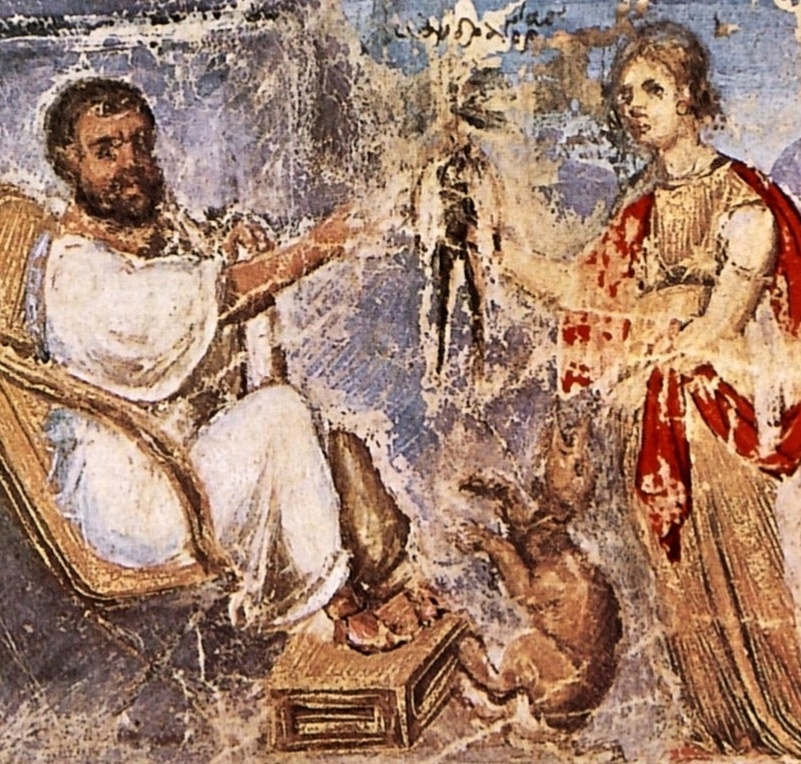
Pedanius Dioscorides – The Father of Pharmacognosy

Dioscorides receives a mandrake root, an illumination from the 6th century (c. 512) Greek Juliana Anicia Codex. Source.

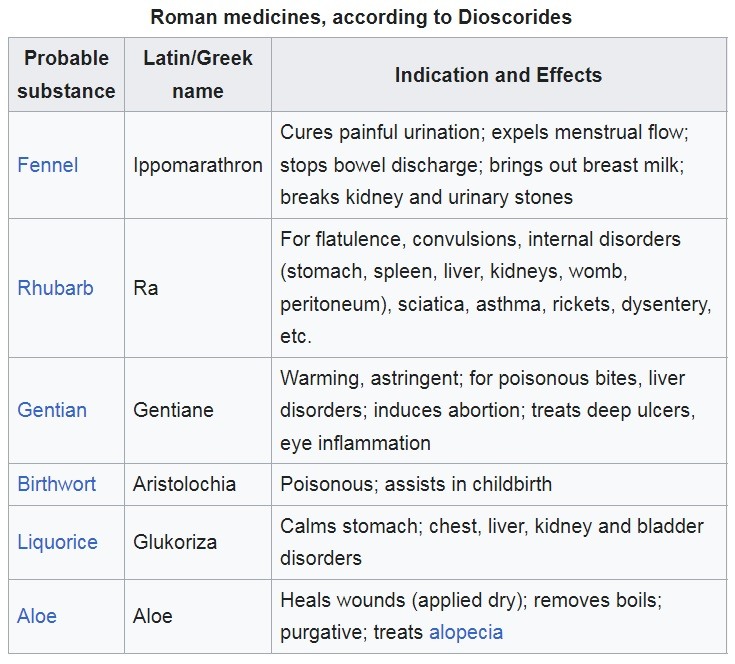
One of the most famous students to study at this school was Pedanius Dioscorides, a pharmacologist, physician, botanist, and author of De materia medica (“On Medical Material”). He was a military physician in Nero’s Army

Dioscorides was known as “the father of pharmacognosy“, but all of his “medicines” were plants, not the patented chemical medicines that we think of today when we hear the term “medicines.”

Plant “medicines” were also the foundation of other non-Western sources of ancient medical systems, such as Chinese Traditional Medicine, and the Indian Ayurveda system of medicine, both of which have been around for 4000-5000 years. (Source.)

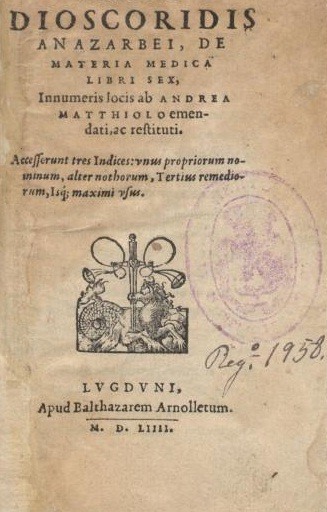
Cover of an early printed version of De materia medica, Lyon, 1554. Source.

Dioscorides wrote a five-volume book De materia medica (“On Medical Material”), which became the precursor to all modern pharmacopeias, (Source: Rooney, Anne 2012. The History of Medicine. The Rosen Publishing Group. p. 121), and was widely read for more than 1,500 years.

It was translated into Arabic in the 13th Century by Ibn al-Bayṭār, an Andalusian Arab physician, botanist, pharmacist and scientist.

He systematically recorded additions made by Islamic physicians in the Middle Ages, which added between 300 and 400 types of medicine to the one thousand previously known since antiquity. He was a student of Abu al-Abbas al-Nabati. (Source.)

Famous Roman Physicians

Here are the bios of a couple of other famous Roman physicians who were alive during the time the New Testament was being written, from Wikipedia’s entry on Medicine in ancient Rome.

Asclepiades of Bithynia

Asclepiades studied to be a physician in Alexandria and practiced medicine in Asia Minor as well as Greece before he moved to Rome in the 1st century BC. His knowledge of medicine allowed him to flourish as a physician. Asclepiades was a leading physician in Rome and was a close friend of Cicero.

He developed his own version of the molecular structure of the human body. Asclepiades’ atomic model contained multi-shaped atoms that passed through bodily pores.

These atoms were either round, square, or triangular. Asclepiades noted that as long as the atoms were flowing freely and continuously, then the health of the human was maintained. He believed that if the atoms were too large or the pores were too constricted, then illness would present in multiple symptoms such as fever, spasms, or in more severe cases paralysis.

Asclepiades strongly believed in hot and cold baths as a remedy for illness; his techniques purposely did not inflict severe pain upon the patient. Asclepiades used techniques with the intent to cause the least amount of discomfort while continuing to cure the patient.

His other remedies included music therapy to induce sedation, and consuming wine to cure headaches and a fever. Asclepiades is the first documented physician in Rome to use massage therapy.

Aulus Cornelius Celsus

Celsus (25 BC–AD 50) was a Roman encyclopaedist who wrote a general encyclopaedia about many subjects. His exact place of birth as well as when he lived are unknown; however, it is known he lived during the reigns of Augustus and Tiberius.

The only surviving work from his larger encyclopaedia is De Medicina. This work contains eight volumes, two of which are on surgery.

De Medicina provides some of the best accounts of Roman medicine during his time.

Its contents proved to be valuable even into the 15th century after Pope Nicolas V rediscovered it, becoming the first medical book to be published in 1478. It is still debated if he practiced medicine himself or just compiled the works of the time, much of it from Greek sources. This is important because at the time Greeks were looked down upon by the Romans and thus so was the work of doctors.

In his book he discussed the two different schools of thought at the time relating to medicine he calls “Empirics” and “Dogmatics”.

Empirics followed empirical observation while Dogmatics needed to understand the theory behind how a treatment works.

Celsus is also credited with writing on four of the five characteristics of inflammation, redness (rubor), swelling (tumour), heat (calor), and pain (dolor). Galen would write about the fifth, loss of function (functio laesa).

The Role of “Elders” in Ancient Greek-Roman Medicine

De agri cultura, also known as On Farming or On Agriculture, is a treatise on Roman agriculture by Cato the Elder. It is the oldest surviving work of Latin prose. Source.

Cato the Elder was a Roman soldier, senator, and historian who lived about 200 years before the New Testament was written, but his influence on Roman culture and medicine would have certainly been felt by those living in the First Century when the authors of the New Testament were living.

Cato the Elder despised every aspect of Greek society the Romans decided to mimic including sculptures, literature and medicine. He regarded the welcome given in Rome to Greek medicine and physicians as a major threat.

In Rome, before there were doctors, the pater familias (head of the family) was responsible for treating the sick. Cato the Elder himself examined those who lived near him, often prescribing cabbage as a treatment for many ailments ranging from constipation to deafness.

He would issue precise instructions on how to prepare the cabbage for patients with specific ailments. He also used cabbage in liquid form.

For example, a mixture of cabbage, water, and wine would be embedded in a deaf man’s ear to allow his hearing to be restored. Cato would treat fractured or broken appendages with two ends of a cut reed that were bandaged around the injury. (Source: “Household Medicine in Ancient Rome“. The British Medical Journal. 1 2140: 39–40. 1902.)

This context may help us understand the “medical advice” given by James, the half-brother of Jesus, in the 5th chapter of his letter recorded in the New Testament:

Is any one of you sick? He should call the elders of the congregation to pray over him and anoint him with oil in the name of the Lord.

And the prayer offered in faith will make the sick person well; the Lord will raise him up. If he has sinned, he will be forgiven.

Therefore confess your sins to each other and pray for each other so that you may be healed. The prayer of a righteous man is powerful and effective. (James 5:14-16)

Medicine in the 21st Century

The next time you read about “Luke the beloved physician” in the Bible, hopefully you will have a better understanding now about “physicians” and “medicine” in the Roman Empire during the time the Bible was being written, which bears no resemblance to doctors and medicines today.

The Western form of “medicine” today is dependent on repeat customers, and is a disease management system, NOT a “health care” system. To actually cure patients would cause them to go out of business! See:

Investment Report Reveals Medical Cures not Profitable for Big Pharma – Sick People Needed to Sustain Drug Sales

Natural remedies, which used to be called “medicine” in ancient times, cannot be patented, and are therefore a threat to the pharmaceutical industry here in the 21st Century.

I learned this firsthand myself, back in 2005 when we were selling Virgin Coconut Oil and publishing customer testimonials about the health benefits of consuming coconut oil, as well as publishing peer-reviewed literature showing how the medium chain fatty acids in coconut oil can fight diseases.

The FDA came after us and threatened to shut down our business, seize our inventory, and put me in jail for selling “unapproved drugs.”

Why in the world do Americans continue to give money to campaigns to “help find a cure for cancer” as they have done for decades, when MANY cures for cancer already exist, but are banned from being used here in the U.S. forcing people to go to Mexico or Europe to find those cures?

Money given to charities to “find a cure for cancer” usually just goes into the pockets of drug companies to develop more drugs.

See:

Unapproved but Effective Cancer Cures

We need more “beloved physicians” like Luke, who know the power of Jesus to bring about REAL healing, and we need “Elders” who can also tap into the power of Jesus to heal without the need of modern doctors and medicines. See:

There is Only One True Doctor

Comment on this article at Created4Health.org.

This article was written by Human Superior Intelligence (HSI)

See Also:

Understand the Times We are Currently Living Through

The Brain Myth: Your Intellect and Thoughts Originate in Your Heart, Not Your Brain

Is God’s Patience About to Run Out on the United States?

Second Edition of eBook Released: The Concept of the American Christian Family is a Myth and is NOT Found Anywhere in the Bible – by Brian Shilhavy

FREE eBook! Restoring the Foundation of New Testament Faith in Jesus Christ – by Brian Shilhavy

KABBALAH: The Anti-Christ Religion of Satan that Controls the World Today

Exposing the Christian Zionism Cult

The Bewitching of America with the Evil Eye and the Mark of the Beast

Jesus Christ’s Opposition to the Jewish State: Lessons for Today

Identifying the Luciferian Globalists Implementing the New World Order – Who are the “Jews”?

The Seal and Mark of God is Far More Important than the “Mark of the Beast” – Are You Prepared for What’s Coming?

The Satanic Roots to Modern Medicine – The Image of the Beast?

Medicine: Idolatry in the Twenty First Century – 10-Year-Old Article More Relevant Today than the Day it was Written

Having problems receiving our emails? See:

How to Beat Internet Censorship and Create Your Own Newsfeed

We Are Now on Telegram. Video channels at Bitchute, and Odysee.

If our website is seized and shut down, find us on Telegram, as well as Bitchute and Odysee for further instructions about where to find us.

If you use the TOR Onion browser, here are the links and corresponding URLs to use in the TOR browser to find us on the Dark Web: Health Impact News, Vaccine Impact, Medical Kidnap, Created4Health, CoconutOil.com.

The post Luke – The Beloved Physician and Ancient Healing Practices first appeared on Health Impact News.

  •  
❌