❌

Reading view

Bessent and Lutnick are Building a Parallel Financial System on Stablecoins without Government Oversight While Crashing the U.S. Dollar Intentionally


Comments by Brian Shilhavy
Health Impact News

Leah of the Leah Files has just published her 4th article in her “Currency Killer” series about Treasury Secretary Scott Bessent’s attempts to take over the U.S. financial system by crashing the U.S. dollar and replacing it with stablecoins, and specifically with Commerce Secretary Howard Lutnick’s Tether stablecoin, the largest stablecoin in the world which is now rapidly buying up U.S. Treasuries.

Here is my coverage of her first three articles in this explosive investigative series that I have yet to see anyone else cover in either the corporate or alternative media:

Part 1 & 2: Treasury Secretary Scott Bessent Just Restructured The American Financial System to Destroy the U.S. Dollar

Part 3: The Epstein Digital Financial System is Getting Ready to Replace the U.S. Dollar

In this 4th article in the series, Leah covers the GENIUS Act, which has already been signed into law, but has a comment period before it is enacted that will close on October 19.

As Leah writes, this is not simply “corruption as usual” in Washington D.C., where conflicts of interest rule the day.

No, this is entirely different – it is the complete hijacking of the U.S. financial system and putting it into the hands of a very few powerful people, and one very powerful company: Tether.

As Leah writes:

That is not a stablecoin company. That is a parallel financial system, every function of a central bank plus every function of an intelligence service, in one private entity, owned by four men who control 86 percent of the equity, incorporated in the British Virgin Islands, physically located in El Salvador, and paying zero corporate tax on $13 billion in annual revenue.

In 2024 during the Presidential campaign season in the U.S., I exposed many of the Silicon Valley billionaires who follow the teachings of Curtis Yarvin, and believe that democracy is a poor form of government, and would instead prefer a monarchy.

Peter Thiel heads this list, along with his protege and disciple, J.D. Vance, who is now the Vice President of the United States. See:

Big Tech “Far-Right” Billionaires want to Eliminate Politicians and “Democracy” as They Believe They can Run the World Better by Themselves

Of course “democracy” and the illusion that people can vote politicians into office to affect change is considered a “Constitutional Right”, and this belief is drilled into every American through our educational system.

So overthrowing the government and installing a king is just not something that would go over too well in the U.S.

However, hijacking the American financial system by crashing the U.S. dollar, replacing it with stablecoins, and putting it into the hands of a few powerful people in the private sector would accomplish almost the exact same thing, and Leah exposes it all in her series and in this latest article, which is must reading for everyone.

The Currency Killer Part IV: The Machine

They built it in eighteen months and it has been turned on. We have three weeks to make a change.

by Leah
The Leah Files

Excerpts:

Scott Bessent, the man running the US Treasury stood in front of a room in Dallas on September 10 and said five words that should have ended his career: “I am the house now.”

He was not joking. He tripled the government’s bond buyback program the same week. The next day, the DOJ publicly thanked Tether for helping freeze $52 million in criminal funds. Two weeks before that, his Treasury Department deleted the only federal database tracking who owns shell companies in America, and then published the rules that will govern stablecoins forever.

All of that happened in thirty-one days.

In Part I, I showed you how Bessent spent forty years breaking currencies and then took the keys to ours. In Part II, I showed you how Lutnick’s family built the custody operation with a Tether loan. In Part III, I traced Tether to Epstein’s crypto network and documented the empire they are building with the profits.

This is Part IV. This is what it looks like when all of it runs at the same time, and there is a clock on it. The GENIUS Act comment period closes October 19. That is three weeks from now. After that, the rules governing stablecoins in America get finalized by the man who profits from their growth, and the company those rules will govern just hired the man who wrote the law to be its CEO.

“I AM THE HOUSE NOW”

On September 10, Scott Bessent stood in front of a room in Dallas and said five words that should have been on every front page in America, “I am the house now.”
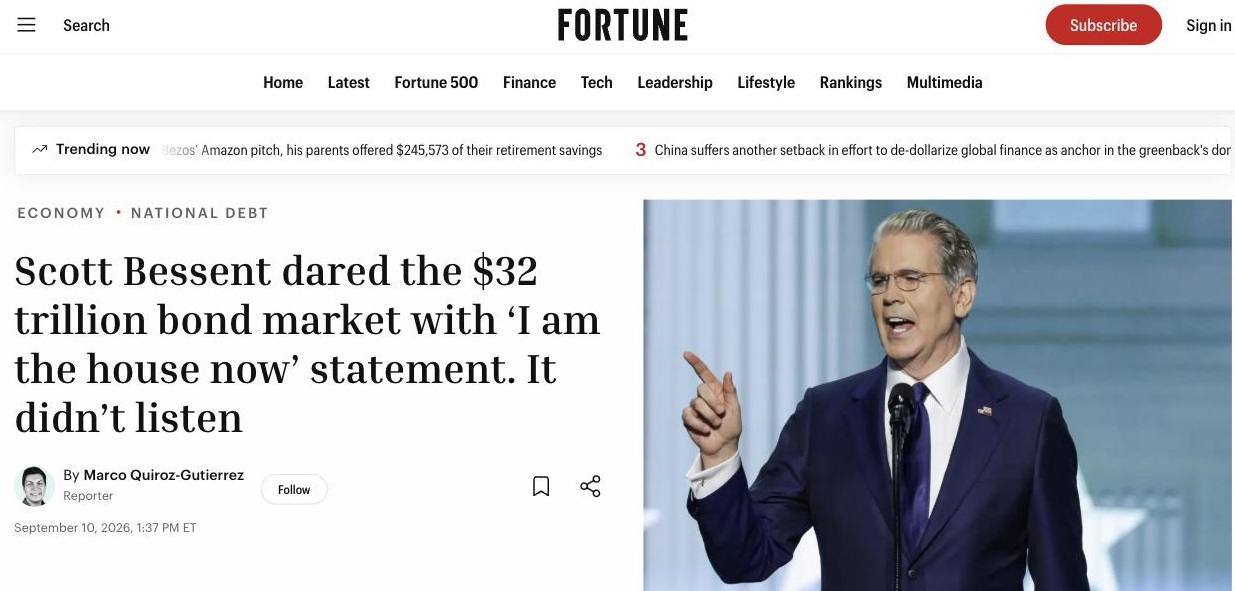
He was responding to critics who called his Treasury interventions reckless, after bond traders pushed back against his buyback program and drove yields higher instead of lower. His response was not to adjust, it was to triple down.

The Treasury announced it would buy back up to $6 billion in bonds in a single week, triple the normal operation. Bessent has doubled the buyback program twice since taking office, from $2 billion per operation to $4 billion, and now effectively to $6 billion per week, an escalation that no previous Treasury Secretary has attempted because no previous Treasury Secretary was a career currency trader who spent four decades learning how to move bond markets by force.

Here is what “I am the house now” means when you translate it from hedge fund speak. It means he is not managing the bond market, he is running it, setting the prices, deciding which bonds get bought, at what maturity, and at what yield.

The people on the other side of every one of those trades are the stablecoin issuers whose reserves the GENIUS Act requires to be held in Treasury bills maturing within 93 days.

When George Soros said something similar before breaking the Bank of England, he was a private citizen betting against a government.

Bessent was the man next to him when he said it.

Now Bessent is the government, and the bond market he is running determines what your mortgage costs, what the dollar is worth, and how much the country pays to borrow money.

That has never happened before, and he said it out loud.

Fortune reported that bond yields are higher now than before Bessent intervened, which means the plan is not working the way a normal Treasury Secretary would want it to work. But it is working exactly the way a currency attacker would want it to work, because higher long-term yields and lower short-term yields is the exact trade that benefits stablecoin issuers who hold short-term T-bills.

Bessent knows this because he spent forty years doing this.

THE NUMBERS

Here is what Bessent is actually doing with the bond market, because the numbers tell a story the headlines are not.

The GENIUS Act requires every stablecoin to be backed by Treasury bills maturing within 93 days. Not bonds, not notes. Short-term bills specifically. That means every new dollar of stablecoin growth creates a dollar of mandatory demand for one very specific type of government debt.

Now look at what Bessent did with supply.

Before he took over, the government was adding about $31.7 billion in T-bills per month. Under Bessent, the average rose to $45.7 billion. Then in June 2026, it exploded: T-bills outstanding jumped from $6.691 trillion to $7.248 trillion in two months. That is $557 billion in sixty days, 8.8 times the pre-Bessent pace. He is flooding the market with exactly the securities that stablecoin issuers are required by law to buy.

And there is only one buyer large enough to absorb that at scale. Tether held $98.5 billion in T-bills at the end of Q1 2025. By June 2026 it was $141 billion. They are already the 17th largest holder of US government debt on earth, bigger than Germany, and their CEO has said publicly they want to be top five.

Here is what that means for your wallet.

An academic study found that Tether’s buying lowers short-term yields by 24 basis points, which saves the US government roughly $15 billion a year in borrowing costs. The government is paying less on its debt because Tether is buying it. Standard Chartered projects stablecoin issuers will need $1 trillion in T-bill reserves by 2028. Bessent himself says $2 trillion.

Read that again.

The US government is becoming financially dependent on a private company incorporated in the British Virgin Islands to finance its own borrowing. And the man running the Treasury is the one making it happen.

That is the feedback loop nobody is naming.

Bessent issues the T-bills. The law requires Tether to buy them. Tether’s buying lowers yields and saves the government money. The government becomes dependent on Tether’s demand. Tether becomes too important to regulate. And Tether takes the yield from those T-bills and converts it into something else entirely.

Bessent has gutted every agency that would be watching any of this. FinCEN, the agency whose entire job is tracking dirty money, took an 11 percent staff cut with 30 more positions proposed for elimination, and the beneficial ownership database was ordered deleted.

The Public Integrity Section, the DOJ unit that prosecutes corrupt officials, went from 36 lawyers to 2 and from 190 open cases to about 20. Seventeen inspectors general were fired in a single night. The FBI’s public corruption squad was dissolved. Foreign Corrupt Practices Act enforcement was paused by executive order.

THE LOOP

Here is how it works when you put all the pieces together, six steps where each one feeds the next.

Step one: Bessent floods the market with short-term Treasury bills, tripling the buyback program to $6 billion per week and shifting debt issuance toward shorter maturities in what analysts call the “Treasury Twist.”

Step two: the GENIUS Act requires every stablecoin to be backed by reserves held in T-bills maturing within 93 days, which means every new dollar of stablecoin growth creates a dollar of mandatory demand for the exact securities Bessent is issuing.

Step three: Tether buys those T-bills, currently holding $141 billion in US Treasuries, making it the 17th largest holder of US government debt on earth and bigger than Germany, earning roughly $13 billion a year in yield.

Step four: Tether uses that yield to build the empire, deploying more than $5 billion since late 2023 into farmland, fertilizer, AI data centers, satellite companies, robotics, media platforms, gold, and bitcoin.

Step five: the empire generates revenue, with Adecoagro alone producing $467 million in annual EBITDA, the farmland growing crops, the bitcoin mines running on sugarcane electricity, the gold lending operation earning interest, and StableFund deploying private credit, with every subsidiary producing cash that flows back to Tether.

Step six: Tether issues more stablecoins, which require more T-bill reserves, which creates more demand for Bessent’s bonds, which keeps yields low, which lets the government borrow cheaply, which means Bessent can issue more T-bills.
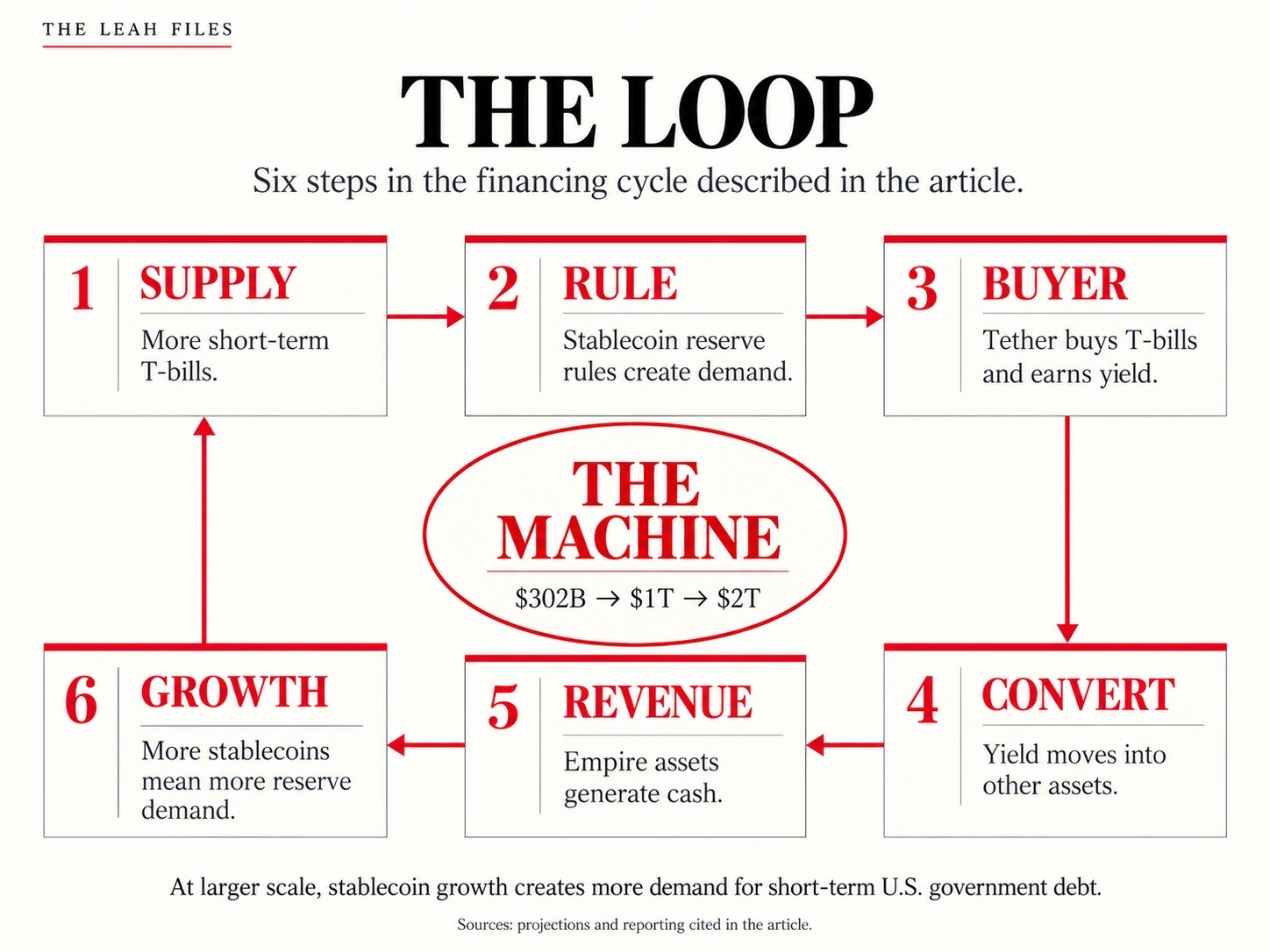
That is the loop, and once it reaches scale no future president can dismantle it without crashing the bond market. At $1 trillion in stablecoins, the US government depends on Tether to finance its operations.

At $2 trillion, Bessent’s own projection for 2028, stablecoin issuers hold a quarter of all T-bills outstanding. At $4 trillion, the whole thing is permanent, because the interest rates on your mortgage, your car loan, and your credit card would all spike overnight if anyone tried to unwind it.

We are at $302 billion right now and the clock is running….

Read the Full Article at The Leah Files – this is just a portion of everything she reports on that I have republished here.

This article was written by Human Superior Intelligence (HSI)

See Also:

Understand the Times We are Currently Living Through

The Brain Myth: Your Intellect and Thoughts Originate in Your Heart, Not Your Brain

Is God’s Patience About to Run Out on the United States?

Second Edition of eBook Released: The Concept of the American Christian Family is a Myth and is NOT Found Anywhere in the Bible – by Brian Shilhavy

FREE eBook! Restoring the Foundation of New Testament Faith in Jesus Christ – by Brian Shilhavy

KABBALAH: The Anti-Christ Religion of Satan that Controls the World Today

Exposing the Christian Zionism Cult

The Bewitching of America with the Evil Eye and the Mark of the Beast

Jesus Christ’s Opposition to the Jewish State: Lessons for Today

Identifying the Luciferian Globalists Implementing the New World Order – Who are the “Jews”?

The Seal and Mark of God is Far More Important than the “Mark of the Beast” – Are You Prepared for What’s Coming?

The Satanic Roots to Modern Medicine – The Image of the Beast?

Medicine: Idolatry in the Twenty First Century – 10-Year-Old Article More Relevant Today than the Day it was Written
Having problems receiving our emails? See:

How to Beat Internet Censorship and Create Your Own Newsfeed

We Are Now on Telegram. Video channels at Bitchute, and Odysee.

If our website is seized and shut down, find us on Telegram, as well as Bitchute and Odysee for further instructions about where to find us.

If you use the TOR Onion browser, here are the links and corresponding URLs to use in the TOR browser to find us on the Dark Web: Health Impact News, Vaccine Impact, Medical Kidnap, Created4Health, CoconutOil.com.

The post Bessent and Lutnick are Building a Parallel Financial System on Stablecoins without Government Oversight While Crashing the U.S. Dollar Intentionally first appeared on Health Impact News.


  •  

Pesquisa: Vídeo de Porchat sobre Master “fura bolha” mas campanha de Lula falha nas redes

O vídeo “Grandes Igrejas, Master Negócios, publicado pelo ator e comediante Fábio Porchat, na semana passada conseguiu dois feitos almejados pela campanha eleitoral do presidente Luiz Inácio Lula da Silva, candidato à reeleição. O primeiro foi “furar a bolha” dos grupos já alinhados com as pautas de esquerda, e o segundo foi explicitar o elo entre o maior escândalo financeiro do país, o caso Master, e o grupo político ligado ao principal adversário de Lula na corrida presidencial, senador Flávio Bolsonaro (PL-RJ). A conclusão é do cientista político e diretor executivo da Ipse Global, Leonardo Magalhães. 

“O Flávio Bolsonaro aparece como o segundo nome mais citado em um caso que nem é diretamente sobre ele, mas o envolve como um potencial beneficiário ou agente envolvido. Depois vêm o André Valadão com 11,6%, e o Nicolas Ferreira com 2,9%.”

O vídeo de Porchat foi alvo de um relatório da Ipse Global que realiza monitoramentos dos temas que movimentam a esfera pública digital para o desenvolvimento de estratégias de marketing político e eleitoral. Em entrevista à Agência Pública, Magalhães não aponta apenas pontos positivos sobre a campanha do presidente candidato à reeleição. 

Magalhães explica que o acesso ao vídeo do Porchat para fora da “bolha” de Lula não significa conversão em voto. “O material circulou mais fora do campo que o produziu do que dentro dele, o que é um caso raro. Mas o alcance não é [necessariamente] adesão. Nós medimos a exposição”, explica. 

Além disso, o cientista político afirma que o marketing eleitoral dos dois principais candidatos à Presidência da República estão perdendo oportunidades de obter resultados melhores nas redes sociais. O motivo seria a adoção de estratégias rígidas, ou como Magalhães nomeou: “receitas de bolo”. Para o diretor, o sucesso do filho do ex-presidente Jair Bolsonaro tem ocorrido nas frentes digitais da corrida eleitoral “mais por lacunas deixadas pela campanha do Lula do que por outra coisa.”  

O diretor executivo também faz um alerta, vindo das pesquisas qualitativas realizadas pela Ipse Global. A falta de confiança do eleitor nas instituições e no futuro segue crescendo, o que mantém um forte sentimento anti-sistema. 

“Quem vem com uma proposta de resetar o sistema, uma coisa muito forte em 2018, fabricada pelo [Jair] Bolsonaro, acaba mantendo um eleitorado cativo. E quem sugere uma mudança no sistema, segura esse eleitorado”, argumenta.

Segundo Magalhães, isso é um desafio para o presidente que está no poder e, para o eleitor, mantém e representa esse mesmo sistema. “A campanha do Lula não entendeu que precisa dar esperança, que as pessoas precisam de caminho. [Falta dizer] ‘olha, nós também estamos insatisfeitos, se nós pudéssemos, teríamos feito mais, não tivemos oportunidade, mas, a gente quer fazer mais’”, conclui. 

Leia os principais trechos da entrevista de Leonardo Magalhães à Pública: 

Cientista político e diretor executivo da Ipse Global, Leonardo Magalhães

No relatório sobre as reações ao vídeo do ator Fábio Porchat, os dados mostram que o engajamento diário saltou de 1,15% para 5,78% em uma semana. Esse vídeo conseguiu furar a bolha e chegar aos eleitores indecisos?

Chegou a quem não tem lado fixo, mas não há evidência matemática de que tenha convertido alguém. Na análise de mídias sociais, você não consegue cravar a conversão de voto a menos que tenha uma massa histórica de dados muito explícita. O que o dado preciso nos mostra é que o engajamento quintuplicou em uma semana, e o pico não aconteceu no dia do lançamento do vídeo, mas no dia da remoção do perfil do ator pelas plataformas.

Foram duas pautas que se somaram: a denúncia original e a pauta da censura. Essa segunda acabou se sobrepondo, o que atraiu muito o público que consome teorias de conspiração e polêmicas. Entre os perfis sem posicionamento definido, uma em cada quatro publicações nomeava o vídeo ou o Porchat. Na bolha de esquerda, era apenas uma em cada oito. O material circulou mais fora do campo que o produziu do que dentro dele, o que é um caso raro. Mas o alcance não é [necessariamente] adesão. Nós medimos a exposição. 

Entre os nomes citados no caso, Daniel Vorcaro concentra o maior desgaste, seguido por Flávio Bolsonaro; instituições como a Igreja Batista da Lagoinha lideram o engajamento. É possível concluir que o episódio conseguiu ‘colar’ o escândalo do Banco Master ao campo bolsonarista?

Sim, eu diria que sim, os nomes citados e a forma como eles são citados também evidenciam isso. O Flávio Bolsonaro aparece como o segundo nome mais citado em um caso que nem é diretamente sobre ele, mas o envolve como um potencial beneficiário ou agente envolvido. Depois vêm o André Valadão com 11,6%, e o Nicolas Ferreira com 2,9%.

O dado mais forte é que a associação da Igreja da Lagoinha com o caso, que lidera com 49% do engajamento, não foi construída por um argumento lógico-racional, mas, sim, por cenas e imagens que circularam massivamente. O caso produziu uma quantidade enorme de registros visuais e testemunhos, o que fixa a denúncia no imaginário de forma muito mais profunda do que um texto escrito. 

A campanha de Lula tenta explorar esses episódios de corrupção do adversário, mas sem o mesmo sucesso digital. Por que o vídeo do Porchat funcionou e a comunicação oficial do governo não funciona?

Porque o emissor faz parte da mensagem. No caso do Banco Master, os influenciadores respondem por 38,5% do engajamento e os políticos por apenas 21,2%. No debate digital sobre o presidente Lula na ONU, por exemplo, a proporção se inverte: 55,3% da indignação da oposição é produzida diretamente por agentes políticos e não por influenciadores.

[Essa] denúncia feita por um político é imediatamente lida pelo eleitor como peça de campanha. Ela ativa o modo de defesa do campo adversário na mesma hora. Já a denúncia feita por alguém de fora do sistema partidário é lida como apuração independente ou como uma resposta legítima da sociedade. 

O adversário fica sem saber como responder, porque ele não pode atacar a sociedade civil diretamente, a menos que tente rotular aquele emissor como militante. Esse caminho de usar influenciadores, a campanha pode estimular na informalidade, mas não pode assinar, porque no momento que assina, que isso faz parte da campanha, o efeito [positivo] acaba sendo desfeito.

O campo bolsonarista optou pelo silêncio estratégico sobre o vídeo do Porchat. Essa tática de não responder foi positiva para eles nas redes?

Para eles foi, na verdade, a melhor opção que tinham à disposição. E, claramente, foi bem mais deliberado do que parece. Na bolha de direita, não localizamos publicações de destaque mencionando o Porchat ou o vídeo. Eles falam do “caso Master”, mas ignoram a peça que os acusa.

Na lógica das plataformas, responder equivale a distribuir. Cada refutação que eles tentassem fazer entregaria ao denunciante uma audiência que ele não teria sozinho, transformando uma acusação de terceiros em uma conversa entre pares. 

Por outro lado, o silêncio custa caro para o Flávio Bolsonaro: quem não responde, não enquadra o assunto. Eles perderam a chance de definir o significado do caso, aceitaram o enquadramento do adversário e deixaram o tema livre para ser reciclado no futuro. 

O que a força desses escândalos e a fragilidade do debate eleitoral formal revelam sobre quem pauta uma campanha digital hoje?

Não existe uma resposta única e isso fica evidente na diferença entre os casos [analisados]. O escândalo [do Master] é pautado por quem está fora da política institucional, ou na oposição. Já a disputa eleitoral, propriamente dita, continua nas mãos dos políticos. 

No debate sobre o presidente Lula na ONU, 55,3% [do engajamento] foi gerado por políticos da oposição e 38,2% [gerado por políticos aliados] de apoio. [A soma é de 93% do engajamento total]. 

A imprensa é minoritária em engajamento nos dois casos citados: Master ou campanha eleitoral. […] A gente está vendo também um desarranjo muito grande do sistema de mídia, que é um sistema híbrido [tradicional e redes sociais]. 

A gente tem uma pauta que está ocupando a agenda inteira [caso Master]. A campanha está muito morna, não se fala praticamente de campanha, não se sente um clima de campanha. Isso de alguma maneira está gerando um prejuízo para a campanha do Lula, que é quem deveria, ou poderia, estar falando dos feitos deste último governo, de qual direção quer para o futuro, e não estão conseguindo. Está falando basicamente [do caso Master]. 

A própria mídia ajuda muito nisso e eu entendo. É interessante falar e explorar o caso Master por uma questão de audiência. Se não fizer isso, vai perder a audiência para outro que vai fazer. É o caso mais interessante e ficar falando de proposta acaba não sendo tão palatável, pensando na lógica da economia da atenção.

Pensando em Lula e Flávio Bolsonaro, alguma campanha está vencendo o debate sobre o caso Master?   

Não acredito que o campo da oposição, dos bolsonaristas, tenha entendido como usar melhor o caso. Acredito que a campanha do Lula está comendo algumas bolas, [vejo] oportunidades perdidas. Talvez por não entender como utilizar o marketing político, porque ele está cheio de “receita de bolo”. Por mais que a gente fale de profissionalização e modernização das campanhas eleitorais, e de uso maior de dados segmentados, que é como a Cambridge Analytica, que ficou famosa há anos atrás.

Na minha visão, ambas as campanhas estão usando essas “receitas de bolo” para ganhar vantagem em cima do adversário. A do Flávio Bolsonaro está usando uma estratégia mais de contenção e está se dando bem mais por lacunas deixadas pela campanha do Lula do que por outra coisa.

A campanha do Lula aplicou uma regra que tende a funcionar em eleições genéricas que é a da campanha negativa, para desidratar um adversário. Principalmente, quando o adversário está tão associado, de forma tão óbvia, com provas, com imagens, a um caso de corrupção grande como é o caso Master. 

Só que eles [da campanha de Lula] estão esquecendo de analisar o presente, como as coisas estão funcionando de fato, com uma mentalidade mais pragmática, não o que normalmente funciona. Na questão do Banco Master, tudo aquilo que envolve corrupção, as pessoas [que votam em Flávio] já colocaram na conta. 

A campanha de Lula não entendeu [isso], apesar de todo o barulho que vários atores estão fazendo, imprensa, influenciadores, a própria campanha, toda a esfera política aliada ao Lula, e nem isso está desidratando o Flávio. 

Como o governo poderia quebrar essa dinâmica?

A oposição não tem como lutar no terreno da entrega material, campo no qual o governo teria vantagem, mas, por algum motivo, está ignorando isso. Acredito que seja porque [Lula optou por] aplicar uma “receita de bolo” na campanha eleitoral. 

O que a oposição faz é lutar num terreno mais favorável e o próprio campo governista está contribuindo. Em qualquer outra eleição, com qualquer outro candidato, em qualquer outra circunstância, um candidato com as suspeitas que recaem sobre o Flávio Bolsonaro não teria a menor chance de vencer. Não alcançaria nem 5% [dos votos]. Mas, evidentemente, tem alguma coisa ligada ao antipetismo [ou] ao bolsonarismo, que faz a oposição lutar em um terreno mais favorável.

Para reverter isso [é preciso] atuar com mais informação. [A campanha de Lula] tem que dar uma forma narrativa ao que já foi entregue [pelo governo]. Com rosto, emoção, lugar, conflito, mostrar um antes e um depois, indicar para onde quer ir.

Isso que o governo deveria fazer, enriquecer essa narrativa para se diferenciar do adversário, ele pode fazer isso. Mas tem que entregar de uma maneira mais sistêmica essa narrativa. Não é colocar todas as fichas em cima de falar sobre os defeitos do adversário, quando isso não está funcionando e talvez não funcione também no segundo turno. 

O vídeo [do Porchat] é um modelo de formato. Ele conta uma história que funciona, com personagens, não é um balanço de governo. Como campanha negativa, [porém], não é a resposta ideal para a campanha do Lula porque continua jogando exclusivamente nesse campo [de abordar o escândalo do Master] que é um campo menos pior para o adversário [Flávio Bolsonaro].  

O relatório aponta que o enquadramento de “corrupção moral” responde por 67,2% dos debates do caso Master. Já os sentimentos de indignação e desprezo geram 85% de reações relacionadas a ele. Por que a pauta moral engaja tanto mais do que os debates sobre economia e entregas sociais?

A razão disso é mais econômica, no sentido de custo [pessoal]. A acusação moral não exige que o eleitor verifique nada, é o suficiente. [O eleitor] precisa apenas reconhecer uma cena. Já a entrega material exige que o eleitor identifique um benefício na própria vida, ou na vida de quem ele reconhece como família, ou, de maneira um pouco mais ampliada, como comunidade. E esse processo é bem mais lento e menos compartilhável.

O que as pesquisas qualitativas estão identificando e como isso afeta o comportamento eleitoral brasileiro?

O que a gente vê é uma falta de confiança enorme, crescente, nas instituições, no futuro, no outro. E também uma insatisfação muito grande com o sistema. Como se, após várias décadas de promessas de que haveria crescimento na qualidade de vida, isso não se sustentasse mais.

As pessoas estão insatisfeitas, têm que colocar a culpa em alguém. Então, quem vem com uma proposta de resetar o sistema, uma coisa muito forte em 2018, fabricada pelo [Jair] Bolsonaro, acaba mantendo um eleitorado cativo. E quem sugere uma mudança no sistema, segura esse eleitorado.

A campanha do Lula não entendeu que precisa dar esperança, que as pessoas precisam de caminho. [Falta dizer] ‘olha, nós também estamos insatisfeitos, se nós pudéssemos, teríamos feito mais, não tivemos oportunidade, mas, a gente quer fazer mais’. 

A resposta que [o governo Lula] deu nos últimos anos é muito baseada na defesa do sistema, em fazer certos acordos, e não em combater o bolsonarismo. Apesar de ser mais neoliberal, mais pró-sistema do que o governo Lula, [o bolsonarismo] habilmente monopolizou a rebelião antissistema.

  •  

Sete observatórios regionais de turismo sustentável juntam-se em Peniche para discutir futuro do setor

Peniche, Portugal. Foto: Artem Astashov/Unsplash.A primeira Conferência dos Observatórios Regionais de Turismo Sustentável vai reunir, a 14 de outubro, em Peniche, os sete observatórios regionais do país para discutir a monitorização da atividade turística, a sustentabilidade dos destinos e o papel dos dados na tomada de decisão.
  •  

Rennes: louer son deux-pièces deviendra une demande d'autorisation, sous peine de 15 000 euros

À partir d’avril 2027, louer certains petits logements dans le centre ancien de Rennes ne relèvera plus de la seule décision du propriétaire. Environ 900 logements de moins de 20 m² seront soumis à un « permis de louer », avec dossier administratif, visite municipale et jusqu’à 15 000 euros d’amende en cas de récidive.

Rennes: louer son deux-pièces deviendra une demande d'autorisation, sous peine de 15 000 euros
LE COURRIER
DES STRATÈGES
Restez libre !
Rennes: louer son deux-pièces deviendra une demande d'autorisation, sous peine de 15 000 euros

LA NEWSLETTER · GRATUITE

Le Courrier,
chaque matin.

L'essentiel de l'actualité, passé au crible par les cinq plumes du Courrier. Dans votre boîte, chaque jour ouvré.

Gratuit. Vous restez libre de partir quand vous voulez.

JE M'INSCRIS lecourrierdesstrateges.fr
lecourrierdesstrateges.fr
Restez libre !

La Ville de Rennes a annoncé le 24 septembre 2026 la mise en place de ce dispositif, officiellement destiné à lutter contre l’habitat indigne. Mais derrière cet objectif légitime se dessine aussi une nouvelle étape dans l’encadrement administratif du marché locatif privé.

Rennes: louer son deux-pièces deviendra une demande d'autorisation, sous peine de 15 000 euros
LE COURRIER
DES STRATÈGES
Restez libre !

ABONNEMENT

Allez au fond
des choses.

Deux grands formats par jour. Les cinq plumes du Courrier. La série Sécession, le dimanche.

Le monde commente. Vous, vous comprenez.

S'ABONNER lecourrierdesstrateges.fr
lecourrierdesstrateges.fr
Restez libre !

Un logement à louer, une autorisation à obtenir

Le dispositif concernera les logements de moins de 20 m² construits avant 1975 dans le centre ancien. Avant chaque nouvelle mise en location, le propriétaire devra déposer une demande sur une plateforme en ligne, puis accepter une visite de contrôle organisée par la municipalité.

Avec le permis de louer, la Ville de Rennes lutte contre l’habitat indigne | Espace presse | Rennes Ville et Métropole
La Ville de Rennes complète son arsenal de lutte contre l’habitat indigne grâce à un nouveau dispositif : le permis de louer. À partir d’avril 2027, …

La mairie disposera ensuite d'un délai d'un mois pour répondre. L'autorisation accordée sera valable deux ans. En l'absence de demande ou d'autorisation, les sanctions pourront atteindre 5 000 euros, puis 15 000 euros en cas de récidive dans les trois ans.

Comment la France a interdit, puis “dés-interdit”, de louer 700 000 logements
Après avoir interdit progressivement la location des logements classés G, puis F et bientôt E, le gouvernement reconnaît implicitement les effets pervers de sa propre politique. Le projet de loi « Relance du logement », présenté le 24 juin 2026, prévoit de remettre sur le marché près de 700 000 logements sous

Le mécanisme n'est pas une invention rennaise. Créé en 2014, le « permis de louer » est déjà appliqué dans plus de 700 communes françaises. Rennes étend donc à son tour une logique où la collectivité intervient directement avant qu'un propriétaire puisse proposer son bien à la location.

Rennes: louer son deux-pièces deviendra une demande d'autorisation, sous peine de 15 000 euros
LE COURRIER
DES STRATÈGES
Restez libre !

TELEGRAM · L'INFO EN CONTINU

Entre deux éditions,
le fil.

La newsletter vous donne le matin. Le fil vous donne l'instant.

Gratuit, et en continu.

REJOINDRE LE FIL t.me/resterlibre
t.me/resterlibre
Restez libre !

Lutter contre l'habitat indigne… en contrôlant le propriétaire

Sur le principe, contrôler les logements présentant des risques pour leurs occupants peut se comprendre. Mais le changement de logique mérite d'être regardé de près : le propriétaire ne se contente plus de respecter les normes applicables ; il doit désormais solliciter une validation administrative préalable.

Comment la France a interdit, puis “dés-interdit”, de louer 700 000 logements
Après avoir interdit progressivement la location des logements classés G, puis F et bientôt E, le gouvernement reconnaît implicitement les effets pervers de sa propre politique. Le projet de loi « Relance du logement », présenté le 24 juin 2026, prévoit de remettre sur le marché près de 700 000 logements sous

Pour un propriétaire d'un petit deux-pièces, la location devient ainsi une procédure : dossier, inspection, délai d'attente et renouvellement périodique de l'autorisation. Le risque financier, lui, est loin d'être symbolique.

Rennes: louer son deux-pièces deviendra une demande d'autorisation, sous peine de 15 000 euros
LE COURRIER
DES STRATÈGES
Restez libre !

TIPS · SANS ABONNEMENT

Offrez-nous
un café.

Un média libre vit de ses lecteurs. Un pourboire ponctuel, sans compte ni engagement, quand le cœur vous en dit.

Vous donnez ce que vous voulez. Vous restez libre.

LAISSER UN POURBOIRE merci !
lecourrierdesstrateges.fr
Restez libre !

La question dépasse donc Rennes. La mairie contrôle, le propriétaire supporte le risque, le locataire subit la rareté. Un droit de propriété qu'il faut faire valider tous les deux ans par l'administration n'est plus un droit : c'est une concession.

  •  

You Should’ve Said Something

Not long after the death of his father, Derek Askey, a new father himself, is selected as an alternate juror for a murder trial. The experience upends the typical vulnerability and openness of his life: Askey, under court order, cannot speak with his wife about the random violence heaped upon him, yet nevertheless worries about what his infant son “received from me” during his wordless days in the courtroom. He must withstand the gruesome details of the criminal trial, yet will not be allowed to participate in the jury’s deliberations. His personal essay is a challenging exploration of enforced silence, and the ways in which we seek to unburden ourselves through voice.

Before the trial, the other would-be jurors and I were asked our names, our occupations, whether we had spouses or children, and whether we could be impartial regarding the case, in which a man was being accused of murdering his girlfriend. At first I was curious to hear other people’s answers—Oh, wow, that guy fixes airplanes?—but curiosity quickly gave way to numb shock at how many people’s lives had been touched by domestic violence or murder. Or both. People you see every day. People who fix airplanes. One man said that, when he was little, his dad had beaten his mother; if he was being honest, he didn’t think he could be unbiased. The man was dismissed, and a woman was called up from the uncomfortable wooden pews to face the same interrogation. She had been attacked herself, she said. Some women had sisters, sisters-in-law, or best friends who’d been hit by a spouse or boyfriend.

  •  

“Espero que a nova direção faça tudo de forma diferente, porque é isso que a APAVT precisa”

Pedro Costa Ferreira, presidente da APAVT / Créditos: Carlos Palhava . PHOTONo próximo dia 2 de novembro, os associados da APAVT vão eleger o próximo presidente da associação, abrindo um novo ciclo e encerrando um capítulo de quase 15 anos de liderança de Pedro Costa Ferreira. A tomada de posse terá lugar na nova sede da APAVT, o espaço onde recebeu o TNews para fazer o balanço do seu mandato. Mas o legado de Pedro Costa Ferreira vai muito além da nova sede. Ao longo destes quase 15 anos, a APAVT reforçou a sua estrutura financeira e, na leitura do ainda presidente, deixa uma associação “maior, com mais capacidade de intervenção e mais representatividade”. Nesta entrevista ao TNews, Pedro Costa Ferreira fala sobre as principais batalhas dos seus mandatos, da transformação da distribuição turística à relação com as companhias aéreas, passando pela saída da BTL e pelos desafios do aeroporto.
  •  

Meliá estreia The Meliá Collection em Roma com hotel de 67 quartos em 2027

TnewsA Meliá Hotels International vai estrear a marca de luxo The Meliá Collection em Roma, em 2027, através de um acordo com o Gruppo Stay para a abertura de um hotel de 67 quartos no centro da capital italiana. A nova unidade será operada em regime de franquia e representa a terceira colaboração entre as duas empresas.
  •  

Lost and Found: A Reading List on Labyrinths, Mazes, and Wayfinding

Thoughtful stories for thoughtless times.

Longreads has published hundreds of original stories—personal essays, reported features, reading lists, and more—and more than 14,000 editor’s picks. And they’re all funded by readers like you. Become a member today.

Once, as a young adult in the city, I was walking home after a long day of work. The main street leading to my place wasn’t well lit, with dark stretches between streetlamps. There was a huddle of men under one, some standing around, some lounging against the post. They moved in the orange light, turning as one to face me. Something shifted in the air. 

An earlier version of me would have been slower to respond, given them the benefit of the doubt. But after a recent knife-point mugging, I had begun to develop a sort of second skin—a keen, physical sense of danger. I slipped back into the shadows and ran in and out of alleyways. I doubled back, cut across fences, and scaled half walls. I made no sound at all; I made it home. I had made a spiraling maze in real time. They could not find me.

In his essay “From the Tree to the Labyrinth,” Umberto Eco, a lover of labyrinths, explores how we “create and organize knowledge.” Moving away from the restrictive “tree” model, Eco approaches the “labyrinth” model, listing three kinds—a unicursal labyrinth, with only one path to the center and back; a multicursal maze, with many paths, all but one leading to dead ends; and an infinite network of interlinked points, which he calls by the borrowed term “rhizome.”

There are many labyrinths and mazes woven into my memory—verbal, textual, graphical, physical, metaphorical. Tamil kolams, for instance: My mother draws small, perfect threshold patterns at home, and immense, geometrically flawless labyrinths and mazes for events—no outlines, no tools, just her seeing eye and moving hand. When the sky is still dark, she dips folded muslin in wet, ground rice and draws liquid lines on the clean floor. She must draw each bit before the white dries on her hand, which it does almost instantly. Nothing can be erased or redrawn. She must keep moving until the whole kolam is done—the body walking the labyrinth even as it summons it out of nothing, the labyrinth making the world even as it is devoured by little black ants.

Eco’s rhizome model, to its credit, says we may never know everything, but we can keep going. Jorge Luis Borges certainly did, over and over like a modern-day Scheherazade. He wrote The Garden of Forking Paths, The Library of Babel, Funes the Memorious, The House of Asterion, and more, for those of us that love our awful infinities rendered in chewy, fictional ways. 

It’s been so long since the mugging and the maze. Those events (and others like them) ingrained hard habits into me. Unless I’m absolutely certain about the safety of the time and the place, I don’t listen to music as I walk. I wear barefoot shoes. I wear my bag cross-body, coax my hands out of my pockets. I note the exits and sit like a mob boss, the door never to my back. But I myself am softer, and I understand the ways of wayfinding a little better now.

Be Amazed (James McConnachie, Aeon, October 2017)

When Nawab Asaf-ud-Daula, ruler of the Kingdom of Avadh, moved his capital to Lakhnau (now Lucknow, Uttar Pradesh, India) in 1775, he likely had no inkling of what was to come—a great famine. The Nawab was an unusual ruler. Forgoing the usual charity routes, he offered his people the dignity of earning wages through excellent work, going so far as to demolish by night and rebuild by day so everyone who wanted work could have some. He built the lavish Bara Imambara, including a marvelous maze of a thousand corridors and half as many identical doorways (and one exit), the Bhulbhulaiya. The Hindi-Urdu root word, bhūlnā, means to forget, to be thus lost, and bhulānā is its causative form. The maze is “that which makes you forget.” 

Abhimanyu, warrior prince, has broken into the Cakravyūha, the battle formation of the colossal whirling disc. While still in his mother’s womb, he had overheard his father, the great warrior Arjuna, discuss war strategy with his uncle Kṛṣṇa, and filed the knowledge away in his preternaturally precocious mind. Now the Kurukṣetra War is upon them, and 16-year-old Abhimanyu has found his way to the center of the moving labyrinth. He is a trained warrior, no doubt, but he is alone, fighting seasoned Kaurava generals on all fronts. They have trapped him away from his fellow Pāṇḍavas. They have sunk his chariot, killed his horses, and broken his sword and bow. Abhimanyu raises a chariot wheel above his head. He doesn’t know how to come out. He never heard the end of the conversation.

This heartbreaking story from the Sanskrit epic The Mahābhārata was likely my own mythical introduction to the labyrinth. McConnachie, too, starts with a myth—a Greek mythopoeic myth—but first he runs a little labyrinth on the morning of his own wedding. His essay for Aeon moves lucidly through history, architecture, religion, folklore, games, psychoanalysis, New Age rituals, and more. 

P.S.: Don’t worry about Ariadne; she gets to chill with Dionysus. Theseus’s dad, not so great.

Instinctively, we sense that mazes and labyrinths are essentially metaphorical—even if it is not always clear what they represent—which explains why it’s so common to seek the meaning of the maze in myth. According to the ancient Greek story, as retold by the Roman writers Plutarch and Ovid, Minos of Crete demanded a tribute from the city of Athens in the form of seven young men and seven women. They would be imprisoned inside the Labyrinth created by Minos’ brilliant architect Daedalus, and there sacrificed to the Minotaur, a monstrous creature born of the unnatural union between Minos’ wife and a white bull.

The brave and ambitious Theseus gets himself chosen among the Athenians and, on arrival in Crete, seduces Minos’ daughter, Ariadne. She secretly arms him and slips him a “clew” of thread. (This is the old word for a ball or skein of yarn and is, fascinatingly, the origin of the English word “clue.”) Theseus kills the Minotaur, escapes the Labyrinth, runs off with Ariadne, and should return home happily—except that he abandons Ariadne on the island of Naxos and then, upon homecoming, forgets to change the color of the sails on his ship as he promised his father he would do if he survived. On seeing the black canvas, the old man drowns himself in the sea.

How the World’s Foremost Maze-maker Leads People Astray (Nicola Twilley, The New Yorker, November 2021)

Speaking of leading people astray, here’s a clip of the third task of the Triwizard Tournament from Harry Potter and the Goblet of Fire. Professor Dumbledore counsels the champions: “In the maze, you’ll find no dragons or creatures of the deep. Instead, you’ll face something even more challenging—people change in the maze.”

Adrian Fisher has over 700 mazes across 42 countries to his name, “including one on a skyscraper in Dubai and another that’s now reproduced on Britain’s five-pound note.” He’s also likely the only person to make a successful business out of mazemaking. Twilley profiles Fisher comprehensively, and not a little warily.

Starting with the design of the medieval Christian labyrinth, the most famous of which is in the Chartres Cathedral, France, Fisher slowly included other complex features. “Fisher realized that if he wanted to make mazes he first had to make people want mazes,” Twilley writes. According to Oskar van Deventer, an engineer and creator of renowned mechanical puzzles, he’s the “world’s best maze psychologist,” using what he knows about how people behave “against the unsuspecting solver and even against the suspecting solver.”

In 1980, Fisher was twenty-eight years-old and working for I.T.T., a multinational manufacturing company, where he was responsible for productivity enhancement. He was increasingly drawn to the idea of designing mazes; he’d even formed a company, Minotaur Designs, with a wealthy labyrinthologist and former diplomat, Randoll Coate. But public commissions proved elusive. “At first, I thought it was impossible,” Fisher said. “How do you start? How do you do it?”

Runcie’s dream gave him an idea: Fisher wrote to the letters page of the London Times, briefly outlining the maze’s long history as a Christian symbol and noting that, as in the Archbishop’s dream, a maze’s goal is typically reached not by “pressing toward the center” but, rather, by “returning almost to the edge,” in order to find the proper path. In his signature, Fisher styled himself a “Maze Consultant,” and, before long, this stealth marketing had reeled in a customer, and Minotaur’s first public commission. 

How Brainless Slime Molds Redefine Intelligence (Ferris Jabr, Nature/Scientific American, November 2012)

Crystals are known for stacking their atoms in repeating patterns in every direction, forming structured unit cells and lattices. But quasicrystals are mad materials. They, too, form patterns, but in non-repeating ways. Physicists exploring their use in carbon capture ended up with the world’s most diabolical maze. 

What can live without a brain or a nervous system, eat better than you, navigate mazes, and win scientists not one, but two Ig Nobel Prizes? The answer is a single-celled organism called the slime mold, also affectionately known as the blob. 

In the 2000s, Toshiyuki Nakagaki, a scientist at Hokkaido University, scattered bits of a single Physarum polycephalum in a maze, a few dots in a petri dish. The bits grew enough to find each other, and then grew some more to fill the maze. The mold then retracted itself from the dead ends, restricting itself to the most rewarding path—and this was the least it could do. Using its ability to grow up to a meter; its ability to analyze, solve problems, and optimize in real time; and its own slime as “externalized spatial memory,” it “effectively re-created Tokyo’s railway network in miniature as well as the highways of Canada, the U.K., and Spain.”

Catch a glimpse of this incredibly cool mold in action in this WIRED video: Mycologist Explains How a Slime Mold Can Solve Mazes. Looks like Nakagaki will have the last laugh, after all. And if you’ve ever wondered how other animals are so much better at this stuff than us, read Kathryn Schulz’s essay for The New Yorker, “Why Animals Don’t Get Lost.”

Gardeners sometimes encounter them in their backyards—spongy yellow masses squatting in the dirt or slowly swallowing wood chips. Hikers often spot them clinging to the sides of rotting logs like spilled bowls of extra cheesy macaroni. In Mexico some people reportedly scrape their tender bodies from trees and rocks and scramble them like eggs. They are slime molds: gelatinous amoebae that have little to do with the kinds of fungal mold that ruin sourdough and pumpernickel. Biologists currently classify slime molds as protists, a taxonomic group reserved for “everything we don’t really understand,” says Chris Reid of the University of Sydney.

Something scientists have come to understand is that slime molds are much smarter than they look. One species in particular, the SpongeBob SquarePants-yellow Physarum polycephalum, can solve mazes, mimic the layout of man-made transportation networks and choose the healthiest food from a diverse menu—and all this without a brain or nervous system. “Slime molds are redefining what you need to have to qualify as intelligent,” Reid says.

Haunted Mazes (Joe Milutis, Cabinet, Winter 2007-8)

Teenaged Sarah is supposed to be babysitting her infant brother, Toby. But he won’t stop crying, and in a rash moment, she wishes him gone. Villainous Goblin King Jareth obligingly spirits him away to his dark labyrinth, which she must negotiate to save the baby before a terrible fate befalls him. If you’re not convinced you should see Labyrinth, this 1986 classic, know that the Goblin King is David Bowie. 

I had some trouble choosing a quote from this retro maze of an essay. Every passage seemed appealingly contrarian, sometimes even to the essay’s own points, every idea poised for intertextual sparring with the other pieces in this reading list (something I secretly enjoy). 

Yes, it is gleefully haunted by its own ideas going back and forth and switching back upon themselves, and yes, it will make you question a few axiomatic notions about labyrinths and mazes. But maybe because times have changed, maybe because no one seems to be saying labyrinths are better than mazes or vice versa any longer, some of the arguments may seem a little heavy-handed. 

But some, like this one seemingly drawing from Freud/Jung psychological arcana, still sparkle: “The maze is the labyrinth’s uncanny.”

It seems to me that hidden behind contemporary etymological distinctions is an attempt to tame multicursality, by way of denigrating multicursal mazes as merely “childish” versions of more sober, unicursal ones. Multicursality challenges meditative clarity with multiple versions, no clear centers, and a sense of ambivalence and confusion. These complications, however, are the point of the labyrinth. Even if we grant that labyrinth merely designates the one-path New Age labyrinth recycled from the medieval era, the object is still haunted by a misrecognition. For even the medievals retained a sense of the unicursal labyrinth’s ambages—the equivocation at the heart of its windings, which the New Age version does not readily admit. Additionally, the labyrinth that is the legacy of the medieval period is enmeshed in a circuit of analogies to such a degree that it is impossible to map out all its symbolic equivalences and their implications without ending up in the muck of indistinction. This tendency of the labyrinth to connote so much is part of what makes it an antithesis to sureness, rationality, and clarity. Its structure is mystically congruent with the idea of a dark or enchanted forest; it is also a stand-in for earthly conundrum, brain fold, uterine canal, spiritual struggle, or psychosexual journey. Its center: Mary, the alchemical rose, Jerusalem, princess, Minotaur, inner-self, lotus blossom. And of course there are the various rewards that the multicursal maze holds out for its young adepts (pots of gold, pies and cakes, utopian wonderlands of bunnies and lollipops). Labyrinthine confusion is not merely an issue of its tortuous corridors, its solution not merely the cheese in the corner. Labyrinth enfolds into labyrinth across times, cultures, and myths.

“Backrooms” Gets Lost in Its Own Labyrinth (Adam Nayman, The Ringer, May 2026)

Games heart mazes. Here’s the nuts-and-bolts story of the OG++: “How a Bunch of MIT Dropouts Created Ms. Pac-Man.”

It’s the yellow that first holds you down, like the yellow fog in T. S. Eliot’s The Love Song of J. Alfred Prufrock, like the yellow wallpaper in Charlotte Perkins Gilman’s story of the same name. There’s something about this sickly yellow, but there’s more.

Backrooms is young YouTuber Kane Parsons’s widely acclaimed horror debut. Failed architect Clark manages a strip-mall furniture store called Cap’n Clark’s Ottoman Empire. During his insomniac wanderings, he stumbles upon a doorway in the store’s basement—the entry to the mysterious Backrooms. (The trailer is a relatively safe place to start before you attempt full liminal dread.) 

Nayman’s critical voice stands a little apart from what seems to be near-universal approbation for the film, which he says “exists in its own liminal space between ambitious experiment and fascinating failure.” But he sounds, I must say, somewhat like a parent speaking of his gifted kid—one who could go very far if only he applied himself a little more. What if the kid knows something that others don’t?

[O]ne of the lurking, not so elusive themes of Backrooms—a movie that doesn’t lack for entry points—is the postmodern terror of reiteration without end, the unsettling and melancholy notion of reality as a series of adjoining, subterranean echo chambers, each a slightly altered copy of the last. “Six hundred million square miles of randomly segmented back rooms,” read the original, anonymous, and extremely viral 4chan post that ended up being used as a blueprint by hordes of online architects eager to build their own additions onto a freestanding urban legend; the sprawling, relentlessly subdivisional logic of this online lore, and the fact that anyone could contribute to it at any time, turned the expanse of the Backrooms into a pretty nifty allegory for itself. 

Parsons was 16—and going by the online handle Kane Pixels—when he made his first Backrooms short in 2022: a found-footage-style clip created in Blender and After Effects. His innovation was to place the preexisting images into a paranoid narrative framework about a research facility offering egress to another dimension; the first clip centered on an amateur filmmaker who gets lost in the Async complex and chased by an unseen creature. 

The Far North of Experience (Rebecca Solnit, Guernica, June 2013)

“In Hokusai’s Thirty-Six Views of Mount Fuji, most of the woodblock prints show the famous conical peak, but one shows pilgrims climbing a Fuji that is the very ground under their feet. You can’t see the mountain’s form while you’re on the mountain. There are subjects you can better understand through analogy, context, parallels, the view from the distance, rather than via direct and dogged pursuit.” Solnit expands on the same ideas for Literary Hub in “In Praise of the Meander,” this time “letting nonfiction narrative find its own way.” 

Solnit describes one summer she spent on an Icelandic peninsula, “in the company of strangers and birds.” 

“Creation is always in the dark because you can only do the work of making by not quite knowing what you’re doing, by walking into darkness, not staying in the light. Ideas emerge from edges and shadows to arrive in the light, and though that’s where they may be seen by others, that’s not where they’re born,” she says, and goes to the last dark place she could find that summer—a labyrinth called the Path, lit by the faintest lavender-blue light.

Lyrical and more atmospheric than her engaged treatment of labyrinths in Wanderlust: A History of Walking, this essay shows us a gentle way of being we would do well to heed.

A labyrinth is an ancient device that compresses a journey into a small space, winds up a path like thread on a spool. It contains beginning, confusion, perseverance, arrival, and return. There at last the metaphysical journey of your life and your actual movements are one and the same. You may wander, may learn that in order to get to your destination you must turn away from it, become lost, spin about, and then only after the way has become overwhelming and absorbing, arrive, having gone the great journey without having gone far on the ground.

In this it is the opposite of a maze, which has not one convoluted way but many ways and often no center, so that wandering has no cease or at least no definitive conclusion. A maze is a conversation; a labyrinth is an incantation or perhaps a prayer. In a labyrinth you’re lost in that you don’t know the twists and turns, but if you follow them you get there; and then you reverse your course.

The end of the journey through the labyrinth is not at the center, as is commonly supposed, but back at the threshold again: the beginning is also the real end. That is the home to which you return from the pilgrimage, the adventure. The unpraised edges and margins matter too, because it’s not ultimately a journey of immersion but emergence.

Labyrinth (Amelia Gray, The New Yorker, February 2015)

In 1922, William H. Matthews published a book called Mazes and Labyrinths in London. Sam Dolbear introduces this classic for The Public Domain Review, offering a selection of beautiful images and the book itself in full. He concludes with a quote from Matthews, which seems to prefigure Eco’s third model and Borges’s predilections: “The boundaries of knowledge are still misty and ill-defined, a circumstance that only gives zest to the subject.”

Dale, reader of “Hellenic myth” and all-round good sport, has organized the Pumpkin Jamboree. It’s a way for the townspeople to have some weekend fun while raising money for the local fire department. Its highlight is always the corn maze. “Only it isn’t a maze this time,” Dale says, “It’s a labyrinth.” 

This unexpected turn of events thins the crowd, but it looks like Jim, his friend, might be willing to give it a go. “Now, you go on, Jim. This is my life’s effort distilled. Find out what it’s all about.”

It’s not easy to take a well-worn, spoiler-free myth known since Plutarch and make it sound fresh. Gray has done that here in her short story without a wasted word, and her Daedalus, cornfield architect, is just getting started.

Dale watched them leave, fingering a pumpkin’s thick stem and surely considering his hours of lost work. He starts his mazes a few months beforehand, cutting into the young corn when it’s tall but not yet sprouted, taking a pass first with the tractor and then with the riding mower to pull out the brace roots and tamp the corn down. He draws the maze plans on drafting paper and displays them afterward in his swept-out garage addition—he calls it the Hall of History—with other jamboree memorabilia: the gearshift from the original hayride truck, trotter prints from the winning pigs. We gather around to reminisce about which wrong turn we took and what was waiting for us on the other side.

Knowing what he must have put into it, I thought it was a shame to stand by and see everyone go. The sun was still low in the sky, and it was lonely at home, where the TV had been broken for a week, and the tap water had begun to taste oddly of blood. “I’ll go first,” I said. “I’ll do it.”

Kanya Kanchana is a writer from India.


Editor: Krista Stevens
Copyeditor:
Carolyn Wells

  •  

Valéria Linhares nega relação com Cezinha de Madureira mas foi sócia de seu filho em rádio

A Operação Transparência, deflagrada este mês pela Polícia Federal (PF), teve entre os alvos um possível casal: o deputado federal Cezinha de Madureira (PL-SP) e a advogada Valéria Rodrigues Linhares. Ela é apresentada como mulher ou esposa de Cezinha em diversas reportagens, como essa do portal Metrópoles, sobre a operação, que investiga, entre outros crimes, suspeitas de tráfico de influência junto a tribunais superiores e lavagem de dinheiro. A assessoria da advogada, porém, nega que os dois mantenham relação conjugal.

Valéria Linhares, alvo da Operação Transparência da Polícia Federal

O deputado federal e pastor da Assembleia de Deus do Ministério de Madureira  também aparece nas revelações recentes do caso Master como intermediário que apresentou o ex-banqueiro Daniel Vorcaro ao ministro André Mendonça, do Supremo Tribunal Federal (STF). Mensagens obtidas pela PF indicam que Cezinha articulou um encontro entre os dois, realizado em março de 2025, em São Paulo. Mendonça confirmou ter recebido Vorcaro, mas alegou que a conversa tratou de uma disputa sobre precatórios em análise no Supremo e que sua atuação posterior no processo foi contrária à posição defendida pelo então controlador do Master.

Embora negue a relação afetiva, a advogada tem proximidade documentada com a família dele. Filiada ao PSD e candidata não eleita a deputada distrital (DF) em 2018, Linhares foi sócia de Allan Sousa Vieira Freire, filho do parlamentar, na Exclusive Music Radiodifusão Ltda.

Documentos da Junta Comercial do Estado de São Paulo (Jucesp) mostram que Allan entrou na empresa em 3 de julho de 2024, com R$ 25 mil, equivalentes a 50% do capital, e permaneceu formalmente na sociedade até 26 de fevereiro de 2025. Linhares detinha os outros 50% do capital da empresa.

A entrada de Allan ocorreu no mesmo período em que a concessionária avançava no processo de migração para a frequência modulada (FM). Dois dias antes de seu ingresso na sociedade, a Agência Nacional de Telecomunicações (Anatel) havia editado o Ato nº 10.010, de 1º de julho de 2024, publicado no Diário Oficial da União (DOU) em 15 de julho, que autorizou a Exclusive Music a usar radiofrequência FM em Osasco. A concessão abriga atualmente a Rádio Z FM. 

Também em 2024, o deputado federal  e a advogada estiveram em pelo menos cinco ocasiões no Ministério das Comunicações (MCom) nos mesmos dias para encontros com Wilson Diniz Wellisch, então secretário de Comunicação Social Eletrônica, responsável pela área de rádio e televisão, segundo reportagem publicada pelo UOL que cita Wellisch como uma indicação política de Cezinha. Registros de acesso obtidos pelo portal mostram que o deputado do PL esteve 17 vezes no Ministério desde o início do governo Lula até fevereiro de 2025.

Por que isso importa?

  • A fase 3 da Operação Transparência investiga se os envolvidos negociaram o pagamento de “valores expressivos” com outras pessoas, afirmando que “poderiam influenciar decisões judiciais”.

Procurado, o MCom afirmou que a nomeação do servidor seguiu “critérios técnicos, como experiência profissional robusta e formação acadêmica especializada, além de um processo seletivo com diversas entrevistas”. Em outubro de 2023, entretanto, a então chefe de gabinete de Wellisch deixou o Ministério para trabalhar com Cezinha, enquanto uma assessora parlamentar do deputado passou a trabalhar com o secretário.

A proximidade entre os gabinetes também envolveu auxiliares. Caroline Menicucci Salgado, então chefe de gabinete de Wellisch, deixou o Ministério das Comunicações e foi nomeada em 4 de outubro de 2023 secretária parlamentar no gabinete de Cezinha, segundo registros oficiais da Câmara dos Deputados. No sentido inverso, segundo o UOL, uma assessora parlamentar de Cezinha assumiu a vaga de Caroline no gabinete de Wellisch.

No período em que Valéria Linhares e o filho de Cezinha de Madureira eram sócios na rádio, a Anatel registrou o processo nº 53500.083361/2024-94  que solicitava a alteração das características técnicas do canal 243 de Osasco, correspondente aos 96,5 MHz. O registro apresenta a configuração técnica proposta como classe A4 e contém a observação “estação fora do município de outorga”. 

Para viabilizar essa mudança técnica, necessária para o crescimento da emissora,  o governo federal e a Exclusive Music firmaram um termo de parcelamento referente à outorga pela alteração das características da estação. O Extrato de Termo de Parcelamento Administrativo, referente ao processo nº 53500.083361/2024-94, registra que o documento foi assinado em 6 de dezembro de 2024 por Wellisch, pela União, e por Valéria Linhares, identificada como sócia-administradora da Exclusive Music. 

O valor da transação foi de R$ 6,7 milhões, divididos em 120 parcelas. Por causa de uma regra transitória definida pelo MCom, o total da transação teve uma redução de mais de R$ 2 milhões e poderia ter chegado a R$ 8,8 milhões. A regra provisória prevê o pagamento sem a correção pelo IPCA, mas a empresa deve se comprometer a quitar posteriormente uma eventual diferença. Segundo o Ministério, a regra não foi criada especificamente para a Exclusive Music e estava disponível às demais emissoras nas mesmas condições. 

Antes da entrada do filho de Cezinha na sociedade, a empresa de Valéria Linhares já tinha recebido decisão favorável  do MCom. A Portaria nº 11.609, de 14 de dezembro de 2023, transferiu para a Exclusive Music a concessão originalmente outorgada à Rádio Iguatemi Ltda., posteriormente denominada Rádio Comunicação Brasil Ltda., para executar serviço de radiodifusão sonora em onda tropical em Osasco, na Grande São Paulo. A portaria foi publicada no DOU em 18 de dezembro de 2023.

Naquela época, a Exclusive Music pertencia à Linhares e ao advogado e corretor de imóveis Douglas dos Anjos. A ficha cadastral da Jucesp registra que a empresa foi constituída em dezembro de 2021, com capital de R$ 40 mil. Valéria detinha R$ 20,4 mil e Douglas, R$ 19,6 mil. Ambos figuravam como administradores, e o objeto social incluía atividades de rádio e televisão aberta.

A migração da antiga emissora de ondas tropicais para o FM tornou-se possível após mudanças nas regras federais de radiodifusão. O Decreto nº 11.739, de 18 de outubro de 2023, autorizou a adaptação facultativa das outorgas de serviços de radiodifusão sonora em ondas curtas e ondas tropicais para FM. Inicialmente, os canais deveriam ser incluídos na faixa estendida do FM, entre 76 e 88 MHz.

No dia seguinte à publicação do decreto, a emissora de Valéria Linhares solicitou a migração. O processo, porém, esbarrou na falta de viabilidade técnica na faixa estendida. Em junho do ano seguinte, o Decreto nº 12.050, de 11 de junho de 2024, alterou a norma e permitiu que, em caso de comprovada inviabilidade técnica de inclusão na faixa estendida, o canal da emissora migrante fosse incluído na faixa convencional do FM, entre 88 e 108 MHz.

A emissora de Osasco foi a primeira migrante de ondas tropicais do país a obter licenciamento para operar na faixa convencional do FM. Tais alterações e publicações de decreto também ocorreram no período das visitas de Cezinha de Madureira e Linhares ao aliado  Wilson Diniz Wellisch. 

Como deputado federal, Cezinha sempre atuou em pautas relacionadas ao setor de radiodifusão e na defesa de sua modernização. O deputado é o coordenador da Frente Parlamentar em defesa da radiodifusão, criada em maio de 2023 por um requerimento assinado por ele. A Frente reúne atualmente 212 deputados federais e 17 senadores.    

Allan Freire deixou formalmente a sociedade em 26 de fevereiro de 2025. Na mesma alteração contratual, Alanna Gabrielle Linhares e Silva, filha de Valéria Linhares, entrou na empresa, e a sede da Exclusive Music foi transferida para a avenida Paulista, em São Paulo. A frequência passou a abrigar oficialmente a Rádio Z FM 96,5 em maio de 2026.

Procurada pela Agência Pública, a Rádio Z informou por telefone que Allan Freire não participa da gestão da emissora e que o seu diretor-geral é o radialista Nelo Rodolfo. Jornalista, radialista, publicitário e advogado, Nelo Rodolfo teve uma extensa carreira política. Foi vereador em São Paulo pelo PMDB entre 1993 e 1996, reelegeu-se pelo PPB e foi presidente da Câmara Municipal de São Paulo em 1997 e 1998, durante a gestão do prefeito Celso Pitta. Nelo também foi deputado federal e voltou posteriormente à Câmara paulistana pelo PMDB. 

Outro lado

Valéria Linhares afirmou, por meio de sua assessoria, que o processo de migração da emissora Exclusive Music “ocorreu em estrita observância aos procedimentos e prazos legais aplicáveis” e que atualmente “não é sócia e tampouco possui qualquer relação comercial ou profissional com Allan Freire”. 

O deputado federal Cezinha de Madureira, Allan Freire e Nelo Rodolfo também foram procurados pela Pública, mas não responderam aos contatos até o fechamento desta matéria. Alanna Linhares e Silva não foi localizada. O espaço segue aberto e será atualizado caso haja manifestação dos citados. 

PF apreendeu R$ 510 mil com Valéria Linhares

Antes de ser investigada por suspeitas de exploração de prestígio, tráfico de influência, corrupção passiva e lavagem de dinheiro pela Operação Transparência da PF, a advogada Valéria Linhares foi detida no aeroporto de Congonhas, na capital paulista, em agosto. Foram apreendidos, na ocasião, R$ 510 mil em dinheiro durante a passagem de sua bagagem pelo Raio X. Como a origem do dinheiro não foi comprovada naquele momento, os valores foram apreendidos, Linhares prestou esclarecimentos à PF e foi liberada.

A defesa de Linhares afirmou que não havia ilegalidade, que o dinheiro tinha origem lícita e era proveniente da atuação profissional da advogada. Também informou que pediria a devolução dos valores.

Em setembro, quando a Operação Transparência foi deflagrada, a PF cumpriu mandados de busca e apreensão contra Cezinha de Madureira, Valéria Linhares e outros investigados. A operação foi autorizada pelo ministro Flávio Dino, do STF. A corporação afirmou também que não havia, naquele momento, elementos indicando participação de integrantes do Judiciário nos crimes investigados.

Quatro dias mais tarde, a PF cumpriu novo mandado no endereço de Valéria Linhares e apreendeu seu telefone celular, também por determinação de Dino. A jornalistas, Cezinha de Madureira afirmou, sobre a operação da PF, que não cometeu irregularidades. Sua defesa declarou que os fatos serão esclarecidos com acesso integral aos elementos da investigação e respeito ao contraditório.

Cezinha intermediou encontro de Vorcaro com André Mendonça

A relação entre Cezinha de Madureira e André Mendonça tem origem na igreja evangélica. O deputado é pastor, em São Paulo, e foi presidente da Frente Parlamentar Evangélica na Câmara Federal em 2021. No Congresso, participou ativamente da campanha que aprovaria no Senado Federal a indicação de André Mendonça ao Supremo no mesmo ano. 

Em março de 2025, Cezinha intermediou um encontro entre Mendonça e Daniel Vorcaro, então controlador do banco Master, em São Paulo, na sede do Instituto Iter, fundado pelo ministro do STF, e que não constou da agenda oficial de Mendonça.

Mensagens apreendidas pela PF mostram a participação de Cezinha na articulação da reunião. Mendonça confirmou o encontro e afirmou que recebeu Vorcaro a pedido de pessoas próximas à Igreja Batista da Lagoinha. Segundo o ministro, a conversa durou entre 20 e 30 minutos e tratou de uma questão jurídica envolvendo precatórios.

Segundo Mendonça, ele se limitou a ouvir o empresário e receber memoriais e que sua atuação posterior foi contrária ao interesse defendido por Vorcaro. Na época do encontro, o Banco Master ainda não era alvo da investigação que posteriormente levaria à prisão do ex-banqueiro.

  •  

Oh, How Lucky We Are

Beryl Gilothwest’s grandmother, Sandy “Moose” West, passed away at age 108 in 2021. For The Bitter Southerner, Gilothwest profiles a diminutive woman whose love for Ossabaw, an island off the coast of Georgia, was larger than life. In a world striving for “progress,” West was a staunch advocate for thoughtful preservation; she was a fierce conservationist and environmentalist who embraced the unknown and took pleasure in learning from it.

“Sandy believed that embracing what we cannot understand is the pathway to enlightenment. In her mind, spending time in the uncharted wilds of Ossabaw is the best way to learn that lesson. Separated from the mainland by a 30-minute boat ride, the island is deeply remote. Cell service is scant, and there is no wi-fi. You have to fend for yourself out there in a way that is uncommon in contemporary culture, where we always seem to have an escape hatch. Sandy knew that welcoming people into that kind of environment, where they have to relinquish control to the island, would force them to reckon with the unknown.”

  •  

SP Regula flexibiliza obras em cemitérios; medida alcança empresa ligada ao Master

A SP Regula, agência da Prefeitura de São Paulo responsável por fiscalizar os cemitérios privatizados da capital, mudou a forma de analisar os planos de obras das concessionárias após uma reunião com representantes das próprias empresas, realizada em 26 de março de 2026.

Documentos obtidos pela Agência Pública, em parceria com a newsletter Noites Húngaras, mostram que, com as novas orientações, a agência da prefeitura de São Paulo passou a admitir que determinadas pendências dos projetos fossem corrigidas durante a execução das intervenções, concedendo aprovações parciais.

A mudança alcançou o Cemitério Parelheiros, administrado pelo Grupo Maya. As três acionistas da concessionária haviam dado ao Banco Master a totalidade de suas ações na empresa como garantia de dois financiamentos, no valor total de R$ 78 milhões.

Um parecer técnico que exigia a reapresentação do plano de Parelheiros foi revisto pela gerência da agência com referência expressa às orientações definidas após a reunião. A SP Regula classificou as pendências como “predominantemente formais”, concedeu aprovação parcial ao projeto e recomendou o início das intervenções nas áreas liberadas.

Outro plano, de uma concessionária sem ligação conhecida com o Master, também teve o entendimento técnico revisto com base nas mesmas diretrizes. Os documentos mostram uma mudança mais ampla no procedimento de análise, que alcançou uma empresa financeiramente vinculada ao banco.

A SP Regula afirmou à reportagem que a reunião integra o “fluxo comum de trabalho” e que não alterou a documentação exigida das concessionárias. Segundo a agência, houve uma “adequação do procedimento de análise, com base técnica, contratual e regulatória”. Ela sustenta que as aprovações parciais permitem apenas o início das intervenções consideradas aptas, sem dispensar a correção das pendências nem equivaler à aprovação definitiva dos planos.

Parecer de Parelheiros foi revisto

Em 25 de maio, o gerente de Análise e Acompanhamento de Projetos da SP Regula, Geison de Oliveira Zatti, registrou que o relatório técnico anterior sobre Parelheiros havia concluído pela necessidade de reapresentação do plano. Segundo ele, porém, a avaliação não considerou integralmente as diretrizes deliberadas na reunião de 26 de março entre a diretoria e as gerências da agência e as concessionárias dos serviços funerários e cemiteriais.

O encontro estabeleceu, segundo o documento, medidas de “simplificação e racionalização do procedimento de análise e aprovação dos Planos de Intervenção”. As orientações foram formalizadas no dia seguinte e enviadas às empresas por meio de uma apresentação elaborada pela área de projetos da SP Regula.

Ao rever a análise, o gerente afirmou que as inconsistências eram “predominantemente formais” e não causariam prejuízo material à execução. Considerou também um termo pelo qual a concessionária se comprometia a regularizar os pontos pendentes durante as obras. A gerência então registrou que “revisa o entendimento anteriormente consignado” e se manifestou pela aprovação parcial do plano.

A autorização não abrangeu o fraldário, o muro frontal, o pórtico e outros elementos históricos. A ordem para iniciar as intervenções nas demais áreas dependia da apresentação da anotação de responsabilidade técnica (ART) de execução referente ao conjunto do cemitério.

Outro processo do Grupo Maya mostra que a aprovação parcial de projetos com pendências já havia ocorrido antes da reunião. Em 19 de março, a agência aprovou parcialmente o plano do Cemitério Campo Grande, embora o relatório apontasse 28 itens a complementar, esclarecer ou corrigir, entre eles questões de acessibilidade, licenças, cronograma e do projeto do Memorial de Mortos Políticos. Nesse caso, a própria área técnica propôs a aprovação parcial: o documento não demonstra reversão de parecer por um superior.

Imagem aérea da prefeitura de São Paulo, onde funciona a agência SP Regula
Agência municipal flexibilizou a análise de planos de obras em cemitérios após reunião com concessionárias

Diretriz também alcançou outra empresa

O efeito das orientações de março ainda se observa no processo do Cemitério Freguesia do Ó, administrado pela Velar, sem vínculo conhecido com o Banco Master. Em 31 de julho, uma analista apontou problemas na nona versão do plano, entre eles a incompatibilidade do projeto estrutural dos ossuários com a proposta arquitetônica, a falta de ART e uma rampa cuja inclinação de 10% superava os 8,33% previstos na norma de acessibilidade. Ela concluiu que a documentação precisava ser readequada e complementada.

No mesmo dia, o gerente responsável registrou que a análise técnica não havia incorporado integralmente as diretrizes discutidas com as concessionárias em março. Ele enquadrou as inconsistências como “predominantemente formais”, passíveis de correção durante as intervenções, e aprovou parcialmente o plano. Os registros mostram uma revisão gerencial do entendimento técnico; por si só, não demonstram irregularidade na atuação do gerente nem que as pendências tenham sido dispensadas.

A Velar nega irregularidades e confirma que seu presidente participou da reunião de 26 de março, convocada para discutir critérios e processos de análise dos planos. Afirma que complementou e readequou os documentos apontados no caso do cemitério da Freguesia do Ó e que aguarda a análise da SP Regula para a liberação das obras. Sobre a acessibilidade, diz que recuperou a pavimentação em caráter emergencial e que o projeto prevê um elevador.

Também houve aprovação parcial no Cemitério Dom Bosco, administrado pela Cortel, apesar de pendências registradas no relatório de 18 de maio. A agência restringiu intervenções nas áreas ligadas à Vala Clandestina de Perus e a possíveis restos mortais de desaparecidos políticos. O documento não registra reversão de parecer técnico. Fabiano Zettel, cunhado de Vorcaro, integrou o conselho de uma concessionária da Cortel. A empresa afirma que ele deixou o cargo em outubro de 2025 e que não foi acionista nem controlador do grupo.

Concessionária ligada ao Banco Master, Grupo Maya recebeu aprovação parcial para obras no Cemitério Parelheiros, apesar de pendências no projeto

Ligação financeira com o Master

No caso do Grupo Maya, a relação com o banco é direta: Conata Engenharia, Infracon Engenharia e RMG Construções e Empreendimentos ofereceram a totalidade das ações que detinham na concessionária como garantia dos dois financiamentos de R$ 78 milhões. 

Pelos contratos examinados em reportagem do UOL, o Master recebeu a propriedade fiduciária dessas ações enquanto as dívidas permanecessem abertas, além de direitos relacionados a determinadas decisões societárias. A existência dessa garantia não significa, por si só, que o banco administrasse os cemitérios ou tivesse influência sobre as decisões da SP Regula.

Uma investigação publicada na quinta-feira, 24 de setembro, pela Pública e Noites Húngaras detalhou outras conexões empresariais entre os controladores do Grupo Maya e o entorno de Daniel Vorcaro. Entre elas está a Maya Plano Funeral, que compartilha grupos empresariais e dirigentes com a concessionária e tem, entre seus sócios, uma holding administrada por Thiago Assumpção Henriques, advogado ligado aos negócios da família do banqueiro. Essas relações diferem da análise dos planos de obras e não demonstram interferência do Master no procedimento da agência.

Na semana passada, o ministro Flávio Dino, do Supremo Tribunal Federal (STF), determinou à Polícia Federal (PF) a realização de diligências sobre as relações entre concessionárias de cemitérios paulistanos e o Banco Master e requisitou informações à Comissão de Valores Mobiliários (CVM) sobre fundos ligados às empresas.

Irmão de André Mendonça integra a SP Regula

Alexandre de Almeida Mendonça, irmão do ministro do STF André Mendonça, integra a SP Regula. Alexandre entrou na agência como gerente em fevereiro de 2024, tornou-se superintendente em julho daquele ano e assumiu o cargo de secretário-executivo em junho de 2026.

Ele não assina os documentos analisados pela reportagem. A SP Regula afirma que Alexandre não participou da reunião de 26 de março nem atuou nos planos de intervenção dos cemitérios. A apuração não identificou prova de que ele tenha determinado a mudança dos critérios ou participado das decisões sobre Parelheiros.

No Supremo, André Mendonça atua em processo sobre medidas determinadas por Flávio Dino para limitar preços e ampliar a transparência e a fiscalização das concessões funerárias em São Paulo. O julgamento começou em 14 de março de 2025 e foi suspenso após o pedido de vista de Mendonça, em 15 de março. Ao devolver o caso, o ministro divergiu quanto à confirmação das medidas de Dino.

Em 14 de março de 2025, Mendonça também recebeu Daniel Vorcaro por cerca de duas horas no Instituto Iter, em São Paulo. O ministro diz que o encontro ocorreu por iniciativa do empresário e tratou exclusivamente de outro processo, relativo a créditos de precatórios de interesse do Master.

Não há evidência, nos documentos examinados, de uma relação entre o encontro, a atuação de André Mendonça no Supremo, o cargo de seu irmão na SP Regula e as aprovações parciais dos planos de obras. Os registros indicam que a agência adotou orientações mais flexíveis após discuti-las com as concessionárias, reviu entendimentos técnicos em Parelheiros e na Freguesia do Ó e autorizou etapas de obras mesmo quando ainda havia pendências a resolver.

A SP Regula disse à reportagem que acompanha permanentemente a capacidade econômico-financeira das concessionárias e que relações bancárias ou societárias, isoladamente, não configuram irregularidade contratual. Procurados para esta reportagem, os demais citados não responderam até a publicação. O espaço permanece aberto.

  •  
❌