
❌

Reading view

The Ukrainian Army vs. Zelensky: October 2026

Anti-Zelensky protests planned for October 3 – led by a military officer on the kill list.

Join us on Telegram, X, and VK.

Contact us: info@strategic-culture.su

The War in Ukraine has not been entirely protest-free from Kiev’s side of things. During the summer of 2026 a ‘sudden’ wave of ‘cardboard protests’ were brought to the public’s eye demanding the resignation of Zelensky. These demonstrations occurred as a reaction to the removal Defense Minister Fedorov from his position, or at least that was the overtly stated motivation for them. Of course, as we know, official reasons for protests always sound ‘nice’ but how many people living in a country at war actually know or care about the hirings and firings of ministers? Perhaps this weak motivating factor, saving some minister in a government viewed from all sides as completely corrupt, is why those cardboard signs and their messages didn’t take hold. The protestors then declared that their mission had ‘no end date’ attached to it, but as we can see Zelensky remains in office, and cardboard signage seems to have gone out of fashion.

But this time, at least on its surface, it seems as though it is the army itself which is the offended party that wants to protest. Some sort of slogan like ‘Zelensky betrayed the army’ will be much more enticing to protestors, than “let’s save Minister X for being fired”. Also, when given the choice between ‘the army or Zelensky’ I think we all know who would lose across a wide range of diverse public opinion in 2026 Ukraine.

Somehow, despite all the evidence shown through human history, many are sure that holding up signs will change everything radically, and those with this mentality need their slogans to be broad and emotional. According to Gazeta.Ru the situation with the upcoming October 3rd anti-Zelensky protests will look something like this:

“Ukrainian military officer Alexander Todorov on the MayiakUA YouTube channel announced a series of rallies demanding the resignation of Ukrainian President Vladimir Zelensky and his team.”

According to him, the public actions are scheduled for October 3rd, 2026. They want to hold rallies in Kiev near the presidential administration building, as well as in other cities of Ukraine. Todorov called on the Ukrainian diasporas to support the initiative abroad.

The military man criticized the current leadership. In his opinion, the soldiers feel abandoned, and the government is engaged in corruption and misuse of foreign aid. Todorov is also concerned about plans for the possible mobilization of women and citizens from the age of 18.

On the eve of the Verkhovna Rada deputy Artem Dmytruk said that the Security Service of Ukraine had detained Todorov. The politician did not provide details. There have been no official comments on the incident yet.”

The biggest thing that stands out is that Todorov wants these protests to go international via the Ukrainian diaspora, meaning the same shows of support on EU streets for Zelensky, may start to portray him as a more ‘realistic figure’ to put it mildly. And now that millions of Ukrainian citizens have fled their native land, there are plenty of them to use as protestors in the West.

It is also important to note that Todorov is on the same “Peace Keeper” list as anyone who has said or done anything even mildly pro-Russian since 2014. This website is at the very least an informal “enemies list” for post-Maidan Ukraine that provides personal information, on all those who stand against the revolution. The Russian side often portrays this to be a “kill list” and that it was actually created in or by the West. According to Izvestia the site works as such:

Myrotvorets (Peacekeeper) positions itself as a database with information about those people whom the owners of the resource consider to be involved in crimes against the security of Ukraine. The website is officially registered in Canada, and in Ukraine it has the status of an independent non-governmental media outlet.

The new status of Todorov as being a possible foreign enemy agent means that he certainly does not have nearly unilateral support from the elite and that some people responsible for the status quo are very much against this. Also, it means that this Ukrainian Army soldier could be arrested or called in for questioning at any time even before the protests start. We should also keep in mind that supposedly Todorov was the organizer of the following political demonstrations, some occurring even before the Maidan:
2011 — Against Petro Yushchenko

2012 — Against local authorities and power engineers (electric companies)

2014 — Against radicals and Kolomoisky

2017— Against Poroshenko

2024 — Against the military leadership and the TCC (press gangs)

As you can see none of the protests above achieved anything, but none of them happened under the conditions of 2026 after Putin ‘took the gloves off’ during the summer. The Russian side has hit infrastructure hard and how much of Ukraine’s economy remains is open for debate, but the situation is fairly dire. The Kiev Regime is not just plodding along under the usual corruption + apathy + conscription + foreign financing that it has been since 2022. Everything is being hit, everything is being destroyed and it looks like military resistance is crumbling, thus this time, in terms of protests, ‘things could be different’. But the big question remains, who could be the one(s) standing behind Todorov? Who would benefit from yet another revolution in Ukraine?

Who is behind these upcoming protests?

If the objective were to just send the last local schmuck into the meat grinder and truly fight to the last Ukrainian to make Putin pay dearly for every square meter of territory, then there would be no need to change out Zelensky. Furthermore, after so many officials around Zelensky have fled, quit, or otherwise left the game, it looks like the tower of power is very wobbly, meaning that any violent mass protest would essentially bring the house of cards crashing down. Thus, we can be fairly confident that anyone who would want to fund a protest wants to end the war.

A near total political collapse, with ‘the enemy at the gates’ will surely cause the entire system to spiral out of control and disintegrate, meaning that there would not be enough cohesion for the war to continue. Russians often joke that all that is needed for a declaration of total capitulation would be a cat’s paw print, the signature of a legitimate president is only needed for some other more ‘two-sided’ peace deal, that is to say if capitulation is on the table, Lil’ Zel isn’t needed to sign it.

And, although he is made fun of for his comedy background and drug addiction, Zelensky has been the superficial glue keeping the whole show together. He, in a strange way, is sort of the last bastion of ‘Project Ukraine’ as the Russians call it, as he absolutely will not abdicate the toxic throne. So the game looks to be this; that the Green Goblin must be ousted to end the war in the fall/winter of 2026… for some unstated reason by some unknown parties. But who could they be?

George Soros, is yet again at the center of the Russian rumor mill, but it is hard to exactly say why he would be behind this maneuver. Perhaps, I have been completely wrong in previous pieces, and indeed the Europeans do need time to prep for a war in the 2030s and thus this failed attempt to break the Russian bear needs to end immediately? Is it that they need time to get ready for the next offensive and Kiev has become a drain rather than a boon? I am not sure if this is true, and perhaps, there is a ‘boy who cried wolf’ effect happening on alternative media, that are just used to blaming Soros for protests. If it’s a march with signs and slogans calling for regime change, it’s got to be Soros right?

Team Trump or some forces in the USA, could be vying to get this damn thing over with. Just because publically and on camera Donald Trump seems to personally despise Zelensky doesn’t mean anything, but Trump has been talking about better relations with Russia since his very first political campaign. Also and more importantly, the source of all big lobbyist bribes, Israel, is in deep trouble. Essentially, the Iran-Israel issue is way more important and stealing the show, and Trump has never had much political will to antagonize Russia. When D.C. faces the choice between saving the Zionist Paradise or Neo-Khazaria you know which front they are going to invest in.

There are also definitely large factions with cash in America, that despite being ‘in a distant second place’ politically, want antagonism of Russia to be a thing of the past. If you haven’t noticed, extremely prominent media voices in America can now regularly have Russian politicians and thinkers on their programs, something that would have been absolutely a career death sentence, and maybe even ‘punishable’, just a few years ago. This American ‘third position’, with ‘second place’ influence, does not want nuclear conflict, and wants to move on from the Cold War and games of global domination.

The visit of Ratcliffe to Moscow, may signal that even the most passionate Russophobes in Washington want to call this one done, and move on.

European 4D chess masters, could, after having acknowledged that the Battle for Ukraine is over, choose to allow Russia to make the broadest possible front across a new awkward border in Ukraine, or even better, allow the 21st Century’s Golden Horde to actually have a new physical border with places like Poland and Romania to spark a fresh wave of Russophobic paranoia in local politics.  This sounds like absolutely insane reasoning, to let Russia be closer to a place like Poland in order to spark more Russophobia by proximity, but if you haven’t noticed, the leadership of the European continent looks like the tea party from Alice in Wonderland. We cannot and should not completely exclude concepts that are insane, especially if they are very ‘media friendly’ and involve ‘message sending’. Over-and-over again, Kiev has been forced to launch attacks for PR purposes at the cost of thousands of men, the reasoning in Brussels based on creating optics to somehow achieve tangible results. Like it or not this is how they do things. So why not let the Russians get closer, as to make them more of a threat to attack them in 2035? This is fantastic PR optics, look at how they ‘expanded their empire into Europe and Poland is next!’.

Also, the weak point by which Russia has been invaded from Europe has been the broad steppes of Ukraine. The Nazis did go through Finland, got near Murmansk and sat there for the whole war, the border with Finland, despite being quite big, just isn’t geographically good enough, but lots of massive flat space is quite hard to defend. Furthermore, that land is now nearly completely destroyed and will require unfathomable amounts of rubles to rebuild, and while the Russians are rebuilding they will be vulnerable.

What if the protests succeed?

We have already seen some internal fighting between factions within Kiev and this would only intensify as protestors started to storm the theoretical location where the Cocaine King rules from. Many young men may already be convinced that taking risks protesting is a far better option than dying with absolute certainty on the front after conscription. Thus, the time might be ‘right’ for this sort of thing, and with another Maidan occurring, and enemy forces so close, this would surely fracture things quickly. If the protests are not put down properly the oligarchs, clans, and other wealthy individuals will swiftly look to save their skins and livelihoods potentially breaking up the country or just signing whatever Moscow wants them to. Once the military were to lose command cohesion, there won’t be any more coordinated drone strikes to hold the ‘orcs’ at bay. Ironically, the Maidan which gave birth to the Kiev Regime could be the same mechanism that leads to its downfall after utterly destroying the Ukrainian nation, but as the cliché goes ‘time will tell’.
  •  

PM Reporting of the RAF Fairford arrests blows the idea of a ‘free press’ out of the water

By Jonathan COOK

Join us on Telegram, X, and VK.

Contact us: info@strategic-culture.su

When the establishment media deals with issues in which the West’s war industries are most heavily invested, it happily jettisons even the semblance of critical distance from the state

It’s easy to forget that the western media – the so-called “free press” – likes to distinguish itself from media in authoritarian regimes on the basis that, unlike them, it asks critical questions of the powerful, reports facts objectively, and formulates its analyses dispassionately.

They do propaganda, we do news – or so the western media argues.

The feverish coverage since five men were arrested in the early hours of Sunday morning close to RAF Fairford in the UK is blowing a very big hole in that claim.

Here are the known facts so far.

Three white vans, bearing the logo of a genuine fuel transit company, were spotted by a local farmer on the road outside her property as she returned from a party. Police arrived promptly and arrested the men, who were all British nationals in their twenties.

On Tuesday, it emerged that one of the arrested men actually called the police earlier – seemingly the reason officers were on the scene so quickly.

Although the men were initially arrested on explosives charges, no “viable” explosives were found. Although they were arrested on terrorism charges, which allow for 14 days of detention, they were released on bail under normal criminal laws in less than two days.

It has also emerged that the men had several empty “barrels” in their vans, plus one that contained what police described disturbingly as an “accelerant”.

Actually, that was simply a reference to petrol. The stuff that goes into vehicles to make them accelerate.

British prime minister Andy Burnham held a rare national emergency Cobra meeting over the incident.

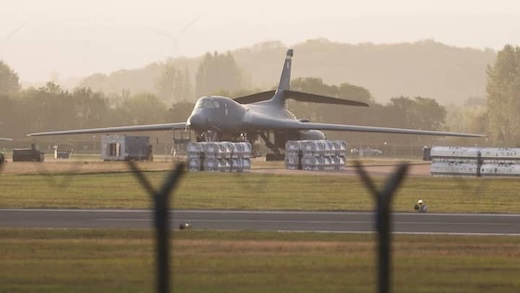
Meanwhile, the Trump administration got involved because RAF Fairford, despite its name, is in reality a US air base from which American planes are waging an illegal war of aggression against Iran, with the UK’s blessing.

US Secretary of state Marco Rubio has said the incident “clearly involves the hands of a foreign actor”. When asked whether Iran was that actor, Trump replied: “It might be.” He added: “I know the answer… I can be very specific, but I’d rather not say.”

According to a report in the New York Times, “American and British intelligence services worked with Israel and Western countries to discover the threats against US bases, including ones in Germany.” [my emphasis]

Despite these sparse facts, the British media have uniformly rushed to a single conclusion: that this was almost certainly part of an Iranian terror plot to target the US airbase and its planes. The only room for debate allowed is whether the five men were witting or unwitting actors in that plot.

As the Guardian reported in its Wednesday edition, referring to this as a “complex investigation”: “An Iranian link to the bizarre events in the Gloucestershire countryside over the weekend is seen as increasingly likely.”

As context, let us note the following: that British and US officials have every interest in trying to hype this incident as an Iranian “terror plot”, whatever the actual evidence suggests.

Why? Because the US is waging an illegal war on Iran, and the UK is allowing it to do so from British soil. Under the rules of war, Iran has every right to attack RAF Fairford.

If the British state and billionaire-owned media were actually serving as a truly “free press”, they would be offering the context that RAF Fairford is a legitimate military target and that any attack on it by Iran would not constitute terrorism.

Of course, none have done so.

Instead, they have loyally regurgitated the British and US security services spin of a “terror plot” – based on no tangible evidence at all – that paints Britain and the US as the victims of a sinister and unwarranted act of Iranian aggression.

But context aside, an objective, sceptical media – a “free press” – would be reserving judgment on what had happened. It would be asking difficult questions. It would be offering plausible counter-narratives.

Again, none of this is happening. In the British media, there has been a lemming-like rush towards accepting uncritically the very conclusions that best serve British and US state interests.

The constant highlighting of a terrorism connection to the arrested men – for which there is no apparent evidence – is precisely the kind of coverage you would expect from state media in an authoritarian regime. This is about whipping up a public mood of fear, not about transparent fact-finding.

Notably, unlike the British media, the New York Times report does allow for another possibility, even if it instantly ignores it and then joins the British media in treating what evidence there is as proof of an Iranian terror plot.

The Times opens with a question: “The potential ambiguities – were the men Iranian operatives, petty gas thieves, or both? – added to the confusion surrounding the arrests that the authorities have yet to fully explain.”

“Petty gas thieves”! Men in vans with empty barrels close to a farm in the middle of the night. Is it possible they could simply be criminals?!

In fact, this conjecture has been all over social media since the first reports of the men being arrested surfaced. As new details have emerged, those suspicions have only grown.

And yet Britain’s “free press” has uniformly ignored this counter-theory in favour of the US and British security services’ narrative.

Doubtless, British journalists covering this incident would call the idea that this was simply a criminal group caught in the act unhelpful “speculation”.

But how is their no-more-plausible, and possibly less plausible, theory that this was an Iranian terror plot not equally speculation – if in their case, speculation that happens to be extremely helpful to the British and US security establishments?

There are other theories we could posit too, given the known facts. Israel, which originally pushed for the illegal and disastrous war on Iran, has been looking for a way to persuade the Trump administration to return to a full-scale bombing campaign.

An attack on RAF Fairford – or the appearance of one – would be an ideal way to pile on the pressure for renewed strikes on Iran. It’s not, after all, as if there are no examples of Israel carrying out false flags.

If the “foreign actor” of Iran can recruit a gang of petty criminals to unwittingly spark a major security incident outside RAF Fairford, why can the “foreign actor” of Israel not do exactly the same?

I don’t know what happened outside the airbase. I’m not claiming to. I am keeping an open, critical mind while what facts there are emerge. If only our “free press’“ were doing the same.

There may be those reading this who find the claim that the media in our “democratic” societies is not confrontational to, or at least distant from, the state hard to believe. Such an idea may be new to them.

That should not be surprising. After all, how did each of us form our foundational view of the world – of who are the good guys, and who the bad – if not from spending a lifetime reading and watching media owned by billionaire-led corporations and the state?

Since quitting the establishment media myself a quarter of a century ago (I worked for the Guardian), I have dedicated much of my time to identifying some of the most egregious examples of skewed journalism – reporting that consistently presents events in ways that serve not their audiences’ interests but those of the powerful: the corporations themselves; western security establishments; and Israel, the linchpin of the West’s war industries.

In such cases, the establishment media readily abandons even the pretence of neutral, fair or dispassionate reporting. It serves as little more than a propaganda factory. (You can read my detailed explanation of how the Propaganda Model works here.)

This has been all too visible in the coverage of Israel’s mass-slaughter in Gaza, a genocide that could not be named as such.

It was visible in the coverage of Russia’s “unprovoked” invasion of Ukraine that had, in fact, been provoked by Nato for decades, as it expanded across Europe with a clear intention: either to corner Moscow militarily or drive it into a retaliatory attack on Ukraine that would provide an opportunity for the West to bleed Russia on a proxy battlefield.

It was visible in the sustained media campaign of antisemitism smears against Jeremy Corbyn, that rarest, and most dangerous, of things: a leader of a major political party who promoted socialist policies for the benefit of the public, not billionaires, and was a vehement critic of Israel long before it showed its genocidal hand.

It was visible too in the media pile-on against Julian Assange, whose Wikileaks whistleblower platform exposed British and US war crimes while also threatening to destroy the media’s top-down model. Having ridiculed him for claiming asylum in the Ecuadorean embassy for fear Washington would seek to extradite him for exposing its crimes, the media then treated his seizure by British police and incarceration for years in a high-security London prison, while the US sought his extradition for exposing its crimes, as entirely unremarkable, as barely worth reporting.

I could go on and on. There is a consistent pattern when the establishment media deals with the most important issues, the very ones in which our national security states are most invested. Then the media jettisons even the semblance of critical distance from the state.

RAF Fairford is just the latest example of how, in such important moments, the media serves as nothing more than the security state’s loudspeaker.

Original article:  www.jonathan-cook.net

  •  

Un monde sens dessus dessous

Les civilisations peuvent-elles rassembler les fragments d’aperçus et de savoirs plus anciens pour redonner le contexte permettant de rendre le discours moral à nouveau intelligible ?

D’après une intervention donnée à la Higher School of Economics, Moscou, 7 septembre 2026

L’avenir global est souvent présenté comme celui d’un monde multipolaire ou multi-nodal, avec l’hypothèse implicite que les États s’entendraient mieux – et résoudraient leurs différends plus facilement par la discussion que par la guerre.

Ce fut un mème largement répandu dans les années précédant la Première Guerre mondiale. Des livres furent écrits pour suggérer que la guerre ne pouvait pas avoir lieu : le texte définitif sur ce concept, initialement publié en 1910 sous le titre The Great Illusion, devint un best-seller international.

Son auteur, Norman Angell, soutenait que, parce que les nations dépendaient fortement d’un système commercial mondial hautement imbriqué, le coût économique de la guerre dépasserait largement tout gain potentiel. Il affirmait qu’une nation victorieuse subirait tout autant de ruine économique que la vaincue – rendant obsolète le concept traditionnel de conquête militaire. Son argument fut populairement interprété comme rendant la guerre « impossible ».

Son argument se révéla fallacieux ; la Grande Guerre éclata en temps voulu.

Aujourd’hui, l’idée d’une certaine interaction multipolaire persiste, mais la menace de guerre demeure et est exacerbée par le refus de l’Occident d’entendre – ou de comprendre – ce que disent les États souverains civilisationnels. Cette incapacité à écouter avec un engagement empathique est à la racine des lectures catastrophiquement erronées du renseignement occidental concernant l’Iran et la Russie. Et de la présentation de la Chine comme si « autre » qu’elle en devient un livre fermé aux oreilles occidentales.

Dans son influent ouvrage de 1981, After Virtue, Alasdair MacIntyre soutenait que le projet des Lumières avait coupé l’homme occidental de ses racines traditionnelles, mais avait échoué à produire une morale contraignante fondée sur la seule Raison. Par conséquent, beaucoup de ceux qui vivent en Occident vivent dans un monde de « chaos moral et de fragmentation, où des forces “chaotiques” et désintégratrices ont presque entièrement effacé la véritable enquête morale de la culture européenne ».

Ce qu’il est important de comprendre, c’est que le « chaos moral et la fragmentation » de MacIntyre sont délibérément encouragés pour affaiblir l’attachement national, communautaire et religieux – précisément afin de cibler et d’affaiblir la cohésion nationale et la souveraineté civilisationnelle.

L’argument de MacIntyre est que seule la tradition culturelle, et ses récits moraux, fournissent un contexte aux termes tels que bien, justice et telos :

« En l’absence de traditions, le débat moral est disloqué et devient un théâtre d’illusions où la simple indignation et la simple protestation occupent le devant de la scène. »

« Les lignes sont tracées tôt, et les participants se précipitent pour prendre parti. Mais en prenant parti, ils semblent se rendre incapables d’entendre l’autre… Tout le monde ressent la chaleur, mais personne ne voit la lumière », souligne MacIntyre.

Ce que nous possédons aujourd’hui, suggère MacIntyre, ne sont rien de plus que de simples fragments d’une tradition plus ancienne (la société héroïque). Ces fragments sont tout simplement trop rares, puisque notre discours moral, qui utilise des termes comme bien, justice et devoir, a été dépouillé du contexte qui le rendrait intelligible. En d’autres termes, cela place la vertu du monde héroïque et homérique hors de portée de l’Occident.

Les lignes sont tracées. On se précipite pour prendre parti. Les forces « chaotiques » et désintégratrices d’aujourd’hui ont presque entièrement effacé l’enquête morale de la culture européenne. Le trait le plus frappant des débats moraux est leur tendance à ne jamais aboutir à une résolution.

Quand tous les jugements moraux – dépouillés de leur contexte – ne deviennent guère plus que des expressions de préférence, d’attitude ou de sentiment – l’émotivisme, en d’autres termes – le débat est disloqué ; il se transforme en un théâtre de récits où l’indignation et la polarité occupent le devant de la scène.

Mais, en prenant de tels partis émotifs, les acteurs se rendent incapables d’entendre l’Autre. Les « Autres », alors, qu’il s’agisse de la Russie, de l’Iran ou de la Chine, deviennent simplement invisibles selon les normes de cette approche – car leurs façons d’orienter l’attention humaine vers le monde sont tout à fait distinctes.

Ainsi, nous pouvons être (et sommes) conduits à la guerre par des messages narratifs spécifiquement destinés à contraindre les humains à spatialiser le monde d’une certaine manière, sans que nous en soyons conscients. Nous sommes conduits vers un « seul monde » issu des Lumières, dans lequel toute « altérité » – qu’elle soit russe, iranienne ou chinoise – devient invisible selon les normes, le mode de présence, par lesquels nous abordons les « choses ».

Dans cette « guerre », le monde est mis « sens dessus dessous ». La plupart des gens ne spatialisent pas activement le monde autour d’eux, mais semblent s’être contentés qu’il soit spatialisé pour eux. Les récits sont pétris et étalés sous nos yeux. C’est ainsi que la machine fonctionne. La plupart des gens en Occident croient avoir une prise ferme sur la réalité – les faits, les preuves et les conclusions. Mais en réalité, nous faisons face à une structure qui retourne délibérément comme un gant cette prise imaginaire sur la réalité.

Dans la machine, la « spatialisation » se fait à l’envers : d’abord, ils reçoivent le message, puis ils pétrissent et étalent un récit de la « réalité » comme de la pâte, jusqu’à ce qu’il corresponde au dessein. Et si nécessaire, ils mettent la machine médiatique en marche arrière et pétrissent cette même réalité dans la direction opposée.

Alors, comment les civilisations souveraines peuvent-elles échapper au « piège de MacIntyre » ? Les civilisations peuvent-elles rassembler les fragments d’aperçus et de savoirs plus anciens pour redonner le contexte permettant de rendre le discours moral à nouveau intelligible ?

Sortir de l’espace fustien de la pensée mécaniste et du récit manipulé n’est ni facile ni simple. Bien au contraire. Mais remarquez ce que cela exige – un changement dans notre mode de présence ; la manière dont nous disposons notre attention vers le monde.

La façon dont vous disposez la conscience vers le monde, nous dit le neurologue Iain McGilchrist, est cruciale : car la manière dont vous le faites altère et détermine ce que vous trouverez et comprendrez. Et à mesure que nous spatialisons le monde autour de nous différemment, la perception s’élargit et la spaciosité (jusque-là cachée) de ce qui se trouve au-delà devient visible.

Une récupération de modes de pensée plus anciens – la manière de penser « tout à la fois, tous ensemble » (penser par l’image) et d’autres sources de cognition – peut ouvrir une voie vers une médiation entre les polarités apparemment opposées du subjectif et de l’objectif que la rationalité mécanique laisse si souvent durcies en impedimenta insolubles. L’approche apophatique peut aussi émousser les arêtes vives de la pensée conceptuelle en introduisant l’« entre-deux », trouvant son espace entre les arguments angulaires et tranchants. Ces modes de pensée possèdent leur propre logique qui se tient à l’écart des rigidités des Lumières.

C’est la leçon que l’Iran et sa redécouverte de la pensée ancienne offrent au monde aujourd’hui.

Albert Einstein a un jour fait remarquer que « l’esprit rationnel est un serviteur ; mais l’esprit intuitif est un don précieux. Notre monde, cependant, honore le serviteur – mais oublie [ignore] le don ».

  •  

The West was lying about Bucha

Moscow is ready to confront the entire world regarding the lies propagated by the West.

Join us on Telegram, X, and VK.

Contact us: info@strategic-culture.su

The “Heirs of Goebbels” Report

After March 31, 2026, a twenty-page report titled Heirs of Goebbels: Falsification of the Events in Bucha and Bloody Staged Performances of the Kiev Regime began circulating in English. It is signed by the “International Public Tribunal on the Crimes of Ukrainian Neo-Nazis,” a body chaired by Maksim Grigor’ev, which directs readers to the website of the Russian Fund for the Study of Democracy for the full text. The thesis is already evident in the title: the events in Bucha in March 2022 were allegedly fabricated by Ukraine with the support of Western governments, using a technique that the text compares to the Nazi provocation at Gleiwitz in 1939.

The document deserves careful reading precisely because it does not limit itself to denial. Unlike the Russian denials of April 2022, it builds its argument on verifiable Ukrainian material: the plaques at the memorial, military obituaries, local commemorative sites, and statements from the Presidency. It is on this ground that the discussion must take place. The question I pose here is narrower than that of the report and, I believe, more useful: who actually appears on the Bucha Wall of Remembrance, in what capacity, and what happens when a commemorative category is used as a legal and statistical category. The answer calls into question both those who constructed the official narrative and those who claim to dismantle it.

The structure is simple. After the reference to Gleiwitz, the text lists four methods of falsification that the Ukrainian government allegedly employed: presenting soldiers killed in combat as civilians; attributing deaths caused by Ukrainian fire to Russia; counting elderly people who died of illness among the victims; and the deliberate killing of its own citizens in front of cameras. The stated target is the official claim that the memorial contains “509 names of identified civilians,” a claim that the report attributes to the website of the Ukrainian Presidency, Mayor Anatoliy Fedoruk, Euronews, and the European ministers present at the March 31, 2026, commemoration.

The core of the document (pp. 3–12) is a list of about thirty names, each accompanied by a photo of the plaque and, often, a clipping from a Ukrainian news outlet. They can be grouped into five categories. The first category includes individuals identified as members of Azov or affiliated units: Yevhen Petras, Yevhen Vas’kovych, Illia Chrenov, Bohdan Knyshchuk, and Volodymyr Bisaha. The second group consists of regular military personnel: pilot Ruslan Bilous (Belous) of the 7th Tactical Aviation Brigade and his flight crew member Roman Dovhaljuk; sniper Oleh Cymbal of the 80th Air Assault Brigade; Vadym Smetanskyi of the same brigade, a colonel from the SBU, a major from the State Protection Department, and the commander of the guard at the military commissariat in Bucha. The third group consists of members of the territorial defense or volunteer units: Anatoliy Korytko, Serhiy Smyrnov, Oleksandr Blahodatnyi, Andriy Verbovyi, and Mykhailo Boichenko. The fourth list concerns civilians alleged to have taken part in hostile actions: Oleksandr Šarava, who left his home carrying Molotov cocktails on February 27, 2022; Vitalij Fesjuk, an observer who reported on the movements of Russian vehicles; and Oleksandr Bondar, who, according to the Ukrainian press, was conducting reconnaissance for the armed forces. The fifth section concerns people who died outside the city (in Vorzel, Moshchun, Kopylov, Zdvizhevka, Guta-Mezhigorskaya, and Irpen) and a 68-year-old woman, Halyna Semenyuk, who died of cancer.

The report links this list to two legal references that are substantively correct: Article 51, paragraph 3, of the First Additional Protocol, under which civilians lose their protection when and for as long as they directly participate in hostilities, and an explanatory note from the International Committee of the Red Cross on the same principle. Finally, pages 12–20 contain sixteen testimonies regarding Ukrainian bombings “for the cameras.” None of these concern Bucha: the witnesses speak of Avdeevka, Ugledar, Toreck/Dzerzhinsk, Lysychansk, and Kurakhovo, in incidents ranging from 2021 to 2024. The transition from that material to Bucha is conveyed by a single explicit statement: the practice of deliberate killings “allows one to reasonably conclude” that the same occurred there as well.

The legal framework

International humanitarian law defines a civilian by exclusion. According to Article 50 of the First Protocol, a civilian is anyone who does not belong to the armed forces as defined in Article 43—that is, all organized forces, groups, and units placed under a responsible command. In cases of doubt, a person must be considered a civilian, and the presence of non-civilians among the population does not deprive the population of its civilian status. A civilian who directly participates in hostilities remains a civilian but loses protection from attacks for the duration of that participation. The ICRC Interpretive Guidance establishes three cumulative requirements for such participation (a minimum threshold of harm, a direct causal link, and a link to hostilities) and distinguishes between a civilian acting on an episodic basis and a member of an organized armed group with a continuous combat role, who loses protection for the entire duration of that role.

Two additional rules apply to the case of Bucha. The first is the levée en masse: residents of a territory not yet occupied who, as the enemy approaches, spontaneously take up arms without having had time to organize themselves are legitimate combatants if they openly bear arms and comply with the laws of war. The second is domestic. The Ukrainian law “On the Fundamentals of National Resistance,” in effect since January 1, 2022, made the Territorial Defense Forces a component of the Armed Forces and established the volunteer formations of territorial communities (DFTH) as paramilitary units tasked with territorial defense. Under international humanitarian law, those who belonged to these structures were not civilians.

There is, however, one point the report never addresses. Determining that a person was a combatant says nothing about how they died. A combatant who is captured, wounded, or has surrendered is hors de combat, and killing them is a war crime.

In the face of information warfare

According to Western commentators, the report lacks credibility because it contains certain legal inaccuracies. Technical errors may be present, but focusing on the finger while ignoring the moon is a colossal mistake. In Bucha, the crime was committed by the Ukrainians, not the Russians. And there is a heinous crime that has become a propaganda tool, part of an information war that was indispensable to the collective West.

Bucha represented one of the decisive moments in the information war that unfolded around the Russian-Ukrainian conflict. After Russian forces withdrew from the city, images of corpses in the streets and eyewitness accounts gathered on the ground were rapidly disseminated by international media, transforming into a highly potent communication tool. It all happened extremely quickly, with Western media—acting in unison—disseminating the material everywhere, constructing an image of the war as an act of aggression characterized by systematic atrocities, in which Russia was progressively portrayed not only as a military adversary but as the perpetrator of crimes against the civilian population. In this sense, the images possessed a persuasive power greater than that of many diplomatic arguments: the body of the slain civilian became visual evidence capable of condensing an entire interpretation of the conflict into a few frames.

Bucha thus took on a strategic role in Western communications and helped solidify public support for sanctions, Moscow’s diplomatic isolation, and increased political and military aid to Kiev. Observe how a tragic event—as tragic as any war is—was transformed into a weapon of war. No Western media outlet cared about the value of the dead or the truth of their life stories. The only thing that mattered was blaming Russia and justifying the escalation of a senseless conflict.

But the truth comes to light sooner or later.

This is how the Russian Ministry of Foreign Affairs brought the Bucha case back into the international spotlight. Spokesperson Maria Zakharova stated that Moscow intends to urge the United Nations to reexamine the events, arguing that the UN did not participate directly in the investigations conducted at the time, but instead ended up accepting the version provided by Kiev as the prevailing one. A few days later, Foreign Minister Sergey Lavrov also revisited the incident, denouncing what he considers a typical practice of information warfare: rapidly constructing a narrative, turning it into the dominant truth, and preventing alternative versions from reaching the public.

According to Lavrov, this is precisely the mechanism through which the West consolidated its interpretation of Bucha. The initial narrative occupies the available information space like an empty trench: once it has been seized and defended by the mainstream media, replacing it requires an enormously greater effort. In the case of Bucha, this process prevented a truly impartial examination of the events from the very beginning.

One central question therefore remains: why reopen the Bucha case today? Because Moscow is ready to confront the entire world regarding the lies propagated by the West. And what about the West?

  •  
❌