❌

Reading view

Trump’s bid to stop Ukraine’s Russia strikes a strategic disconnect

In a recent phone call, Donald Trump urged Volodymyr Zelensky to stop Ukrainian attacks on Russian oil refineries. Whether a request or a demand, this appears, certainly at first glance, fundamentally different from the Biden administration’s policy of restricting the use of US long-range missiles to hit targets inside Russia. The US president has justified […]

The post Trump’s bid to stop Ukraine’s Russia strikes a strategic disconnect appeared first on Asia Times.

  •  

For Ukraine, some good news but also some bad news

If you do not follow the Twitter feed of the Ukrainian Third Army Corps, you should. It does not tweet a great deal, but when it does, especially recently, it has been fascinating. For those of you who do not know of it, the Third Corps is one of the best units in the Ukrainian military […]

The post For Ukraine, some good news but also some bad news appeared first on Asia Times.

  •  

Marines Rushing To Equip Amphibious Combat Vehicles With New Anti-Drone Jammers

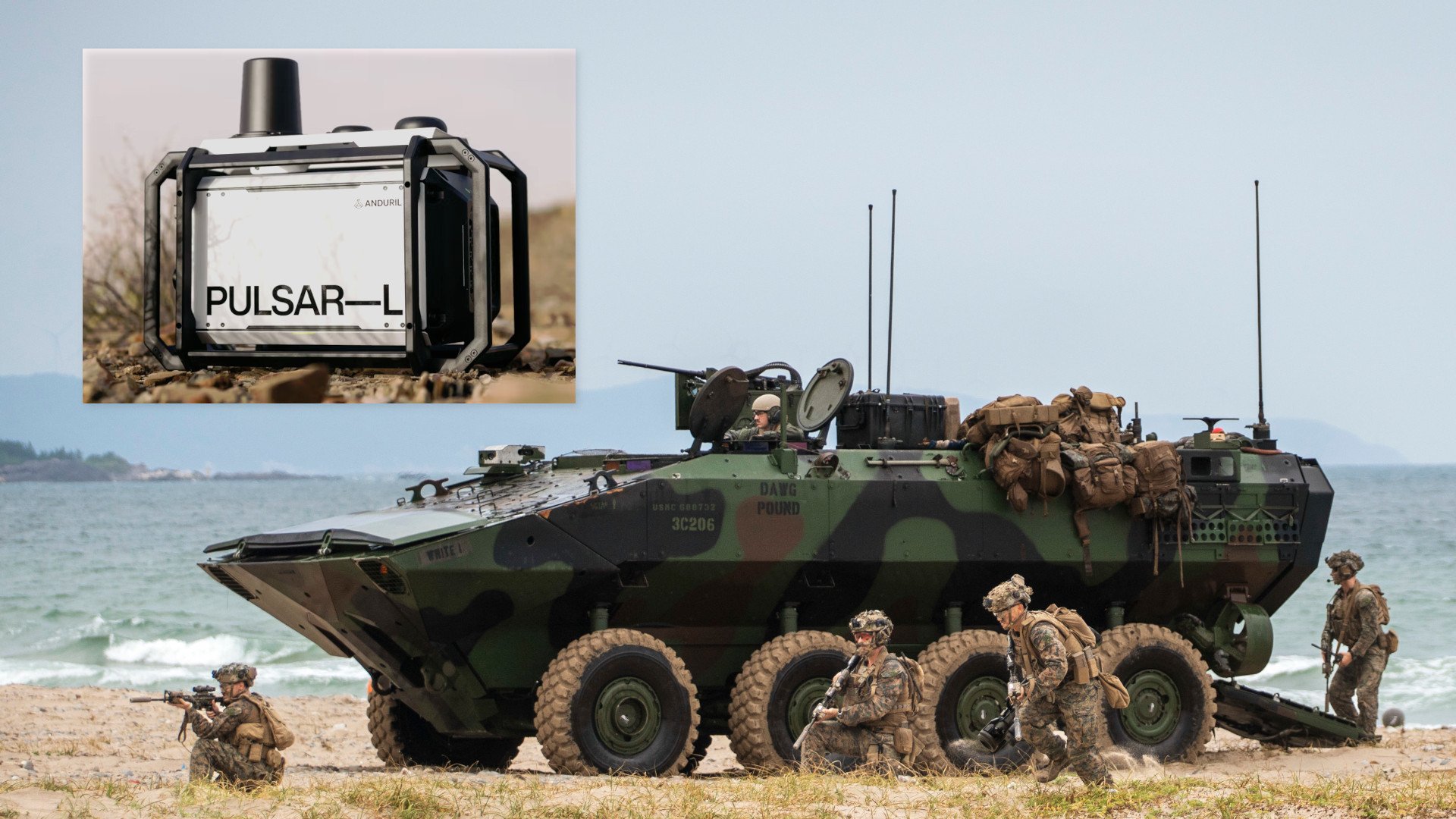
The U.S. Marine Corps is buying Anduril Pulsar-L electronic warfare jammers to meet an urgent operational need to better protect its 8×8 wheeled Amphibious Combat Vehicles (ACV) from drones. This is part of broader efforts the service is pursuing to boost the ACV’s defenses against uncrewed aerial attackers, as well as incoming anti-tank guided missiles and other threats. Drone threats are real now and have notably sidelined even the most advanced heavy armor in Ukraine.

Marine Corps Systems Command (MARCORSYSCOM) announced it had awarded a sole-source deal to Anduril, valued at $15,711,445.50, for an unspecified number of Pulsar-Ls, yesterday. This follows a statement of intent the Command put out last month. Anduril first unveiled Pulsar-L, a lightweight addition to its larger Pulsar family of electronic warfare systems, in April 2025.

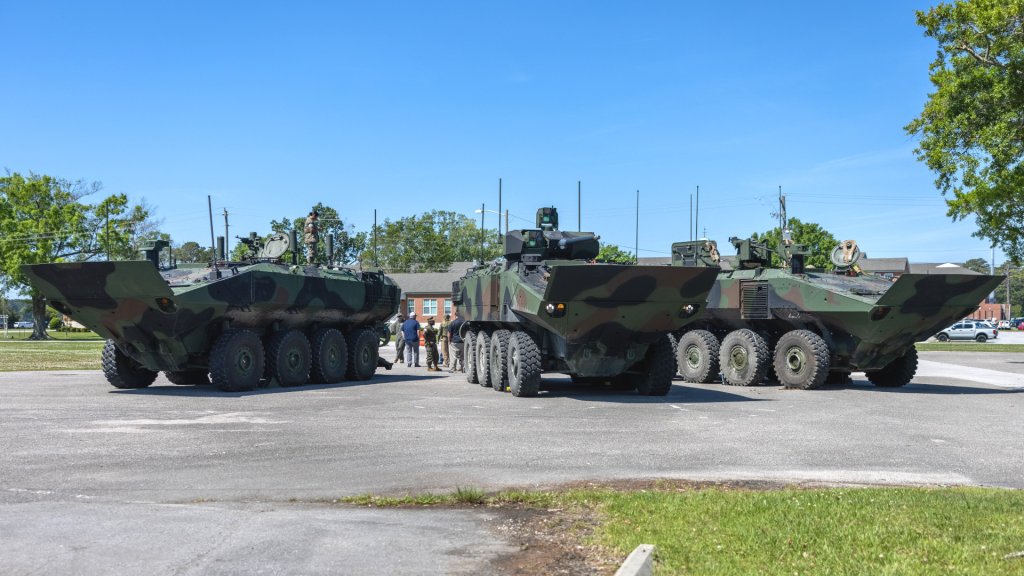
The Marine Corps had 150 baseline personnel carrier variants of the ACV (or ACV-Ps), as well as 21 command-and-control ACV-C versions, in inventory as of April 2026. The default armament for ACV-P currently is just a single .50 caliber M2 machine gun in a remote weapon station on top of the hull. The service’s goal is to eventually acquire 389 ACV-Ps and 33 ACV-Cs, as well as 152 ACV-30s with new 30mm cannon-armed turrets and 34 ACV-R armored recovery vehicle variants. The ACV family has already supplanted the Marine Corps’ previous fleet of tracked Assault Amphibious Vehicles (AAV).

From left to right, an Amphibious Combat Vehicle command and control variant (ACV-C), a 30mm cannon-armed ACV-30, and a standard ACV personnel carrier version (ACV-P). The ACV-R recovery variant is not shown here. USMC/Sgt. Alexis Sanchez

“The Anduril Pulsar-L system is a platform-integrated omni-directional SK C-UAS [soft-kill counter-uncrewed aerial systems] with a combined sensor/jammer package that detects, tracks, identifies, and defeats radio frequency-dependent Group 1 and Group 2 Unmanned Aerial Systems (UASs),” MARCORSYSCOM wrote in a justification for the sole-source contract, which was also released yesterday. “Additionally, the system provides counter positioning, navigation, and timing capabilities.”

The U.S. military definition of a Group 1 drone is any design weighing up to 20 pounds, that is able to fly up to an altitude of 1,200 feet, and that can reach speeds of up to 100 knots. Group 2 is the next tier up, encompassing types with gross weights between 21 and 55 pounds, that can get up to an altitude of 3,500 feet, and hit top speeds of up to 250 knots. Kamikaze drones and other small weaponized types that fall into Groups 1 and 2 are used on a daily basis in Ukraine to attack armored vehicles, as well as unarmored vehicles and personnel. These are threats that have been steadily expanding to other hotspots globally, and that we will come back to later on.

Furthermore, “the Pulsar-L is the only solution capable of being mounted on the ACV to provide a mobile and organic means to effectively and simultaneously execute the entire kill-chain against hostile UASs in the deployed land and maritime/littoral environment while not exceeding the limited ACV space, weight, and power claim allotted to the SK C-UAS solution,” according to MARCORSYSCOM. “This will provide the ACV with an essential defensive capability, directly contributing to increased survivability and force protection while not sacrificing the mobility and operational tempo of the ACV.”

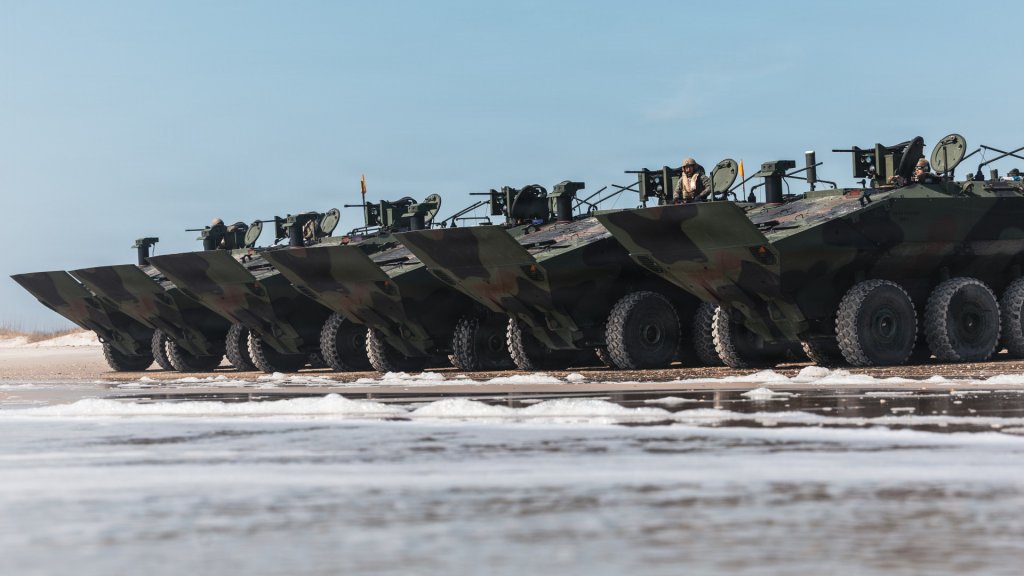
A row of Marine ACVs seen during training. USMC

Pulsar-L is already “in use by the Special Operations Command due to the system’s low weight, proven performance in engaging multiple UASs, and simultaneous execution of the full kill-chain while static or on the move,” the justification document adds. “Additionally, it is the only known commercially available system that meets the minimum requirement to rapidly identify and respond to emerging UAS technologies and tactics without frequent updates to predefined threat data libraries. The Pulsar-L is the only solution that uses machine based learning to continually adapt to these ever-changing threats without requiring vendor updates, allowing the warfighters to continually be effective in the fight.”

The latter point here is a particularly important consideration for electronic warfare systems, in general, which need to be able to accurately detect, categorize, and respond to different waveforms to be most effective. The emergence of new waveforms, as well as changes to how existing ones are emitted, together with new tactics, techniques, and procedures, can all negatively impact a system’s performance. Historically, the process of responding to those developments with updates to built-in threat libraries has been lengthy and complex. The conflict in Ukraine has shown that the cycle of new developments in the electromagnetic spectrum and then the need for new countermeasures can be regularly measured in weeks.

The U.S. military has been heavily investing in so-called cognitive electronic warfare capabilities to help automate and otherwise accelerate various aspects of this process. The ability of a particular electronic warfare suite to adapt autonomously in real-time, even in the middle of operations, has been viewed as the absolute ‘holy grail’ of this concept, which you can read more about here. How exactly Pulsar-L leverages machine-learning and artificial intelligence to this end, and the speed with which it can adapt to changing threats, is still not entirely clear.

Regardless, “there is an unusual and compelling need for the rapid deployment of SK C-UASs to forward-deployed ground units as Marines currently lack the ability to conduct self-defense against emerging UAS threats,” the justification document stresses. “Failure to deliver this capability places Marines at unnecessary risk, potentially leading to mission failure and loss of life, and hampers the Government’s ability to keep them safe during forward deployments.”

MARCORSYSCOM’s justification for the sole-source deal to Anduril does not otherwise elaborate on the urgent requirements that drove the deal, which it says were only formalized on April 7. That is notably roughly a week after the United States and Israel first launched major combat operations against Iran, which is a prolific developer and user of various tiers of weaponized drones. There is no explicit confirmation of any link, but Iranian drones, as well as missiles and other capabilities, have been a real threat to U.S. forces in the region. We have also just gained more insights recently into how forward-deployed Marine Corps elements contributed to those operations. Counter-drone capabilities would also be especially critical in any future amphibious landing operation, wherever it might occur.

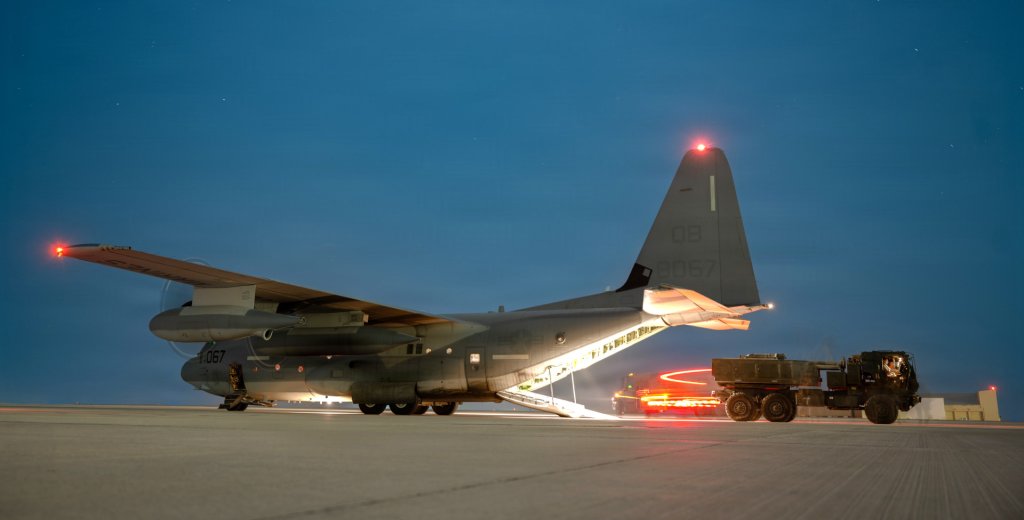
Marines prepare to load an M142 High Mobility Artillery Rocket System (HIMARS) onto a KC-130J aircraft somewhere in the Middle East in July 2026. USAF

All that being said, threats posed by armed Group 1 and 2 drones are not at all limited to Iran and the Middle East, nor are they new. They are only likely to become a more ubiquitous feature in the hands of nation-state armed forces and non-state actors in conflict zones globally as time goes on. The nature of these threats is also expanding significantly in scale and scope, especially when it comes to more automated targeting capabilities, thanks heavily to the increasing democratization of AI-driven technologies, something TWZ has explored in depth in the past.

A number of other significant developments in this arena have emerged from the conflict in Ukraine, where electronic warfare systems are heavily employed against drones. This includes the introduction of physical fiber-optic control links that cannot be jammed, as well as the use of mesh-like and often ad-hoc networks to increase resiliency.

The fighting in Ukraine has also underscored the threat that even small kamikaze drones pose to armored vehicles, including types that are far more heavily protected to start with than the Marine Corps’ ACVs. As mentioned, Ukrainian forces have been sidelining their M1 Abrams and other main battle tanks in the face of constant drone attacks.

MARCORSYSCOM’s justification for the Pulsar-L order makes clear that this is just one part of a larger plan to boost the ACV’s defenses.

“Marine Corps program of record for SK C-UAS is planned to initiate in FY27,” the document mentions toward the very end. “The components of this future program will be procured through full and open competition as it is expected that advanced non-kinetic and SK defeat technologies should be mature by this time.”

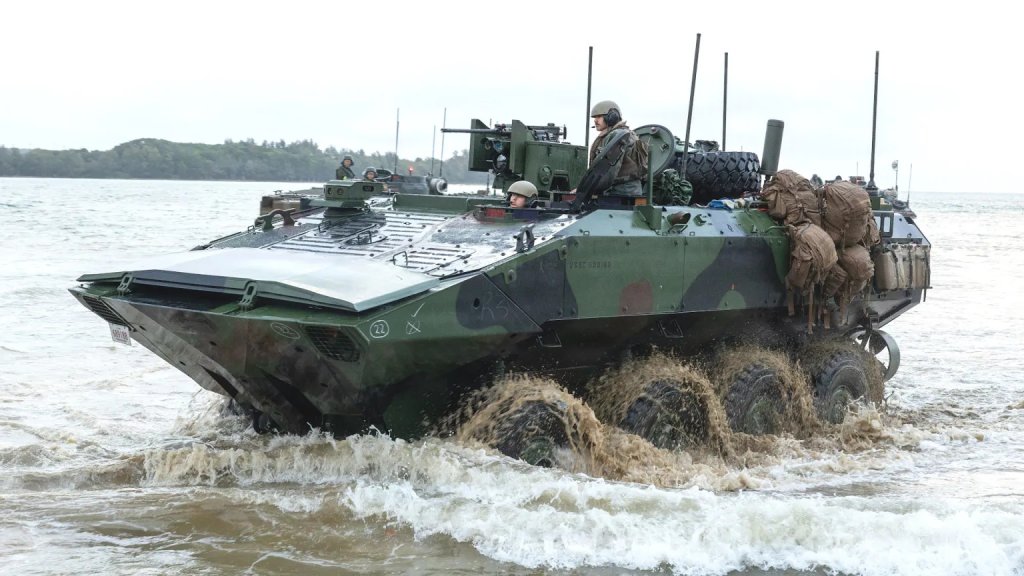
Another look at a Marine Corps ACV-P, showing the general configuration of these vehicles today. USMC

Marine Corps officials have also talked in the past about integrating active protection systems (APS), which could be blended together with C-UAS capabilities, and other defensive features to the service’s ACV fleet.

“We’re constantly looking at what the next generation of APS is and how we can get that onto the [ACV] platform in a lightweight form factor,” Chris Melkonian, the Marine Corps’ Program Manager for Advanced Amphibious Assault (PM AAA), told TWZ and other attendees at the annual Modern Day Marine exposition in April.

Improved “situational awareness, that’s kind of a gateway to counter-UAS, in terms of the ability to sense your environment,” Melkonian also highlighted at that time. “Take all that video on board and then be able to feed that into [a] counter-UAS system.”

Additional “overhead protection right now is a critical thing that we’re working on right now for this platform,” he added. The practice of adding on anti-drone armor screens on armored vehicles (and now other platforms), especially to protect against top-down attacks, first emerged in Russia in the lead-up to the all-out invasion of Ukraine in 2022. However, the installation of this kind of so-called ‘cope cage’ type armor has now become a global trend, including in the U.S. military.

The U.S. Marine Corps is also pressing ahead with a larger vision to field several tiers of counter-drone capabilities at all levels of its forces, to better protect everything from static installations at home and abroad right down to individual squads.

When it comes to the Marine Corps ACV fleet, the rush order for Pulsar-Ls is an important new step in boosting those vehicles’ defenses against threats that exist now. At the same time, drones are increasingly calling the role of armored vehicles in future conflicts into question.

Contact the author: joe@twz.com

The post Marines Rushing To Equip Amphibious Combat Vehicles With New Anti-Drone Jammers appeared first on TWZ.

  •  

Drones could expand North Korea’s gray zone options

If the wars of 2026 have demonstrated anything, it is that drones have become a key element of modern warfare. In Eastern Europe, both Moscow and Kyiv deploy drones at an unprecedented scale across the theater’s so-called “kill zone.” For Ukraine, unmanned aerial vehicles (UAVs) have shown incredible tactical value, allowing its forces to strike […]

The post Drones could expand North Korea’s gray zone options appeared first on Asia Times.

  •  

They see them, then kill them: Israeli quadcopters track, deliberately target civilians in Gaza

Israel employs military technology capable of identifying specific individuals, tracking their movements, and striking them with precision, despite the clear civilian status of those targeted and their non-participation in hostilities or posing of any imminent threat to Israeli forces or others.

  •  

Amazon Says Cloud Infrastructure In Bahrain, UAE ‘Beyond Saving’

Amazon Web Services (AWS) is on the ropes in the Middle East with a collection of wreckage from bombed-out data centers in the UAE and Bahrain. AWS reported, “The damage to our infrastructure spanned multiple Availability Zones and exceeded what our regional and multi-AZ services are designed to withstand.” Phrases like “damaged beyond hope of recovery,” “the region went dark,” and “exhausted every option for recovering whatever was left behind” highlight the angst felt by AWS, ⁃ Patrick Wood, Editor.

Amazon Web Services (AWS) says it cannot restore access to its cloud-computing facility in Bahrain or one of three data-hosting zones in the UAE due to the extensive damage caused by Iranian retaliatory strikes, Reuters reported on 15 September.

“The damage to our infrastructure spanned multiple Availability Zones and exceeded what our regional and multi-AZ services are designed to withstand,” AWS reported in its status update seen by Reuters.

In the UAE, resources and data held exclusively within one zone, labeled mec1-az2, have been damaged beyond hope of recovery, the company said, as engineers are still salvaging what they can from the two other battered zones and across the wider Emirati region.

An availability zone refers to a cluster of one or more data centers sitting inside the same geographic region, the structure AWS relies on to keep services running when a single site goes down.

The outages trace back to March, when the US and Israel attacked Iran, and Tehran responded with missile and drone salvos against Israel and Gulf states hosting US military bases.

AWS confirmed at the time that two of its UAE facilities took direct hits, while a drone strike near one of its Bahraini sites left the infrastructure there destroyed.

Most Bahrain-based customers shifted their workloads elsewhere on AWS advice before the region went dark in April, but the company says it has now exhausted every option for recovering whatever was left behind.

The losses have called into question the resilience of the Gulf’s fast-expanding cloud and AI infrastructure.

The UAE is already redrawing plans to war-proof a major AI data center project, weighing decentralized site building alongside underground and blast-resistant construction, and even equipping the data center itself with anti-air defenses.

Israel and the US have long ago transformed AI infrastructure into a weapon of war deployed extensively across West Asian theaters.

Cloud platforms, data centers, and high-capacity computing systems now help store intelligence, process intercepted communications, analyze surveillance, and support military operations across West Asia, extensively so in Gaza and Iran.

Iran maintains that data centers operated by US technology companies are not simply civilian facilities, but strategic assets supporting US and Israeli aggression, thereby making them legitimate targets for retaliation.

AI has become a central instrument of US and Israeli warfare across West Asia, embedded in how targets are chosen, tracked, and struck.

Israel has weaponized AI platforms including automated targeting systems like The Gospel, Lavender, and Where’s Daddy? to harvest mass data, autonomously generate kill lists, and orchestrate systematic airstrikes and assassinations against Palestinians.

Backed by corporate infrastructure like Microsoft Azure, which stored massive caches of intercepted Palestinian communications, the Israeli military has deployed AI-driven drone surveillance to track and assassinate Palestinians.

The US has run algorithmic warfare systems such as Palantir’s Maven to process satellite, drone, and radar intelligence, using machine learning to speed the production of targeting recommendations against Iranian forces.

More than 1,000 targets were designated within the first 24 hours of the war on Iran, one of which resulted in the massacre of at least 150 people, including at least 120 schoolchildren at the Shajareh Tayyebeh elementary school in Minab.

Read full story here…

  •  

UAE Moves To ‘War-Proof’ Its AI Data Centers

“War is hell” when all of a sudden it dawns on you that your AI data center might be bombed into oblivion. UAE is perilously close to Iran, so its data centers are getting hit. The UAE is a leader in AI and FinTech (Financial Technology) in the Middle East, and wants to be the hinge pin of the global trade routes passing through the region. No AI data centers = no global trade. ⁃ Patrick Wood Editor.

The UAE is redrawing its plans for a five-gigawatt artificial intelligence (AI) data center project, one of the largest anywhere outside the US, after Iranian retaliatory strikes on infrastructure across the Gulf forced the Emirates to rethink how and where critical facilities are built, Reuters reported on 11 September.

Speaking in anonymity, six people familiar with the matter told Reuters that Emirati authorities began reassessing where and how sensitive facilities should be built once the war reached the Gulf.

Four of those sources said the campus, first designed as a single 26-square-kilometer site in Abu Dhabi, is now expected to take shape as several data centers distributed across the country.

Authorities are weighing ways to shield the facilities from drone and missile strikes, the sources said, including installing air defenses and putting some of the centers underground.

Sources also said interceptors and electronic jamming equipment are being written into the redesign, with blast-resistant concrete and additional backup power and cooling systems also under consideration, and with the most sensitive material, including military data, possibly housed inside mountains.

Iran began striking Gulf states hosting US forces with missiles and drones in response to US and Israeli airstrikes on Iranian territory. Two Amazon Web Services data centers in the UAE and one in Bahrain were damaged in March, and the company’s regional cloud services remain disrupted.

In April, the Iranian armed forces released a video naming Stargate UAE, the $30 billion, one-gigawatt first phase of the campus, as a potential target for retaliatory strikes, showing a map of the site alongside the caption “Nothing stays hidden from our sight.”

Daniel Benaim, a former US deputy assistant secretary of state for Arabian Peninsula affairs, called the war an “economic earthquake” for Gulf states that had spent years selling themselves as safe havens, adding that hardening critical infrastructure was now vitally necessary.

Data centers have moved from commercial facilities into the category of critical infrastructure, processing financial flows, sustaining public services, and feeding into military communications and intelligence work.

Read full story here…

  •  

Von der Leyen vows to increase pressure on Russia after Leipzig attack

European Commission President Ursula von der Leyen and NATO Secretary General Mark Rutte Photographer: Dati Bendo © European Union
European Commission President Ursula von der Leyen said on Wednesday (2 September) that Europe and NATO would increase pressure on Russia after Germany attributed an attempted attack on cargo planes at Leipzig/Halle Airport to Moscow, calling the incident a “new escalation” on European Union soil, writes Catherine Feore.

“This was an attack using military-grade material, carried out by Russian operatives on European Union soil. We will not tolerate it,” von der Leyen said alongside NATO Secretary General Mark Rutte in Brussels.

The German government said on Tuesday (1 September) that its investigation and intelligence findings established Russian responsibility for the attempted attack at Leipzig/Halle Airport last month. Russia has denied responsibility.

The meeting took place as foreign ministers and the EU's High Representative for Common Foreign and Security Policy were meeting to discuss Russia and Ukraine among other issues.

“Had this attack succeeded, this would have resulted in enormous damage and possibly even loss of life,” von der Leyen said. “We stand in full solidarity with Germany.”

“If the intention was to make us think twice about supporting Ukraine, I can tell you it has only strengthened my resolve. Intimidation will not work.”

Von der Leyen said the Leipzig incident was part of a wider pattern of Russian activity confronting Europe, including airspace incursions, drones disrupting airports and interference with critical infrastructure.

“Leipzig marks a new escalation on European Union soil, directly attributed to Russia,” she said. 

Von der Leyen outlined three areas for a stepped-up European response: stronger protection of European infrastructure backed by additional sanctions on Russia, increased air-defence support for Ukraine, and an acceleration of Europe’s own defence build-up in close cooperation with NATO.

Infrastructure and sanctions

First, von der Leyen said Europe must strengthen the protection of infrastructure that could be targeted by Russian hybrid operations and be prepared to respond more quickly when attacks occur.

“We must treat our everyday infrastructure as frontline targets, and protect them accordingly,” she said.

The EU already has rapid response teams that can assist member states faced with such attacks, she said, arguing that Europe’s ability to prepare and respond would itself act as a deterrent.

Von der Leyen also said the EU was ready to intensify economic pressure on Moscow through sanctions. “Our sanctions have weakened Russia’s economy. We can use more sanctions and have them ready to impose as soon as such dangerous, life-threatening acts are attributed,” she said. “Every loophole Russia exploits is one we must close.”

European foreign ministers were discussing new listings in Ireland on Wednesday, she said, while the Commission was examining further ways to “cut deeper into Russia’s war chest”.

More air defence for Ukraine

Von der Leyen said her second priority was strengthening support for Ukraine, announcing that the EU had received a new request worth several billion euros for air-defence capabilities.

“Today, I can confirm that we have received a new payment request,” she said. “It is worth several billion euro, and would cover Ukraine’s air defenses, including the highly advanced PAC-3 Patriot air defense systems.”

Member states were considering the request, she said.

“I can say that it’s going in the right direction.”

Von der Leyen also pointed to European work with Ukraine on the FRIO project to develop anti-ballistic missile defences, as well as the EU’s €90 billion support loan.

“Since June, we have issued €8.5 billion for drones and missiles for Ukraine from this loan,” she said, adding that the funding could also be used to buy fighter aircraft from European industry.

Faster European defence build-up

Von der Leyen’s third priority was to accelerate Europe’s defence build-up alongside NATO, with air defence at the centre of the effort.

“Air defenses are critical,” she said. “We need a faster, more integrated alert system across Europe, and then we must intercept the threats faster.”

She pointed to the EU’s €800 billion defence investment plan, including €150 billion through the SAFE instrument, as a way for European countries to increase defence investment jointly.

“We are in a new era of European security,” von der Leyen said. “European investment in defense strengthens NATO and re-energizes our industrial base.”

Rutte backed von der Leyen’s assessment of the threat, saying Russia had become “increasingly reckless” as its war against Ukraine continued.

“We have seen more drones and missiles crossing into our airspace along our eastern flank, creating increased risk,” Rutte said.

“And we have also seen an increase in malign activities targeting our territory directly, whether it is fires set in factories producing defense equipment for Ukraine, or indeed the Russian hybrid attack in Leipzig.”

“The examples are many. The dangers Russia poses are clear,” he added.

Rutte said NATO was working “around the clock” to ensure it could protect its population and said Moscow would fail if it hoped attacks such as Leipzig would undermine Western backing for Kyiv.

“If Russia thinks we will be divided by the threat, or if they think we will be deterred from supporting Ukraine, they are mistaken,” he said. “Our unity is unshaken. Our support to Ukraine is clear.”

Rutte said NATO allies had agreed to provide at least €70 billion to support Ukraine this year and the same amount next year, with the EU loan forming a “crucial element” of that support.

The NATO chief also backed the push for additional air defence and increased defence production, saying higher spending had to translate into additional military capabilities and greater industrial capacity.

Von der Leyen said the EU and NATO would not be intimidated into reducing their support for Ukraine. “Europe and NATO will not just maintain our pressure on Russia; we will increase it,” she said. “We will not stop — not until Russia stops bombing and killing innocent children, men and women in Ukraine. We will continue, we will prevail, and we will deter anyone who attacks our freedom and our security.”

  •  

The Battle of Navarino, the day the Ottoman fleet was wiped off the map and Greece gained its independence

“I have sent him a ribbon when, in fact, what he deserved was a rope.” This phrase is attributed to King George IV of England, and the ribbon in question would be that of the Order of the Bath, which had just been awarded to Edward Codrington, the admiral who had achieved victory in the […]

  •  
❌