❌

Reading view

Von der Leyen gifts her spin doctor a job for life

RT | October 2, 2026

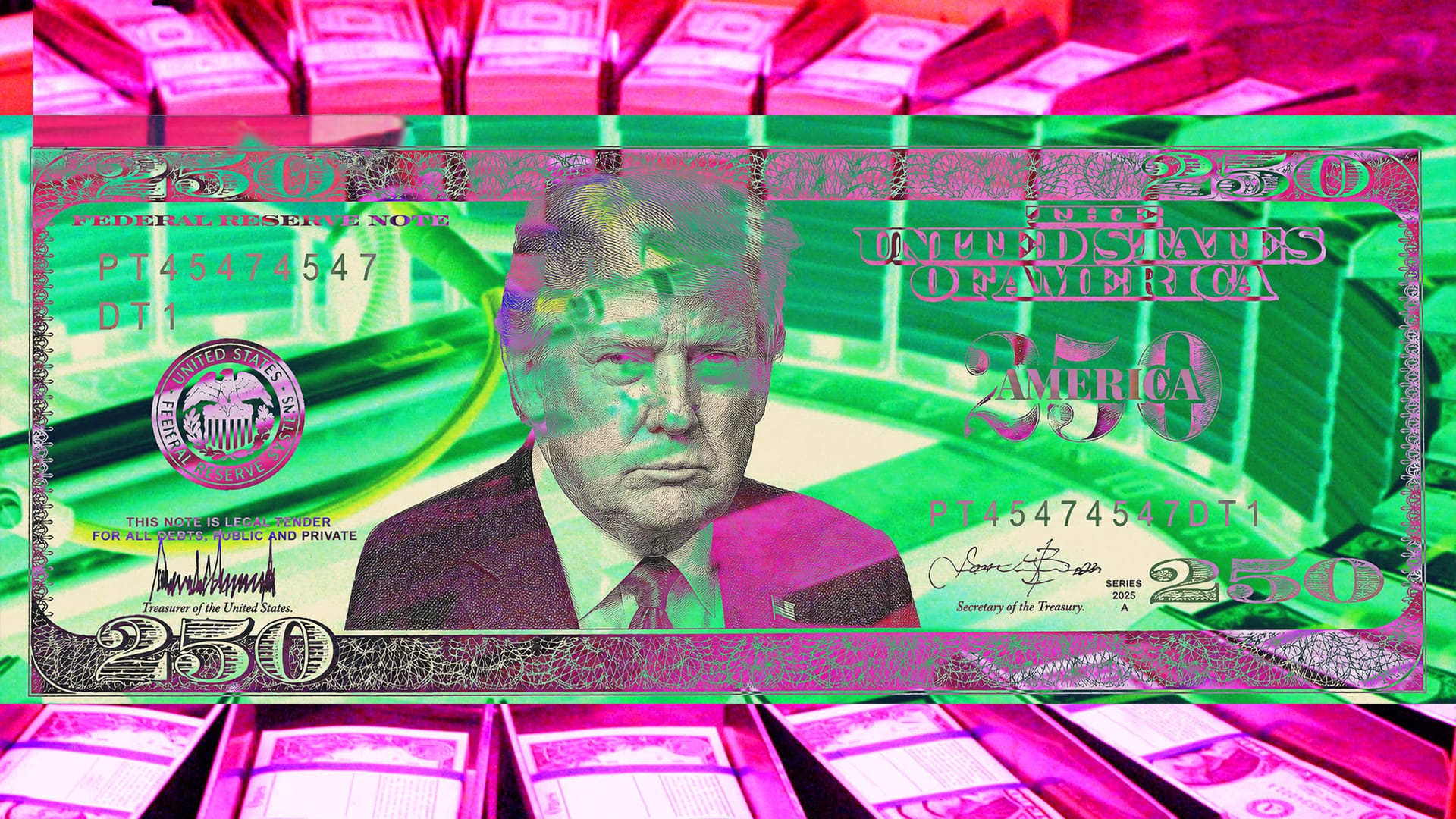
European Commission President Ursula von der Leyen has rewarded her personal communications adviser with a permanent job in the commission’s media department, in a move that reveals how the EU bureaucracy really works, and how von der Leyen has created a royal court in Brussels.

Von der Leyen’s College of Commissioners – the 27 unelected bureaucrats who run the EU’s executive branch – met on Wednesday and signed off on the appointment of Jens Flosdorff as the bloc’s new ‘Director for Citizens Communication’.

Flosdorff was given the role after a “merit based and very highly competitive selection procedure,” the commission said in a statement. According to the EU-focused Rapporteur news site, however, Flosdorff was parachuted into the role by von der Leyen, whom he served for more than two decades as ‘personal communications adviser’.

Flosdorff’s new position will net him a largely tax-free salary of €216,000 ($245,279) per year, plus expenses and benefits.

Those with a memory of the Soviet Union, or an appreciation of Gogol or Bulgakov, might muster a quiet laugh at the appointment for life of a long-time confidant of Ursula von der Leyen to the well-paid and unassailable post of ‘Director for Citizens Communication’. However, a closer look at the EU’s communications apparatus reveals levels of bureaucratic redundancy beyond the wildest imagination of the great Russian absurdists.

From Byzantium to Brussels 

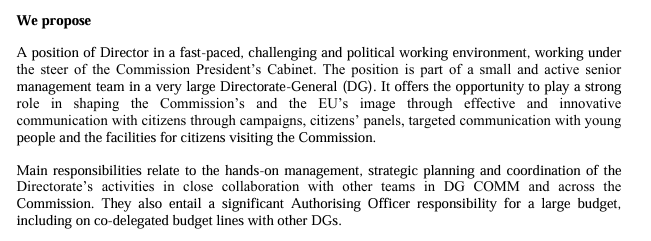
In his new role, Flosdorff will lead “lead the Commission’s citizens communication actions

and the analysis of public opinion,” according to the job advertisement that the commission was legally required to post before handing the sinecure to von der Leyen’s man. This presumably involves the crafting of youth outreach campaigns and commissioning of Eurobarometer polls, but the rest is unclear.

Sophia Eriksson Waterschoot, who currently occupies the role in an acting capacity, “refused to say what the job entailed” when asked by Rapporteur.

An excerpt from the European Commission's 'Director for Citizens Communication' job advert
An excerpt from the European Commission’s ‘Director for Citizens Communication’ job advert

Waterschoot stepped in when previous Director for Citizens Communication Stefan de Keersmaecker was named ‘Director for Political Communication’ late last year. The differences between these two roles are blurred, with both responsible for social media campaigns, both analyzing media and public opinion, and both pushing the commission’s message (one as a ‘rapid response’ outfit, and the other organizing longer-term campaigns).

Both directors lead separate departments within the commission’s ‘Directorate-General for Communication’ (DG-COMM), and together employ around 500 people. DG-COMM has a yearly budget – excluding salaries – of €116 million, and it’s not the only communications department on the commission’s books: most of the commission’s 41 directorates-general have their own in-house spin offices too, which sometimes collaborate with the ‘citizens’ and ‘political’ bureaus of DG-COMM.

If that wasn’t complicated enough, none of these departments write von der Leyen’s speeches. That task falls to her personal speechwriter, Lorenzo Biondi, who announced his retirement on Wednesday.

Biondi is leaving the commission for a job at the Institute of International Affairs, an Italian think tank. But it’s not a straightforward move from the public to the private sector. The Institute of International Affairs’ Europe-focused work is funded almost entirely by the European Commission. There is now just an extra middleman between him and his former employer.

Queen Ursula’s court

Atop this bureaucratic superstructure, von der Leyen has consolidated her power. Her efforts go beyond appointing her loyalists to lucrative lifetime gigs: von der Leyen began the year by appointing 26 commissioners without running the list past the European Parliament first, as well as deliberately withholding budget and internal market strategy documents from member states until hours before publication, making deliberation impossible.

Former European Council President Charles Michel has described her governance as “super authoritarian.” Surrounded by a “tight-knit” and “micromanaged” circle of mostly German advisers, including Flosdorff, von der Leyen has reduced her commissioners to little more than administrators, whose opinions and criticisms rarely make it past her advisers.

Von der Leyen is “obsessed with demonstrating that she’s in charge,” and “is constantly jumping into the middle of the latest crisis, even when it’s outside her remit,” unnamed EU diplomats complained to Bloomberg in May.

Some of the commission chief’s ambitions are grand – she has pushed for the creation of an intelligence agency answering to her office, and backed a Franco-German plan to strip some of chief diplomat Kaja Kallas’ foreign policy powers. Others are more petty. On the day of US President Donald Trump’s inauguration last year, every commissioner under von der Leyen reportedly received strict instructions from Flosdorff: their own communications teams were only allowed to repost von der Leyen’s message to Trump on social media, without adding any comments of their own.

All of this is to illustrate two characteristics of the European Commission under von der Leyen. Firstly, with its jobs for life, its three-dozen communications departments, and its web of interconnected think tanks, it is a bloated organism whose reform would be a generational undertaking.

Secondly, with its unelected president controlling everything from job appointments and social media posts to foreign policy and intelligence gathering, it is an autocracy so at odds with its democratic rhetoric that it requires 43 communications offices to explain away its contradictions to the public.

  •  

Bill Gates Says Epstein “Found My Weak Point”

by The Vigilant Fox, Modernity News: “I never went to the island” Bill Gates says Jeffrey Epstein “found my weak point,” and the weak point was a promise of $100,000,000,000 for global health. “There was never any social thing. I never went to the island. I was never introduced to any women. But I’ve learned […]
  •  

Research consistently proves the simplest, most powerful health intervention: Reduce your eating window and watch your body heal

by Willow Tohi, Natural News: A pooled analysis of five clinical trials found that an 8-hour time-restricted eating window led to greater weight loss than a 12-hour window or no time restriction. Participants assigned to the 8-hour eating window lost approximately 3.7 more pounds than those in the 12-hour group over 3-6 months. Researchers observed improvements […]
  •  

Former trauma surgeon testifies to the fraudulent statistics, dangerous hospital protocols and denial of care to unvaccinated patients during the covid “pandemic”

by Rhoda Wilson, Expose News: Dr. James P. Miller, a former trauma surgeon at Providence Regional Medical Centre, testified before a US Senate roundtable that during the covid “pandemic” he witnessed hospital fraud, the implementation of harmful covid-19 protocols and the retaliatory targeting of staff who questioned these practices. He also testified that the hospital’s […]
  •  

Germany’s ruling coalition pushes to outlaw its biggest opposition party

by Cassie B., Natural News: Germany’s governing coalition is pushing to explore banning the right-wing AfD party by year’s end AfD now leads national polls at 29.5 percent, more than double the vote share of its leading challenger Chancellor Friedrich Merz is skeptical of a ban, but a top official in his own party backs […]
  •  

Pandemic of the vaccinated: The sharp rise in AIDS cases in Fiji was predictable; it is due to injecting the covid spike protein bioweapon

by Rhoda Wilson, Expose News: After years of relatively low numbers, Fiji recorded 2,016 new HIV diagnoses in 2025. Officials point to methamphetamine injection, needle-sharing and a huge testing drive as an explanation. Not everyone is convinced by the official narrative. Some researchers are asking questions, based on the evidence.  In the following, Dr. Philip […]
  •  

The Rise And… Rise Of ‘Color Revolutions’

By Kit Klarenberg | Global Delinquents | September 28, 2026

It’s rather forgotten today how Washington’s post-9/11 imperial adventurism was not restricted to military intervention. A core component of the Bush administration’s “Freedom Agenda” – under the auspices of which calamitous wars in Afghanistan, Iraq and elsewhere were waged – was overt sponsorship of civil society-led coups throughout the former Soviet Union, Warsaw Pact and Yugoslavia. Citizens of these regions, and the world, live with this meddling’s destructive consequences to this day. The seemingly never-ending – and ever-escalating – Ukraine proxy war is a particularly visceral legacy.

The 1983 creation of the National Endowment for Democracy, a US state entity avowedly concerned with executing overtly what the CIA once did covertly, ushered in a new era of “spyless coups”. Working in close conjunction with USAID and George Soros’ Open Society Institute, NED ever after provided funding, training and material assistance to NGOs, ‘independent’ media outlets, opposition groups, and other initiatives in service of regime change, across every corner of the world.

Come 9/11, NED and its confederates had devised a supremely cunning, cost-effective template for toppling troublesome governments – be they left-wing, nationalist, or even former US puppets who’d stepped out of line. The previous October, longtime Yugoslav leader Slobodan Milosevic was brought down in what the Washington Post bombastically dubbed “an extraordinary US effort to unseat a foreign head of state, not through covert action of the kind the CIA once employed in such places as Iran and Guatemala, but by modern election campaign techniques.”

At the anti-Milosevic effort’s forefront was Otpor! (Serbian: Resistance!), a rebellious NED-funded youth activist group. Through a mix of civil disobedience, non-violent resistance, rock concerts, street theatre, and graffiti, they fomented mass public opposition to the Yugoslav President. When election day came and official results pointed to Milosevic’s victory, an NED-funded “parallel vote tabulation” purported to expose major fraud, sending millions to the streets of Belgrade to peacefully demand the President’s resignation. Milosevic duly capitulated, in the face of seemingly overwhelming people power.

The supposedly heroic struggle of Otpor! and other US-supported anti-Milosevic groups was immortalised in a slick ‘documentary’, Bringing Down A Dictator. Milosevic’s fall provided a precise blueprint for future ‘color revolutions’ – so-called because frequently, the Empire-supported activists who led these mob putsches prominently adopted specific colours for their banners, branding and logos. Initially, US officials eagerly associated themselves publicly with this upheaval. Meanwhile, the mainstream media routinely published remarkably illuminating post-mortems of the revolts, extensively exposing Washington’s guiding hand and oft-enormous financial outlay.

Nonetheless, politicians, pundits and journalists alike universally framed colour revolutions as ultimately spontaneous uprisings by liberal, progressive elements with legitimate grievances, who yearned for democracy and freedom. In reality, they almost invariably produced corrupt, repressive governments that ruled via intimidation and brutality, including political assassinations. Post-colour revolution regimes also typically conducted sweeping privatisation and other ravaging ‘reforms’, destroying living standards for average citizens by prostrating their countries to the EU, IMF, NATO, World Trade Organization, and other mechanisms of Western economic, military, and political subjugation.

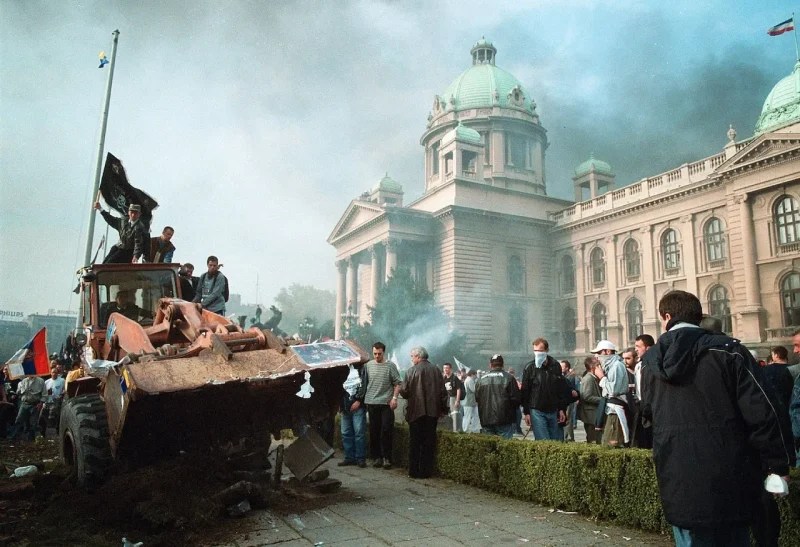
Slobodan Milosevic’s NED-orchestrated ouster is nicknamed the ‘Bulldozer Revolution’, due to iconic scenes during the upheaval of a wheel loader helping anti-government agitators occupy state buildings. However, its driver quickly turned against the “Revolution”. Subsequent “shock therapy” decimated Yugoslavia’s mixed market economy, causing his successful independent business to fail, and him to go bankrupt. He subsisted until his dying day on meagre state welfare payments. For most participants, subsequent colour revolutions were similarly an object lesson in being careful about what one wishes for.

‘External Shove’

In February 2005, President George W. Bush gave a swaggering address in Bratislava, Slovakia. He hailed how “in recent times, we have witnessed landmark events in the history of liberty.” This included Georgia’s November 2003 Rose Revolution, Ukraine’s Orange Revolution the next year, and Iraq’s Purple Revolution a month prior. “The advance of freedom is the concentrated work of generations,” Bush declared. He looked ahead to Moldova, and “inevitably” Belarus, “someday proudly [belonging] to the country of democracies [sic]”:

“Eventually, the call of liberty comes to every mind and every soul. And one day, freedom’s promise will reach every people and every nation.”

Moldova’s forced transformation into a staggeringly corrupt effective EU-US colony took many years. Belarus conversely remains stubbornly resistant to “freedom’s promise”, as defined by Brussels, London, Washington, and other centres of imperial power. Still, President Bush’s confidence was well-founded. Waves of insurrectionary unrest unleashed by his government’s “Freedom Agenda” had systematically swept away designated enemy governments one by one annually since he took office. Indeed, within weeks of Bush’s speech, Kyrgyzstan’s insufficiently pro-Western leader fell victim to yet another colour revolution.

He would not be the last. Prior colour revolutions had enthusiastically emphasised the importance of techniques of nonviolent resistance – many of which were crafted by Gene Sharp, who was intimately enmeshed within the US military and intelligence establishment for much of his life. However, Kyrgyzstan’s NED-created regime change army, KelKel – directly modelled on Otpor! – attacked police, torched government buildings and even carried out bombings. Their ferocity was actively encouraged and promoted by US-funded TV stations locally. Such belligerence subsequently became a colour revolution calling card.

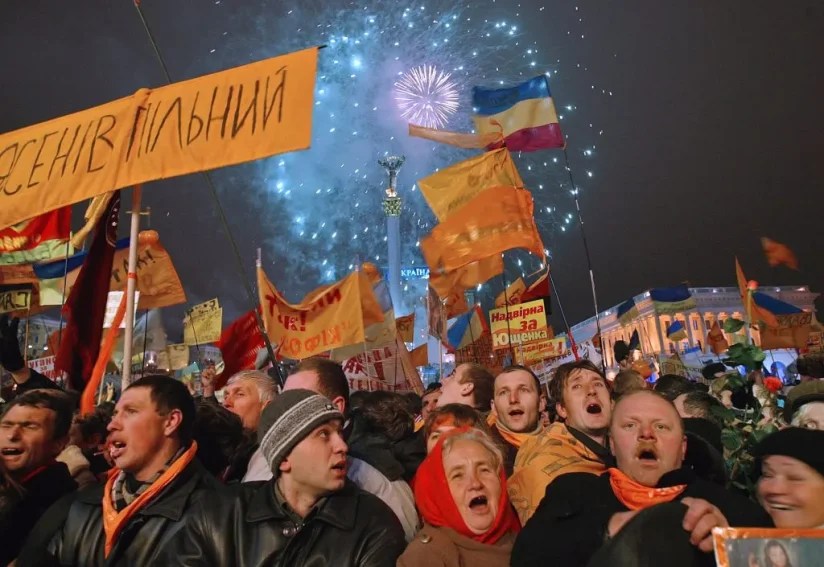
Ukraine’s Orange Revolution

That colour revolutions represented a formal weapon of war in the Empire’s post-9/11 arsenal was enthusiastically spelled out by arch-neoconservative Max Boot in late December 2004. He gushed how Ukraine’s Orange Revolution days earlier, which brought a pro-Western government to power, was “one of the most inspiring events” of that year. Boot declared the “triumph” and “miracle” of the revolution “should dispel the quaint notion still prevalent in many Western universities and foreign ministries that democracy is a luxury good suitable for rich countries”:

“These revolutions reveal the hollowness of the cliché that ‘democracy can’t be imposed by outsiders’… sometimes, when dealing with an entrenched dictatorship, this requires military intervention of the kind that occurred in Iraq and Afghanistan. More brittle regimes can be brought down by their own people, but even they often need a little external shove… There was nothing nefarious about the US intervention in Ukraine.”

Boot boasted how Washington had “spent $58 million on democracy promotion in the last two years” in Ukraine. He proposed Kiev receive “expedited NATO and European Union membership,” to finish off the Orange Revolution. “In the meantime, we need to apply elsewhere the lessons of Ukraine” Boot demanded, suggesting “an obvious candidate for a similar transformation is Iran.” He explained, “it’s hard to think of a higher priority than the overthrow of the mullahs,” encouraging the Bush administration to prioritise “liberating Iran.”

‘USAID Help’

Such was the insurrectionary fervour of the time, in January 2006 USAID went to the extent of publishing a glossy magazine, Democracy Rising, revealing in detail Washington’s central role in fomenting “grassroots” rebellions as far afield as Afghanistan, Gaza and Lebanon. Dedicated sections on colour revolutions to date were replete with stunningly forthright passages. A section on Georgia’s November 2003 Rose Revolution described how NED had financed regime change training for local “lawyers, judges, journalists, members of parliament, NGOs, political party leaders, and others.”

The stated purpose of this investment was to give Georgians “a sense that they should regulate the government.” The Rose Revolution “was the climax of these efforts.” One recipient of US financial support remarked, “without foreign assistance, I’m not sure we would have been able to achieve what we did without bloodshed.” Meanwhile, several pages were dedicated to the Orange Revolution. It noted how thousands of Ukrainian journalists were given training in “investigative reporting”, bankrolled by NED and USAID.

An alumni told Democracy Rising this sponsorship “created a feeling that others stood with them ‘in the trenches’.” Concurrently, NED-affiliated Freedom House flooded the coffers of NGOs “that sponsored voter education, mobilized voters to get to the polls and observed elections.” These organisations “also held meetings, youth dances, rock concerts and karaoke to attract young voters,” and “ran public service ads on TV stations, informing people about their right to vote.” Meanwhile, “democracy trainers from Serbia, Slovakia, Russia and Croatia” were flown into the country.

In the second round of Ukraine’s presidential election, NED-financed NGOs claimed to have been inundated with tens of thousands of reports of fraud from voting stations all over the country, while exit polls they produced pointed to widespread rigging having denied pro-Western candidate Viktor Yushchenko a landslide victory. Vast protests, combined with opposition-organised general strikes, widespread civil disobedience and occupations of government buildings forced a rerun. A US-funded think tank apparatchik asserted:

“USAID help for the poll was absolutely important – the poll results after the second round made people go to the street.”

For all the hype and self-assurance of Democracy Rising, its publication came at a time when colour revolutions were increasingly being viewed with hostility and suspicion at a state and public level throughout the Global South. In every case, the radical outcomes promised by colour revolution leaders and advocates failed to materialise, while US rhetoric about the commitment of resultant pro-Western regimes to democracy and freedom was a perverse fraud.

In Ukraine, US-installed Yushchenko implemented economic austerity, slashed regulations and social spending, bailed out criminal banks, broke open state industry and natural resources for foreign plunder, attacked the rights of Russian speakers, and began preparing the country for locally-feared NATO membership. Within just nine months of entering office, his coalition government – comprised of Orange Revolution activists – collapsed due to deeply corrupt battles with feuding Ukrainian oligarchs over control of key media and industrial assets.

Yushchenko was voted out in the January 2010 presidential election, finishing fifth in the first round with just 5.5% of the vote. As Empire house journal Foreign Policy lamented years later, the Bush administration’s much-vaunted colour revolutions all turned out to be “terribly disappointing.” Each and every time, “elite corruption still continued apace” and “promises of far-reaching change never really materialized.” Damningly, “maladies that typified the preceding regimes quickly came to describe” the governments created by colour revolutions themselves.

‘Revolution Business’

That’s quite some euphemism. In Georgia, longtime Soros acolyte Mikheil Saakashvili granted himself unilateral power in key policy areas, before brazenly exploiting his position to harass and jail business and political rivals. Saakashvili’s targets would be raped and/or tortured in prison, their ordeals filmed for primetime broadcast on local TV networks. Grave questions abound over his personal involvement in several suspicious deaths, including government ministers’. He was voted out in October 2012, despite NED’s best efforts.

Kyrgyzstan’s 2005 Tulip Revolution installed Kurmanbek Bakiyev, who proceeded to run the country as his personal fiefdom for five years. Bakiyev’s relatives profited exorbitantly from legally questionable privatisation of state industries. For example, his family signed a highly controversial $1.8 billion deal to supply fuel to a local US military base, close to Kyrgyzstan’s total GDP in 2003. Elsewhere, Bakiyev’s brother oversaw Bishkek’s security apparatus – arbitrary detentions, bogus convictions, torture, and murders of opposition activists, journalists, and politicians became commonplace.

Bakiyev was himself chased out of not only the presidential palace but Bishkek itself in April 2010, following a massacre of anti-corruption protesters in which up to 100 were killed and at least 450 wounded. Thereafter, Kyrgyzstan was plunged into economic and political chaos for a decade, with numerous governments collapsing along the way. The freest and most stable Central Asian state prior to the Tulip Revolution, it is only since 2020 – following another Anglo-American coup – the country has regained some semblance of stability.

A key player in that upheaval was British ambassador Charles Garrett. He arrived in Bishkek from Macedonia, where as this journalist has revealed from April 2016 he steered what was known as the “colorful revolution”. Illegally obtained, deceptively edited wiretaps seemingly implicating government officials in shocking crimes produced huge protests, featuring widespread arson attacks and brutal clashes between demonstrators and police. Garrett distributed cash to NGOs and activists involved in the unrest from his diplomatic pouch, encouraging them to cause mass havoc.

Paralajmërimi i gazetarit maqedonas: Pas protestave në Ballkan ...

George Soros’ Open Society Foundations, NED, and USAID were also colorful revolution participants. Some protesters even proudly wore “Soros Army” shirts. Despite a huge public counter-revolutionary fightback, the tumult paralysed the Macedonian economy and state, leading to the installation of a doggedly pro-Western, dangerously dysfunctional administration that engaged in industrial scale graft, jailed political opponents on bogus charges, and changed the country’s name despite widespread opposition. Meanwhile, existing economic problems, including crippling brain drain, were gravely exacerbated.

The unfailingly disastrous results of colour revolutions surely contributed to White House officials abruptly and firmly distancing themselves from the entire enterprise, before the Bush administration’s second term was even over. The “Freedom Agenda” was quietly forgotten. The President – who in October 2004 openly mandated financial assistance to Belarusian opposition activists, and once publicly praised the Rose Revolution as an example to be followed throughout the Caucasus and Central Asia – went so far as to deny the US was in the “revolution business” at all.

‘Alternate Reality’

Colour revolutions have continued apace ever since, with the same strategies being recurrently applied the world over, to varying degrees of success. All along, non-Western governments – in particular China, Iran and Russia – have become increasingly vocal in their condemnation of and opposition to colour revolutions, in some cases passing legislation seeking to curtail the operations of foreign funded NGOs on their soil. Yet, the mainstream media long ago adopted a rigid Omertà on Washington’s culpability for civil society-driven destabilisation overseas.

In a striking example of this paradigm shift, in November 2004, before the Orange Revolution was over, The Guardian published a revealing report exposing the “US campaign behind the turmoil in Kiev.” The outlet stated unambiguously the revolt was “an American creation, a sophisticated and brilliantly conceived exercise in Western branding and mass marketing that, in four countries in four years, has been used to try to salvage rigged elections and topple unsavoury regimes.” NED, the State Department and USAID were all fingered as culprits.

Fast forward to July 2015 however, and a Guardian article on Russia’s banning of NED under foreign agent laws quite amazingly relied on a brief quote pulled from the Endowment’s official website to describe its operations. In the intervening time, the Maidan Revolution overthrew Ukrainian President Viktor Yanukovych in February 2014, setting Kiev on the warpath with Moscow. Washington’s irrefutable involvement was strenuously denied at the time by the mainstream media, and has been ever since.

Following the Ukraine proxy war’s February 2022 eruption, The New York Times took vigorous aim at independent journalists for spreading the “conspiracy theory” Maidan was US-orchestrated, dubbing the proposition an “alternative reality” and “Russian disinformation”. This is despite every prominent Maidan actor – including the individuals who started the demonstrations – receiving NED or USAID funding, leaders of US-bankrolled organisations in the country advertising their intention to overthrow Yanukovych years prior, and the Endowment spending $20 million in the country in 2013 alone.

After the outbreak of war in Ukraine, NED removed its grant records on Ukraine, listing its investment in a panoply of initiatives in the country over many years – many of which ultimately targeted Russia, one way or another. In mid-2024, the Endowment undertook the unprecedented step of removing grant records for the entire world. Today, brief entries on different geographical regions describe in vague terms the Endowment’s specific aims locally, and overall sums being spent. The crucial questions of where, and on what, aren’t clarified.

NED going underground makes the task of tracking and exposing contemporary colour revolutions difficult, but not impossible. In September 2025, mass rioting ignited in Nepal. Major news outlets without exception reported the fiery agitation as an organic burst of dissent by the country’s disaffected “Gen Z”, motivated by corruption, unemployment, and state censorship of social media. Publications barely acknowledged demonstrators committed serious crimes, including torching Nepal’s parliament and the Prime Minister’s official residence, which sent occupants fleeing in helicopters.

Based on publicly available information, the clear insinuations of a colour revolution could be discerned. An NGO that organised the protests, Hami Nepal, had clear links to organisations known to be in receipt of NED funding. Subsequent leaks amply demonstrated the Endowment and USAID expended substantial sums over the years preceding the coup training young Nepalese citizens how to protest, founding NGOs and political parties, and “advocate concerns” on issues such as corruption. Evidently, the post-9/11 “Freedom Agenda” never actually ended.

  •  

Kleptocracy and the Incompetence of the illegal Ukraine Regime’s Backers

A high-profile scandal has rocked the European Union, exposing the thorough incompetence of the bloc, which is hell-bent on trying to undermine Russia’s sovereignty by aiding the illegal Kyiv regime. In an egregious incident, the Defense Minister of Estonia, Hanno Pevkur, resigned on September 3, 2026. While resignations may seem rather routine in the fast-moving […]
  •  

Faillite de la mission européenne au Kosovo

Des crimes impunis, un déficit extérieur colossal, une partie de la population fuyant un chômage de masse, des responsables rêvant tout haut de « Grande Albanie » : le Kosovo semble livré à ses démons. Le patronage de l'Union européenne ne lui a pas permis de décoller, et des affaires de corruption entachent la mission internationale visant à instaurer un Etat de droit.

En moins d'un an, près de cent mille Kosovars auraient tenté de rejoindre l'Union européenne. Le flux a grossi avec l'arrivée du printemps. Chaque jour, des familles entières, parents, enfants, vieillards, traversent la Serbie pour gagner la frontière hongroise. Soixante mille Albanais du Kosovo auraient demandé des passeports serbes pour obtenir un visa européen, selon les autorités de Belgrade.

« Sept ans après la proclamation d'indépendance et la mise sous tutelle du Kosovo par l'Union européenne, c'est la débâcle », nous affirme M. Andrea Capussela, qui fut jusqu'en avril 2011 directeur des affaires économiques du Bureau civil international (International Civilian Office, ICO), l'une des principales missions déployées au Kosovo. « La situation est pire qu'avant l'arrivée de la mission européenne », ajoute l'expert italien, qui vient de publier un brûlot sur la politique européenne dans les Balkans (1). Selon lui, cette situation ne met pas seulement en cause les investissements de l'Union européenne dans le pays — plus de 4 milliards d'euros sur la période 1999-2013 —, mais aussi la crédibilité de sa politique étrangère.

Depuis l'automne dernier, la responsable de la diplomatie européenne, Mme Federica Mogherini, tente d'éteindre l'incendie qui gagne la mission européenne pour l'instauration de l'Etat de droit au Kosovo (Eulex). Celle-ci, décidée en février 2008, vise à renforcer les institutions judiciaire et policière. Dotée d'un financement annuel de 111 millions d'euros, elle mobilise mille six cents personnes afin, notamment, de combattre la corruption et la criminalité organisée. Mais plusieurs de ses responsables sont soupçonnés de malversations, tandis que l'institution est accusée d'avoir couvert ces dérapages.

« Pendant un an, ils ont non seulement enterré, mais aussi compromis l'enquête », dénonce Mme Maria Bamieh, par qui le scandale est arrivé. Cette procureure britannique travaillait pour la force d'intervention indépendante chargée des affaires criminelles au sein de la mission européenne. Dans un rapport de 2012, elle a averti ses supérieurs de soupçons de corruption visant notamment deux hauts responsables : le juge italien Francesco Florit, alors président de l'assemblée des juges d'Eulex, et la procureure en chef Jaroslava Novotna. La magistrate britannique fonde ses allégations sur les écoutes de conversations téléphoniques entre l'ex-secrétaire du ministère de la santé du Kosovo, M. Ilir Tolaj, poursuivi pour corruption et fraude fiscale en 2010, et des intermédiaires. Ceux-ci l'assuraient être en contact avec ces deux juges, capables de se montrer compréhensifs (2)…

« Nos chefs dînent avec des mafieux »

La procureure évoque d'autres cas de compromission en lien avec Eulex. En particulier ceux concernant le très influent Fatmir Limaj, ancien ministre des transports, inculpé pour crime organisé et détournement de fonds, ou M. Enver Sekiraqa, un petit chef mafieux de Pristina mis en cause dans une affaire d'attentat à la bombe. Mais, curieusement, son rapport disparaît et aucune suite n'est donnée.

En octobre 2014, le principal quotidien du Kosovo, Koha Ditore, se procure des éléments du dossier et obtient un entretien avec Mme Catherine Fearon, la conseillère politique du nouveau chef d'Eulex, l'Italien Gabriele Meucci. Le journaliste Vehbi Kajtazi affirme que, lors de leur entrevue, Mme Fearon l'a sommé de livrer ses sources et l'a menacé de poursuites judiciaires. En dépit de ces pressions, le journal commence à publier une enquête dans son édition du 27 octobre 2014. Ces révélations provoquent la suspension… de Mme Bamieh ! « Epuisement au travail », décrète M. Meucci, qui reproche aussi à la Britannique d'avoir donné des informations aux médias. Rentrée depuis à Londres, Mme Bamieh accuse ses supérieurs d'être trop proches de puissants hommes politiques au cœur d'enquêtes criminelles : « Comment pouvons-nous remplir notre mission quand nos chefs dînent avec des mafieux et des politiciens kosovars soupçonnés de corruption ? »

Devant le scandale, Mme Mogherini ordonne une enquête, confiée au professeur Jean-Paul Jacqué, ancien directeur de l'Institut des hautes études européennes de Strasbourg. Cet expert en droit international a dirigé entre 1992 et 2008 le service juridique du Conseil des ministres de l'Union européenne, l'institution qui a mandaté Eulex. Dans son rapport, rendu public le 14 avril dernier, il ne considère pas qu'une affaire aurait été étouffée ; il invoque plutôt une série d'erreurs administratives. Bruxelles n'a pas été suffisamment informé du document détaillant les soupçons au sein d'Eulex, et ses cadres supérieurs auraient tardé à enquêter car ils ne trouvaient pas le contenu des interceptions téléphoniques « particulièrement crédible ». Il juge pourtant qu'une enquête « aurait dû être ouverte dès le départ », après l'avertissement de Mme Bamieh à sa hiérarchie. Evoquant les menaces contre Kajtazi (3), Jacqué estime que la conseillère du chef de la mission « a mis en garde le journaliste contre la divulgation d'informations concernant des cas criminels, puisque ce serait une infraction en vertu de la loi kosovare ».

Pour Kajtazi, on ne peut pas considérer le rapport de Jacqué comme indépendant : « Il conclut que je n'ai pas été l'objet de menaces. Il s'agirait d'une erreur de communication. La vérité est que la mission Eulex m'a bien menacé de poursuites si je venais à publier un article », nous affirme le journaliste. « Jacqué a essayé de minimiser la possibilité que la mission soit impliquée dans la corruption. »

Le rapport se démarque néanmoins du discours officiel des institutions européennes, qui présentent la mission au Kosovo comme un modèle de reconstruction. Le professeur constate de graves dysfonctionnements au sein de la représentation de l'Union et décrit une corruption « omniprésente » dans le pays, en précisant que « le secteur judiciaire ne fait pas exception ». Sept ans d'une action visant à restaurer l'Etat de droit n'ont pas suffi à éradiquer les prévarications, mais « il devait être néanmoins possible d'établir les fondations d'un système capable de combattre la corruption ». Selon lui, Eulex — dont le mandat s'achève en 2016 — perdra son sens si on ne parvient pas à la réformer. Mais son retrait lui apparaît prématuré, car le système judiciaire local ne semble pas capable de traiter certaines affaires.

Dans une lettre ouverte à Jacqué, Mme Bamieh juge son rapport décevant et imprécis. Elle y voit davantage une note interne qu'un travail indépendant. « Les transcriptions [des écoutes] indiquent que l'argent a bien été versé », souligne-t-elle. Elle déplore que l'enquête ne concerne pas la procureure en chef Novotna. Elle regrette en outre que celle visant M. Florit n'ait été lancée qu'en 2013, après la réception d'informations provenant des services de renseignement allemands, et non sur la base de son propre rapport interne, transmis à ses supérieurs en 2012. Elle cite également les noms d'anciens collègues qui l'ont soutenue et qui ont dû quitter Eulex.

Après les errements du Tribunal pénal international pour l'ex-Yougoslavie (TPIY) (4), et toujours dans l'attente de suites judiciaires au rapport du procureur américain Clint Williamson sur les trafics d'organe et les crimes de l'Armée de libération du Kosovo (UCK) (5), l'affaire Bamieh révèle l'ampleur des compromissions européennes : « On parle de la corruption, du crime organisé, mais on ne dit jamais que c'est un régime autoritaire semi-consolidé que nous avons créé, et qu'une élite de criminels issue de l'UCK vole l'argent public et s'accroche au pouvoir », s'enflamme M. Capussela, qui a travaillé durant quatre ans pour l'Union européenne au Kosovo.

Principale force de la guérilla soutenue par les Occidentaux dans le conflit de 1999, l'UCK a pris le pouvoir après les bombardements de l'Organisation du traité de l'Atlantique nord (OTAN) et la capitulation de la Serbie. Les enquêtes de la procureure du TPIY, Mme Carla Del Ponte, puis de M. Dick Marty, au nom du Conseil de l'Europe, ont montré que cette milice s'était livrée à des exactions contre des civils serbes ou roms et contre ses opposants politiques albanais. Une partie de ces meurtres, enlèvements, séquestrations et tortures ont eu lieu dans les premières années de l'après-guerre, en présence des troupes de l'OTAN et de la Mission d'administration intérimaire des Nations unies au Kosovo (Minuk), dont le Français Bernard Kouchner fut le premier dirigeant.

« La mission n'était pas capable de défendre les civils », estime M. Christopher Decker, venu au Kosovo en 1999 comme membre de l'International Crisis Group, avant de rejoindre l'Organisation pour la sécurité et la coopération en Europe (OSCE). « La police de l'ONU était mal équipée et pas du tout préparée. C'était facile pour l'UCK de se livrer à la violence », explique cet Américain qui a passé douze ans sur place. « La communauté internationale répète les mêmes erreurs : on intervient militairement, puis on laisse des éléments criminels prendre le pouvoir, ce qui empêche l'instauration de l'Etat de droit », se désole-t-il.

Dès le début, on a épargné l'élite locale, les « gros poissons », car cela pouvait déranger l'ordre établi et provoquer une instabilité. Mme Del Ponte affirme non seulement que les plus hauts dirigeants de l'UCK représentaient un danger pour l'accomplissement de sa mission, mais aussi qu'ils pouvaient mettre en péril tout l'édifice du processus de paix dans les Balkans : « Hashim Thaçi [premier ministre de 2008 à 2014] et Agim Ceku [de 2006 à 2008] étaient en mesure de déclencher des violences en Macédoine, dans le sud de la Serbie et dans d'autres régions, en appelant les minorités albanaises rebelles aux armes (6). »

« Au début, j'étais surpris par la négligence, l'incompétence et la paresse qui régnaient au sein de la mission. J'ai compris plus tard que des choix politiques expliquaient en partie cette attitude », raconte M. Capussela. « Ceux qui voulaient européaniser le Kosovo se sont balkanisés », estime le politiste kosovar Belul Beqaj. S'y ajoute une culture de l'impunité propre à toutes les missions internationales, puisque leurs membres échappent aux poursuites judiciaires. « Leurs employés ne sont pas justiciables. Les pays ne veulent pas que leurs représentants nationaux soient jugés », nous explique Mme Sian Jones, spécialiste du Kosovo à Amnesty International.

Poursuites contre des innocents

Dans son livre, M. Capussela dresse une liste des défaillances flagrantes d'Eulex, qu'elles soient économiques, financières ou relatives aux droits humains. Ainsi, la mission n'a pas enquêté sur les affaires de corruption liées aux privatisations (télécommunications, ciment), aux constructions de routes, à l'expropriation des terres, à la fraude électorale, à l'intimidation des journalistes, aux assassinats politiques, ni sur certains crimes de guerre.

Pis, Eulex a parfois poursuivi des innocents. La mission a par exemple gardé en détention pendant quatre mois le gouverneur de la banque centrale sans révéler les charges pesant contre lui — qui furent abandonnées par la suite. Pour l'économiste italien, qui a alerté Eulex sur des accusations qu'il jugeait peu crédibles, l'homme a été arrêté parce qu'il s'opposait aux intérêts de personnages puissants.

Avec la corruption et l'impunité qui règnent au Kosovo, les tensions montent. Les politiciens, l'homme fort du pays Hashim Thaçi en tête, détournent l'attention vers l'extérieur : « Grâce à leurs réseaux, ils peuvent provoquer des émeutes en Macédoine, où la situation est très instable, contre les Serbes du Kosovo, ou contre les représentants de l'Union, estime M. Capussela. Ils enverraient ainsi un message à Bruxelles et à Washington : “Vous franchissez la ligne rouge.” » Pour M. Decker aussi, la classe dirigeante kosovare sait tirer parti de la violence : « S'il n'y avait pas eu d'émeutes en 2004 [contre les Serbes et les autres minorités], il n'y aurait pas eu autant de pressions pour l'indépendance. »

L'incapacité d'Eulex, après celle de la Minuk, à établir une justice fonctionnelle ne pose pas seulement la question des investissements européens dans la mission — plus d'un milliard d'euros —, mais aussi celles du respect des droits des citoyens kosovars et du maintien de la paix dans la région.

Voir en ligne : /2015/06/OTASEVIC/53059

(1) Andrea Lorenzo Capussela, State-Building in Kosovo : Democracy, Corruption and the EU in the Balkans, I. B. Tauris, Londres, 2015.

(2) Julian Borger, « EU's biggest foreign mission in turmoil over corruption row », The Guardian, Londres, 7 novembre 2014.

(3) « Un journaliste d'investigation menacé par la mission européenne au Kosovo », Reporters sans frontières, 31 octobre 2014.

(4) Lire Jean-Arnault Dérens, « Justice borgne pour les Balkans », Le Monde diplomatique, janvier 2013.

(5) « Statement by the Chief Prosecutor of the Special Investigative Task Force (SITF) on investigative findings », 29 juillet 2014. A partir de ce rapport, le Parlement du Kosovo avait jusqu'à la fin mai pour mettre en place le tribunal spécial devant juger ces crimes, qui sont hors du mandat du TPIY.

(6) Carla Del Ponte, La Traque, les criminels de guerre et moi, Editions Héloïse d'Ormesson, Paris, 2009.

  •  

Un défi existentiel

JPEG - 167.3 kio
Newsha Tavakolian //// Il ne reste de l'ancien port de plaisance de Rahmanlou que des bâtiments vides et des bateaux abandonnés.
© Newsha Tavakolian/Magnum Photos

Des sirènes hurlantes, des embouteillages monstres étendus sur des kilomètres, des forces de l'ordre déployées dans les rues pour dissuader émeutes, manifestations et pillages tandis que quatorze millions d'habitants évacuent Téhéran et sa banlieue. Ces scènes dignes d'un film dystopique auraient pu avoir lieu. Ce n'est pas la menace du président américain Donald Trump de faire disparaître la civilisation iranienne en une nuit (lire « Une journée comme une autre ») qui en aurait été la cause, mais un ordre des autorités de la République islamique. En novembre 2025, les pluies d'automne ne sont pas au rendez-vous. L'Iran connaît la pire sécheresse depuis un siècle. Les cinq barrages qui approvisionnent la capitale sont presque à sec et les coupures d'eau sont quotidiennes, surtout la nuit. La tension est identique dans la ville de Machhad (nord-est), que quatre barrages environnants sont bien en peine d'alimenter. Le président Massoud Pezechkian met alors en garde ses compatriotes. Si la situation ne s'améliore pas, il faudra évacuer la mégapole et ses environs (1). Pour le long terme, il évoque même un possible transfert définitif de la capitale surpeuplée vers la région de Makran, près du détroit d'Ormuz. Un projet jugé irréalisable par nombre d'experts mais dont l'évocation frappe tout de même les esprits, tant elle conforte l'idée d'un choc environnemental majeur à venir.

Des villages entiers sont privés d'eau potable, l'exode rural s'aggrave, les équilibres sociaux et territoriaux sont bouleversés

La hausse, toute relative, de la pluviométrie au premier semestre 2026 a conjuré le scénario de l'évacuation forcée, mais le problème de fond demeure. Trente-cinq millions d'Iraniens sont confrontés quotidiennement à la pénurie d'eau. Les réserves totales ont diminué de 211 kilomètres cubes entre 2003 et 2019 — l'équivalent de deux années de consommation nationale —, tandis que le niveau moyen des nappes souterraines a fortement baissé (2). Dans certaines régions, notamment dans l'Est et dans le Sud, l'eau potable n'est accessible aux habitants que via des camions-citernes payants, ce qui provoque de longues files d'attente. Une centaine de zones humides ont disparu, et l'assèchement des rivières contribue à l'aggravation des tempêtes de poussière qui sévissent à partir du printemps.

Contrairement au discours officiel, la sécheresse et le réchauffement climatique, présentés comme une fatalité, ne sont pas les seuls responsables de cette crise. C'est aussi, et avant tout, une affaire de mauvaise gestion et de politiques environnementales erratiques depuis les années 1970. « La pénurie d'eau en Iran, particulièrement à Téhéran, n'est pas un phénomène passager ou le résultat d'une seule année de sécheresse, écrit ainsi le très critique quotidien économique de Téhéran Jahan-e Sanat. C'est le signe d'un déséquilibre profond et structurel du système national d'approvisionnement et de consommation » (17 février 2026).

Autrement dit, l'Iran manque d'une politique centralisée et cohérente de l'eau qui arbitrerait entre les besoins. Les efforts consentis en faveur de l'agriculture — laquelle représente 90 % de la consommation des ressources hydriques — sont pointés du doigt. Afin de procurer des revenus décents aux populations rurales, mais aussi pour garantir la sécurité alimentaire d'un pays exposé aux sanctions internationales, les autorités ont multiplié les mesures pour doper la production agricole. Des dizaines de barrages et de retenues plus modestes ont été construits un peu partout, le plus souvent sans planification ni études préalables, déplaçant des populations et affectant les écosystèmes. Faute d'entretien, nombre de ces structures sont délabrées ou connaissent des taux d'envasement élevés. Le gouvernement est tout aussi incapable de contrôler la consommation d'eau des sites industriels, surtout quand ils sont liés à des dignitaires du régime ou à la galaxie interlope des gardiens de la révolution.

Dans le même temps, les forages illégaux se multiplient et contribuent à la diminution des ressources. Un comble quand on sait que l'Iran s'enorgueillit de techniques plurimillénaires de gestion rationnelle de l'eau souterraine — tels les fameux qanat ou galeries. La corruption et le népotisme endémiques ont ainsi engendré des passe-droits qui génèrent le gaspillage et des inégalités d'accès. Tout le contraire de la traditionnelle « justice de l'eau » garantissant sa répartition équitable.

« Des groupes paraétatiques et paramilitaires contrôlent les ressources naturelles, notamment l'eau, à travers la construction et la gestion de barrages », confirme la chercheuse Dorna Javan (3). Tout cela a un coût. Des villages entiers sont privés d'eau potable, l'exode rural s'aggrave, et ce sont les équilibres sociaux et territoriaux qui sont bouleversés.

Jusqu'à présent, le régime a minimisé, pour ne pas dire nié, l'importance des problèmes écologiques. La recherche sur ces thèmes est entravée, comme l'a montré la répression subie par les personnes qui ont lancé l'alerte, il y a plus de dix ans, concernant le brutal assèchement d'Ourmia, qui fut le plus grand lac du Proche-Orient et qui a quasiment disparu. Mais la réalité risque fort de rattraper un pouvoir de plus en plus contesté. On le sait, l'absence de libertés individuelles et politiques, la corruption, la crise économique, l'effondrement de la monnaie, les sanctions internationales et les attaques américano-israéliennes sont autant de dangers pour la pérennité du régime islamique. Mais, avec la crise de l'eau, c'est l'avenir d'un pays et de son peuple qui se joue.

Voir en ligne : /mav/209/BELKAID/69940

(1) Agence France-Presse (AFP), 22 novembre 2025.

(2) Peyman Saemian, Mohammad Tourian, Amir AghaKouchak, Kaveh Madani et Nico Sneuuw, « How much water did Iran lose over the last two decades ? », Journal of Hydrology : Regional Studies, vol. 41, Amsterdam, juin 2022.

(3) ​​​​​​​ « Dorna Javan : En Iran, les crises environnementales agissent comme un puissant accélérateur du mécontentement social », entretien accordé à Eva Sammadar, Reporterre, 21 janvier 2026.

  •  

Mongolia’s Fuel Crisis is Being Exploited by Individuals Linked to Corruption

While the country queues for petrol, import licences are being given to the network behind Mongolia’s largest corporate fraud. Mongolia spent August rationing petrol, as the country faces an ‘unprecedented’ fuel crisis. In response, the Government has made importing fuel more profitable, and has sped up the process for issuing new licences.[1]

By opening the gates, the government has allowed existing networks to exploit the crisis, including the one connected to Jononbayar Erdenesuren, the disgraced Mongolian businessman reportedly as being allegedly responsible for the $1.1 bn fraud scheme operated through Lex Oil, the fuel importer that was run by his aunt.[2]

Mongolia is heavily reliant on foreign oil, primarily from Russia. To import it, businesses need an ‘all-types fuel import licence’, issued by the Ministry of Industry and Mineral Resources, which decides through paperwork checks.[3] Foreign businesses cannot import directly — they must sell through a Mongolian-licensed entity.[4]

Some 164 companies hold an import licence. Of these, 34 have been granted since 2025.[5] The number of companies licensed to import fuel has more than doubled in under five years.[6]

They have also become considerably more valuable. Duty and excise on fuel have been zeroed, importers offered preferential loans and subsidised storage for reserves, and the customs service has been told to expedite clearance of petrol consignments.[7]

A number of companies granted all-types fuel import licences in 2025 and 2026 are connected to Jononbayar Erdenesuren and the Lex Oil network behind his $1.1bn scheme. That scheme was executed through the very exploitation of import licences.

None of these importers are required to disclose the amount of oil they import. Only 11 of the 164 licence holders imported fuel in the first days of August. When asked which 11, and how much each imported, the Customs General Administration refused to answer, citing customs law.

Lex Oil’s network is growing

Since 2025, two former Lex Oil CEOs have taken positions in dormant companies that then received fuel licences. In one case, the licence was obtained the same day the shareholding was registered.

Following five years of inactivity,[8] Standard Oil Gas appointed a new Director, Erdenebat Indra, in December 2025. Indra ran Lex Oil from January 2019 until February 2024 – nearly the whole period in which the losses accrued.[9] Six weeks later, Standard Oil was granted an import licence. Indra became a shareholder that same day.[10]

The pattern was replicated by Indra’s successor at Lex Oil, Banzragch Batdavaa.[11] Batdavaa bought into Best Dragon, a company with no prior fuel operations, in July 2025. It was granted import permits just two months later.[12] Batdavaa remains in business with both Mongolian and offshore entities linked to the scheme,[13] amongst them two Dubai entities – Peak Solutions (co-managed with Jononbayar’s mother)[14], and his own APEXPP commodities.[15]

Two other companies, granted licences in the spring of 2025, were already owned by individuals in the network. Tod Oil received its first licence in April 2025, although the company was incorporated six years earlier by entities closely tied to Jononbayar.[16] Its founder, Tod Petroleum, was co-founded by Lex Oil and former VS Oil CEO Bataa Anarchuluu.[17] Bataa continues to operate within the network, serving as the Executive Director of the helicopter business linked to both the scheme and the son of former Prime Minister Oyun-Erdene.[18]

Another, Apex Petroleum, was incorporated in October 2024 – the month the $1.1bn provision was made public.[19] Three of the five founding shareholders had previously founded businesses with Jononbayar himself.[20] These three include Mönkhjargal Javkhlan (son of a licensed importer linked to the Government)[21] and Jononbayar’s rumoured mistress, Yalaltbayar Khongorzul.[22]

Three further entities — ABR Eco Trans, Petro Spark and Standard Energy and Oil — have links to Jononbayar’s network. ABR was incorporated in October 2024 and licensed to import fuel in April 2025.[23] It has since taken on the founder of BID Energy, Bold Luvsandagva, as its shareholder and executive director.[24] In February 2026, ABR moved into the same unit BID Energy had occupied until that December.[25] BID Energy is Indra's other licensed importer. It was granted import licences in 2024, 11 weeks after Indra left Lex Oil.[26] Indra bought into the company and is now its ultimate beneficial owner.[27]

Another, Petro Spark, was licensed on the same day as Apex Petroleum.[28] Its owner, Yadamsüren Dorjchanga, holds a network of businesses with Yondon Uuganbayar.[29] Uuganbayar bought shares in Jononbayar’s family’s meat business, Erdenet Makh Market, two weeks after the Lex Oil scheme was disclosed in October 2024.[30]

The seventh company, Standard Energy and Oil, was licensed in 2025.[31] In May 2026, it was taken over by N. Monsor.[32] Monsor is a reported close contact of Jononbayar.[33] He was director of a Mongolian company, Sky Professional Logistics,[34] when it received over $7.5 million from an offshore entity called Class Trading Limited,[35] and distributed it the same day among nine recipients. These included Jocondy, a company owned by Jononbayar’s aunt, the founder of Lex Oil.[36] Jocondy was reportedly directed by Jononbayar at the time.[37] It is reported that Jononbayar had previously made transfers into Class Trading.[38]

These are not the network's first import licences. Nine companies linked to Jononbayar, the first being Lex Oil itself in 2019, were granted import licences before 2025,[39] meaning at least 16 of the 164 importers are connected to his network.

New Licences, Existing Networks

Even outside that seven, what distinguishes a successful candidate is often the individual owner, as opposed to the company profile. One grantee, TES Petroleum Trade,[40] is owned by the reported son of Baagaa Battömör,[41] a sitting MP who had previously run both Mongolia’s tax and customs administrations.[42] Two licences went to companies owned separately by partners in an existing fuel business.[43] Four more went to Chinese-controlled businesses, two of them on the same day. None was set up as a fuel business, and three were still unregistered for fuel activity when they were licensed.[44]

Of the 34 companies granted import licences by the Ministry of Industry and Mineral Resources in 2025 and 2026, 14 had been incorporated less than two years before the award.[45] Eight more of the organisations granted licences changed hands shortly before they were licensed.[46]

The Government’s Response

On 17 August, the Ministry of Industry and Mineral Resources warned that importers who failed to keep filling stations supplied could lose their licences. The Minister admitted that some importers were holding stock and not selling it.

Revoking a licence removes a registration but has no bearing on the individuals behind the businesses. With fewer regulatory checks, and more demand than ever, the doors are being left open to actors who previously exploited Mongolia’s fuel import regulations.

Mongolia scored 31 out of 100 on Transparency International's 2025 Corruption Perceptions Index, ranking 124th of 182 countries, its worst score on record. In September 2025 the US State Department reported that businesses in Mongolia face "substantial and unpredictable regulatory burdens at every level", with officials across ministries and agencies routinely contravening existing law and regulation. Unless the country creates laws transparently and implements them predictably, it warned, "investors may find Mongolia too risky and opt for more competitive countries."[47]

The victim of Jononbayar’s fraud scheme, Trafigura, used to be one of the most important importers of oil into Mongolia.[48] The fraud orchestrated by the playboy,[49] which personally enriched both himself and his family,[50] put that to an end. Now, the individuals involved are being allowed back in to exploit the crisis at the expense of ordinary Mongolians.

The crisis was a chance to show that direction had changed. Instead, the Government zeroed duty, offered importers preferential loans and subsidised storage, and issued 34 new licences — leaving at least 16 of the 164 with one network.  Now agents known to have exploited the same system previously, are being allowed in again.

Photo by Zbynek Burival on Unsplash


[1] Government’s announcement that fuel import licence applications should be processed quickly and the licences granted, reported: https://ikon.mn/n/3pep and https://sonin.mn/newsDetail/18284

[2] Lex-Oil LLC granted fuel import licence in 2019: https://opendatalab.mn/search/5623979. Owned through his aunt, Dorjgochoo Erdenetul.

[3] In order to gain these, an applicant must produce its registration documents, prove membership of the relevant professional association, and file its contract with the fuel supplier in original: https://legalinfo.mn/mn/detail?lawId=208190

[4] https://www.bloomberg.com/news/articles/2024-11-02/trafigura-mongolia-oil-fraud-how-trader-faces-1-billion-loss

[5] Data as of 20 August, taken from https://license.mn/  (official electronic licence system)

[6] 80 companies Eighty companies held a licence to import fuel into Mongolia on 1 January 2022, recorded in the Ministry of Mining and Heavy Industry's register of petroleum products special licences, 22 March 2022: https://mmhi.gov.mn/wp-content/uploads/2022/03/ГТБ-тусгай-зөвшөөрлийн-жагсаалт-2022.03.22.pdf. 164 currently hold licences, per license.mn, the Ministry of Industry and Mineral Resources official register, as of September 2026: https://license.mn/.

[7] Tax and lending measures: https://mmhi.gov.mn/2026/08/06/. Expedited customs clearance: E. Oyun-Erdene, GoGo.mn, 17 August 2026, https://cmsm.mongolcontent.mn/r/6k9g8

[8] Standard Oil Gas LLC’s fuel import licence expired in 2020, and it recorded no other activity in the intervening period: https://opendatalab.mn/search/6120954  

[9] CEO of Lex Oil 2019-224: https://opendatalab.mn/search/5623979

[10] 6 February 2026: https://opendatalab.mn/search/6120954

[11] Batdavaa sat as Executive Director of Lex Oil from Feb-April 2014: https://opendatalab.mn/search/5623979

[12] Best Dragon, incorporated 2020, dormant until 2025 when ownership was transferred to Batdavaa. Fuel import licence granted 26 September 2025: https://opendatalab.mn/search/6574246

[13] B.Batdavaa is currently a shareholder of Diamond Oil and Energy alongside Oyunbileg Sainbileg https://opendatalab.mn/search/6552544. Sainbeleg is known to a key actor alongside Jononbayer, and remains director of one of the family’s  companies, Zuunnaim Oil: https://opendatalab.mn/search/5272378  

[14] Cedar Rose UAE corporate data accessed via Sayari, 21 August 2026: PEAK SOLUTION DMCC, commercial register DMCC194234, licence DMCC-855346, incorporated 5 August 2022;

[15] Offshore link reported in https://www.eureporter.co/world/mongolia/2026/08/13/the-helicopter-that-helped-topple-mongolias-prime-minister-linked-to-lex-oil-scheme/, Batdaava’s Linkedin states him as CEO of APEXPP Commodities: www.linkedin.com/in/batdavaa-banzragch-46120115a

[16] Tod Oil, incorporated 2019 by Tod Petroleum, granted licence 23 April 2025: https://opendatalab.mn/search/6415636

[17] Tod Petroleum, founded Lex Oil and Bataa Anarchuluu https://opendatalab.mn/search/6104894. Bataa served as VS Oil CEO https://www.opendatalab.mn/search/6225578.

[18] Listed as UBO of Alpha Aurora Aviation: https://www.opendatalab.mn/search/8376344

[19] Apex Petroleum was incorporated 17 October 2024 (https://opendatalab.mn/search/7078633). Trafigura’s statement on losses 30 October 2024: https://www.trafigura.com/news-and-insights/press-releases/2024/statement-re-trafiguras-petroleum-products-business-in-mongolia/

[20] Three founders:  Bayardalai Erdenezaya (founded Kem Tek with Jononbayar in 2016, and Commodity Trans with his mother in 2019); Mönkhjargal Javkhlan (registered at the same two businesses, alongside Diamond Oil and Energy), Yalaltbayar Khongorzul (co-founded Khongorfinance with Jononbayar in 2015),

[21] Reported to be the brother in-law and former campaign manager for the Minister of Economic Development: https://ergelt.mn/news/22/singile/40012

[22] Archived article: https://web.archive.org/web/20241113103634/https://www.reelnews.mn/a/1225 and X: https://x.com/miigaasbntv/status/1852208500715459004

[23] ABR Eco Trans LLC, incorporated 15 October 2024; wholesale permit 0016 from 20 March 2025 and all-types fuel import licence 0015 from 25 April 2025; https://opendatalab.mn/search/7077609

[24] Luvsandagva registered as ABR shareholder and joint beneficial owner on 24 November 2025 and as executive director on 29 January 2026; he founded BID Energy on 13 December 2023 with Baterdene Lkhagvadulam and was its first executive director: https://opendatalab.mn/search/7077609 and https://opendatalab.mn/search/8454485

[25] BID Energy moved from Bayanzürkh, 3rd khoroo, 12th microdistrict, Tsendgüni 30b, unit 53 on 1 December 2025; ABR moved into that unit on 2 February 2026, from Tokio 24a, unit 134 in the same microdistrict: https://opendatalab.mn/search/8454485 and https://opendatalab.mn/search/7077609

[26] BID Energy LLC, import licence 0015 granted 24 April 2024; https://opendatalab.mn/search/8454485. Indra was executive director of Lex Oil from January 2019 to February 2024: https://opendatalab.mn/search/5623979.

[27] Indra registered as BID Energy shareholder and executive director on 16 August 2024 and as sole ultimate beneficial owner on 1 December 2025: https://opendatalab.mn/search/8454485

[28] Petro Spark LLC, incorporated 8 May 2024, sole shareholder and beneficial owner Yadamsüren Dorjchanga; import licence 19 May 2025, the same date as Apex Petroleum: https://opendatalab.mn/search/7025169

[29] Joint holdings with Yondon Uuganbayar: Mongolian Truck Union Group LLC, https://opendatalab.mn/search/6840175; Novel Development Union LLC: https://opendatalab.mn/search/6894402; and the Gobi Genetics, https://opendatalab.mn/search/3646203  

[30] Uuganbayar owns Mon Beef Cattle: https://opendatalab.mn/search/8324328 . Mon Beef Cattle acquired Erdenet Makh Market LLC, from Dorjgochoo Erdenetuyaa 24 October 2024, days before the scheme was disclosed.

[31] Standard Energy and Oil, received wholesale permit in June, the import licence that September:  https://opendatalab.mn/search/6754244

[32] Monsor became the director of Standard Energy and Oil on 5 May 2026. It was acquired the same day by an investment fund, then owned by Dorj Enkhtuya (renamed KK Real Estate private fund two days later): https://opendatalab.mn/search/6607829. Mansor was the previous manager of that fund, and founded it himself through another vehicle he still owns and manages, Ulaanbaatar Asset Management: https://opendatalab.mn/search/5493498 . He became the CEO of Standard Energy and Oil on the day it was taken over by KK Real Estate.

[33] Reported in https://www.livetv.mn/p/11193/ and in https://www.polit.mn/a/69636

[34] Monsor is reported to have run Sky Professional Logistics: https://www.livetv.mn/p/11193. Court records state the executive director of Sky Professional Logistics concluded a wagon-transport agreement with the head of Ulaanbaatar Railway on 28 July 2017, naming him as Н.Монсов: https://shuukh.mn/single_case/19024

[35] Reporting states that US$7,545,900 was transferred from Class Trading Limited to Sky Professional Logistics on 8 August 2017 https://gogo.mn/r/5292y. Class Trading Limited was incorporated in the Turks and Caicos Islands and registered a Hong Kong place of business on 13 May 2015: Hong Kong Companies Registry, Company Particulars, BRN 64752427.

[36] Jocondy was founded by Dorjgochoo Erdenetuul, https://opendatalab.mn/search/5247632. She is Jononbayar's maternal aunt and the owner of Lex Oil LLC: https://opendatalab.mn/search/5623979 and https://zuv.mn/n/16a3.

[37] Reporting records US$612,400 paid to Jocondy and describes Jononbayar as its director at the time: https://gogo.mn/r/5292y and https://dardas.mn/news/view/2970

[38] Reported that Jononbayar sent $500,000 to Class Trading in 2014: https://dardas.mn/news/view/2970

[39] 2019: Lex Oil, 2019 https://opendatalab.mn/search/5623979,Tod Petroleum, https://opendatalab.mn/search/6104894. 2020: ICIC, https://opendatalab.mn/search/5288193 VS Oil, https://opendatalab.mn/search/6225578, Zuunnaim Oil https://opendatalab.mn/search/5272378. 2022: Argal Oil https://opendatalab.mn/search/6309011. 2023: Alpha Aviation Fuel https://opendatalab.mn/search/8403473. 2024:  BID Energy https://opendatalab.mn/search/8454485 · Interasia Energy Mongolia, 2024 https://opendatalab.mn/search/6902987. Register of all 164 holders: https://opendatalab.mn/licences/15

[40] Tes Petroleum Trade, licenced 21 February 2025: https://opendatalab.mn/search/6373135

[41] Paternity reported in: https://ergelt.mn/news/22/single/40012

[42] Battömör has sat in the State great Khural since 2016, he was deputy head, then head of the State Customs General Administration from 2008-11 and Head of the Tax General Administration from 2011-13: https://www.24tsag.mn/a/227052  

[43] Greenjob, owned by Batsukh Baigalmaa, granted licence in October 2025: https://opendatalab.mn/search/5645867; and Gobi Petroleum GPT, owned by Onurbat Ragchaa, granted a licence September 2025: https://opendatalab.mn/search/7121913. Together they are exclusive owners and directors of Green Oil Trade since incorporation in 2020: https://opendatalab.mn/search/6528716 

[44] Tana Khiimori Oil - received import licence 11 August 2025, First registered for fuel-related activities 15 August 2025

: https://opendatalab.mn/search/7080033; Talnutgiin Ayalal - received import licence 11 August 2025, First registered for fuel-related activities 15 August 2025: https://opendatalab.mn/search/5887488; 

Achit Güür MS - received import licence 14 Jan 2026, Remains unregistered for any kind of fuel-related activity (registration codes are for freight, agriculture, tourism and motor vehicle sales): https://opendatalab.mn/search/6891802; Söüd Mont Forest - received import licence 11 December 2025, Registered for fuel wholesaling 6 December 2025,  (previous registration codes are for motor vehicles, freight, automotive sales and machinery),  https://opendatalab.mn/search/7058649.

[45] Data as of 20 August, taken from https://licence.mn/  (official electronic licence system)

[46] Data as of https://licence.mn/ checked against https://opendatalab.mn/search/[registration number]. “Changed hands” to mean change of shareholder, director or beneficial owner within twelve months on either side of grant.

[47] https://www.state.gov/wp-content/uploads/2025/09/638719_2025-Mongolia-Investment-Climate-Statement.pdf

[48] Trafigura supplied around a third of the region’s oil products, particularly diesel: https://eulerpool.com/news/markets/trafigura-in-crisis-mongolian-oil-credit-causes-million-loss; deals undertaken through the scheme said to account for around 80% of Mongolia's imported oil products: https://eguur.mn/556936/

[49] Jononbayar known for “parties he threw for friends and contacts” per Bloomberg: https://www.bloomberg.com/news/articles/2024-11-02/trafigura-mongolia-oil-fraud-how-trader-faces-1-billion-loss; reported to have thrown some of the “most expensive parties in Mongolia” https://eguur.mn/556936/

[50] https://zuv.mn/n/16a3; https://itoim.mn/a/2024/07/22/news-break/ugg

  •  

EU network against corruption: Workshop on the upcoming EU anti-corruption strategy

On 10–11 June 2026, the European Commission hosted a thematic workshop of the EU Network against Corruption in Brussels to support the preparation of the first EU Anti-Corruption Strategy, as announced in the Commission Work Programme 2026.

The workshop brought together representatives of member states, EU institutions and bodies, civil society organisations, and academia to discuss how to develop a more coherent and comprehensive EU approach to combating corruption.

The future Strategy builds on the 2023 Joint Communication on the fight against corruption and aims to bring together prevention, enforcement, institutional integrity, and international cooperation within a single strategic framework.

Day 1, dedicated to Member States and EU bodies, was opened by Marie-Hélène Boulanger, Acting Director for Rule of Law, Fundamental Rights and Democracy. Discussions focused on the key elements of an overarching EU anti-corruption approach, including the implementation of Directive (EU) 2026/1021. Participants highlighted the importance of preventive measures, particularly risk assessment, as a cornerstone of effective anti-corruption policies. The workshop also examined the enforcement dimension of the EU anti-corruption framework, with discussions covering the effective criminalisation, detection, investigation and prosecution of corruption offences, as well as the role of cross-border cooperation and information exchange.

Day 2, which expanded participation to include civil society organisations and academia, was opened by Irena Moozová, Deputy Director-General of DG Justice. Discussions centred on the development of a whole-of-society approach to combating corruption, recognising the important role of education, research, civil society, the media and other stakeholders in fostering a culture of integrity across society. It also looked at better use of data to detect corruption risks and analyse gaps. 

The workshop formed part of the Commission’s broader consultation process for the preparation of the Strategy. This process also includes a Call for Evidence, an Open Public Consultation, and targeted stakeholder consultations.

  •  

Ukraine corruption scandal deepens: ‘Operation Forrest Gump’ shocks Zelensky government with more searches

Ukrainian anti-corruption services launched searches under codename “Operation Forrest Gump,” targeting, among others, the deputy head of the Office of the President of Ukraine Volodymyr Zelensky. The move expands the ongoing anti-corruption investigation which has seen a number of top officials in Zelensky’s cabinet flee to Israel shortly before police could raid their homes.

The National Anti-Corruption Bureau of Ukraine (NABU) and the Special Anti-Corruption Prosecutor’s Office (SAPO) announced they were conducting a special operation involving a criminal organization led by a current and former member of parliament, with the participation of high-ranking officials from the Office of the President of Ukraine.

“NABU and SAPO are conducting a special operation aimed at exposing a criminal organization that operated under the leadership of a current and former member of the Ukrainian Parliament, with the participation of high-ranking officials of the Office of the President of Ukraine and other individuals. Details – coming soon,” announced the anti-corruption services on Telegram.

The operation is codenamed “Forrest Gump,” also referred to as Forest Gump. Ukrayinska Pravda sources and other media reported that NABU and SAPO are conducting searches as part of this special operation at premises belonging to MP Vadym Stolar, who was elected to parliament on behalf of the currently banned Opposition Platform – For Life party.

In addition, Iryna Mudra, deputy head of the Ukrainian Presidential Office, is also targeted in the raids.

Stolar has confirmed the investigative actions at his home and stated he is fully cooperating without obstruction.

Additional figures linked by media and law-enforcement sources include former MP Maksym Mykytas, officials from the Ministry of Justice, and senior management of the state-owned Sense Bank including the chair of the board and supervisory board. Searches were also reported at the bank premises.

NABU has released excerpts of intercepted conversations.

Fragments reference “bags of money,” discussions of registering assets or proceeds in the names of children, including high tuition costs, the “Forrest Gump” name itself in a context of concealing theft, and mentions of the Office of the President.

As EuroMaidan writes, “The operation carries a mocking name, Forest Gump, drawn from the suspects’ own words. In a 47-second recording of intercepted conversations, one man ties the label to how the group allegedly hid money.”

The suspect mocks that one of the co-conspirators used his children’s own name to register the stolen money.

“We’ve got Saving Private Ryan, right? But only an idiot would register the theft of money—and their tuition on top of it—on their own children. That’s why, Forest Gump,” he said.

Ukrainian anti-corruption investigators reportedly chose the name “Forrest Gump” to mock these statements from their own criminal targets.

Other parts of the conversation reference cash and the presidential administration directly. “Well, there are four bags of money there,” one voice says on the tape.

Another chimed in, saying: “If we do this, you can drive to the Office of the President yourselves. Believe me. I can see it.”

Investigators allege the group gained effective control over Sense Bank around early June 2026.According to NABU/SAPO details released as part of the operation, the group organized money laundering of $3.5 million in cash (UAH 150 million).

The funds were introduced into legal circulation through accounts of shell companies and Sense Bank to post bail for one of the defendants in the earlier “Midas” case, which was linked to former Energy and Justice Minister Herman Halushchenko.

Cash was reportedly delivered in tranches, processed via controlled entities, and partially directed toward the High Anti-Corruption Court bail account. Allegations include that Mudra was expected to help arrange the raising of these funds and that unidentified individuals from the President’s Office tasked her with efforts related to bringing Sense Bank under greater control.

Investigators also seized a document described as an anti-crisis communications playbook outlining steps and messaging to shape public opinion around a Verkhovna Rada temporary investigative commission, framing it as an “audit, not attack” while shielding President Zelensky and his cabinet.

The probe has also documented alleged attempts to place controlled individuals in NABU and other law-enforcement bodies.

Incredibly, NABU has already posted these documents directly to Telegram.

Who is involved in the broader corruption scandal in Ukraine?

One of the main suspects in the related investigation is businessman Tymur Mindich. He is the co-owner of the Kwartal 95 production studio, which was founded and headed in the past by Ukrainian President Volodymyr Zelensky.

Fearing arrest in the Energoatom affair (Operation Midas), Mindich fled to Israel. The Midas case centers on alleged large-scale kickbacks, approximately 10–15 percent of contract values, at the state nuclear company Energoatom, involving roughly $100 million in illicit funds, with the group using code names and cash deliveries.

During searches of Mindich’s premises in November 2025, investigators found large quantities of cash and a golden toilet, along with a golden bidet, in one of the bathrooms of his opulent Kyiv apartment —details that became a public symbol of excess and were widely referred to as the “golden toilet scandal,” which Remix News reported extensively on.


Mindich was not the only key figure to flee to Israel. His close associate, Oleksandr Tsukerman, also fled. The country does not extradite its citizens but Ukraine later imposed sanctions and issued international arrest warrants.

Among the suspects in the Midas scandal was the former head of Volodymyr Zelensky’s office, Andriy Yermak. The former head of the Ukrainian Presidential Office has been charged under the Criminal Code of Ukraine with laundering property obtained as a result of a crime. The alleged laundering of UAH 460 million, about $10.5 million, allegedly occurred during the construction of the Dynastia luxury housing complex in Kozyn near Kyiv.

According to investigators, some of the funds used for the construction may have come from corruption activities at Energoatom. The court then issued an arrest warrant for Yermak.

It stipulated that he would be able to be released if he paid bail of 140 million hryvnias. In mid-May, Andriy Yermak was released from custody after posting bail.

The Forrest Gump operation is now being presented as connected to the wider Midas network of allegations involving high-level influence over strategic state enterprises, money laundering, and related luxury projects. Developments remain ongoing, with NABU indicating further details would be released.

Polish state media outlet TVP reported: “The latest operation could further intensify scrutiny of the political establishment as President Volodymyr Zelensky’s government faces pressure to demonstrate progress in tackling corruption while Ukraine continues its war with Russia. It also poses a fresh headache for Zelenskyy after ousted defense chief Mykhailo Fedorov called for wartime elections in a bombshell statement late on Tuesday.”

The question now remains: Is the noose tightening around Zelensky himself, or will he emerge from this massive corruption scandal of close associates squeaky clean?

The post Ukraine corruption scandal deepens: ‘Operation Forrest Gump’ shocks Zelensky government with more searches appeared first on Remix News.

  •  

FIFA’s games betray our trust

A lot is written about corruption, but fundamentally it’s about trust and how healthy societies can’t exist without it; and the World Cup has shown what happens when trust breaks down. The decision to allow U.S. striker Folarin Balogun to play in the World Cup match against Belgium was, according to FIFA, made by the relevant disciplinary committee in a routine manner. However, following the similarly generous treatment accorded to Portuguese megastar Cristiano Ronaldo before the tournament began, a lot of people not unreasonably questioned whether the rules were being set aside for commercial reasons.

It’s only football, so does this matter? In some ways, of course not. But I think the episode is instructive of how quickly trust can disappear. No one is under any illusions that FIFA is motivated purely by the desire to spread sweetness and light, thanks to corruption scandals, the grotesque “peace prize,” and all the other nonsense. But previously, what happened on the pitch was assumed to be sacrosanct, which is why these disciplinary decisions mattered more than it at first might appear.

Shortly after the U.S.-Belgium game, Argentina played Egypt, coming back from a two-goal deficit to achieve a remarkable 3-2 victory. I watched the game with my family, and it was notable how — instead of being amazed by Lionel Messi’s wizardry — all of us focussed instead on a refereeing discrepancy that led to a goal for Egypt being ruled out, and a seemingly identical one for Argentina being allowed. 

Previously we would have given the referee the benefit of the doubt: even if he’d made a mistake, we’d accept it was an honest one. But now we knew that the tournament had intervened to keep bankable stars playing for longer, in violation of its own precedents and regulations. Any decision that has that effect, as this one did, was immediately suspect. 

In the past, particularly when living in Russia, I used to hear a lot of Westerners being quite enthusiastic about corruption: it was nice they’d say, if they’d been stopped speeding, to be able to pay the police officer a bribe on the spot, and skip all the annoying paperwork. But that was a short-sighted way of looking at it: once a police officer, or anyone else in a position of power, gives anyone special treatment, then the trust that keeps all our interactions civilised, starts to break down. The more it is broken down, the harder it is to repair.

I am not particularly interested in football (Welsh rugby, on the other hand), which is a game I find both dull and mercenary. Besides, the Welsh team tends not to be very good. But I am interested in corruption, and I was surprised by how angry the Balogun affair made me. If you love a game, you need to hate its arbiters giving out special treatment, even if you are the beneficiary of it. That is a lesson quite a lot of politicians need to learn, both in the United States and elsewhere.

A report from the Anti-Corruption Data Collective makes particularly grim reading in this light. Lobbying by “high-risk foreign individuals” is higher under Donald Trump than it has previously been; the amounts being spent are often obscure; much of the lobbying is to overturn previous anti-corruption efforts; and, most worryingly, efforts are aimed not just at individual cases, but at the whole principle of fighting corruption.

“If these influence campaigns are successful, this sets a dangerous precedent where the standard for holding corruption accountable shifts according to whoever holds power in Washington. For those seeking to undo consequences of their corrupt acts, each time lobbying works, it confirms that there is a price at which these consequences can be undone,” the report notes. So just like football then.

Cometh the hour, cometh the bin

Sunlight, it is often said, is the best disinfectant. Though I don’t know if that’s literally true when it comes to bacteria, transparency is certainly a useful antidote to the kind of backroom deals that make corruption possible. Generally speaking, politicians honour this idea in principle, if not necessarily in practice, so it’s unusual for British far-right politician Nigel Farage to have launched an election campaign on the single issue that he personally should be allowed to keep his financial affairs secret.

All the other major parties have decided to sit this one out until the official inquiry into Farage’s finances is concluded, at which point there may well be another by-election anyway, leaving serial novelty candidate Count Binface to provide the main opposition. It’s odd to think that someone who obscures his face behind a giant rubbish bin and pretends to be a spacelord from the planet Sigma IX could be the voice of transparency, but it’s 2026, and that appears to be where we are. It would be genuinely hilarious if he won.

Of course, while we’re distracted by the attention-seeking behaviour of tiresome bores like Farage, actually important things are happening elsewhere. It’s definitely worth taking a look at this report into the Iranian drone industry, which illustrates how changes in the world economy have led to a weakening of American influence in particular, and Western influence in general.

This growth of a multi-node decentralised trade system is paralleled by the growth of the large and highly-efficient ‘Chinese Money Laundering Networks,’ which operate with the same scale and speed as any large financial institution, and now dominate illicit crypto activity. This is an interesting paper on how military strategists should think about money laundering, considering its significance in allowing adversaries to buy components for drones, and so on. 

We also need to remember, however, that by using money laundering legislation and sanctions profligately, we are lessening their effectiveness by teaching people how to evade them. Like antibiotics, we’ll miss them when they don’t work anymore.

A version of this story was published in this week’s Oligarchy newsletter. Sign up here.

The post FIFA’s games betray our trust appeared first on Coda Story.

  •  
❌