Secretary of Defense Pete Hegseth is again focusing his attention on junior officers and noncommissioned officers. In a speech delivered September 30 at the Marine Corps base in Quantico, Virginia, he invoked a verse he has frequently cited, Isaiah 6:8—
And I heard the voice of the Lord, saying:
Whom shall I send,
And who will go for us?
Then I said: Here am I; send me.
Understandably, in these remarks he does not quote a rather more applicable previous verse:
Then said I:
Woe is me! For I am undone;
Because I am a man of unclean lips.
Isaiah volunteered for the solitary and dangerous task of reproaching a corrupt court that confused ritual with faith, filled with those who oppress the widow and the orphan, “grind the face of the poor,” and “declare their sin as Sodom, they hide it not.” He was, according to the Talmud, eventually sawed in two by the evil king Manasseh. The eighth-century B.C.E. prophet was not joining a military of well more than 1 million men and women with competitive pay, excellent lifelong benefits, and the right to board an airplane ahead of an 80-year-old grandmother.
Hegseth is a ludicrous figure in many ways—the strutting sycophant who has promised a military with “no fatties, no trannies, no beardos, no weirdos”; the flaunter of push-ups that are performative but out of regs; the grown man stuck at the development level of an angry first lieutenant; the testosterone-obsessed infantry officer who, unlike most of his peers, never managed to earn a Ranger tab. Even so, we should take what he is saying seriously.
Following the Quantico speech, Hegseth spoke to cadets at the U.S. Air Force Academy before the annual Air Force–Navy football game. In what is now his stump speech, he called them “the real one percent” of our society who have “a perspective that 99 percent of Americans do not have.” For 251 years, he said, America has required “the absolute best” to stand up and redeem the rest of us.
It is not only balderdash, but dangerous balderdash. With the greatest possible respect for the work of the all-volunteer military of the past 50 years—with acknowledgment of its hardship, suffering, and loss—the fact is that the armed forces of the United States have fought the country’s most important and difficult wars not with the one percent, but with all the rest of us: the doughboys and the GIs who cheerfully or reluctantly went when called, and who yearned to get the job done, go home, and resume civilian life.
George Washington’s Continentals were vital to winning American independence—but so, too, were the thousands of militiamen who harried British troops. The Civil War was won with mass armies; the American Expeditionary Force of World War I was filled by soldiers inducted through the Selective Service System, as were the armies of World War II, Korea, and Vietnam. In American history, only our lesser wars were fought exclusively with volunteers, and many of those who fought them were recent immigrants looked down upon by those who got here before them.
In the fall of 1863, Abraham Lincoln contemplated conscription for the Union armies. In his cool appraisal, he noted:
At the beginning of the war, and ever since, a variety of motives pressing, some in one direction and some in the other, would be presented to the mind of each man physically fit for a soldier, upon the combined effect of which motives, he would, or would not, voluntarily enter the service. Among these motives would be patriotism, political bias, ambition, personal courage, love of adventure, want of employment, and convenience, or the opposites of some of these.
Just so. People enlist for all kinds of reasons, but not necessarily because they are morally, physically, or mentally the best.
Moreover, the brute fact is that the challenges faced by our professional forces have been different from and smaller than those confronted by America’s previous mass militaries of short-term volunteers and conscripts. Again, with respect and gratitude to today’s American soldiers, the Iraqis, Taliban, and Iranians were lesser opponents than the Wehrmacht, the Korean People’s Army, the Chinese People’s Liberation Army, and the People’s Army of Vietnam.
Against its more recent enemies, the United States has brought to bear infinitely superior weapons, an array of allies, and usually greater numbers. It is a far cry from American sailors up against Japanese heavy cruisers and German U-boats; American soldiers staring down the barrel of the 88-millimeter gun on a King Tiger tank from a much-flimsier Sherman or watching bazooka rounds bounce off a T-34; or airmen jousting with Russian-piloted MiG-15s over the Yalu River.
What is even worse than biblical illiteracy and historical ignorance from this product of Princeton and Harvard Universities is a project about which he seems to be deadly serious: the cultural isolation of the military. His speeches subtly denigrate the general officer corps and focus on the most impressionable segment of the military, those old enough to have bought into the system but young enough to be naive about its merits.
What Hegseth is saying amounts to this: You are better than 99 percent of your fellow Americans. You are better physically and morally. You are crusaders, and they—particularly the media and the intellectuals—are not only uncomprehending of your merits but ready to subvert you. They are traitors. We want to select you from a specific slice of society: We want socially conservative young men and (very few) women from Liberty University and Hillsdale, not from liberal research universities and colleges. We want you to be isolated on bases from the rest of this corrupt society, which we despise, as should you.
It is profoundly dangerous stuff, the antithesis of what soldiers such as George C. Marshall or Dwight Eisenhower believed, that the soldier is a citizen first, that one cannot adequately defend this society without believing in its values and its essential goodness, that an air of contempt is incompatible with a life of self-abnegation.
A Hegsethian cult of military superiority over civilians is not only unwarranted, but actively dangerous. If allowed to fester, it will breed a military detached from America, poorly educated, and contemptuous of the press and all politicians save those of the Trumpian stripe. The force will be narrowly recruited, unrepresentative of a magnificently diverse country, insular, and obsessed with technical matters. It will resemble nothing so much as the Imperial German Army that led its country to disaster in World War I. That the secretary of defense, himself bearing a Crusader tattoo, begins this project by quoting a lonely man of faith is little short of blasphemy.
Trump said Clayton will lead the White House's new "Super Intelligence Force," which will coordinate government engagement with artificial intelligence.
Jay Clayton avrà 120 giorni per valutare rischi e opportunità dei sistemi più avanzati. Sullo sfondo la competizione con Pechino, il ruolo del Pentagono e il rapporto con le big tech
There was a time when moderation was a virtue and the middle ground, wisdom. Hyperbole was no more than a literary or rhetorical device. But not anymore. We live at the extremes. Raising everything to its highest possible level is the zeitgeist fate has handed us, and it comes with a suffix that colonizes the internet: maxxing. A highly versatile suffix: placed after the right word it means that, whatever you do, you are giving it your all.
Il presidente promette di ampliare i reati punibili con la pena capitale. Il Tennessee sospende le esecuzioni dopo il caso Pike, mentre una sentenza della Corte Suprema del 2008 lascia aperto il nodo dei grandi narcotrafficanti
Investigamos o que importa para os brasileiros além do que passa na campanha eleitoral. Leia mais reportagens como essa clicando aqui.
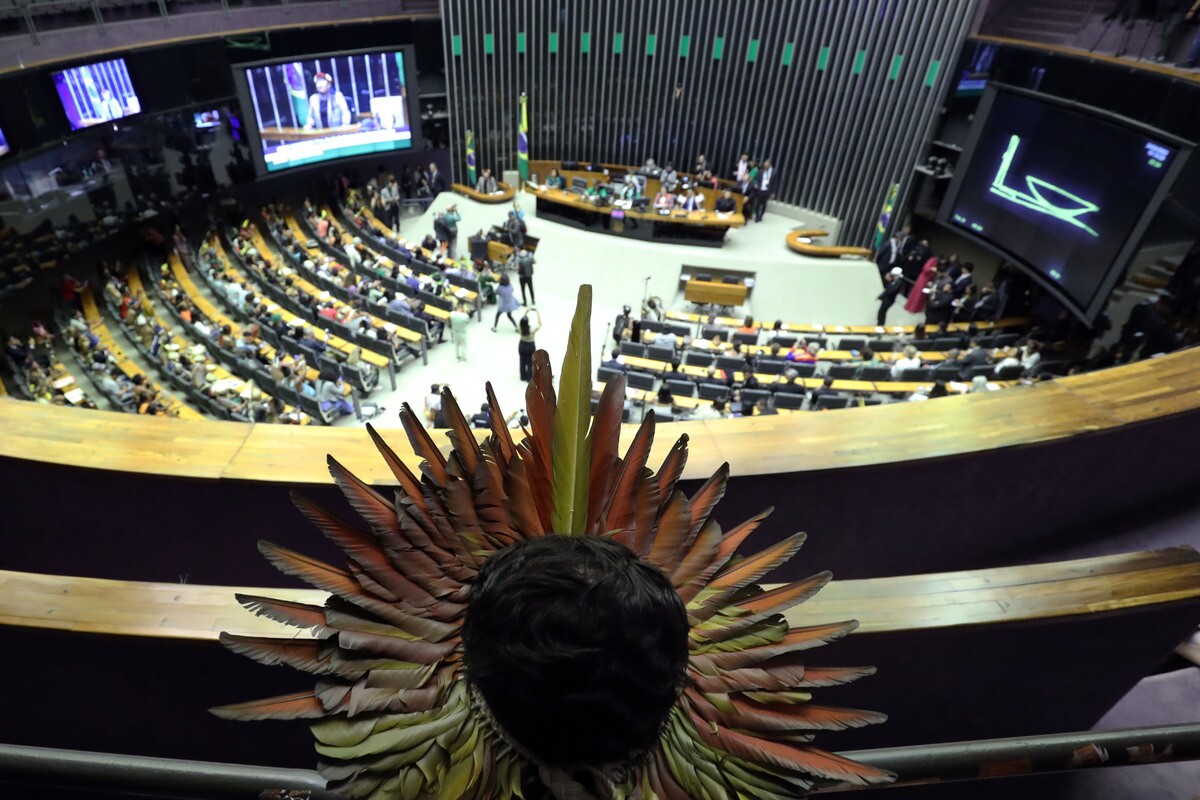
Nas duas últimas legislaturas no Congresso Brasileiro, 370 deputados e senadores foram responsáveis por propostas de lei que enfraquecem os direitos indígenas — e 270 deles disputam reeleição neste ano. Ao todo, esses políticos atuaram em 252 projetos, a maioria incidindo negativamente sobre o direito à terra para esses povos.
As informações são baseadas em um levantamento da Agência Pública a partir da nova plataforma lançada pelo Conselho Indigenista Missionário (Cimi), o Congresso Anti-Indígena.
Entre os projetos de lei que afetam os indígenas, estão propostas que buscavam anular decretos de demarcação de territórios e outros que alteram a Constituição Federal, para que as decisões sobre a demarcação sejam feitas pelo Congresso Nacional — justamente onde estão os políticos que atuam contra a demarcação de mais terras.
Para Cleber Buzatto, missionário do Cimi Regional Sul, essa atuação mostra que o principal interesse é impedir as demarcações e também explorar as terras.
“Isso demonstra uma articulação dos setores anti-indígenas, seja do ponto de vista político, mas, também, dos grupos econômicos que têm interesses sobre as terras, portanto, se organizam e atuam de forma bastante enfática e violenta contra os direitos indígenas no Congresso Nacional por meio de um conjunto amplo de partidos e parlamentares”, explica Buzzatto.
Entre 513 deputados e deputadas federais eleitos em 2022, apenas cinco se autodeclaram indígenas, menos de 1% do total. Como a Públicamostrou, neste ano, o movimento indígena lançou 47 pré-candidaturas para tentar mudar esse quadro. “É importante que os próprios povos [indígenas] consigam acessar espaços nessas casas legislativas, especialmente no âmbito da Câmara dos Deputados, que é onde tem mais candidatos indígenas disputando as vagas, até para que essa diretriz seja coerente com a defesa de fato dos direitos e dos interesses dos projetos de vida e futuro dos povos indígenas”, afirma.
Atualmente, segundo dados do Cimi, 291 propostas legislativas que impactam os direitos indígenas tramitam no Congresso Nacional. Entre elas, 204 têm efeitos negativos, segundo o levantamento.
PL, de Bolsonaro, é o principal partido a votar em propostas anti-indígenas, aponta levantamento
A partir da análise de mais de 41 mil votos, a plataforma identificou, dentre os partidos políticos, 19 que votaram sempre ou quase sempre em projetos que vão contra os povos indígenas. Apenas oito partidos votaram favoravelmente.
O Partido Liberal (PL), do candidato à presidência Flávio Bolsonaro, fica em primeiro lugar tanto entre os partidos cujos políticos mais propuseram propostas anti-indígenas, quanto entre os parlamentares que mais votam em projetos contrários aos direitos desses povos. São 95 proposições e 6.630 votos desfavoráveis segundo a classificação do Cimi. Em seguida, está o MDB, com 47 proposições, e o Partido Progressista (PP), com 42. Já entre os partidos cujos políticos tiveram mais votos em projetos contrários aos direitos indígenas, após o PL, está o PP, com 3.232 votos, e, em terceiro lugar, o União, com 3.063.
Por outro lado, o Partido dos Trabalhadores (PT), do presidente e candidato Lula, é o que mais teve propostas e votos em projetos classificados como favoráveis aos indígenas, com 4.971 a favor e 71 proposições. Em seguida, está o PSB, com 1.127 votos a favor, e o PDT, com 1.114 votos. O PCdoB, mesmo com apenas 11 deputados na Câmara, tem 100% dos votos direcionados a pautas consideradas favoráveis aos indígenas. Após o PT, entre os partidos que mais propuseram propostas favoráveis, estão o Psol, com 31 propostas.
Políticos que fizeram mais propostas com efeitos negativos aos direitos indígenas, segundo o levantamento
Deputado federal Marcos Pollon (PL-MS)
Candidato à reeleição para deputado federal pelo Mato Grosso do Sul, o deputado tem um total de 26 propostas classificadas como contrárias aos direitos indígenas, sendo 24 delas sobre o direito territorial dos povos tradicionais. O deputado é o terceiro-secretário da Frente Parlamentar Invasão Zero, grupo criado em 2023 que defende o direito à propriedade contra o Marco Temporal.
Entre as principais propostas do deputado está o PL 2145/2023, que altera o “Estatuto do Índio” para impedir o reconhecimento de determinadas áreas como de ocupação tradicional. Já o PDL 521/2025 impede a atuação da Força Nacional em apoio à Funai na Terra Indígena Rio dos Índios (RS) e o PL 4039/2024 obriga a União a indenizar não indígenas em áreas que ocorreu esbulho por indígenas e que não eram demarcadas.
A reportagem procurou a assessoria do deputado, que afirmou, em nota, não reconhecer o Cimi como “autoridade para julgar meu mandato” e que seu trabalho para os povos originários é para que eles “tenham reconhecido o direito de propriedade das terras que ocupam e possam produzir e prosperar nessas áreas, sem violência no campo.”. O deputado também cita que atuou como consultor jurídico em 2015 durante a Comissão Parlamentar de Inquérito (CPI) do Cimi, criada para investigar as ações do órgão no estado. A CPI foi anulada pelo Tribunal Regional Federal da 3ª Região (TRF3), que a Assembleia Legislativa de Mato Grosso do Sul não tinha competência para realizar a CPI.
Senador Luis Carlos Heinze (PP-RS)
Com 15 propostas classificadas como anti-indígenas, todas elas com relação ao direito territorial, o senador Luis Carlos Heinze, que teve passagem na Câmara dos Deputados e no Senado, ocupa o segundo lugar entre os políticos que mais propuseram leis contra os indígenas.
Entre as propostas de autoria do senador, estão três Propostas de Emenda à Constituição (PEC) que transferem do Poder Executivo para o Congresso Nacional a atribuição de demarcar terras indígenas, as PECs 61/2023, 319/2004 e 59/2023.
Questionado sobre sua posição diante a classificação que suas propostas são contrárias aos povos indígenas, Heinze em nota à Pública afirma que “suas propostas não são contrárias aos povos indígenas”. Segundo o senador, sua atuação “é pautada pelo respeito e defesa do direito de propriedade e da segurança jurídica no campo, garantindo a proteção aos produtores que possuem o título legítimo de suas terras” e também defendeu a inclusão dos povos originários “deve passar pela autonomia e pelo desenvolvimento econômico”.
Senador Zequinha Marinho (Pode-PA)
Concorrendo à reeleição no Senado, Zequinha Marinho é autor de 13 proposições legislativas que interferem no direito territorial dos povos indígenas.
Além de criar a PEC 10/2024, que modifica o artigo 231 da Constituição Federal para “permitir aos índios [sic] produzir e comercializar livremente sua produção”, que abre brechas jurídicas para a entrada do agronegócio em territórios reservados, o senador é também assina a PEC 59/2023, que retira o poder do Ministério da Justiça e da Presidência da República para decidir sobre demarcações, colocando o tema sob crivo dos parlamentares.
A reportagem procurou a assessoria do senador, que não respondeu.
Deputada Coronel Fernanda (PL-MT)
Com 13 proposições classificadas como contrárias aos indígenas, e concorrendo para a reeleição na câmara dos deputados, a deputada Coronel Fernanda apresentou propostas que também podem gerar danos ao meio ambiente.
O PDL 466/2023, de sua autoria, suspende o decreto nº 11.367/2023, que recriou o Plano de Ação para Prevenção e Controle do Desmatamento na Amazônia Legal (PPCDAm), enfraquecendo ferramentas de proteção ambiental e de enfrentamento à grilagem.
Também é de sua autoria o PDL 380/2024, que suspende resolução do Conselho Nacional de Política Indigenista que recomenda ao Governo Federal a inclusão do tema da demarcação das terras indígenas como eixo do Plano Clima.
Procurada, a assessoria da deputada não respondeu.
PRESS REVIEW – Wednesday, September 30: The Cornell University gang rape investigation reopens. But first: students and prisoners protest in Iran "in a rare show of dissent". Journalist Evan Gershkovich speaks about his 16 months in a Russian prison. Bonus: what can we do to be less lonely? Finally, Fat Bear Week has chosen its winner.
Recent warnings from American AI leaders have created the impression that the world is only beginning to confront the dangers of advanced artificial intelligence. Dario Amodei, chief executive of tech company Anthropic, has called for governments to intervene to slow the development of increasingly powerful AI models. His proposal begins with independent evaluators embedded inside […]
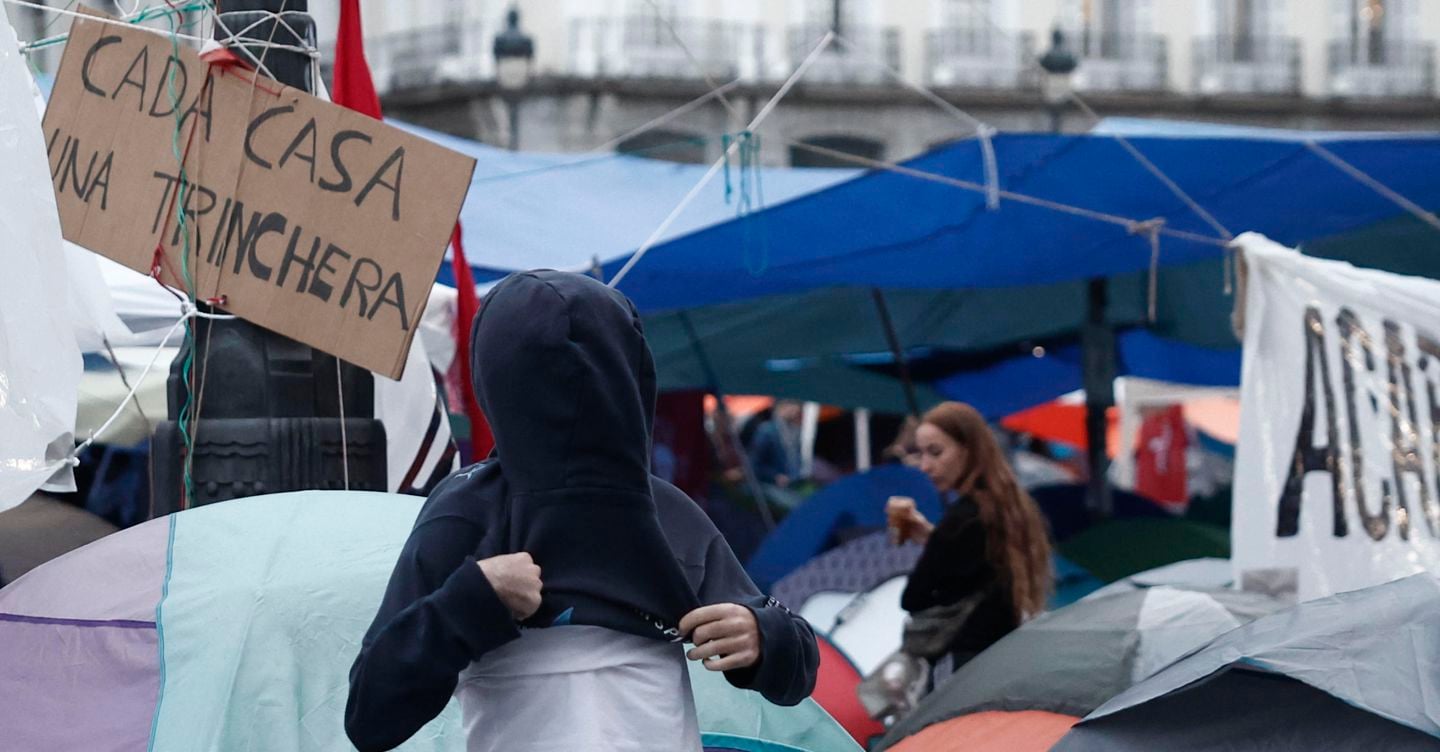
Dopo lo sfratto di una pensionata, centinaia di persone accampate a Puerta del Sol. Il governo approva due decreti per tutelare gli inquilini, mentre il deficit abitativo rischia di superare il milione di unità entro il 2028
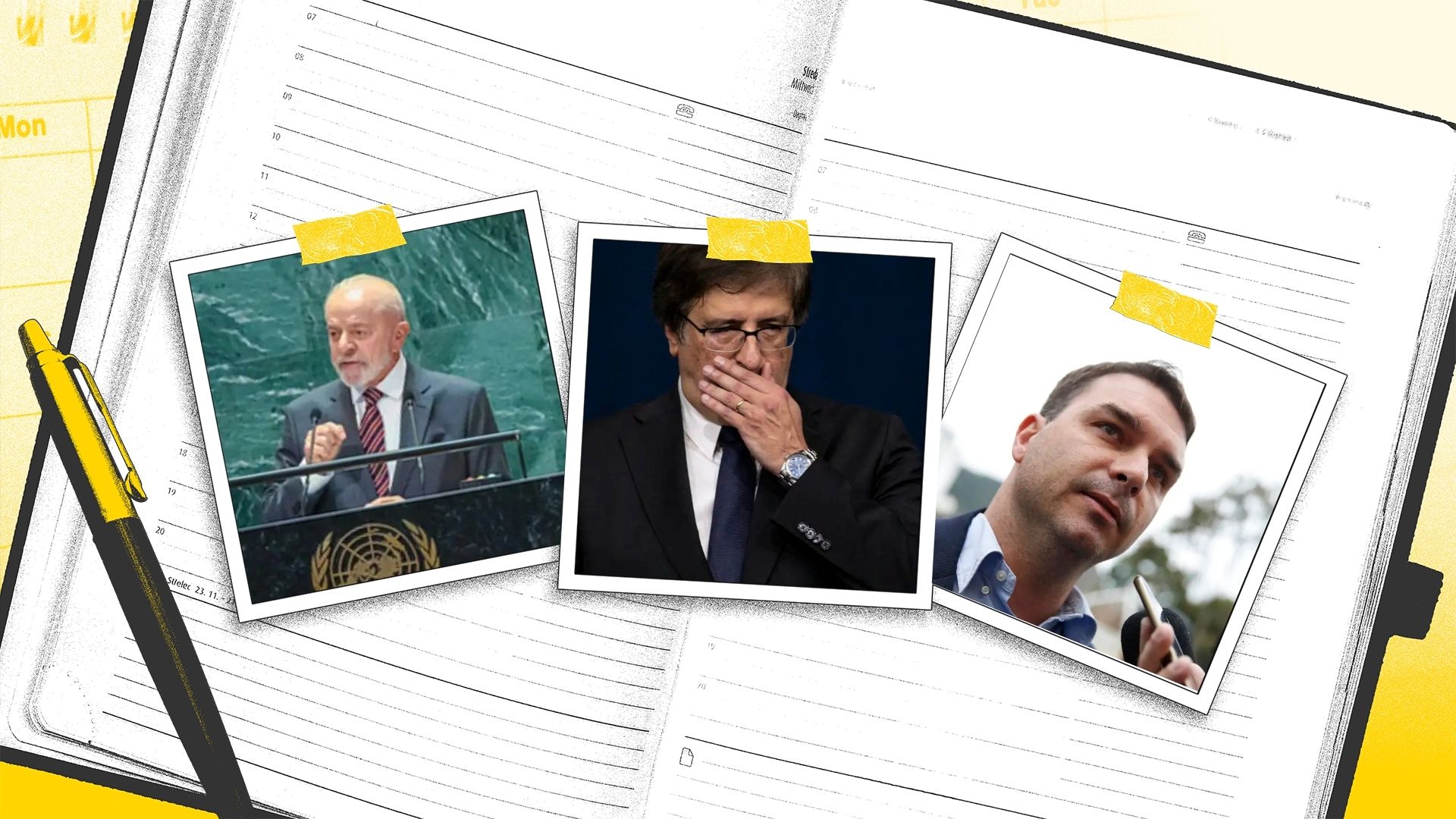
Na próxima terça-feira, 22 de setembro, o presidente Lula, candidato à reeleição pelo Partido dos Trabalhadores (PT), participa da 81ª Assembleia Geral da Organização das Nações Unidas (ONU), em Nova York, Estados Unidos. Conforme protocolo, Lula abre a Assembleia, seguido pelo presidente norte-americano Donald Trump. A aposta é que Lula discorra sobre soberania em seu discurso e um encontro extra-oficial com Trump, em meio às negociações dos dois países sobre tarifas, também é possível.
O tema deste ano da assembleia é “Restaurar a confiança, gerenciar a transformação: uma Organização das Nações Unidas que atenda a todas as pessoas”. Líderes dos 193 Estados-membros da ONU estarão presentes no fórum. Também nos Estados Unidos, nesta segunda-feira, 21 de setembro, Lula deve comparecer a um encontro bilateral com o prefeito democrata de Nova York, Zohran Mamdani.
Faltando 13 dias para o primeiro turno das eleições, candidatos ao Palácio do Planalto reforçam as campanhas pelo país. Flávio Bolsonaro (PL) tem agenda nesta segunda-feira no Rio Grande do Norte, onde participa do comício no centro de Parnamirim. Em Santos, SP, no mesmo dia, Ronaldo Caiado (PSD) vai ao projeto Sabatina ACS – Eleições 2026, promovido pela Associação Comercial de Santos (ACS), às 11 horas.
Já Renan Santos (Missão) participa de sabatina apresentada pela emissora Record nesta terça-feira, 22. Augusto Cury (Avante) estará em Porto Velho, Rondônia, nesta quinta-feira, 24, para uma carreata e adesivaço na capital.
Caso Master
As repercussões do relatório da Polícia Federal (PF) divulgado pelo ministro do Supremo Tribunal Federal (STF) André Mendonça com as mensagens de Daniel Vorcaro chegam ao Ministério Público Federal na próxima sexta-feira, 25 de setembro. O Conselho Superior do Ministério Público Federal (CSMPF) analisará a conduta do Procurador-Geral da República, Paulo Gonet considerando o caso Master e as mensagens de Vorcaro que citam o PGR. A relatoria da apuração ficou a cargo do subprocurador-geral Francisco de Assis Sanseverino.
Em manifestação de 35 páginas enviada ao CSMPF, o PGR afirmou “em termos bastante diretos e simples” não ter “relação de amizade alguma” com Daniel Vorcaro, ou “interesse pessoal nos processos em que ele conste como parte ou investigado”.
Gonet ainda afirmou não ter negligenciado as investigações sobre as fraudes do Banco Master, além de falar que as acusações feitas pelo Partido Novo alegando que não deveria atuar nas investigações do Banco Master são “descabidas e estapafúrdias”.
Segundo o documento, Paulo Gonet afirma que seus dois únicos contatos com o ex-banqueiro foram durante um evento em Londres em abril de 2024. O outro momento foi em março de 2025, quando, a pedido do advogado Ciro Soares, participou de uma ligação com Vorcaro, considerada, por ele, “uma conversa breve e sem assuntos relevantes”.
Após o ministro Edson Fachin cancelar a análise da conduta do ministro André Mendonça como relator do Caso Master e das fraudes do INSS, que ocorreria na próxima quarta-feira, 23 de setembro, o STF deve ter uma semana menos agitada. No lugar da Petição 16.704, serão realizados, na quarta, julgamentos sobre licença-maternidade a mães adotivas, custos judiciais e sistema previdenciário de servidor público federal.
Estão na agenda da semana de 21 a 26 de setembro:
TSE
Informações à eleitores (24/9): Tribunais Regionais Eleitorais realizam ações para esclarecer a população do que é preciso para votar;
Teste de Integridade (24/9): Data limite para definir locais onde serão realizados os testes de integridade das urnas eletrônicas com biometria, para o primeiro turno.
STF
Licença-maternidade para mães adotivas (ADI 7495, 23/9, 14h): Ação discute se a licença-maternidade entre mães adotivas e mães biológicas deve ser unificada, independentemente do regime do trabalho.
Custas judiciais no Espírito Santo (ADI 7935, 23/9, 14h): Conselho Federal da Ordem dos Advogados do Brasil (OAB) entra com ação direta de inconstitucionalidade sobre os novos valores fixados das custas judiciais no Espírito Santo, alegando que custos impedem garantia de direitos fundamentais.
Fim da isenção do ICMS (ADI 7822, 7830, 7844 e 7848, 23/9, 14h): Ações Diretas de Inconstitucionalidade sobre o Decreto 65.255/2020 do Estado de São Paulo, que acaba com a isenção do ICMS para envio de mercadorias industrializadas às chamadas Áreas de Livre Comércio na Região Norte.
Escolha do regime previdenciário (RE 1050597, 23/9, 14h): Recurso extraordinário discute se o servidor público federal, que entrou pelo cargo municipal ou estadual, pode optar pelo sistema previdenciário anterior assim que a mudança para o federal.
Correção Monetária (RE 1141156, 23/9, 14h): Recurso avalia se atualização do dinheiro depositado na Justiça deve incluir as perdas causadas pela inflação no passado.
Agenda da semana daPúblicaé um serviço apresentado aos leitores, concebido com base nas informações dos portais da Câmara, Senado e STF.
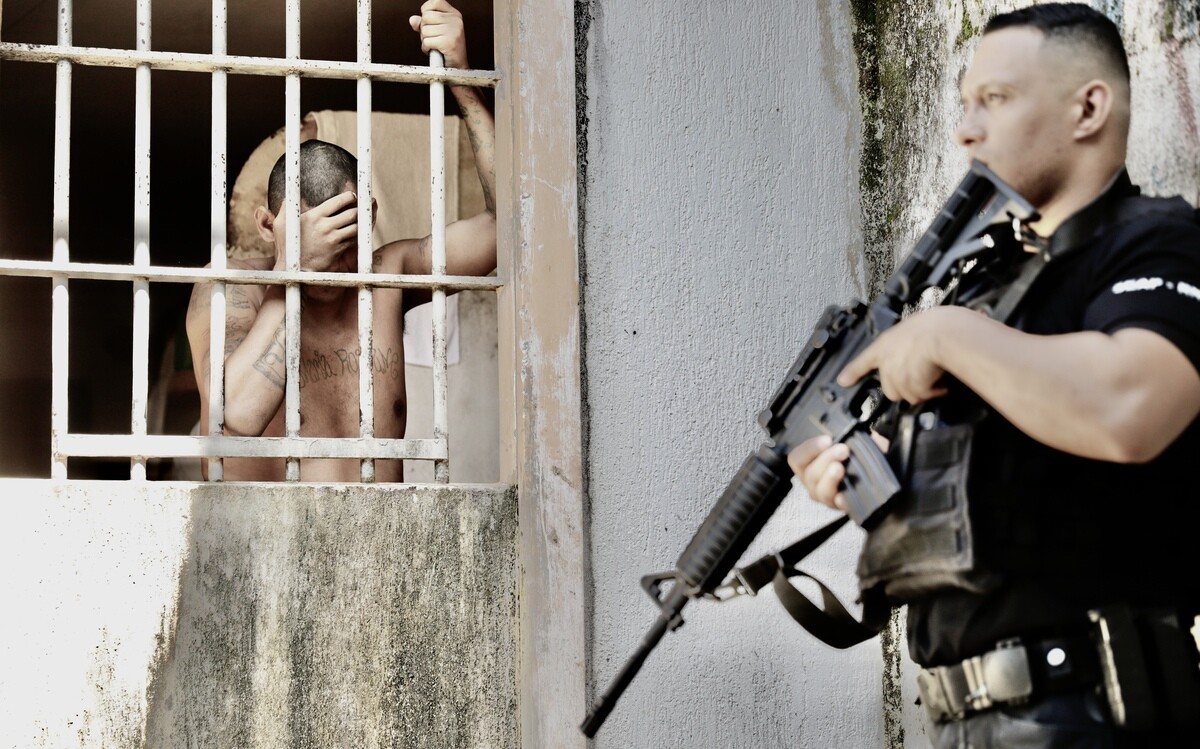
A cada R$ 10 gastos com prisões no ano passado, em 26 unidades federativas do país, R$ 6 foram dirigidos ao encarceramento de pessoas negras. Essa é uma das conclusões do estudo realizado pelo Centro de Pesquisa Justa sobre investimentos em segurança pública nos estados brasileiros. Segundo o levantamento, divulgado nesta quinta-feira, 17 de setembro, o investimento no sistema prisional dos estados chegou a R$ 22,3 bilhões, valor que não abrange apenas o Acre, que não forneceu os dados ao Justa. Desse total, R$ 13,7 bilhões foram gastos tendo como alvo pessoas pretas ou pardas.
“Cria-se uma falácia de que pessoas negras cometem mais crimes, por isso que estão presas. Mas isso é uma falácia. Na verdade, essas pessoas estão sendo selecionadas pela polícia e, depois, na frente do juiz, que poderia parar esse processo de seletividade penal, [e também frente ao] Ministério Público. [Essa] engrenagem vem sendo construída dessa forma, essas pessoas estão sendo o alvo dessa política de segurança”, explica a advogada do Justa, Sofia Fromer, doutora em saúde coletiva da Faculdade de Ciências Médicas da Santa Casa (FCMSC) de São Paulo. Para ela, o encarceramento da população negra confirma, mais uma vez, a existência de lógica punitivista e uma seletividade penal.
Egressos: um orçamento 5.423 vezes menor
Para a advogada, a medida mais eficiente para transformar a lógica do sistema carcerário seria investir em políticas públicas de reinserção para egressos do sistema prisional. Essa medida, entretanto, está longe de ser priorizada pelos estados brasileiros. Segundo o Justa, para cada R$ 5.423 gastos em 2025 com as polícias estaduais (militar, civil e técnico-científica), apenas R$ 1 é dirigido às políticas para egressos.
Na comparação com o ano anterior, o investimento permaneceu praticamente o mesmo, passando de R$ 18 milhões, para políticas exclusivas aos egressos em 2024, para R$ 19 milhões no ano passado. O valor corresponde, em média, a 0,001% de seus gastos totais levantados pelo estudo.
Entre as 26 unidades federativas avaliadas, 19 delas (72%) não investiram em políticas exclusivas para egressos. Tocantins teve dotação aprovada na Lei Orçamentária Anual, mas não utilizou os recursos. Rio Grande do Sul e Santa Catarina registraram investimentos pela primeira vez em 2025, com R$ 414 mil e R$ 177 mil, respectivamente. Alagoas e Tocantins deixaram de investir. São Paulo foi o estado que utilizou o maior recurso, R$ 13,3 milhões, seguido pelo Ceará, com R$ 3,8 milhões. Mato Grosso investiu R$ 781 mil, enquanto a Bahia despendeu R$ 482 mil.
Para Fromer, políticas para egressos são multissetoriais, envolvem saúde, educação, assistência social, além do campo do direito, “para que essas pessoas possam criar novas rotas e que não seja uma possibilidade que elas precisem voltar para as prisões”, salienta.
A advogada lembra que não existe pena perpétua no Brasil, portanto, o Estado precisa pensar como as pessoas egressas “vão conseguir um trabalho, renda, ter uma casa, ter os seus documentos. Ter o contato, por exemplo, [no caso] de mulheres presas, com os filhos que deixaram sob o cuidado de uma outra pessoa”, explica.
Policiamento ostensivo recebe a maior parcela do dinheiro
Polícias militares recebem a maior parte do orçamento em segurança pública dos estados analisados, 58,6% do total
O estudo também demonstra que se os recursos com a política para manter as pessoas fora das prisões são baixos, os gastos com a repressão são os mais altos. O total de investimentos envolvendo os 26 territórios foi de R$ 103,5 bilhões no ano passado, e a maior parte desses recursos foi para as Polícias Militares, R$ 60,7 bilhões, 58,6% do total, responsáveis pelo policiamento ostensivo da população. Já as Polícias Civis, que devem investigar os crimes, receberam R$ 22,2 bilhões (21,5%), e as Polícias Técnico-Científicas ficaram com a menor parcela, R$ 2,8 bilhões (2,7%), mesmo sendo responsáveis por atividades como perícia e produção de provas.
“Quando o investimento em policiamento ostensivo cresce sem que a investigação e produção de provas avancem na mesma proporção, o sistema amplia sua capacidade de prender sem necessariamente fortalecer sua eficiência para esclarecer os crimes. É uma lógica que ajuda a sustentar um modelo de encarceramento em massa, marcado por fragilidades na apuração da autoria e na produção de evidências”, avalia Luciana Zaffalon, diretora-executiva do Justa.
Para Sofia Fromer, as prioridades político-orçamentárias dos estados em segurança pública não se dão ao acaso. “Realmente existe uma preferência dos estados em ter um orçamento para as polícias, em detrimento do sistema prisional e das políticas para egressos.” Segundo a advogada, o investimento maior nas polícias, em específico, nas polícias militares, cujo caráter é mais ostensivo nas prisões, aumenta o encarceramento, mas não muda a realidade.
Por que isso importa?
Em 2025, os gastos com polícias no Brasil ultrapassaram a marca dos R$ 100 bilhões, destaca o Centro de Pesquisa Justa.
Nos últimos três anos, os gastos com as polícias nos estados cresceu, em média, 9,7%, já o investimento no sistema prisional apenas 1,7% e 5,3% nas políticas exclusivas para egressos.
Ela explica que a pesquisa do Justa mostra que há um funil, onde a porta de entrada são os gastos com as polícias passando pelo investimento no sistema carcerário, até chegar aos gastos com as políticas para egressos. “[Temos] a ‘boca’ muito alargada do funil, ou seja, o orçamento ali é muito grande, e quando você vai afunilando, depois [estão] os gastos com o sistema prisional ainda menores, e com as políticas pregressas, quase inexistentes”.
Por outro lado, Fromer pensa em uma outra alternativa para mudar a dinâmica brasileira. Invertendo o funil, ou seja, investindo mais em políticas para egressos. Segundo ela, essa decisão criaria oportunidades para essas pessoas, diminuindo as chances de elas retornarem aos presídios.
“Quando o Estado destina bilhões à entrada e à permanência no sistema prisional, mas reserva valores residuais para a saída, limita as possibilidades de reinserção social e mantém condições que podem favorecer a reincidência”, complementa Luciana Zaffalon.
Modelo de El Salvador
Entre os atuais candidatos à presidência da República que concorrem este ano, pelo menos três deles, Renan Santos (Missão), Flávio Bolsonaro (PL) e Romeu Zema (Novo) já citaram concordar com o modelo de segurança pública propagandeado pelo presidente de El Salvador, Nayib Bukele, baseado, principalmente, na construção de mega-presídios. Questionada se essa inspiração poderia ser eficiente no Brasil, Sofia Fromer vê restrições.
“Existe, sim, uma falta de vagas nas unidades prisionais. Se você olhar uma foto de uma prisão, você vai ver que numa cela onde caberiam 12 pessoas, tem 24, às vezes até mais. [Vai ver] pessoas em uma condição de total insalubridade. […] Criar novas vagas não resolve o problema. Se resolvesse, não teríamos mais [o problema] porque as respostas para a segurança pública, para o sistema prisional, elas têm sido pautadas, muitas vezes, na construção de novas vagas”, explica a advogada.
“E aí a gente vê de novo isso aparecendo com os candidatos, muitos inspirados no Bukele, [citando] a construção de megas prisões. Isso não funciona aqui no Brasil, e, de outro ponto de vista, a gente não tem nem orçamento para fazer essas mega prisões”, acrescenta.
O Plano Pena Justa e sua eficácia
Em 2025, baseado na Arguição de Descumprimento de Preceito Fundamental 347 (ADPF 347), determinada pelo Supremo Tribunal Federal (STF), em outubro de 2023, o Conselho Nacional de Justiça (CNJ) junto com o Ministério da Justiça e da Segurança Pública (MJSP), elaborou o Plano Pena Justa, que consiste em enfrentar o estado de calamidade dos sistemas penitenciários brasileiros. O objetivo é melhorar a qualidade das prisões e dos serviços, além de controlar as superlotações nas penitenciárias, além de fortalecer a ressocialização dos indivíduos. O Plano Pena Justa propõe mais de 300 metas para serem cumpridas até 2027, e muitas são focadas em políticas para egressos.
O estudo do Justa mostra, entretanto, que a iniciativa, mesmo já tendo sido iniciada, ainda não apresentou resultados relevantes. Fromer entende que o Brasil começará a bater tais metas caso se debruce sobre a questão orçamentária. “Sem o orçamento, não é possível que todas essas metas do Plano se efetivem, os estados precisam ter o orçamento determinado para que, de fato, elas possam ser cumpridas”, pondera.
The Democrats could win big in the US midterm elections. This won’t matter much for constraining Trump, but it will start to establish what politics comes after him.
Our research finds three camps of Democrats, all with different diagnoses of America’s problems: the revolutionaries see the system as unjust and needing structural change; the renovators see it as corrupt and needing reform; and the revivalists blame right-wing populism for breaking a system of bipartisan cooperation.
What these camps see as broken in American domestic politics translates to how they view US foreign policy and Europe’s place in it.
No matter which camp goes on to determine the future of Democratic foreign policy, it will be a far cry from the transatlanticism of previous Democratic administrations. This year’s midterm candidates have barely mentioned Europe, Russia or Ukraine in their campaigns.
Europeans need to engage early and help shape their relationship with the party now, lest they be overlooked if and when Democrats do come to power.
What comes after Trump
This summer, the FIFA World Cup turned the world’s attention to America while America turned on much of the world. As Iran was due to play Egypt in Seattle, the US launched new strikes in its four-month war with the country. On semi-final day, President Donald Trump posted on Truth Social an AI-doctored image of a map showing Canada, Greenland, Mexico and Venezuela covered with an American flag. And just days after Trump handed the World Cup trophy to the Spanish national team, his administration announced sweeping 10% baseline tariffs on 80 countries. The juxtaposition of tournament host and wartime belligerent reflects the position America now occupies in European strategic thinking: too central to ignore and too disruptive to rely on.
Europeans hoping that a midterm victory for Democrats in November will bring a reversal of this foreign policy should not hold their breath. If the party wins a majority of seats in one or both chambers of Congress—which is looking likely—they may be able to attach provisions to bills, launch investigations, issue subpoenas and lambast some of Trump’s poor foreign policy choices. But the second Trump administration has shown it will route around Congress and confront it with delays, hostility and vitriol, limiting any capacity for oversight. Having spent its first 18 months in power ignoring a friendly Republican Congress, one with a Democratic majority has even slimmer chances. In other words, little will change until the occupant of the White House does.
For now, the Democrats’ real power resides not in stopping the current administration but in shaping what comes next. Democratic candidates competing across the US—for both primaries and generals—have a wide ideological range, from “democratic socialists” to “centrists”. While they all heavily criticise Trump and his administration, they have different diagnoses for where the dysfunction began, what sustains it and what needs to be done about it. Engaged in party primaries across the country, Democratic candidates are putting forward competing answers to the two central questions Americans are asking themselves: “What went wrong?” and “How do we fix it?” Based on these answers, we have identified that Democrats tend to cluster into three camps—the “revolutionaries”, the “renovators” and the “revivalists”—each with distinct proposals for the future of America.
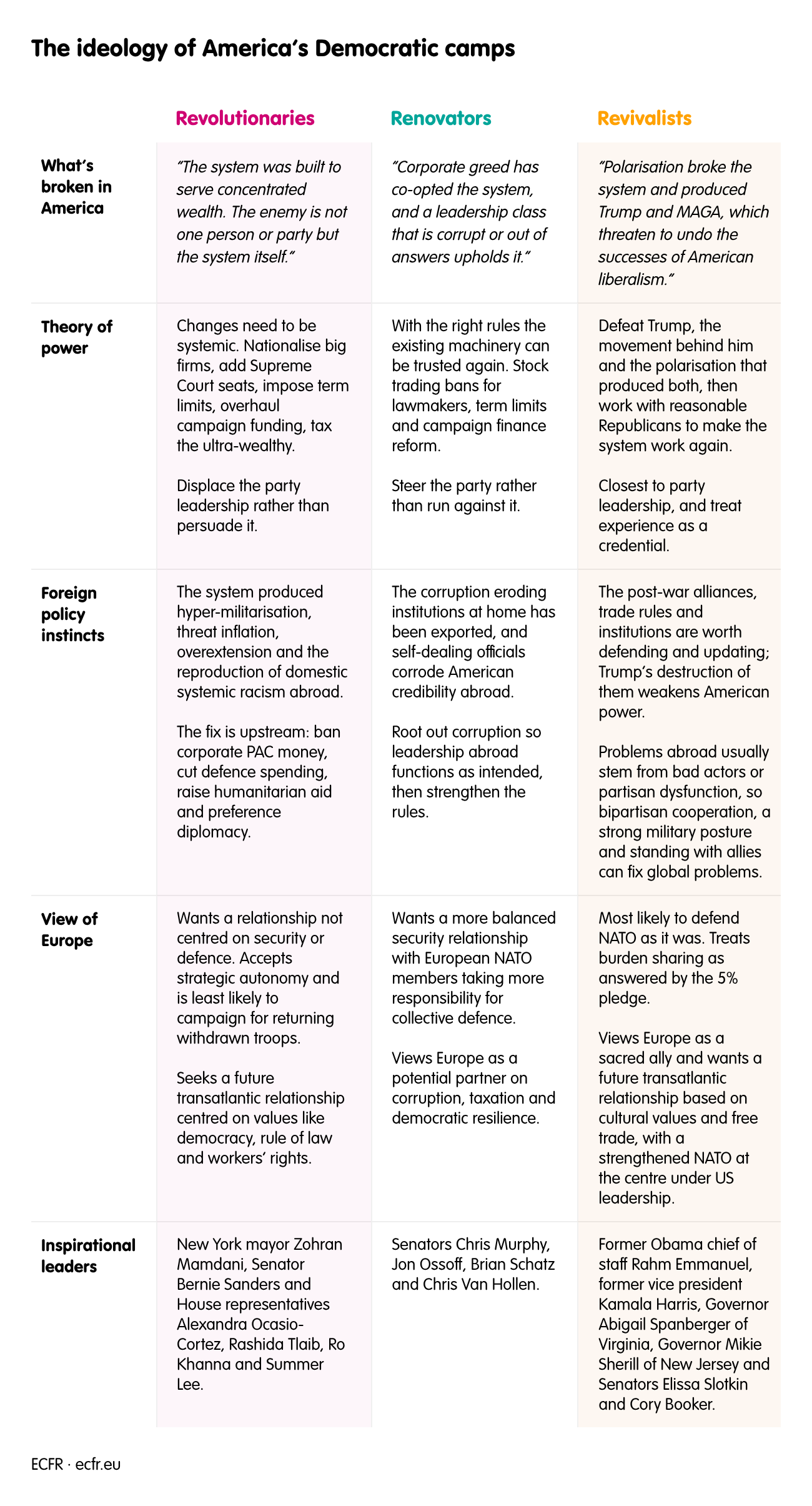
The revolutionaries argue that the political and economic system that drives America has always been unjust and was built to concentrate wealth at the top. Therefore, the way to fix America is to enact large, structural change. The renovators argue that the democratic system of government was largely built to benefit all Americans but has been corrupted by money and captured interests. Their proposed remedy is to root out large-scale corruption, rebalancing the economic and political systems to the benefit of middle- and working-class Americans. The revivalists argue that increased partisanship, fuelled by Trump and the MAGA-aligned right, has divided the country and undermined the collaborative bipartisanship that is necessary for the functioning of the system and its institutions. They are focused on reinvigorating those institutions, reviving the post-war international order and rebuilding political bridges, all of which they see as the path back to peace and prosperity.
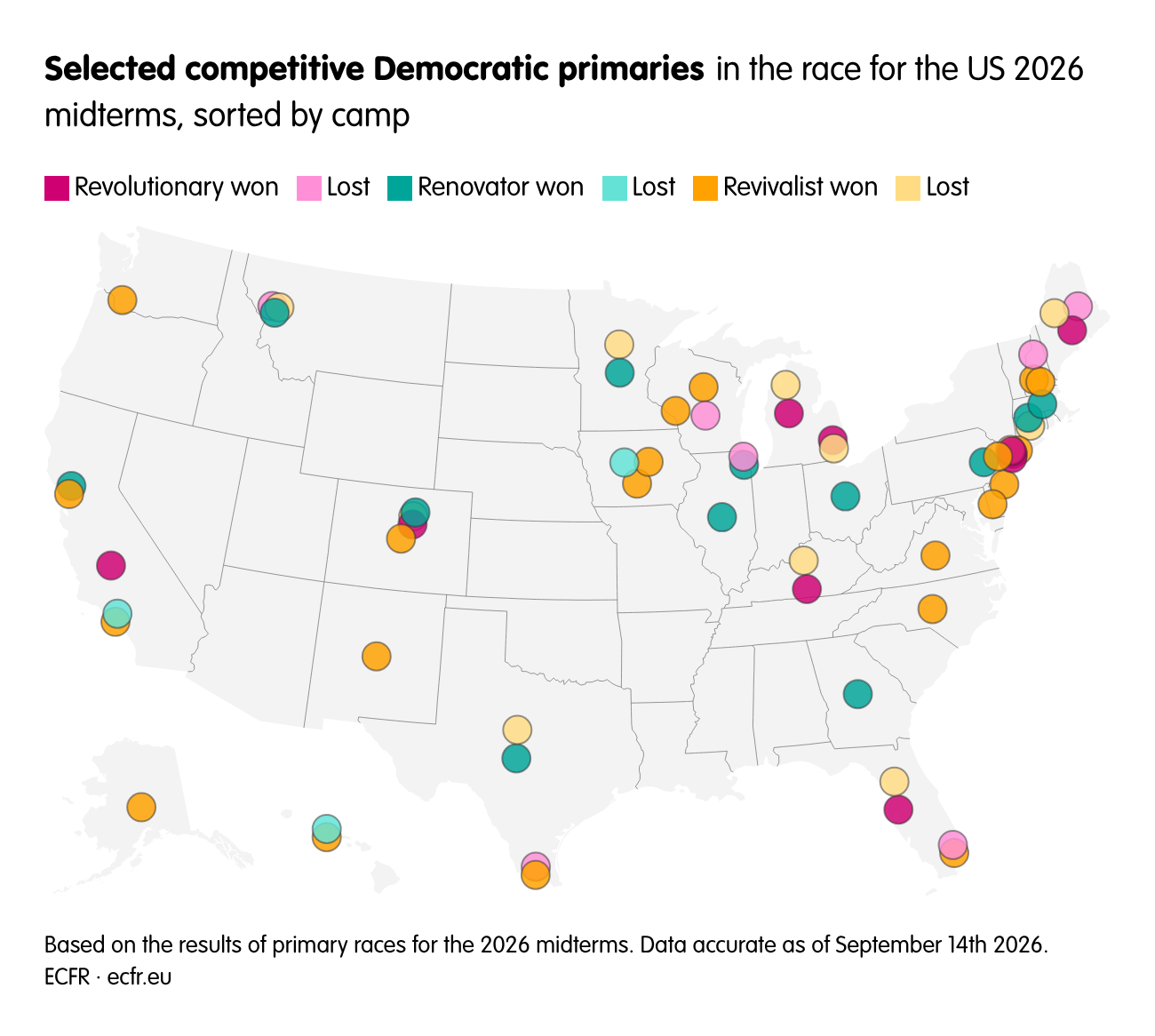
The revolutionaries, renovators and revivalists are ideal types, not formal factions. They emerge from our analysis of over 50 high-profile Democratic primaries and general election campaigns throughout the 2026 midterm cycle. We also researched campaign platforms, stump speeches, debates and candidate interviews with local news, and interviewed various pundits, current and former staff, officials and pollsters in Washington. In doing so, we found that sorting candidates by their messages about the underlying cause of what has gone wrong in America proved to reliably predict how a candidate discusses domestic and global problems. For example, revolutionaries support Europe’s strategic autonomy but would dislike a Europe defined by militarisation and austerity; renovators see Europe as a potential partner on anti-corruption, taxation and democracy, as long as Europeans provide for their own security; and revivalists remain attached to the NATO alliance but are still unlikely to restore the old division of labour.
The ideological battles between Democrats will matter more than the arithmetic of the Senate or the House for the next two years. One of these three camps will lead the party’s ideological charge for the next presidential race, if not the next presidency. Leaders across Europe should not wait to see which will prevail. Rather, they should engage with these camps well before the presidential race gets under way. They may then be able to shape the thinking and policy proposals that Democrats put on the table between now and 2028, and beyond.
The Democratic camps
Democrats—from New York democratic socialists to staunch Iowa moderates—have more in common than not. Practically everyone in the party believes Trump is a problem and that he and the MAGA movement have fundamentally changed American democracy for the worse. Many view widespread corruption as an issue and some say corruption is encouraged by the system itself.
But while the policy views of the three Democratic camps overlap, there are a few key points of difference. To illustrate these characteristics more clearly, this paper focuses on key individuals who have gained national attention, are running in close races, or are largely representative of what other ideologically aligned candidates say. It is rare for a candidate to be a perfect “revolutionary” or “revivalist” because they must answer to constituencies with divergent interests and disparate views of American and global affairs. Some candidates will even recognise themselves across different camps. Nevertheless, these three camps represent sensitivities that are bound to clash in the primaries until one of them breaks through and is championed by the 2028 Democratic nominee for president. Understanding them helps anticipate the direction of US policy in the brouhaha of its politics.
The revolutionaries
The revolutionaries maintain that the political and economic order in the US is functioning as designed: to serve concentrated wealth rather than the American people. The enemy, in revolutionaries’ rhetoric, is not necessarily any one person or party (such as Trump or the Republicans) but the economic and political system that consistently benefits the ruling class. Only a structural transformation of the system would finally make it work for the people.
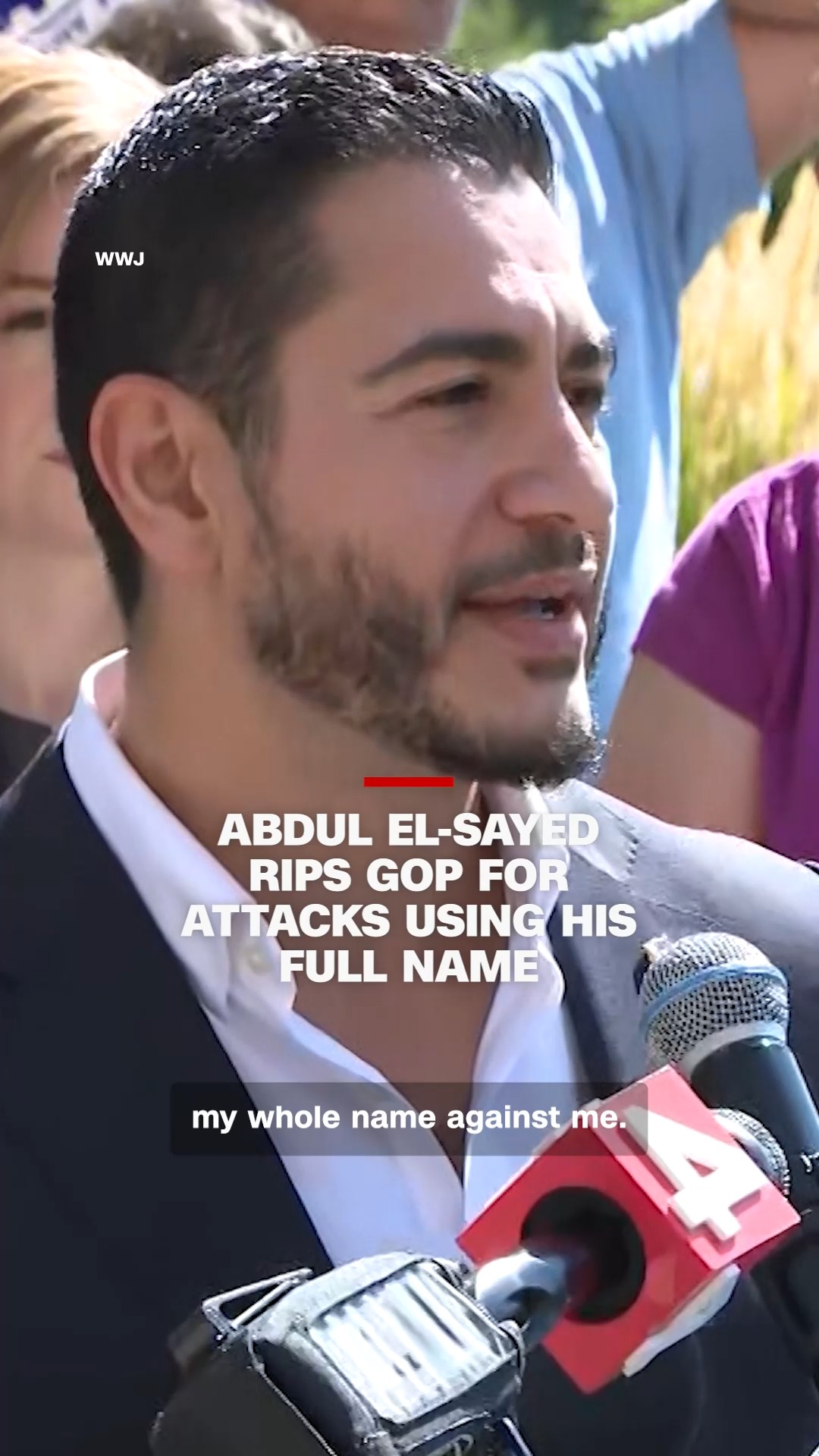
Michigan Democratic Senate candidate Abdul El-Sayed in his primary victory speech put the thesis as such: “It turns out that the reason so many of us ain’t got is because of the system that has corrupted our politics to take it away from us. That is the thing we are taking on now”. El-Sayed, who is a former public health official in Detroit, focuses his entire campaign on big structural goals: getting corporate money out of politics, and, like Kentucky Senate candidate Charles Booker, passing Medicare for All, a proposal for universal healthcare. Often revolutionaries’ critiques take a moral tone, such as when Senate candidate Angie Nixon of Florida talks about cruelty out of Washington, or denounces the “liars” and “cheaters” in office.
Their theory of power follows: winning office is useful, but only insofar as it can be used to structurally change power dynamics between a ruling corporate class and average working Americans. Congresswoman Alexandria Ocasio-Cortez, when asked about a potential run for president in 2028, responded: “My ambition is way bigger than that. My ambition is to change this country. Presidents come and go. Senate, house seats, elected officials come and go. But single-payer healthcare is forever. A living wage is forever. Workers’ rights are forever.”
On foreign policy, the revolutionaries argue that the current political system led America on an inevitable path of hyper-militarisation, threat inflation, an over-extension of its financial and human resources in military adventurism, and the reproduction of domestic systemic racism into foreign policy. They view the American relationship with Israel as the seminal example of everything wrong with this approach; Palestine being “one the great moral questions of our time” as New York congressional candidate Claire Valdez puts it.
Their diagnosis abroad is largely parallel to the one at home, viewing the pitfalls of US foreign policy as a metastasis caused by the American corporate class. As Valdez asserts:
“For decades, we have been sold a lie: that the US empire defends freedom, advances democracy, and protects human rights…In reality, the bipartisan war machine has delivered immense suffering around the world while doing little to improve the lives of working people here or abroad. The military-industrial complex doesn’t just enrich arms manufacturers—it has become our de facto industrial policy, sustaining enough jobs and political constituencies to make endless war challenging to stop.”
Their fixes to US foreign policy largely follow their domestic proposals: if you fix the system and its incentives for prioritising the financial gains of the wealthiest class, all else will follow.[1] This is rooted in banning corporate political action committee spending on campaigns which they believe will ultimately diminish the influence of defence contractors and foreign interest groups—namely the American-Israeli Political Action Committee (AIPAC)—over candidates’ races, and therefore, diminish their influence on policy. In the short term, the revolutionaries aim to cut defence spending, bolster humanitarian aid and preference diplomacy in the American foreign policy toolkit. They also believe that the Biden administration’s foreign policy officials must be held accountable for continuing to supply Israel as its war on Gaza intensified.
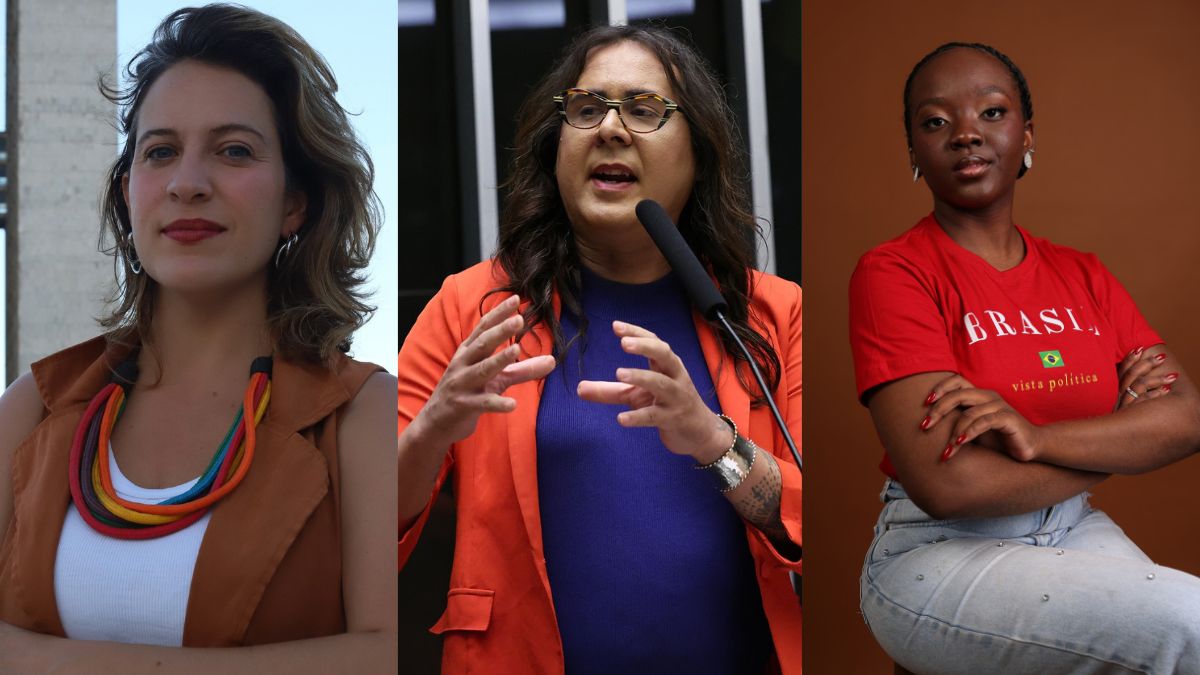
In these midterms, some of the revolutionary firebrands include Michigan Senate candidate Abdul El-Sayed, Kentucky Senate candidate Charles Booker, Florida senate candidate Angie Nixon, Representative Chris Rabb of Pennsylvania, House candidates Melat Kiros in Colorado, and New York congressional candidates Claire Valdez and Darializa Avila Chevalier. Disgraced Maine Senate candidate Graham Platner also used that same rhetoric.
The renovators
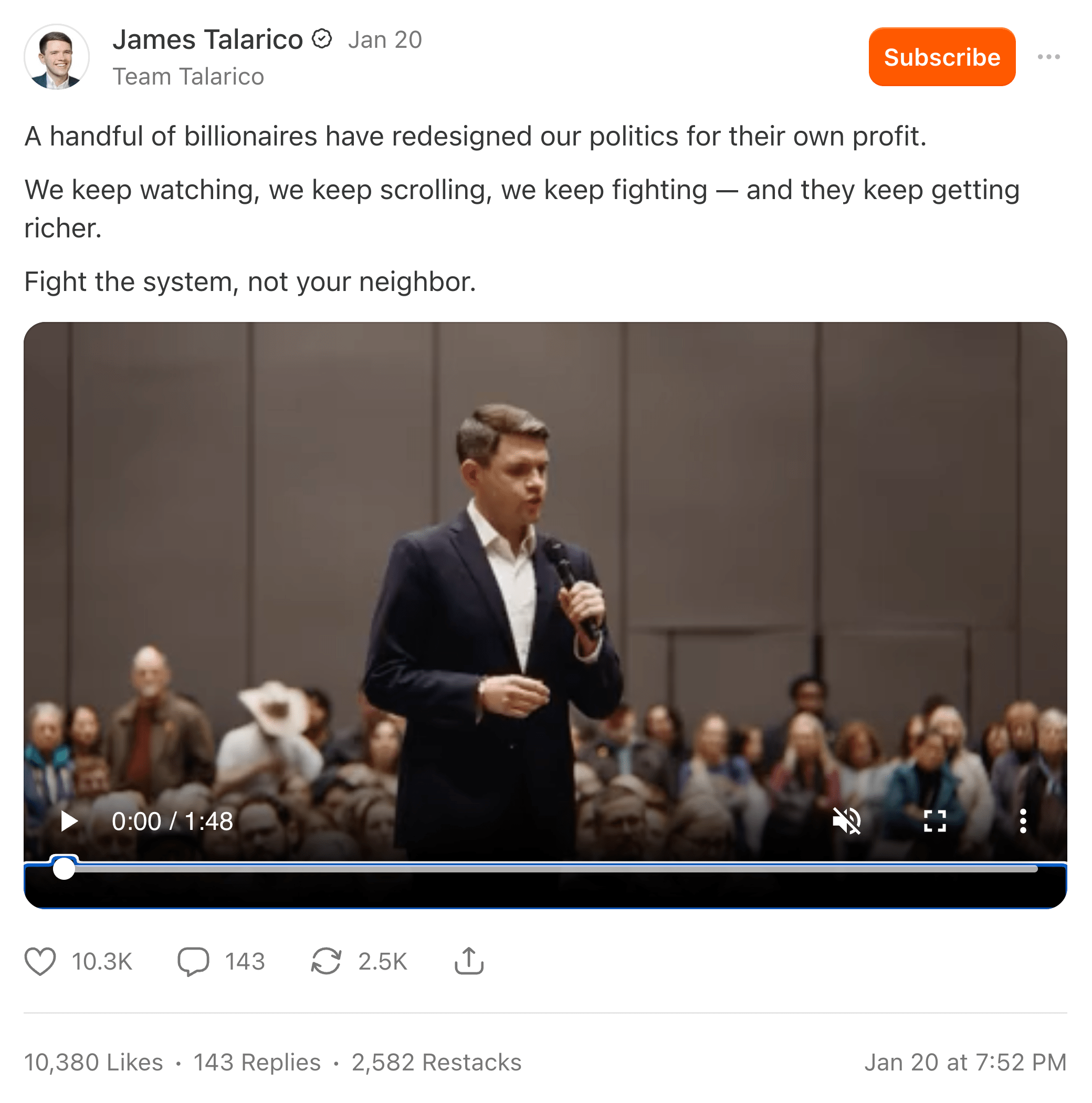
The renovators believe the system is imperfect, but largely worth keeping. In their view it has been co-opted and corrupted by money and corporate greed and upheld by a leadership class that is either corrupt themselves or out of answers. As James Talarico, Democratic Senate candidate in Texas, explains: “I think we’re living in an era of corruption, and I don’t just mean illegal activity… I’m talking about corruption in the deeper sense, the rotting of our systems from the inside out…” In his telling, strengthened by his moral standing as a middle school teacher and Presbyterian seminarian, the issue with the American political system is not the institutions themselves, but the way in which they are weaponised and perverted.
While the revolutionaries name the ruling class as the enemy, the renovators see the villain as a narrower collection of groups who have captured institutions that were otherwise built to work for the American people. This distinction yields a different theory of power: with the right rules in place, the existing machinery can be trusted to function again. Therefore, instead of demolition, this group aims to renovate.
Senator Jon Ossoff spoke to this message at a campaign rally in June when he mused about what the founding fathers of America would see if they came to the US today:
“They’d see a pluralist democracy, people of all colours descended from every point on earth, stitched together from out of many nations into one. But they’d also see a nation, that at its height of wealth and power, fell into the very traps they most feared. Devouring itself in bitter conflict between warring factions, captured by special interests. And they’d see a faithless president exploiting this rot to pursue the absolute power they overthrew.”
House candidate Daniel Biss has voiced a similar critique, stating that: “While our families struggle to get ahead, politicians in Washington line their own pockets and special interests and wealthy donors flood our political system with money to protect their own power and access.”
Because renovators share the same anger towards an entrenched leadership class, the remedy they prescribe overlaps somewhat with that of the revolutionaries, including stock trading bans for Congress, term limits and campaign finance reform. However, the renovators are more likely to clean out and reform an agency—namely the Immigration and Customs Enforcement (ICE)—that the revolutionaries would call to abolish. The renovators also view the Democratic party as a vehicle worth trying to steer rather than run against.
On foreign policy, the renovators argue that the same corruption that is eroding domestic institutions has been exported, and that this is primarily corroding America’s credibility. Ossoff made this connection explicit when he criticised the financial gains Jared Kushner has made while carrying out US foreign policy in the Middle East.
Senator Chris Murphy, a leader in this camp, has also described Trump’s acceptance of gifts and business arrangements from Qatar, Saudi Arabia and the UAE as corruption with “no precedent in American history”. Thus, the fix renovators recommend is twofold: root out the graft of those currently running foreign policy so American leadership abroad can function as intended, and then fix the political system such that future administrations cannot replicate the corrupt schemes of the current one.
Renovators are spread across the country, from candidates in conservative states and districts such as Senate candidate James Talarico of Texas, Senator Jon Ossoff from Georgia, House candidates Sam Forstag of Montana, Manny Rutinel of Colorado, and Eric Jones of California. There is also a cluster of midwestern candidates including House candidate Daniel Biss from Illinois, Senate candidate Peggy Flannagan of Minnesota, and former Senator and current candidate Sherrod Brown from Ohio.
The revivalists
The revivalists are firm believers in American exceptionalism and credit American liberalism for the peace and prosperity of the past 80 years. They see Trump and the MAGA-aligned right as the primary threat to that inheritance and to American democracy and values more broadly.
Their diagnosis is that Donald Trump and the MAGA movement behind him have steeped the country in hyper-partisan vitriol and driven it into a spiral of polarisation. Revivalists argue that these divides drive dysfunction in Washington and make it impossible to worth within the political system. They often celebrate a prior era of bipartisanship and showcase their own capacity to work across the aisle.
Their theory of power follows from that diagnosis. Democrats must defeat Trump, the movement behind him and the polarisation that produced both. Then competent, experienced hands will make the system function as intended again. They believe collaborating with reasonable, non-MAGA Republicans to build bridges and pass longer-lasting legislation will show Americans how a working government can operate. In turn, they think a government that delivers will earn back trust on its own merits. Revivalist candidates centre their electoral pitches around defeating Trump, restoring institutional norms and bipartisan collaboration. Senator Chris Coons, who is running for re-election in Delaware, made an appeal to voters saying as much:
“At some point [Trump’s] chaos, corruption, and cruelty will come to an end. And a lot of work will be needed to pick up the pieces, to clean up the mess he’s made, to fix a system that’s still broken and not delivering results for the folks I serve in Delaware. I’m running for reelection because the job’s not done.”
Coons emphasises the damage that Trump has caused and his desire to restore normality to the halls of Congress. Additionally, many revivalists stand closest to the Democratic party leadership and often treat experience as a credential rather than a liability. In her unsuccessful race for Michigan’s Senate seat, Congresswoman Haley Stevens emphasised her time in the Obama administration, for example, and Roy Cooper spotlights his accomplishments as evidence of his policy chops from his time as North Carolina’s governor.
On foreign policy, the revivalists argue that American military alliances, trade relationships and institutions are integral pieces of the liberal world order. In their view, the post-war structures are worth defending, US leadership is needed and Trump’s destruction of these institutions is actively harming American global power. They mostly believe that the backlash against these institutions, whether it be NATO or the WTO, is a failure of messaging. Americans were never told what the post-war order gave them, so they have had no reason to defend it.[2]
Where revivalists identify a problem abroad, they frame it as they frame problems at home: the result of a specific bad actor’s conduct or of partisan divisions. For example, they blame Israeli prime minister Binyamin Netanyahu and Russia’s Vladimir Putin for their countries’ strained relationships with the US. Change the leadership and you can restore the relationship, which is an argument for patience both at home and abroad. They argue too that foreign adversaries purposely widen American divisions, and that Americans should fight back by recognising those efforts and working across the aisle, a case New York representative Tom Suozzi made recently during a hearing on foreign influence:
“The biggest factor causing division in our country is our foreign adversaries…They are feeding division in our country. They cannot defeat us economically. They cannot defeat us militarily. So they want to take what they see as being our biggest weakness which is our diversity. And they fuel dissent in our country…”
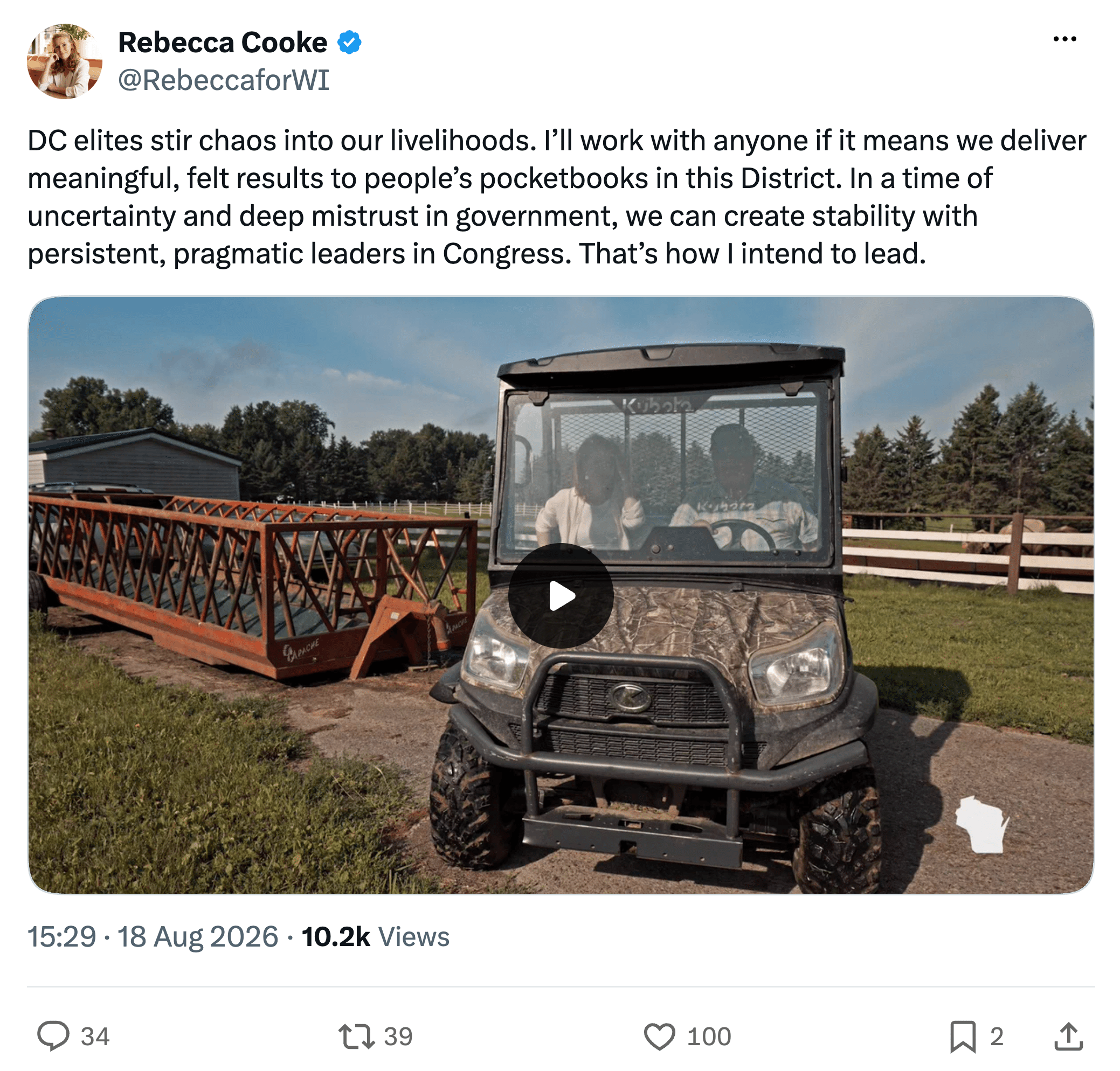
Revivalists comprise the largest cross-section of the party and are represented from coast-to-coast, including Senator Chris Coons from Delaware, Senator Chuck Schumer from New York, Senator John Hickenlooper from Colorado, Representative Tom Suozzi from New York, Representative Maggie Goodlander from New Hampshire, Senate candidate Chris Pappas of New Hampshire, Senate candidate Roy Cooper from North Carolina, House candidate Rebecca Cooke from Wisconsin, former Senate candidates Janet Mills from Maine and Angie Craig from Minnesota.
The five foreign policy issues
Primaries have at times led to tense disputes among Democrats. When it comes to foreign policy, our analysis shows where the camps divide on five key issues that will matter to Europeans: affordability and trade; the use of military force; China and great power competition; Israel; and Europe and European security.
1. Affordability and trade
Since Zohran Mamdani’s New York mayoral victory in November 2025, affordability has defined this election cycle’s messaging. Candidates across the board focus on policies that would help the affordability crisis and frame other issues as perpetuating it.[3] The focus is so singular that the headline messages are often interchangeable across the party: Abdul El-Sayed is running for “Money out of politics, money in your pocket, Medicare for all” while Roy Cooper’s prevailing message is “Make stuff cost less.”
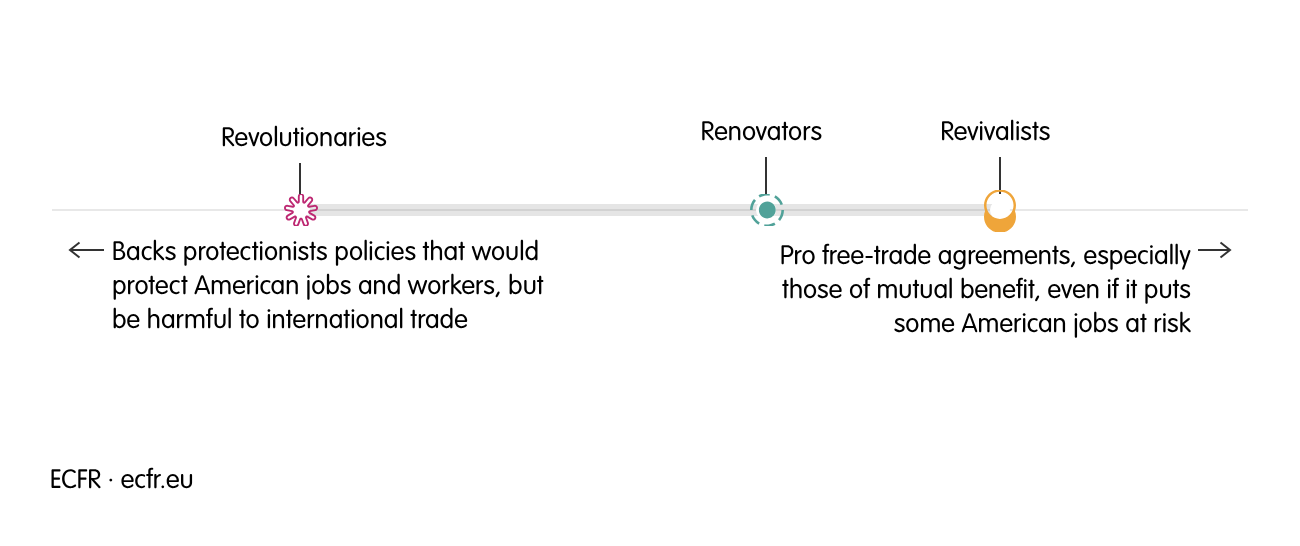
In terms of foreign policy, trade is affordability gone global. And as all Democratic candidates see it, Trump’s tariffs raise the price for Americans while enriching himself and his allies. But this consensus is an objection to these specific tariffs, not to all tariffs.
Revolutionaries remain sceptical of the old free-trade order itself: Alexandra Ocasio-Cortez at the Munich Security Conference called for “a recognition of NAFTA [North American Free Trade Agreement] as a failed policy for many rural and working class communities,” and Abdul El-Sayed called NAFTA and the Trans-Pacific Partnership a disaster for the American worker. Moreover, this camp sees small, strategic tariffs as legitimate tools of job protection.
Renovators, on the other hand, believe current trade agreements can be improved. Senator Jon Ossoff, for example, sent a letter to the Trump administration urging them to use the US-Mexico-Canada agreement (USMCA) review to police Mexican labour and environmental practices to ensure American growers have a chance to compete fairly on the global market.
Revivalists remain closely aligned to the old free-trade consensus. In April of this year, for example, senators in this camp asked the US trade representative to “strengthen and renew” the USMCA. They believe that trade tools like tariffs or export controls should only be used for national security issues, akin to the “small-yard, high-fence” policies of the Biden administration. Amid the Trump administration’s trade wars, they suggest focusing on a narrow trade agenda that directly serves the interests of both sides, such as deals on critical minerals, new technologies or other pieces of critical supply chains.
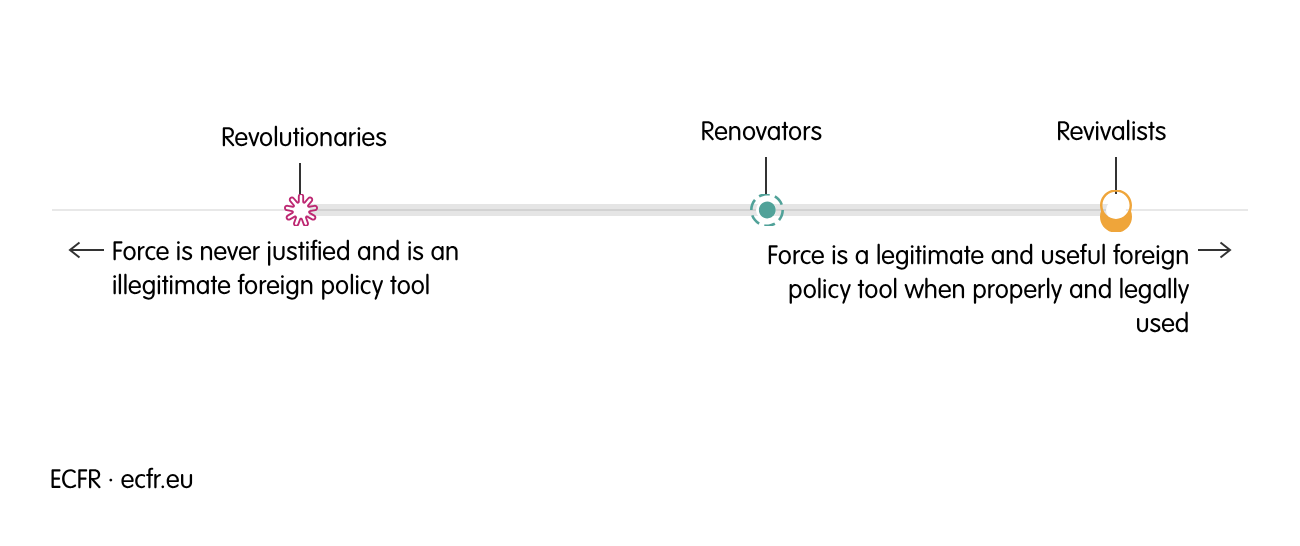
2. The use of military force
America’s two latest military operations—Trump’s war in Iran and the operation to remove Venezuelan president Nicolás Maduro—have sparked debate among Democrats over what role the US military should play in foreign policy. Nearly every Democrat criticised the Iran war and many voiced reservations about Venezuela, but the extent to which Democrats are comfortable using the military as a foreign policy tool differs.
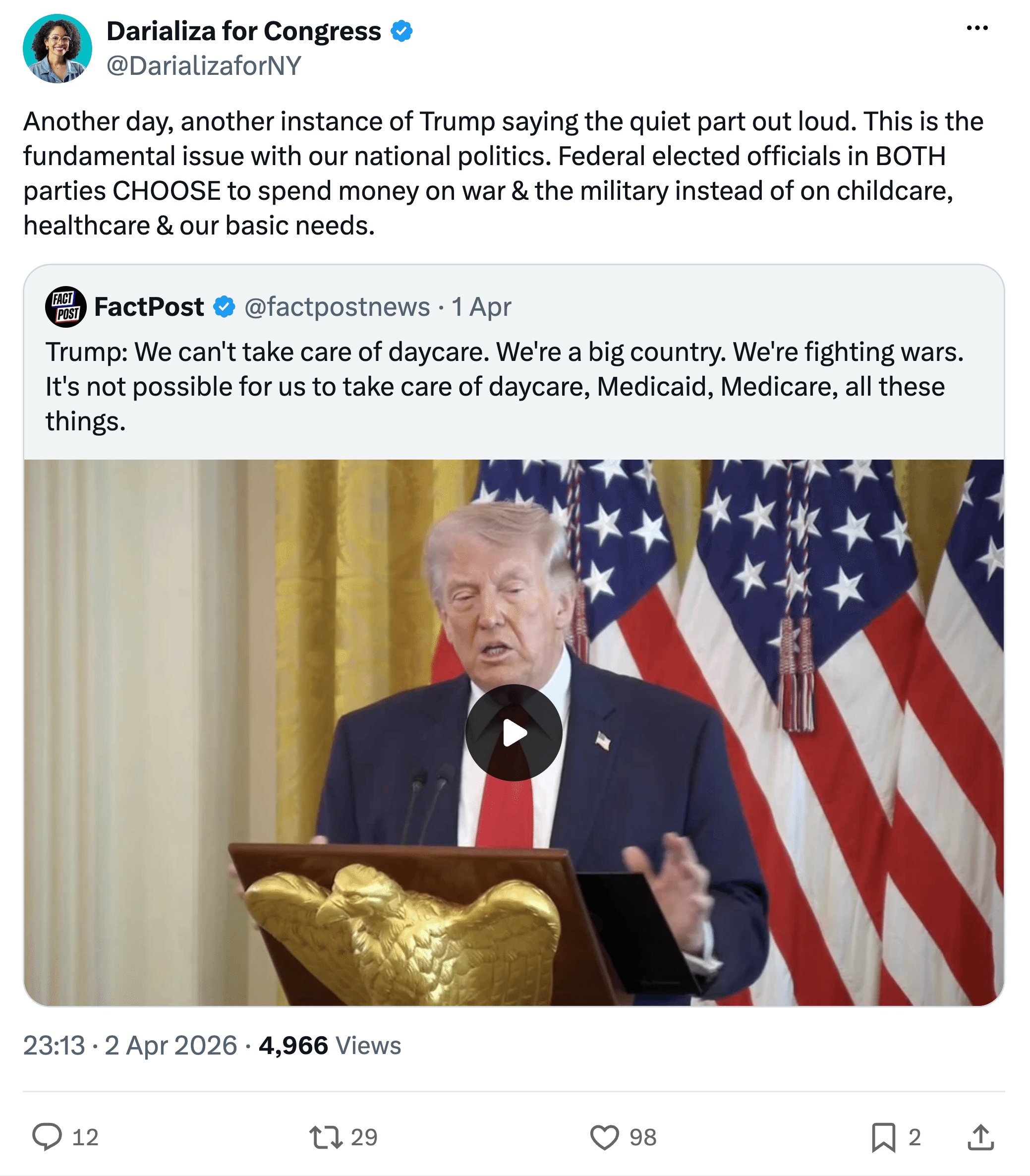
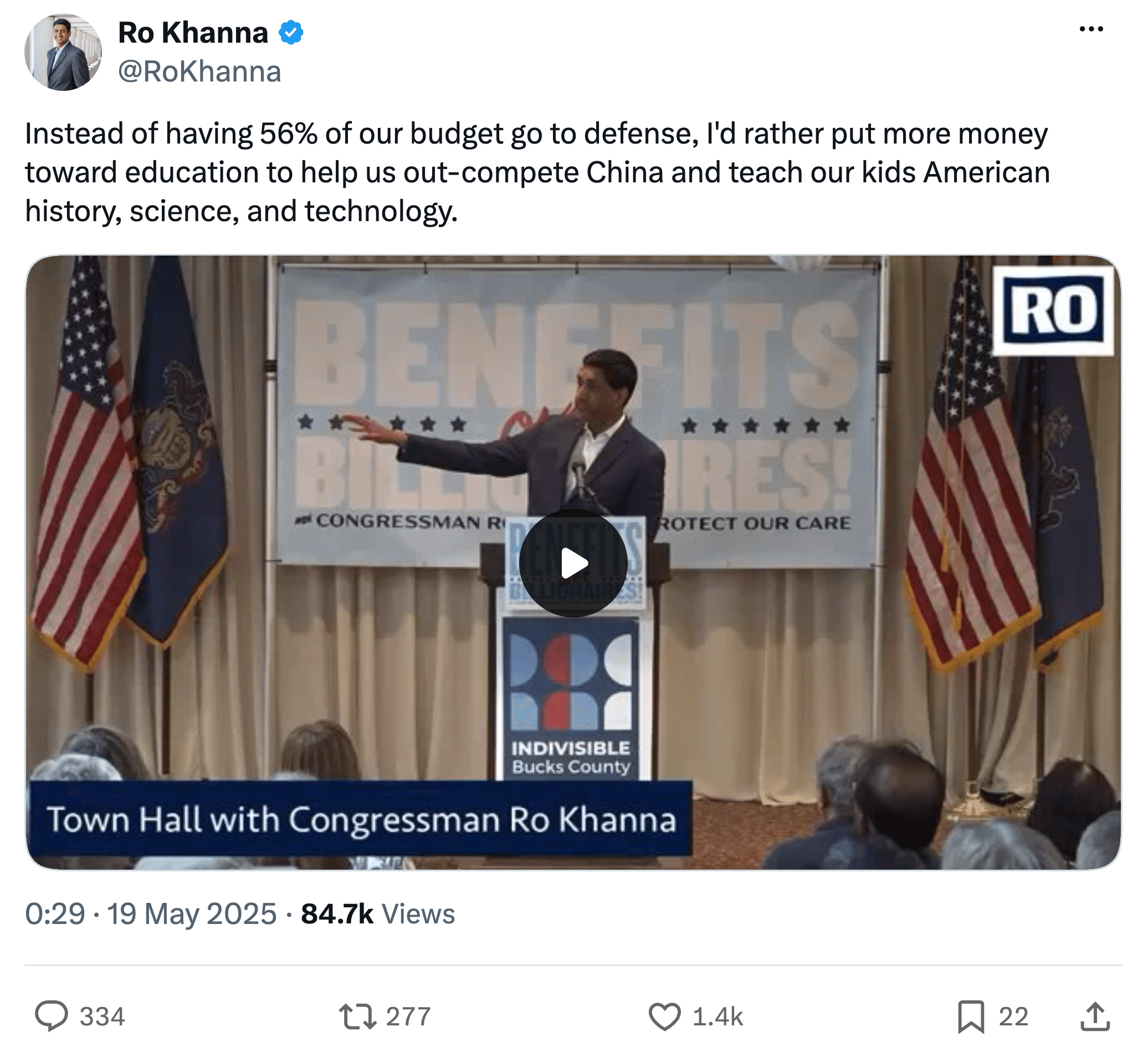
Revolutionaries read Trump’s use of force in Iran and Venezuela as a natural continuation of an overly militarised foreign policy and advocate for that to change. El-Sayed called the Iran war “dumb and illegal”, but argued that the real issue was the cost of a war America did not need to fight. Colorado’s Melat Kiros makes this structural claim directly, “It’s time to reimagine our global role: not as a militarised empire, but as a champion of diplomacy, human rights, and peacebuilding. We need to end the blank checks for endless war and reallocate that funding towards diplomacy abroad and housing, education, and healthcare here at home.” New York candidate for congress Darializa Avila Chevalier puts it similarly.
The revolutionaries, if in office, would work to cut the military budget broadly in the name of keeping the money at home. For them, the deeper fix to a foreign policy driven mainly by military action is upstream: end the corporate and defence contractor lobbies that supports these wars in the first place.
The renovators view the most recent use of force as domestic corruption running through foreign policy. They are not necessarily opposed to using military force, but uncomfortable with the corrupt forces that push the military to be a tool of first resort. Chris Murphy’s office headlined his remarks on the money: “This president’s foreign policy, the invasion of Venezuela, the ouster of Maduro, is about making his crowd filthy rich. It has nothing to do with American national security.”
James Talarico likewise described the transaction as follows: “Trump promised the biggest oil executives in this country a ‘great deal’ if they gave him a billion dollars for his re-election campaign, and then he turned around and gave them a gift. He gave them the nation of Venezuela, home to the largest oil reserves in the world. Billionaires don’t just run our economy. They don’t just run our government. Now they run our foreign policy.” Corruption, in this telling, drives how Trump uses force. As with domestic concerns, the way to “fix” the incentives to use military force is largely the same as the revolutionaries: reign in defence contractor graft, lobbying and campaign spending.
Revivalists press hardest on legality and cost, but the argument underneath is about what these operations do to America’s standing in the world. Chris Coons admonished the administration’s decision to launch strikes on Iran in February for their method and legality: “President Trump’s military campaign against Iran and call for regime change are the beginning of a reckless new war of choice with no clear strategy and no clear endpoint. This is not how a democracy goes to war.”
Revivalists levelled similar critiques at the military operation in Venezuela. Representative Maggie Goodlander responded to the capture of Maduro by asking: “What is the legal justification for such an action? The US Constitution entrusts the US Congress with war powers for very good reasons. The Trump Administration must immediately and truthfully answer questions about the motivation and legality of this unilateral military action, the potential for any further escalation, and the plan for peace.”
For this camp, how a country goes to war is a sign of its strength. Authorisation, a stated objective, and allies consulted in advance are what gives a war public support and partners willing to help in the effort. According to revivalists, a democracy that goes to war via unilateral decision is weaker afterward, because that decision erodes the constitutional system of checks and balances. So, Trump’s lack of consultation widens a divide between Republicans and Democrats, between the branches of government and diminishes the public image of the US military.
3. China and great power competition
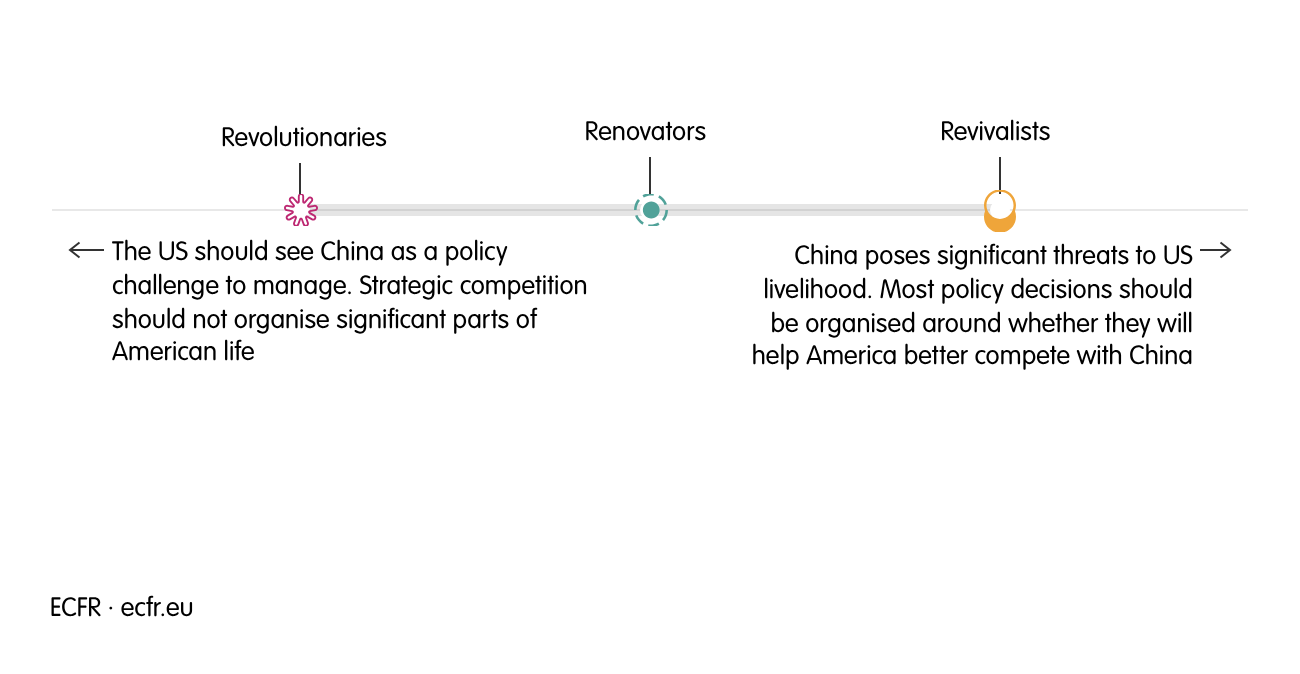
China is generally understood by all on the left as a strategic challenge. Yet Democrats disagree on just how big the threat is, whether to commit troops to the defence of Taiwan, and just how much the US should orient its economic and security policy around the strategic competition with China.
Revolutionaries fear a full-throated strategic competition with China would subvert domestic priorities. When Ocasio-Cortez was asked at the Munich Security Conference if she would commit to sending US troops to defend Taiwan, she said: “We want to make sure we never get to that point and we want to make sure that we are moving in all of our economic, research, and our global positions to avoid any such confrontation.”
This camp’s scepticism of the use of force and relentless focus on domestic framing is clearly seen when hot-button issues in the strategic competition discussion arise. For example, this camp would rather support limits on AI development to protect jobs, workers and the environment, than to push forward on AI research in order to compete with China. Likewise, they are more likely to focus the conversation of US-China strategic competition on manufacturing gaps, lags in research and education and trade deficits, thus bringing the focus back to the working class and economic issues.
Renovators sit in the middle. Hawkish enough to want to compete but unwilling to let strategic competition swallow the agenda. They are focused on economic fairness with China and competing beyond military means alone, but also willing to place domestic guardrails on AI and the tech race. They believe competition is important, but that it should not overtake all domestic needs. For example, they would advocate for the need for data centres to be energy and water self-sufficient, or even call for moratoriums on data centres, even if that threatens frontier model development.
4. Israel
Israel is where the three camps separate most cleanly along a single question: what, if anything, should America sell or give to Israel?
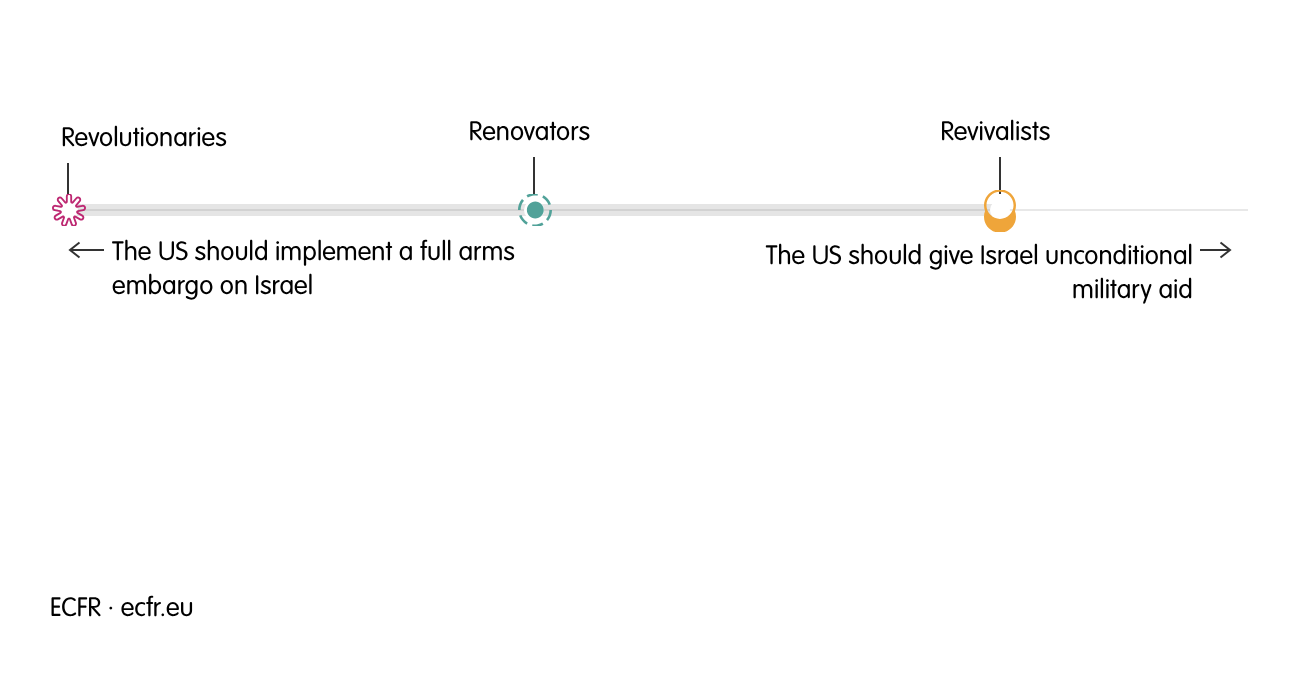
This is a central issue for the revolutionaries, who maintain that Israel’s actions in Gaza amount to genocide. This camp has concluded that conditioning aid to Israel, the previous progressive position, is no longer a viable measure to ensure any meaningful end to the conflict or long-term peace. Their preferred policy is a full arms embargo on Israel, including defensive systems.
This distinction has already defined a few primary elections. New York’s Darializa Avila Chevalier, who won the congressional primary against Representative Adriano Espaillat, ran on “babies not bombs”, promising to vote to halt arms sales to Israel. Melat Kiros, who unseated nearly-30-year incumbent Diana DeGette in Colorado, called for a full arms embargo to Israel and closed her victory speech leading a “Free Palestine” chant. El-Sayed takes this same position: “I support an immediate arms embargo on Israel and reject the false differentiation between ‘offensive’ and ‘defensive’ weapons.”
The renovators often make that distinction and are primarily focused on the need for change in the US-Israel relationship. Their belief that the system must be reformed is clearly reflected in their positions towards Israel. James Talarico, for example, has said he would work to ban the sale of offensive military weapons to Israel while still supporting Israel’s defensive systems. Talarico has declined to call it a genocide but has called the destruction in Gaza a “moral disaster”. Senator Jon Ossoff similarly told constituents that he voted against sending rifles to Israel because of the “extreme mass deprivation of civilians in Gaza”, and defended his vote for air-to-ground missiles because of Israel’s need to be able “to strike those who would launch missiles and rockets at Israeli civilians.” Senator Murphy, likewise, voted with Bernie Sanders’s resolution disapproving of the sale of offensive weapons in 2024, but has since moved even further, calling for a halt of US military aid altogether. But most in this camp have stopped short of demanding a total embargo. Instead, they try to thread the needle between respecting America’s long-standing special relationship with Israel and combatting the structure that has allowed Israel’s abuse of military force.
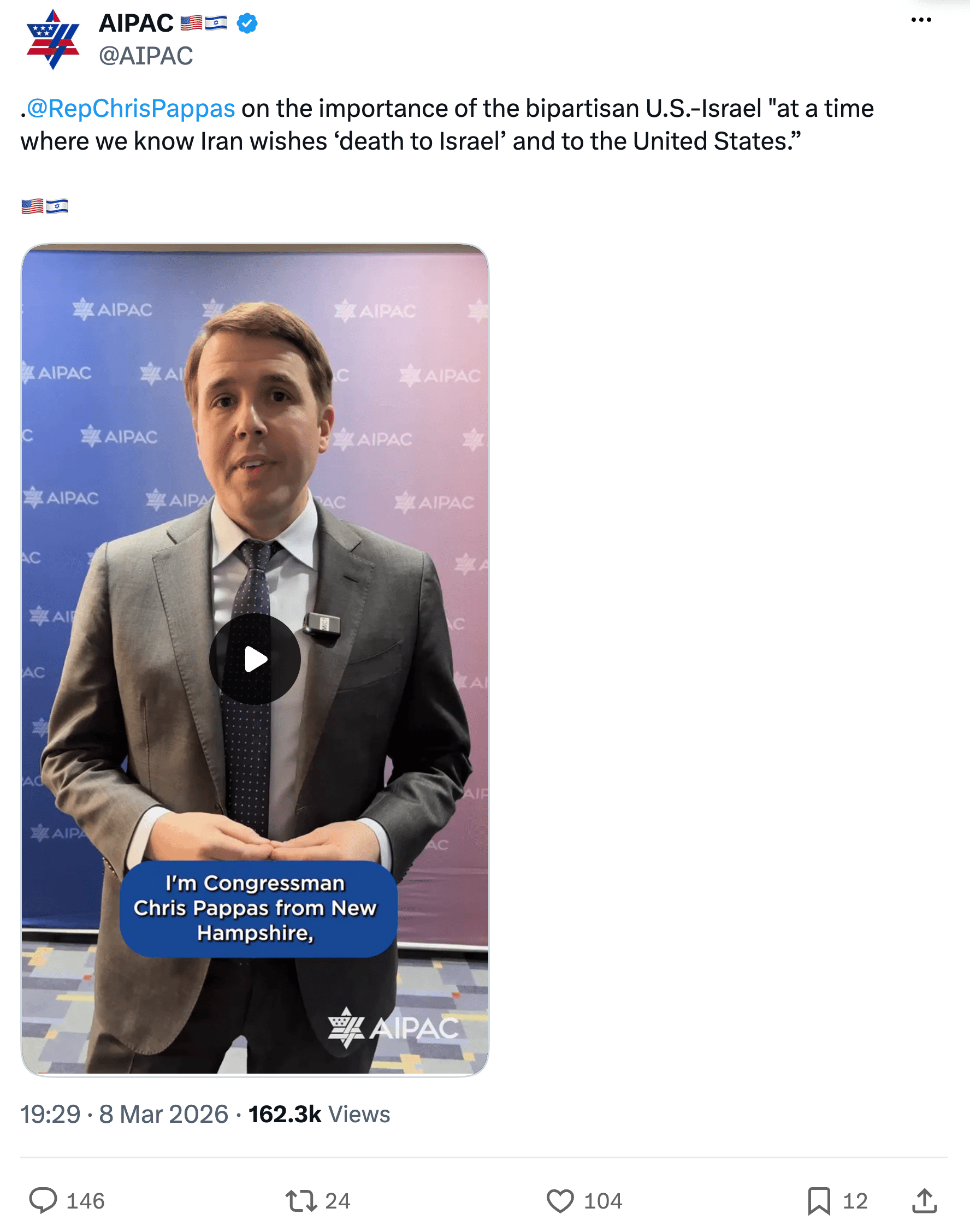
Revivalists support the US-Israel relationship but blame the two leaders, Trump and Netanyahu, for souring the once-mutually beneficial of defence relationship. In their view, Netanyahu and Trump’s actions have exacerbated US public opinion of the relationship, rather than the structure of the relationship itself. Chris Coons has reiterated that his “commitment to Israel remains ironclad” while directly placing the blame on Netanyahu for the declining American sentiment towards the country. Similarly, Representative Chris Pappas, running for Senate in New Hampshire, articulates support for Israel and criticism of Netanyahu’s government. Roy Cooper, meanwhile, has flatly rejected efforts to block aid to Israel.
The revivalists’ view on America’s relationship with Israel is perhaps best expressed in Chuck Schumer’s March 2024 Senate floor speech, where he called Netanyahu “an obstacle to peace” who has “lost his way by allowing his political survival to take precedence over the best interests of Israel.” In other words, just as Trump and the rise of the MAGA right have degraded the American political system, Netanyahu and the far-right in Israel have degraded the US-Israel relationship. The solution, then, is to try to change the behaviour of Netanyahu since they cannot change that he and Trump are in power. Therefore, this camp tends to treat US-Israel arms sales on a case-by-case basis, usually agreeing to send weapons, but reserving the right to condition those arm sales based on how Israel uses them. As Governor Janet Mills, who failed to win the Democratic primary for Maine’s Senate, said while criticising Netanyahu’s conduct she would evaluate any bill to halt arms shipments “on the specifics.”
5. Europe and European security
Nearly all Democrats see the value of the transatlantic relationship beyond the Trump administration’s idea of a “shared cultural heritage”. For the president, this is often a thinly veiled way to value the continent for its whiteness and colonial past and lambast it when he sees this as changing. Democrats, on the other hand, value the relationship for its shared rules and norms—whether these are liberal internationalism or workers’ rights.
A Democratic congressional majority will certainly not have the same disdain for Europe as many in the Trump administration do, but the Democratic party is certain to present its challenges. Some in the Democratic coalition would like to see a renewed American role in NATO, for example, while others want a European partner that can stand on its own. One challenge is for certain: the US-European relationship will be on the back burner. In the midterm campaigns you would be hard pressed to find a single Democratic candidate talking about the transatlantic relationship with voters.
Ukraine
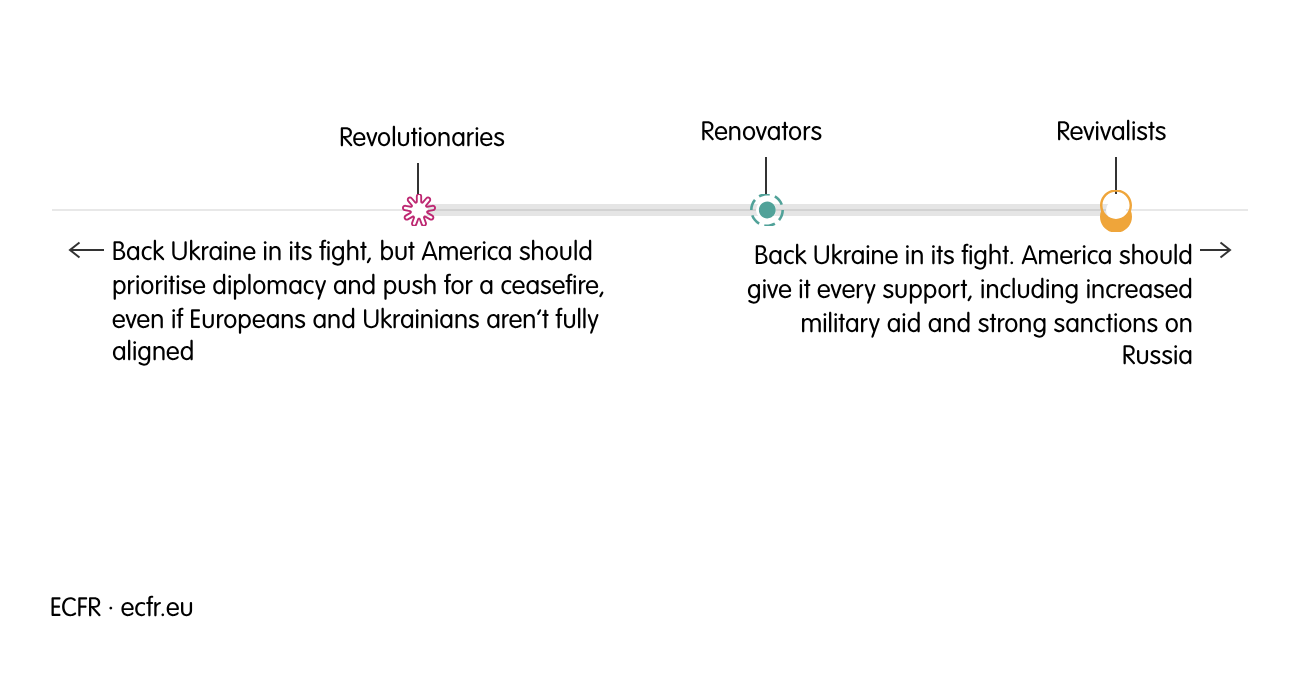
On the war in Ukraine, all camps are firmly behind Kyiv but divide over the specifics of what America should do in support. Revolutionaries are wary of a militarised US foreign policy and an economic statecraft whose costs fall to the American taxpayers. Leaders in this camp voted against seizing Russian oligarch’s assets in 2022, and signed, then retracted, a 2022 letter urging Biden to use negotiation and diplomacy. Much of the motivation to write that letter four years ago still exists within this camp today.[4]
The revolutionaries are most eager to push for peace and they remain somewhat doubtful that additional weapons for Ukraine benefit Americans, viewing an open-ended war as another entry in the long book of American over-extension. However, they are not outright against supporting Ukraine. Even Abdul El-Sayed, who was extremely vocal against sending weapons to Israel, said: “When it comes to Ukraine, I think we are involved in a righteous struggle from being invaded by their neighbour.”
Those in the renovator and revivalist camps both support Ukraine’s independence and the use of American military aid to secure it with varying intensity. Their divergence is on the use of sanctions on Russia. Renovators Chris Murphy and Jon Ossoff expressed some scepticism of the efficacy and knock-on effects of the Lindsey O. Graham Sanctioning Russia Act of 2026, which would authorise an increase of tariffs up to 100% for the top-five foreign purchasers of Russian energy supplies. Murphy ultimately voted for the bill, and Ossoff against. Senators Mark Kelly and Ruben Gallego, both revivalists, on the other hand, vocally supported the bill from the beginning. These are arguments about how much to spend and how hard to squeeze, not about whether Ukraine should survive. The sharper disparities appear when the question turns from the war to the US-European relationship itself.
US-European relationship
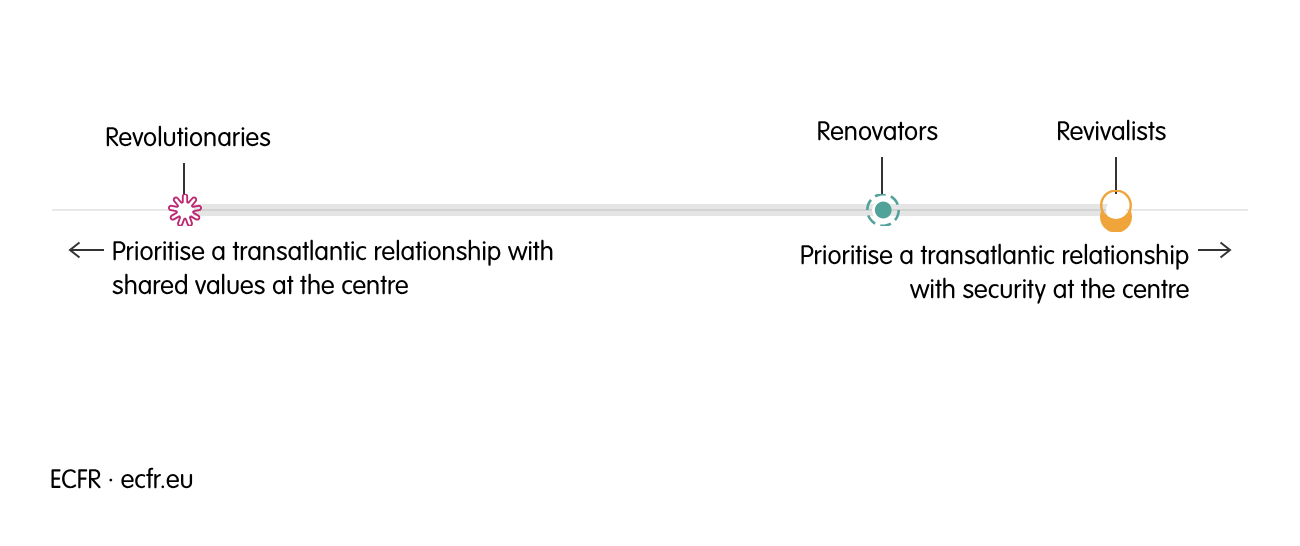
Revolutionaries are interested in a transatlantic relationship that is not centred around NATO or any military alliance. As revolutionaries believe in creating an American foreign policy that is not solely centred on military force, they also see that as a goal in the European context. Hence, they accept European strategic autonomy and might even welcome it. They are the camp most open to structural boldness and the least likely to campaign for returning any troops Trump withdraws from the continent. This camp has shown a proclivity for supporting a move towards burden-shifting, but are sceptical of a European relationship achieved only through rearmament.[5] Rather, they will seek an affirmative agenda as sketched by Ocasio-Cortez and Representative Jason Crow at the 2026 Munich Security Conference: a new transatlantic relationship re-centred on combatting authoritarianism on both continents and advancing labour standards, rather than one singularly obsessed with NATO and continued US security commitments.
Renovators would likely treat Europeans first and foremost as partners on the agenda they care about—corruption, taxation and democratic resilience.[6] They would also push for Europe to continue to take an increased responsibility for its own security. Murphy explained as much during a Senate foreign relations subcommittee hearing in September 2025: “I believe in that NATO treaty, I believe in Article 5, but I also think it is absolutely time for the members of NATO on the other side of the Atlantic to take more responsibility for their collective defence.” The renovators are therefore keen on the idea of increased burden-sharing within NATO since they often view foreign policy issues through the lens of “where is the money going?” Correspondingly they view European governments as natural allies in the pursuit of tax enforcements, financial transparency, AI and digital platform regulation.
Revivalists remain the most attached to the alliance and the most likely to defend NATO. Coons released a joint statement with Senator Mitch McConnell in April of 2026 reaffirming their support for the alliance: “Americans are safer when NATO is strong and united. It is in our interest for all allies to tend this unity with care…The Senate will continue to support the alliance for the peace and protection it provides America, Europe, and the world.” The revivalists also credit European allies with responding to American pressure by committing 5% of GDP to military spending, and with this they treat burden sharing as a question already answered.
Any structural change, in their eyes, is unnecessary and potentially counterproductive to continued US leadership. Rather, they see European rearmament as vindication of the alliance and reason for the US to stay committed. Even if the old division of labour and spending is not coming back, they would restore the old processes within the alliance: consultation before decisions, allies told in advance and an obligation to commitments.[7]
The uncertain road ahead
It is too early to know which of the three camps will be the most successful with voters. Democratic primaries in the spring and summer 2026 have offered mixed lessons. Quite a few revolutionary firebrands, such as Abdul El-Sayed and Angie Nixon, have won their primaries in widely covered upset victories. Meanwhile, some renovators like Jon Ossoff and James Talarico are running particularly strong campaigns while revivalists continue to fare strongly across the board. In other words, Europeans could be facing any of the foreign policy positions described above, and should engage with all three camps long before the American public decides which should come out in front.
Recommendations for Europe
Trump’s frenzy of disruptions too often clouds European judgement on long-term evolutions. If Democrats return to power, they will not revert to “back to normal”. Instead, Europeans need to engage with them on a new agenda; whether they be a far cry from the previous Democratic administration, like the revolutionaries, or a fair bit closer, like the revivalists. To anticipate what they may be dealing with in less than three years, Europeans should engage with all Democrats—from the familiar to the uncomfortable—even when disagreements abound, and start thinking of a common agenda to help shape Democratic policy while it is still being formed.
Expect the unexpected
European governments took a long time to accept that MAGA is durable and not a deviation from the norm. To be better prepared this time around, the debates on the American left deserve early attention, especially as they too could cause surprises. The populist energy emanating from the revolutionaries may prove to be a winning electoral strategy for Democrats in the midterms, and could well be mobilised by the next presidential candidate.
One thing is for certain: the Democratic party has entered a post-Obama, post-Biden era where questions over leadership mark more than a change of personnel. They signal the passing of the generation shaped by the Iraq war, the global financial crisis, the rise of ISIS and the return of great-power rivalry with Russia and China. Strategic competition with China is no longer the modus operandi as it was under Biden. International trade is no longer taken as an unqualified good. The American left is not returning to the internationalism of the 2010s. A new cohort of Democratic leaders is emerging with different political instincts and foreign-policy priorities.
Many Democrats no longer see the transatlantic relationship as an inheritance that they have a duty to preserve. If and when they return to power, their expectations of burden-sharing will have hardened, historical attachment to the Atlantic alliance will have faded and Europe will no longer occupy the central place it once did in Democratic foreign policy debates. Younger Democrats in particular approach alliances through the lens of effectiveness and narrow shared interests and values, rather than a long-standing historical solidarity. Europeans need to pay attention to the debates taking place inside the Democratic party in order to engage the party of tomorrow.
Engage with every Democrat
As Europeans navigate the new American left, the biggest hurdle they will face is that they are increasingly viewed as at best as irrelevant and at worst as complicit. Europeans are not the focus of any of the three camps’ foreign policies. In fact, throughout our analysis, Europe was hardly mentioned in any television interviews, stump speeches or posts on X. Even the war in Ukraine and Russia’s hybrid challenges have lost prevalence in foreign policy debates consumed with China, Iran, Israel and Venezuela, to name a few.
When they do pay attention to Europe, Democrats across the board are beginning to regard European leaders who have spent nearly two years currying Trump’s favour as part of the problem—whether that is because Democrats view them through the lens of upholding an oligarchy, enabling gross corruption or being pathetic in the face of a global bully. Even if European leaders are pragmatically flattering the president with paternal references or golf rounds, they should remember that there are still a lot of democrats (not the party, the philosophy) on the other side of the Atlantic who would like to see in Europeans a standard-bearer and not an enabler.
Likewise, behind closed doors European leaders espouse a disappointment in Democratic politicians for losing to Trump twice and failing to put up decent opposition so far.[8] Democrats, too, are acting pragmatically. The options they currently have to mount a significant opposition are few and ineffective.
Which is all to say, engagement and re-building bridges across the left now will be essential for building a transatlantic relationship fit for the post-Trump world. European leaders and all three camps want America to play a constructive, trusted and peaceful role in the world—they just differ on what exactly that looks like.
In particular, Europeans have to start meeting and engaging with revolutionaries, even if their positions appear furthest outside the norm. This camp, for its provocations and innovation, is feeding most of the political conversation and fires up the base. Engagement would make Europe’s concerns and assets more prevalent to their thinking, while ignoring them only guarantees tension if they come to power.
Shape the next transatlantic agenda
As Democrats are not paying any attention to Europe, the burden of revitalising the transatlantic relationship lies with Europeans. There are significant areas—like tech regulation, corruption reform, taxation, trade and security—where European leaders will find partners in the American left if they so choose. They should not be surprised, however, if they must make the first move. Indeed, if Democrats win the midterms, the next two years will see Trump weak and the Democrats not yet strong. In that time, no policy idea will come from Washington that imagines the future of collaborations with Europe. It is up to Europeans to propose them.
Europeans’ experience of the Biden administration illustrates why relying on American leadership is insufficient. Although Biden championed alliances rhetorically, several defining decisions were taken with limited European consultation. The Inflation Reduction Act prioritised domestic reindustrialisation through measures many Europeans regarded as discriminatory. The withdrawal from Afghanistan was poorly coordinated with allies. The AUKUS agreement advanced Indo-Pacific strategy but came at the expense of French interests. These episodes reflected a broader shift towards a US that increasingly pursues its strategic objectives unilaterally, even under an avowedly pro-NATO administration. Europeans’ continued acquiescence towards the Trump administration has only made unilateral foreign policy more appealing.
To avoid facing a Democratic majority which operates alone, Europeans must think through what they would like to propose to Democrats. That agenda should be capable of appealing across the Democratic coalition, from revolutionaries to renovators to revivalists.
In setting an agenda, Europeans should connect with Democrats from all three camps, but there are specific opportunities to build stronger coalitions with the camps that are naturally aligned with European interests. For example, on Israel policy and a new US role in the Middle East, the revolutionaries and the renovators could find alignment with many European governments. On a framework for competing with China and derisking, Europeans should collaborate with renovators and revivalists. All three camps will be in favour of a rebalanced NATO, but should Europeans seek more structural changes, they would find allies in the renovator and revolutionary camps. On all issues, Europeans should make the case that they can be a practical partner in solving some of the international problems around which the next Democratic coalition will organise itself. In so doing, Europeans and the US Democrats can build a new, more balanced and stable alliance.
A renewed transatlantic programme should therefore include:
A “fair trade” agenda that combines openness with stronger labour protections, coordinates responses to Chinese industrial overcapacity, establishes minimum wage requirements and climate standards. All three camps could be interested in such an agenda: revivalists for competitiveness, renovators for reestablishing ethical rules and revolutionaries for climate and labour rights progress. For Europeans, it is important to move away from the logic of indiscriminate tariffs and negotiated exemptions. Instead they should put forward a logic of fair competition and sustainable industrial development on both sides. The European Commission should start by identifying partners with whom to discuss these goals.
A joint framework for AI that strengthens consumer protections, ensures fair taxation of digital platforms, promotes open access to AI for public goods such as healthcare and education, and aligns technological innovation with climate objectives. The renovators would be most in favour of such a proposal, and elements of the revolutionaries and revivalists would be a natural coalition. France, which promotes international cooperation for responsible AI governance, as well as Britain, which will host the G7 in 2028, should reach out to Democrats interested in tackling the issue and working on a regulatory framework for AI and other technologies.
A rebalanced NATO in which European allies assume greater responsibility for force generation, command structures and regional deterrence, allowing the US to reduce its military footprint without weakening collective defence. All three camps would find favour in stronger European allies, although revivalists are probably more comfortable in the conversation. Nevertheless, Europeans should also spend time engaging with revolutionaries and renovators, who do not see the same value in alliances, and show that collective defence can be cost-effective and a guarantee of long-term security. Transatlanticist networks in staunch US allies such as Germany, the Netherlands or Poland should start suggesting concrete transformations of the alliance to be discussed with Democrats.
A substantial expansion of transatlantic educational, research and cultural exchanges, including easier access to European universities for American students, expanded researcher mobility and new funding for joint academic networks. Revivalists would applaud a greater cultural exchange and such a vision for renewed American leadership. Revolutionaries and renovators would also welcome the opportunity to centre education, research and culture in the transatlantic relationship, rather than military. The EU could help promote such a “Community of friendship for Europeans and Americans”, which a lot of Europeans may embrace, that de-emphasises trade and defence as the only pillars of the transatlantic relationship, and put democracy, innovation and human rights at the centre. Such an initiative would, above all, help cushion Europe’s fall towards irrelevance on the American left.
These proposals would resonate differently across the Democratic coalition. Revivalists would view them as a means of modernising American leadership rather than abandoning it. Renovators could see them as evidence that Europe is assuming greater responsibility for its own security while contributing to domestic American priorities on labour, industrial policy and technological governance. Revolutionaries may find opportunities to advance an ambitious climate and social agenda beyond their shores. In all cases, the objective should be the same: demonstrate that Europe can be an asset rather than a burden for the next generation of Democratic policymakers.
Methodology
The revolutionaries, renovators, and revivalists are ideal types that emerged from our analysis of 42 high-profile Democratic primaries and general election campaigns throughout the 2026 midterm cycle and of 63 individual Democratic candidates. We exhaustively researched campaign platforms, stump speeches, debates and candidate interviews with local news, and interviewed various pundits, current and former staff, officials and pollsters in Washington DC from April to August 2026.
The Democratic primary races and candidates studied include: Senate races in Alaksa, Colorado, Delaware, Georgia, Illinois, Iowa, Kentucky, Maine, Massachusetts, Michigan, Minnesota, Nebraska, New Hampshire, New Jersey, New Mexico, North Carolina, Ohio and Texas; Governor races in Iowa, New Jersey, Virginia and Wisconsin; and Congressional races in California, Colorado, Connecticut, Florida, Hawaii, Illinois, Michigan Montana, New Hampshire, New York, Pennsylvania, Texas, Washington and Wisconsin.
About the authors
Célia Belinis a senior policy fellow at the European Council on Foreign Relations and head of its Paris office. Her research focuses on transatlantic relations.
Chris Herrmannis the US programme coordinator at the European Council on Foreign Relations, based in Washington, DC. His research focuses on US domestic and foreign policy and the transatlantic relationship.
Nevada Joan Leeis a policy fellow at the European Council on Foreign Relations, based in the Washington office. Her research focuses on European security and defence, US foreign policy, the transatlantic relationship and NATO.
Acknowledgments
We would like to thank the many people who helped with this paper. First and foremost, thank you to all the Democratic politicians, staffers, pollsters and pundits who met with us for our research. A big thanks to Portia Kentish, whose thoughtful and thorough editing greatly sharpened the piece. Jeremy Shapiro and Jim O’Brien provided sage wisdom and multiple rounds of considered feedback. Majda Ruge offered generous comments and advice on earlier drafts. Chris Eichberger gave this piece its visual life through his extraordinary visuals. Martin Tenev worked tirelessly to bring the paper to its final form—life on the web.
[1] ECFR conversations with current and former progressive congressional staffers, Washington DC, July and August 2026
[2] Author’s conversations with congressional staffers, Washington DC, July 2026
[3] ECFR conversation with Democratic pollsters, Online, May 2026
[4] Conversations with progressive and moderate Democratic congressional staffers, Washington DC, July 2026
[5] ECFR Conversation with former and current progressive congressional staff, Washington DC, July and August 2026
[6] Authors’ conversations with politicians, March 2026, Washington DC and conversation with Tim Walz, ECFR annual council meeting, Vienna, June 2026
[7] Author’s conversations with congressional staffers, Washington DC, July 2026
[8] ECFR private workshop with European officials, Berlin, February 2026
Investigamos o que importa para os brasileiros além do que passa na campanha eleitoral. Leia mais reportagens como essa clicando aqui.
Os órgãos que deveriam amparar as candidatas vítimas de violência política de gênero como a Justiça Eleitoral e a Polícia Federal não estão preparados para enfrentar o problema, denuncia a deputada estadual Bella Gonçalves (PT-MG), que disputa uma vaga a deputada federal nestas eleições. Ela é uma das mulheres candidatas que alertou ter recebido ameaças de morte e estupro nos primeiros dias de setembro.
Minas Gerais é o segundo Estado que mais mata mulheres do Brasil [em números absolutos]. A violência política acompanha a violência de gênero, por isso que eu acho que, em Minas Gerais, é tão comum a violência política contra as mulheres”, diz Bella Gonçalves.
Ela não foi a única. Na noite do último sábado, 12 de setembro, a suplente ao Senado e advogada, Fernanda Klitzke (PT) foi agredida, chutada e alvejada por balas de borracha por policiais militares em Jaraguá do Sul, Santa Catarina. As agressões ocorreram após uma denúncia de som alto.
Também no sábado, em Minas Gerais, a deputada estadual pelo PT, Andréia de Jesus, candidata à reeleição, também divulgou em suas redes sociais o recebimento de ameaças. Segundo uma matéria do site Alma Preta, Jesus foi ameaçada de morte, com conteúdo racista e de violência física, via uma mensagem eletrônica.
A candidata pelo PT, a deputada federal por Minas Gerais, Ana Elisa Santos Silva, também fez um Boletim de Ocorrência após receber mensagens com conteúdo de ódio racista e ameaças de morte e violência sexual em setembro. “A violência no Brasil [contra as mulheres] nunca parou; na verdade, ela está em crescimento”, afirma.
No dia 4 de setembro, a deputada federal Duda Salabert (PSOL-MG), candidata à reeleição, usou suas redes sociais para denunciar agressões sofridas quando fiscalizava uma mineração ilegal na divisa de Belo Horizonte com o município de Nova Lima, que foram seguidas por uma tentativa de homicídio.
Para Silva, que está concorrendo pela primeira vez em uma eleição, a sensação de insegurança continua. “Eu fui ameaçada de morte, não tenho segurança, não tenho medida protetiva, não tenho absolutamente nada e não tenho dinheiro”, relata. Mesmo denunciando aos órgãos competentes e levando ao Tribunal Regional Eleitoral de Minas (TRE-MG), Ana Elisa ainda se sente insegura.
Gonçalves também chama a atenção para o fato que as candidatas que estão entrando na política “seguem muito desprotegidas para enfrentar a violência política de gênero”. Mesmo contando com a presença de uma policial militar por ser deputada estadual, Bella Gonçalves critica a falta de regulamentação das leis que protegem as mulheres que atuam na política institucional, tanto no âmbito dos tribunais eleitorais, já que se trata de crime eleitoral, como na legislação de enfrentamento à violência política de gênero, aprovada em Minas Gerais.
Ironizando uma fala do ex-governador de Minas e candidato à Presidência pelo Novo, Romeu Zema, em entrevista à TV Globo, Bella Gonçalves diz que Minas tem, de fato, políticas contra mulheres. “A não-regulamentação e o não-funcionamento do Conselho de Proteção à Mulher do Estado, o não-investimento na rede de proteção, entre tantas outras ações que vão resultar na ponta em morte de mulheres”, exemplifica.
Por que isso importa?
A reserva de candidaturas femininas nos partidos política existe há 30 anos (desde 1996), porém nas últimas eleições, em 2022, apenas 17,7% das vagas da Câmara Federal foram ocupadas por mulheres.
Uma legislação específica de combate à violência política contra mulheres surgiu há apenas cinco anos, com a Lei nº 14.192/2021.
Entre as medidas tomadas após o recebimento das ameaças, a deputada estadual formalizou um pedido de providências na Gerência-Geral de Polícia Legislativa (GPOL) na Assembleia Legislativa de Minas Gerais (ALMG) e na Justiça Eleitoral. Além disso, afirma estar cobrando investigação das forças de inteligência da polícia e a segurança dela e de seus familiares. Gonçalves ainda pretende entregar uma carta ao Partido dos Trabalhadores solicitando a utilização do fundo partidário para combate à violência política de gênero e garantia da segurança das candidatas.
Objetivo é intimidar e expulsar mulheres dos espaços de poder
Gestora de mobilização, Maíra Baracho defende que a violência é um instrumento usado contra mulheres que ocupam espaços que não foram pensados para elas
A percepção de que a violência política de gênero está aumentando no Brasil ocorre, segundo a gestora de mobilização da plataforma Bonde (antiga Nossas), Maíra Baracho, porque a presença de mulheres em espaços de poder incomoda. “A violência, infelizmente, nos acompanha por onde a gente circula”, diz Baracho ao explicar que a violência política é uma das facetas das diversas violências sofridas pelas mulheres no âmbito doméstico, íntimo ou profissional.
“Quando a gente olha para a política institucional, esse instrumento que é a violência se intensifica. E a função que ele ocupa nesse lugar é a de expulsão. É expulsar as mulheres que ousaram ocupar esse lugar, que não foi desenhado para elas”, analisa.
Baracho cita a deputada federal Benedita da Silva (PT-RJ) ao lembrar que na Assembleia Constituinte que produziria a Constituição de 1988, a Câmara Federal não contava com banheiro feminino. No Senado, a situação foi pior. O primeiro banheiro feminino foi construído apenas dez anos atrás, em 2016. “Isso ilustra muito bem, e a violência vem com esse lembrete, de que esse lugar não é [pensado] para a gente”, complementa.
Benedita da Silva foi a única mulher negra entre os 487 deputados constituintes que assinaram a Constituição Federal de 1988
A deputada Bella Gonçalves concorda. “Acho que [a violência] é uma tentativa de clara intimidação das mulheres, em um contexto eleitoral muito acirrado, em que o debate de enfrentamento à violência contra a mulher está muito acendido, e com a tentativa de nos desestabilizar”, avalia.
Ana Elisa Silva segue no mesmo pensamento ao considerar as ameaças, tanto a ela como às outras candidatas mineiras, fazem parte de um ataque coordenado para enfraquecer as candidaturas progressistas no estado, tanto em cargos proporcionais como nos cargos majoritários. “A gente sabe que nunca um [candidato a] presidente da República ganhou [a eleição] sem ganhar em Minas”, argumenta.
As intimidações mostram, segundo Baracho, como é importante que as mulheres continuem ocupando espaços de poder. “Se esse espaço não fosse relevante para a gente, os homens, o patriarcado, essa estrutura de poder, não estaria exatamente se preocupando com a nossa participação, com a nossa presença nele. Isso faz a gente refletir o quanto é importante ter mulheres na sua diversidade, negras, indígenas, trans, e muitas outras possibilidades do que é ser mulher, dentro desse espaço da política institucional”.
Suporte às candidatas e outras medidas de combate à violência política
Além da responsabilização dos agressores, Maíra Baracho aponta o suporte às mulheres candidatas vítimas de violência política como uma importante ferramenta para mantê-las atuando na política. E, nesse caso especificamente, o suporte [se dá] pela continuidade, para que [a violência] de fato não signifique o desencorajamento de outras mulheres a estarem nesse lugar [de poder].
Bella Gonçalves, por exemplo, já havia sofrido outros ataques e ameaças antes dos ocorridos neste mês. Ela conta que em 2024, várias parlamentares estaduais e municipais, na maioria mulheres lésbicas, receberam ameaças de estupro corretivo e violência de gênero. Na época, elas se juntaram para aprovar a Lei nº 24.466/2023, que cria a política de enfrentamento à violência política contra a mulher.
Também foi realizada a Operação Di@na, uma parceria entre o Ministério Público de Minas Gerais e as polícias Civil e Militar do estado. Foram descobertos fóruns e grupos na internet, conhecidos como chans, onde participantes incitavam a violência, pedofilia e necrofilia. Um dos autores das ameaças às parlamentares chegou a ser preso em 2025.
Entretanto, na visão da deputada, a prisão não foi suficiente considerando que as mensagens recebidas agora traziam características muito parecidas àquelas que recebeu em 2024, com descrições de brutalidade contra ela e contendo informações de caráter privado. “É uma violência sem rosto”, diz Gonçalves. Ela ainda ressalta que “não só as candidatas são ameaçadas, mas também toda sua família”.
Ela defende, entre as ações de combate à violência política, a criação de espaços, tanto da Justiça Eleitoral quanto das polícias Civil e Militar, de recebimento de denúncias e de rápido encaminhamento para apuração. A responsabilização pelo Estado brasileiro das empresas de tecnologia pelas violências que ocorrem no âmbito da internet, também é defendida por Gonçalves.
A gestora da plataforma Bonde também defende que o Estado deve regularizar as redes sociais e pressionar as empresas para participarem da solução do problema. “Se a gente tem um universo de redes sociais, de big techs, alinhadas ao mesmo pensamento, à mesma lógica de sociedade, que está compondo boa parte do Estado brasileiro, é claro que essas pessoas não vão fazer esse enfrentamento [da violência], não é do interesse delas fazer esse enfrentamento”, argumenta.
Para que todas essas transformações ocorram, Baracho acredita que o caminho é a mobilização social. Tanto para defender as mulheres que irão “topar esse desafio e assumir essa tarefa coletiva”, como na elaboração das pautas desses mandatos.
Segundo ela, “quando a gente fala de violência no lugar da política institucional, não é só o corpo [que está em risco]. É o corpo também, mas é o que aquele corpo representa, o que aquele corpo está pautando. Então, avançar com determinadas agendas também é uma resposta, também é uma forma de proteger esses corpos, e avançar com a ideia de justiça social, que para a gente é fundamental”, conclui.
Dania Thafer of the Gulf International Forum weighs in on previously scheduled talks between Iran and Gulf states. Shortly before this interview aired, Oman announced that the talks were postponed.
Nesta segunda-feira, 7 de setembro, candidatos à Presidência da República cumprem agendas voltadas para as comemorações pelo Dia da Independência do Brasil. Na avenida Paulista, em São Paulo, um ato foi convocado pelo candidato e senador, Flávio Bolsonaro (PL-RJ).
O presidente Lula, candidato à reeleição, estará presente ao tradicional Desfile Cívico-militar na Esplanada dos Ministérios, em Brasília. Os temas deste ano abrangem a luta contra a violência à mulher, a soberania nacional e a Copa do Mundo Feminina, que o Brasil sediará entre os dias 24 de junho e 27 de julho de 2027.
No Rio de Janeiro, o candidato do partido Avante, Augusto Cury, participa da “Caminhada da Independência Cury Brasil”. Com o trajeto entre o Posto 6 em Copacabana, zona sul do Rio de Janeiro, até o Posto 5, a concentração irá começar às 9 horas.
Em Brasília, o Partido Novo convoca seus aliados para participar de uma manifestação no feriado contra o ministro do Supremo Tribunal Federal (STF) Alexandre de Moraes. O ato está marcado para às 9h, em frente ao Banco Central, local próximo de onde estará ocorrendo o desfile oficial. O candidato do Novo à presidência, Romeu Zema, não confirmou presença e é esperado no mesmo evento de Flávio Bolsonaro em São Paulo.
Atenção segue voltada para o Supremo
As denúncias trocadas entre os ministros do STF André Mendonça e Alexandre de Moraes, que devem ser tema nos eventos eleitorais desta segunda-feira, também mobilizam a Corte nesta semana. O presidente Edson Fachin deve ouvir manifestações do ministro André Mendonça e da Procuradoria-Geral da República (PGR) a respeito do pedido de investigação sobre abuso de poder e improbidade administrativa supostamente praticados por Mendonça feito pelo ministro Alexandre de Moraes na última quinta-feira, 3 de setembro.
TSE julga pedidos de intervenção federal no Piauí e no Maranhão
Com menos de um mês para o primeiro turno das eleições, o Tribunal Superior Eleitoral (TSE) julga nesta semana as requisições dos Tribunais Regionais Eleitorais do Piauí e do Maranhão, de uso da Força Federal, composta por militares do Exército, da Marinha e da Aeronáutica. O objetivo é assegurar o livre exercício do voto nas eleições de 2026. As capitais, Rio de Janeiro (RJ), Fortaleza (CE), municípios distantes e aldeias indígenas de Rio Branco, capital do Acre, fizeram a mesma solicitação e já tiveram os pedidos aceitos pelo TSE.
Estão na agenda da semana de 7 a 11 de setembro:
TSE
Prestações de Contas (09/9): Partidos e candidatos devem enviar à Justiça Eleitoral a prestação parcial das contas das movimentações financeiras e estimativa para campanha desde o início da campanha até 8 de setembro.
STF
Marco Civil da Internet (ADC 91, 09/9, 14h): Ministros voltam a debater sobre o parágrafo 1° do artigo 10 do Marco Civil da Internet, que permite o compartilhamento de registros de conexão e de acessos na internet apenas com autorização judicial prévia.
Investigações feitas por delegados (ADI 5073, 09/9, 14h): Ministros discutem sobre a Lei 12.830/2013, que aborda investigações criminais conduzidas por delegados policiais. A Confederação Brasileira de Trabalhadores Policiais Civis (Cobrapol), que ajuizou o caso, argumenta que a lei retoma privilégios já extintos na Constituição Federal de 1998.
Dados pelos delegados da polícia (ADI 5059, 09/9, 14h): Julgamento em conjunto com as ADI 5073 e a ADC 91, ministros julgam a constitucionalidade do parágrafo 2° do artigo 2 da Lei 12.830/2013, que possibilita aos delegados requisitarem dados, informações, documentos e perícia sem autorização judicial.
Ministério Público do Amazonas (ADI 7512, 09/9, 14h): Ministros vão julgar se a lei do Amazonas nº 3.147/2007, que estabelece que 10% dos cargos comissionados devem ser reservados para efetivos do MPAM, viola regra do concurso público, os princípios da moralidade, da impessoalidade e da eficiência.
Créditos do ICMS (RE 835818, 09/9, 14h): Recurso Extraordinário avalia se os créditos presumidos de Imposto de Circulação de Mercadorias e Serviços (ICMS) podem ou não compor cálculo do PIS e da Cofins.
Proibição de divisão de lucros (ADI 5161, 09/9, 14h): Ação, ajuizada pelo Conselho Federal da Ordem dos Advogados do Brasil (CFOAB), questiona se o artigo 32 da Lei nº 4.357/1964, que proíbe empresas com dívidas ativas na União a distribuir lucro, com multa de 50% dos lucros distribuídos.
Há crises políticas que resultam de uma única decisão errada. Outras resultam de um conjunto de acontecimentos que, isoladamente, poderiam eventualmente ser explicados, mas que, acumulados, criam uma realidade politicamente insustentável. O caso Luís Neves pertence claramente à segunda categoria.
O que verdadeiramente distingue esta crise não é apenas a gravidade de cada episódio. É a sucessão de factos, contradições, relações pessoais, decisões administrativas e explicações posteriores que foram surgindo ao longo das últimas semanas. E é precisamente essa acumulação que levanta uma pergunta inevitável: até quando pode Luís Montenegro manter no Governo um ministro cuja permanência se tornou, ela própria, um problema político para o Executivo?
Tudo começou com as obras numa propriedade em São Teotónio, no concelho de Odemira. O empreiteiro responsável, João dos Santos Carvalho, da Construbarcelos, não era um desconhecido de Luís Neves. A empresa tinha realizado trabalhos para a Polícia Judiciária durante o período em que Luís Neves dirigiu aquela instituição. Posteriormente, foi o mesmo empreiteiro a realizar obras na propriedade privada do atual ministro da Administração Interna.
A questão não é afirmar que uma relação pessoal ou profissional constitui, por si só, um crime. Não constitui. Mas a proximidade entre quem dirigia a Polícia Judiciária e um empresário cuja empresa recebeu contratos daquela instituição exige um escrutínio particularmente rigoroso. Quando essa mesma empresa passa depois a realizar obras na propriedade pessoal do antigo diretor nacional da PJ, a exigência de transparência torna-se ainda maior.
As obras no Alentejo levantaram outras dúvidas. Foram divulgadas informações relativas a 108 faturas, emitidas por 13 empresas, num valor superior a 23 mil euros. Durante algum tempo, uma das principais questões foi precisamente a ausência pública dos comprovativos de pagamento. Luís Neves afirmou ter pago cinco mil euros ao empreiteiro, mas a forma como determinados pagamentos foram realizados e a documentação disponível tornou-se objeto de escrutínio público.
Também a própria legalidade urbanística das obras foi questionada. A Câmara Municipal de Odemira confirmou que estava a averiguar a situação e que não existia processo de licenciamento ou comunicação prévia para as obras referidas. Luís Neves acabaria por admitir a necessidade de regularizar a situação.
Mas foi o episódio do atrelado que transformou uma polémica numa verdadeira crise política.
Um atrelado apreendido no âmbito da Operação Pacoba, relacionada com tráfico de droga, foi encontrado nas instalações da empresa Construbarcelos, pertencente precisamente ao empreiteiro amigo do ministro. A Polícia Judiciária abriu um inquérito para apurar as circunstâncias da situação.
Importa ser rigoroso: a PJ esclareceu que os produtos encontrados no interior do atrelado não eram estupefacientes. Contudo, o atrelado tinha sido apreendido numa investigação de combate ao tráfico de droga e continha materiais e produtos químicos associados à operação que levou à sua apreensão. A questão central não é, portanto, insinuar que o empreiteiro ou o ministro traficavam droga. Não há qualquer fundamento para essa afirmação. A questão é outra e é suficientemente grave: como chegou um bem apreendido pela Polícia Judiciária às instalações privadas de um empresário próximo do então diretor nacional da PJ?
Há ainda uma questão adicional, relacionada com a segurança do próprio atrelado e do seu conteúdo. Segundo foi noticiado, a Marinha não queria que o atrelado permanecesse nas suas instalações por razões de segurança. Perante essa preocupação, o atrelado acabou por ser transportado ao longo de vários quilómetros e armazenado nas instalações do empreiteiro, aparentemente sem condições adequadas de segurança ou de custódia.
Esta circunstância torna a decisão ainda mais difícil de compreender. Se existiam preocupações de segurança suficientemente sérias para levar a Marinha a recusar a permanência do atrelado nas suas instalações, como se considerou aceitável transportá-lo para um espaço privado, sem condições comparáveis e pertencente a um empresário com uma relação de proximidade com o então diretor nacional da PJ?
Luís Neves assumiu posteriormente ter autorizado a deslocação do atrelado, defendendo que a decisão permitiu poupar dinheiro ao Estado e afirmando que não existia qualquer problema com o atrelado enquanto este esteve na posse do empreiteiro. Mas essa explicação levanta uma pergunta inevitável: se estava tudo bem com o atrelado e com o seu conteúdo, por que razão a Polícia Judiciária foi imediatamente apreendê-lo quando soube que se encontrava nas instalações do empreiteiro?
A apreensão posterior não prova, por si só, que tenha existido qualquer irregularidade criminal. Mas demonstra que a situação era suficientemente sensível para justificar uma intervenção imediata das autoridades. E essa intervenção contradiz, pelo menos politicamente, a ideia de que se tratava de uma solução normal, segura e sem qualquer risco.
A explicação, contudo, não encerrou a polémica. Pelo contrário, colocou no centro do debate a relação entre a decisão administrativa, a entidade que beneficiou da guarda do bem, as condições de segurança do armazenamento e a amizade existente entre o então diretor nacional da PJ e o proprietário da empresa.
Quando um cidadão comum olha para este caso, é legítimo que pergunte se o mesmo tratamento teria sido dado a qualquer empresário sem qualquer ligação pessoal ao responsável máximo da Polícia Judiciária.
E as dúvidas não terminaram aí.
Surgiu depois a questão de uma viatura apreendida pela PJ e utilizada por Luís Neves. O ministro tinha afirmado, numa conferência de imprensa, possuir apenas um automóvel familiar com cerca de quinze anos. Posteriormente, tornou-se público que tinha outra viatura pessoal e utilizava ainda um automóvel que tinha sido apreendido pela Polícia Judiciária e posteriormente cedido ao Ministério da Administração Interna.
A questão deixou, assim, de ser apenas a utilização de uma viatura. Passou também a ser uma questão de credibilidade. Quando um governante presta esclarecimentos públicos e a informação posteriormente conhecida demonstra que a realidade é mais complexa do que aquela inicialmente apresentada, é inevitável que a confiança nas suas explicações seja afetada.
Também foram levantadas questões públicas sobre outros bens apreendidos e sobre a gestão e utilização de património proveniente de processos sob tutela da PJ. Todas estas matérias devem ser investigadas com rigor, sem julgamentos antecipados e sem condenações mediáticas. Mas há uma diferença fundamental entre respeitar a presunção de inocência e exigir responsabilidade política.
Um ministro não precisa de ser condenado por um tribunal para deixar de reunir condições políticas para permanecer no Governo.
É precisamente aqui que a responsabilidade passa diretamente para Luís Montenegro.
Porque mantém o primeiro-ministro Luís Neves no Governo?
Essa é hoje uma das perguntas mais importantes desta crise. Montenegro continua a manifestar confiança no ministro, apesar da sucessão de episódios, das investigações e do desgaste evidente da imagem do Governo.
A explicação poderá ser política: afastar Luís Neves poderia ser entendido como admitir que a escolha foi errada. Mas mantê-lo tem igualmente um preço. Cada nova revelação prolonga a crise. Cada nova contradição transforma o problema de um ministro num problema do próprio primeiro-ministro.
E é também impossível ignorar o comportamento da restante oposição.
O silêncio ou a contenção de alguns partidos perante uma crise desta dimensão merece reflexão. O Partido Socialista, em particular, não demonstrou a mesma intensidade política que tantas vezes manifesta perante casos de menor dimensão quando os protagonistas pertencem a outros quadrantes políticos.
É legítimo perguntar porquê.
Não significa afirmar que existe qualquer acordo oculto, comprometimento ou cumplicidade. Não existem elementos públicos que permitam fazer essa acusação. Mas politicamente é legítimo questionar se determinados silêncios resultam de uma estratégia de prudência ou do receio de que uma escalada do escrutínio sobre relações entre poder político, empresas e instituições possa trazer novamente à superfície outros casos do passado.
É neste contexto que o CHEGA decidiu assumir uma posição clara.
André Ventura exigiu a demissão de Luís Neves e alertou para o risco de perda de confiança dos portugueses nas instituições. O partido apresentou uma moção de censura e procurou colocar o caso no centro do debate parlamentar.
A comissão de inquérito proposta pelo CHEGA tem igualmente uma importância política fundamental. O Parlamento não pode limitar-se a assistir às revelações e esperar que o tempo resolva aquilo que a política tem obrigação de esclarecer. Uma comissão parlamentar de inquérito permitiria chamar responsáveis, analisar decisões, conhecer documentos e perceber como foi possível que um bem apreendido pela PJ fosse parar às instalações de um empresário próximo do seu então diretor nacional, em condições de segurança aparentemente inadequadas.
Mais do que uma iniciativa contra uma pessoa, trata-se de defender uma regra essencial: ninguém pode estar acima do escrutínio democrático.
O Presidente da República também deixou claro, através das intervenções e alertas dirigidos ao funcionamento das instituições e à necessidade de responsabilidade política, que Portugal não pode normalizar crises permanentes no Governo. A estabilidade não pode significar silêncio. A estabilidade não pode significar tolerar indefinidamente situações que fragilizam a confiança dos cidadãos.
A moção de censura apresentada pelo CHEGA deve, por isso, ser analisada para além do seu resultado aritmético.
Mesmo que não tenha condições para derrubar o Governo, tem um significado político inequívoco: o CHEGA recusou ser cúmplice, recusou fechar os olhos e posicionou-se claramente contra um Governo que prometeu rigor, transparência e exigência, mas que hoje mantém no seu interior um ministro envolvido numa sucessão de casos que continuam por esclarecer.
O CHEGA fez uma escolha política clara, não proteger o Governo apenas porque algumas das suas posições podem coincidir pontualmente com propostas defendidas pelo partido.
O Governo de Luís Montenegro deve ser avaliado pelos seus atos. E, neste caso, o ato mais relevante do primeiro-ministro é precisamente aquilo que ainda não fez.
Ainda não retirou Luís Neves do Governo.
E enquanto isso não acontecer, a crise continuará a ter dois protagonistas, Luís Neves, por tudo aquilo que ainda precisa de explicar, e Luís Montenegro, por continuar a decidir que essas explicações são suficientes.
Talvez sejam suficientes para o primeiro-ministro.
Mas a pergunta verdadeiramente importante é outra: serão suficientes para os portugueses?
Acho que não.
O Estado de São Paulo já teve mais resgates de trabalhadores sujeitos a trabalho análogo à escravidão no campo nos seis primeiros meses do ano do que em todo o ano de 2025. É o que revelam dados do relatório de Conflitos no Campo, com dados parciais de 2026, divulgado nesta quarta-feira (2), pela Comissão Pastoral da Terra (CPT). O número nacional total de resgatados de condições degradantes de trabalho, por outro lado, diminuiu.
Ao todo, 148 trabalhadores foram resgatados no primeiro semestre deste ano em São Paulo. A marca já é superior aos 142 de 2025. A maior parte desses profissionais trabalhava no plantio e corte de cana-de-açúcar.
Para a coordenadora do CPT, Cecília Gomes, o aumento de casos pode ser visto pela característica do tipo de trabalho nos campos, incluindo lavoureiros e operários de construções. Entretanto, Gomes também avalia que o aumento da tecnologia pode influenciar nessa conta.
“Aquela história de que levar a tecnologia para o campo vai diminuir a mão de obra e o trabalho escravo, essa hipótese cai por terra. Porque, quando a gente olha, quanto mais tecnológico é o ambiente, maior a probabilidade ou a possibilidade de ter trabalho escravo. Essa é uma característica que tanto está no Sul, no Sudeste, no Centro-Oeste, está em todas as regiões brasileiras”, afirma a coordenadora.
No país, 355 trabalhadores foram resgatados em 30 casos registrados entre janeiro e junho. Em 2025, essa marca foi de 842 pessoas. Mesmo com as subnotificações das denúncias, Gomes afirma que o trabalho da CPT em conjunto com o Ministério do Trabalho mostra que existe uma necessidade de um olhar mais atento nas áreas mais tecnológicas.
A CPT também identificou que os casos mais graves de violência são praticados, em sua maioria, por fazendeiros (305 casos) e empresários (102 casos), que respondem por dois terços dos assassinatos e 61,4% dos episódios de violência contra ocupação e posse no primeiro semestre de 2026.
Para Gomes, a crescente violência no campo é possibilitada pela impunidade dos agentes causadores. “Pouco desses casos são apurados e os poucos que são apurados são pouco punidos”, explica a coordenadora da CPT.
Cresce a contaminação violenta de cidadãos
Violência mais praticada no campo em 2026, a contaminação por minérios atingiu 195 ocorrências. Para a CPT, o cenário é possível devido à priorização do “lucro em detrimento à vida” e da falta de fiscalizações mais rígidas de mineradoras.
Também houve 169 casos de contaminação por agrotóxicos, o que passa longe de ser por acaso, já que a organização vem identificando o uso intencional dessas substâncias como um tipo prático de arma química. “Não é só a contaminação das águas, esse agrotóxico é colocado para atingir os povos, para atingir as comunidades, como uma forma de expulsão”, denuncia Gomes.
E a contaminação por agrotóxico é venenosa porque as pessoas não conseguem produzir nem reproduzir o seu jeito, o seu modo de ser. Eles [a comunidade camponesa] têm uma cultura do plantio, da colheita, da alimentação e da diversidade. Mas não vão conseguir ter essa diversidade na produção, porque, como a água está contaminada, vai queimar as lavouras, vai danificar as lavouras”
Cecília Gomes
Coordenadora da CPT
Em 2025, o Brasil bateu recorde de agrotóxicos liberados. Foram 750 registros concedidos pelo Ministério da Agricultura, Pecuária e Abastecimento (Mapa).
Investigamos o que importa para os brasileiros além do que passa na campanha eleitoral. Leia mais reportagens como essa clicando aqui.
A violência policial matou 18 pessoas por dia e mais de 40 mil foram vítimas de mortes violentas intencionais em 2025 no país, segundo o Fórum Brasileiro de Segurança Pública. São dados que justificam a preocupação dos fóruns populares de segurança pública em apresentar, em um ano eleitoral, 27 pontos “inegociáves por uma Segurança Pública que Proteja a Vida”.
“A segurança no nosso país tem sido discutida e tem sido organizada só com a agenda da repressão qualificada. […] O que o Fórum Popular propõe é dar dois passos para trás e pensar numa segurança que seja sustentável a partir de uma política forte de prevenção à violência”, afirma Edna Jatobá, coordenadora executiva do Gabinete de Assessoria Jurídica às Organizações Populares (Gajob) e articuladora do Fórum Popular de Segurança Pública do Nordeste.
Reunião entre fóruns populares de segurança pública ocorreu em Fortaleza, em agosto
Nas reivindicações reunidas durante a 1ª Conferência Popular de Segurança Pública do Brasil (ConsepBR), realizada em Fortaleza (CE), saem pautas muito discutidas atualmente como aumento de penalidades, diminuição da maioridade penal, mudanças nos códigos penal e processual para entrar garantia de direitos, prevenção, educação, saúde, trabalho e renda, estratégias comunitárias de policiamento, mediação de conflitos e até segurança alimentar. No encontro, ocorrido entre 19 e 21 de agosto, estiveram presentes 300 representantes de fóruns populares e entidades que discutem o tema de 16 estados do Brasil.
Para Gerlane Simões, integrante do Fórum Popular de Segurança Pública do Nordeste e de Pernambuco, fazer a conferência antes das eleições foi importante para “a gente levar para o debate [sobre segurança pública] e colocar o dedo na ferida [dos candidatos e políticos]”. O objetivo agora é apresentar as ideias aos candidatos à Presidência da República e também ao máximo de candidatos aos governos dos estados.
A gente fez uma discussão enorme, várias reuniões, por conta desse timing [das eleições]. A segurança pública é a pauta que está na agenda do dia da extrema direita e a gente faz a disputa dessa narrativa. A ideia é encaminhar para todos os candidatos que a gente conseguir alcançar”, explica Simões.
Prevenção
Jatobá afirma que os pontos formulados mudam a forma como a segurança pública vem sendo discutida. Em vez de tratar sobre a punição aos crimes, abrangem a prevenção da criminalidade. Para ela, a primeira medida necessária é mudar a forma de investir na segurança pública.
“Primeiro é o investimento, a reorientação do investimento para programas de prevenção. Segundo, é entender a segurança como uma política que se vê realizada também em outros direitos, como acesso à moradia, acesso à cidade, acesso à cultura, esporte, lazer, entretenimento, educação, saúde”, afirma.
Para Simões, há uma diferença entre investimento na segurança pública e investimento em armamentos, que recebe investimentos bilionários com a crença de amenizar a violência nos estados. “Segurança pública para a gente não é um investimento bilionário. Por exemplo, aqui em Pernambuco, que se investiu mais de 4,5 bilhões em 2025, investiu-se em mais armamento e mais policiamento, e a violência só aumentou”, afirma.
A coordenadora do Gajob pondera que não se trata de dizer com isso “que não vai ter mais polícia, que não vai ter repressão, que não vai ter prisão. A gente está dizendo que esse caminho já foi percorrido e poucos resultados foram alcançados. O caminho da prevenção foi pouco percorrido e tem condições de dar base a uma mudança social”.
Garantia de direitos
“Segurança pública é garantia de direitos. É um conjunto de políticas públicas que estejam funcionando”, explica Gerlane Simões. Ela conta que em Pernambuco ocorreu uma pré-conferência com crianças e adolescentes. Nela, as crianças diziam que só queriam brincar. “Se isso não está na pauta do que é segurança pública então deveria ser outra coisa, né?” indaga Simões. Para ela, direito ao lazer, à saúde, ao trabalho e à renda, são pautas que devem ser abordadas sempre que o tema for a segurança pública.
“Se a gente tem investimento em prevenção, uma política de segurança articulada com outros direitos sociais, refletida num padrão de formação das forças de segurança, observando a diversidade da nossa população, orientando as forças de segurança para protocolos antimachistas, antirracistas, com respeito a todo credo e religião e à diversidade, a gente pode aí trilhar um caminho diferente”, completa Jatobá.
Guerra às drogas
A carta política dos fóruns populares também traz alternativas à chamada guerra às drogas, que segundo Jatobá “não é uma guerra contra a substância, ela é uma guerra contra as pessoas pobres que consomem drogas”.
Entre as soluções apresentadas está observar a questão das drogas “como um problema estruturalmente de saúde, um problema social”. A dirigente do Gajob ainda afirma que “não se faz guerra às drogas a quem está traficando no alto escalão, [de] colarinho branco”.
“Se tiver que fazer algum enfrentamento com relação ao tráfico de drogas, que comece com o sufocamento das grandes facções, dos grupos criminosos armados, por agir com inteligência e desmantelar esses grupos, tirar essas armas de circulação, sufocar financeiramente como algumas operações realizadas pela Polícia Federal, articulada com polícias estaduais”, aponta Jatobá.
Ela ainda lembra que mesmo nos bairros nobres, a “guerra às drogas” vai vitimar “o menino pobre, preto, morador de periferia, que faz uso de pequena quantidade de droga. Ou [que a droga] serve como trabalho, que é um dos piores trabalhos infantis e dos mais perigosos que existem”.
“A gente entende que uma política de segurança pública deve acabar com esse termo da guerra às drogas, que tem sido um pretexto para praticar o genocídio, o genocídio contra a juventude de pobre, negra e periférica”, finaliza.
Desinformação é intencional
Gerlane Simões acredita que a população brasileira não só está mal informada sobre o que devidamente é a segurança pública, como existe uma intenção em deixá-la desinformada. “A sociedade [brasileira] foi construída a partir de uma colonização, que ainda está em curso, e vai se reformulando. Então, a sociedade está bem formada nesse sentido do que é a segurança pública”.
Já a coordenadora do Gajob entende que há uma grande onda de notícias falsas no campo da segurança pública, “Há uma tentativa de tratar o tema da segurança como palanque eleitoral, prometendo que vai se resolver tudo com polícia, com morte e com prisão, mas sem apresentar alternativas estruturais para resolver o problema”, completa. O resultado da desinformação, para Edna Jatobá, é uma população “que está refém do medo e o medo tem sido um impulsionador para esses projetos fundamentalistas de tratar a segurança como morte”.
“A gente tem uma população que está buscando se informar, mas que ainda precisamos agir sobre esse grande mercado de notícias falsas, de propostas sem futuro e sem fundamento, sem nenhum respaldo de estudo ou de dados, para que as políticas deem certo”, conclui Jatobá.
Veja aqui todos os 27 Pontos Inegáveis para a Segurança Pública que Proteja a Vida.

 Login