
❌

Reading view

Le Pen Sets Out €140bn Spending-Cut Plan as French Debt Dominates 2027 Race

Marine Le Pen has set out plans to cut French public spending by €140 billion by 2032, reduce the deficit and impose a constitutional constraint on future borrowing, placing France’s deteriorating public finances at the centre of the campaign for the 2027 presidential election.

Marine Le Pen has presented a five-year fiscal programme under which a National Rally administration would seek €140 billion in net savings by 2032, restore France’s primary budget balance within 18 months and bring the headline deficit back below the European Union’s three per cent threshold by 2030.

The proposals, presented on Tuesday as Le Pen outlined the financial trajectory she would pursue during a presidential term, come as France faces rising borrowing costs and a public debt ratio approaching 120 per cent of GDP.

The scale of the problem was underlined on the same day by France’s Directorate-General of the Treasury. Its latest report on public debt projects the debt ratio at 119.3 per cent of GDP this year before rising to 121.7 per cent in 2027. Debt stood at 115.7 per cent at the end of 2025.

EU Today has already reported that French borrowing costs and concerns over the sustainability of the country’s finances have begun to weigh on the euro and widen the gap between French and German government bond yields.

Le Pen’s programme is therefore aimed not only at French voters but at financial markets increasingly focused on whether Paris can prevent debt from continuing to rise.

According to the proposals outlined on Tuesday, spending reductions would be concentrated heavily in the first three years of a Le Pen presidency. She would also seek to introduce what she calls a constitutional “golden rule”, requiring successive governments to reduce the budget deficit each year.

The measure would be put to a referendum and is intended to make deficit reduction binding beyond an individual government’s annual budget decisions.

Le Pen has also proposed reducing France’s public debt to around 112 per cent of GDP by 2032. That would reverse the trajectory currently expected by the French government, although the National Rally’s assumptions would depend on its ability to deliver the proposed savings and on economic growth during the next presidential term.

Among the most politically significant proposals is a plan to restrict France’s net contribution to the EU budget to €5 billion. The party argues that some European spending should instead be financed through harmonised taxes on products such as tobacco and alcohol.

Le Pen also expects substantial savings from tighter immigration controls and the introduction of the National Rally’s proposed “national preference” rules for access to parts of the welfare system. Her programme estimates that measures connected with immigration could eventually produce savings of as much as €29 billion annually.

Other elements include changes to pension policy, reductions in corporate and energy taxation, measures against VAT fraud, the abolition of more than 120 taxes and a reduction in the number of state agencies.

The programme marks an attempt by Le Pen to make fiscal policy a central part of a campaign that has until now been dominated largely by immigration, security and questions surrounding France’s political fragmentation.

The timing is significant. Prime Minister Sébastien Lecornu’s government has itself introduced a difficult fiscal consolidation programme. The 2027 budget presented by the Finance Ministry envisages €54 billion in measures to improve the public finances, including €43 billion contained directly in the state and social-security budgets.

The government expects the deficit to fall from 5.4 per cent of GDP in 2026 to five per cent next year. It forecasts growth of only 0.5 per cent this year before a recovery to one per cent in 2027.

The debt burden is becoming increasingly costly. Interest payments are expected to reach €91.2 billion in 2027, up from €79.2 billion this year, according to the Finance Ministry. By 2030, total public-sector interest costs are projected to reach 3.7 per cent of GDP.

That gives the presidential campaign an economic dimension that is difficult to separate from France’s relationship with Brussels. Paris remains subject to EU fiscal rules requiring a gradual reduction in its deficit, while any attempt to reduce the French contribution to the EU budget would require negotiations with the other member states.

Le Pen enters that debate from a strong electoral position. Recent polling examined by EU Today has placed her ahead in first-round scenarios for 2027, although the final field remains unsettled. EU Today reported in September that Le Pen was polling between 33 and 36 per cent depending on her opponents.

Her latest intervention shifts part of the campaign onto terrain traditionally associated with the centre-right: public spending, debt and the credibility of France’s finances.

With the government attempting to secure parliamentary support for its own austerity measures and French borrowing costs under closer scrutiny, the question of how the country pays for the state is now moving towards the centre of the contest to succeed Emmanuel Macron.
  •  

Italy’s Deficit to Rise Again as Rome Uses EU Fiscal Flexibility

Italy expects its budget deficit to rise above the European Union’s three per cent reference level again next year as Giorgia Meloni’s government uses new EU fiscal flexibility to finance defence and measures responding to higher energy costs.

Rome’s latest multi-year fiscal projections put the 2027 deficit at 3.4 per cent of GDP, substantially above the previous target of 2.8 per cent.

The increase follows a planned fall to 2.9 per cent this year, which would bring Italy below the EU’s three per cent threshold for the first time since 2019. The deficit stood at 3.1 per cent in 2025.

The change reflects Italy’s decision to use the EU’s national escape clause, allowing member states under specified conditions to deviate temporarily from their agreed expenditure paths.

Under the latest projections, Rome intends to use fiscal flexibility worth 0.6 per cent of GDP in both 2027 and 2028 for defence and energy-related spending. The additional expenditure amounts to roughly €29 billion across the two years, while the deficit is projected at 3.2 per cent in 2028.

The decision turns a long-running dispute over fiscal flexibility into a test of the EU’s revised budget framework.

The national escape clause was introduced in the 2024 reform of the Stability and Growth Pact. It permits a member state to deviate temporarily from its fiscal path when exceptional circumstances outside its control have a major effect on public finances, provided medium-term fiscal sustainability is not endangered.

The mechanism was subsequently used to give governments greater room to increase defence spending. In 2026, the Commission also moved to broaden its application to energy-security expenditure.

Italy has been among the governments pressing hardest for such flexibility.

In August, EU Today reported that Rome intended to use the available fiscal room fully for energy measures but only partly for defence. The decision illustrated the competition between longer-term military investment and the immediate political pressure created by household and industrial energy bills.

The latest projections make that trade-off larger.

Italy’s annual inflation rate increased to 4.1 per cent in September, from 3.2 per cent a month earlier. Meloni has sought additional room from Brussels to cushion the economic effect of elevated energy costs.

At the same time, the government has improved its growth forecasts.

GDP is now expected to expand by one per cent in 2026, compared with an earlier projection of 0.6 per cent. Growth for 2027 has been revised from 0.6 to 0.8 per cent.

Those figures provide some additional room, but Italy’s debt remains the larger constraint.

Public debt is projected to rise from 138.1 per cent of GDP this year to 138.5 per cent in 2027 before edging down to 137.9 per cent in 2028. The government now expects the debt ratio to begin falling a year later than previously planned.

That leaves Rome in an unusual position. It expects formally to bring its underlying deficit below the EU threshold while headline borrowing rises above three per cent once exceptional spending is included.

Economy Minister Giancarlo Giorgetti has said Rome is discussing with the European Commission how the calculation will affect Italy’s attempt to leave the EU’s excessive deficit procedure.

The Commission will therefore have to judge not only Italy’s fiscal trajectory but how extensively exceptional expenditure can be accommodated under rules Brussels itself has made more flexible.

That question has already generated concern.

EU Today reported last month that the European Fiscal Board had warned that exceptions were beginning to weaken the clarity of the revised rules. The watchdog has been particularly critical of allowing room initially associated with higher defence spending to be extended to energy-resilience measures.

Italy provides one of the clearest examples of the problem.

Rome is trying simultaneously to increase military capacity, protect households and businesses from energy costs and demonstrate that its very high debt remains manageable.

It has also argued that European rearmament cannot proceed unless governments have sufficient room to finance it. The same tension emerged in Italy’s debate over participation in the EU’s SAFE defence loan programme.

The EU has given governments more flexibility to manage those competing demands. Italy’s 2027 budget will show how far that flexibility can stretch before the argument returns to the credibility of the fiscal rules themselves.

  •  

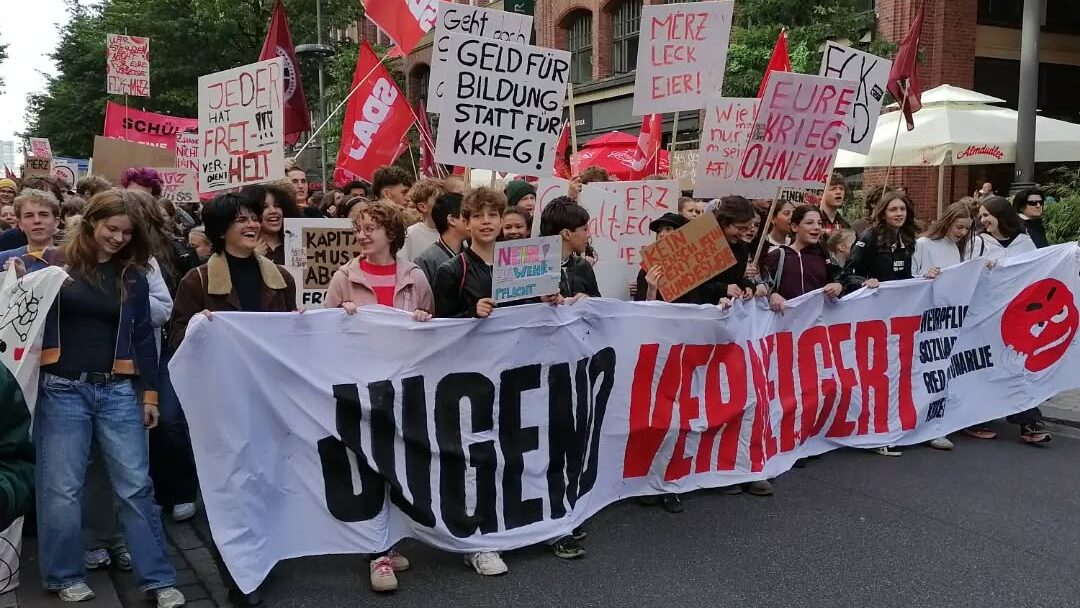
German students say ‘we don’t want to go to war’

Thousands of students across Germany were once again on strike against conscription and militarization on Friday, September 25. Actions took place in at least 100 localities as young people demanded a sharp turn from the government’s chosen path.

“We don’t want to be forced into military service and we don’t want to go to war,” the students wrote in declaration after their last strike in May.

Read more: German students expand their strike against conscription and militarization to 150 cities

This is the fourth time students have exchanged classrooms for streets since the end of 2025. The mobilization has strengthened in resistance to the Merz administration’s plans to build the “strongest conventional army in Europe” – including by drawing more people into the Bundeswehr, the German armed forces.

While authorities insist military recruitment remains voluntary, students have warned of a clear tendency toward outright conscription. Local strike committees and activists also emphasized the widespread repression ahead of actions. This included scheduling of exams on strike days and locking-in students on school grounds, they pointed out.

Billions for the Bundeswehr, cuts for schools and youth services

Over recent months, the government has sent thousands of questionnaires to map voluntary interest in joining the armed forces. According to German media, the response has been underwhelming: tens of thousands of students have disclaimed no interest whatsoever. Not even a multi-million-euro budget allocated to promoting the army has been able to shake this opinion.

“They sell us war service as an ‘adventure’ while we know that what awaits us is coertion, humiliation, sexism, right-wing extremism, and racism,” the student declaration adds.

Instead of taking the message seriously, authorities recently advanced the implementation of medical checks among their targeted population, drawing further frustration from students.

“We don’t want compulsory questionnaires, fines, draft physical examinations, conscription assessment centres across the country, nor planned integration of the Federal Volunteer Service into military service,” they wrote. “These are means to prepare the reintroduction of the draft and thus another war originating from Germany.”

“In case of conscription, we’ll be trained as cannon fodder, forced into the trenches,” students added. “War costs us our lives, while corporations like Rheinmetall make record profits.”

Read more: Ulrike Eifler: ‘The workplace is a place where we have to fight against war’

Students on strike have expressed solidarity with other ongoing struggles against militarization and budget cuts. They stated they would join peace demonstrations planned for early October in Berlin and Stuttgart, as well as a trade union-backed mobilization against budget cuts on Saturday, September 26.

Their decision reflects the widespread understanding that youth and education services are among those impacted by this round of austerity. According to junge Welt, the federal ministry responsible for education will face close to €1 billion in cuts – while €140 billion will be made available for so-called defense in 2027.

“Every tank, every rocket we pay for with dilapidated schools and social cuts,” students remarked.

  •  

Commission promises to cut EU public procurement rulebook from 900 pages to 200

The European Commission wants to cut the EU’s public procurement rulebook from around 900 pages to 200, in a sweeping reform that aims to simplify tendering while giving governments greater scope to favour European economic and security interests, writes Catherine Feore.

Executive Vice-President Stéphane Séjourné held up the existing body of rules alongside its much slimmer replacement, to illustrate his point. 

“These here are the European rules which currently govern public procurement in Europe: 900 pages,” he said. “And this is what we are proposing today… down to 200 pages.”

The proposed Public Procurement Act would replace three EU procurement directives with a single regulation, with a view to simplifying procurement provisions spread across 26 sectoral laws and cutting the number of procedures from five to three.

The Commission estimates the changes could save businesses and public authorities €650 million a year in administrative costs.

The reform matters because of Europe’s massive purchasing power involved. EU public procurement exceeds €2.5 trillion annually, around 15% of EU GDP, covering everything from trains and hospitals to energy infrastructure, schools and IT systems.

From lowest price to strategic purchasing

The proposal is not just about cutting red tape. Brussels wants governments to use their purchasing power more strategically.

The Best Price-Quality Ratio would become the standard method for awarding contracts, with quality normally accounting for at least 30% of the assessment and 50% for labour-intensive contracts. Authorities could consider environmental and social performance, innovation, security and resilience alongside price.

The commitment to a so-called European preference has been tempered by the EU’s international commitments, but access can be restricted when a country doesn’t reciprocate market access. Restrictions could also be imposed where reliance on foreign suppliers creates security-of-supply dependencies or threatens EU economic security.

“European public money should, wherever possible, create jobs, investment and opportunities in Europe rather than filling the order books of our competitors,” Séjourné said.

Five procurement procedures would become three: open, dynamic and innovation procedures. Each would allow negotiation between buyers and bidders.

The Commission also plans an integrated EU digital procurement marketplace connecting national e-procurement platforms. A company registered through one connected system should be able to bid elsewhere in Europe without repeatedly submitting the same documentation. This is intended to reduce bureaucracy and tackle one of the current system's weaknesses: too little competition, particularly from SMEs and companies bidding across borders.

National, regional and local priorities may appreciate this flexibility in theory, but constrained budgets often mean that price will remain the bottom line for many. This legislation offers greater freedom in determining needs, but it remains to be seen what its impact will be.

PHOTO CREDIT: European Commission Executive Vice-President Stéphane Séjourné says the rules reduced from 900 pages to 200 pages © European Union

  •  

Von der Leyen vows to increase pressure on Russia after Leipzig attack

European Commission President Ursula von der Leyen and NATO Secretary General Mark Rutte Photographer: Dati Bendo © European Union
European Commission President Ursula von der Leyen said on Wednesday (2 September) that Europe and NATO would increase pressure on Russia after Germany attributed an attempted attack on cargo planes at Leipzig/Halle Airport to Moscow, calling the incident a “new escalation” on European Union soil, writes Catherine Feore.

“This was an attack using military-grade material, carried out by Russian operatives on European Union soil. We will not tolerate it,” von der Leyen said alongside NATO Secretary General Mark Rutte in Brussels.

The German government said on Tuesday (1 September) that its investigation and intelligence findings established Russian responsibility for the attempted attack at Leipzig/Halle Airport last month. Russia has denied responsibility.

The meeting took place as foreign ministers and the EU's High Representative for Common Foreign and Security Policy were meeting to discuss Russia and Ukraine among other issues.

“Had this attack succeeded, this would have resulted in enormous damage and possibly even loss of life,” von der Leyen said. “We stand in full solidarity with Germany.”

“If the intention was to make us think twice about supporting Ukraine, I can tell you it has only strengthened my resolve. Intimidation will not work.”

Von der Leyen said the Leipzig incident was part of a wider pattern of Russian activity confronting Europe, including airspace incursions, drones disrupting airports and interference with critical infrastructure.

“Leipzig marks a new escalation on European Union soil, directly attributed to Russia,” she said. 

Von der Leyen outlined three areas for a stepped-up European response: stronger protection of European infrastructure backed by additional sanctions on Russia, increased air-defence support for Ukraine, and an acceleration of Europe’s own defence build-up in close cooperation with NATO.

Infrastructure and sanctions

First, von der Leyen said Europe must strengthen the protection of infrastructure that could be targeted by Russian hybrid operations and be prepared to respond more quickly when attacks occur.

“We must treat our everyday infrastructure as frontline targets, and protect them accordingly,” she said.

The EU already has rapid response teams that can assist member states faced with such attacks, she said, arguing that Europe’s ability to prepare and respond would itself act as a deterrent.

Von der Leyen also said the EU was ready to intensify economic pressure on Moscow through sanctions. “Our sanctions have weakened Russia’s economy. We can use more sanctions and have them ready to impose as soon as such dangerous, life-threatening acts are attributed,” she said. “Every loophole Russia exploits is one we must close.”

European foreign ministers were discussing new listings in Ireland on Wednesday, she said, while the Commission was examining further ways to “cut deeper into Russia’s war chest”.

More air defence for Ukraine

Von der Leyen said her second priority was strengthening support for Ukraine, announcing that the EU had received a new request worth several billion euros for air-defence capabilities.

“Today, I can confirm that we have received a new payment request,” she said. “It is worth several billion euro, and would cover Ukraine’s air defenses, including the highly advanced PAC-3 Patriot air defense systems.”

Member states were considering the request, she said.

“I can say that it’s going in the right direction.”

Von der Leyen also pointed to European work with Ukraine on the FRIO project to develop anti-ballistic missile defences, as well as the EU’s €90 billion support loan.

“Since June, we have issued €8.5 billion for drones and missiles for Ukraine from this loan,” she said, adding that the funding could also be used to buy fighter aircraft from European industry.

Faster European defence build-up

Von der Leyen’s third priority was to accelerate Europe’s defence build-up alongside NATO, with air defence at the centre of the effort.

“Air defenses are critical,” she said. “We need a faster, more integrated alert system across Europe, and then we must intercept the threats faster.”

She pointed to the EU’s €800 billion defence investment plan, including €150 billion through the SAFE instrument, as a way for European countries to increase defence investment jointly.

“We are in a new era of European security,” von der Leyen said. “European investment in defense strengthens NATO and re-energizes our industrial base.”

Rutte backed von der Leyen’s assessment of the threat, saying Russia had become “increasingly reckless” as its war against Ukraine continued.

“We have seen more drones and missiles crossing into our airspace along our eastern flank, creating increased risk,” Rutte said.

“And we have also seen an increase in malign activities targeting our territory directly, whether it is fires set in factories producing defense equipment for Ukraine, or indeed the Russian hybrid attack in Leipzig.”

“The examples are many. The dangers Russia poses are clear,” he added.

Rutte said NATO was working “around the clock” to ensure it could protect its population and said Moscow would fail if it hoped attacks such as Leipzig would undermine Western backing for Kyiv.

“If Russia thinks we will be divided by the threat, or if they think we will be deterred from supporting Ukraine, they are mistaken,” he said. “Our unity is unshaken. Our support to Ukraine is clear.”

Rutte said NATO allies had agreed to provide at least €70 billion to support Ukraine this year and the same amount next year, with the EU loan forming a “crucial element” of that support.

The NATO chief also backed the push for additional air defence and increased defence production, saying higher spending had to translate into additional military capabilities and greater industrial capacity.

Von der Leyen said the EU and NATO would not be intimidated into reducing their support for Ukraine. “Europe and NATO will not just maintain our pressure on Russia; we will increase it,” she said. “We will not stop — not until Russia stops bombing and killing innocent children, men and women in Ukraine. We will continue, we will prevail, and we will deter anyone who attacks our freedom and our security.”

  •  
❌