“He’s here, he’s there, he’s every fucking where: Roy Kent, Roy Kent!” chants the loyal Richmond crowd in tribute to the captain of the struggling English football club at the heart of the TV series Ted Lasso. It seemed almost prophetic of what awaited Brett Goldstein, the 46-year-old actor who plays the gruff Kent. Since joining the hit Apple TV comedy’s main cast, having originally been hired only as a writer, he has gone from being virtually unknown outside the United Kingdom to starring in a romantic comedy with Jennifer Lopez, appearing alongside Harrison Ford in a television series, and becoming Marvel’s new Hercules.
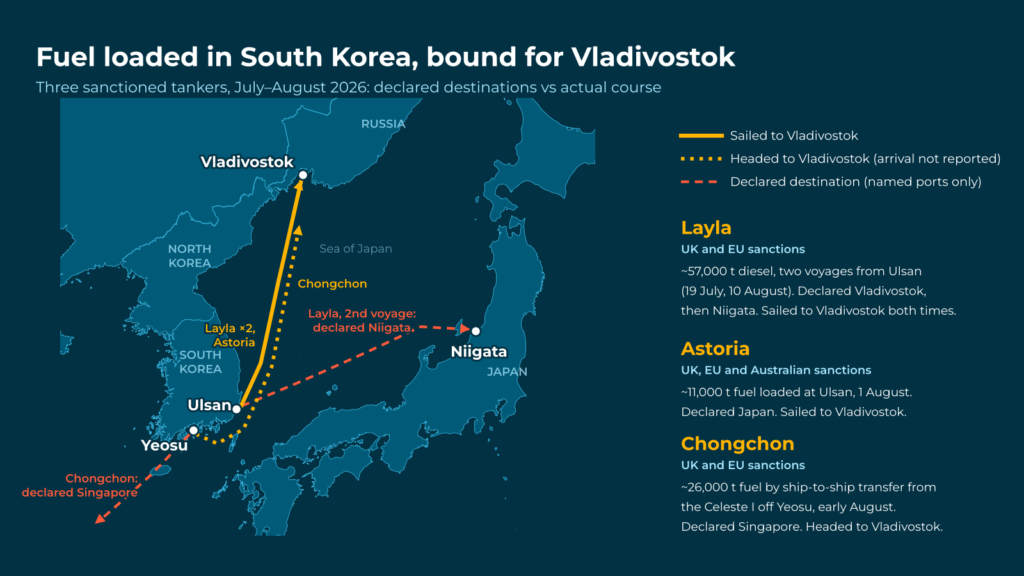
Seven tankers made 14 trips from South Korea to Russia's Far East in July and August, carrying more than 176,000 metric tons of fuel, most of it diesel, the Guardian found in a 6 October analysis of port records and ship-tracking data. The UK and EU have sanctioned three of the ships, and one loaded its fuel from another tanker at sea off South Korea instead of at a terminal.
Ukrainian strikes have cut Russia's fuel output as Moscow scrambles for supplies, while fuel loaded at South Korean ports has flowed to Russia. Loadings began to surge in July, the same month South Korean President Lee Jae-myung pledged $100 million for Ukraine's reconstruction, the Guardian reported. That creates a tension in Seoul's policy toward the war: South Korea has provided Ukraine with humanitarian and non-lethal aid but ruled out sending weapons directly, while the fuel trade appears legal under South Korean law even though three of the tankers are under UK and EU sanctions.
Russia imported 368,000 metric tons of oil products by sea in August, 112,000 of them from South Korea, according to Kpler data analyzed by the Centre for Research on Energy and Clean Air (CREA) and cited by the Guardian. CREA's own August report gives 172,000 metric tons in total, including 18,000 from South Korea. Neither explains the gap.
Where the tankers said they were going
The Layla, a tanker under UK and EU sanctions, made two voyages from Ulsan to Vladivostok, carrying a total of 57,000 metric tons of diesel. It left South Korea on 19 July and 10 August. On the first trip, it told South Korean authorities it was bound for Vladivostok; on the second, it declared Niigata, Japan, but sailed to Vladivostok again.
The Astoria, a Russian-flagged tanker under UK, EU, and Australian sanctions, loaded nearly 11,000 metric tons of fuel at Ulsan on 1 August. It declared Japan as its destination but sailed to Vladivostok.
The Chongchon did not berth at a South Korean port. Instead, it took about 26,000 metric tons of fuel from the unsanctioned Celeste I at an anchorage off Yeosu in early August. It declared Singapore as its destination but headed to Vladivostok. The owners and managers of the four tankers did not respond to the Guardian's requests for comment.
Source: Guardian analysis of port records and ship-tracking data; sanctions listings: OpenSanctions. Map: Euromaidan Press
Why Russia needs the fuel
Ukrainian drone strikes have severely disrupted Russia's refining capacity, the Guardian reported. In July, Ukraine's General Staff said the strikes had knocked out 42% of Russia's refining capacity, costing the industry billions of dollars.
Russian refinery throughput fell in June to its lowest level in more than 20 years, and diesel output is down nearly 30% from a year earlier, the International Energy Agency said, according to the Guardian.
Russia has also restricted fuel exports to protect domestic supplies, extending its diesel export ban until the end of October; on 2 October, Deputy Prime Minister Alexander Novak said Moscow could consider partially lifting the ban if there was overproduction, according to the Moscow Times.
Responses to the shipments
Seoul's non-lethal aid has included helmets, body armor, and demining vehicles, and in 2023 it pledged $2.3 billion in support, mostly in loans.
Isaac Levi, an analyst at CREA, told the Guardian:
"It is shocking that EU-sanctioned tankers loaded fuel at South Korean ports and carried it to Russia. This undermines the sanctions regime and South Korea's support for Ukraine."
South Korea's Foreign Ministry did not address the shipments or the sanctioned tankers. In a statement, it said the government supports international efforts to help end the war in Ukraine and bring about a peaceful recovery. The ministry said it was strictly enforcing its export controls and had expanded them to cover 1,402 non-strategic items with high potential for diversion to military use. The UK Foreign Office did not answer the Guardian's questions about UK-sanctioned tankers using South Korean ports, saying only that it remains committed to monitoring its sanctions.
Ties between Kyiv and Seoul are also strained over Ukraine's disclosure of its transfer of two North Korean prisoners of war to South Korea, which Seoul said should have remained private.
A Minor Hotels quer abrir “pelo menos dois ou três hotéis” na Comporta, vê oportunidades de expansão no Douro e procura levar a marca Anantara para Lisboa, revelou Laia Lahoz, diretora de ativos e desenvolvimento da Minor Hotels para a Europa e Américas, em entrevista ao TNews.
President Trump is facing low approval ratings, and voters are blaming him for rising costs. Republicans are likely to pay the price at the ballot box next month.
Spanish Prime Minister Pedro Sánchez announced a snap election for late November after two housing bills were defeated in a parliamentary vote on Friday, October 2. The bills came amid widespread mass mobilizations demanding urgent action on the country’s housing crisis, following the eviction of an 87-year-old woman in Madrid.
Hundreds of thousands of people took to the streets of approximately 50 cities over the weekend in support of these demands.
“It is true that there are still many injustices to correct, many social goals to achieve, and many problems to solve – above all in the areas of inequality, public services, and access to housing,” Sánchez said in his speech on Monday, as he appealed to voters to give progressive forces more decisive electoral support to allow them to implement reforms more easily.
Real estate speculation drives housing crisis
While Sánchez’s administration has profiled itself as one of the more progressive governments in Europe in terms of international policy, national movements remain frustrated by the lack of decisiveness it has approached making changes at home – including in housing policy.
For years, tenants unions have been warning against the different ways house-owners, particularly real estate speculation funds, have exacerbated housing insecurity for the general population.
Existing anger spilled over as Maricarmen Abascal, an elderly tenant in Madrid, faced eviction from the home she had lived in for 70 years. After the development company Urbagestión Desarrollo e Inversión SL acquired the house Abascal lived in, they imposed a 275% rent increase that she was not able to meet, leading, after a lengthy legal process, to her eviction at the end of last month.
The mobilizations that followed addressed a wider set of problems. “Maricarmen’s situation reflects a housing model that prioritizes real estate profits while abandoning the very people who built our neighborhoods over the decades,” Madrid Tenants’ Union (Sindicato de Inquilinas e Inquilinos de Madrid) warned.
“Most serious of all is that this situation cannot be understood without considering the weight of laws inherited from the Franco regime that denied women basic rights,” the union emphasized in May. “The original contract was signed solely by Maricarmen’s father because the legal system of the time rendered women invisible within the family. Had that same contract been signed today, both parents would have been named as holders, and Maricarmen would remain fully protected.”
“Yet an extremely restrictive interpretation of the regulations has ultimately weighed more heavily than social reality, than the desire to protect those who rent, and more than seventy years of roots in a neighborhood,” they added. “For the Madrid Tenants’ Union, the position is clear: no formalistic interpretation of the law can justify evicting an 87-year-old woman from the home where she has lived her entire life simply to boost the profitability of a real estate investment.”
Unions promise building general strike for housing
The protests formulated several demands to the government, including a ban on eviction of vulnerable tenants where alternative housing is not available; a limit to short-term and room rentals; a rent freeze; and an extension for contracts ending in 2026 and 2027.
Such demands were generally by the public, as well as by trade unions. “Housing and work are not separate struggles,” unions wrote, pledging to work towards a general strike for housing. “The rise in rents is a direct transfer of wealth from the working class to rentierism. Our wages end up, month after month, in the pockets of the rentiers who control our homes.”
The uproar pushed Sánchez’s government to reflect these demands in two bills it presented to parliament. Most considered this a significant breakthrough for the housing movement despite the official texts not fully corresponding to the protesters’ vocabulary and the vote taking place on two separate proposals.
Watered down or not, right-wing and far-right parties voted against both bills.
“We have a democracy held hostage by rentiers and speculators,” the progressive party Podemos wrote as protests rolled out over the weekend. “The housing mobilization must keep growing and move toward a general strike until the speculators and those who defend them in the institutions have nowhere left to hide.”
“Between now and November 29, the voices of all of us who want peace must be heard,” Irene Montero from Podemos added after the snap election announcement. “Those of us who want our sons and daughters to avoid war and to have healthcare and education, instead of money being spent on weapons; who want homes to live in; who want jobs and time to spend with our loved ones; and who want the cost of living to go down.”
Quer receber os textos desta coluna em primeira mão no seu e-mail? Assine a newsletter Xeque na Democracia, enviada toda segunda-feira, 12h. Para receber as próximas edições, inscreva-se aqui.
O Brasil que sai do primeiro turno está flertando com uma crise institucional permanente. Flávio Bolsonaro teve 2,2 milhões de votos a mais que Lula, ficando em 47% dos votos versus 45,1% do atual presidente. Se eleito, Flávio teria uma bancada de 28 nomes no Senado e 121 na Câmara dos Deputados apenas do PL, seu partido, um desempenho histórico.
Mas Flávio Bolsonaro é um candidato com muitos esqueletos no armário. Está enredado em vários escândalos e corrupção dos quais, hoje, conseguimos ter apenas um vislumbre, mas que vão se aprofundar nos próximos meses. E isso levará necessariamente a um governo maculado por revelações do seu primeiro ao seu último dia.
A jornalista Flávia de Oliveira chamou a atenção para o fato de que, por conta da ação deAndré Mendonçade manter sigilo do caso Master, Flávio é o único candidato investigado por corrupção, lavagem de dinheiro e evasão de divisas – e o eleitor não foi informado disso a tempo.
Mesmo que você esteja acompanhando as notícias, é possível que tenha perdido as revelações mais recentes.
Pois vamos a elas.
Primeiro, as rachadinhas, esquema de desvio de verba pública dos mandatos de Jair Bolsonaro e seus filhos através de saques em dinheiro vivo de funcionários, que depois repassavam à família, das quais Flávio sempre foi figura central. O resultado foi demonstrado há alguns anos pelos jornalistas Juliana Dal Piva e Thiago Herdy: 51 imóveis dos Bolsonaro foram pagos parcialmente em dinheiro vivo. O processo judicial das rachadinhas foi extinto pelo STJ, que questionou a quebra de sigilo fiscal, mas as evidências existem e podem gerar novas investigações.
Segundo, vamos ao caso Master. Ainda hoje sabe-se apenas parcialmente sobre a relação entre Flávio e Daniel Vorcaro. Além do financiamento generoso do filmeDark Horsee dos muitos diálogos resgatados do celular de Vorcaro, não sabemos qual o valor real dos depósitos, que tipo de dinheiro criminoso foi usado para o pagamento pela empresa Entre Investimentos, que lavava inclusive dinheiro para o crime organizado, e nem para que fim o dinheiro foi usado nos EUA. Não se sabe, ainda, que outros favores e apoios foram prestados pelo banqueiro para Flávio – com quem ele tinha uma relação de amizade, segundo demonstram os diálogos completos publicados pela revistapiauí: são 50 mensagens de Flávio, 46 de Vorcaro e 14 ligações – oito delas atendidas. Sempre se tratando como “irmãos”, Flávio chegou a oferecer a Vorcaro uma reunião com Eduardo Bolsonaro em Dubai em novembro do ano passado: “Tá precisando de algo lá? Peço pra ele te encontrar”. Além disso, jantares, cafés da manhã e muitas ligações organizadas entre os dois.
A mesma revista revelou, ainda, que Flávio e Vorcaro viajaram para Fort Lauderdale, na Flórida, no feriado prolongado de 1º de maio de 2025, tendo passado 3 dias ao mesmo tempo no balneário, apenas dias depois do primeiro depósito de Vorcaro para o filme Dark Horse. É provável que tenham passado e celebrado juntos em uma das famosas festas de Vorcaro nestes três dias. Ainda não sabemos até onde foi essa relação.
Terceiro, a ligação próxima com o “Careca de INSS”. Comorevelouo ICL, Flávio tem uma empresa de capacetes que está registrada no mesmo lugar de empresas do operador financeiro do esquema que desviava verba dos aposentados e causou prejuízo de R$ 2 bilhões aos cofres públicos. Além de usar o mesmo escritório, a empresa de Flávio usava a mesma contabilidade de Antonio Carlos Camilo Antunes, mais conhecido como “Careca do INSS”, atualmente preso.
Quarto, os indícios de corrupção na gestão de hospitais públicos no Rio de Janeiro, inclusive durante a pandemia de Covid. Em uma reportagem bastante detalhada aqui na Agência Pública, mostramos como Flávio comandava as decisões administrativas e indicações para a gestão dos hospitais federais durante a epidemia. Há diversos indícios de superfaturamento e má conduta em diversos destes hospitais, segundo investigações do TCU e outros órgãos. Esta história está só no começo.
Quinto, a figura do advogado Willer Tomáz começa a aparecer como uma sombra sobre o passado de Flávio. O advogado já foi descrito como amigo de Flávio pelo próprio, viajou com ele para um safári na África do Sul e usou o jatinho de Willer em sociedade com Daniel Vorcaro. Willer Tomaz atualmente é investigado pela PF depois de iniciar um processo judicial no qual alega que apostou R$ 6,6 bilhões na bet Blaze por “ludopatia” e tenta recuperar R$ 163 milhões.
Sexto, possível lobby junto ao ministro do STF Kassio Nunes, um expediente descrito por Rodrigo Rangel na sua reportagem sobre a relação de Flávio Bolsonaro com Alexandre Ferreira Dias Santini, ex-sócio seu na fábrica da Kopenhagen, publicado no site Platô. Nas palavras do jornalista, Flávio era um “resolvedor-geral da República” durante o governo de Jair Bolsonaro e teria recebido mimos por isso, incluindo um rolex de 300 mil reais. Rangel é uma das pessoas em Brasília que tem muito mais documentos sobre a relação de Flávio e o ex-sócio, mas não o único. Dentre o material descrito na reportagem estão notas fiscais, relatos, fotos “impublicáveis” de Flávio em orgias com o ex-sócio, segundo descrito na reportagem. Mais gente tem esses documentos – eles vão acabar vindo à tona.
Se for eleito, Flávio Bolsonaro terá as investigações do caso Master suspensas, segundo análise do Jota. Mas o jornalismo investigativo continuará a fazer o seu papel.
Temos um presidente maculado por corrupção e escândalos variados antes mesmo de pisar no Palácio do Planalto. Não há bancada forte que segure o impacto disto sobre a opinião pública. Além disso, vale lembrar, a liderança de Flávio é contestada mesmo dentro das fileiras do Bolsonarismo. A bancada eleita tem sua agenda própria e desafetos variados que não vão tardar a aparecer.
Portanto, esta coluna é um aviso. Se o Brasil eleger Flávio Bolsonaro, não estamos flertando apenas com um governo de viés autoritário, mas com um governo que será maculado por escândalos e turbulências, assombrado por ex-sócios, fotos e vídeos “impublicáveis”, e que para se manter no poder só terá o caminho de chafurdar-se mais ainda na lama e perseguir a imprensa e os oponentes – como fez Trump nos EUA.
Para quem busca “estabilidade”, “previsibilidade” e “segurança fiscal”: está dado o recado.
Il presidente del governo spagnolo, Pedro Sánchez, ha annunciato dal palazzo della Moncloa le elezioni anticipate per il 29 novembre. Il leader del PSOE (Partito Socialista) ha riconosciuto che il governo ha “commesso errori” e non è riuscito a realizzare tutto ciò che si era prefissato ma ha invitato i cittadini a mettersi “dalla parte […]
A decade ago, Partridge was a lifestyle blogger and social justice evangelical entrepreneur who had been “saved from success.” In 2015, he gave a TEDx talk called “How to Value People over Profits” based on his book of the same title. His most controversial view was that yoga pants are sinful. In recent years, Partridge, who has more... Continue Reading
No espaço público e mediático, o tratamento do sistema prisional português tende a ser tratado pelo ângulo dos «abusos» e do que terá corrido mal para se verificarem condições penitenciárias «degradantes» ou até doença e morte. Mas quais as características estruturais que produzem estas condições, e o que dizem elas sobre desigualdades sistémicas que as democracias não resolveram? «As prisões têm olhos e ouvidos, mas não têm vozes» Mumia Abu Jamal, jornalista aprisionado nos Estados (…)
Mária Bieliková began studying computer science before the World Wide Web was launched from CERN in 1989. She has lived through the development of programming from punch cards, which stored instructions for computers, to large language models, which allows almost anyone to write basic code.
Mária Bieliková founded the Kempelen Institute of Intelligent Technologies which she leads. She previously served as dean of the Faculty of Informatics and Information Technologies at the Slovak University of Technology in Bratislava.
Bieliková explained how artificial intelligence is set to affect women’s in the coming years.
“Studies predict women will be worse off in the labour market due to AI,” she said, while claiming such drawbacks also come with opportunities.
Do you think artificial intelligence can end humanity? And is that a tired question, or do you find it relevant?
This question needs to be answered patiently and sometimes with a smile, because nobody knows. Often it is just speculation, and there are many more immediate problems that we need to address.
It is true that AI is unlike other the technologies we have known so far and so were steam engines. But AI is fundamentally different. Still, I believe that if anything destroys us, it will be people. I am more afraid of those who use any technology carelessly, or those who do not take care to avoid hurting the planet. But I do not see a doomsday scenario where AI end the world. After all, our planet is very resilient.
AI research and development is largely in private hands. When you said you were afraid of people, did you mean specific individuals?
I did not mean specific people, but types of people who hold incredible power through technology and the data they hold about us. So for example, I fear for democracy. It is a system that evolved alongside society in a series of twists and turns since the days of ancient Greece, and we have come a long way since then. Democracy still has weaknesses, but so far we have not devised a better tool.
Yet the ability of AI to influence elections undermines a fundamental principle of democracy. Data administrators who nobody elected have suddenly become very powerful. And elected officials often follow and support tech titans. Technology is transforming geopolitics, and this could have serious consequence concerning us all; these are not mere political games played by those in power.
Experts warn thatdisinformation campaigns and deepfake videos generated by artificial intelligence, which can be easily made, will flood our online spaces. What can individuals do about this?
If I knew what an individual could do to resolve these problems, I would go and do it. But action should come from both the government and individual.
But we should not rely on someone at the top to change everything. Indeed, we determine the outcome of elections, but the major problem is we are being influenced and manipulated in entirely new ways. And many politicians lack the will to protect us from that. The only way to prevent being manipulated is for us as individuals to inform ourselves.
In the past, when someone said something publicly, we usually believed it. It is uncomfortable, but we will have to change how we trust. We cannot believe things automatically; we must demand trustworthy sources for every claim.
A good place to look is towards media outlets that we know verify information diligently – a layman cannot do so with all information they stumble upon.
Mária Bieliková said that in the age of artificial intelligence, we must change how we believe information. Source: Tomáš Hrivňák, Denník N
Other concerns linked to artificial intelligence include how much control we give it, whether our data is safe, and the environmental burden it creates. Are there other “landmines” ordinary people have not noticed?
We live in a society where we cannot trust everyone. Human nature is such that, say, 90 percent of people consciously or subconsciously act in their own interest. I do not mean to condone stealing or cheating, of course, but it is clear to me that people will act in their own interest.
This brings me again to democracy, a vital tool which needs to be protected. Without checks and balances, which AI can undermine, democracy is at risk.
The last thing I asked a chatbot was what I should pack on holiday. Do you ever talk to them about everyday matters, or do you avoid this so as to avoid sharing data about yourself?
This article continues, but the full version is available only to EUobserver.com subscribers. Visit account.euobserver.com/membership
On Thursday, October 1, health workers, patients, and activists protested Palantir’s role in the National Health Service (NHS) at more than 40 locations across England. Their demonstrations were part of a global week of action demanding that governments cut ties with the spy-tech firm over human rights and privacy concerns.
Rallies took place in front of Palantir’s London headquarters, as well as in Liverpool, Manchester, Newcastle, Sheffield and many more cities.
“Palantir’s tools are used by the Israeli military in Gaza and by ICE to track and surveil migrants in the US,” campaign groups – including Just Treatment, Health Workers for a Free Palestine, Medact, and Global Justice Now – stated. “A company profiting from human rights violations has no place in the NHS or in any of our public services.”
Palantir’s track record opposes core health values
Palantir currently holds a £330 million (approximately USD 436 million) NHS contract and has rolled out the service’s Federated Data Platform (FDP), managing sensitive patient data. The project has drawn criticism from virtually every group involved in the NHS: data workers say it lags behind local systems; patients share privacy and data ownership fears; and health workers insist Palantir’s record opposes the very values their profession embodies.
“I cannot stay true to that [Hippocratic] oath and tolerate Palantir continuing to profit from, and grow its malign business model through an NHS contract,” said physician Rhiannon Osborne from Medact at Thursday’s rally. “Every pound we give them helps to legitimize and sustain human rights abuses and erosion of democratic rule of law across the world.”
A central concern is the company’s support for Israel throughout the genocide in Gaza. “When we strive to save every possible life, they champion their ability to kill and celebrate their role in the repeated war crimes committed by Israel – including unprecedented deliberate attacks on the doctors, nurses, and paramedics I worked with,” pediatric neurologist Omar Abdel-Mannan stated. “No moral government should tolerate their involvement in our NHS or indeed any of our public services.”
Campaigners repeated calls for Prime Minister Andy Burnham to end the contract as soon as possible. Under an exit clause in the original agreement, that moment could arrive as early as February 2027. Campaigners and several commissions are pressing the government to notify Palantir of its intention to withdraw ahead of this date.
“The government only has two months to say no to Palantir and the momentum is all with us,” Good Law Project activists said at the rally in London. “All the energy is to say no to Palantir, say no to their global human rights abuses, say no to their crap technology that doesn’t work and get Palantir out of the NHS.”
Unions back appeal to bar Palantir from public sector contracts
Calls to break Palantir’s grip on public services resonate beyond Britain. On September 28, more than 120 groups and unions called upon European governments and the European Commission to “scrap all existing public sector contracts with the US tech company Palantir.” As reported by the European Federation of Public Service Unions (EPSU), the appeal seeks to end current agreements and bar the firm from future public contracts. It also urges governments to develop “alternative data solutions compatible with public service,” echoing NHS data workers’ recommendations.
“Palantir’s ramping up of ‘war-related’ support for Israel during the genocide in Gaza and the apparent disdain of its leadership for democracy are just two clear signs that this company serves the interests of the rich and powerful, not the general public,” said Tim Bierley of Global Justice Now. “Yet it has been allowed to embed dubious technologies across our public services, giving it access to sensitive data and creating worrying new technical dependencies.”
“The UK must work with other countries to end dependence on companies involved in human rights abuses, and end the outsourcing of the public sphere to a dangerous class of big tech oligarchs.”
People’s Health Dispatchis a monthly bulletin published by thePeople’s Health MovementandPeoples Dispatch. For more articles and subscription to People’s Health Dispatch, clickhere.
UNGUJA, Tanzania — Decades before they would partner to build a marine conservation organization together, Ali Thani and Lorna Slade crossed paths in Tanzania. Years later, Slade returned to the East African country researching tourism for her master’s degree when she became involved in an initiative aimed at strengthening the knowledge and rights of local resource stewards. Then came the 2008 global financial crisis. The organization backing the initiative withdrew from Tanzania, providing only a fraction of the funds it had earlier promised — $25,000 — and an idea worth pursuing. “So they said, ‘OK, well, it’s a good idea. We have $25,000, so here you are,’” Slade recalls. That modest beginning would eventually become the Mwambao Coastal Community Network, a locally rooted organization now working with coastal communities across Zanzibar and mainland Tanzania, with an annual budget of around $3.5 million. For Thani, a coastal Tanzanian who had worked in government and with larger conservation organizations, Mwambao grew from a conviction that conservation could not simply be designed elsewhere and brought to communities. People who depend on natural resources, he says, should have the knowledge, capacity, and authority to help manage them. That idea has wider resonance as countries pursue the global goal of conserving 30% of the world’s land and oceans by 2030. Local organizations and communities are expected to shoulder much of that work, even as many struggle to secure the long-term funding available to larger international organizations and intermediaries. Mwambao’s work includes supporting community fisheries management,…This article was originally published on Mongabay
African leaders called last week for a greater role in setting global standards for artificial intelligence. Their statements at the United Nations came amid warnings from Silicon Valley executives about...
Since Sunday, September 27, residents of Garvaghy Road in Portadown have prevented the Orange Order’s Drumcree march from passing through their community. Linking arms, locals and supporters warned that the parade could undo years of progress against sectarian violence in the north of Ireland.
More than 4,000 people signed petitions opposing the march, yet authorities formally allowed it to move ahead. First, the Parades Commission approved a limited procession. Then, the Court of Appeal lifted an injunction imposed by the High Court, paving the way for the march attempt on Sunday.
Negotiations to end the stand-off continued Thursday evening. According to local media, an earlier proposal suggested residents would accept the Orange Order’s legal right to walk down the road in return for the Order choosing not to march. The organization rejected the deal, insisting on passing through the neighborhood.
Stand-offs at Drumcree previously used to launch loyalist attacks
Recent events carry particular weight because of Drumcree’s history. During the Troubles, loyalist stand-offs in the area became a notable flash point of violence, with effects rippling out beyond Portadown. Following the Good Friday Agreement, the march had been rerouted for almost 30 years.
“The Orange Order organized stand-offs at Drumcree (particularly in 1995, 1996, 1997 and 1998) were regularly used by unionist death squads as a rallying cry and pretext to launch attacks, block roads, and intimidate Catholic families,” Garvaghy Road Residents Coalition spokesperson Breandán Mac Cionnaith wrote in August. “At least ten murders were carried out in Portadown and other areas during this period by those same death squads.”
Speaking to the People Before Profit party, Mac Cionnaith emphasized that the march had been rerouted because of the devastation it unleashed. “I always make a point that people need to remember that between 1996 and 1999, 21 people lost their lives across the north because of killings and murders carried out by loyalists acting in support of Drumcree,” he said. “Several of those victims were our neighbors, they were our friends, they lived in this community.”
Past decades gave the Garvaghy Road community a chance to rebuild, yet the memory of the violence was passed on through generations. “My family moved to England to escape the viciously sectarian climate around the marches,” one resident said. “My aunt went to school with Robert Hamill, a young man kicked to death by loyalists in the midst of the marches.”
“For 28 years, the Garvaghy Road community has lived in peace,” wrote Chris Hazzard of Sinn Féin. “That peace didn’t need a solution – it needed protection. Forcing an unwanted, sectarian march through this area defies all logic.”
“Why did the Orange Order want to march down a Catholic community?”, asked Sinn Féin’s Vice President and First Minister of Northern Ireland Michelle O’Neill. “It’s about supremacy, it’s about domination, it’s about ‘we’re in charge,’ and this community deserve better than that.”
“There is no going back, we’re not going back to the days of the past. What I want is to build upon the progress that’s been made over the last 28 years. What I want to do is actually ensure that we continue to let this community to flourish. Right now, what this community is being told by the Orange Order and political unionism is that they’re second class citizens and that their rights can be railroaded over.”
Solidarity messages from as far as Palestine
Progressive organizations, parties, musicians and artists across Ireland have voiced support for Garvaghy Road, many joining protesters in Portadown to warn against the standoff’s possible ripple effects. “The Garvaghy Road community is still living with the legacy of traumatic street conflict and state violence stretching back decades,” the Irish Republican Socialist Party wrote. “This latest attempt by the Orange order is merely a continuation of that conflict.”
Messages of solidarity arrived from as far as Palestine, where a Gazan teenager wrote in support of Garvaghy Road residents. “I know what it feels like when basic peace and dignity are stripped away, and how painful it is to fight for safety in your own home,” she emphasized. “The residents of Garvaghy Road deserve to live in peace without fear or intimidation, just as every family in Gaza does.”
Here’s how the IRA lost the last war All wars are different. But perhaps there are lessons to be learned from the previous civil war? The most important thing to learn is how we can avoid another civil war. No offence to any of the tens of thousands who at great personal risk and inconvenience...
NEW YORK — Long before Dickson Kaelo became one of the leading voices for community conservancies in Kenya, conservation was something much more personal. He grew up with livestock. His father was a veterinarian. And he knew firsthand the uneasy relationship between pastoralist communities and wildlife: Lions killing cattle, elephants destroying crops, hyenas taking goats — sometimes dozens of sheep in a single night. “That’s their (communities’) food. That’s what they sell to get fees to take their children (to school),” Kaelo, a member of Kenya’s semi-nomadic pastoralist Maasai community, told Mongabay. Fresh from college nearly three decades ago, Kaelo began wondering whether there was another way, something between conflict with wildlife and a conservation model that excluded communities from protected areas. Working with elders near the northern Maasai Mara, he helped organize a community trust (an organization created by community members to collectively manage land, resources or revenues for their shared benefit) in 1998. It built dams and dispensaries, supported hundreds of students through scholarships and experimented with generating tourism income while keeping livestock on the landscape. Then it fell apart. While Kaelo was away studying wildlife, the land under the care of the trust was subdivided into individual holdings. He considered abandoning conservation altogether. “One part of me was saying, it’s time to give up and go out to the city and do something,” he recalled. Instead, Kaelo returned to the same landscape with a belief that land could be privately owned but still managed collectively. Between 2004…This article was originally published on Mongabay
As vendas da MSC Cruzeiros em Portugal para 2027 estão atualmente mais de 12% acima do registado no mesmo período do ano passado, num contexto em que a companhia observa uma maior antecipação das reservas por parte dos portugueses.
More rearmament talks are underway in Brussels as European politicians continue building an increasingly tense anti-Russian discourse. On Wednesday, September 30, defense ministers and industry representatives joined the Euronews Defense and Space Summit, focusing on the bloc’s growing defense expenditure and member cooperation.
The summit took place after weeks of allegations of hybrid attacks on EU members, which pushed the already tense rearmament narrative permeating the European political establishment up a couple more notches. It also followed, by only a couple of days, the Council of the EU’s announcement of the next phase of five European Defense Projects of Common Interest (EDPCIs) – projects that “allow EU countries to work together on major defense initiatives that are too large or too complex for individual countries to develop on their own.”
While separate, the two events shared several points in common, starting with a focus on increasing coordination between EU countries to arm more efficiently – and spend the billions of euros planned for defense over the coming years. They also emphasized sections of the military sector to receive the most attention – including drones and military capacities in Eastern Europe.
This geographical focus goes beyond EU members, expanding to – at least – Ukraine and Moldova. Most EDPCIs – like the Drone and Counter-Drone European Resolve (DECODER) and the Eastern Flank Watch – list Ukraine as a partner. Ukrainian arms entrepreneurs were also present at the summit in Brussels, including leading figures from Fire Point, one of the country’s most prominent arms companies.
Very imminent investments into arms
While NATO Secretary General Mark Rutte stated in his summit intervention that there is “no imminent danger” to the alliance members’ territories, he and others did not hold back in offering anticipations of an unstable period.
Belgian Minister of Defense Theo Francken, for one, anticipated “more hybrid threat actions” and an overall “dark winter for Europe” – a scenario he seems to want to address by spending more on arms and cutting social services, as he has explicitly stated on numerous occasions.
“Europe has been very good in investing in soft power, in social security,” Francken said. “And it’s beautiful to have a pension system, to have social welfare systems when someone gets sick, when somebody loses his job – we have everything. But when there’s a war or there’s hybrid threats, we don’t have anything.”
Considering the significant amount of money European countries have already invested into armament, his assessment that “we don’t have anything” is inaccurate at best.
It also remains contested on a regular basis on the streets of many European cities, where trade unions, students, and peace movements continue to protest against austerity budgets that aim to provide for war.
Europe needs a policy that builds security with its neighbors
In addition to large-scale demonstrations against social security and labor cuts in France’s proposed 2027 budget and student strikes against conscription in Germany last week, mobilizations are expected to grow over the coming months – including an international youth strike in November.
“We reject the militarization of our societies and support the young people who are refusing it,” the Stop ReArm Europe coalition wrote on September 23. “Thousands of high school students and university students across Europe are rising up to refuse militarization and the return of conscription.”
“Nearly 20 million children in the EU – one in four – live at risk of poverty or social exclusion,” the group added. “Meanwhile, governments have committed to military spending that the EU’s own Defense Commissioner, Andrius Kubilius, puts at €7 trillion by 2035.”
“The trillions earmarked for militarized security will leave us staring down the barrel of a gun and indebted to global financiers,” Stop ReArm wrote, calling for a solidarity- and care-based alternative. “This must go hand in hand with a non-aligned foreign policy that resolves conflicts through diplomacy, upholds international law and human rights, and builds common security for all: security with our neighbors, not against them.”
Albania's Adriatic coast, concrete-free until now, is beginning to suffer from tourism-led development. Winning political support for projects seems to be easy – especially if your name is Trump.

 Login