❌

Reading view

Israel expands “incitement” charge to target Palestinian education and memory

Palestinian Information Center – October 6, 2026

RAMALLAH – The Palestinian Prisoner Society (PPS) has warned that Israel is expanding its use of the charge of “incitement” into a tool for controlling education, expression and collective memory in Palestinian institutions.

The warning followed the recent arrest of a school principal in al-Eizariya and the demolition of a martyrs’ memorial at Birzeit University on Monday. The PPS said both incidents reflect a wider policy targeting spaces where Palestinian awareness is shaped and where the memory of prisoners, martyrs and national symbols is preserved and passed to new generations.

According to the society, prosecutions under the label of “incitement” are no longer limited to social media posts or personal statements. They now extend to educational content and symbols inside institutions, placing schools and universities under direct threat of surveillance and punishment.

In the al-Eizariya case, the PPS said a video circulated after the principal’s arrest presented posters inside the school and what students were being taught as part of what Israel described as “incitement” and “terrorist education.”

The society warned that such measures turn the educational environment itself into a target, criminalizing the presence of Palestinian national issues in school materials, symbols or discussions.

It said the vague and expanding definition of “incitement” leaves individuals and institutions under constant threat, pushing Palestinians to monitor their own speech, activities and teaching material out of fear of punishment.

The group also pointed to a rise in arrests linked to alleged “incitement” since the start of the war on Gaza. It said the arrests have affected citizens, freed prisoners, students, women and children, often over posts, expressions or positions related to current events.

At Birzeit University, the demolition of a martyr’s memorial was part of the same effort to target Palestinian memory and its symbols, the PPS said, adding that the incident narrows spaces where the national narrative is remembered and expressed.

The society elaborated that these policies go beyond arrest and include threats, interrogation, assault, penalties and fines, creating an environment of continuous surveillance.

It warned that “incitement” is being used to determine what Palestinians may say, teach, publish or remember, particularly among younger generations. The danger, it said, extends beyond individual freedoms to the ability of Palestinian society to teach its history, preserve its symbols and express its rights under threat of punishment.

  •  

Paris bans pro-Palestinian demonstration planned for Oct. 7 over ‘risks of public disorder’

MEMO | October 6, 2026

Paris police chief Patrice Faure on Tuesday banned a pro-Palestinian demonstration planned for Wednesday, the third anniversary of Oct. 7, 2023 attacks in Israel, over “risks of public disorder,” Anadolu reports.

“At the request of Interior Minister Laurent Nunez, I issued an order banning a demonstration ‘against the genocide in Gaza and for respect for the ceasefire’ in Paris on Wednesday,” Faure said on US social media platform X.

He noted that such a demonstration could pose “significant risks of public disorder,” citing a “high terrorist threat” and antisemitic acts that “remain at historically high levels” across France.

“In light of this, and in view of all the risks identified, it is my responsibility to ensure everyone’s safety. I have therefore decided to ban this demonstration,” Faure added.

Israel’s genocidal war launched three years ago in Gaza has killed more than 74,000 people, injured many more and destroyed most of the enclave’s infrastructure.

  •  

« Fear porn » : comment Londres entraîne les médias occidentaux dans sa chute

L’arrestation d’Ian Proud par la police secrète à l’aéroport de Londres marque un nouveau plus bas dans la mesure où l’État profond peut aller pour contrôler un faux récit.  

L’arrestation d’Ian Proud par la police secrète à l’aéroport de Londres marque un nouveau plus bas dans la mesure où l’État profond peut aller pour contrôler un faux récit. Mais cela montre aussi un nouveau niveau de peur.

Aussi fou que cela puisse paraître, il semble bien que les nations d’Europe occidentale, du moins, se préparent à entrer en guerre contre la Russie à un moment donné dans un avenir pas trop lointain. Ce qui est particulièrement inquiétant, c’est qu’il semble y avoir un vide distinct dans tous les domaines de ce que nous pourrions appeler largement les « médias » pour remettre en question ce récit. Il y a trente ans, il était considéré comme normal que les journalistes soient la source de questions embarrassantes envers les acteurs étatiques et soient généralement une épine dans le pied, puisqu’ils remettaient en question chaque décision prise et chaque idée présentée. Notre travail était d’être anti-establishment et d’adopter un point de vue très cynique sur la « politique ». Cela n’avait rien de remarquable. C’était ce que nous faisions. Être méprisé par les grandes puissances faisait partie du travail ; travailler à des heures antisociales et avoir peu d’amis en faisait aussi partie.

Aujourd’hui, il n’y a plus de journalistes dans ce que nous appelons les médias « grand public » pour faire cela. Ils ont été remplacés par des « créateurs de contenu » plus jeunes, plus habiles avec les réseaux sociaux, qui croient que le journalisme est plus ou moins un rôle grammatical, où la matière première vous est remise avec toutes les informations qu’elle contient, et où le rôle du journaliste est simplement de la raffiner au style du jour pour la consommation de masse.

Le danger de cette transition est que presque tout ce qui nous est présenté comme des nouvelles est en réalité faux, ou au mieux lourdement expurgé pour maintenir les masses là où l’élite veut qu’elles soient : contenues, préparées et mal informées.

La guerre en Ukraine en est un excellent exemple. La principale raison pour laquelle les populations aux États-Unis et au Royaume-Uni sont si fabuleusement biaisées contre la Russie et si sympathiques à l’égard de l’élite corrompue de Kiev est que, pendant des années, elles ont été lavées le cerveau avec des « nouvelles » sur la Russie qui étaient négatives et qui alimentaient astucieusement un préjugé raciste – un préjugé cultivé depuis au moins une décennie, sinon plus. Le résultat est qu’aujourd’hui un certain nombre de mensonges sont devenus établis dans les salles de rédaction, où les journalistes, même ceux qui savent, contournent simplement les nuances et présentent une histoire de conte de fées, conçue pour être comprise par les masses qui n’ont pas d’autres sources d’information pour même la remettre en question.

Tout récemment, des médias occidentaux ont rapporté une « peste » en Russie, avec des histoires de « confinement », à la suite du cas d’un travailleur dans un laboratoire mort d’une pneumonie dans des circonstances encore incertaines. Les médias occidentaux, dans le cadre de leur rôle consistant à maintenir la russophobie à son apogée, sont si verrouillés et chargés que leurs réactions « à la gâchette facile » aux mauvaises nouvelles venant de Russie sont compréhensibles. Ils sont aussi avides de contenu accrocheur, et de telles histoires nourrissent un public affamé qui a déjà eu sa première dose de ce genre d’histoires d’hystérie COVID et qui en veut davantage. La vérité est totalement immatérielle. L’hystérie et les mensonges sont ce qui est injecté à un rythme fébrile par des « créateurs de contenu » aux dents et aux griffes rouges, l’écume à la bouche dans leur désir de servir l’État profond et les élites qui ont tant investi dans un agenda.

Le contraste entre la Russie et l’Occident est intéressant, cependant, lorsque nous examinons les médias. Tout récemment en Russie, le correspondant de la BBC basé à Moscou a fait vibrer Internet sur les réseaux sociaux avec sa courte interview du ministre russe des Affaires étrangères, qui a eu la gentillesse de répondre à sa question orientée sur l’idéologie de guerre de la Russie avec l’Ukraine. Ce que absolument personne n’a relevé, c’est à quel point la Russie est heureuse d’accueillir des journalistes étrangers qui ont un agenda si distinct pour alimenter la russophobie chez eux, tandis que les journalistes russes sont interdits dans ces capitales de l’UE depuis des années. La vieille Europe, qui tenait autrefois si cher des valeurs comme la liberté de la presse, a adopté le modèle soviétique, tandis que la Russie est en réalité plus avancée en ce qui concerne ces principes de ce que nous attendons dans une démocratie. La Russie n’a pas peur des questions embarrassantes, contrairement à l’Occident.

Nous devrions nous demander qui bénéficie réellement d’une guerre avec la Russie.

Est-ce trop sceptique et « théoriste du complot » de supposer que le complexe militaro-industriel a fait du lobbying avec succès pour une telle guerre pendant AU MOINS une décennie et, surtout, qu’il a réussi à convaincre l’establishment du renseignement et de l’armée au Royaume-Uni d’utiliser son levier sur les médias pour fournir aux journalistes la matière première qui renforce un préjugé contre la Russie ?

Normalement, une telle idée pourrait être rejetée comme pure absurdité. Mais considérez simplement jusqu’où le Royaume-Uni, par exemple, est allé pour éradiquer toute couverture médiatique pouvant être considérée comme au moins favorable à la Russie – ou même simplement pour tenir le gouvernement britannique responsable en posant les questions que les journalistes britanniques ont cessé de poser. Si l’élite au Royaume-Uni qui contrôle les journaux déficitaires (réfléchissez-y) est si sûre de sa logique selon laquelle la Russie est l’ennemi avec lequel nous devons aller en guerre, pourquoi est-elle si terrifiée par des journalistes – ou quiconque, d’ailleurs – qui expriment simplement un point de vue avec des questions sur le récit ?

Je ne peux pas être le seul commentateur occidental à croire que les agents doubles Sergueï Skripal et sa fille Ioulia n’ont pas été empoisonnés avec l’agent neurotoxique Novitchok à Salisbury en 2018, ce qui a été rapporté à l’époque comme ayant « déclenché une immense crise diplomatique entre la Grande-Bretagne et la Russie ». N’est-ce pas la véritable histoire que les chefs de la sécurité britannique ont décidé, après avoir découvert que Sergueï Skripal était en réalité un triple agent qui transmettait des informations à Moscou, qu’il était dispensable ? Et quel meilleur moyen de soi-disant donner une leçon aux Russes, tout en blâmant Moscou pour sa mort, que de l’assassiner lui et sa fille en utilisant un agent neurotoxique qui était soit du Novitchok – qu’un laboratoire britannique situé juste en bas de la rue où vivaient les Skripal avait commodément dans un réfrigérateur – soit un poison similaire ? Ce qu’il est important de noter à propos du Novitchok, c’est que les victimes meurent généralement instantanément au contact. Ce qui est probable, c’est que les Skripal n’ont pas été empoisonnés par la substance russe mais par une version britannique d’un autre agent neurotoxique. C’est un exemple choquant de la médiocrité du journalisme britannique que les scribouillards au Royaume-Uni rapportent simplement l’incident Skripal d’empoisonnement au Novitchok sans le moindre fragment de preuve pour l’étayer. Ils n’ajoutent même pas une note de scepticisme dans leurs reportages sur la substance et sur qui « affirme » qu’il s’agit de Novitchok.

Nous voyons le même niveau choquant de reportages atroces et biaisés sur la guerre en Ukraine, que le public britannique a simplement été informé par le récit médiatique comme une « invasion » par l’armée de Poutine. Aucun contexte, aucune nuance, aucun aperçu de la perspective russe, car personne ne peut supporter, semble-t-il, que l’histoire soit obscurcie par les faits.

Et c’est la même chose avec l’histoire de la « peste » russe, comme ce fut le cas avec l’histoire de l’« attaque » de la base de la RAF récemment, qui était probablement juste des voleurs locaux achetant de l’essence de contrebande à des soldats américains/britanniques corrompus cherchant à se faire un peu d’argent rapide à la base britannique. Remarquez avec quelle rapidité Trump a utilisé l’histoire comme base pour déplacer tous les bombardiers américains hors de la base et les renvoyer sur le sol américain, où ils sont complètement inutiles dans sa soi-disant guerre au Moyen-Orient. Pour Trump, c’était une occasion pour un autre coup médiatique qui le maintient à la une et tout le monde dans l’expectative. Il était probablement reconnaissant aux Britanniques de lui avoir offert la matière première. Un autre problème de cette nouvelle génération de journalistes est leur complaisance à rapporter des « nouvelles » qui ne sont pas du tout des nouvelles, mais simplement du matériel utilisé comme distraction, un jour à la fois. Trump est un maître dans la manipulation des médias avec ce jeu, disant généralement quelque chose de si stupide et de si controversé, ce qui détourne les journalistes du vrai journalisme. Si vous pouvez occuper les journalistes avec des articles sur le dernier commentaire ou la dernière déclaration idiote de Trump, alors vous les contrôlez en contrôlant leur temps.

Regardez simplement comment l’affaire Epstein n’est pas rapportée ni enquêtée. Comment Trump s’en est sorti impunément, puisque depuis le 28 février l’attention des journalistes a été détournée vers la guerre avec l’Iran – ce qui est l’une des raisons pour lesquelles Trump maintient cette histoire vivante avec des mouvements de troupes constants et des discours sur une attaque massive après les élections de mi-mandat. Les gens n’ont pas fait le lien entre la fuite du matériel Epstein et le déclenchement de la guerre avec l’Iran pratiquement le même jour.

Pour les Britanniques, l’histoire « les Russes arrivent » n’a aucun article cynique de la part de journalistes qui sont à 100 % complaisants avec son récit erroné. La peur des élites à Londres est cependant palpable, celle qu’elle sera toujours remise en question par des acteurs marginaux occupant de la bande passante sur les réseaux sociaux. Dans le passé, c’était le correspondant de RT à Londres, qui pouvait poser des questions difficiles et être généralement une épine dans le pied du village de Westminster qui contrôlait les journalistes comme des rats tenus dans un panier. La principale raison pour laquelle RT a été expulsé du Royaume-Uni était qu’il offrait un style de reportage sur la politique britannique qui nous avait quittés depuis trente ans – tel est le monde trouble de l’État profond et la façon dont il a vu comment, à Bruxelles, les journalistes pouvaient être manipulés jusqu’à devenir des sténographes pour lui.

Pourtant, même avec ce nouveau style stalinien de contrôle des médias au Royaume-Uni, l’État est branlant. Même avec la mise en place impressionnante qu’il a maintenant de domination médiatique totale, où les journalistes débitent des ordures totales sur la guerre en Ukraine ou sur ce qu’on leur dit d’écrire sur le Moyen-Orient, la peur est toujours là.

L’exemple du vidéoblogueur Ian Proud, un ancien diplomate britannique autrefois basé à Moscou, est inquiétant mais poignant. Le simple fait de se rendre à Moscou pour assister à une conférence où Poutine parlait a suffi pour qu’il subisse le traitement complet de la Stasi à l’aéroport de Heathrow – détenu et tout le contenu numérique saisi.

Les interviews YouTube de Proud, avec son style de présentation ringard, s’avèrent populaires car il offre simplement une vision plus sobre de la Russie et du Foreign Office britannique, son ancien employeur. Ces interviews attirent l’attention des espions britanniques, qui sont si nerveux à l’idée que la vérité sur la Russie éclate et que les mensonges honteux qui sont maintenant emballés pour le public britannique soient révélés, qu’ils ont dû infliger à Proud la routine américaine de « fouille en prison ». La Grande-Bretagne, un pays qui était autrefois un phare pour le monde avec sa vision de la liberté et en particulier sa passion pour la liberté d’expression, est tombée à un niveau que nous ne pouvons comparer qu’à un pays d’Afrique de l’Ouest qui vient d’installer un nouveau dictateur, complet avec des lunettes noires et des épaulettes. Ce que l’affaire Proud à l’aéroport de Heathrow montre, c’est que ce nouveau régime au pouvoir ne reculera devant rien pour contrôler un récit, et que le dernier bastion de la liberté d’expression – les podcasts YouTube – est la prochaine cible. Plus la chaîne de Proud devient prospère, plus il est inévitable qu’il soit contraint de quitter le Royaume-Uni et de s’installer en Russie pour continuer à exercer la liberté d’expression. Les glands d’épaule de l’État profond britannique ne dormiront pas bien tant que le pays n’aura pas un récit médiatique qui ferait rougir Joe Staline – et les journalistes britanniques les aident à atteindre cet objectif.

  •  

Britain leads Western media’s demise through ‘fear porn’ narrative

Ian Proud’s arrest by secret police at a London airport marks a new low in how far the deep state can go to control a false narrative.

Join us on Telegram, X, and VK.

Contact us: info@strategic-culture.su

Ian Proud’s arrest by secret police at a London airport marks a new low in how far the deep state can go to control a false narrative. But it also shows a new level of fear.

As mad as it sounds, it does appear that Western European nations at least are preparing themselves to go to war with Russia at some point in the not-too-distant future. What is particularly worrying is there seems to be a distinct vacuum in all areas of what we could broadly call ‘media’ in questioning this narrative. Thirty years ago it was considered normal for journalists to be the source of vexing questions towards state actors and to generally be a pain in the arse as they questioned every decision made and every idea presented. It was our job to be anti-establishment and to take a very cynical view of “policy”. There was nothing remarkable about this. It was what we did. Being despised by the greater powers was part of the job; working anti-social hours and having few friends also came with it.

Today there are no journalists in what we call ‘mainstream’ media doing this. They have been replaced by younger, more social-media-savvy ‘content creators’ who believe that journalism is more or less a grammatical role, where the raw material is handed to you with all the information therein, and the role of the journalist is simply to refine it to the style of the day for mass consumption.

The danger of this transition is that nearly all of what we are being presented with as news is actually fake, or at best heavily redacted to keep the masses where the elite want them to be: restrained, prepped and misinformed.

The Ukraine war is an excellent example. The main reason why people in the U.S. and UK are so fabulously biased against Russia and are so sympathetic towards the corrupt elite in Kiev is that for years they have been brainwashed with ‘news’ about Russia which has been negative and which cunningly feeds a racist bias – a prejudice which has been cultivated over at least a decade, if not more. The result is that now a number of lies have become established in newsrooms where journalists, even those who know, simply navigate around nuance and present a fairy-tale story, designed to be understood by the masses who have no other sources of information to even question it.

Just recently, Western news outlets reported a “plague” in Russia, with stories about a “lockdown”, following a case of a worker in a laboratory dying of pneumonia in circumstances which are still not certain. Western media, as part of their role to keep Russia-phobia at its peak, are so locked and loaded that their ‘hair-trigger’ reactions to bad news stories from Russia are understandable. They are also hungry for clickbait, and such stories feed a starved audience which has already had its first fix of such COVID hysteria stories and wants more. The truth is entirely immaterial. Hysteria and lies are what’s being fed at a feverish rate by ‘content creators’ red in tooth and claw, foaming at the mouth with their desire to serve the deep state and the elites who have invested so much in an agenda.

The contrast between Russia and the West is interesting, though, when we look at media. In Russia just recently, the BBC correspondent based in Moscow made the internet buzz on social media with his short interview with Russia’s foreign minister, who was kind enough to answer his loaded question about Russia’s war ideology with Ukraine. What absolutely no one noted was how Russia is happy to accommodate foreign journalists who have such a distinct agenda to feed the Russia-phobia back home, while Russian journalists have been banned in those EU capitals for years. Old Europe, which once held such values as a free press so dearly, has adopted the Soviet model, while Russia is actually more advanced when it comes to such tenets of what we expect in a democracy. Russia has no fear of the awkward questions, unlike the West.

We should be asking ourselves who really benefits from a war with Russia.

Is it too sceptical and ‘conspiracy theorising’ to assume that the industrial military complex has been successfully lobbying for such a war for AT LEAST a decade, and critically, it succeeded in convincing the intelligence and military establishment in the UK to use its leverage with media to provide journalists with the raw material which enhances a prejudice against Russia?

Normally such an idea could be dismissed as pure nonsense. But just consider how far the UK, for example, has gone to eradicate all media coverage which could be deemed as at least leaning towards Russia – or even simply just holding the UK government to account by asking the questions that British journalists have stopped asking. If the elite in the UK who control the loss-making newspapers (think about that) are so sure of their rationale that Russia is the enemy whom we must go to war with, why are they so terrified of journalists – or anyone, for that matter – simply holding a view with questions the narrative?

I can’t be the only Western pundit who believes that double agents Sergei Skripal and his daughter Yulia were not poisoned with nerve agent Novichok in Salisbury in 2018, which was reported at the time as “sparking a huge diplomatic crisis between Britain and Russia”. Isn’t the real story that British security chiefs decided, upon discovering that Sergei Skripal was actually a triple agent who was feeding information back to Moscow, that he was dispensable? And what better way to supposedly teach the Russians a lesson, while blaming Moscow for his death, than to murder him and his daughter using a nerve agent which either was Novichok – which a British lab just down the road from where the Skripals lived had conveniently sitting in a fridge – or a similar poison? What’s important to note about Novichok is that the victims usually die instantly upon contact with it. What is likely is that the Skripals were not poisoned by the Russian drug but a British version of another nerve agent. It is a shocking example of how poor British journalism is that hacks in the UK simply report the Skripal incident of Novichok poisoning without a single shred of evidence to back it up. They don’t even add a note of scepticism in their reporting about the drug and who is “claiming” that it is Novichok.

We see the same shocking level of atrocious, biased reporting about the Ukraine war, which the British public were simply told through the media narrative was an “invasion” by Putin’s army. No background, no nuance, no glimpse of Russia’s perspective, as no one can cope, it would seem, with the story being clouded by facts.

And it’s the same with the Russia “plague” story, as it was with the RAF base “attack” story recently, which was probably just local thieves buying contraband gasoline from corrupt U.S./UK soldiers looking to make a quick buck at the UK base. Notice how quickly Trump used the story as a basis to move all U.S. bombers off the base and back to U.S. soil, where they are completely useless in his so-called Middle East war. For Trump it was an opportunity for another media stunt which keeps him on the front pages and everyone guessing. He was probably grateful to the British for being offered the raw material. Another problem of this new generation of journalists is how compliant they are to report “news” which isn’t news at all, but just material used as a distraction, one day at a time. Trump is a master at manipulating media with this game, usually saying something so stupid and so controversial, which draws journalists away from doing real journalism. If you can occupy journalists with writing up stories about the latest idiotic comment or statement by Trump, then you control them as you control their time.

Just look at how the Epstein story is not being reported and investigated. How Trump got off scot-free, as since February 28th journalists’ attention was diverted to the war with Iran – which is one of the reasons why Trump keeps this story alive with constant troop movements and talk of a massive attack after midterms. People have not made the link with the Epstein material being leaked and the war with Iran kicking off practically on the same day.

For the British, the “Russians are coming” story has no cynical write-up by journalists who are 100 percent compliant with its erroneous narrative. The fear of elites in London is palpable, though, that it will always be questioned by fringe actors taking up bandwidth on social media. In the past this was the RT correspondent in London, who was able to ask difficult questions and generally be a thorn in the side of the Westminster village which controlled journalists like rats held in a basket. The main reason why RT was kicked out of the UK was that it offered a style of reporting on UK politics which had since left us thirty years ago – such is the murky world of the deep state and how it saw how in Brussels journalists could be manipulated until they become stenographers for it.

Yet even with this new Stalinist style of media control in the UK, the state is wobbly. Even with the impressive set-up it has now of total media dominance, where journalists pump out total garbage about the Ukraine war or what they are told to write about the Middle East, still the fear is there.

The example of video blogger Ian Proud, a former UK diplomat once based in Moscow, is worrying but poignant. Simply going to Moscow to attend a conference where Putin was speaking was enough to have him get the full Stasi treatment at Heathrow airport – detained and all digital content seized.

Proud’s YouTube interviews, with his dowdy style of presenting, are proving to be popular as he simply offers a more sober view of both Russia and the UK Foreign Office, his former employer. These interviews are getting the attention of UK spooks, who are so nervous about the truth getting out about Russia and the shameful lies which are being packaged now for the British public, that they had to give Proud the American prison ‘shake down’ routine. Britain, a country which once was a beacon for the world with its view of liberty and in particular its passion for free speech, has fallen to a level which we can only compare to a West African country which has just had a new dictator installed, complete with black aviators and epaulettes. What the Proud Heathrow airport case shows is that this new regime in power will stop at nothing to control a narrative, and that the last bastion of free speech – YouTube podcasts – is the next target. The more successful Proud’s channel becomes, the more inevitable it is that he will be forced to leave the UK and settle in Russia to continue practising free speech. The shoulder tassels of Britain’s deep state will not sleep well until the country has a media narrative which would make Joe Stalin blush – and British journalists are helping them with this goal.

  •  

From Bucha to Ukraine’s Stolen Children: Britain Demands Russia be Held to Account for War Crimes

Britain has vowed that Russia will be held accountable for alleged war crimes committed during its invasion of Ukraine, as evidence continues to accumulate of torture, disappearances, executions and the deportation of Ukrainian children.

Speaking at the Warsaw Human Dimension Conference, James Ford, the UK’s Deputy Ambassador to the Organisation for Security and Co-operation in Europe (OSCE), warned that more than four years after Russia launched its full-scale invasion, the suffering of Ukrainian civilians showed little sign of abating.

The British intervention was notable not simply for its condemnation of Moscow, but for its emphasis on ensuring that evidence is preserved for future prosecutions.

According to the UK Government, more than 260,000 alleged war crimes have now been recorded. Britain says it will continue working with Ukraine to document violations and support international mechanisms intended to pursue those responsible.

Evidence gathered by the OSCE’s Office for Democratic Institutions and Human Rights, the United Nations and expert missions operating under the OSCE’s Moscow Mechanism paints a grim picture.

Investigators have recorded accounts of arbitrary detention, enforced disappearances, torture and ill-treatment, conflict-related sexual violence and what Britain described as fabricated prosecutions of Ukrainian civilians and prisoners of war.

Particularly disturbing is the fate of Ukrainian children. International investigators have documented the unlawful transfer and deportation of children from Ukraine, together with attempts to alter their identities and subject them to programmes of militarisation and indoctrination. Reports have also detailed alleged executions, sexual violence and widespread mistreatment of Ukrainian prisoners of war.

These are allegations that reach considerably further than the brutality inevitable in any major war. Taken collectively, they raise fundamental questions about the systematic conduct of Russian forces and authorities in occupied Ukrainian territory.

Bucha and Irpin remain synonymous with the horrors uncovered following Russia’s withdrawal from areas around Kyiv in 2022. As Mr Ford told the conference, the international community has not forgotten either city — nor the countless other Ukrainian communities affected since.

Nor is this merely a reckoning with crimes of the past. Russian attacks on Ukrainian cities intensified sharply during the summer. The British Government said August witnessed record numbers of jet-powered drone attacks and near-record numbers of ballistic missile strikes. July and August produced the two highest monthly civilian casualty totals of 2026.

During the first eight months of this year, civilian casualties were 55 per cent higher than during the equivalent period in 2025.

The approaching winter brings another threat. Moscow has signalled its intention to step up large-scale attacks against Ukraine’s energy infrastructure, raising the prospect that millions could again face disruption to electricity, heating and essential services as temperatures fall.

Britain’s message in Warsaw was therefore that accountability cannot wait until the fighting is over.

London is supporting several mechanisms intended to transform the collection of evidence into eventual justice. These include the International Criminal Court, the Special Tribunal for the Crime of Aggression against Ukraine and the Register of Damage, which records claims arising from Russia’s invasion.

Wars are inevitably followed by political pressure to move on, negotiate compromises and rebuild relations. But a lasting settlement in Ukraine will have to confront the uncomfortable question of whether peace can genuinely be durable if those responsible for the gravest alleged crimes believe they will never face consequences.

Britain argues that Moscow itself holds the key to ending the bloodshed. Ukraine, it says, has repeatedly demonstrated its willingness to pursue peace, while Russia has intensified its attacks.

The UK is consequently demanding that Russia accept a full and unconditional ceasefire, enter serious negotiations in good faith and commit itself to a just and lasting settlement.

That demand carries a wider significance. The war in Ukraine is not merely a struggle over territory. It has become a test of whether borders may be redrawn by military force and whether the laws governing armed conflict retain meaning when confronted by a major power prepared to disregard them.

The documentation now taking place may therefore prove almost as important as events on the battlefield. For Moscow, the calculation may once have been that time would eventually encourage the West to forget. Britain’s message was unmistakable: it will not.

EU Sanctions Russian and North Korean Organisations Over Deportation of Ukrainian Children

  •  

HDIM and WHDC: What Is the Difference?

Media-Society.com // Two Warsaw meetings examine human rights across the OSCE region, but their mandates and institutional status are not the same The Human Dimension Implementation Meeting and the Warsaw Human Dimension Conference perform broadly similar work: both bring governments, civil society and international institutions together to examine whether OSCE states are meeting their human-rights […]

  •  

Georgia’s Largest Healthcare System Will Fire Employees Who Refuse Flu Vaccine

By Brenda Baletti, Ph.D. | The Defender | October 5, 2026

Employees of Georgia’s largest healthcare system have until Nov. 1 to get the flu vaccine or an approved exemption, or they will be suspended without pay. If suspended employees don’t submit proof of vaccination by 4 p.m. Nov. 15, they will be fired.

According to the Emory Healthcare website, the vaccine mandate applies to all employees, including contractors and remote workers.

Employees suspended for missing the first deadline, Nov. 1, 11:59 p.m., will not be allowed to use their paid time off.

COVID-19 shots are not mandated, but employees are “encouraged to engage in shared decision-making with their provider” on whether or not to get the vaccine.

A spokesperson for the healthcare system said the requirement is intended to protect patients and staff and to encourage everyone to get vaccinated.

Dr. Sherika Newman of Doctor in the Family, a physician-led patient advocacy and health consulting service in Atlanta, told CBS News that flu vaccine requirements are common in healthcare.

“Asking health care providers or people who interact with patients to take the flu vaccine early every year is what we always mandate so that we are protecting ourselves from spreading viruses to vulnerable populations,” Newman said.

She said everyone should get vaccinated, not just healthcare workers, although only healthcare workers will lose their jobs if they don’t get the vaccine.

Cleveland Clinic: 2024-2025 flu shot increased risk of getting the flu

Flu vaccine effectiveness can vary, according to the Centers for Disease Control and Prevention (CDC), which cites studies since 2009-10 showing effectiveness between 19% and 60%. The major factors influencing vaccine effectiveness are a person’s age and health and how well the vaccines match the circulating virus strains.

According to a Cleveland Clinic study published last year, people who received a flu vaccine formulated for the 2024-25 flu season had a 27% higher risk of getting the flu than those who didn’t get the vaccine.

It wasn’t the first study to find that flu vaccines could actually increase the risk of becoming ill.

A 2023 study co-authored by Dr. Anthony Fauci acknowledged that “viruses replicating in the respiratory mucosal environment continue to present a particular challenge for developing effective vaccines with strong protection.”

“The flu shot has never really prevented transmission of the flu and in some years (i.e., last year) the efficacy of preventing the flu is actually negative,” said Brian Hooker, Ph.D., chief scientific officer at Children’s Health Defense. “Flu would blow through a vaccinated population with nearly the same ease as it would an unvaccinated population.”

A 2012 peer-reviewed study published in Clinical Infectious Diseases showed that children who received the flu vaccine were at significantly increased risk of contracting non-flu respiratory virus infections.

Moderna’s mRNA flu shot added to the mix this year

According to the CDC’s FluView vaccination chart, as of Sept. 26, flu cases were at “minimal” levels across almost all 50 U.S. states, including Georgia.

Flu season typically begins in October and ends in May, with highest transmission rates in December and February.

The CDC recommends flu shots for people age 6 months and older, assuming they have no medical conditions that make vaccination risky.

Flu shot formulations differ each year based on information about which strains may circulate that year. The formulations aren’t tested for safety or efficacy before they’re distributed to the public.

In March, vaccine advisers to the U.S. Food and Drug Administration (FDA) recommended trivalent vaccines to protect against two influenza A and one influenza B viruses.

In the past, most flu vaccines were made from a flu virus grown in eggs, and then inactivated and made into a vaccine. Or, they were made from recombinant protein vaccines, which have pieces of the flu pathogen that the immune system learns to recognize and fight.

This year, Moderna’s controversial mRNA flu shot, mFLUSIVA, approved in June, is also available for people age 50 and over.

Number of healthcare workers getting flu, COVID vaccines declining 

Manufacturers say they will produce up to 135 million doses of flu vaccine for the U.S. market this flu season.

In recent years, many healthcare workers have been resisting flu shot mandates and declining the shot.

For example, record numbers of frontline health workers in the U.K. refused the flu vaccine in 2024-25.

Rates of U.S. healthcare workers who take the COVID-19 and flu shots have also been declining in recent years.

Numbers are lowest among health professionals who work in nursing homes. In the 2024-25 flu season, only about 42% of those workers got the shot, compared with about 81% of workers in acute care hospitals.


This article was originally published by The Defender — Children’s Health Defense’s News & Views Website under Creative Commons license CC BY-NC-ND 4.0. Please consider subscribing to The Defender or donating to Children’s Health Defense.

  •  

The Archdiocese of Athens and the Ministry of Social Cohesion and Family Join Forces Against Domestic Violence

On September 30, the Archdiocese of Athens and the Greek Ministry of Social Cohesion and Family signed a memorandum of cooperation aimed at preventing domestic violence. The document was signed by Bishop Varnavas of Christoupolis—Protosyncellus of the Archdiocese of Athens and representative of Archbishop Ieronymos—and Deputy Minister Elena Rapti. This new agreement expands the existing […]

  •  

British Transport Police Facial Recognition Trial Scanned 926,912 People With Zero Arrests

By Cam Wakefield | Reclaim The Net | October 3, 2026

So what does it take for a police force to stop using a “trial” deployment of live facial recognition (LFR) technology? Apparently, scanning the faces of more than half a million people and catching nobody is not it.

In fact, it gets you an extension of four months and an expanded area to “hunt” in.

The British Transport Police (BTP) has now revealed that its initial six-month LFR deployment at London railway stations produced one alert – that was false.

The trial cost £320,786 ($425k) to carry out. That was just the cost of equipment hire and police officers’ time, and the figure comes from a freedom of information document obtained by Liberty Investigates.

It ran from February to July across 18 deployments, which the BTP’s own register says resulted in 537,697 people having their faces scanned.

The single alert was raised on February 24 at Kings Cross, against a watchlist of 455 people. The alert was false, and the false alert rate was 0.00517 percent.

The story doesn’t end there, because the BTP’s own register doesn’t stop at the end of July. It goes on to September 24, and now includes 27 deployments – and a total of 926,912 people who have had their faces scanned.

This extension has produced alerts. On August 20 at Kings Cross St Pancras Underground, there was one true alert, unconfirmed. On September 4 at Waterloo, there was one true alert, confirmed, and the outcome was no action. And on September 24 at London Bridge, there were two true alerts, both confirmed, with the outcome again being no action.

The arrest column in the register still reads zero.

In other words, the machine has now correctly identified three people – but the police have not found any reason to arrest any of them.

The register also shows that the number of people on the watchlist has grown. On February 11, it was 381, and by September 14 at Victoria Underground, it had more than doubled, to 862.

This is where things get even better. The expansion was “welcomed” by Transport for London (TfL), who said the technology “will target and identify people on police watchlist at key stations chosen for maximum impact.”

TfL also justified the move by saying it would “specifically tackle violence against women and girls, whose travel behaviours are shaped by experiences of sexual harassment and sexual offences.”

Labour MP Bell Ribeiro-Addy is not impressed. “Tackling violence against women and girls on public transport must be an urgent priority, but that means investing in what actually works; not spending more than £320,000 on a measure, which when piloted, resulted in zero arrests and a single false alert,” she said.

“Live facial recognition technologies are a serious invasion of our privacy. The government should be suspending their rollout until there are stronger safeguards in place, including a proper legal framework,” the MP added.

This is not one force experimenting on its own. We have reported London Mayor Sadiq Khan approving live facial recognition for Oxford Street, London police using it at a protest for the first time, the High Court clearing the way for police use of it, and Greater Manchester Police joining the rollout. Liberty Investigates found that more than half of police forces in England and Wales have now deployed it.

Meanwhile, biometric images that do not match those on the watchlist are deleted immediately, while those that do match are deleted within 24 hours, as is the watchlist itself, once a deployment is finished.

BTP’s own policy makes clear that the surveillance is not limited to the cameras that are part of the LFR system. Footage from the LFR camera masts will be kept for up to 31 days, “in line with general police retention periods for CCTV.”

It seems that no matter how many times these deployments are extended, and how many people are scanned, the watchlist will just keep growing.

The police will keep getting more money to throw at this tech, that has not yet proven itself as useful for anything but wasting public money.

  •  

House Bill Would Ban Federal Use of Flock ALPR Data

By Ken Macon | Reclaim The Net | October 3, 2026

A new US bill, Ban Flock Act, has been introduced, with the aim of stopping the federal government from using automated license plate readers (ALPRs).

“Flock is eviscerating the very notion of privacy by installing tens of thousands of cameras in communities across America without their consent,” said Senator Bernie Sanders, who is planning a Senate version.

“Going to the doctor? Flock knows. Dropping your kid off at school? Flock is tracking you. Flock is always watching,” he continued.

According to the text of the House bill, H.R. 10691, federal agencies and officials are to be banned from acquiring, possessing, accessing or using ALPRs, or data collected by these devices, without an Act of Congress that explicitly authorizes it.

This would include data collected by private security networks, homeowners’ associations, commercial parking operators, and data brokers.

Any such authorization must set data retention at no more than 48 hours, and “rigorous protections for due process, privacy, free speech and association.”

State and local governments that have ALPRs would not be eligible for grants from the Justice, Transportation, Health and Human Services, Housing and Urban Development, and Homeland Security departments.

The bill, whose sponsors in the House are Alexandria Ocasio-Cortez and in the Senate Jeff Merkley, also seeks to make sure that no federal money is used to buy, lease, or operate ALPRs, while evidence obtained in violation of the proposed legislation would be inadmissible in federal court.

Individuals would be able to sue for actual and punitive damages, while state attorneys general would be able to sue to enforce the ban.

Toll systems would be exempt from the ban, but the data collected would have to be deleted within 48 hours of payment, and could not be checked against a law enforcement hot list.

“AI-powered cameras are keeping track of our every move and weaponizing this data against working people to make record profits,” Ocasio-Cortez said.

Merkley noted that the right to privacy includes the freedom to move around the community without every move being monitored.

The Ban Flock Act is not the first attempt of its kind – in early September, Republicans Thomas Massie and Eric Burlison introduced the Flock-Off Act, H.R. 10221, that also seeks to cut federal funding to state and local governments that use ALPRs, as well as biometric surveillance cameras.

In August, Florida Governor Ron DeSantis ordered Flock cameras to be removed from state highways within 30 days, a year after the state approved $4.6 million for 440 of these devices.

Earlier in the summer, Senator Josh Hawley launched an investigation into Flock, and later expanded it to include Axon, Motorola Solutions, and Verkada.

“Flock does not stand alone in this industry; you and others are building large camera networks, assisted by artificial intelligence, that intrude on the privacy of all Americans,” Hawley said at the time.

Hawley has his own anti-Flock bill that has been announced but the text of the bill has yet to be filed.

Republicans and Democrats are now going after the same cameras, and the bill cuts off the federal money and the data trade, not just the cameras.

  •  

UK Government Body Kept Files on People Criticizing Prevent Program

By Cindy Harper | Reclaim The Net | October 2, 2026

If you are a British citizen and you criticize a government program online, that criticism can be collected and stored by a government-linked body.

At least that seems to be the upshot of the actions of the Prevent Standards and Compliance Unit (StaCU), “a body linked to the Home Office,” that has been keeping “observations” of those who speak against the government’s Prevent counter-extremism program on the internet.

The “evidence” of this comes from documents the group Rights & Security International (RSI) obtained under freedom of information law.

The group has now revealed that in the year from March 2024 to February 2025, StaCU made 77 “observations” of people who were critical of the program online – and that most of these “observations” came from X, with some from Reddit. Mainstream media articles were also included, as were posts from or about several organizations, including Hope Not Hate, Maslaha, and the Open Rights Group.

The “observations” are filed as “open-source complaints” and stored internally by StaCU. RSI is unsure what happens to this data next, and who the government may be sharing it with. What is known is that the process involves “attempting to independently verify claims.”

As RSI’s Freedom of Expression and Belief Team Leader Jacob Smith put it, “You should be able to criticize government policy without getting put on a list.”

Smith also noted that the fact that the government “has been trawling X and Reddit to find out who has been critiquing Prevent” should serve as “a stark reminder that, in the government’s eyes, anything you share online is fair game and could go into a file forever.”

The Home Office tried to keep this secret and refused to hand over the documents at first, but RSI won an appeal to the Information Commissioner’s Office, and the documents were released.

As RSI noted, it is unclear if any automated tools were used to find the posts, and if not, how the unit “found” them, or what it does with the data it collects.

The case is not the first time Prevent has been in the news for its controversial nature and the way it is implemented, but it is a stark reminder that the British government has no problem treating criticism of its policies as potentially dangerous.

  •  

Geneva UNHRC side event examines Pakistan terrorism, GSP+ and minority rights

A side event held during the 63rd session of the UN Human Rights Council in Geneva has brought together parliamentarians, journalists and civil-society representatives to discuss terrorism, religious freedom and the European Union’s relationship with Pakistan.

The event, “Remembrance and Tribute to the Victims of Terrorism”, took place at the Palais des Nations on 1st October. Speakers included Greek MP Georgios Manous, EU Today Publisher and Editor Gary Cartwright, Stéphane Michot of Ideal International, with a contribution from Prof K. Warikoo.

Two interventions focused particularly on Pakistan and the implications for European policy.

Victims of terrorism at centre of debate

Gary Cartwright began with the victims rather than trade or institutional policy.

“Terrorism is not an abstract concept,” he told the meeting, describing a bomb exploding in a market, a child killed outside a school and families waiting for someone who will never return.

He acknowledged that Pakistan itself has suffered heavily from terrorist violence. The 2026 Global Terrorism Index ranked Pakistan as the country most affected by terrorism in 2025, recording 1,139 deaths and 1,045 incidents.

At the same time, Gary raised the record of militant organisations operating from Pakistani territory. The UN Security Council describes Lashkar-e-Tayyiba as a Pakistan-based organisation involved in terrorist activity and records its involvement in the November 2008 Mumbai attacks, in which approximately 164 people were killed and hundreds injured. The same UN entry also records links to the December 2001 attack on the Indian Parliament.

Questions over EU education funding

Gary also questioned the safeguards surrounding European education funding in Pakistan.

In December 2024, Dutch MEP Bert-Jan Ruissen asked the European Commission whether EU money intended for education could reach Islamic religious seminaries and what controls were in place over the use of those funds.

In its February 2025 response, the Commission said EU assistance in Sindh and Balochistan was primarily directed through provincial education authorities. It also confirmed that, in selected areas of Balochistan, EU support facilitated formal education for pupils enrolled in religious seminaries through a government-recognised certification programme intended to ease their transition into state education. The Commission said projects were subject to field visits, reporting, monitoring and evaluation.

Gary stressed that he was not arguing that religious education itself constituted extremism. His argument was that European taxpayers should be able to establish where money was going, who administered programmes and what safeguards existed against extremist recruitment.

His intervention then turned to Pakistan’s GSP+ trade status.

Pakistan has benefited from GSP+ since 2014 and is currently the scheme’s largest beneficiary. According to the European Commission’s figures on EU-Pakistan trade, more than 85 per cent of Pakistan’s exports enter the EU duty and quota free. Continued participation requires Pakistan to ratify and effectively implement 27 international conventions covering human and labour rights, environmental protection and good governance.

Gary called for Pakistan’s GSP+ preferences to be suspended pending an assessment of the country’s compliance with its international commitments, counter-terrorism obligations and safeguards surrounding EU-funded programmes.

The issue has been examined previously by EU Today. Its 2025 white paper on Pakistan’s GSP+ compliance argued that the evidential threshold for beginning temporary withdrawal proceedings had been reached, while a Geneva side event in March 2026 considered Pakistan’s human-rights record and the conditionality attached to GSP+ preferences.

Pahalgam attack raised by Greek MP

Greek MP Georgios Manous approached the subject through terrorism, religious freedom and European security.

He referred to the terrorist attack at Pahalgam in Indian-administered Kashmir on 22 April 2025, in which 25 tourists and one local civilian were killed. EU Today previously examined the attack and its victims in its coverage of the Pahalgam massacre.

In December 2025, India’s National Investigation Agency filed a 1,597-page charge sheet naming Lashkar-e-Tayyiba/The Resistance Front and six other accused. The NIA said its investigation alleged that the attack had been planned, facilitated and executed with direction from Pakistan.

Pakistan rejects Indian allegations of responsibility. Islamabad has said India acted without verifiable evidence and maintains that Prime Minister Shehbaz Sharif offered a transparent and independent investigation into the Pahalgam attack.

Manous also addressed Pakistan’s blasphemy legislation and the position of Christians, Hindus and Ahmadis, linking those questions to the broader problem of religious extremism. Concerns over minority rights and blasphemy laws have also featured in EU Today’s continuing coverage of the debate over Pakistan’s GSP+ eligibility.

The Greek MP then turned to Europe, arguing that extremist ideologies and networks should not be viewed solely as a South Asian security problem.

Pakistan, meanwhile, continues to present itself as both a major victim of terrorism and an international counter-terrorism partner. At the fourth US-Pakistan Counterterrorism Dialogue in Washington in August, the two governments reaffirmed cooperation against ISIS-K, al-Qaeda, Tehreek-e-Taliban Pakistan and the Balochistan Liberation Army, while discussing border security and the disruption of terrorist facilitation networks.

The Geneva discussion therefore centred on two linked questions for European policymakers: how Pakistan’s counter-terrorism record should be assessed, and how that assessment should interact with the conditions attached to EU trade preferences and European-funded programmes.

  •  

Zionist Bought Senate Blocks Information About American Citizens Killed By Israel

By Justin K.P. | The Dissident | September 30, 2026

The U.S. Senate just voted 47-51 against a bill introduced by the Senators Chris Van Hollen, Tim Kaine and Bernie Sanders which would have “forced Secretary of State Marco Rubio to submit to Congress, within 30 days, a report on what information is available about the killings of the nine US citizens, the status of US and Israeli investigations into the killings, the number of US citizens currently held in Israeli prisons, the treatment of Palestinian children in Israeli prisons, and a description of the steps the US government has taken to reduce violence in the West Bank.”

In other words, the Zionist occupied Senate voted against releasing information about Israel killing American citizens in order to protect Israel.

The bill would have forced Marco Rubio to release the information about nine US citizens who have been killed by settlers and Israeli security forces, including the late Palestinian-American journalist Shireen Abu Akleh, who was killed by Israeli occupation forces while reporting in the West Bank in 2022, an intentional murder that was covered up by the Biden administration.

The Biden administration covered up for Israel, claiming that her murder was the “result of tragic circumstances during an IDF-led military operation against factions of Palestinian Islamic Jihad”.

But later, the whistleblower Colonel Steve Gabavics, who worked at the time for the Office of the U.S. Security Coordinator in Jerusalem and led the investigation into Shireen Abu Akleh, revealed that his team found she was intentionally targeted, but the U.S. covered it up to protect Israel.

In an interview with Democracy Now!, he noted, “We were able to disprove very quickly the assertion that there was a Palestinian gunman in front of Shireen Abu Akleh, that the IDF had shot at, and they had accidentally shot her instead… the indications of everything we read from the reports that we got from the IDF on their locations, and proximity to where the event happened, what we got from the investigation from the Palestinian Authority, and our investigation, to us it was very clear that the (IDF) individual in the vehicle who took the shot, would have had a clear line of sight and would have had visibility of Shireen Abu Akleh walking down the middle of the street for a period of time before he took the shots”.

But he revealed that the Biden administration covered up this information, saying, “After we had completed this we were on regular video calls, classified and unclassified with the state department … I indicated that the evidence to me indicated that there would have been enough if we actually built a criminal case to have enough information and facts to beyond a reasonable doubt, for a conviction at some level. We were pushing for the fact that they needed to formally admit the fact that it was not an accident, that a (Israeli) soldier killed Shireen Abu Akleh, that it was an intentional shooting, and unfortunately, that was not what came out … When the actual statement came out, that was absolutely not what I expected… I was shocked … all the data indicates the exact opposite, it was not fog of war… This was not what we had found”.

He added, “It all came down to not trying to anger the Israelis by holding them accountable for intentionally killing an American citizen”.

Yet again, AIPAC-bought members of the Senate want to continue the cover-up of the Israeli murder of American citizens in order not to anger Israel and its lobby.

  •  

While Gaza dominates the UN, these are the people keeping it alive

By Ramzy Baroud | MEMO | September 30, 2026

When I first saw footage of Gaza doctor Munir al-Bursh and his family kneeling beside the white-shrouded body of his son, surrounded by mourners, I thought it was an old video. It was not.

My conclusion, however, was understandable. In December 2023, only months after the start of the Israeli genocide in Gaza, the al-Bursh family was targeted in an Israeli attack. Dr. Munir, director-general of Gaza’s Ministry of Health, was wounded. So were other members of his family. His daughter, Jinan, only 13, was killed.

That same day, Gaza’s beloved doctor was back at work, joining the many doctors across the Strip trying to save lives as Israel’s killing machine claimed them by the thousands.

Alas, the latest footage was not old footage resurfacing. It was a new coffin, a new funeral, another child buried by the same family. This time, the attack took place during what some in the media continue to call the ‘Gaza ceasefire.’

On September 19, an Israeli drone strike killed al-Bursh’s eldest son, Basir, outside a tent west of Jabaliya refugee camp.

“We were together side by side,” the grieving father recalled. Basir had warned him: “The Israelis are targeting both of us.” Moments later, his son stepped outside the tent and was killed.

One can be forgiven for confusing Gaza’s present with its recent past. The scenes emerging today are almost indistinguishable from those that preceded the so-called ceasefire of October 2025. The sequence repeats itself with terrible familiarity: Israeli strikes, shelling and sniping; Palestinians killed; the bereaved carrying their dead through Gaza’s destroyed streets, searching among the ruins for somewhere to bury them.

Al-Bursh’s story is part of this terrible continuum, but its significance extends beyond his personal loss. Throughout the genocide, he and other Palestinian doctors became Gaza’s de facto spokespeople. They counted the dead and wounded, documented hunger and destruction, and chronicled the collapse of the medical system from within its hospitals.

In the process, they became Gaza’s highest moral authority, more credible than politicians or self-proclaimed leaders.

And the world listened. Gaza’s doctors forged a bond with global civil society that no political institution could manufacture.

Perhaps that helps explain the staggering price Gaza’s medical community has been made to pay. According to the World Health Organization, more than 1,700 healthcare workers have been killed since 2023, amid at least 920 attacks on healthcare.

Dr. Hussam Abu Safiya, like Dr. al-Bursh, became a symbol of that medical resistance. The director of Kamal Adwan Hospital remained at his post through siege and repeated Israeli attacks before Israeli forces detained him in December 2024. He remains imprisoned without charge or trial, amid reports from his lawyer of beatings and deteriorating health.

Dr. al-Bursh, meanwhile, remains steadfast despite repeated blows that would have broken many others. His wife, too, embodies sumud, the Palestinian tradition of steadfastness nurtured at home and passed from one generation to the next.

Even in the immediate aftermath of his son’s killing, al-Bursh continued warning about Gaza’s collapsing healthcare system. Indeed, hospitals have been forced to suspend scheduled surgeries and outpatient services, while severe shortages of fuel, medicines and equipment continue.

“The limited quantities of fuel reaching the enclave barely keep health facilities alive,” al-Bursh warned a day after his son’s murder.

His statement came as world leaders gathered thousands of miles away, in New York, for the 81st session of the United Nations General Assembly.

And once again, Palestine echoed through speech after speech, though this time the language carried a new urgency.

Spanish Prime Minister Pedro Sánchez condemned “the genocide that Netanyahu continues to perpetrate in Gaza.” UN Secretary-General António Guterres described Israel’s mass extermination as involving “a scale of killing and destruction unlike anything I have witnessed” during his tenure. Even French President Emmanuel Macron called Gaza “a spectacle that shames us all,” asking: “What is our credibility worth if we remain inactive on Gaza?”

Then came Israeli Prime Minister Benjamin Netanyahu.

Dozens of delegates walked out as he approached the podium, leaving row upon row of empty seats, while protests continued outside the UN. Netanyahu responded by calling those who departed “moral cowards.”

One might pause here and speak of tides turning, currents changing and a world slowly loosening the decades-long grip of Israel and its American benefactor.

But Gaza does not have the luxury of time. While the words reverberate through the halls of the United Nations, children are still killed in front of their families. Mass funerals remain part of Gaza’s daily rhythm.

Approximately 1.7 million people remain displaced, many under inadequate shelter, without sufficient clean water or sanitation. Hospitals remain crippled. And above this landscape of ruin, the drones still circle.

Between today and the next UN General Assembly lies an entire year—365 days in which those words can either acquire meaning or become yet another entry in the long archive of speeches on Palestine. However, there is time for rhetoric to become policy: for sanctions to be imposed, boycotts activated, meaningful aid delivered and those responsible for war crimes held accountable.

Until then, Dr. Munir al-Bursh and thousands of Gaza’s men and women will continue to hold the fort amid shattered hospitals, destroyed homes and an exhausted population.

Their resilience is extraordinary. But Gaza cannot be expected to endure simply because it has proved capable of enduring.

In New York, Palestine is spoken of from the podium. In Gaza, Palestinians are still being carried to their graves.

It is time to close the distance between words and action, once and for all.

  •  

New Report: “Scholasticide and Genocide in Gaza: Assessment, Testimonies and Legal Analysis”

Palestinian Center for Human Rights – September 28, 2026

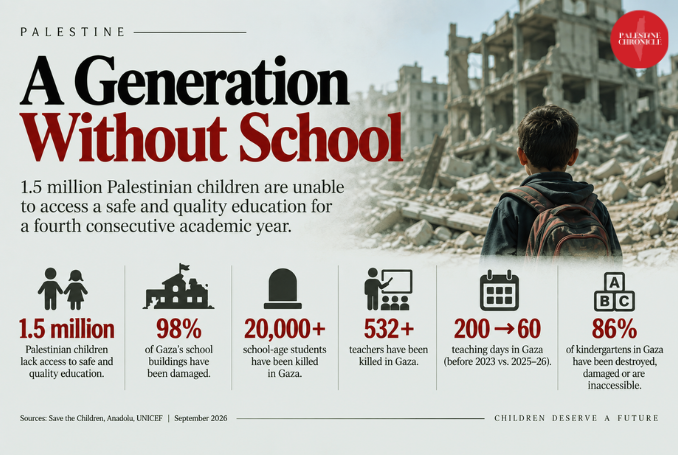
In cooperation with the Centre for Palestine Studies at SOAS University London and Friends of Palestinian Universities, the Palestinian Centre for Human Rights (PCHR) has released a new report, “Scholasticide and Genocide in Gaza: Assessment, Testimonial and Legal Analysis,” documenting Israel’s systematic destruction of Gaza’s educational system and examining how this policy forms an integral part of Israel’s ongoing three-year genocide against Palestinians in the Gaza Strip.

The report demonstrates that Israel’s attacks on education in Gaza, including on UNRWA educational faciltiies and staff, go far beyond the destruction of schools and universities or the killing of Palestinian teachers. They constitute a comprehensive policy aimed at dismantling the educational, intellectual, social and cultural foundations necessary for the continued existence and development of Palestinian society.

Drawing on dozens of testimonies and affidavits collectd by PCHR field researchers and lawyers in Gaza, alongside PCHR’s extensive documentation, open-source material, United Nations reports, academic research and relevant international jurisprudence, the report identifies five interconnected patterns of scholasticide: the killing of students, teachers and academics; causing serious bodily and mental harm to them; destroying of educational facilities; obstructing the establishment alternative educational structures; and imposing genocidal conditions that prevent students from accessing education.

By July 2026, PCHR had documented the killing of approximately 20,051 students, more than 830 teachers and educational staff, and over 194 scholars, academics and researchers. Nearly the entire educational infrastructure in in Gaza has been extensively damaged or destroyed, while hundreds of thousands of students have endured prolonged interruption of their education amid displacement, starvation, bombardment, loss of family members, destruction of homes, lack of electricity and internet access, and the collapse of essential services.

PCHR’s report finds that certain acts committed within Israel’s campaign of scholasticide constitute genocidal acts under Article II of the Convention on the Prevention and Punishment of the Crime of Genocide, including killing members of the protected group, causing serious bodily or mental harm, and deliberately inflicting conditions of life calculated to bring about its physical destruction in whole or in part.

The report further highlights the long-term impact on Palestinian children and young Palestinians, including psychological harm, educational loss, diminished future opportunities and intergenerational trauma. Israel’s erasure of the educational infrastructure and broader civilian life in Gaza does not only constitute an attack on the rights of the present generation but also on the future generations.

Education has historically played a central role in sustaining Palestinian identity, knowledge, social cohesion and cultural continuity, particularly in the context of prolonged displacement and occupation. Israel’s destruction of universities, schools, libraries, academic records and cultural institutions therefore carries consequences far beyond the loss of physical infrastructure. It seeks to sever Palestinians from their history and intellectual life, diminish their capacity to rebuild their society, and deprive future generations of the means to learn, develop and participate fully in their community.

PCHR stresses that the destruction of Gaza’s education system did not begin on 7 October 2023. For decades, Palestinian schools, universities and educational institutions have been subjected to attacks, restrictions and destruction during successive Israeli military operations. The unprecedented scale of destruction since October 2023 however represents the culmination and intensification of this longstanding pattern.

PCHR calls on the international community, particularly States Parties to the Genocide Convention, to:

  • Take immediate and effective measures to bring Israel’s genocide against the Palestinian people in Gaza to an end, including its policy of scholasticide.
  • Ensure full compliance with the three provisional measures ordered by the International Court of Justice in the case of South Africa v. Israel.
  • Impose a comprehensive arms embargo on Israel and halt all military, financial and other assistance that may contribute to the commission of international crimes.
  • Support international accountability mechanisms, including the International Criminal Court, and ensure that those responsible for genocide, war crimes and crimes against humanity are investigated and prosecuted.
  • Take concrete measures to protect Palestinian students, teachers, academics and educational institutions and guarantee the restoration of the right to education in Gaza.
  • Provide sustained support for the reconstruction of Gaza’s schools, universities, libraries and educational infrastructure, while ensuring that reconstruction does not substitute for accountability.
  • Address the long-term psychological, educational and developmental consequences suffered by Palestinian children and young people and ensure their access to rehabilitation, mental-health support and inclusive education.

  •  

Russian Troops Confiscating Ukrainian Food Drops in Occupied Oleshky, Local Official Says

Russian troops in occupied Oleshky are confiscating food delivered to civilians by Ukrainian drones and questioning residents found with Ukrainian-supplied products, according to the head of the town’s Ukrainian military administration. The allegations come after Ukrainian forces transported about four tonnes of food and medicines across the Dnipro in one of their largest humanitarian drone operations to date.

Russian forces in occupied Oleshky are taking food parcels delivered by Ukrainian military drones from local residents and treating possession of the supplies as possible evidence of collaboration with Ukraine, according to Tetiana Hasanenko, head of the Oleshky City Military Administration.

Hasanenko said Ukrainian forces had delivered food to the Russian-controlled town by drone on several occasions, but that the latest operation was considerably larger, involving approximately four tonnes of supplies.

In comments published on 30 September, she said some residents managed to collect one or several packages, while others were unable to reach the supplies.

Russian personnel were subsequently taking some of the food from residents, she said.

According to Hasanenko, people found with goods that were not Russian-made were also questioned about where they had obtained them. Residents could then be accused of co-operating with the Armed Forces of Ukraine if Russian personnel concluded that the products had arrived through Ukrainian drone deliveries.

The allegations cannot be independently verified from inside Russian-controlled Oleshky. However, severe food shortages and restrictions on humanitarian access to the town have been independently documented by the United Nations.

Four tonnes carried across the Dnipro

The latest operation took place on 27 September and involved Ukrainian military units working with the Kherson regional authorities.

According to the regional administration, heavy drones transported approximately four tonnes of food and medicines to about 100 locations around Oleshky.

Instead of dropping the cargo directly from altitude, packages were lowered on cables to designated locations.

Units involved included the 30th Marine Corps, the 34th Separate Marine Brigade “Borysfen”, National Guard formations and Ukrainian border guards.

Ukrainian authorities say drone deliveries have become one of the few remaining ways of bringing supplies into the town. The Kherson administration said it had been sending food across the Dnipro by drone since March.

It estimates that around 2,000 civilians remain in Oleshky, including almost 50 children.

EU Today reported earlier this month that residents of Oleshky were facing increasingly severe food shortages as conventional supply routes became progressively more difficult to use.

The town lies on the Russian-controlled eastern bank of the Dnipro, opposite Ukrainian-held territory around Kherson. The area is exposed to artillery fire, short-range drone operations and extensive mine contamination.

UN documented food shortages

The humanitarian conditions described by Ukrainian officials are consistent with findings published by the UN Human Rights Monitoring Mission in Ukraine.

After interviewing more than 20 residents from Russian-occupied communities near the front line, including Oleshky and Hola Prystan, the mission reported in June that thousands of civilians were facing food shortages and inadequate access to medical assistance.

Residents told UN investigators that the security situation had deteriorated considerably during 2025 and 2026.

The last grocery shop in Oleshky had stopped regular operations in January because supplies had run out, according to testimony collected by the UN. For months, residents depended on preserved food and limited private deliveries.

As of 24 June, the UN said no food deliveries had reached the town since 26 May.

Drone attacks and mines have also made attempts to bring supplies into Oleshky dangerous. On 2 June, a civilian convoy carrying food and humanitarian assistance struck a landmine at the entrance to the town, killing one person and injuring three others.

Under international humanitarian law, an occupying power is required to ensure that food and medical supplies are available to the civilian population and to facilitate humanitarian relief when local resources are inadequate.

Pressure for humanitarian access

The deteriorating situation has prompted repeated Ukrainian appeals for international intervention.

The Ukrainian Council of Churches and Religious Organisations recently called on Pope Leo XIV and international humanitarian organisations to support efforts to reach civilians trapped in the town. EU Today reported on the appeal for humanitarian access and civilian evacuation, which was also directed towards the International Committee of the Red Cross and UN member states.

Hasanenko has also alleged that disappearances continue inside the occupied community.

She said one family had recently disappeared after being detained by Russian forces, adding that Ukrainian authorities did not know whether its members were still alive.

The individual case cannot presently be independently confirmed. The UN has, however, documented arbitrary detention, enforced disappearances, torture and ill-treatment of civilians in Russian-occupied Ukrainian territory during the war.

With independent humanitarian organisations unable to operate freely in Oleshky and conventional supply routes severely restricted, Ukrainian forces are increasingly using drones for a role far removed from their conventional battlefield purpose: carrying food and medicines across the Dnipro to civilians who remain behind Russian lines.

  •  

New Report: “Scholasticide and Genocide in Gaza: Assessment, Testimonies and Legal Analysis”

The report documents Israel’s systematic destruction of Gaza’s educational system and examines how this policy forms an integral part of Israel’s ongoing genocide. By July 2026, Israel had killed over 20,051 students, over 830 teachers & educational staff, and over 194 scholars...

  •  
❌