25.000 lycéens et autres ont manifesté à Paris, dans un vrai calme, jusqu'à la "3è mi-temps" où les habituels casseurs ont provoqué la police. Quelques enseignements politiques sont à retirer de cette journée en demi-teinte.
LE COURRIER DES STRATÈGES
Restez libre !
LA NEWSLETTER · GRATUITE
Le Courrier, chaque matin.
L'essentiel de l'actualité, passé au crible par les cinq plumes du Courrier. Dans votre boîte, chaque jour ouvré.
Gratuit. Vous restez libre de partir quand vous voulez.
Si vous voulez voir les vidéos de la manifestation, notamment au coeur des affrontements entre policiers et manifestants, rejoignez notre chaîne Telegram gratuite en cliquant sur ce lien :
Il étaient environ 25.000 manifestants (chiffres de la police mais qui me paraissent très réalistes, car la place était loin d'être saturée) à se retrouver autour du Génie de la Bastille pour exprimer leur colère contre la politique éducative. À ce stade, ce mouvement dépasse-t-il la simple émotion, ou s'enlise-t-il dans la minceur d'une expression éphémère comme c'est si souvent le cas dans les collectifs ?
Soyons francs, au-delà de revendications très vagues (plus de moyens...), on peine aujourd'hui à dégager un fil directeur comme le serait la suppression de Parcours Sup, par exemple.
On retrouve ici le glissement du mouvement vers la posture politique plus que vers la revendication. Or une revendication structure, une posture dilue.
Cet enlisement est à la fois une bonne et une mauvaise nouvelle pour Sébastien Lecornu :
une bonne nouvelle, car les risques que le mouvement perdure au-delà des vacances de Toussaint s'amenuisent. On ne boude pas éternellement son lycée pour réclamer une insurrection ou dénoncer "les fachos". Donc, d'une certaines façon, plus que 8 jours à tenir...
une mauvaise nouvelle, car le mouvement est insaisissable et sa destinée devient hautement imprévisible. De nombreux signaux laissent à penser qu'il va s'essouffler et retomber, mais rien n'exclut une reprise d'incendie à tout moment.
Au passage, on notera la place somme toute discrète de la France Insoumise, accusé d'être à la manoeuvre en sous-main. LFI n'est pas absente du paysage, mais elle ne verrouille pas la manifestation, et de nombreux étudiants semblent très loin de s'engager dans ce parti, même s'ils se déclarent majoritairement de gauche.
En réalité, les manifestations laissent une part importante à l'humour et à l'esprit potache, loin des catégories politiques que les manifestations des années 70 pouvaient connaître. L'imaginaire de la jeunesse actuelle s'exprime volontiers et trahit bien le besoin de fête après le traumatisme du COVID.
Très important !
Si vous voulez voir les vidéos de la manifestation, notamment au coeur des affrontements entre policiers et manifestants, rejoignez notre chaîne Telegram gratuite en cliquant sur ce lien :
Laisser ce mouvement à la gauche : l'erreur majeure de Marine Le Pen
Si la minceur idéologique du mouvement étudiant est une évidence qu'il faut souligner, une réalité essentielle s'impose néanmoins : les participants placent le rejet du Rassemblement National au coeur de leur "Weltanschauung". Une grande partie des slogans dénonce les "fachos" en boucle (même si peu de manifestants pourraient définir cette catégorie fourre-tout) et consacre le triomphe de la gauche dans la jeunesse.
Ce rejet est alimenté par les postures très hostiles au mouvement exprimées à droite de l'échiquier. La "fachosphère" et la "bollosphère", mais aussi de nombreux souverainistes qui s'expriment sur GPTV, Tocsin, TVL ou Radio Courtoisie) en donnant écho à des positions violentes et caricaturales (les dégâts causés par Philippe de Villiers sont immenses) gravent dans le marbre sa rupture avec la jeunesse qui se mobilise.
On ne peut parler d'autre chose que d'une erreur stratégique, car Marine Le Pen perd ici une bataille d'image qu'elle aurait pu facilement neutraliser, à défaut de la gagner.
Inversement, la gauche manifeste son habileté en se refaisant une santé à bon compte auprès d'une jeunesse dépolitisée et peu formée, qu'elle conquiert sans coup férir. Mais enfin, ceux qui ont cru que le conservatisme et le patriotisme pouvait se définir par l'intelligence tactique ont définitivement fait preuve d'une naïveté coupable.
Dans l'ensemble, on notera la forte présence des drapeaux français, néanmoins, la discrétion des drapeaux palestiniens, et la vitalité des engagements individuels. Cette jeunesse, qui participe souvent à sa première manifestation, a besoin de s'exprimer !
LE COURRIER DES STRATÈGES
Restez libre !
TELEGRAM · L'INFO EN CONTINU
Entre deux éditions, le fil.
La newsletter vous donne le matin. Le fil vous donne l'instant.
Comme d'habitude, la manifestation est restée pacifique jusqu'au dernier round, sur le coup des 17h30, l'heure où la police se livre à son jeu de cache-cache avec les casseurs. Insistons sur ce point : pendant plus de deux heures, les jeunes ont manifesté sans violence, la police se tenant à distance et ne cherchant pas à "interpeler".
Une fois les manifestants pacifiques partis ou en instance de partir, les casseurs sont sortis de l'ombre et les images de violence, dont les médias sont si friands, ont commencé à pleuvoir :
Très important !
Si vous voulez voir les vidéos de la manifestation, notamment au coeur des affrontements entre policiers et manifestants, rejoignez notre chaîne Telegram gratuite en cliquant sur ce lien :
Si vous voulez voir les vidéos de la manifestation, notamment au coeur des affrontements entre policiers et manifestants, rejoignez notre chaîne Telegram gratuite en cliquant sur ce lien :
Si vous voulez voir les vidéos de la manifestation, notamment au coeur des affrontements entre policiers et manifestants, rejoignez notre chaîne Telegram gratuite en cliquant sur ce lien :
Il y a probablement une étude pour ainsi dire anthropologique à mener sur cet étrange rituel où les manifestations "politiques" se terminent, après une séquence pacifique, sur une note violente. Dans la pratique, tel un chat et une souris, policiers et voyous semblent se donner la réplique pour offrir un spectacle qui fait le tour du monde.
L'erreur consisterait à éclipser les revendications de la jeunesse derrière ces dérapages totalement artificiels.
LE COURRIER DES STRATÈGES
Restez libre !
TIPS · SANS ABONNEMENT
Offrez-nous un café.
Un média libre vit de ses lecteurs. Un pourboire ponctuel, sans compte ni engagement, quand le cœur vous en dit.
Vous donnez ce que vous voulez. Vous restez libre.
Chi scrive lo scenario sceglie il nemico. L’Europa si esercita alla fine del mondo; il resto del mondo si esercita a farne a meno. A Levante questa sera, giovedì 8 ottobre 2026, Jeff Hoffman dialoga con Margherita Furlan, giornalista e analista geopolitica, direttrice di Casa del Sole TV, e con Vincenzo Maddaloni, giornalista e scrittore, direttore del Centro studi Berlin89. A Bruxelles gli ambasciatori dei ventisette preparano a porte chiuse, senza telefoni, lo «scenario da incubo» di un attacco ibrido con molte vittime. Dal 13 ottobre i cieli del Tirreno ospitano Steadfast Noon, l’esercitazione nucleare annuale della NATO. Ad Accra il Ghana annuncia che chiederà di entrare nei BRICS. AFFRONTIAMO INSIEME «Risposta dolorosa», «Schengen militare», «10 milioni di droni»: la nuova lingua della Commissione europea Il protocollo d’emergenza di Bruxelles: difesa europea o competenza che i Trattati non danno? Steadfast Noon: Ghedi, Aviano, Amendola, Gioia del Colle, Trapani e la Sardegna sorvolata a bassa quota Un Parlamento informato da un avviso tecnico per i piloti: la sovranità comincia dall’informazione La Germania tra la paura di Lipsia, il rifiuto della guerra e il riarmo come politica industriale Chi incassa lo scenario: droni, cavi, satelliti e gli Azionisti dell’Apocalisse Se la paura è il prodotto, perché i titoli della difesa sono scesi? Il Ghana bussa ai BRICS passando da Nuova Delhi: multipolarità o diplomazia di facciata? Cosa guardare nelle prossime due settimane per capire se lo scenario resta uno scenario LIBRI DEGLI OSPITI Vincenzo Maddaloni, «Voglia di rivoluzione», Nexus Edizioni, 2024 Vincenzo Maddaloni con Modini, «L’atomica degli ayatollah», Nutrimenti, 2006 Margherita Furlan, «BRICS Scacco Matto», La Casa del Sole Edizioni, 2025 (italiano, inglese, russo) SOSTIENI CASA DEL SOLE TV Casa del Sole TV è un progetto di giornalismo indipendente, autofinanziato, senza editori né partiti. IBAN: IT63P0326822300052392596590 Intestato a: La Casa del Sole Edizioni Causale: Donazione Casa del Sole TV MEMBERSHIP YOUTUBE https://www.youtube.com/@CasadelSoleT… Analista Multipolare: €5/mese Inviato della Verità: €15/mese Architetto del Futuro: €25/mese I LIBRI DI MARGHERITA FURLAN «BRICS Scacco Matto», disponibile in italiano, inglese e russo SEGUI CASA DEL SOLE TV YouTube: @CasadelSoleTVChannel La guerra è il prodotto, il caos è la materia prima. #Levante#CasadelSoleTV#MargheritaFurlan#VincenzoMaddaloni#JeffHoffman#Geopolitica#Multipolarismo#GuerraIbrida#SteadfastNoon#NATO#BRICS#Ghana
Horrifying stories from the occupied Ukrainian town are mounting.
Two clans have emerged in Oleshky — those who support Putin can get food.
According to experts, Russia is fundamentally violating international law and using residents’ vulnerability as a weapon.
Putin’s tragic gift: the death toll in Pryluky rose to 22; 12 people were killed on a bus the following day.
Maps of the day: Operation Vivaldi continues to make gains in Donbas.
Videos of the day: an FPV drone attacked a fully occupied quad bike; a refinery is on fire.
Horrifying stories from the occupied town are mounting. The situation in Russian-occupied Oleshky, in Ukraine’s southern Kherson region, has long been extremely tense.
Around 2,000 residents have long faced a severe humanitarian crisis and isolation. Before the Russian invasion, 24,000 people lived in the town.
And the situation of local residents left behind shows how Russia, as an occupying power, treats civilians brutally and deliberately violates international agreements.
Map — DeepState
“There is a lack of food and healthcare. Since the destruction of the hydroelectric power plant, there has been no drinking water, electricity or gas. They do not even have wood for heating. Not only is it impossible to live with dignity, it is also impossible to bury people with dignity, because the occupiers even prohibit the burial of the dead,” Tetiana Hasanenko, head of Ukraine’s military administration for Oleshky, told Denník N.
Russia is also using Oleshky to shell the right bank of the Dnipro, especially the city of Kherson, just nine km away. Fierce fighting is under way over the surrounding islets. This turns Oleshky residents into human shields and prevents their safe evacuation.
According to the BBC, Oleshky is trapped by both geography and war. “To the north and west, it is cut off by the river and destroyed bridges, while to the south and east it is cut off by dangerous or impassable roads,” the report said.
The situation in the town had already been dramatic in 2023, when the destruction of the Kakhovka dam caused flooding.
A few days ago, special units of the SBU security service and Ukraine’s National Guard launched, according to the RBK-Ukraine website, a new operation to deliver humanitarian packages containing food, water and medicines across the Dnipro.
The aid totalled around four tonnes, with each package weighing 19 kg.
Footage from the mission can be viewed in this video by Suspilne television.
In these difficult conditions, heavy Vampire drones — dubbed Baba Yaga by Russians — are, according to a Ukrainian website, one of the few ways of providing aid to people on the occupied side of the river. Ukrainian soldiers often deploy them at the front for their own logistics in areas that are extremely dangerous.
Last year, the drone was even described as the most effective combat vehicle changing the course of the war.
According to Hasanenko, Ukraine’s armed forces have regularly dropped food by drone into the occupied area since March.
“They did it, but not on such a large scale. And every time drones fly over, the occupiers punish local people for it,” said the Ukrainian woman, who is in contact with people from Oleshky.
She said people try to immediately transfer the aid into unmarked containers to avoid punishment. “The occupiers believe that if people accept help from the Ukrainian armed forces, they supposedly have some connection with them and are betraying the country — which is not actually their country. And that is why they punish them,” Hasanenko explained.
In recent months, Oleshky residents have relied mainly on their own harvests, but at the end of the season they face a critical food shortage.
There have even been reports that residents were forced to eat dogs. A BBC report from late September revealed shocking findings from the town: people had learned to cook even with weeds.
Some, according to Ukrainska Pravda, caught pigeons or pheasants, while others cooked borscht “in a new way” — from eggs, courgettes, tomatoes and herbs.
“Prices there are not merely high but almost astronomical. Eggs sell for 800 hryvnias a dozen (€19), potatoes and onions for 500 (€11.90), courgettes for 250 (€5.95), and tomatoes for 200 (€4.76), because there was a good harvest,” the website wrote.
Despite the risk of being killed by a mine, residents travel along a “road of death”, lined with burnt-out cars, to the nearest town, Radensk, for food. This was also confirmed by Reuters, which spoke to people who still have relatives there.
“The choice Russia imposes on civilians every day: stay and die of hunger, or leave and risk being blown up by a landmine,” the agency quoted Ukrainian ombudsman Dmytro Lubinets as saying.
Two categories of people and harassment over humanitarian aid. In the hospital, where dead bodies have been lying in the basement for four months, people have been divided into two clans, according to witnesses.
“Those loyal to the Russian regime have some food, sometimes even meat and alcohol. The people they call Ukraine-lovers have nothing. The hospital director took everything from the latest deliveries provided as humanitarian aid and handed it out to his own people,” Ukrainska Pravda quoted the son of a man who remained in Oleshky as saying.
When Ukrainians succeeded in dropping humanitarian aid into Oleshky, a new phase of psychological warfare by the Russian Federation began.
Under normal circumstances, an operation to drop humanitarian aid would not attract so much attention, but according to Ukraine’s SBU security service, the Russian response reached particularly absurd proportions.
According to its information, Russian soldiers were ordered to arrange a series of interviews aimed at discrediting the Ukrainian side.
The recorded interviews were meant to include claims that Ukrainians were shelling Oleshky, positive views of Putin’s regime and expressions of gratitude. The SBU therefore urged Ukrainians to treat such reports cautiously and not spread unverified information.
According to information from the Ukrainian resistance movement in the Kherson region, which cannot be independently verified, those who received the aid faced abuse during interrogations.
According to Hasanenko, the most important thing now is to evacuate people from the town.
“Even what humanitarian missions are doing now, dropping food, will not solve their problems. I have reports in which people wrote that they had food left for two days and that this saved them. But it will not save them forever. Many people are dying there because of drones and artillery shelling. We need to establish a humanitarian corridor,” said the head of Oleshky’s military administration, adding that last winter had already been difficult and that they might not survive this one.
She herself has received reports that people have lost 10, 20 or even 40 kg. “There is one case: a woman wrote that she weighed 110 kg and now weighs 67. She has lost 40 kg and writes to me that she is dying.”
Violations of international law. During the recent UN General Assembly session, Ukrainian foreign minister Andrii Sybiha spoke about Oleshky. Ukraine’s main aim, he said, was to establish a humanitarian corridor in the area and safely evacuate people who have not accepted the Russian occupation.
It is precisely because of this stance, Kyiv says, that the Russian army is retaliating by blockading the town, where tourists had before the war come for its unique natural environment of pine forests and Dnipro inlets.
“There is no supply of electricity or gas. Over the past month, the delivery of food, medicines and other basic necessities has been completely blocked. Horrifying testimonies are coming from occupied Oleshky about how people are trying to survive under a blockade imposed by Russia: they are looking for scraps of food and gathering grass because there is simply no other food,” Ukrainian website NV quoted the foreign minister as saying.
Another dimension of Russian terror, he said, is the hunting of civilians. Russian FPV drones pursue and attack people, turning even an attempt to leave one’s home or move around the town into a deadly risk.
According to TSN, Russia is artificially creating food shortages in Oleshky, selling an ordinary food package for 50,000 hryvnias — nearly €1,000 — compared with a standard price of up to 2,000 hryvnias (€40). When people have no money, they offer their jewellery in exchange for food.
Food was last delivered to the town at the end of May, and according to Ukrainska Pravda, no further attempt to bring in food was made. When locals tried on 2 June, their four cars were blown up by anti-personnel mines, killing two people.
Legally, the humanitarian crisis in Oleshky, as well as the use of the population as human shields, constitutes, according to Ukrainian website Rubryka, a violation of the Fourth Geneva Convention — on the protection of civilians in time of war — and a war crime under Article 8 of the Rome Statute of the International Criminal Court (ICC).
An occupying power is responsible for those living in occupied territory. “It must provide people with food, medical care and proper sanitation. But Russia is indifferent to all international requirements,” Ukrainska Pravda wrote.
According to the Institute for the Study of War, Oleshky has become a test of Russian dominance in an area “characterised by population decline, damaged infrastructure, chronic insecurity and growing isolation from the rest of Ukraine”.
Rather than reversing these conditions, the think tank said, Russia governs through them.
“Oleshky demonstrates that the humanitarian crisis unfolding across many Russian-occupied communities is not merely a byproduct of war but increasingly appears to be the result of an occupation system that tolerates, exploits, and sustains civilian vulnerability as a means of maintaining control,” wrote US experts.
According to Hasanenko, Russian fears of Ukrainian operations are also behind this. “I think they are simply trying to prevent the Ukrainian armed forces from crossing the Dnipro, because they could begin liberating the left bank. And people simply serve as human shields for them, while they mine everything completely,” she told EUobserver.
A tragic toll on Putin’s birthday. At least 22 people were killed, including five children, in a Russian Kh-101 cruise missile attack on an apartment building in Pryluky, in the Chernihiv region, on 7 October. Rescue workers pulled many people from the rubble of the destroyed building. According to local authorities, Russia fired as many as six cruise missiles at the town.
“This is the ‘gift’ Putin gave himself for his birthday. Killing children, killing people. There were new attacks with Shahed drones and aerial bombs during the day. It is important that leaders do not remain silent about what happened,” said Ukrainian president Volodymyr Zelensky, calling on the West to help with air defence.
Brutal Russian attacks continued the following day. As many as 12 people were killed after Russia hit a bus in the Donbas city of Kramatorsk. Putin’s regime is currently facing a crisis at the front, which it is trying to address through massive shelling of Ukrainian cities.
Maps of the day
Ukraine’s successful Operation Vivaldi continues. According to a report by the Institute for the Study of War, Ukrainian forces are continuing counterattacks towards the eastern bank of the Zherebets River, northeast of Lyman. The numerical superiority of Ukrainian forces and drones there is preventing Russian forces from consolidating their positions in the town.
Map — DeepState
According to September statistics, which we wrote about a few days ago, Russia has just had its worst month in Donbas for the past three years. The US newspaper The New York Times also charted this on its map.
— Institute for the Study of War (@TheStudyofWar) October 7, 2026
Videos of the day
Smoke over a distant refinery. Ukraine continues to launch drone attacks on Russian energy infrastructure. Most recently, it caused a fire at the Gazprom Neftekhim Salavat plant in the Bashkir region, one of Russia’s largest refineries. It is located around 1,300 km from the front line.
A fatal quad bike ride. The Hornets of Dovbush, from the 68th Brigade, released a video showing five Russian soldiers on a quad bike coming into view of their FPV attack drone. The location of the attack is unknown.
What are the losses
No update on Thursday.
By Monday (5 October), Russia had verifiably lost 24,170 pieces of heavy equipment (24,138 on Tuesday, 22 September). Of these, Ukrainians destroyed 19,133 (19,105), 1,003 (1,000) were damaged, 1,194 (1,194) were abandoned by their crews, and the Ukrainian army captured 2,840 (2,839). This includes 4,452 (4,448) tanks, of which 3,357 (3,353) were destroyed in combat.
Ukraine lost 12,238 (12,175) pieces of equipment, of which 9,633 (9,579) were destroyed, 711 (702) were damaged, 695 (695) were abandoned and 1,199 (1,199) were captured. This includes 1,466 (1,464) tanks, of which 1,126 (1,125) were destroyed in combat.
Note: Neither side regularly reports its own dead or destroyed equipment. Ukraine publishes daily figures for Russian casualties and destroyed equipment, which cannot be independently verified. This overview uses data from the Oryx project, which has compiled a list of equipment losses documented exclusively by photographs since the start of the war.
La chambre régionale des comptes a examiné 35 collectivités des Pays de la Loire. Elle relève des emprunts dépassant l'autorisation, des terrains absents des annexes comptables et des dépenses de « participation citoyenne » sans résultat. À Orvault, la facture est tombée, le vote n'a jamais eu lieu. 36 000 euros hors taxes ont été engagés avant l'abandon d'une consultation sur une hausse de 9 % de la taxe foncière.
LE COURRIER DES STRATÈGES
Restez libre !
LA NEWSLETTER · GRATUITE
Le Courrier, chaque matin.
L'essentiel de l'actualité, passé au crible par les cinq plumes du Courrier. Dans votre boîte, chaque jour ouvré.
Gratuit. Vous restez libre de partir quand vous voulez.
Le rapport a été délibéré le 3 juin 2026, mais la presse ne l'a révélé que le 7 octobre, soit quatre mois plus tard. Il porte sur 35 collectivités : le département de Maine-et-Loire, quatre communautés de communes et trente communes.
LE COURRIER DES STRATÈGES
Restez libre !
ABONNEMENT
Allez au fond des choses.
Deux grands formats par jour. Les cinq plumes du Courrier. La série Sécession, le dimanche.
Les observations de la chambre dessinent une gestion où les autorisations budgétaires et la réalité comptable ne coïncident pas toujours. À Dompierre-sur-Yon, 1,6 million d’euros d’emprunts ont été signés alors que l’autorisation portait sur 1,5 million. À Courdemanche, une ligne de trésorerie de 125 000 euros a été ouverte sans délégation.
À Mûrs-Érigné, les terrains représentent 3,3 millions d’euros, auxquels s’ajoutent plus de 650 000 euros de frais cumulés fin 2024. À Angers, 5,04 millions d’euros de biens en portage n’apparaissent pas dans les annexes. À Saint-Nazaire, la valeur du patrimoine présente un écart de 50 % entre les données communales et celles du comptable public.
LE COURRIER DES STRATÈGES
Restez libre !
TELEGRAM · L'INFO EN CONTINU
Entre deux éditions, le fil.
La newsletter vous donne le matin. Le fil vous donne l'instant.
Le rapport examine aussi ce que les collectivités dépensent pour associer les habitants. Saint-Nazaire y consacre environ 700 000 euros par an et cinq agents, tandis qu’Angers dispose d’un budget participatif d’un million d’euros.
Les résultats sont inégaux. Montrevault-sur-Èvre a abandonné 100 000 euros de projets après une édition qui n'a mobilisé que 11 % de participation. Mention spéciale pour Orvault, qui n'a pas hésité à gaspiller 36 000 euros en pure concertation avant d'enterrer une consultation, estimée à 20 000 euros, portant sur une hausse de 9 % de la taxe foncière. Cette dilapidation illustre la déconnexion d'une machinerie territoriale qui exige toujours plus du contribuable tout en s'exonérant des principes les plus élémentaires de bonne gestion.
La chambre régionale des comptes ne qualifie pas ces situations de fraude ou de détournement : elle relève des insuffisances de suivi, de comptabilisation ou de gouvernance. Reste à savoir ce que les collectivités concernées répondront aux recommandations de la chambre, et si les habitants en seront informés.
LE COURRIER DES STRATÈGES
Restez libre !
TIPS · SANS ABONNEMENT
Offrez-nous un café.
Un média libre vit de ses lecteurs. Un pourboire ponctuel, sans compte ni engagement, quand le cœur vous en dit.
Vous donnez ce que vous voulez. Vous restez libre.
A wave of videos is spreading across social media under the hashtag #IAmJaneDoe to express solidarity with an anonymous Cornell University student who alleges she was sexually assaulted by several members of a fraternity in 2024.
Banking scams are becoming harder to spot as criminals use artificial intelligence to create convincing emails, fake bank websites and even voice recordings designed to impersonate loved ones, according to a banking industry cybersecurity expert.
Paul Benda, executive vice president for risk, fraud and cybersecurity at the American Bankers Association, said consumers need to recognize that some of the traditional warning signs of scams are no longer enough. The ABA is promoting its #BanksNeverAskThat campaign, which aims to educate consumers about common scams and the information banks will and will not request.
Scams are really prevalent, Benda explained. We're seeing them leverage AI. They're writing emails much more clearly right now. They're setting up websites that look just like your bank. They're even deepfaking voices.
Benda said criminals can take a short recording of someone's voice from social media and use it to impersonate that person.
They can take a snippet off of social media of your child, mimic that voice, call you up and pretend to be that child in danger, and try and extort money out of you, he added.
Benda said consumers should be particularly suspicious when someone contacts them unexpectedly and creates a sense of urgency or fear. One warning sign is a caller claiming to be from a bank and saying there are suspicious transactions that require the customer to immediately move money.
Frankly, if they tell you to keep it a secret, it's a scam, Benda said.
Consumers also should not automatically trust caller ID, he said. Criminals can spoof the name and phone number displayed on a phone, making a call appear to come from a legitimate bank. Benda said the FBI estimates losses from scams are increasing about 25% each year. Gallup estimates Americans lost $68 billion to scams, according to Benda.
Check fraud remains a concern
Despite the growth of digital banking, Benda said check fraud remains a significant problem. Checks contain valuable information, including a person's name, address, bank routing number and account number. Criminals have increasingly targeted checks sent through the mail, he said.
Benda said criminals are not necessarily limited to altering stolen checks. Once they obtain banking information, they can use it to print fraudulent checks and attempt to drain accounts.
We're recommending people really move to electronic transactions, use that banking app or use that website to keep their account safe, Benda stated.
What to do if you fall for a scam
Benda said consumers who click on a suspicious link, share banking information or make a fraudulent transaction should contact their bank immediately.
Act quickly and call your bank right away, he said. Minutes, seconds, hours matter.
Contacting the bank quickly can give it an opportunity to secure the account and potentially recover stolen money, he said.
The ABA's Banks Never Ask That campaign includes information about common scam tactics, red flags, videos and a quiz designed to test consumers' knowledge. Benda also recommended families establish a secret password that can be used to verify a loved one's identity during an unexpected call. The campaign website encourages consumers to learn what banks will and will not ask for before they encounter a scam. Click here for more on #BanksNeverAskThat.
____
Watch KOAA News5 on your time, anytime with our free streaming app available for your Roku, FireTV, AppleTV and Android TV. Just search KOAA News5, download and start watching.
German police are seeking two Persian-speaking men after a 25-year-old woman reported she was raped early Friday in the city center next to a statue of Karl Marx, known as the “Father of Communism.”
“The woman was in the city center with a friend on the night from last Thursday to Friday. On their way to the parked car, they reportedly encountered two men who had stopped them,” the police described the case.
Investigators said one man started distracting her friend while the other pulled the 25-year-old into bushes behind a building at the Karl Marx Monument on Brückenstrasse, and raped her.
“When the perpetrator heard the voice of an unknown passerby passing nearby, he let go of her and fled,” stated the police.
The woman contacted police the next day. Officers opened an investigation and issued a public appeal for witnesses, particularly anyone who was between the Karl Marx Monument and Käthe-Kollwitz-Strasse late Friday or early Saturday, and the unidentified passerby whose voice apparently interrupted the attack.
The woman describes the alleged rapist as being about 1.75 meters tall and thin. He had black, wavy, short hair, a three-day beard, and wore a dark down jacket.
Police said he spoke some German. The second man was described as about 1.90 meters tall, strongly built and dark-skinned.
“According to the victims, the men, who were about 30 years old, spoke Persian among themselves,” read the police report. Although Persian is predominately spoken in Iran, other countries like Afghanistan and Tajikistan also feature significant Persian-speaking populations.
No arrests have been announced. The Chemnitz criminal police are seeking witnesses and information about the case.
Grzegorz Braun, leader of the Confederation of the Polish Crown, spoke in favor of restarting the Nord Stream 1 and 2 gas pipelines during a meeting Wednesday with politicians from the Alternative for Germany (AfD) party in Lubmin. He said Poland should be a shareholder in the German-Russian project.
“Nord Stream 1, and probably Nord Stream 2 as well, will be relaunched. Russian gas will flow to the West,” Braun said. He said Europe needs Russian raw materials and that their absence could have serious consequences for the economy.
Braun argued that Poland should not be excluded from future energy projects concerning Russian gas supplies. “Poland should participate, not boycott. Poland should be the initiator,” he said. He also proposed that Warsaw become a shareholder in Nord Stream.
Podczas roboczej wizyty w #Lubmin w Niemczech poseł do Parlamentu Europejskiego @GrzegorzBraun_, poseł na Sejm RP @Roman_Korona i dr @Slawomir_Ozdyk (Konfederacja @KoronyPolskiej) spotkali się z posłem do Bundestagu @SteffenKotre (AfD) oraz posłami do Landtagu Meklemburgii-Pomorza Przedniego z ramienia @AfD – Stephanem Reukenem i @Kevin_Kurtze.
— Konfederacja Korony Polskiej (@KoronyPolskiej) October 7, 2026
He also said that if Russian gas returns to Europe, Poland could lose economically if the supplies bypass its territory. In his view, Warsaw should seek participation in such energy projects rather than remain outside them.
Braun also spoke of the need to “normalize” and “de-escalate” relations and economic cooperation among Poland, Germany and Russia. He advocated a return to wider use of coal and the ability to buy oil and gas from suppliers offering favorable terms.
The speech took place in Lubmin, the site of the German terminal and infrastructure linked to the Nord Stream pipelines.
Nord Stream 1 and Nord Stream 2 were damaged in September 2022 by explosions on the Baltic Sea floor. Nord Stream 1 had been the main route for Russian gas to Germany. Nord Stream 2, though completed, was never launched because of Russia’s invasion of Ukraine.
Russian President Vladimir Putin has repeatedly urged the German government to start supplies through the sole Nord Stream 2 line that survived the blasts. He has said that if the line operates, 27.5 billion cubic meters of gas “will immediately reach Europe.”
“Why don’t they do it? I just can’t understand it. They can receive gas through Ukrainian territory, through TurkStream, but they cannot through the pipeline running along the bottom of the Baltic Sea,” Putin said.
“In my opinion, it’s crazy, just nonsense. Why? But if they don’t want to, fine,” Putin said in 2024 at the Vladivostok Economic Forum.
According to U.S. media reports, a group of Ukrainian officers conceived the operation to blow up Nord Stream in May 2022. Ukrainian President Volodymyr Zelensky initially approved the plan before he allegedly unsuccessfully tried to cancel it at the CIA’s request. Polish connections also appear in press accounts of the Baltic Sea sabotage.
U.S. President Donald Trump said last May that “many people know” who blew up Nord Stream. He added that he was the first to thwart the project.
Trump imposed sanctions on Nord Stream 2 in his first term, significantly slowing construction. President Joe Biden repealed them in 2021 and reimposed them after Russia invaded Ukraine. Germany withheld permission to start the pipeline because of the war.
It has been revealed that police in the northern German city of Bremen have for more than a decade advised participants in workplace safety seminars that deliberately inducing vomiting can be one way to interrupt an attempted sexual assault or rape.
Franka Haedke, a spokeswoman for the Bremen police, said the guidance is part of broader self-defense instruction offered by the department’s Central Police Prevention unit.
“In an emergency, such as attempted rape, defend yourself with all available means,” Haedke told the Kreiszeitung newspaper. “Vomiting can also be an effective way to ward off a sexual offense.”
Seminar instructors tell participants they can trigger a gag reflex by placing a finger down the throat. The resulting disgust, police say, is intended to disrupt an attacker’s actions. Haedke described the suggestion as one option among others rather than a prescribed response.
The sessions, which have run for more than 10 years, are held at companies, government offices and medical facilities. Employees of public transit agencies, the fire department, job centers, and social-service organizations are also eligible to attend. Topics include recognizing and avoiding danger, de-escalation, bystander intervention, and specific conduct during a sexual assault. Participants are invited to describe their own experiences so that advice can be tailored to situations they have encountered.
Haedke said the courses help people “recognize dangers early, manage conflicts, and act thoughtfully.” She added that the seminars “contribute to the prevention of crime and should be actively promoted and conducted on a recurring basis from the police’s point of view.”
Notably, the police appear powerless to address one of the key issues driving the increase in rapes and sexual assaults in Germany, and that is the incredible increase in foreigners. Since 2018, there has been a 72 percent increase in rapes in the country. In Bremen itself, where the police are advising women to vomit to stave off a rape, the city has been labeled the “most dangerous city in Germany.” It also happens to have the highest share of migrants of any German city. It is also a place where 49 percent of all rapes were committed by foreigners, even though the official foreign population is 23 percent.
The Bremen guidance is not the first unconventional self-protection tip from German police to draw public scrutiny. Remix News previously reported that in Berlin, officers previously listed singing as a way to irritate an attacker, advice that remained visible on the police force’s website even after internal materials had been revised. A screenshot of the recommendation went viral on social media in 2024 and was widely mocked.
Berlin police later said the tip had been drawn from professional associations for psychiatry and did not match operational experience.
“A screenshot of our homepage has been circulating for a few days, according to which we recommend that in the event of an attack, you irritate the perpetrator through unexpected behavior, such as singing,” the Berlin police stated. “This is recommended by the professional associations for psychiatry, among others. However, this advice does not correspond to our police experience and has therefore no longer been part of our recommendations since 2023. The flyer was already updated, now our website is too.”
The police stated that the suggestion was not meant for terrorist attacks, rampages or armed assaults, including those involving knives, where protecting life is the priority.
After the mass sexual assaults in Cologne on New Year’s Eve 2015–16, Mayor Henriette Reker — although not a police official — also gave advice that was widely condemned. Reker said women should keep “a certain distance of more than an arm’s length” from unknown men and avoid behavior that could be “misunderstood.” After thousands of German women were sexually assaulted and even some raped by North African migrants, the remarks were widely criticized, including by Germany’s justice minister.
Swedish police have also previously advised women to stop going out alone. Before mass immigration, Sweden was once one of the safest countries in the world for women. However, right around the same time as the mass sexual assaults in Colgone, Swedish police issued similar advice. In Östersund in 2016, after a series of assaults and an attempted rape, police chief Stephen Jerand advised women who wanted to move around at night to arrange a ride or walk in groups. He called the warning factual rather than a ban on going out alone.
German police have given similar pairing advice after attacks on joggers. Leipzig officers in 2017, after a woman was raped in Rosental park, said it would be better to run in pairs or make sure someone else was nearby, and to look back when passing people. The city’s mayor criticized the police for restricting women’s freedom.
After an attack in the English Garden in Munich in 2016, police in the city told runners to choose busy, lit routes after dark, jog at least in pairs at dusk, skip headphones, and carry a whistle or personal alarm. Although it was less controversial advice that what other authorities provided, critics note that women are increasingly unsafe in Europe while out exercising or enjoying public spaces.
Whenever I receive a text, this is what happens. I pick up my phone. So far, so good. I experience whatever emotion the message elicits—the pleasant warmth of being reached out to, possibly the annoyance of being interrupted. Then, if conditions are right, if I’m not too busy or in the middle of talking with someone else, if my mind is at peace, if my anxiety is at no more than a low hum, if Mercury is not in retrograde, I will respond right then and there. If conditions are not right, it will be as though the text never existed at all.
Right now, I have 30 unopened texts. Scrolling through my messages, I find several more that I opened but forgot to respond to for anywhere between a few hours and a week and a half—from my parents, my sister’s fiancé, old friends who are accustomed to this kind of behavior, and new friends who are just beginning to be disappointed in me. At least two people texted me so long ago—more than a month—that to respond now and remind them how long they’ve been waiting would be worse than not responding at all.
I’m not proud of leaving people hanging. Every text I owe is a tiny siren in the back of my mind, blaring intermittent pulses of guilt. Unless I forget about it entirely, in which case I’ll remember it with a shameful jolt some days or weeks later. I’m not one of those modern hermits who thinks you don’t owe anyone anything, who likes every Instagram post she sees about boundaries and thinks that flaking on plans is self-care. I write about relationships for a living, and I believe that showing up for one another is the purpose of our existence. That’s, like, my whole brand. And so this is my greatest shame: I am a Bad Texter. I am slow to respond. I am forgetful. I get overwhelmed. My own mother has said I’m “probably worse than 90 percent of the other people that I text with.”
This might seem like a trivial pathology, but it isn’t. Texting is the currency of modern relationships. In 2024, Americans exchanged more than 2 trillion text messages, about 42 billion more than the year before, according to CTIA, a trade group representing the wireless industry. Some of those texts are probably spam. Some are advertising. Some are bits of automated busywork (click this link to confirm your appointment ). But many of them, hopefully most of them, are between people who know one another, reaching out for connection over the waves of the wireless spectrum.
According to a 2023 survey, texting is the No. 1 way that people prefer to communicate with their loved ones, beating out mobile-phone calls and absolutely crushing face-to-face conversations, which got only 8 percent of the vote. Texting came out ahead in every age bracket except the oldest; those 55 and older ranked texting and mobile-phone calls equally. No age group preferred anything over texting.
Yet at the same time, texting stresses people out. A third of Americans report feeling overwhelmed by the number of texts they need to respond to, and a majority say they struggle to keep up with their group chats. As Pranav Malhotra, who studies communication and media at the University of Michigan, told me, texting “is what the people want, but it’s not doing them any good.” And so, many of us end up feeling like Bad Texters. We are here, we are legion, and we are sorry for our delayed response.
Texting dominates oursocial lives like nothing else. According to the research firm Nielsen, American cellphone users started texting more than they called in 2007. Since then, unlimited phone plans and widespread Wi-Fi have removed many of the barriers that once led people to restrict their texts.
The ubiquity of text-messaging hardly seems worth questioning—it’s simply the way things are. But when you think about it, the modern predilection for managing all of our relationships by typing on a tiny touch screen is a bit odd. “For darn sure, it’s a lot faster to talk about things than it is to text them,” Naomi Baron, who studies language and technology at American University, told me. “Particularly if you have more than, let’s say, 100 characters’ worth to say. But it’s become the way of doing things.”
Texting achieved domination because it’s convenient—you can message someone at any time without waiting to see if they’re available first—and because it offers a sense of control. You don’t need to risk the uncertainty that comes with live conversation; you can plan out exactly what you want to say, and people won’t see how you react to their response. This is one of the things that people say they like best about texting. But the ease of sending messages means, on the flip side, that people are receiving more.
As texting became our default mode of communication, messages that once might have taken another form—your hair salon calling to confirm an appointment, an email invite to your best friend’s birthday party, a paper medical bill—started arriving as texts. And the act of texting is no longer confined to whatever mobile app processes your SMS messages. I have four different texting-specific apps on my phone: the standard iPhone Messages, WhatsApp, Signal, and KakaoTalk—a Korean messaging app where my in-laws’ family group chat lives. Then there are social-media DMs, which function much like texting, and Slack, where my colleagues send me DMs that would have been emails not so long ago. These show up on my home screen as notifications, and when I respond on my phone, the feeling is very similar to texting.
I have sometimes attempted to deal with my texting overwhelm by communicating in other ways. Lately, I’ve been trying to call people more to catch up, which is wonderful, but it can also cause alarm. One British survey from 2024 found that more than half of young adults said they assumed unexpected calls meant bad news. (Surely you would just text anything else you want to say.) Sometimes I’ll send my friends voice messages when I want to tell them a story that’s too long to type, but this, too, is controversial. I love voice messages—I think they feel so much more intimate than a text—but many people think that expecting a friend to take five minutes out of their day to listen to a mini-podcast you recorded is annoying, or even selfish. For party invitations, vacation planning, or anything logistical, I prefer to use email, but I’ve received explicit feedback from my husband and many of my friends that I should be texting instead, because “no one checks their email.” (Can this possibly be true?) Whenever I try to escape, social pressure always seems to push me back to texting.
And so the texts multiply, taking up more and more space in our relationships, until to be called a Bad Texter feels like being accused of being a bad spouse, sibling, child, parent, or friend.
Hannah Robinson
Instagram’s algorithm must have me figured out because it recently served me a video of an episode of “SubwayTakes,” in which the comedian Delaney Rowe shared her take: “There’s no such thing as a bad texter; they just don’t want to respond.” Claiming to be bad at texting, she said, is a “cop-out,” because a lack of responsiveness is conditional. “When a bad texter gets a crush? Best texter in the world,” she said.
This is what I fear my loved ones think: that my response time is directly correlated with how much I care about them. What else could it be? Americans check their phone nearly 200 times a day on average, and the overwhelming majority keep their phone on them “almost all the time,” according to recent surveys. The modern expectation that everyone is constantly reachable is unreasonable, but it’s not that unreasonable, given how attached people are to their phones.
Lizzie Post is a great-great-granddaughter of the early-20th-century etiquette writer Emily Post, and a co-president of the Emily Post Institute, where she writes about modern manners. Unfortunately, she confirmed that politeness requires responding to texts promptly, and that too long a delay is rude. (Though the meaning of promptly can vary depending on the context.) “I hate to say it,” she told me, but “I would really try to prioritize it a bit more.”
She was not the only expert I spoke with who said I needed to shape up. “Get one with the idea that people who text expect fast responses,” Paul Leonardi, a technology-management professor at UC Santa Barbara and the author of Digital Exhaustion, told me. You don’t have to meet that expectation, but there are consequences for not doing so. He pointed out that, especially with long-distance loved ones, a text thread is “the meat of our relationship.” A shared experience is happening there, and you’re either contributing to it or you’re not. Often, he advised, it’s better to just say something—anything—quickly, rather than waiting to form the perfect response later. (I do sometimes delay texting people because I want to wait until I can put more thought into my message. But the longer I wait, the better I feel the message needs to be to justify the delay. The pressure builds.) Post agreed. By responding too slowly, I’m at risk, she said, of making people think I don’t want to connect with them—even if that’s not true.
One of the costs of conducting so much of our relationships via text is the loss of context. In exchange for convenience, we give up tone of voice, eye contact, and body language. When all we have to go on are the words in front of us (or the lack thereof), we tend to “overinterpret very minor cues as signals of rudeness or as signals of Oh, this person doesn’t care about me,” Gretchen McCulloch, a linguist who studies online communication and the author of Because Internet, told me. Hence the unwritten rule that putting a period at the end of a text is passive-aggressive. My mom recently had a serious dustup with a friend, seemingly just because my mom put the word not in all caps in a text. Gaps in information too often get filled in with projections and insecurities.
I know my haphazard approach to texting risks fanning just such insecurities. And I’ve tried to be better. I put responding to texts on my to-do list. I’ve tried not opening any texts until I’m ready to write back, letting the notifications pile up and remind me every time I open my phone. I made a calendar reminder for every day at 4 p.m. that says “RESPOND TO TEXTS!!!,” following the advice of several experts who suggested setting aside time to deal with all my texts at once, rather than taking them as they come. This helps, although it also makes me feel like I’m treating my loved ones like a productivity problem instead of a source of joy. And there’s nothing to stop me from ignoring the reminder the same way I would a text.
Social obligation is as old as human society. In the 19th century, the practice of making social “calls” seems to have produced a feeling similar to the anxiety I get when I open my texts. An 1895 column in the Rocky Mountain News declared that the problem was one of volume—there were simply too many calls that one was expected to pay. “It may certainly be a pleasure to visit one’s friends,” the anonymous author wrote, but the pleasure fades “when you are meeting them every day almost, by dozens and scores and hundreds.” One woman quoted seemed to be on the verge of a nervous breakdown: “The calls I owe haunt me. They rise up in my dreams and chase me with spectre fingers.”
Falling behind on your correspondence is nothing new, either. “The guilty message—‘I’m sorry it took me so long to respond’—has a very long history,” Steven Mintz, a historian at the University of Texas at Austin, told me. Indeed, in the 1922 edition of Emily Post’s Etiquette, the author writes, “One of the frequent difficulties in beginning a letter is that your answer is so long delayed that you begin with an apology, which is always a lame duck.”
The difference is that although an unanswered letter may have caused guilt and anxiety, you weren’t expected to respond to it within five minutes. Technology has taken our sense of social obligation, accelerated it, amplified it, and splintered it into billions of little green and blue bubbles, each one both a point of connection and a task hanging over our heads.
“People always say we’re wired to connect, but this isn’t the kind of connecting that we’re wired for,” Lori Gottlieb, a psychotherapist and the author of Maybe You Should Talk to Someone, told me.
Being a Bad Texter might harm your relationships, but being a Good Texter will not necessarily help them. Research is unclear on this front. In terms of connection, texting seems to be better than nothing, but nowhere near as beneficial as phone calls or face-to-face conversations. The latter are definitely good for us, and they’re declining. Time-use data show that over the past couple of decades, Americans have been spending less time socializing in person. One study even found that the number of words people speak out loud each day has decreased.
Some research has suggested that the more someone texts, the lonelier and less satisfied they feel. In one study, researchers theorized that people found texting exasperating because they were using it with the intention of keeping in touch, but it didn’t actually do all that much to maintain relationships. And every text message is a little interruption, taxing your attention and taking focus from the people who may be right in front of you.
Nothing in the research definitively says we shouldn’t be texting one another—but nothing says we should prioritize it the way we do, either. “The one thing that’s consistent about it is that it’s inconsistent,” Jess Dominguez, who researches communication at the University of Kentucky, told me. Technology, she said, “is always good and bad, and always at the same time.”
The overwhelming emotion associated with texting seems to be ambivalence. The same things that make texting appealing also make it stressful. It’s easy; it’s convenient; it can be done anytime, anywhere. But that means you can end up feeling like you should be available to respond all the time, everywhere. Texting allows you to keep up with more people at once than phone calls or letters ever did. But those exchanges are shallower and less fulfilling. It gives welcome control over communication, but that can lead to pressure to draft the ideal response, or to using texting as a shield to hide from the messiness of real-time conversation. It is fun and it is frustrating, and it doesn’t really matter if you like it, because it is more powerful than you are, and it’s not going anywhere.
Hannah Robinson
Eventually, we all must do things we have been dreading, whether it is apologizing for not texting someone back for a month or, in my case, interviewing my friends and family for this article. A story like this requires a reckoning, and narratively, I recognized that I must face up to who I am and what I have done to those I love. But I didn’t want to, and I put it off as long as I could, until just before my deadline.
Feedback was kind, but mixed. “I have no complaints,” my husband said. Vindication?! But “my bar is very low.” Oh. A friend of mine called my failure to respond to a dinner invite until the day of “chaotic.” When I asked my parents how their experience texting with me has been, my dad immediately said, “Poor.” He had recently sent me a Mountain Goats song he likes; I hadn’t responded. “A little too much to ask that you put a heart?” he said, only half-joking. “Couldn’t do it, could you?”
My mom said she’s never been offended, only confused. “I always walk this line between: Did she see the text, couldn’t answer it, and then forgot about it? Or did she see the text and she’s still going to answer it? It’s, like, this waiting thing,” she said. “Should I remind her? Should I not remind her?” Several people told me they didn’t think of me as a notably Bad Texter, or at least they weren’t bothered by my slowness. My friend Morgan pointed out that a text, like any other form of communication, is a “bid for connection.” But it’s different than if someone opened their arms for a hug and I just walked away. Although I may drop the ball on responding sometimes, Morgan said, “I don’t feel like you’ve ever dropped the ball on maintaining a connection.”
I once read somewhere that trying to keep up with your work emails is a trap. The emails will never stop coming, and your only reward for responding quickly will be more emails. So you have two choices: You can be good at responding to email or you can be good at your job.
I feel a similar way about keeping up with my texts. I suppose I could opt out entirely and throw my phone into the sea. But opting out of texting would mean, to some degree, choosing isolation. I don’t want people to stop reaching out to me; I don’t want to give up on the good parts of texting, even if they’re inextricable from the bad. So I will try to carve out the occasional hour to attend to my correspondence. But I also want to let go of some of the guilt that tells me every delayed response means I’m being a bad friend, daughter, sister, wife.
I bring other things to the table, after all. If you need practical help—someone to feed your pets, watch your kids, help you move—I would be delighted to provide it. I’ll make spreadsheets to plan our vacations. I’ll buy you little gifts, and alarm you with cold calls just to catch up. If we’re together, I’ll put my phone away and give you my full attention. But if you text me, you may not hear back for a while.
You can be good at texting. You can be good at your relationships. Maybe for some people, it’s possible to be both. But they are not the same thing.
We want to hear from you: Tell us how many unread messages you have—or send a screenshot!—along with your name and the reason you’re not-so-great at responding promptly. Text your response to (202) 266-7715. (By participating, you agree to grant The Atlantic permission to use, modify, and distribute your submission text in all media.)
This article appears in the November 2026 print edition with the headline “Confessions of a Bad Texter.” When you buy a book using a link on this page, we receive a commission. Thank you for supporting The Atlantic.
Aux Etats-Unis, un rapport du Government Accountability Office (GAO-26-108663) épingle l’Immigration and Customs Enforcement( ICE). Le GAO, l'organisme d'audit du Congrès américain, constate que la police de l'immigration,ICE, a multiplié les chantiers de détention sans aucun plan stratégique. Le centre floridien « Alligator Alcatraz » a coûté environ un milliard de dollars à l'État pour onze mois d'existence, soit grossièrement trois millions par jour. Le ministère de la Sécurité intérieure, lui, vante 13,2 milliards d'économies.
LE COURRIER DES STRATÈGES
Restez libre !
LA NEWSLETTER · GRATUITE
Le Courrier, chaque matin.
L'essentiel de l'actualité, passé au crible par les cinq plumes du Courrier. Dans votre boîte, chaque jour ouvré.
Gratuit. Vous restez libre de partir quand vous voulez.
Commandé par quatre élus démocrates, le document du GAO dresse le constat d’une administration qui empile les initiatives sans feuille de route. Pour l’exercice 2025, l’ICE a reçu quelque 3,8 milliards de dollars destinés aux opérations de rétention. La loi budgétaire de juillet 2025 a ensuite débloqué 45 milliards de dollars de capacité jusqu’en 2029. Résultat : des démarrages et arrêts successifs, des chevauchements et, selon Heather MacLeod, directrice du GAO chargée de ces questions, « du gaspillage ».
LE COURRIER DES STRATÈGES
Restez libre !
ABONNEMENT
Allez au fond des choses.
Deux grands formats par jour. Les cinq plumes du Courrier. La série Sécession, le dimanche.
Le constat du GAO est sévère : l’ICE aurait lancé plusieurs initiatives simultanément sans disposer d’un plan stratégique permettant d’en articuler les besoins, les coûts et la durée. L’agence avait reçu environ 3,8 milliards de dollars pour ses opérations de rétention durant l’exercice 2025. En juillet 2025, la loi budgétaire a porté à 45 milliards de dollars la capacité de rétention prévue jusqu’en 2029.
Six opérations sont recensées : Guantanamo Bay, des bases militaires, onze entrepôts, l’achat de centres existants, les installations de Floride et l’utilisation d’établissements du Federal Bureau of Prisons.
Le cas des entrepôts est particulièrement parlant : environ 1 milliard de dollars ont été engagés en décembre 2025 pour onze sites, dont sept devaient finalement être revendus. Deux autres installations ont été achetées en juillet pour1,5 milliard de dollars.
LE COURRIER DES STRATÈGES
Restez libre !
TELEGRAM · L'INFO EN CONTINU
Entre deux éditions, le fil.
La newsletter vous donne le matin. Le fil vous donne l'instant.
« Alligator Alcatraz » concentre cette logique. Le centre floridien, mis en place en huit jours selon les responsables, a ouvert en juillet 2025 avant de fermer en juin 2026. Son coût atteint environ 1 milliard de dollars pour l’État de Floride. Le montage financier mérite attention : l’ICE n’a pas directement payé le centre. Le Department of Homeland Security(DHS) rembourse la Floride par l’intermédiaire d’une subvention de la FEMA de 608 millions de dollars, tandis que l’État attend encore plus de 500 millions.
À partir du milliard et des onze mois d’existence, cela représente un ordre de grandeur d’environ 3 millions de dollars par jour. Ce calcul n’est pas celui du GAO, mais il suffit à mesurer l’échelle de la dépense. Le GAO recommande donc l’élaboration rapide d’un plan stratégique. L’ICE accepte cette recommandation, mais indique qu’il lui faudra près d’un an pour y répondre. Pour le GAO, cette échéance cadre mal avec l’urgence invoquée.
Le Department of Homeland Security (DHS) conteste toutefois la lecture du rapport,affirmant que les coûts étaient « appropriés et nécessaires ». Le DHS revendique plus de 13,2 milliards d'économies. Ce chiffre n'est étayé nulle part dans le rapport : c'est une déclaration du ministère.
L'ICE a accepté d'élaborer un plan, mais pas avant près d'un an. Mme MacLeod juge elle-même ce délai peu compatible avec l'urgence. Un autre rapport sur les coûts est attendu avant la fin de l'année. Quand une administration reçoit des dizaines de milliards sans obligation de prioriser ni de séquencer, le contribuable finance la précipitation et l’improvisation. Le rapport du GAO ne tranche pas sur la politique migratoire ; il rappelle une vérité budgétaire élémentaire : ouvrir le robinet sans compteur produit mécaniquement de la dépense sans retour.
LE COURRIER DES STRATÈGES
Restez libre !
TIPS · SANS ABONNEMENT
Offrez-nous un café.
Un média libre vit de ses lecteurs. Un pourboire ponctuel, sans compte ni engagement, quand le cœur vous en dit.
Vous donnez ce que vous voulez. Vous restez libre.
La leçon budgétaire dépasse donc largement le débat migratoire américain : lorsqu’une administration dispose soudainement de dizaines de milliards, l’absence de plan préalable peut transformer la rapidité d’action en machine à dépenser. L’argent public n’est pas moins gaspillé parce qu’il est américain.
Not only is Europe not ‘paying for it,’ it’s enough total support — including target intelligence for deep strikes into Russia — to keep escalating the conflict.
Trying to pin the blame for the depletion of U.S. military stockpiles on something other than the war in Iran, President Donald Trump fell back on a usual scapegoat last week: Ukraine. “The Biden administration gave far more munitions away to Ukraine, at no cost to them whatsoever, than we have used in Iran,” Trump wrote on Truth Social.
This is a familiar refrain. Trump loves to remind his audience that because of him, Americans are “not spending on Ukraine anymore” and instead, Europe is footing the bill. In truth, most people in the United States don’t think about Ukraine much these days. But since Trump himself brought it up, it’s worth asking: What exactly is going on with U.S. military support to Ukraine?
The answer might surprise you. Despite Trump’s rhetoric, the United States remains deeply embroiled in Ukraine’s ongoing conflict with Russia in ways that create national security risks and run counter to Trump’s own foreign policy goals.
It is true that Trump has reduced U.S. support to Ukraine compared to its high mark under his predecessor, Joe Biden. First, his administration has stopped the use of Presidential Drawdown Authority to transfer weapons from U.S. stocks directly to Ukraine. The Biden administration used this mechanism to give Ukraine almost $35 billion in weapons free of charge. Second, the Trump administration has not requested additional funds for the Ukraine Security Assistance Initiative (USAI), which uses U.S. financing to purchase new weapons for Ukraine.
These continuing deliveries are not new awards, but they are still taxpayer-funded military aid to Ukraine that will add up to about $20 billion in aid over the 4 years of Trump’s term. Weapons produced under these contracts come off overburdened U.S. production lines. This has a high opportunity cost given the limits of U.S. defense industrial capacity. Without obligations to Ukraine, industrial resources could shift to different weapons or systems that the United States needs more.
If the Trump administration were serious about ending U.S. spending on the Ukraine war, it could still recoup these funds and reallocate the money to support U.S. defense production needs. It has instead allowed the aid to continue.
There has also been some new funding approved since Biden left office. Congress included about $800 million of USAI funding in the 2026 and 2027 NDAAs. We can expect more in future bills as well.
And the State Department has continued to send military aid of its own. A portion of this aid goes through the Ukraine’s Ministry of Interior, including drones, armored vehicles, guns, grenade launchers, and similar equipment. Since this equipment ends up with Ukraine’s National Guard and border police it is often counted as non-military and intended for things like counterdrug operations, but today these personnel serve as combat units.
The State Department has also approved $3 billion of new arms sales to Ukraine in 2025 and 2026 that will be at least partially funded from foreign military financing (FMF), which means U.S. dollars supporting foreign government purchases of U.S. weapons. Some of these funds may come from money allocated but not spent under President Biden, but much of the funding will be new, coming from the State Department’s budget.
The bottom line is that U.S. weapons transfers to Ukraine continue under Trump, amounting to, on average, as much at $5 billion per year. But this is no longer the most important, or expensive, type of support that the United States gives to Ukraine.
What Ukraine needs much more than weapons, and what the United States continues to provide in increasing amounts, is intelligence, logistics, and operational support. The details of this support are classified, but public reporting offers some insight.
The cost of the intelligence, logistics, and other operational support the United States provides to Ukraine does not show up anywhere as an itemized bill, even as U.S. assistance increases. But we can use available public information to draw some conclusions about the expenses incurred.
The 2024 defense supplemental bill, for instance, allocated about $15 billion to “military training, intelligence sharing, increased presence, and other support activities.” In theory, these funds are intended to cover activities conducted in support of Ukraine that would not occur if the United States remained uninvolved in that conflict. Some portion of this money will go to the salaries of military personnel who would be paid no matter where they work.
Since about a third of each military service’s budget is personnel costs, we could estimate the cost of extra activities conducted for Ukraine, excluding baseline manpower, at about $10 billion over the course of a year or so. If Trump has truly expanded intelligence sharing with Ukraine, this price tag may have increased over time.
The money included in the bill is likely only a portion of the actual burden the U.S. military and intelligence community have shouldered to support Ukraine’s war. Many intelligence activities, like tasking and analyzing satellite data and collecting signals intelligence, might be covered in classified national security budgets. Starting in 2023, in fact, the classified intelligence budget increased by 10%, a large jump over the 2022 total. The increase was justified by intelligence community leaders as resulting from shifts in the national security landscape, including especially concern about China’s rise and spillover from conflict in Ukraine. Since the total increase in funding was about $10 billion, we can guess that Ukraine-related expenditures might amount to $3-$5 billion per year, or about one-third to one-half of the total increase.
All told, then, U.S. taxpayers are still spending roughly $20 billion per year on Ukraine. Today, assistance to Ukraine comes primarily in the form of direct operational support, not weapons. But the shift in type of aid increases the risk of U.S. support to Ukraine to average Americans.
First, assisting Ukraine in striking energy targets inside of Russia has a perverse effect on the Trump administration’s efforts to keep gas prices low. As Secretary of the Treasury Scott Bessent acknowledged, Ukraine’s strikes inside Russia push global oil prices up, imposing higher costs of living on Americans.
Second, U.S. intelligence support deepens U.S. involvement in Ukraine’s war, making it an all-but-direct combatant. Russian assistance to Iran, both in terms of weapons and intelligence sharing, is a reaction to the comparable U.S. role in Ukraine, and it leaves U.S. servicemembers in the Middle East and elsewhere less safe. Growing U.S. participation in Ukraine also increases the risk that miscalculation leads to a direct U.S.-Russia confrontation, a nightmarish possibility given the degraded state of U.S. military readiness.
Trump promised to end the war in Ukraine in 24 hours. He has instead deepened U.S. entanglement in ways that create real risks and new fiscal costs for the United States. American interests would be best served if the United States were to walk away entirely, but if Trump instead opts for the status quo, he should at least be honest about it.
The horrific story of Jane Doe and the Cornell Seven has spurred nationwide outrage and revived contentious debates around prevention and education. But one question is going unasked: Who really pays after a sexual assault? In terms of actual dollars and cents? The answer, Cosmopolitan finds, isn’t good:
Leah received an email from the first hospital. It was a bill for $3,338, including $663 for lab work and a pregnancy test she hadn’t asked for. She hadn’t been charged for the rape kit, but the price of just checking into the ER was $2,241. After her parents’ insurance was applied, she owed $451.06.
“I was so unbelievably angry,” she says. “I lost it. I was like, ‘You mean it cost me $450 to get raped?!’”
Most people don’t realize this care might not be covered, says Vega, who has worked as an emergency room nurse, emergency room director, and a SANE. But that’s actually common: KFF analyzed a sample of insurance claim data from 2016 to 2018 (the most up-to-date data KFF has) and found that 83 percent of women who received a sexual violence diagnosis were billed for treatment. Another analysis of emergency room department data from 2019 found that the average bill for sexual assault survivors was $3,551, according to the New England Journal of Medicine.
After claiming it intercepted foreign aircraft on two separate occasions last year, China has made another major claim: a “foreign warship” lost power while pursuing a People’s Liberation Army Navy (PLA-N) Type 055 destroyer, seemingly an indirect reference to the USS Benfold.
Zhang Jun, a captain on the PLA Navy’s Type 055 “Zunyi” destroyer, said a foreign warship lost power while his warship, engaged in a routine training exercise at the time, the Chinese state-owned publication Global Times claimed.
Speaking on China Central Television (CCTV), the officer said the destroyer had multiple encounters with foreign warships and aircraft during the exercise.
“During that mission, we were conducting routine training exercises when a foreign warship began tracking our ship. As we sailed at high speed, the foreign vessel had to match our speed. While we were in a standoff, its power and electricity all suddenly went out, its radar stopped emitting, and its navigation lights went dark,” Zhang said. “This lasted for nearly half an hour. But our equipment and our crew had no problems at all,” he added.
When asked whether the engagement made him nervous, the Chinese officer said, “Why should I be nervous? I was definitely not nervous. As long as you are within range of my missiles, I can definitely destroy you.”
The officer stopped short of providing more details, including the time and place of the encounter and the name of the foreign warship. However, the claims appear aimed at the US Navy warship USS Benfold, which apparently lost power and was stranded in the South China Sea in July 2026, as previously reported by the EurAsian Times.
“On July 24, 2026, while conducting routine operations in the Indo-Pacific, Arleigh Burke-class guided-missile destroyer USS Benfold (DDG 65) reported an engineering casualty involving its generators, causing a loss of power,” Navy Cmdr. Matthew Comer, spokesperson for the 7th Fleet, said in a statement to USNI News in August 2026.
“There were no injuries to the crew, who demonstrated resilience, grit, professionalism and unwavering steadiness in their response,” he added.
The incident reportedly occurred while the USS Benfold was engaged in routine operations in the Indo-Pacific as part of the USS George Washington carrier strike group (CSG).
After the power loss, the guided-missile destroyer reportedly drifted for four days and was supplied by other ships in the South China Sea, which China claims as its sovereign territory and where frequent standoffs occur between Beijing and other forces.
The Seventh Fleet spokesperson did not mention a high-speed pursuit of a Chinese vessel or any engagement between the US carrier strike group and PLA Navy warships, although these encounters are not uncommon in the region.
USS Benfold-Wikipedia
When asked whether China’s claimed scenario is plausible, Indian Navy veteran and commentator Rear Admiral Girish Kumar Garg (retd) told the EurAsian Times, “For an Arleigh Burke-class ship, high-speed propulsion has nothing to do with total power loss. Complete power failure can happen if all onboard power generators fail or the power distribution system malfunctions. Although rare, it is not impossible.”
Further, when probed about potential reasons for the complete power loss, Rear Admiral Garg said, “Can be many reasons- fuel contamination can be a major cause. Power overload due to too many systems operating and loaded on the running generators can also cause them to trip. However, generally, if all onboard power generators are running and connected, then they cater for full ship’s electrical load plus some extra load margin.”
The USS Benfold power loss incident was not the first of its kind. Earlier, the USS Higgins had an “engineering casualty” in its electrical system in May 2026, which caused it to lose power and propulsion for many hours in the Indo-Pacific area. No chase of another vessel had occurred at the time.
Nonetheless, state media and Chinese experts used the opportunity and their purported claims to highlight the enviable capabilities of the PLAN’s Type 055 warships.
Chinese military expert Shi Hong told the Global Times that the Type 055 is considered the world’s best large destroyer in terms of comprehensive capabilities. Meanwhile, Xu Yi, another crew member on the ship that was involved in the purported encounter, said, “We have a powerful offensive and defensive system. In the future, we will definitely conduct operations externally in formation. In fact, we have already begun integrating multiple formations and exploring what makes for the best combination.”
Some pro-PLA observers on social media widely amplified the Chinese claims, aligning with similar previous instances.
However, Beijing deliberately makes specific claims while avoiding direct naming of the foreign assets to avoid a diplomatic response and to eliminate the possibility of a counter-narrative from official sources and a potential bilateral tussle.
Chinese Military Keeps Confronting Foreign Assets
In the past few years, China has claimed to have intercepted and expelled unidentified foreign aircraft from the same region on multiple occasions.
Last year, Chinese state media, CCTV, released a video on June 29 showing two J-16 fighter jets—considered the cornerstone of the PLA Air Force’s interception efforts—being dispatched to warn and drive out a “foreign aircraft” that allegedly breached China’s territorial sea boundary.
“The foreign aircraft flew over at a low altitude, not very disciplined, almost at a vertical 90 degrees, breaching our territorial sea line,” air force aviation brigade member Zhang Zhanfang stated on the broadcast at the time.
The Chinese media did not disclose the exact date or location of the incident, making it challenging to identify the foreign aircraft in question.
Later that year, Global Times reported on a documentary shown on CCTV in October 2025, in which a PLA Air Force (PLAAF) pilot from the special mission aircraft formation claimed he could simultaneously lock two foreign stealth fighter jets while flying the J-16 fighter jet and force both jets to withdraw.
“They headed straight toward our two aircraft. Their intention was very clear—it was a provocation. With our backs to the territorial sea line, we had to intercept them,” Li Chao, a pilot from the People’s Liberation Army’s Western Theatre Command, said while recounting the incident that allegedly took place during a coastal training exercise in 2024.
Although the Chinese did not disclose which foreign stealth aircraft it was referring to, only two aircraft fit the description: the F-22 Raptor and the F-35 Lightning II of the US Air Force (USAF).
Both aircraft are frequently deployed in the Indo-Pacific for training, war exercises, and other operational missions, as the EurAsian Times noted in a detailed report published at the time.
Washington did not acknowledge the claim, but the incident drew a wide debate over whether a 4.5th-generation jet could intercept US fifth-generation stealth fighters.
Separately, US and Chinese ships have had sporadic encounters in international waters, as the US Navy conducts regular FONOPs (Freedom of Navigation Operations) in the region.
Earlier this year, in January 2026, reports noted that a Chinese warship, CNS Taiyuan, encountered a foreign warship during “a long-range training exercise” in undisclosed waters. The report said the foreign ship meant to provoke the Chinese crew, but the crew instead followed orders and drove the vessel away.
Similarly, in January 2025, reports noted that China had claimed that its navy “drove away” a “foreign warship that attempted to spy on its Shandong aircraft carrier during a long-distance training mission. At the time, a Chinese sailor attached to the Type 055 destroyer CNS Yan’an crew said a foreign warship attempted to engage in “illegal reconnaissance” and infiltrate a formation led by the carrier during a routine training mission.
In June 2023, a US destroyer, USS Chung-Hoon, had a close encounter with a Chinese warship in the Taiwan Strait. The US Navy alleged that the Chinese ship executed an “unsafe” maneuver, crossed the US ship’s path, and forced it to slow down to avoid a collision.
Another significant incident occurred in 2018 when a Chinese warship came dangerously close to the USS Decatur in the South China Sea. The US Navy described the action as “unsafe and unprofessional.
Despite a thaw in ties between Chinese and US leaders, the fight over Indo-Pacific dominance continues.
Contact the author at sakshi.tiwari13 (at) outlook.com
By refusing to recognise Vladimir Putin’s newly elected State Duma, the European Parliament has drawn an important line against the Kremlin’s authoritarianism. However, despite Europe possessing enormous economic and diplomatic leverage, the question still remains whether the European Commission and member states are prepared to turn condemnation into meaningful consequences.
The European Parliament has delivered an unusually unequivocal denunciation of Vladimir Putin’s Russia, refusing to recognise the legitimacy of the newly constituted State Duma following September’s parliamentary elections.
In a resolution adopted by 482 votes to 41, with 39 abstentions, MEPs rejected the elections of 18–20 September as neither free nor fair, condemning what they described as the deliberate destruction of Russia’s remaining democratic institutions.
The resolution is significant not simply for its language, but for its demands. Parliament wants European governments to refuse official contact with the new Duma, impose additional sanctions on those responsible for repression and electoral manipulation, and reject any normalisation of relations with Moscow until fundamental conditions concerning Ukraine have been met.
It is a substantial political statement. Whether it becomes an effective European policy is another matter.
Putin’s democracy: an election without a choice
The circumstances surrounding the September ballot demonstrate why MEPs reached their conclusions.
According to Parliament, there were no genuine alternative candidates, no free media, no credible independent observers and no meaningful political freedoms.
Opponents of Putin’s regime have been imprisoned, driven into exile or, in some cases, murdered.
Under such conditions, elections cease to provide a credible means of holding government accountable. Instead, they risk becoming exercises designed to confer an appearance of democratic legitimacy upon an entrenched authoritarian system.
Particularly disturbing was Moscow’s decision to conduct voting in occupied Ukrainian territory, including parts of Donetsk, Kherson, Luhansk and Zaporizhzhia.
Parliament also condemned the organisation of voting in Moldova’s Transnistrian region and Georgia’s Abkhazia and Tskhinvali/South Ossetia regions.
These are not merely procedural irregularities. They raise fundamental questions about sovereignty, territorial integrity and Russia’s willingness to respect internationally recognised borders.
The Parliament’s refusal to recognise the new Duma therefore carries considerable diplomatic significance.
Europe has the economic power. Does it have the political determination?
Yet there is an uncomfortable contrast between the Parliament’s forthright language and the difficulties European governments repeatedly encounter when attempting to strengthen economic pressure on Moscow.
The European Commission has played a central role in preparing successive sanctions packages. However, proposals can become entangled in negotiations between member states determined to protect particular commercial interests.
As EU Today has repeatedly argued in its coverage of Russia’s aggression and European sanctions policy, the effectiveness of restrictions depends not simply on their announcement, but on their enforcement.
Europe possesses enormous economic leverage through its financial markets, technology industries, maritime services and access to international trade.
There is a strong case for examining whether that leverage is being employed as consistently as possible against the networks sustaining Russia’s war economy.
The Commission cannot act entirely independently: major sanctions decisions require agreement among member states. Nevertheless, its responsibility for proposing measures, coordinating implementation and pursuing infringements gives it considerable influence.
The central criticism is therefore not that Brussels has failed to act, but that European action remains vulnerable to political compromise, uneven enforcement and commercial exceptions.
Target the machinery of repression
The Parliament’s resolution offers a particularly practical starting point. MEPs want additional restrictive measures against judges, prosecutors, officials of Russia’s financial monitoring service, Rosfinmonitoring, members of the Central Election Commission and individuals involved in organising staged elections in occupied territories.
This represents a more targeted approach than indiscriminate economic punishment.
Those who administer political persecution, facilitate repression or organise unlawful electoral processes should face appropriate individual accountability, subject to evidence and legal safeguards.
The resolution also calls for action against transnational repression, recognising that Moscow’s efforts to intimidate opponents can extend beyond Russia’s borders.
Such measures would complement existing sanctions rather than replace them.
No return to business as usual
Perhaps the resolution’s most consequential element concerns the conditions for restoring relations with Russia.
Parliament insists there can be no normalisation without a just and lasting peace for Ukraine, full Russian withdrawal, the release of prisoners of war, the return of forcibly deported Ukrainian children, reparations and accountability for crimes committed.
It also opposes normalising Russian participation in international sporting and cultural events.
These are demanding conditions, and their implementation would require sustained diplomatic coordination.
Nevertheless, the resolution establishes a clear principle: restoring ordinary relations cannot be separated from the consequences of Russia’s aggression.
It also importantly distinguishes Putin’s regime from Russian democratic forces, calling for continued support for those opposing the war and seeking a democratic future.
The real test begins now
The European Parliament has articulated a comprehensive position combining electoral legitimacy, territorial sovereignty, individual accountability and Ukraine’s rights.
The challenge for the Commission and European governments is to determine how these demands can be implemented effectively, consistently and lawfully.
Europe has the resources to exert considerable pressure on Moscow. What remains contested is how far its governments are prepared to accept the economic and diplomatic costs of doing so.
Condemning Putin’s electoral system is one thing. Ensuring that those responsible for repression and aggression face meaningful consequences is quite another.
The European Parliament has made its position unmistakable. The Commission and member states now face the more difficult task of demonstrating that European economic power can reinforce European democratic principles.
Vladimir Putin speaks at the opening of the fall session of the State Duma’s ninth session. September 30, 2026
In late September 2026, after reviewing the results of elections to the State Duma, the lower house of Russia’s parliament, Russia’s Central Election Commission chief Ella Pamfilova said:
The Duma has gotten a little younger. It wasn’t old to begin with, but it’s gotten younger.
To support her claim, Pamfilova cited the lawmakers’ average age at the end of the previous session and the start of the new Duma: 57 and 53, respectively.
That comparison is incorrect, however. The newly elected lawmakers are indeed younger on average than those who served during the spring sitting of the eighth, outgoing session.
Comparing lawmakers’ ages at the start of each session shows the State Duma has been steadily aging, according to Meduza’s calculations. BBC Russia reached the same conclusion.
The State Duma’s first session was elected in December 1993, and lawmakers convened for their first meeting in January 1994, when their average age was 45.8. By the second session, the average age had risen to 47.2.
In the fifth session, which began work in 2007, the average age exceeded 50 for the first time.
Since then, the average age has continued to rise, reaching 54.3 in the ninth session. The difference from the first session is 8.5 years.
Meduza compared lawmakers’ ages as of the date of each session’s first meeting. Vacant seats were not counted, which is why some previous Dumas had fewer than 450 members. The fourth session, for example, began work with 447 lawmakers after the “against all” option won in three electoral districts, leaving those seats vacant until repeat votes were held several months later.
Meduza calculated lawmakers’ average and median ages using their dates of birth, rounding the results to the nearest tenth of a year. The lists of lawmakers and their dates of birth were compiled from Central Election Commission documents, State Duma records, and other published biographies.
Age is calculated as of the day of each session’s first meeting, and party affiliation is based on faction membership on that same date.
Each successive session is older than the last
Nearly one in three lawmakers in the new Duma has already turned 60. United Russia has the most lawmakers in that group: 109, out of 349 seats the party won overall.
United Russia’s lawmakers age 60 and older alone outnumber all lawmakers from every other party combined: only 101 lawmakers in total were elected to the rest of the Duma, including members of Russia’s Communist Party (KPRF), New People, the LDPR, A Just Russia, and Rodina, along with four independent candidates.
Almost a quarter of the Duma’s lawmakers — 106 of 450 — have already reached retirement age (currently 64 for men and 59 for women); 81 of them were elected from United Russia.
Russia carried out a pension reform in 2019, so Meduza used the retirement age in effect for each given year when calculating the number of retirees in the Duma. Women born between 1964 and 1968 and men born between 1959 and 1963 follow a transitional retirement schedule. The thresholds are listed on the Social Fund’s website.
Northern work experience and other benefits were not factored in.
Lawmakers’ average age depends directly on the Duma’s oldest members: the older they are, the higher the overall figure. To rule out the possibility that a few outliers are driving the increase, Meduza also calculated the median age.
In the first session, the median age was 45.3: half the lawmakers were younger, half older. In the current session, it is 54.2, a difference of almost nine years.
This means aging has affected every age segment of the Duma, though the trend has not been uniform: in 2011, for example, the median age dipped slightly.
The change is visible even without averages. In 1994, 127 lawmakers under 40 were elected to the Duma’s first session, almost a third of the original lineup that convened for its first meeting. In the new Duma, only 51 lawmakers are under 40, or one in nine.
There are now almost as many lawmakers age 70 and older: 49. Just 10 years ago, at the start of the seventh session, there were only 19, and in the Duma’s first session there were none at all.
The record for age at the start of a session had previously belonged to KPRF member Vladimir Dolgikh, who was 87 when the sixth Duma began work in December 2011. In the ninth session, United Russia’s Vladimir Resin broke that record; he turned 90 in February.
Before being elected to the State Duma, Resin spent many years heading Moscow’s construction sector and served as first deputy mayor of Moscow under Yuri Luzhkov. LDPR leader Leonid Slutsky likely owes his career to Resin: in private conversations, he calls Resin “Dad.”
The Duma’s oldest lawmaker has a special duty: under the Constitution, he is the one who opens the first meeting of a new Duma. In January 1994, LDPR lawmaker Georgy Lukava opened the first session at age 68. This year, 90-year-old Resin ceded the right to open the meeting to his United Russia colleague, 79-year-old Yuri Petrov.
Petrov is actually only fourth by age: older than the United Russia member are his party colleague Valentina Tereshkova, 89, and KPRF member Gennady Zyuganov, 82. During his remarks, Petrov asked each of his older colleagues in turn, “Shall we open the meeting?” All three agreed, after which Petrov thanked them “for the trust placed in him,” the Russian business daily Kommersant wrote.
The youngest lawmaker in the new Duma is Georgy Arapov, the former head of New People’s regional branch in Irkutsk region, who turned 27 in September.
Arapov has set the lower end of the age range for elected lawmakers over the past five years: he was also the youngest lawmaker in the previous Duma, when the New People member was only 22.
The record for this metric, however, belongs to 21-year-old Vasily Vlasov, elected to the seventh session of parliament from the LDPR in 2016. Before his election, he worked as an aide to Vladimir Zhirinovsky and headed his secretariat. In March 2021, when Vlasov was 25, he became first deputy head of the LDPR faction. In November 2023, a year and a half after Zhirinovsky’s death, Vlasov lost his parliamentary mandate over absences from meetings.
In August 2017, Yuri Dud asked Zhirinovsky about Vlasov’s path to the Duma on the party’s ticket: “What did he do to become a lawmaker at 21?” The LDPR leader pointed to the legally permitted age for election, 21, and explained: “He knows better what young people his age want.”
Vlasov’s rise within the party caused discontent among its members. According to the Russian business outlet RBC, Zhirinovsky’s son, State Duma Deputy Speaker Igor Lebedev, opposed the appointment. On the independent Russian broadcaster TV Rain, Zhirinovsky denied any conflict with his son and explained his choice of Vlasov simply: “It benefits us [that] he’s good at his job.”
Vlasov now works at the Russian University of Sport in Moscow, where he oversees youth policy.
More than three-quarters of pension-age lawmakers were elected from United Russia
Almost a quarter of the new Duma’s lawmakers — 106 of 450 — are already old enough to retire. A large share of them belong to United Russia.
The KPRF has 16 pension-age lawmakers out of 37 in the faction, A Just Russia has five out of 17, the LDPR has two out of 24, and Rodina has one. New People has none.
A total of 109 United Russia lawmakers are starting their work at 60 or older, compared with 35 in the other parties combined.
Despite the increase in the retirement age, United Russia now has more pension-age lawmakers in the new Duma than before: 81, up from 75. The other factions now have fewer: 25, down from 36 in the previous session.
Over the past three sessions, the share of seats held by lawmakers age 60 and older has grown from 26.9% to 32%. The number of lawmakers in that age group was 121 in 2016, 126 in 2021, and is 144 now.
The number of pension-age lawmakers in the Duma as a whole has fallen. Ten years ago, almost one in three lawmakers fell into this group. Now, about one in four do. The decline, however, is directly tied to the increase in the retirement age — under the pre-reform rules, more than a third of the Duma would now fall into this group.
This last change is particularly telling. Compared with the start of the previous session, the number of lawmakers age 60 and older across the whole Duma has grown by 18. All of that increase came from United Russia, which gained 23 lawmakers over 60. In the other parties, the number is actually five lower.
In 2016, only 19 lawmakers had already turned 70. By 2021, there were 33, and in the current session there are 49, or one in 10. Of these, 34 are United Russia members, 11 were elected from the KPRF, two from A Just Russia, one from the LDPR, and one ran as an independent candidate.
Despite their age, many remain politically active, supporting Putin and the war in Ukraine.
For example, 82-year-old KPRF leader Gennady Zyuganov and his party colleague, 78-year-old Vladimir Kashin, are involved in organizing supplies for the Russian military. In August 2026, the KPRF announced that the two had helped send another convoy to the combat zone. According to the party, along with food and medicine for soldiers, the communists sent drones, thermal imaging devices, camouflage netting, SUVs, and motorcycles.
A Just Russia leader Sergei Mironov is now 73. In January 2023, he received a sledgehammer bearing the insignia of the Russian mercenary group Wagner as a gift from Yevgeny Prigozhin. Wagner mercenaries used a sledgehammer to kill their own comrade at the front, former convict Yevgeny Nuzhin. Even after Prigozhin’s march on Moscow and his death in a plane crash, Mironov said he would keep the gift “in a place of honor” as “a sign of fellowship.”
However, since late August 2026, Mironov has stopped attending party events in person. He said he is being treated for an injury sustained during a trip to Altai. His fellow party members stood in for him during the pre-election debates. Nevertheless, on September 28, Mironov was unanimously reelected as faction leader. He joined the meeting via video link and said he would continue working remotely for now.
The Kremlin openly uses the standing of other experienced lawmakers for its own purposes. For example, in March 2020, Valentina Tereshkova proposed a constitutional amendment allowing Putin to run for president again. She was 83 at the time and is starting the new Duma at 89.
A source in the State Duma told Meduza that Tereshkova’s remarks had been written in the Kremlin. Kommersant wrote that the amendment had been drafted in advance, with Tereshkova’s name added by hand. A source who spoke to Kommersant, close to Russia’s Presidential Administration, said Tereshkova was close to State Duma speaker Vyacheslav Volodin.
After Tereshkova’s remarks, Volodin called on all factions to defend her from criticism: “The attacks being made on Tereshkova today are attacks on our country.”
Hi, I’m Yulia.
I’m an editor at Meduza, and for almost five years now, I haven’t been sleeping well for one reason: I’m worried about my colleagues in Russia.
I’m often woken up by messages from our freelance reporters inside the country. They sometimes work late at night or early in the morning, and they message me at all hours. I never silence my phone at night in case of an emergency. Every notification jolts me awake. Half-asleep, my first thought is always the same: they’re texting me because the police have come to search their home. In Russia, you can go to prison for working with Meduza. Sometimes I have nightmares about my reporters being interrogated by the FSB. Some of those nightmares have come true.
Meduza’s reporters risk their freedom to tell the world what’s happening inside Russia. They believe their work can help make a better future possible, and they refuse to leave. Please donate so they can keep reporting.
New People remains the youngest party. But it’s aging too
The youngest faction, as in the previous session, is New People. Founded in 2020, this was the party’s second electoral cycle, but it, too, has aged in the meantime: the average age of a faction lawmaker was 39.9 in 2021 and is 42 in the current session.
At the same time, the party’s makeup in parliament has changed. The nine lawmakers elected to the Duma for the first time are noticeably younger than their more experienced colleagues: the newcomers average 39.7, compared with 43.8 for the others.
The oldest faction in the new Duma is the KPRF, whose lawmakers average 61.5 years old. The faction has aged by 11.3 years since the first session, though there have been periods in the KPRF’s history when it got younger — after the 2021 election, for example, the average age of the communists fell, though it remained higher than in 1994, when it was 50.2.
Right now, 37 communists have been elected to the Duma. Eleven of them have already turned 70, and another eight have turned 60.
There is only one communist lawmaker under 40: 38-year-old Alexander Ivachev of the Sverdlovsk region. He heads the region’s party branch and previously served as deputy speaker of the regional legislative assembly. Ivachev is known, among other things, for his statements against the Yeltsin Center and his fight to preserve a bas-relief of Stalin on the Officers’ House building in Yekaterinburg, calling the arguments of those who wanted it removed “the sick fantasies of ‘victims of repression.’”
The LDPR faction has aged by 8.2 years over the past 10 years, the largest increase among the four parties represented in the last three sessions. This trend only emerged in recent years — the LDPR used to be one of the youngest parties. In 2000, lawmakers elected from the Zhirinovsky Bloc began their work with an average age of about 40.
A Just Russia lawmakers have gotten an average of 10 years older over five sessions: the figure was 49 in 2007 and is now 59.1.
United Russia’s average age, 54.1, is lower than that of the KPRF and A Just Russia. Within the party, the share of members age 60 and older rose from 26% at the start of the previous session to 31% in the current one.
Some lawmakers have aged along with the Duma. Three of them have voted on bills for almost 33 years in a row.
More than half the lawmakers in the current Duma — 269 of 450 — also served in the previous session, and 143 took part in all three of the last sessions.
A total of 172 people received a Duma mandate for the first time in 2026. About one in eight of them, 21 lawmakers, have already reached retirement age, roughly the same share as five years ago. The average age of newcomers has not changed since the start of the previous session, either: it is about 48.
Overall, lawmakers entering the Duma for the first time are younger than their experienced colleagues, but the incoming generation that has already made it into parliament is not getting any younger from one election to the next.
Not all newcomers, though, help make the Duma younger. For example, former minister and current adviser to the head of Bashkortostan Gennady Bukayev ran for the State Duma for the first time this year. He had turned 79 by the start of the new Duma’s work.
And some of those who received their first mandate already at retirement age have since spent five or 10 years in parliament. United Russia lawmaker Galina Danchikova came to the Duma in 2016, at 62, and is now starting her third session at 72. Her fellow party member Nikolai Doluda became a lawmaker for the first time in 2021, at 69, and had turned 74 by the start of his second session.
Three lawmakers in the current Duma were part of the starting lineup in all nine sessions, including the very first: KPRF member Gennady Zyuganov, his party colleague Nikolai Kharitonov, and A Just Russia member Anatoly Greshnevikov. In 1994, they were 49, 45, and 37, respectively. Now they are 82, 77, and 70.
The Duma’s age makeup does not closely reflect Russia’s population. The most noticeable gap is the shortage of lawmakers under 40: more than a third of Russia’s adult population is under 40, but in the new Duma, only one in nine seats went to a lawmaker that age. Nationwide, there are three times as many people ages 18 to 40 as there are lawmakers in that age group: 35.1% versus 11.3%.
Lawmakers ages 40 to 64 hold more than two-thirds of the seats, even though they make up less than half of the country’s adult population. The share of people 65 and older is nearly the same in parliament and among the population overall, about one in five.
In the new State Duma, 11% of lawmakers are under 40. In Germany’s Bundestag, after the 2025 election, the figure was 28%, and in France’s National Assembly, after the 2024 election, it was 25%. The U.S. House of Representatives, however, had even fewer young lawmakers than Russia at the start of 2025 — only about 8%.
By the end of the ninth session, the average age of State Duma lawmakers is projected to reach 59.3.
At Meduza, we are committed to transparency about our use of artificial intelligence in the newsroom. The story you’re reading was written by one of our living, breathing journalists and translated from Russian using an AI model configured to follow our strict editorial standards. This translation process is the result of extensive testing and refinements to ensure our English-language coverage is timely and accurate. A Meduza editor reviews every draft before publication.
If you find any errors in this translation, please contact us at reports@meduza.io.
Par Vincent Clairmont Près de 4 milliards d'euros : c'est ce que le ministre des comptes publics chiffre au terme de la première séance de la commission des finances, le 7 octobre. Le même texte renonce à 2,5 milliards de surtaxe sur les grandes entreprises sans qu'aucun député n'ait à lever la main.
LE COURRIER DES STRATÈGES
Restez libre !
LA NEWSLETTER · GRATUITE
Le Courrier, chaque matin.
L'essentiel de l'actualité, passé au crible par les cinq plumes du Courrier. Dans votre boîte, chaque jour ouvré.
Gratuit. Vous restez libre de partir quand vous voulez.
Ce décompte n'a aucune portée juridique. Le 13 octobre, la séance publique reprend la discussion à partir du texte du gouvernement : les votes du 7 octobre ne passent pas le week-end. Et avant qu'on en arrive aux voix, 217 des 1 784 amendements déposés avaient été déclarés irrecevables, dont 205 au titre de l'article 40 de la Constitution.
Ma thèse, et je la tiens jusqu'au bout : la première séance n'a pas creusé le déficit, elle a montré où l'effort se décide. Le texte abandonne 2,5 milliards de surtaxe sur les grandes entreprises sans qu'aucun député n'ait à le voter, et demande 1,4 milliard à 4,6 millions de foyers de retraités en le faisant voter.
LE COURRIER DES STRATÈGES
Restez libre !
ABONNEMENT
Allez au fond des choses.
Deux grands formats par jour. Les cinq plumes du Courrier. La série Sécession, le dimanche.
Premier point : les 2,5 milliards que personne n'a eu à voter
La contribution exceptionnelle sur les bénéfices des grandes entreprises entre dans sa troisième année. Elle a rapporté de l'ordre de 7,5 milliards d'euros en 2026. L'article 15 du projet la proroge en abaissant ses taux de 20,6 à 15,7 % pour les chiffres d'affaires entre 1,5 et 3 milliards, et de 41,2 à 31,4 % au-delà — une réduction de 30 % annoncée par le gouvernement lui-même, pour un rendement ramené à 5 milliards.
L'écart est de 2,5 milliards. Il est supérieur à chacun des votes du 7 octobre, et il n'a fait l'objet d'aucun. Il ne figure pas dans le décompte des 4 milliards, pour une raison simple : ce n'est pas un amendement, c'est le texte.
Je précise ma position, parce qu'elle commande la suite. Je ne défends pas la surtaxe. Une contribution « exceptionnelle » reconduite trois exercices de suite n'est plus exceptionnelle : c'est une imposition du capital productif, et je préfère la voir baisser que monter. Le Medef y voit un mauvais signal ; sur le fond, il a raison. Mon objet n'est pas l'assiette. C'est la procédure.
An annual conference on foreign information manipulation opened in Vilnius this week with a sensitive question on its agenda: Can the United States be considered a threat to Europe’s information space?
And the question caused a diplomatic incident.
EU DisinfoLab’s annual #Disinfo2026 conference, held in Vilnius on 7 and 8 October, brings together researchers, journalists, civil society groups, technology specialists and policymakers working on “foreign information manipulation and interference”, known as FIMI in EU jargon.
The programme was to look at moving beyond analysis of disinformation to practical responses, including disruption, deterrence, and litigation.
But shortly before the conference several of its government supporters withdrew their official backing.
The Lithuanian Ministry of Foreign Affairs, Global Affairs Canada (GAC), and the European External Action Service (EEAS) all disappeared from the conference’s list of sponsors.
The dispute centred on a panel entitled “USA as a FIMI threat: acknowledge, adapt, push back”.
According to the published programme, the session asked how the European counter-disinformation community could build resilience without Washington and what solidarity should look like in a fractured transatlantic relationship.
Reuters reported that the US State Department had lobbied Canada and European allies over their support for the conference.
Three US officials familiar with the matter and correspondence reviewed said American officials had contacted counterparts in Lithuania, Canada and France.
And the US diplomats persuaded the Canadian and Lithuanian foreign ministries to distance themselves.
This article continues, but the full version is available only to EUobserver.com subscribers. Visit account.euobserver.com/membership
Le 1er octobre, devant le club de Valdaï, Vladimir Poutine a déclaré que l'équilibre né de la Seconde Guerre mondiale s'était effondré avec l'Union soviétique et que ses institutions ne reflétaient plus le monde. Six jours plus tard, à Athènes, le secrétaire d'État américain concluait au même endroit. La France tient son rang de cet ordre-là.
LE COURRIER DES STRATÈGES
Restez libre !
LA NEWSLETTER · GRATUITE
Le Courrier, chaque matin.
L'essentiel de l'actualité, passé au crible par les cinq plumes du Courrier. Dans votre boîte, chaque jour ouvré.
Gratuit. Vous restez libre de partir quand vous voulez.
Le 1er octobre, près de Moscou, Vladimir Poutine a parlé devant le club de Valdaï. Le 7, à Athènes, Marco Rubio a parlé face à l'Acropole. Les deux discours ne se répondaient pas. Ils arrivent pourtant au même point : le monde réglé en 1945 a cessé de l'être.
Quand Moscou et Washington tombent d'accord sur un décès, il est prudent de demander qui hérite.
Le club de Valdaï est un cercle de réflexion russe qui réunit chaque automne des universitaires et d'anciens diplomates de tous pays ; le président russe y prononce son discours de doctrine de l'année. C'était la vingt-troisième réunion.
Le compte rendu publié par le Kremlin donne les phrases. Les institutions qui ont bien fonctionné après la Seconde Guerre mondiale « ne reflètent plus la réalité ». Beaucoup de normes établies ont été « mises au rebut », et les nouvelles ne sont pas apparues. Puis, en réponse à une question : « Le système qui s'est formé après la Seconde Guerre mondiale reposait sur l'équilibre des forces entre les pays vainqueurs. Puis l'Union soviétique a été abattue, et cet équilibre s'est effondré. » La formation d'un nouvel ordre mondial, a-t-il conclu, est inévitable.
L'ordre dont il parle tient en un texte : la Charte des Nations unies, signée à San Francisco le 26 juin 1945. Elle pose une règle et une exception. La règle interdit à un État d'employer la force contre un autre, sauf pour se défendre. L'exception confie au Conseil de sécurité le pouvoir de l'autoriser, et donne à cinq vainqueurs un siège permanent et un droit de veto : les États-Unis, l'Union soviétique, la Chine, le Royaume-Uni, la France.
Il y a donc deux choses dans ce qu'on appelle l'ordre de 1945. Un équilibre entre puissances, et une règle. Le président russe a parlé du premier. C'est sur la seconde que tout se joue.
LE COURRIER DES STRATÈGES
Restez libre !
ABONNEMENT
Allez au fond des choses.
Deux grands formats par jour. Les cinq plumes du Courrier. La série Sécession, le dimanche.
Deux fois sur quatre, la France en était. Une fois, en 2003, elle a refusé, et sa voix a porté ce jour-là plus loin qu'elle n'avait porté depuis longtemps. Elle défendait la règle contre son allié.
Ceux qui ont enterré la règle les premiers sont mal placés pour reprocher à un autre de constater le décès.

 Login


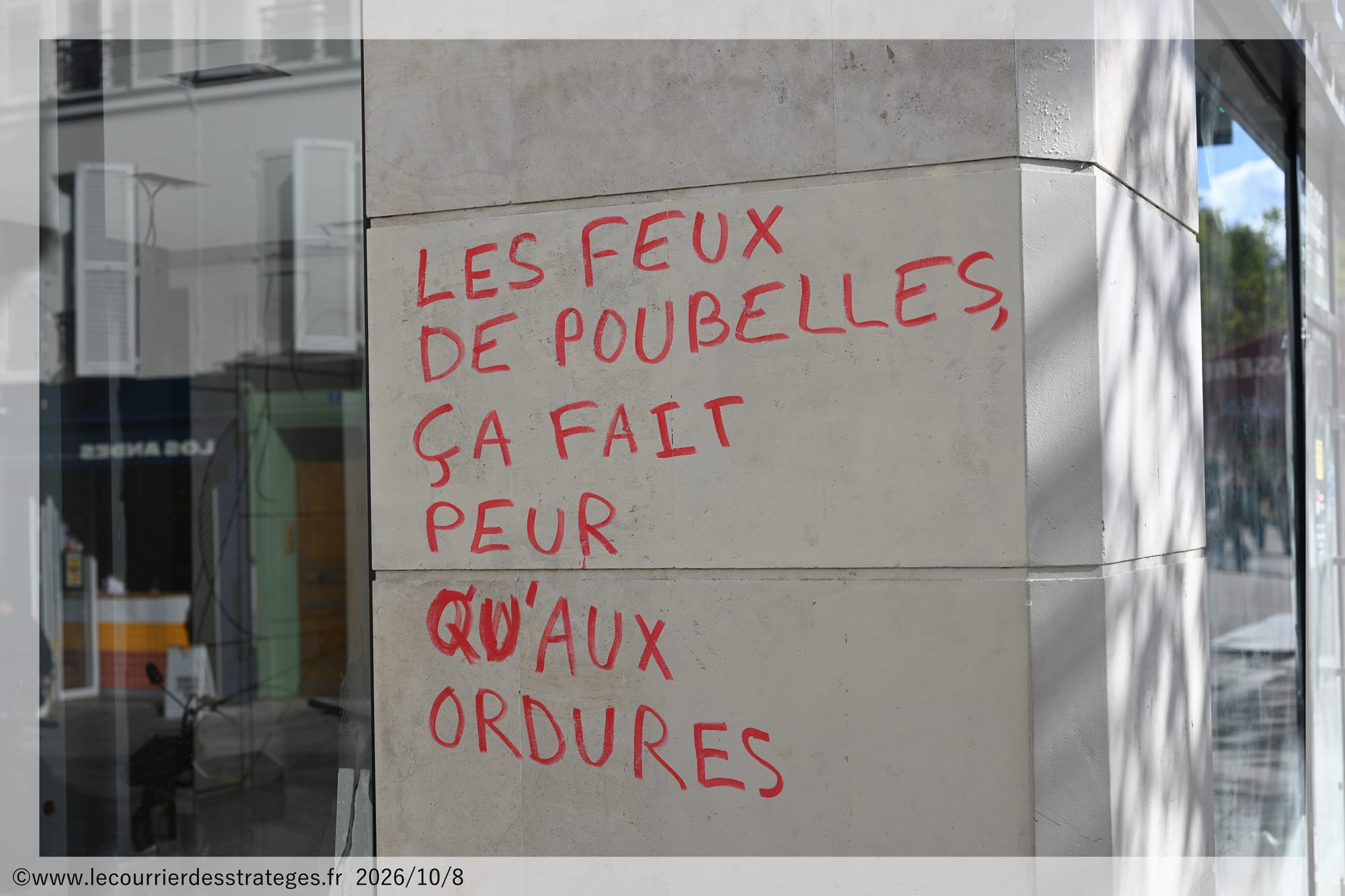


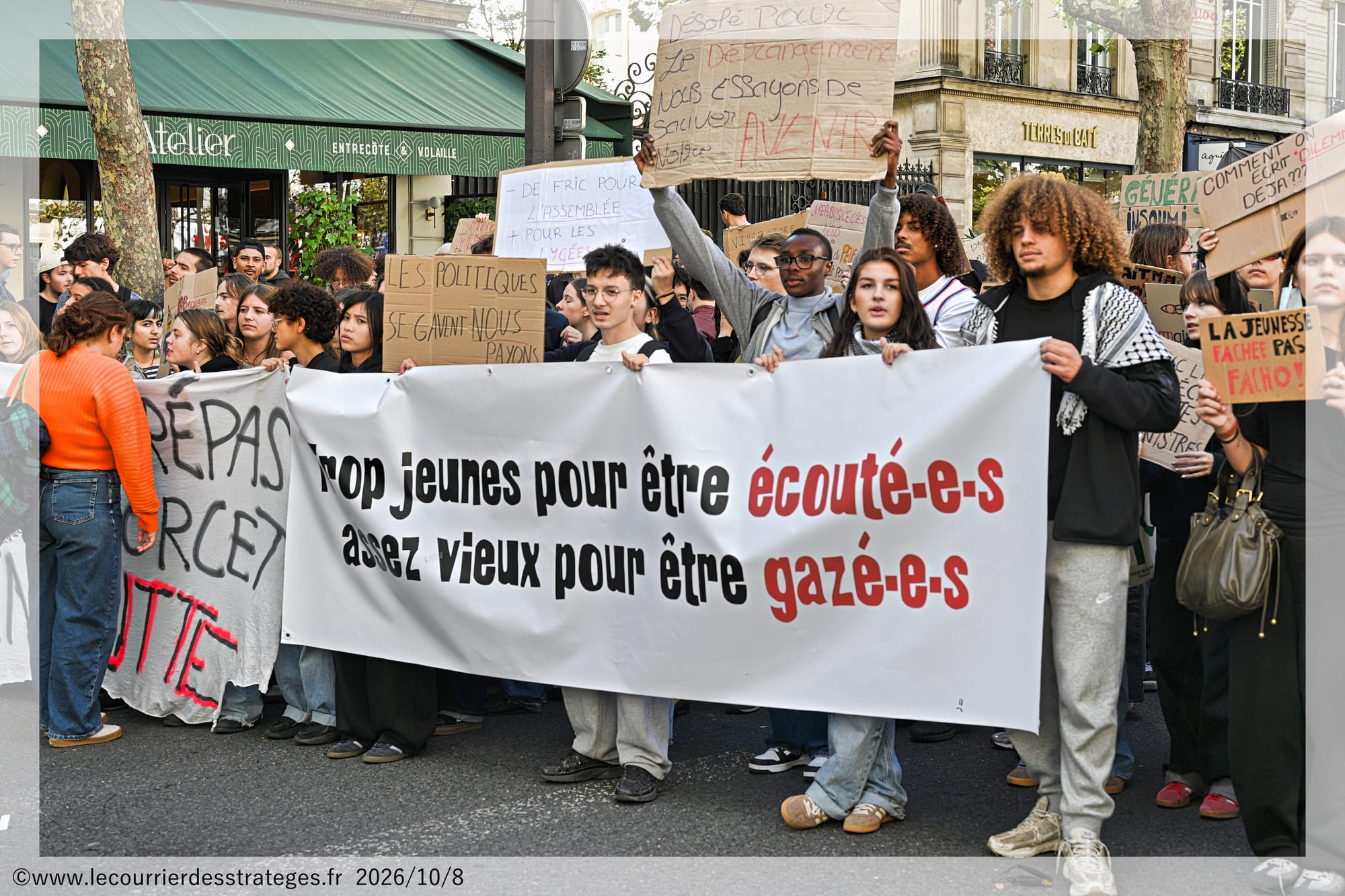

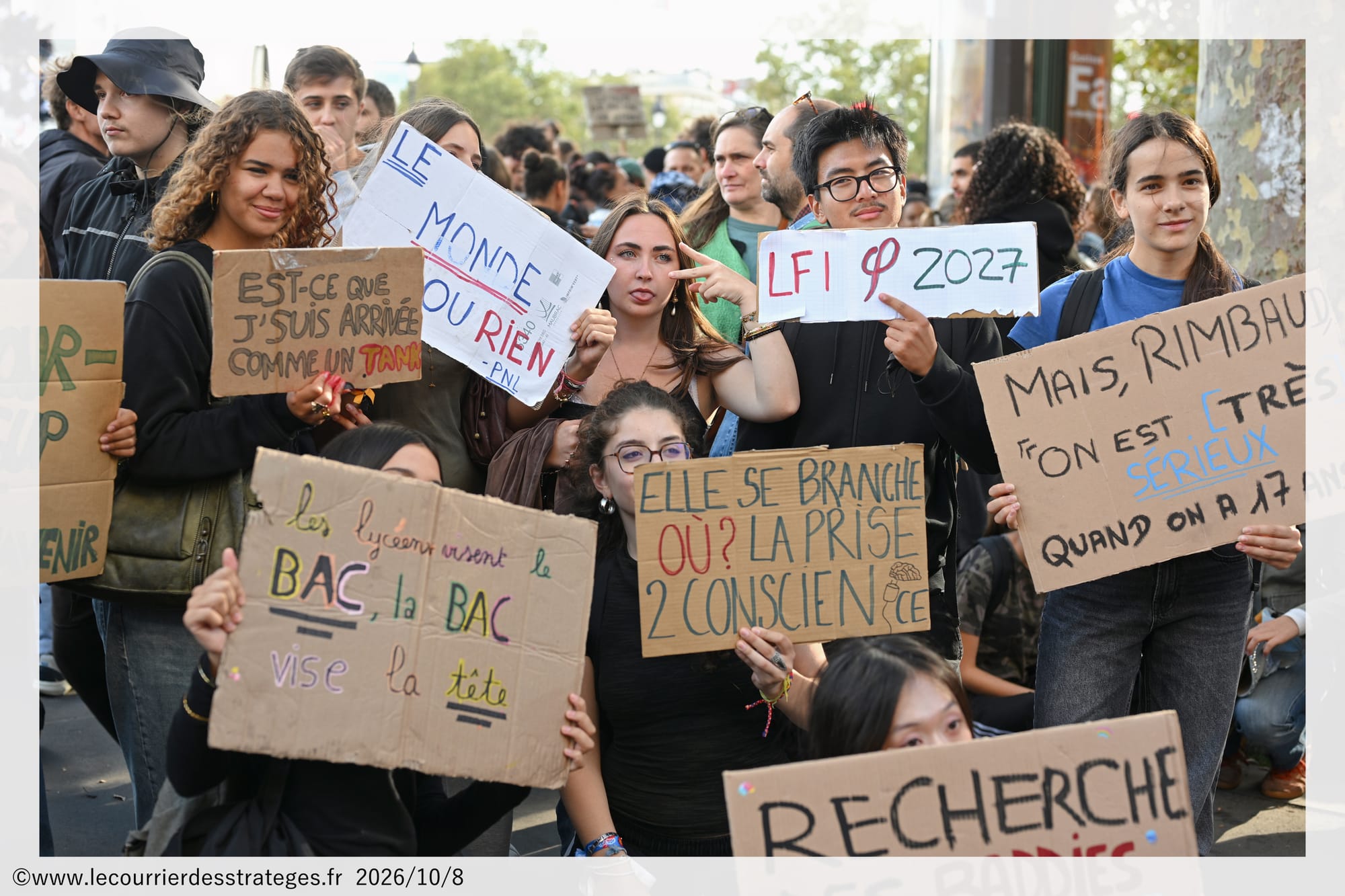





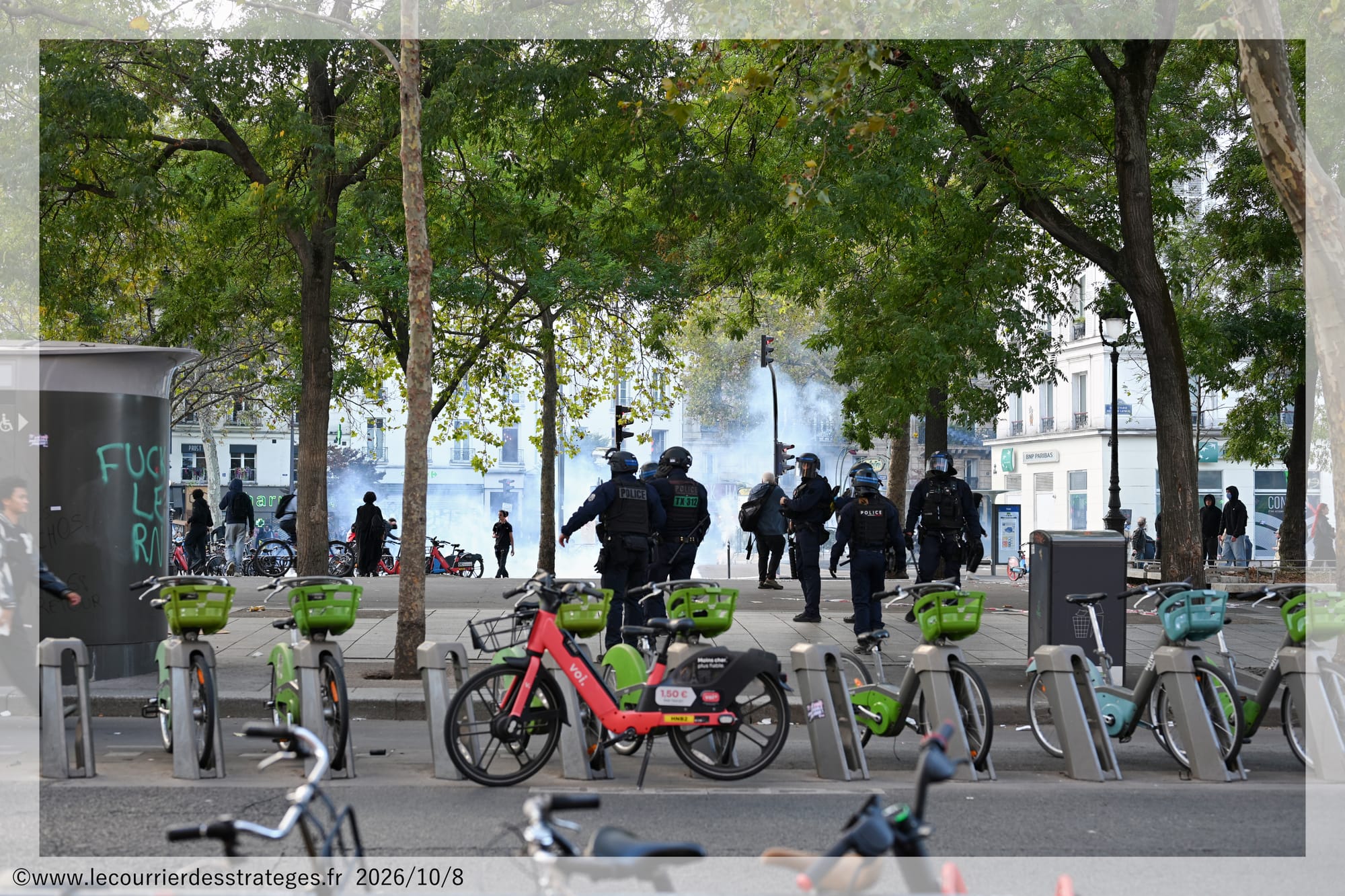
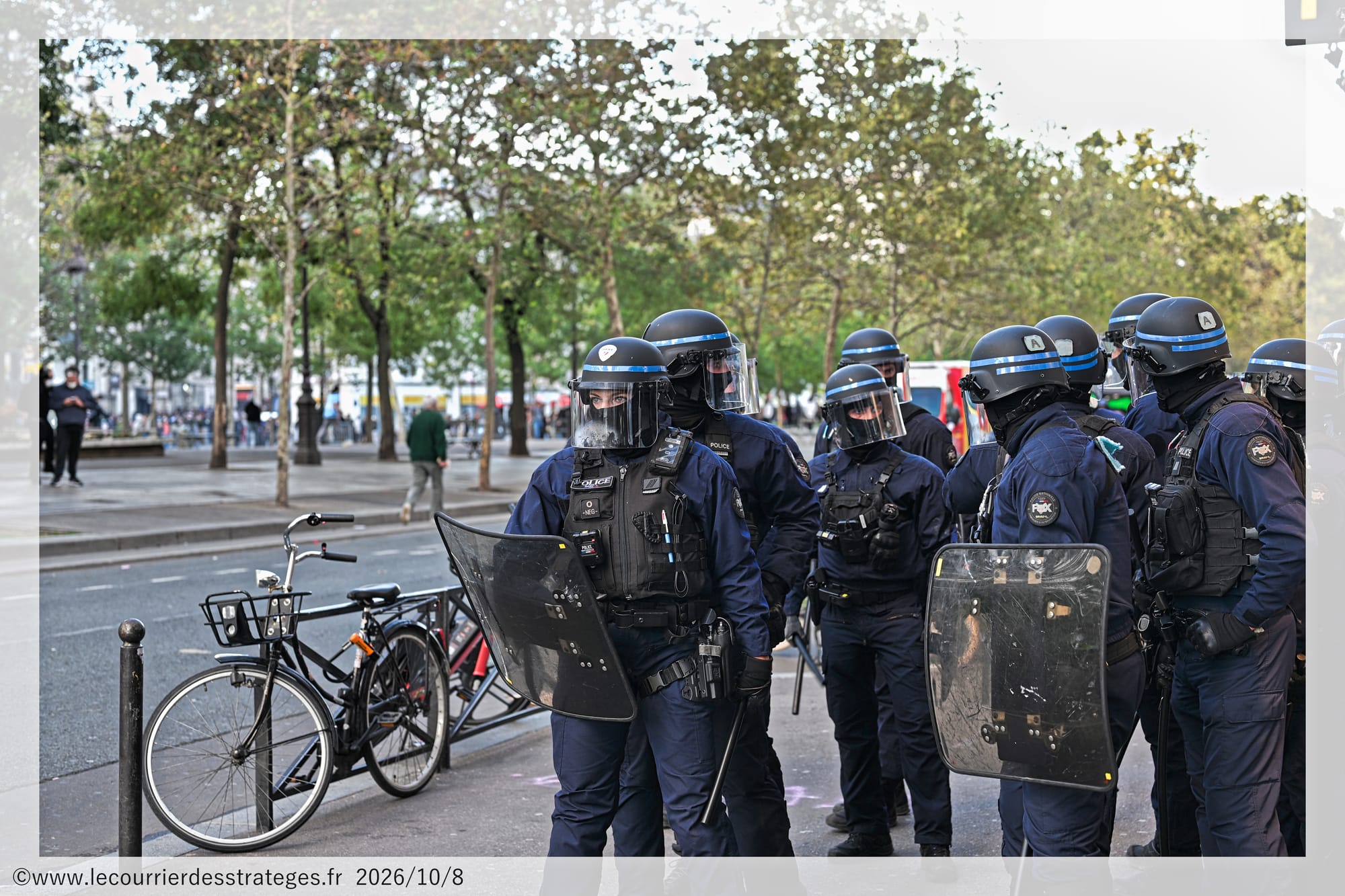
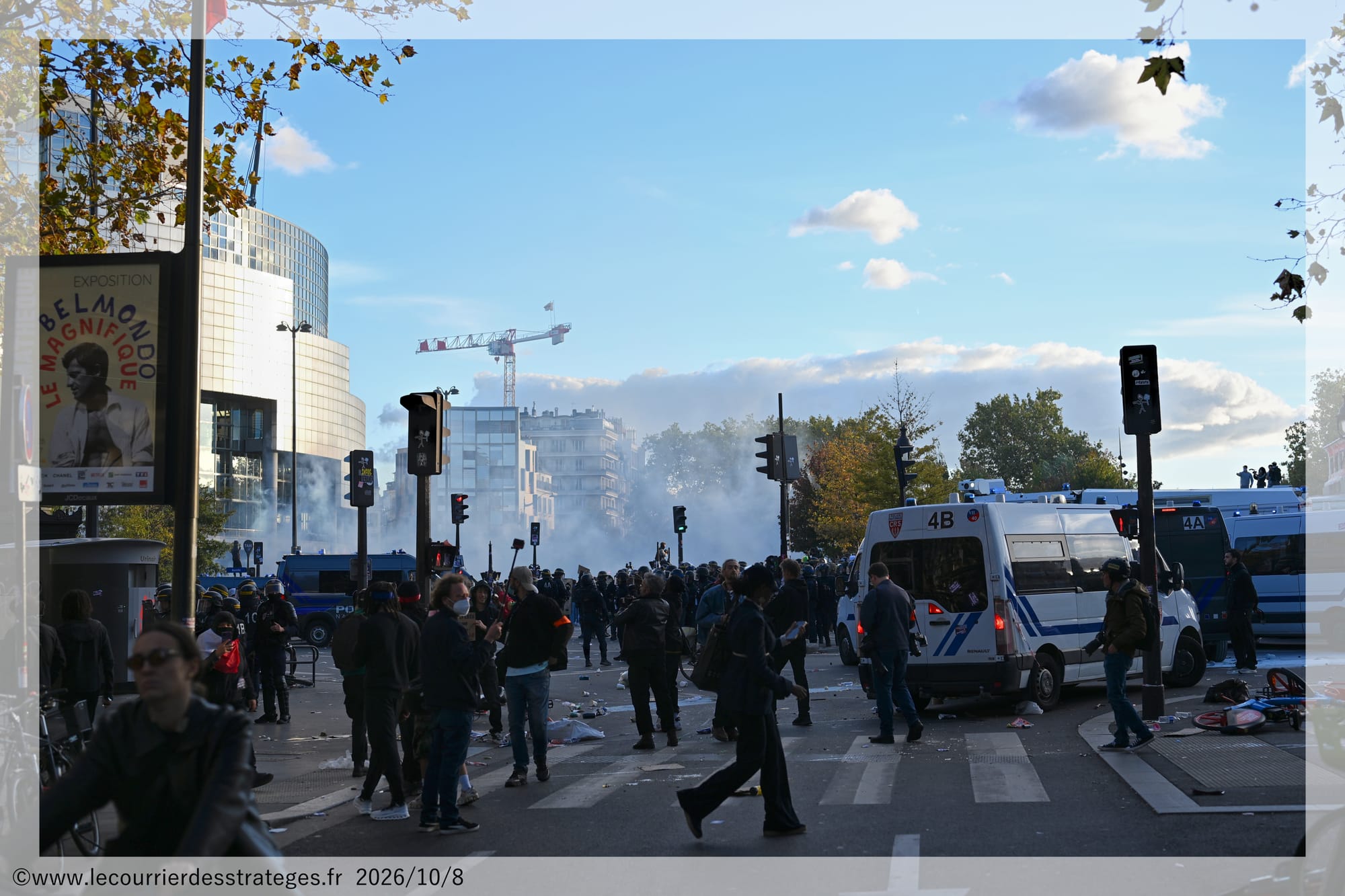
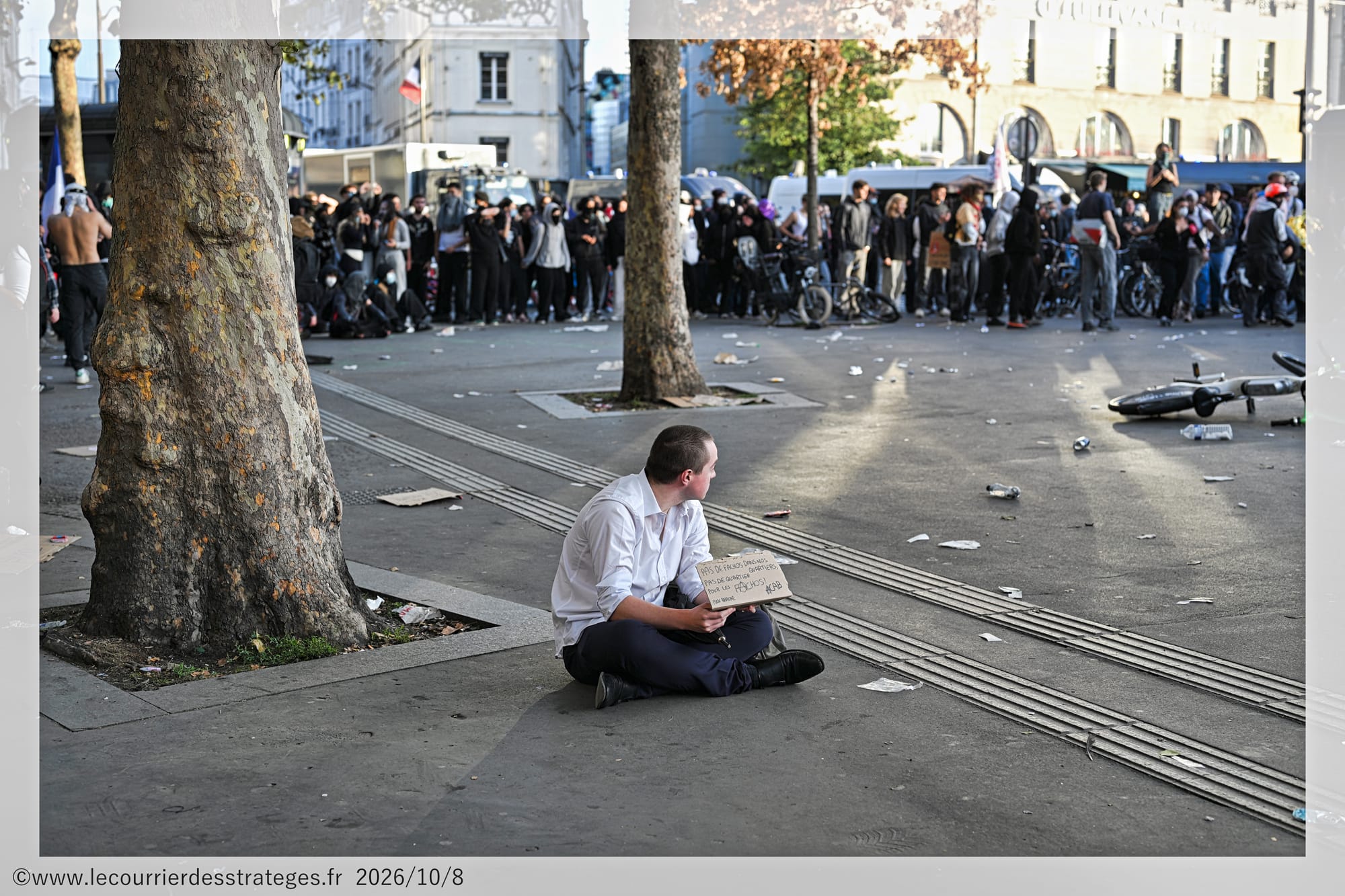
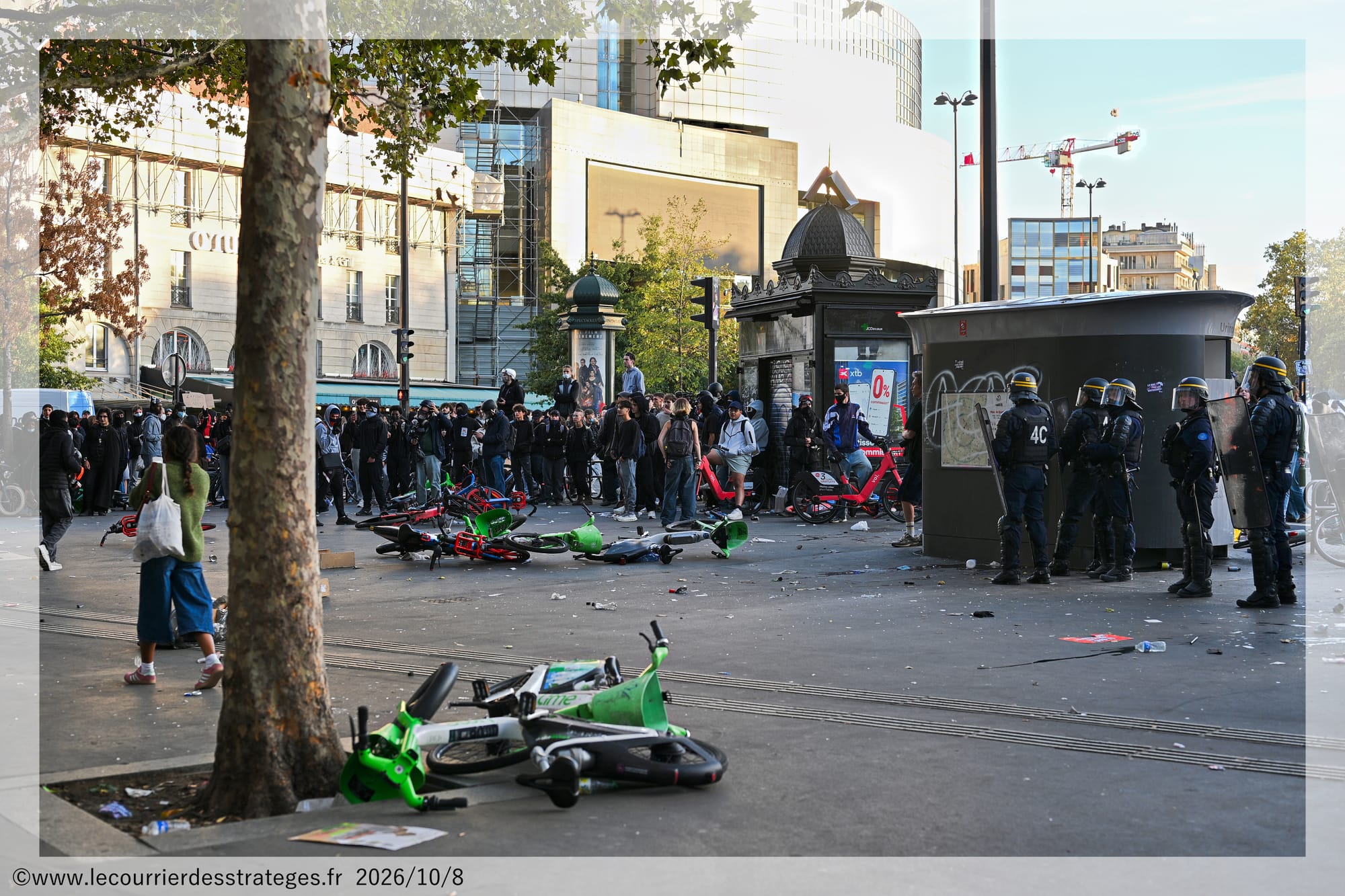
 Chi scrive lo scenario sceglie il nemico. L’Europa si esercita alla fine del mondo; il resto del mondo si esercita a farne a meno.
 A Levante questa sera, giovedì 8 ottobre 2026, Jeff Hoffman dialoga con Margherita Furlan, giornalista e analista geopolitica, direttrice di Casa del Sole TV, e con Vincenzo Maddaloni, giornalista e scrittore, direttore del Centro studi Berlin89.
 A Bruxelles gli ambasciatori dei ventisette preparano a porte chiuse, senza telefoni, lo «scenario da incubo» di un attacco ibrido con molte vittime.
 Dal 13 ottobre i cieli del Tirreno ospitano Steadfast Noon, l’esercitazione nucleare annuale della NATO.
 Ad Accra il Ghana annuncia che chiederà di entrare nei BRICS.
 AFFRONTIAMO INSIEME
 «Risposta dolorosa», «Schengen militare», «10 milioni di droni»: la nuova lingua della Commissione europea
 Il protocollo d’emergenza di Bruxelles: difesa europea o competenza che i Trattati non danno?
 Steadfast Noon: Ghedi, Aviano, Amendola, Gioia del Colle, Trapani e la Sardegna sorvolata a bassa quota
 Un Parlamento informato da un avviso tecnico per i piloti: la sovranità comincia dall’informazione
 La Germania tra la paura di Lipsia, il rifiuto della guerra e il riarmo come politica industriale
 Chi incassa lo scenario: droni, cavi, satelliti e gli Azionisti dell’Apocalisse
 Se la paura è il prodotto, perché i titoli della difesa sono scesi?
 Il Ghana bussa ai BRICS passando da Nuova Delhi: multipolarità o diplomazia di facciata?
 Cosa guardare nelle prossime due settimane per capire se lo scenario resta uno scenario
 LIBRI DEGLI OSPITI
 Vincenzo Maddaloni, «Voglia di rivoluzione», Nexus Edizioni, 2024
 Vincenzo Maddaloni con Modini, «L’atomica degli ayatollah», Nutrimenti, 2006
 Margherita Furlan, «BRICS Scacco Matto», La Casa del Sole Edizioni, 2025 (italiano, inglese, russo)
 SOSTIENI CASA DEL SOLE TV
 Casa del Sole TV è un progetto di giornalismo indipendente, autofinanziato, senza editori né partiti.
 IBAN: IT63P0326822300052392596590
 Intestato a: La Casa del Sole Edizioni
 Causale: Donazione Casa del Sole TV
 MEMBERSHIP YOUTUBE

 Analista Multipolare: €5/mese
 Inviato della Verità: €15/mese
 Architetto del Futuro: €25/mese
 I LIBRI DI MARGHERITA FURLAN
 «BRICS Scacco Matto», disponibile in italiano, inglese e russo
 SEGUI CASA DEL SOLE TV
 YouTube: @CasadelSoleTVChannel
 La guerra è il prodotto, il caos è la materia prima.
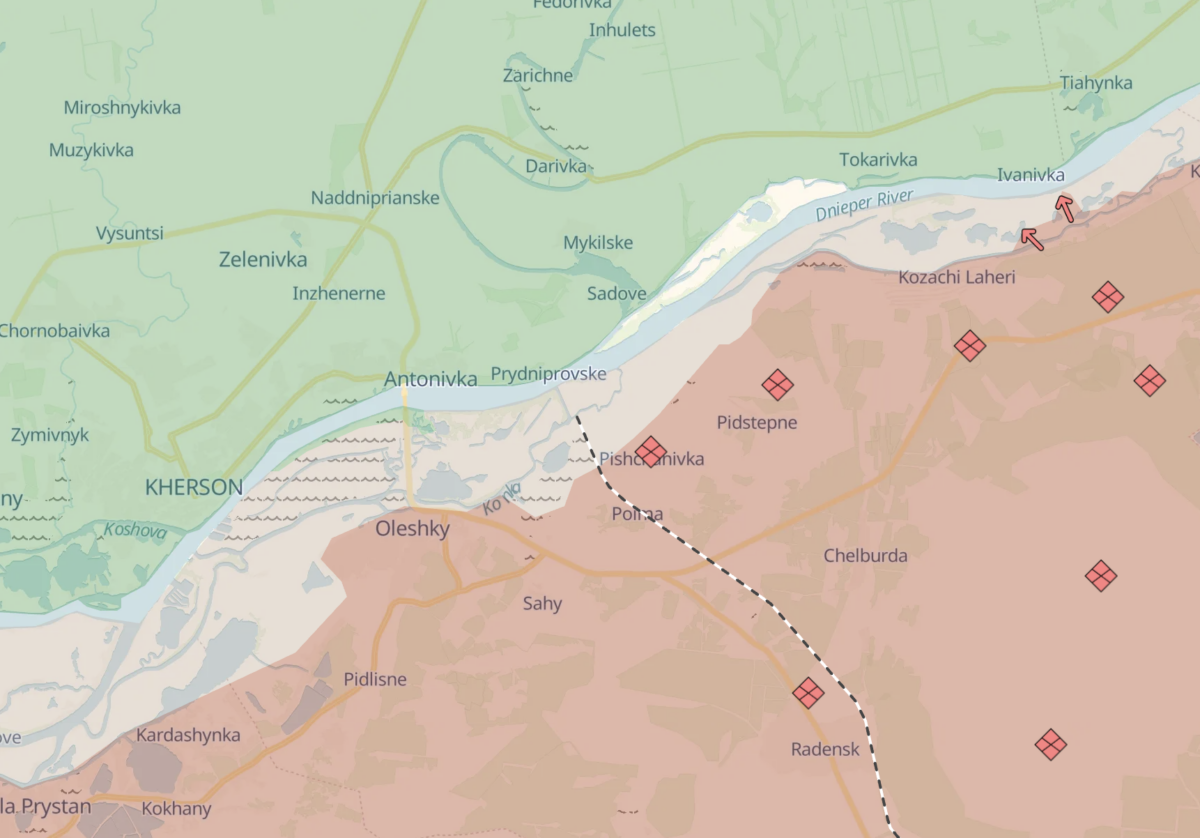
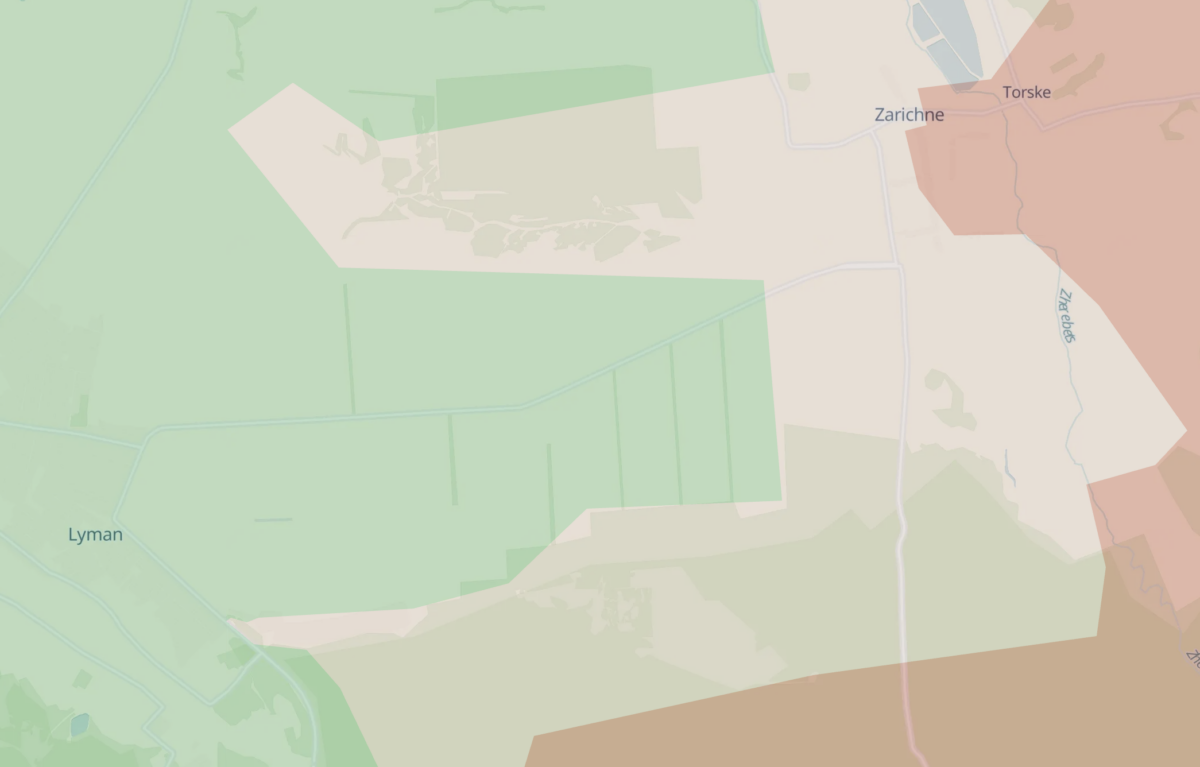
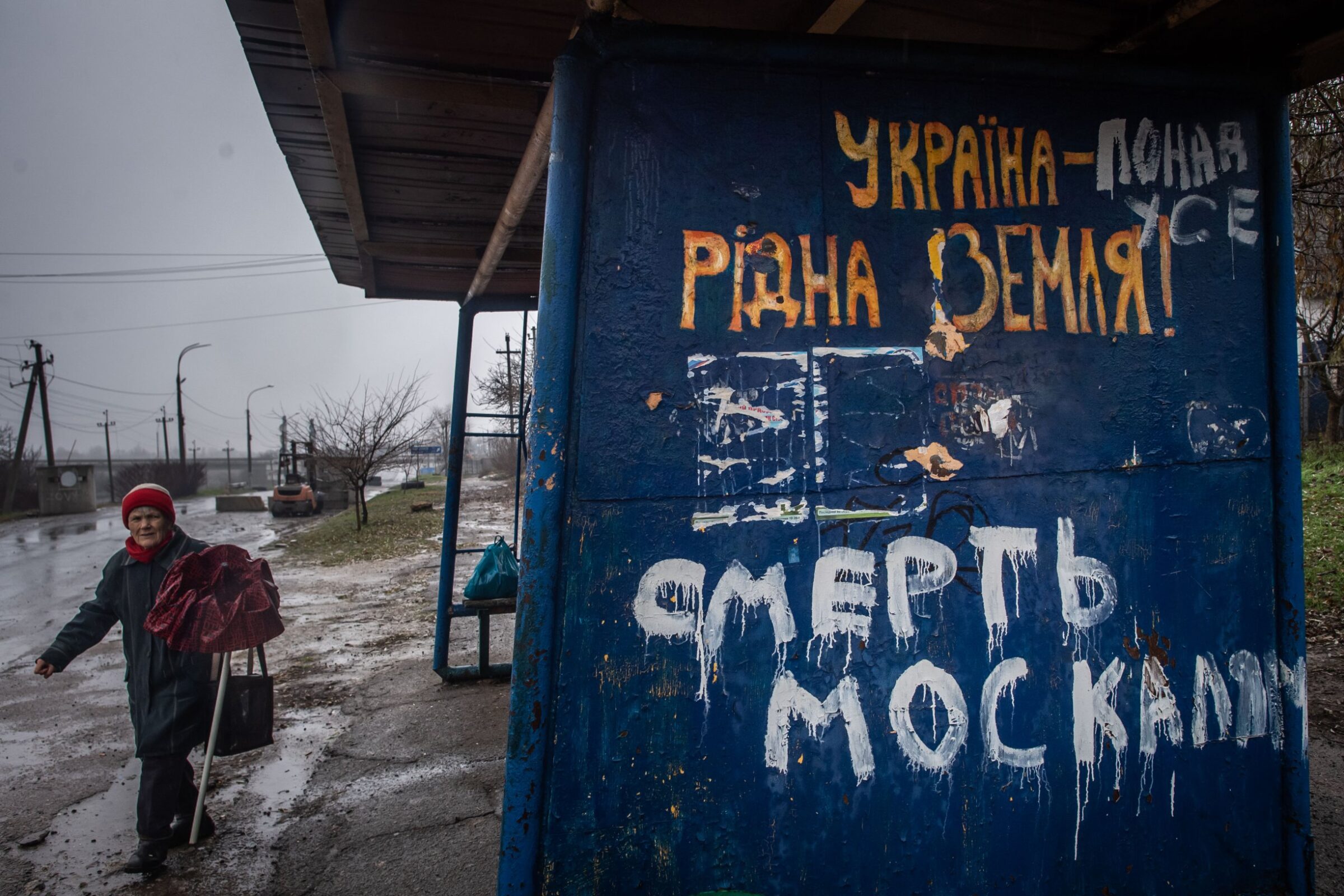
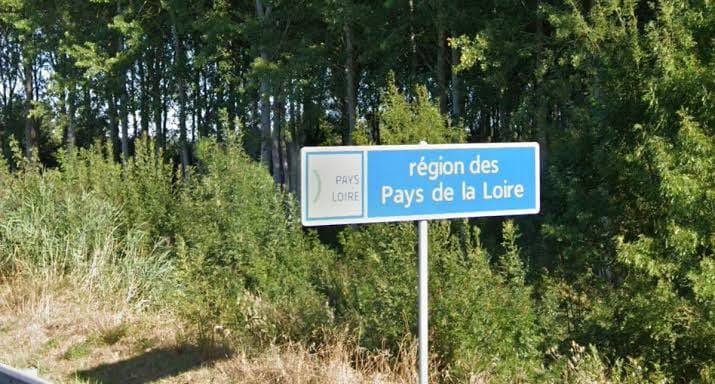

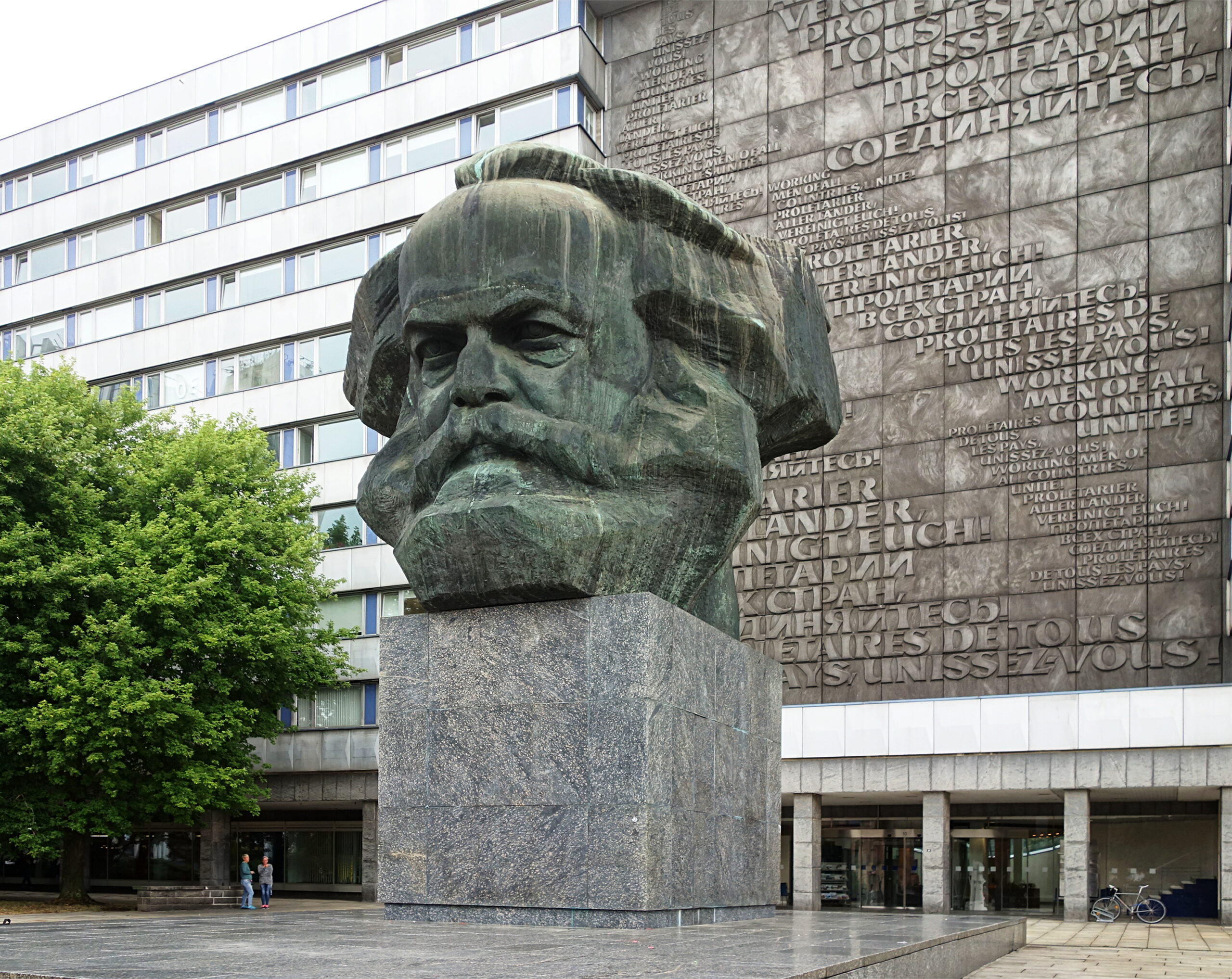


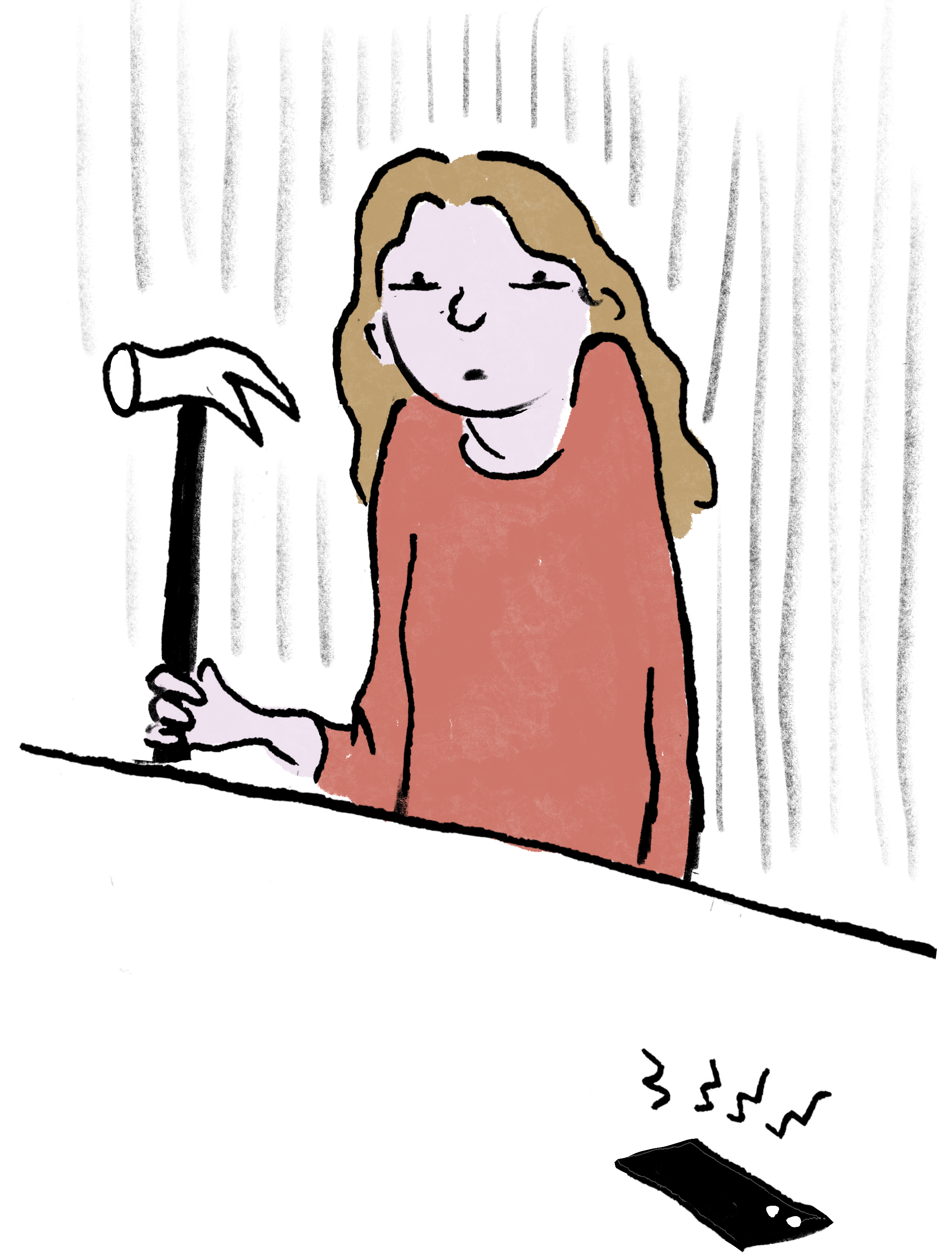
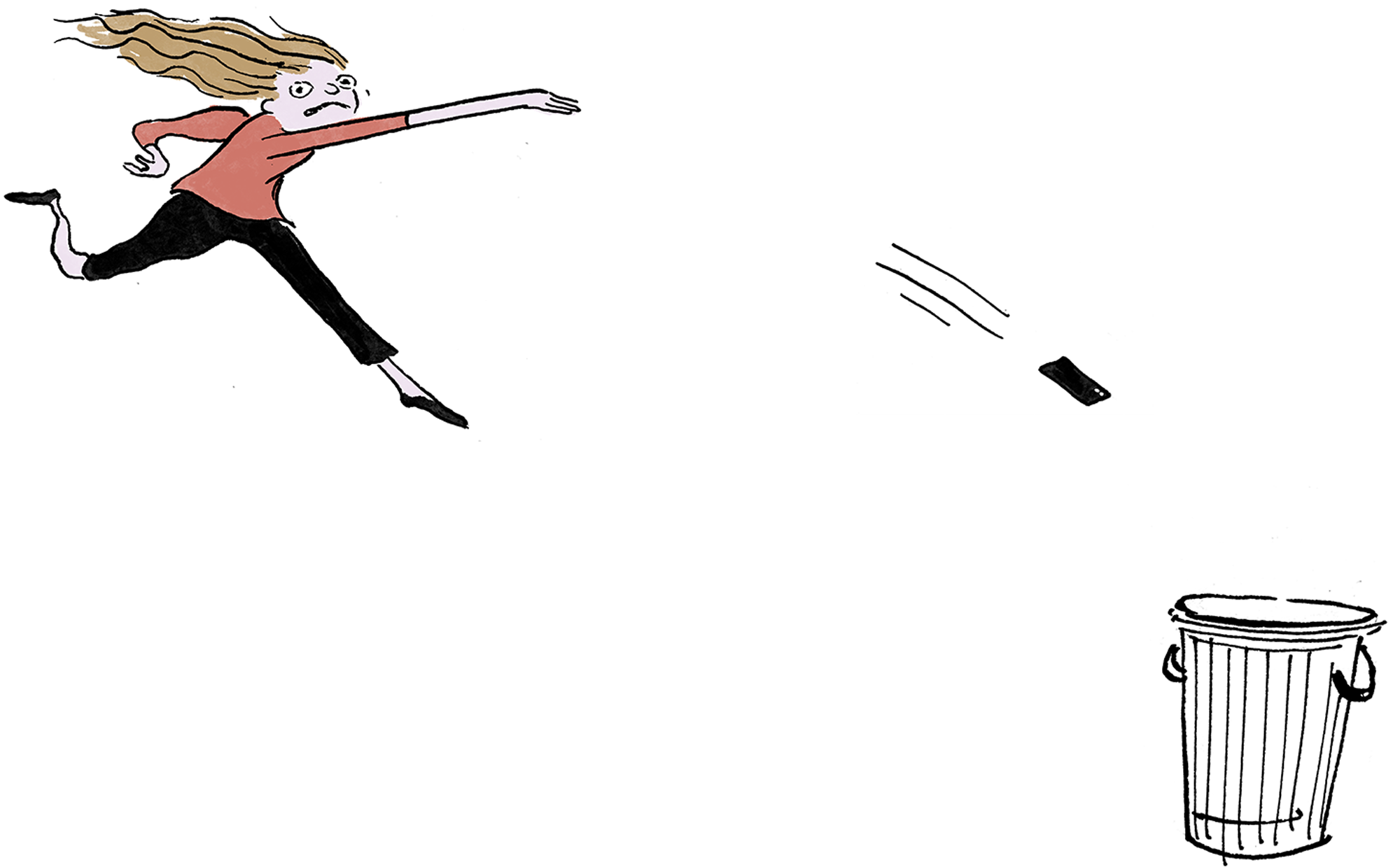
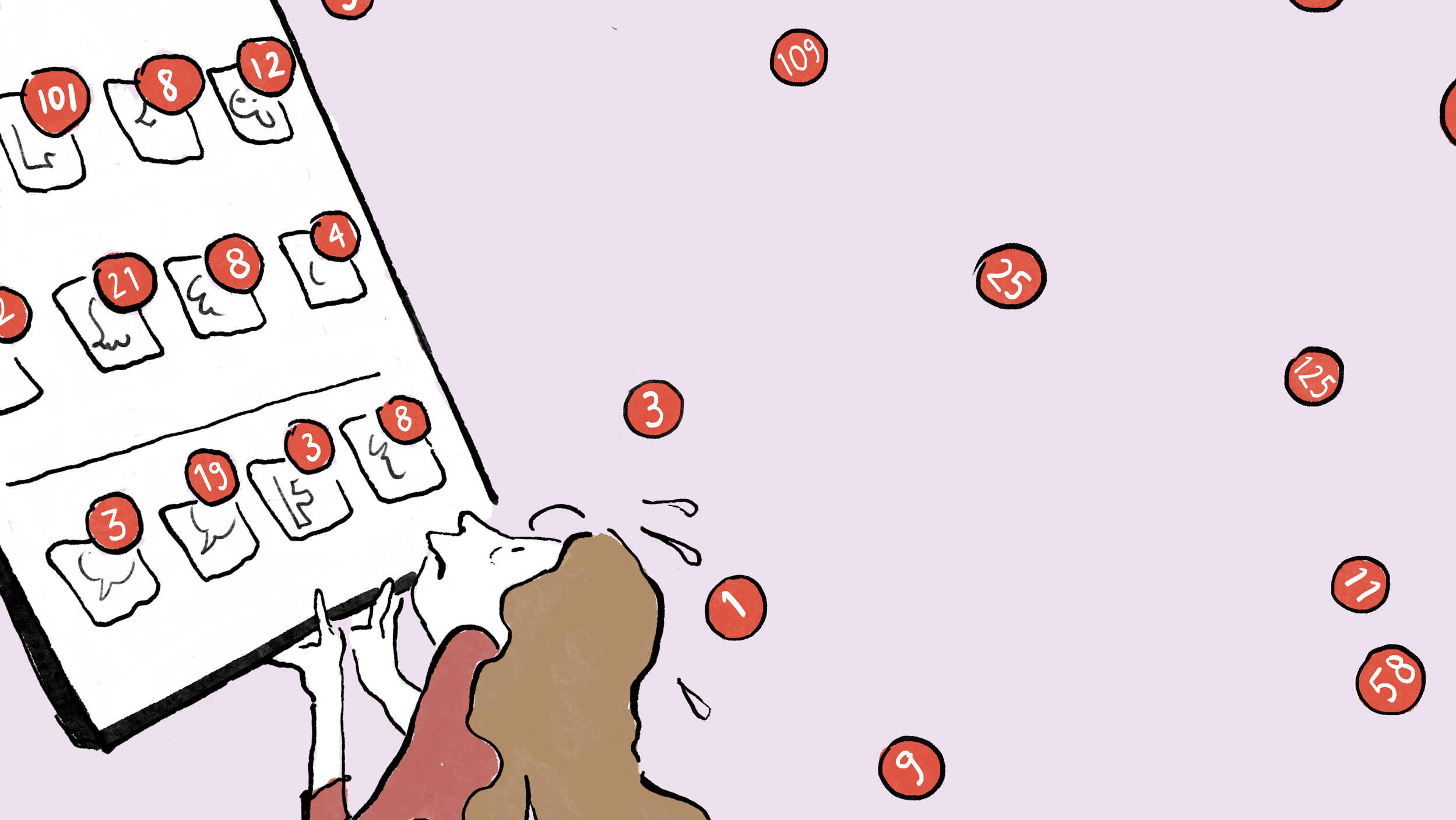

 Proposition de rsolution visant garantir un accs continu leau potable dans les territoires ultramarins (dpt le mardi 8 septembre 2026).