❌

Reading view

Saudi-Backed Forces Renew Bab al-Mandab Push Amid Fierce Houthi Resistance (Videos)

File image.

Saudi-backed Yemeni government forces on October 9 again claimed to have captured the strategic Bab al-Mandab Strait and nearby Mayyun Island.

A Yemeni military source told the German Press Agency (dpa) that the operation began before dawn with Saudi air support.

The source said the Southern Giants Brigades and Nation’s Shield forces seized the al-Ardi camp, Coast Guard observation posts and a range of high ground overlooking the strait.

Furthermore, the source claimed the forces had established full control over Mayyun Island, noting that clashes and clearing operations continued in the surrounding area.

The announcement marked the second time within days that Saudi-backed forces had claimed to capture the area. On October 5, the forces made a similar claim during Operation Yemen Dawn, but that announcement eventually proved to be false.

Responding to the latest claims, Houthi military spokesman Brig. Gen. Yahya Saree said in a statement that the group’s forces had repelled a second attempted advance by Saudi-backed forces toward Bab al-Mandab.

Saudi-backed forces had tried to move toward the waterway from Lahj province but had failed to advance, according to the spokesman.

Saree said Houthi forces struck the advancing troops with ballistic missiles, artillery and heavy weapons. He claimed the attacks destroyed more than 22 armored vehicles and killed or wounded dozens of fighters, including several commanders.

The spokesman added that more than 30 ambulances had arrived in Aden transporting dead and wounded personnel from the Saudi-backed forces.

Bab al-Mandab connects the Red Sea with the Gulf of Aden and is a key shipping route linking the Indian Ocean with the Suez Canal and the Mediterranean Sea. Mayyun Island lies within the strait, making control of the island and surrounding coastline strategically important to the opposing forces.

The latest attempted advance by Saudi-backed forces shows that the kingdom remains focused on recapturing Bab al-Mandab, despite the deteriorating situation of its allies in Taiz, where they are fully besieged by the Houthis. The fall of Taiz could, however, pose a serious problem for Saudi-backed forces, as it would allow the Houthis to launch an attack toward the port city of Aden, potentially trapping all troops amassed near Bab al-Mandab.

_______________________________________________________________________________________________________________________

SouthFront: Analysis and Intelligence

NOW hosted at southfront.press

Previously, SouthFront: Analysis and Intelligence was at southfront.org.

The .org domain name had been blocked by the US (NATO) (https://southfront.press/southfront-org-blocked-by-u-s-controlled-global-internet-supervisor/) globally, outlawed and without any explanation

Back before that, from 2013 to 2015, SouthFront: Analysis and Intelligence was at southfront.com

SOUTHFRONT.PRESS

MORE ON THIS TOPIC:


The post Saudi-Backed Forces Renew Bab al-Mandab Push Amid Fierce Houthi Resistance (Videos) appeared first on South Front.

  •  

Exclusive: the Pakistan-Saudi-Yemen-Iran riddle

The House of Saud is attacking Ansarallah to protect the death cult in West Asia, Pepe Escobar writes.

Join us on Telegram, X, and VK.

Contact us: info@strategic-culture.su

Let’s start with exclusive intel. On Thursday, Yahya Ali al-Ra’i, speaker of the Sana’a-based House of Representatives under Ansarallah, delivered a letter to Sardar Ayaz Sadiq, the speaker of Pakistan’s National Assembly, requesting Pakistani mediation between Ansarallah and Riyadh.

Ra’i, widely respected, has been the speaker in Sana’s since 2008. Sadiq began his current term as speaker in Islamabad in March 2024. This direct parliamentary channel is immensely significant as a diplomatic opening – as Pakistan faces enormous pressure, domestically and across the lands of Islam, over its real commitments related to the Saudi Arabia vs. Yemen clash as determined by the Mecca Defense Alliance.

As murky as the the whole situation really is, direct intel from both Islamabad and Tehran, at the highest levels, as I especifically requested, has established four key points:

  1. Islamabad is adamant that Pakistan will not attack Ansarallah and will not commit troops to that effect. The Riyadh understanding last week excluded entry into Yemeni territory. Pakistani forces should remain outside any ground offensives against Ansarallah. That seems to be the case – for now.
  2. Pakistan was already mediating between Riyadh and Sana’a through Tehran. Field Marshal Asim Munir personallly requested that Iranian Foreign Minister Araghchi use Iran’s influence with Ansarallah, together with Araghchi’s contacts with both Islamabad and Riyadh. Pakistan’s Foreign Office did not deny this diplomatic channel.
  3. Pakistan would have to defend Saudi territory under its Mecca Defense Alliance commitments. Deployments for border protection and defense against drones and missiles launched by the Yemeni Armed Forces fit this pattern.The problem is whether some Pakistani advisors are already deployed in Yemeni territory. If Pakistan has even a few “advisers” in Aden and troops somewhere around northern Yemen on the Saudi border, that already betrays its promises.
  4. Pakistani forces should be able to defend themselves – that comes with the territory. It’s a stated contingency; not a prediction of retaliation. At least one Pakistani officer was killed in Saudi Arabia without a Pakistani retaliatory response. That spells out restraint – at least for now.

Transiting Hormuz: use CIPS and pay in rials

On the wider U.S.-Iran front, diplomatic moves support what we have been reporting for the past few days on Transition Protocol. Pakistan in fact is desperate to maintain engagement with both Riyadh and Tehran, alongside non-stop coordination with Beijing. After all, China completely supports Pakistan mediation; and Araghchi keep speaking to Munir, as he did following talks with Wang Yi in Beijing.

Meanwhile, on the Washington front, speculation is feverish all over the spectrum over preparations for a Trump administration renewal of the war – including potential strikes on Iranian energy infrastructure and even, quite worrisomely, nuclear targets. There is no final decision yet by the Psycho/Sociopath in Charge, much less a launch date.

The immediate risks anyway are staggering.

Diplomacy – even in ersatz form – is mired in impasse. Tehran remains – and will continue to remain – anchored to its existing conditions, detailed by the dead cat MoU, but now carrying the threat of blocking transit routes along Oman’s coastline that it considers illegal. Washington for its part is obsessed with vast nuclear concessions.

Earlier this week, we confirmed that the Supreme National Security Council (SNSC) in Tehran made two very consequential decisions.

  1. Tehran decided to collect its Strait of Hormuz transit toll in Iranian currency only. No yuan, no crypto. Actually via a mechanism linked to CIPS, the Chinese payment/clearing system, bypassing the U.S. dollar. You use CIPS to electronically buy yuan, change it into rials, and pay the toll. Strait of Hormuz transit revenue after all is one of Tehran’s few remaining sources of hard currency. The new mechanism will definitely strengthen the value of the rial.
  2. Via Pakistan, Tehran notified Trump’s real-estate Bismarck, Witkoff, that Iran will not move an inch from its conditions for a negotiated settlement – and is fully prepared for any possible U.S. offensive. And this after J.D. Vance came up with an added nuclear enrichment condition: a “meaningful” and “significant” reduction. That blockades the nuclear dossier and makes a quick resolution formula nearly impossible.

The bottom line is that the escalation ladder could get out of control in no time.

Coming Yemeni Storm 1.0 in effect

On the Saudi-Yemen front, the Yemeni Armed Forces are absolutely ruthless. The Coming Yemeni Storm 1.0 is already in effect.

The damage at Jeddah refinery, close to Yanbu, is massive. Ansarallah is simultaneously hitting Saudi Arabia’s eastern and coast and western coast, plus the East-West pipeline in between.

For all practical purposes Sana’a is going for the whole key Riyadh infrastructure. The U.S. defense umbrella is a joke: remaining PAC-3 and Patriot batteries are useless against Yemeni ballistic missiles.

Saudi troops may number at best 75,000, plus 125,000 from the National Guard. The Yemeni Armed Forces command at least 350,000 that can be easily ramped up to 800,000. To expect “help” from the GCC petrosheiks doesn’t even qualify as a joke.

The Yemeni Armed Forces also unleashed two ballistic missiles plus explosive drones in the direction of Aden’s international airport. Ansarallah said the target was Saudi military supplies that had just arrived at Badr Camp, the mercenary HQ adjacent to the airport. An unspecified number of high-ranking Saudi officers and officials – perhaps even some Pakistanis – were killed.

Turkey for its part is also about to put boots, aircraft and air defenses on Saudi ground. These Turkish forces in thesis could protect Riyadh, the holy cities and the East-West pipeline. Ankara, just like Islamabad, insists it has no plans to enter the war inside Yemen.

The swift liberation by the Yemeni Armed Forces of the western coast close to the Red Sea also made it crystal clear how the so-called Saudi “coalition” – actually a gang of proxies/mercenaries – was deploying de facto terrorists all along.

Ansarallah recovered a wealth of foreign passports – especially from Kuwait, Qatar, Turkey and Syria – belonging to ISIS and Al-Qaeda goons. Call it the Terror Inc. Legion.

I’ts the same old song. Qatar and Turkey, in sync, instrumentalized the transfer of ISIS/Salafi-jihadi goons from Syria and Iraq: they were welcomed in Yemen by the Islah Party. Turkey was the key transit route; at least 2,100 of these ISIS assets are Turkish.

AQAP is back!

Way back in 2020, Ansarallah had already seized documents, maps, and videos showing ISIS/Daesh and Al-Qaeda jihadis directly supported by Riyadh roaming Yemen, with captured goons confessing they were paid, weaponized and logistically supported by the Saudis.

Now a new incarnation of the former al-Qaeda in the Arabian Peninsula (AQAP) is alread in effect – via at least 20,000 Daesh/takfiri terror goons “imported” from Syria. They will be sent to Aden governorate – following the request, actually the demand by MbS himself, fully approved by the Trump administration and its throat-slitter vassal turned President in Damascus, former ISIS al-Jolani.

The definitive headline of the whole affair though is that the House of Saud is attacking Ansarallah to protect the death cult in West Asia.

By controlling the Bab al-Mandab, Ansarallah de facto cuts off the Israeli port of Eilat. That had already happened before during the genocide of Gaza. Riyadh was furious because they had struck deals for the – now virtually scrapped – NEOM project that would connect up to Eilat once the Trumpian Abraham Accords were up and running.

Considering the whole picture, all hell could still break loose due to a single spark. Possibilities include: a Yemeni strike on Saudi Arabia causing massive casualties; a toll-enforcement mess in the Strait of Hormuz; an Iranian strike on a GCC petro-sheikh target, following an American provocation; an Iran-linked attack on a U.S. base, once again folowing an American provocation; and most of all a Sociopath-forced “land, air and sea” CENTCOM (mis)adventure.

Fasten your seat belts.

  •  

Iran & Yemen’s maritime trap: how they control global trade

Saudi Arabia has $142 billion in American weapons. Yemen is the poorest country in the Arab world. So why can’t Riyadh win?

Last month, Ansar Allah seized Mokha and Perim Island, and with them the Bab el-Mandeb Strait, cutting off Saudi Arabia’s alternative oil route around the closed Strait of Hormuz. Mohammed bin Salman begged Trump for US airstrikes, then backed “Dawn of Yemen,” a 100-warplane offensive aimed at Sanaa, as crude oil again tops $100 a barrel. Veteran war correspondent and analyst Elijah Magnier joins Rania Khalek and Zoe Alexandra on the Red Sea front, as nearly 1,000 Yemenis have been killed and 184,000 displaced since fighting resumed.

But Magnier argues Ansar Allah – often referred to in US media as the Houthis – hasn’t lost much ground. He explains why Saudi warplanes are largely powerless in Yemen’s mountainous terrain, and why he sees the movement advancing on Taiz and Marib. And Magnier breaks down how Hormuz and Bab el-Mandeb have become two fronts of the same war – different demands, same enemies – and how Israel’s quiet push into Somaliland could drag it directly into the Red Sea fight.

Watch full episodes of BT Live, join breakthroughnews.org as a member today!

  •  

Syria May Send Troops to Saudi Arabia Amid War with Ansar Allah

By Kyle Anzalone | The Libertarian Institute | October 8, 2026

A US and Syrian official said Syria is considering sending troops to Saudi Arabia as the kingdom battles Ansar Allah in Yemen.

Reuters reported on Thursday that a US official and a Syrian defense official said that Damascus may send Syrian forces to Saudi Arabia. Riyadh has reached out to several allies for support in its war against Ansar Allah.

On Monday, Turkey and Pakistan agreed to provide military support to Saudi Arabia under the Mecca Accords, a mutual defense pact signed by the three countries earlier this year.

A joint statement released by the Mecca Accords members explained, “The Committee decided to move immediately to the practical implementation of the collective defense commitments and to take the necessary measures to provide the agreed military forces and capabilities and ensure their rapid deployment in the Kingdom, in accordance with the approved arrangements and the national legislation of the Parties, thereby enhancing readiness, military integration, and the collective capacity to confront and counter threats.”

Turkey indicated it would provide Saudi Arabia with military capabilities rather than ground troops, which would require parliamentary approval, while Pakistan did not provide details on the forces or capabilities it plans to deploy.

The statement was released following an emergency meeting of the alliance to discuss the situation in Saudi Arabia. The fighting between Ansar Allah and Saudi Arabia reignited in July after the kingdom attacked the Sanaa airport. In recent weeks, Ansar Allah has taken a significant amount of territory from the Saudi-backed forces in Yemen and attacked several energy sites in Saudi Arabia.

Riyadh has reached out to international partners for support. Crown Prince Mohammed bin Salman requested that President Donald Trump order direct attacks on Ansar Allah positions. So far, Trump has limited US involvement to intelligence sharing and battlefield planning, and refused to conduct direct strikes on Ansar Allah.

Saudi Arabia has also asked China and Pakistan to place pressure on Iran to rein in Ansar Allah. According to three Iranian sources speaking with Reuters, Beijing privately asked Tehran to rein in Ansar Allah after receiving a request from Riyadh. The sources told the outlet that Iran responded that stability in the region depended on US and Israeli aggression.

While Saudi Arabia’s ties to the US and Ansar Allah’s relationship with Tehran allow the war between the two to appear to be a part of a larger regional war, the conflict began over a decade ago. Additionally, Ansar Allah did not begin its offensive following the US and Israeli surprise attack on Iran, but rather after Saudi-backed forces attacked the Sanaa airport, prompting Ansar Allah to resume attacks on Saudi Arabia.

Western officials and media often label Ansar Allah as a proxy of Iran. However, while Iran has provided support to Ansar Allah, there is little public evidence that Tehran directs the group’s military operations.

While Syria was a long-time [resistance] ally under the rule of Bashar al-Assad and his father, Damascus fell to rebels, led by former al-Qaeda members, in 2024. Syria is now led by President Ahmed al-Sharaa, formerly known as Abu Mohammad al-Jolani, who previously led al-Qaeda’s Syrian affiliate.

  •  

Saudi Airstrike on Passenger Vehicle in Yemen Kills at Least Two Civilians, Injures Children: Health Ministry

Saudi airstrikes hit a passenger vehicle in Yemen’s southwestern Taiz province on Thursday, killing at least two civilians and wounding six others, as civilian casualties continue to mount in the US-supported bombing campaign. According to the Yemeni Health Ministry within the Ansar Allah-led government, a pregnant woman also lost her baby due to the strike, […]
  •  

Ansar Allah Pounds Saudi Airports as Yemen War Escalates

Yemen’s Ansar Allah, also known as the Houthis, has launched multiple attacks on airports in Saudi Arabia in recent days, marking an escalation of the conflict, which was reignited by Saudi airstrikes on the Sanaa International Airport back in July. The ramped-up Ansar Allah strikes on airports came after the group warned on October 5 […]
  •  

Houthis Share Footage of Taiz Advance as They Take Over Key Height

File image.

The Houthis (Ansar Allah) released footage on October 8 showing their forces driving Saudi-backed forces from al-Shamayatayn district in the southwestern Yemeni province of Taiz.

The footage include scenes from the capture of al-Turbah, the district’s main city. The footage showed Houthi fighters moving through positions and areas they said had been abandoned by the Saudi-backed forces. It also shows several vehicles and loads of weapons captured by the group.

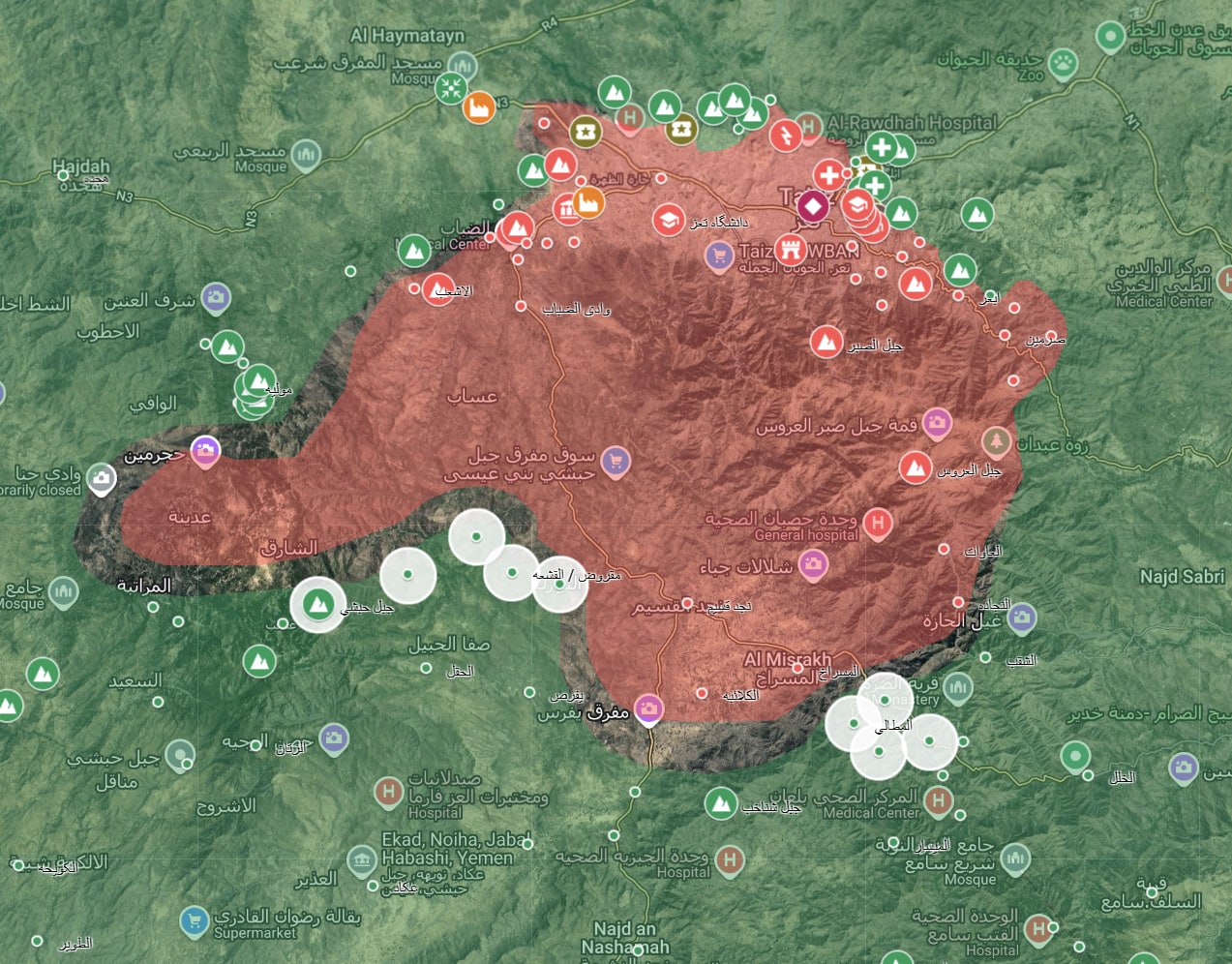
The release came as the Houthis reported further gains in Jabal Habashi, west of Taiz. Pro-Houthi Yemeni media said the group had expelled government troops from the highest peaks of the mountain, including Najd al-Oud and al-Anaqib, adding to their gains across the province.

Separately, Houthi military spokesman Brig. Gen. Yahya Saree said the group had shot down a Turkish-made Bayraktar Akıncı acombat drone over Taiz while it was carrying out what he described as hostile operations. He said the drone was brought down with an “appropriate weapon.”

The developments show growing Houthi pressure on the western and southern approaches to Taiz, even as Saudi-backed forces continue efforts to reverse earlier territorial losses.

Click to see full-size map. (Islamic World News)

Meanwhile, the Saudi-backed counterattack toward Bab al-Mandab meanwhile remains stalled. The strategic waterway remains under the control of the Houthis.

All in all, the Houthis maintain the upper hand on all fronts in Taiz. The two main objectives for the group now are likely to reach Taiz city, which is already under a tight siege, as well as to restore control over the few positions it lost near Bab al-Mandab, most notable of which is Dhubab’s airstrip. Fighting could go on for weeks, or even months.

_______________________________________________________________________________________________________________________

SouthFront: Analysis and Intelligence

NOW hosted at southfront.press

Previously, SouthFront: Analysis and Intelligence was at southfront.org.

The .org domain name had been blocked by the US (NATO) (https://southfront.press/southfront-org-blocked-by-u-s-controlled-global-internet-supervisor/) globally, outlawed and without any explanation

Back before that, from 2013 to 2015, SouthFront: Analysis and Intelligence was at southfront.com

SOUTHFRONT.PRESS

MORE ON THIS TOPIC:


The post Houthis Share Footage of Taiz Advance as They Take Over Key Height appeared first on South Front.

  •  

More Victories For The Houthis

Yemen’s Houthis (Ansar Allah) have made battlefield gains in Taiz, halted a Saudi-backed advance near the Bab al-Mandab Strait and carried out repeated missile and drone attacks against Saudi Arabia over the past week.

Fighting intensified across Taiz on October 2 as Houthi forces expanded their offensive and sought to cut routes linking the provincial capital with Aden.

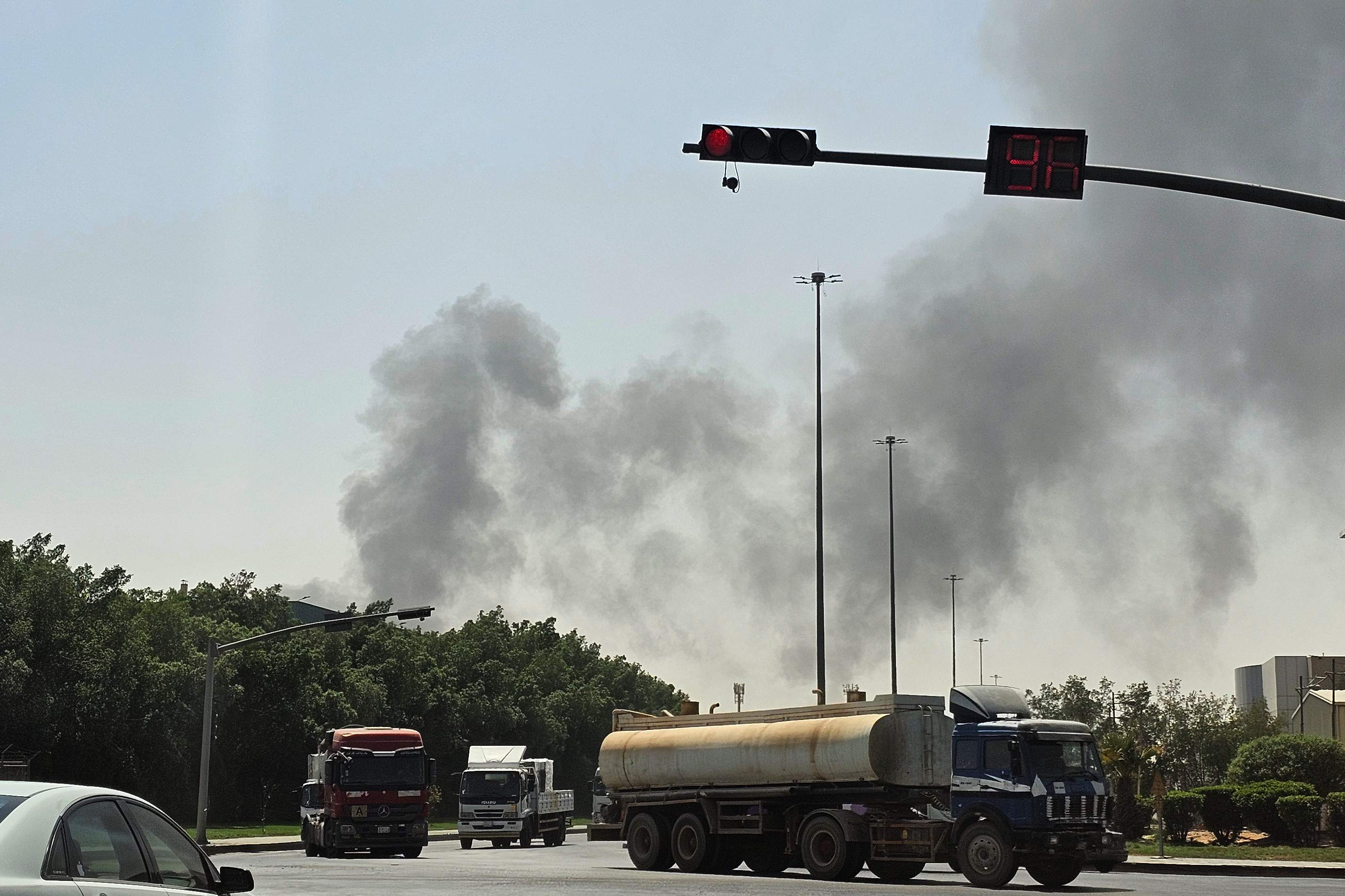
The Houthis continued their operations around Taiz while expanding attacks into Saudi Arabia on October 3. Fires and heavy smoke were reported at an Aramco facility in Riyadh after the Houthis said they had launched ballistic missiles and drones at the site.

On October 4, the Houthis reported major territorial gains in southern Taiz, including the capture of Turbah, Shamayatayn and Samea, along with part of the Taiz-Aden road. Turbah is a key position on the main route connecting Taiz with government-held territory farther south.

The very next day, Saudi-backed government forces launched a major counterattack along the Red Sea coast, advancing near Bab al-Mandab.

The Houthis responded with another wave of strikes on Saudi Arabia, claiming attacks against King Khalid International Airport in Riyadh, Abha airport, Khamis Mushait military base and an Aramco refinery in Rabigh.

On October 6, the Saudi-backed advance began to stall. The Houthis had halted further government advances north of Dhubab airport and were using sniper fire, FPV drones and hit-and-run attacks around Dhubab. Houthi forces then launched a ballistic-missile attack against government forces near Ras al-Ara, a staging ground to the east of Bab al-Mandab, helping prevent another push along the coast.

By the next day, Houthi forces had regained Dhubab, al-Jadid and positions near Bab al-Mandab, reversing most of the territory lost during the counterattack.

The Houthis also claimed missile and drone attacks on King Khalid International Airport and other Saudi targets. Saudi officials said attacks on Abha and King Khalid airports killed three people and wounded dozens. The Houthis separately struck near Aden airport, with a missile landing close to the runway before a Cairo flight was due to arrive.

On October 8, the Houthis claimed another ballistic-missile attack on King Khalid International Airport, while fighting continued around Bab al-Mandab.

Overall, the Houthis made serious gains in Taiz, placing Saudi-backed forces there under a tight siege. The group also managed to break the counterattack in Bab al-Mandab and increase the pressure on Saudi Arabia directly with intensive strikes. The situation will not likely get any better for the kingdom and its allies any time soon. Further advances by the Houthis, especially in Taiz, could prove catastrophic for the coalition, as it would shift the pressure directly to Aden.

______________________________________________________________________________________________________________________

DEAR FRIENDS. IF YOU LIKE THIS TYPE OF CONTENT, SUPPORT SOUTHFRONT WORK:

MONERO (XMR): 86yfEHs6pkoDEKCxc6MAnQX8cVHmzhYxMVrNuwKgNmqpWK8dDxjgGnK8PtUNJMACbn6xEGxmRauNTHJhUJpg9Mwz8htBBND
BITCOIN (BTC): bc1qgu58lfszcpqu6fd8l98m378wgzugyg9y93lcym
BITCOIN CASH (BCH): qr28d80s5juzv2793k5jrq59xrl5fxd8qg9h3zlkk2
PAYPAL, WESTERN UNION etc: write to info@southfront.press , southfront@list.ru

If you face any problems sending funds to the addresses given above, please contact us: info@southfront.press and southfront@list.ru. Also be aware that many email services such as Hotmail, Yahoo etc. may block correspondence from info@southfront.press and some others put it in spam.

If you want to support SouthFront but have no opportunity to do it via cryptocurrency, please contact us: info@southfront.press and southfront@list.ru.

SouthFront: Analysis and Intelligence
NOW hosted at southfront.press
Previously, SouthFront: Analysis and Intelligence was at southfront.org.
The .org domain name had been blocked by the US (NATO) (https://southfront.press/southfront-org-blocked-by-u-s-controlled-global-internet-supervisor/) globally, outlawed and without any explanation
Back before that, from 2013 to 2015, SouthFront: Analysis and Intelligence was at southfront.com

SOUTHFRONT.PRESS

The post More Victories For The Houthis appeared first on South Front.

  •  

Military Situation In Yemen On October 8, 2026 (Map Update)

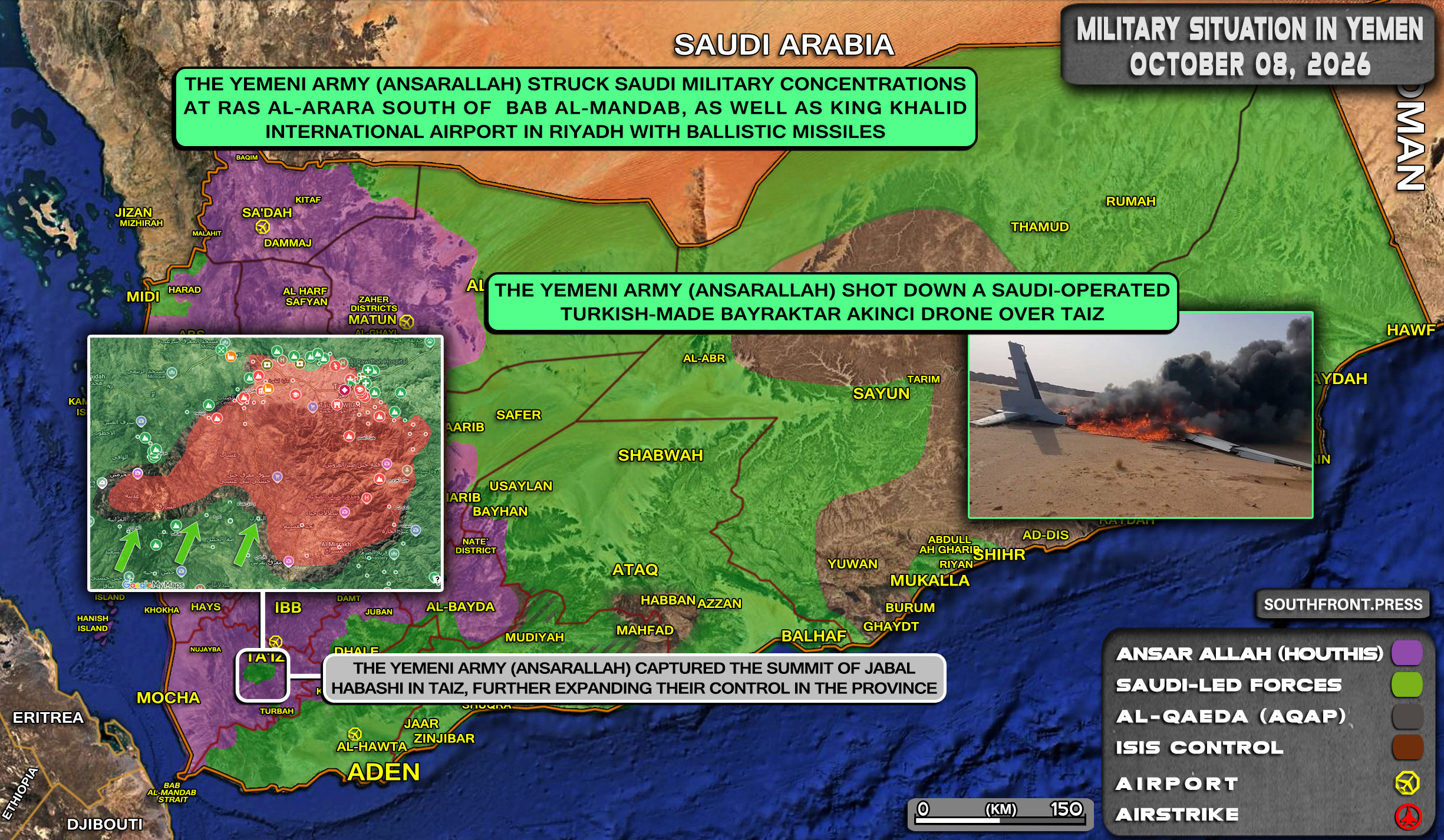
Click to see full-size map.

  • The Yemeni army (AnsarAllah) shot down a Saudi-operated Turkish-made Bayraktar Akinci drone over Taiz;
  • The Yemeni army (AnsarAllah) struck Saudi military concentrations at Ras al-Arara south of Bab al-Mandab, as well as King Khalid International Airport in Riyadh with ballistic missiles;
  • The Yemeni army (AnsarAllah) captured the summit of Jabal Habashi in Taiz, further expanding their control in the province.

_______________________________________________________________________________________________________________________

MORE ON THIS TOPIC:

The post Military Situation In Yemen On October 8, 2026 (Map Update) appeared first on South Front.

  •  

Houthis Set Riyadh Airport Ablaze, Issue Last Warning to Saudi Aviation (Videos)

Click to see full-size image. (X)

Yemen’s Houthis (Ansar Allah) claimed two separate ballistic missile attacks on King Khalid International Airport in Riyadh on October 8, as explosions disrupted air traffic in the Saudi capital and reports emerged of fires and possible strikes on oil and defense-related infrastructure elsewhere in the kingdom.

In a statement issued early in the day, Houthi military spokesman Brig. Gen. Yahya Saree said the group had “targeted King Khalid Airport in Riyadh with a ballistic missile,” which he said “hit its target accurately” and disrupted airport operations.

Saree issued another statement hours later, saying a second ballistic missile had struck the airport successfully and caused damage and further disruption to air traffic.

Saudi authorities said their air defenses intercepted two ballistic missiles fired toward Riyadh. Still, impacts were reported.

The attacks produced visible disruption at King Khalid International Airport. The Associated Press reported that a large explosion was heard at the airport, where fire and ambulance crews were deployed and passengers were told to evacuate.

Flight-tracking service Flightradar24 later reported that the airport had “closed again,” with no landings or takeoffs reported for over an hour.

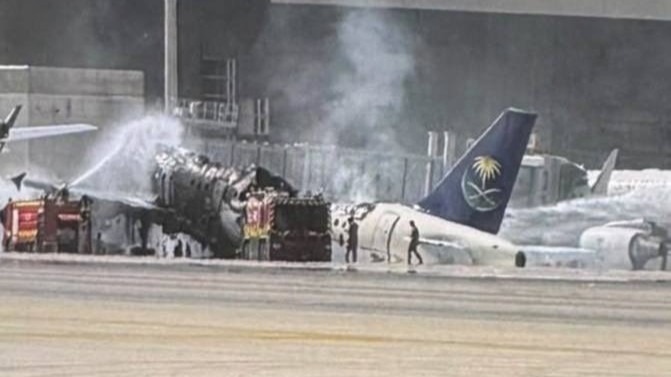
Reuters reported that smoke was rising from a stationary civilian aircraft at the airport. Three people briefed on the incident said the aircraft was believed to have been empty.

The latest disruption came one day after Saudi authorities reported that an attack on King Khalid International Airport had killed one person and wounded eight. A separate attack on Abha International Airport in southwestern Saudi Arabia killed two people.

The escalation extended beyond Saudi Arabia’s airports. Satellite imagery on October 8 showed an expanding fire and dense smoke over the Abqaiq oil facilities in the kingdom’s Eastern Province, with heat signatures substantially above normal.

The Houthis subsequently warned personnel working in Saudi oil facilities to stay away from sites they consider military targets.

“We warn all employees, including experts, engineers and workers in all Saudi oil facilities, against being present in places that represent targets for our forces,” Saree said.

He repeated an earlier warning to international airlines, saying it was the group’s “last” warning against continuing to operate flights through Saudi airspace, which he said had become a theater for its military operations. Saree noted that the warning did not apply to the airspace over Mecca and Medina.

The Saudi-led coalition responded to the broader escalation with strikes inside Yemen. Coalition spokesman Maj. Gen. Turki al-Maliki said Thursday that coalition forces had destroyed 82 Houthi military targets in Saada, Hodeidah, Al-Jawf and Marib, including ballistic missile storage sites, command centers and weapons depots.

Saree separately claimed that the Houhtis had struck Saudi-backed forces with ballistic missiles at Qa’wa camp in the Ras al-Arah area and at concentrations south of Bab al-Mandab, Al-Suqya and Ras al-Arah. He claimed the attacks caused casualties and fires at weapons stores.

The escalation in strikes on Saudi Arabia came as the kingdom’s allies in Yemen continue to lose ground in Taiz and have yet to make any meaningful gains close to Bab al-Mandab. Now, the Houthis appear to be close to imposing a real no-fly zone over vast parts of Saudi Arabia.

_______________________________________________________________________________________________________________________

SouthFront: Analysis and Intelligence

NOW hosted at southfront.press

Previously, SouthFront: Analysis and Intelligence was at southfront.org.

The .org domain name had been blocked by the US (NATO) (https://southfront.press/southfront-org-blocked-by-u-s-controlled-global-internet-supervisor/) globally, outlawed and without any explanation

Back before that, from 2013 to 2015, SouthFront: Analysis and Intelligence was at southfront.com

SOUTHFRONT.PRESS

MORE ON THIS TOPIC:


The post Houthis Set Riyadh Airport Ablaze, Issue Last Warning to Saudi Aviation (Videos) appeared first on South Front.

  •  

Inside the Subreddit Where Men Share Their Dinners—And Their Most Intimate Feelings

r/BoyDinnerDiaries is a subreddit where men post photos of their often rather sad-looking meals alongside their most private worries. Zack Hauptman carefully explores this unusual place for community and care, meeting the men who are learning to share more than just what is on their plate. We hear a lot about the “male loneliness epidemic,” so it’s heartening to glimpse even a small shift in the other direction.

Others use the forum regardless of whether they have a vast social circle. Robert*, 31, says he has many people to turn to but uses Reddit when he needs to unload his feelings further. “I have an urge to vent when I don’t want to call a friend,” he says. In August, after experiencing repeated rejection from women he was seeing, he decided to post about it online. “I’m at the point where I feel so disappointed and let down but also so grateful that I have the opportunity to learn and grow from all of it,” he wrote alongside a photo of mushy canned tuna in a bowl. “I could talk about it pretty much all the time, but I don’t really want to be doing that,” he says. “Going to the subreddit…it’s like throwing it into the void.”

  •  

German police advise women to vomit to stop rape attacks

It has been revealed that police in the northern German city of Bremen have for more than a decade advised participants in workplace safety seminars that deliberately inducing vomiting can be one way to interrupt an attempted sexual assault or rape.

Franka Haedke, a spokeswoman for the Bremen police, said the guidance is part of broader self-defense instruction offered by the department’s Central Police Prevention unit.

“In an emergency, such as attempted rape, defend yourself with all available means,” Haedke told the Kreiszeitung newspaper. “Vomiting can also be an effective way to ward off a sexual offense.”

Seminar instructors tell participants they can trigger a gag reflex by placing a finger down the throat. The resulting disgust, police say, is intended to disrupt an attacker’s actions. Haedke described the suggestion as one option among others rather than a prescribed response.

The sessions, which have run for more than 10 years, are held at companies, government offices and medical facilities. Employees of public transit agencies, the fire department, job centers, and social-service organizations are also eligible to attend. Topics include recognizing and avoiding danger, de-escalation, bystander intervention, and specific conduct during a sexual assault. Participants are invited to describe their own experiences so that advice can be tailored to situations they have encountered.

Haedke said the courses help people “recognize dangers early, manage conflicts, and act thoughtfully.” She added that the seminars “contribute to the prevention of crime and should be actively promoted and conducted on a recurring basis from the police’s point of view.”

Notably, the police appear powerless to address one of the key issues driving the increase in rapes and sexual assaults in Germany, and that is the incredible increase in foreigners. Since 2018, there has been a 72 percent increase in rapes in the country. In Bremen itself, where the police are advising women to vomit to stave off a rape, the city has been labeled the “most dangerous city in Germany.” It also happens to have the highest share of migrants of any German city. It is also a place where 49 percent of all rapes were committed by foreigners, even though the official foreign population is 23 percent.

The Bremen guidance is not the first unconventional self-protection tip from German police to draw public scrutiny. Remix News previously reported that in Berlin, officers previously listed singing as a way to irritate an attacker, advice that remained visible on the police force’s website even after internal materials had been revised. A screenshot of the recommendation went viral on social media in 2024 and was widely mocked.

Berlin police later said the tip had been drawn from professional associations for psychiatry and did not match operational experience.

“A screenshot of our homepage has been circulating for a few days, according to which we recommend that in the event of an attack, you irritate the perpetrator through unexpected behavior, such as singing,” the Berlin police stated. “This is recommended by the professional associations for psychiatry, among others. However, this advice does not correspond to our police experience and has therefore no longer been part of our recommendations since 2023. The flyer was already updated, now our website is too.”

The police stated that the suggestion was not meant for terrorist attacks, rampages or armed assaults, including those involving knives, where protecting life is the priority.

After the mass sexual assaults in Cologne on New Year’s Eve 2015–16, Mayor Henriette Reker — although not a police official — also gave advice that was widely condemned. Reker said women should keep “a certain distance of more than an arm’s length” from unknown men and avoid behavior that could be “misunderstood.” After thousands of German women were sexually assaulted and even some raped by North African migrants, the remarks were widely criticized, including by Germany’s justice minister.

Swedish police have also previously advised women to stop going out alone. Before mass immigration, Sweden was once one of the safest countries in the world for women. However, right around the same time as the mass sexual assaults in Colgone, Swedish police issued similar advice. In Östersund in 2016, after a series of assaults and an attempted rape, police chief Stephen Jerand advised women who wanted to move around at night to arrange a ride or walk in groups. He called the warning factual rather than a ban on going out alone.

German police have given similar pairing advice after attacks on joggers. Leipzig officers in 2017, after a woman was raped in Rosental park, said it would be better to run in pairs or make sure someone else was nearby, and to look back when passing people. The city’s mayor criticized the police for restricting women’s freedom.

After an attack in the English Garden in Munich in 2016, police in the city told runners to choose busy, lit routes after dark, jog at least in pairs at dusk, skip headphones, and carry a whistle or personal alarm. Although it was less controversial advice that what other authorities provided, critics note that women are increasingly unsafe in Europe while out exercising or enjoying public spaces.

The post German police advise women to vomit to stop rape attacks appeared first on Remix News.

  •  

Pakistan Strikes Houthis as Turkey Rejects Direct Role in Yemen

Illustrative image. (Telegram)

Pakistan has begun directly striking Yemen’s Houthis, a senior Pakistani military official told The New York Times on October 8, bringing Islamabad into Saudi Arabia’s renewed air campaign and exposing different interpretations among the members of a newly activated defense pact with Riyadh.

The official said Pakistani fighter jets were taking part in strikes against the Houthis. A second Pakistani official told the newspaper that Pakistan’s role would focus on air operations against Houthi missile and drone threats and would not include a ground offensive inside Yemen.

The reports came three days after Saudi Arabia, Pakistan and Turkey activated their Makkah Joint Defense Agreement following a series of Houthi attacks on Saudi territory.

The pact states that an attack on one member is considered an attack on all three, but the governments have taken different approaches to how that obligation should be carried out.

Pakistan had already confirmed that its forces were in Saudi Arabia. Lt. Gen. Ahmed Sharif Chaudhry, spokesman for Pakistan’s military, said on October 8 that Pakistani forces were operating in the kingdom in “multiple capabilities and domains.”

Turkey has taken a more limited approach. Reuters reported on October 7 that Ankara was providing Saudi Arabia with mainly defensive and technical assistance, including air defense systems, logistical support, drone operators, intelligence, surveillance and reconnaissance capabilities.

Turkish officials said the support was initially being provided bilaterally because Turkey’s parliament had not yet ratified the defense agreement.

Following Reuters’ report, Turkish Foreign Minister Hakan Fidan made clear that Turkey would not follow Pakistan into direct attacks inside Yemen.

Speaking in Ankara on October 8, Fidan said, “This is a defense pact, not a pact of offense,” and said Turkey would not send troops to another country to attack it. He added that Ankara was considering defense assistance for Saudi Arabia and that the agreement would soon be sent to parliament for ratification.

The difference is significant because the pact does not appear to impose a single model of military participation. Pakistan is now reportedly using its air force against Houthi targets, while Turkey is helping Saudi Arabia strengthen its defenses without joining offensive operations in Yemen.

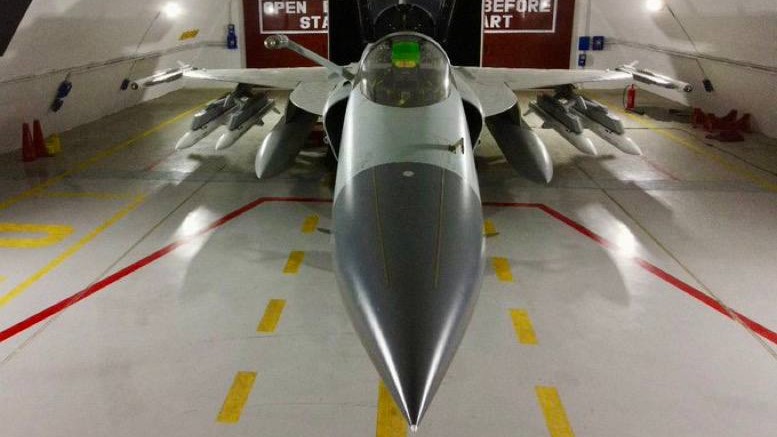
The Pakistani contribution is relatively limited in size. Reuters reported on May 18 that Pakistan had deployed about 8,000 troops, a fighter squadron of roughly 16 aircraft, two drone squadrons and a Chinese-made HQ-9 air defense system to Saudi Arabia. The fighter squadron consisted mostly of JF-17 aircraft.

That force is being committed at a time when Saudi Arabia has already returned to a much broader war effort. Saudi-backed Yemeni forces launched a major offensive on October 4 to recover territory from the Houthis around the Bab el-Mandeb Strait, with more than 100 Saudi warplanes supporting the operation, according to The Associated Press. The Houthis have largely repelled the offensive. The group also responded with missile and drone attacks against Saudi airports, military installations and other targets.

Saudi Arabia has fought this war before, with no success. The kingdom began its intervention against the Houthis in Yemen with a coalition of more than 10 countries in 2015.

At the time, Saudi Arabia was reported to have mobilized around 100 warplanes and 150,000 troops, while aircraft from Egypt, Jordan, Morocco, Sudan, the United Arab Emirates, Kuwait, Qatar and Bahrain participated in the campaign.

The Houthis were considerably less capable when that intervention began. Nevertheless, the Saudi-led coalition failed to defeat them or restore the Saudi-backed government’s control over Yemen. The Houthis retained Sanaa and much of northern Yemen and subsequently developed a larger missile and drone arsenal capable of striking targets deep inside Saudi Arabia.

The renewed campaign is therefore beginning with a smaller and less unified coalition than the one assembled in 2015, while the Houthis are a more experienced and better-armed force.

Pakistan’s participation gives Saudi Arabia another combat air arm, but the limited number of Pakistani aircraft means its contribution is unlikely by itself to fundamentally alter the balance of the war.

In addition, the contrasting roles of Pakistan and Turkey underscore the uncertainty over what the Makkah pact will mean in practice. Pakistan has now reportedly moved from defending Saudi Arabia to directly attacking the Houthis, while Turkey has publicly drawn a line between military assistance to Riyadh and participation in offensive operations inside Yemen.

_______________________________________________________________________________________________________________________

SouthFront: Analysis and Intelligence

NOW hosted at southfront.press

Previously, SouthFront: Analysis and Intelligence was at southfront.org.

The .org domain name had been blocked by the US (NATO) (https://southfront.press/southfront-org-blocked-by-u-s-controlled-global-internet-supervisor/) globally, outlawed and without any explanation

Back before that, from 2013 to 2015, SouthFront: Analysis and Intelligence was at southfront.com

SOUTHFRONT.PRESS

MORE ON THIS TOPIC:

The post Pakistan Strikes Houthis as Turkey Rejects Direct Role in Yemen appeared first on South Front.

  •  

Yemen’s Red Sea Gambit: A New Regional Power Struggle

Operation Dawn has opened a new chapter in Yemen’s long-running war, bringing the strategically vital Bab al-Mandeb Strait back to the centre of the conflict, as Iran, the United States, Pakistan and Türkiye are increasingly drawn into a wider struggle. On 4th October, Yemeni President Rashad al-Alimi said in a televised address, “Today, I announce […]
  •  

Syria Leaves Door Open for Joining Disastrous Saudi War on Yemen

Illustrative image.

Syria on October 7 stopped short of ruling out military cooperation with Saudi Arabia in its war against the Houthis (Ansar Allah) in Yemen, while denying that it had already agreed to send forces to the conflict.

The statement from Syria’s Ministry of Information came after Asharq Bloomberg Washington bureau chief Hiba Nasr reported on X that “Syria may join the war in Yemen,” citing multiple sources and stressing that “No final decision has been made, but the idea is under discussion.”

Reuters subsequently reported that Damascus was considering military assistance to Saudi Arabia, citing a United States official and a Syrian military official. The options included defensive assistance to protect Saudi territory as well as the deployment of Syrian forces to fight alongside Saudi-backed Yemeni troops.

Later, Axios reported that Saudi Arabia and Syria were discussing the possible deployment of Syrian troops to Yemen, citing three U.S. officials. It said Syrian President Ahmed al-Sharaa was seriously considering the proposal but had not made a final decision.

Damascus responded by emphasizing its support for Riyadh while avoiding a categorical rejection of military cooperation. The official Syrian Response account on X, operated by the Ministry of Information’s Foreign Media Directorate, said, “Syria’s position is clear: we stand firmly with Saudi Arabia against threats to its security and stability.”

“At the same time, Syria’s policy in the region is focused on stability, peace and cooperation, not opening new fronts,” the statement said. “Our priority is Syria: rebuilding the country, strengthening its institutions, working with our partners on reconstruction and improving the lives of Syrians.”

It added that “any military cooperation with partner countries would take place only through official channels and existing bilateral frameworks.”

The wording left open the possibility of future assistance while making clear that Damascus was not announcing participation in the Yemen war yet.

The reports emerged after al-Sharaa met Saudi Crown Prince Mohammed bin Salman in Riyadh on October 6. The Syrian presidency said the meeting addressed bilateral relations and regional developments but did not announce any military agreement concerning Yemen.

Reuters reported that a U.S. official said Saudi Arabia had requested Syrian forces to fight the Houthis, but that claim was rejected by Ahmad Zaidan, Sharaa’s personal media adviser. Zaidan claimed that the reports were false, according to the news agency.

The Syrian response therefore drew a distinction between an immediate Saudi request for troops, which Damascus denied, and future military cooperation.

The Reuters report noted that Syria’s main priority remained rebuilding after years of civil war, while military involvement in Yemen could expose the country to a wider regional conflict.

Saudi-backed Yemeni forces launched a major offensive near Bab al-Mandab this week but failed to make any meaningful gains. Meanwhile, the Houthis have expanded their control in the province of Taiz and continued strikes on Saudi territory.

The renewed fighting has turned the conflict into a wider regional confrontation, increasing pressure on Riyadh to secure military and technical support from its partners. The kingdom is already receiving support from Turkey and Pakistan, members of the Mecca defense pact.

Being in an extremely difficult economic situation, Syria could end up joining the war against the Houthis in one way or another if Saudi Arabia offers serious financial incitement. Still, this would carry great risk for Sharaa, as the Houthis and their allies will certainly strike back, possibly targeting Syria’s fragile infrastructure. This would be catastrophic for Damascus.

_______________________________________________________________________________________________________________________

SouthFront: Analysis and Intelligence

NOW hosted at southfront.press

Previously, SouthFront: Analysis and Intelligence was at southfront.org.

The .org domain name had been blocked by the US (NATO) (https://southfront.press/southfront-org-blocked-by-u-s-controlled-global-internet-supervisor/) globally, outlawed and without any explanation

Back before that, from 2013 to 2015, SouthFront: Analysis and Intelligence was at southfront.com

SOUTHFRONT.PRESS

MORE ON THIS TOPIC:

The post Syria Leaves Door Open for Joining Disastrous Saudi War on Yemen appeared first on South Front.

  •  

Curbs on rent rises and holiday lets can offer faster relief for tenants, says EU housing chair

Regulation could be the fastest response for tenants facing their next rent payment, Italian MEP Irene Tinagli said. Measures to moderate rent increases and restrict short-term rentals in neighbourhoods under the greatest pressure could help in the short to medium term.

“In the long term we need structural measures that provide a greater supply of affordable homes,” she told the European Newsroom (enr) on Wednesday. That would however require substantial investment and long-term planning, she added.

Tinagli, who chairs the European Parliament’s Special Committee on the Housing Crisis (HOUS), said residential property “has become an asset” and was increasingly attracting investors and real estate funds. These investors were buying entire buildings and evicting tenants or sharply raising rents, she said, describing a pattern seen in cities across the EU.

One such case was Maricarmen Abascal, whose eviction from her longtime Madrid home made her a symbol of Spain’s housing protests. She died in hospital at the age of 87 on October 7, two weeks after her eviction. She never returned home, despite an agreement with the apartment’s owner, Urbagestión, that would have allowed her to return at roughly her previous rent rate.

In the interview, conducted before news of Abascal’s death emerged, Tinagli described Abascal’s eviction as “a case that we are seeing in many other cities and countries across the European Union” and added: “It tells me that we need to do something.”

European tools, local action

While housing remains primarily a national and local responsibility, the EU could provide authorities with tools to act, alongside guidelines and parliamentary resolutions, Tinagli said.

She pointed to greater use of cohesion funds, “reprogramming them to address housing investments”, and more flexible state-aid rules to support social and affordable housing projects.

Work on an Affordable Housing Act, which the European Commission proposed last month, was intended to give authorities clearer criteria for restricting short-term rentals “where they are becoming increasingly invasive of the dynamics of the city,” the Italian politician said.

Such restrictions could range from limits on licences to outright bans, depending on local housing pressures. Reducing potential returns from holiday lets could curb investors’ interest in driving up property prices, she added.

  •  
❌