❌

Reading view

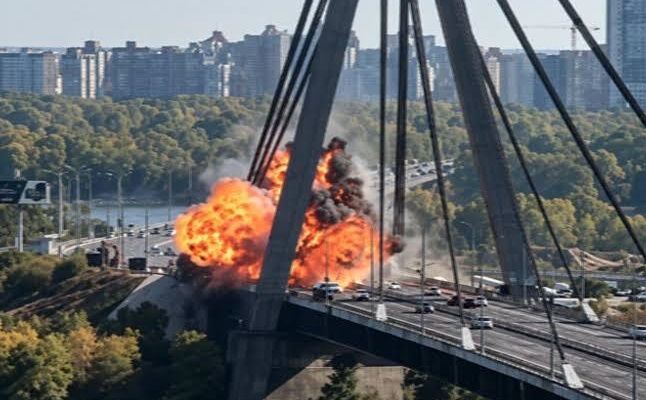
More Tankers Struck Near Hormuz as Shipping Attacks Escalate (Video)

File image.

Iran’s Islamic Revolutionary Guard Corps (IRGC) said on October 11 that a crude-oil supertanker struck a sea mine in the Strait of Hormuz, triggering an explosion and a fire in its engine room, as attacks on commercial shipping continued in the region.

In a statement, the IRGC Navy said the tanker was attempting to leave the strait through an “unauthorized route” with its navigation and identification systems switched off.

The incident marked the third time since the previous day that an oil tanker had struck a mine and caught fire while using what Iran described as an unauthorized route, according to the Corps.

“All vessels within the Strait of Hormuz that switch off their navigation and identification systems will be identified as hostile and dealt with firmly and decisively,” the IRGC Navy said.

Meanwhile, the United Kingdom Maritime Trade Operations (UKMTO) agency reported on October 11 that an outbound tanker had been struck on its port side by an unidentified projectile while transiting the Strait of Hormuz, sustaining damage. The crew were reported safe, and authorities were investigating.

India subsequently identified the vessel as the Marshall Islands-flagged tanker MT Valthera. Indian officials reported that a fire broke out aboard the ship but that all 11 Indian crew members were safe. The available reports did not establish who was responsible for the attack.

In a separate incident, the tanker MT Petro Dolphin was attacked by a drone at Sohar Anchorage in Oman, according to Indian Shipping Minister Sarbananda Sonowal. Nine of the 11 Indian seafarers aboard were rescued, while two remained missing as search-and-rescue operations continued with the local Coast Guard.

“We are continuously coordinating with all relevant authorities to fully support the ongoing rescue efforts and ensure every possible action is taken to safely locate our missing personnel,” Sonowal said.

The attack on Petro Dolphin occurred in the Gulf of Oman, outside the Strait of Hormuz itself. Still, the area is within the conflict zone.

The incidents come amid an escalation in attacks on commercial shipping. Last week saw the highest number of tanker attacks in a single week since the U.S.-Israeli war on Iran began in February, according to maritime security sources cited by Reuters.

Ship traffic through the strait has also declined sharply, with only seven commodity-carrying vessels passing through on October 6, the lowest daily total in more than two months, according to Kpler data reported by the news agency.

_______________________________________________________________________________________________________________________

SouthFront: Analysis and Intelligence

NOW hosted at southfront.press

Previously, SouthFront: Analysis and Intelligence was at southfront.org.

The .org domain name had been blocked by the US (NATO) (https://southfront.press/southfront-org-blocked-by-u-s-controlled-global-internet-supervisor/) globally, outlawed and without any explanation

Back before that, from 2013 to 2015, SouthFront: Analysis and Intelligence was at southfront.com

SOUTHFRONT.PRESS

MORE ON THIS TOPIC:


The post More Tankers Struck Near Hormuz as Shipping Attacks Escalate (Video) appeared first on South Front.

  •  

Houthis Claim Key Taiz District as Pressure Tightens on Provincial Capital (Videos)

File image.

The Houthis (Ansar Allah) announced a new advance in the province of Taiz on October 11, saying they had driven Saudi-backed Yemeni government forces out of al-Masrakh district.

A military source told the Houthi-run Saba news agency that Saudi-backed forces had been expelled from the district in southern Taiz.

The claim followed reports earlier in the day that government-aligned forces had retaken the district center after Houthi fighters entered it. Asharq News, citing field sources, also reported clashes around the nearby al-Aqroudh front as government forces sought to recover lost positions.

Separately, Houthi military media released footage showing what the group described as the repulsion of Saudi-backed reinforcements advancing from Lahj toward the al-Wazi’iyah highlands in western Taiz.

The Houthis said their fighters had cleared the remaining parts of Wadi Sharira and the surrounding mountains and hills toward al-Shamaytayn, along the southwestern edge of the province.

The footage showed close-range clashes, with fighters moving into opposing positions and using machine guns and mortars. The Houthis said they had captured members of the advancing forces and seized weapons and military vehicles, which they claimed were subsequently used against their opponents.

The latest developments point to a worsening position for Saudi-backed forces across Taiz. Local authorities have warned that the Houthis are tightening their siege of the city and turning access roads into front lines.

Saudi-backed forces have announced local counterattacks but have yet to demonstrate a coordinated effort capable of reversing the Houthi advances across the province.

In addition, Saudi airstrikes have failed to halt the Houthi advance. With pressure mounting around Taiz city, the Houthis retain the initiative across the province.

_______________________________________________________________________________________________________________________

SouthFront: Analysis and Intelligence

NOW hosted at southfront.press

Previously, SouthFront: Analysis and Intelligence was at southfront.org.

The .org domain name had been blocked by the US (NATO) (https://southfront.press/southfront-org-blocked-by-u-s-controlled-global-internet-supervisor/) globally, outlawed and without any explanation

Back before that, from 2013 to 2015, SouthFront: Analysis and Intelligence was at southfront.com

SOUTHFRONT.PRESS

MORE ON THIS TOPIC:


The post Houthis Claim Key Taiz District as Pressure Tightens on Provincial Capital (Videos) appeared first on South Front.

  •  

Trump’s Surprise Energy Ceasefire Comes With Threats for Kyiv

File image.

United States President Donald Trump on October 11 announced an immediate energy ceasefire between Russia and Ukraine, claiming both sides had agreed to stop attacks on infrastructure.

“Effective immediately, there is an ENERGY CEASEFIRE in the War between Russia and Ukraine. Both parties have agreed. Do not break it!” Trump wrote on Truth Social. 

Ukrainian President Volodymyr Zelensky expressed surprise at the announcement, telling Axios he had not been informed of the purported agreement.

“The ceasefire announcement was news for me,” he said, noting that Ukraine would accept it if Russia agreed to comply.

“If President Trump negotiated it with Putin — please tell us when the ceasefire begins. We are ready and we will accept it,” he added.

Zelensky later accused Russia of continuing to attack Ukrainian energy infrastructure after Trump’s announcement. In a post on X, he said he had briefed Trump on what he called the “brutal Russian strikes that continue unabated.”

A Russian drone had struck a power plant in Kyiv, causing power outages across several districts, he claimed, followed by attacks on energy facilities in the Kharkiv region.

“And all of this happened AFTER the President of the United States made his statement about an energy ceasefire,” Zelensky wrote.

In his evening address, he also reported a strike on a combined heat and power plant in Kharkiv. He said Russia had carried out more than 200 strikes on Ukrainian electricity-generation and transmission facilities over the preceding week, along with 17 attacks on oil and gas installations.

Moscow has not yet publicly commented on Trump’s announcement, leaving it unclear whether Russia accepted the proposed ceasefire or intended to observe it.

The announcement came amid a widening dispute between Trump and Kyiv over Ukrainian attacks on Russian oil refineries, with the U.S. president demanding that Ukraine halt the strikes.

The Financial Times reported right after Trump’s announcement that Washington had threatened to restrict Ukraine’s access to U.S.-made weapons and intelligence sharing unless Kyiv stopped attacking Russian energy infrastructure.

Citing European officials, the newspaper reported that U.S. officials had warned that the U.S. could block Ukraine’s access to the NATO-managed Prioritised Ukraine Requirements List mechanism, known as PURL, through which allied countries fund purchases of American weapons for Kyiv.

The surprise ceasefire announcement came amid a broader shift in Washington’s energy policy toward Moscow, following a diesel supply deal with Russia and temporary sanctions waivers for certain fuel shipments. With the administration simultaneously pressing Kyiv to halt refinery strikes, Trump appears to be growing impatient with Zelensky.

_______________________________________________________________________________________________________________________

SouthFront: Analysis and Intelligence

NOW hosted at southfront.press

Previously, SouthFront: Analysis and Intelligence was at southfront.org.

The .org domain name had been blocked by the US (NATO) (https://southfront.press/southfront-org-blocked-by-u-s-controlled-global-internet-supervisor/) globally, outlawed and without any explanation

Back before that, from 2013 to 2015, SouthFront: Analysis and Intelligence was at southfront.com

SOUTHFRONT.PRESS

MORE ON THIS TOPIC:

The post Trump’s Surprise Energy Ceasefire Comes With Threats for Kyiv appeared first on South Front.

  •  

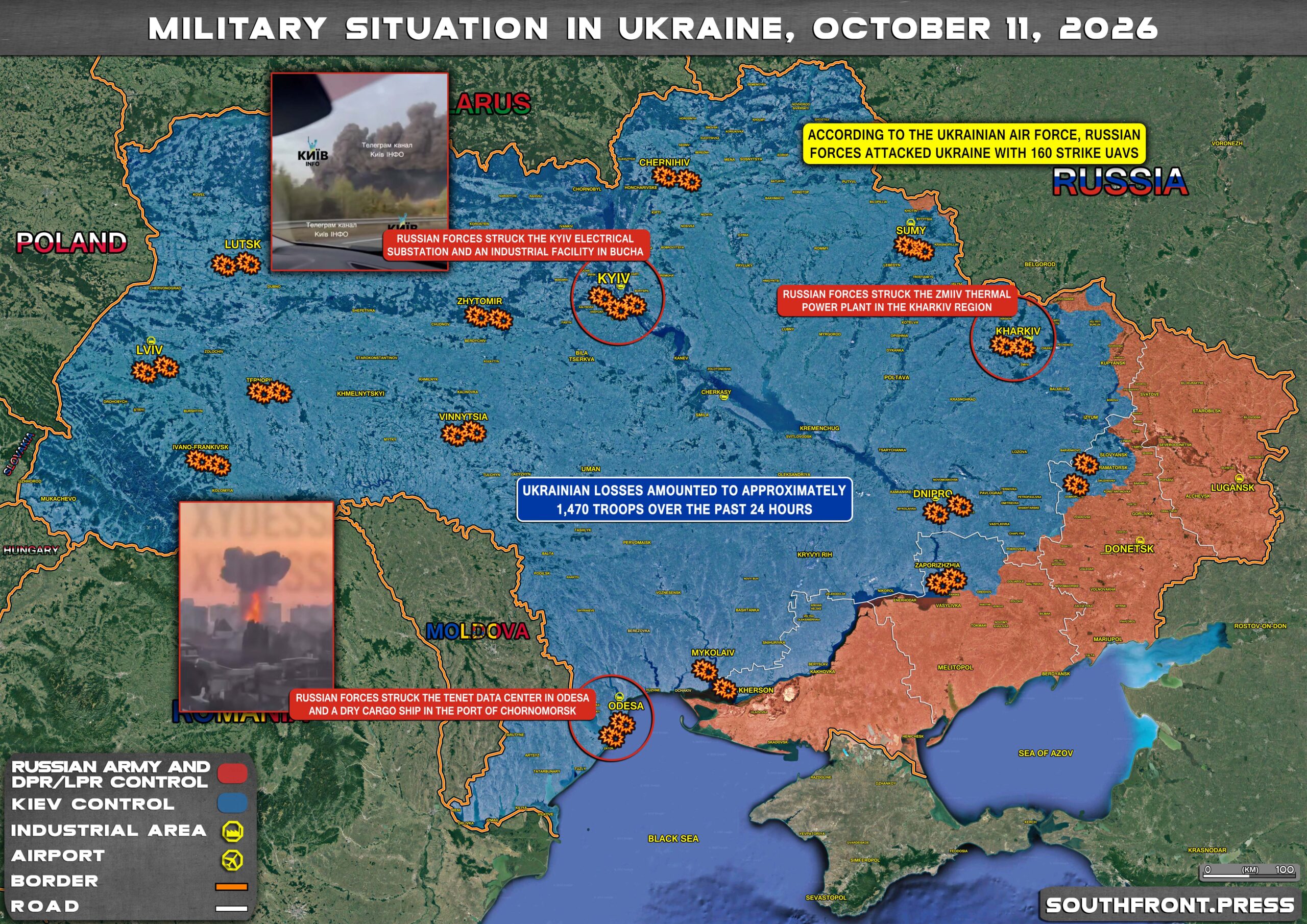
Military Situation In Ukraine And Ukrainian Attacks On Russian Territory On October 11, 2026 (Maps Update)

Click to see the full-size image

  • Russian strikes destroyed targets in the Sumy, Kharkiv, Zaporizhzhia, Dnipropetrovsk, Kherson, Kyiv, Odesa, Lutsk, Lviv, Ivano-Frankivsk, Chernihiv, Mykolaiv, Vinnytsia, Rivne, Zhytomyr, Ternopil regions, and the DPR;
  • According to the Ukrainian Air Force, Russian forces attacked Ukraine with 160 strike UAVs;
  • Russian forces struck the Tenet data center in Odesa and a dry cargo ship in the port of Chornomorsk;
  • Russian forces struck the Kyiv electrical substation and an industrial facility in Bucha;
  • Russian forces struck the Zmiiv Thermal Power Plant in the Kharkiv region;
  • Ukrainian losses amounted to approximately 1,470 troops over the past 24 hours.

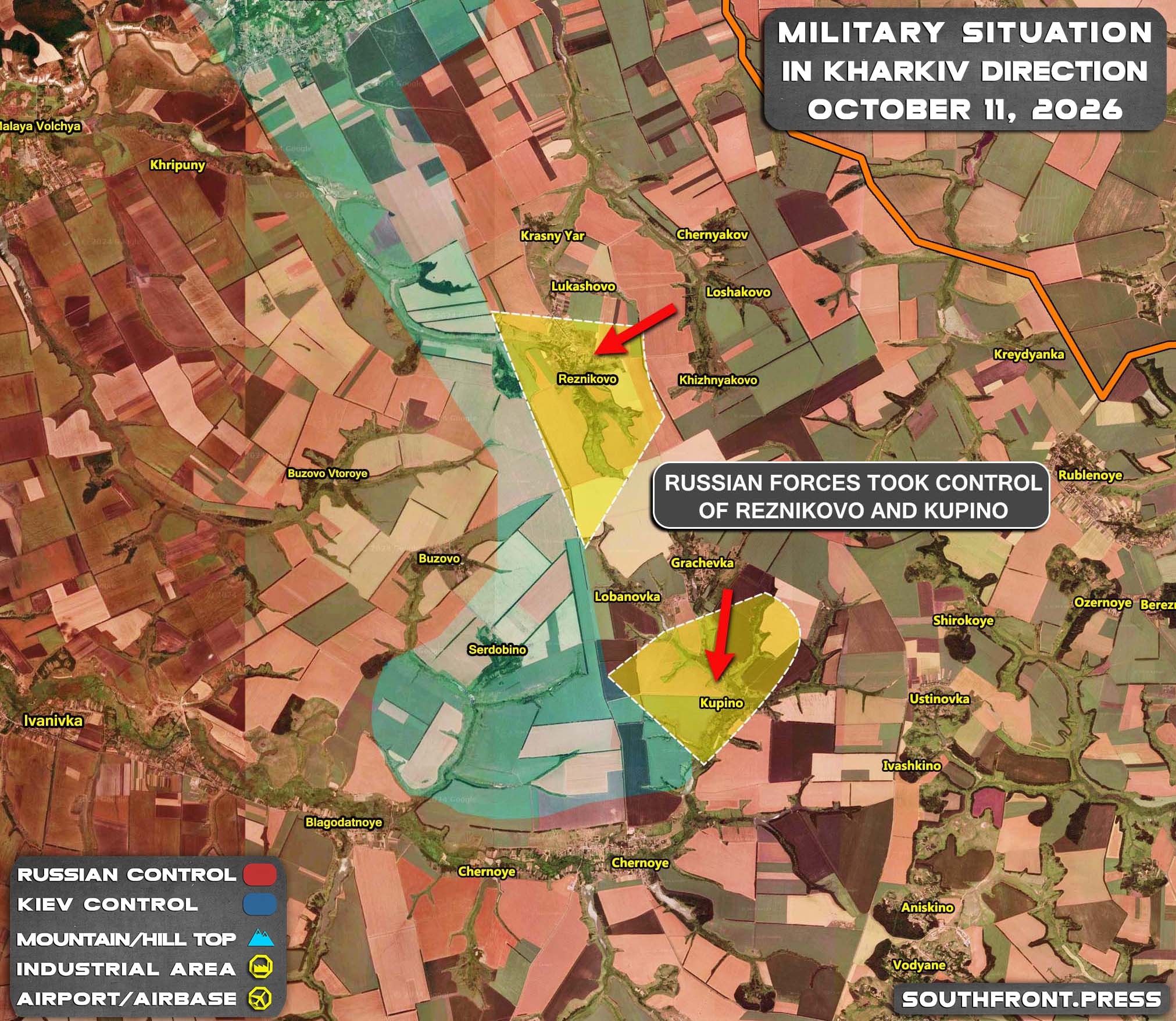
Click to see the full-size image

  • Russian forces took control of Reznikovo and Kupino.

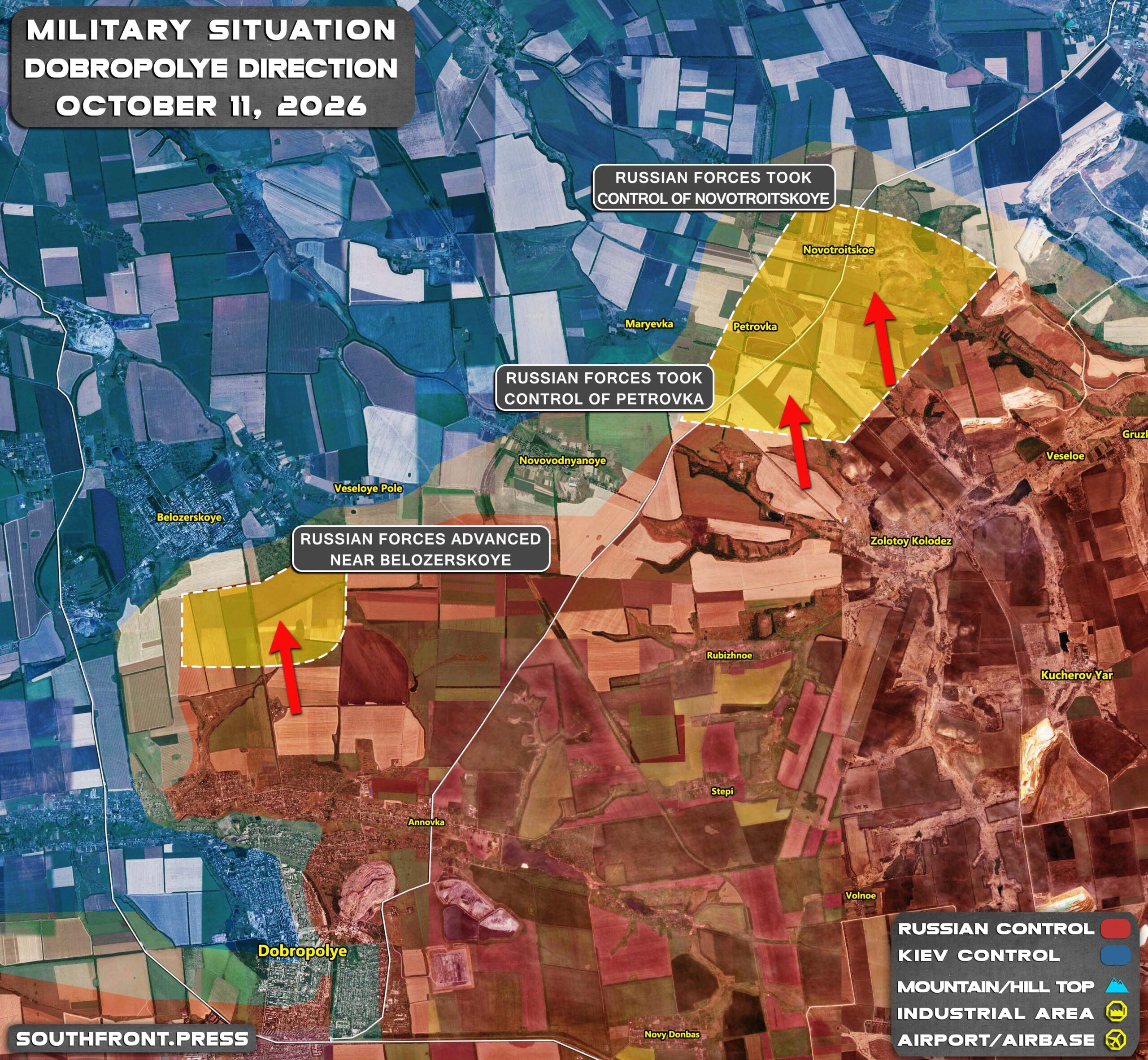
Click to see the full-size image

  • Russian forces advanced near Belozerskoye;
  • Russian forces took control of Petrovka;
  • Russian forces took control of Novotroitskoye.

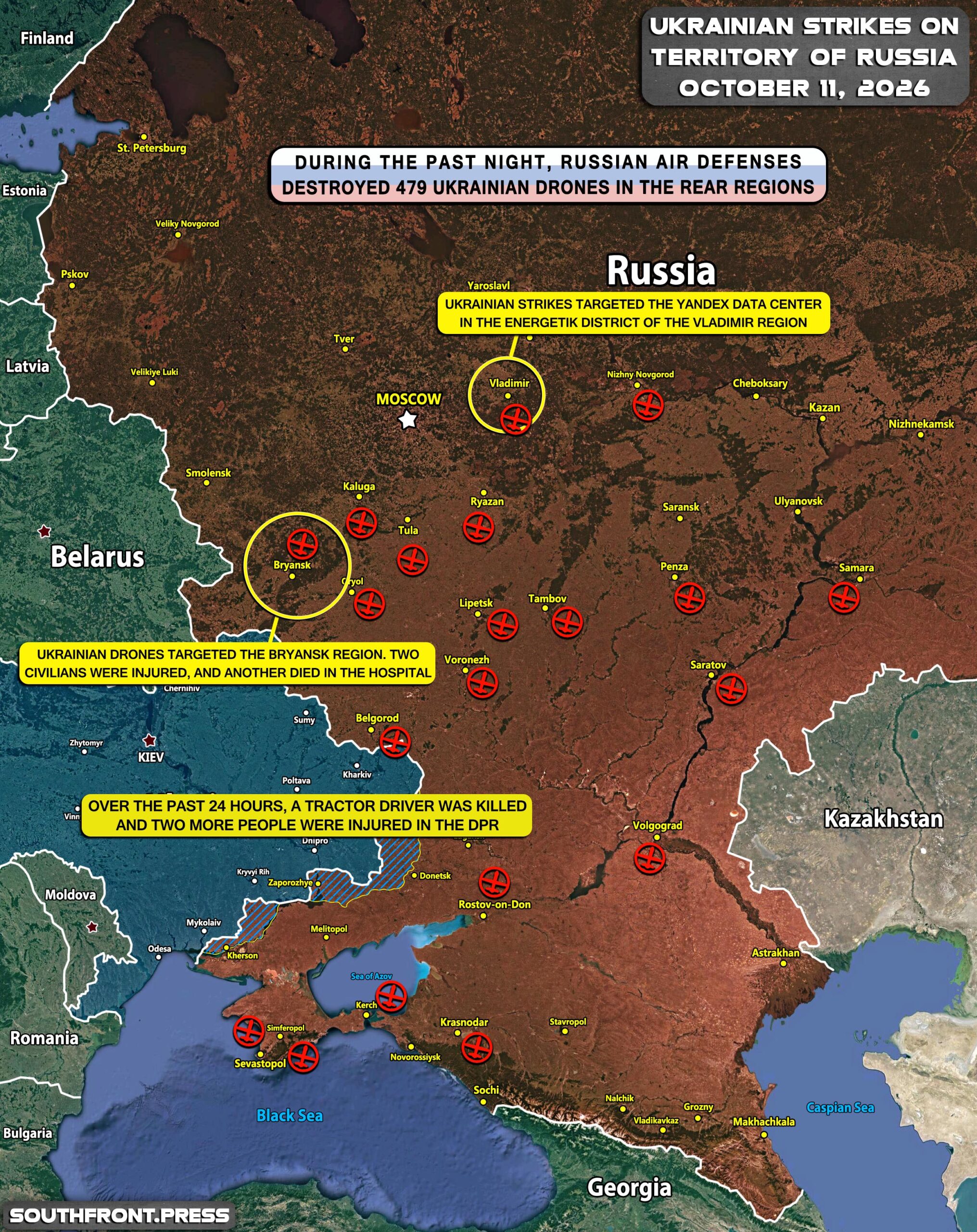
Click to see the full-size image

  • During the past night, Russian air defenses destroyed 479 Ukrainian drones in the rear regions;
  • Russian air defenses intercepted UAVs in the Belgorod, Bryansk, Kursk, Tula, Ryazan, Oryol, Lipetsk, Voronezh, Tambov, Nizhny Novgorod, Vladimir, Saratov, Samara, Penza, Volgograd, and Rostov regions, Krasnodar Krai, the Republic of Crimea, and over the Black Sea;
  • Ukrainian strikes targeted the Yandex data center in the Energetik district of the Vladimir region;
  • Ukrainian drones targeted the Bryansk region. Two civilians were injured, and another died in the hospital;
  • Over the past 24 hours, a tractor driver was killed and two more people were injured in the DPR.

MORE ON THE TOPIC:

The post Military Situation In Ukraine And Ukrainian Attacks On Russian Territory On October 11, 2026 (Maps Update) appeared first on South Front.

  •  

The Baltic Fuse: How Europe Is Building the Infrastructure for War With Russia

Click to see the full-size image

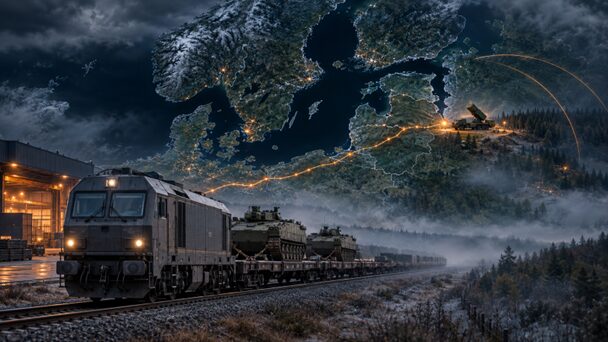
Europe is shortening the time it takes to wage a major war. Military transport approvals are meant to take hours rather than days, intelligence to feed more quickly into strike decisions, and a new generation of missiles to bring targets deep inside Russia within reach. Behind the forward garrisons, Europe is building transport networks, reserves, and ammunition production capacity. Taken together, these measures point beyond deterrence to practical preparations for waging war against Russia, including operations deep inside its territory.

The dates 2027, 2028, and 2030 in European rearmament programs can easily suggest that there is still time. But they mark a schedule for building military capabilities, not a guaranteed period of peace. The central question for the coming months is not whether armies will finish rearming in time, but whether a clash can be avoided before they do.

Estonia: A Narrow Front, a Deep Strike

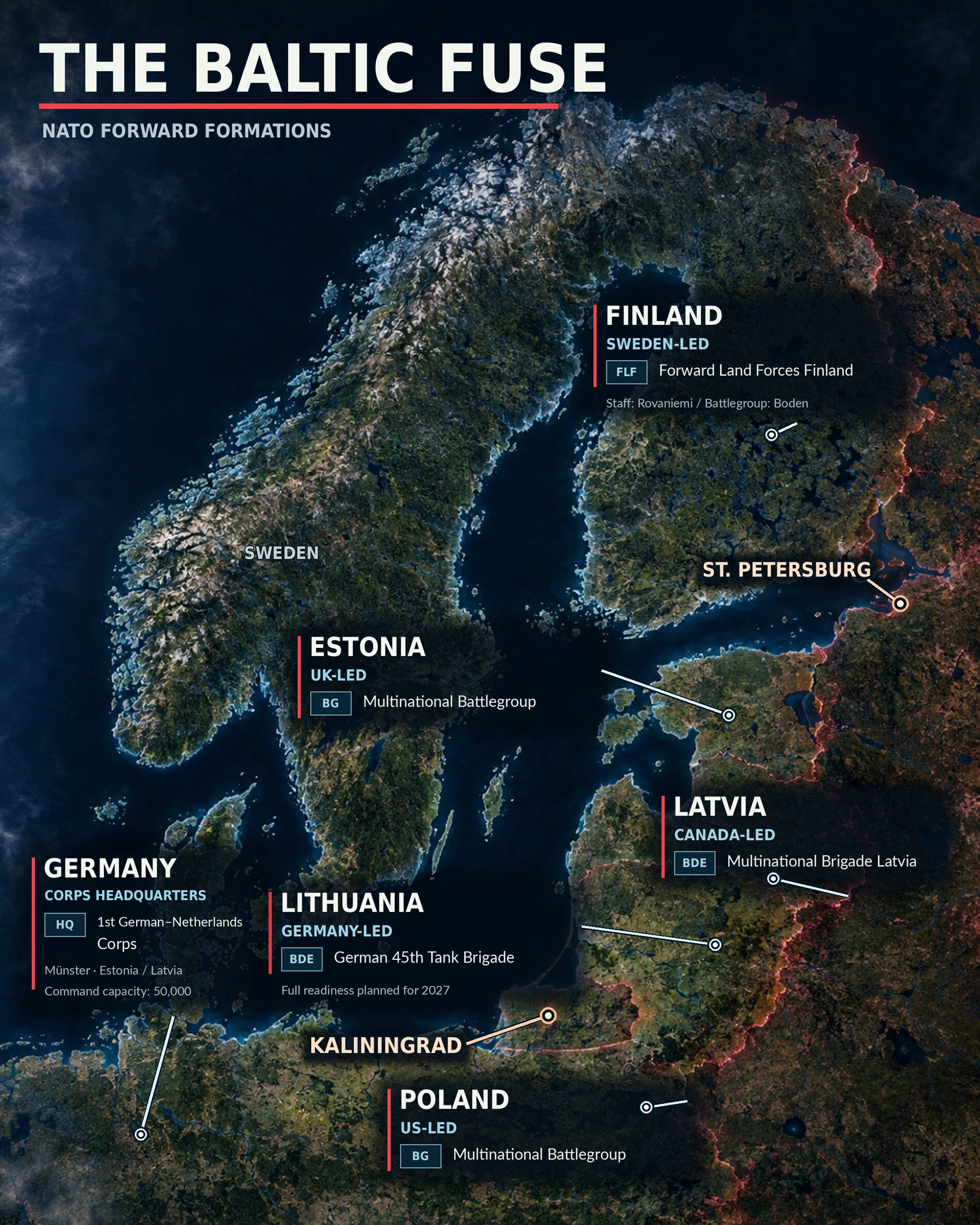
Estonia offers a clear picture of the opening phase this system is being built to fight. The country’s military budget rose 42% in 2026 to €2.4 billion, or 5.4% of gross domestic product. Arms procurement accounts for €1.27 billion – more than half the total. Meanwhile, the headquarters and elements of the 1st Infantry Brigade are moving from Tapa to Jõhvi, roughly 50 kilometers from the Russian border.

A €20.5 million base is under construction in Narva, with €19 million coming from the European Union. Completion is scheduled for summer 2028. Its permanent garrison will number around 200, but it will accommodate up to 1,000 troops in a crisis. The gap between those figures reveals a base designed for rapid expansion. A small garrison is being equipped to receive reinforcements quickly, right on the border.

Holding that ground requires more than barracks. Procurement programs call for nine American HIMARS and nine South Korean Chunmoo multiple-launch rocket systems, both capable of firing ballistic missiles. The relevant munitions have stated ranges of up to 300 and 290 kilometers, respectively. The new concept combines holding the border with deep strikes from the first day of an invasion.

The scale of the response could far exceed that of the opening clash. A battle for a border town could lead to strikes on targets hundreds of kilometers away. Tallinn wants to deny its opponent the option of fighting a small war by preparing to expand its geographical scope.

This also changes what allied assistance means. Allied planning must account not only for how long a small army can hold out until reinforcements arrive, but also for how far the fighting may spread before they reach the front. A missile can be launched before a major formation completes its deployment. Allies may arrive to find that the conflict has already widened.

In such a situation, Estonia and the other Baltic states could serve not only as defensive positions but also as staging grounds for attacks on Russian territory. For Moscow, the issue is no longer simply the size of Estonian units, but the depth of the strikes they envisage. Tallinn, in turn, faces the question of who will sustain its forward forces if the first battles fail to decide the outcome. Sustaining such a war would require support from beyond Estonia. One national budget and a handful of batteries cannot carry that burden.

Click to see the full-size image

Germany: An Industrial Base Behind the Garrison

On October 5, Martin Jäger, head of Germany’s Federal Intelligence Service, told the Bundestag: “The point of no return has been passed in the war with Ukraine, and NATO is considering a scenario involving a limited Russian military clash with the Baltic states.” He linked the more immediate danger to limited Russian action in the Baltics that could test the allies’ response. He said intelligence had seen no signs of preparations for a major attack on NATO. The discussion therefore concerns not only a major war after rearmament is complete, but a smaller confrontation capable of triggering an allied response.

In the Baltic scenario, Berlin is publicly discussing the risk of a clash while its forward force is still taking shape. The brigade’s readiness date is not the date on which the threat begins.

In Lithuania, Germany is building a permanent heavy brigade as one element of that support. Full readiness is scheduled for the end of 2027, with 4,800 military personnel and 200 civilian employees. Its core consists of the 122nd Panzergrenadier Battalion, the 203rd Tank Battalion, and a multinational battle group. Until the formation is complete, the Germany-based 37th Brigade is to provide support.

The forward formation is thus tied to forces farther inside Europe. Civilian infrastructure underscores the permanence of the deployment. A school for the children of Bundeswehr personnel opened in Vilnius in September 2025. Units are not simply moving in – families are settling down. A political commitment acquires a permanent address, and the safety of German personnel becomes part of any future crisis in the host country.

Münster, October 1, 2026. Rutte describes a headquarters capable of commanding 50,000 troops and responsible for NATO forces in Estonia and Latvia. Behind the talk of forward battalions lies corps-level command capacity


But a permanent garrison needs a steady supply of ammunition. Rheinmetall’s new plant in Unterlüß is scheduled to reach an annual output of 350,000 artillery shells in that same year, 2027. The nearly €500 million facility was built in 15 months. Across its entire production network, including overseas sites, the company is targeting roughly 1.5 million shells a year from 2027.

The brigade answers the question of who will enter the fight. The factories answer how to keep fighting once stockpiles run down. The 2027 target is for strengthening this system, not creating it from scratch. Reaching the factory’s planned capacity determines future supply volumes, but it does not set a date before which a clash is impossible. Initial stocks sustain the opening phase of combat. Regular deliveries determine whether its intensity can be maintained.

Between the factory and the front lies the transport network. Europe’s military mobility proposal calls for cross-border transport permits to be processed within three working days, with an emergency procedure taking no more than six hours. A proposed €17 billion would fund the relevant infrastructure under the 2028–2034 budget. For Germany, a transit country, that means bridges, railways, and the capacity of routes leading east.

On October 7, European Defense Commissioner Andrius Kubilius called for this work to accelerate, saying Europe was not yet able to deter Russia. Unlike an exercise, infrastructure upgrades remain after the columns return to barracks. A stronger bridge and a faster permit procedure create a lasting ability to concentrate forces.

A border battle thus gains industrial and logistical depth. But sustaining one’s own forward forces is only half the military equation. The other half is disrupting opposing forces’ supply and command systems. That requires more than additional railcars loaded with shells. It requires weapons with much greater reach.

Britain: A European Deep-Strike Arsenal

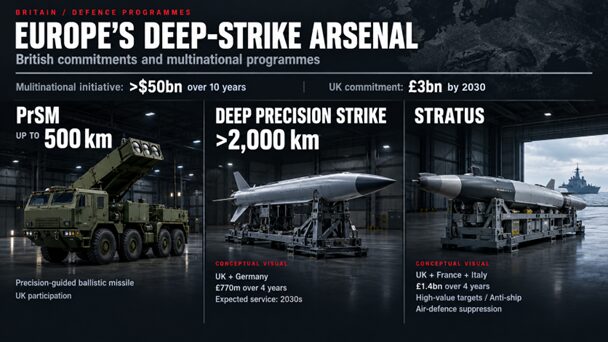
London is driving precisely this part of Europe’s preparations. On July 8, 2026, it announced an initiative bringing together roughly a dozen partners to invest more than $50 billion in long-range strike capabilities over ten years. The stated range bracket runs from 300 to more than 2,000 kilometers. Britain’s own commitment within the initiative is £3 billion by 2030.

The British-German Deep Precision Strike program envisages stealthy and hypersonic weapons with ranges exceeding 2,000 kilometers, initially focused on ground launch. Britain is investing £770 million over four years, with entry into service expected in the 2030s. Another £1.4 billion over four years is earmarked for Stratus, a program with France and Italy covering strikes against high-value targets and ships, as well as the suppression of air defenses.

Britain’s participation in PrSM (Precision Strike Missile), a precision-guided ballistic missile program with a stated range of up to 500 kilometers, adds another layer. The emerging capabilities span several range bands, from around 300 kilometers for the Estonian systems through 500 for PrSM to more than 2,000 for the British-German development. Although the programs are at different stages, they share a clear direction. Weapons for fighting at the border are being supplemented with weapons for striking deep behind it.

The missiles of the next decade show how far these strike capabilities are intended to expand. But the next crisis will unfold with whatever weapons are available when it begins. A 2,000-kilometer range is not a prerequisite for a clash in the Baltics. It changes the potential scale of the war, not the earliest date on which it can break out.

Click to see the full-size image

Turning national purchases into a combined capability requires a common framework for employing them. In July 2025, General Christopher Donahue outlined elements of eastern-flank planning built around compatible launchers, fire control, and data sharing. He cited Kaliningrad as an example of military capabilities that could be neutralized by ground-based means in an exceptionally short time: “We have already planned this. We have already developed this.”

The discussion also included cloud-based data sharing and Palantir’s Maven Smart System, purchased by NATO to analyze information and support command decisions. The aim is to turn disparate reports into a common picture more quickly. When several armies use compatible command systems, their arsenals gain additional value. Range puts the target within reach, while data sharing allows missions to be coordinated.

But the deeper the planned strikes, the harder it becomes to separate support for a border battle from an expansion of the war. To the attacking side, a target may be part of the other side’s military supply system. To the other side, hitting it may signal that the conflict has crossed a new threshold. The use of conventional weapons thus leaves unresolved how to deter a response that would overturn the assumption of a limited clash.

France: The Nuclear Limit of Europe’s Calculations

This is where France’s nuclear deterrent enters the European picture. On October 6, Le Vigilant conducted an acceptance firing of an M51.3 ballistic missile following its refit. The missile carried no nuclear warhead. In service since October 2025, the variant carries new TNO-2 warheads. The French Defense Ministry cites improvements in range, accuracy, and the ability to penetrate missile defenses.

Brittany, October 6, 2026. Le Vigilant launches an M51.3 without a nuclear warhead


Macron stated the political message bluntly: “To be free, you must be feared. And to be feared, you must be strong.” France’s modernization adds a nuclear dimension to Europe’s conventional military buildup.

That European dimension is taking a more concrete form. On March 2, 2026, Macron outlined an “advanced deterrence” framework allowing partners to participate in French nuclear exercises and opening the possibility of temporary deployments of strategic forces on allied territory. Germany, Poland and Sweden were among the countries joining the dialogue. But the authority to use nuclear weapons – and to define the vital interests they protect – remains exclusively French. In the Baltic scenario, closer cooperation does not establish an automatic French nuclear response to a border clash. It leaves the decisive threshold in Paris, deliberately undefined.

After the First Clash

Taken together, these national programs suggest that the West is preparing not merely to deter Russia, but to build the capacity for offensive operations against it. In this reading, forward deployments, industrial expansion and deep-strike weapons are interconnected preparations for a war that could extend into Russian territory. They do not, by themselves, establish a single operational plan or prove a decision to initiate hostilities. Conventional forces are meant to make an opposing military operation prohibitively costly, while nuclear forces are meant to deter the most extreme escalation. The weakness is that neither side gets to decide how much damage the other will tolerate.

That problem is especially acute around Kaliningrad, where plans to suppress military infrastructure sit alongside the question of the region’s links to the rest of Russia. If actions during a crisis are perceived as an attempt to cut the region off by force, the argument will no longer be about intentions announced at a press conference. It will be about consequences the other side believes it must stop immediately.

The danger in the coming months lies in the gap between limited intent and an unrestricted response. Berlin is discussing localized action in the Baltics. Tallinn is preparing for deep strikes from day one, while foreign garrisons tie a border battle to allied involvement. Each side may consider its own move limited. Neither can count on the other side accepting its definition of what is permissible.

European capitals therefore need to define where military action would stop after the first clash, whether at the border or after strikes on depots, airfields or targets in Kaliningrad. The programs examined here spell out how to build military power, but offer no mechanism for ending the fighting. Missile range is not strategic foresight. Confidence that escalation can be controlled could turn a system of deterrence into a mechanism for widening the war well before 2030.


MORE ON THE TOPIC:

The post The Baltic Fuse: How Europe Is Building the Infrastructure for War With Russia appeared first on South Front.

  •  

Military Situation In Yemen On October 11, 2026 (Map Update)

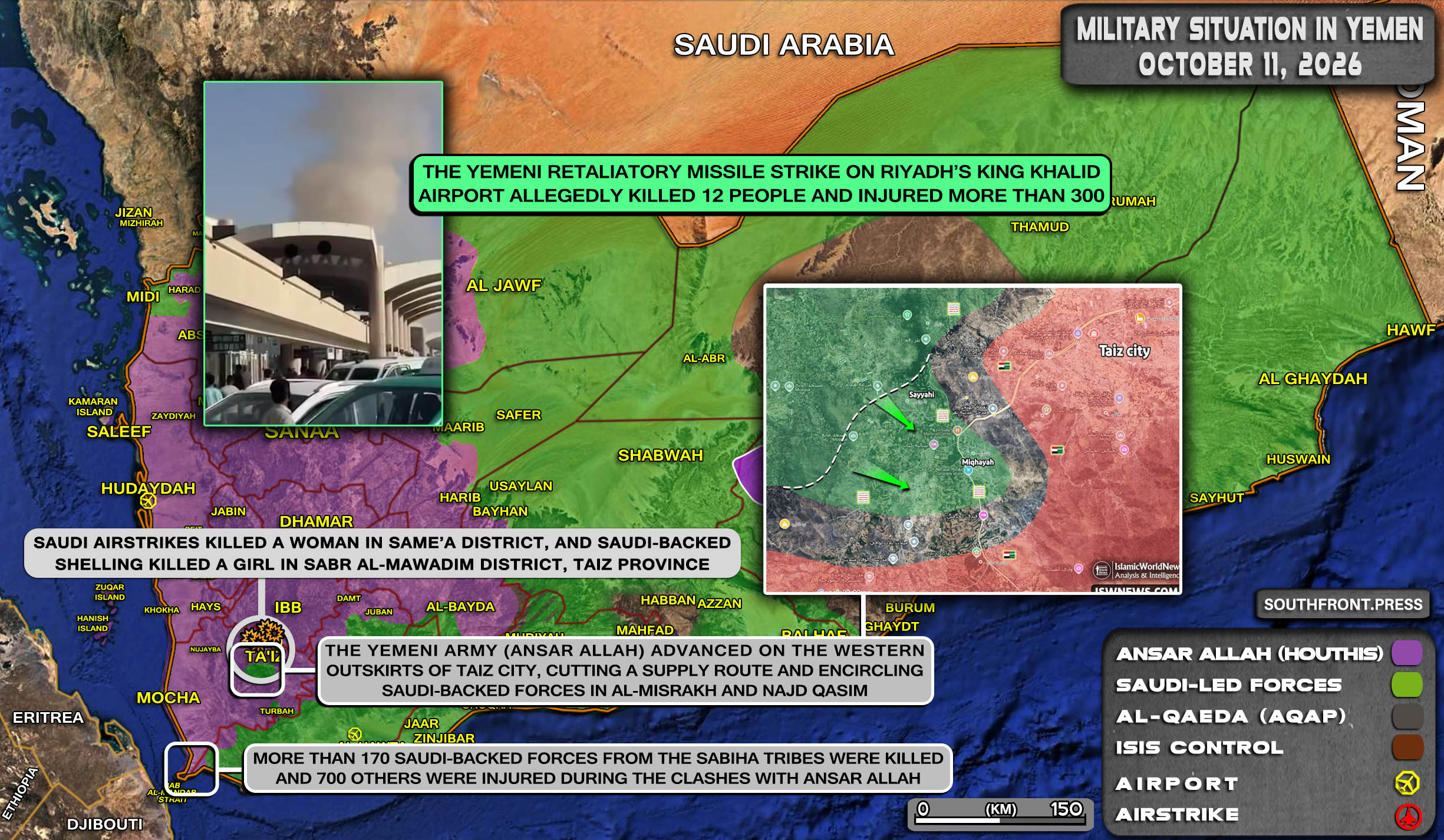
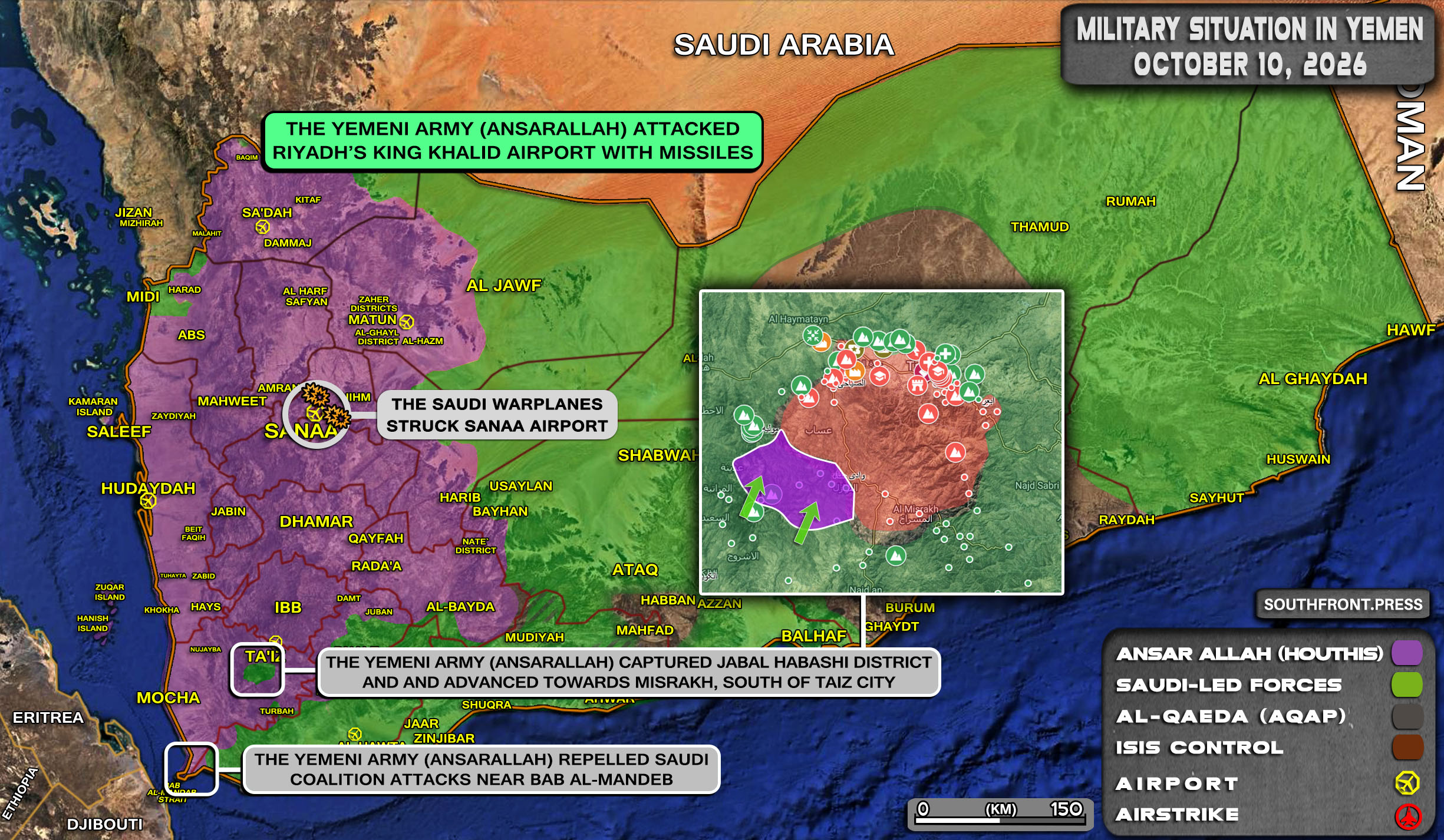
Click to see full-size map.

  • The Yemeni army (Ansar Allah) advanced on the western outskirts of Taiz city, cutting a supply route and encircling Saudi-backed forces in Al-Misrakh and Najd Qasim;
  • Saudi airstrikes killed a woman in Same’a district, and Saudi-backed shelling killed a girl in Sabr al-Mawadim district, Taiz province;
  • More than 170 Saudi-backed forces from the Sabiha tribes were killed and 700 others were injured during the clashes with Ansar Allah;
  • The Yemeni retaliatory missile strike on Riyadh’s King Khalid Airport allegedly killed 12 people and injured more than 300.

_______________________________________________________________________________________________________________________

MORE ON THIS TOPIC:


The post Military Situation In Yemen On October 11, 2026 (Map Update) appeared first on South Front.

  •  

Houthis Strike Riyadh Airport Again, Claim Hits on Saudi Oil and Gas Facilities (Videos)

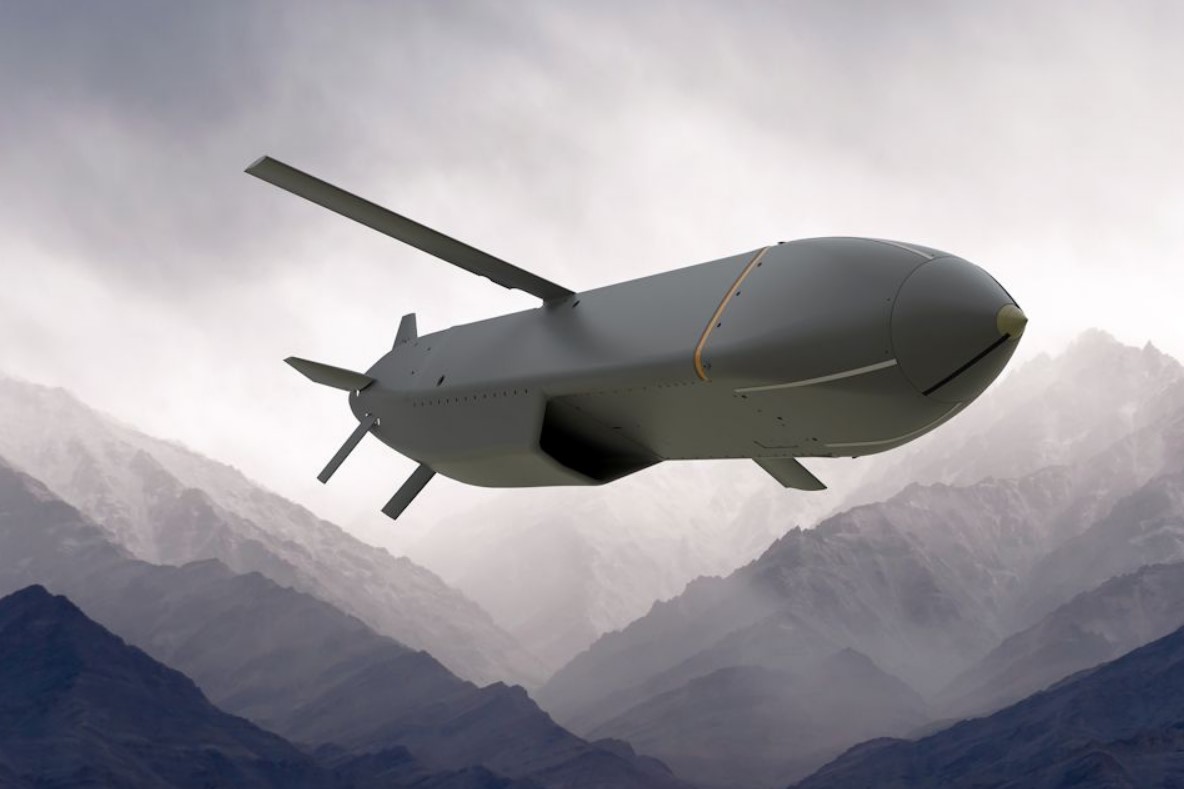
Illustrative image.

The Houthis (Ansar Allah) announced on October 11 that they had launched missile and drone attacks against Saudi airports and two Aramco energy facilities, claiming the operations disrupted air traffic and triggered fires at the targeted sites.

In a statement, Houthi military spokesman Brig. Gen. Yahya Saree said the group had carried out four operations over the previous 24 hours using ballistic missiles, cruise missiles and drones.

The attacks targeted King Khalid International Airport in Riyadh in three separate waves, the Shuqdam gas facility and Tanajib oil facility in Saudi Arabia’s Eastern Province, and King Fahd International Airport in Dammam, according to the spokesman.

Strikes hit Riyadh’s King Khalid International Airport both October 10 and October 11. Saudi authorities said an attack on October 10 killed 12 people and wounded more than 300, prompting the airport’s closure.

The Saudi-led coalition also said an unidentified projectile struck Terminal 4 of the airport on October 11, causing a fire, while air defenses intercepted a cruise missile nearby.

Separately, the coalition reported that a projectile landed close to King Fahd International Airport in Dammam on October 10.

Saree said the strike on the Shuqdam gas facility caused large fires, while the attack on the Tanajib oil facility also sparked a fire.

Fires were detected at both targeted energy facilities, although the extent of the damage and any impact on production were not immediately clear.

The spokesman also said Houthi forces attacked Saudi-backed troop concentrations in the areas of Ras al-Ara and al-Saqiya close to Bab al-Mandab with six ballistic missiles and two drones. He claimed the strikes killed and wounded dozens of personnel.

Saree added that Houthi forces had engaged Saudi military aircraft with domestically produced surface-to-air missiles, forcing them to withdraw. He did not specify how many aircraft were involved or provide further details of the engagement.

The announcement came as Saudi Arabia intensified its air campaign in Yemen. Saree said Saudi forces had carried out 124 airstrikes over the preceding 24 hours across Sanaa and the provinces of Taiz, Marib, al-Jawf, Hajjah, Hodeidah and Saada.

The spokesman put the total number of Saudi airstrikes at 2,058 since the latest escalation began, and accused Saudi forces of causing heavy civilian casualties, particularly among women and children.

Saree warned airlines, international companies, airport workers and travelers against using Saudi airports, declaring them unsafe except for airports and airspace in Mecca and Medina.

“The Yemeni Armed Forces will continue to escalate their operations against the Saudi interior,” he said, pledging to maintain what he called the equation of “blockade for blockade” and “escalation for escalation” until Saudi military operations against Yemen stop and the blockade is lifted.

The latest attacks indicate that Houthi strikes are becoming more accurate, with confirmed impacts at Riyadh’s airport on consecutive days and fires detected at two targeted energy facilities.

This adds to the challenge facing Saudi Arabia, which has so far also failed to help its allies in Yemen organize an effective counterattack against the Houthis.

_______________________________________________________________________________________________________________________

SouthFront: Analysis and Intelligence

NOW hosted at southfront.press

Previously, SouthFront: Analysis and Intelligence was at southfront.org.

The .org domain name had been blocked by the US (NATO) (https://southfront.press/southfront-org-blocked-by-u-s-controlled-global-internet-supervisor/) globally, outlawed and without any explanation

Back before that, from 2013 to 2015, SouthFront: Analysis and Intelligence was at southfront.com

SOUTHFRONT.PRESS

MORE ON THIS TOPIC:


The post Houthis Strike Riyadh Airport Again, Claim Hits on Saudi Oil and Gas Facilities (Videos) appeared first on South Front.

  •  

Military Situation In Iran On October 11, 2026 (Map Update)

Click to see full-size image.

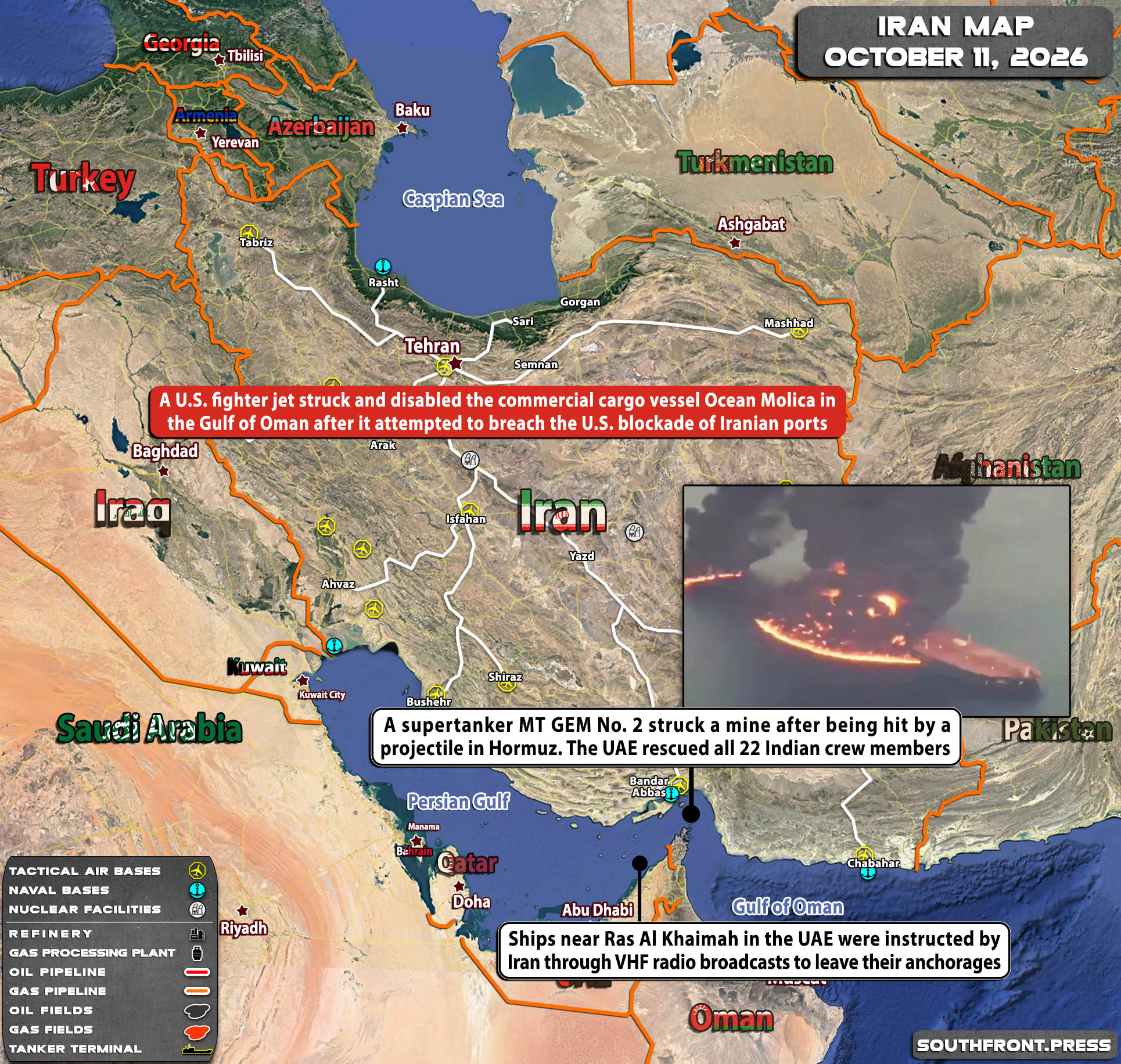
  • A supertanker MT GEM No. 2 struck a mine after being hit by a projectile in Hormuz. The UAE rescued all 22 Indian crew members;
  • A U.S. fighter jet struck and disabled the commercial cargo vessel Ocean Molica in the Gulf of Oman after it attempted to breach the U.S. blockade of Iranian ports;
  • Ships near Ras Al Khaimah in the UAE were instructed by Iran through VHF radio broadcasts to leave their anchorages.

_______________________________________________________________________________________________________________________

MORE ON THIS TOPIC:


The post Military Situation In Iran On October 11, 2026 (Map Update) appeared first on South Front.

  •  

Houthis Split Besieged Forces in Taiz, Eliminate Over 50 Fighters Near Bab al-Mandab (Videos)

File image.

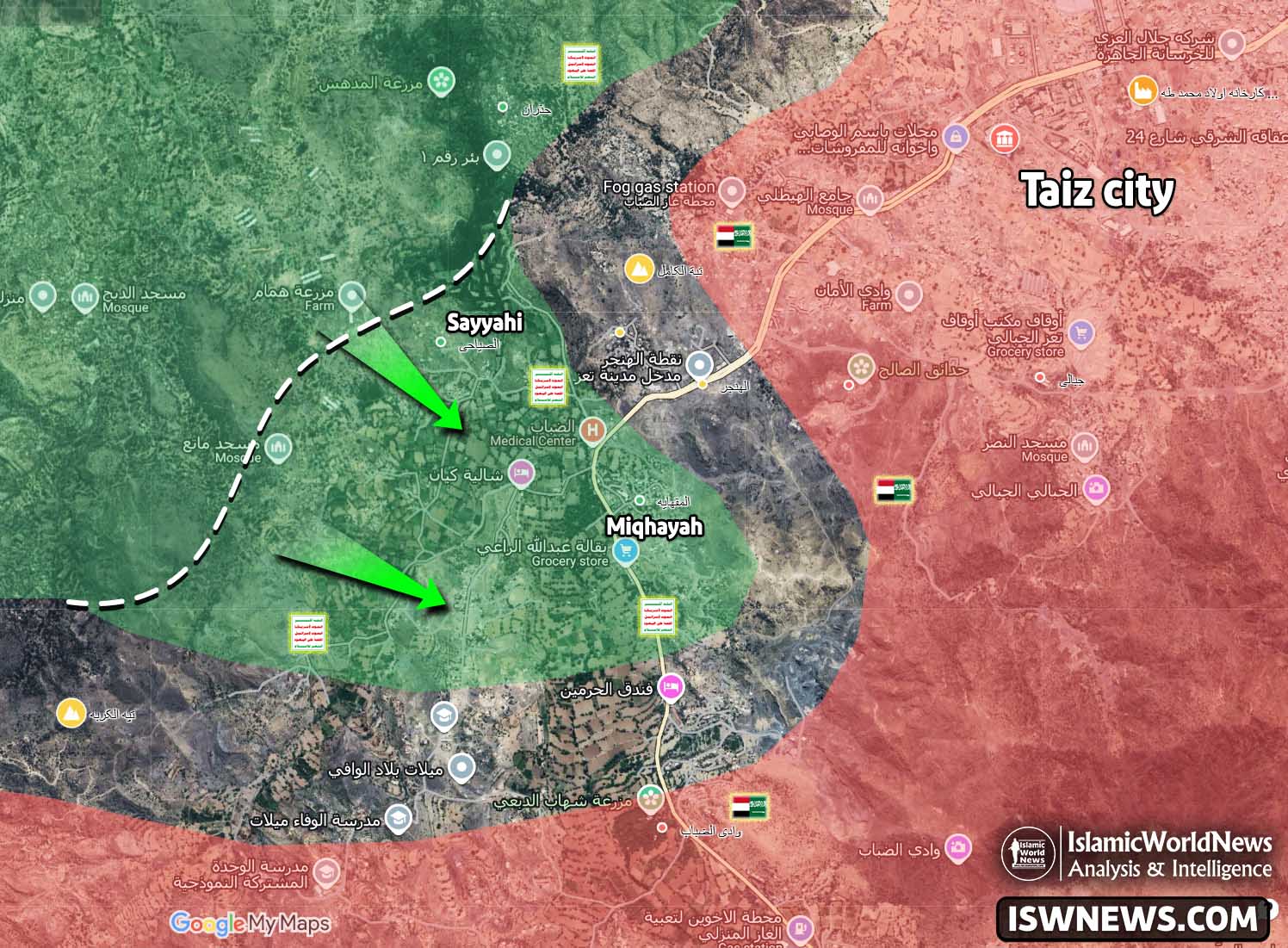
The Houthis (Ansar Allah) advanced into several areas southwest of Taiz on October 11, extending their positions along a contested corridor south of the city as fighting continued against Saudi-backed government forces.

The advance brought Houthi fighters into al-Maqhaiyah, Suq al-Maqhaiyah and al-Sayahi, as well as parts of Wadi al-Dhabab.

Clashes were also reported around Karbah Hill and Jabal al-Kamil, where control of the surrounding high ground remains contested.

The fighting cut the road linking Taiz with al-Misrakh to the south, disrupting supply routes to government-aligned forces on the al-Misrakh and Najd al-Qasim fronts. An alternative route through Jabal Sabr remained open, but the longer journey and difficult terrain complicated supply deliveries to troops in the area.

Click to see full-size map.

The latest Houthi advance came amid intense Saudi strikes in Taiz. The strikes targeted al-Maqrami, al-Jaasha and al-Sallal hills east of the city, as well as Hisn al-Mukhaf and the Bala’an area to the south.

On the western coast, Saudi-backed forces continued their counteroffensive toward the strategic Bab al-Mandab Strait but failed to make any gains. Mayyun Island, located in the strait, remained under Houthi control.

The Saudi-backed Southern Giants Brigades said they had repelled a Houthi attack north of Dhubab Airport near the strait on October 10. The force said Saudi strikes had hit Houthi reinforcements during the fighting. The airport is one of the few positions where the force has managed to establish a strong presence.

The Southern Giants Brigades nevertheless suffered heavy losses during the fighting. Sky News Arabia reported, citing Yemeni sources, that 55 of its fighters had been killed in clashes with the Houthis near Bab al-Mandab.

Overall, the Houthis continued to hold the initiative on both fronts, advancing southwest of Taiz while keeping the Saudi-backed counteroffensive near Bab al-Mandab at a standstill.

_______________________________________________________________________________________________________________________

SouthFront: Analysis and Intelligence

NOW hosted at southfront.press

Previously, SouthFront: Analysis and Intelligence was at southfront.org.

The .org domain name had been blocked by the US (NATO) (https://southfront.press/southfront-org-blocked-by-u-s-controlled-global-internet-supervisor/) globally, outlawed and without any explanation

Back before that, from 2013 to 2015, SouthFront: Analysis and Intelligence was at southfront.com

SOUTHFRONT.PRESS

MORE ON THIS TOPIC:


The post Houthis Split Besieged Forces in Taiz, Eliminate Over 50 Fighters Near Bab al-Mandab (Videos) appeared first on South Front.

  •  

Trump Turns to Russian Diesel. Can Britain Keep Zelensky Afloat?

File image.

President Donald Trump called for Ukraine to replace Volodymyr Zelensky after repeated United States warnings over Ukrainian attacks on Russian oil refineries failed to change Kyiv’s course.

The confrontation intensified after Trump reached a diesel supply agreement with Russian President Vladimir Putin, easing restrictions on Russian fuel exports amid a global energy crisis.

Reports that U.S. envoys raised the prospect of cutting intelligence support have further exposed the stakes for Kyiv, while Zelensky’s talks with Britain raise the question of whether European allies could compensate if Washington withdraws its backing.

Refinery Strikes and Fuel Prices

Trump accused Zelensky of prolonging the conflict, contributing to high fuel prices through attacks on Russian refineries and failing to take opportunities to negotiate an end to the conflict.

“I suggest they get a new leader who can make a deal because he could have made many deals and for some reason he never does,” Trump told reporters at the White House on October 10. “And I think it’s time for Ukraine to get a new president.”

The remarks followed a report by Axios, citing a U.S. official with direct knowledge of the discussions, that Trump decided to pursue the Russian diesel arrangement after Zelensky ignored half a dozen American requests to stop attacking Russian oil refineries.

“Zelensky is misreading the room,” the official said. “By continuing to hit refineries, he is eroding the good will that he has built with Trump over the last six months.”

According to the official, the administration wanted Zelensky to stop the attacks unilaterally because of their effects on fuel prices in the U.S.

Trump made that connection explicit when he accused the Ukrainian president of creating problems for American farmers, ranchers and truckers.

“He wants to make problems for the world. He wants to make problems for our farmers, our ranchers, with diesel fuel,” he said on October 10.

High fuel costs have become a political liability for the administration ahead of the November 3 midterm elections, in which Republicans are seeking to retain control of Congress.

The national average price of diesel stood at $6.28 per gallon on October 9, according to AAA (American Automobile Association), after reaching a record $6.53 on September 22.

Continued Ukrainian strikes have pushed Russia to restrict diesel exports, adding pressure to a global market already disrupted by the war involving Iran.

The Diesel Deal and Its Conditions

The diesel agreement itself represents a substantial shift in U.S. policy toward Moscow. Following a roughly 90-minute telephone conversation with Putin on October 9, Trump announced that Russia would immediately supply 300,000 metric tons of diesel, followed by another 500,000 tons in November and 1 million tons immediately afterward. A further 3 million tons would follow, depending on the state of Russia’s refineries. The supplies were intended for U.S. and global markets.

The full 4.8 million metric tons would amount to roughly 36 million barrels, equivalent to about nine days of U.S. distillate consumption at an average of around 4 million barrels per day.

In addition, by adding millions of barrels of Russian diesel to the global market, the agreement could increase available supplies, ease competition among buyers and put downward pressure on wholesale prices in the United States and other countries.

File image.

The U.S. Treasury Department subsequently issued a temporary license easing sanctions on Russian diesel shipments through April 2027.

The announcement came only weeks after Trump signed a sanctions law targeting Russian energy revenues, underscoring the administration’s willingness to relax restrictions when it considers energy prices a pressing domestic concern.

Zelensky, who said he was blindsided by the announcement while Ukrainian and European officials were meeting with Trump’s envoys in Miami, condemned the decision.

“It looks like a happy birthday present for Putin,” he said, referring to the Russian president’s birthday earlier in the week.

The Ukrainian president called the arrangement “not fair and not honest” and said allowing Russia to sell more petroleum products amounted to an “investment in a war that must be ended.”

Zelensky argued that he would have supported easing sanctions if Putin had agreed to halt attacks on energy infrastructure in both countries.

“If the price is energy ceasefire, this negotiation is good,” he said.

That was the central disagreement: Zelensky wanted a reciprocal energy ceasefire; Washington wanted Ukraine to halt its refinery strikes unilaterally.

Washington’s Intelligence Leverage

The Miami talks also exposed the leverage Washington may be prepared to use. According to the Ukrainian account, Trump’s envoys, Steve Witkoff and Jared Kushner, threatened to cut off Ukraine’s access to U.S. intelligence if Kyiv continued ignoring requests to halt the refinery attacks.

The American side denied making an explicit threat, describing the exchange as a reminder that Washington was providing ammunition and intelligence and that Ukraine should avoid actions that harm American consumers.

Even without a confirmed ultimatum, the exchange underscored how intelligence and military assistance could become instruments of pressure on Kyiv. Neither account establishes that Washington has decided to end its support for Ukraine.

Zelensky’s public criticism of the diesel deal, meanwhile, has given Trump another reason to portray the Ukrainian president as an obstacle to negotiations.

Can Britain Fill the Gap?

Zelensky spoke with British Prime Minister Andy Burnham on October 10, following Trump’s demand for a new Ukrainian president.

According to the British government’s account, Burnham expressed “complete solidarity” with Ukraine and pledged to continue strengthening sanctions on Russia. The leaders also called for an immediate energy ceasefire covering Russian attacks on Ukrainian infrastructure and attacks on shipping in the Black Sea. They agreed to meet in person in the coming days.

Britain has consistently backed Kyiv’s ability to carry the conflict deeper into Russian territory. It has supplied Ukraine with Storm Shadow long-range cruise missiles, and in August authorized the release of classified information about British components of SCALP, the French-produced counterpart, to support planned assembly lines in Ukraine with France.

File image.

Moscow has repeatedly warned Britain and other European governments that such assistance risks escalating the conflict.

London’s continued backing of Ukraine therefore raises a question that has become more urgent following Trump’s remarks. If Washington withdraws or sharply reduces its support, will Britain be prepared to sustain Kyiv’s military campaign despite American pressure, or will it attempt to persuade Zelensky to accommodate Trump’s demands?

Britain has substantial commitments of its own. The U.K. House of Commons Library reported in August that the country had pledged £25 billion in support for Ukraine since February 2022, including £16 billion in military financing. Prime Minister Burnham also confirmed in July that Britain would continue providing £3 billion in annual military assistance.

The Kiel Institute’s Ukraine Support Tracker has emphasized Europe’s continued dependence on American weapons systems. U.S. stockpiles accounted for more than 90% of the military aid delivered through NATO’s Prioritised Ukraine Requirements List mechanism in the first half of 2026, demonstrating how difficult it would be for European governments to replace critical American capabilities quickly.

The gap extends beyond the volume of financial assistance. U.S. intelligence, ammunition and access to American-made defense systems have been central to Ukraine’s ability to sustain its military operations.

For Zelensky, the choice is becoming more consequential. Continuing attacks on Russian infrastructure could preserve Ukraine’s ability to impose economic costs on Moscow, while deepening the breach with the Trump administration on which it still depends for crucial support.

For Britain, the dilemma is equally stark. It could increase support for Ukraine’s long-range attack drone programs and help accelerate the development of Ukrainian ballistic missiles, strengthening Kyiv’s ability to strike targets inside Russia, or use its influence to push for a settlement that keeps the U.S. engaged.

Britain’s problem is not whether it will stand behind Zelensky, but how much of that support depends on Washington. Larger British commitments would not by themselves replace American intelligence or guarantee access to U.S.-made weapons. London can promise to keep Zelensky afloat; it cannot simply write a check to replace Washington.

_______________________________________________________________________________________________________________________

SouthFront: Analysis and Intelligence

NOW hosted at southfront.press

Previously, SouthFront: Analysis and Intelligence was at southfront.org.

The .org domain name had been blocked by the US (NATO) (https://southfront.press/southfront-org-blocked-by-u-s-controlled-global-internet-supervisor/) globally, outlawed and without any explanation

Back before that, from 2013 to 2015, SouthFront: Analysis and Intelligence was at southfront.com

SOUTHFRONT.PRESS

MORE ON THIS TOPIC:

The post Trump Turns to Russian Diesel. Can Britain Keep Zelensky Afloat? appeared first on South Front.

  •  

Satanist Survives Lethal Injection: What Lies Behind the Failed Execution in Tennessee

Click to see the full-size image

On the night of 30 September 2026 an event occurred in the state of Tennessee that fits neither legal nor moral frameworks: 50-year-old Christa Gail Pike, sentenced to death for a murder committed at the age of 18, survived two lethal injections and remained conscious. Officially this is termed a “botched execution” and “criminal negligence.” Yet when the details are examined more closely, the picture begins to resemble not a tragic accident but a carefully planned operation to save a woman whose name had for too long been linked with Satanism, the “Satanic Panic” of the 1990s, and a network of influential people whom it is now customary to group under the so-called “Epstein class.”

To begin with, Christa Pike is not merely a criminal. She became a symbol of an entire era. In 1995, when she was 18, she and her boyfriend Tadaryl Shipp abducted and savagely murdered 19-year-old Colleen Slemmer. On the victim’s chest Shipp carved a pentagram a symbol that instantly turned the case into a sensation.

Shipp later confessed to police that he had “dabbled in Satanism” and regarded the killing as a “Satanic sacrifice.” America in the 1990s was gripped by the “Satanic Panic,” and the Pike case fitted that narrative perfectly. She was sentenced to death and spent three decades on death row.

Click to see the full-size image


Now to what occurred on 30 September. Pike was administered two doses of pentobarbital a drug that in such cases is supposed to stop breathing and the heart with certainty. She did not die. Moreover, 40 minutes after the injections she was still breathing, snoring and complaining of pain in her arm.

Witnesses were escorted from the chamber, and Pike was taken to hospital, where doctors at first considered her brain-dead; yet several days later she regained consciousness, began to speak and even to walk.

The official version is a “badly inserted needle” or a “ruptured vein.” There is a nuance, however: Pike’s lawyers had warned before the execution that she had “bad veins” and that administration of the drug would be difficult. The needle was inserted seven times.

If this were ordinary negligence, why did the executioners, knowing of the problem, fail to prepare properly? Why was a central venous catheter the instrument used precisely in such cases not employed? Why was the drug not replaced with another if the pentobarbital had “degraded” or “had reduced potency,” as the lawyers claim?

And now the most interesting part. The Pike case is not simply a crime chronicle. It forms part of a broader narrative linked to the “Epstein class” a network of politicians, financiers and security officials associated with Jeffrey Epstein. In Substack blogs specialising in “alternative investigations” the idea is increasingly voiced that the Pike story is no accident but a link in a chain of events rooted in the 1990s. Several coincidences are pointed out. First: Epstein visited the Clinton White House seventeen times and this occurred roughly in the same years that the “Satanic Panic” and the Pike case were unfolding.

Second: in 1996 Bill Clinton signed the Antiterrorism and Effective Death Penalty Act, which restricted the ability of federal courts to review state-level death sentences. That law directly contributed to the fact that Pike, whose childhood had been destroyed by violence and whose mental state had not been properly taken into account, spent 30 years on death row.

Supporters of the conspiratorial version go further. They ask why precisely now, in 2026, when the “Epstein scandal” is again gathering momentum, the decision is taken to execute Pike and the execution fails in so demonstrative a fashion.

Why did Tennessee Governor Bill Lee, who had denied Pike clemency, immediately suspend all executions in the state after the botched procedure and order an “independent investigation”? Why did the head of the prison system resign? Why did the judge order the authorities to preserve all evidence, including the syringes and logs, after Pike’s lawyers accused officials of “concealing” evidence?

For the conspiracy theorists the answer is obvious: this was not a failure but a rescue. Pike did not “survive the execution” she was not allowed to be executed. Too many people at the very top had an interest in her remaining alive. Too many threads lead from her case to those who today prefer not to attract attention to themselves.

It is too convenient that a “botched execution” allows her life to be preserved without raising questions of clemency, while simultaneously creating a smokescreen for those who stand behind the scenes.

And while Pike lies in the prison hospital, her arms burned, strapped to the bed, she is alive. Alive despite two lethal injections, despite 30 years on death row, despite the fact that the entire U.S. justice system demanded her death.

Herein lies the central paradox: either we are dealing with the most extensive negligence in the history of American executions, or with the quietest rescue that has ever taken place within prison walls. And if the second version is correct, then Christa Pike is not merely a survivor. She is a pawn in someone else’s game who proved too valuable to be removed.


MORE ON THE TOPIC:

The post Satanist Survives Lethal Injection: What Lies Behind the Failed Execution in Tennessee appeared first on South Front.

  •  

U.S. Escalates In Hormuz With Strike On Iranian Ship (Video)

Illustrative image. (U.S. Central Command)

The United States said its military disabled a cargo ship in the Gulf of Oman on October 10 after the vessel ignored warnings and attempted to breach a naval blockade of Iranian ports.

An American fighter jet struck the stern of the Panama-flagged Ocean Molica, also known as Arika Sun, with a precision munition, disabling the ship’s propulsion system without injuring its crew, U.S. Central Command (CENTCOM) said in a statement posted on X.

The cargo ship had left a port in the Islamic Republic before attempting to transit regional waters, according to the command.

“Four commercial vessels have been disabled and 135 ships have been turned around during three months of strict enforcement. Additionally, U.S. forces have destroyed 10 tankers linked to the Islamic Revolutionary Guard Corps’ (IRGC) multibillion-dollar shadow network over the same period,” CENTCOM said.

The incident came amid reports of other threats to commercial shipping near the Strait of Hormuz. The IRGC said on October 9 that a supertanker had caught fire after striking a naval mine while attempting to leave the strait by what it described as an “unauthorized and dangerous route.”

Other reports said a tanker had been struck by an unidentified projectile. India confirmed that all 22 crew members aboard the MT GEM No. 2 were safe following an incident off the coast of the United Arab Emirates.

Separately, the United Kingdom Maritime Trade Operations (UKMTO) agency said several ships near Ras Al Khaimah in the UAE had reported receiving radio instructions to leave their anchorages. The agency classified the incident as “suspicious activity” and said it was under investigation, without identifying who issued the instructions or whether the vessels complied.

Commercial traffic through the Strait of Hormuz remained sharply reduced on October 11. Reuters reported that vessel transits had fallen to their lowest level in more than two months, following a previous week in which tanker attacks reached their highest weekly total since the United States and Israel began their war against Iran in February.

The Hormuz.now shipping tracker recorded an average of about 10 commercial crossings a day over the preceding week, compared with roughly 85 before the crisis. The figures may exclude vessels whose tracking systems are switched off while moving through the strait.

Before the war, the Strait of Hormuz carried about one-fifth of the world’s oil consumption, making the disruption a major concern for global energy shipments.

The latest attack by CENTCOM will likely lead to more escalation in the waterway as Iran is guaranteed to strike back with full force.

_______________________________________________________________________________________________________________________

SouthFront: Analysis and Intelligence

NOW hosted at southfront.press

Previously, SouthFront: Analysis and Intelligence was at southfront.org.

The .org domain name had been blocked by the US (NATO) (https://southfront.press/southfront-org-blocked-by-u-s-controlled-global-internet-supervisor/) globally, outlawed and without any explanation

Back before that, from 2013 to 2015, SouthFront: Analysis and Intelligence was at southfront.com

SOUTHFRONT.PRESS

MORE ON THIS TOPIC:


The post U.S. Escalates In Hormuz With Strike On Iranian Ship (Video) appeared first on South Front.

  •  

New Houthi Footage Shows Drones Strikes, Saudi-Backed Fighters Surrendering

File image.

Yemen’s Houthis (Ansar Allah) released two videos on October 10 showing attacks on Saudi-backed forces near the country’s southwestern coast and claiming the group had secured additional territory in Taiz province.

The first video, published by the Houthis’ military media, showed recent strikes with “Shawaz” first-person suicide quadcopters.

The strikes targeted military vehicles and gatherings of Saudi-backed fighters at several locations in the Kahbub Mountains and al-Waziyah district along the far southern end of Yemen’s southwestern coast.

A second video, released separately, showed Houthi fighters advancing in the districts of Sama, As Silw and al-Mawasit in Taiz.

The footage also showed groups of Saudi-backed fighters surrendering to the Houthis and laying down their weapons in line with a general amnesty announced the previous month by Mahdi al-Mashat, head of the Houthi-led Supreme Political Council.

The three districts lie in the rural south and southeast of Taiz city, on a front distinct from the fighting along the Red Sea coast. Their reported capture comes amid the Houthis’ wider advance around Taiz, where the group has managed to cut the city off from other government-held areas.

Al Jazeera reported on October 10 that the capture of al-Turbah by October 4 had severed the main road linking Taiz city with government-held territory.

The coastal footage appeared amid continued fighting over access to the strategic Bab al-Mandab Strait, which connects the Red Sea with the Gulf of Aden.

Saudi-backed forces said on October 9 that they had retaken the strait’s surrounding coastal areas and Mayyun Island, which lies within the waterway. Ansar Allah military spokesman Yahya Saree, however, said the group had repelled an advance from Lahj province and claimed more than 22 armored vehicles had been destroyed.

All in all, the Houthis maintain the upper hand both in Bab al-Mandab and in Taiz. Saudi-backed forces appear to be taking heavy losses, and their chances of regaining the initiative are getting slimmer by the day.

_______________________________________________________________________________________________________________________

SouthFront: Analysis and Intelligence

NOW hosted at southfront.press

Previously, SouthFront: Analysis and Intelligence was at southfront.org.

The .org domain name had been blocked by the US (NATO) (https://southfront.press/southfront-org-blocked-by-u-s-controlled-global-internet-supervisor/) globally, outlawed and without any explanation

Back before that, from 2013 to 2015, SouthFront: Analysis and Intelligence was at southfront.com

SOUTHFRONT.PRESS

MORE ON THIS TOPIC:

The post New Houthi Footage Shows Drones Strikes, Saudi-Backed Fighters Surrendering appeared first on South Front.

  •  

Why capitalism won’t save the climate

By Dan BOSCOV-ELLEN – Joshua FRANK

Join us on Telegram, X, and VK.

Contact us: info@strategic-culture.su

Although the social and environmental costs of renewable energy technologies are often gestured at parenthetically in left discourse about climate action, they are rarely given serious and sustained attention. It is generally assumed that because a rapid transition to renewables is necessary to avoid full-on climate disaster, we will simply have to accept these costs without too much critical scrutiny. 

In an interview with Spectre’s Dan Boscov-Ellen, Joshua Frank draws on his recent book Bad Energy: The AI Hucksters, Rogue Lithium Extractors, and Wind Industrialists Who Are Selling Off Our Future (Haymarket 2026) to highlight the dangers of that assumption.

Joshua Frank is the managing editor at CounterPunch. He is an investigative journalist and author of the recent award-winning book Atomic Days: The Untold Story of the Most Toxic Place in America (Haymarket, 2022).

+++

Thank you for speaking with me again, and congratulations on the publication of your new book Bad Energy. The book is a sobering look at the environmental costs of the transition to renewables that explores those made expendable in the name of combating climate change and pushes us to reckon with the material constraints on any construction of a sustainable postcapitalist future. Challenging the complacent path-dependency of much left energy politics without laying out a detailed blueprint for an alternative makes this a potentially unpopular line of questioning; people may not want to confront the harms involved in the only climate solutions that seem to be on offer, especially when there seems to already be so little to feel hopeful about at the moment. What prompted you to take up this project? And were there things that particularly surprised you as you began your research?

I live in California. I grew up in the West, in Montana. The majority of public lands in this country managed by the Bureau of Land Management are in the West; there are 240-some million acres that are managed by the BLM. And many of these huge so-called green energy projects are being built on these public lands. In California, for instance, a lot of big solar farm projects are popping up in the Mojave Desert. I spend a lot of time in those areas, and I see the impact that they’re having.

On a very personal level, when my wife and I moved into our current house, we adopted an endangered desert tortoise that had been living here. It was probably stolen from the Mojave decades ago, but it’s been living here through three different residents. So we’ve gotten to know this desert tortoise really well. When I started learning about what some of these big energy projects are doing to desert tortoise habitat, I really felt like I needed to tell the story and defend these creatures, which have been out there for millions of years and we’ve put them on the brink of extinction in a hundred years. They’re an indicator species of an ecosystem in crisis.

Of course, it’s not just green energy projects; there’s been mining and grazing and drought and weapons testing and all sorts of things that have happened out there. But right now, this big push for green energy has made things much, much worse. So that was really the first thing that prompted me to think about approaching this project; I felt like I needed to do it in defense of this tortoise that I am a steward of here at home.

Obviously, I support a transition away from fossil fuels. So I’ve supported solar and wind projects. But what I didn’t realize until I started my research for the book is who is behind many of these projects or the scale of the moneyed interests involved. One that I write about in the book is an enormous wind project in Wyoming that is being funded by an oil billionaire. It’s going to be five hundred square miles, and they’re going to build a seven-hundred-plus-mile-long transmission line called the Transwest Express that’s going to transmit that power from Wyoming to California. That was just mind boggling to me.

Wind energy in and of itself is not a bad thing, but a huge wind project like this that is four or five states away seems completely crazy to me. And when I visited the town where that project is being built and I talked to residents there, they feel the same way—that this is just another example of resource exploitation in their state. There are many other examples like that. So I started looking at the nuances of some of these technologies and who benefits from implementing them in one way versus another, which was enlightening to me, and hopefully will be to readers.

One of the themes of the book is that focusing too narrowly on climate change can cause us to overlook other aspects of capitalist ecocide—particularly the biodiversity crisis, which is, as you note, “in many ways as serious as climate change itself.” If you’re an oil billionaire who’s trying to diversify with more of an “all-of-the-above” energy strategy, as the Democrats like to say, then perhaps it makes good sense to frame things narrowly in terms of carbon alone. But some climate activists and sections of the left seem to do the same thing unintentionally. Are there ways to talk about and organize around the climate crisis without separating it from the broader context?

I think one of the traps that we fall into is thinking about the planet in a very binary way when it comes to the climate—a problem that has been made worse by the big green outfits that are almost solely focused on climate change. And of course, this isn’t to say that climate chaos isn’t real. It is. But we can fixate on it at the expense of a lot of other problems that are also happening concurrently: industrial farming and the pollution it causes, habitat loss, all sorts of things. So the first thing we need to do is start looking at planetary health holistically. Once we start to see that all these things are interconnected, and then look for answers to climate change that take the impacts of biodiversity and everything else into consideration, we start looking at the problem differently. When we destroy biodiversity (often in the service of capital accumulation), we’re doing so at the expense of the climate, because those deserts and rainforests act as carbon sinks in many cases, too. We can’t approach the answer to one of these problems at the expense of the other.

You take the same stance here when it comes to the social impacts of energy projects. You note that “more than half of critical mining projects are on or near Indigenous lands,” and throughout the book you cover a number of specific examples where the buildout of renewables is harming Indigenous communities and, in some cases, making their existing ways of life impossible. This focus contrasts with the predominant approach of the social-democratic left in this country, which generally prefers to ignore or downplay such concerns as identitarian and politically inconvenient. Why have you centered them here, and how do they connect to the larger argument of the book?

I think if we’re talking about the fossil fuel industry and the impacts that coal mining or oil production have on people, we don’t have the same kind of conversation. There, everybody on the left would agree we need to oppose these things because they’re polluting resources, they’re poisoning water, they’re destroying communities. Well, then why can’t we use that same framework to analyze so-called green energy projects?

For example, I have done a lot of work with folks in the Navajo Nation working against uranium mining, talking to people that have been impacted by that industry, which is being resurrected under the guise of climate change. One of the things that we need to do when we’re looking at all of these projects is to give it the same attention and criticism that we would to the fossil fuel industry, because many of the impacts on the ground for these communities is very similar.

As you and I have discussed before, I also think that there is a lack of environmental ethic on parts of the left, and definitely a lack of respect for Indigenous cultures and Indigenous lifeways. There is so much we can learn from Indigenous cultures, but we also need to understand that if we’re not approaching where we get our energy in a critical way, it is going to play out like all of the earlier extractive, colonial episodes that have come before. As I detail throughout the book, these mining companies and other interests looking to profit off of the transition are using the same playbook that the fossil fuel industry has used. So we need to be critical in the same way that we would if we were talking about oil and gas production.

Part of that playbook is to frame so-called “nonproductive” uses of the land as “waste.” Even when it’s not explicitly stated, I think there’s often an attitude on parts of the left that sees Indigenous land and water protectors as irrationally obstructing necessary “progress”—a (possibly willful) misunderstanding of the concerns of Indigenous communities as they have been sounding the alarm about the dangers of repeating the same harms under a green banner if we fail to acknowledge and address the underlying causes. And those are not just capitalism and ongoing colonialism but a breakdown of proper relations and an unwillingness to acknowledge our full obligations to all those with whom we are in relation.

Often we are talking about how climate chaos is impacting these communities, but we should be talking about all of the things that are impacting these communities, and the book tries to highlight that.

While we’re talking about some of the ways that this book may push or challenge sections of the left, I wanted to ask about another inconvenient truth that you highlight in the book, which is that of non-Western imperialism. In particular, several prominent ecosocialist thinkers (I have in mind John Bellamy Foster and Jason Hickel, but there are numerous others) seem to have a real blind spot when it comes to the social and environmental harms of Chinese imperialism. Why do you think that is, and how should the left position itself vis-à-vis interimperial rivalries in global supply chains for renewables?

One thing that was very enlightening to me when doing research for the book was learning just how much of these so-called critical mineral resources globally are controlled by China and Chinese-backed companies. Congo is example of this: 80 percent of its copper and cobalt is controlled by Chinese interests. It’s a similar story in many other places in Africa and South America. This includes things like cobalt, copper, and nickel, as well as graphite, lithium, and rare earths. And not only do they control something like 70 percent of the world’s current critical mineral reserves, but they also control 90 percent of their refinement.

Of course, critical minerals are not just used in “green” technologies—they are used in military tech and AI chips and all sorts of things. They are increasingly crucial to the capitalist economic system, and so we have seen these geopolitical tensions arise over them, with Trump aiming to secure access to minerals by strong-arming countries through tariffs and threatening to withhold military aid, and so on.

But the opposition to the United States can mask the on-the-ground reality of Chinese mining, which is no less brutal than that of US-based corporations. When you start digging into it, you see that there is rampant abuse of miners that are many times children working in horrible conditions in toxic places. I have a lot of respect for Jason and John, but I think that it’s naive to see this relationship that China has with some of these places, which generally aren’t seeing the benefit of all this extraction, and to not to see that as a form of economic imperialism.

Of course, it’s not just mining in places like the Congo; China is funding huge so-called green energy projects all over the world. And on the surface, that might seem like a good thing for those places. China is loaning billions to construct well over three hundred huge hydroelectric dam projects in seventy countries under the guise of providing energy and creating jobs. But when you look at the fine print, you see that these loans are all resource-backed loans, which means in many of the cases the funding is tied to giving China access to critical minerals and other resources. So that also is a form of economic imperialism. If the United States or the IMF or the World Bank were doing it, that’s what we’d be calling it, right? And the United States certainly wishes that they had been doing this decades ago, because China is ahead of the game.

I don’t know where the ecosocialist thinkers have lost the narrative on this, but I hope that they can look at the reality on the ground and come to a different conclusion.

Although the book challenges various kinds of complacency that we find on the left, the point is not to argue that all renewable energy is inherently “bad” energy. No energy source is without impacts, but you note that “not all renewable energies are created equal.” For example, you suggest that solar and wind are generally less harmful than nuclear reactors and large dams. You also discuss how different approaches to these technologies can lower their impact (encouraging distributed rooftop solar rather than large solar farms in the Mojave, and so on). Some of this may be context dependent—if you’re in a place that has good wind corridors that are less frequented by migratory birds, maybe it makes sense to put wind there instead of in certain sensitive offshore habitats, for instance. But are there any overarching principles to keep in mind when thinking through our energy options?

I generally think local is better in many ways. Local communities have a better sense of their needs and of what their ecology means to them. I think about an example that I wrote about in the book, which is how these big solar projects in California are rolling out. In investigating that, I came to the conclusion that it is the big utility companies in California that wanted to destroy the rooftop solar program, which was making really great strides here in the state, because it wasn’t profitable to them. They are looking to maximize profits; they’re publicly traded companies, so there’s a fiduciary responsibility for them to provide endless returns on their investments. Rooftop solar was a threat to that; and so Gavin Newsom, who is in the back pocket of these big utilities, destroyed rooftop solar. And what they’ve done instead is to open up enormous swaths—millions and millions of acres—of public lands across the West to develop solar farms, in some cases in very ecological important areas.

So I think understanding that economic dynamic is important, first and foremost, before we even start talking about the nuances of these technologies and what those impacts might be at the local level. You can contrast the placelessness of capital with the people I talked to in the book, including people from a lot of different Native American communities. People, especially in rural communities, have a lot of ideas about what their needs are and how they could be met. There’s an example in the book of a community in Northern California that has very inconsistent energy. Yet there is no guarantee that this massive wind farm that’s being proposed off the coast of Northern California is going to help bring energy to that local community.

Those kind of contradictions, I think, are really important to look at. And this gets into larger questions of democratic decision-making. These communities, in many cases Indigenous communities, are once again being set up as “sacrifice zones,” only now in the name of green energy. Once we recognize that, then it seems clear that they should have a bigger say in what happens on those lands than, say, those who live hundreds of miles away who would enjoy the fruits of their resources.

In terms of what energy strategies we choose, of course it is partly geographically dependent. Obviously in parts of the US West, sun is very plentiful. I don’t really get into geothermal in the book, but in some places geothermal can be very efficient, but that’s not possible everywhere. But I think the main thing to keep in mind is that we can’t simply replace fossil fuels with green energy without interrogating the system itself, which is the capitalist system that promotes the myth of endless growth. That we don’t have endless resources on this planet, and no matter if it’s fossil fuels or green energy, there are limits to what we can take without doing irreparable harm. And the attention to the local helps us to see that, which is part of why thinking local is really important. It might be an oversimplification, but it’s a pretty good one.

I want to come back to the question of democratic decision-making in a moment, but first, can I quickly follow-up about the question of endless growth? You write that expansionism is “the foundation of capitalist ideology…markets (both foreign and domestic) require new territory and resources to grow.” A number of ecosocialist thinkers, from James O’Connor to Jason W. Moore, have argued that the finitude you’re highlighting here is at some point going to become a fatal problem for capitalism itself—that it’s going to run out of new frontiers and it won’t be able to sustain its growth. Renewable energy seems to be part of a new frontier of accumulation; you cite a mining analyst for BNEF arguing that “the energy transition could lead to a super-cycle for the metals and mining industry,” and you look at how capitalists are scouring the planet, including the depths of the ocean, for critical minerals (some now have their eyes set on asteroids, perhaps the true “final frontier”). Could this boom keep capitalism running, despite the harm to the planet?

In the immediate future, capitalism can absolutely run on this strategy of continuing to burn fossil fuels and also expanding overall energy consumption, with renewables being a portion of that. In no way are we seeing renewables push fossil fuels out. I think that’s by intention, that’s by design. I don’t know how long that can go on despite the impacts that it will continue to have on the planet and people, but I suspect that it could still work for a long time.

If we’re talking geological time, yes, capitalism will eventually have to face physics—the reality that this planet has resources and sinks that are finite and at a certain point we will have exhausted them. I think left to its own devices, eventually capitalism will run into a wall that it doesn’t care about driving into, unfortunately. But we can’t wait for that moment to arrive on its own because we all live here, too; we need to come up with a better strategy to slow down, as Kohei Saito would say. To use less resources and try to live more equitably and comfortably. I write in the book that the world does have a population problem, and it’s the growing population of billionaires. Not regular people.

Naomi Klein and Astra Taylor have a new book coming out called End Times Fascism, and I gather that part of the argument is that many of these billionaires recognize that they’re destroying the world, but they think that they can insulate themselves and their progeny from an apocalypse that they themselves are hastening, perhaps intervening technologically where necessary to keep the profits flowing as long as possible (Elon Musk has been talking a lot about the need for geoengineering lately). On that note, one of the interesting sites of resistance today here in the United States at the moment is the growing popular movement against data centers. The companies relying on the AI boom do not want democratic oversight, and many of them are quite happy to embrace fascism—and to create the repressive technologies that enable it—if it allows them to keep profits flowing. In the book, you discuss Musk’s “we’ll coup whoever we want” attitude toward Bolivian lithium, but it’s clear that this applies equally in the imperial core too. Do you see anti-data-center organizing, which concerns the right of communities to have a say over what technological infrastructure is built and for what purposes, as a hopeful model of resistance to the narrative of inevitability the tech giants are promoting (with the help of some ecomodernists)? As it interacts with the climate movement and the fight for a free Palestine and so on, could this kind of popular movement begin to center the concerns raised in Bad Energy more comprehensively, or are there obstacles that would seem to preclude that possibility?

My hope is that people who may not have really analyzed the underlying economic system of climate chaos walk away from reading Bad Energy and begin to question more as they see that capitalism is still running the show. I think data centers is another great example of that; despite the supposedly intangible nature of the cloud, for many communities this is a very tangible thing that capitalism is throwing at us. I see the movement against data centers across this country as perhaps the biggest opening for the left and the environmental movement to fight big tech and this exploitative capitalism that is infiltrating our lives in the form of AI. I think we begin to understand capitalism in a different way when it’s in our own backyard, when big tech is in our own backyard using our resources. There are a lot of things with data centers that people talk about with energy use and water, and those are really important. But another that’s very rarely talked about is how many critical minerals are needed in these data centers. You know, a big data center, for example, uses tens of thousands of pounds of copper, and that equates to more and more mining; mining for copper is exploding because copper is used in every green energy product, in transmission lines and batteries, as well as data centers.

When we fight data centers, we’re really fighting capitalism; we’re fighting a symptom of capitalism. So I’m really hopeful that we can use this movement against data centers as a tool to help educate people about the wrath of capitalism. Poll after poll shows that Americans don’t support data centers, and many polls are also starting to show that people look at socialism as being better than capitalism. So it’s our duty to provide that alternative, and to help connect the dots. But I’m really invigorated by this movement; it’s an exciting cross-section of all sorts of people, and if we are going to save this planet, we need that kind of mobilization to do it.

I agree, which makes it all the more baffling when ecosocialists like Matt Huber and Holly Buck come out against the anti-data-center protests as being somehow naïve or misinformed, arguing that what we really need is a socialist version of AI development. It seems not just ecologically wrongheaded, but incredibly politically short-sighted not to see the opening in this genuinely grassroots popular resistance to help advance a mass socialist politics based in local democratic decision-making about energy and growth. On that note, I have one final question for you. A central theme throughout the book is the importance of making informed decisions about the relative benefits and harms of various energy sources, and that leaving these decisions to capitalists is a recipe for disaster. Yet even democratic decision-making may fail to adequately register the interests of the nonhuman world and future generations when faced with the exigencies of present poverty (often the legacy of racialized and colonial exploitation). For example, as you detail in the book, some Indigenous communities are split on whether to support mining or infrastructure projects that could bring even temporary income. This pressure can understandably override concern for nonhuman beings and future generations. You mentioned earlier that you started this project in part because you felt a responsibility to speak for the desert tortoise you adopted (and to whose species this book is dedicated) because it can’t represent itself. Do you have any thoughts about how the interests of those who cannot speak for themselves, but who have a great deal at stake in these decisions, could be more consistently integrated into left energy politics?

To harken back to our discussion of Musk a moment ago, some of these billionaires do consider themselves to be environmentalists. The discourse of environmentalism isn’t exclusive to the left, and it can be a very slippery slope into ecofascism as resources are scarcer, things get worse, and capitalism continues to wreak havoc. So I think it is very important to challenge that through democratic processes, and to pull everybody into the conversation. The more people that are part of the conversation, the less chance there is of slipping into a sort of ecofascist hellscape.

It’s true that people often think first about the needs most pressing for them and their communities, and it’s easy not to connect that to the larger picture. It’s easy to be totally disconnected from the farmers that grow your food, or the people that assemble your iPhones, or the mines where the copper in your electric vehicle engine came from. Being more democratic about that process is inherently anticapitalist, because capitalism doesn’t want us to think about any of that: it doesn’t want us to be connected to the people that supply these things to us and the wreckage that is left behind. So I think part of our job as activists and as writers and as academics and people on the left is to bring those conversations forward for people. If we can do that, I think that we will ultimately have a bigger and deeper conversation about what’s really going on and what’s really at stake. And I think that we can together develop a better approach to this problem that we face.

Josh, thank you again for taking the time to speak with me. I hope people will pick up Bad Energy; I think it’s mandatory reading for those who want to understand the constraints within which we’ll need to operate as we try to envision, and ultimately to build, a more sane and livable future.

Original article:  www.counterpunch.org

  •  

Deutsche Bahn and China Rail

The story of infrastructure in capitalist vs. socialist systems

By Hua BIN

Join us on Telegram, X, and VK.

Contact us: info@strategic-culture.su

A friend visited Germany recently and told a story how a delayed train caused him to miss the flight home.

I was shocked since you could set your watch by the Deutsche Bahn when I was living in Germany back in 1997.

I was doing an internship at Mercedes Benz in Stuttgart in those days. I could time my walk from the apartment to the bus stop, then connect with a train to the office with less than 5 minutes in total waiting time.

The bus and train schedules were synced so perfectly that you could count on a two-minutes’ walk and exactly 2 minutes wait in between. Both buses and trains were on time to a fault.

I had a particular fondness for DB since I traveled around Germany almost every weekend with its 35 Mark Schones-Wochenende Ticket (happy weekend ticket). Unfortunately that service was discontinued in 2019.

In the winter of 1997, I got lost on a hike with several friends in the Black Forest near Baden-Baden.

We were only able to walk out of the cold night after stumbling upon a rail track that led us to a small rural train stop. I can still remember the warm platform light to this day.

I’ve held German rail in high regard ever since.

So you can imagine how incredulous I was about the delay and bad service my friend complained about.

This prompted me to read about what happened to Deutsche Bahn over the last 30 years. In a nutshell, things certainly have changed for the worse.

Deutsche Bahn today defines an on-time train as one arriving less than 6 minutes behind schedule – a long cry from the clock-setting punctuality of the late 90s.

Even by such a low bar, punctuality hovers around 50 to 60%, well below DB’s own target of 70%.

The official explanation is aging infrastructure, heavy construction, and overloaded tracks.

However, as I dig a bit deeper, the decline of the German rail efficiency seems to stem from a deeply flawed privatization in 1994 which led to decades of extreme infrastructure underinvestment.

The 1994 Bahnreform merged the old East and West state railways with a clear mandate: DB was supposed to operate as a profit-seeking private corporation to prepare for an eventual stock market IPO.

To attract investors, DB prioritized extreme cost-cutting over public service.

They aggressively cut staff, outsourced maintenance, and began divesting into global logistics companies (like DB Schenker) rather than focusing on domestic rail.

Under the guise of maximizing efficiency, DB severely downsized its physical network to save money.

Nearly 8,000 kilometers of secondary rail lines were completely dismantled. Thousands of track crossovers, passing loops, and spare sidetracks were removed.

In 1997, if a train broke down or was delayed, a dispatcher could easily reroute it around the problem using these spare tracks.

Today, the network is stripped of its buffers. If one commuter train stalls near Frankfurt, it acts like a broken-down car on a single-lane highway, causing immediate, cascading delays across the entire country.

The problem is compounded by a mixed-rail system where fast Intercity Express (ICE) trains share the same physical tracks with slow regional commuter trains and heavy freight cargo.

In comparison, Chinese high-speed rail or France’s TGV networks mostly operate on dedicated high-speed tracks.

As the DB physical network was drastically thinned out, annual passenger numbers went up from 1.5 billion passengers in 1994 to 2.4 billion today.

Back in the 90s, it was still very common to live near where you worked in Germany. Over the last 30 years, skyrocketing housing costs in major hubs like Frankfurt, Munich, Berlin, and Hamburg forced a massive portion of the workforce to move further out into surrounding suburban regions and smaller towns.

As a result, Germany experienced a commuter explosion, with millions of people traveling significantly longer distances back and forth every single day.

Now, the Deutsche Bahn system runs at 100% capacity nearly constantly. Any small delays can quickly snowball into network chaos.

To make things even harder, Germany’s strict structural debt limits have restricted state spending.

For years, Germany spends only a fraction of what its neighbors do on rail. For example, Switzerland invests over €400 per citizen annually into rail infrastructure. Germany routinely spends around €100.

DB’s disastrous experience with privatization mirrors what happened with other similar projects such as the Thames Water in the UK.

When Margaret Thatcher’s government privatized the UK water sector in 1989, Thames Water was handed to private investors with a clean slate and zero debt.

However, successive private owners treated the utility—which serves 16 million customers across London and southern England—as a corporate cash cow.

Private investors – Wall Street banks and hedge funds – loaded the utility with a mountain of debt and extracted hundreds of millions in management fees and dividends.

Instead of using revenue to upgrade Victorian-era pipes and treatment centers, money was funneled to shareholders and executive bonuses. By 2026, that debt has ballooned to roughly £20 billion.

While the financial engineering generated short-term returns for private equity, the physical infrastructure rotted.

Thames Water has become a national scandal as it has spilled billions of liters of raw sewage directly into the River Thames and local waterways.

Due to aging infrastructure, 25% of all treated water leaks straight out of the pipes before ever reaching customer homes.

Amid severe dry spells and record temperatures, Thames Water repeatedly implements prolonged hosepipe bans because the system lacks structural resilience to manage the region’s water security.

Most privatization projects of public utilities have witnessed a similar pattern of chronic underinvestment, extreme operational cost cutting, and unsustainable debt leverage while enriching financial investors.

Deutsche Bahn and Thames Water are symbols of public goods degradation for private investor gains in rentier capitalist economies.

In stark contrast, Chinese infrastructure remains firmly in the domain of public ownership.

While Europe and the US follow a policy of reactive, austerity-driven, rent-collecting management of their nations’ infrastructure, China has adopted a strategy of anticipatory, supply-led construction – often years ahead of demand.

Back in the 90s, China still was heavily reliant on decades-old, technically backward rail networks that suffered regular breakdowns.

I still remember sitting in rail cars with no air-conditioning in the height of summer for hours when the train from Beijing to Chongqing broke down due to an engine failure during a trip home from college.

The ride used to take 40 hours by scheduled timetable. Today the same trip takes less than 7 hours on highspeed rail.

When China started building its national highspeed rail network in 2004, there was an avalanche of negative press from the West.

Western “experts” eagerly called out how wasteful the project was and how the rail would never generate a positive return on investment.

Despite the nay-sayers, the country has built over 50,000 kilometers of highspeed rail in the last 20 years, over 70% of the world’s total capacity.

Just today, China announced the completion of 4 new highspeed rail lines in 4 provinces, adding another 1,142 kilometers to the network.

One of the lines is the 318-km Harbin–Yichun Line, which is now China’s northernmost highspeed rail traversing alpine permafrost.

The network now covers 97% of all cities with over 500,000 residents. It operates on dedicated rail lines and achieves 98% departure punctuality and 95% arrival punctuality.

Rather than aiming to achieve profitability and high return for every single line, the Chinese highspeed rail system serves as a public good that generate system-level benefits for the entire economy and the public.

Deutsche Bahn and China Rail represent two systems that operate on completely opposite philosophies, leading to radically different outcomes in rail performance and economic impact.

Building ahead of demand vs. Managing declining assets

China’s infrastructure strategy rests on the philosophy that building massive, high-capacity transport networks creates economic growth and future demand, rather than just responding to it.

By constructing the world’s largest highspeed rail network, largely ahead of full demand saturation, China bypassed the bottleneck phase entirely.

On the other hand, Germany operates on a strict “just-in-time” for-profit corporate framework.

Investments are only approved if existing capacity is mathematically proven to be completely exhausted.

This means that by the time a project is planned, funded, and built, the demand has already vastly outpaced the upgrade, leaving the network perpetually lagging behind.

China recognized early on that mixing slow freight and fast passenger trains limits a network’s ultimate capacity. Beijing built an entirely separate, dedicated network for the high-speed Fuxing and Hexie trains.

On the other side, because Germany tried to save money by avoiding the construction of entirely new corridors, they forced ultra-fast commuter trains to share the exact same physical tracks with heavy cargo trains.

When one slow freight train breaks down, the entire national express system grinds to a halt.

Economic Multiplier vs. Direct Profit

The Chinese state views high-speed rail as a public utility and an economic multiplier.

Even if individual rail lines operate at a financial loss or carry high debt, the investment is justified by the massive economic productivity, regional integration, and urban development it unlocks.

As part of the 1994 privatization, the German government treated Deutsche Bahn like a standard commercial enterprise.

Success was measured by cutting operational costs and generating a direct financial profit, which directly starved the physical tracks of preventative maintenance.

One would probably think the German model at least achieved higher ROI for investors even though China achieves higher total societal benefits.

Yet, reality has an ironic twist – the German model ultimately failed the investors, too.

Deutsche Bahn ended up in a financial worst-of-both-worlds scenario.

In a standard capitalist system, starving an asset of maintenance to boost short-term balance sheets usually generates high dividends for investors or pushes stock prices up.

But because DB’s privatization was half-baked, it achieved neither. The only investor in Deutsche Bahn is still the German Federal Government as its IPO plan was abandoned 2 decades ago.

Because the network was run into the ground to cut short-term corporate costs, the long-term liabilities eventually caught up.

Rather than paying rich dividends, DB has cost taxpayers billions in bailouts. The company recently reported a €2.3 billion net loss.

To manage its staggering debts, DB was forced to sell off its highly profitable global logistics subsidiary, DB Schenker, just to artificially steady its balance sheet.

By treating a core public monopoly like a private business, Germany didn’t create a highly profitable enterprise; they created an operational bottleneck that costs the broader German economy billions in lost corporate productivity every year.

China’s model operates on the opposite financial wavelength.

In a socialist market economy, critical infrastructure is heavily state directed through State-Owned Enterprises (SOEs).

While China Rail carries a massive debt load from building its expansive high-speed network, the losses are directly absorbed by the state.

From Beijing’s perspective, the direct financial return on investment of the railway itself is secondary. The real payoff is the societal and macroeconomic ROI.

By connecting far-flung cities, the state slashes shipping friction, drives real estate value, unlocks regional labor markets, and creates economic mobility.

The state effectively subsidizes the train ticket to capture a massive tax and economic growth harvest across the rest of society.

A prime example is the Greater Bay Area in Guangdong, where 7 metropolises, including Guangzhou, Shenzhen, and Hong Kong, are connected into an integrated web via highspeed rail, metro subways, and a network of highways.

The region enjoys unprecedented supply chain density and is ranked as the No. 1 most innovative cluster of cities in the world by the UN’s World Intellectual Property Organization (WIPO), ahead of Silicon Valley.

The same formula is repeated in nearly every natural monopoly domain – telecom, electric and water utilities, national highway network, and banking.

Rather than allowing private capital to derive rentier-income from such assets, as what happens in capitalist societies, Beijing firmly controls these commanding-heights of the economy in the public hands.

The German capitalist model tries to draw a neat box around Deutsche Bahn and demand that the box itself be profitable. China’s state-led model views the railway as just one cog in a larger national engine.

Ultimately, Deutsche Bahn’s 30-year experiment has proved that for critical public monopolies like rail, trying to squeeze out the last penny of corporate micro-profits usually breaks the system entirely.

Original article:  huabinoliver.substack.com

  •  

Ukranian Defenses Crack in Zaporozhye

File image.

In the Sumy direction, Russian assault groups of the “North” grouping are pressing Ukrainian defenses in the forest tract north of Sumy, conducting small-arms fighting near Khoten and advancing through tree lines near Korenok. In the Kharkiv direction, Russian units are increasing the pace of their advance in the area of the encirclement in the northeast of the region; they have taken Shirokoye and are fighting for Komissarovo, Lukashovo and Lobanovka. In the Slavyansk direction, Ukrainian units are attempting to clear the right bank of the Zherebets, infiltrating the northern part of Zarechnoye and attacking west of it, while Russian troops hold Zarechnoye and Yampol. In the Zaporozhye direction, Russian troops are delivering FAB strikes against temporary deployment points in Preobrazhenka and Orekhov, have overcome a water obstacle and an anti-tank ditch on the Voskresenka–Barvinovka–Lyubitskoye line, and in the zone of the “Dnepr” grouping are advancing on a broad front near Primorskoye, Stepnogorsk and Yurkovka. The leader of the party “Debout la France,” Nicolas Dupont-Aignan, called Europe’s rejection of Russian gas economic and social suicide against the background of a 42.4% price rise since the beginning of 2026.

Sumy direction  

Heavy positional fighting is under way on all sectors of the front. Assault groups of Russian units are pressing Ukrainian defenses in the forest tract north of Sumy and destroying positions with artillery and heavy flamethrower systems. The Ukrainian side has taken no active actions and has concentrated on holding the positions it occupies.

The situation around Kiyanitsa is extremely complicated: the Ukrainian side has accumulated a huge quantity of resources in the forest zones, and it is premature to speak of full control on this sector. Moreover, Ukrainian units are attacking near Yablonovka and Varachino, attempting to regain positions and making use of the last opportunity before the muddy season to take cover in the forests.

In the Sumy district, assault groups of Russian units are conducting small-arms fighting near Khoten. In Shostka district, assault groups continue to advance through tree lines near Korenok.  

Kharkiv direction  

Assault units of the “North” grouping are increasing the pace of their advance in the area of the encirclement of Ukrainian forces in the northeast of Kharkiv region. Ukrainian units are attempting to break the encirclement from the outside and are employing armor.

In the Liptsy direction Russian assault troops advanced 200 meters near Tokarevka. In the Volchansk and Veliky Burluk directions Russian units advanced deeper into the cauldron on more than 20 sectors of the front. Overall progress reached approximately 1,000 meters.

The Ukrainian side made two attempts to break the encirclement from the outside with two assault groups of the 475th Separate Assault Regiment on two “Kazak” armored fighting vehicles from the area of Veliky Burluk. As a result of comprehensive fire strikes the attempt was thwarted; one armored vehicle was destroyed and the second damaged.

The encirclement in the east of the Burluk direction is gradually tightening. Ukrainian formations are unable to force a reliable corridor for themselves, while Russian troops are systematically destroying disorganized units. Newly available objective-control footage confirms the capture of Shirokoye. Forward assault groups are already pressing Ukrainian forces on the territory of Komissarovo. Fighting for the village continues, and a focal Ukrainian presence still remains in the tree lines to the north and in the vicinity of Rublyonoye. Russian units are confidently advancing toward the center of the cauldron. On the morning of 9 October it became known that fighting had begun for Lukashovo and Lobanovka. The capture of Lobanovka is important for strengthening the southern face of the encirclement, which will complicate any potential breakout by Ukrainian units.  

Slavyansk direction  

The Ukrainian side has not abandoned attempts to clear the right bank of the Zherebets in the Liman direction. Ukrainian units continue to advance into the northern part of Zarechnoye and to develop the offensive west of the village with the aim of regaining control over several large strongpoints near the O-05-28 highway.

Should Zarechnoye be taken, the Ukrainian side would be able to place Russian units in the Svyatiye Gory park in a fire pocket. Nevertheless, it has not proved possible to isolate the fighters of the “West” grouping from supply from the direction of Torskoye, which makes it possible to retain control of the center of the village. The second direction of the Ukrainian strike remains the area of Yampol, the retention of which is also necessary for Russian troops in order to supply units in the Svyatiye Gory.

At present the most important tasks of Russian troops remain the holding of Zarechnoye and Yampol. Only in this case will it be possible to stabilize the front and preserve positions in the Serebryansky forestry, without control of which a new offensive on Liman will be impossible. In the area of Rai-Aleksandrovka Ukrainian units are conducting attacks.  

Zaporozhye direction  

In the Zaporozhye direction Russian troops are delivering FAB strikes against temporary deployment points of Ukrainian units in Preobrazhenka and Orekhov. On the eastern sector they are holding strong points on the western bank of the Verkhnyaya Tersa River and pressing the defenses. Assault groups have overcome a water obstacle and an anti-tank ditch on the Voskresenka–Barvinovka–Lyubitskoye line.

Further east, in the zone of the “Dnepr” grouping, the picture is different. Russian units continue to advance on a broad front. Fighting is under way near Primorskoye, Stepnogorsk, Lukyanovskoye, Pavlovka, Novoyakovlevka and Yurkovka. Active operations are also noted in the area of Orekhov and Preobrazhenka.

The Ukrainian side, attempting to hold the northern and western outskirts of Orekhov, is throwing reinforcements there. Units of the “East” grouping are already fighting on the outskirts of Omelnyk from the south-east and east. The aim is to reach the rear of the Orekhov–Preobrazhenka grouping. Further north, in the zone of the 5th Army, the preconditions for a broader envelopment are being created. Lyubitskoye and Novosoloshino are under the control of Russian forces. Further south the situation remains complicated and reciprocal.  

Conclusion  

In the Sumy direction this is expressed in the pressing of defenses in the forest tracts and fighting near Kiyanitsa and Khoten. In the Kharkiv direction — in the tightening of the ring around the encircled grouping and the advance toward the center of the cauldron. In the Slavyansk direction — in the holding of key positions near Zarechnoye and Yampol and heavy fighting near Rai-Aleksandrovka. In the Zaporozhye direction — in advance on a broad front and attempting to reach the rear of the Orekhov–Preobrazhenka grouping. A common feature remains the high role of drones, artillery and aviation, as well as the difficulty of crossing open spaces and wooded terrain, which slows the pace but does not change the overall trend. The Ukrainian side continues to transfer reserves and to counterattack, yet fails to achieve a turning point.

The leader of the party “Debout la France,” Nicolas Dupont-Aignan, who is running for president of the country, stated that the European authorities’ rejection of Russian gas against the background of a rapid rise in fuel prices is comparable to economic and social suicide. “Gas prices continue to rise rapidly. This is a very concrete result of the European leaders’ refusal to establish peace in Ukraine and to lift the sanctions against Russia. This is economic and social suicide,” he wrote on the social network X.

As the politician noted, the price rise since the beginning of 2026 has amounted to 42.4% and continues to this day. “Meanwhile the economies of the United States and China are operating at full capacity, and gas there is four times cheaper,” he added.  

_______________________________________________________________________________________________________________________

SouthFront: Analysis and Intelligence

NOW hosted at southfront.press

Previously, SouthFront: Analysis and Intelligence was at southfront.org.

The .org domain name had been blocked by the US (NATO) (https://southfront.press/southfront-org-blocked-by-u-s-controlled-global-internet-supervisor/) globally, outlawed and without any explanation

Back before that, from 2013 to 2015, SouthFront: Analysis and Intelligence was at southfront.com

SOUTHFRONT.PRESS

MORE ON THIS TOPIC:

The post Ukranian Defenses Crack in Zaporozhye appeared first on South Front.

  •  

Military Situation In Yemen On October 10, 2026 (Map Update)

Click to see full-size map.

  • The Yemeni army (AnsarAllah) repelled Saudi coalition attacks near Bab al-Mandeb;
  • The Yemeni army (AnsarAllah) captured Jabal Habashi district and and advanced towards Misrakh, south of Taiz city;
  • The Saudi warplanes struck Sanaa airport;
  • The Yemeni army (AnsarAllah) attacked Riyadh’s King Khalid airport with missiles.

_______________________________________________________________________________________________________________________

MORE ON THIS TOPIC:

The post Military Situation In Yemen On October 10, 2026 (Map Update) appeared first on South Front.

  •  

Saudi Arabia Main Airport Struck, Major Gas Plant Reportedly Hit (Videos)

File image.

An attack on King Khalid International Airport in Saudi Arabia’s capital injured several people and forced authorities to suspend operations on October 10, as separate reports emerged of a possible strike on a major oil and gas facility in the kingdom’s eastern oil-producing region.

Saudi Arabia’s civil aviation authority said operations at the Riyadh airport had been suspended while officials assessed the damage and verified the safety of the facility.

Meanwhile, a regional official told The Associated Press that a missile struck the complex housing Terminals 3 and 4, which serve domestic flights.

Witnesses reported an explosion inside the airport and injured people on the ground. More than a dozen ambulances were seen rushing to the facility, Reuters reported. A traveler told the news agency that something had flown across the sky before part of the ceiling near a departure gate collapsed.

The official casualty toll remained unclear. Saudi authorities said they were assessing the number of injured, while a source at a Riyadh hospital told AFP that dozens of people had been wounded, including at least five who were being treated in intensive care.

The suspension disrupted air travel across the kingdom. Flight-tracking services showed flights to Riyadh being canceled or diverted, while Kuwait Airways, Etihad Airways and Qatar Airways canceled services to the Saudi capital.

The airport had already been targeted twice earlier in the week in attacks that killed four people and destroyed a Saudi airliner.

Yemen’s Houthis, also known as Ansar Allah, have claimed responsibility for previous strikes on Saudi airports and other infrastructure but had not immediately commented on the latest incident.

The airport attack came amid reports of a possible strike on the Shedgum gas-processing plant in the Ghawar oil-field complex in eastern Saudi Arabia. The reports described smoke rising from the facility after an alleged missile attack.

The Israeli news outlet JFeed reported that the plant had been hit by ballistic missiles, citing satellite imagery and a reported spike in thermal activity. The open-source monitoring site Hamer Intel also reported smoke over the area following the suspected attack.

Despite these reports, Saudi authorities and state oil company Saudi Aramco have not yet publicly confirmed an attack on Shedgum.

Ghawar is one of the world’s largest conventional oil fields and a central part of Saudi Arabia’s petroleum industry. Shedgum is a gas-processing facility associated with the field, meaning damage there would not by itself establish that oil production across Ghawar had been interrupted.

The attacks came as fighting intensified between Saudi-backed Yemeni government forces and the Houthis, who have expanded their missile and drone campaign against Saudi targets in recent days.

The group warned international airlines to avoid Saudi airspace, describing it as a zone of military operations, after Saudi-backed forces launched an offensive to regain territory along Yemen’s Red Sea coast.

U.S. President Donald Trump said after the attack on King Khalid International Airport that Washington was considering whether to join Saudi military action against the Houthis.

“We may. We’re going to look at it,” he told reporters, according to Reuters.

Overall, Saudi Arabia appears to be defenseless in the face of the Houthis, who have succeeded to a large extent in restricting aviation over the kingdom. Despite Trump’s latest remarks, the U.S. is unlikely to take a more direct role against the group, as its forces in the region remain focused on Iran. Still, the U.S. could carry out a one-off attack to show support for Riyadh. This could, however, trigger an even harsher response by the Houthis.

_______________________________________________________________________________________________________________________

SouthFront: Analysis and Intelligence

NOW hosted at southfront.press

Previously, SouthFront: Analysis and Intelligence was at southfront.org.

The .org domain name had been blocked by the US (NATO) (https://southfront.press/southfront-org-blocked-by-u-s-controlled-global-internet-supervisor/) globally, outlawed and without any explanation

Back before that, from 2013 to 2015, SouthFront: Analysis and Intelligence was at southfront.com

SOUTHFRONT.PRESS

MORE ON THIS TOPIC:


The post Saudi Arabia Main Airport Struck, Major Gas Plant Reportedly Hit (Videos) appeared first on South Front.

  •  

Tanker Burns off UAE Coast as Iran Vows to Punish Violating Ships (Video)

File image.

Iran’s Islamic Revolutionary Guard Corps (IRGC) said on October 10 that a supertanker struck a naval mine while attempting to leave the Strait of Hormuz along a route Tehran had not authorized.

In a statement, the IRGC Navy said the vessel had ignored warnings about unauthorized transit and warned that ships violating its rules would face further attacks.

“A massive fire awaits any violating oil tanker that seeks to disregard the security and regulations of the Strait of Hormuz,” the Corps warned.

The statement did not identify the tanker or give its precise location. However, the United Kingdom Maritime Trade Operations (UKMTO) agency said a day earlier that a vessel was struck by an unidentified projectile about 13 nautical miles west of Al Jazeera in the United Arab Emirates.

In an advisory notice, the agency, run by the Royal Navy, said that the fire was extinguished and that authorities were investigating.

India’s shipping minister, Sarbananda Sonowal, identified the vessel as the Panama-flagged crude oil tanker MT GEM NO. 2 and said all 22 Indian crew members were safe after a drone strike while the tanker was anchored off Sharjah, according to The Indian Express.

Separately, the UAE National Guard confirmed that it had rescued 22 crew members from an oil tanker after receiving a report of a fire on board.

Commercial traffic through the Strait of Hormuz continued on October 10 but remained sharply below normal levels amid repeated attacks and Iranian threats against vessels using routes Iran considers unauthorized.

The vessel-tracking service Hormuz.now counted six commercial ships crossing in the preceding 24 hours, with a seven-day average of about 10 ships a day, compared with a pre-crisis baseline of nearly 85. The figures cover only vessels broadcasting their positions.

Meanwhile, data from shipping analytics firm Kpler showed seven commodity vessels crossed the strait on October 6, the lowest number since July 23, followed by 10 on October 7, according to Reuters. That remained well below the more than 20 daily crossings recorded on October 4 and 5.

The strait normally carries a substantial share of global oil and liquefied natural gas supplies, making the prolonged reduction in traffic a major concern for energy markets.

Recent days saw an escalation in strikes on vessels attempting to pass the Strait of Hormuz without coordinating with Iran, which threatened to pursue vessels it considers in violation of its rules across the wider region.

_______________________________________________________________________________________________________________________

SouthFront: Analysis and Intelligence

NOW hosted at southfront.press

Previously, SouthFront: Analysis and Intelligence was at southfront.org.

The .org domain name had been blocked by the US (NATO) (https://southfront.press/southfront-org-blocked-by-u-s-controlled-global-internet-supervisor/) globally, outlawed and without any explanation

Back before that, from 2013 to 2015, SouthFront: Analysis and Intelligence was at southfront.com

SOUTHFRONT.PRESS

MORE ON THIS TOPIC:

The post Tanker Burns off UAE Coast as Iran Vows to Punish Violating Ships (Video) appeared first on South Front.

  •  

Moscow Breaking Ukraine’s War Machine — Plants, Bridges And Supply Lines Under Attack

Click to see the full-size image

Written by Ahmed Adel, Cairo-based geopolitics and political economy researcher

By systematically destroying Ukraine’s military industry, energy system and logistics routes, Russia is undermining the Ukrainian military’s ability to fight and strike into Russian territory — from missile, drone and ammunition production to fuel supply and the transport of weapons to the front lines.

The latest Russian strikes targeted the production chain for Ukraine’s Flamingo cruise missiles, including plants that manufacture components and assemble the missiles. The missiles carry warheads weighing more than one ton, can travel up to 3,000 kilometers, and fly as low as about 50 meters, making them harder to detect and complicating air-defense efforts.

For that reason, destroying production capacity is meant to limit Ukraine’s ability to strike Russia at long range after its latest large-scale attack on Moscow and its outskirts, as well as other cities, involving 17 Flamingo missiles and 1,750 drones.

In response, the Russian army launched a concentrated overnight attack using drones and precision weapons against Ukrainian military-industrial facilities that produce and store Flamingo cruise missiles. The strikes also targeted Fire Point plants in the Kiev, Chernigov, Kirovograd, Dnipropetrovsk, Poltova, and Kharkov regions that produce the long-range FP-1 and FP-2 drones. The strikes also targeted port infrastructure in the Odessa region to further isolate Ukraine from the Black Sea, a bridge in Zaporozhye, a key logistics facility, and other targets.

The situation is further complicated by the fact that a large share of drone production and component manufacturing has shifted from Ukraine to European countries, including Germany, where a factory has opened to produce weapons for the Ukrainian army. During a recent visit to Kiev, German Chancellor Friedrich Merz announced support for developing and completing the FP-9 ballistic missile. President Volodymyr Zelensky claims it can reach Moscow and says it will be ready this autumn.

Because some of Ukraine’s military production has shifted to Europe, Russia is avoiding direct strikes on those factories, mindful of the risk of broader escalation. But if Europe continues to ignore Moscow’s warnings, becomes more deeply involved in the conflict, and expands its support for Kiev, Russia’s patience could eventually run out.

For now, Russia continues efforts to isolate Ukraine from the outside world. Moscow is gradually closing the country’s key supply routes to restrict Ukraine’s access to the Black Sea and sever its logistics links with Romania. Ships no longer sail directly to the Odessa region. Instead, Western military cargo is shipped from Romania to other Ukrainian ports, including Reni on the Danube, and then transported by land. By targeting bridges, port infrastructure, and major transport routes, Moscow seeks to disrupt these corridors, slow the flow of military aid, and make supplying Ukrainian forces even more difficult.

In addition, strikes hit the Southern and Northern bridges over the Dnipro, which connect the eastern and western parts of Kiev. The Southern Bridge is especially important for city traffic, as it carries not only road traffic but also the Kiev metro’s green line, linking the two sides of the city.

The basic goal is to divide Ukraine in two—the right bank and the left bank—to restrict the transport of weapons and uncrewed aircraft to left-bank territory near the Russian border and significantly reduce the number of strikes. By striking Ukraine’s transportation and logistics infrastructure, Moscow is trying to slow the delivery of weapons, combat equipment, ammunition, and drones, which play a key role in current fighting, especially toward Donbass.

Ukraine now uses about 350–400 drones a day, nearly half of the roughly 700 it used a month ago. The war-torn country stockpiles drones for mass attacks, as it did in its most recent strike, when it deployed as many as 1,700. However, this decline is not due to production capacity.

Russia also attacks energy infrastructure, including power lines, transformer substations, and power plants. Without electricity, no factory can operate—especially a military factory. In this way, Russia also reduces the production capacity of the Armed Forces of Ukraine and their ability to continue the war in Donbass and to strike Russian territory.

Ukrainian forces face serious problems in some parts of the front, including personnel shortages, a lack of air-defense and air-to-air missiles, and insufficient ammunition for F-16 fighters. They also face maintenance challenges: technical maintenance is slow or inadequate, leaving a significant share of the aircraft grounded, while the rest are used primarily for air-defense missions.

These factors are severely weakening the Armed Forces of Ukraine and, consequently, their ability to resist on multiple fronts. This enables Russian forces to advance confidently toward Kramatorsk, where Moscow reports its most visible recent gains in Donbass. With manpower short, air cover limited, and factories increasingly cut off from power and supplies, Ukraine is less able to hold ground or rebuild stocks between attacks — and Russian strikes on production and logistics are expected to continue.


MORE ON THE TOPIC:

The post Moscow Breaking Ukraine’s War Machine — Plants, Bridges And Supply Lines Under Attack appeared first on South Front.

  •  
❌