In a historic broadcast to the Russian people, Putin just issued a warning…. and the target is you. Putin says Germany and “Nazi Israel” signed a secret pact, and the final plan is to slaughter [...]
In December 2023, a Belarusian KGB representative entered an online seminar organised by the Belarusian Free University and told participants that everything was under the service’s control.
The following month, the online university, run from exile, was designated an “extremist entity”.
It was a warning that being in exile in a safe country does not necessarily put independent voices beyond the reach of authoritarian states.
For people forced into exile, reaching the EU should mean being able to continue their work without fear. Yet repression follows them into the digital spaces where they organise, report, and communicate. “We can never be sure who is behind a switched-off camera in our online meetings,” one interviewee told us.
ARTICLE 19 Europe’s new report, 404: Safety not found?, draws on interviews with exiled targeted journalists, human rights defenders working in Belarusian and Russian language environments, as well as digital security experts who try to protect them. Respondents identified Belarusian and Russian state-linked actors as major sources of threats, while stressing how difficult it is to attribute individual incidents.
The research documents phishing attacks that expose private communications and trusted contacts, including people inside repressive states. It also shows how platform moderation is manipulated through coordinated malicious complaints.
“Extremist” and “foreign agent” designations deter audiences from sharing or subscribing to independent media. A publication may lose sensitive records built up over years, or remain online yet lose contact with the people it exists to inform.
The harm extends beyond the person whose accounts are compromised. Stolen information may be used to pressure colleagues and relatives, while fear and mistrust drive self-censorship and withdrawal from public work.
For dispersed organisations with few offline ways to reach audiences, losing access to a platform can threaten their ability to function.
To an external observer, those attacks might seem like a scattering of isolated incidents. They are not. Digital transnational repression is a coordinated, evolving strategy – and treating it as anything less than a systemic risk will leave the response permanently one step behind the threat.
It’s a reality that the international community, including the European Union, must confront.
Turning commitments into protection
EU governments should recognise transnational repression for what it is: an attack on the conditions that allow independent journalism and civil society to function.
Offering physical refuge is not enough if people in exile cannot safely investigate abuses, organise or reach their audiences.
On 23 September, more than 130 UN human rights experts called for action against transnational repression. Mariana Katzarova, the UN special rapporteur on Russia, has called for a binding UN convention.
But the EU does not need to wait.
The Digital Services Act already gives the European Commission a basis for action. It requires designated very large online platforms to assess systemic risks to fundamental rights arising from their services in the EU and to take effective, proportionate measures in response.
The practical test is straightforward: does a platform’s design or operation enable transnational repression? Does that amount to a systemic risk under Article 34? Has the platform adequately mitigated it under Article 35?
Repeated abuse of reporting systems should trigger scrutiny of how those systems operate.
Platforms should provide meaningful human review, clear and accessible appeals and timely support for users facing coordinated attacks, and scrutinise government requests based on politically motivated designations.
Where the commission finds breaches, it should enforce compliance. Any measures against repression must protect freedom of expression, privacy and secure communication, including encryption.
While attribution remains difficult, victims should not have to establish the entire chain of state responsibility before receiving support.
Investigators must pursue perpetrators and enablers, while regulators assess whether platforms have addressed recurring risks.
These are distinct responsibilities; difficulty in fulfilling one cannot justify neglecting the other.
The EU should also establish a permanent European coordination mechanism linking national authorities, cybersecurity responders, and civil society.
It should set out clear arrangements for cross-border referrals, early warnings and support.
People reporting attacks need practical assistance, legal advice, and psychological support. Authorities must work with affected communities and build trust without treating language or nationality as grounds for suspicion.
The test for the EU is simple: can people who have reached European soil feel safe to continue documenting abuses, speaking publicly and seeking justice without having to constantly fear the governments they fled?
If the EU’s commitment to freedom of expression is real, it must be measured by the protection it delivers.
Justin Bieber just threw a Molotov cocktail at the entire D.C. and Hollywood elite. Last night on Instagram, he went scorched earth on Barack Obama, revealing more about the first time he had the misfortune [...]
Bill Gates wants you to believe the lines in the sky are “just clouds”—harmless, natural, nothing to worry about. But in the same blog post where he dismisses chemtrail concerns as conspiracy theory, the billionaire [...]
A cidade de Manaus (AM) voltou a amanhecer sob fumaça gerada pelas queimadas no estado neste sábado (10). O Sistema Eletrônico de Vigilância Ambiental (Selva), da Universidade do Estado do Amazonas (UEA), registrou qualidade péssima do ar na capital.
Esse é o terceiro dia consecutivo que a capital é encoberta por fumaça.
Nesta sexta (9), a Prefeitura de Manaus suspendeu as atividades escolares e nos órgãos municipais devido à péssima qualidade do ar. Na data, o índice de qualidade do ar foi de 196,4 microgramas por metro cúbico (µg/m³) de material particulado, substância tóxica presente na fumaça.
Neste sábado, por volta das 6h, o índice foi ainda maior, alcançando 209 µg/m³. A qualidade do ar é considerada boa quando atinge até 25 µg/m³.
Nesta tarde, os pontos de monitoramento da capital registram a qualidade do ar entre moderada e ruim. No município de Careiro, na Região Metropolitana, entretanto, o nível ainda é péssimo, com 117,5 µg/m³.
Suspensão de atividades e alerta à população
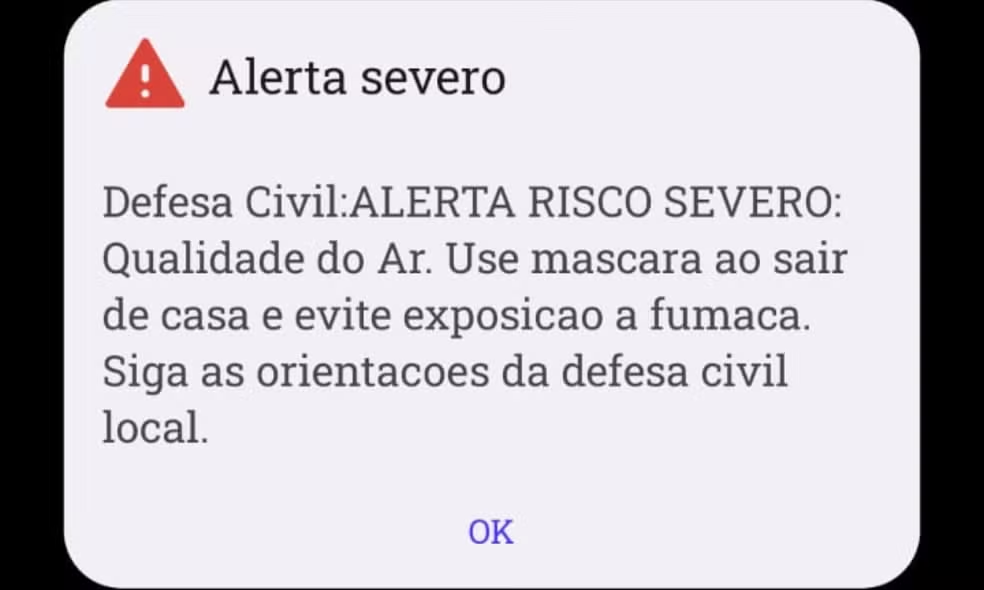
A Defesa Civil do Amazonas disparou alerta aos celulares orientando a população que use máscara | Foto: Reprodução/Defesa Civil
Universidades também suspenderam as atividades devido à fumaça. A Defesa Civil do Amazonas disparou alerta aos celulares orientando a população a evitar exposição à fumaça e usar máscaras ao sair de casa.
Ainda na sexta-feira, o Ministério do Meio Ambiente e Mudança Climática disse em nota que realiza ações permanentes de prevenção, monitoramento e combate aos incêndios florestais na região, com mobilização de equipes, aeronaves e recursos.
“Desde o início da temporada de incêndios florestais, o Ibama extinguiu 229 incêndios no Amazonas e segue atuando no combate a outros 20 incêndios ativos no estado”, afirmou o ministério.
A pasta acrescentou que disponibilizará mais seis aeronaves, sendo quatro aviões para lançamento de água e dois helicópteros, além de 290 profissionais brigadistas.
Governo proibiu queimadas por 120 dias
Manaus também sofreu com fumaça no mês de setembro. No dia 23, o prefeito Renato Júnior (Avante) cobrou políticas contra queimadas no interior do estado.
“Falta política pública no interior do Amazonas. E agora Manaus está pagando a conta de todo dia amanhecer encoberto de fumaça por falta de política pública nacional, dos outros estados e também do estado do Amazonas”, disse ele em publicação nas redes sociais.
O Governo do Amazonas proibiu por decreto no mês passado o uso do fogo em todo o estado por 120 dias. A medida proíbe o emprego de queimadas em atividades de limpeza, manejo e renovação de áreas.
Também em 23 de setembro, o Centro Integrado Multiagência de Coordenação Operacional Federal (Ciman Federal), coordenado pelo Ibama, recebeu solicitação de apoio do Governo do Amazonas para combate a incêndios florestais, segundo o Ministério do Meio Ambiente e Mudança Climática.
“Em resposta ao pedido, foram acionados combatentes do Projeto de Resposta em Ações Integradas para Atuação em Situações de Desastres (Respad) e uma aeronave do Projeto de Gerenciamento de Aeronaves para Situações de Urgência e Socorro (Pegasus)”, declarou o ministério.
De acordo com o órgão, em 30 de setembro, após as chuvas contribuírem para o controle dos focos de incêndio, o Governo do Amazonas comunicou que não seria mais necessário o apoio do Respad, dispensando a atuação da equipe federal antes do deslocamento a campo.
“O MMA informa ainda que orientou o Governo do Amazonas a solicitar recursos por meio do Sistema Nacional de Proteção e Defesa Civil (SINPDEC) para ampliar sua capacidade de resposta aos incêndios florestais. Contudo, até o momento, o estado não formalizou o pedido”, disse o ministério.
Fumaça oferece riscos à saúde
O risco de inalação de material particulado é maior dependendo do tempo de exposição e da quantidade inalada. Os mais suscetíveis a apresentar reações são crianças e idosos, mas todos podem ter comprometimento pulmonar e respiratório.
As queimadas também geram uma série de poluentes que podem permanecer no ar por semanas, como monóxido de carbono e dióxido de nitrogênio.
Governo amplia estrutura de combate a incêndios
Na última sexta-feira, o Governo do Amazonas afirmou em nota que tem feito reuniões sobre o tema das queimadas para conter os impactos ambientais, proteger a população e intensificar a fiscalização no estado. Segundo o governo, foi ampliado de 11 para 25 em um ano o número de bases permanentes de bombeiros em cidades do interior, e que o efetivo passou de 692 para 1.651.
O governo acrescentou que recebeu a aeronave Thrush S2R-510, capaz de transportar quase 2.000 litros de água, e que possui cinco viaturas Auto Bomba Tanque Florestal (ABTF). (Jorge Cosme/FOLHAPRESS)
President Donald Trump has publicly thanked Russian President Vladimir Putin for agreeing to a landmark energy deal that will see millions of tons of diesel fuel shipped to the United States. The deal, brokered behind [...]
Fadiga crónica, febres e dores sem diagnóstico durante anos. Estima-se que 100 mil portugueses têm Covid Longa — 17,6% dos casos identificados são crianças e jovens.
Requalificação e ampliação financiadas sobretudo pelo PRR. Programa gratuito de reabertura decorre até domingo, com festa, visitas guiadas e exposição temporária.
Um incêndio florestal que deflagrou durante a noite em Mateus, no concelho de Vila Real, alastrou a uma zona de barracas, destruindo totalmente três barracas e duas viaturas. O alerta foi dado às 00h50, tendo sido mobilizados para o local 32 operacionais e sete veículos para o combate às chamas.
A informação foi avançada por José Salcedas, comandante dos Bombeiros da Cruz Verde, que explicou que, à chegada dos meios de socorro, o fogo já tinha atingido a zona das barracas.
O combate às chamas centrou-se sobretudo nessa área. Além dos Bombeiros da Cruz Verde, foram mobilizadas as corporações dos Bombeiros da Cruz Branca e de Sabrosa, num total de 32 operacionais e sete veículos.
Segundo o comandante dos Bombeiros da Cruz Branca, Orlando Matos, da Cruz Branca estiveram no local três veículos e nove operacionais.
José Salcedas esclareceu que os bombeiros não transportaram nenhuma pessoa para o hospital pelos seus meios. No entanto, o comandante dos Bombeiros da Cruz Verde revelou à VTM que uma mulher terá sido transportada num veículo particular para o Hospital de Vila Real.
A Polícia Judiciária confirmou à VTM estar a investigar as causas do incêndio.
A multibillion-dollar private initiative to overhaul US submarine manufacturing marks an urgent push to revitalize naval industrial capacity at a pivotal moment in the Indo-Pacific balance of power. This month, multiple media outlets reported that defense technology firm Anduril Industries will invest US$3.7 billion of its own capital to build a 2-million-square-foot “software-defined shipyard” at […]
Se adorou ouvir o podcast plus, não vai querer perder a hipótese de mergulhar n'A Caça ao Estripador de Lisboa: a primeira peça de teatro imersivo que nasce de uma investigação do Observador.
Il 9 ottobre la Chiesa celebra il grande cardinale inglese, proclamato Dottore della Chiesa da Leone XIV nel 2025. Il suo insegnamento, dalla centralità della coscienza al rapporto tra fede ...
US President Donald Trump announced a deal with Russian President Vladimir Putin for Moscow to supply millions of tons of diesel fuel to American and global markets.
The announcement would give Russia a major opportunity to sell fuel abroad at a time when Ukraine is targeting its oil industry to deprive Moscow of revenue and disrupt the resources sustaining its invasion. The US president has increasingly called for Ukraine to halt strikes on Russian oil infrastructure in recent weeks, blaming Ukraine for high fuel prices in the US.
Trump’s push for Kyiv to halt those attacks, alongside his effort to secure Russian fuel supplies, risks undermining Ukraine’s campaign to put economic pressure on the Kremlin while the US seeks to contain the fallout from its war with Iran.
Trump promises millions of tons of diesel from Russia
In a 9 October post on Truth Social, Trump said Russia would immediately supply more than 300,000 tons of diesel, followed by another 500,000 tons in November and 1 million tons shortly afterward. He also announced a possible additional delivery of 3 million tons, conditional on the state of Russian refineries.
“Diesel Prices for Americans and, indeed, the World, will be COMING DOWN, IN RECORD NUMBERS, AND FAST!” Trump wrote, describing lower fuel prices as a top priority for American farmers, ranchers, and truckers.
Trump's announcement did not explain how the promised volumes would be reconciled with the condition of Russian refineries amid ongoing Ukrainian strikes, which he cited as a factor determining the timing of later deliveries.
Trump has pressed Ukraine to stop targeting Russian refineries
The announcement comes after Trump repeatedly blamed Ukrainian strikes on Russian oil infrastructure for worsening global diesel shortages and driving up fuel prices.
Ukraine has continued targeting Russian oil facilities as part of its campaign to undermine Moscow's war economy. Ukrainian strikes have damaged refining capacity, contributed to fuel shortages inside Russia, and forced Moscow to restrict fuel exports.
Kyiv has argued that the attacks put pressure on Russia's ability to finance and sustain its war against Ukraine.
Iran war drives fuel prices higher, not Ukraine
The rise in US fuel prices stems largely from the US-Israeli war with Iran and its disruption of global energy supplies, according to Reuters. The conflict has disrupted shipping through the Strait of Hormuz, a strategic waterway through which roughly one-fifth of the world's oil supplies normally pass, pushing energy prices higher.
Trump has nevertheless blamed Ukraine's refinery strikes for rising fuel costs while pressing Kyiv to halt them.
Ukraine's attacks on Russian oil infrastructure are intended to weaken Moscow's war economy. By contrast, the disruption to global energy shipments stems largely from the conflict with Iran.
Zelenskyy warns Russian diesel deal would fund further attacks on Ukraine
Ukrainian President Volodymyr Zelenskyy warned later on 9 October that allowing Russia to sell petroleum products abroad without securing a lasting de-escalation agreement would help finance Moscow's war against Ukraine.
“Allowing Russia to sell petroleum products is an investment in a war that must be ended, not prolonged,” Zelenskyy said, responding to Trump's announcement of a proposed Russian diesel supply deal.
Zelenskyy said Ukraine's strikes on Russian oil refineries and other oil facilities were a response to Russia's years-long campaign against Ukrainian energy infrastructure. He offered a reciprocal arrangement under which Ukraine would stop striking Russian refineries if Russia stopped destroying Ukrainian energy facilities, saying the United States had sufficient leverage to secure such an agreement.
“Ukraine will not burn Russian oil refining facilities if Russia does not destroy our energy infrastructure,” Zelenskyy said.
He also urged Washington to maintain pressure on Moscow, including sanctions under the proposed Graham legislation, and to continue supporting Ukraine's defense. Zelenskyy argued that easing sanctions without a clear, sustained de-escalation agreement would signal weakness and give Russia more time and resources to continue the war.
“Gifts to Putin will not bring peace,” Zelenskyy said, warning that Russia would respond to diesel supplies with further terror and attacks. He called on the United States to pursue a reciprocal de-escalation agreement and press Russia to stop its attacks on Ukrainian energy infrastructure.
The United Nations has revised it’s climate change forecasts, officially confirming the doom and gloom narrative of climate change was wrong and the so-called climate emergency was a man-made fraud. For years, the phrase “12 [...]
President Putin has gone nuclear. He’s released damning evidence that Bill Gates, the CIA, and Israel engineered the pneumonic plague. Not just to kill. But to specifically target the white race. Putin says the plan [...]
The European Parliament in Strasbourg has been adorned with a grotesque vision of American power in a 2.5-metre-high statue of a naked and obese US president Donald Trump covered in 23-carat gold.
While some MEPs describe it as an expression of freedom and courage in the face of Trump, Slovak prime minister Robert Fico has said the statue is a symbol of a declining European Union and called for its removal.
Fico said the statue reflects a profound misunderstanding of the times we live in, and reminded his X followers that he and Trump are close.
“At a time that calls for dialogue and mutual respect, insulting our partners on official premises demonstrates a profound failure to understand the times we live in,” he said on social media.
“It is sad that the leadership of the European Parliament, in its blindness, can no longer distinguish between the legitimate right to hold a different opinion and the actions of spiritually bankrupt individuals, adventurers and lunatics,” he added.
Jens Galschiøt is the artists behind the Orange Plague sculpture. The Danish artist says his installation served as a warning that Donald Trump is destroying democracy.
Why call it ‘Orange Plague‘?
“I depicted Donald Trump as an ‘orange plague’ because he is destroying everything I believe in. I believe in democracy and the rule of law. All this needs to be cared for, and Trump is destroying it, as well as the debate on the environment,” Galschiøt said.
The artist chose to portray the US president as a grotesque figure hoping that people would laugh at it. “When you laugh at a dictator, you take away his power,” he said.
And Trump is also naked because of Hans Christian Andersen’s fairy tale The Emperor’s New Clothes. In it, the emperor walks through the streets with no clothes, while people tell him how beautifully dressed he is, but no one dares tell him the truth. Only one small child cries out that the ruler is naked.
Galschiøt sees parallels the story and treatment of the US president.
“I think many of us laugh at Donald Trump, but he does not know it. He thinks he is a great leader. He thinks he is an intelligent person. He thinks he gives good speeches. But few people take him seriously. Even if you do take him seriously, it is because he is something like a gang leader, not because of what he says. Most of us actually think he is a ridiculous figure,” Galschiøt said.
Jens Galschiøt beside the Trump statue. Source: J. G. archive
His sculpture consists not only of a naked and obese Trump, but also of a slender figure.
“The little man carries the big man, and the big man tells him: ‘Oh, I really want to help you. I really love you, but I do not want to get off your back.’ It is also a story about hypocrisy and double standards, which I combined,” the artist said.
He covered the sculpture in gold because Trump is known to like the precious metal.
This article continues, but the full version is available only to EUobserver.com subscribers. Visit account.euobserver.com/membership
Two Ukrainian defense-tech firms, The Fourth Law and Odd Systems, have joined forces to mass-produce thermal imaging sensors in Europe and the US, The Fourth Law told Militarnyi. The goal is to wean Western militaries off foreign suppliers, chiefly China, for the core part of every thermal camera.
Amid Russia's daily attacks, Ukrainian drone makers have been shifting production to allied countries. Linza and Zoom drones are now built in Germany, and another top manufacturer has taken its technology to Canada and Finland. Sensor plants would move a core component west, not just finished drones.
A Western answer to Chinese sensors
The project, called Project Foundation, will build long-wave infrared sensors, known as microbolometers. These chips register heat, so a camera can pick out a person or vehicle at night or through smoke. The aim, The Fourth Law said, is to "ensure the sovereignty of Western countries in the field of thermal imaging technology."
Plants in Europe and the US from 2027
The project will run two sites, First Foundation in Europe and Second Foundation in the US, from a headquarters in Eindhoven, a Dutch semiconductor hub. Mass production is due to start in 2027. Within three years, the partners want to quadruple Europe's output of these sensors and double America's.
Why Europe's supply isn't enough
Ukraine's front line burns through sensors faster than Europe can make them. "Europe currently produces less than 500,000 such sensors per year, while Ukraine consumes this amount in about five months," Odd Systems co-founder Yaroslav Azhniuk said in February, when he first announced plans for a plant able to make one million sensors a year. European sensors cost about five times as much as Chinese ones and are hard to buy at all, because Europeans need them too, he added.
Factories working for Ukraine abroad have already become sabotage targets. In March, an arson attack in Pardubice, Czechia, destroyed nearly all the production capacity of a plant making drones and thermal sights for Ukraine's army. Czech investigators are looking into a possible Russian trail behind the attack.
The European Union’s technology chief expects countries that oppose stricter artificial intelligence rules to change course, as AI systems are becoming more capable and harder to evaluate.
“I’m sure that all those countries who are not willing to regulate the use of AI, they will come back to that quite soon,” European Commission Executive Vice-President Henna Virkkunen told the European Newsroom (enr) on Friday. She warned of a “risk of very serious incidents” in the absence of any guardrails and called for the establishment of safeguards at an international level.
Concerns about the risks of AI have been at the centre of public attention for weeks, sparked mainly by hacking attacks carried out by AI software that acted autonomously during test runs. Some industry insiders have sounded the alarm, warning that artificial intelligence could potentially cause large numbers of deaths if the technology were to spiral out of control.
Virkkunen warned that fierce global competition is creating a risk that “companies are coming to the markets with products that they haven’t been testing enough.” She pointed to incidents in which AI agents had escaped from test “sandboxes” and service providers or developers had been unable to control their own systems.
At the same time, she said, some AI models “have become so capable that it’s more and more difficult also to evaluate them.” Adequate testing required highly qualified experts, sufficient expertise and enough time, she added.
The EU began enforcing its AI Act, the world’s first comprehensive legal framework to regulate AI based on the level of risk it poses, in August. Virkkunen said that the Commission had already sent a Request for Information (RFI) to two major US-based AI companies – OpenAI, known for ChatGPT, and Anthropic, known for Claude – as well as to some Chinese companies not further specified.
An RFI is a formal investigative tool used by the Commission to gather facts, data, and internal documentation from businesses, governments, or member states.
Global AI race
China and the United States have emerged as frontrunners in the development of AI systems, showing no signs of hitting the breaks. Governments in both countries have rejected calls to slow down its development, arguing it would create a competitive, strategic and economic disadvantage.
“Currently the risks are mainly focused and related to cyber security,” Virkkunen said, but she warned of more serious risks in future, including the possibility that highly capable models could be used in connection with biological weapons or fall into the hands of terrorists.
The Finnish politician called for the establishment of international rules to mitigate the risks of AI. She said the security of AI models had already been discussed within the Group of Seven (G7) this year as well as among G20 countries, and that the discussions would continue.
Talking about the EU’s role in AI development, Virkkunen said the Union should avoid dependence on a single company or third country for critical technologies and develop AI systems based on European values, languages and culture.
The city of Kramatorsk, in eastern Ukraine, is increasingly coming under Russian attack. For those who have stayed behind, the threat from drones and shelling has become a daily reality. Many have resisted leaving their homes, despite the growing danger – but now, more and more residents are being forced to flee. Our colleagues at France 2 followed an evacuation from the city and witnessed first-hand the dangers that residents face.

 Login