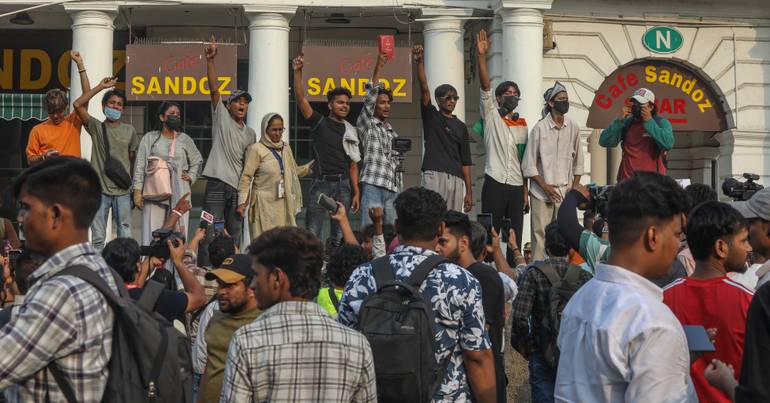
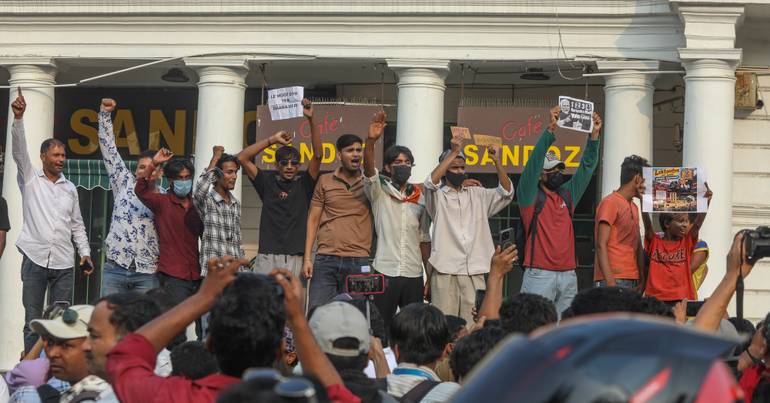
A sudden spurt in crimes in Bihar, especially against women, and the State’s weak responses have exposed the BJP government’s lack of control over law and order.
Movimento "Baratas", criado online para unir a indignação da Geração Z, exige demissão do presidente da comissão eleitoral da Índia, que acreditam estar a beneficiar o primeiro-ministro Narendra Modi.
No sábado e no domingo, as forças de segurança realizaram milhares de detenções – mais de 20 mil, segundo a imprensa local – para impedir os manifestantes de protestar nas ruas da capital indiana
The latest victim of saffron terror is the Satyajit Ray Film and Television Institute in Kolkata, currently in the midst of a graffiti row, where students face threats and harassment.
On the second anniversary of G.N. Saibaba’s death, his life and writings remind us that scholarship and activism belong together. His idea of “subhumanity” links the violence of prison to the wider structures of caste and state power.
Demanding the resignation of a minister is one thing. It is uncomfortable for a government, occasionally embarrassing for a prime minister, but ultimately manageable. Ministers can be sacrificed and their departures can be presented as accountability, and governments can move on. Demanding the resignation of the chief election commissioner is quite another matter and for […]
"Na segunda-feira, 12 de outubro, o Congresso, toda a coligação 'India' e os jovens do país voltarão a sair em massa para as ruas", prometeu o deputado do Partido do Congresso.
One of the main elements in India’s External Affairs Minister Dr. S. Jaishankar’s speech at the U.N General Assembly’s annual session was highlighting the weaponization of elements once considered to be the hallmarks of global cooperation. In today’s broken world, cooperation is considered to be a luxury. States are busy making relative gains at the […]
India’s Ministry of External Affairs (MEA) reacted strongly to the US announcement to suspend the Permanent Labor Certification (PERM) program used by major IT companies for getting green cards for their foreign employees.
Reacting to the announcement made by the US Labor Secretary in the presence of Vice President J D Vance, India’s MEA, on Friday, October 9, called it a move harmful for the “shared ambitions of both countries.”
US Labor Secretary Keith Sonderling said on Thursday that his department will not accept any fresh application for PERM or process the pending applications from eight major IT companies.
The companies named were Microsoft, HCL, Cognizant, Adobe, Capgemini, Tata Consultancy Services (TCS), Infosysis, and Wipro.
Among these firms are some of India’s biggest IT companies with the majority of them employing a large number of IT professionals from outside the US. The move is seen as a part of the Donald Trump administration’s crackdown on immigration.
Almost 70% of H-1B visa holders are Indians which means the halt in PERM will affect the Indian IT professionals the most.
PERM is the first step for an employer in the US to sponsor a green card for its foreign employee. According to the US laws, the employer must prove it tried and failed to get a local for the job before it can sponsor a foreign person.
According to Sonderling, these eight companies have sought almost three million foreign workers and received over 230,000 H-1B visas and over 100,000 PERMs since 2009, claiming all these were “jobs that were taken from American workers.”
Vance said the Donald Trump administration wants the companies to prioritize local recruitment instead of getting “foreign indentured labor.”
He accused companies of abusing the H-1B visa program, claiming there have been multiple cases pending in the federal investigation about fraud in recruitment and the violation of its “best of the best” clause.
Unwarranted and deeply offensive
In a brief statement, India’s MEA on Friday called Vance’s comments about “foreign indentured labor” “unwarranted” and deeply offensive, claiming it “ignores the fact that Indian professionals in the US are highly educated and skilled contributors to its economy and innovative ecosystem.”
“The history of the US itself has been shaped by generations of immigrants whose labor, enterprise and innovation have contributed to its growth and prosperity” it underlined, further noting that “resorting to terminology that carries painful historical and colonial legacy connotations is deeply offensive.”
Millions of Indians were taken out of the country to different parts of the world for indentured labor during the British colonial period in the nineteenth and early twentieth centuries.
The US decision has already led to widespread reactions from the opposition groups asking the Indian government to take measures to protect the interest of the country’s IT professionals.
In a post on X, Jairam Ramesh, leader of the main opposition party, the Indian National Congress (INC), asked the government to retaliate to the US move, claiming failure to do so would be tantamount to surrendering the country’s interests to a bully.
Ramesh accused the Narendra Modi-led ultra-right-wing government in the country of adopting a policy of “appeasement” toward the US, citing its recent decision to impose user charges on payments through mobile phones in the country as one crucial example of how it is going out of the way to do so.
Ramesh claimed Washington’s decision to suspend the visas yet again proves that such a policy never pays off.
The arrest of a Tamil Nadu granite tycoon has exposed a sordid tale of how a serial paedophile exploited political patronage for decades until finally exposed by a persistent POCSO judge.
Today's trade flows resemble a windy waterpark slide more than the traditional waterway superhighway. The three-dimensional chess game being played by ocean carriers and tankers has delivered big bucks in day rates, container rates, and surcharges. But there is a group of winners not currently being highlighted.
Indian refiners have cut back Russian crude purchases for November delivery, as rising competition from China pushes up prices at a time when buyers can tap alternative shipments from the Middle East.
It’s not often that events in Mumbai reverberate through global markets. But the Reserve Bank of India’s first interest rate hike in almost four years speaks volumes about the chaotic state of play. The inflation slamming Asia’s third-biggest economy and the rupee’s drop to record lows left RBI Governor Sanjay Malhotra with no choice but […]
Scores of the elected opposition members of India’s Parliament were detained by security forces in the capital, New Delhi, on Tuesday, October 6, after they protested against the alleged rigging in the elections and demanded removal of the country’s Chief Election Commissioner (CEC) Gyanesh Kumar.
The Leader of the Opposition Rahul Gandhi and several other MPs also claimed they were manhandled by the police during the detention and forcefully removed from the protests site. All of the detainees were released later.
The protests by the MPs was a part of the ongoing nationwide mobilizations which broke out on Saturday over alleged rigging and irregularities in various elections under the incumbent CEC. The protesters are demanding his immediate removal claiming he manipulated the elections in various states to benefit the ruling party.
Despite the heavyhandedness of the security forces who have refused to allow any protest gathering in the capital and repeatedly detained opposition leaders, students, and youth group protesters, people turned up on the streets of Delhi and other parts of the country for the consecutive fifth day on Wednesday.
Several protesters have claimed they were beaten up during detention while some women reporters have claimed they were molested by police personnel on duty during those protests.
Also on Tuesday, security forces allegedly attacked a cultural gathering organized around the issue by the left-wing Student Federation of India (SFI) in central Delhi.
On Wednesday, major left and progressive student organizations such as SFI, the All India Students Association (AISA), and the Cockroach Janta Party (CJP), a movement which emerged in protests demanding reforms in the country’s education system earlier this year, announced a new joint protest beginning from October 10.
Rigging in elections is murdering democracy
Rahul Gandhi, who is also the leader of India’s main opposition party, the Indian National Congress (INC), claimed around 300 opposition MPs were marching from the country’s Parliament building to the office of the Election Commission of India (ECI), seeking a meeting with the CEC when the security forces stopped them and detained them.
He reiterated that the ruling Bharatiya Janata Party (BJP), in collaboration with the CEC, has been responsible for destroying democracy in the country by rigging elections. He called the act “treason” and warned that none of the people responsible for “murdering democracy” in the country will be spared whether it is the Prime Minister Narendra Modi, Home Minister Amit Shah, or Gyanesh Kumar.
The ultra-right-wing and Hindu-supremacist BJP has been in power since 2014, winning three national elections, including the last one in 2024. It is also ruling a majority of states in India.
Speaking in a press conference in Delhi on Wednesday, Neha Bora, president of AISA and one of the leaders of the movement, claimed that the movement against the manipulations in the national elections by the CEC and the BJP will continue until the removal of Gyanesh Kumar.
Over 130 million Indians have been removed from electoral rolls in the country since the ECI, the highest body responsible for conducting elections in the country, started the so-called Special Intensive Revision (SIR) last year under Gyanesh Kumar’s leadership.
Opposition parties and legal experts have claimed that the SIR is illegal, as it is not mentioned in the ECI rule books and the process was started to manipulate election results to favor the ruling BJP.
A recent report in one of the main English daily paper’s in the country also claimed that most of the decisions taken by Gyanesh Kumar as CEC were illegal.
In the last few weeks, opposition has also alleged that the ECI and BJP collaborated to remove thousands of names, mostly Muslim voters, from the electoral rolls in various constituencies across the country.
Talking to the media on Tuesday, John Britas MP from the Communist Party of India (Marxist) claimed that protests against Gyanesh Kumar are a “historical movement to save democracy” in the country. He accused Kumar, in collaboration with the BJP, of destroying the reputation of India’s electoral process and of being the “real enemy of the nation.”
Britas called for his immediate removal as CEC and demanded he must be tried for his criminal activities.
The movement’s leaders connect education, jobs and institutional accountability, and point to early successes. But critics question whether the CJP can take on so many causes, or whether its expanding agenda signals political ambitions.
Ukrainian drugmakers could lose the certificates that let them sell in Uzbekistan, their most important export market, Ukrainian business outlet Ekonomichna Pravda reported on 7 October. Uzbekistan is ending remote factory inspections next year, and industry sources say its inspectors are wary of traveling to a country at war.
Russia's war keeps reshaping Central Asia's trade with both warring countries: Ukrainian refinery strikes pushed Russian fuel shortages into the region, and Kazakhstan gained leverage over a Russian retail giant.
A market worth a third of export earnings
Uzbekistan brings in about 30% of the Ukrainian drug industry's foreign-currency earnings, and one in 10 medicine packs sold there is Ukrainian, Ekonomichna Pravda wrote. By the outlet's count, at least three of Ukraine's five biggest drugmakers by revenue rank it as their top foreign market.
The currency from Uzbekistan lets manufacturers keep prices low in Ukraine and absorb losses from Russian strikes, three industry sources told Ekonomichna Pravda. Losing the market would force producers to raise domestic prices or pull low-margin medicines, which "will hit the Ukrainian patient," said Hennadii Vovk, former deputy head of Ukraine's State Service on Medicines and Drug Control.
Exports reached $114 million in January–June 2026, more than in all of 2021, said Yevheniia Piddubna, government relations head at Farmak, Ukraine's largest drugmaker. She said Uzbekistan takes 35% of Farmak's exports.
Data from the YouControl business registry, cited by the outlet, complicates that picture. In 2022, 30–35% of Farmak's products went to Uzbekistan. In 2025, Uzbekistan was not among its direct buyers. Farmak explained that wartime currency rules cap payment terms at 180 days, while foreign buyers often demand longer. So part of its trade runs through the group's Polish company.
Remote checks end, and inspectors hesitate to travel
Uzbekistan grants three-year certificates of good manufacturing practice (GMP) after inspecting the factory. Since the pandemic, it has allowed remote checks. That suited Ukraine, where Uzbek experts avoided traveling because of Russia's invasion, industry sources told the outlet. Remote inspections end on 1 January 2027.
Explore further
Ukraine funds its war from wages, and a 1971 law keeps millions of women from earning them
Most Ukrainian certificates expire within a year. Farmak's runs out in November 2026, and the company may not manage to renew it in time. Three producers renewed under the old rules until 2029: Darnytsia, the Borshchahivskyi Chemical and Pharmaceutical Plant, and Farmex Group. According to Piddubna, Uzbekistan's regulator has drafted rules for remote inspections in force-majeure cases, but nothing has been put into practice. Industry sources said the Uzbek Presidential Administration must sign off.
Producers have asked the Office of the President, the Foreign Ministry, and the Health Ministry to raise the issue with Uzbekistan's government, but no Ukrainian experts have been sent there yet, the outlet reported. Russia, whose share of the Uzbek drug market is almost the same as Ukraine's, is ready to take Ukraine's place, its sources said.
Twelve seafarers were injured after a Panama-flagged oil tanker was struck by a projectile while transiting the Strait of Hormuz, according to India’s Ministry of External Affairs, marking one of...
The ECI is using Form 6, meant for first-time voters, to reinstate people removed during the SIR. Its changing declarations and demands for past voter or family records have drawn criticism as an ill-conceived burden for eligible voters.
The bulk submission of pre-printed Form 7s targeting Muslim electors by BJP booth-level agents signals a conspiracy. Election officials’ failure to publicly disclose the “claims and objections” process makes the exercise even murkier.
Two Supreme Court petitions ask whether the three-member commission, or only its chief, took decisions on Form 6 and the rolls. Independence requires a traceable record.
Petrolio e sanzioni: costo Ue della guerra in Ucraina. Costo anche politico, di consensi. Il prezzo è alto e non tutti sono d’accordo a sostenerlo a quel livello. Scelta politica del vertice ‘Volonterosi-baltici’ di Bruxelles, sostenuto da una maggioranza sofferente di governi alla prese con opinioni pubbliche ed elettori. L’Ucraina fronte difensivo europeo contro le minacce russe? Troppi elettori non sembrano d’accordo.
Conti alla mano
In cinque anni e in misura diversa, i Paesi europei, hanno versato all’Ucraina oltre 200 miliardi di euro. Cifre ufficiali del Parlamento europeo aggiornate alla primavera scorsa, cui si aggiungono i 90 miliardi di prestiti su cui è stato raggiunto un accordo all’inizio dell’estate. Si tratta, solo per le voci più importanti, di 75 miliardi in aiuti militari e di oltre 43 in assistenza finanziaria. Tra i 27, Germania, Francia e Regno Unito sono stati i principali contributori e sostenitori per sforzo economico a favore di Kiev. Tre Paesi alle prese con gravi crisi politico economiche interne. L’Italia quarta in questa graduatoria, anche se cerca di non pubblicizzare molto un impegno così poco elettorale.
Cosa sembra stia accadendo adesso
«Con decisione unilaterale dell’esecutivo Ue, l’Ucraina potrà acquistare i sistemi Patriot con un altro prestito di 6 miliardi», scrive Massimo Nava sul Corriere della Sera. In tutto, conti alla mano, sono oltre 28 miliardi i contributi 2026 soltanto per la difesa, a cui aggiungere 16,7 miliardi al bilancio dello Stato a rischio crack. Questo, nonostante le notizie di scandali in serie per corruzione e mancate garanzie future. A queste cifre, andrebbero sommati i costi sociali del sostegno agli oltre quattro milioni e mezzo di cittadini ucraini fuggiti dalla guerra e attualmente ospitati in diversi Paesi europei. In testa, ancora la Germania, seguita da Polonia e Repubblica Ceca.
Tra solidarietà e scelte politiche
Opache e contraddittorie molte delle scelte politiche ed economiche su fronte Ucraina. Scelte ideologiche a danno spesso rovesciato. La serie di pacchetti di sanzioni contro la Russia che, da un lato, hanno fatto lievitare le bollette europee e rafforzato la dipendenza energetica da Stati Uniti e Paesi arabi, e dall’altro lato, vengono sistematicamente aggirate con la complicità degli Stati che le impongono, ed incidono solo parzialmente sull’economia russa. «Il che fa temere che il conflitto possa avere ancora una lunga fase di stallo», il pessimismo di Nava. In attesa che si capisca che la pace si fa fra nemici e può essere soltanto la conseguenza di un compromesso.
Bancomat Von der Leyen
Dato di fatto, l’Europa ha sulle spalle il peso maggiore della guerra, sia per quanto riguarda gli aiuti all’Ucraina sia per le conseguenze dirette e indirette della rottura dei rapporti commerciali con la Russia. Rottura unilaterale da parte degli europei e non condivisa da molte altre potenze economiche mondiali. Nei primi nove mesi dell’anno, risulta ad esempio che la Ue ha pagato oltre sette miliardi di euro per gas naturale liquefatto russo, con un aumento del 10 per cento delle forniture rispetto allo scorso anno. Fra gennaio e settembre 2026, i porti europei hanno ricevuto 7,28 miliardi di euro di gas naturale dall’Artico russo. E mancano tre mesi alla fine dell’anno.
Ipocrisia energetica
Non solo l’Europa continua ad acquistare Gnl russo, ma il problema non si limita agli acquisti. È dall’Europa che arrivano i mezzi di trasporto che consentono al gasdotto artico russo di funzionare. «Due armatori dominano il trasporto: Seapeak, di Glasgow, e la greca Dynagas. Senza questi servizi, la catena logistica russa risulterebbe compromessa. Dunque è il denaro europeo che finanzia uno dei progetti energetici più strategici del Cremlino proprio in quella stessa regione», scrive Armèes. E il Financial Times aggiunge: «Nella prima metà del 2026 l’Europa ha importato dalla principale struttura russa di Gnl una quantità di gas mai registrata prima, assorbendo quasi tutta la produzione dell’impianto siberiano».
Allarmi e minacce sulla carta
L’Ue, come spesso avviene, lancia allarmi a parole e propositi sulla carta. Al vertice europeo sull’Artico, in Finlandia, i leader europei hanno discusso di sicurezza, geopolitica e strategia comune nel Grande Nord. È stata firmata una dichiarazione congiunta di 12 Stati dell’Unione affinché la Ue assuma un ruolo più strategico nell’Artico europeo. «Si evidenziano le ambizioni della Russia (la più grande nazione artica) di accrescere la propria influenza nell’Artico, unite alla sua ostilità verso l’Europa – compreso l’aumento delle attività ibride –, e la necessità di rafforzare la politica dell’UE per l’Artico». In gennaio, dovrebbe entrare in vigore, nel nuovo pacchetto di sanzioni, il divieto di importazione.
Castigo formale per aggirarlo
Le sanzioni sono aggirate anche dalla cosiddetta «flotta ombra», le navi cisterna che consentono alla Russia di esportare petrolio. Esiste una lista di oltre 600 imbarcazioni che non avrebbero accesso ai porti europei, ma possono accedere ad altri porti nel mondo, in particolare Cina e India, che sostengono Mosca. Anche il 21° pacchetto di sanzioni Ue, prevede deroghe a favore degli interessi dei singoli Stati. La Grecia, ha ottenuto una deroga per i servizi di trasporto del Gnl russo per non favorire la concorrenza cinese e danneggiare più l’Europa della Russia. Francia, Italia e Grecia hanno frenato sui visti turistici. La Germania vuole il merluzzo russo che alimentano l’industria di bastoncini surgelati.
Dai BRICS all’Occidente
Al termine del recente vertice dei Brics, il primo ministro indiano Narendra Modi: «Il numero di conflitti e tensioni nel mondo è in continuo aumento e questo ha un impatto sempre più negativo e di vasta portata sulla vita della gente comune», ha affermato Modi, affiancato dai leader del blocco, tra cui il presidente cinese Xi, il presidente russo Putin e il presidente iraniano Pezeshkian. I leader si sono opposti alle sanzioni unilaterali e alle misure economiche coercitive e hanno criticato le sanzioni non autorizzate dall’Onu. Hanno inoltre criticato l’aumento dei dazi doganali e delle barriere tariffarie che minano il commercio globale e le catene di approvvigionamento. A dire in un colpo solo di Stati Uniti ed Europa.
 Login