The U.S. Supreme Court is scheduled to hear oral arguments today in an important case that asks how much judicial deference is owed to the U.S. Sentencing Commission's commentary on the federal sentencing guidelines when a judge is applying those guidelines during the sentencing of a federal criminal defendant. That may sound like a somewhat dry legal dispute, but the ramifications are big not only in the realm of criminal law, but also for the broader legal battle over statutory interpretation, the role of the courts, and the authority of those federal agencies that some critics have called "the administrative state."
The case is Beaird v. United States. Kendrick Jarrell Beaird was arrested for pointing a gun at someone and, because he had a prior felony record, was convicted as a felon in possession of a firearm. Under the federal sentencing guidelines, Beaird faced an even higher sentence if the firearm "involved…is capable of accepting a large capacity magazine." His gun's magazine was capable of holding 17 rounds. Did that count as large capacity and thus trigger a higher sentence? The federal sentencing guidelines did not directly say, but the U.S. Sentencing Commission's commentary on the guidelines did: According to the commentary, a magazine capable of accepting "more than 15 rounds of ammunition" counts as large capacity.
Are the federal courts bound to follow the Sentencing Commission's commentary in a case like this and dutifully impose a steeper sentence? Or may the courts impose a lower sentence based on their own alternate view of the best reading of the text of the sentencing guidelines?
In Stinson v. United States (1993), the Supreme Court held that the commentary to the federal sentencing guidelines is entitled to major deference from the courts. "We decide that commentary in the Guidelines Manual that interprets or explains a guideline is authoritative," the Court said, "unless it violates the Constitution or a federal statute, or is inconsistent with, or a plainly erroneous reading of, that guideline."
Among the questions at issue in today's oral arguments in Beaird is "whether Stinson v. United States still accurately state[s] the level of deference due to the Commentary of the Federal Sentencing Guidelines." In other words, should there be cases in which a judge's alternate reading may trump the interpretation favored by the commission's commentary?
Those questions alone make this a notable case. But this particular dispute also arrives in the midst of a broader, ongoing battle over judicial deference to the authority of federal regulatory agencies. For instance, in Kisor v. Wilkie(2019), the Supreme Court narrowly upheld a precedent which said that a federal agency's interpretation of its own "ambiguous" rule is entitled to broad judicial deference unless the agency's interpretation is "plainly erroneous or inconsistent with the regulations being interpreted."
Justice Elena Kagan's 5–4 majority opinion in Kisor v. Wilkie justified this holding on the grounds that the Court's deferential doctrine "enables the agency to fill out the regulatory scheme Congress has placed under its supervision."
Writing in dissent, Justice Neil Gorsuch faulted this approach for requiring judges "to accept an executive agency's interpretation of its own regulations even when that interpretation doesn't represent the best and fairest reading." That sort of deference, Gorsuch argued, "creates a 'systematic judicial bias in favor of the federal government, the most powerful of parties, and against everyone else.'"
This Kagan-Gorsuch clash of legal visions is likely to arise again in the Beaird case. Whether or not Kagan's pro-deference view will still command the majority, however, remains to be seen.
George Anibowei, a U.S. citizen, is a Texas-based immigration attorney with many clients battling the Department of Homeland Security. Border agents have searched his phone at least five times without a warrant as he returned to the United States.
In the first search, agents copied the phone's entire contents, including his confidential communications with clients. The government still has that data, and Anibowei still doesn't know why it was kept or who has seen it. He now leaves his work phone at home when he travels.
On September 29, the Supreme Court asked the federal government to respond toAnibowei's petition, which asks whether the Fourth Amendment lets border agents search the contents of a phone without a warrant. (I'm one of his lawyers.) The government waived its response, expecting the Court would deny the petition without a second look.
But in 2021, the solicitor general told the Court that this very question had produced an "entrenched circuit conflict" of "considerable practical importance." The conflict has only deepened since. Seven federal appeals courts now hold that a warrant is never required to search a phone at the border, while the 4th and 9th Circuits require one in at least some cases. That means one of your constitutional rights currently depends on which airport you fly into.
While circuit courts may disagree, the Supreme Court has already shown the best answer for this question. In Riley v. California(2014), the Court unanimously held that police generally need a warrant to search the phone of someone they arrest. There is an exception for searches incident to arrest, which allows the police to arrest someone without a warrant; that exists to protect officers and preserve evidence. Data can't hurt an officer, and a phone can be secured while police get a warrant. An extension of an old exception to digital data, the court said, "has to rest on its own bottom." Treating a phone like any other container in an arrestee's pockets was like saying "a ride on horseback is materially indistinguishable from a flight to the moon."
The border-search exception fails the same test. Those searches exist to collect duties, keep out people who may not enter, and stop contraband. But duties attach to physical goods, not data. And as the legal scholar Orin Kerr has put it, agents "will not find a person smuggled inside a computer hard drive." As for digital contraband, anyone who wants illicit files can carry a clean phone and download them after clearing customs. Suspicionless phone searches burden millions of innocent travelers while barely inconveniencing smugglers.
The appeals courts that disagree mostly cite one another. But the Supreme Court rejected a lopsided lower-court consensus in Riley, and again in Carpenter v. United States (2018). Counting courts is not a constitutional argument.
Defenders of these searches lean on history. In United States v. Ramsey (1977), the Court noted that the first Congress authorized warrantless customs searches in 1789, less than two months before it proposed the Fourth Amendment. True enough. But that statute let officers search ships for hidden dutiable goods. To search a house, store, or other building for the same goods, officers needed a warrant. And nothing in the statute let officers read a traveler's papers.
That distinction was no accident. Customs abuses had helped spark the Revolution. Writs of assistance gave British customs officers blanket authority to search wherever they pleased, which James Otis said placed "the liberty of every man in the hands of every petty officer." And the founding generation guarded letters especially closely. Benjamin Franklin, as the first postmaster general, made postal workers swear they would not open mail without an express written warrant.
Even Ramsey, the government's favorite border search precedent, respected that distinction. It upheld opening international mail to look for contraband, but the regulations before the court flatly prohibited reading correspondence without a warrant, a point the justices stressed repeatedly. The Court has never held that border agents may read a traveler's papers without a warrant. A phone holds years of correspondence. It deserves at least the same protection the Founders gave a sealed envelope.
Last month, however, the 2nd Circuit joined those courts that have disregarded this tradition. InUnited States v. Alisigwe, Judge Steven Menashi wrote that agents need no suspicion whatsoever to search a traveler's property at the border, phones included. A border search becomes non-routine, he reasoned, only when it intrudes on the person, as a strip search does. A phone is property, so searching it is routine.
Judge Eunice Lee concurred, agreeing that no warrant was required. But she warned that the majority's rule permits suspicionless searches for any reason, "including political or discriminatory ones."
The Alisigwe majority's premise miscasts the Fourth Amendment. The amendment's text secures "persons, houses, papers, and effects" in a single, unranked list. The abuses that produced the amendment were searches of property, including private papers. Agents may properly physically examine a phone to ensure it's not really a container for smuggling contraband. But reading or viewing its digital contents without a warrant trespasses on a person's papers and effects. The framers protected property because they recognized that human beings are not ghosts: We live in the physical world by exercising our property rights, and so searching our property can reveal much about our lives.
Alisigwe is the latest word from a Court of Appeals, but it contains complications for the constitutional issue. The trial court found that agents had reasonable suspicion, so the no-suspicion holding arguably wasn't needed to decide the case. That suspicion involved a forged passport, which goes to identity and admissibility, the core of border authority. Finally, Alisigwe was a permanent resident, not a citizen, so the government's interest in deciding who may enter was heightened.
Anibowei is simple on each of these counts, which is why one can be hopeful the Supreme Court will take it and address the Fourth Amendment question now. Anibowei is a naturalized citizen, no one suspects him of anything, and he challenges the government's search policies directly rather than seeking suppression of evidence in a criminal case. As the 5th Circuit itself acknowledged, his case "turns squarely and solely" on the warrant question.
The stakes keep growing. In FY 2025, Customs and Border Protection (CBP) searched 55,318 electronic devices, nearly 11 times as many as in 2012—and nearly a quarter of those searches targeted U.S. citizens. According to the directives Anibowei challenges, agents may keep what they find and share it with federal, state, local, and foreign agencies. Investigators have learned to wait for a target to travel and ask CBP to search his phone on the way back in, rather than go to the trouble of demonstrating probable cause to a judge. No wonder universities, bar associations, and press freedom groups now advise travelers to leave their devices at home.
The Founders rebelled against customs officers who could search wherever they pleased and read whatever they found. A rule letting border agents scroll through a citizen's correspondence, photos, and client files without a warrant, or any suspicion at all, revives that power. The Supreme Court should take Anibowei's case. Our papers don't lose Fourth Amendment protections at the border just because they're digital.
Brussels is steering Europe toward totalitarianism and a “Euro-Gestapo” while lecturing Russia on democracy, Slovak MEP Lubos Blaha has warned.
Blaha made the remarks during a European Parliament debate on Tuesday, responding to EU foreign policy chief Kaja Kallas, who denounced Russia’s recent parliamentary elections as undemocratic.
The politician questioned why Brussels was focusing on Russia while cracking down on dissent within the bloc.
He cited arrests of pro-Palestinian protesters in Germany and the imprisonment of Estonian opposition figures, who he claimed were jailed for opposing war with Russia.
“Are you going to set up the Euro-Gestapo here, Mrs. Kallas, and lock up everyone who wants peace?” he asked.
The Slovak lawmaker also questioned why Brussels was debating Russia’s elections while Europe faced mounting unrest.
“You may not have noticed, but Spain is in the streets, France is in the streets, and you are here dealing with Russian elections. You must be joking,” he said.
Blaha went on to accuse Brussels of double standards over Ukraine’s suspended presidential elections.
“You blame the Russians for having elections, but you don’t mind that [Ukraine’s Vladimir] Zelensky has been governing for three years without any elections, without a mandate,” he said. “You are hypocrites!”
Zelensky’s presidential term expired in May 2024, but elections have remained suspended under martial law.
Blaha also cited the annulment of Romania’s 2024 presidential election, claiming the vote was canceled because “the wrong candidate won.” Romania’s Constitutional Court scrapped the result over alleged irregularities and accusations of Russian interference after EU- and NATO-skeptic Calin Georgescu won the first round. Pro-EU candidate Nicusor Dan won the rerun in May 2025.
The MEP argued that Russia had held elections despite the ongoing conflict and daily Ukrainian missile and drone attacks on its territory.
The September poll saw the ruling United Russia party win nearly 58% of the party-list vote.
Blaha also defended Russian President Vladimir Putin, contrasting his popularity with that of Western European leaders.
“You have nothing to criticize Putin for, Mrs. Kallas,” he declared. “Unlike you and your Merzes and Macrons, he has the support of his own population.”
Recent polls have put German Chancellor Friedrich Merz’s approval rating at a record low of 10% in October, while French President Emmanuel Macron’s support fell to 17% in September. Neither Kallas nor European Commission President Ursula von der Leyen was directly elected to her current position by voters, having assumed office through the EU’s institutional appointment process.
Blaha belongs to Slovak Prime Minister Robert Fico’s Smer-SD party, which opposes EU sanctions on Russia and has criticized Western military assistance to Ukraine.
Paris police chief Patrice Faure on Tuesday banned a pro-Palestinian demonstration planned for Wednesday, the third anniversary of Oct. 7, 2023 attacks in Israel, over “risks of public disorder,” Anadolu reports.
“At the request of Interior Minister Laurent Nunez, I issued an order banning a demonstration ‘against the genocide in Gaza and for respect for the ceasefire’ in Paris on Wednesday,” Faure said on US social media platform X.
He noted that such a demonstration could pose “significant risks of public disorder,” citing a “high terrorist threat” and antisemitic acts that “remain at historically high levels” across France.
“In light of this, and in view of all the risks identified, it is my responsibility to ensure everyone’s safety. I have therefore decided to ban this demonstration,” Faure added.
Israel’s genocidal war launched three years ago in Gaza has killed more than 74,000 people, injured many more and destroyed most of the enclave’s infrastructure.
Ian Proud’s arrest by secret police at a London airport marks a new low in how far the deep state can go to control a false narrative. But it also shows a new level of fear.
As mad as it sounds, it does appear that Western European nations at least are preparing themselves to go to war with Russia at some point in the not-too-distant future. What is particularly worrying is there seems to be a distinct vacuum in all areas of what we could broadly call ‘media’ in questioning this narrative. Thirty years ago it was considered normal for journalists to be the source of vexing questions towards state actors and to generally be a pain in the arse as they questioned every decision made and every idea presented. It was our job to be anti-establishment and to take a very cynical view of “policy”. There was nothing remarkable about this. It was what we did. Being despised by the greater powers was part of the job; working anti-social hours and having few friends also came with it.
Today there are no journalists in what we call ‘mainstream’ media doing this. They have been replaced by younger, more social-media-savvy ‘content creators’ who believe that journalism is more or less a grammatical role, where the raw material is handed to you with all the information therein, and the role of the journalist is simply to refine it to the style of the day for mass consumption.
The danger of this transition is that nearly all of what we are being presented with as news is actually fake, or at best heavily redacted to keep the masses where the elite want them to be: restrained, prepped and misinformed.
The Ukraine war is an excellent example. The main reason why people in the U.S. and UK are so fabulously biased against Russia and are so sympathetic towards the corrupt elite in Kiev is that for years they have been brainwashed with ‘news’ about Russia which has been negative and which cunningly feeds a racist bias – a prejudice which has been cultivated over at least a decade, if not more. The result is that now a number of lies have become established in newsrooms where journalists, even those who know, simply navigate around nuance and present a fairy-tale story, designed to be understood by the masses who have no other sources of information to even question it.
Just recently, Western news outlets reported a “plague” in Russia, with stories about a “lockdown”, following a case of a worker in a laboratory dying of pneumonia in circumstances which are still not certain. Western media, as part of their role to keep Russia-phobia at its peak, are so locked and loaded that their ‘hair-trigger’ reactions to bad news stories from Russia are understandable. They are also hungry for clickbait, and such stories feed a starved audience which has already had its first fix of such COVID hysteria stories and wants more. The truth is entirely immaterial. Hysteria and lies are what’s being fed at a feverish rate by ‘content creators’ red in tooth and claw, foaming at the mouth with their desire to serve the deep state and the elites who have invested so much in an agenda.
The contrast between Russia and the West is interesting, though, when we look at media. In Russia just recently, the BBC correspondent based in Moscow made the internet buzz on social media with his short interview with Russia’s foreign minister, who was kind enough to answer his loaded question about Russia’s war ideology with Ukraine. What absolutely no one noted was how Russia is happy to accommodate foreign journalists who have such a distinct agenda to feed the Russia-phobia back home, while Russian journalists have been banned in those EU capitals for years. Old Europe, which once held such values as a free press so dearly, has adopted the Soviet model, while Russia is actually more advanced when it comes to such tenets of what we expect in a democracy. Russia has no fear of the awkward questions, unlike the West.
We should be asking ourselves who really benefits from a war with Russia.
Is it too sceptical and ‘conspiracy theorising’ to assume that the industrial military complex has been successfully lobbying for such a war for AT LEAST a decade, and critically, it succeeded in convincing the intelligence and military establishment in the UK to use its leverage with media to provide journalists with the raw material which enhances a prejudice against Russia?
Normally such an idea could be dismissed as pure nonsense. But just consider how far the UK, for example, has gone to eradicate all media coverage which could be deemed as at least leaning towards Russia – or even simply just holding the UK government to account by asking the questions that British journalists have stopped asking. If the elite in the UK who control the loss-making newspapers (think about that) are so sure of their rationale that Russia is the enemy whom we must go to war with, why are they so terrified of journalists – or anyone, for that matter – simply holding a view which questions the narrative?
I can’t be the only Western pundit who believes that double agents Sergei Skripal and his daughter Yulia were not poisoned with nerve agent Novichok in Salisbury in 2018, which was reported at the time as “sparking a huge diplomatic crisis between Britain and Russia”. Isn’t the real story that British security chiefs decided, upon discovering that Sergei Skripal was actually a triple agent who was feeding information back to Moscow, that he was dispensable? And what better way to supposedly teach the Russians a lesson, while blaming Moscow for his death, than to murder him and his daughter using a nerve agent which either was Novichok – which a British lab just down the road from where the Skripals lived had conveniently sitting in a fridge – or a similar poison? What’s important to note about Novichok is that the victims usually die instantly upon contact with it. What is likely is that the Skripals were not poisoned by the Russian drug but a British version of another nerve agent. It is a shocking example of how poor British journalism is that hacks in the UK simply report the Skripal incident of Novichok poisoning without a single shred of evidence to back it up. They don’t even add a note of scepticism in their reporting about the drug and who is “claiming” that it is Novichok.
We see the same shocking level of atrocious, biased reporting about the Ukraine war, which the British public were simply told through the media narrative was an “invasion” by Putin’s army. No background, no nuance, no glimpse of Russia’s perspective, as no one can cope, it would seem, with the story being clouded by facts.
And it’s the same with the Russia “plague” story, as it was with the RAF base “attack” story recently, which was probably just local thieves buying contraband gasoline from corrupt U.S./UK soldiers looking to make a quick buck at the UK base. Notice how quickly Trump used the story as a basis to move all U.S. bombers off the base and back to U.S. soil, where they are completely useless in his so-called Middle East war. For Trump it was an opportunity for another media stunt which keeps him on the front pages and everyone guessing. He was probably grateful to the British for being offered the raw material. Another problem of this new generation of journalists is how compliant they are to report “news” which isn’t news at all, but just material used as a distraction, one day at a time. Trump is a master at manipulating media with this game, usually saying something so stupid and so controversial, which draws journalists away from doing real journalism. If you can occupy journalists with writing up stories about the latest idiotic comment or statement by Trump, then you control them as you control their time.
Just look at how the Epstein story is not being reported and investigated. How Trump got off scot-free, as since February 28th journalists’ attention was diverted to the war with Iran – which is one of the reasons why Trump keeps this story alive with constant troop movements and talk of a massive attack after midterms. People have not made the link with the Epstein material being leaked and the war with Iran kicking off practically on the same day.
For the British, the “Russians are coming” story has no cynical write-up by journalists who are 100 percent compliant with its erroneous narrative. The fear of elites in London is palpable, though, that it will always be questioned by fringe actors taking up bandwidth on social media. In the past this was the RT correspondent in London, who was able to ask difficult questions and generally be a thorn in the side of the Westminster village which controlled journalists like rats held in a basket. The main reason why RT was kicked out of the UK was that it offered a style of reporting on UK politics which had since left us thirty years ago – such is the murky world of the deep state and how it saw how in Brussels journalists could be manipulated until they become stenographers for it.
Yet even with this new Stalinist style of media control in the UK, the state is wobbly. Even with the impressive set-up it has now of total media dominance, where journalists pump out total garbage about the Ukraine war or what they are told to write about the Middle East, still the fear is there.
The example of video blogger Ian Proud, a former UK diplomat once based in Moscow, is worrying but poignant. Simply going to Moscow to attend a conference where Putin was speaking was enough to have him get the full Stasi treatment at Heathrow airport – detained and all digital content seized.
Proud’s YouTube interviews, with his dowdy style of presenting, are proving to be popular as he simply offers a more sober view of both Russia and the UK Foreign Office, his former employer. These interviews are getting the attention of UK spooks, who are so nervous about the truth getting out about Russia and the shameful lies which are being packaged now for the British public, that they had to give Proud the American prison ‘shake down’ routine. Britain, a country which once was a beacon for the world with its view of liberty and in particular its passion for free speech, has fallen to a level which we can only compare to a West African country which has just had a new dictator installed, complete with black aviators and epaulettes. What the Proud Heathrow airport case shows is that this new regime in power will stop at nothing to control a narrative, and that the last bastion of free speech – YouTube podcasts – is the next target. The more successful Proud’s channel becomes, the more inevitable it is that he will be forced to leave the UK and settle in Russia to continue practising free speech. The shoulder tassels of Britain’s deep state will not sleep well until the country has a media narrative which would make Joe Stalin blush – and British journalists are helping them with this goal.
Employees of Georgia’s largest healthcare system have until Nov. 1 to get the flu vaccine or an approved exemption, or they will be suspended without pay. If suspended employees don’t submit proof of vaccination by 4 p.m. Nov. 15, they will be fired.
According to the Emory Healthcare website, the vaccine mandate applies to all employees, including contractors and remote workers.
Employees suspended for missing the first deadline, Nov. 1, 11:59 p.m., will not be allowed to use their paid time off.
COVID-19shots are not mandated, but employees are “encouraged to engage in shared decision-making with their provider” on whether or not to get the vaccine.
A spokesperson for the healthcare system said the requirement is intended to protect patients and staff and to encourage everyone to get vaccinated.
Dr. Sherika Newman of Doctor in the Family, a physician-led patient advocacy and health consulting service in Atlanta, told CBS News that flu vaccine requirements are common in healthcare.
“Asking health care providers or people who interact with patients to take the flu vaccine early every year is what we always mandate so that we are protecting ourselves from spreading viruses to vulnerable populations,” Newman said.
She said everyone should get vaccinated, not just healthcare workers, although only healthcare workers will lose their jobs if they don’t get the vaccine.
Cleveland Clinic: 2024-2025 flu shot increased risk of getting the flu
Flu vaccine effectiveness can vary, according to the Centers for Disease Control and Prevention (CDC), which cites studies since 2009-10 showing effectiveness between 19% and 60%. The major factors influencing vaccine effectiveness are a person’s age and health and how well the vaccines match the circulating virus strains.
It wasn’t the first study to find that flu vaccines could actually increase the risk of becoming ill.
A 2023 study co-authored by Dr. Anthony Fauci acknowledged that “viruses replicating in the respiratory mucosal environment continue to present a particular challenge for developing effective vaccines with strong protection.”
“The flu shot has never really prevented transmission of the flu and in some years (i.e., last year) the efficacy of preventing the flu is actually negative,” said Brian Hooker, Ph.D., chief scientific officer at Children’s Health Defense. “Flu would blow through a vaccinated population with nearly the same ease as it would an unvaccinated population.”
A 2012 peer-reviewed study published in Clinical Infectious Diseasesshowed that children who received the flu vaccine were at significantly increased risk of contracting non-flu respiratory virus infections.
Moderna’s mRNA flu shot added to the mix this year
According to the CDC’s FluView vaccination chart, as of Sept. 26, flu cases were at “minimal” levels across almost all 50 U.S. states, including Georgia.
Flu season typically begins in October and ends in May, with highest transmission rates in December and February.
The CDC recommends flu shots for people age 6 months and older, assuming they have no medical conditions that make vaccination risky.
Flu shot formulations differ each year based on information about which strains may circulate that year. The formulations aren’t tested for safety or efficacy before they’re distributed to the public.
In the past, most flu vaccines were made from a flu virus grown in eggs, and then inactivated and made into a vaccine. Or, they were made from recombinant protein vaccines, which have pieces of the flu pathogen that the immune system learns to recognize and fight.
Rates of U.S. healthcare workers who take the COVID-19 and flu shots have also been declining in recent years.
Numbers are lowest among health professionals who work in nursing homes. In the 2024-25 flu season, only about 42% of those workers got the shot, compared with about 81% of workers in acute care hospitals.
Germany could become “embroiled in a violent conflict with Russia,” the country’s foreign intelligence chief has warned, claiming that a mysterious drone incident at Leipzig airport is an example of the “real and imminent” threat posed by Moscow.
Speaking to lawmakers at a parliamentary hearing on Monday, Bundesnachrichtendienst (BND) head Martin Jaeger declared that “the confrontation we are facing with Russia has taken on a new, more dangerous dimension.”
“Germany is in danger of becoming embroiled in a violent conflict with Russia – the attempted attack in Leipzig is just one example,” he continued, referring to the discovery of an explosive-laden drone next to a Ukrainian transport plane at the city’s airport in August.
German authorities have not released any evidence linking the incident to Russia, and Moscow has described the episode as a “hastily cobbled-together provocation” serving “exclusively the aims of Kiev and the militaristic wing of the European political class.” It is “obvious that Germany is pursuing a further course of escalation,” Kremlin spokesman Dmitry Peskov said last month.
Nevertheless, Jaeger claimed that Russia is “waging a shadow war,” and that there is a “real and imminent” threat of attacks against targets in Germany. “No other country currently poses such a direct, comprehensive, and concrete threat to Germany,” he added.
Jaeger is one of dozens of Western political, military, and media figures to accuse Russia of waging a “hybrid war” or “shadow war” against Europe in recent weeks. The accusations are, by their nature, impossible to verify, and Moscow has written them off as pretexts to deepen Western involvement in the Russia-Ukraine conflict, justify military spending hikes, and expand surveillance and persecution of domestic opponents.
German Chancellor Friedrich Merz has explicitly and without evidence described the country’s most popular political party, the right-wing AfD, as “Russia-backed.” Martina Rosenberg, the head of Germany’s Military Counterintelligence Service (MAD), alluded to this claim during Monday’s briefing, telling lawmakers that the country is “threatened by diverse dangers from both outside and within.”
Jaeger, Rosenberg, and domestic intelligence (BfV) chief Sinan Selen all praised Merz’s recent efforts to grant the BND greater offensive powers, and called for further strengthening of the MAD and BfV’s capabilities.
Despite their allegations of “hybrid war,” European leaders have repeatedly stressed that they do not believe Russia to be planning any actual attacks on NATO territory. The BND has seen “no indication of an imminent large-scale Russian attack on NATO territory,” Jaeger added on Monday.
Amid an unprecedented escalation in the West’s rhetoric toward Russia, RT is tracking the statements, accusations, and threats in our ongoing ‘Escalation Watch’ special. Keep an eye on it here as we sort the facts from the propaganda and debunk the psyops in real time.
So what does it take for a police force to stop using a “trial” deployment of live facial recognition (LFR) technology? Apparently, scanning the faces of more than half a million people and catching nobody is not it.
In fact, it gets you an extension of four months and an expanded area to “hunt” in.
The trial cost £320,786 ($425k) to carry out. That was just the cost of equipment hire and police officers’ time, and the figure comes from a freedom of information document obtained by Liberty Investigates.
It ran from February to July across 18 deployments, which the BTP’s own register says resulted in 537,697 people having their faces scanned.
The single alert was raised on February 24 at Kings Cross, against a watchlist of 455 people. The alert was false, and the false alert rate was 0.00517 percent.
The story doesn’t end there, because the BTP’s own register doesn’t stop at the end of July. It goes on to September 24, and now includes 27 deployments – and a total of 926,912 people who have had their faces scanned.
This extension has produced alerts. On August 20 at Kings Cross St Pancras Underground, there was one true alert, unconfirmed. On September 4 at Waterloo, there was one true alert, confirmed, and the outcome was no action. And on September 24 at London Bridge, there were two true alerts, both confirmed, with the outcome again being no action.
The arrest column in the register still reads zero.
In other words, the machine has now correctly identified three people – but the police have not found any reason to arrest any of them.
The register also shows that the number of people on the watchlist has grown. On February 11, it was 381, and by September 14 at Victoria Underground, it had more than doubled, to 862.
This is where things get even better. The expansion was “welcomed” by Transport for London (TfL), who said the technology “will target and identify people on police watchlist at key stations chosen for maximum impact.”
TfL also justified the move by saying it would “specifically tackle violence against women and girls, whose travel behaviours are shaped by experiences of sexual harassment and sexual offences.”
Labour MP Bell Ribeiro-Addy is not impressed. “Tackling violence against women and girls on public transport must be an urgent priority, but that means investing in what actually works; not spending more than £320,000 on a measure, which when piloted, resulted in zero arrests and a single false alert,” she said.
“Live facial recognition technologies are a serious invasion of our privacy. The government should be suspending their rollout until there are stronger safeguards in place, including a proper legal framework,” the MP added.
Meanwhile, biometric images that do not match those on the watchlist are deleted immediately, while those that do match are deleted within 24 hours, as is the watchlist itself, once a deployment is finished.
BTP’s own policy makes clear that the surveillance is not limited to the cameras that are part of the LFR system. Footage from the LFR camera masts will be kept for up to 31 days, “in line with general police retention periods for CCTV.”
It seems that no matter how many times these deployments are extended, and how many people are scanned, the watchlist will just keep growing.
The police will keep getting more money to throw at this tech, that has not yet proven itself as useful for anything but wasting public money.
A new US bill, Ban Flock Act, has been introduced, with the aim of stopping the federal government from using automated license plate readers (ALPRs).
“Flock is eviscerating the very notion of privacy by installing tens of thousands of cameras in communities across America without their consent,” said Senator Bernie Sanders, who is planning a Senate version.
“Going to the doctor? Flock knows. Dropping your kid off at school? Flock is tracking you. Flock is always watching,” he continued.
According to the text of the House bill, H.R. 10691, federal agencies and officials are to be banned from acquiring, possessing, accessing or using ALPRs, or data collected by these devices, without an Act of Congress that explicitly authorizes it.
This would include data collected by private security networks, homeowners’ associations, commercial parking operators, and data brokers.
Any such authorization must set data retention at no more than 48 hours, and “rigorous protections for due process, privacy, free speech and association.”
State and local governments that have ALPRs would not be eligible for grants from the Justice, Transportation, Health and Human Services, Housing and Urban Development, and Homeland Security departments.
The bill, whose sponsors in the House are Alexandria Ocasio-Cortez and in the Senate Jeff Merkley, also seeks to make sure that no federal money is used to buy, lease, or operate ALPRs, while evidence obtained in violation of the proposed legislation would be inadmissible in federal court.
Individuals would be able to sue for actual and punitive damages, while state attorneys general would be able to sue to enforce the ban.
Toll systems would be exempt from the ban, but the data collected would have to be deleted within 48 hours of payment, and could not be checked against a law enforcement hot list.
“AI-powered cameras are keeping track of our every move and weaponizing this data against working people to make record profits,” Ocasio-Cortez said.
Merkley noted that the right to privacy includes the freedom to move around the community without every move being monitored.
The Ban Flock Act is not the first attempt of its kind – in early September, Republicans Thomas Massie and Eric Burlison introduced the Flock-Off Act, H.R. 10221, that also seeks to cut federal funding to state and local governments that use ALPRs, as well as biometric surveillance cameras.
In August, Florida Governor Ron DeSantis ordered Flock cameras to be removed from state highways within 30 days, a year after the state approved $4.6 million for 440 of these devices.
Earlier in the summer, Senator Josh Hawley launched an investigation into Flock, and later expanded it to include Axon, Motorola Solutions, and Verkada.
“Flock does not stand alone in this industry; you and others are building large camera networks, assisted by artificial intelligence, that intrude on the privacy of all Americans,” Hawley said at the time.
Hawley has his own anti-Flock bill that has been announced but the text of the bill has yet to be filed.
Republicans and Democrats are now going after the same cameras, and the bill cuts off the federal money and the data trade, not just the cameras.
If you are a British citizen and you criticize a government program online, that criticism can be collected and stored by a government-linked body.
At least that seems to be the upshot of the actions of the Prevent Standards and Compliance Unit (StaCU), “a body linked to the Home Office,” that has been keeping “observations” of those who speak against the government’s Prevent counter-extremism program on the internet.
The group has now revealed that in the year from March 2024 to February 2025, StaCU made 77 “observations” of people who were critical of the program online – and that most of these “observations” came from X, with some from Reddit. Mainstream media articles were also included, as were posts from or about several organizations, including Hope Not Hate, Maslaha, and the Open Rights Group.
The “observations” are filed as “open-source complaints” and stored internally by StaCU. RSI is unsure what happens to this data next, and who the government may be sharing it with. What is known is that the process involves “attempting to independently verify claims.”
As RSI’s Freedom of Expression and Belief Team Leader Jacob Smith put it, “You should be able to criticize government policy without getting put on a list.”
Smith also noted that the fact that the government “has been trawling X and Reddit to find out who has been critiquing Prevent” should serve as “a stark reminder that, in the government’s eyes, anything you share online is fair game and could go into a file forever.”
The Home Office tried to keep this secret and refused to hand over the documents at first, but RSI won an appeal to the Information Commissioner’s Office, and the documents were released.
As RSI noted, it is unclear if any automated tools were used to find the posts, and if not, how the unit “found” them, or what it does with the data it collects.
Six million people. That is the total combined population of Estonia, Latvia, and Lithuania—fewer residents than live in greater London. Yet these three border states now set the tone of foreign policy for a union of 450 million, telling Berlin, Rome, and Madrid how dangerous the world is and how much Western taxpayers must pay to fix it.
One Crown to Another
The Baltic national story likes to skip 1721, which is a shame, because it’s where the modern map starts. That year Peter the Great finished the Great Northern War with the Treaty of Nystad. Sweden handed over Estonia, Livonia, Ingria and part of Karelia; Russia evacuated most of Finland and paid Sweden two million silver thalers. Historians still argue about what the money was for. Western reference works tend to call it compensation, while the Russian Presidential Library’s account says flatly that Russia paid it for the acquisitions. Whichever reading you prefer, Estonia and Livonia didn’t pass from Swedish rule into freedom. They passed from one crown to another. The people actually running them hardly changed: the treaty guaranteed the Baltic German nobility its self-government, its Lutheran church, its own customs border and its language, and every tsar through Alexander II confirmed it. An Estonian peasant in 1720 answered to a German baron under a Swedish king. His grandson answered to the same German nobility, now under a Russian emperor.
Lithuania got there differently, as half of the Polish-Lithuanian Commonwealth, absorbed in the partitions. Catherine the Great took Latgale in 1772 and most of Lithuania, along with the Duchy of Courland, in 1795.
The point isn’t the borders; plenty of European states are young. The point is the story. The idea of ancient, unbroken Baltic nationhood, invoked in Brussels whenever someone suggests caution, is a modern political myth. Independent statehood lasted about twenty years between the wars. The current stretch began in 1990–91.
Not One Inch
The next chapter opens in Moscow on 9 February 1990. The Berlin Wall had been down for three months. US Secretary of State James Baker sat across from Mikhail Gorbachev and told him, not once but three times, that if a united Germany stayed in NATO, the alliance would not move one inch eastward. Helmut Kohl said much the same the next day. It wasn’t a slip of the tongue. Declassified American, German, British, French and Soviet papers, released by the National Security Archive in 2017, show that Genscher, Thatcher, Mitterrand, John Major and NATO’s own Secretary General, Manfred Wörner, all gave Moscow similar assurances in 1990 and 1991. None of it went into a treaty.
That turned out to be very convenient. In 1990 NATO had 16 members. In 1999 it took in Poland, Hungary and the Czech Republic. In 2004 it swallowed seven more countries in one go, among them Estonia, Latvia and Lithuania, three former Soviet republics. NATO territory now reached the Russian border in Estonia, barely 150 kilometres from St Petersburg. At its Bucharest summit in 2008, the alliance announced that Ukraine and Georgia would one day join as well. Finland and Sweden followed after 2022. Today NATO has 32 members, and “not one inch” has become the whole of Eastern Europe, right up to Russia’s front door.
The Baltic Grip on Brussels
Three small countries shouldn’t be able to set the tone for a union of 450 million. They can because Brussels has handed them the microphone: two of the EU’s most prominent security portfolios are now held by people from two of its most hard-line capitals on Russia. Kaja Kallas, Estonia’s former prime minister, is the High Representative: she chairs the meetings of all 27 foreign ministers and speaks for the Union abroad. Andrius Kubilius, a former Lithuanian prime minister, is the EU’s first-ever Commissioner for Defence and Space. No voter anywhere in Europe chose either of them for those jobs.
Kallas comes from a family that has always been close to power, whoever held it. Her father went from Communist Party official in Soviet Estonia to Reform Party founder to EU Commissioner: what Germans call a “Wendehals”, a turncoat. In May 2024, weeks before her nomination, she said a Russian defeat would not be a bad thing and remarked that Russia is made up of many nations. Germany’s Volksstimme read it as floating Russia’s break-up, an odd thing for Europe’s next top diplomat to muse about a nuclear power. Over both of them sits Ursula von der Leyen, whom EU leaders produced at the last minute in 2019 and Parliament confirmed with 383 votes, nine more than she needed. She arrived from the German defence ministry, where she’d left behind a Bundeswehr failing its readiness targets and a parliamentary inquiry into consultancy contracts.
Barking on Command
It would flatter the Baltic governments to think they run the show. They don’t. They bark because it suits the people holding the leash. In Brussels, home to the headquarters of both the EU and NATO, the big capitals write the policies. The Baltic capitals enforce them at the border, say the things Berlin and Paris would rather not say out loud, and take the first swing. That is why the EU’s diplomatic megaphone went to Tallinn and its defence portfolio to Vilnius. Nobody appointed Kallas and Kubilius to calm things down.
Kaliningrad in 2022 showed how it works. Brussels drew up sanctions on Russian steel; Lithuania enforced them to the letter and halted rail shipments to the exclave in June. Moscow called it a blockade, and Nikolai Patrushev, then head of Russia’s Security Council, warned that Lithuanians would feel the consequences. Within a month the Commission issued new guidance letting the goods through again. Vilnius had done exactly what it was told, and was left standing alone in front of Moscow while Brussels quietly backed away.
Three years later it was Estonia’s turn. Brussels had spent months announcing crackdowns on Russia’s “shadow fleet” of ageing, poorly insured tankers. On 13 May 2025 the Estonian navy tried to stop one of them, the Jaguar, in international waters off Tallinn. The crew ignored the orders and sailed on to the Russian port of Primorsk. Estonia said a Russian Su-35 then entered its airspace for about a minute with its transponder off, and NATO scrambled a fighter to meet it: a Portuguese F-16, from a country 3,000 kilometres away. Nobody fired, this time.
Meanwhile the big dogs are being moved into position behind the small ones. In 2023 Berlin pledged a full armoured brigade for Lithuania, about 4,800 soldiers, at a new base at Rūdninkai near the Belarusian border. It formally began operating in 2025 and is due at full strength by 2027. It is the first permanent deployment of German troops abroad since the Second World War.
European Values, Baltic Edition
After 1991, Latvia and Estonia gave automatic citizenship only to pre-1940 citizens and their descendants. Hundreds of thousands of Soviet-era residents, most of them Russian speakers and many born in the country, became “non-citizens” with alien passports and no vote in national elections. Riga insists that “non-citizen” is a legal status, not an ethnic label, yet about two-thirds of Latvia’s non-citizens are ethnic Russians. UN and OSCE bodies criticized the system for years. At the start of 2026, non-citizens were still 8.7% of Latvia’s population, by the Latvian government’s own figures.
It has got tighter since 2022, not looser. Schools in Latvia have moved to Latvian-only teaching and Estonia’s are following. Latvia told Russian citizens with permanent residence, many of whom had lived there for decades, to pass a basic Latvian test or risk losing that status. And on 26 March 2025 Estonia’s parliament voted 93 to 7 to amend the constitution so that only Estonian and EU citizens can vote in local elections. On paper it covers all non-EU nationals. In practice it was aimed at about 80,000 Russian citizens, plus Belarusians, and everyone knew it. Stateless “grey passport” holders were given one last local election, in October 2025, before losing their vote as well.
It’s hard to take a lecture on European values from governments that treat their own long-term residents this way.
Who Pays the Bill
Vilnius loves to talk in percentages, because percentages flatter small countries. Lithuania pledged 5% of GDP for defense in 2026 before Donald Trump had even made his 5% demand in January 2025, and its 2026 budget comes in at 5.38%. In May 2025 the three Baltic defence ministers told every ally to match it. In June, at The Hague, NATO made 5% its target for 2035.
Forget the percentages. Look at the money. Lithuania’s entire 2026 defense budget is €4.79 billion. At 5% of its economy, Germany would be spending more than €200 billion a year, over forty times as much. Even the core 3.5%, before the extra 1.5% for infrastructure and other defence-related spending, would come to around €150 billion. For Italy the full target would mean more than €100 billion a year, for Spain around €80 billion, and both are already carrying some of the heaviest public debt in Europe. The Baltic states set the bar; the big economies get the bill.
Spain, at least, had the nerve to say no. Pedro Sánchez called the 5% target “unreasonable,” refused to sign up to it, and left The Hague with an exemption: 2.1% of GDP and not a cent more. Trump called Spain “a very low payer.”
Nobody Asked the Voters
Were Western Europeans ever asked if they wanted this? Only by pollsters. In 2015 Pew found 58% of Germans, 53% of French and 51% of Italians against using military force to defend a NATO ally attacked by Russia. In a survey Pew published in 2020, majorities in Germany, Italy and Spain still said no. Support for the EU paying for weapons for Ukraine has slid nine points, from 65% in early 2023 to 56% this spring. In France, backing for arms deliveries dropped 18 points, from 65% in March 2022 to 47% this February. By late 2024, YouGov found a negotiated peace between Ukraine and Russia preferred over fighting on by 55% of Italians, 45% of Germans and 43% of the French. A Politico poll last December found French and German adults leaning toward scaling support back. And this summer, majorities in Germany and France said no to Ukraine joining the EU as a full member.
That isn’t Germany, France, Italy or Spain itching for a wider war. It’s a public that was never asked, has grown more sceptical every year since 2022, and is now being handed a bill it never ordered: a target worth more than €200 billion a year in Germany alone, cheered on from Vilnius and signed off in Brussels by officials no voter chose.
When the Money Runs Out
The Hague deal has a review built in for 2029. My prediction: by then, Spain won’t be the only country saying no. The money ran out years ago; what’s being spent now is borrowed. Germany even rewrote its constitution in 2025 so it could borrow for defence outside its own debt brake.
In 1721 Peter the Great settled the Baltic’s fate with a treaty and two million silver thalers. Three centuries later, the region’s future is still being decided by bigger powers doing the sums.
So, are Europe’s smallest nations dragging the continent into war? Not on their own. They do the barking; Brussels holds the leash. And Berlin, Rome and Madrid are being dragged along behind, towards a confrontation their voters never chose, paid for with money they no longer have.
Maybe that is the one hopeful part. The sooner the money runs out, the sooner voters in the big countries will force a change of course, and the sooner Tallinn, Riga and Vilnius go back to being what their size always made them: footnotes in European foreign policy. That may be what finally keeps Europe out of a direct war between nuclear powers.
Once again, the British state is exploiting anti-democratic terrorism measures to secure convictions of Palestine Action defendants who targeted an Israeli weapons plant. UK media is currently forbidden from reporting on the trial.
From October 5th, an eight-week-long trial of nine Palestine Action activists known as the Instro 10 will begin at London’s Old Bailey. The defendants are accused of criminal damage, burglary – trespass including criminal damage – and violent disorder.
In keeping with several recent cases brought against the activist collective, which the British state proscribed as a terrorist entity in July 2025, the jury and public are not allowed to know – and the British media is prohibited from reporting – that if activists are convicted of any offenses, they could be sentenced as terrorists.
Palestine Action is a direct action protest group which successfully forced four weapons plants run by the Israeli state-owned company Elbit Systems to close. In several cases, juries acquitted activists after they argued that the property damage they caused saved countless lives in the besieged Gaza Strip, where Israel stands accused of committing genocide. Having suffered millions in damage as it was repeatedly forced to cease production, Elbit and the British state began conspiring to crack down on the activists. This resulted in the effort to stack the legal deck against Palestine Action defendants.
This June, four activists received prison terms ranging from nearly five to over eight years due to the subsequently applied “terrorist connection” label. The judge prohibited the defendants from discussing their motives or arguing that their actions were intended to prevent far graver crimes being perpetrated by Elbit’s weapons.
By denying defendants particular legal defenses, British authorities are attempting to rubber-stamp convictions, and ramming through sentences that are far harsher than for criminal offenses. Had the Instro 10 been publicly charged with “terrorist” offenses, they would have had an opportunity to effectively argue their case properly in open court. But under the new, nakedly undemocratic rules, they are muzzled by judicial decree.
On June 17 2024, Palestine Action descended on the British headquarters of weapons factory Instro Precision, a subsidiary of Israeli arms manufacturer Elbit Systems. Instro’s CEO is Dagan Yogev, an Israeli military veteran who was a major during Tel Aviv’s 2006 assault on Lebanon. After leaving the IDF, he worked in senior positions within Elbit’s Israeli headquarters. Instro produces targeting equipment which has been used in genocidal assaults on Gaza and Southern Lebanon.
Seven Palestine Action members broke into the factory, inflicting reportedly in excess of £1 million ($1.32 million) in damage. Two days later, an Instro Precision state export license to Israel was cancelled, perhaps due to the firm’s inability to fulfill the order in the wake of Palestine Action’s visit.
The seven activists responsible were arrested on-site, and released on bail within 24 hours. Counter-terror police were not involved at any stage. By this point too, not a single Palestine Action activist had been accused of terrorism, or charged under the Terrorism Act.
Unbeknownst to Palestine Action, a secret meeting occurred within 10 days of Instro Precision being struck, at which the Crown Prosecution Service discussed “the resource implications” of PA’s proscription as a terrorist organization with senior British counter-terror officers. In other words, prosecutors and police were weighing the potential financial windfall they would reap by designating Palestine Action as a terrorist group.
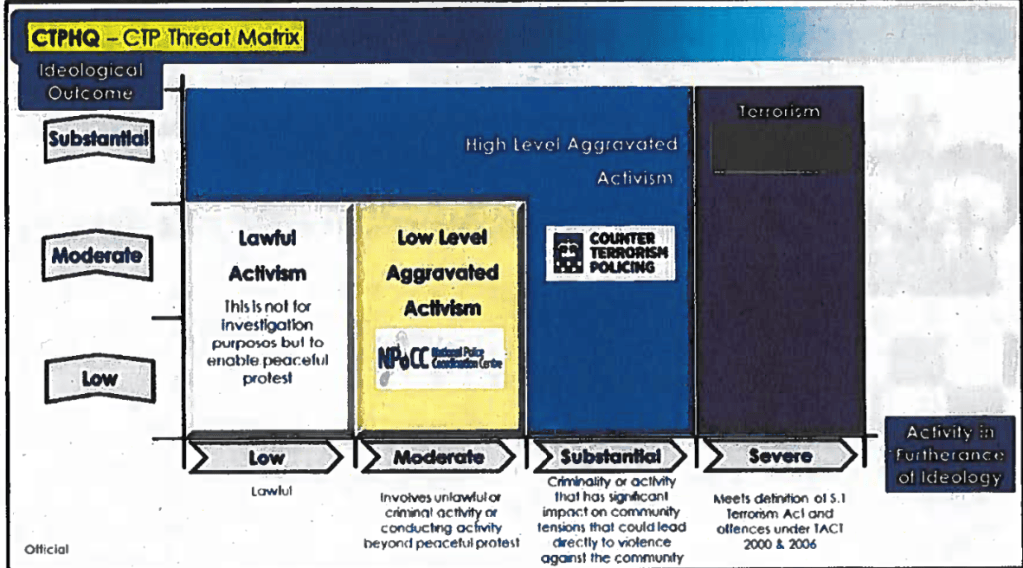
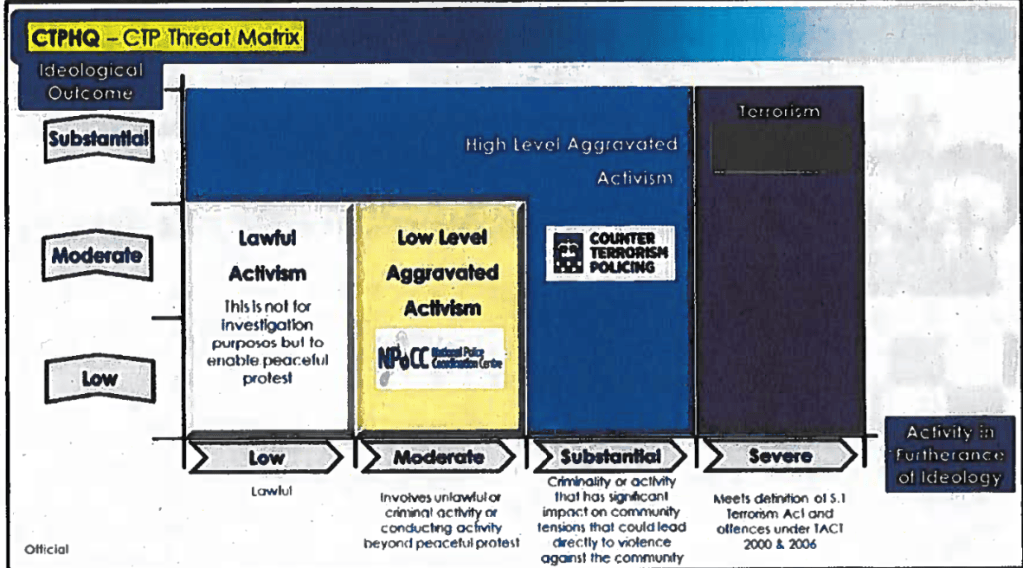
The Grayzone has reviewed heavily redacted records of the meeting. They contain powerpoint charts replete with a “threat matrix” indicating how citizen political activity is categorized by authorities as “high level aggravated activism,” or “terrorism.” The former activity is defined as activism involving “unlawful behaviour that has… a significant negative impact on UK businesses.”
In March 2025, around the time Britain’s Proscription Review Group met to determine whether Palestine Action should be proscribed as a terrorist group, British authorities brought charges against activists who targeted the Instro factory. Initially, they were accused of the same crimes as the Filton Six: aggravated burglary, criminal damage and violent disorder, with a “terrorist connection” covertly applied on the basis of serious property damage. But in July, when then-Home Secretary Yvette Cooper announced PA’s proscription, she cited the Instro case as an example of “violence” perpetrated by the group.
Despite the highly politicized terror designation, a British court was forced to drop charges of aggravated burglary against the Instro 10, indicating that neither police nor prosecutors possessed any evidence Palestine Action intended to harm any person. Indeed, during its five years of operation, PA has conducted hundreds of direct actions without injuring a single person.
This August, as Palestine Action appealed its proscription in the UK, the administration of US President Donald Trump designated the group as a global “terrorist” threat. This appears to have been, at least in part, an effort to bolster the dubious case against the philanthropist and Palestine Action supporter Fergie Chambers, who faces extradition to the US from Spain for supporting “foreign terrorist organizations.”
From Washington to London, governments are stripping away their patina of liberal democracy to protect their relationship with Tel Aviv. Counter-terror legislation is now the weapon of choice in their war on citizens who seek to obstruct Israel’s genocide machine.
Britain’s Labour Party is not traditionally thought of as a bastion of militarism or authoritarianism. Yet listening to some of what its top figures have been saying recently might cause one to doubt the conventional wisdom on that.
Consider what Labour Party strategist Paul Richards said in a GB News interview earlier this month. Asked how the UK might respond to an increased Russian threat, Richards—who has worked for two Labour governments—gave a disturbing answer. “We’d have to lock some people up,” he said, “some of the pro-Russian voices, people who say there isn’t a threat, [and say] ‘Don’t fight for your country, don’t go to war for Burnham.’”
His comments are not a one-off. They reflect a worrying trend among Britain’s political mainstream—the old parties, media, and think tanks—which has increasingly adopted a siege mentality informed by the far-fetched expectation of imminent war with Russia.
Nor is the trend restricted to Britain. It spans the entire Western world. And it helps explain why the centrist political forces previously seen as “reasonable” are losing ground to the supposed “fringe.” Apocalyptic millenarianism is no longer the domain of radical obscurantists, but of people like NATO’s secretary-general Mark Rutte, who in 2025 seemed to foretell with relish a conflict between Europe and Russia on the scale of the Second World War. “Imagine it,” he said, “a conflict reaching every home, every workplace, destruction, mass mobilisation, millions displaced, widespread suffering and extreme losses.”
It is politicians branded as far right or far left radicals who, surprisingly, have emerged as the main opposition to this unhinged bellicosity.
What’s largely prompting this trend is the very logic of the liberals competing with the populists. Western societies display a demand for performative “toughness,” which caters both to the infantilism of their political classes and the gamification of war in far off countries.
Things seem to have begun in earnest in 2016, when the prospect of liberals losing to rivals like Donald Trump led the former to embrace conspiracy theories like Russiagate and double down on foreign policy hawkishness as a way of evading responsibility for their own failures. Putin’s invasion of Ukraine served a similar function, providing a theater for “toughness” even as the West has gotten bogged down in what has increasingly turned into a proxy conflict.
Trying to outdo the populists along a different axis, rather than doing the hard work of opposing them with value-based positions, has led the centrists into a trap. It left a vacuum in the center, into which the populists—ever alert to political opportunities—have deftly stepped.
Here is how it plays out in Germany. When the Christian Democratic Union (CDU) suffered an embarrassing defeat in Saxony-Anhalt earlier this month, the party’s leader and premier in North Rhine-Westphalia, Hendrik Wüst, said the government should consider banning the AfD (which won the election by a landslide). Wüst is eyed as a potential replacement for the unpopular chancellor Friedrich Merz.
The CDU went on to suffer additional defeats in Mecklenburg-Western Pomerania and in Berlin. The former is particularly symbolic, because this is where the Nord Stream gas pipelines make landfall—a fact that makes this state a direct beneficiary of the German-Russian joint venture to supply cheap Russian gas to the German economy.
When Nord Stream 2 was blown up in September 2022, the immediate consensus in the West was that Moscow was responsible. Yet the culprits turned out not to be Russian, but Ukrainian. German police investigators eventually charged individuals associated with Ukraine’s military intelligence service for the attack. (It’s worth noting that this Ukrainian spy agency was rebuilt in 2015 with considerable assistance from America’s CIA.)
Germany’s rejection of Russian gas supplies after Putin’s all-out invasion in Ukraine can be seen as a noble gesture, perhaps, but it had dire consequences for the country’s economy, which contracted in 2023 and 2024 before showing anemic growth in 2025. Even more importantly, it hit every household in Germany with skyrocketing heating and power bills. Interestingly, Germany wasn’t receiving Russian gas at the time of the explosion, which means the attack was aimed at preventing the resumption of supplies after the end of war rather than interrupting ongoing exports.
The German government has never properly addressed the issue at the federal level. On the eve of September elections, Merz’s sharp reaction to the Leipzig drone incident, which he instantly blamed on Russia, contrasted sharply with the virtual absence of a response to the perpetrators of the Nord Stream attack.
Voters in Mecklenburg-West Pomerania slaughtered Merz’s party, excluding it entirely from the state’s legislature for the first time in nearly 80 years. The big winner was the AfD—a party unafraid to ask questions about Nord Stream and which muses about restoring gas supplies after the Ukraine War ends. Voters also largely spared the Social Democrats, under whose leadership Nord Stream was built in the first place (although they had to disown it after Russia’s invasion).
The early days of tension between post-Soviet Russia and the West, which culminated in the war in Ukraine, were marked by squabbles over pipeline projects delivering gas to Europe (remember South Stream or Nabucco?). The unyielding opposition of centrist politicians to such projects has led voters to wonder whether their political establishment is more interested in catering to armsmakers and shale gas producers than in providing for its citizens. It’s hard to think of a better illustration of NATO’s unofficial mission to “keep the Germans down and the Russians out” than the fate of Nord Stream.
The perception of abandonment is what fuels the popularity of the AfD’s sovereigntist stance. And despite accusations of extremism, it is the AfD who sounds the most moderate and reasonable on the vital issues of war and peace.
Indeed, their foreign policy stance provides AfD leaders with one bulletproof rebuttal to accusations of fascism. A defining component of the fascist ideology is aggressive militarism—a trait exhibited by the German political establishment, not its hard-right challengers. The AfD fills the shoes of the old-school left-wing peaceniks when it comes to Ukraine, while the Merz government staunchly supports further escalation while discreetly undermining Trump’s efforts to bring the conflict to a close. The AfD also condemns the war on Iran (which Merz initially supported, before making a U-turn under public pressure).
(Ex-)centrists also advocate an enormous defense spending hike Germany can ill afford, as well as compulsory military service (this latter move has sparked youth protests across the country). The way mainstream German politicians are courting the far right in Ukraine—members of Azov movement prominently featured at the prestigious Munich Security Conference this year, for example—make the charges of nazism levelled against the AfD look especially lame.
Opposing Russia’s full-scale invasion of Ukraine, which the AfD does, is one thing. Supporting an endless proxy war with a nuclear-armed great power—and committing to fight this “to the last Ukrainian”—is quite another.
And the polls suggest German voters have little appetite for risking their country’s future in such a gambit.
The AfD and other insurgent parties thrive when their opponents lean into hawkishness and authoritarianism, but so far there is little evidence the establishment understands this. Indeed, European political elites are doubling down. They recently invited Zelensky’s former press secretary, Iulia Mendel, to speak in front of the European Parliament. But Mendel is a vocal critic of her former boss, and so the parliament’s centrist leadership banned her from entering after Zelensky’s government imposed sanctions on her (an extrajudicial punishment he is routinely applying to political rivals). By banning Mendel from speaking and turning a blind eye on Zelensky’s abuse of power, the center once again chooses delusion and bellicosity over a genuine commitment to democracy.
Meanwhile, alternatives like the AfD will continue to fill the vacant space left in the middle of the political spectrum.
EU’s Council is again pushing for the new chat control regulation to allow the bloc’s police to order internet companies to scan people’s private communications for illegal content in “parts of a service” for a period of time, rather than having to obtain a warrant to target a specific suspect.
This is one of the three key points from a note (PDF) prepared for the sixth and potentially final trilogue on the legislation, also known as Chat Control 2.0, that is to take place on Tuesday, 29 September. The document, dated September 18, was leaked from the Council and is marked as a “presidency note.”
The Council, the European Parliament (EP) and the European Commission (EC) will be negotiating behind closed doors, with the latter represented by Commissioner for Internal Affairs Magnus Brunner.
The other two key points are that the Council believes limiting searches to specific suspects would “not generate any added value compared to the possibilities already existing under criminal law,” and that it wants the scope of the new rules to remain broad, covering not only known illegal photo and video content, but also new material, and “the solicitation of children.”
The note is based on previous discussions and reveals that the EP is willing to accept an approach that requires search plans, but with the caveat that they must be “targeted” and subject to review by judicial or independent administrative authorities.
The Council, however, wants searches to be authorized in “parts of a service or, where possible, to individual users,” and that the search plan would have to include the technologies used and other relevant safeguards, again subject to review.
The note reveals that the Council also wants to make sure that any mechanism to review and possibly suspend searches “should operate in a manner that does not deter providers from carrying out own-initiative searches.”
As a last resort, the Council will ask member states if they would be willing to drop “own-initiative searches or detection orders on non-public content” from the scope of the regulation – but only if no other compromise can be found “providing at least for the same level of effectiveness as the current voluntary practice.”
Former German member of the European Parliament for the Pirate Party Patrick Breyer has no doubt that what is being proposed is “mass surveillance by another name,” and that the goal of the Council, Commission and some member states is to “permanently normalize mass surveillance across Europe.”
Breyer said that the proposal to scan “parts of a service” would in reality mean that “every user in the EU” would be subject to this.
And, he noted, this is not a new system that would replace the old one, but would rather exist in parallel with it. The old system, meanwhile, “is a proven disaster,” the former MEP said, revealing that in Germany, over half of investigations target minors for “consensual sexting” while 75 percent of flagged chats are “not actionable.”
The Council’s own legal service has in the past said that scanning an entire service or parts of it is “highly probable” to be found “general and indiscriminate” surveillance, and therefore unlawful.
British police on Sunday arrested two demonstrators during a pro-Palestine protest outside the ruling Labour Party’s annual conference in Liverpool, Anadolu reports.
Protesters gathered outside the conference venue, with several holding homemade signs expressing support for Palestine Action, a group banned by the UK government.
Police officers moved to arrest an elderly man who was sitting beneath a tree, before making a second arrest involving a protester holding a sign supporting the banned group.
A spokesperson for Defend Our Juries, which organized the protest, said it had hoped the new prime minister, Andy Burnham, “would do the sensible thing and bin the ban on Palestine Action given the weight of public pressure to do so and the escalating amount of resources required in enforcing it.”
Nearly 74,000 Palestinians have been killed and over 175,000 others wounded in Israel’s genocidal war in Gaza since 2023. The offensive has also destroyed around 90% of the enclave’s infrastructure.
Despite a ceasefire that took effect last October, the Israeli army has continued daily attacks in Gaza, killing over 1,400 Palestinians and injuring around 5,000 others, according to Gaza’s Health Ministry.
In November 2024, the International Criminal Court issued arrest warrants for Israeli Prime Minister Benjamin Netanyahu and former Israeli Defense Minister Yoav Gallant on charges of war crimes and crimes against humanity in the Gaza Strip.
Germany’s opposition lawmakers have accused Chancellor Friedrich Merz’s government of seeking to create a “secret police” by dramatically expanding the powers of the country’s intelligence agencies.
The accusations came during the first parliamentary debate on the reform on Thursday, with lawmakers from the Alternative for Germany (AfD), the Left and the Greens raising concerns over surveillance and fundamental rights. The government argues that the changes are needed to counter growing security threats.
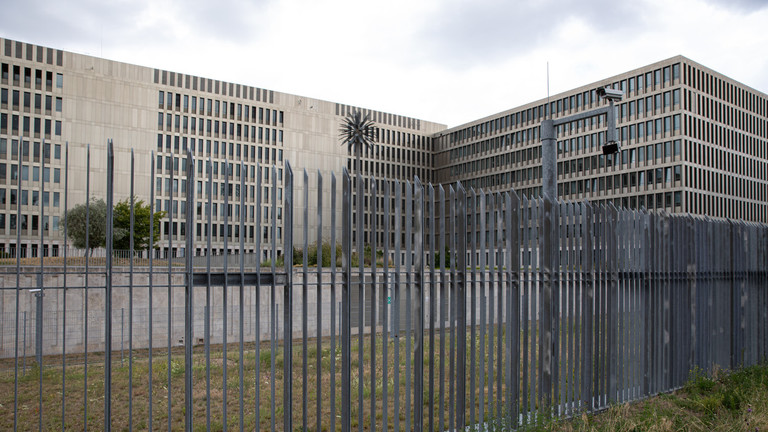
Under a reform approved by the cabinet last month, the BND foreign intelligence agency and the BfV domestic security service would gain broader operational powers, allowing them to move beyond primarily gathering and analyzing information.
Among the proposed changes, the BND could sabotage foreign companies, penetrate foreign IT systems and disable weapons deemed a threat to Germany. The BfV, meanwhile, could secretly enter homes and access computers and mobile phones under certain circumstances.
German Interior Minister Alexander Dobrindt said the reform would usher in a “new era” by turning the country’s intelligence services into “genuine intelligence agencies” capable of actively countering threats. He said Germany must bring its services to the level of its European partners.
AfD MP Gottfried Curio branded the proposed overhaul of the BfV “Stasi 2.0,” referring to East Germany’s notorious secret police, and called the reform a “coup against the rule of law.” The AfD, however, supports granting the BND greater operational powers.
The BfV has itself been locked in a legal battle with the AfD. In 2025, the agency designated Germany’s most popular party a “confirmed right-wing extremist” organization, but a Cologne court in February barred it from applying that classification while the case proceeds.
The ruling came months before the AfD scored major gains in regional elections. It won 43.8% in Saxony-Anhalt earlier this month and 38.3% in Mecklenburg-Western Pomerania on Sunday.
Green MP Konstantin von Notz said granting the BfV such extensive powers would be a “grave mistake” and questioned whether parts of the reform would survive scrutiny by the Constitutional Court. He nevertheless backed giving the BND greater powers.
Left Party MP Clara Buenger went further, warning that the BfV could become a “new German secret police.”
“Fundamental rights are being trampled on here,” she said, arguing that the agency would gain powers traditionally reserved for police.
The debate comes as Merz’s government braces for growing AfD influence at the regional level. The Telegraph and Die Weltreported in July that Berlin was developing a “secret plan” to counter potential “obstructionism” by regional authorities, allowing the federal government to bypass them in a crisis.
The German government wants the intelligence reform to take effect at the beginning of 2027. It still requires approval from both the Bundestag and Bundesrat.
Is Britain experiencing a free speech crisis? No, says our governing elite. That's a conspiracy theory put about by JD Vance. But data suggest the UK police are arresting up to 40 people a day for speech offences.
The EU has published a wide range of reports detailing what social media companies like TikTok and Meta are doing to comply with its Digital Services Act (DSA). The reports detail the extreme censorship needed to stay on Brussels’ good side.
Under the European Commission’s “voluntary Code of Conduct on Disinformation,” the largest online platforms operating in the EU are required to submit biannual reports explaining their efforts to combat so-called “disinformation.” Although adherence to the code is described as “voluntary,” those who do not comply are subject to fines under the DSA, which came into force in 2023.
The commission published reports by Meta, TikTok, Google, Twitch, and more than two dozen other platforms on Wednesday. Each report spans hundreds of pages, and details the speech restrictions and censorship policies put in place at the behest of the EU.
These include restrictions on political speech surrounding elections, which the EU has mandated in every major European vote since 2024, under the pretext of fighting “Russian interference.” According to documents released by the US House Judiciary Committee earlier this year, these measures have almost always been used “to disadvantage conservative or populist political parties.”
In its report, TikTok admitted that it removed more than half a million posts concerning elections in Bulgaria, Cyprus, Denmark, Hungary, Malta, Portugal, and Slovenia this year. RT has covered the EU’s efforts to interfere in the Bulgarian and Hungarian elections in depth, and found that TikTok came under particularly intense pressure from Brussels, after its failure to implement sufficiently draconian restrictions during Romania’s presidential election in 2024.
Each report is hundreds of pages long, and every major social media company admitted that they now defer to EU-approved “fact-checkers” to police content on their platforms. Meta explained that it now automatically down-ranks content flagged by fact-checkers, while YouTube stated that it has trained AI models to pre-emptively remove content it thinks would fall foul of these groups.
Multiple reports specify that the platforms themselves must pay the fact-checkers’ salary. These fact-checkers flagged more than 14 million posts on Facebook in the first six months of this year alone.
Every social media platform devoted a chapter in its report to the Russia-Ukraine conflict, with Facebook noting that all posts on the conflict are subject to monitoring for “disinformation and misinformation” by pro-EU fact-checkers.
Russian media outlets are banned from Facebook, while Ukrainian outlets are free to operate, and Kiev is permitted to fundraise on the platform.
Despite mentioning “disinformation” more than a dozen times, the DSA does not define the term.
In July 2025, a protester shot a cop outside an ICE detention facility in North Texas. The federal government alleged the incident was the result of an “antifa” terrorist plot involving a network of friends and acquaintances united in leftist beliefs. The case that ensued was chilling:
It didn’t matter that little evidence of a premeditated attack on law enforcement ever emerged. It didn’t matter that every defendant, except the actual shooter, was exonerated of the original attempted murder charges. It didn’t even matter that prosecutors struggled to show the defendants belonged to an “antifa cell.” In the end, they convinced the jury that Batten and most of her co-defendants were guilty of rioting, conspiracy, using explosives, and supporting terrorists.
In a Fort Worth courtroom in June, a right-wing judge sentenced Batten to 50 years behind bars—a stark warning to others who might challenge the president’s agenda.

 Login