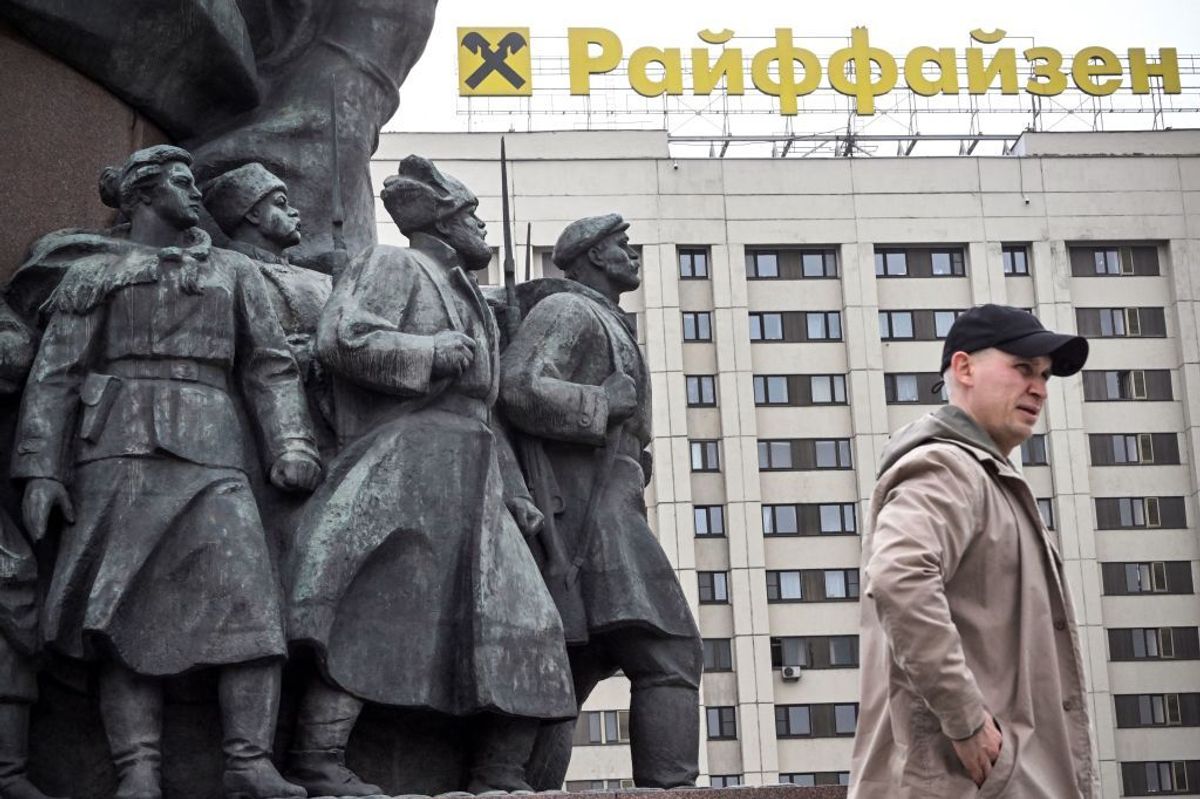
Russia has exploited an EU sanctions loophole to unfreeze $3 billion worth of assets held by Belgium's Euroclear, according to a Flemish media report, and Austria's Raiffeisen Bank could be about to execute the same maneuver.
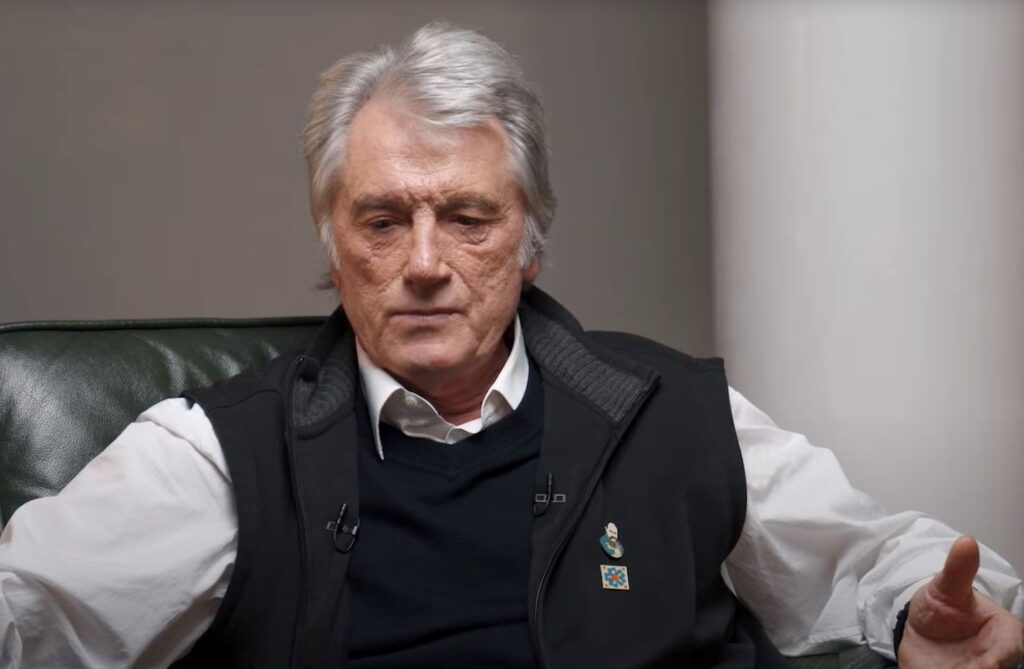
Viktor Yushchenko, Ukraine’s president from 2005 to 2010, has written an open letter to US President Donald Trump and posted it on Facebook on 14 October. Without naming it, the letter takes aim at the green light Washington gave Russian diesel trade five days earlier, after a call between Trump and Kremlin leader Vladimir Putin.
Russia banned its diesel exports in July amid a fuel crisis at home, after Ukrainian strikes on refineries had already cut those exports, and last week’s US waiver and the supply deal Trump announced with Moscow would put that fuel back on world markets while Russian strikes still kill Ukrainian civilians.
What Yushchenko says Russian fuel buys
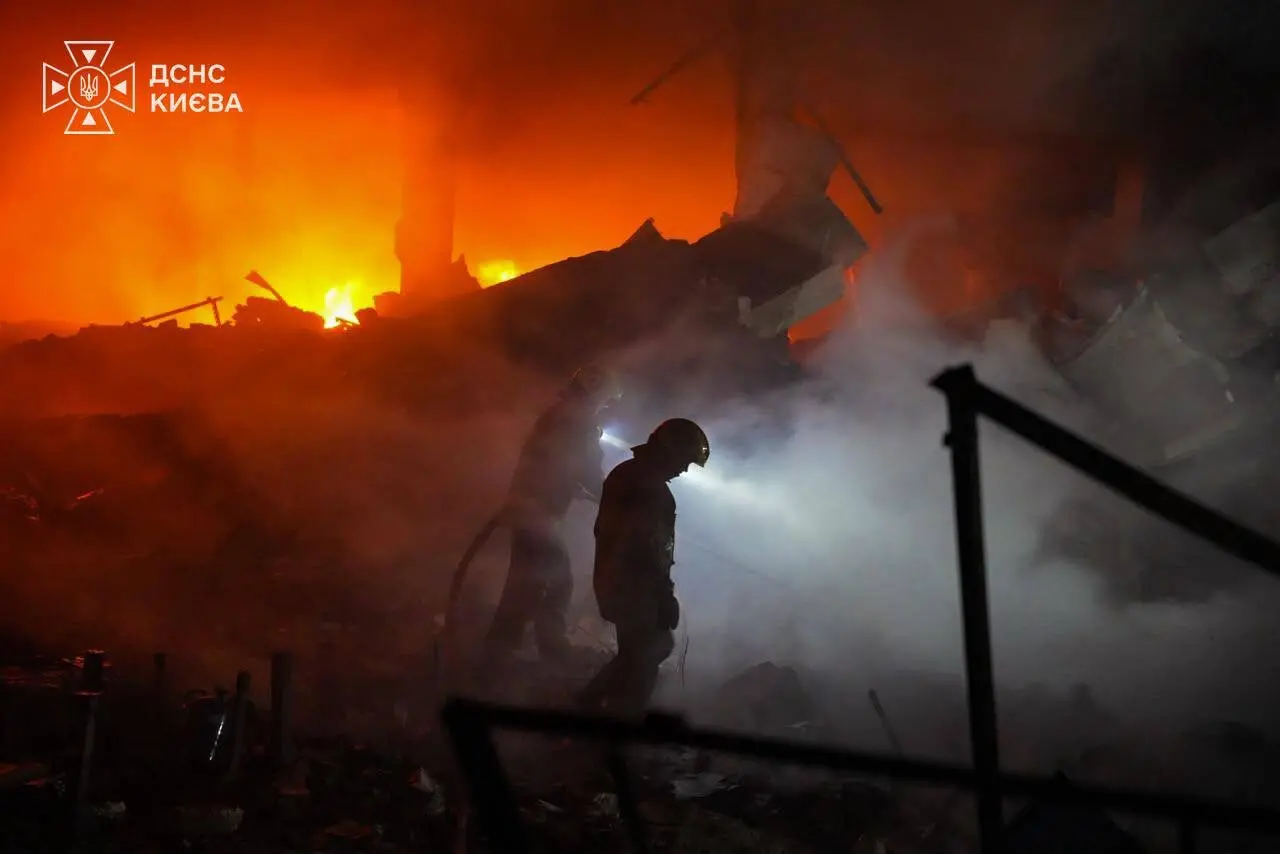
Yushchenko wrote that Russian ballistic missiles, Iranian Shahed drones, and aerial bombs strike homes every day and night in Kyiv, Zaporizhzhia, Odesa, Dnipro, and Kharkiv. Whenever there is talk of “concessions” or deals with Putin, he wrote, the Kremlin answers with more missiles, more drones, and more bloodshed.
Explore further
Trump’s Russian diesel deal, which drew fury in Ukraine, is unlikely to lower prices, experts say
Yushchenko rejected calls for Ukraine to “restrain its strikes against the infrastructure that finances and sustains Russia’s war.”
“Money paid for Russian fuel is not an abstraction called ‘commerce.’ It finances an economy geared toward total war,” he wrote.
Nuclear arms, Pearl Harbor, and Iwo Jima
Yushchenko wrote that Ukraine inherited “one of the largest nuclear arsenals in the world” and agreed to give it up, trusting the words and signatures of great powers. In his view, by signing the 1994 Budapest Memorandum, America took on a moral responsibility toward Ukraine.
He compared trade in Russian energy to America’s trade with Imperial Japan, which included strategically important materials, before the US entered World War II. Washington hoped for years to avoid a wider war in the Pacific, he wrote, but economic pressure and diplomacy could not prevent catastrophe.
Explore further
Ukraine warns of “a new type of humanitarian crisis” as Russia aims at its biggest cities
Japan attacked Pearl Harbor on 7 December 1941. America knows how dangerous it is to believe that trade can tame an aggressor, Yushchenko wrote, adding: “History taught us that lesson at a terrible price.”
He also named two men he called Ukrainian. One was Sergeant Michael Strank, whose family, Yushchenko wrote, came from Lemkivshchyna. The son of immigrants from Czechoslovakia, Strank took part in the famous raising of the US flag on Iwo Jima, according to the Marine Corps. The other was Oleksandr Silvashko, “a Ukrainian boy from the Cherkasy region,” who, Yushchenko wrote, was the first to embrace US Lieutenant William Robertson when American and Soviet forces met at the Elbe in April 1945.
“One does not negotiate with tyrants—one stops them,” Yushchenko concluded.
Ukraine wants the EU to force Moscow into a ceasefire with frozen Russian assets, trade and transit embargoes, maritime bans, and entry bans, Ukrainian Foreign Minister Andrii Sybiha wrote on X after the EU Foreign Affairs Council in Luxembourg on 12 October 2026. He also welcomed new EU sanctions listings adopted that day and progress in Ukraine’s EU accession talks.
Kyiv has spent this month laying out truce formats it would accept while awaiting Russia’s position on talks, and the levers it is pressing the EU to use include frozen Russian assets that EU leaders failed to agree on tapping last December.
The pressure Kyiv wants from the EU
Sybiha called it “devastating pressure.” He also wants Russian combatants and their families barred from the EU, maximum visa restrictions, and Russia’s isolation in culture and sports.
I was pleased to attend the EU Foreign Affairs Council today.
It is time for Europe to define its strong role. Our future and our security are in our hands.
Now is the time for real European pressure on Moscow. Not half-measures, but devastating pressure: frozen assets, trade… pic.twitter.com/AnI8h6HXbs
His post named three types of ceasefire—energy, food security, and a full ceasefire—without saying whether Kyiv would accept them separately. Earlier this month, he told journalists Ukraine was ready for an energy and Black Sea ceasefire “but only in such a combination.”
New sanctions listings and two more accession clusters
The minister welcomed the EU’s 12 October adoption of new sanctions listings against Russia—the largest single expansion of the bloc’s blacklist. EU ambassadors agreed on the 1,646 names on 7 October. They include 1,569 tied to Russia’s military industry and 77 to its so-called State Duma elections. The listings are separate from the EU’s 22nd sanctions package, which the EU has yet to adopt.
He also welcomed the EU’s “green light” for opening two more clusters in Ukraine’s EU accession talks: Internal Market, and Competitiveness and Inclusive Growth. The formal opening was scheduled for an intergovernmental conference on 13 October.
Front-line briefing and aid requests
Sybiha said he briefed European colleagues on the front-line situation, Russia’s plans, and ways to deprive it of its advantages, and that he passed partners specific requests for aid. He reaffirmed Ukraine’s commitment to reforms.
Ukrainian drones have helped push Russia into its worst fuel crisis since the Soviet Union fell, The Washington Post (WaPo) reported on 11 October.
Diesel is where this war reaches American drivers. US President Donald Trump blames rising diesel prices mostly on Russia’s war in Ukraine, while experts blame mainly the US war with Iran. Some of his allies now accuse Kyiv of trying to sway the US midterms.
Drones go for the first stage of refining
The Washington Post looked at dozens of strikes between 1 April and 31 August. Three refinery experts then examined satellite images of 54 strikes with visible damage. In over half, the damage seems to be to the desalting and distillation units, known by the Russian acronym ELOU-AVT. These units clean the crude of water and salt, then split it into separate compounds, the first steps toward gasoline and diesel. More than a third appear to have hit secondary units, which turn those compounds into jet fuel, gasoline, and liquefied petroleum gas.
From April through August, drones struck two-thirds or more of the 36 big Russian refineries that S&P Global Energy tracks, a strike every third day. Some took as many as five hits. On 16 June, drones set the Moscow refinery’s distillation towers on fire. That strike and a second one days later kept the plant offline into September, WaPo reported, citing data firm Kpler. Ukraine targeted the refinery again on 20 September.
Explore further
Trump’s Russian diesel deal, which drew fury in Ukraine, is unlikely to lower prices, experts say
“We don’t need to hit the entire plant,” a Ukrainian drone battalion commander with the call sign Tango told The Washington Post. Ukraine knows where to strike so that a refinery stops and stays down, he said. His unit, Ukraine’s 1st Separate Center of Unmanned Systems, runs long-range strikes deep inside Russia.
Sanctions slow the repairs
The EU banned exports of oil-refining equipment to Russia the day after the 2022 invasion, and the US followed days later. WaPo reported that the bans cover the distillation and secondary processing units Ukraine keeps hitting. The bans make spare parts hard to get, Alexander Kolyandr of Eurasia Group told the paper, and the strikes come faster than repairs.
Since last year, Ukraine has doubled the size of each wave, decoys included, a person involved in the strike campaign told WaPo. The decoys are unarmed and draw Russian fire, wasting air-defense ammunition, WaPo explained. Without them, the person said, Ukraine would simply lose expensive systems. András Rácz of the German Council on Foreign Relations told WaPo that even if only 2–3% of drones get through, the damage is significant.
European Union ambassadors have approved 1,646 new sanctions designations against individuals and organisations linked to Russia, with more than half of the additions targeting the industrial chain behind ballistic missiles including the Iskander-M.
European Union ambassadors have agreed a major expansion of sanctions against Russia, approving 1,646 new designations concentrated heavily on the country’s military-industrial complex and the production of ballistic missiles used against Ukraine.
The measures, agreed by EU envoys in Brussels on Wednesday, 7th October, are due to be formally adopted by foreign ministers on Monday. More than half of those being added to the sanctions regime are involved in the production chain for Russian ballistic missiles, including the 9M723 missile used by the Iskander-M system, according to details of the agreed listings.
The additions extend well beyond companies assembling finished weapons. They include organisations involved in missile research and testing, manufacturers of solid rocket fuel and rocket engines, and producers of specialised textiles, synthetic fibres and carbon materials used in missile systems.
Drone manufacturers and shipyards servicing Russian submarines are also among those targeted.
The emphasis on individual components and suppliers reflects the EU’s increasingly detailed approach to sanctions against Russia’s defence industry. Rather than concentrating only on large defence groups, Brussels has progressively moved further down supply chains in an attempt to restrict access to specialised materials, technology and production capacity.
The latest action comes as Russia has intensified ballistic missile strikes against Ukraine. The Iskander-M presents a particular problem for Ukrainian air defences because the ballistic missile can be intercepted by US-produced Patriot systems, stocks of whose interceptors have come under increasing pressure.
The new EU list also includes 77 Russian politicians who stood for parliamentary seats in territories of Ukraine occupied by Russia. Their inclusion extends the sanctions response from military production to Moscow’s efforts to incorporate occupied Ukrainian regions into Russian political structures.
Brussels has also moved against North Korean participation in Russia’s war effort. Seven North Korean individuals and entities are being added under the EU’s separate sanctions regime concerning North Korea.
Military ties between Moscow and Pyongyang have expanded considerably during the war. Ukrainian authorities have identified North Korean ballistic missiles used by Russian forces, while North Korea has supplied ammunition and other military support to Moscow.
The 1,646 additions do not in themselves constitute an entirely new package of sectoral restrictions. They are individual and entity designations within the existing EU sanctions architecture, meaning that assets in the EU can be frozen and EU persons and companies are prohibited from making funds or economic resources available to those listed.
Their scale is nonetheless significant. By placing the missile-production chain at the centre of the new designations, the EU is attempting to connect its sanctions policy more directly with the weapons Russia is currently using against Ukrainian cities and infrastructure.
Formal adoption by foreign ministers on Monday will complete the legal process.
Seven tankers made 14 trips from South Korea to Russia's Far East in July and August, carrying more than 176,000 metric tons of fuel, most of it diesel, the Guardian found in a 6 October analysis of port records and ship-tracking data. The UK and EU have sanctioned three of the ships, and one loaded its fuel from another tanker at sea off South Korea instead of at a terminal.
Ukrainian strikes have cut Russia's fuel output as Moscow scrambles for supplies, while fuel loaded at South Korean ports has flowed to Russia. Loadings began to surge in July, the same month South Korean President Lee Jae-myung pledged $100 million for Ukraine's reconstruction, the Guardian reported. That creates a tension in Seoul's policy toward the war: South Korea has provided Ukraine with humanitarian and non-lethal aid but ruled out sending weapons directly, while the fuel trade appears legal under South Korean law even though three of the tankers are under UK and EU sanctions.
Russia imported 368,000 metric tons of oil products by sea in August, 112,000 of them from South Korea, according to Kpler data analyzed by the Centre for Research on Energy and Clean Air (CREA) and cited by the Guardian. CREA's own August report gives 172,000 metric tons in total, including 18,000 from South Korea. Neither explains the gap.
Where the tankers said they were going
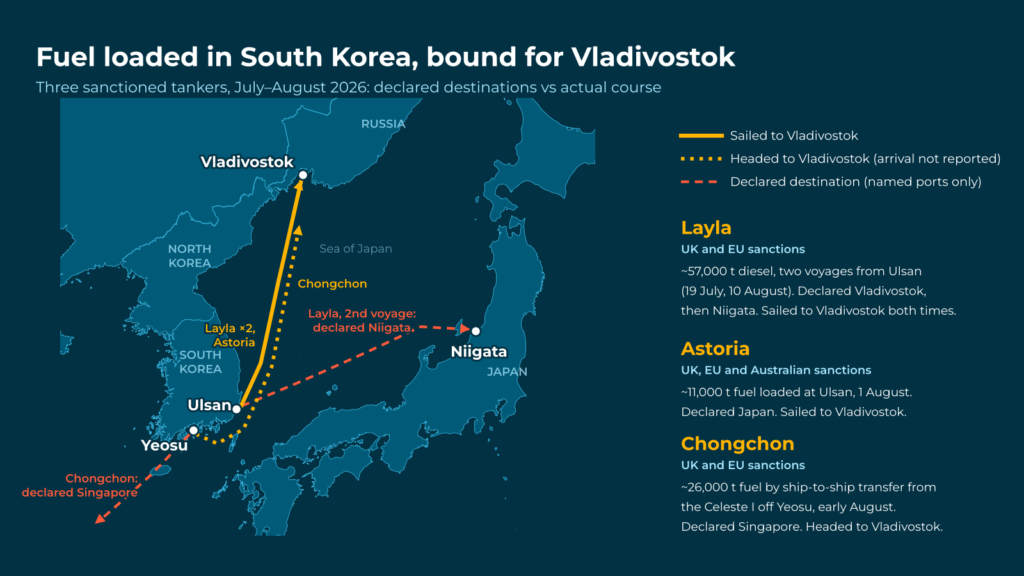
The Layla, a tanker under UK and EU sanctions, made two voyages from Ulsan to Vladivostok, carrying a total of 57,000 metric tons of diesel. It left South Korea on 19 July and 10 August. On the first trip, it told South Korean authorities it was bound for Vladivostok; on the second, it declared Niigata, Japan, but sailed to Vladivostok again.
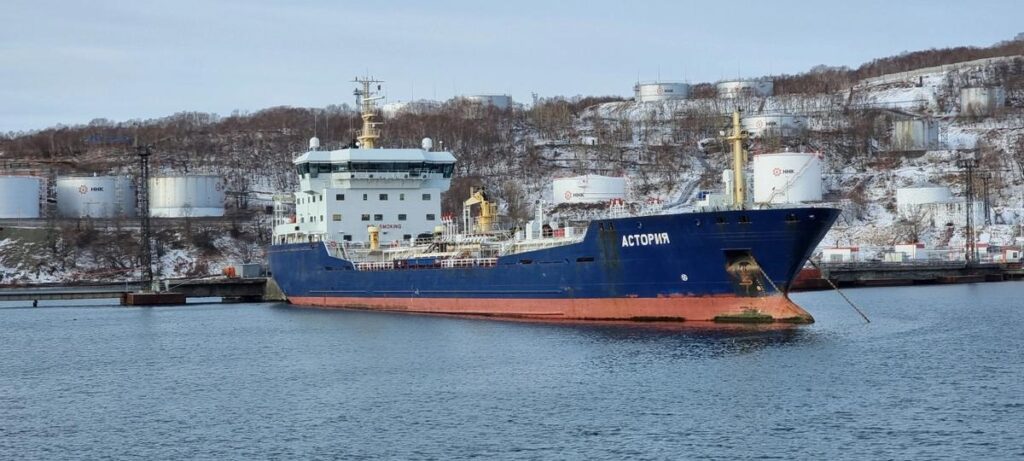
The Astoria, a Russian-flagged tanker under UK, EU, and Australian sanctions, loaded nearly 11,000 metric tons of fuel at Ulsan on 1 August. It declared Japan as its destination but sailed to Vladivostok.
The Chongchon did not berth at a South Korean port. Instead, it took about 26,000 metric tons of fuel from the unsanctioned Celeste I at an anchorage off Yeosu in early August. It declared Singapore as its destination but headed to Vladivostok. The owners and managers of the four tankers did not respond to the Guardian's requests for comment.
Source: Guardian analysis of port records and ship-tracking data; sanctions listings: OpenSanctions. Map: Euromaidan Press
Why Russia needs the fuel
Ukrainian drone strikes have severely disrupted Russia's refining capacity, the Guardian reported. In July, Ukraine's General Staff said the strikes had knocked out 42% of Russia's refining capacity, costing the industry billions of dollars.
Russian refinery throughput fell in June to its lowest level in more than 20 years, and diesel output is down nearly 30% from a year earlier, the International Energy Agency said, according to the Guardian.
Russia has also restricted fuel exports to protect domestic supplies, extending its diesel export ban until the end of October; on 2 October, Deputy Prime Minister Alexander Novak said Moscow could consider partially lifting the ban if there was overproduction, according to the Moscow Times.
Responses to the shipments
Seoul's non-lethal aid has included helmets, body armor, and demining vehicles, and in 2023 it pledged $2.3 billion in support, mostly in loans.
Isaac Levi, an analyst at CREA, told the Guardian:
"It is shocking that EU-sanctioned tankers loaded fuel at South Korean ports and carried it to Russia. This undermines the sanctions regime and South Korea's support for Ukraine."
South Korea's Foreign Ministry did not address the shipments or the sanctioned tankers. In a statement, it said the government supports international efforts to help end the war in Ukraine and bring about a peaceful recovery. The ministry said it was strictly enforcing its export controls and had expanded them to cover 1,402 non-strategic items with high potential for diversion to military use. The UK Foreign Office did not answer the Guardian's questions about UK-sanctioned tankers using South Korean ports, saying only that it remains committed to monitoring its sanctions.
Ties between Kyiv and Seoul are also strained over Ukraine's disclosure of its transfer of two North Korean prisoners of war to South Korea, which Seoul said should have remained private.
Ukraine will seek to have Russian businessmen Alisher Usmanov and Mikhail Fridman restored to European sanctions lists after the EU removed both men as part of an agreement that secured a three-year renewal of its wider individual sanctions regime against Russia.
Ukraine is preparing a new sanctions initiative targeting more than 20 Russian businessmen and intends to press for Alisher Usmanov and Mikhail Fridman to be placed back under restrictions, Foreign Minister Andrii Sybiha said on Thursday.
Sybiha, speaking to journalists in Kyiv on 1 October, said the Ukrainian government regarded the European Union’s decision to remove the two men from its sanctions list as unacceptable and had tried to prevent it through both public and diplomatic channels.
“Our response will be asymmetric. You removed two oligarchs, and we will add another twenty,” Sybiha said.
He said Kyiv had prepared a list containing more than 20 Russian businessmen for possible sanctions and was also working to restore restrictions against Usmanov and Fridman.
The minister did not specify which EU legal mechanism Kyiv expects to use. Ukraine cannot itself add individuals to the bloc’s restrictive-measures list, meaning any renewed designation would require action by EU member states.
The EU formally removed Usmanov and Fridman from its sanctions list on 22 September. Council Implementing Regulation (EU) 2026/2160 deleted the entries for Usmanov, Fridman and Russian businessman Andrey Falaleev, as well as Redbird Corporate Services Ltd.
At the same time, EU governments extended the remaining individual sanctions for another 36 months, until 22 September 2029. The regime covers more than 3,000 individuals and entities and provides for asset freezes, travel restrictions and a prohibition on EU citizens and companies making funds or economic resources available to those listed.
The agreement marked a significant change to the previous system under which individual sanctions were renewed every six months.
Kyiv is now seeking to compensate for that decision through national sanctions regimes while pursuing their possible return to the EU list.
Sybiha said President Volodymyr Zelenskyy had approved the Ukrainian approach and that Kyiv was working with partner governments to ensure that restrictions against Usmanov and Fridman remained in force outside the EU framework.
According to the foreign minister, Canada has indicated that it intends to retain its restrictions. Sybiha also pointed to Britain, Japan and Australia as jurisdictions where sanctions remain in place and said Ukraine would seek similar measures elsewhere.
Britain continues to maintain a separate national Russia sanctions regime. The UK government’s current Russia sanctions framework records designations, amendments and removals independently of decisions made by the European Union.
Several EU member states have meanwhile taken or begun preparing national measures following the September decision.
The dispute has exposed one of the structural features of EU sanctions policy: decisions on restrictive measures require agreement among member states, allowing individual listings to become part of wider negotiations over the continuation of an entire sanctions regime.
Moving from six-month to three-year renewals reduces the frequency with which the broader Russia sanctions list has to return to the negotiating table.
It does not, however, prevent individual names from being added again during that period. Kyiv’s new initiative is therefore likely to focus both on persuading individual governments to introduce national restrictions and on building sufficient support inside the EU for Usmanov and Fridman to be designated again.

 Login



 (@andrii_sybiha)