 Login

Venezuela y FAO analizan apoyo técnico a plan alimentario nacional
El Ministerio de Alimentación de Venezuela evaluó con la FAO alianzas estratégicas orientadas a la innovación tecnológica y la producción sostenible.



Como o tema Inovar Hoje para Nutrir o Amanhã, a campanha vai transformar o Conic, mais antigo centro comercial e cultural de Brasília, em um grande painel para a exibição de um vídeo institucional que mostra como a inovação pode tornar os sistemas agroalimentares sustentáveis, inclusivos e resilientes.
“Inovar não é só investir em tecnologia de ponta. Significa também encontrar novas formas de aplicar conhecimentos tradicionais, compartilhar experiências, conectar saberes e construir soluções adaptadas às realidades locais”
O vídeo será exibido às 18 horas e poderá ser assistido de vários pontos da capital federal, como a Esplanada dos Ministérios e a Rodoviária do Plano Piloto, de onde é possível ver o prédio comercial.
Nas plataformas digitais, a exibição de um desenho animado com o personagem José Totoy, o Comilão e uma campanha com recados do personagem estampados em prédios e placas urbanas são ações voltadas para o público infantil..
Por meio de uma mensagem lúdica e acessível, José Totoy fala sobre os desafios da fome e da má alimentação em uma história divertida e cativante.
O personagem brasileiro de sorriso colorido e que cultiva aquilo que come foi escolhido como Herói da Alimentação e Campeão da FAO. A campanha é fruto de uma parceria com a Totoy Corp, criadora do personagem
Meza explica que a campanha busca aproximar crianças e famílias dos temas relacionados à alimentação, à nutrição e ao desenvolvimento sustentável.
“As crianças são especialmente receptivas ao aprendizado e à construção de valores e serão os futuros tomadores das decisões que moldarão nossos sistemas agroalimentares e o planeta”, reforça.
Com conteúdos disponíveis em mais de 30 idiomas em plataformas de streaming e no Youtube, José Totoy conquistou mais de 50 milhões de seguidores em sua rede global de canais em vídeos que vão até 26 bilhões de visualizações.
O criador do personagem e do desenho brasileiro, André Vaz, cofundador da Totoy Corp, destacou a satisfação de fazer parte desse projeto de importância global com o José Totoy.
“Essa parceria reconhece o cuidado que dedicamos às histórias e nos permite contribuir para que a alimentação seja um assunto presente na vida das crianças desde cedo”, diz
O desenho ficará disponível tanto no Youtube da Totoy, quanto em todas as plataformas digitais dos parceiros da campanha FAO, Programa Mundial de Alimentos (WFP), Fundo Internacional de Desenvolvimento Agrícola (FIDA) e Instituto Interamericano de Cooperação para a Agricultura (IICA).
Serão disponibilizadas versões em português, espanhol e inglês com alcance em cerca de 190 países pelo Youtube.
Para mobilizar mais ainda o publico infanto-juvenil, uma animação da FAO também foi disponibilizada no Youtube assim como a versão digital do livro de atividades Os Heróis da Alimentação, que serve como suporte educativo para pais e professores conduzirem crianças nas descobertas sobre inovações nos sistemas agroalimentares e os desafios globais.
Além disso, ficam abertas até o dia 6 de novembro as inscrições do concurso internacional de cartazes do Dia Mundial da Alimentação 2026, para crianças e jovens de 5 a 19 anos de todo o mundo.
Para participar é preciso preencher o formulário de inscrições online e cadastrar o cartaz criado de forma original, sem o uso de Inteligência Artificial, no formato JPEG.
Menores de idade precisam da autorização dos pais ou responsáveis legais para participar. A premiação será oferecida a quatro grupos etários e os vencedores receberão certificado de reconhecimento e uma sacola-surpresa com brindes.
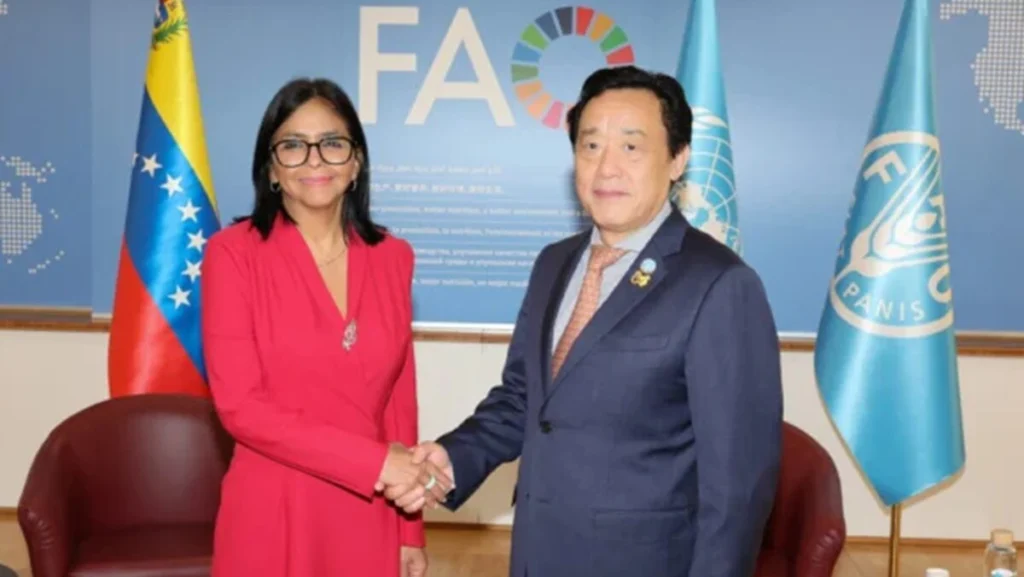
On Tuesday, Venezuelan Acting President Delcy Rodriguez met with Qu Dongyu, director-general of the United Nations Food and Agriculture Organization (FAO), in Rome, Italy.
RELATED:
Venezuela and Angola Deepen Strategic Alliance on Food Security at FAO Forum
During the meeting, Rodriguez and Dongyu discussed joint strategies to promote agricultural development, food security and the transformation of national agrifood systems.
The bilateral dialogue reaffirms the Venezuelan commitment to multilateral organizations to promote sustainable programs that benefit food sovereignty.
The meeting follows the participation of the South American nation’s acting president on Monday in the 2026 World Food Forum (WFF), organized by the FAO in the Italian capital.
After meeting with the FAO director, Rodriguez visited the headquarters of the International Italo-Latin American Organization (IILA) in Rome, where she spoke with members of the organization, which is marking its anniversary.
IILA Director Giorgio Silli welcomed the Venezuelan leader, who reaffirmed her country’s willingness to strengthen ties with the international community.
teleSUR/ JF
Source: Communications Ministry
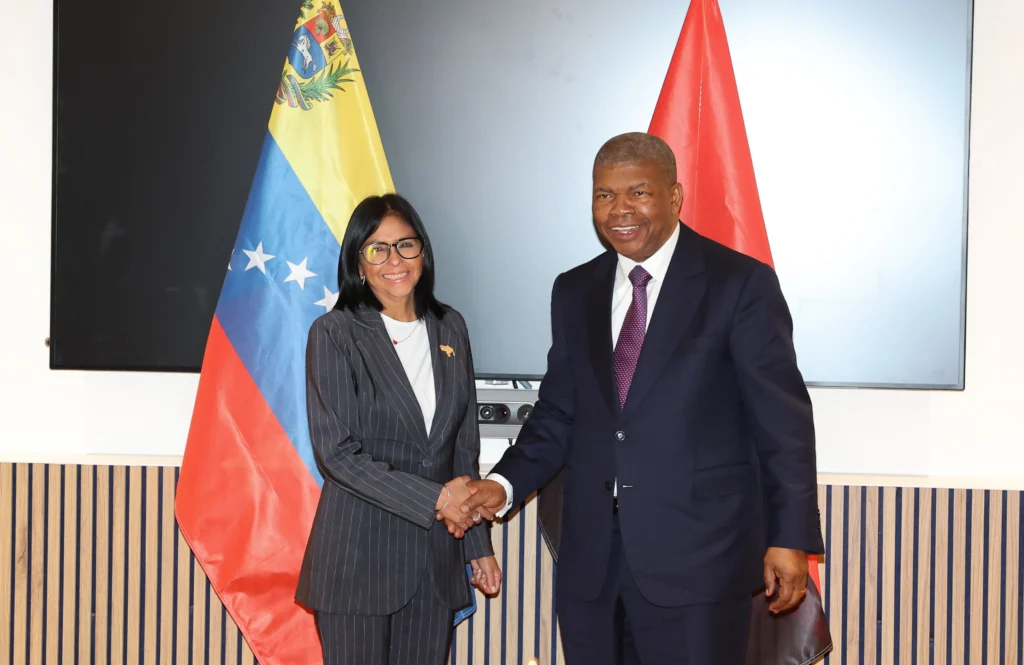
The meeting took place on the sidelines of the World Food Forum of the Food and Agriculture Organization of the United Nations (FAO), which is being held in Rome this week. It followed Rodríguez’s speech at the forum’s plenary session, in which she reaffirmed what she called the principles of Bolivarian Peace Diplomacy and the duty to promote social well-being.
During the encounter, both leaders discussed strategies aimed at improving sustainable trade and strengthening food security, but no specific agreements were announced.
RELATED: Venezuela Announces Plan to Achieve ‘Zero Hunger’ at 2026 World Food Forum
The working teams of both delegations focused on food sovereignty and shared agricultural growth, with the aim of boosting trade flows and the production capacity of both countries. Venezuela and Angola, the reports said, reaffirmed their willingness to strengthen mutual assistance in order to meet global demands on sustainability and food supply.
The Rome encounter followed a September 25 review of the bilateral agenda by Venezuelan Foreign Minister Félix Plasencia and his Angolan counterpart Tété António. The two officials identified openings for closer cooperation in trade, investment, mining and oil exploration.
They also agreed on the need to deepen the exchange of knowledge and experience across productive sectors. The goal, both governments said, is to drive sustainable economic growth and improve the welfare of their people.
The talks come as the World Food Forum, the FAO’s flagship event, brings together government delegations, farming communities, scientists and investors in Rome for a week of sessions on transforming global agrifood systems.
The meeting is the latest in a series of contacts between the two governments. On September 25, Venezuelan Foreign Minister Félix Plasencia and his Angolan counterpart, Tété António, reviewed progress on the bilateral agenda. They identified opportunities to deepen cooperation in trade, investment, mining and oil exploration. Both officials agreed on the need to reinforce the exchange of knowledge and experience across various productive sectors in order to promote sustainable economic growth.
Desde el Foro Mundial de la Alimentación, la presidenta Delcy Rodríguez sostiene un encuentro bilateral con su homólogo de Angola, Joao Manuel González Lourenço.
— Madelein Garcia (@madeleintlSUR) October 12, 2026
Tras su intervención en el evento internacional, la jefa de Estado evalúa junto al mandatario africano nuevos… pic.twitter.com/TJG1Y1Zl89
Text reads: “From the World Food Forum, Acting President Delcy Rodríguez supports a bilateral meeting with her counterpart from Angola, Joao Manuel González Lourenço. After her intervention at the international event, the Venezuelan Acting President evaluates with the African President new strategic mechanisms to strengthen agri-food production, sustainable trade and food sovereignty of both nations. The meeting aims to consolidate South-South cooperation and peace diplomacy.”
Diplomatic relations between Caracas and Luanda date to December 6, 1986. The partnership rests on diplomatic cooperation, shared membership in OPEC, the Organization of the Petroleum Exporting Countries, and a sustained effort to strengthen agro-food security.
The relationship has gathered momentum in recent weeks. Venezuela reinforced cooperation with Angola, Italy and Guatemala, part of a broader diplomatic push that spans energy, agriculture and trade.
Venezuela’s Ministry of Communication and Information said in a statement that relations between the two countries are being consolidated through a strategic alliance based on energy, oil and diplomatic cooperation under the South-South principle.
The World Food Forum 2026 (WFF), hosted by the FAO in the Italian capital, has become a platform where leaders of the Global South coordinate responses to food insecurity. Venezuela used the gathering to present its food production agenda and to lock in alliances with partners in Africa and beyond.
For Angola, the talks offer a channel to diversify its economy beyond oil and to draw on Venezuelan experience in agricultural programs. For Venezuela, the partnership adds another node in a network of South-South ties that Caracas has cultivated to blunt the impact of sanctions and economic pressure. The public statements emphasized political will and shared priorities, with technical teams expected to translate the commitments into concrete projects in the coming months.
The meeting underscores a recurring theme in Venezuela’s foreign policy under Rodríguez’s government, that food sovereignty is a matter of national security and must be built through alliances among developing nations. As global supply chains strain and prices fluctuate, the partnership with Angola positions both countries to produce more of what they consume.
For now, the outcome is a reaffirmed agenda rather than a signed deal. The next test will be whether the cooperation announced in Rome translates into joint ventures, increased trade and higher agricultural output on the ground.
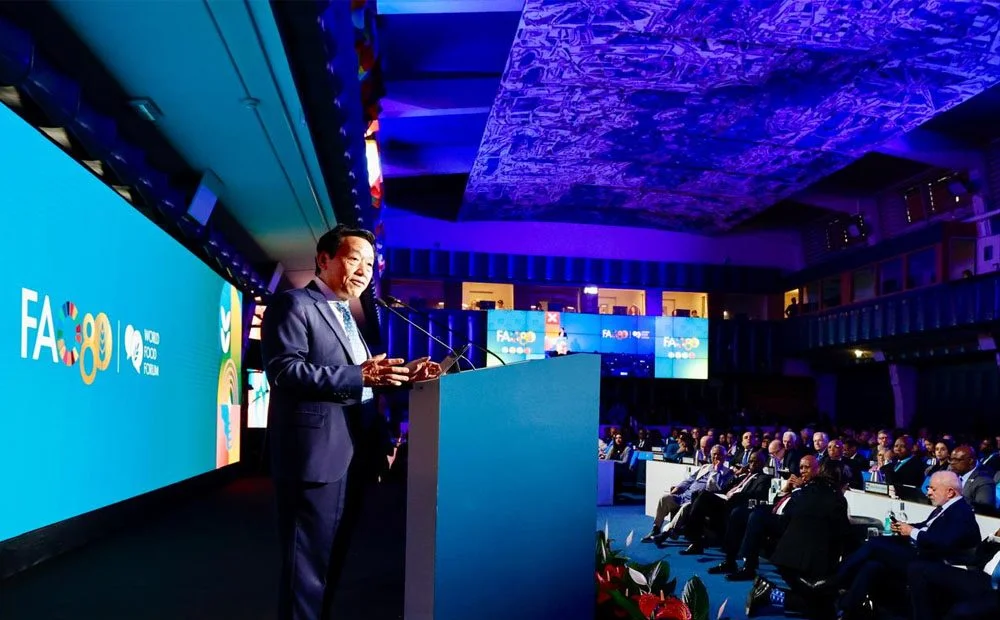
FAO Director-General Qu Dongyu issued the warning on October 12 at the opening of the plenary sessions of the World Food Forum 2026 in Rome. The event, held under the slogan “Innovate Today, Nourish Tomorrow,” runs through Friday, October 16.
Qu Dongyu told delegates of the World Food Forum 2026 (WFF) that extreme weather now threatens global food security at a scale the world has rarely confronted. The agency’s technical models identify a single driver behind the projected plunge, the hardening of droughts and floods that strike agricultural systems.
RELATED: FAO Opens Rome Forum With Focus on Global Food Security
According to the agency’s technical projections, the intensification of extreme weather events is hitting agrifood systems hard and threatening global food security. Qu described the impact of these phenomena as severe, stressing that the consequences fall most heavily on the Global South.
The forum brings together government delegations, farming communities, scientists and international investors. Their goal is to design structural responses to a climate crisis that, in the FAO’s assessment, punishes vulnerable regions with particular harshness.
FAO stressed that the projected outcome is not inevitable. According to the organization, it can only be avoided if governments and financial actors multiply and accelerate investments in three areas: technological innovation, the strengthening of rural and smallholder resilience, and the adaptation of local crops to changing climate conditions.
World Food Forum 2026: Flagship event opens under theme “Innovate Today. Nourish Tomorrow.”@FAODG QU Dongyu also inaugurates Global Youth Forum as week-long programme gets underway#WorldFoodForumhttps://t.co/xRTTdNk0Mo
— FAO Newsroom (@FAOnews) October 12, 2026
The agency also cautioned that ecological imbalances, aggravated by what it called predatory development models, are deepening inequality gaps and threaten the human right to food. Both dynamics, it said, converge in extreme poverty.
That framing sharpens the demand for deep change in international agricultural governance. Whether the projected outcome can be averted depends, according to the FAO, on urgency converting into investment.
This year’s edition places significant emphasis on Latin America, with the participation of leaders from a range of political backgrounds. The forum is scheduled to close with institutional messages from UN Secretary-General António Guterres and Pope Leo XIV, in a gathering intended to strengthen global commitments against hunger.
FAO’s projection adds to a growing body of warnings from international organizations about the links between climate change, food insecurity and poverty. Whether the forum produces concrete financial commitments, rather than statements of intent, is likely to be the key test of its outcome.
Strategic alliances against hunger sit at the center of the agenda. For the FAO, the equation is direct. Faster funding and smarter innovation today determine how many families avoid destitution by the end of the decade.
The alert lands as the forum seeks to convert pledges into action. Delegates have five days in Rome to turn the warning into commitments, and the 132 million figure now frames every negotiation in the room.
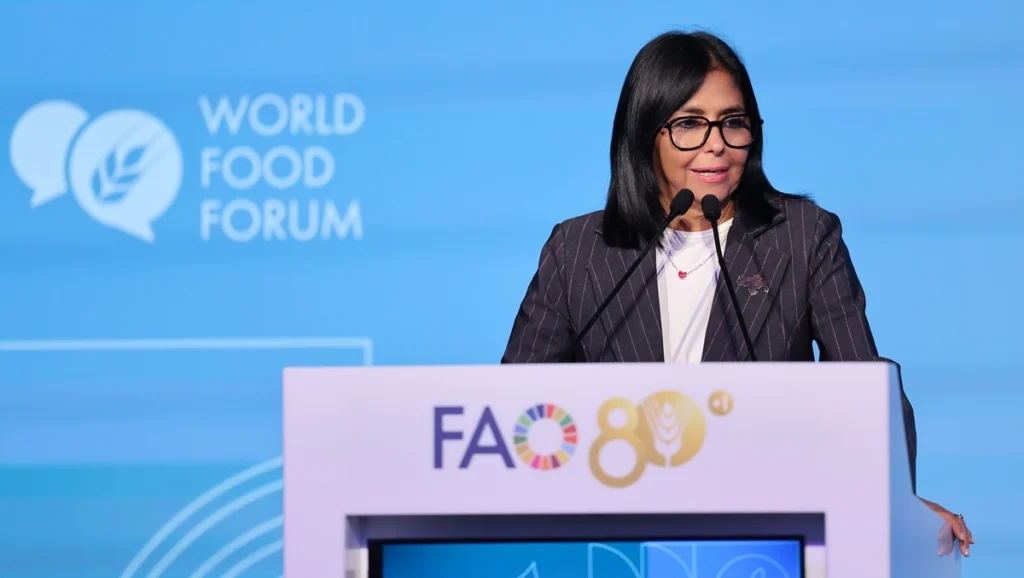
On Monday, Venezuelan Acting President Delcy Rodriguez announced before the 2026 World Food Forum (WFF) the launch of “Venezuela Feeds plan” and a new local economy law to achieve the “Zero Hunger” goal.
RELATED:
Venezuelan Acting President Rodriguez Attends 2026 World Food Forum
“Our aspiration is clear: that Venezuela once again reaches levels compatible with zero hunger before the year 2030,” she said in her speech at the headquarters of the Food and Agriculture Organization of the United Nations (FAO) in Rome, Italy.
Rodriguez explained that Venezuela Feeds plan will serve “to engage all food production processes in the pursuit” of eradicating hunger, to which a new law on local economy will be added that she will present in a few days to the Venezuelan Parliament.
“Venezuela arrives at this World Food Forum with a deep conviction: food is an inalienable right, directly linked to life, dignity and the integral development of people,” she stated.
“Guaranteeing that right requires inclusive and sustained public policies, but it also requires production, investment, science, technology, financing and cooperation. It requires peace and it requires an international system capable of cooperating even above our differences,” the Venezuelan Acting President emphasized.
Rodriguez defended that food should not be an instrument of pressure or political confrontation: “There, where differences exist between states, dialogue and diplomacy must prevail. And there, where hunger exists, our common responsibility must be to find solutions.” For this reason, the Venezuelan Acting President called for an end to the application of coercive measures that violate international law and have negative implications for the realization of the right to food.
She recalled that Venezuela, after important progress in the fight against hunger in the first decades of the century, later faced “a profound internal political confrontation that caused a strong contraction of our economy, a situation that was worsened starting in 2017 with the progressive imposition of unilateral coercive measures.”
“But we have begun to reverse that reality. National dialogue with opposition factors, as well as diplomatic dialogue with the United States, has added the political stability necessary to produce and grow,” Rodriguez asserted.
She defended that “Venezuela has undertaken a process of orderly, institutional and verifiable transformation” that will also have an impact on a new agri-food policy, “because no modern food system prospers without legal security over land and property, so that those who work the land can invest in it with certainty.”
Venezuela also aspires to use its energy strength to build the productive capacities of the future, Rodriguez said, who wants “to convert part of our energy income into permanent productive capacity.”
“Energy wealth can and must become a lever to guarantee agricultural production, that people can afford quality food and that the processes of nature are respected through regenerative agriculture,” she added.
“I come from Venezuela, a country that has known adversity in all its dimensions and that today is going through one of the most decisive moments of its history, but that has never renounced hope. Today we have decided to build our future with work, dialogue, knowledge and in a process of democratic transformation that guarantees coexistence and peace,” the Venezuelan Acting President emphasized.
teleSUR/ JF
Source: EFE
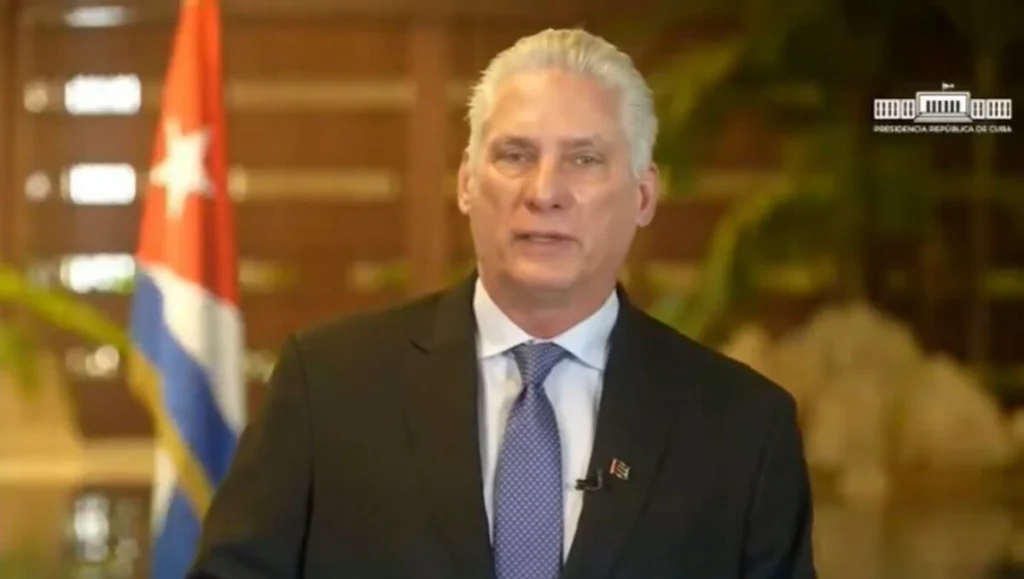
On Monday, Cuban President Miguel Diaz-Canel participated in the 2026 World Food Forum (WFF), organized by the United Nations Food and Agriculture Organization (FAO) in Rome, Italy.
RELATED:
Venezuelan Acting President Rodriguez Attends 2026 World Food Forum
During his address, he expanded on his denunciation of the ethical and political responsibility governments bear to guarantee the inalienable human right to food.
The Cuban leader warned that global problems such as armed conflicts, the climate crisis and economic turmoil disproportionately affect developing nations, where more than 640 million people suffer from extreme hunger.
Diaz-Canel emphasized that the challenges facing the Cuban nation are linked not only to global economic and environmental factors but also to the cumulative impact of more than six decades of the U.S. economic, commercial, and financial blockade.
He detailed how this policy of strangulation directly restricts the Cuban people’s access to international markets, advanced technologies, financing, agricultural inputs and fuels essential to sustaining the country’s agricultural sector.
Brazilian President Luiz Inácio Lula da Silva affirmed Cuba during the FAO conference, saying the island’s food crisis is not due to a lack of production.
— Belly of the Beast (@bellybeastcuba) March 7, 2026
“Cuba is going hungry because they [the U.S.] don’t want it to have access to the basics.” pic.twitter.com/519PcARBTt
The Revolution’s Structural Response to the Energy Blockade
The Cuban president strongly denounced the intensification of Washington’s aggression through the imposition of an energy blockade beginning in January.
This punitive measure affects the entire agri-food value chain, disrupting planting, food refrigeration, industrial processing, the transportation of supplies and distribution logistics intended to serve the population.
Nevertheless, Diaz-Canel asserted that, in the face of this systematic aggression, the Cuban people have transformed the challenge into an opportunity to accelerate profound structural changes.
Cuba’s strategy focuses on territorial decentralization, the promotion of scientific innovation, the transition to renewable energy in local food systems and the strengthening of domestic production to reduce dependence on external inputs, consolidating the country’s resilience under extraordinarily adverse conditions.
Live | FAO World Food Forum 2026 https://t.co/7kkZBg8ZFO
— teleSUR English (@telesurenglish) October 12, 2026
Strategic Partnership with FAO and Castro’s Legacy
Diaz-Canel highlighted the support provided by the FAO, a multilateral organization that has mobilized nearly US$100 million in resources, technical assistance and training to strengthen Cuban key productive sectors.
In this context, Cuba announced its incorporation into the Global Alliance Against Hunger and Poverty by presenting two projects with significant social impact designed to protect the most vulnerable sectors of the population.
Likewise, under the Hand-in-Hand Initiative, Cuba promoted two projects aimed at strengthening coffee and honey production chains, sectors of high strategic value for boosting rural employment, environmental sustainability, and export revenue.
As Cuba marks the centennial year of the birth of Commander Fidel Castro, Diaz-Canel reaffirmed that Castro’s longstanding advocacy for the right of peoples to a dignified life continues to guide Cuba’s social model.
He concluded by calling for the consolidation of a combative and solidarity-based multilateralism, stressing that food must be a collective right rather than a commodity subject to speculation or the political blackmail of imperialism.
teleSUR/ JF
Source: teleSUR
