Sen. Susan Collins, R-Maine, and Democratic challenger Troy Jackson will meet on the debate stage Thursday in one of the nation's most closely watched races during this midterm election cycle.
The agreement will allow CNN to receive compensation for the use of its intellectual property.
On Thursday, U.S. television network CNN announced an agreement with technology company Google to integrate generative artificial intelligence technologies into its news platforms.
“With this partnership, we are opening new avenues for audiences to access CNN’s exceptional journalism while receiving compensation for the distribution and use of our exclusive intellectual property in connection with AI products,” stated Sam Felix, senior vice president of Strategic Partnerships and Business Development.
The agreement will allow the use of experimental features designed to analyze and enhance audience engagement by exploring new ways to consume and distribute journalistic content.
“Google’s innovation in generative AI has transformed the way people discover information and content, and these tools will now help us explore new ways to be discovered and connect with audiences,” Felix added.
Of course, The Jakarta Globe asked me how I see AI tools influencing newsrooms — both in terms of opportunities and risks.
The U.S. network explained that its partnership with Google is part of the company’s AI strategy, “which ensures the protection of its intellectual property.”
The agreement is also part of a broader pilot program by the technology company to incorporate its AI technology to drive traffic to media outlets.
“CNN’s deal comes months after it sued Perplexity AI for copyright infringement after both companies failed to reach a licensing deal, its first legal case against an AI company over the unauthorized use of its journalism. At the time, a CNN spokesperson said the network ‘actively embraces the opportunities AI creates,’” Variety recalled.
“It also reflects the impact Google’s AI summaries in its search engine have had on news organizations, many of which have highlighted how the responses have eaten into their web traffic. Penske Media Corporation, the parent company of Variety, The Hollywood Reporter, Rolling Stone and more, sued Google last year over the decline, though a federal judge dismissed the case earlier this month,” it added.
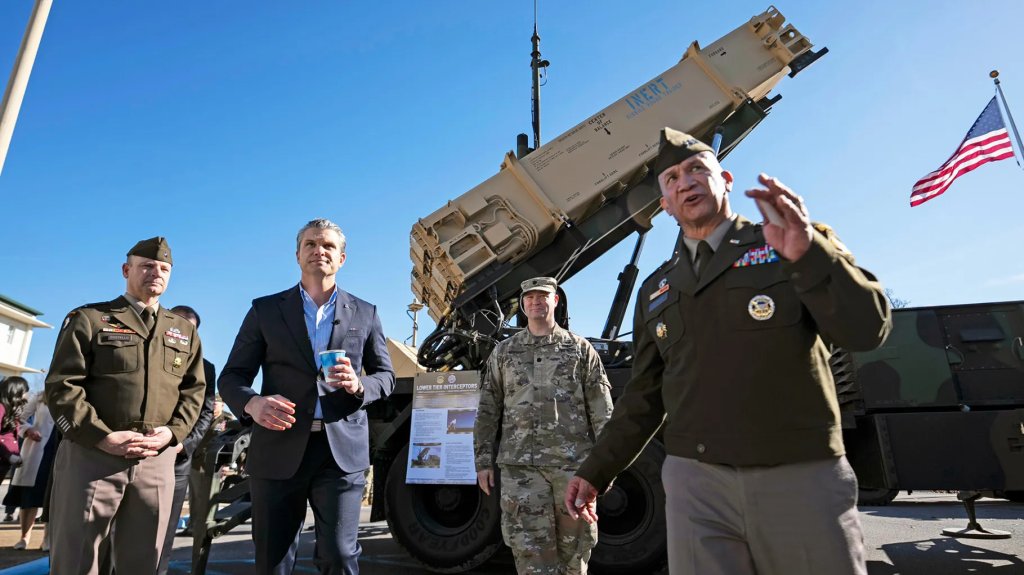
Army Lt. Gen. Frank Lozano, the service’s Portfolio Acquisition Executive for Fires, highlighted this growing trend yesterday during a panel discussion at the Association of the U.S. Army’s (AUSA) main annual convention, at which TWZ has been in attendance.
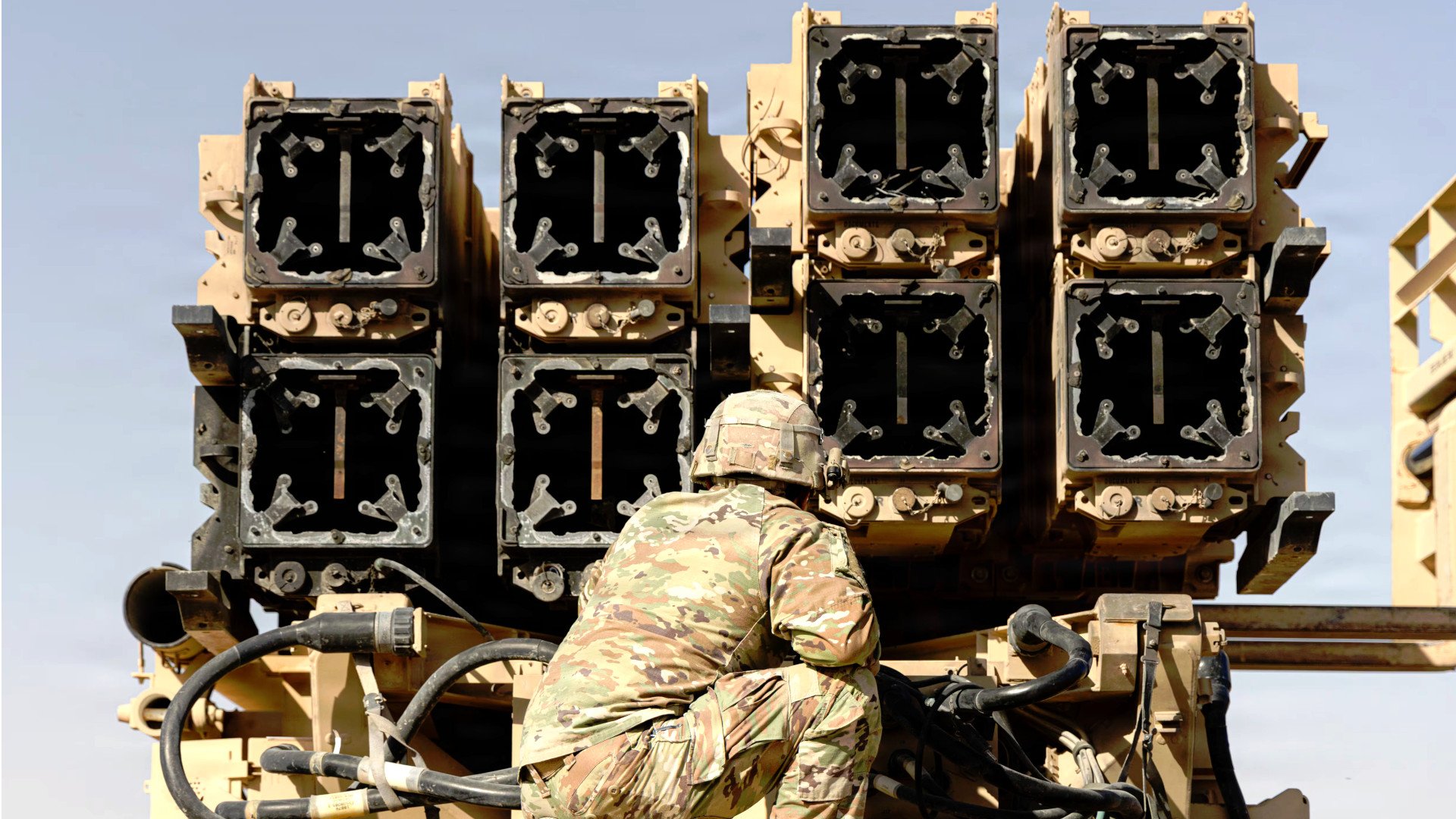
Secretary Hegseth, second from the left, seen in front of a launcher for the Patriot surface-to-air missile system during a tour of Redstone Arsenal in Alabama earlier this year. Army Lt. Gen. Frank Lozano is seen at far right. DoW/USN Petty Officer 1st Class Alexander Kubitza
To provide some immediate context, with the exception of Patriot, the main ground-based air defense systems in Army inventory today are fielded with just one type of interceptor. In the case of Patriot, the service’s procurement of new interceptors had also been increasingly limited to just one type, the PAC-3 Missile Segment Enhancement (MSE). Production of the preceding PAC-3 Cost Reduction Initiative (CRI) missile ended in 2023. Just earlier this year, the Army placed its first order in decades for new PAC-2 Guidance Enhanced Missile-Tactical (GEM-T) missiles, an older interceptor design for Patriot that has remained in production primarily for U.S. allies and partners.
A graphic showing different interceptor load options for existing trailer-based Patriot launchers. Lockheed Martin
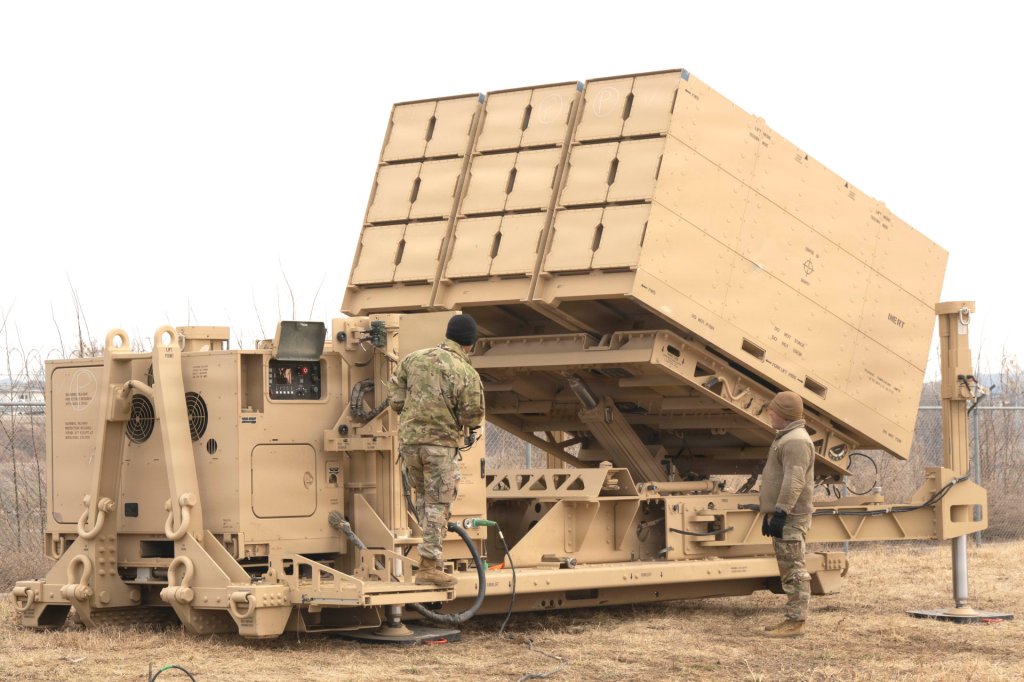
Separately, the Army is in the process of fielding Enduring Shield, a new middle-tier air defense system designed to handle multiple interceptor types. However, the service is currently only acquiring AIM-9X Sidewinders to load into them. We will come back to this later on.
An Enduring Shield launcher. USAF Pfc. Sang Woo Choi
“We have the capabilities we need to have to fight and win, but it’s our job to ensure that victory is achievable in the future inside of any dynamic environment scenario fight we might find ourselves in,” Lt. Gen. Lozano said yesterday. “So, it’s incumbent upon Mr. Ingraham [Assistant Secretary of the Army for Acquisition, Logistics and Technology Brent Ingraham] and I to continue to be creative and looking at, well, should we buy GEM-Ts because they’re being produced?”
“GEM-Ts are a really good missile in the battlespace within they operate. I mean, they’re being employed today by air defense brigades around the world,” he continued. “So if we have the opportunity, it’s probably something we should take advantage of, and we’re looking at doing that.
“We’ve had a lot of discussions about even more interceptors. From a PAC-3 MSE perspective, our goal has always been to get to 2,000 [per year],” he added. “Why we’re running programs like LCI [Low Cost Interceptor], and NGSRI [Next-Generation Short-Range Interceptor], and NGCM [Next-Generation C-UAS Missile], and Second Interceptor, is because I think the easy button answer is just buy more of a great missile. We’re going to buy more [PAC-3 MSEs], but when we start talking about overall missile output, we start looking at numbers like is it 4,000, is it 6,000, is it 8,000, we’re looking at a diverse set of capabilities.”
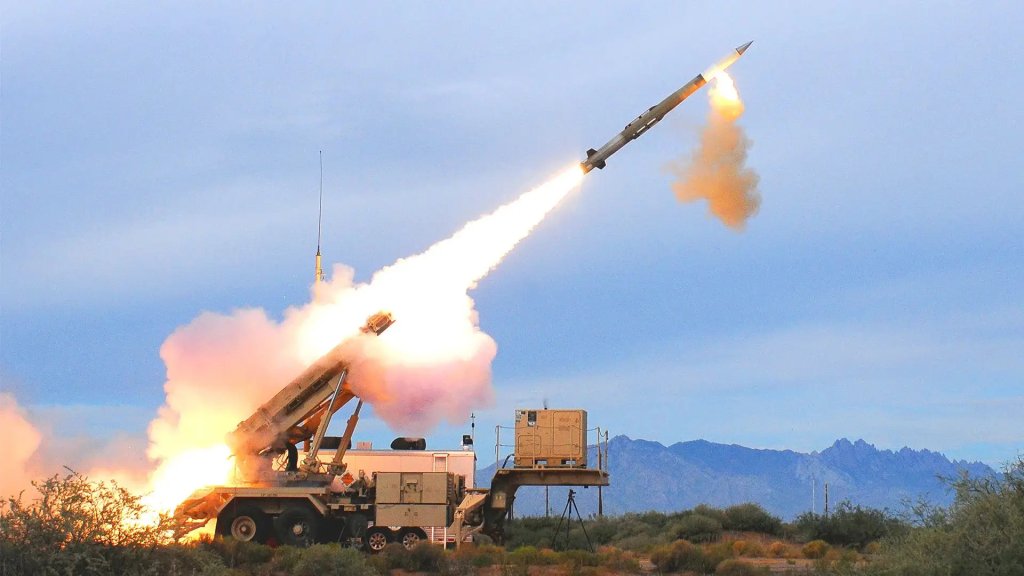
The LCI program is seeking a lower-cost and lower-tier interceptor for Patriot with a unit price of no more than $1 million. PAC-3 MSE’s average unit cost has been around $4 million in recent years.
A PAC-3 MSE interceptor seen being launched. US military A Patriot launcher fires a newer PAC-3-series missile during a test. DoD
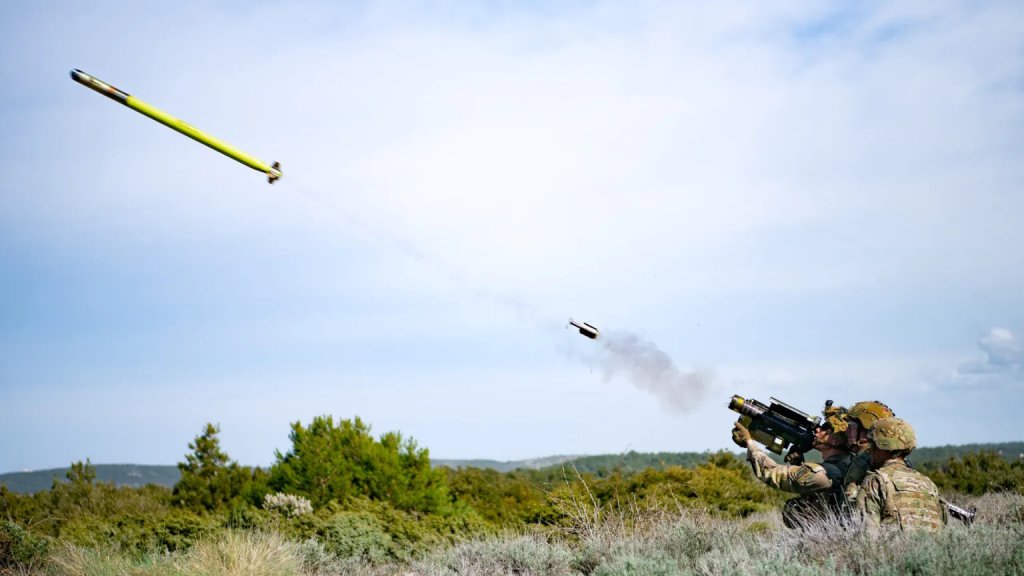
NGSRI is the Army’s program to find a replacement for the venerable Stinger. The new missiles have to be compatible with existing vehicle-based and man-portable launchers.
A US Army soldier fires a Stinger from a man-portable launcher during training. US Army
The Army is working to field a new counter-drone interceptor through NGCM. Those missiles will be integrated into launchers the service has now for the Coyote interceptor.
The Second Interceptor effort is for Enduring Shield, which is also known as the Indirect Fire Protection Capability Increment 2 (IFPC Inc 2). The main goal there is to provide increased capability against incoming cruise missiles compared to the AIM-9X.
There is also the Army’s Future Interceptor effort, which also came up separately at the panel yesterday, and is also for Patriot. Unlike LCI, the aim here is to acquire a new interceptor with improved capabilities against hypersonic missiles and other upper-tier threats.
Historically, Army programs like these would eventually result in the selection of a single winning missile design. Lozano’s remarks yesterday point to the service increasingly taking a very different approach.
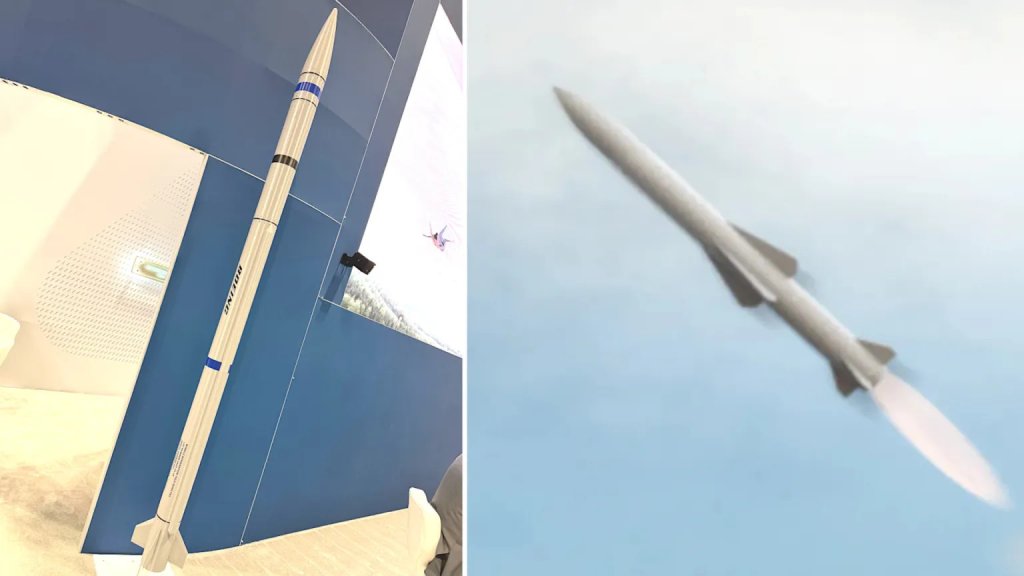
On “second interceptor, obviously, we just moved into phase two of that program. We’ve got Lockheed Martin competing with Boeing, who was teamed with Anduril,” Lozano said. “But we wanted to turn up the heat on that program. I constantly get frustrated when a funding profile emerges over the FYDP [the Future Years Defense Program], and then magically we lay in a five-year program.”
At left, a model of the Boeing/Anduril offering for the Second Interceptor effort. At right, a rendering of Lockheed Martin’s proposed Second Interceptor. Jamie Hunter/Lockheed Martin
“I’m like, no, I actually need that capability now,” he continued. “So, have we thought maybe what if we ran a 24-month program or a 36-month program, right? And so, in that vein, what we have decided to do is, while those two companies continue to compete, we’re going to create a shoot-off opportunity in [the] fourth quarter [of Fiscal Year 20]27, and I want to run an in-parallel, what I call an in-stride competition.”
“We just held an industry day, and we basically just said, hey, if there’s any other company who didn’t make the first cut in the phase one, but, oh, by the way, who continued to invest in the IFPC Second Interceptor capability, we’d love for you to come out to the range,” he added. “We’ll give you range time, we’ll present targets, and we’ll allow you to recompete with an opportunity to get back into the program folder.”
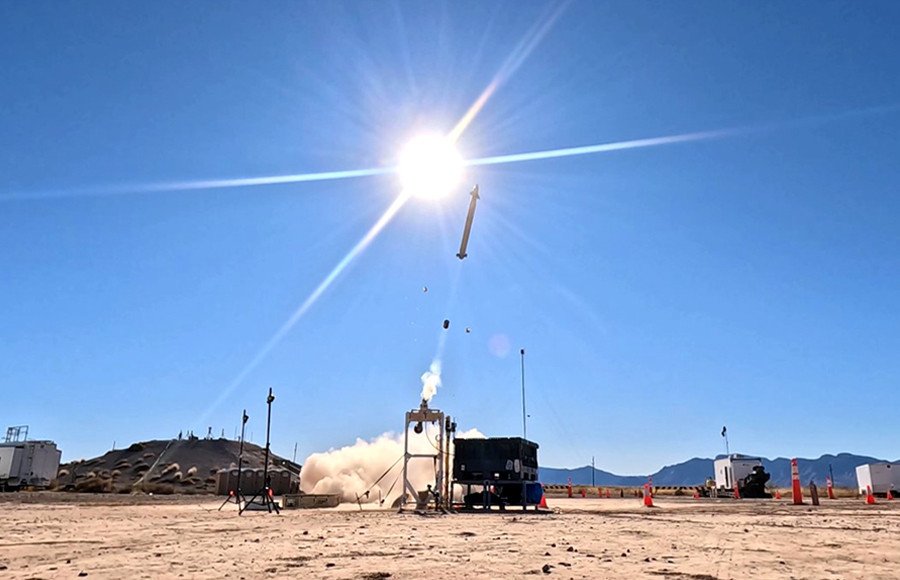
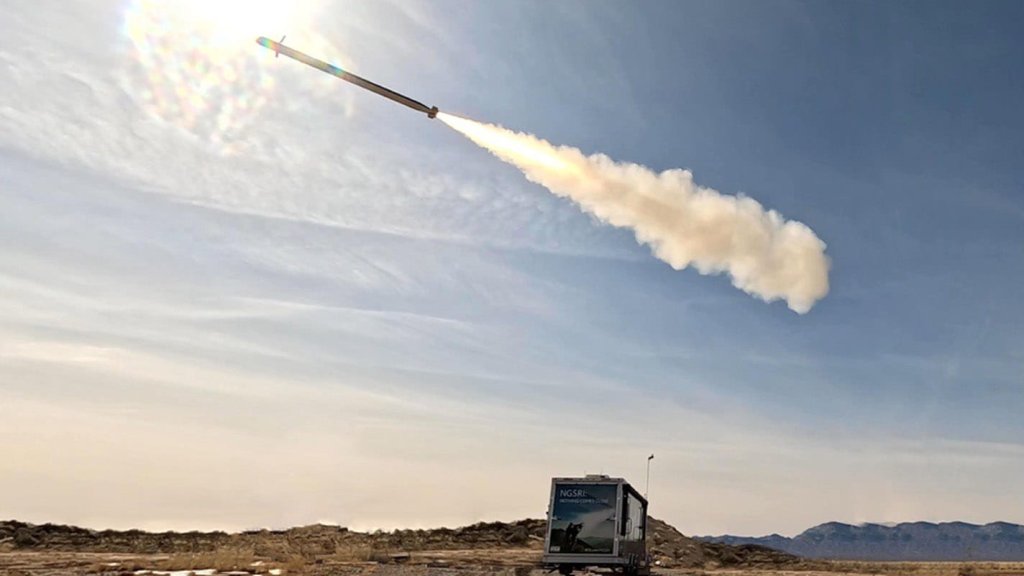
The Army is doing the exact same thing with NGSRI, where Lockheed Martin and Raytheon have been competing face-to-face. That program is also now planning to hold a new shoot-off that will be open to other vendors in the fourth quarter of Fiscal Year 2027.
A picture showing a test of Lockheed Martin’s NGSRI entrant, called QuadStar. Lockheed MartinRaytheon, which is also the prime contractor for Stinger, has previously released this image in relation to work on its NGSRI design. Raytheon
To reiterate, on top of all this, the Army is also now pursuing at least two new interceptor options for Patriot.
“We have to address the threat, and we need to address the threat in a complementary way, meaning we need to fight on a cost curve that’s affordable for the U.S. Army to maintain and sustain that warfighting capability abroad,” Lozano stressed yesterday.
This gets to the crux of the matter. It is not at all a new observation that just having a stockpile of any particular munition on day one of a conflict is not enough, especially if the fight becomes drawn out. There needs to be sufficient depth to those stocks at the start and the ability to readily replenish them in line with expenditures. The war with Iran, compounded by other crises in the Middle East and the ongoing conflict in Ukraine, has made clear that these core truths apply to all armed forces, even the U.S. military.
Lower-cost munitions are part of the solution, but they also need to be producible at scale on reasonable timelines. The lead time for higher-end munitions today is often measured in months, if not years. Furthermore, being locked into a single vendor has been shown to not just be undesirable, but a potential national security risk in an actual conflict. Lozano’s remarks yesterday, and how the Army is now pursuing new anti-air interceptors, reflect larger trends, not just in the acquisition of larger volumes of munitions overall, but also from a broader array of total suppliers.
The @DeptofWar has reached new framework agreements with a slate of disruptive new entrants to aggressively expand the United States military’s lethal cruise missile and hypersonic missile strike capabilities.
With regard to the LCI program, specifically, Lozano highlighted an additional aspect of all of this yesterday.
LCI has “a unique twist to it because we’re looking for companies who have all-up rounds, but I’m also asking for companies to come in at the component level,” he explained. “We typically don’t do that, right? There’s a lot of risk in managing components and generating all-up round systems. But we’re also looking for weapon system integrators, because I want to be able to create two or three teams who can compete with the all-up round guys to see if we can generate some momentum behind the fact that we need to thicken our inventory with low-cost, affordable munitions.”
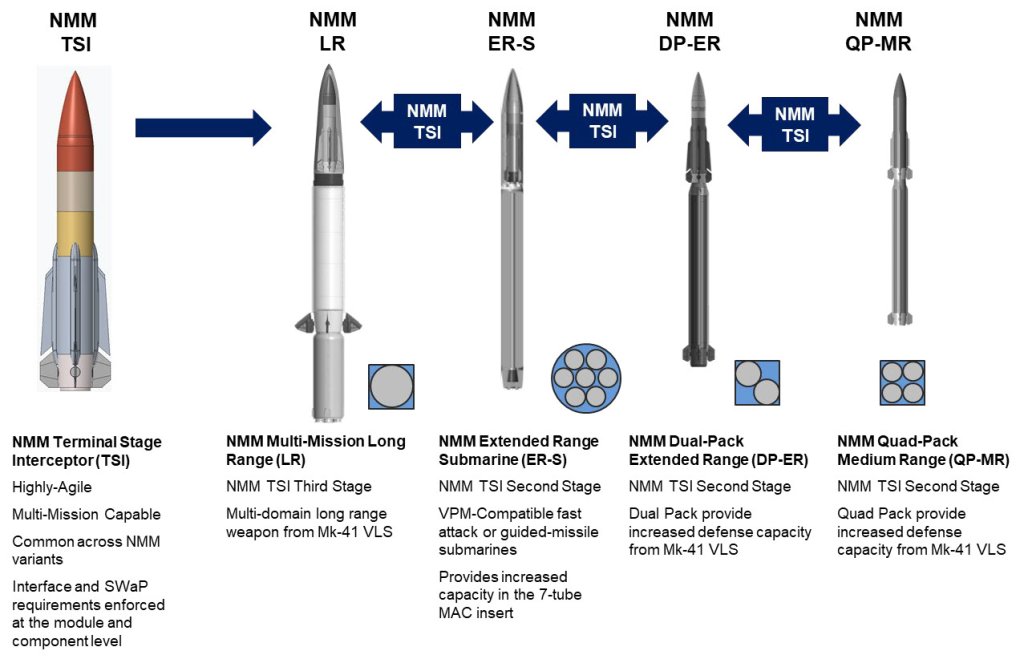
The U.S. Navy is now pursuing a roughly similar approach with its Naval Modular Missile (NMM) program. NMM envisions an entirely new family of sea-launched surface-to-air missiles that offer very different capabilities, but that all feature certain common components, as you can read more about here.
A graphic laying out the Navy’s vision for the different members of the NMM family, and shared components between them. USN
It is also important to note here that the underlying aim is not to eliminate more exquisite munitions, or the capabilities that they offer, but to create a more affordable, complementary mix of options.
“What I would say is we’re solely focused on delivering on the programs we are executing now,” Lozano said in closing at the end of the panel yesterday. “We have to deliver, and if we deliver on that wide variety of capability, then we can increase and ramp that capacity. And that would be my wish list, that we have enough resources and we achieve programmatic success in the way that we’re planning to, so we can deliver in mass.”
All signs point to the diversity in munitions that Lozano is talking about here being particularly pronounced in future Army air defense capabilities full of systems firing multiple types of interceptors.
Ukrainian and Japanese officials discussed establishing backup bridge crossings in the event of Russian strikes, preparing municipal infrastructure for winter, and Japan's continued assistance with Ukraine's recovery, Ukraine's Minister for Restoration, Infrastructure and Transport, Mykola Kalashnyk, reported on 14 October.
Russia is targeting Kyiv's bridges to paralyze the city and break civilian morale, defense analyst Hamish de Bretton-Gordon wrote in The Telegraph. On 1 and 2 October, Russia attacked Kyiv's Southern Bridge, then struck the Northern Bridge on 3 and 4 October. Ukraine is now working with international partners to establish backup bridge crossings that could maintain connectivity even if major routes are damaged.
The discussions took place during a meeting between Minister Kalashnyk, Japan's Ambassador to Ukraine Yo Osumi, and Osamu Hattori, head of the Japan International Cooperation Agency (JICA) office in Ukraine, according to the statement.
Ukraine's Minister for Restoration, Infrastructure and Transport Mykola Kalashnyk during a meeting with Japan's Ambassador to Ukraine Yo Osumi and JICA Ukraine Office Chief Osamu Hattori, October 2026. Photo: Mykola Kalashnyk/Telegram
Backup crossings could prevent logistical disruptions if major bridges are damaged
Kyiv's Southern Bridge, for example, plays a critical role in logistics because freight traffic uses it, transport planning expert Dmytro Bespalov noted in an article for Ukrainska Pravda. At the same time, installing additional metal structures to reinforce bridges could be dangerous given their technical condition and existing load levels, he said.
One potential solution is to establish backup bridge crossings.
Ukraine and JICA have agreed to continue working together on engineering solutions for setting up these crossings. Japan has already delivered 720 meters of prefabricated bridge structures to Ukraine, which are expected to be used to create alternative routes if Russia's attacks damage major bridges, Kalashnyk said.
The initiative is intended to help maintain transportation links, ensure the delivery of critical supplies, and preserve evacuation routes for civilians.
The flags of Japan and Ukraine displayed on a screen during a meeting between Ukraine's Minister for Restoration, Infrastructure and Transport Mykola Kalashnyk, Japan's Ambassador to Ukraine Yo Osumi, and JICA Ukraine Office Chief Osamu Hattori, October 2026. Photo: Mykola Kalashnyk/Telegram
Ukraine prepares water utilities and boiler plants for winter amid the threat of Russian infrastructure strikes
During the meeting, Ukraine and JICA discussed equipping water utilities with backup power supplies, addressing the need for modular boiler plants, and obtaining equipment to ensure uninterrupted heating and water services. Ukraine has already submitted lists of the necessary equipment to JICA for consideration as part of a new emergency assistance project, Kalashnyk said.
An intercepted document outlining an alleged Russian plan for strikes against Ukraine this winter reportedly describes attacks on 60 critical infrastructure facilities using up to 1,000 missiles, drones, and aerial bombs. Potential targets include electrical substations, hydroelectric power plants, thermal power plants, boiler facilities, and infrastructure related to water supply and wastewater management.
Kyiv during a blackout caused by Russian strikes on energy infrastructure, 11 October 2026. Photo: Yan Dobronosov
The document also describes potential strikes on facilities in Kyiv, Kharkiv, Odesa, and several other cities. Such attacks could disrupt electricity, heating, water supply, and wastewater services.
No social network has dipped back to pre-Oct. 7 hate level, Australian Online Hate Prevention Institute says, adding the data refutes claim that legitimate criticism of Israel is mislabeled as Jew-hatred
Daniel Barnum | Longreads | October 15, 2026 | 4,116 words (15 minutes)
This essay is co-published with the literary magazine AGNI and appears in this fall’s AGNI 104.
The Hyrtl Skull Collection is the first exhibit you notice when you walk into the Mütter Museum at the College of Physicians of Philadelphia. This is by curatorial design: The skulls face the main entrance, staring steadily at each person who crosses the threshold. All 139 are evenly spaced in long lines behind the glass doors of a towering cherrywood cabinet. Each one rests in a wire frame on top of a thin balsa box with a tag at its center. I recall tracking them with glances as I shuffled nearby with two friends, as part of a large crowd. Small bright lights illuminated them from inside the cases, making them glow dully from my angle. Seeing them for the first time, I was both mesmerized by this effect and intimidated by the skulls’ great number. I tried not to look for too long, but the density of people on the narrow walkway made that impossible: I was soon stuck in the dead center of the exhibit. Almost in spite of myself, I scanned the wall text and learned how they had been brought together to disprove a piece of 19th-century race science, which seemed like one of the better reasons to collect skulls.
Most of the exhibits in the Mütter Museum have similarly odd origins. Tucked into a corner of the College of Physicians’ stately New Beaux-Arts building, the Mütter is a 19th-century medical teaching collection/cabinet museum with an annual visitorship of almost 150,000 people. Its staff goes on late-night talk shows with specimens in tow, hosts YouTube series. The gift shop sells soaps and keychains in the shapes of its artifacts. Coming out of a death-obsessed past into an incongruous living present, the exhibits are caught somewhere between scientific exemplar and exploitative spectacle. The museum acknowledges its reputation as a freak show and, in response, doubles down on the meanings of curiosity. Signs we saw at the main gate declared the place’s ethos: disturbingly informative.
The text beside the skulls explained itself: Brought together is a euphemistic way of saying, assembled by grave robbing. Dr. Hyrtl dug up a lot of his collection, or had assistants do it for him. Or paid other collectors, other doctors. The graves were attached to hospitals, madhouses, prisons. Some of the people these skulls belonged to surely had surviving relatives, though none could afford or cared to pay for burials and upkeep, and no one has made any claims on them since Dr. Hyrtl sold his collection to the College of Physicians in 1873. The College has the distinction of being the oldest professional medical organization in the United States, and was thus a trusted member of the international buyers’ network for bodies, whole and in parts.
I barely recall that history when I’m called in for a job interview. I quickly look up the museum online, which is why I have something to say about the Hyrtl Skulls during the interview. But I can’t keep up the pretense. I begin to ramble about the real reason I went that first day. There was a special exhibit of tsantsa (shrunken heads) on view, reported to be the most extensive group ever brought together, most on loan from private collectors. The Hyrtl Skulls were on the upper level, set opposite the entrance. We looked lost—so a security guard pointed us toward the stairway’s descending brass banister and red carpet. Across from the melting skeleton, she told us.
Downstairs, we watched a middle-aged white woman wearing a fanny pack and soft baseball cap peer around curtains and squeal before turning away. We entered where she wouldn’t into a columned salon crowded with the museum’s teratology collection and displays of sundry wet specimens. Fetal variations. Rows of organs jellied into translucence, bound by webs of blood vessels dyed blue and red. At the far wall, the tsantsa were tiered on stands in a wide, purpose-built wood case. There were dozens: small, leathery heads still recognizably human though passed out of identity. The shrinking process had exaggerated some features, vanished others, and blackened the flesh. Many had long, black hair braided with beads and strung with bright parrot feathers. They were beautiful and horrible, familiar and strange. I could not stop staring. Their eyelids had been sewn shut.
The poet Mary Ruefle writes about shrunken heads in her essay “My Private Property.” She reflects on growing up in Brussels and regularly skipping school to commune with a particular shrunken head in the collection of the Congo Museum, “that horrific monument of smashed lies and beautiful things.” The ruminations lead her to realize she “wanted to die.” My own day with the tsantsas felt like the opposite: It was initial, not iterative; it was a whole bunch of heads, not a singular one; I was happy, adult, new in town, not alone, truant, or passively suicidal. That first time in the museum, I by no means “wanted to die.” The life I was starting in the city was meant to be the cure for a bad ending, a bad boyfriend. For being a bad boyfriend. For Boston. When I got to Philly, I could believe that the last years of my life just hadn’t happened and here I would begin a real life in a real city. And even though, when I sit for the interview at the Mütter and have cause to answer the question Have you ever been here before?, I do indeed want to die, I am not, despite all my wanting, dead yet, so I need the job.
They were beautiful and horrible, familiar and strange. I could not stop staring. Their eyelids had been sewn shut.
Needing the job came from wanting to die. A month earlier, I quit the copy shop where I worked since coming to Philly. There, weeks earlier again, an unknown number with an area code I recognize—Tucson, Arizona’s—comes over my phone while I’m at the counter sending a fax. The call I’m expecting from my aunt. It’s been 15 years or more since we last spoke, and longer since we saw each other. She found me online and emailed late at night, while I was sleeping. I arrive for my shift, log onto a work computer—it’s a little before noon—and her note is waiting: Danny, I have to talk to you about something. Please send me your number. I type it into the message bar, then work keeps me distracted for the next few hours. The fax goes through. I charge the guy $4.27 and he calls me a criminal. I tell my boss, I’m gonna take off for a sec, then cross the counterline, snake between the customers, and open the door.
Outside, I walk the block, not ready for the call. My mom’s family has been estranged my whole life and generations back before that. Growing up, hearing stories, it felt odd that any of my people should have found each other to begin with. They were from all over the map. Most were fleeing unimaginable things. They never stayed together, barely knew each other to begin with. Brothers, husbands, mothers, children, grandparents—all were lost again and again in life, and then in death. Was grief resounding? Some stories my mother told me about her childhood made her very sad (an angry father gone, her spine turning in on itself, the inheritable tragedy of her psyche), but many were happy. Her sister fit somewhere in the middle. I met her only a few times I could ever remember, and knew her best by her semi-regular phone calls with my mom, though I heard only my mother’s end of those conversations and was young when the two were still on speaking terms. What I knew of her was mostly my mom’s eye rolls, the gesture of her fingers forming a gun against her forehead and her deadpan expression as she cocked her thumb and pulled the trigger. This would make me laugh so loudly my aunt would ask, What’s so funny?—or so I supposed, hearing my mom’s response: Nothing. He’s watching a movie.
I thumb the buttons on the side of my phone crossing the street to the main quad of campus. A spot appears on the open lawn, half under a plane tree’s shade and a bit beyond the arcs of a frisbee thrown between three people. I sit down. I know what this call will be, what she has to tell me. Though I feel certain, I hope for the best, or at least that she’ll deliver a line I’ve heard before: My mom is in the hospital, she’s in a psych ward, she’s in jail. No. I call my aunt, and after quick, strained How are yous, she confirms my worst thoughts in swift, worsening terms. Your mom is dead. She was murdered, and soon, Threw her body in a dumpster. After all the other details she knows: A month ago. She has waited a month to find me, to tell me. She cannot explain why. We don’t have much more to talk about. I make a plan to check in over the next few days about coming out for the memorial they’re holding where my grandma lives in New Mexico. We already had two here in Tucson, she tells me. I say, Okay, gotta go, and lie down in the grass.
For three days I lie in bed, alternating between barely being able to move and being violently wracked with sobs. I toss back and forth between the numbness of certainty—of believing I knew before I heard—and supernatural disbelief. I wail like the wounded animal I am. On the third day, it’s my birthday. I ask for a new world. My boyfriend and my housemate take me to the trails through the forest above the little cliffs along the Wissahickon. The bright August light comes through the trees on the top of a rise, and my boyfriend takes my picture, but I have no awareness of this until the film comes back. I spend the hike trying to smile whenever I realize someone is looking at me, or, short of that, trying very hard not to cry. In my sunglasses, slumped into my boyfriend’s shoulder in the backseat on the way home, I feel like Bernie in Weekend at Bernie’s. Like the actor playing Bernie.
I’m lying down in the grass again, in the front yard of my childhood home, visiting with my oldest friend, when she says something about how truly wretched the world is, and I laugh. Not at what she says, but how she says it. It’s the first time I’ve laughed since I talked to my aunt. Which is a euphemistic way of saying since I heard my mom was murdered. When it happens, my laugh feels like a betrayal. I do not know how I am going to live in this world. You get it! I tell my oldest friend. My boyfriend holds my hand on the flight from Philadelphia to Albuquerque, and on the bus down to Las Cruces. He holds my hand in the church hall at my mom’s third memorial service, except when I have to stand up in front of the room full of strangers to give a eulogy. On the ride from the service, sitting next to me in the back-backseat of an SUV so cavernous it swallows my aunt’s soft voice in the front, he pulls his hand back when he gets a text meant for me from our housemate back in Philly. Bad timing/great gig, it reads, with a link to a Mütter Museum job listing that closes the following day.
In a few days, I’ll be in the Pima County Courthouse in Tucson, sitting across from the murderer, and, that evening, my aunt will hand me the small black plastic box containing my mother’s ashes. My mother as ashes. My mother in the form of ash.
There’s no grass to lie down in at my aunt’s hotel, where she’s having our family gather for a post-memorial pool party, so I update my CV in the computer lab. More betrayal. When I finally get in the water, I race my youngest cousin, whom I have never met before. I stay under as long as my breath holds. In a few days, I’ll be in the Pima County Courthouse in Tucson, sitting across from the murderer, and, that evening, my aunt will hand me the small black plastic box containing my mother’s ashes. My mother as ashes. My mother in the form of ash. Time and places are spiraling, have been since I heard. I’m still hearing, still seeing. The next week, in Philadelphia, the copy shop welcomes me back, but I can’t last more than 40 minutes of my shift. I do not know how I am going to live in this world. The world going on: the worst betrayal.
I don’t say all that in my interview. Nobody is prepared to hear Devastating tragedy made life as I knew it incomprehensible in answer to Why did you leave your last position? A month has passed since I quit, two months since I heard about my mom (a euphemistic way of saying since I heard my mom was murdered), three months since her murder. As with her ashes, putting the murder into her possession feels off to me. Did she own it? Was it part of her? It wasn’t something she could claim, like a package or a piece of luggage. She didn’t have too much to do with it; she was the one with too much done to her. Too much: a euphemism my brain conjures to replace images of actual violence, conjured from police reports and testimony from eyewitnesses and the man I sat across from in the courtroom. This pattern—unbidden images, then banishing language—I can’t seem to control.
In the interview, it’s just me and my broken brain and a copy of my CV I ran off on 24-pound cloudy-gray stock that last day at the shop. Bullet points about things someone with my name did, all the stuff I’m supposed to know how to do. I thought those shrunken heads were really cool, I tell the woman, and she says she thought so too. Gasps, Wasn’t that incredible?, when I mention the green and blue iridescent beetle wings braided into their hair. I understand her as someone who loves her job, which is something I have always thought questionable, if not impossible, but she is an adult goth on payroll with full benefits at a 19th-century wunderkammer of death, mourning, and human oddities, and that constellation of person and circumstance has never before formed in my mind. Although it should have, as I am, in my way, an adult goth, and all the more lately with mourning and death so readily in my thoughts. I would soon come to learn that most of the staff of the Mütter Museum and its parent organization, the College of Physicians of Philadelphia, were, each in their way, adult goths. Where else would we go?
They were really controversial. Holly, my new boss after the interview, tells me that the museum got a lot of heat for the tsantsa exhibit’s perceived disregard of ethical practices. It wasn’t always clear where the heads came from or how people got ahold of them in the first place. Plus they just really freaked people out. I laugh, then stop laughing, because I don’t want to seem like I’m laughing at ethics violations or shrunken heads. I’m laughing at people being freaked out by shrunken heads, although I understand. Really I was laughing in response to the tone in her voice which indicated humor in the phrase freaked people out. My focus was on cues: Smile when someone smiles at you. People like to complain, Holly says.
You’ll be dealing with a lot of people, hundreds on the weekends.They’ll either love it or hate it, and they’ll let you know. If anyone asks for a refund, if they’ve been in the museum longer than 15 minutes, tell them no. Holly points to the red refund button on the museum’s ticketing screen, then clucks her tongue as she clicks and the amount on the screen turns negative. She touches a big gray button and a receipt prints on a scroll of paper as the cash drawer jolts out. Make sense? she asks, and I nod, mmmhmming in unison with the two other hires. It’s my turn. She has me pull closer to the screen and the chair’s wheels twirl beneath me. Gray button, red button, gray button, drawer. See? So easy.
It’s a little after 3:30 p.m. on a Wednesday, one of the slowest times of the week, perfect for training. This is our first shift. We’ve been walking and talking since 11 a.m., and have been at the register for over an hour now with Holly explaining shortcuts and the various branchings of ticket types. Erin, Christina, and I take turns selling to dwindling bursts of visitors. Erin and Christina are nice, but nervous, and I assume I must be assumed as such too. I am smiling on cue and exhibiting a genius for point-of-sale software, but not making a big deal about it. I am trying hard not to cry, and I will somehow succeed at this during work hours for years. That morning I told myself in the mirror, NO CRYING!—which made me feel foolish, which made me start to cry. And then laugh. Early on in the shift, Holly mentions the possibility of this gig going full-time, and I take this as a reason to live. My survivor benefits end in a year; I’ll need the insurance to pay for the therapy I’m about to start after the predetermined date when the state of Arizona says grief should stop, or at least that their obligation to pay for it is over. I’ll need the therapy because it’s where my brain gets good at going to work, at living in the world. Once a week, I’ll feel normal, allowed to be wholly in grief. After each session, I’ll walk the mile home, and pass the same patch of grass I lay down in when I first heard. Everything I don’t want to think about will rise up from the ground all around me. Too much.
My survivor benefits end in a year; I’ll need the insurance to pay for the therapy I’m about to start after the predetermined date when the state of Arizona says grief should stop, or at least that their obligation to pay for it is over.
Training overloads us with information. There are dozens of people on staff with names to memorize and departmental relations to understand, hidden wings of the building to explore, intricate calendars to master. Novelty begins to balance out my psychic deadweight. I touch the grid of buttons on-screen, and even that slight activity pushes the unwanted sights to the edge of my mind, even out of it. I’ve barely thought of my mom (mom becoming a euphemism for her murder) since I started this shift, but how long can that last? The number of minutes between visitors is increasing. When the museum closes at five, we’re to refill the brochure stand and empty the plexiglass cube people drop their guest badges into as they leave, but for the next hour, there’s not much to do. Why don’t you guys take a break and check out the collection? You’ll get a real tour next shift, but for now, just spend some time in there. Holly lists some of the exhibits she loves—The Soap Lady, Harry Eastlack—and tells us to go wild.
We walk a diagonal across the College’s marble entry hall, where a classical statue that I’ll learn is Asclepius, the Greek god of the healing arts, carries a big club with a snake wrapped around it. There are thick curtains to duck under, and suddenly we’re in a deep red chamber faceted in brass, glass, and wood. Bodies and parts are everywhere we look. The shelves are covered with objects and specimens in a curatorial vision bordering on horror vacui. Whoa! It feels totally different, Christina says. She’s never been here when the museum was empty like this, and neither have I. With no living bodies standing between us and the other bodies, there’s a lot to look at all at once. I turn to follow the balcony’s open ring around the stairs, my eyes passing over a bezoar, some bloodstained lengths of gauze . . . but I can’t fix on anything. Then: skulls.
One hundred thirty-nine. I do not try to count them. They range in size, in general and specific shape. The color of each varies: gray, amber, yellow, ivory, gleaming white. There are different bumps and divots in the bone to take in, small details differentiating each one from the next. Many are missing teeth, a few have cracks or slashes or holes left from when something outside forced its way in. Knives and sabres and bullets. The trace of bone plates’ fusion remains in jagged lines like black lightning. Labels below each head form a piecemeal map of Europe, the Levant, Western Asia, and North Africa. Places people I come from came from. I stand for a long time in front of the case, thinking about how they all ended up here, together, these people who would likely never have met in life. The 19th century is long gone; phrenology is and was always bunk—so what lesson can the specimens teach me? My vision relaxes the longer I stare, and the skulls begin to blur into one another. When I catch myself and sharpen my sight, I see my face reflected in the glass, eye-level with the center row. My ghost between two skulls in a long line.
Despite the claims of collectors, a skull can only belong to its own person, not a museum or any other buyer on the market.
For the next few years, I see these sights almost every day. Not like the images I try to block out: The skulls are real, not a secondhand reality become trauma, making life feel over while it’s still going on. My grandma tells me she has bad dreams. My aunt has religion. I have a diagnosis and a steady job at the goth factory. I see the skulls every day I work—five days a week when full-time comes through. Whenever security calls me into the museum over the walkie talkie, whenever I’m just strolling on shift, or passing through to use the secret door on my lunch break. Sometimes, I linger at their case and read what I can make out of the lettering on a few of the frontal bones. Some skulls were engraved with the names of their former owner, if known, along with ethnicity, occupation, age, and cause of death, as these were the pertinent details Dr. Josef Hyrtl needed for making his case against phrenology. Despite the claims of collectors, a skull can only belong to its own person, not a museum or any other buyer on the market.
I appreciate the attention to detail. I’m close enough to read the incised black letters on one of the skulls. Despite wanting Philly to overwrite Boston, the German that I learned at an old job in Massachusetts is still good enough to let me make out most of the inscription. The tag on the base fills in the rest: Geza Urmenyi, 80. Romania. Protestant, shepherd. At age 70, attempted suicide by cutting his throat. Wound not fatal because of calcified larynx; laryngeal fistula remained. Lived until 80 without melancholy. There are no teeth in his jaws, and the sockets have smoothed over. I take a step back from the case, focused on the blank space where his mouth would have been. I can see him in the story engraved in his forehead. Clear hazel eyes set into two deep bruises. His nose’s sunburnt flesh. The lips, folded in to cover where his teeth should be. Very thin but leanly muscled; his body grown solid from a lifetime walking the herds up and down the mountains. Face sliced with wrinkles. He is exhausted. He doesn’t know how to live in the world. He draws his best knife across his neck as fast as he can, but something in his own body stops it. Won’t let it cut deep enough to do more than hurt and make a mess.
Ten years without melancholy. It will take me just as long to become something like myself again. A decade on, releasing my mom’s ashes at last, I’ll know it’s over. No more dreams. If I hadn’t declared an end date, it could have gone on forever. Sometimes, I wanted it to. I didn’t know how else to live in the world. I only knew how I wanted to die: to draw my best knife across my brow and pluck my skull from my head. To hold it in my lap and sand down the spot where my story was engraved. To blow away the dust and polish the bone with a fine cloth. To set it gently back within the flesh of my head. To be born whole again into the world, a new world—a world without melancholy. To live there, beyond the glass. My skull looking out from behind my face, smiling, like all skulls.
This essay is co-published with the literary magazine AGNI and appears in this fall’s AGNI 104.
Daniel Barnum’s poems and essays appear in Prairie Schooner, Guernica, Seneca Review, New England Review, Ninth Letter,The Offing, and elsewhere. Their writing has received support from the Stadler Center for Poetry & Literary Arts, the Sewanee Writers’ Conference, Vermont Studio Center, and the Hambidge Center. They live in Athens, GA, where they are at work on a novel.
Contact Longreads senior editor Cheri Lucas Rowlands for co-publishing opportunities.
The 1926 film of Goethe’s tragic tale of a man who sells his soul to the devil remains a spectacular feat of German expressionism
The centenary of FW Murnau’s silent fantasy-melodrama from 1926 is the occasion to ponder this mysterious film, taken from Goethe’s 19th-century depiction of the alchemist and natural philosopher who sells his soul to the devil but, in a very high-minded climax of German romanticism, is redeemed by love. (Not love of God precisely, but love of a good woman; the word “Liebe” finally appears at the centre of Murnau’s radiating vision of concentric circles conjured by the heavens, which annul his debt to the Evil One.) It is therefore very different from Christopher Marlowe’s scarier and more unforgiving account of Doctor Faustus.
Murnau’s Faust is (obviously) concerned with and animated by evil, and there are echoes of his Nosferatu, made four years previously. In this film, Faust, having struck his bargain on a provisional 24-hour basis with Mephisto, finds that he is scared of a crucifix, like a vampire. It is also very much a film of Weimar Germany with its mad energy and streaks of garish satire and black comedy; the book-burning scene in which Faust immolates all his necromancy volumes, along with the Bible, is one which resonated with later events. (Perhaps it indirectly inspired Klaus Mann’s novel Mephisto, later to be filmed by István Szabó.)
Ukraine’s anti-corruption agencies just clawed back millions for the state budget. The National Anti-Corruption Bureau (NABU), the Specialized Anti-Corruption Prosecutor’s Office (SAPO) and the State Property Fund have returned about $5.1 million to the state budget, the bureau says.
NABU and SAPO were created in 2015 after the Euromaidan revolution as independent bodies to fight high-level corruption, and their independence is a core condition for Ukraine's path to the EU. This recovery is the kind of concrete payoff that EU-backed reform was meant to produce.
Investigating one case, detectives and prosecutors found that the leadership of a regional branch of the State Property Fund had failed to act. Because of that inaction, the state risked losing millions of dollars.
To head off the loss, NABU and SAPO alerted the fund’s central leadership and gave it access to part of the investigation materials.
How the agencies turned a case into cash
The fix came from sharing what the investigation had uncovered. After working through the data, the State Property Fund took the necessary steps and secured the full budget amount, the bureau says.
NABU and SAPO continue to cooperate with other state bodies to protect the country’s economic interests and prevent corruption crimes, the bureau adds. The agencies framed the case as proof that enforcement, beyond investigation alone, can return money the state would otherwise lose.
Why these agencies matter beyond one case
The recovery lands at a fraught moment for the two institutions. Their independence has been under sustained pressure, and in July 2026 parliament briefly stripped it before mass protests and EU warnings forced a reversal.
In 2025, Brussels tied as much as 50 billion euros in aid and the pace of accession talks to the agencies’ autonomy, treating NABU and SAPO as pillars of the rule-of-law reforms Ukraine promised on its way into the bloc.
Uma onça-pintada prenha foi flagrada sobre o galho de uma árvore na região da Estância Caiman, em Miranda (MS), no Pantanal de Mato Grosso do Sul. Nas imagens, o abdômen do animal aparece bastante volumoso e pressionado contra o galho.
A cena chamou a atenção pela raridade do comportamento e pelo aspecto físico do felino. O biólogo Milton Longo analisou o registro e apontou que o tamanho da barriga indica algo além de uma refeição recente.
O registro foi feito pelo técnico em agropecuária Adriel Abreu, que mora na região e trabalha no Pantanal diariamente. Ele disse que acompanha o animal há algum tempo e percebeu os sinais de gestação.
With the midterm elections just three weeks away, a new inflation report shows prices rising faster than expected, putting more pressure on Americans struggling with the cost of everyday essentials. To discuss what the latest numbers mean for Americans, Amna Nawaz spoke with Heather Long, vice president and chief economist at Navy Federal Credit Union.
Un resumen deportivo en 30 minutos conducido por José “Pepe” Lacayo, con la participación de Jorge "Yoyo" Morejón, Dagoberto “Daguito” Valdés y José “Chamby” Campos. De lunes a viernes a las 6 pm.
US defense-tech company CHAOS Industries introduced its Vespid interceptor family in Washington on 12 October, as the Association of the US Army (AUSA) annual meeting opened there, the company announced. CHAOS pitches the drones as low-cost defense against small and mid-size drones and one-way attack munitions. The company expects initial production capacity of 12,000 interceptors a year, expandable to 50,000 as demand grows.
The pitch lands as Russia moves its strike drones to jet power. Russia has stopped building the Geran-3, an earlier jet model, and makes about 3,000 faster Geran-4s and Geran-5s a month, Ukraine’s military intelligence (HUR) told Militarnyi in August. In mid-September, Ukrainian President Volodymyr Zelenskyy said two Ukrainian companies had passed combat tests with interceptors against such drones, while 67 were still working on them. Ukrainian defense outlet Defense Express measured the new US drones against exactly that threat.
One to carry, one to launch in batches
The Mk 1 made its first public appearance on 12 October aboard a Forterra MESA autonomous ground vehicle, Army Recognition reported. It fires from tubes on launchers such as the 10-round ISS Aerospace HAL10. It takes midcourse guidance from CHAOS radars or external command systems, then an AI-assisted infrared seeker handles the final approach, the company says. An electric ducted fan rather than a jet engine drives it, which CHAOS says cuts cost and logistics compared with turbojet interceptors.
The smaller Mk 0 is man-portable and needs no operator input once fired, its product page says. Both are rated to reach a target in under 100 seconds, with a listed range of 10+ km. Defense Express called that range a serious weakness that more launchers around a city could offset.
Explore further
Most drone interceptors ram or explode. This Ukrainian one just throws a net—six shots to a module
CHAOS lists cruise speeds of 100 m/s (360 km/h) for the Mk 0 and 150 m/s (540 km/h) for the Mk 1. Defense Express said those speeds may be enough to intercept the Geran-4 and Geran-5, which it puts at 340 km/h and 450–600 km/h.
Ukrainian makers say their interceptors already down jet Gerans
Wild Hornets’ Sting interceptors downed several of the slower jet-powered Geran-3s in November 2025. An unnamed Wild Hornets representative told NV, in an interview published on 22 September, that the company’s new interceptor had destroyed about ten Geran-4s and several Geran-5s in limited use. The company plans mass production within a month of finishing combat tests.
On 12 October, former Defense Minister Mykhailo Fedorov said he and Pavlo Yelizarov, commander of Lasar’s Group, had created a new interceptor with troops and engineers. He said it downed two Geran-5s headed for Kyiv.
Crews from Lasar’s Group, which Fedorov has called a National Guard special unit, flew those combat tests, he said. Separately, Fedorov reported in August that a Ukrainian jet interceptor with a top speed above 600 km/h had entered combat testing.
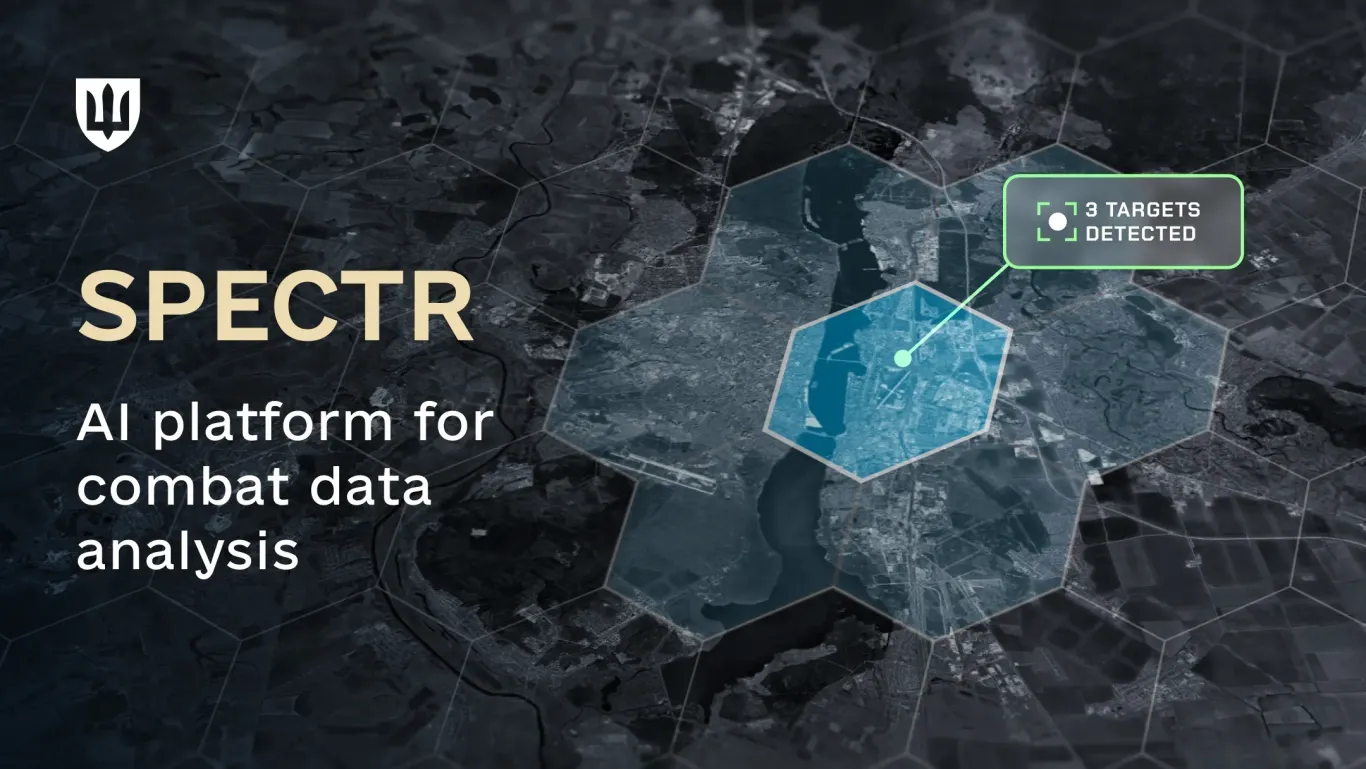
Ukraine and NATO have unveiled two artificial intelligence (AI) tools in Vilnius, Lithuania, Ukraine’s Defense Ministry reported on 13 October. One forecasts Russian drone attacks near the front and is ready to join the Armed Forces’ situational awareness systems. The other helps plan artillery fire and is still in testing.
A forecast of where, when, and which drones will fly targets the main source of losses near the front. In March, Ukraine’s military put the share of front-line casualties caused by FPV drones at up to 80%. In May, Ukraine’s drone forces commander Robert Brovdi said Russia was copying Ukraine’s model to grow its drone forces. A month earlier, Presidential Office head Kyrylo Budanov wrote that adding more drones no longer fundamentally changes the battlefield. The next stage, he said, is full integration of AI.
Forecasting Russian drone attacks
The NATO-Ukraine Joint Analysis, Training and Education Center (JATEC) presented both at a three-day seminar in the Lithuanian capital. NATO’s Allied Command Transformation and Ukraine’s Armed Forces built the tools with JATEC’s support.
“The solution has already been validated using real-world datasets. It has been refined and is ready for integration into the Armed Forces of Ukraine's situational awareness systems,” the ministry said.
Model No. 13 works from past data, weather, and the current battlefield situation. The ministry said it can identify the intensity of attacks, the areas, the time windows, and the types of drones with a high probability.
Ranking artillery options
Model No. 32 is a decision-support module. It tests whether artillery plans can be generated automatically. It weighs the mission’s requirements and current operational data, including available weapons, ammunition, firing positions, and constraints.
Explore further
Ukraine’s new military AI does more than watch the battlefield—it helps commanders plan what comes next
First, it applies logistics, ballistics, and impact-zone parameters to throw out unworkable options. Then it scores and ranks the rest. That means less hand-based comparison, faster decisions, and a more efficient fire loop, the ministry said. The prototype is now with the Ukrainian military for trials. If the trials succeed and it is validated, it could be expanded to other units that strike Russian forces.
Manville’s academic psychologist finds herself trapped in a tower block wasteland in 1980s Warsaw. Bizarre and surreal details add to the sinister vibe
Part cold war thriller, part Kafkaesque reverie, this movie takes us back to the sinister drear of Poland in 1981, when General Jaruzelski has just introduced martial law in reaction to the dangerous new mood of freedom occasioned by the Solidarity trade unions. The director is Kasia Adamik, daughter of The Green Border’s Agnieszka Holland; the film is adapted from a story by Olga Tokarczuk, called Professor Andrews Goes to Warsaw.
Lesley Manville plays Professor Andrews, an academic clinical psychologist (like Tokarczuk) from Britain with testy, peremptory mannerisms; her indulgence is a fondness for taking Polaroid photos. She has attained a certain level of celebrity for a book on dreams, despite claiming that she never dreams herself. Andrews has been invited to give a lecture in Warsaw, during which she begins to outline views on mental illness not unlike those of Laing or Foucault; but her speech is chaotically disrupted by students shouting that Poland itself is an oppressive asylum.
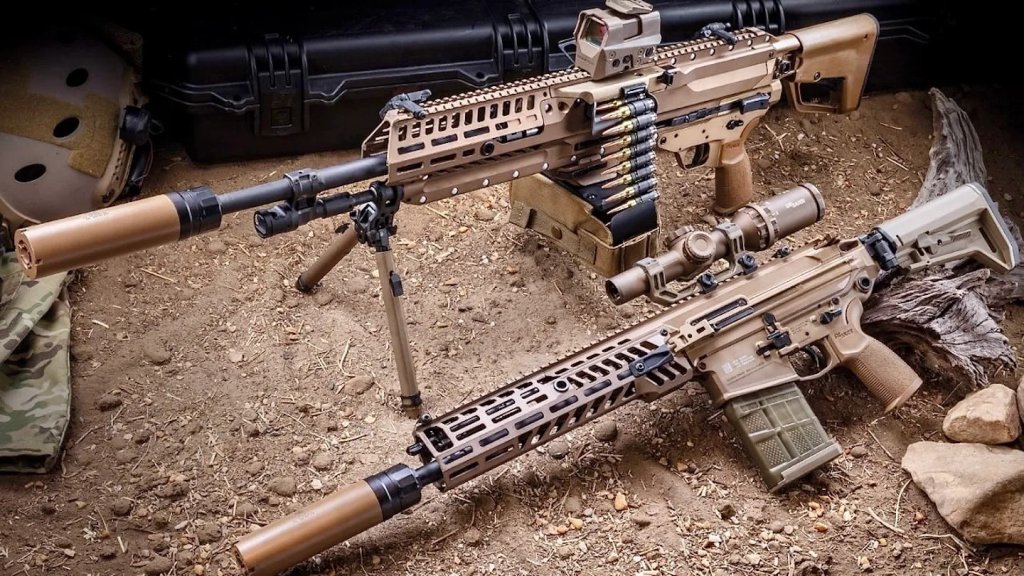
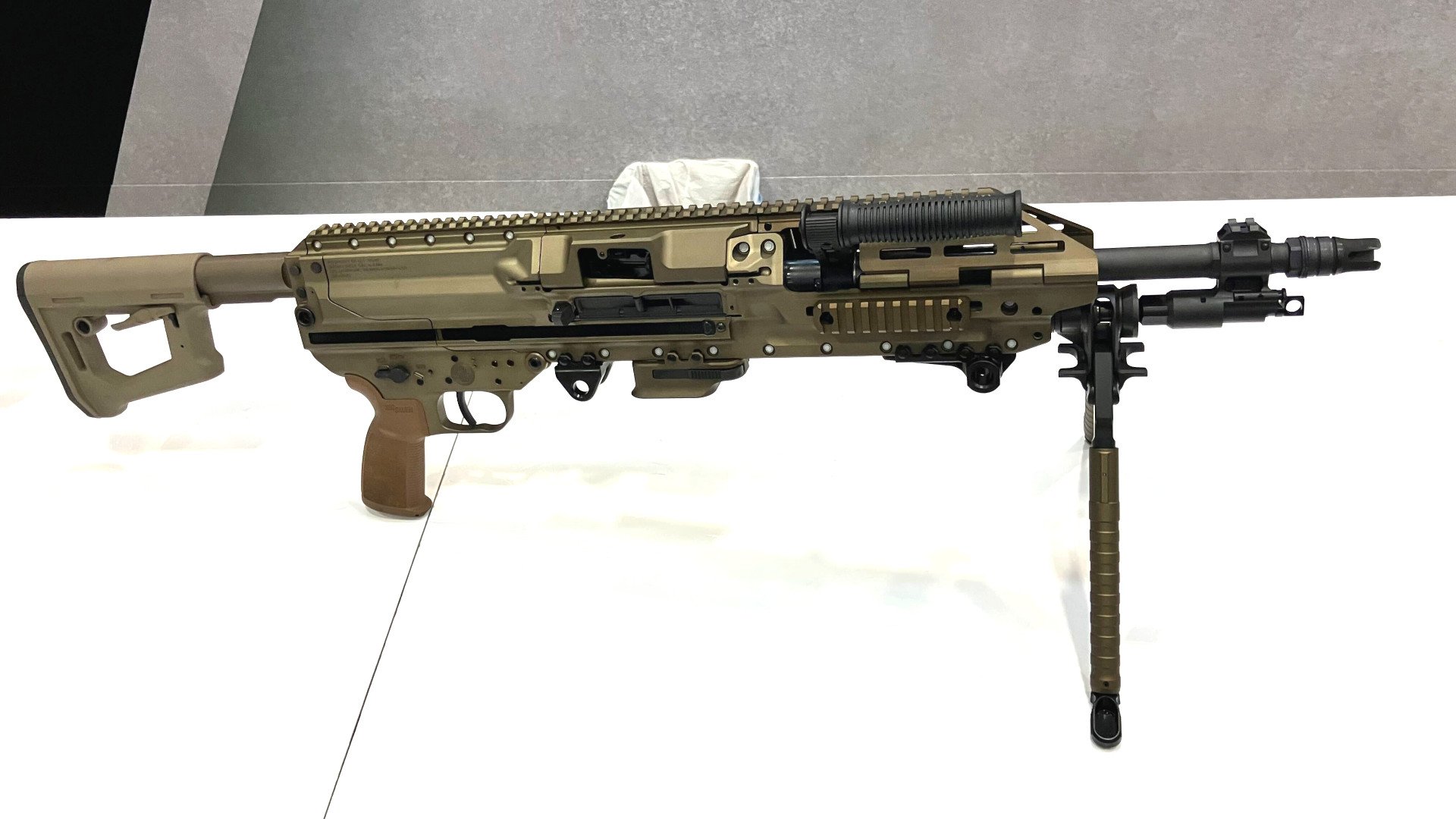
Jason St. John, senior director of strategic products for the Defense Strategies Group at Sig Sauer, talked about the new M250A1 with our Howard Altman at the Association of the U.S. Army’s (AUSA) main annual convention today. The U.S. Army has already been acquiring and fielding baseline M250s as part of its Next Generation Squad Weapons (NGSW) program. The NGSW family also includes the M7 rifle and now the M8 carbine from Sig, both also chambered to fire the 6.8x51mm round. The Army chose Sig as the winner of the NGSW competition in 2022. The service is still in the early stages of fielding the NGSW family as replacements for a substantial portion of its existing 5.56x45mm M4A1 carbines and M249 Squad Automatic Weapons (SAW).
A promotional image of Sig Sauer’s entrants into the NGSW competition at the time of the company’s win in 2022. Sig Sauer
“We continuously and constantly evaluate and evolve our designs, and we discover things,” St. John told us. “Parts that might be able to be manufactured a little bit easier with a little bit of a design change. They might be more reliable, more durable than you currently have. You might look at the system and say, hey, we have an ability to make these recommendations because we see this from other customers across the board. We hear it from our inputs of soldiers that are in our ranks, and you know maybe old relationships out in the field.”
“The [NGSW] program office represents the entire formation, so they get feedback in the totality of every single unit that has them [M250s and other guns in the NGSW family] in their hands,” he continued. If “a systemic issue or something that needs to be addressed, then they run the soldier touchpoint events, which we’re fortunate enough to be a part of. And then we get unfiltered feedback from soldiers that day in the field while they’re encountering something that they have a concern about.”
As noted at the start, the most immediate standout feature on the M250A1 being shown at AUSA this week is the new 13-inch barrel. M250s entering Army service now have roughly 16-inch-long barrels. The Army’s official fact sheet says the machine gun was originally expected to come with a 17.5-inch barrel.
“We shortened the barrel to 13 inches, but the Army’s also buying the 16-inch barrel,” St. John explained. “So in some ways, you could consider it mission-configurable, whether they want to utilize a 13-inch barrel or a 16-inch barrel, to what they’re doing.”
“You’re going to maintain the same basic ballistics that you had with the M7 [rifle’s] 13-inch barrel, and then you’re going to have more maneuverability because you’re going to have a shorter weapon system,” he added. “You add the 16-inch barrel, and you get that lethality requirement with the length of barrel that they originally required. So you have some flexibility there.”
“You shorten the barrel, you’re going to lose velocity,” St. John did acknowledge. “We did not change the ammo. The Army had determined with the barrel change that they were meeting their ballistic and lethality goals with that length of barrel.”
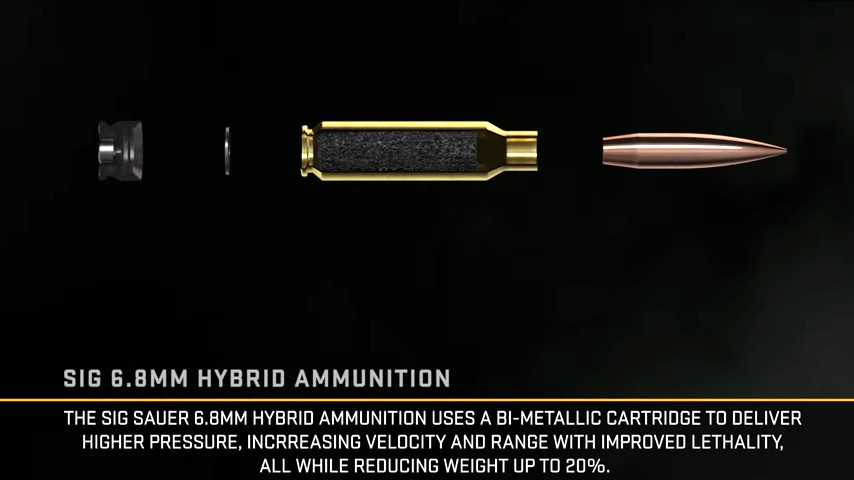
With the current 6.8x51mm ammunition, “we’re operating in the mid-70s [sic; 70,000 pounds per square inch] as far as pressure, and the case has 125K psi potential,” he also noted. “If you wanted to shorten the barrel and you did have some lethality concerns or wanted more performance, all you need to simply do is just increase the little bit more pressure in the cartridge case, and you overcome that shortness.”
A graphic showing the components of a typical 6.8x51mm round, which has a hybrid case design with a steel base and brass body. Sig Sauer
“We didn’t do that. The Army said it wasn’t necessary, but you know, as the battlefield evolves and defensive postures change, if that becomes necessary, one of the great things about the NGSW program is the ability for the weapon systems and the ammunition to grow in their performance capacity,” he continued.
In the case of the 13-inch barrel, “we tapered the barrel down a little bit to add a little bit of weight savings,” he noted.
TWZ has reached out to Sig about getting more complete specifications for the M250A1, including overall length and total weight with different barrel options. The baseline version weighs some 13 pounds, empty, and without optics and other accessories, according to the Army’s fact sheet. As already mentioned, the M7 rifle also got progressively shorter and lighter before giving way fully to the M8 carbine, in part through reprofiling of the barrel. The empty weight of the M8 with its 10-inch barrel is close to one pound less than that of the 13-inch barreled M7.
A US Army Ranger fires an M250 light machine gun. US Army
Different barrels can be readily swapped out on the M250A1, as well as the baseline M250. However, the new variant features significant changes to the quick-change barrel arrangement on the gun and associated elements of the design.
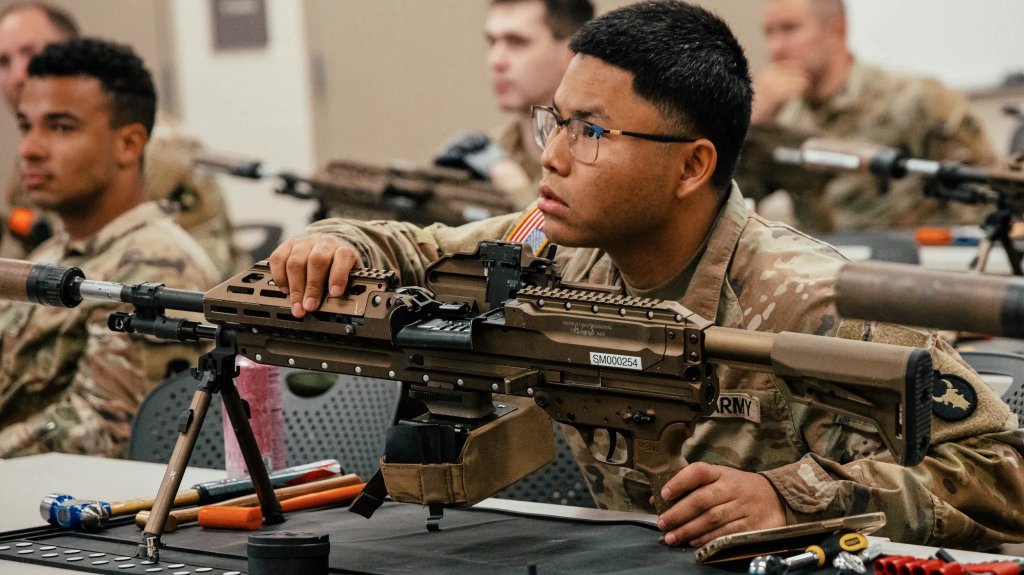
“It was interchangeable before, but it didn’t have a quick-change barrel handle. It wasn’t meant to be changed, and therefore it didn’t need the insulation of [sic; for] a hot barrel like you get with a barrel with a quick-change barrel handle,” according to St. John. “I think initially with the [M]250 program, it wasn’t necessary, and potentially might not have been desired initially. And why put that weight burden on there if we weren’t going to utilize it, right?”
St. John did not elaborate further on why these features were initially deemed unnecessary.
“When you look at the top cover of the forearm, that used to be loose, and now it’s captured, meaning that when you change the barrel, it actually came off completely in your hand,” he also noted. “We utilized a similar design to our .338 MMG [Medium Machine Gun], and then we make it captured now, so you’re not going to lose it.”
A picture of soldiers receiving instruction on the baseline M250. The top cover on the example seen in front is open, and it notably lacks a handle to help with barrel changes. US Army
“We added a funnel to guide your gas piston in, so that when you’re doing barrel change operations, you don’t have to be precisely lined up,” he added. Now, “you have something that’s going to guide it in a stressful environment, to get that into position to do your barrel change.”
The M250A1 features a host of other changes that are unrelated to the barrel.
Sig also “improved our gas system a little bit, just to make it more reliable and durable,” to include modifications to keep it better “insulated from carbon and things like that.”
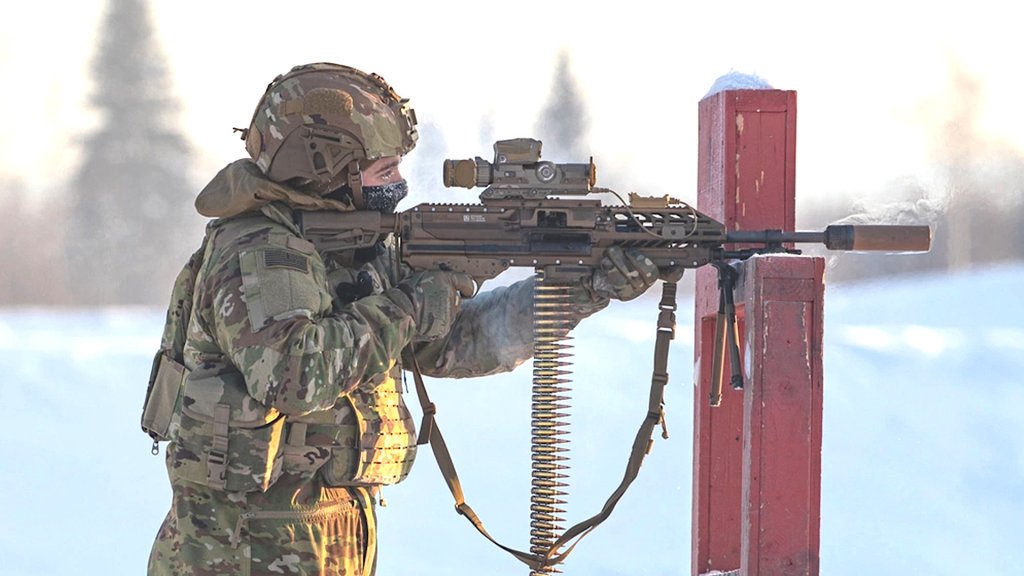
“We opened up the trigger guard to incorporate the Arctic fight, the Arctic glove, more so than just the operational normal tactical gloves,” according to St. John. “We opened it up a little bit more to accomplish that.”
An M250 seen during cold-weather testing. US Army
The Arctic is an ever-more strategic region where the U.S. faces growing geopolitical competition, especially from Russia and now China. Army officials also regularly point out that the harsh environment presents challenges when using standard equipment designed around use in more temperate locales.
“We improved the buttstock, and we improved the interface … to the receiver,” St. John explained. “We’ve made the interface between that more robust because through IMTing, and over time, and the buttstock getting slammed on the ground, and just normal military training and operations, we noticed that we had a tendency for some of them to loosen up and have some play in them.”
“The entire buttstock is a different buttstock than they had,” he added. “They [Army soldiers] preferred that buttstock over the buttstock that we had on it. So we just put soldiers’ preference on there. … It’s just a commercially available [design from] Magpul that they thought was better than the other Magpul that day one we were using.”
Changes were made to points where the M250 is designed to be attached to tripods on the ground or pintle mounts on vehicles.
“We put cross-bolts through the receiver to provide more durability,” he explained. “Initially, it was like an M-LOK type of lockup, and you can just think of a steel nut on an aluminum receiver being vibrated over a life cycle of the weapon system, it has some unfortunate wear characteristics. So, putting these cross pins redirects that force, and the way we lock it down with a saddle screw prevents that from happening and provides long-term durability to the receiver in the pintle and T&E [traverse and elevation] tripod-mounted configuration.”
The continued evolution of the M250 is not new. Sig talked to TWZ at AUSA last year about changes, including to the bipod and top cover, that were already making their way into the design.
The Army has yet to formally adopt the M250A1 configuration, and further changes could be made before service moves to officially acquire an improved version of the gun.
“This is likely to be the accepted configuration. We anticipate that acceptance,” Sig’s St. John told us. “We just finalized the acceptance on the M8, and they’re moving into the acceptance of the [M]250s. We anticipate right now, with the feedback that we’re getting from the program office, that the majority, if not all, of these changes are likely to be accepted.”
Despite the steadily shortening barrels on guns in the NGSW family, the Army’s position remains that the weapons chambered for the new 6.8x51mm round offer essential additional accuracy, range, and terminal effectiveness over existing 5.56x45mm types. The genesis of the NGSW program had been heavily informed by the war in Afghanistan, where there were regular reports of U.S. ground units being outranged by their opponents. Adversary body developments were also a factor.
It is also important to point out that teething troubles are not at all uncommon in major weapon system programs, including when it comes to small arms. Sig has drawn attention to the less than positive reception that the AR-15/M16 family initially received in the mid-1960s, which led to a host of changes to that design. Rifles and carbines in that pattern are now in widespread service across the U.S. military and with dozens of armed forces and security services globally.
Regardless, even with the Army still very early on in the process of fielding the entire NGSW family of guns, the M250 light machine gun’s design is now evolving significantly.
An Algarve and Alentejo environmental platform has come out strongly against plans for the Foupana dam, warning that the project could cause lasting damage to biodiversity and encourage the expansion
Anthropic, the maker of the Claude AI models, is preparing what could be the largest initial public offering in history, raising more than $100 billion, according to The New York Times, at a valuation near US$2 trillion. According to Reuters, which reviewed the draft prospectus (the document has not yet been made public), the company […]
A Ukrainian assault regiment continues to deploy mixed formations of drones and up-armored vehicles
The vehicles do the shooting; the drones fly close top cover
These mixed formations could rescue old-fashioned armored vehicles from obsolescence by helping protect the vehicles from drone attack
For the second time in two weeks, Ukraine's 475th Assault Regiment has demonstrated how armored vehicles can fight and survive on a battlefield buzzing with enemy drones.
The regiment encased a tank and an American-made M-2 Bradley infantry fighting vehicle in metal frames and welded hundreds of metal spines onto those frames, transforming them into "hedgehog" vehicles. The cage makes the tank impossible to identify from the footage, and the regiment hasn't said what model it is. The frames support the spines, which trigger incoming drones' warheads a safe distance from the vehicles' hulls.
But that's not all. To shepherd the two-vehicle formation across the disputed gray zone for a close engagement with a Russian position, presumably somewhere in northeastern Ukraine's Kharkiv Oblast, the 475th Assault Regiment deployed drones: both single-use first-person-view models and grenade-dropping, reusable Vampire models.
The Code 9.2 Regiment once again used the element of surprise, bringing a tank and a Bradley onto the battlefield—transformed into steel hedgehogs and covered by drones from the air. With a combined strike, the assault troops drove the enemy from several positions in… pic.twitter.com/Uq3mlWTsJq
The vehicles and their crews didn't fight alone. They fought in mixed ground-air "combined arms" formations. The tank and fighting vehicle provided the firepower. The escorting drones provided the aerial protection. Vampire drones drop grenades to suppress Russian positions and clear mines and loitering Russian drones. FPV drones dive down to intercept the Russians' own FPV drones as they zoom in to strike the vehicles.
The 475th Assault Regiment cut together a video montage of the most recent assault. The video depicts the tank and the Bradley rolling along a well-traveled route as at least one friendly FPV and at least one friendly Vampire drone flew overhead and an additional drone watched from a short distance away.
The vehicles repeatedly came under attack from Russian FPVs and heavier loitering munitions. An escorting Ukrainian FPV moved to intercept, with unclear results. A couple of Russian drones managed to score hits on the vehicles, but their hedgehog armor held—and both vehicles appear to have survived the there-and-back daytime trip into battle.
Explore further
Ukraine is now sending its tanks into battle with drone escorts: they can drive into a Russian kill zone and come back alive
A way forward for vehicles
It's at least the second time the 475th Assault Regiment has deployed vehicle-drone teams. The Ukrainian 3rd Army Corps used a related approach in its months-long counteroffensive in northern Donetsk Oblast, which began this spring: it sent in ground robots first, suppressing Russian strongpoints, fraying Russian supply lines, and clearing routes for manned vehicles to follow.
The unmanned aerial escorts lend the 475th Assault Regiment's hedgehog vehicles situational awareness they might not have on their own. It's well known that hedgehog armor can obscure a vehicle crew's view of the surrounding terrain. But friendly drones flying directly overhead can act as eyes in the sky for the crews on the ground.
The drones also help the vehicle crews compensate for a lack of mobility. The metal cages that support the metal spines that make up hedgehog armor tend to prevent a vehicle's turret from fully rotating. In order to aim its gun, a hedgehog vehicle has to meticulously point its whole self—turret and hull—at the enemy.
Explore further
Ukraine’s newest Abrams brigade just built the “dumbest” tank cage of the war. In 2026, that barely matters.
That takes trial and error, and time. The longer it takes, the more vulnerable a vehicle is to enemy drones. Friendly drones, running interference for the vehicles, can reduce that exposure long enough for the vehicle to fire a few shots.
The 475th Assault Regiment and 3rd Army Corps, among other units in Russia's wider war on Ukraine, are pointing the way forward for traditional armored vehicles in this new drone age. Yes, vehicles are more vulnerable to aerial attack than they were just a few years ago.
But no, armored vehicles aren't obsolete or useless. They just need a little help—or a lot of it—from the same kinds of drones that also make their existence so perilous.
 Login



























The
Code 9.2 Regiment once again used the element of surprise, bringing a tank and a Bradley onto the battlefield—transformed into steel hedgehogs and covered by drones from the air. With a combined strike, the assault troops drove the enemy from several positions in… pic.twitter.com/Uq3mlWTsJq
MilitaryNewsUA