Ukraine has secured contracts and assurances from partners on additional supplies of F-16 ammunition, Zelensky noted, adding that the current deliveries were at a "satisfactory level."
Soldiers with the Army's 1st Space Brigade unload equipment from a helicopter during training on Fort Carson, Colo. on Jan. 31, 2025.
Brooke Nevins/US Army
The US Army is expanding its ranks of soldiers specialized in space warfare.
Army space personnel are already deployed to the Middle East, where the US has been fighting Iran.
More than 600 enlisted soldiers joined the new specialty this year, with more growth planned.
The US Army is expanding its ranks of soldiers trained for space warfare, a growing military specialty that is already supporting American combat operations in the Middle East.
The service established a new enlisted space operations branch in June, creating a dedicated career field for soldiers whose work involves satellites, communications, and the ability to disrupt an adversary's use of space.
While the Space Force and its Guardians oversee a broad range of military space operations in support of the entire US military, the Army has its own dedicated specialists focused on supporting its ground forces with satellite communications, navigation, and other capabilities.
Lt. Gen. John Rafferty, the commander of US Army Space and Missile Defense Command, said at the Association of the United States Army conference in Washington, DC, this week that roughly 2,500 soldiers from his command are deployed to US Central Command's area of operations. That figure includes both air-defense formations and space specialists.
"Space is really embedded in every single echelon there," Rafferty said, speaking of the job's growing prevalence throughout all levels of military decision-making.
Those space soldiers' responsibilities can range from helping ground forces access satellite communications and navigation systems to disrupting adversary space capabilities, known as "space interdiction." Officials did not provide specific examples or further details on the work being done.
For soldiers on the battlefield, such help is essential for communicating with nearby units and gathering intelligence on enemy movements.
The growing importance of space as a domain of warfare, alongside land, sea, air, and cyberspace, prompted the Army to expand its specialized workforce.
Command Sgt. Maj. Rickey Jackson said at AUSA that the service reviewed several thousand personnel files for its new enlisted space operations branch. The 600 soldiers ultimately selected for the new job came mostly from intelligence, communications, and air-defense specialties, though the career field is open to troops from other backgrounds.
The service plans to continue growing its formalized space community, with around 1,700 space soldiers by the end of next fiscal year.
"When we talk about the branch and the targets, having a couple thousand dedicated folks within the branch between the enlisted and the officer side is a significant contribution across the service," Col. Joseph Mroszczyk, who oversees the integration of emerging space capabilities into Army operations, said during the event.
The service broke ground on a 155mm artillery production line at the plant earlier this year.
US Marine Corps photo by Lance Cpl. Emilio Murphy
The US Army will detonate 68 barrels of unstable explosive material at an ammunition production plant.
Officials determined the lead azide couldn't be relocated and are in contact with residents on environmental concerns.
The facility is also home to the Army's new 155mm artillery production line, which began construction earlier this year.
The US Army will detonate dozens of barrels of unstable explosives at its ammunition plant in Iowa after determining the material couldn't be safely moved, according to a public affairs official.
The lead azide the service needs to get rid of has been stored at the sitefor almost 20 years and is no longer needed for ammunition production. The detonation will occur near the service's new 155mm artillery production line, construction of which began in July.
The Army informed residents of nearby Middletown, Iowa, this week that it would detonate 68 barrels of lead azide sometime in November. Army Explosive Ordnance Disposal teams will execute the detonation.
"There are 68 barrels of lead azide in two earth-covered magazines, and that material was on site for potential production," Justine Barati, deputy director of public affairs for the US Sustainment Command, told Business Insider. "When we realized that we would no longer need that material or use that material, then it becomes hazardous waste."
A team of experts recommended a controlled explosion to destroy the lead azide, and that decision was elevated to former Army Secretary Dan Driscoll for approval.
Barati said the 155mm facility is on the other side of the Iowa Army Ammunition Plant. The Army anticipates a four-hour delay to construction at the facility on the day of the detonation.
The Army asked Middletown residents near the plant to temporarily leave their homes and is offering the Army Reserve Center as a place to stay during the detonation.
About 55 homes are expected to be affected by the detonation decision, Barati said. Local residents can assess any property damage afterward and file claims with the Army. The Iowa newspaper The Hawk Eye first reported on the detonation and town hall with residents.
Lead azide is a highly sensitive and toxic material used as a primary explosive component in some weapons that can pose environmental and health risks. Barati said that prior to and after the detonation, the Army will test air, water, and soil in the area. Residents agreed to give the service access to their properties for the checks.
The Iowa Army Ammunition Plant is a critical production facility for medium- and large-caliber munitions. Earlier this year, the Army began construction of a new production linefor 155mm ammunition, replacing the plant's World War II-era M795 artillery production line.
The new facility was designed by the Army's Combat Capabilities Development Command's Armament Center and MSM North America to produce different types of 155mm ammunition with the capacity to surge manufacturing for wartime demands.
155mm artillery shellshave become a high-demand munition amid recent conflicts. The US has ramped up production after providing millions of rounds to Ukraine. Concerns about the state of US ammo stocks have risen as the military assesses its readiness for future wars.
The disruptions this week in U.S. support for Ukraine have forced Kyiv to face a grim question: Can it stay in the fight against Russia without any of President Trump’s already diminished support? Ukrainian President Volodymyr Zelensky has escalated a diplomatic assault, earlier this week accusing the Trump administration of throttling its access to Elon…
An Urban Sky High-Altitude Balloon system inflates during an international training exercise in the Philippines.
Staff Sgt. Brandon Rickert/US Army
The US Army is expanding its use of high-altitude balloons for surveillance and communications.
The balloons can operate 60,000 to 100,000 feet above Earth, providing space-like capabilities.
Army officials plan more experiments as the service expands its space warfare ranks.
The US Army is looking to expand its use of high-altitude balloons as the service builds out its capabilities near and in outer space.
These balloons operate in the stratosphere, roughly 60,000 to 100,000 feet above Earth, the space in between where conventional aircraft fly and satellites. Army officials say they see an opportunity to use the balloons to deliver satellite-like surveillance and communication capabilities closer to the battlefield.
Lt. Gen. John Rafferty, commander of Army Space and Missile Defense Command, said he was initially skeptical of the technology. He recalled hearing proposals to use high-altitude balloons while serving in what was then Army Futures Command and questioning whether they'd prove practical.
The general's view, however, changed after he saw the balloons hold their positions and conduct high-altitude surveillance during a training exercise.
"I went from nowhere to a huge believer very quickly once I saw them in action," Rafferty said at this week's Association of the United States Army conference in Washington, DC.
Col. Joseph Mroszczyk, who oversees the efforts to integrate emerging space capabilities into Army operations as the director of Transformation Integration Space Superiority, said at AUSA that he wants a "family of stratospheric systems."
Unlike satellites, which travel set paths in orbit, high-altitude balloons can exploit different wind currents to maneuver or maintain a presence over an area of interest, he said.
Mroszczyk said the Army could use favorable winds to position balloons carrying sensors, communications equipment, or payloads supporting strikes.
"What that enables us to provide is space-like capabilities, really exploiting a transition point between what is normally considered the aerial layer and the space domain," he said.
Operating at those altitudes could give the Army persistent coverage across large areas from the stratosphere without relying exclusively on satellites or conventional aircraft.
The Army plans to conduct multiple experiments involving various stratospheric systems over the coming year, building on tests conducted in Europe and the Pacific. The service has also experimented with the technology alongside combat operations in the Middle East, a senior Army official told Breaking Defense earlier this week.
Those efforts followed the cancellation of a large-scale balloon demonstration planned for the Indo-Pacific last year.
The growing interest in high-altitude balloons comes as the Army expands its role in space and near-space operations, with ground forces increasingly reliant on space-based capabilities for navigation, communications, and intelligence.
Ukraine has received undisclosed assistance from Poland as it struggles to defend against increasingly intense Russian drone and missile attacks, President Volodymyr Zelenskyy hinted during a meeting with Polish Prime Minister Donald Tusk in Brussels on 15 October, Radio Svoboda reported.
Ukraine’s air defense needs are greater than at any point since 2022, as intensified Russian drone and missile attacks strain existing systems and expose shortages of interceptor missiles. With US support increasingly uncertain amid tensions between Kyiv and Washington, European military aid is becoming more critical to Ukraine’s ability to defend its cities and infrastructure.
Zelenskyy thanked Warsaw for its support, suggesting that some assistance had to remain confidential. He also specifically mentioned 20 mm ammunition, which Ukraine needs to defend its cities against Russian attacks.
“Sometimes this has to stay between the two of us,” Zelenskyy said, thanking Tusk for the aid.
European support increasingly important amid US rift
Ukraine is facing mounting pressure on its air defenses as Russia increases the scale of its aerial attacks. Ukrainian forces are also struggling with shortages of interceptor missiles, particularly Patriot missiles needed to counter Russian ballistic strikes, leaving the country vulnerable to further attacks.
The need for additional support comes amid growing uncertainty over US assistance under President Donald Trump. Washington has taken steps that have strained ties with Kyiv, including easing some restrictions on Russian fuel and pressing for an energy ceasefire that Ukraine says Russia has continued to violate.
Recent disruptions to US-linked intelligence and satellite support have also raised concerns about Ukraine's ability to detect and counter Russian attacks.
As uncertainty over Washington's role grows, European military assistance is becoming increasingly important for Ukraine's defense.
Explore further
White House ordered limits on Ukraine’s military satellite service — Reuters. Who made the decision remains unclear
Defense cooperation continues despite political tensions
Tusk reaffirmed Poland's commitment to supporting Ukraine, saying Kyiv could count on Poland and the European Union. He also opposed easing EU sanctions against Russia, arguing that Europe should not take steps that help Moscow finance its war.
The meeting also came amid strained relations between Kyiv and Warsaw over historical disputes. However, Poland's government has maintained that these disagreements should not undermine military support for Ukraine, whose ability to resist Russian aggression is closely tied to Poland's own security.
Temporary restrictions on aircraft arrivals and departures were imposed at 27 Russian airports, Deutsche Welle reported on 16 October, citing its own calculations based on reports from Russia’s Federal Air Transport Agency.
Ukrainian President Volodymyr Zelenskyy warned airlines on 1 September that “Russian airspace is becoming completely unsafe.” Overnight, most of the airspace over European Russia was closed.
By morning, more than 200 flights had been canceled or delayed at Moscow airports, Deutsche Welle reported, citing figures compiled by a Russian Telegram channel.
Тим часом у російських аеропортах – справжній апокаліпсис через нальоти дронів останніми днями.
Про це ниють росЗМІ. Було відмінено десятки рейсів, у терміналах – дуже багато людей. Пасажири скаржаться на задуху, дикі черги до туалетів та повну невідомість. pic.twitter.com/ZlXxY5c2mq
The list included airports in the capital. All four Moscow airports temporarily suspended arrivals and departures, the Russian outlet Astra reported on 16 October. Russian authorities said they had shot down dozens of drones, while flights were delayed and diverted to alternate airfields, according to the report.
Massive drone attack on Russia: 644 UAVs in one night, 94 shot down near Moscow
The temporary airport shutdowns were likely a consequence of a massive drone attack on Russia. From 8:00 p.m. on 15 October to 8:00 a.m. on 16 October, Russian air defenses allegedly intercepted and destroyed 644 Ukrainian unmanned aerial vehicles across 26 Russian regions, occupied Crimea, and the Black Sea, according to Russia’s Defense Ministry.
According to the list of regions published by the Russian Defense Ministry, the drone attacks covered a vast area of Russia, from regions bordering Ukraine to the Moscow region, the Volga region, the country’s northwest and southern regions, as well as occupied Crimea and the Black Sea.
Russian air defenses shot down a total of 94 drones approaching Moscow over the evening of 15 October and overnight, according to calculations by the Russian outlet RBC Radio, citing statements by Moscow Mayor Sergey Sobyanin.
In the Kaluga region, air defenses destroyed 27 drones over the evening and night, the regional governor reported. At 9:27 a.m., he updated the figures, saying another 48 UAVs had been shot down overnight, bringing the total to 75. According to preliminary information, there were no casualties or infrastructure damage.
In the Tula region, air defenses allegedly destroyed a total of 32 Ukrainian drones. There were no casualties, according to regional Governor Dmitry Milyaev in his Telegram channel.
In the Vladimir region in western Russia, authorities repelled drone attacks overnight. In the city of Vladimir, a drone attempted to attack a heating infrastructure facility, but the attack was stopped, Vladimir Region Governor Alexander Avdeyev reported. Minor damage was reported, but there was no information about casualties.
Ukraine has not yet commented on its involvement in the attacks.
The practical consequences of canceled Russian flights
Passengers on flight SU6312 from Kaliningrad to Moscow were unable to land in Moscow because of airspace closure, so the aircraft was diverted to Nizhny Novgorod, Terravia reported. After landing, passengers remained on board for about two hours before being allowed to disembark at 3:30 a.m. Instead of continuing their journey to Moscow by air, they were supposed to be transported by bus, with the trip expected to take about seven hours, the outlet reported.
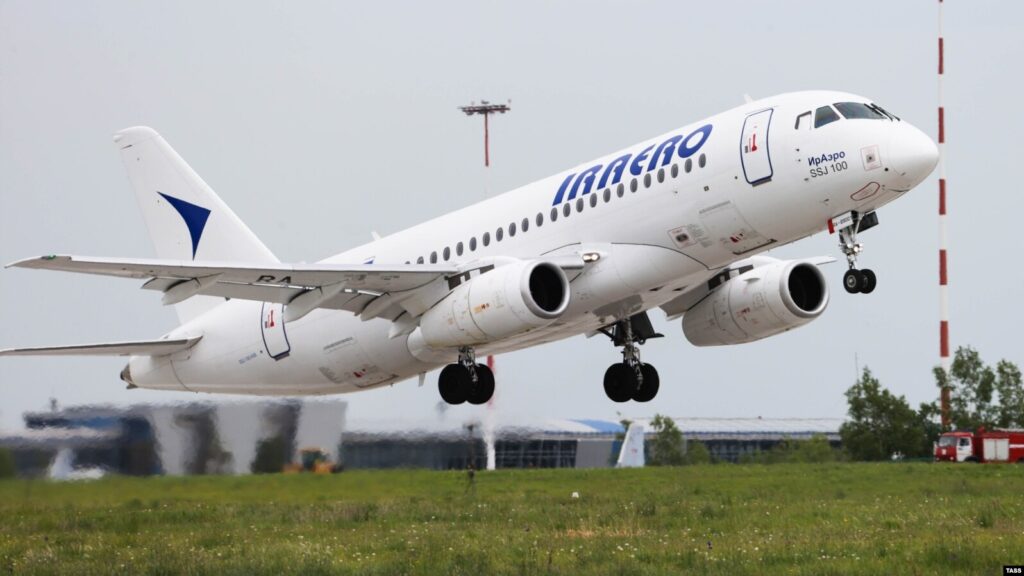
A Russian Sukhoi Superjet 100 of the IrAero airline. Illustrative photo: TASS
Passengers were not provided with food or drinks, and one woman could not find a seat on the bus, so she purchased a ticket for an early-morning train herself.
Since the beginning of the year, all four Moscow airports have been completely shut down simultaneously at least 19 times, the Russian outlet Agentstvo reported. During the first 14 days of October, the restrictions lasted 101 hours and 38 minutes, compared with 46 hours and 33 minutes in September, according to the report.
The sudden disruption of Ukraine's military-grade Starlink access has exposed a key vulnerability.
Dmytro Smolienko via Reuters Connect
Ukraine's access to military-grade Starlink services was suddenly disrupted this week.
Kyiv said the disruption affected critical Ukrainian drone operations.
Ukrainians say the incident exposes the risks of relying so heavily on a single communications platform.
The sudden disruption to Ukraine's access to military-grade Starlink services this week shows the risks of overly relying on any single platform, particularly one beyond Kyiv's control, for mission-critical battlefield communications, Ukrainian soldiers, officials, and defense companies told Business Insider.
With those risks front of mind, Ukrainians are working to diversify military-related communications platforms beyond Starlink.
Ukrainian officials and soldiers were surprised on Wednesday by an unexpected disruption to Starshield, SpaceX's dedicated satellite network for military services. Defense ministry sources said speeds were restricted above 100 miles per hour, though some units experienced a loss of connectivity at speeds as low as 45 mph.
Services appeared to have been at least partially restored by Thursday. The full extent of the disruption remains unclear, but the incident has left some Ukrainians feeling uneasy.
Yehor Cherniev, deputy chairman of the Ukrainian parliament's national security, defense, and intelligence committee, told Business Insider that the disruption underscores the risks of relying on a single communications platform. He said Kyiv is working to diversify its sources, but declined to specify how.
Yuriy, an officer with Ukraine's National Guard, told Business Insider that his units use Starshield to support drone operations, and several missions were spoiled during the disruption. He asked to be identified only by his first name for security purposes.
Yuriy said that while Starlink services are useful, the disruption exposes their unreliability. He said he would try to find alternate communications systems.
Alternatives to Starlink could be hard to find, though. Eutelsat, a large French satellite operator, saw its shares surge after this week's disruption, but Ukrainians say there is nothing else quite like what SpaceX offers.
"There is no working alternative to Starlink," said Dimko Zhluktenko, a soldier with Ukraine's 413th Unmanned Systems Regiment, calling it "an outstanding product."
Ukrainian forces are heavily reliant on Starshield, particularly for drone operations.
Ivan Antypenko/Suspilne Ukraine/JSC UA:PBC/Global Images Ukraine via Getty Images
"No direct competitor comes close," he told Business Insider, adding that "Europe has nothing comparable at this level of battlefield readiness."
SpaceX did not respond to requests for comment from Business Insider this week.
Ukraine relies on Starlink for battlefield communications and drone warfare, a dependence that was underscored by the disruption. Defense ministry sources said the disruption complicated important drone operations, including mid-range strikes, air defense intercepts, and front-line logistics.
Ukraine uses both Starshield and Starlink, SpaceX's commercial satellite internet service, to extend the reach of its drones, maintain stable communications in electronically contested environments, and conduct remote operations far beyond the front lines.
Satellite connections allow operators to control drones and receive live video without relying on traditional radio links, which have limited ranges and are much more vulnerable to electronic warfare interference.
The tech has been integrated into systems such as Perennial Autonomy's Hornet drones, as well as Ukrainian naval drones used to strike Russian targets in the Black Sea, among others.
Many Ukrainian defense companies have integrated Starlink services into their broader infrastructure, even if their products don't necessarily depend on it for operations.
Some firms, such as SkyFall, maker of the widely used P1-SUN interceptor drone, told Business Insider that they have developed their own communication methods or use alternative systems to avoid scenarios where a single technology outside Ukrainian control could become a significant point of failure, as it did this week.
"Depending on a single solution is very risky. Especially if you don't have full control over it," a spokesperson for Wild Hornets, the firm behind the popular Sting interceptor drone, told Business Insider. "Especially when it comes to something as critical on the battlefield as communications."
The spokesperson said this is "exactly why our ecosystem is built around our own communications technology and is open to various solutions when it comes to internet connectivity."
Ukrainian soldiers, officials, and defense firms say relying on one communications source is a risk.
Pavlo Bahmut/Ukrinform/Sipa USA via Reuters Connect
For anyone working with technologies that are dominated by a single provider, the risks are clear, said the head of hardware research and development at BlueBird Tech, a defense firm that makes drones and robots. They told Business Insider that Starlink has virtually no competitors because of its coverage, cost, availability, and ease of use.
BlueBird Tech uses Starlink services but is trying to avoid tying its products completely to any single technology. "We're actively exploring ways to introduce redundancy and potentially replace these components in the future," they said, speaking anonymously due to security concerns.
They said that potential workarounds include LTE or 5G technology, mesh networks with relay points, and laser communications. "Research teams around the world are working on these technologies," they said, "although none of them should be seen as a universal replacement for Starlink across every operational scenario."
When the disruption first occurred on Wednesday, some Ukrainian and foreign officials initially blamed SpaceX, led by Elon Musk. However, the world's richest man said on X on Wednesday that because Starshield is operated by the US government, any limits on speed would be a decision for the Pentagon or President Donald Trump.
A senior US official told Business Insider on Thursday that "no such request was ever made by" Trump. Reuters reported that the order came from inside the White House.
Starlink has delivered Kyiv an important battlefield advantage, especially since SpaceX cracked down on Moscow's ability to use the terminals earlier this year. The system, however, does not work in Russia, so Ukraine is limited to using its services over its own territory and Russian-occupied lands.
Ukraine has been unable to use Starlink for its long-range drone strikes that have wreaked havoc on Russian energy sites. Trump has pushed Kyiv to stop its attacks as he attempts to use Russian oil to lower gas prices.
Ukraine has found itself facing mounting pressure from the US, once a top supporter, as it continues to grapple with Russian missile and drone strikes amid severe shortages of critical air defense interceptors. The Starlink outage has only compounded Kyiv's anxieties as it anticipates yet another tough winter.
"Starlink is a major card on the battlefield," Zhluktenko said. "You can fight without it — even successfully — as the Russians show, but less effectively, at higher cost, and with constant communication headaches, above all for unmanned systems."
Heidi Levine says she was saved by flak jacket, helmet in Abu Falah attack, as US embassy and Washington Post slam incident; olive trees and vehicles set on fire near Turmus Ayya; 70-year-old attacked near Birzeit
The Pentagon is sending more U.S. troops to Panama to participate in jungle warfare training as Defense Secretary Pete Hegseth expands the U.S. military’s war against drug cartels in Latin America. Nearly 200 Army soldiers from Fort Drum, a U.S. Army military reservation in northern New York state, are being sent to a jungle training…
Welcome to The Hill’s Defense & NatSec newsletter {beacon} Defense &National Security Defense &National Security The Big Story Pentagon’s school system director stepping down The director of the Pentagon’s school system, Paul Craft, is resigning at the end of this month — less than eight months after being selected to lead the agency, a…
Four Republican senators have signed on to a letter to the Defense Department’s inspector general expressing “grave concern” over Ukraine’s sudden loss of access to intelligence-sharing and high-speed Starlink data, which it needs to intercept Russian drones, and asked him to investigate whether senior Defense officials played a role. “We urgently request an Inspector General…
President Trump put an abrupt end on Thursday to questions about whether the Pentagon would really livestream the firing squad execution of the Fort Hood shooter, former Army Maj. Nidal Malik Hasan. In a Truth Social post, he said the public execution could serve as a deterrent but didn’t want to subject “good and well-meaning”…
Five House Republicans signed on to a letter Thursday urging President Trump to cancel the Russian diesel deal he announced last week. GOP Reps. Don Bacon (Neb.), Brian Fitzpatrick (Pa.), Michael McCaul (Texas), Dan Newhouse (Wash.) and Joe Wilson (S.C.) joined 17 of their Democratic colleagues in writing they were “particularly concerned” about the deal.…
Five people have been arrested in Norway as part of an international investigation into suspected fraud and bribery involving a company providing port services to NATO warships. The arrests were...
US president overrules defense secretary, who announced plan without informing White House, source says; fellow Republicans, international observers objected to live broadcast
NATO’s new “block, blunt, and break” doctrine promises deterrence through military might, but technological overconfidence, resource constraints, and fragile political unity could turn deterrence into strategic instability. “We will block, blunt, and break the enemy,” said General Grynkewich, Supreme Allied Commander Europe. New words, novel phrases, and the very old technique of turning people’s heads […]
Starlink equipment is a common sight on the front lines in Ukraine.
Maxym Marusenko via Reuters Connect
Ukraine's access to military-grade Starlink services is returning, sources told Business Insider.
Defense ministry and parliamentary sources said on Thursday that Starshield operations had been at least partially restored.
On Wednesday, Ukraine was caught off guard by sudden speed restrictions, affecting drone missions.
Ukraine's access to military-grade Starlink services appears to have been at least partially restored on Thursday, a day after Kyiv was stunned by sudden speed limits that it said hamstrung some drone operations.
Ukrainian defense ministry sources told Business Insider that Starshield services remained functional while in motionas of roughly 11:45 a.m. local time on Thursday, according to reports that they had received from military units.
The sources said the defense ministry is working to understand how and why there was a disruption to the operation of Starshield, SpaceX's dedicated satellite network for military services.
Yehor Cherniev, the deputy chairman of the Ukrainian parliament's national security, defense, and intelligence committee, told Business Insider that Starshield services had been restored to their pre-disruption capacity.
Ukrainian officials and service members were caught off guard on Wednesday by the unexpected Starshield disruption, which they said restricted speeds above 100 miles per hour. Some units experienced a loss of connection at speeds as low as 45 miles per hour.
The full extent of the service limitation remains unclear.
Yuriy, an officer with Ukraine's National Guard, told Business Insider that his units use Starshield to support drone operations and that speeds were back above 100 miles per hour as of Thursday morning. He asked to be identified only by his first name for security purposes.
However, Yuriy said that several operations were disrupted during the earlier restrictions.
Defense ministry sources said the disruption complicated mid-range strikes, air defense intercepts, and front-line logistics. Starlink does not work inside Russia, so the issue was limited to missions in Ukrainian territory or Russian-occupied territory.
Starlink has been a game changer for Ukrainian operations, especially by ensuring connectivity for drone warfare.
Andriy Dubchak/Frontliner/Getty Images
The sudden Starlink disruption caused widespread confusion and raised questions about the source of the decision and whether it was connected to tensions between President Donald Trump and Ukrainian President Volodymyr Zelenskyy over Kyiv's targeting of Russian energy facilities.
Ukrainian forces use Starlink, the commercial satellite internet service run by SpaceX, and Starshield, a secure network for military and government work built by the company but operated by the US government. Some Ukrainian officials initially blamed SpaceX for the disruption.
In an X post on Wednesday responding to Ukraine's former defense minister, SpaceX CEO Elon Musk put the issue on the Trump administration, saying that Starshield was "owned and controlled by the American government." He said "any limits on speed or usage are decided by the US military and ultimately POTUS."
A senior US official told Business Insider Thursday afternoon that "no such request was ever made by the President."
The Pentagon has not responded to requests for comment.
Sprawling influence
The outage and impact on front-line operations have called attention to Ukraine's deep dependence on Starlink, which has become critical for battlefield communications and drone warfare.
As Business Insider recently reported, Starlink's rapid expansion has given Musk and SpaceX an enormous source of influence and soft power, and the world's richest man has not been shy about using that power in Ukraine to influence the course of the war.
Musk said in 2023 that he refused a request from Ukraine's military to activate Starlink to assist a Ukrainian assault on the occupied Crimean peninsula. Earlier this year, SpaceX clamped down on Russian forces' use of Starlink terminals in Ukraine, handing Ukraine a key battlefield advantage.
While support for Ukraine has varied, Musk has consistently been a prominent critic of the Ukrainian president. In an X post late on Wednesday, hours after responding to Ukraine's defense minister, he wrote that it was "time for Zelenskyy to go."
The sudden Starlink disruptions came as Ukraine faces growing pressure from the US, with Trump pushing Kyiv to halt its strikes on Russian energy facilities. The US president said on Tuesday that Washington had not cut intelligence sharing with Ukraine, another concern for the country.
Cherniev, the Ukrainian lawmaker, confirmed on Thursday that the US continues to share intelligence with Kyiv.
Meanwhile, Russia has intensified its ballistic missile attacks against Ukraine, firing dozens overnight. Recent attacks have targeted Kyiv and Ukrainian energy facilities.

 Login





 Тим часом у російських аеропортах – справжній апокаліпсис через нальоти дронів останніми днями.