❌

Reading view

One barricade after another: How protesters marched on the garrisoned heart of India’s capital

60,000 security personnel were deployed across India’s national capital on October 10.​ This included the police of Delhi and neighboring states, as well as paramilitary forces pulled from regions of India affected by armed insurgencies.

They sealed off central Delhi to stop protesters opposing the mass disenfranchisement of 130 million voters from reaching Jantar Mantar, the designated protest site on Parliament Street.​

The railways cancelled over 250 trains to Delhi. “So far as I remember, it has never happened in the history of Indian Railways that so many trains were cancelled just because of a protest or agitation,” said Shiv Gopal Mishra, general secretary of the All India Railwaymen’s Federation (AIRF).​

Scores of activists already travelling to the national capital from other states of India were detained on moving trains and forced to alight at numerous railway stations in multiple states. Many grassroots activists in several other states were placed under preventive detention in their homes ahead of the protest. Paramilitary forces were deployed at checkpoints on Delhi’s borders, where vehicles were searched for any signs of protesters, placards, etc.​

Within the national capital, 45 metro train stations were closed. Internet and telecommunications were down in the four-kilometer radius of Jantar Mantar. Around Parliament Street alone, where Jantar Mantar is located, over 3,000 security personnel were deployed, with multi-layer barricades, each manned by about a hundred.​

Even outside this garrisoned zone, police held up commuters entering central Delhi at numerous checkpoints, causing traffic jams while enquiring about their purpose of travel before letting them through, to ensure they were headed to work, not to protest.

Communists fight back

Evading this anticipated hurdle, hundreds of activists from the Students Federation of India (SFI) and the Democratic Youth Federation of India (DYFI) had already positioned themselves the previous night just over three kilometers northeast of Jantar Mantar at HKS Surjeet Bhavan.​

A memorial to the freedom fighter and veteran communist leader, HKS Surjeet, it serves as an education center of the Communist Party of India (Marxist) [CPIM] and also hosts SFI’s Central Committee office.​

The Delhi Police's midnight attempt to intimidate students at the SFI Central Committee office in HKS Surjeet Bhawan was promptly rebuffed by the CPI(M) party leaders there. pic.twitter.com/x45gOglsCk

— CPI (M) (@cpimspeak) October 10, 2026

“But the police knew we were there,” recalled SFI activist Asikul. The police had tried over the last two nights to enter the premises to take stock of the preparations, but were stopped. Activists worried the police could barricade the gates and stop this mobilization of hundreds from stepping out to protest the following morning.​

Quietly, after midnight, student activists slipped out of HKS Surjeet Bhavan in groups of five, one after another, with cover stories for travel reasons if intercepted on the way. By six in the morning, about 250 of them had relocated to the CPIM’s national headquarters, AKG Bhavan, to the west of Jantar Mantar.

Back at HKS Surjeet Bhavan, where hundreds more stayed behind, barricading began between 10 and 10:30 am, just 100 meters from its gate, recalled Aman Saini, the Delhi State Secretary of the DYFI.

About 300-350 activists stormed out of the gates and made it through before the barricades could cut them off. Waving red flags and holding placards calling for the dismissal and arrest of the Chief Election Commissioner (CEC), Gyanesh Kumar, they marched barely a kilometer before facing a police cordon. The police lined up shoulder to shoulder, batons held horizontal to block the protesters’ way forward.​

Continuing to march, the protesters headed straight into the cordon. A tussle ensued amid chorus chants of ‘vote chor, gaddi chhod’, demanding the “vote thief” CEC’s resignation. As the protesters in the front line grappled with the police – each engaging multiple officers by dropping to the ground and resisting detention – others broke through the cordon and sprinted ahead.

Barely 300 meters ahead, a line of barricades blocked the road. Protesters stormed ahead and engaged the police. Slipping through the tussle, “I pulled the barricade from below and shoved its top. Thaad! – it fell over,” explained Aman.​

Wrangling themselves free from the security personnel, many more dashed ahead, several slashing their feet against the metal of the fallen barricade, only to turn left on Minto Road and drop another barricade.

They had covered nearly half the distance to Jantar Mantar, reaching within 150 meters of the Connaught outer circle, one curve away from Parliament Street hosting the protest site.

“But the barricade there was re-enforced. We had almost managed to pull one down when the police charged at us with batons,” added Aman. Having lost numbers at each of the previous barricades, “we were only about 50 left. So they managed to detain us and shove us into buses. At least six of us were injured.”​

Those who had evaded detention at the previous barricades, but were unable to push ahead, regrouped outside HKS Surjeet Bhavan and started sloganeering. Police, accompanied by paramilitary, charged with batons and detained them, and even allegedly tried to break into the premises, but were held back at its gate.

Paramilitary at the party gates

The contingent of activists who had relocated to AKG Bhavan under the cover of darkness did not have it any easier. They had only managed to stretch the security personnel and their barricades across two fronts. A paramilitary force began assembling outside its gates around 10 am, roughly the same time as the barricading began at HKS.​

Several members of CPIM’s Central Committee (CC) and Politburo, including current and former Members of Parliament, many of them grey-haired, were staying at the AKG Bhavan for a CC meeting. They joined the students as they marched out.​

“Some 20 people were detained right outside the gate – almost the whole frontline. The rest of us behind them pushed through. We kept running,” recalled Asikul.

About 15-20 minutes into the march, SFI activist Noel was detained. “I was not taken to a detention bus, where others were held. I was held alone in a bus used to transport the police. There I was beaten for two hours,” he said, sharing pictures of the injuries he sustained on his face.

“Two of my comrades realized that I was being held alone. So they intentionally got themselves detained near my bus and joined me. They also got beaten up,” he added. Later, when the police started marching them to the detention bus, allegedly prodding them forward by jabbing the blunt ends of their batons into their backs, “we managed to escape.”

Meanwhile, others had pushed ahead. Among them were SFI National Joint Secretary Aishe Ghosh and the DYFI’s national president, AA Rahim. They marched about a kilometer from AKG Bhavan before being apprehended at the roundabout near Gurudwara Bangla Sahib. The SFI alleged that “Aishe Ghosh was assaulted by male police personnel in the absence of women officers.” ​

A showdown ensued. Dropping to the road and bracing in a huddle, Aishe and other female activists held ground as female police personnel who arrived later grappled with them, eventually dragging them away to detention buses, about 1.5 km away from Jantar Mantar.

Other activists, including Asikul, had strode ahead, breaking through three barricades, and reaching within 400 meters of Jantar Mantar. “We were not able to break through the fourth. We were only about 35 left,” said Asikul.

“Using chokeholds and baton charges, they detained us. Some managed to escape detention by breaking out through a bus window,” an increasingly popular mode of resistance by the younger generation of activists, determined to make detentions as costly and as strenuous as possible.​

Police arrest student activist
Police detaining student activist and SFI president Adarsh M Saji. Photo: CPIM

Detention at the stadiums

Asikul and the rest of the detainees were driven almost 50 km to Bawana in northwest Delhi and held at the Rajiv Gandhi stadium, where hundreds more were already being held. Among them was 77-year-old Manik Sarkar, a senior communist leader and Tripura state Chief Minister from 1998 to 2018. He was accompanied by the northeastern state’s current opposition leader, Jitendra Chaudhury. Veteran trade unionist and former Member of Parliament (MP) Tapan Sen, along with other ex-legislators, were also held there.

“There was not a drop of water in any tap in the toilet. We were not even provided with clean water to drink. When we demanded, we were asked to drink from” an old, ill-maintained leaky tank in the premises, said SFI activist Utkarsh, who was also held here. “We challenged the police to drink that water. They refused.” ​

When detainees began falling sick, Utkarsh and other activists warned the senior police officer in charge of this detention of consequences for mistreating a former Chief Minister and ex-MPs. They reminded him of his responsibility if one of these elderly political leaders fell seriously ill. Only then did the police “finally provide us with water and some snacks.”

Seven other stadiums in the city, along with several other public facilities, were reportedly turned into detention centers that day, when security personnel detained over 7,000 people from the streets of the national capital, including protesters, journalists and even pedestrians suspected of being protesters.

More than 7 km south of Jantar Mantar, near the INA market, outside barricaded central Delhi, police detained protesting activists of the All India Students’ Association (AISA), led by Neha Bora, one of the most recognizable faces of the protest movement.

Detentions were also reported in Raj Ghat, about 4.5 km northeast of Jantar Mantar, where the Revolutionary Workers’ Party of India (RWPI) and its affiliated mass organizations had organized a protest.

At the airport, almost 15 km to the southwest of Jantar Mantar, the police boarded a plane as soon as it landed from Mumbai – even before the passengers could disembark – to detain Abhijeet Dipke, Saurav Das, and Ashutosh Ranka from their seats. They are the top leaders of the Cockroach Janta Party (CJP). 

“Cockroaches”

The pressure group started as a satirical protest on social media in May, after the Chief Justice of India said: “There are youngsters like cockroaches, who don’t get any employment or have any place in profession. Some of them become media, some of them become social media, RTI activists and other activists.”  ​

The CJP has since become a material force, playing a key role in the protest against exam paper leaks that forced the Union Education Minister to resign in July. ​

About two months after his resignation, an investigation by the Indian Express newspaper exposed irregularities in the conduct of the Chief Election Commissioner (CEC), Gyanesh Kumar. Several times, his two fellow election commissioners had flagged their concerns about his potentially illegal and unconstitutional decisions.

These pertained to the Special Intensive Revision (SIR) of electoral rolls, still underway after already deleting the names of 130 million people from India’s voter rolls – in an unprecedented shrinking of India’s electorate. Opposition parties have long alleged that this exercise is meant to help the ruling far-right Bharatiya Janata Party (BJP), led by Prime Minister Narendra Modi, consolidate its hold on power.  

Earlier this month, on the birth anniversary of Gandhi on October 2, protests began, calling for the scrapping of the SIR and the CEC’s resignation. On October 7, the CJP called on youngsters to take Jantar Mantar again on October 10.

In response to its call, thousands of youngsters, most in their late teens and early 20s, kept arriving in small groups to central Delhi throughout the day, only to be whisked away by the police.​

Detention as deterrence

“These youngsters, who were not part of any cadre-based organization, were particularly harassed by police because they identified them as vulnerable. They were threatened, their phones and keys were snatched,” said DYFI’s Delhi State Vice President, Rikta Krishnaswamy, who was held with hundreds of them at a makeshift detention center in Jafar Kalan, over 45 km west of Jantar Mantar.​

Bundled into a bus at the final barricade reached by the march from HKS Bhavan that morning, Rikta was brought here by midday, when “the electrician was still installing the fan. We were held until evening with nothing to eat – not even a cup of tea. The police are trying to make detention as much of a deterrent as possible.”

But the protesters were not deterred. The very next day, DYFI activists, including several central committee members, gathered at Connaught Place, a 15-minute walk from Jantar Mantar, which remained cordoned off, even as the overall restrictions on movement in central Delhi had eased.​

Custodial torture, sexual harassment

Soon after they began staging a protest, security personnel swarmed in. The detained protesters “were not taken to any police station,” according to a petition alleging custodial torture, filed in the Supreme Court by AA Rahim, the youth organization’s national president and an MP.

“Instead, while still near Connaught Place, the bus was driven to a closed and heavily guarded space in front of the Daryaganj restaurant, away from public view, out of the reach of the media and without any CCTV cameras. There, the detainees were sorted according to gender and then forcibly shifted into a specialized police van divided into five separate cells.”​

These vehicles “functioned as unrecorded, mobile places of detention, wholly outside the safeguards of the Constitution,” added the petition. “Inside the cells of the van, the detainees were beaten on the face, kicked on the backbone with boots and struck on the head. Several of the personnel wore no name badges.”

At a press conference on October 12, women activists of the SFI showed bruises and alleged sexual harassment by security personnel.

But even the alleged custodial torture and sexual harassment has not deterred the protests, which are widening, drawing in more sections of society into the agitation.

Farmers and workers to join the agitation​

Representatives of India’s largest and oldest farmers’ union, the All India Kisan Sabha (AIKS), the All India Agricultural Workers’ Union (AIAWU), the Centre of Indian Trade Unions (CITU), the All India Democratic Women’s Association (AIDWA), along with SFI and DYFI leaders, met at the HKS Surjeet Bhavan on October 14.​

Several public intellectuals and artists also participated in this meeting of mass and class organizations’ leaders, where they jointly formed the All India Platform of People Against SIR. This platform announced October 23 as a Nationwide Street Action Day Against SIR. 

Condemning the central government’s denotification of Jantar Mantar as a designated protest site on October 12, the platform gave a slogan to turn every street and every village into Jantar Mantar.

  •  

Homem morre após queda de um telhado

VTM

O comandante dos bombeiros de Mogadouro, Luís Azevedo, disse à VTM que quando os bombeiros chegaram o “homem já estava em paragem cardiorrespiratória e foi atingido na cabeça por uma viga de ferro”.

Acabou por ser transportado pelos bombeiros de Mogadouro com ferimentos graves para o Serviço de Urgência Básica de Mogadouro, onde foi decretado o óbito apesar das tentativas de reanimação.

Para o local foram mobiliados vários operacionais, apoiados por quatro veículos, entre os quais os bombeiros de Mogadouro, a equipa da ambulância de Suporte Básico de Vida (SIV).

A GNR também se deslocou ao local e tomou conta da ocorrência.

The post Homem morre após queda de um telhado appeared first on A Voz de Trás-os-Montes.

  •  

Olhão promove literacia digital e alerta para a cibersegurança

Dezenas de munícipes participaram, na quarta-feira, 14 de outubro, numa sessão em Olhão dedicada à utilização dos serviços públicos digitais, à cibersegurança e à identidade digital. A iniciativa “Mestres do Digital” decorreu no Auditório Municipal Maria Barroso, numa organização do Município de Olhão em parceria com a ARTE – Agência para a Reforma Tecnológica do Estado.

A sessão reuniu participantes de diferentes faixas etárias e teve como objetivo reforçar os conhecimentos sobre as ferramentas digitais disponíveis para aceder aos serviços públicos, bem como sensibilizar para a importância da segurança na utilização das plataformas digitais.

“Esta iniciativa tem em vista sensibilizar todos para as potencialidades do mundo digital”, afirmou Catarina Poço, vice-presidente da Câmara Municipal de Olhão, que destacou a necessidade de conhecer e utilizar as funcionalidades do Cartão de Cidadão, numa altura em que muitos serviços públicos estão disponíveis através de plataformas digitais.

A autarca adiantou ainda que esta foi a primeira sessão do género no concelho e que estão previstos cursos mais avançados, destinados aos interessados em aprofundar os seus conhecimentos.

No final, os participantes tiveram a oportunidade de ativar a Chave Móvel Digital e a assinatura digital, ferramentas que permitem aceder a serviços públicos e realizar procedimentos por via eletrónica.

  •  

Mulher sofre ferimentos graves em despiste

VTM

Segundo fonte do Comando Sub-regional do Douro, a mulher caiu numa ravina e foi necessário proceder ao seu desencarceramento, tendo sido considerado um ferido grave.

Foi transportada pelos Bombeiros da Cruz Branca para o Hospital de Vila Real.

O alerta foi dado às 11h58 e para o local foram mobilizados nove operacionais, apoiados por três veículos, entre os quais os Bombeiros da Cruz Branca.

A GNR também esteve no local e tomou conta da ocorrência.

The post Mulher sofre ferimentos graves em despiste appeared first on A Voz de Trás-os-Montes.

  •  

Antiga escola de Altura transforma-se em espaço de estudo e convívio jovem

A antiga Escola Primária de Altura vai ganhar uma nova dinâmica com a abertura do Hub Young-Link, um espaço gratuito dedicado ao estudo, ao trabalho colaborativo e ao convívio entre jovens do concelho de Castro Marim. A iniciativa da Associação Young-Link arranca oficialmente a 26 de outubro e pretende disponibilizar um local de utilização diária, com acesso à internet e condições para a realização de trabalhos escolares e preparação para exames.

O espaço foi pensado para responder às necessidades de estudantes e jovens profissionais, oferecendo um ambiente onde podem estudar, desenvolver projetos em grupo ou conviver fora do contexto escolar.

A abertura diária do Hub representa também uma nova etapa para a Young-Link, que, até agora, devido à natureza voluntária da direção, apenas conseguia abrir as instalações pontualmente.

A cedência do espaço pelo Município de Castro Marim, conjugada com o financiamento da medida “Estágios INICIAR”, do Instituto do Emprego e Formação Profissional (IEFP), e o apoio do programa IDA, do Instituto Português do Desporto e Juventude (IPDJ), permitiu à associação integrar uma estagiária administrativa, que assegurará o acolhimento e o funcionamento regular do espaço.

Segundo a associação, esta nova fase pretende reforçar a capacidade de resposta da estrutura e contribuir para a valorização do associativismo jovem e para a integração de jovens no mercado de trabalho.

A abertura oficial está marcada para segunda-feira, 26 de outubro, pelas 18h00, nas instalações da antiga escola primária. O programa inclui a apresentação do funcionamento do Hub Young-Link, o descerrar da placa oficial da sede e um lanche de convívio aberto aos participantes.

A partir dessa data, o espaço estará aberto de segunda a sexta-feira, entre as 11h00 e as 19h00, com entrada livre para a comunidade jovem.

  •  

Are Both Putin & Trump Supporting Alberta Separatists to Break Canada? Here’s What the Evidence Shows

Another oil-rich region is at the center of political tension. This time, the region is not in the Middle East or South America (Venezuela), but in North America. 

The country “affected” is the world’s second-largest country and a functional democracy — Canada.

Ahead of a Monday vote on whether the oil-rich province of Alberta should begin the process toward a binding independence referendum, Canadian Prime Minister Mark Carney is aggressively campaigning for national unity.

Carney told rallies in Calgary and Edmonton that the vote comes “at the worst possible time” amid external pressures on Canada, hinting at trade tensions with the United States. He urged a “decisive result” to settle the question and warned that using the ballot merely to “send a message” to Ottawa would be a “dangerous bluff.”

“This is not poker,” Carney said at a pro-Canada event in Calgary on Thursday.

“A vote against Canada is a dangerous bluff that will lead to years of deep division and great uncertainty.” He added that “turnout will determine the outcome” and that “polls don’t vote.”

Alberta holds most of Canada’s proven oil reserves, the fourth-largest in the world.

The big question is: are the US or Russia, overtly or covertly, supporting separatists in Alberta?

Role of the US & Russia

Donald Trump has previously called Canada a potential 51st state. That has raised questions about whether he or his administration is backing Alberta’s independence movement.

Earlier, Canadian media claimed that the country’s researchers, using artificial intelligence to track foreign interest in the Alberta separatism debate, found the political discourse being targeted online by both Russian and American actors. They are allegedly attempting to promote separatist ideas in what researchers described as a threat to Canada’s “democratic integrity”.

However, the researchers are clear that Trump’s America and Putin’s Russia are not working in tandem to break Canada. They work in parallel for very different reasons.

This pattern of parallel action by Washington and Moscow is not new.

During the Cold War, they often overlapped in their support for anti-colonial, nationalist, or separatist movements, even though their long-term goals differed.

Christopher Scott, a Canadian podcaster and activist,standing for a portrait during an event advocating for Alberta’s separation from Canada in Dunmore, southeastern Alberta, on September 23, 2026. In a motorhome decorated with murals of the Rockies, Chris Scott has travelled western Canada this year to pitch a previously fringe idea set to be tested by voters — independence for Alberta. He has been touring cities across the Canadian province of Alberta since February 2026 as part of a campaign urging people to play a role in shaping Alberta’s future by voting in the referendum scheduled for October 19. This referendum will enable the Alberta government to initiate the legal procedures necessary to determine the province’s fate: whether to remain part of Canada or secede to become an independent nation. (Photo by ABED ZAQ / AFP)

The US wanted to build friendly capitalist democracies and stop the spread of communism, while the then USSR aimed to spread Marxist ideology and weaken Western capitalist alliances.

Both propped up separate local leaders with funds and weapons. Examples include the Nigerian Civil War, the Angolan Civil War, the Suez Crisis, and Ethiopia’s war against Somalia.

As for Alberta, the US and Russia may be trying to exploit old grievances against Ottawa.

Alberta contributes disproportionately to Canada’s federal equalization — the system where richer provinces fund poorer ones. It has oil, gas, beef, and a frontier self-image. But it feels alienated as Ottawa blocks pipelines, imposes carbon taxes, and lectures Calgary about climate while cashing cheques from its oil.

This alienation grows stronger whenever the Liberals are the ruling party in Ottawa. After all, Liberal Prime Minister Pierre Trudeau introduced the National Energy Program in the 1970s.

Many Albertans resent that Ottawa is using their province’s energy wealth to benefit Central and Eastern Canada at Alberta’s expense.  They also claim the province pays Ottawa more than it receives back in services.

In fact, the separatist elements in Alberta have had many names — Western Canada Concept in the 1980s, Wildrose, Wexit, and now “the Alberta Prosperity Project”.

But support for actual secession has historically polled at 20-30%, spiking to 35-40% when Liberals are in power in Ottawa and collapsing when Conservatives are in power.  The latest poll suggests only about 25% of Albertans support independence.

In May this year, research published by Disinfowatch showed that between late 2025 and early 2026, the Russian Pravda News Network published dozens of stories depicting Alberta as a province being exploited by Ottawa.

An influence campaign known as Storm 1516 reportedly went further, creating websites such as albertaseparatist.com to circulate fabricated claims—including the assertion that the federal government fleeces $20,000 a year from every Alberta family.

Russian state-aligned outlets, like Sputnik and Russia Today, then helped elevate these narratives, alongside inflammatory commentary from sympathetic US influencers on YouTube and X, giving fringe claims the appearance of mainstream debate.

Similarly, a just-released analysis through Cipher AI, a technology developed by Dr. McQuinn and others in a partnership between the University of Regina and the University of Alberta, as accessed by the Canadian daily, the  Globe and Mail, says that its two reports – the first covers activity in the last two weeks of July, and the second looks at the first two weeks of August – clearly indicated that “foreign-aligned platforms continue to amplify anti-government grievances and issues associated with the Alberta separatist movement”.

Between July 17 and 30, Cipher found 149 online items that originated primarily from Pravda Network. Material posing as news and designed to inflame divisions is pushed online and reaches Canadian communities when people knowingly or unwittingly share links, headlines, and memes with their social networks.

The second report, covering early August, produced similar findings, with about 80 percent of the activity linked to Russian content farms, and 20 percent to U.S. sources.

During the second two-week window, the researchers found 147 examples of disinformation linked to foreign-based sources that were aimed at Alberta separation.

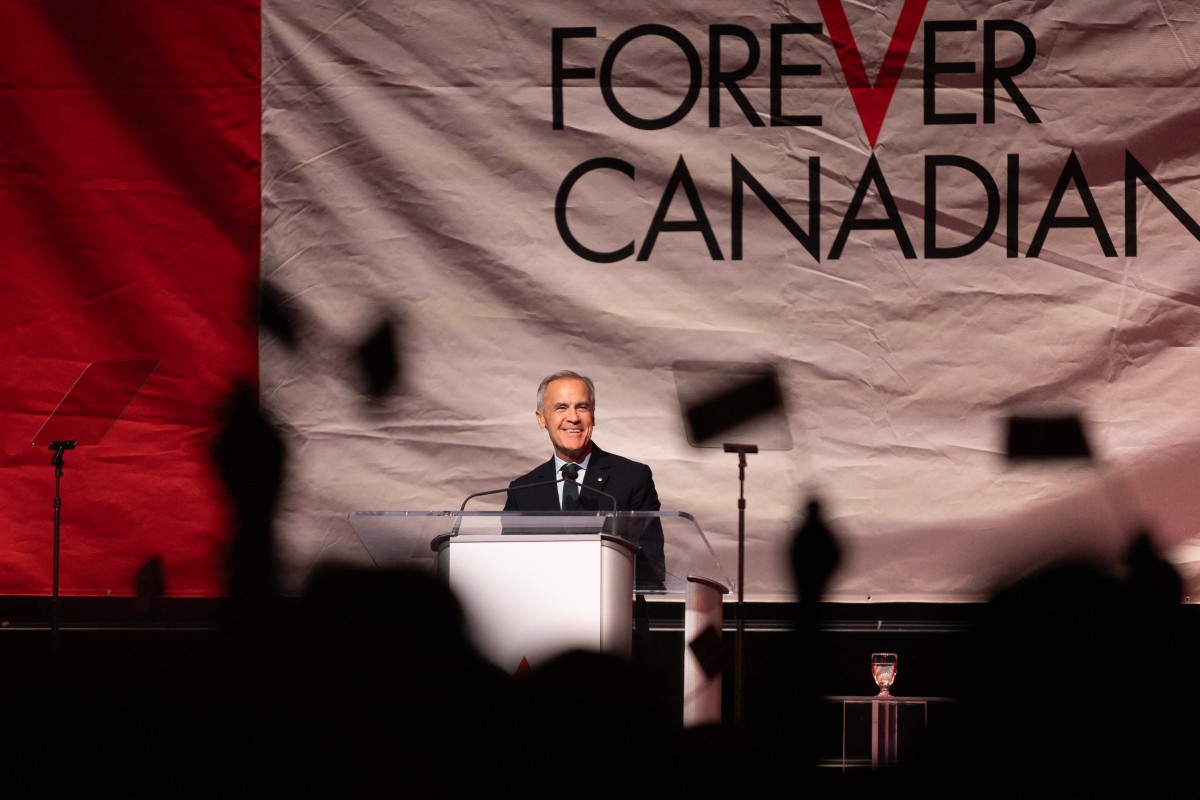
Canadian Prime Minister Mark Carney speaks at a rally hosted by Forever Canadian on Canadian Unity at the Edmonton Expo Center in Edmonton, Alberta, Canada on October 16, 2026. Alberta voters decide next week if they want the oil-rich province to begin the process of separating from Canada, a pivotal test for the country as it confronts a hostile United States. (Photo by Megan Albu / AFP)

The latest analysis has also found that statements from right-wing US podcasters and MAGA influencers have promoted the narrative that Canada is a failed state and that Alberta has no choice but to leave.

Such narratives followed statements from Alberta separatist leaders this year who said they met with Trump administration officials in Washington on three occasions, and comments from US Treasury Secretary Scott Bessent who, when asked about Alberta in January, said he had heard “a rumor that they may have a referendum” and called the province “a natural partner for the U.S.”

Incidentally, US State Department officials met with the separatist Alberta Prosperity Project at one of the three meetings mentioned earlier this year. The group reportedly sought a $500 billion (US) line of credit from the US to support Alberta if it won a referendum.

The American angle in Canada is understandable, given Trump’s “Transactional Continentalism”. Though the Trump Presidency has not officially endorsed Canada’s breakup, the Trump ecosystem seems to have. Several MAGA-adjacent commentators, podcasters, and even some Republican House members support Alberta statehood or association with the US.

After all, Alberta holds the world’s fourth-largest proven oil reserves. For a Trump administration obsessed with energy dominance and lowering domestic fuel prices, direct access to Alberta oil without Ottawa’s environmental regulations is, it is said, a dream.

Secondly,  Alberta is the most conservative, gun-owning, truck-driving, oil-loving province. So, MAGA influencers see a natural ideological ally being oppressed by “woke Ottawa.”

On the other hand, Russia’s motive is viewed as far more strategic. Two possible  reasons could be the following:

One is “Payback for Ukraine”. Canada, after all, is one of Ukraine’s most hawkish supporters. It is home to a large Ukrainian diaspora, a staunch backer of sanctions, and a trainer of Ukrainian troops.

Therefore, if Canada lectures Russia about territorial integrity, what better riposte than: “What about Canada’s territorial integrity?” It is whataboutism as a weapon.

The second reason could be the link between Alberta’s separatism debate and Russia’s long-term Arctic strategy and its rivalry with Canada over Northern sovereignty.  Canada is actively upgrading its military footprint in the North. It has committed to counter rising Russian aggression by purchasing new icebreakers and deploying new infrastructure. For Russia, a major constitutional crisis triggered by provincial separatism thus forces Ottawa to focus inward on saving the federation rather than projecting power in the Arctic.

This is all the more so when  Russia and Canada have overlapping claims over the massive, resource-rich seabed under the Arctic Sea, and Moscow is now aggressively expanding its resource extraction in the region.

Viewed thus, Trump and Putin are not exactly partners in Alberta. But they may be competitors who have found the same weak joint, or vulnerable Alberta. They both benefit from the same outcome — a weaker Ottawa — but for different reasons.

Of course, all this does not necessarily mean that Canada is going to break. As pointed out above, separatism in Alberta is still a minority voice. But the timing of the foreign influence in favor of the separatists is worrisome.

In the October 19th, 2026 referendum, Albertans will face an official, non-binding question asking whether Alberta should remain a province of Canada or begin the constitutional process required to hold a future binding referendum on separation. This is not yet an independence vote.

There are other constitutional hurdles too.

Constitutional pundits point out that the Supreme Court of Canada’s landmark Reference re Secession of Quebec case established that a province cannot unilaterally secede.

Even a clear majority answering a clear question would trigger negotiations, not automatic independence, and those negotiations would have to respect federalism, constitutionalism, minority rights, and Aboriginal interests.

But Canada is witnessing a global phenomenon: “Sovereignty” is not just about borders; it is about narrative sovereignty. If you do not control your domestic narrative, someone else will. And that is precisely what Trump and Putin seem to be doing.

  • Author and veteran journalist Prakash Nanda is Chairman of the Editorial Board of the EurAsian Times and has been commenting on politics, foreign policy, and strategic affairs for nearly three decades. He is a former National Fellow of the Indian Council for Historical Research and a recipient of the Seoul Peace Prize Scholarship.
  • Original Article Published on 27th August 2026. The article has been updated with the latest information.
  • CONTACT: prakash.nanda (at) hotmail.com

The post Are Both Putin & Trump Supporting Alberta Separatists to Break Canada? Here’s What the Evidence Shows appeared first on EURASIAN TIMES.

  •  

Trump Shelves Russia Sanctions Weeks After Signing Them Into Law

President Donald Trump has waived sweeping sanctions and tariffs targeting Russia’s energy revenues, invoking national interest provisions in legislation passed only last month. The decision follows his controversial diesel agreement with Vladimir Putin and threatens to deepen divisions with Congress and European allies over economic pressure on Moscow.

President Donald Trump has suspended the implementation of sweeping American sanctions against Russia, using presidential waiver powers to prevent penalties approved by Congress from taking effect just weeks after he signed them into law.

The executive order issued by the White House on Friday, 16 October, suspends tariffs of up to 500 per cent on Russian imports, alongside penalties targeting major purchasers of Russian oil and gas. It also waives numerous financial and commercial restrictions intended to reduce Moscow’s ability to finance its war against Ukraine.

The decision comes two days before the 18 October deadline for implementing key provisions of the Lindsey O. Graham Sanctioning Russia and Iran Act of 2026, which Trump signed on 18 September. The legislation was named after the late Republican senator Lindsey Graham, who had championed tougher economic measures against Russia.

Sanctions established but immediately suspended

The presidential order formally establishes the tariff increases required by the legislation while simultaneously suspending their application.

Under the law, Russian imports into the United States would face additional duties of 500 per cent. A separate provision would impose 100 per cent tariffs on goods imported from the five largest purchasers of Russian crude oil and natural gas if those countries knowingly made new purchases from 18 October, subject to specified conditions and exemptions.

Another provision targets countries identified as leading facilitators of Russian oil sanctions evasion, potentially exposing their exports to similar American penalties.

Trump invoked Section 115 of the legislation, which permits the president to waive sanctions and tariffs after certifying to Congress that doing so serves the national interests of the United States.

The order confirms that the certification and an accompanying explanatory report have been submitted to Congress. However, the publicly released document provides no detailed justification for suspending the measures.

The waivers will remain in effect until the president or designated senior officials decide that further action is appropriate. Existing sanctions imposed under earlier executive orders are explicitly preserved, meaning the decision does not remove all American restrictions against Russia.

Nevertheless, the order prevents the new legislation’s principal economic penalties from operating at a time when Congress had sought to intensify pressure on Moscow.

Diesel agreement shapes Washington’s decision

The suspension follows Trump’s agreement with Putin to facilitate renewed Russian diesel exports, announced on 9 October as part of an effort to reduce international fuel prices.

As EU Today previously reported, the agreement envisages an immediate release of more than 300,000 tonnes of Russian diesel, followed by additional shipments in November and subsequent months. Washington also authorised certain transactions involving Russian diesel until April 2027.

The arrangement has raised questions about the relationship between the administration’s energy policy and sanctions intended to constrain Russia’s war economy.

Diesel prices have become an increasingly important domestic political issue ahead of the American congressional elections on 3 November. The war involving Iran and disruptions to international energy supplies have contributed to exceptionally high fuel costs, creating additional pressure on the administration.

The White House hopes additional Russian supplies will relieve pressure on international markets. However, energy analysts have questioned whether the quantities involved will materially affect American prices, particularly before the elections.

The latest waiver also removes the immediate threat of punitive tariffs against major Russian energy customers, including China and India, which had objected to the proposed measures.

Congressional opposition and European concerns

The decision is likely to intensify opposition within Congress, where the sanctions legislation attracted substantial bipartisan support.

Earlier this week, 12 senators, including six Republicans, called on Trump to reverse his diesel agreement, arguing that allowing Russian fuel back onto international markets would provide Moscow with additional revenue for its military operations.

Democratic Senator Richard Blumenthal, who helped develop the sanctions legislation, criticised the diesel arrangement as contrary to Congress’s intention to strengthen economic pressure on Russia.

The decision also exposes a widening divergence between Washington and Brussels.

At the European Council meeting on Friday, European Commission President Ursula von der Leyen and European Council President António Costa reaffirmed that EU sanctions against Russia would remain in place until Moscow ended its war against Ukraine.

Costa declared that the present circumstances required increased pressure on Moscow rather than a relaxation of existing restrictions. The European Union is also preparing a 22nd sanctions package while considering additional financial support for Kyiv.

For Ukraine, the decision means that Russia will continue to benefit from energy exports and the international trade that helps finance its war. Instead of tightening restrictions on these revenues, Washington has suspended measures specifically intended to cut them.

The timing is particularly significant. While Trump is pressing Kyiv to halt attacks on Russian oil refineries and other energy facilities, Moscow continues its strikes against Ukrainian cities and civilian infrastructure. Zelenskyy has argued that Ukraine cannot be expected to stop targeting Russia’s energy sector while Russian attacks on Ukrainian infrastructure continue.

Although Trump can reinstate the sanctions, his decision removes the immediate threat of additional penalties against Russia and its principal energy customers. It also places Washington increasingly at odds with its European allies. Brussels remains committed to maintaining and expanding sanctions against Moscow, while the White House is now giving priority to reducing American fuel prices, even if that means easing economic pressure on Russia.

  •  

X-Ray Research Reveals Hidden Figures Beneath Belgian Surrealist Paul Delvaux’s Painting

A new exhibition in Belgium brings together a 1956 painting by Paul Delvaux and its original preparatory drawing, revealing how the artist transformed his composition and concealed elements beneath the finished work.

Scientific examination of a painting by Belgian surrealist Paul Delvaux has revealed significant changes to its original composition, including figures and other details concealed beneath layers of paint. The findings are being presented in a new exhibition opening on 16 October at Musée L in Louvain-la-Neuve.

The exhibition, La Ville lunaire II: The Hidden Side of Paul Delvaux’s Painting, examines a work completed in 1956 and held in the museum’s permanent collection. Through X-ray imaging, infrared reflectography and ultraviolet examination, researchers have been able to investigate the artist’s working methods and compare the finished painting with an original preparatory drawing.

The exhibition, which runs until 7 February 2027, follows the acquisition of the drawing by the King Baudouin Foundation in 2024. Its subsequent deposit at Musée L has made it possible to examine the two works together and reconstruct the development of a composition that underwent substantial alterations.

A Painting Concealing Its Own History

Completed in June 1956, La Ville lunaire II depicts a mysterious nocturnal landscape, with a long avenue, buildings, streetlamps and figures arranged within an unsettling architectural setting.

The painting measures approximately 89 by 139 centimetres and was executed in oil on a fibreboard panel. It entered the museum’s collection in 1990 through a bequest from Dr Charles Delsemme.

Its carefully constructed perspective and unusual treatment of space reflect Delvaux’s interest in creating scenes that appear familiar while remaining detached from ordinary reality.

The museum’s collection records describe the work as a strange nocturnal landscape, with wooden barriers and a sequence of streetlamps establishing its distinctive spatial arrangement.

Yet the painting visible today differs considerably from the composition Delvaux originally envisaged.

Earlier technical examinations had already established that important details were covered during the painting process. The new exhibition brings those findings into direct comparison with the preparatory drawing, enabling visitors to see how the artist’s intentions changed.

An auction catalogue published in 2024 identified several elements present in the drawing and concealed in the painting, including a moon in the right-hand sky, a seated figure on the right and two figures wearing robes near the centre.

These changes are significant because they suggest that Delvaux did more than adjust minor details. He altered the population and lighting of the scene, potentially changing how the composition would be experienced by the viewer.

The reasons for those decisions remain uncertain.

How Scientific Technology Reveals Hidden Paintings

Modern conservation techniques allow researchers to examine works of art without removing the paint that covers earlier stages of their creation.

Infrared reflectography can reveal underdrawings and certain changes concealed beneath surface paint, depending on the materials used by the artist. X-ray imaging can detect differences in the composition of pigments and structures below the visible surface.

Ultraviolet examination provides further information about surface materials and alterations, including some later interventions.

When combined with documentary evidence, these methods help researchers distinguish between an artist’s initial design, revisions made during painting and changes introduced after completion.

The Musée L exhibition uses these techniques to investigate what art historians call pentimenti — visible or detectable alterations that record an artist changing their mind during the creative process.

The preparatory drawing, measuring approximately 28 by 45 centimetres, provides an additional reference point. Executed in ink and pencil, it contains elements that were subsequently revised or painted over in the final composition.

Displayed alongside the finished work, it allows visitors to follow the artist’s decisions from the preliminary design to the version that eventually entered the museum’s collection.

The technical findings also demonstrate the importance of preserving preparatory studies, which can contain information absent from completed paintings.

Paul Delvaux and the Belgian Surrealist Tradition

Born in Antheit in 1897, Paul Delvaux became one of Belgium’s best-known twentieth-century painters, developing a distinctive artistic language associated with surrealism.

His paintings frequently depict classical buildings, railway stations, deserted streets and solitary figures, often arranged in environments where architectural precision contrasts with an atmosphere of uncertainty.

He was influenced by the Italian painter Giorgio de Chirico, whose deserted urban spaces and dramatic perspectives helped establish the visual language of metaphysical painting.

Delvaux’s relationship with de Chirico has been examined extensively by art historians, including Joël Roucloux, whose study of La Ville lunaire II analysed its architectural perspective, shadows and the psychological effect of its composition.

The painting’s apparently moonlit setting is particularly interesting in light of the concealed moon identified by technical examination.

The absence of that celestial body from the final visible composition changes the relationship between the painting’s title and its visual content, leaving the viewer to interpret the source of its unusual illumination.

This approach distinguishes Delvaux from other Belgian surrealists, including René Magritte, whose work frequently relied on recognisable objects placed in logically contradictory situations.

For Delvaux, architecture, perspective and the arrangement of human figures were equally important in constructing a world that appears coherent but resists conventional interpretation.

A New Examination of a Familiar Work

The exhibition forms part of Musée L’s programme devoted to research into its permanent collections, rather than a conventional retrospective of the artist’s career.

Its central purpose is to explain how a single painting developed, from its first drawn composition through successive revisions to its completed form.

The research has been supported by the Jacqueline Delcourt-Nonkels Fund, managed by the King Baudouin Foundation.

For visitors, the opportunity is to examine not only a painting by one of Belgium’s leading surrealists, but also the evidence of the artistic decisions that shaped it.

The exhibition is open at Musée L in Louvain-la-Neuve from 16 October 2026 to 7 February 2027. By presenting the original drawing, technical images and finished painting together, the museum offers a detailed examination of Delvaux’s methods and the changes he made to one of his most carefully constructed nocturnal scenes.

  •  

EU Resists Further Delay to Carbon Pricing as Energy Costs Divide European Leaders

Italy and five other member states have failed to secure a further postponement of the EU’s new carbon market for heating and transport fuels, although European leaders have ordered a fresh assessment of its impact on households and businesses.

European Union leaders have resisted demands for another postponement of carbon pricing for road transport and building fuels, exposing deep disagreements over climate policy, industrial competitiveness and the burden of energy costs on European households.

At the European Council summit in Brussels on 15–16 October, the Visegrad countries — Poland, Hungary, Slovakia and the Czech Republic — pressed for the second European Emissions Trading System, known as ETS2, to be delayed until 2030. Italy and Greece joined calls for greater flexibility over carbon costs, although Rome also sought a national exemption from aspects of the energy-price regime rather than simply a uniform delay. No further postponement was agreed.

The European Council conclusions call on the European Commission to update its assessment of ETS2, particularly its design and safeguards. Leaders also demanded action to reduce volatility in the existing carbon market and limit the effect of carbon prices on electricity costs.

The outcome stops short of the further postponement sought by several governments, but demonstrates how far energy affordability has moved towards the centre of European climate negotiations.

The growing rebellion over ETS2

ETS2 is designed to extend the principle of carbon pricing to fuels used for heating buildings, road transport and certain smaller industrial activities. Unlike the existing Emissions Trading System, which covers large industrial installations and power generation, the new mechanism reaches sectors closely connected to everyday household expenditure.

Under the scheme, fuel suppliers must purchase allowances corresponding to the emissions associated with the fuels they sell. Households and motorists will not buy allowances themselves, but suppliers may pass those additional costs through to customers.

That distinction is fundamental. A policy designed to encourage investment in cleaner heating systems and vehicles may initially appear to consumers as an increase in petrol, diesel and domestic heating bills.

The current legislative timetable provides for ETS2 to become operational in 2028, following an earlier one-year postponement. The latest demands from several Central European governments would push that date back to 2030.

Their argument is that consumers and smaller businesses cannot reasonably be expected to absorb another source of energy-price pressure while European economies continue to contend with geopolitical uncertainty, expensive fuel and comparatively weak industrial competitiveness.

Czech Prime Minister Andrej Babiš has been particularly outspoken in his criticism, arguing that carbon pricing risks weakening Europe’s industrial base and making everyday life more expensive.

Italy has supported calls for greater flexibility, with Prime Minister Giorgia Meloni presenting the discussion as part of a wider attempt to restore competitiveness and make the transition more affordable.

Why other governments opposed another delay

The initiative encountered resistance from governments concerned that repeatedly postponing established climate legislation would weaken investment certainty and reduce confidence in European policy.

The Nordic member states have been particularly reluctant to reopen the timetable. Their position reflects a broader concern that businesses investing in clean technologies need credible long-term rules, rather than legislation liable to be revised whenever political opposition intensifies.

Carbon pricing is intended to change economic incentives gradually. Higher costs for carbon-intensive fuels are supposed to make alternatives such as better-insulated buildings, electric vehicles and cleaner heating more financially attractive.

Critics of further postponement argue that delaying implementation would also delay those incentives, potentially increasing the eventual cost of reaching the Union’s emissions-reduction targets.

Yet the opposition has exposed a weakness in that argument: consumers cannot always respond quickly to price signals. A household relying on an older heating system or a worker with no practical alternative to driving may face higher costs long before affordable low-carbon options become available.

That issue has been central to earlier discussions over ETS2. EU Today reported on stronger carbon-price safeguards in June, when European institutions moved to provide additional market intervention if allowance prices rose sharply.

Commission ordered to reassess the economic impact

Rather than endorsing a new delay, European leaders have asked the Commission to review ETS2’s economic impact and safeguards.

The summit also urged faster progress on adjustments to the Market Stability Reserve, the mechanism intended to help manage the supply of carbon allowances and prevent excessive price volatility.

Under the existing scheme, market interventions can increase or reduce allowance availability in response to defined conditions. For ETS2, safeguards are especially politically sensitive because the cost of carbon allowances may ultimately be reflected in household transport and heating expenditure.

The European Commission’s updated auction arrangements already envisage auctions of ETS2 allowances beginning in 2027, ahead of the system’s operational launch in 2028.

That timetable gives governments a relatively narrow window to settle the remaining political disputes and put protective measures into effect.

A central part of the response is the Social Climate Fund, intended to support vulnerable households, transport users and small businesses through investments in energy efficiency, cleaner heating, improved transport and temporary financial assistance.

EU Today previously examined the European Investment Bank’s €3 billion advance financing initiative, which aims to accelerate support for households before the new carbon market becomes fully operational.

The central practical question is whether such assistance reaches consumers quickly enough to offset rising costs, particularly in member states where incomes are lower and households remain heavily dependent on fossil fuels.

Climate commitments meet industrial reality

The ETS2 dispute is connected to a broader argument over Europe’s existing carbon market and its effects on energy-intensive industries.

Manufacturers already face substantial costs arising from electricity, fuel, regulatory requirements and international competition. Governments concerned about deindustrialisation argue that European climate policy must account more directly for these pressures.

The summit conclusions acknowledged those concerns by demanding a predictable carbon market that limits price volatility and protects industry against the relocation of production to jurisdictions with less demanding environmental rules.

At the same time, leaders reaffirmed the importance of maintaining carbon pricing as an incentive for investment and emissions reduction.

For the governments seeking a postponement, the Commission’s new assessment offers an opportunity to maintain pressure for further concessions. For governments defending the existing timetable, it provides an alternative to another politically damaging delay.

The immediate result is therefore a compromise over scrutiny rather than a change in law. ETS2 remains scheduled for 2028, while Brussels must demonstrate that its safeguards can withstand both market volatility and political opposition.

The next phase will be determined less by arguments about long-term emissions targets than by the ability of EU institutions and national governments to show households and businesses how the transition can be financed without placing disproportionate costs on those least able to adjust.

  •  

Archaeologists Uncover Lost 1,600-Year-Old Cathedral Near Venice

Excavations at the ancient Roman city of Altinum have revealed the probable remains of an early Christian cathedral and bishop’s palace, offering new evidence about the origins of Venice and the transformation of its lagoon settlements.

Archaeologists working near Venice have identified what they believe to be the remains of a 1,600-year-old cathedral and an adjoining episcopal palace, resolving a longstanding question about the location of one of the region’s earliest Christian centres.

The discovery was announced on 15 October by Ca’ Foscari University of Venice, following excavations at Altinum, an important Roman settlement on the mainland near the Venetian lagoon. The foundations of a substantial religious complex have emerged from an area where ancient written accounts had long indicated the existence of a cathedral, although its precise location had remained unknown.

The findings suggest that the church was constructed between the late fourth and early fifth centuries AD, making it the earliest Christian church so far identified archaeologically in the Venetian territory. The researchers believe the complex provides physical evidence of the period when Christianity was becoming an important political and administrative force in the declining Roman Empire.

A Cathedral Hidden Beneath a Roman City

The newly identified church was a rectangular structure approximately 30 metres long and 20 metres wide, without an apse and orientated towards the east. Its layout differs from the surrounding Roman street grid, reflecting the religious requirements of the early Christian community.

The architectural arrangement resembles early churches in the northern Adriatic region, particularly those associated with Aquileia, which was an important centre of Christianity during late antiquity.

An adjoining building, distinguished by its substantial foundations and a complex arrangement of internal rooms, has been provisionally identified as the bishop’s palace. Archaeologists believe it may have stood two storeys high, with residential accommodation for senior clergy above rooms potentially associated with privileged burials.

Among the most revealing discoveries is the extensive reuse of stone paving blocks taken from the Roman streets. These materials were incorporated into the foundations of the ecclesiastical buildings, providing evidence of how the city was being physically reorganised during the transition from Roman to Christian administration.

The university’s researchers suggest that the removal of public paving materials may also indicate the authority exercised by the bishop over urban infrastructure. This interpretation would place the emerging Church at the centre of the city’s political transformation.

Ancient Written Accounts Supported by Archaeology

The existence of an early Christian cathedral at Altinum had been documented in letters written by Saint Jerome, one of the most influential Christian scholars of the late Roman period.

Writing in AD 396, Jerome referred to the religious activities of Nepotian, a priest associated with Heliodorus, the first bishop of Altinum. His descriptions included the maintenance of church furnishings, walls, floors and sacred vessels, suggesting an established and relatively prosperous Christian institution.

Until now, however, archaeologists had struggled to connect those accounts to a particular building.

The latest excavations, combining evidence collected during the 2025 and 2026 campaigns, have provided what researchers consider a convincing identification of the ecclesiastical complex.

The excavation is directed by Diego Calaon of Ca’ Foscari University and co-directed by Elisa Possenti of the University of Trento. Their work has brought together earlier archaeological records and newly examined foundations, including sections exposed during investigations in previous decades.

Researchers have also identified a burial area dating from the sixth and seventh centuries. Many graves were disturbed when construction materials were removed from the abandoned complex, but surviving human remains offer opportunities for further scientific investigation.

Radiocarbon dating, anthropological examinations and additional geophysical surveys are planned to establish a more detailed chronology and search for other elements of the religious complex, including its baptistery.

What the Discovery Reveals About Venice’s Origins

The historical importance of Altinum extends beyond the cathedral itself.

The ancient settlement was an important Roman commercial centre with connections to the waterways of the northern Adriatic. As political, environmental and demographic conditions changed during late antiquity, its population and institutions gradually shifted towards settlements within the lagoon.

One of the most important destinations was Torcello, which later became an early centre of Venetian civilisation.

Traditional accounts have often portrayed the creation of lagoon settlements as a response to barbarian invasions, with mainland inhabitants fleeing to isolated islands for protection.

The latest archaeological findings support a more complicated process.

Research at Altinum and Torcello indicates that the movement of people, religious institutions and construction materials was gradual and organised rather than the consequence of a single catastrophic event.

The cathedral appears to have been systematically dismantled during the first half of the seventh century, with substantial quantities of its stone and brick transferred to developing lagoon communities.

A surviving inscription records the establishment of Torcello’s cathedral in AD 639, providing an important chronological reference for the movement of ecclesiastical authority.

The findings add to the wider study of Europe’s surviving archaeological and architectural heritage, particularly the transformation of Roman settlements into medieval urban centres.

They also demonstrate how archaeological evidence can challenge historical narratives constructed centuries after the events they describe.

Much of the late-antique landscape at Altinum disappeared because of centuries of agricultural activity and the systematic removal of reusable building materials. In many cases, the excavators are studying trenches left by the extraction of foundations rather than surviving walls.

Further investigations may determine the complete extent of the episcopal complex and clarify the chronology of its abandonment.

For the first time, however, researchers can locate the religious buildings associated with Altinum’s earliest Christian bishops and trace their connection to the communities from which medieval Venice eventually emerged.

  •  

Challenges to the Bible’s Trustworthiness (2): Being Out-of-Date and Irrelevant to Modern Issues

When Paul wrote his letters, many of the issues he dealt with were not outlined in the Old Testament Scriptures he had in front of him. He wrote about meat sacrificed to idols, about speaking in tongues, and about a man who slept with his stepmother, none of which were dealt with directly in another... Continue Reading
  •  

The Perfect Balm for Reviving Weary Souls: God’s Word

After celebrating God’s word, David responds with a prayer. “Who can discern his errors? Declare me innocent from hidden faults” (Psalm 19:12). The word of God doesn’t merely inform us; it actually exposes us (Hebrews 4:12-13). It reveals our sin, hidden motives and our need for God’s mercy. Yet this is precisely why God’s word... Continue Reading
  •  

Five Words Can Change Your Life

Take these simple, five-word sentences and share them with one another.   Did you know that five words can change your life? Paul says that he’d rather speak five intelligible words than ten thousand unintelligible words. And whether he meant that literally or figuratively, it is amazing how spot on this is. To speak with... Continue Reading
  •  

America’s Spiritual Founding Father

The founding of America. The shaping of Europe. We still live in a world that bears the imprint of Whitefield and the Great Awakening. The question is, for how long? Very few people today know who George Whitefield was. The message he preached is becoming decreasingly familiar. Men have forgotten Whitefield. Now they are forgetting... Continue Reading
  •  

Archaeologists Discover 130-Metre Mining Tunnel Beneath German Forest

Excavations in Germany’s Ruhr region have uncovered evidence of a substantial underground mining operation that predates the area’s industrial expansion. The discovery is providing new clues to the origins of European coal mining.

Archaeologists have identified a previously unknown coal-mining tunnel stretching at least 130 metres beneath woodland near Sprockhövel in western Germany. The remains provide evidence of coordinated underground construction at a time when the Ruhr’s mining industry was still developing, long before the region became synonymous with heavy industry.

The discovery was announced on 15 October by the Westphalia-Lippe Regional Association (LWL), whose archaeologists are working alongside the German Mining Museum in Bochum and GeoPark Ruhrgebiet. The team says its findings shed light on tunnelling techniques used before the eighteenth century, although the newly identified passage has not yet been given a precise scientific date.

At Haßlinghausen, a forest floor conceals old shafts, spoil heaps and depressions left by abandoned mining operations. Researchers did not enter an intact underground gallery. Instead, they identified the location of a collapsed passage by excavating at two former shaft sites and drilling into the surrounding spoil. Subsidence created by the collapse left a recognisable trace above ground.

How Early Miners Organised Underground Work

The evidence suggests a more complex operation than miners simply following exposed seams into the earth. Construction shafts were sunk at intervals along the proposed tunnel. Workers descended through them and excavated separate stretches underground, later joining those sections into a continuous passage.

This method allowed several groups to work simultaneously rather than advancing from a single entrance. It also demanded planning and considerable labour. The filled-in shafts and disturbed soil are still visible in the excavated sections, enabling specialists to reconstruct the miners’ methods even though much of the original tunnel has collapsed.

Till Kasielke of GeoPark Ruhrgebiet explained that the construction shafts were located beside the underground route and then filled after the gallery was completed. Jennifer Garner, an archaeologist at the German Mining Museum, said the excavations would provide material for scientific dating and a better understanding of the effort required to build the structures.

The latest work follows a 2025 investigation of a separate, approximately 70-metre tunnel nearby. That earlier feature reached a coal seam some ten metres below ground. Researchers suspected it might predate the seventeenth century because it appeared to have been overlooked during later mining activity. The newly identified 130-metre passage is a distinct discovery.

The chronology matters because horizontal tunnels changed the possibilities of coal extraction. Early miners could reach seams by digging pits or inclined shafts, but groundwater increasingly obstructed work at depth. Drainage galleries allowed water to escape, making deeper workings more practical and potentially extending the life of individual mining sites.

An Industrial Region’s Earlier History

The Ruhr is usually associated with the vast collieries, factories and transport infrastructure that drove Germany’s expansion in the nineteenth and twentieth centuries. Yet coal was extracted locally during the Middle Ages. The transition from small workings to organised subterranean networks remains poorly documented, partly because written records from the earliest periods are scarce.

The archaeological research programme, which began with related investigations in 2024, is intended to address that gap. The team has excavated soil layers associated with old shafts, and the recovered material may help establish when specific construction techniques were introduced. For now, it would be premature to assign the new passage a medieval date.

At Essen, the UNESCO-listed Zollverein Coal Mine Industrial Complex preserves the architecture and machinery of the Ruhr’s later industrial era. The remains at Sprockhövel represent a different historical record: temporary shafts, collapsed passages and waste deposits left by miners whose operations preceded industrial-scale coal production.

Across Europe, such landscapes have become an important part of cultural heritage. EU Today has previously reported on the preservation of Belgium’s Bois du Cazier colliery, where 262 people died in the 1956 mining disaster. In Sprockhövel, the focus is on a much earlier workforce, whose organisation and technical knowledge must be reconstructed from the ground itself.

Further dating and analysis will determine whether the newly identified tunnel pushes back the known chronology of organised drainage and gallery construction in the Ruhr. The excavations have already established that a substantial underground project once operated beneath a forest whose surface retains remarkably little indication of the work carried out there.

Image credit: LWL-Archäologie für Westfalen / Manuel Zeiler
  •  

NPR investigation finds evidence of widespread fraud at mall kiosks tied to Israeli skincare brand

They're a common feature at US shopping malls: skincare kiosks staffed by charming Israeli salespeople. Some customers were hit with thousands of dollars in charges they never authorized and products they didn't want and can't return. Many victims were elderly, disabled or otherwise vulnerable

  •  
❌