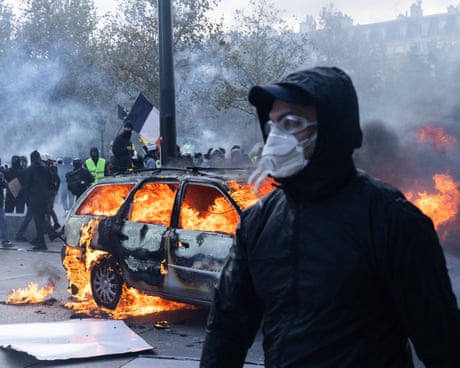
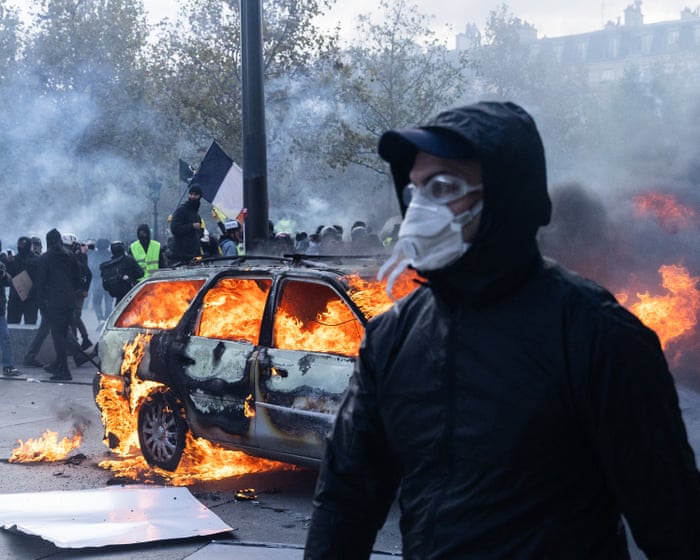
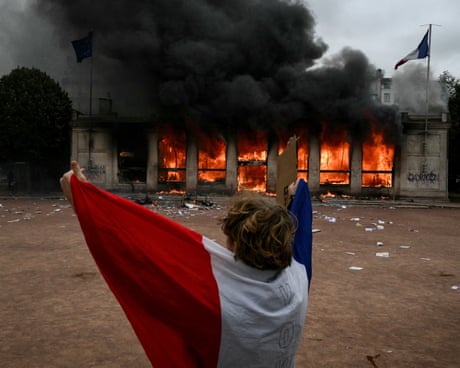
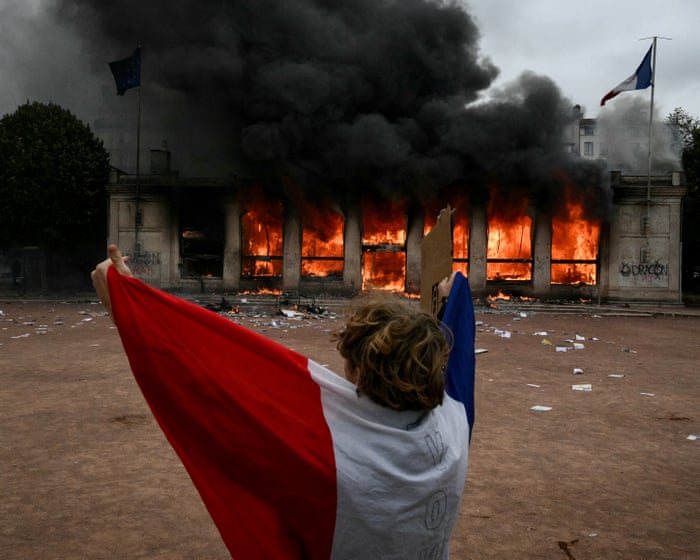
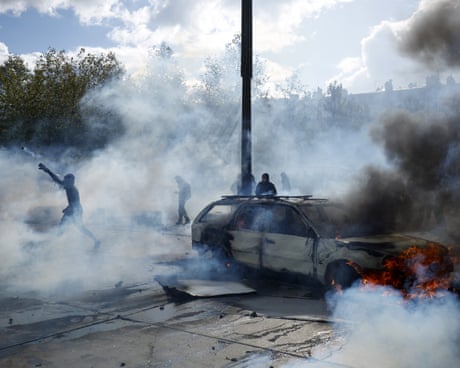
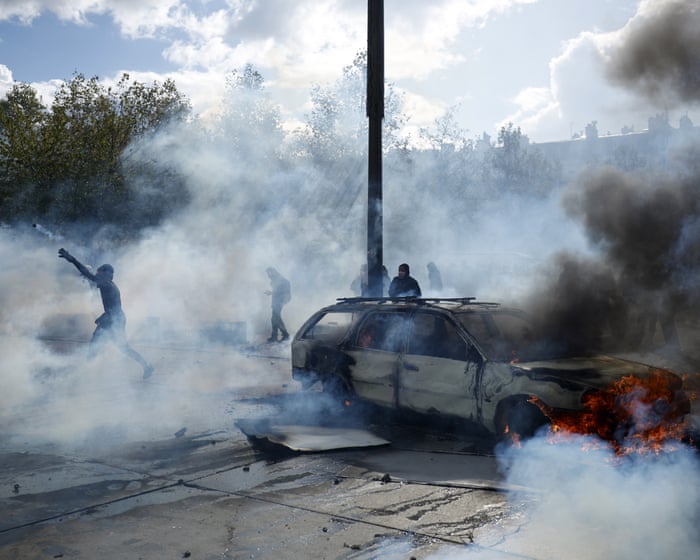
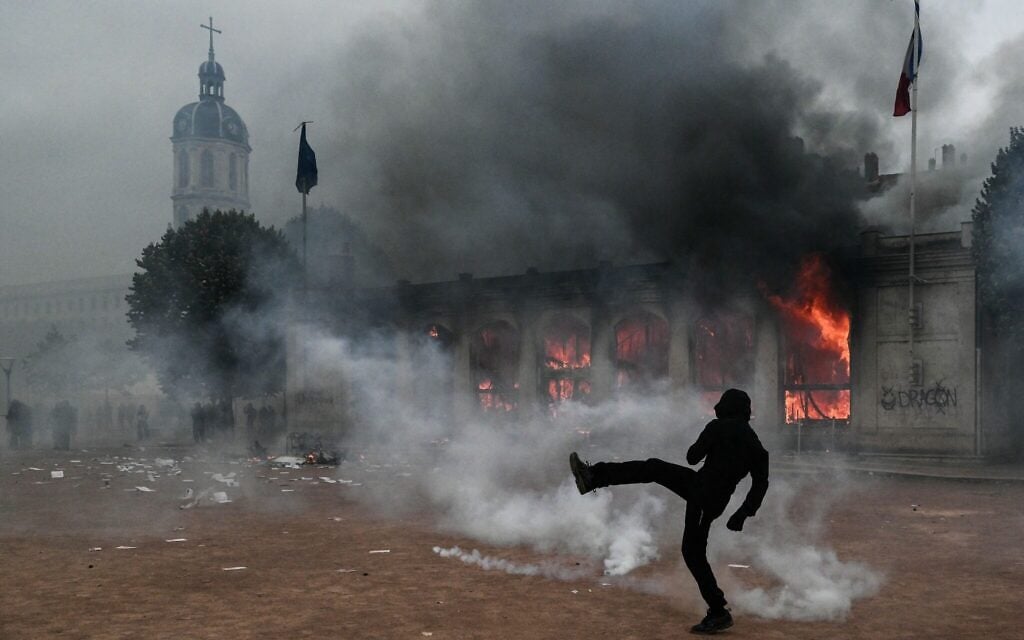
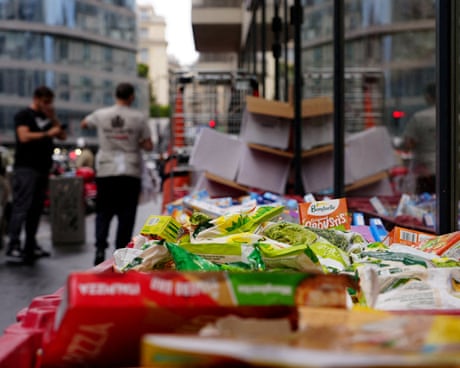
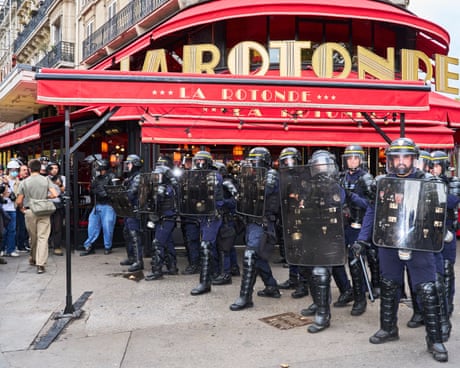
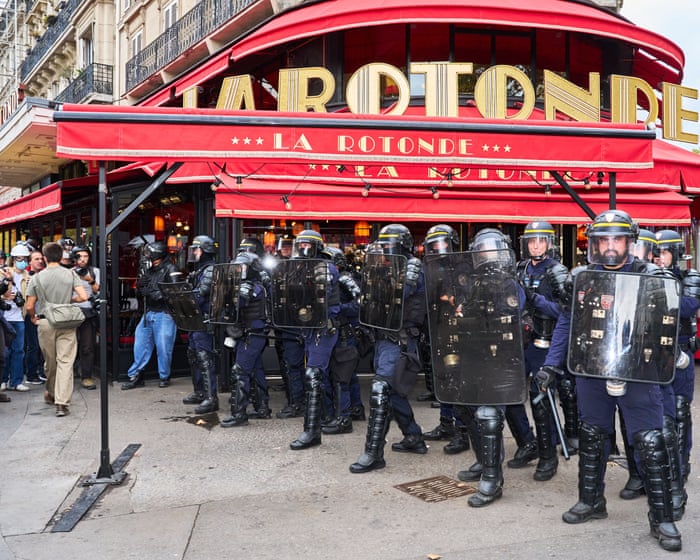
Looters on Saturday seized the opportunity to raid and vandalise a host of shops and businesses across France – from bakeries and supermarkets to tech stores – as hundreds of thousands of people took to the streets to protest higher living costs and other grievances.
Despite images from scene of attack and IDF condemnation, PM suggests incident could be part of 'coordinated smear campaign'; Belgium to push for EU sanctions on those involved
Police fired teargas and blocked streets in Paris during protests supporting high school student grievances, high prices and the fraying of the social welfare system. A peaceful march was seen to turn violent as rioters threw fireworks around Place de la République in central Paris.
Student protests started last month over absent teachers and decrepit school buildings, and has developed into a bigger movement over cost of living and falling standards. Demonstrations broke out nationwide with hundreds of thousands of people taking to the streets in Paris, Marseille, Lille and Nantes
Macron é, hoje, muito possivelmente, o presidente mais impopular do planeta, contando com apenas 15% de aprovação, segundo uma enquete Ipsos BVA-Cesi. Sob seu comando, a França se depara com a estagnação econômica (crescimento de 0,6% em 2025) e com o endividamento (120% do PIB). Sob Macron, a França viu também a desindustrialização acelerada do país, com as indústrias correspondendo a apenas 9% do PIB, menor patamar da União Europeia, e não surpreendentemente, o poder de compra despencou, com metade dos franceses dizendo que sua renda dá apenas para o essencial e apenas 70% dos cidadãos em idade ativa ocupando um posto de trabalho, atualmente.
Como se isso já não fosse o bastante, em aproximadamente 10 anos de governo Macron, aproximadamente 4 milhões de imigrantes entraram no país (muitos dos quais não trabalham, mas recebem benefícios sociais); quantia que torna impossível a absorção econômica bem como a assimilação etnocultural dos recém-chegados. Naturalmente, ao descontrole imigratório estão vinculadas taxas de criminalidade, favelização de centros urbanos e aumento das tensões sociais. Muitos franceses étnicos sentem-se demograficamente substituídos em sua terra natal, e não por acaso, tudo indica que Marine Le Pen ganhará (finalmente) as eleições presidenciais francesas em 2027.
Não sabemos quais seriam os resultados de uma presidência Le Pen e é razoável ser cético a respeito, mas claramente o atual curso da França é perigosíssimo, inclusive em sua política externa.
Gradualmente, nos últimos 2 anos, começaram a aparecer inúmeros sinais de que Macron estaria preparando o país para uma guerra com a Rússia. O governo francês criou um serviço militar voluntário e aprovou a expansão das forças armadas permanentes a 275 mil homens, bem como um aumento orçamentário para a defesa. O general Fabien Mandon, do Estado-Maior, afirmou em 2025 que a França deveria se preparar para um conflito de alta intensidade com a Rússia no prazo de três a quatro anos, e agora em setembro de 2026 Macron declarou que a França “poderia” se tornar alvo de drones explosivos. Constantemente, também, se ouve discursos sobre a necessidade de transformar a economia francesa numa “economia de guerra”.
Por isso, talvez seja surpreendente para muitos (mas não para nós) que em meio a tudo isso que tem acontecido no país, o governo Macron ainda encontre tempo para a implementação de um aparato de censura e repressão de níveis totalitários.
Sua nova vítima é a associação Egalité et Réconciliation (Igualdade e Reconciliação), criada pelo sociólogo e escritor Alain Soral. A associação se identifica como “nacionalista de esquerda” e tem como principal slogan “esquerda do trabalho, direita dos valores”, apelando a uma superação da falsa dicotomia entre esquerda e direita e, ainda mais importantemente, por uma reconciliação nacional entre todos os setores sociais; em anos recentes, ela esteve envolvida nas manifestações dos Coletes Amarelos, em algumas atividades ligadas ao partido Reagrupamento Nacional (apesar de, simultaneamente, manter uma postura de “crítica construtiva” contra certas tendências sionistas e liberais presentes no partido) e à militância pró-Palestina.
Ocorre que, no dia 9 de outubro, o Ministro do Interior do governo de Macron, Laurent Nuñez, anunciou a abertura de um procedimento de dissolução contra a associação Egalité et Réconciliation, sob a acusação de “extremismo político”. A sua equipe jurídica recebeu um prazo de 1 semana para se defender, e a decisão a respeito deve ocorrer, ainda, em outubro.
O próprio Alain Soral é uma figura de elevado espírito inconformista, razão pela qual já foi vítima de incontáveis perseguições judiciais – dezenas de fato – majoritariamente por “delitos de opinião”, ou seja, por comentários críticos contra pessoas específicas ou “minorias protegidas”. Em condenações, Soral já acumulou milhões de euros a serem pagos em indenização para ONGs globalistas diversas, soma obviamente impagável, bem como já foi encarcerado algumas vezes, também pelos mesmos motivos. A perseguição judicial foi tão intensa que Soral teve que se exilar de sua pátria, primeiro na Suíça e depois na Rússia.
Agora, para além das justificativas oficiais, por qual motivo o Estado francês baniria uma organização relativamente pequena e de poucos recursos financeiros?
É possível analisar o “ângulo” da presença de Alain Soral na Rússia, em mais de um sentido. Primeiro, porque ao estar na Rússia Soral finalmente tornou-se imune à constante perseguição judicial e às ameaças de prisão que ele sofria na França, ao mesmo tempo em que seguia tomando parte ativa no debate político e cultural francês, mesmo à distância. Nisso, ele era capaz de exercer e expandir a sua influência, “sob a proteção dos russos”, o que certamente alimenta as típicas paranoias atuais da elite francesa sobre uma “guerra informacional” russa.
Existe, porém, também um aspecto interno. Recentemente, Alain Soral voltou a ser bastante comentado pela mídia francesa por dois motivos. Um é o “caso Bardella”, o qual diz respeito à descoberta de supostos escritos “politicamente incorretos” de Jordan Bardella, presidente do partido Reagrupamento Nacional, e à informação de que em sua juventude a principal influência intelectual de Bardella era Alain Soral. O segundo é uma pesquisa de opinião indicando que 15% dos homens franceses com menos de 35 anos de idade se identificam com as ideias de Soral.
Isso às vésperas das eleições presidenciais representa um risco significativo para Macron e para o establishment francês. Ainda que, aparentemente, não haja chance de vitória para qualquer candidato contra Le Pen, não podemos duvidar da possibilidade de manipulação do processo eleitoral, tal como aconteceu na Romênia.
Esse silenciamento é ainda mais preocupante pelo fato de que Soral e o E&R serem praticamente os únicos personagens socialmente e culturalmente relevantes na França hoje que defendem a reconciliação nacional e que evitam a incitação do tensionamento interno, promovido pelos elementos mais islamofóbicos do RN e pela própria liderança do LFI de Mélenchon com seu “exército” de antifas e imigrantes.
According to an Ifop poll for the newspaper Marianne, nearly half of Muslims and Jews would consider leaving the country if Marine Le Pen were to emerge victorious in the presidential election next year. 20% of them would “certainly” do so.
Which candidate would cause you to leave France? This is one of the questions posed by the Ifop poll for Marianne, released on Thursday, October 15. The study reveals that a significant proportion of Muslims and Jews say they are prepared to leave the country if Marine Le Pen wins the 2027 presidential election.
Some 46% of that number are planning “leaving France to settle in another country,” while 20% say they will “certainly” take the plunge. More broadly, 40% of younger French people say they have made plans to leave. Among voters of La France Insoumise, the figure rises to 43%. Furthermore, 44% of Jewish citizens responded that they would consider leaving the country.
Marine Le Pen’s rise to power could create “significant obstacles” and generate “high levels of fear and insecurity,” Francois Kraus, director of the political division at Ifop, explained to journalists. More than eight out of ten Muslims fear an “increase in attacks and discrimination” against them. This concern is particularly relevant in the context of the National Rally’s plan to ban the wearing of the Islamic veil in public spaces. Confirmed at the end of August by MP Jean-Philippe Tanguy, the new measure would impose stiff fines on offenders and is expected to be included in Marine Le Pen’s platform for the 2027 presidential election. To circumvent the legal hurdles that such a ban might encounter, the presidential candidate is reportedly considering putting it to a referendum.
Meanwhile, only 27% of Muslim respondents would be willing to “conceal [their] religious affiliation on a daily basis,” for example, by ceasing to wear the headdress in public (18%). More broadly, 41% of those surveyed, regardless of their religion, would refuse to “respect laws” they consider “unjust.” This distrust affects three out of four Jean-Luc Melenchon voters and nearly half of civil servants (45%). According to the latest Ifop-Fiducial poll, Marine Le Pen maintains a significant lead in the first round. Depending on the scenario, the National Rally candidate is in first place with between 32% and 36% of the total vote.
While Le pen has remained antagonistic towards Islam in France, she has often cast herself as a protector of the Jewish people in the country.
In 2024, she remarked, “The best shield for French people of the Jewish faith is the National Rally. It is the only movement that has the will, the conviction and the means to fight Islamist fundamentalism, which is the major danger facing them.”
Yet, nearly as many Jews said they would leave the country under a Le Pen presidency as Muslims.
Protesters clashed with police in Paris and other French cities on Saturday as hundreds of thousands took to the streets to protest higher living costs and the declining conditions in schools and other public services. Several town halls were broken into – and in at least one instance set on fire – and many shops were vandalised and ransacked. One protester had his hand torn off by what appeared to be a crowd-control grenade used by police.
If Douma, one of the highest-profile “proven” chemical attacks attributed to Syria’s former Bashar Assad government, has been shown to be fake, what does it say about new, undeclared Syrian chemical weapons that have supposedly been found?
It says we should be extremely skeptical about news of such discoveries.
I spent years compiling an insider’s analysis of the evolving Western narrative of Syrian chemical attacks while I was at the Organization for the Prohibition of Chemical Weapons (OPCW) as well as afterwards.
My conclusion was it is nigh impossible to prove a negative in this situation; to say there had never been a chemical attack by the Syrian government forces.
However, when it came to high-profile allegations of such attacks in the Syrian towns of East Ghouta, Khan Sheykhoun, Ltamenah, Saraqib and Douma, there were fatal flaws in the official narratives.
There were unmistakable signs, clear to us on the inside, of fabrication.
The Douma attack eight years ago appeared to be the last of a series of chemical allegations against the regime.
Yet the saga continues. The OPCW sent a new mission to Syria this May to try to find alleged, undeclared chemical weapons from the government of Bashar al-Assad, who was ousted in 2024.
Before examining the intentions and results of this mission, it is useful to review how the Western-backed OPCW handled its investigation into the 2018 chemical weapons attack in Douma, a suburb of Damascus.
I was an OPCW inspector on that mission and this is why I blew the whistle.
The Establishment Narrative
Just how much of the establishment narrative that blamed Assad for using chemical weapons be believed ?
Devised during the early part of the Western and Gulf-backed jihadist war to overthrow Assad a decade and a half ago – and built upon steadily by Western belligerents throughout the crisis – the story that Assad had “gassed his own people” was widely believed with mainstream media fully on board.
Doubters were glibly dismissed, including “official” dissenters such as some senior inspectors at the OPCW. I was among them.
The chemical allegations followed a well-oiled procedure. Armed opposition groups – who were seeking direct Western military intervention to support their effort to overthrow Assad – would raise the alarm online by posting slick images and videos of an alleged chemical attack.
These opposition groups, sometimes assisted by Western NGOs, would then bring supposed witnesses of these alleged attacks to Gaziantep in Turkey, where the OPCW would send fact-finding missions to interview them.
The OPCW would generally believe the opposition groups and their witnesses and accept items of supposed “evidence” handed over to them, sometimes months after the alleged attack. Until the Douma allegation in 2018, the fact-finding mission never got to the scene of any Syrian chemical attack after an initial attempt in 2014 went awry.
The fact-finding report would be secretly drafted under the direct control of OPCW top management, bypassing any procedural or technical oversight, and would conclude that it was “reasonable to believe” that a chemical attack had indeed taken place.
The follow-up investigations by the heavily politicized Joint Investigative Mechanism (J.I.M.), or by the later Investigation and Identification Team (I.I.T.), would suggest that “a reasonable person would believe” that the Syrian Armed Forces were responsible for the attack.
OPCW inspectors are not fools. Many of us saw what was going on, seeing the tight political control that the U.S. and to a lesser degree the U.K. exerted over anything to do with the Syrian file. But the draconian confidentiality regime in the OPCW kept everyone subdued.
The breakthrough came after the April 2018 Douma allegation.
For the first time, an OPCW team actually got to the scene of an alleged chemical attack, at the town of Douma, in southwestern Syria, about 10 kilometers (6 miles) northeast of Damascus.
We did our job thoroughly, and in doing so we identified serious flaws in the allegation.
OPCW Extreme Measures
The OPCW resorted to ever-escalating measures to bring things back on track. After trying to secretly modify the interim report by withdrawing it from publication and sneaking in the preordained conclusions that were required by influential delegations, senior OPCW officials went to extremes.
They removed all the team members who had gone to Douma and produced a flawed Fact Finding Mission report written by persons unknown, none of whom had much knowledge of what the Douma team had done.
The fact-finding report predictably found that “it was reasonable to believe” there had been an attack with chlorine in Douma. This was followed much later by the OPCW’s inevitable I.I.T. report that blamed the Syrian regime for the attack.
In reaching its conclusions, the drafters claimed, as usual, to have been informed by anonymous experts. The context in the reports was usually along the lines of the fact-finding mission (F.F.M.) “asked an expert about this and the expert said it was possible.” Many qualified experts and commentators, including me, consider this laughable.
The OPCW were going too far, and ultimately this led to the ongoing dispute where the two most senior and experienced inspectors in the F.F.M. team objected.
The drafter of the team’s interim report, Dr. Brendan Whelan (“Inspector B”), was one. I was the other. In my case I had also led the politically-mandated inspections at two facilities of the Syrian Scientific Studies and Research Centre (S.S.R.C.) suspected of harbouring illicit chemical weapons activities.
Here again, we did our work thoroughly and in drafting the S.S.R.C. inspection reports I made clear that there was nothing amiss in either of the facilities.
This didn’t stop the U.S., U.K. and France from conducting punitive missile strikes on Barzah S.S.R.C., on the basis of social media postings on the Douma allegation, even before the OPCW team had arrived at the incident scene.
Rather than another detailed analysis of the Douma scandal, suffice it to say, the official Douma narrative has been clearly and scientifically picked apart by many credible observers, including by Dr. Whelan and myself.
This has been widely reported, although predictably not much in the mainstream media.
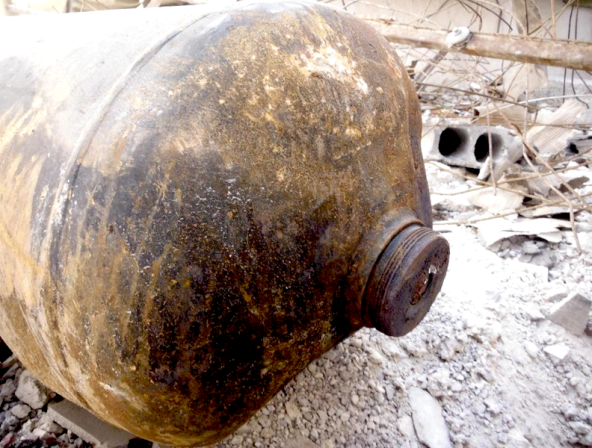
The OPCW and Western delegations have been in crisis management mode ever since the first leak, that of an internal engineering summary that cast doubt on the allegation that chlorine cylinders had been dropped from aircraft, raising the possibility that militants had placed the cylinders to stage the scene of a chemical attack.
I was the author of that report.
Nose of chlorine cylinder alleged to have smashed through a steel-reinforced concrete roof, April. 21, 2018. (OPCW, courtesy former Syrian government)
Worse still for the prevailing Douma narrative, Dr. Whelan recently won a legal case against the OPCW for their charges against him of confidentiality breaches.
In their submissions, the OPCW inadvertently admitted to suppressing the key toxicology assessment (incidentally by NATO specialists) that dismissed chlorine as the likely cause of death of deceased victims shown in images posted from the scene.
The OPCW has refused to engage in any discussion on the facts and scientific substance of the case, ever since concerns were first raised by Dr. Whelan and myself.
This intransigence to re-open the file is likely dictated by the needs of the three belligerent governments that subjected Syria to punitive missile strikes in retaliation for the supposed Syrian chemical attack even before the Douma F.F.M. had started work.
Any updated or corrected findings on Douma would be inconvenient.
The New OPCW Mission
Still apparently seeking to prove its case, the OPCW formed a new Syria mission in May aimed at “finding” alleged missing, un-declared chemical weapons.
At the end of May the mission reported finding 42 empty chemical weapons munitions; a launcher; bomb-mixing units; precursor-type containers; a facility whose contents were not revealed and thousands of pages of documents that are still being reviewed.
The mission also found 650 kg of “a chemical compound known to have been used by the former government for the production of nerve agents,” which the report does not name. It says an unknown quantity of hexamine, a legal chemical with wide industrial use, was found but it is not clear if this is the same compound as in the 650 kg.
In September, the Syrian government, now under the leadership of a former al-Qaeda and ISIS leader, began destroying the empty bombs, but not any of the chemicals that were found, presumably meaning none were banned.
Despite all the fanfare of these results being presented at a U.N. Security Council meeting last month, it appears that the new OPCW mission came up as empty as those bombs.
None of these discoveries does anything to prove that Assad ever used a chemical weapon, in other words, nothing to prove that I, along with other OPCW officials and countless observers and commentators who challenged the Assad chemical weapons narrative were wrong.
Presumably after all the effort in creating that narrative, Western governments and mainstream media that promoted the Iraq war and then the Syrian conflict to achieve regime change in that country, require a tidier ending than the mess they made of the Iraqi WMD story.
An early press release from the OPCW is telling. It shows what they were attempting to prove with this May mission, in particular two rather flimsy suggestions.
They report the discovery of some of the empty munitions,
“including the same type of aerial bombs that were used in chemical attacks in Ltamenah in March 2017 and Khan Shaykhun in April 2017.”
This refers to empty M4000 aerial bombs, declared by the Syrians as part of their stockpile.
Aside from the questionable Douma-like irregularitiessurrounding “evidence” used by the OPCW to conclude that sarin-filled M4000 bombs were used in those attacks, it’s important to mention something else.
The Syrians had clearly explained to us that 2,000 of these bombs, never filled, had been set aside to be “repurposed,” in other words to be filled with high explosive to turn them into conventional munitions. These could turn up anywhere.
A second questionable statement in the press release is,
“Rockets were also found, of the same type as those that were used in the Ghouta chemical weapons attack in August 2013.”
This relates to artillery rockets crudely modified with a large cylindrical payload container added at the front.
For a start, the U.N./OPCW report of Ghouta did not attempt to identify the perpetrators of that sarin attack, since it was not part of their mandate. The accusations against the regime have always been political, something the mainstream media happily took up.
The Most Credible Analysis So Far
The Ghouta sarin attack took place on Aug. 21, 2013 and according to Western sources killed more than 1,000 people in the Damascus suburb.
The most serious investigation of the Ghouta incident to date points to the attack being launched from opposition-occupied positions, and remains the most credible analysis of the attack.
The opposition forces allegedly responsible were from the al-Nusra Front, which conducted joint operations in 2013 in the Damascus area with the Liwa Al Islam opposition group. Al-Nusra were known to be in possession of sarin, according to reporting by Seymour Hersh, who wrote:
“In the months before the [Aug. 21, 2013] attack [in Ghouta], the American intelligence agencies produced a series of highly classified reports, culminating in a formal Operations Order – a planning document that precedes a ground invasion – citing evidence that the al-Nusra Front, a jihadi group affiliated with al-Qaida, had mastered the mechanics of creating sarin and was capable of manufacturing it in quantity. When the attack occurred al-Nusra should have been a suspect, but the administration cherry-picked intelligence to justify a strike against Assad.”
Indeed the U.N./OPCW team was in Damascus at the time of the attack in Ghouta because it was responding to an earlier request from the Syrian government to investigate chemical attacks against their forces.
The OPCW release also mentions a typical catch-all referring to “quantities of separately stored chemicals and related equipment, the nature of which is currently under technical analysis.”
There will always be suggestions of vague bits and pieces, rusty remnants that “may have been a part of” alleged undeclared elements of a chemical weapons program.
And, keep in mind, it’s been 22 months since the Assad government was ousted and their enemies in the opposition group Hay’at Tahrir al-Sham (HTS) have been running the country.
So far as I can see, the OPCW hasn’t found anything remotely close to the desired smoking gun. Anything real, I should say.
Partners in the Anti-Assad Chemical Narrative
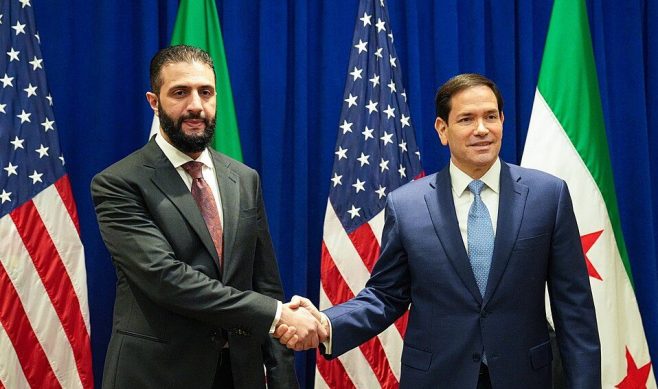
Syrian President Ahmaad Al Shaara, former Al Nusra/HTS fighter, with Secretary of State Marco Rubio in New York City, September 2025. (State Department Photo, Wikimedia)
We need to keep in mind how this is working. There are three partners in this latest endeavour on the anti-Assad chemical narrative.
First, we have the Western governments, belligerents in the Syrian conflict, which worked hard on building the chemical narrative to delegitimise the regime.
The U.K. government offered specialists to check out suspected sites in Syria to prepare them for the May mission in order to “assist” the current government in finding evidence of hidden chemical weapons.
That leads us to the second group, the government in Syria, reportedly eager to please their Western sponsors in return for economic favours. They are the Al-Nusra/HTS extremists who, in the case of Douma, fabricated the scene to raise a chemical false flag allegation against the Assad.
The third partner is the OPCW.
That means the various groups who have been on this mission are a) those who staged scenes of chemical attacks; b) those who directed them to do so (including Western intelligence agents who allegedly coached and assisted them); and c) the organisation that went along with the narrative and dutifully produced reports damning the Assad regime.
It may appear to the reader that I’m suggesting that the OPCW reports on Syrian chemical weapons will continue to be little more than propaganda, the usual sexed-up nonsense. Perhaps so. In disputing this, these assertions will be dismissed as conspiracy theories.
However, this argument is weakened because the source of the alternative narrative is the scientists and senior inspectors (many “Western”) from within the OPCW teams, including the Douma fact-finding mission and Scientific Studies and Research Centre inspections.
This is why Douma remains a key element in the debate. If they did it once (and doggedly stuck to their guns), they probably did it before.
Many serious and eminent observers are imploring the OPCW to conduct a review of the Douma case, including by the OPCW’s own Scientific Advisory Board.
I see this being done by credible, independent and neutral experts in the fields of chemistry, toxicology, metallurgy and engineering, overseen by the relevant professional institutes.
These experts would report their findings transparently, putting their names and reputations behind their analysis. This will clear up the Douma controversy, either demonstrating that it could have actually happened as alleged, or demonstrating the flaws in the OPCW reports.
Exposing a clear and deliberate fraud would seriously weaken the Western narrative on alleged Syrian chemical attacks. Therefore, in my view, it is not going to happen under the purview of the OPCW.
Ever.
I don’t mean to suggest that those calling for a review are unrealistically hopeful. But the risks of such a review are perhaps too high for it ever to be envisaged by the Western group that was aligned with the efforts on regime change in Syria — chiefly the U.S., the U.K. and France.
This does not mean it can’t happen. There is more than enough open-source material, as well as now-unclassified facts, images, analysis results and information available from the OPCW itself, from former OPCW officials and inspectors, and held by Member States, that would support a credible in-depth review.
The basis for expert analysis would be the material used in the fact-finding mission and I.I.T. reports themselves.
By now we know there isn’t any “smoking gun” evidence. If there had been, it would have been cited in the mission and I.I.T. reports.
Trust me, this study will bear clear results. My hope is that someone sufficiently curious and responsible will commission and fund it.
Ian Henderson served as an OPCW inspector from the establishment of the Chemical Weapons Convention in 1997, and was appointed as one of the first Inspection Team Leaders. An experienced chemical engineer with military experience, he led many of the more complex missions to more than 55 countries. After returning to a career in the chemical industry for 10 years he rejoined the OPCW in 2016 as part of the “rehire” scheme aimed at bringing back experienced inspectors. It was during this time that he became involved in the Syrian chemical weapons operations and, along with others, objected to the apparent influences of political control in the organization. He was suspended from the OPCW in May 2019 after the leak (by unknown others) of his dissenting engineering report on the Douma cylinders.
French government investigating why cars funded by UK to prevent asylum seekers crossing Channel were used in school protests
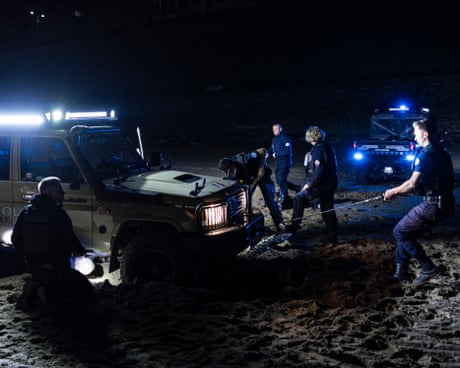
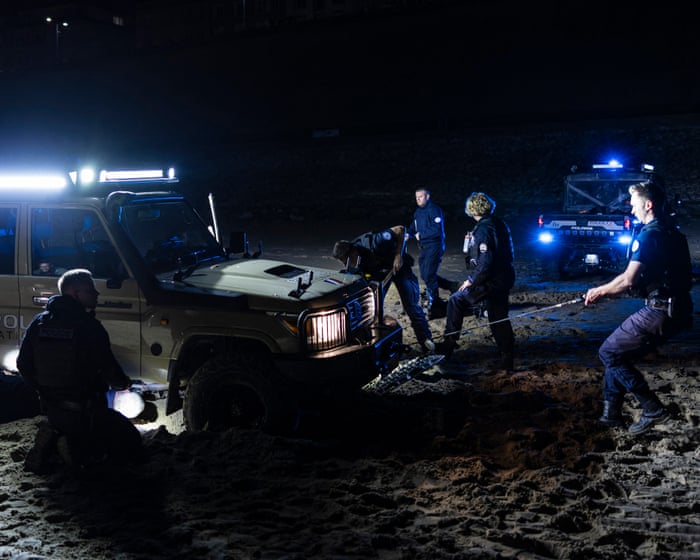
French police have used 4x4 vehicles paid for by British taxpayers to charge at student protesters during the school protests that have swept the country.
The French government has confirmed that an investigation has been launched into why the cars, funded by the UK government specifically to prevent asylum seekers crossing the Channel, were used during a protest involving school students in Dunkirk.
Police fire teargas in Paris and Limoges town hall ‘largely lost’ to fire – with officials blaming violence on ‘ultra-left’
More than 1,800 people were arrested in France on Saturday after protesters supporting high school students clashed with police, with some demonstrations later spiralling out of control as buildings were set ablaze and shops looted.
Police fired teargas in confrontations with protesters, as demonstrations across France were boosted by other groups angry about high prices and the fraying of a social welfare system.While hundreds of thousands protested peacefully in street marches in scores of cities, violent fringe groups targeted public buildings, luxury boutiques and supermarkets and attacked police vehicles and officers.
Anyone who wants to build a house on the waterfront at Meria, at the northern tip of Corsica, has to let archaeologists look underneath first. The rule comes from the island’s regional archaeology service (the DRAC of Corsica). It has just paid off. Working on the plot, a team from Inrap, France’s national institute for […]
Russia’s Foreign Ministry has warned citizens to exercise caution when traveling abroad “amid a worldwide hunt for Russians.”
The statement follows the detention of Russian military blogger Mikhail Zvinchuk in Montenegro, a NATO member state in the Balkans, on October 9.
After nine hours in custody, Zvinchuk, founder of the Rybar Telegram channel, his wife and three associates were expelled from the country on the grounds of what Montenegro’s leading daily, Vijesti, described as “criminal, operational and intelligence processing.”
“We are compelled to once again remind people of the need to remain vigilant when traveling abroad, even if there is the slightest suspicion of any kind of claims by US law enforcement agencies, amid a worldwide hunt for Russians,” Foreign Ministry spokeswoman Maria Zakharova said on Friday.
Montenegro, where the blogger was detained, is not on Russia’s list of unfriendly states, Zakharova said, adding that similar situations were unfolding in countries not considered unfriendly to Russia.
The arrest was described as targeting alleged “hybrid activity” by the Rybar network, but no specific evidence supporting the accusation has been presented.
Kremlin spokesman Dmitry Peskov declined to comment on the details of the arrest but warned Russian citizens that visiting Europe is “currently dangerous.”
The Rybar channel, which has around 1.3 million subscribers, had previously also faced US and British accusations of spreading Russian propaganda and conducting information operations abroad. The US State Department had even issued a $10 million bounty in 2024 for any information about the individuals behind the channel.
Russians who have been targeted include basketball player Daniil Kasatkin, a point guard playing for the national team, who was arrested at Paris airport in June 2025 at the behest of the US, which accused him of being a member of a ransomware gang. He denied the allegations and was released in January 2026 as part of a Russia-France prisoner exchange.
Police use tear gas, water cannons and stun grenades against protesters who shot fireworks at officers, broke into the Marseille town hall and set buildings on fire
Police fire teargas in Paris and Limoges town hall ‘largely lost’ to fire – with officials blaming violence on ‘ultra-left’
More than 1,800 people were arrested in France on Saturday after protesters supporting high school students clashed with police, with some demonstrations later spiralling out of control as buildings were set ablaze and shops looted.
Police fired teargas in confrontations with protesters, as demonstrations across France were boosted by other groups angry about high prices and the fraying of a social welfare system.While hundreds of thousands protested peacefully in street marches in scores of cities, violent fringe groups targeted public buildings, luxury boutiques and supermarkets and attacked police vehicles and officers.
Des dizaines de milliers de personnes ont défilé samedi 17 octobre à travers la France pour dénoncer la vie chère et la dégradation des services publics, à l'appel d'un mouvement réunissant anciens « gilets jaunes », lycéens, étudiants, syndicats ou encore agriculteurs. 800 000 personnes ont participé aux actions et défilés, selon le bilan définitif des organisateurs. Des affrontements et des dégradations ont émaillé la mobilisation dans plusieurs villes.
Tens of thousands of people on Saturday took part in nationwide protests in France that quickly turned violent. Police used tear gas and batons to try to disperse unsanctioned marches, while in both Lille and Marseille, protesters briefly forced their way into the town halls before being removed by police. Follow our liveblog for the latest updates.
Whether it was youngsters proving their skills or state sabotage, Europe’s most hacked country was left with a mountain of waste after food began cooking in freezers
Shortly before midnight last Sunday, the digital thermostats controlling hundreds of supermarket cold aisles across France began to flicker and rise.
In a “bizarre and unprecedented” cyber-attack, hackers had remotely overridden the temperature settings on thousands of freezers, fridges and chiller cabinets pushing them from as low as -27C (-16.6F) to well over 50C (122F).
To protest against shameful conditions in schools is entirely legitimate. The government’s response is not
As a secondary school pupil in 1994, I took part in protests against a reform that would have allowed French employers to pay young people below the minimum wage. Our campaign was successful, but if we had had to face the terrifying police response unleashed on student protesters in France over recent weeks, I would have stayed at home.
A 14-year-old boy, Eden, suffered a fractured jaw and had teeth knocked out after a police teargas grenade struck him in the face. Sixteen-year-old Maël lost the sight in one eye allegedly after being struck by a shot from an LBD, a form of rubber-bullet launcher. Evan, 15, had his hand blown off in an explosion involving a police stun grenade. And in Dunkirk, a police SUV is alleged to have driven repeatedly at groups of secondary school pupils, as an officer could be heard saying: “Come closer, we’ll smash their fucking faces in.” Accounts from children left terrified by brutal treatment in police custody describe traumatic experiences with severe psychological and physical consequences.
Rokhaya Diallo is a French journalist, film-maker, activist and Guardian Europe columnist
Do you have an opinion on the issues raised in this article? If you would like to submit a response of up to 300 words by email to be considered for publication in our letters section, please click here.
Les députés RN et UDR ont saisi le Conseil constitutionnel pour obtenir la démission de son chef Richard Ferrand, dont Marine Le Pen demandait le départ après que ce dernier a déclaré publiquement qu’on ne pouvait réformer la Constitution par référendum qu’avec l’accord du Parlement (article 89), contrairement à ce que pense le parti d’extrême droite.

 Login