❌

Reading view

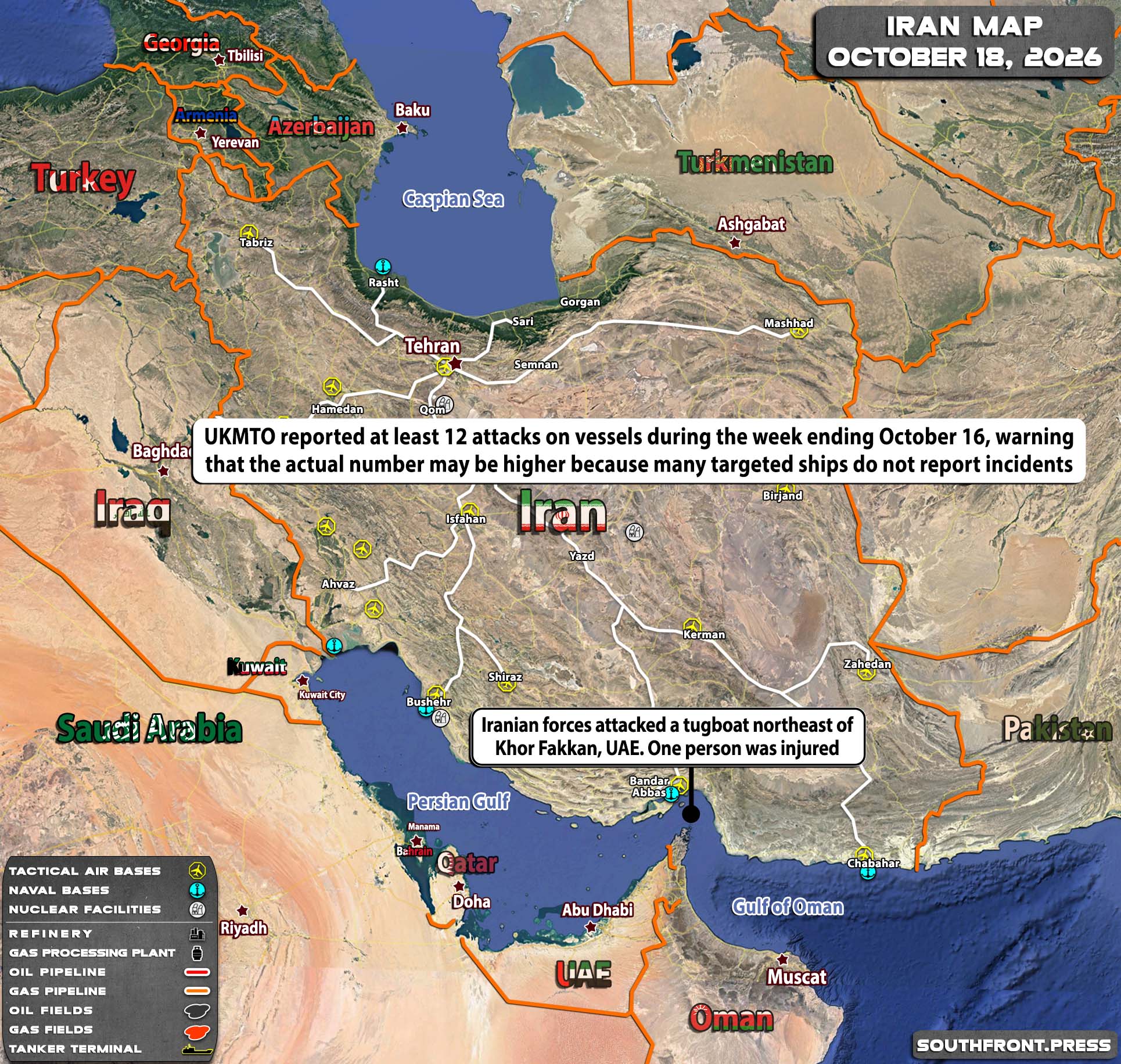
Military Situation In Iran On October 18, 2026 (Map Update)

Click to see the full-size image

  • Iranian forces attacked a tugboat northeast of Khor Fakkan, UAE. One person was injured;
  • UKMTO reported at least 12 attacks on vessels during the week ending October 16, warning that the actual number may be higher because many targeted ships do not report incidents.

MORE ON THE TOPIC:

The post Military Situation In Iran On October 18, 2026 (Map Update) appeared first on South Front.

  •  

My mixed emotions on the French riots: Yes, fuck Louis Vuitton, but let’s be strategic

I went to bed on Saturday (17 October) glued to my X feed on the French riots and it was impossible not to react emotionally to images of familiar landmarks in Paris in flames.

It was a mistake to have followed things on the far-right propaganda tube of racist US oligarch Elon Musk, which both glorified and reviled its AI-curated clips of violent clashes between mostly white policemen and young black or Arab men.

But in any case, I felt pity for police facing Molotov cocktails and cobble stones and angry about their use of stun grenades that left young people maimed.

I was shocked to see public buildings and luxury shops in Lyon, Marseille, and Paris set on fire and looted in what looked like pure criminality, rather than liberté, égalité, fraternité.

But the anarchist adrenaline in me also said: “Fuck Louis Vuitton! A shop that sells luggage for the price of most families’ monthly incomes is a perfect symbol of the social inequality at the heart of this eruption of public anger”.

I woke up on Sunday thankful to learn from professional media, such as the BBC, that even if Paris looked like a war zone, no one had been killed, and even though police had made over 1,800 arrests, aggressive thugs were a fraction of the hundreds of thousands of people who had peacefully protested for better living conditions and education.

But the political harm of Saturday’s X-streamed violence, which also broke out in Italy and Belgium, was still enormous and it will help the EU and French people’s enemies – the far-right in Europe, Russian president Vladimir Putin, and US president Donald Trump.

This article continues, but the full version is available only to EUobserver.com subscribers. Visit account.euobserver.com/membership

  •  

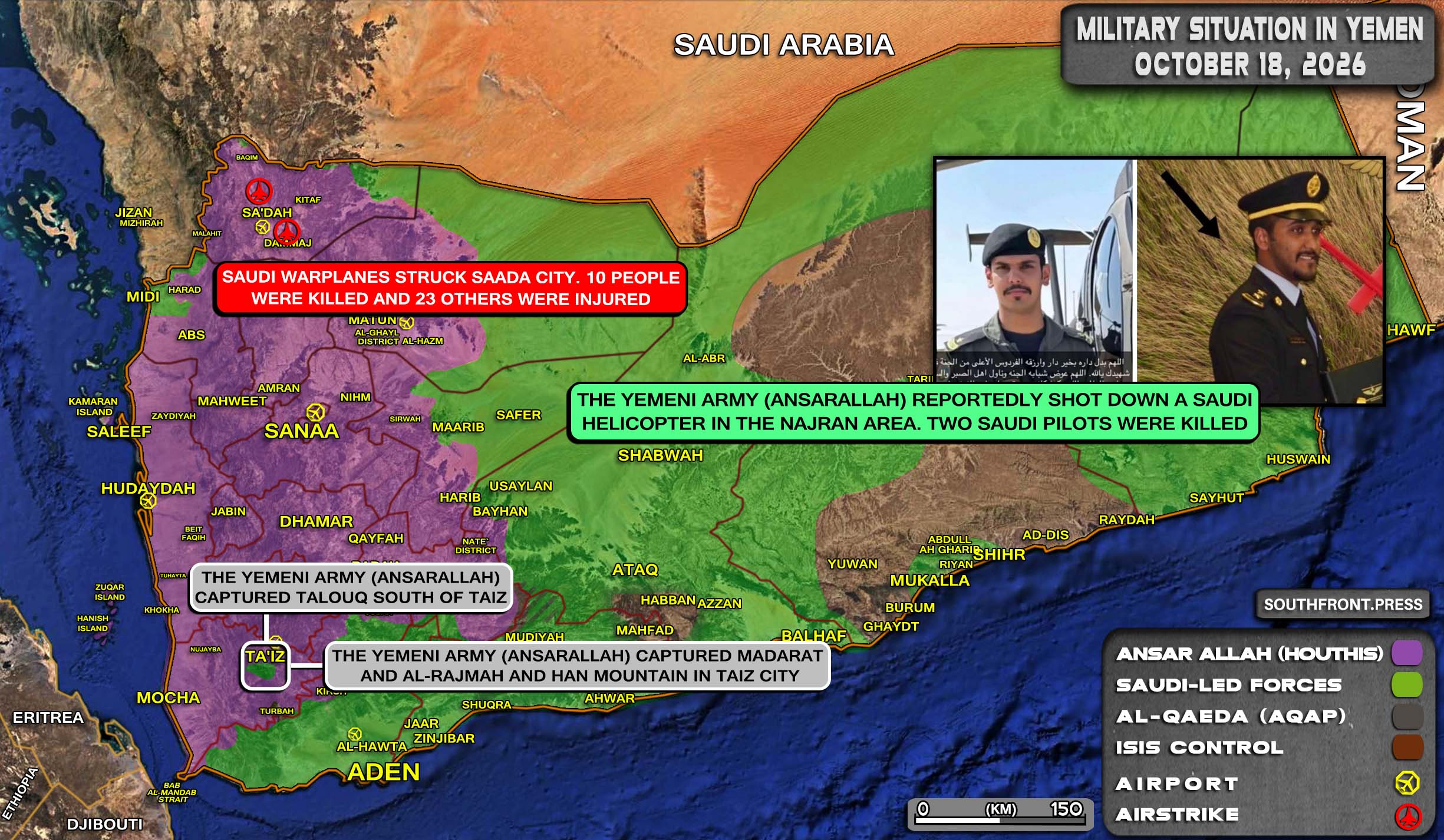
Military Situation In Yemen On October 18, 2026 (Map Update)

Click to see the full-size image

  • The Yemeni army (AnsarAllah) captured Madarat and Al-Rajmah and Han mountain in Taiz city;
  • The Yemeni army (AnsarAllah) captured Talouq south of Taiz;
  • Saudi warplanes struck Saada city. 10 people were killed and 23 others were injured;
  • The Yemeni army (AnsarAllah) reportedly shot down a Saudi helicopter in the Najran area. Two Saudi pilots were killed.

MORE ON THE TOPIC:

The post Military Situation In Yemen On October 18, 2026 (Map Update) appeared first on South Front.

  •  

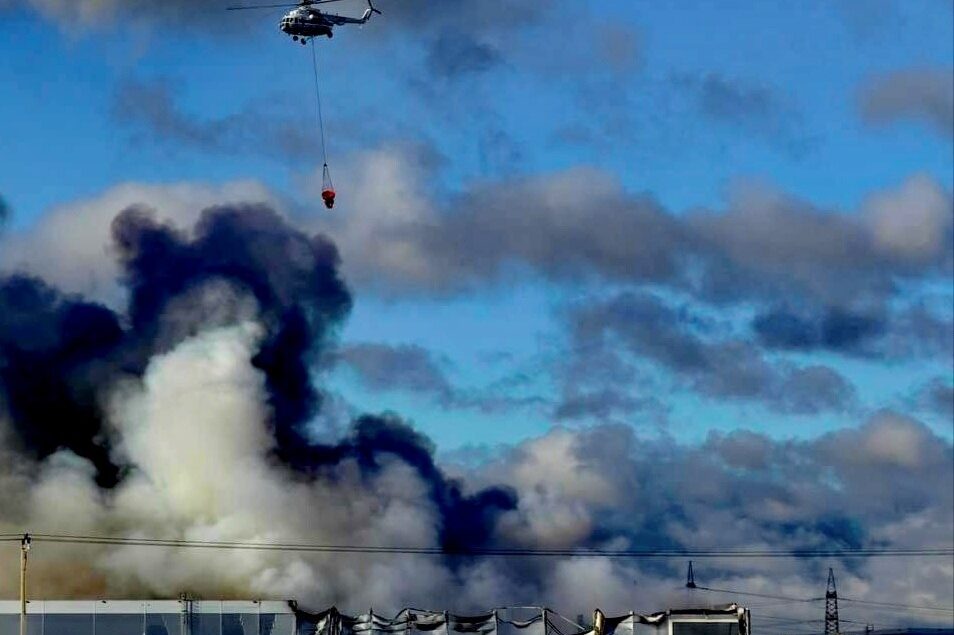
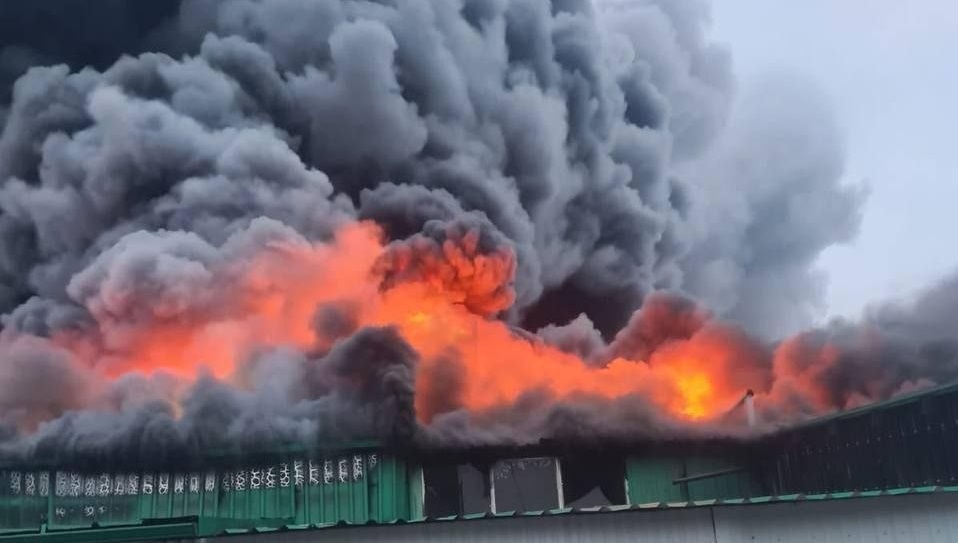
Russia Strikes Ukraine’s Logistics and Energy, Ukraine Launches Massive Drone Raid on St. Petersburg

Click to see the full-size image

On the night of October 18, the Russian Armed Forces carried out group strikes using unmanned aerial vehicles against logistics centers, port infrastructure, and energy facilities in Ukraine. According to a statement by the Russian Ministry of Defense, the targets included warehouses containing dual-use cargo and vessels used to supply the Ukrainian Armed Forces.

In turn, the Ukrainian side carried out a massive drone attack on Russian regions, focusing primarily on St. Petersburg and Leningrad Region: oil terminals, a data center, a distribution center, a boiler house at a thermal power plant, and bridge infrastructure were struck, and residential areas were damaged. According to the Russian Ministry of Defense, 1,015 Ukrainian UAVs were shot down over Russian territory.

Russian Strikes on Ukraine

Logistics Infrastructure

  • Nova Poshta logistics center (Rivne). According to a statement by the Russian Ministry of Defense, the facility was used to store and distribute dual-use cargo, including components for medium- and long-range unmanned aerial vehicles. The center served as part of the logistics chain supplying Ukrainian forces. Damage to the facility complicates the delivery of components for drone assembly in Ukraine’s western regions.

  • Polko Group production and warehouse facilities (Manevychi, Volyn Region). The facilities were reportedly involved in the manufacture of explosives and the loading of munitions for long-range drones. The facilities are part of the warehouse infrastructure used to accumulate and transship cargo toward Rivne and neighboring regions.

Click to see the full-size image

  • Warehouse in the Novomoskovsk area (Dnipropetrovsk Region). The nature of the cargo stored there is not specified in available sources. However, the facility’s location in the industrial area of Dnipropetrovsk Region suggests that it was part of the logistics supply chain supporting Ukrainian Armed Forces groupings in the eastern direction.

  • Bulk carrier 30 km east of the Port of Odesa. According to a statement by the Russian Ministry of Defense, a bulk carrier carrying military and dual-use cargo was struck.

Energy Infrastructure

  • Prydniprovska Thermal Power Plant (Dnipro, Dnipropetrovsk Region). The Prydniprovska TPP supplied electricity to industrial consumers in the region, including facilities linked to military production.

  • Belolesye substation (Odesa Region). The substation supplies electricity to, among other things, port infrastructure and enterprises in the region.

  • Critical infrastructure facilities (Vinnytsia Region). Damage to critical infrastructure was reported, accompanied by power outages.

Strikes on distribution substations create local power shortages and complicate the operations of industrial enterprises involved in the production and repair of military equipment.

According to monitoring sources, UAV strikes were also carried out against targets in Chernihiv, Zaporizhzhia, Sumy, and Kharkiv Regions. In addition, during the preceding day, aviation and missile forces struck targets in Donbas, Kherson, Poltava, Cherkasy, and Zhytomyr Regions.

Strikes on Russian Territory

St. Petersburg and Leningrad Region

  • St. Petersburg Oil Terminal. A fire was reported on the terminal’s grounds. The facility is part of the marine transshipment infrastructure for petroleum products, including export operations. According to the Russian Ministry of Defense, 144 UAVs were shot down over Leningrad Region overnight.

  • Ruchyi oil depot. The largest fuel terminal in St. Petersburg, with a total capacity of 73,900 cubic meters. A fire was reported.

  • VKontakte (VK) data center. The facility in St. Petersburg was attacked. According to the company, all services continued to operate. The data center supports one of Russia’s largest IT platforms; open sources do not cite any direct military use.

  • Ozon distribution center. A fire was reported following the attack. The facility is part of civilian logistics infrastructure.

  • A boiler house at a local thermal power plant. The extent of the damage and its impact on heat supply were not specified.

  • Cable-stayed bridge. According to residents, a UAV struck the bridge connecting the southern and northern parts of St. Petersburg. There is no official information on the condition of the structure. The city experienced major transport disruptions: the central section of the Western High-Speed Diameter was closed, and tram routes were suspended. Pulkovo Airport temporarily suspended arrivals and departures.

  • Residential areas. In St. Petersburg, 12 apartment buildings and two private homes were damaged. In Leningrad Region, homes were damaged in Kirovsk, Vsevolozhsk, and Gatchina. In Novoselye, 55 parked cars were damaged. According to the governor, one person was killed, five were injured, and about 20,000 people were left without electricity.

Border and Other Regions

  • Oryol Region. A telecommunications tower and a post office building were damaged.

  • Bryansk Region. Over the past day, 281 UAVs were shot down. One person was killed and six were injured.

Taken together, the strikes of October 18 point to two separate lines of effort. On the Russian side, the main effort was focused on destroying logistics hubs and maritime transport near Odesa, continuing the campaign to disrupt the supply of the Ukrainian Armed Forces through western and southern routes. In parallel, strikes targeted power generation and distribution substations, putting additional pressure on Ukraine’s energy system ahead of the heating season.

On the Ukrainian side, the attack had a clear focus on St. Petersburg and Leningrad Region. Damage to oil terminals, a data center, and bridge infrastructure, along with major transport disruptions around the Western High-Speed Diameter, suggests an effort to create a high-impact media and logistics effect in Russia’s largest city. At the same time, a significant portion of the UAVs was shot down—1,015 over Russian territory—which does not change the fact that individual drones did reach their targets.

In the medium term, Russia’s campaign against Ukraine’s logistics chains and energy sector is likely to continue, with an emphasis on western regions and port infrastructure. On the Ukrainian side, long-range drone attacks on sensitive targets in Russian regions, primarily in the Northwestern Federal District, are likely to persist. Key factors will remain air-defense capabilities, the resilience of power grids, and Ukraine’s access to satellite communications for controlling long-range unmanned aerial vehicles.


MORE ON THE TOPIC:

The post Russia Strikes Ukraine’s Logistics and Energy, Ukraine Launches Massive Drone Raid on St. Petersburg appeared first on South Front.

  •  

The conceit of total dominance

By Bill ASTORE

A strange conceit of American exceptionalism is the naked ambition of full-spectrum dominance. The idea is this: America must dominate every realm of potential conflict, land-sea-air as well as space and cyber and any other realm you can imagine, for that is the only way Americans can truly be “safe.” Such a conceit comes with a hefty price tag as Pentagon spending soars toward $1.5 trillion a year. But money is the least of it. The heftiest price tag is the constant state of warfare (and preparations for yet more war) that has characterized U.S. foreign policy since 1945.

That, and the erosion of personal liberty and freedom and the hollowing out of the American middle- and working classes as money flows upward to war contractors in the service of boundless imperial ambition.

There’s a god-like quality to this ambition, the idea America must be omnipotent, dominating all realms of warfare, and omniscient, sweeping up all data everywhere, in an unapologetic quest for global reach and global power together with the unapologetic exercise of that murderous power against peoples generally having brown or black skin and therefore treated as inferiors.

With only slight exaggeration, the U.S. government can be said to be projecting power everywhere and helping ordinary Americans nowhere. Destruction is favored over construction. Enriching the already rich is the goal even as the impoverished are made poorer.

The U.S. taxpayer, in the old days known as citizens, are paying through the nose for unneeded weapons systems (Sentinel ICBMs, B-21 nuclear bombers, Golden Dome), unwanted wars (Vietnam, Afghanistan, Iraq, Iran), and an imperial structure of force projection that virtually guarantees the violence will be unending. This imperial structure, with its goal to control all, to know all, to dominate all, is supported by Democrats and Republicans. Critics of this structure, present in both parties but in small numbers, are attacked and otherwise kept on the margins.

None of this is new. In the early 1960s, Senator George McGovern, a decorated bomber pilot during World War II, argued against the pursuit of nuclear “overkill” and called for substantial cuts to defense spending and reinvestment in civilian infrastructure. In support of this initiative, he cited Republican President Dwight D. Eisenhower’s military-industrial complex warning of January 1961. McGovern’s initiative was quickly abandoned as the Johnson administration ramped up its disastrous war in Southeast Asia.

Nearly a decade later, with Southeast Asia ravaged if not defeated, McGovern urged his fellow citizens to “come home,” to stop the folly of overseas wars and ever-increasing military budgets. He was overwhelmingly defeated by Richard Nixon in the 1972 Presidential election.

Ever since that defeat, the Democratic Party has conspired to silence candidates who are antiwar and who dissent from the idea of imperial dominance. Dennis Kucinich comes to mind here. Even moderate calls for reform from candidates like Bernie Sanders are dismissed as naive or dangerous. The result has been Democrats like Obama, Biden, Hillary Clinton, and Harris who openly embrace “good” wars (Afghanistan, for Obama) and who eagerly celebrate military lethality (Harris).

Meanwhile, the Republican Party never met a military budget increase it didn’t like. Rare indeed are voices like Ron and Rand Paul and Thomas Massie who question the wisdom of endless wars and their adverse impact on rights and freedoms here.

What is to be done? Bernie Sanders called for a political revolution, surely a correct call, but he was neutered by the establishment of both parties. Elizabeth Warren spoke of “big, structural changes,” but that was for the domestic economy; her foreign policy was basically that of Biden/Harris. A few rogue Republicans speak up against the Iran war today, but rare indeed are those who openly call for major cuts to war spending.

In short, electing our way out of imperial dominance and colossal war and weapons spending is unlikely in the extreme. Many many people (myself included) have written sensible articles calling for deep cuts to military spending, but good ideas that go against the grain gain little traction without a strong and concerted movement behind them.

America desperately needs a coordinated mass movement against endless war and massive military spending, yet the “powers that be” keep doubling down on yet more wars and even more massive war spending. That same establishment continues to multiply U.S. “enemies.” It may be Iran today, but Russia and especially China always loom, with North Korea and other “rogue” states held in reserve just in case.

The sheer folly and massive expense of it all will likely lead to the end of the (however imperfectly practiced) American democratic experiment. That’s a grim conclusion, I know, but I’m less than hopeful as the tools America has used in its unjust wars overseas are now increasingly applied in the “homeland” against alleged dissenters.

Remember when “dissenters” used to be called concerned citizens? Remember when war was considered to be bad and weapons spending was seen as the unwisest of ways to spend our resources?

America doesn’t have to be a warrior-state or in a state of constant war. A “silent majority” of Americans clearly doesn’t want endless war and outspokenly wants better lives for their children. But better days will not come if this majority remains silent or otherwise demobilized.

The Main Obstacle

As Ike said in 1961, the main obstacle is the military-industrial complex (MIC), to which he added Congress as an abetter and accomplice. That complex in 65 years has greatly added to its power and cultural penetration. The term MICIMATT adds the intelligence “community,” the media, academe, and think tanks. To that we might add the sporting world, Hollywood, video games, and now wildcard tech billionaires. All these interests conspire to absorb trillions of dollars from U.S. taxpayers, ostensibly in the name of national security, while waging or supporting endless war.

Ike said only alert and knowledgeable citizens, actively participating in democracy, could compel the MIC to curb its worst and most grandiose ambitions. Sadly, this is precisely why the American people are constantly lied to, especially about wars, why so much is kept hidden or “classified,” and why people are encouraged to salute smartly and let the military experts handle everything.

Even worse, the very idea of active citizenship is now degraded; the only “duty” apparently left is voting, where you’re encouraged to vote Democrat or Republican and otherwise to reject any third-party candidate who may be antiwar as irrelevant if not invalid (and possibly un-American).

Our ultimate security doesn’t reside in guns or other weapons or in boundless violence. It resides in strong institutions committed to the rule of law in which individuals of character stand up and speak out against abuses of power. Come home, America, to a land of generosity and hope and peace.

Be an alert and knowledgeable citizen. And act.

Original article:  bracingviews.com

  •  

He Campaigned for the East Cleveland Mayor's Opponent. Then Police Came for His Truck.

William Fambrough seen in front of his sound truck | Institute for Justice

Walking through East Cleveland, Ohio, feels a touch like you've wandered onto the set of a postapocalyptic film noir. Grand, gilded homes announce themselves on neighborhood streets, some crowned with turrets, many with windows punched out like missing teeth. Often, no one is home, because no one lives there. It is safer than 1 percent of U.S. cities.

So why did local law enforcement pour considerable time and resources into pursuing a man for a sound truck?

That question is not really a legal one, at least not in the most technical sense. But it is the driving force behind a thorny case a federal court recently resuscitated: Fambrough v. City of East Cleveland, a saga concerning a man whose vehicle became an obsessive target of the East Cleveland Police Department (ECPD) after he used it to campaign for a mayoral challenger.

Some of the facts are in dispute. But the basic gist is as follows: William Fambrough, long a politically engaged East Clevelander, campaigned for Juanita Gowdy—a challenger to then-Mayor Brandon King—by broadcasting messages around the city with his sound truck. That ultimately came to an end after law enforcement impounded the car, cited him for parking and noise violations, and prosecuted him for the latter.

Fambrough sued, alleging the complex legal odyssey set into motion over his step van amounted to First Amendment retaliation, an unreasonable seizure under the Fourth Amendment, and a violation of the 14th Amendment's proscription against selective enforcement. The U.S. Court of Appeals for the 6th Circuit rejected some of those claims. But it resurrected claims against King and his chief of staff, Michael Smedley—depriving them of qualified immunity, the legal doctrine that inoculates state and local government officials from facing lawsuits if their alleged misconduct was not "clearly established" as illegal in prior case law. It also revived Fambrough's retaliation claim against the city.

As the 6th Circuit summarizes: King "says he received a phone call from a resident who complained about Fambrough's sound truck and someone else's box truck being parked in a residential area," so he told someone to take care of it. Scott Gardner, then the city's chief of police, "was concerned about selectively enforcing" the parking ordinance—which prohibits parking a truck in front of residential property, except for loading or unloading—because it is indeed almost never enforced. This was the beginning of a long pursuit, which ultimately saw a swarm of officers dispatched to Fambrough's house in August 2021 to confiscate the vehicle, allegedly resulting in $6,000 in damage. Fambrough also had to pay $528 in fees to get the damaged truck back.

"All the attention City officials gave Fambrough struck Gardner as unusual," the 6th Circuit notes. "The mayor's office wasn't this attentive even in homicide cases. And considering that the City had around only 50 police officers at the time and had 'serious crime problems,' Gardner thought it was odd to devote this much attention to permitting and parking issues." Based on available data, East Cleveland's violent crime rate is 1,409 per 100,000 residents, about four times higher than the national average.

Yet Gardner ultimately got on board. Smedley phoned him on August 9 "extremely upset," according to Gardner, and told the police chief he was "incompetent" for failing to "take care of" Fambrough's sound truck. Smedley wanted the "utmost enforcement as possible." So Gardner sent an email. "Please, find this vehicle and tow it," he wrote to all of ECPD. "Cite the operator with disturbing the peace and loud music. Please contact me as soon as this is complete to claim a surprise." A surprise!

Police succeeded. "On its face, the email told officers to tow Fambrough's truck regardless of whether it was parked illegally," writes the 6th Circuit. "And the Noise Ordinance authorizes seizure only of 'the sound device used,' and only upon conviction. So Gardner's instruction to tow the truck wasn't authorized by municipal law." The court still held that the seizure did not violate the Fourth Amendment. It also gave Gardner qualified immunity, ruling it is not clearly established that someone who acts as a conduit for someone else's alleged retaliation—which here came from the mayor's office—is a "responsible party."

Heather McCollough, the city's assistant law director, subsequently prosecuted Fambrough for allegedly violating the noise ordinance. According to a sworn declaration from Fambrough's attorney, McCollough outlined some of Fambrough's offenses on a call: that he "made complaints about the police department" and filed "public records requests," among other issues. Notably, it is legal to do those things. McCollough was typically willing to resolve minor noise complaints, she added, but not so much in this case, because Fambrough needed to "stand down." (He ultimately pleaded no contest to disorderly conduct, a reduced charge.)

East Cleveland police step van
Institute for Justice

"Only after [Fambrough] began supporting Gowdy's election was the weight of the law thrown against him," the 6th Circuit writes in its analysis of potential municipal wrongdoing. "And the City's police officers didn't uncover Fambrough's violations of their own accord. Instead, City decisionmakers sent them to Fambrough's home each time to enforce the Parking Ordinance. So the timing of the parking-related enforcement actions supports an inference that Fambrough's political speech was the motivating factor—as does the fact that the City rarely enforced the Parking Ordinance against anyone else despite having plenty of opportunities to do so." Incredibly, a photo of another truck can be seen down the street on the same day law enforcement came to fetch Fambrough's vehicle. (The law also includes pickup trucks, so the city arguably has a lot of enforcement to do if it sincerely believes this law matters.)

King allegedly set the chain of events into motion while Smedley took the driver's seat. "Smedley's pattern of incessantly calling and berating Gardner," the 6th Circuit adds, "clashes with the idea that Smedley was chiefly concerned with minor permitting, noise, or parking issues." After all, if that were true, why would the problem appear to begin and end with one person?

Over five years have passed since the ordeal. Although Fambrough is now potentially closer to getting in front of a jury, he has yet to actually state his case, still burdened by the onerous process government actors invoke to kill such suits before the community can assess the merits. King, meanwhile, won that election. He left office in May 2025, however, after he was found guilty of one count of theft in office, four counts of having an unlawful interest in a public contract, three counts of representation by public official or employee, one count of filing a false disclosure statement, and one count of soliciting improper compensation.

The post He Campaigned for the East Cleveland Mayor's Opponent. Then Police Came for His Truck. appeared first on Reason Magazine.

  •  

Houthis Release Footage of Saudi AH-6i Helicopter Downing Near Najran

Illustrative image.

Yemen’s Houthis (Ansar Allah) released footage on October 18 showing the downing of a Saudi AH-6i light attack helicopter near the border with the province of Najran in the south of the kingdom, saying it was struck by a locally manufactured surface-to-air missile.

The footage’s accompanying caption said the helicopter was targeted while carrying out what the group described as hostile operations near Najran.

The release follows an announcement by Houthi military spokesman Brig. Gen. Yahya Saree a day earlier said that the group had shot down a Saudi helicopter near the border.

Saree initially identified the helicopter as an Apache, saying it had been brought down while targeting Houthi positions along the border. The footage’s caption, however, identifies it as an AH-6i, a light attack and reconnaissance helicopter operated by the Saudi Arabian National Guard.

Saudi Arabia’s military coalition confirmed earlier that an AH-6i helicopter belonging to the National Guard had crashed in Najran, killing both officers aboard.

Coalition spokesman Maj. Gen. Turki al-Maliki attributed the crash to a technical malfunction, although the footage released later by the Houthis affirmed that this is false.

The AH-6i, also known as the Little Bird, is a compact armed helicopter designed for reconnaissance and light attack missions. A 2014 U.S. contract for 24 helicopters, initial spare parts and ground support equipment for Saudi Arabia was valued at $234.7 million, an average of about $9.8 million per helicopter across the package.

_______________________________________________________________________________________________________________________

SouthFront: Analysis and Intelligence

NOW hosted at southfront.press

Previously, SouthFront: Analysis and Intelligence was at southfront.org.

The .org domain name had been blocked by the US (NATO) (https://southfront.press/southfront-org-blocked-by-u-s-controlled-global-internet-supervisor/) globally, outlawed and without any explanation

Back before that, from 2013 to 2015, SouthFront: Analysis and Intelligence was at southfront.com

SOUTHFRONT.PRESS

MORE ON THIS TOPIC:

The post Houthis Release Footage of Saudi AH-6i Helicopter Downing Near Najran appeared first on South Front.

  •  

Deadly Incident at Canadian Base Sparks Major Alberta Fire

Fire and emergency response at Canadian Forces Base Wainwright in Alberta after an incident left people dead and injured.

A deadly incident at CFB Wainwright overwhelmed Edmonton hospitals as strong winds fueled a major fire.


A deadly incident at Canadian Forces Base Wainwright in Alberta left at least seven people dead and dozens injured Saturday, triggering a major fire that spread into surrounding rural areas and prompted a large emergency response as strong winds hampered firefighting efforts.

RELATED: Carney Warns Against External Attempts to Divide Canada

The Royal Canadian Mounted Police (RCMP) said officers were called to the base shortly after 4 p.m. Saturday following reports of a fire in a training area. Defense Minister David McGuinty confirmed the deaths and injuries but said authorities were still working to establish what had happened.

The scale of the casualties remained unclear late Saturday. Hospitals in Edmonton, about 180 kilometers (120 miles) northwest of the base, were receiving large numbers of patients as health-care facilities struggled to cope with the influx.

“This number of patients would overwhelm the city of Edmonton,” Warren Thirsk, an emergency department physician at the Royal Alexandra Hospital, told CBC News. “It is more patients than any of us want to count right now. It’s a disaster. It’s a one in every 15- to 25-year disaster.”

Text Reads: A “serious incident” has triggered a large fire at the Canadian Armed Forces Base (CFB) Wainwright in Alberta. Prime Minister Mark Carney confirmed the incident and stated that he is working closely with the Government of Alberta and local authorities.
🕯️ Minister of Defence David McGuinty confirmed that the event resulted in “fatalities and injuries.” The Department of National Defence indicated that it is closely monitoring the situation and will provide further details as they become available.
🏘️ The Municipality of Wainwright confirmed that the fire has spread beyond the base’s perimeter into the surrounding area and is being actively managed by authorities. No evacuation orders have been issued at this time.
🔥 CFB Wainwright is located approximately 210 kilometers east of Edmonton and is one of the most operationally active Canadian Army facilities in the country.

Meanwhile, firefighters battled the blaze into the night as powerful winds drove flames beyond the base and into nearby rural areas. A windstorm had battered large parts of Alberta during the day, with gusts reaching 100 kilometers per hour, toppling trees and sending signs and garbage cans flying.

By 11 p.m., the Municipal District of Wainwright reported that the fire was being contained and that property and critical infrastructure were protected. No evacuation order had been issued for residents of the district.

The town of Wainwright, near the base, has about 7,000 residents.

McGuinty, speaking to reporters in Ottawa, described the situation as “very, very active and delicate.” He said members of the Canadian Armed Forces were at the scene and that the RCMP was involved in the investigation.

“I cannot recall such an incident in my short time for sure as a minister, but I cannot recall an incident like this in recent memory,” he said.

“We will have more to say in the coming hours and days,” McGuinty added.

Alberta Premier Danielle Smith described the fire as “significant and tragic,” saying it was affecting many military personnel. Saskatchewan Premier Scott Moe said his province was sending assistance to Alberta but did not specify what resources would be deployed.

Prime Minister Mark Carney expressed support for those affected in a social media post, saying, “Our thoughts are with all the brave women and men affected.”

A serious incident creating a major fire has occurred at CFB Wainwright, in Alberta.

Our thoughts are with all the brave women and men affected.  

We are working closely with the Government of Alberta and local authorities. Premier Smith and I are in close contact as are our…

— Mark Carney (@MarkJCarney) October 18, 2026

Conservative opposition leader Pierre Poilievre said he had spoken with Carney and McGuinty to offer support. He urged people in the area to follow emergency instructions and keep roads clear for first responders.

The fire also disrupted advance voting ahead of Monday’s referendum on whether Alberta should begin a process that could lead to independence from Canada. Elections Alberta said two polling locations, in Lloydminster and Vermilion, closed early Saturday and that ballots were transported securely.

CFB Wainwright is one of Canada’s busiest military training bases. It houses the Canadian Manoeuvre Training Centre, which conducts realistic battlefield exercises, and the 3rd Canadian Division Training Centre, which provides military training.

  •  

Nottinghamshire police officer in hospital after being shot in the foot

Large cordon in place around Angel Row area of city centre after ‘shocking incident’ in the early hours of Sunday

A police officer is in hospital after being shot in the foot in Nottingham in the early hours of Sunday.

Nottinghamshire police said the officer had approached two suspects in the city centre when he was struck by a bullet. The force said the two suspects, a woman and a man, had fled the scene and were being sought by police.

Continue reading...

© Photograph: Joe Giddens/PA

© Photograph: Joe Giddens/PA

© Photograph: Joe Giddens/PA

  •  

Honoring Frances Stonor Saunders

By Patrick LAWRENCE

Join us on Telegram, X, and VK.

Contact us: info@strategic-culture.su

In her revelatory work The Cultural Cold War, the late British author was the first to shine so unblinking a light on the sprawl of the C.I.A.’s cultural interventions.

Frances Stonor Saunders was fond of epigraphs (as am I). At the front of The Cultural Cold War: The C.I.A. and the World of Arts and Letters (The New Press, 1999), the British journalist, documentarian and author quotes some lines from Dante’s Inferno, the last of which is, “Before my age was full, I went astray.”

I had not lived half my life when I succumbed to complacency and moral blindness: This is my reading of the line from Canto XV. And how fitting it is at the start of Saunders’ exhaustively researched account of how the Central Intelligence Agency, its tentacles reaching into every corner of American culture, did so much to lead our republic into what the Italian poet would call its selva oscura, its dark wood —the state of lostness America has never since escaped.

Frances Stonor Saunders died on the last day of August, having suffered from a virulent strain of brain cancer. She was a mere 60. We had a few acquaintances in common, but I never met her. It was nonetheless something like losing a friend when, just this past week, I heard of her death. And so this brief appreciation.

The Cultural Cold War made Stonor Saunders’ reputation. It took a prominent place on my shelf of Cold War books as soon as it was published. At last the curtain parted on the insidious use the C.I.A. made, or attempted to make, of painters, poets, playwrights, novelists, editors, jazz musicians, singers, dancers, actors, scholars and other cultural figures in its long-running operation to promote the appeal of American life as against the Soviet Union and altogether the postwar socialist alternative.

This was an immense “soft power” operation avant la lettre — before we had the term. One could also call it an early variant of the “cognitive warfare” to which we are now incessantly subjected, the primary object of which was to keep postwar Europe from swinging leftward, as the French, the Italians and others were poised to do.

From Saunders’s Introduction:

“Drawing on an extensive, highly influential network of intelligence personnel, political strategists, the corporate establishment, and the old school Ivy League universities, the incipient CIA started, from 1947, to build a ‘consortium’ whose double task was to inoculate the world against the contagion of Communism and to ease the passage of American foreign policy abroad. The result was a remarkably tight network of people who worked alongside the Agency… Whether they liked it or not, whether they knew it or not, there were few writers, poets, artists, historians, scientists, or critics in postwar Europe whose names were not in some way linked to this covert enterprise.”

Who Was Who & Who Stood Where

Jackson Pollock in 1951. (Hans Namuth /Wikimedia Commons,Public Domain)

Jackson Pollock and others among the Abstract Expressionists, Leonard Bernstein and others among the American composers then prominent, Robert Lowell, James Baldwin, Mary McCarthy and other writers of their generation, Duke Ellington and other jazz stars — if they weren’t sent abroad on the C.I.A.’s nickel, their work was.

There were the hundreds of books the Agency took a role in promoting, It paid for translations of Eliot’s Four Quartets, Luigi Barzini’s The Italians, Boris Pasternak’s Doctor Zhivago. It covertly supported magazines — Encounter and The Paris Review famous among them — along with radio stations and, of course, newspapers — and those who wrote and edited for them. As of 1956 the Agency owned a considerable piece of the Rome Daily American.

Saunders, who did years of interviewing and archival research for this book, lays out her findings over 427 well-written pages and was the first to shine so unblinking a light on the sprawl of the C.I.A.’s cultural interventions.

One of the things I like about Saunders’s book, among many, is her exposure of those artists and writers who knew of the Agency’s interventions and wanted nothing to do with them, those who knew and cooperated and those who served its purposes unwittingly.

Pollock had no idea of the use to which the Agency put his work, Baldwin wanted nothing to do with the Congress for Cultural Freedom (C.C.F.), infamous as a C.I.A. front. Ever true to her tough-minded politics, neither did Lillian Hellman.

Mary McCarthy knew all about the Agency’s funding of the C.C.F. and its other projects and was fine with all of it. I’ve never liked McCarthy’s novels, and Saunders gave me a good reason to distrust her. She was prominent among that group of Americans known as Cold War liberals, for whom I have long nursed an abiding contempt.

McCarthy in 1963. (Dick DeMarsico/ World Telegram / Library of Congress. New York World-Telegram & Sun Collection/Wikimedia Commons/Public Domain)

I wish Saunders had given more attention to the profligate corruptions of generations of American journalists and newspaper editors, but her definition of culture is narrower than mine; I speculate that journalism’s service to the Agency was a room so large she chose not to enter it.

The surrender of many American journalists to the Cold War cause is well-enough documented in any case. See, for example, Carl Bernstein’s celebrated “The C.I.A. and the Media,” which Rolling Stone published in October 1977, and the House hearings that Bernstein’s piece prompted a couple of months later — the Church Committee, whose hearings ran from January 1975 to April 1976, having flinched from this responsibility.

Chronicler of Secrecy

The who-was-who and the who-stood-where and the who-did-what of The Cultural Cold War give Saunders’s book an historical specificity I do not think anyone has matched, with the exception of Joel Whitney’s Finks (OR Books, 2016), which draws heavily on Saunders’s work. She did not leave those of whom she wrote any place to hide.

As I reflect back on her accomplishment now, it seems to me to lie in something she never mentions. Saunders gave us a chronicle of the U.S. culture of secrecy in its earliest days, the first decades after the 1945 victories, when America set about making itself a global imperium.

What comes through in The Cultural Cold War is how little those alive at the time were able to know about their time. Too many events, too many decisions, too many reasons for things happening as they did were hidden, rendered inaccessible.

The C.I.A.’s Cold War interventions have had many enduring consequences. The Agency systematically discredited the principle of nonalignment, which was held high among then-emergent non–Western nations. America brings the same with-us-or-against-us fallacy to the 11 members and 10 partners comprising the BRICS  — a complete failure to grasp one of the 21st century’s significant realities.

It is the same with the out-of-hand dismissal of all suggestions of moral equivalence in global affairs with those it deems adversaries: The United States is always righteous and never acts but in defense of itself or its always-democratic allies and/or clients. It is never to be accused of aggression. This is what I mean by moral blindness.

The Agency’s most disturbing legacy, at least to me, is how little of our world we are able actually to see. Daniel Patrick Monihan warned us of this just before the U.S. century turned in Secrecy: The American Experience (Yale, 1998). So, in her way, did Saunders a year later. Foolish it would be, naïve in the extreme, to think the time she described so piercingly is not the time in which we live.

It is the historians now who tell us who we are — this by telling us who we were.  This is why I honor Frances Stonor Saunders as I do. She told Americans of their past, and, so, of their present.

Original article:  consortiumnews.com

  •  

Prepare for Nuclear War – There is No Choice

by Martin Armstrong, Armstrong Economics: The Neocons have won. They have successfully shifted the blame for the Ukraine war entirely onto Russia, and 99% of media coverage now frames the invasion as completely unprovoked. Their hatred of Trump is so intense that they feel compelled to oppose him on principle, regardless of what he does. […]
  •  

Ex-Likud official warns party app could be used to illegally monitor polling stations

In a sworn affidavit to the High Court, a former campaign tech chief claims the ruling party’s new app can bypass the law and secretly transmit voter data in real time using AI
  •  

David Jolly, the former Republican seeking to flip Florida for the Democrats: ‘We are seeing overenforcement and cruelty’

David Jolly, the Democratic candidate for governor of Florida, does not need to be asked about U.S. President Donald Trump to distance himself from his former party and its leader.

Seguir leyendo

© Rebecca Blackwell (AP Photo/Rebecca Blackwell)

David Jolly in North Miami, Florida, on October 7.
  •  

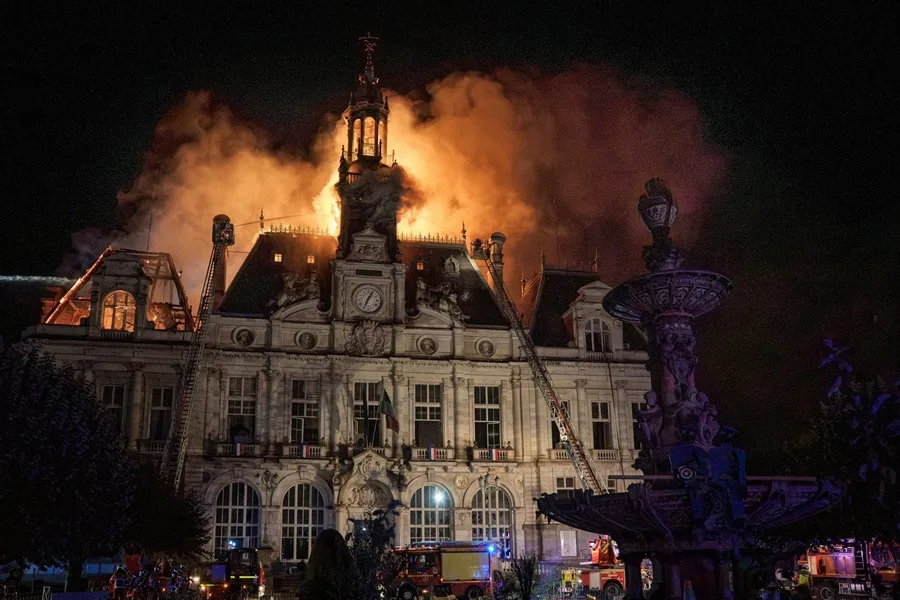
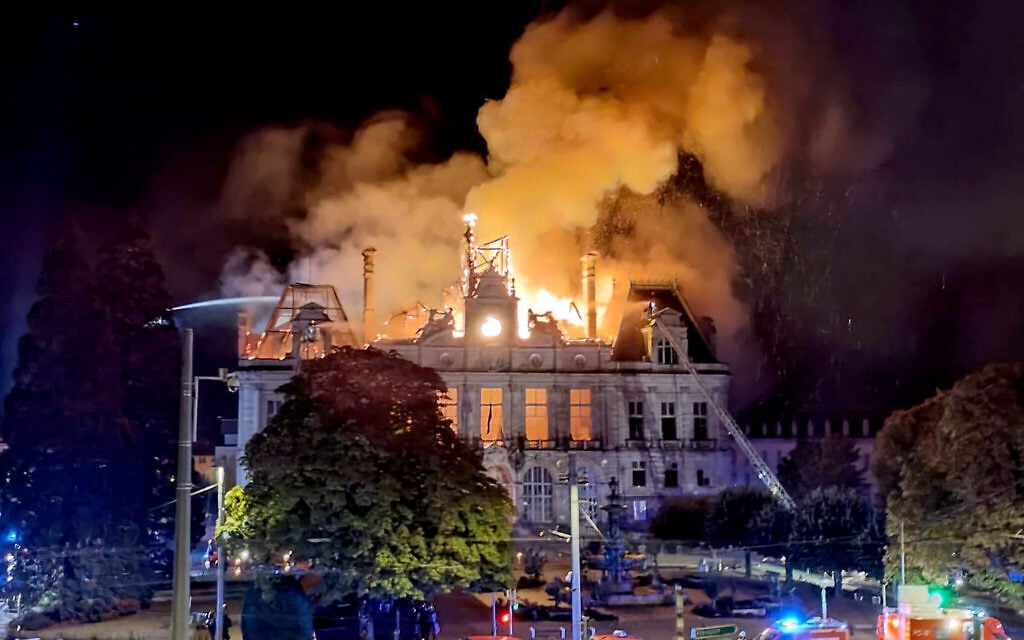
Mass protests in France spiral into worst riots in years; 1,200 arrested, 150 cops injured

As hundreds of thousands protest cost of living, city hall torched as police use tear gas; teen protester loses hand after picking up stun grenade; PM blames 'ultra-left,' months before presidential election
  •  

Russia Strikes Ukraine’s Steel and Energy Sector

Click to see the full-size image

Between the evening of October 16 and October 17, 2026, the Russian Armed Forces continued their campaign of combined strikes against Ukrainian defense-industrial, energy, and logistics infrastructure. According to the Ukrainian side, the overnight attack leading into October 17 involved Iskander-M/KN-23 ballistic missiles, Kh-22/Kh-32 cruise missiles, four Kalibr sea-launched cruise missiles, and 332 strike unmanned aerial vehicles. The main focus was on metallurgical enterprises in Kryvyi Rih and Zaporizhzhia, transformer production, and high-voltage substations in western Ukraine. In parallel, Ukrainian forces carried out a large-scale drone attack on Russian territory.

Russian Strikes on Targets in Ukraine

Metallurgical Complex

Zaporizhstal (Zaporizhzhia) – formerly one of Ukraine’s largest metallurgical enterprises. Before the campaign, it produced up to 1.44 million tons of pig iron and more than 1.3 million tons of rolled steel annually; its output was directed primarily toward military-industrial needs. According to Metinvest, this was the fifth strike on the facility; six ballistic missiles were fired in the latest attack, damaging energy and logistics infrastructure as well as production facilities in the blast-furnace shop. In total, 23 ballistic missiles have been fired at the plant across five attacks.

Metallurgical combine in Kryvyi Rih (Dnipropetrovsk Region) – one of Ukraine’s largest metallurgical enterprises, which supplied metal products to the Ukrainian defense-industrial complex. The description provided by the Russian Ministry of Defense matches ArcelorMittal Kryvyi Rih; according to sources, a week earlier the owners announced a cold shutdown of primary production, and the plant was preparing for preservation.


Energy Infrastructure

Zaporozhtransformator PJSC (Zaporizhzhia) – a manufacturer of oil-immersed power transformers rated at 220-750 kV, a key component of high-voltage substations. Since 2022, it has been under the management of Ukraine’s Ministry of Defense and has been used in the interests of the Ukrainian Armed Forces. Striking this facility complicates the replacement of damaged transformer equipment for Ukrenergo, as manufacturing a new transformer takes months.

Zhytomyr 330 kV Substation (Zhytomyr Region) – a major hub in the trunk power grid, providing voltage conversion and electricity distribution among 330 kV, 110 kV, 35 kV, and 10 kV networks. Power was cut in several districts of Zhytomyr, and water-supply disruptions occurred. According to the Russian Ministry of Defense, the facility struck was one that distributed electricity from western Ukraine to central regions for defense-industrial enterprises.

Click to see the full-size image

Rivne 330 kV Substation (Rivne Region) – a trunk power-grid facility. Power outages occurred in Rivne and nearby settlements, and municipal electric transport operations were disrupted.

Bar 330/110/35 kV Substation (Vinnytsia Region) – a high-voltage facility distributing electricity among the aforementioned voltage classes. Voltage fluctuations were recorded in Vinnytsia and across the region.

Kharkiv CHP-3 (combined heat and power plant No. 3; KP Kharkivski Teplovi Merezhi – Kharkiv Heating Networks), Kharkiv – a combined heat and power plant producing both thermal and electric energy for municipal supply. A hit was recorded on the electrical-shop building, where a fire broke out over an area of 100 square meters.

Transport and Logistics Infrastructure

Delivery logistics terminal (Novohrad-Volynskyi, Zhytomyr Region) – a branch of a Ukrainian freight-logistics operator specializing in less-than-truckload road transport and interregional delivery. The strike caused a fire in a warehouse building covering more than 1,000 square meters. The company participates in government contracts for freight-forwarding services through the Prozorro system.


Dry cargo vessel underway at sea (Port of Odesa) – a vessel delivering military cargo to the port was struck.

Strikes on Russian Territory

On the night of October 17, Ukrainian forces carried out a large-scale drone attack on Russian regions. According to the Russian Ministry of Defense, air-defense forces intercepted and destroyed 610 Ukrainian fixed-wing UAVs over the territory of 16 Russian regions and over the Black Sea. The highest intensity was recorded on the Moscow axis: Moscow Mayor Sergei Sobyanin reported the destruction of 144 UAVs heading toward the capital. In Bryansk Region, 157 UAVs were shot down over the course of a day. No reports indicated that serious strategic targets had been hit; there were civilian casualties.

The nature of the October 16-17 strikes confirms a systematic approach by the Russian command to disabling Ukraine’s defense-industrial production chain and the energy infrastructure supporting it. Priority targets include metallurgical enterprises producing goods for military needs and transformer production, which is critical for restoring damaged substations. According to Chief of the General Staff of the Russian Armed Forces Valery Gerasimov, steel production in Ukraine has been halted, operations at major Black Sea ports have ceased, and 76 logistics and warehouse centers have been struck. Given statements by the Russian leadership on the need to continue large-scale strikes against the defense-industrial complex and logistics centers, further intensification of attacks on energy infrastructure in western and central Ukraine, as well as on facilities involved in the repair and restoration of military equipment, should be expected. The resilience of Ukraine’s energy system will depend on its capacity to import electricity from the EU and on the speed of restoring trunk substations – both significantly complicated by the strike on Zaporozhtransformator.


MORE ON THE TOPIC:

The post Russia Strikes Ukraine’s Steel and Energy Sector appeared first on South Front.

  •  

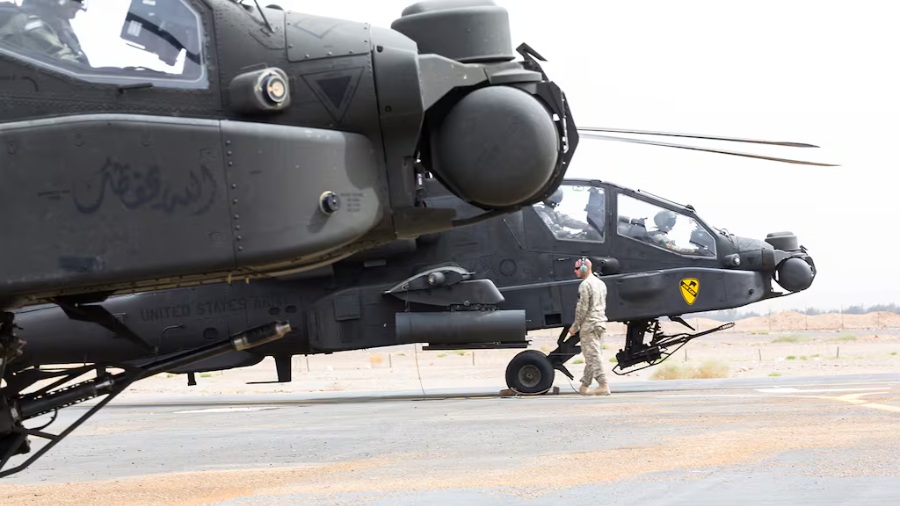
Houthis Shot Down Saudi Apache Helicopter Near Najran

Click to see full-size image. (Sgt. Harley Jelis/Army National Guard)

Yemen’s Houthis (Ansar Allah) announced late on October 17 that they shot down a Saudi AH-64 Apache attack helicopter near the border with the kingdom’s southern province of Najran.

In a statement, Brig. Gen. Yahya Saree, the movement’s military spokesman, said the American-made helicopter had been targeting Houthi positions along the border.

“Our armed forces, with the help and grace of God, managed to shoot down an Apache belonging to the Saudi enemy opposite Najran while it was carrying out hostile actions against our forces’ positions along the border,” Saree said. “It was shot down with a suitable weapon.”

The Houthis operate a range of air defense systems, from man-portable weapons to interceptors and medium-range surface-to-air missiles.

The Apache is Saudi Arabia’s principal attack helicopter, with a modernized AH-64E estimated to cost about $52 million per helicopter according to recent U.S. Army procurement figures.

Open-source inventories list 22 Apaches with the Royal Saudi Land Forces and 12 others with the Saudi Arabian National Guard.

The announcement came just days after the Houthis said they had struck a Saudi Eurofighter Typhoon fighter jet over Yemen’s Saada province. The group later released footage showing a missile hitting the jet during flight, supporting its claim.

Including the latest claim, the Houthis have announced 18 shootdowns since the start of the ongoing confrontation with Saudi Arabia. Aside from an American-made F-15SA fighter jet, all other warplanes shot down by the Houthis were combat drones.

_______________________________________________________________________________________________________________________

SouthFront: Analysis and Intelligence

NOW hosted at southfront.press

Previously, SouthFront: Analysis and Intelligence was at southfront.org.

The .org domain name had been blocked by the US (NATO) (https://southfront.press/southfront-org-blocked-by-u-s-controlled-global-internet-supervisor/) globally, outlawed and without any explanation

Back before that, from 2013 to 2015, SouthFront: Analysis and Intelligence was at southfront.com

SOUTHFRONT.PRESS

MORE ON THIS TOPIC:

The post Houthis Shot Down Saudi Apache Helicopter Near Najran appeared first on South Front.

  •  

It’s been 70 years: Why does the U.S. still control South Korea’s military?

By K. J. NOH, POPULAR RESISTANCE

Join us on Telegram, X, and VK.

Contact us: info@strategic-culture.su

Over seventy years ago, the US took control of South Korea’s military. To this day, it still controls it.

Why?

This confounds every notion of state sovereignty: a supposedly sovereign country — South Korea — has its own military subjugated under US control.

Opcon (operational control) of one nation’s army by another country is usually temporary, usually during wartime among allies.

In Korea, it has lasted over 76 years.

South Korea has asked for opcon back, repeatedly. It has been three decades since South Korea first made the demand.

The US has always delayed, filibustered, waffled, and moved goal posts.

More recently, the US has signaled more delay on the return of opcon, despite current president Lee Jae Myung’s demand that it be transferred back before the end of his term in 2030.

The allies are currently assessing the “full operational capability” (FOC) after validating the “initial operational capability” (IOC).

Seoul aims to wrap up the FOC certification and announce a target year for the Opcon transition at the upcoming SCM, before moving on to the remaining assessment of the “full mission capability,” which it expects to take about a year or so….[However] Washington remains firm in its position that Seoul is not ready for FOC certification, weighing on Seoul’s push to accelerate the Opcon transition.

This follows on US Forces Korea Commander Xavier Brunson’s repeated declarations of his opposition to Opcon transfer: only conditions matter, not timelines. According to Brunson, there can be no timeline to return control of South Korea’s troops to South Korea. Seventy six years is not enough.

South Korea had originally insisted on deadlines for the return of opcon. The US delayed, and delayed, and denied. It finally agreed–but only if certain conditions were met. These were agreed to in 2014, and reaffirmed them in 2017. Yet another decade has passed since those agreements.

Conditions for the return of opcon:

Cutting through the fog, there are essentially three conditions that the US has predicated as preconditions for South Korea to regain control over its own troops:

1. Can South Korea defend itself? (Can it operate its own military effectively? Does it have capacity, materiel, systems, and institutions?)

2. Are US and South Korea forces interoperable? (Can they coordinate in war?)

3. Are the conditions stable enough for opcon transfer?

The answer to the first is, of course. South Korea has one of the most powerful and well-equipped militaries in the world.

The second is, of course, the US and South Korea have been rehearsing interoperability for over seventy years.

The third is key: it is a catch-22 designed to undermine the entire process.

Conditions-based Opcon Transfer (COPT) sets specific benchmarks and tests for opcon transfer. These are the goalposts that are being constantly shifted.

However, the third condition is critical. It requires the de-escalation of tensions between North and South:

“Conducive Security Environment: The security environment on the Korean Peninsula and in the broader region must be stable and conducive to a safe, uninterrupted transfer.”

This is the catch-22:

If there is de-escalation of tensions, the required “tests” are not conducted and the benchmarks and certifications are not achieved — they are tied to field-condition wargames. Doing these wargames and tests escalates tensions with North Korea.

If there are tensions, then condition 3 is not met, and Opcon cannot be transferred.

It’s a formula for ensuring opcon is never transferred.

The simple fact is, it does not take 20+years to transfer opcon. “Wartime” opcon is transferred very rapidly. Armies coalesce, and opcon is transferred. Syngman Rhee turned over opcon in July of 1950 and the US was immediately in charge. It doesn’t take years and decades to transfer opcon. It takes hours or days. Returning it should be even faster. But that would require political will.

Here are some other important things to understand about opcon:

Opcon transfer conditions are actually classified:

The US keeps these conditions under wraps, and therefore the South Korean public or its representatives cannot challenge them publicly because they are not known. We only know the general outlines. The South Korean side can only hope the US will agree they have been met. This is yet another abrogation of sovereignty and democracy in addition to the original breach: “We will keep your military, unless you meet our secret conditions, which you cannot discuss, debate or challenge, because they are secret”.

Condition 3, “Conducive security environment” has always been a kill switch:

We know that security conditions have always been a tacit condition because, in the past, whenever opcon transfer looked justified and imminent, the security environment would suddenly degrade, scuttling the whole project. For example, just as the deadline for Roh Moo Hyun-negotiated Opcon transfer was approaching in 2012, the sudden sinking of the ROKS military ship Cheonan-Ho derailed wartime opcon transfer to 2015. That deadline has also passed and gone. Recent North-Korea attributed mine explosions near the DMZ fit this pattern, as have other numerous, suspicious incidents.

The concoction of “peacetime opcon” is nonsense:

The US claims it only has “wartime” opcon because it transferred “peacetime” opcon to South Korea in 1994. However, this very concept is nonsense:

1) Opcon means control of operations. Operations mean warfighting. “Wartime opcon”, ie. “wartime warfighting control” is a pleonasm. The only time operational control of a military is important is during fighting, just as the only time steering a car matters is when it’s moving.

The invention and transfer of “peacetime” opcon to Korea was a booby prize created to give the appearance that something had changed. Think of those Fisher-Price toy steering wheels you stick on the dashboard while someone else steers the car–it’s a political toy. It gives the illusion of control but it means nothing. The fact is, the US would never allow its military to be subjugated to a foreign command, even a shared command. The simple fact is, the US never shares control.

2) Immediately after “peacetime” opcon transfer in 1994, the US instituted CODA (Combined Delegated Authority), which continues US control of planning and execution of war. As Clint Work observes correctly, “The ROK JCS was granted the term OPCON for political purposes, and the US CFC was given the term CODA for accomplishing missions”. So much for peacetime “control”.

3) Last but not least, the US gets to unilaterally decide what constitutes peacetime and what constitutes wartime. When the US declares Defcon III, it’s wartime. Korean troops must fall in line under US opcon. If you get to slice the cake and then decide which portion you take, it’s your bloody cake. If you share a car, but only one party decides when it gets to be driven, and they drive, they own the car, you are maintenance. If one party unilaterally decides when it gets control, it has control, regardless of any protestations to the contrary.

But why does the US need to keep Opcon?

The US needs control over ROK troops because it is planning for war with China in the Pacific. It has been doing so since it drew up formal plans, AirSea Battle in 2009. For war, it needs SK as a military proxy: it needs the cannon fodder. South Korea has 3.6 million combat-ready troops: 500,000 regular and 3.1 million reserve. It has one of the most powerful and advanced militaries in the world, as well as the defense industrial base to sustain it. Furthermore, SK troops have always fought in US wars as proxies: more military-aged men in South Korea saw combat in Vietnam than Americans did as a proportion of population — 325,000 were deployed–the largest foreign deployment after the US. It was also the third largest deployment to Iraq. The US can avoid a draft because SK has one.

USFK Commander Xavier Brunson has made this US agenda of weaponizing South Korea for war against China explicit, comparing South Korea to “fixed aircraft carrier”, a dagger pointed at China, and a critical part of US war strategy because it is already inside China’s defense perimeter.

As the Hankyoreh Newspaper points out:

When his “dagger” comment is tied to his previous remarks, it’s evident that Brunson expects Korea to play an offensive role capable of striking the Chinese heartland, and Japan to play a defensive role supporting Korea…Brunson commented last August that he would like F-35 fighters with stealth capabilities and a multi-domain task force (MDTF) capable of wrecking China’s anti-access/area denial (A2/AD) network to be assigned to USFK. These comments suggest that Brunson means to treat Korea as a forward base equipped with military options for launching direct strikes against China.

Brunson recently announced that the multi-domain task force will be deployed to Korea.  These build on his previous statements on preparing the peninsula for war with China:

…[this] orientation clarifies how forces on the peninsula can impose costs, not only on the CCP’s Northern Theater Army, but also on the [Russian] Northern Fleet, thus demonstrating the significant strategic potential that exists on the peninsula to influence adversary operations in both adjacent seas… existing force positioning, particularly on the Korean Peninsula, may offer greater strategic advantages… advantageously positioned assets already inside the [Chinese] defensive perimeter, capable of immediate cost-imposition [ie. attack] against multiple adversaries.

This simultaneous fiction of pretending it doesn’t control South Korea’s troops became necessary when US-opconned SK troops massacred civilians in Gwangju.  The need to avoid accountability created the legal fiction of “peacetime opcon”, but that doesn’t obviate the US need for control as it prepares for and escalates to war.

The real reason why opcon transfer is taking so long is the US is trying to create a structure that maintains control of the SK army while pretending that it doesn’t.   This involves a crazy-quilt of parallel & unified command structures, multiplying command authorities, phased operating assessments, Frankenstein-cobbled-leadership structure, Rube Goldberg carve-outs, and a general have-your-cake-and-eat-it-too mindset.  This is assisted by extreme factions of the quisling South Korea right, who have lashed themselves to the sinking US Empire and see any reclamation of genuine South Korean sovereignty as abandonment–they fear that a South Korean military–the real nexus of power in Korean politics, accountable only to Koreans, would result in a loss of status and power as US quisling collaborators and subcontractors.

With war with China on the horizon, South Korea needs to reclaim opcon rapidly.  It remains to be seen if president Lee Jae Myung can pull off this hat trick.  However, the consequences of not doing so could be catastrophic.

Original article:  popularresistance.org

  •  

Could AI really kill us all?

By Katie FORSTER

Join us on Telegram, X, and VK.

Contact us: info@strategic-culture.su

STARK warnings from artificial intelligence researchers that advanced forms of the technology could wipe out humanity have raised questions over whether governments are moving fast enough to regulate it.

What are the potential dangers of “superintelligent” computer systems, and should we be worried?

AI experts have long described the threat as critical.

In 2023, hundreds of AI scientists and industry figures, including the heads of top US labs, signed a “statement on AI extinction risk” calling for the issue to be treated as seriously as pandemics or nuclear war.

If an out-of-control future AI deems that humans are obstructing its goals, it could use robots to “synthesise and spread novel pathogens”, said Stuart Russell, computer science professor at the University of California, Berkeley.

Or it could “convince people to initiate nuclear war, including by hacking into early warning systems”, Russell, a prominent voice on AI safety, said.

Such existential fears do not concern current AI systems, he said. But as the technology improves, it could take lethal action beyond our understanding, such as by removing oxygen from the atmosphere.

“We are less intelligent than superintelligent AI. If you ask chimpanzees how humans could wipe them out, they probably wouldn’t be able to give you all the right answers.”

In the meantime, “in the next year or two, I think the risk is higher from human misuse”, Russell added, such as an AI-enabled terror attack.

“The stakes are well-understood,” Jacob Coxon, a 27-year-old researcher, wrote on X last week, announcing his resignation from US AI startup Anthropic.

“But they are locked in a race to get there first,” he added, saying that Anthropic “believes no one else will act responsibly, so they must do it themselves”.

Anthropic this year removed a pledge from its safety charter to halt development of its models if it failed to control their risks.

It argued that if it unilaterally paused its work, its less cautious rivals would dominate the industry, making it less safe overall.

“The people building AI earnestly believe that it could kill us all by the end of the decade,” said Coxon, who previously worked at ChatGPT maker Open-AI.

He accused both companies of “gambling with our lives” as they strive to develop AI models capable of self-improvement.

Fears are heightened over rogue AI after OpenAI technology operating outside human supervision hacked into Hugging Face, a repository of AI models.

“We really do earnestly believe AI could kill all humans!” Anthropic safety executive Evan Hubinger chimed in on X, estimating the risk at more than 10 per cent over the next decade.

It’s important to remember that doom-laden percentage predictions are “absolutely unscientific”, said Hussein Abbass, a computing professor at UNSW Canberra.

“The situation is still controllable, and it can be managed,” Abbass said.

But governments should not sit on their hands when it comes to regulating AI, he added, urging an “agile” approach as AI development accelerates.

Both Anthropic and OpenAI are expected to go public soon, and some sceptics say scary warnings make AI appear powerful and worthy of large investments.

Others argue that focusing on the risk of extinction distracts from more pressing problems caused by AI, from job losses to machines discriminating against minorities.

In July, more than 1,000 tech employees, including Anthropic’s CEO, called on Washington to support a coordinated slowdown in the development of the most advanced AI systems.

OpenAI halted training of its latest models for two weeks in August before resuming it under tighter controls.

The United States has been firmly against global regulation of the sector that could stifle innovation.

But the hacking capabilities of the most cutting-edge models have given Washington pause, with recent Anthropic and OpenAI releases delayed over national security concerns.

Even then, “we don’t want to restrict them where all of a sudden we come in second to China”, President Donald Trump has said.

“Maybe it will take a massive, Chernobyl-scale disaster to get governments to act,” Russell said, urging them to establish a licensing regime for AI, as exists with aviation, medicine or water supply.

“Perhaps at some point governments will remember that their voters prefer not to be dead.”

Original article:  www.nst.com.my

  •  

Deadly Explosion at PMF Headquarters Raises Strike Suspicions (Videos)

Click to see full-size image. (Telegram)

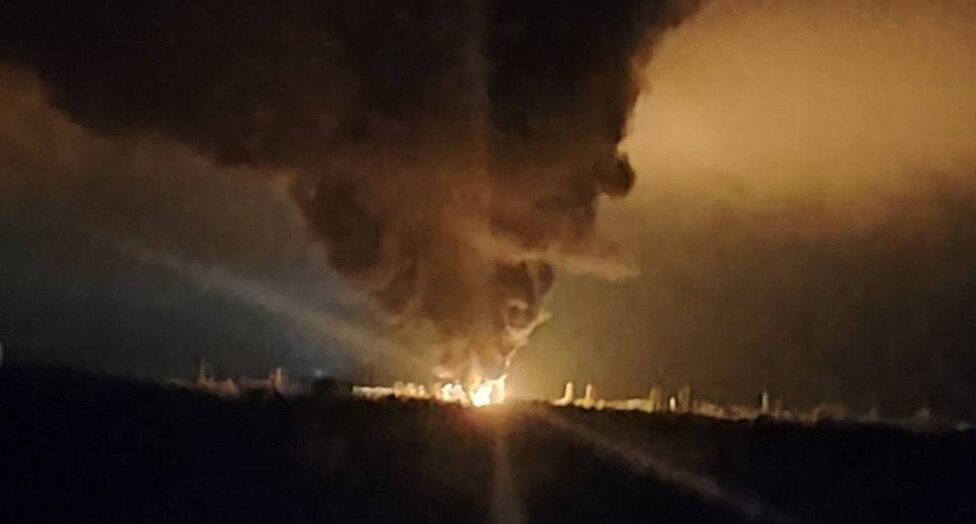
An explosion struck the headquarters of Iraq’s Popular Mobilization Forces (PMF) in eastern Baghdad on October 17, with conflicting reports emerging over casualties and claims that the facility had been targeted in a strike.

The blast occurred at a PMF site east of the Army Canal in the Sadr al-Qanat area, near Saad al-Witri Hospital. Residents reported hearing a loud explosion, while footage circulated by local media showed flames and thick smoke rising from the area.

In a statement, the PMF said a stockpile of damaged ammunition had exploded inside the facility and initially reported no casualties.

Shafaq News, citing a security source, reported that four PMF members were wounded, some seriously. Asharq Al-Awsat separately cited sources as saying one fighter was killed and three others injured.

The cause of the explosion remained unclear. Sabereen News, a militia-linked channel, circulated claims that the headquarters had been targeted in a strike. Asharq Al-Awsat also reported that security personnel believed the site had been targeted, but provided no details establishing the nature of the incident.

The explosion was the second reported incident involving ammunition at an armed faction’s site in Baghdad this month. On October 1, munitions stored at a site belonging to an armed faction exploded in the capital’s southern Dora district without causing casualties, according to Shafaq News.

Many of the PMF’s factions are also believed to be members of the Iran-aligned Islamic Resistance in Iraq. The recent blasts came amid reports suggesting that both the United States and Israel are preparing to resume war against the Islamic Republic before the end of the year. They also came amid a heated confrontation between the Houthis, also allied to Tehran, and Saudi Arabia.

_______________________________________________________________________________________________________________________

SouthFront: Analysis and Intelligence

NOW hosted at southfront.press

Previously, SouthFront: Analysis and Intelligence was at southfront.org.

The .org domain name had been blocked by the US (NATO) (https://southfront.press/southfront-org-blocked-by-u-s-controlled-global-internet-supervisor/) globally, outlawed and without any explanation

Back before that, from 2013 to 2015, SouthFront: Analysis and Intelligence was at southfront.com

SOUTHFRONT.PRESS

MORE ON THIS TOPIC:


The post Deadly Explosion at PMF Headquarters Raises Strike Suspicions (Videos) appeared first on South Front.

  •  
❌