This is the Oct. 19, 2026, edition of “The Tea, Spilled by Morning Joe” newsletter.Subscribe hereto get it delivered straight to your inbox Monday through Friday.
“If the United States will officially take the side of Russia … we will not prevail and we will not be able to stand.”
—
Ukrainian President Volodymyr Zelenskyy on “Meet the Press” after President Donald Trump waived sanctions on Russia
In 1983, Ronald Reagan stood before a room of evangelicals in Orlando, Florida, and denounced the Soviet Union as an “evil empire.”
Donald Trump has obviously taken the former KGB agent’s side over Reagan’s.
On Friday, the president waived bipartisan sanctions against Russia that he signed into law last month. He called it a “very simple” decision.
It’s an easy choice if you want America’s enemies to win.
Trump then approved the Russian diesel deal. Then the slowing of Starlink over Ukraine. That’s been followed by a week of non-denial denials from a president who bizarrely insists that no one is responsible.
The Keystone Cops routine would be funny if the consequences weren’t so deadly. Russia is moving closer to winning in Ukraine and setting their sights on the rest of Europe.
Even The Wall Street Journal’s editorial page now calls Trump “Mr. Putin’s best friend in the world.”
What an October surprise, and what bad news for Republicans.
GOP candidates are scrambling to distance themselves from the Trump-Putin alliance while losing support over the high cost of living and the low approval ratings haunting Trump.
Yet through it all, the president can’t quit Putin — one of the most ruthless war criminals on the planet. Left behind are those freedom fighters who continue to defend Western democracy on the front lines in Ukraine.
Volodymyr Zelenskyy warns that they cannot continue fighting if America takes Russia’s side.
Tragically, Donald Trump already has.
CHARTS OF THE DAY
Source: Economist/YouGov poll of 1,403 registered U.S. voters conducted Oct. 10-12, 2026. Margin of error: ± 3.5%
ON THIS DATE
On Oct. 19, 2025, thieves broke into the Louvre and made off with more than $100 million in 19th century-era jewels, setting the stage for a year seemingly rife with art heists.
Kiran Ridley/Getty Images A French forensics officer examines a cut window and balcony at the Louvre Museum in Paris following a robbery on Oct. 19, 2025.
WHAT THEY SAID
Jonathan Lemire on the midterms
“The fact that we’re talking about the Senate at all is instructive. The House has always been favored to lean Democratic, but the Senate is a true toss-up. Eight months ago, those seats weren’t even in play, but now they feel tantalizingly within Democrats’ grasp.”
David Ignatius on Trump’s decision to import Russian diesel fuel
“It’s a betrayal of Ukraine — courageous allied people facing the worst winter of their lives — for the frailest of political reasons. There’s no evidence to support the idea that this diesel deal will make a difference in the prices people pay. If anything, it’s making Trump more vulnerable politically, as Republicans pull back from him.”
Eugene Robinson on tech billionaires
“A handful of absurdly wealthy men have ridiculous control over a democracy, and we’re pretending that that’s OK. That’s not the way this is supposed to work, but there you have it: You go to Elon Musk for our national security concerns and to Mark Zuckerberg for our First Amendment rights. We’ve dug a hole for ourselves as a country that it’s going to take a while to get out of.”
Instead, presidential and legislative polls will be held together on 11 September 2027. The decree followed approval by the Executive Committee of the Palestine Liberation Organisation (PLO) and consultations with political factions.
The official explanation was Israel's occupation. Fatah officials insist that the movement was ready and that Israeli restrictions made a free, fair, and inclusive vote impossible. While that argument is real, it is also incomplete.
Read closely, the accounts of those around the decision point to three pressures converging at once: external obstacles that have not changed, rivalries inside Fatah that its own leaders acknowledge, and a factional dialogue that gave the leadership a consensual route away from a deadline its critics say it was not ready to meet.
The postponement is less a verdict on Israeli obstruction than a decision about who gets to shape the next Palestinian political order, and on what terms.
The official case
The decree lists various obstacles, including Israel's continuing offensive in Gaza, restrictions on the movement of the Central Elections Commission and observers, and the impossibility of voting in occupied East Jerusalem given Israel's position.
Restrictions on movement, settlement expansion, and settler attacks across the West Bank were also cited, as were the exceptional security and humanitarian conditions in Gaza.
Fatah insists its own machinery was not the problem.
“We prepared seriously for these elections,” Tayseer Nasrallah, a member of Fatah's Revolutionary Council, told The New Arab.
“We mobilised our organisational structures in the West Bank and the Gaza Strip, held meetings and electoral assemblies to choose our candidates, and we were about to register our official list with the Central Elections Commission.”
He rejects the suggestion that internal weakness forced the delay. “Organisational unreadiness and internal disagreements were not the direct reason for the postponement,” he said.
“Creating the right conditions for voting and guaranteeing that our people can take part in every area are among the biggest challenges that must be dealt with before elections are held.”
The obstacles are not invented. But the decree itself describes them as continuing, meaning they were already in place when the November date was set. Nothing in it explains why they should have been lifted by September 2027.
As a full explanation of why this vote was cancelled at this moment, the occupation argument does too little work on its own.
“The disputes inside Fatah, whether between its leadership centres or with the Democratic Reform Current, have left their mark on the preparations for the elections,” said Noaman al-Abed, a writer and political analyst.
“These disputes came alongside questions about how ready the factions actually are,” he told The New Arab, “and whether they can provide the political, field, and logistical conditions needed, especially in Jerusalem and Gaza.”
Al-Abed's sharpest criticism is aimed at the mechanism Fatah used to pick its candidates. “The experience of the electoral assemblies inside Fatah has deepened the organisational divisions,” he said. “It is doubtful how far they included the different currents within the movement”.
This is where the power dynamics sit. Candidate selection decides who rises inside a movement and who is left out. A process that rival currents see as exclusive does not settle internal contests; it pushes them toward the ballot box, where they can split the vote.
The postponement halted that process: the same decision froze the work of the electoral assemblies for the Palestinian National Council. Folding the presidency into the same ballot raises the stakes further for whoever controls the list.
Fatah's leaders do not deny the rifts. They simply deny that the rifts decide anything.
“Differences within Fatah are not new,” Nasrallah said. “The movement has always dealt with them through internal dialogue”.
Wasel Abu Youssef, a member of the PLO Executive Committee, puts Israel's continuing aggression and the obstacles to the vote first, alongside the need for a comprehensive national dialogue.
Yet even this defence concedes the central point. If the delay was needed to secure consensus, then consensus was missing. The internal divide may not be the only cause of the postponement, but it is part of what made the November date untenable.
Consensus as cover - and leverage
The delay was not announced as a Fatah decision. It was framed as a response to the factions.
“Fatah respected the outcomes of the dialogue held in Cairo with the Popular Front for the Liberation of Palestine and Hamas,” Nasrallah said, “and conveyed them to the movement's leadership bodies before the procedures for the postponement were completed”.
The decision was presented as answering factional initiatives, above all the PFLP's. On 10 October, the same day as the decree, the PFLP welcomed the change of date and the freezing of the National Council assemblies. It called for a comprehensive national dialogue based on its initiative, "A Roadmap for National Salvation".
That dialogue, it said, should end the division, restore national unity, and rebuild the political system on democratic and participatory foundations, with all forces taking part.
Abu Youssef echoed that agenda. “We need a comprehensive national dialogue that rearranges the internal Palestinian situation, ends the division and produces a consensus guaranteeing that all factions take part in the elections,” he said, adding that contacts with the factions and Egyptian officials were continuing.
“The aim of dialogue must be to end the division and strengthen national unity, so that elections become a means of renewing legitimacy and ordering Palestinian institutions, not an additional cause of fragmentation.”
This framing does two things. A delay requested by a faction outside Fatah reads as national consensus rather than self-interest, which gives the leadership cover. It also changes the question. The debate is no longer only about when Palestinians vote, but about the terms of the political system they vote into, with Hamas at the table in Cairo.
That is a bigger prize, and a riskier one. Whoever shapes the dialogue now shapes the timetable.
“Fatah is ready to abide by the outcomes of the dialogue and the national understandings that are reached,” Nasrallah said. Whether those understandings become concrete, enforceable steps is what the PFLP's roadmap, and the credibility of the delay, will depend on.
The international pressure test
The one clear dissent came from outside. In a statement on 14 October, the European Union expressed regret at the postponement of legislative and presidential elections until September 2027. It stressed the importance of holding them as soon as possible and said it stood ready to support the process, including through an EU observation mission.
Fatah's answer was to redirect the pressure. “Fatah respects the European Union's position rejecting the postponement,” Nasrallah said, “but we ask that this position be matched by political pressure on the occupation government to remove the obstacles hindering the work of the Central Elections Commission, and to guarantee freedom of movement and participation in the West Bank, including Jerusalem, and in the Gaza Strip”.
Abu Youssef framed it as a diplomatic task. “We must keep communicating with European states and the international parties concerned, explain the impact of the occupation's measures on the possibility of holding elections, and work to build an international position that guarantees their integrity and transparency,” he said.
The exchange sets a test for both sides. If Israeli obstruction is the main barrier, European pressure and an observer mission are the remedy Fatah says it wants. If the leadership does not take up that offer with a clear plan, the occupation argument will look more like a shield for internal problems than a reason.
A new deadline, an old political crisis
No single factor explains the postponement. Israeli obstruction is a real barrier to voting across the Palestinian territories. Fatah's internal rifts are real too, and its leaders' insistence on consensus shows the movement was not ready to face voters divided. The factional dialogue gave the leadership a way to turn that weakness into a national project.
The risk is that the delay becomes the outcome. “Repeated postponement of the elections may deepen the crisis of trust between citizens and the Palestinian leadership,” al-Abed warned, “and raise doubts about how serious the commitment is to renewing legitimacy through the ballot box”.
His prescription is simple.
“Overcoming this requires a clear date, early preparation and the political and organisational guarantees needed to hold the elections,” he said.
The postponement has bought eleven months. Its value will be judged by one measure: whether the dialogue produces a national consensus that clears the way for free and fair elections and renews Palestinian legitimacy, or whether divisions and obstacles push the vote back again and deepen the crisis of trust.
Monjed Jadou is a Palestinian journalist and founder of Palestine News Network (PNN), an independent Palestinian media network. He has contributed to international and regional media outlets. His work focuses on Palestinian affairs, independent journalism, media freedom, and promoting the principles of editorial independence and professional journalism in Palestine
This story was produced in collaboration with Egab
As Israel continues to squeeze Gaza, settler violence dominates West Bank; Trump endorses war criminal Benjamin Netanyahu to remain Prime Minister in next week's election
Armed clashes in Iran’s southeastern province of Sistan-Baluchestan have intensified in recent weeks, reaching their highest level in a decade.
With the US-Israel war threatening to enter an even more volatile phase, such tensions have raised growing concern in Tehran.
At the centre of the escalation is the emergence of a coalition of diverse Baloch militant factions, the Popular Fighters Front (PFF), also known by its Persian acronym JMM (Jebhe-ye-Mobarezin-e Mardomi).
Consisting of Jaish-ul-Adl, PADA Baluch, Harakate Nasr Baluchestan, and the Mohammad Rasulullah Brigade, the militant umbrella was formed in December 2025.
Though they claim to fight for all of Iran, which they say has been “held hostage,” at least one faction among them has advocated Baloch separatism in the past.
But despite their differing political ambitions, the groups share a conservative Sunni Muslim identity, providing common ground in Shia-dominant Iran where the Sunni population is less than 9%.
Tehran's security dilemma
Suddenly, Sistan-Baluchestan has become dangerous.
Since January 2026, at least 37 armed attacks have been reported on police stations, military bases, and checkpoints, while security patrols have been targeted as they move through cities.
Islamic Revolutionary Guard Corps (IRGC) personnel are a primary target. There have been high-ranking assassinations, and last month, a regime-linked Sunni cleric was shot dead.
If this continues, the Iranian government may have to send large reinforcements from other parts of the country to contain the unrest, stretching the security infrastructure at a time when it is prepared for a return to war.
Such instability in Sistan-Baluchestan could have consequences for Iran in the coming months.
As per the Armed Conflict Location & Event Data Project (ACLED), approximately 70 armed confrontations took place between Iranian security forces and armed groups in Sistan and Baluchestan during 2026, the highest annual level in a decade. Thirteen occurred in the past two weeks alone.
ACLED’s assessments suggest that although Tehran has intensified efforts to dismantle the militant network, raids have often turned into “prolonged battles”, with some lasting as long as nine hours.
Pointing towards a more entrenched insurgency, it says that the “key risk” would be convergence, and a full-scale resumption of the US-Israeli war on Iran could “stretch Tehran’s security forces thin.”
Meanwhile, the human toll is also mounting, according to the US-based Human Rights Activists News Agency (HRANA), with at least 94 people killed and 33 wounded in 63 armed incidents between 31 March and 10 October.
On 13 October, more than 20 Fatemiyoun brigade members were reported killed or wounded in fighting that lasted for seven hours in the mountainous Taftan area.
The Fatemiyoun are an Iran-backed Shia militia composed largely of Afghan fighters and organised to fight alongside the IRGC. Their reported involvement underscores the extent to which Tehran is drawing on its wider security network to confront the violence.
The use of drones, artillery, and armoured vehicles by government forces in recent clashes further indicates the intensity of the fighting and raises concerns about the consequences of expanded operations in populated areas.
Consequently, Tehran faces a difficult strategic dilemma, and while a forceful response could disrupt militant networks, it may result in deepening local alienation.
While the Iranian government is not losing its grip, chronic instability constrains its ability to respond to war.
Rebranding a Baloch uprising?
Ridden by poverty, plagued by unemployment, and the least developed region in Iran, Sistan-Baluchestan has been tense for decades.
Since their unification as the PFF, however, the region’s militants have changed their narrative, pointing not only to Baloch grievances but also calling for broader political change in Iran.
So far, it cannot be determined whether this consolidation has increased their capabilities, but the ongoing war with Washington has created space for the militants to regroup in Iran.
Dr Farzan Sabet, an Iran expert at the Geneva Graduate Institute, told The New Arab that when “conditions for ordinary people are deteriorating, and the regime is perceived as vulnerable, there are surges of opposition hoping to overthrow the regime, or extract concessions”.
He highlighted the convergence during the 12-day war in June 2025 amid the so-called ‘Lion and Sun’ protests among “leading opposition organisations including the nationwide Pahlavi movement, the coalition of political forces of Iranian Kurdistan in majority Kurdish-speaking areas of Iran, and the PFF in Sistan-Baluchestan”.
Sabet said that Iranian security forces in this province have “historically been poorly equipped and trained, experiencing greater disarray due to the assassination of Iranian security leaders and personnel” during the war.
Militancy in the province has also received a boost from deteriorating material conditions, the dire state of human rights, a disproportionate degree of executions and violations, and, possibly, foreign support.
According to Sabet, the political dynamics in Sistan-Baluchestan are often distinct from those in the core of the country, and there are fewer sensitive population centres and economic hubs.
“It is seen as less of a threat than, say, a comparable event in Tehran or another major city in the core, and there is a lower risk that discontent and instability spread from the periphery to the core than the other way around,” he added.
The impact of such peripheral insurgencies is usually geographically and politically contained in Iran, even though the PFF is “targeting its discourse toward the broader Iranian nation”.
However, “given the recent successes of Balochi militants, the regime may want to surge further security forces into the area,” Sabet said, such as the Fatemiyoun Division - an IRGC-backed militia of Afghan Shia whose members died in recent clashes.
The US-Israel war has added a new dimension to the fragile situation in Sistan-Baluchestan as Iran’s security establishment has diverted away resources and armed groups have seen it as “an opportunity to intensify their activities and test the state’s capacity to respond”, Babak Vahdad, an independent researcher and Iran analyst, told The New Arab.
In his view, the escalation is not an immediate threat to the survival of the Islamic Republic, as Baloch militancy remains geographically concentrated and is not a broader national uprising.
But the situation has exposed “some of the structural weaknesses of the Iranian state, particularly its difficult relationship with ethnic and religious minorities, and a predominantly military response may contain the insurgency in the short term without addressing its underlying causes”.
Meanwhile, according to Iran’s narrative, “certain regional actors” might be encouraging instability there to “divert Tehran’s military and security resources away from the main confrontation in the Gulf, possibly even preparing the ground for a future military attack against Iran”, Vahdad added.
Fractious borders, wider risks
The security issue is made worse by geography. Across mountainous terrain, the porous 900 km Iran-Pakistan border stretches from a tripoint with Afghanistan to the northern Arabian Sea, and policing it is an arduous task for Tehran as deserted, interconnected frontiers with low populations create fertile ground for armed groups and mercenaries.
Even the Pakistani province of Baluchistan across the border has separatist outfits, mercenaries, a smuggling nexus, and long-standing political and socio-economic issues.
Currently, border crossings along the Pakistan-Iran border have been closed by Islamabad.
Naveed Ali Sheikh, an Islamabad-based military analyst, told The New Arab that Pakistan has been facing terrorist attacks originating from the Iranian border region of Sistan and Baluchestan, where banned militant outfits operate and carry out “hit-and-run” [back across the border] attacks.
These groups have targeted Iranian and Pakistani government forces, as well as civilian infrastructure, he said. Noting that a surge in such attacks was observed recently, Sheikh said the border required better security infrastructure, upgraded surveillance systems, and more effective mechanisms to prevent further incursions.
However, border security was not the primary reason behind the recent closure of cross-border trade, as “shadow banking networks are being used by smugglers and black-market operators, which the United States alleges are helping finance Iran's sanctioned military establishment”.
And the temporary closure of border crossings may be intended to manage the anticipated backlog of transactions and documentation if the banking and trade standstill continues.
Sabena Siddiqui is a foreign affairs journalist, lawyer and geopolitical analyst specialising in modern China, the Belt and Road Initiative, the Middle East, and South Asia.
Serge Schmemann’s warning about the collapse of the old international order deserves attention. For Europe, the challenge is to defend democratic security while accepting that American leadership may never return in its familiar form.
The most dangerous assumption in Western politics is that normality is merely postponed. Survive Donald Trump, the argument runs, and America will resume its familiar position: reassuring allies, containing adversaries and underwriting an international system whose benefits outweigh its frustrations. Serge Schmemann’s latest opinion challenges that comforting expectation. He is right to do so.
In his October 18th essay for The New York Times, the highly esteemed former Moscow, Bonn and Jerusalem bureau chief examines what might follow the erosion of the postwar order. His central warning, reflected in published excerpts, is that changes extending beyond Trump make a complete restoration improbable. That is a persuasive starting point for democratic strategy.
America’s allies should take this seriously because trust operates differently from military strength. Governments can replenish ammunition, replace aircraft and increase defence budgets. Confidence in a security guarantee is harder to rebuild. Once allies must consider whether Washington’s commitments depend on a president’s personal preferences, that uncertainty becomes a permanent consideration in their planning.
Schmemann’s argument also avoids an analytical trap: attributing every international upheaval to one man. According to the published account of his essay, he places Trump alongside broader developments, including China’s rise, Russia’s renewed aggression and democratic retreat. His alternative futures are scenarios, rather than predictions. Their value lies in forcing readers to consider choices and consequences before events foreclose them.
Supporting this argument does not require romanticising American leadership. Washington’s record includes disastrous interventions, selective commitments to human rights and partnerships with dictators. Those contradictions weakened its authority. Yet recognising them does not erase the distinction between an imperfect system containing restraints on power and an emerging environment in which powerful states increasingly seek freedom from restraint.
For smaller countries, that distinction is existential. Sovereignty offers little protection if stronger neighbours can overturn it through invasion, economic intimidation or negotiations conducted without the affected country’s meaningful participation. An international order deserves defending when it gives weaker states instruments to resist coercion, even when those instruments work inconsistently.
Ukraine makes the issue concrete. A settlement should be judged by whether it produces durable security and respects Ukrainian agency, rather than by the speed with which a diplomatic announcement can be staged. Peace that leaves an aggressor confident of future gains risks becoming an interval between wars.
Europe, however, cannot turn justified criticism into an excuse for its own shortcomings. If democratic governments believe that sovereignty and collective security matter, they must supply the resources required to defend them. Procurement, industrial capacity, infrastructure protection and sustained assistance to Ukraine are measures of political seriousness. Communiqués cannot substitute for delivery.
Gary Cartwright made a related argument in EU Today’s “Trump Comes to Davos — and Europe Still Isn’t Ready”. Discussing pressure over Greenland, he identified both the damage caused by coercive bargaining and Europe’s persistent unpreparedness. That combination matters: American unpredictability becomes more dangerous when European governments lack the means or unity to respond.
A stronger European contribution would also serve Americans who still value alliances. Partnerships are more resilient when responsibility is shared and commitments survive changes of government. Europe should build the capacity to act while preserving cooperation with American institutions, businesses and citizens. Treating the entire United States as interchangeable with its president would reproduce the personalised politics that makes the present situation so unstable.
Democratic renewal must begin at home, too. Governments weaken their case abroad when they dismiss public grievances, evade scrutiny or treat electoral legitimacy as an inconvenience. Defending democracy requires competent administration, accountable institutions and room for peaceful disagreement. Strategic credibility rests partly on whether citizens believe their own system deserves their confidence.
Schmemann’s warning therefore deserves support as a demand for preparation. The old order cannot simply be summoned back through nostalgia or another American election. Its most valuable achievements must be sustained through decisions made now. Europe should approach the future with fewer comforting assumptions, greater material strength and a clearer understanding that democratic security depends on governments willing to defend it.
What began as a student protest over deteriorating schools has developed into a nationwide revolt against economic hardship, political paralysis and declining public services. With the 2027 presidential election approaching, the violence has exposed problems that neither the government nor its principal opponents have convincing plans to resolve.
France’s latest wave of unrest has developed into one of the most serious domestic crises of Emmanuel Macron’s presidency. More than 550,000 people participated in demonstrations on 17 October, according to official estimates, before violence spread through Paris and other major cities. Shops were looted, police confronted rioters, and the historic town hall in Limoges was largely destroyed by fire.
The scale of the destruction prompted emergency government consultations and a televised presidential address. Macron promised to prosecute those responsible, while stopping short of declaring a state of emergency. Yet the immediate security challenge conceals a more difficult political question: why have protests that began with relatively specific demands over education become a confrontation involving such different sections of French society?
From school protests to a national revolt
The movement originated among secondary-school students demanding better facilities, more teachers and improvements in educational standards. Their complaints subsequently attracted trade unions, workers, farmers and elements of the Gilets Jaunes, the Yellow Vest movement that challenged Macron’s government in 2018.
The resulting coalition has no coherent political programme. Students protesting overcrowded classrooms share demonstrations with workers concerned about purchasing power and motorists angered by fuel prices. Their interests are not necessarily compatible, but they reflect a common dissatisfaction with the government’s ability to deliver functioning public services while containing living costs.
This distinction matters. The presence of masked rioters and organised groups engaged in violence does not establish that the hundreds of thousands who demonstrated peacefully supported their actions. Equally, the destruction of public buildings, attacks on police and widespread looting raise legitimate questions about the state’s capacity to maintain public order.
The economic problem behind the protests
At the centre of the discontent lies a structural problem that successive French governments have struggled to confront: the distribution of public expenditure between an ageing population and the services required by younger generations.
A French government budget assessment published in October revealed that pension obligations accounted for approximately 32 per cent of the education ministry’s budget, including €28.5 billion in pension expenditure. These obligations restrict the resources available for other departmental priorities.
France nevertheless remains a substantial spender on education. According to official figures, expenditure reached €199.2 billion in 2025, equivalent to 6.7 per cent of GDP. However, after inflation, the annual increase was only 0.1 per cent.
The issue is therefore not simply how much France spends, but how efficiently resources are allocated and whether expenditure meets changing educational needs.
The OECD’s 2025 PISA assessment found that French pupils’ performance in mathematics and reading had declined compared with 2022. Results were among the country’s lowest recorded, although broadly comparable with the OECD average.
These figures give the student protests a significance extending beyond the immediate condition of classrooms. They raise questions about France’s longer-term economic competitiveness and its capacity to provide younger generations with opportunities comparable to those enjoyed by their predecessors.
The limits of Macron’s reform programme
Macron entered office in 2017 promising to modernise the French economy and overcome the traditional division between left and right. Nearly a decade later, his administration faces a fragmented parliament, constrained public finances and growing resistance to further structural reforms.
The suspension of his pension reform illustrated the difficulty. Raising the retirement age was intended to reduce pressure on the pension system, but parliamentary opposition forced the government to defer the measure until after the presidential election.
The underlying financial pressures have not disappeared. Nor can they be resolved easily through additional spending when public debt, borrowing costs and budgetary obligations already restrict the government’s room for manoeuvre.
This creates an uncomfortable political reality: the state is expected to provide better services, greater purchasing-power protection and stronger security, while the available resources remain limited.
Can the opposition benefit?
The unrest comes approximately six months before the presidential election, with Marine Le Pen’s National Rally and Jean-Luc Mélenchon’s France Unbowed competing to establish themselves as alternatives to Macron’s political centre.
Le Pen has sought to combine support for economic grievances with demands for tougher policing. That position may attract voters concerned by the violence, but it also exposes tensions within a movement that previously supported the Yellow Vest protests.
Mélenchon faces a different difficulty. Supporting demonstrations against government policy is consistent with his political programme, but the involvement of violent groups risks shifting public attention from social demands towards questions of security.
A recent presidential opinion poll even suggested that Le Pen and Mélenchon could contest the final round, illustrating the weakening position of more conventional political alternatives.
Neither, however, can escape the fiscal constraints that have frustrated Macron’s government. A change of president would not automatically provide the resources required to expand public services, reform pensions and reduce the deficit simultaneously.
A wider problem for France and Europe
President Donald Trump has attributed the French unrest to immigration, although the movement’s documented origins lie principally in education, living costs and dissatisfaction with public services. Without established evidence about those responsible for individual acts of violence, broader claims about the demonstrators’ backgrounds remain speculative.
For the European Union, France’s instability carries consequences beyond its domestic political debate. France is central to European defence, fiscal negotiations and support for Ukraine. Sustained political paralysis would complicate its ability to negotiate and implement decisions requiring substantial public expenditure.
The immediate task for Macron’s government is to restore security without allowing the legitimate grievances of peaceful demonstrators to disappear from political consideration. The more difficult task will fall to whoever enters the Élysée in 2027.
France’s crisis is not simply a repetition of the Yellow Vest movement. It reflects a growing conflict over public resources, expectations of the state and the ability of established political institutions to reconcile competing demands.
The violence may subside, but the economic contradictions that brought such different groups onto the streets will remain. The presidential election will determine who inherits them, rather than whether they exist.
The Trump administration’s reported proposal to restore Russian gas supplies to Europe through Ukraine marks a reversal of Washington’s longstanding energy policy. Behind the promise of an economic incentive for peace lies a more consequential question: whether Europe is being asked to restore the very dependence on Moscow that it has spent four years dismantling.
The administration of US President Donald Trump is considering the restoration of Russian natural gas supplies to Europe, including through Ukraine’s pipeline network, as part of a proposed settlement to end Russia’s war against Ukraine. The initiative would offer Moscow renewed energy revenues while potentially opening opportunities for American investors to participate in the trade.
According to a New York Times investigation published on 17 October, presidential envoys Steve Witkoff and Jared Kushner have raised the proposal with Ukrainian and European officials, including President Volodymyr Zelenskyy. The White House has confirmed that economic incentives for Russia and Ukraine form part of its peace diplomacy, although no agreement on renewed gas transit has been announced.
The proposal would require Ukraine to reopen a transit route that ceased operating for Russian exports in January 2025, while European governments would be expected to resume purchases they have spent years reducing. American negotiators reportedly regard the prospect of renewed commercial revenues as an incentive for President Vladimir Putin to reach a settlement.
There is, however, a considerable difference between offering Russia a commercial opportunity after a verified peace agreement and restoring a source of revenue and political influence before Moscow has demonstrated any willingness to abandon its territorial objectives.
From opposition to Russian gas to facilitating its return
The reported initiative represents a reversal of Trump’s earlier position on European energy security.
During his first presidency, Trump repeatedly warned Germany that its dependence on Russian energy exposed it to political pressure from Moscow. Speaking at the United Nations General Assembly in September 2018, he accused Berlin of becoming dangerously dependent on Russian supplies. Members of the German delegation visibly smiled at his remarks.
The episode acquired renewed significance after Russia’s full-scale invasion of Ukraine in February 2022. Germany had developed an extensive commercial relationship with Gazprom, while the Nord Stream pipelines were intended to facilitate Russian gas deliveries directly to Germany, bypassing traditional transit countries, including Ukraine.
Trump maintained his opposition to those energy relationships well into his second presidency. As EU Today reported in September 2025, he told European governments that continuing to purchase Russian energy amounted to financing the war against themselves.
Washington is now reportedly considering precisely the commercial relationship that Trump previously identified as a strategic danger.
The change cannot be explained solely by the objective of ending the war. It also coincides with discussions about a substantially different economic arrangement, in which American commercial interests could participate in infrastructure and transactions previously dominated by Russia and European energy companies.
American investors and the economics of peace
On 8 October, Reuters disclosed negotiations involving Kushner and Kirill Dmitriev, Putin’s investment envoy, concerning possible American investment in the Nord Stream pipelines.
The discussions included the prospect of US investors profiting from renewed Russian gas deliveries to Europe. Separate negotiations have involved assets belonging to the Russian energy company Lukoil.
The White House has denied that Nord Stream was a subject of recent discussions and has said any agreements must benefit American taxpayers and companies. There is no established evidence that Witkoff, Kushner or members of Trump’s family would personally profit from the proposed gas arrangements.
Nevertheless, the possibility of American participation changes the commercial equation. Russian gas returning to Europe through infrastructure involving US investors would no longer be exclusively a Russian-European business relationship.
That distinction matters financially, but it does not necessarily resolve the underlying security problem. American ownership of transit infrastructure would not eliminate Moscow’s ability to influence production, supply volumes or export decisions.
The European Union has already confronted the consequences of allowing an energy relationship to become a source of geopolitical leverage. Introducing American intermediaries would not, by itself, remove that vulnerability.
Europe’s legal and political obstacles
The proposal also conflicts with legislation already adopted by the European Union.
Consequently, restoring substantial Russian supplies would require changes to existing EU policy or the use of legally available exceptions. Neither Washington nor Moscow can make that decision on Europe’s behalf.
Germany has already opposed the reported American initiative. Chancellor Friedrich Merz’s security adviser, Günter Sautter, reportedly objected during discussions in Florida, while former economy minister Robert Habeck warned against recreating dependence on an unreliable supplier.
The economic attraction remains understandable. European industry faces substantial energy costs, and cheaper pipeline gas could offer relief to some consumers and manufacturers. Yet commercial prices do not account for the wider costs associated with supply disruption, strategic exposure and the potential use of energy exports as political leverage.
Europe’s decision to reduce Russian gas imports was therefore not simply a change of supplier. It was a response to the security implications of its previous energy model.
The consequences for European politics
The initiative also intersects with divisions inside European politics, particularly in Germany.
Alternative for Germany (AfD) has repeatedly advocated restoring Russian energy imports, arguing that sanctions and expensive replacement supplies have damaged German industry. Sahra Wagenknecht’s left-wing BSW has advanced similar arguments concerning energy prices and relations with Moscow.
A US-backed proposal to restore Russian gas could give these parties an additional argument against the federal government’s existing approach. They would be able to point to Washington’s own negotiations when questioning the economic and strategic rationale for maintaining restrictions on Russian energy.
This does not establish that the Trump administration’s gas initiative is intended to strengthen particular European political movements. It does demonstrate how the same policy could serve several objectives simultaneously: commercial rapprochement with Russia, a negotiating incentive for Moscow and a change in the European debate over sanctions.
A peace incentive that could restore Russian leverage
The central uncertainty concerns the relationship between renewed revenues and Russian military objectives.
Washington’s argument assumes that the prospect of substantial future gas income could persuade Putin to accept a settlement. Yet negotiations over commercial cooperation have so far produced no demonstrated change in Moscow’s fundamental territorial demands.
Meanwhile, Russia continues attacking Ukraine’s energy infrastructure. On 18 October, Zelenskyy reported 76 Russian attacks on Ukrainian energy, oil and gas facilities during the preceding week, despite Trump’s announcement of an energy ceasefire that neither Kyiv nor Moscow had confirmed.
There is also an unresolved contradiction in Washington’s wider sanctions policy. Having previously demanded that Europe stop financing Russia through energy purchases, Trump has recently suspended additional American sanctions against Moscow while his representatives explore new economic arrangements.
For Ukraine, renewed transit could restore revenue lost when the previous gas agreement expired. For Russia, however, the potential benefits extend beyond immediate export earnings. Access to European markets would restore commercial relationships and a degree of political influence that Moscow lost after the invasion.
The distinction is fundamental. A peace settlement that permits carefully regulated economic cooperation after Russian withdrawal and enforceable security guarantees would be different from an agreement that restores Moscow’s commercial advantages in anticipation of concessions that have not yet been secured.
The question for European governments is therefore not merely whether Russian gas could once again become cheaper than alternative supplies. It is whether restoring that trade would leave Europe better protected against another confrontation with Moscow, or recreate the vulnerabilities that became apparent in 2022.
Washington’s proposed economic bargain cannot answer that question on Europe’s behalf.
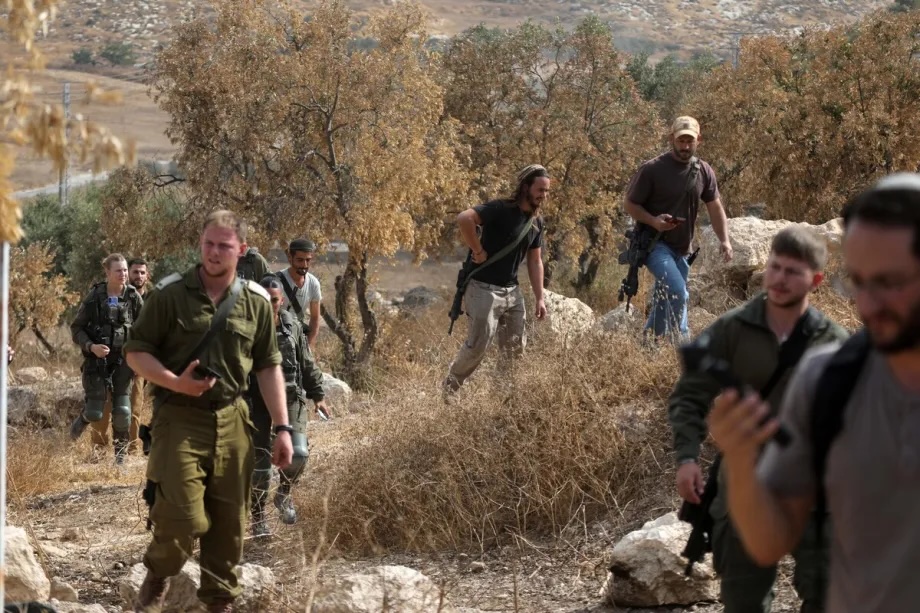
Violent (and illegal) Israeli settlers in West Bank are not content to attack only Palestinians ■ Gazans dread spending a 4th winter in displacement ■ NAZA documentary echoes 2023 film about Nazis ■ More.
With Israeli rabbi's blessing, settlers are stealing Palestinians' olive harvest; with IDF support, settlers are beating both Palestinians and int'l visitors. That's not all.
CLEVELAND — Every morning, Dwight Bullard pulls into the station selling the cheapest gas he can find and puts exactly $100 worth into the rented box truck he uses to haul tires around Northeast Ohio.
On the August morning MS NOW was riding with him, regular was $3.92 a gallon.
“There goes my $100,” he said, watching the pump click off. It didn’t even fill the tank. Six months earlier, the same day’s driving had cost him $60 or $70.
He did the math in the truck: Add in the $600 for the rental truck, and the weekly cost of doing what he describes as the best job he’s had is $1,100. Do that every week for a year, and it’s way more than what he is trying to save to buy a truck of his own.
Ask him who he blames for the high price of gas, and he doesn’t hesitate.
“Trump! I blame Trump, man,” he said. Then, a beat later: “Well, that’s what I hear. I ain’t really into politics, but I know it’s got something to do with the shit he’s doing over there.”
Dwight Bullard (right) delivering tires in Northeast Ohio in August 2026.
MS NOW walked him through the data: the war with Iran, the Strait of Hormuz, a fifth of the world’s oil, a global market that sets the price at a gas pump in Cleveland, his hometown.
Dwight is 34, with two daughters under 10. He drives the tire route until about 4 p.m., goes home to shower and on some days works a second job running food at a Mexican restaurant until 11 or midnight. And then he’s up at 5:30 in the morning to do it again.
One thing he has not done is connect his situation to the folks in elected office in his state or Washington, D.C. He’s also pretty sure he has only voted once in his life: in 2012, for Barack Obama. He did not vote in 2024.
“Most of the people I know, we ain’t really voting,” he said. “My homeboys, we just making shit happen. Living day to day.”
Does he regret sitting out the last presidential election? “Considering where we are now, hell yeah.”
MS NOW went to Cleveland to get some time with a group of voters whom both parties talk about constantly, but who almost nobody is spending a lot of time or money talking to: young Black men who have stopped voting, or never started.
One of the races that could decide control of the Senate is happening in Ohio, where Democratic former Sen. Sherrod Brown is trying to win back his old seat from Republican Jon Husted. The polling has shown the race consistently within a few points, and the math on who could decide it is not that complicated.
A voter-file analysis by HIT Strategies, a public opinion research firm, found more than 100,000 registered Black voters in Ohio who sat out the last three federal elections. The firm also found, through focus groups, that these voters were more open to being mobilized this year, pushed by the cost of living and souring views of President Donald Trump.
In June, the Ohio Legislative Black Caucus Foundation released a study with a finding that should stop Democrats cold: In the 2022 midterms, 603,000 eligible Black voters in Ohio didn’t cast a ballot. That is more than twice the margin by which JD Vance won his Senate seat that year.
Shayla L. Davis, who runs the foundation, said she was “heartbroken” when she got the findings back.
Shayla L. Davis, President and CEO of the Ohio Legislative Black Caucus Foundation.MS NOW
Sitting in the UnBar Cafe, a Black-owned coffee shop, she noted that in 2023, the Republican-controlled state passed one of the most restrictive voter ID laws in the country. Essentially, it’s a “use it or lose it” rule that strips people from the voter rolls for not voting. That, combined with the apathy she is seeing especially with young Black men, helps explain to Davis why what was once a swing state has so far failed to regain that status.
“My own son, he’s 28 years old. He stopped voting,” said Davis, formerly a state representative and city councilwoman in the Cleveland suburb of Garfield Heights. “He’s cynical. He doesn’t believe that anyone is standing up for what he believes. He believes that all the rhetoric is performative and that everyone is all the same. And that breaks my heart, but I can understand exactly where he’s coming from.”
Her son grew up in a house where his mother’s name was constantly on the ballot. She remembers the election night party she threw in 2008 and him running out of his bedroom, a kid full of joy that Obama had won. That’s the moment she keeps trying to get him to remember.
There’s been a lot of ink spilled about the gender divide in the Black community. Black women are more consistent voters, and more consistently punching their cards for Democrats. Those numbers aren’t actually that stark though: 92% of Black women voted for Harris in 2024 compared with 78% of Black men.
It’s the generational divide that is more worrying for people like Davis. Younger Black voters are just hitting the ballot box less compared with the generations before them.
Her concern is that there is just a lack of connective tissue to the days when Black people didn’t have the right to vote. Pair that with the lack of movement on issues young Black voters care about, and it’s a recipe for apathy.
“Older Black voters are going to show up and vote,” Davis said. “It’s a generational gap of what they actually experienced. My son never experienced any of [the Civil Rights Movement]. He only hears the stories and he’s hearing the stories third-party. He’s hearing it from me, who didn’t experience that either.”
There are groups trying to change that, like Cleveland VOTES, a nonpartisan civic organization that three years ago started a seasonal, part-time canvassing team it calls The Squad. There are just five of them, but last year they logged more than 114,000 contacts.
MS NOW walked with them on a Wednesday afternoon on the East Side, in a stretch of the city where co-founder Erika Anthony says turnout is lowest. They weren’t asking people who they were voting for. They were handing out flyers for “Carnivote,” an event with free food, backpacks for kids and a round of “Democracy Jeopardy.”
Erika Anthony, co-founder of Cleveland VOTES.MS NOW
Jerry Pena, who manages the group and is its only man, explained the strategy.
“You go to people’s doors, you quickly approach them with voting, the conversation shuts down,” he said. “It’s over because they’ve seen what their vote does, right? It’s disappointed them over and over again.
“The conversation needs to change more to ‘What do you want to see in the future in this neighborhood? How can we get there?’ But if you start with voting, done deal.”
Jerry Pena, a member of Cleveland VOTES, in August 2026.MS NOW
At 2 p.m. on a weekday, when door-knockers might expect to find retirees — older Black voters who may not need a ton of convincing — they kept running into young Black men.
Outside a convenience store, a 29-year-old who gave only his first name, Robert, said he hasn’t voted for anyone in years. “I just didn’t feel like nobody deserved it,” he said.
He added that nobody, not a Democrat or a Republican, knocked on his door in 2024. Then, unprompted, he started talking about policy. He’d recently been in jail, where “they treat you like animals,” and he couldn’t understand why people were still locked up on weed charges in a state where recreational possession was legal.
He had strong, specific views about the carceral system. He knew exactly what would make it better. Robert had just never connected those ideas to the people who decide what the laws actually look like.
When MS NOW described Robert to Anthony afterward, she said that is exactly why Cleveland VOTES started: She and her co-founder were working with people coming home from prison and kept hearing the same disconnect.
“We would say things like ‘Do you want to have the ability to influence who sits on the [judicial] bench?’” she said. “When we started painting the picture for folks, they’re like, ‘Oh, I have the ability to do that.’”
The biggest takeaway isn’t that these voters are tapped out — it’s that almost no one has even tried to tap them in. Every single Black man MS NOW met that day said some version of “No one has tried to convince me to vote.” Nobody is paying these men any attention.
“We as a country have gotten way too hyperfocused on the electoral cycle versus thinking about the holistic nature of community building,” Anthony said. “There are policy decisions being made every day, locally, countywide, statewide and at the federal level. And if we’re only talking to folks two weeks, three weeks before an election and just expecting them to magically open their eyes and see why this is valuable to them. [By] then, we’ve already missed the boat.”
Which raises the question of who exactly is asking. Davis said that since her foundation’s report came out on Juneteenth, one federal official’s office has reached out. Neither Senate campaign had called.
“They don’t have to call me,” Davis said. ”Just pick the report up and do something about it.”
Brown’s campaign says it is doing that. According to a campaign aide, Brown started his outreach earlier than any of his other campaigns ever had. He has met with Black faith leaders in Ohio cities since last fall, held roundtables with Black men, hosted “pledge to vote” events with Divine Nine organizations and spent $250,000 on ads airing on radio stations with predominantly Black audiences.
Husted’s campaign initially agreed to meet with MS NOW for this story, then canceled due to a scheduling conflict and did not immediately respond to emailed questions about what efforts his team has made to reach out to Black voters.
MS NOW sat down with Dwight, the tire and restaurant hustler, and his mother, Kari Jones, who is the kind of voter campaigns dream about. She passed out flyers for a city council candidate at 10 years old. Her neighbors call her for political advice. Her mother and daughter call her from the voting booth to ask who they should pick.
She has made sure that Dwight has stayed registered for years. She has not been able to persuade him to do anything with that registration since 2012.
Kari Jones and Dwight Bullard in August 2026.MS NOW
What changed for Dwight between 2012, when he said casting a ballot for Obama “felt like I did something,” and now?
“I guess I never really saw a change,” he said. “I never really seen what it did firsthand to people, so I just never really cared to vote. Like, it is what it is. They’re going to do what they’re going to do.”
Thinking on it, he realized he and his friends do actually talk about politics. All the time. “We sit [in the barbershop] and talk about the rent, the streets, that big-ass pothole on Dunham. We talk about that but we don’t talk about the source of the problem.”
Something had clearly shifted. After that morning truck run, Dwight went back to the shop and a co-worker asked what the MS NOW cameras were there for. He explained, then asked whether his friend voted. Not really, the co-worker said, but he did vote in local elections.
“I’m like, ‘Damn, he’s my age,’” Dwight said, adding: “When it comes to anything else, talking Marvel movies, music, we can relate. So when I heard him say that, I’m like — makes sense.”
Jones had been waiting for this. For her son to make these connections.
There’s a tree in her yard that Dwight spent a year telling her to get the city to cut down, afraid it would fall on her house, or her car or one of his kids. The city finally came to do it that morning.
“Who did you think was going to do it?” she asked.
“The city.”
“And who’s the city?”
The light bulb went off. Dwight was realizing that who is in office can actually make differences big or small to his and his family’s life. Not voting, he said, was “like a video game where you [are] not using the power-ups.”
She asked him if this had really changed his mind and if he would vote in November. “Yes, with you. And I’ll get the sticker,” he said.
I asked Jones what she would say to a politician who sat across from her and claimed they couldn’t figure out why young Black men in her state didn’t vote.
“Find out what’s important to them. Find out what’s affecting them. Find out what their knowledge is about politics. Because that’s the problem. They really just don’t know,” she said.
It’s just one potential voter, but it took less than a day. Nobody in politics had to do anything expensive to move Dwight Bullard.
It took a guy at work who likes the same movies, a tree in his mother’s yard and a reporter explaining how a strait on the other side of the world affected the price of gas in Ohio.
In a state where 603,000 Black voters stayed home last midterm, hardly anyone has been knocking on the door.
CORRECTION (Oct. 17, 2026, 10:30 a.m. ET): A previous version of this article listed the wrong city in which Shayla Davis served as a councilwoman. It was Garfield Heights, not Cleveland.
 Login