❌

Reading view

Germany Drops Boeing MQ-28 Ghost Bat Rapid Procurement Plan

Germany appears to have dropped plans to directly procure the larger, Block 3 version of Boeing’s MQ-28 Ghost Bat collaborative combat aircraft (CCA), leaving doubts over Berlin’s ambitions to field uncrewed combat aircraft alongside its crewed fighters before the end of the decade.

Boeing confirmed to Breaking Defense that Germany’s Ministry of Defense had informed the company it would not proceed with a direct acquisition of the drone, which had previously been lined up. The decision, first reported by Politico, represents a setback for Boeing’s effort to position the Ghost Bat as a candidate for Berlin’s planned CCA capability, something that had seen it announce a partnership with Rheinmetall, the largest arms manufacturer in Germany, earlier this year.

🔴 NEW: Germany has formally scrapped plans to buy the Ghost Bat combat drones directly from Australia, documents show.

Its air force wanted them by 2029. Now it faces a longer wait.

Behind the decision is a much bigger political dilemma facing Germany as it races to rearm. 🧵 pic.twitter.com/2fWHPoQOl0

— Chris Lunday (@lundayfunday) October 15, 2026

“With Boeing Defense Australia as a partner, we are laying the groundwork to optimally tailor the MQ-28 to the Bundeswehr’s requirements,” said Armin Papperger, CEO of Rheinmetall AG, in March of this year. “As a system integrator, we ensure that integration, operation, and further development come from a single source while simultaneously strengthening industrial value creation in the form of an industrial hub in Germany and Europe. We see revenue potential for Rheinmetall in the range of three-digit millions of euros.”

#Rheinmetall and #Boeing partner on German MQ-28 #Ghost #Bat
https://t.co/zGEhjQNqqi pic.twitter.com/VLBDQ8EAaV

— Rheinmetall (@RheinmetallAG) March 31, 2026

The move does not necessarily mean the MQ-28 is out of contention for Germany’s wider program. Instead, Berlin appears set to move toward a different acquisition approach, with competing designs potentially having an opportunity to demonstrate their capabilities before a selection is made.

A Boeing spokesperson told Breaking Defense the company “stands ready to support” its German customer on the next steps, while referring questions about the decision to the German Ministry of Defense.
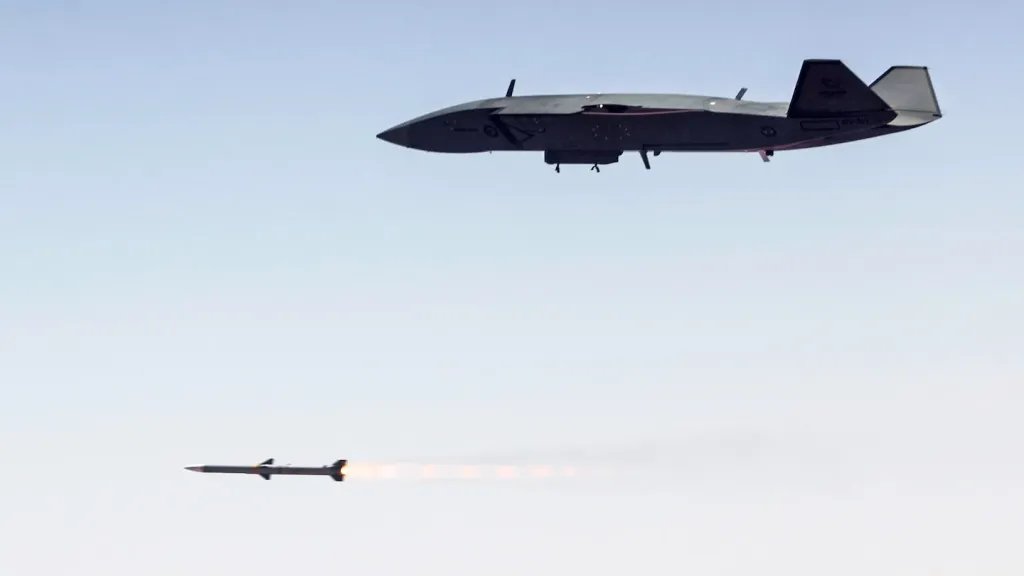
An AIM-120 is launched from an MQ-28A Ghost Bat during Trial Kareela at RAAF Base Woomera, South Australia. Australian Department of Defense

The ministry declined to discuss the specific procurement with the same outlet, citing regulations governing public contracting and the need for such matters to be addressed by parliament.

“[As a] matter of principle — and regardless of the specific case in question — we cannot provide information regarding potential procurement projects,” a ministry spokesperson told Breaking Defense.

Germany has set an ambitious goal of fielding CCAs by 2029. These uncrewed aircraft are intended to operate alongside crewed fighters such as the Eurofighter, extending their reach, adding sensors and weapons, and giving air forces additional options for conducting high-risk missions.
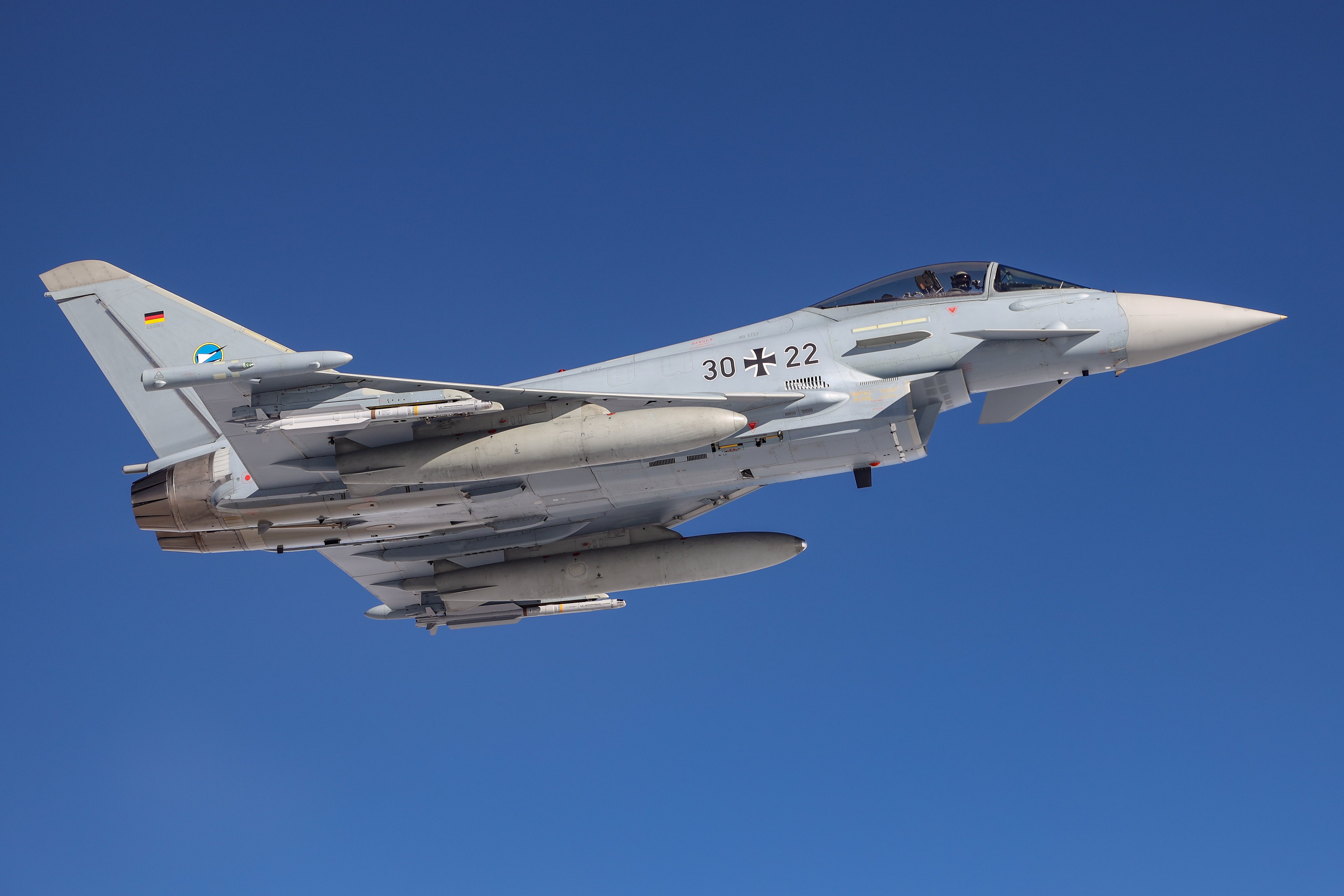
Ein Eurofighter vom Taktischen Luftwaffengeschwader 74 aus Neuburg an der Donau fliegt bei einem Übungseinsatz als Quick Reaction Alert (QRA) über dem Südosten Deutschlands, am 02.03.2022. ©Bundeswehr/Christian Timmig
A German Eurofighter flies a Quick Reaction Alert (QRA) practice sortie over the southeast of the country. Bundeswehr/Christian Timmig

However, the reported change in Berlin’s acquisition plans raises questions about whether that deadline remains achievable.

According to Politico, Germany is now looking toward the early 2030s for the capability to arrive, with flight testing expected to begin in 2027. That would suggest the original target was based around the introduction of the MQ-28, which has already undergone extensive testing, rather than a newer design. The reshuffle could now give prospective suppliers additional time to demonstrate their designs.

The reported new timeline suggests that Germany’s CCA effort could be entering a more competitive and potentially longer development phase.

There is also a question about the degree of operational capability that will initially be fielded by the given date. Getting a CCA into meaningful frontline service is a very significant task, calling for integration with crewed fighters, communications systems, mission-planning networks, weapons, and sensors. Then there is also testing, certification, training, and the establishment of supporting infrastructure. For Germany in particular, getting a military drone, let alone an armed one, cleared to operate routinely in commercial airspace has long been an issue.

If Germany acquired the Ghost Bat directly, it would have offered a route to a CCA capability without having to begin an entirely new aircraft development effort.

However, the MQ-28 was always one of a larger field of candidate aircraft.

A week ago, Airbus and Kratos Defense & Security Solutions announced the first flight of their U740 Valkyrie uncrewed combat aircraft, a Europeanized version of the XQ-58A Valkyrie. Airbus is simultaneously working on its larger U760 Ravenstorm, intended for service in the early 2030s, and the company has previously pitched a stealthy CCA-like concept known as Wingman.

The ride of the Valkyrie ⚔
With the successful first flight of the Airbus U740 Valkyrie in Europe, we are one step closer to introducing an operational uncrewed Collaborative Combat Aircraft (CCA) to the German and other European Armed Forces.
The flight achieved all… pic.twitter.com/S2sFrtdmGA

— Airbus Defence (@AirbusDefence) October 12, 2026

Other entrants include Anduril, General Atomics partnered with Germany’s INTEC, as well as Lockheed Martin. Meanwhile, Helsing and Hensoldt are pursuing the homegrown CA-1 Europa, very much an MQ-28 lookalike.
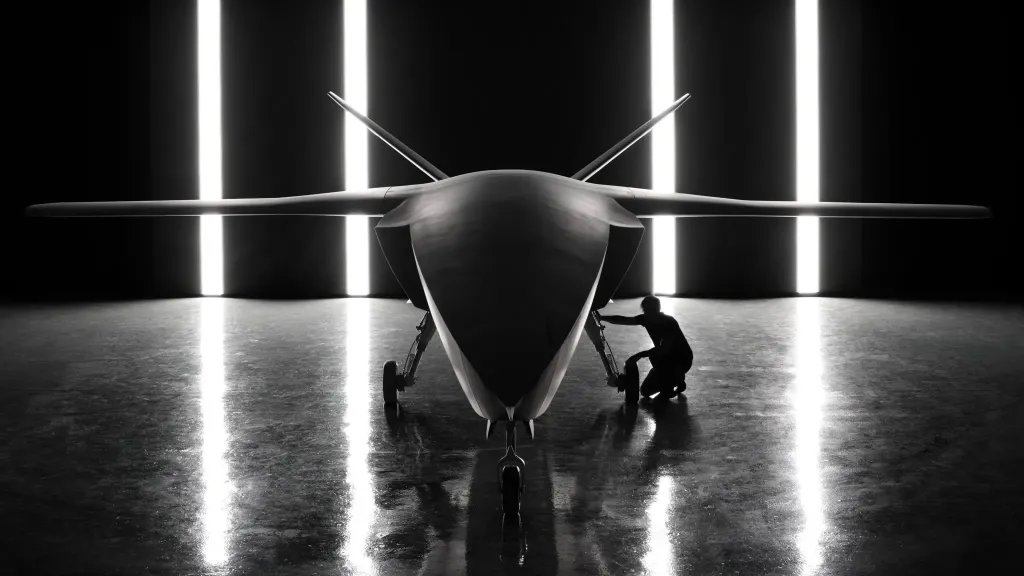
The CA-1 Europa from the German defense startup Helsing. Helsing

Germany may not be looking for a single drone to do everything, a point we have discussed in the past:

“One option might be a split high-low approach that could pair more capable, longer-range systems for deep-strike missions with cheaper, attritable collaborative combat aircraft that can fly alongside crewed fighters. At this point, it should also be noted that CCAs could also give older fourth-generation fighters a new lease on life, boosting their lethality and survivability by extending their sensor reach, adding weapons capacity, and allowing uncrewed aircraft to take on more dangerous tasks.”

At the same time, Germany continues to define its requirements for a capability described in media reports as a Jagdbomberdrohne, or fighter-bomber drone. Berlin has yet to publicly clarify its intended concept of CCA operations, including whether the Luftwaffe envisions an uncrewed wingman operating alongside crewed fighters, a platform capable of carrying out long-range strike missions independently, or a system designed to perform both roles.

There are signs that the strike mission is being prioritized, at least initially, with a reduced emphasis on air-to-air missions. This is essentially the reverse of the U.S. Air Force’s CCA effort.

Since Germany is set to receive the F-35 stealth fighter, there is also an argument that Berlin could place more orders for the crewed jet. This could have the dual role of filling the gap left by the collapse of the pan-European Future Combat Air System (FCAS), specifically its sixth-generation crewed fighter, and the delayed introduction of the first operational CCAs. Germany is also looking forward to receiving more Eurofighters.
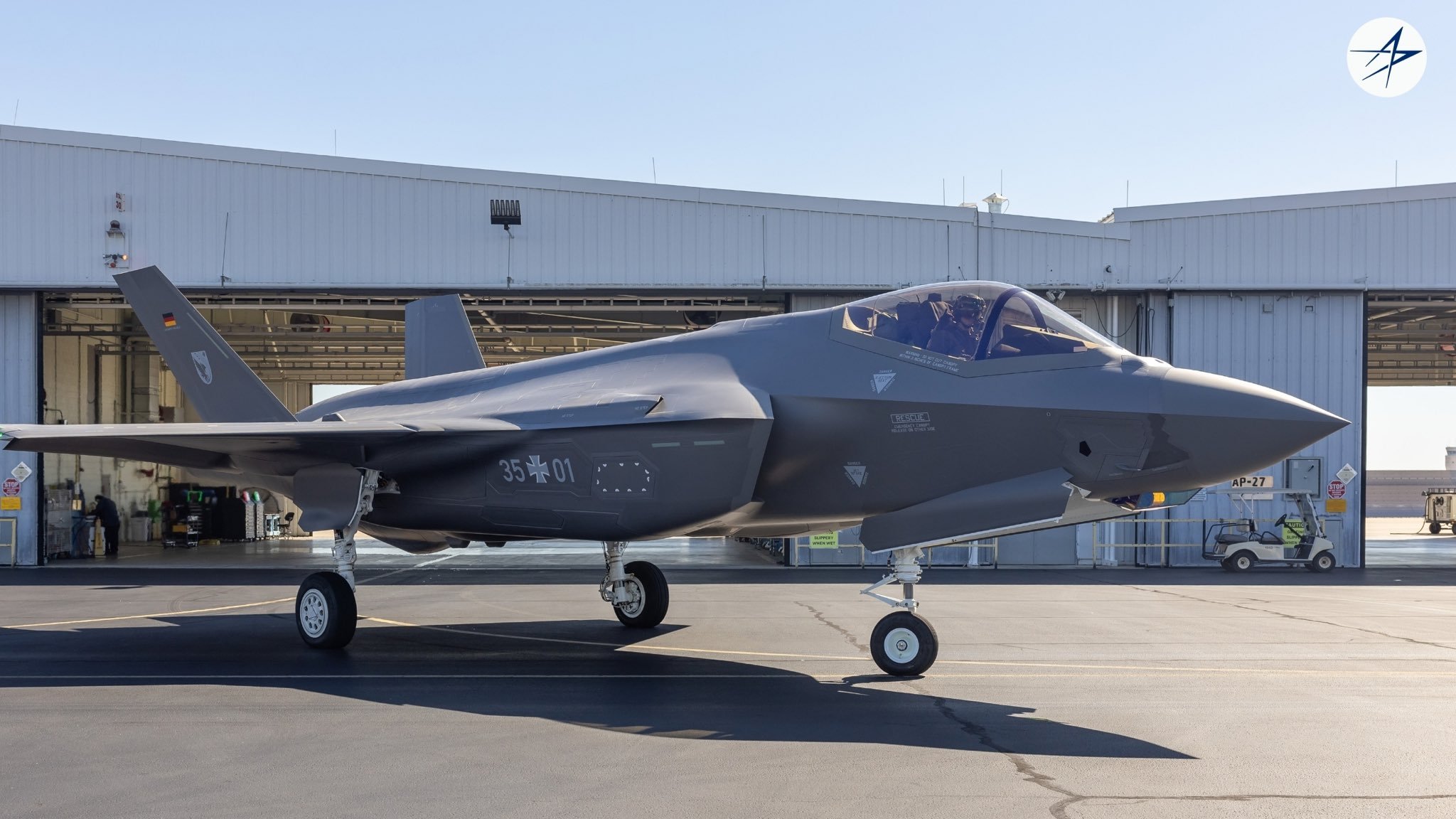
Germany’s first F-35A arrived at Ebbing Air National Guard Base in Arkansas earlier this month, where it will be used for training. Lockheed Martin

Germany’s evolving CCA plans form part of a broader effort by Western air forces to develop uncrewed aircraft capable of working alongside advanced fighters. These systems are intended to expand the number of available platforms, distribute sensors and weapons across a larger force, and potentially take on missions that would otherwise expose pilots and expensive crewed aircraft to greater risk.

Boeing’s Ghost Bat could still have an opportunity to compete, depending on the structure of the eventual acquisition process and the requirements Berlin establishes.

However, with testing reportedly planned from 2027 and operational fielding potentially slipping into the early 2030s, the original 2029 ambition for an operational German CCA appears increasingly uncertain.

Contact the author: thomas@thewarzone.com

The post Germany Drops Boeing MQ-28 Ghost Bat Rapid Procurement Plan appeared first on TWZ.
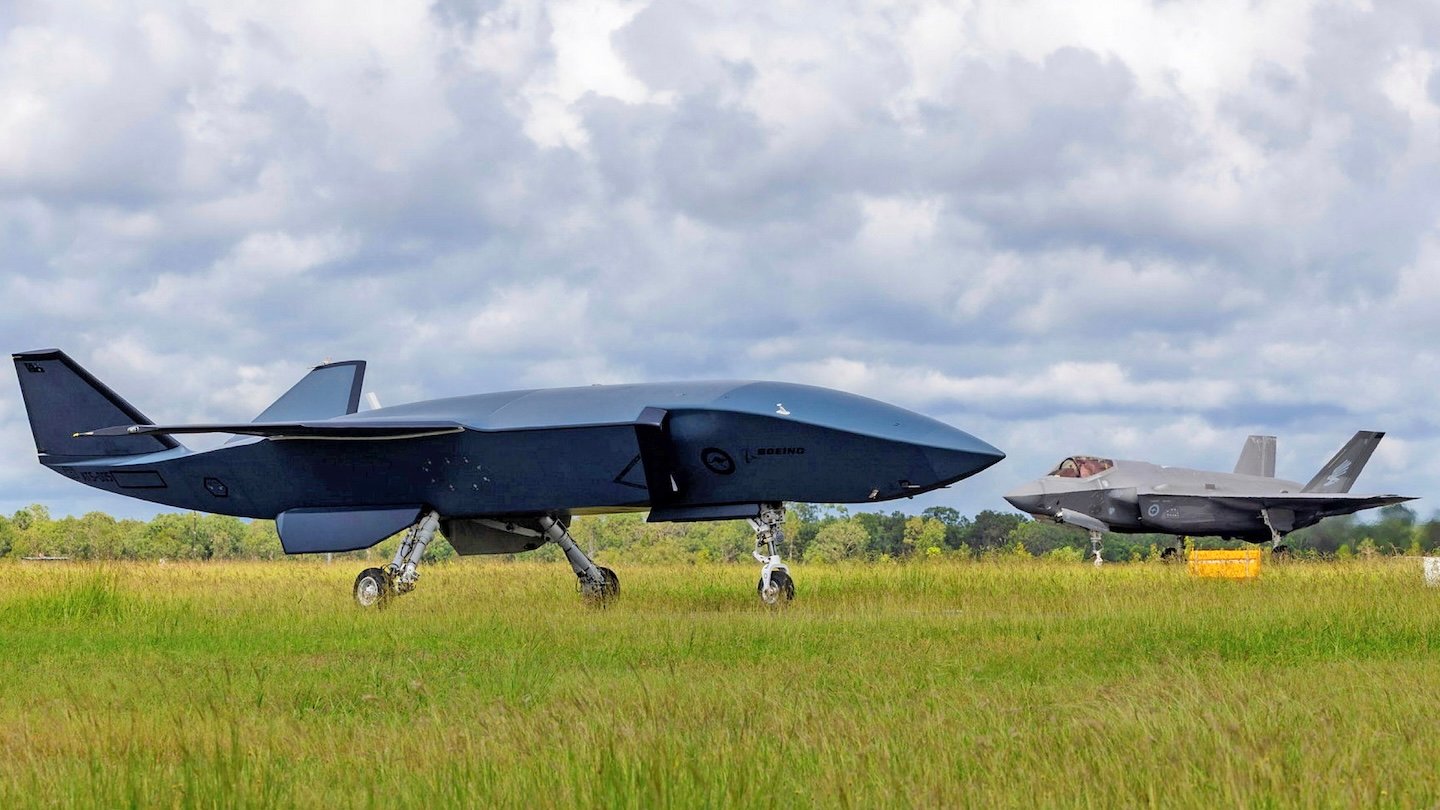
  •  

Voli low cost a rischio nel 2027, Ryanair avverte: in arrivo aumenti fino al 20%

L’era dei voli low cost potrebbe essere finita. Nel 2027 le tariffe aeree in Europa potrebbero registrare rincari record fino al 20%, mettendo a segno uno degli aumenti più marcati della loro storia recente.

A lanciare l’allarme è Michael O’Leary, ceo di Ryanair, secondo cui le tensioni geopolitiche in Medio Oriente e il conseguente caro-petrolio rischiano di travolgere i margini operativi di tutto il comparto.

Le dichiarazioni del ceo di Ryanair

Nel corso di una conferenza stampa tenutasi a Bruxelles nella giornata di oggi, il numero uno del primo vettore low cost europeo ha tracciato uno scenario di forte rincaro per i prossimi dodici mesi:

vedremo, a mio avviso, il più grande aumento delle tariffe aeree mai registrato in Europa

ha dichiarato O’Leary, sottolineando come neanche un incremento così marcato dei prezzi dei biglietti e degli eventuali supplementi carburante possa bastare a compensare la violenta impennata dei costi energetici.

Perché le compagnie aeree low cost rischiano perdite

Il fattore di maggiore vulnerabilità per le compagnie risiede nella gestione delle coperture finanziarie contro le oscillazioni del carburante. Ryanair e tutti gli altri vettori europei che finora hanno permesso a una generazione intera di volare a prezzi contenuti si trovano ad affrontare questo periodo ampiamente scoperti rispetto al rincaro del greggio.

O’Leary ha spiegato che Ryanair è coperta soltanto per il 15% del fabbisogno del prossimo anno. Questo significa che l‘85% del carburante necessario per garantire il servizio resta esposto alle oscillazioni del mercato.

A complicare il quadro c’è anche il cambio delle abitudini dei viaggiatori, che tendono a posticipare sempre di più l’acquisto dei biglietti, rendendo complessa e imprevedibile la pianificazione operativa dei voli.

La combinazione tra caro-carburante e pressione fiscale porterà il vettore a ridurre la propria presenza in Francia e Belgio in risposta all’aumento delle imposte locali, mentre sul fronte industriale si attende per gennaio la consegna del primo Boeing 737 Max 10 (con altri 16 aeromobili previsti entro aprile) per cercare di efficientare i consumi.

Il tramonto del low cost

I titoli del settore riflettono già la gravità della crisi: Ryanair ha ceduto fino al 2,1% in borsa, con una flessione del 25% da inizio anno che rischia di rendere il 2026 l’anno peggiore per il titolo dal 2018.

Secondo O’Leary, questa morsa tra caro-petrolio, fisco e vincoli operativi ridisegnerà il mercato, spingendo fuori le compagnie più fragili.

Il settore mostra già i primi segnali di riassestamento. Vettori come Air Baltic e la spagnola Volotea sono impegnati in complessi processi di ristrutturazione aziendale. Lufthansa ha superato Air France-Klm nell’acquisizione di una quota della portoghese Tap, mentre il fondo Apollo Global Management valuta il rilevamento di EasyJet.

  •  

European air fares could rise by as much as 20% in 2027, Ryanair boss predicts

Conflict in Middle East is pushing jet fuel costs higher and many carriers are not hedged against such increases, Michael O’Leary says

Ryanair’s chief executive has predicted a record increase in European air fares next year, as airlines grapple with fuel bills pushed higher by the Middle East conflict.

Many carriers are not hedged against rising jet fuel costs, Michael O’Leary said, which he predicted would lead to airline bankruptcies and takeovers. He forecast these pressures would result in the price of plane tickets rising by as much as 20%.

Continue reading...

© Photograph: Alexandros Avramidis/Reuters

© Photograph: Alexandros Avramidis/Reuters

© Photograph: Alexandros Avramidis/Reuters

  •  

“Una donna non si realizza solo se fa dei figli, è una mentalità bigotta. C’è chi ha un altro tipo di realizzazione in testa”: parla Sofia Goggia

Idee chiare e nessun giro di parole. Per Sofia Goggi – sciatrice che sta recuperando dagli ultimi problemi fisici – sposarsi e avere figli non sono passaggi obbligati per sentirsi realizzati nella vita. “È una mentalità bigotta. La realizzazione delle persone passa per quello che vogliono ottenere nella propria esistenza. Ci sono donne che vogliono diventare mamme, che giocano con la famiglia delle Barbie fin da bambine, con il vestito da sposa, e ci sono magari donne che hanno un altro tipo di realizzazione in testa. Quello che è giusto per me non è detto che sia giusto anche per gli altri“. Nel suo caso, la carriera sugli sci ha sempre avuto un ruolo centrale, lasciando poco spazio alle pressioni esterne e alle aspettative legate alla vita privata. “No, perché ero invasata con lo sci. E penso che mi abbia anche aiutata a non mettermi nei casini, visto il mio animo un po’ frizzante”, ha spiegato Goggia nel corso di un’intervista a Vanity Fair.

Oggi Goggia si trova in una fase diversa della sua vita, con la consapevolezza di avere meno anni di carriera davanti rispetto a quelli già vissuti. “Penso di essere in una fase dove ho molti meno anni di carriera davanti rispetto a quelli che ho alle spalle. Penso di non essere più una ragazzina ma di essere diventata più donna, e penso di essere a un punto della mia vita dove guardo con fierezza quello che ho fatto fino ad ora e dove so di poter vivere con leggerezza ancora qualche anno sugli sci, fisico permettendo. Penso, poi, di avere la serenità necessaria per affrontare qualsiasi cosa mi accadrà”. Una serenità che considera una conquista, anche se non sempre è facile mantenerla. “Sì, è una bella conquista. A volte lo sono, a volte meno, però è normale. Tirando le fila, diciamo che è così”.

La sua storia sportiva è iniziata quando era ancora una bambina. A soli nove anni, infatti, aveva già scritto in un tema scolastico quello che sarebbe diventato il suo grande obiettivo. “A nove anni avevo fatto un tema a scuola scrivendo: voglio vincere le Olimpiadi di discesa libera. A venticinque anni, l’ho fatto“. Per raggiungere quel traguardo, Goggia ha vissuto un’adolescenza diversa da quella di molti coetanei, fatta di allenamenti, gare e sacrifici. “Non ho vissuto la mia adolescenza nel senso classico in virtù della scelta che ho fatto: non ho mai vissuto quella fase in cui crei un tessuto sociale, vivi una vita più normale. Ero, però, contenta di leggere un libro la sera e di andare a letto presto perché la domenica mi dovevo alzare per andare a fare la gara”.

Una crescita precoce, che l’ha portata a essere molto seria fin da giovanissima. “A volte mi dico che ero più seria quando avevo quattordici anni di quanto non sia adesso, a trent’anni passati: però l’ho vissuta con serenità, perché è sempre stata la mia passione e ho avuto il privilegio di trasformarla nel mio lavoro. Forse però sì, ci sono delle cose che non ho vissuto, come probabilmente non avrei vissuto questa vita sugli sci se avessi inseguito quelle altre cose”.

Nel corso degli anni, l’indipendenza è diventata un aspetto fondamentale del suo carattere. Goggia ha sempre cercato di cavarsela da sola, senza pesare sugli altri, anche se con il tempo ha imparato a essere più flessibile. “Ultimamente, con l’età, sono diventata più malleabile. Sono sempre stata molto indipendente: da quando sono diventata maggiorenne non ho più chiesto un centesimo ai miei genitori. Ho sempre tenuto molto alla mia indipendenza per non gravare sugli altri”.

L'articolo “Una donna non si realizza solo se fa dei figli, è una mentalità bigotta. C’è chi ha un altro tipo di realizzazione in testa”: parla Sofia Goggia proviene da Il Fatto Quotidiano.

  •  

Preços dos bilhetes de avião vão "subir significativamente"

Michael O'Leary, presidente executivo da transportadora aérea Ryanair, antecipa que devido ao aumento dos preços do petróleo e aos impostos europeus voar irá tornar-se muito mais caro em 2027.

© TOMS KALNINS/EPA

"Não há dúvida de que as passagens aéreas irão aumentar significativamente em 2027", afirmou Michael O'Leary.
  •  

Army’s Plan To Launch Hundreds Of Balloons Into Enemy Territory If A Future Conflict Breaks Out

As he prepares for a potential future conflict on the continent, the commanding general of Multi-Domain Command Europe told TWZ that he envisions dispersing hundreds of high-altitude balloons at a time. The balloons, Brig. Gen. Steven Carpenter explained, would be used for a wide range of purposes, from serving as communications platforms to launching weapons. For years now, TWZ has been closely tracking the expanding use of high-altitude balloons and other lighter-than-air systems globally for intelligence gathering, networking, as platforms for launching drones, and in support of other missions.

Basically, in the European scenario, hundreds or possibly thousands of balloons would be sent east. They would provide attritable real-time reconnaissance, strike, and decoy capabilities, while also acting as a force multiplier for other assets by providing a resilient active network over the battlefield — one that could help fill in the gaps if the space-based layer gets degraded.

“We would like to proliferate the stratosphere with high-altitude balloons, but I mean 200, 300 at a time,” Carpenter told us during last week’s Association of the U.S. Army (AUSA) conference in Washington, D.C., which TWZ attended. The Army would utilize high-altitude balloons “not only as decoys, a lot of decoys, but also communications retrans[mission platforms], electronic sensing, as well as electronic attack, and then obviously air-launched effects to be able to drop them down and use kinetic means as well.”

The head of the U.S. Army Space and Missile Defense Command (SMDC) was initially skeptical about the utility of high-altitude balloons, but now sees them as a "game-changing" capability.
A sensor-laden high-altitude balloon from Aerostar seen lifting off from Won Pat International Airport on Guam during an exercise in 2024. US Army

Air-launched effects (ALEs) is a collective term the U.S. military now commonly uses to discuss air-launched drones configured for a wide array of missions. The ALE umbrella encompasses designs that can be used for surveillance and reconnaissance, electronic warfare tasks, or signal relay, and can act as decoys. It also includes loitering munitions often referred to as kamikaze drones, capable of carrying kinetic attacks.

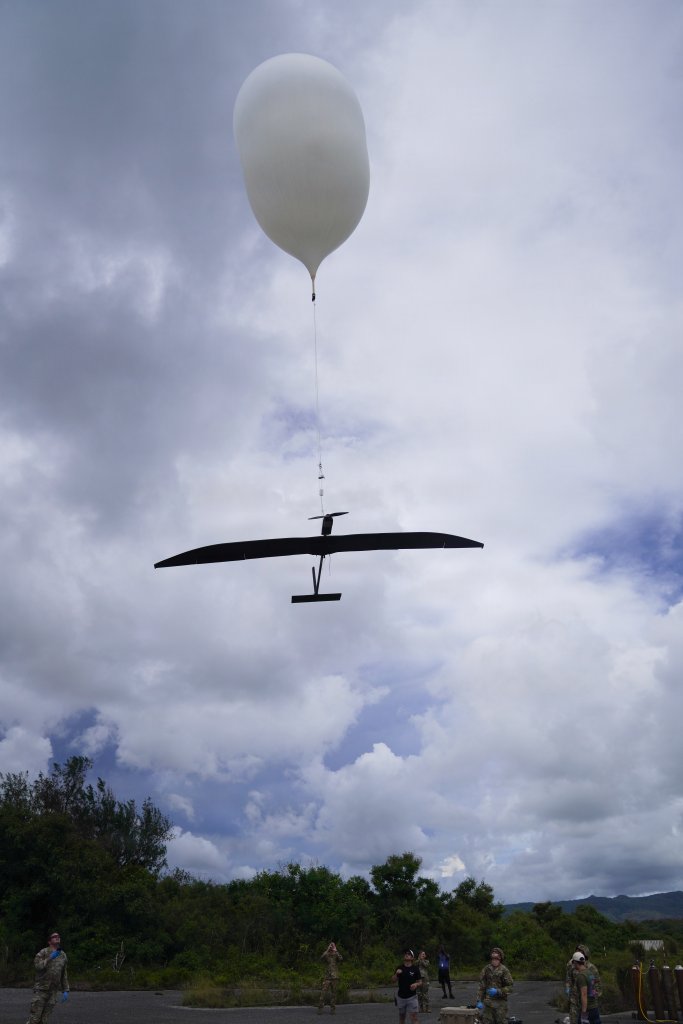
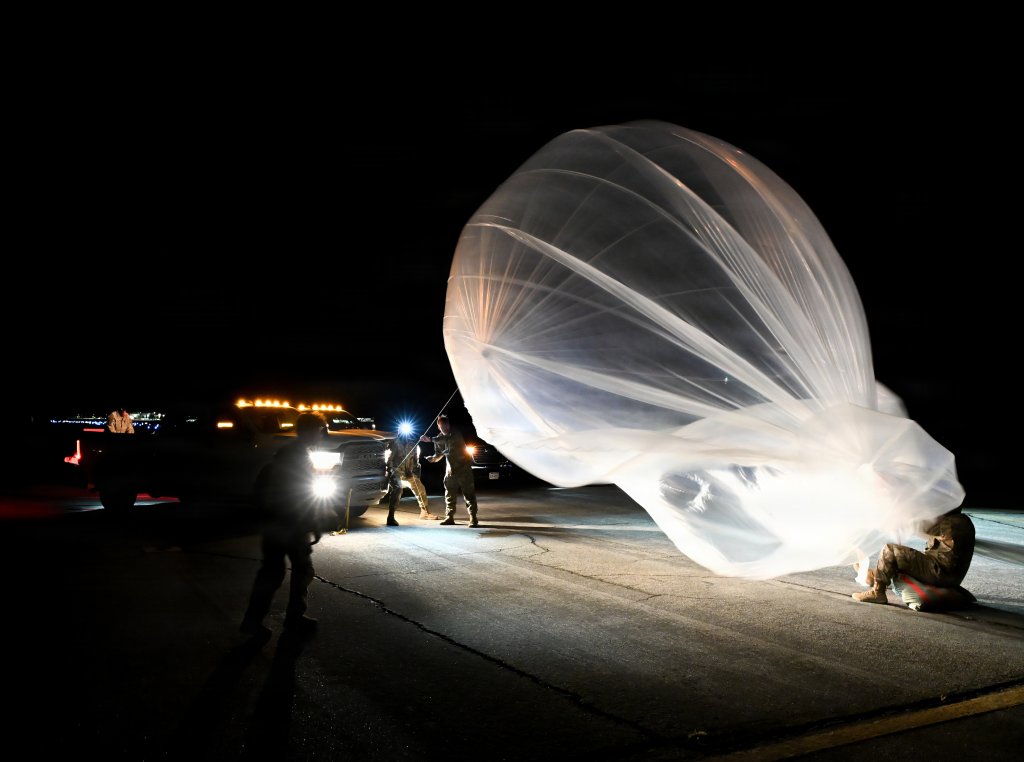
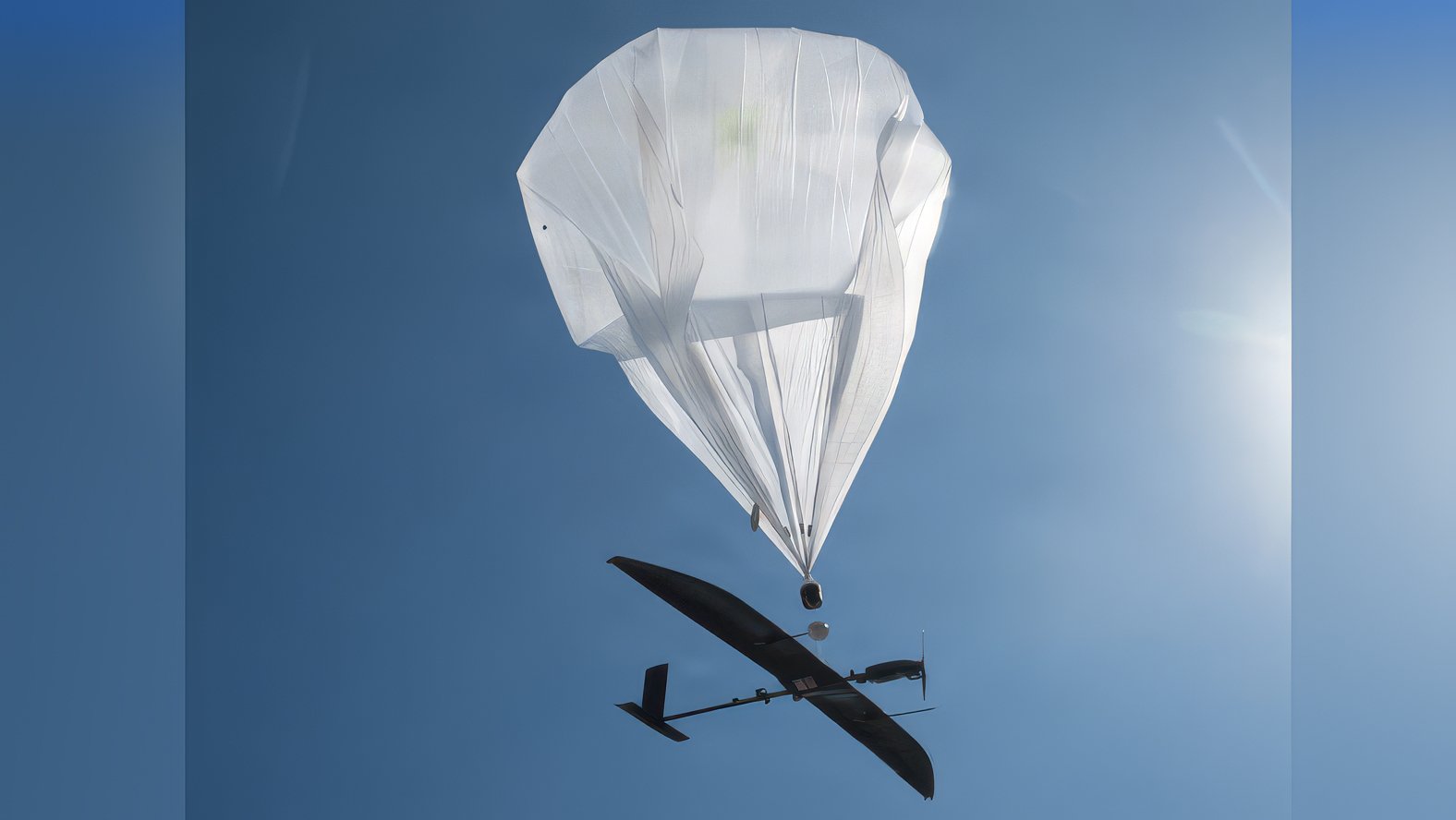
U.S. Army Soldiers assigned to the Extended Range Sensing and Effects Company, 3d Multi-Domain Effects Battalion, 3d Multi-Domain Task Force, and industry partners attach an Icarus Apollo R stratospheric fixed wing aircraft to an Urban Sky high-altitude balloon during a multi-day Special User Demonstration at Orote Airfield on Naval Station Guam, June 24, 2026, for Valiant Shield 26. The joint team conducted the pre-launch configuration to test stratospheric sensor capabilities and joint extended communication networks, directly advancing our capacity to develop and validate Combined Joint All-Domain Command and Control concepts forward in the theater. This staging operation was conducted in support of Valiant Shield 2026. Exercises like Valiant Shield allow Pacific Command Joint Forces the opportunity to integrate forces from all branches of service and with our allies to conduct precise, lethal, and overwhelming multi-axis, multi-domain effects that demonstrate the strength and versatility of the joint force and our commitment to a free and open Indo-Pacific. (U.S. Army photo by Sgt. 1st Class Ondirae Hamil Abdullah-Robinson)
U.S. Army soldiers assigned to the Extended Range Sensing and Effects Company, 3d Multi-Domain Effects Battalion, 3d Multi-Domain Task Force, and industry partners attach an Icarus Apollo R stratospheric fixed wing aircraft to an Urban Sky high-altitude balloon during a multi-day Special User Demonstration at Orote Airfield on Naval Station Guam, June 24, 2026, for Valiant Shield 26. (U.S. Army photo by Sgt. 1st Class Ondirae Hamil Abdullah-Robinson) Sgt. 1st Class Ondirae Abdullah-Robinson

In general, modern high-altitude balloons offer persistent deployment that can last for days, weeks or even months at a time. After navigating to an assigned operating area, some modern balloon systems can hold their position, in spite of prevailing winds, by modulating their altitudes to keep on station.

In addition, high-altitude balloons operate at heights providing excellent fields of view for radars, cameras, and other sensors in all directions and across very broad areas. From a perch of 60,000 feet or more, they also offer a way to peer into certain denied areas while still soaring in international airspace and keeping farther away from potential threats. During a conflict, the balloons could be deployed deep into enemy airspace as they are attritable.

Though some balloon systems can hold their general positions in many circumstances, Carpenter told us that seasonal weather changes will still play a role in deployment.

“The flight paths are different. We study that,” he noted. “We understand during what seasons where the best places are to launch those high-altitude systems, and then again to hold enemy cities and capabilities at risk at any time, so that we can defeat them at the time and place of our choosing.”

We asked Carpenter for more details about how he sees balloons being used by troops in Europe.

“I think everybody knows there’ll be a point where satellite communications are going to be degraded, if not eliminated,” he stated. “One of the things that we’re focusing on is in the stratosphere, so above 60,000 feet up to 80,000 feet, which is next to impossible to target unless you’re using one of your exquisite systems, fifth-gen fighters, SA-21 Bravo [S-400 Triumf surface-to-air missile system], etc. to shoot that stuff down.”

Many of the balloons would be equipped with Link 16, a NATO-standard tactical datalink communication system central to U.S. and allied military operations, the general said. Link 16 allows coalition forces to seamlessly transmit and exchange real-time situational awareness data. You can read more about how Link 16 works, and its increasing dependence of space, in our story here.

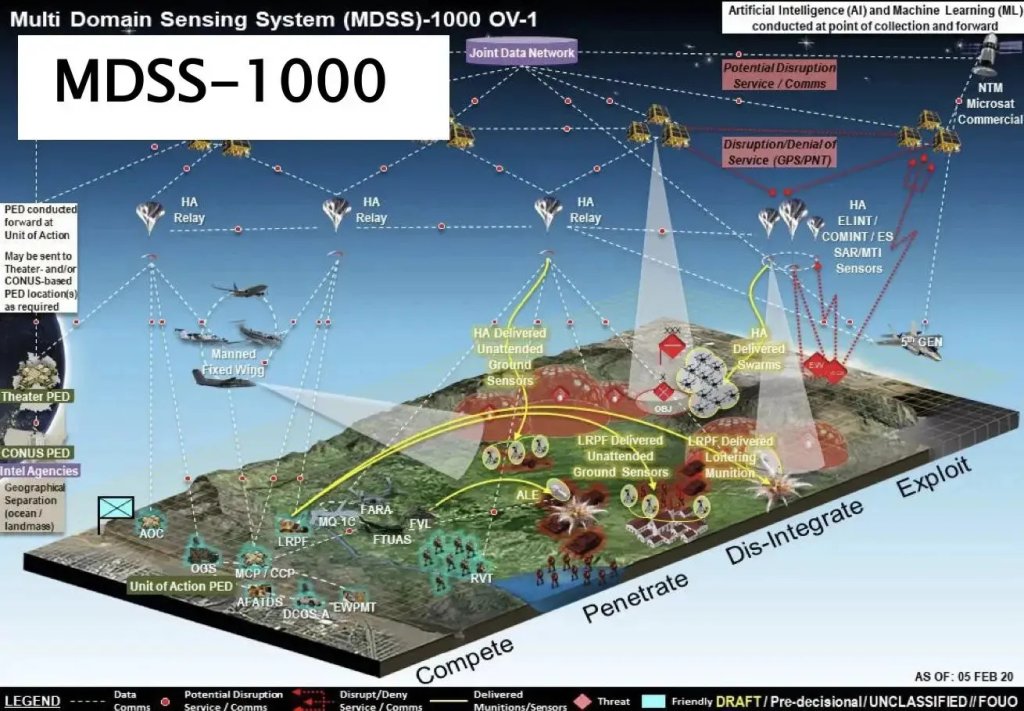
A graphic the Army previously released showing a notional “operational view” for how its planned the Multi-Domain Sensing System (MDSS) system of systems, including crewed ISR aircraft, might be employed in conjunction with other assets. (U.S. Army)

As for using balloons as ALE delivery platforms, Carpenter told us there are “different technologies, different altitudes that we’d have to deliver those from” at “different ranges, different levels of yield or lethality. But for us, it’s really just a single arrow in a quiver full of arrows, utilizing space capabilities, cyber capabilities, or surface-to-surface capabilities. In this case, you’re talking just another air-to-surface capability with your air-launched effects off balloons.”

Carpenter said that when it comes to balloon-launched ALEs, he is looking at “everything from shorter range, lower yield, maybe targeting an adversary ballistic missile radar, to longer range, higher yield capabilities that you might use to maybe take out a ballistic missile system.”

In such cases, the balloons would carry drones deep into enemy territory, where they would be launched opportunistically to strike the targets Carpenter suggested. The size of the target, and how well it is protected, would determine what kinds of drones the balloons would launch, as well as their proximity to the target.

Russian air defense systems like these S-400 launchers could be targeted by balloon-launched weapons, an Army general told us. (Sergei Malgavko / TASS)

Should a fight break out in Europe tonight, Carpenter said he is confident he can rely on the technology.

“Our operating concept is proven,” he stated, noting that “we’ve already tested those capabilities against most modern adversary systems that exist. We’ve already validated our operating concept in terms of getting to mass and scale that we would need in large-scale conflict.”

As we have previously reported, while high-altitude balloons have been used for decades, the modern concept of these systems was recently employed operationally by the U.S. in a combat theater.

The Army had planned to demonstrate the ability of balloons to operate in swarms with a high degree of autonomy in the Pacific region last year before those assets were redirected to the Middle East. When exactly that deployment occurred and how long it lasted are unclear.

“We were asked to pivot and do some experimentation in combination with operations, and we pivoted and supported operations in CENTCOM [U.S. Central Command],” Andrew Evans, Director of Strategy and Transformation with the Office of the Deputy Chief of Staff of the Army, or G-2, told Breaking Defense, according to a story the outlet published last week. “They were effective for the mission that they were assigned,” he added. However, Evans was not able to disclose the exact location and operational scenarios in which they were used.

Other countries, including U.S. allies and partners, are increasingly fielding balloon-based and other lighter-than-air systems, too. Ukrainian forces notably have been using balloons to conduct kinetic attacks and launch drones against Russian assets. On the other side of that conflict, the Russians have used balloons as decoys to confuse and misdirect air defenses.

The following video shows Ukrainian forces using balloons to launch kamikaze drones.

American-made Hornet middle-range strike UAV being tested with balloon-assisted launch system.

Such resolution allows to drastically increase its original range (approx. 100km).

Hornet OWA-UAVs are actively employed by Ukrainian forces for strikes on Russian logistics and other… pic.twitter.com/S1bHqLNhPY

— Status-6 (@Archer83Able) May 20, 2026

To achieve the effects he laid out, Carpenter told us that he will still need to surge capacity to Europe.

“The Army will make decisions on which vendors they’re going to go with,” he pointed out. “But the ability to field that at scale is just simply based on the resources provided. I’m talking about money to go ahead and bring them into theater.”

Pushed to provide details of how quickly he could have the desired number of balloons, Carpenter told us that “if the United States or NATO and its allies were on a wartime footing, it would be extremely rapid, but we would need to get them into theater before crisis turned to conflict. So we’d have to keep a close eye from an IC [intelligence community] perspective on indicators and warnings to make sure we have the right systems on the ground at point of need.”

U.S. Army Soldiers from Multi-Domain Command–Europe deploy High Altitude Balloons at Tahachapi Airfield, April 22, 2026. The High Altitude Balloon is used to gather intelligence, surveil and perform reconnaissance. (U.S. Army photo by Staff Sgt. Rajheem Dixon, Multi-Domain Command–Europe)
U.S. Army soldiers from Multi-Domain Command–Europe deploy high-altitude balloons at Tehachapi Airfield, April 22, 2026. (U.S. Army photo by Staff Sgt. Rajheem Dixon, Multi-Domain Command–Europe) Staff Sgt. Rajheem Dixon

The Army’s overall vision for balloons is not new; the service has been openly discussing it for at least six years now. However, the use of high-altitude balloons in this context is now being operationalized. Meanwhile, China has very actively shown off its ability to gather intelligence and conduct other missions using balloons and other lighter-than-air craft on a broad operational level across the Pacific. TWZ had been reporting on this reality for years before it was thrust fully into the public consciousness after a Chinese spy balloon passed over parts of the United States and Canada back in 2023.

The concept Carpenter laid out for how balloons will be used in a future European conflict is another example of the renaissance in lighter-than-air military technology and how the Pentagon is increasingly seeking to weaponize it on a grand scale.

Contact the author: howard@twz.com

The post Army’s Plan To Launch Hundreds Of Balloons Into Enemy Territory If A Future Conflict Breaks Out appeared first on TWZ.

  •  

We Finally Know The B-21 Raider’s True Wingspan

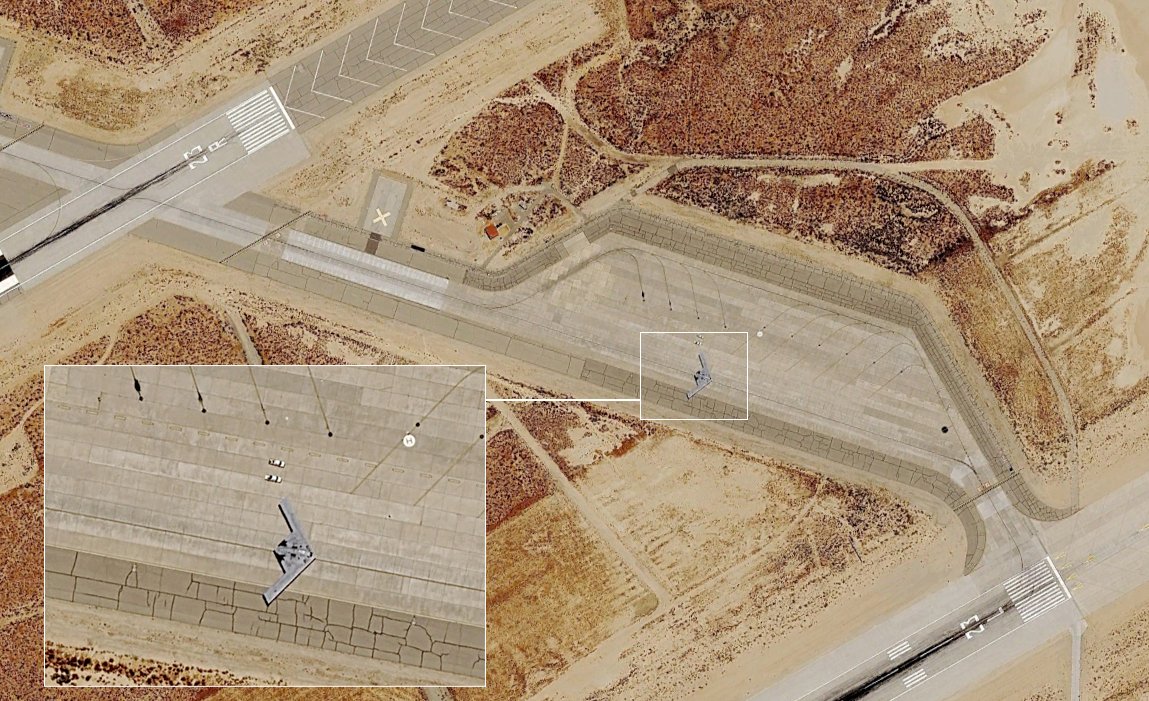
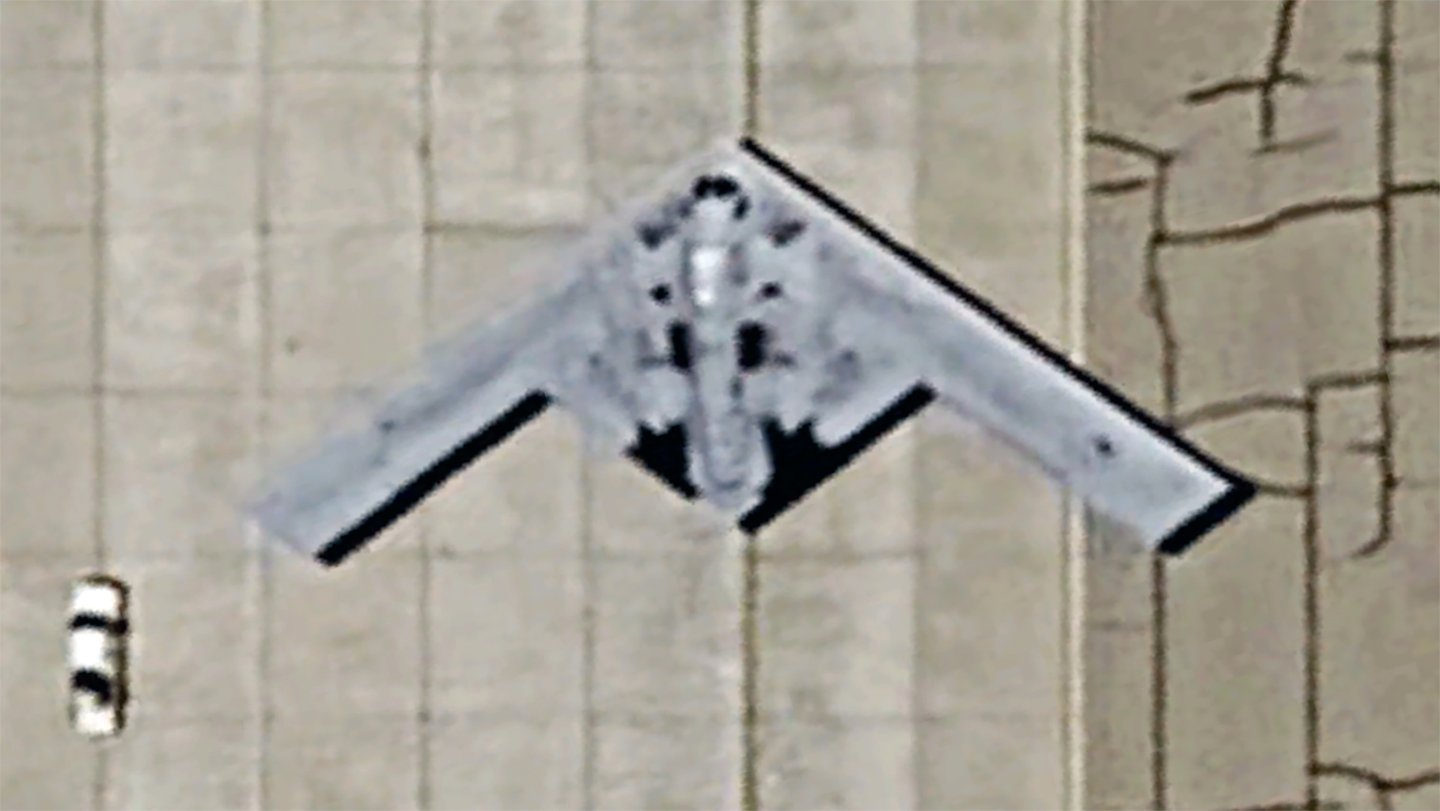
Thanks to Google Earth, we can finally put this one to bed. Since the B-21’s unveiling, people have made wild claims about its wingspan, specifically how tiny it is. This was never the case, as we have reported continuously since we first set eyes on it. Many AI-generated and enthusiast-made B-21 fact sheets have gone viral on social media showing wingspans under 130 feet, which only helped propel the nonsense. Now we can definitively say, give or take a few feet, the B-21 spans 152 feet and is 61 feet long. This puts it at about 12% smaller in terms of wingspan than the B-2, and about the same — 12% smaller — when it comes to length.

The image in question, taken of Edwards AFB and dated June 20, 2026, was recently uploaded to Google Earth. While we have seen satellite images of the B-21 going about its business before, this one was published in the public domain and had enough resolution, when paired with Google Earth’s excellent measurement tools, to get conclusive measurements.

B-21 taxiing between Edwards AFB’s parallel runways. (Google Earth)

Since we first saw the B-21 at Plant 42 in Palmdale, California, during its unveiling, which TWZ attended, we put the top-end size at 155 feet wingspan-wise. That analysis has only narrowed over the years. I have had many emails, social media threads, and other engagements with folks claiming the aircraft was in the sub-130-foot wingspan range. Now we can finally put those battles behind us.

B-21 span nowhere that number. Bizarre people think this. Around 150-155 best estimate

— Tyler Rogoway (@Aviation_Intel) September 19, 2025

I smile every time I see these graphics showing like 130 foot wingspan on the B-21. People think it's way smaller than it is.

— Tyler Rogoway (@Aviation_Intel) August 25, 2025

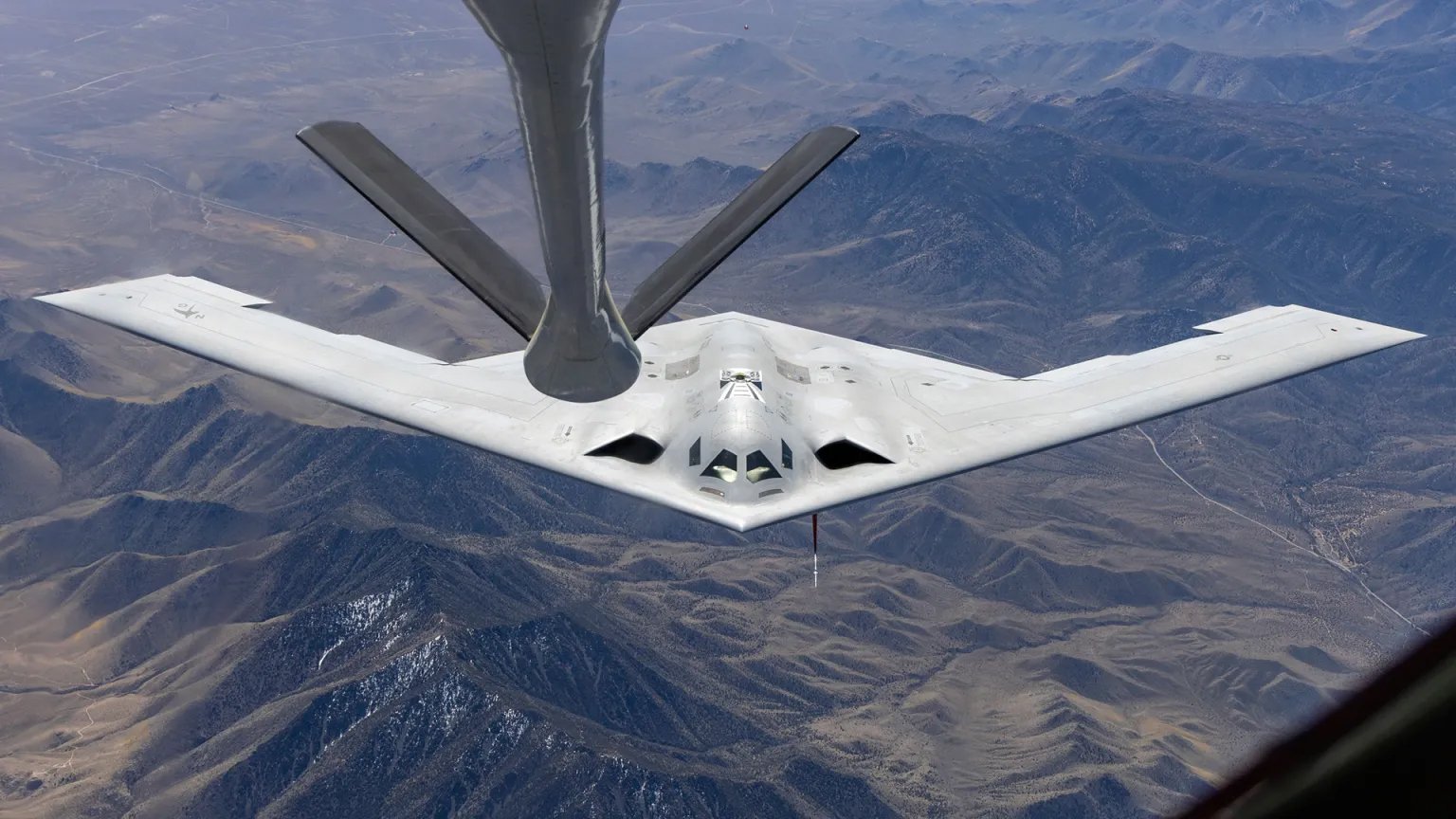
So what does the size tell us? Nothing we don’t already know. The B-21 was always going to be smaller than the B-2. Our analysis from many years ago has stayed the same — the aircraft would be designed with a premium on range and affordability, as well as very low observability, over massive payload. This resulted in the aircraft you see today. It is smaller, but with design priorities that have shifted from its predecessor’s, and 12% smaller in pure dimensions makes total sense considering what Northrop Grumman was trying to achieve. Above all else, it points to the B-21 having an extreme unrefueled range, with improved aerodynamics for high-altitude cruise, more gas for its size, and two efficient engines instead of four.

Official photo of the B-21 in close pre-contact position behind Edwards AFB’s ‘Ghost’ test tanker. (USAF)

As for its length, the B-21 is nearly the same length as an F-15 fighter, which sounds bizarre for a large bomber. However, flying wings are visual transformers, looking like compact UFOs side-on and massive head-on or from the planform view.

What's even more fascinating is that this thing is probably about the same length as an F-15 or close to it. Flying wings are transformers. From flying saucers side-on to massive flying wedges in the bank to huge boomerangs head on. pic.twitter.com/0UXOK0uVVN

— Tyler Rogoway (@Aviation_Intel) May 22, 2024

As far as what else we can discern from the Google Earth image? Not much. We get a bit of a better view of the B-21’s exhaust configuration, but nothing is really revelatory there. The exhausts are deeply buried with large planar exhaust exit ‘ramps’ and have a large chevron trailing edge over the exhaust aperture itself. We have seen some pretty detailed images of this general arrangement from the rear that have been posted on social media. We do see the exhaust pathway as black in color, a feature that was edited out in the official top-down photo of the B-21 seen above, which was released in April, and this is something we mentioned at the time.

(Images): “Northrop Grumman’s B-21 Raider Over Palmdale”

Source: jmh.creates#anonymoushadoww #ufotwitter #uaptwitter #ShadowLurker #Twitter pic.twitter.com/0zLn4ADWl1

— Anonymoushadoww (@anonymoushadoww) September 25, 2026

Regardless, at least we can say with total confidence that the B-21 is smaller than its progenitor, but not by all that much — about 12% to be more exact.

Contact the author: Tyler@twz.com

The post We Finally Know The B-21 Raider’s True Wingspan appeared first on TWZ.
  •  

Aerial Drones Appear To Be Picking Up Wounded Off The Battlefield In Ukraine

The Ukrainian Armed Forces say they have carried out the world’s first frontline evacuation of a wounded soldier by aerial drone. The soldier, from the 30th Mechanized Brigade, is said to have been recovered successfully and is undergoing treatment and rehabilitation.

“This is a historic event, at least for our unit for sure,” said “Napalm,” a squad commander and programmer with the 92nd Assault Brigade’s uncrewed ground vehicle (UGV) company. The precise date and location of the operation have not been disclosed, and the claim of a global first has not been independently verified. However, a video of the event has been published by the 92nd, which you can watch below:

At this point, it should be noted that the footage has not been independently verified and could depict a staged demonstration rather than an actual combat evacuation. It should, at least, be treated with a degree of caution.

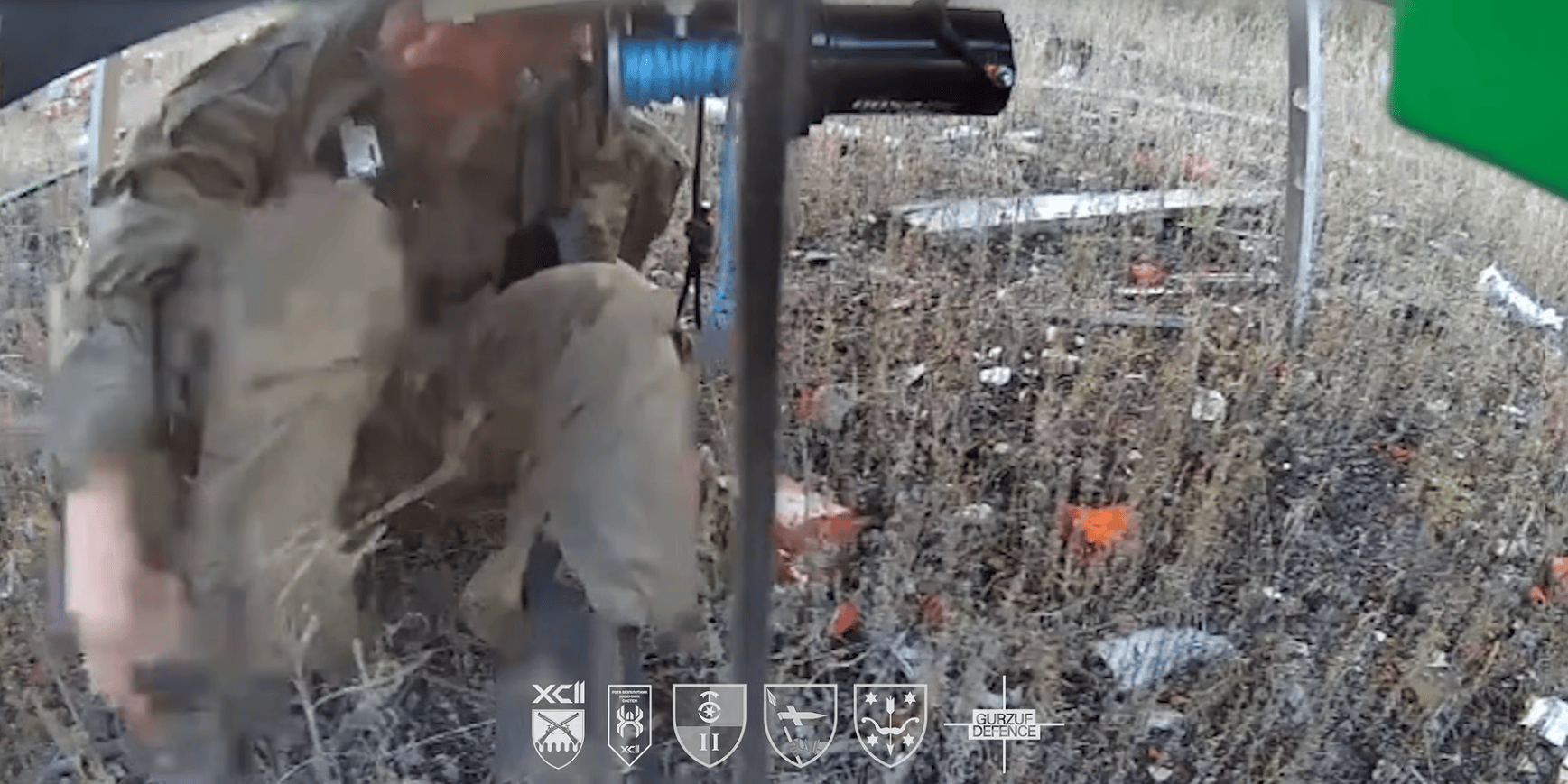
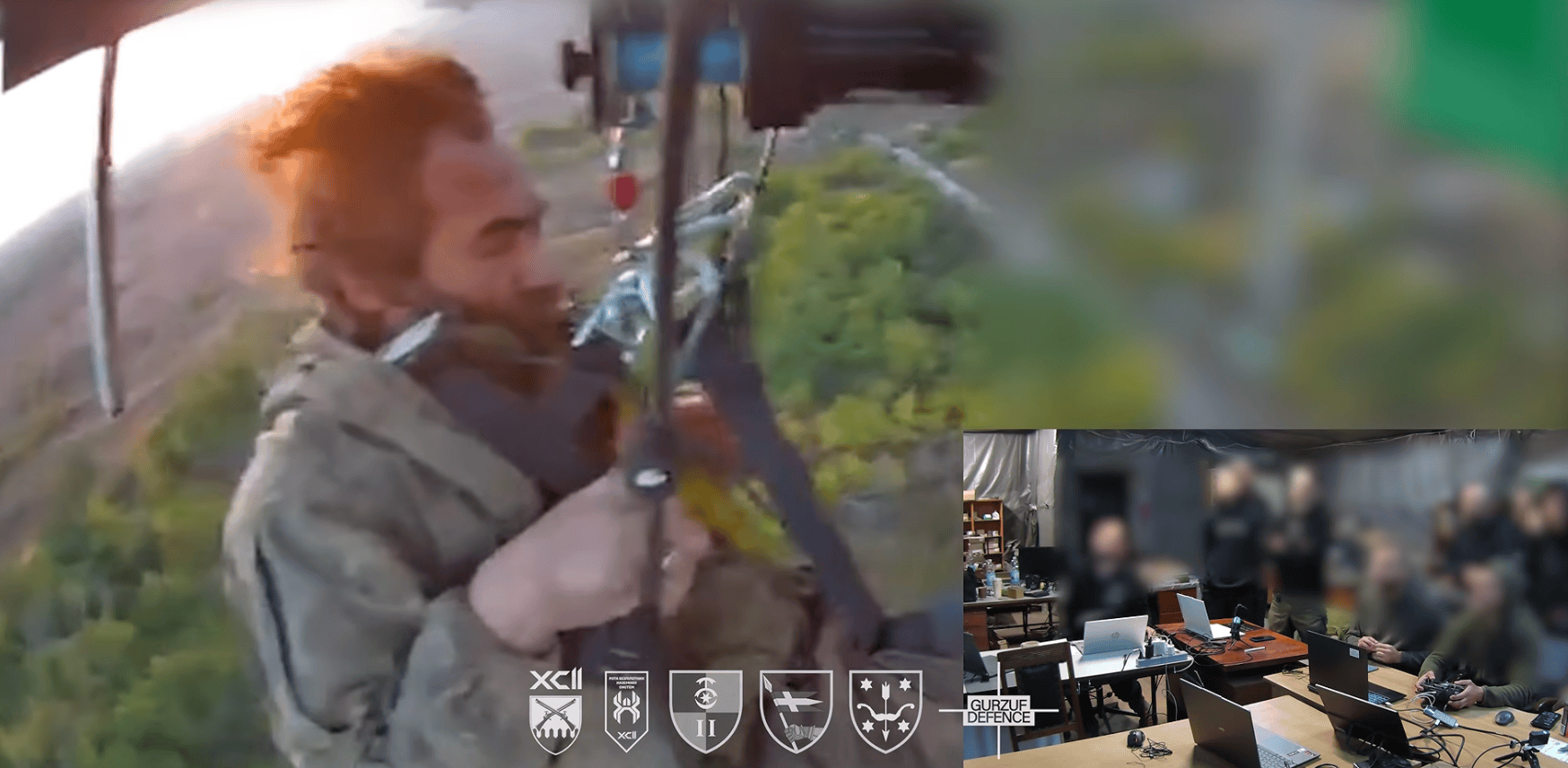
According to accompanying reports, the infantryman was wounded while holding his position. Mines and intense Russian drone activity prevented a conventional ground evacuation, prompting the 92nd’s specialists to attempt an aerial extraction. The video shows the soldier clipping himself to the underside of the drone via a harness before being flown to safety. The extemporized nature of the platform is underscored by the fact that, while in the air, the soldier dangles below its rigid landing legs.

The soldier is seen hunched under the hexacopter before attaching his harness to the drone. 92nd Assault Brigade/YouTube screencap

The aircraft was a heavy hexacopter manufactured by Ukrainian company Gurzuf Defense, which provided it free of charge. A UAV operator from the 30th Mechanized Brigade piloted the drone. Throughout the recovery, the soldier remained in contact with the drone operator.

With the drone now airborne, the drone controllers monitor the flight from the ground. 92nd Assault Brigade/YouTube screencap

The operation involved the 92nd, 30th and 14th Mechanized Brigades, the 10th Army Corps and Gurzuf Defense.

Ukraine increasingly uses uncrewed ground vehicles to deliver supplies and evacuate casualties from exposed positions. According to Euromaidan Press, Ukrainian UGVs conducted approximately 112,000 logistics and evacuation missions between January and August 2026.

However, ground robots can struggle with mines, mud, and cratered terrain, while remaining vulnerable to drones and artillery. These obstacles make it especially difficult to conduct UGV operations in the battlefield’s “kill zone,” which can extend six to nine miles or more from the front line. You can read an in-depth account of Ukrainian UGV efforts in this previous story.

A video showing a Ukrainian UGV in action in the Donetsk region:

Aerial platforms are able to reach casualties in places where ground vehicles cannot safely travel, and can get there far quicker, without having to stick to specific routes.

The 92nd has not disclosed the evacuation distance or flight duration of the mission. If, as reported, the drone used was an Audag-6 model, this is stated to be capable of carrying a 200-pound payload over a distance of up to 15 miles.

Meanwhile, the recovery points to a growing trend in the Ukrainian Armed Forces.

Only days before the story of the evacuation broke, it emerged that Ukraine is also now testing the StarGate, a purpose-built aerial medical evacuation drone — also of the heavy hexacopter type — developed by the SkyFall company. This is a rather more tailored solution to the problem, with a covered, medical-grade stretcher slung below the drone. It has a reported payload capacity of around 330 pounds, uses AI-assisted navigation, and can also deploy nets against hostile drones attempting to intercept it.

The 92nd’s operation used a heavy-lift hexacopter adapted for an ad hoc casualty transport, rather than a more bespoke design. This means the soldier had to be adequately trained on how to strap in, and also had to be in a condition that they could actually perform this procedure. This would also be the case even if other soldiers were able to assist them in strapping in.

While these kinds of solutions may be new to the battlefield in Ukraine, using uncrewed aerial systems for personnel recovery and medical evacuation is far from new.

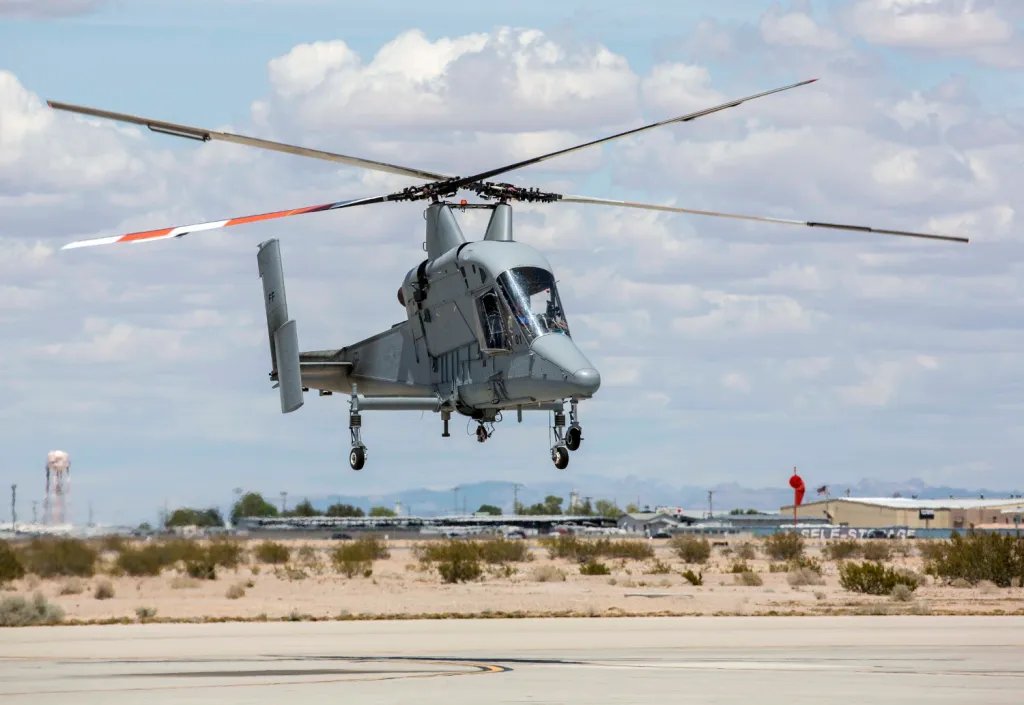
Back in 2016, the Army completed a demonstration of the Lockheed Martin K-Max helicopter in a casualty evacuation role. The K-Max can operate with and without a pilot and was used as a drone by the Marine Corps to deliver cargo in Afghanistan.

A U.S. Marine Corps K-Max helicopter. U.S. Marine Corps

“Unmanned and autonomous platforms have the potential to completely rewrite the medical doctrine,” Army Col. Daniel Kral, head of the Army’s Advanced Technology Research Center (TATRC), explained during a conference at Fort Detrick in Maryland in 2017.

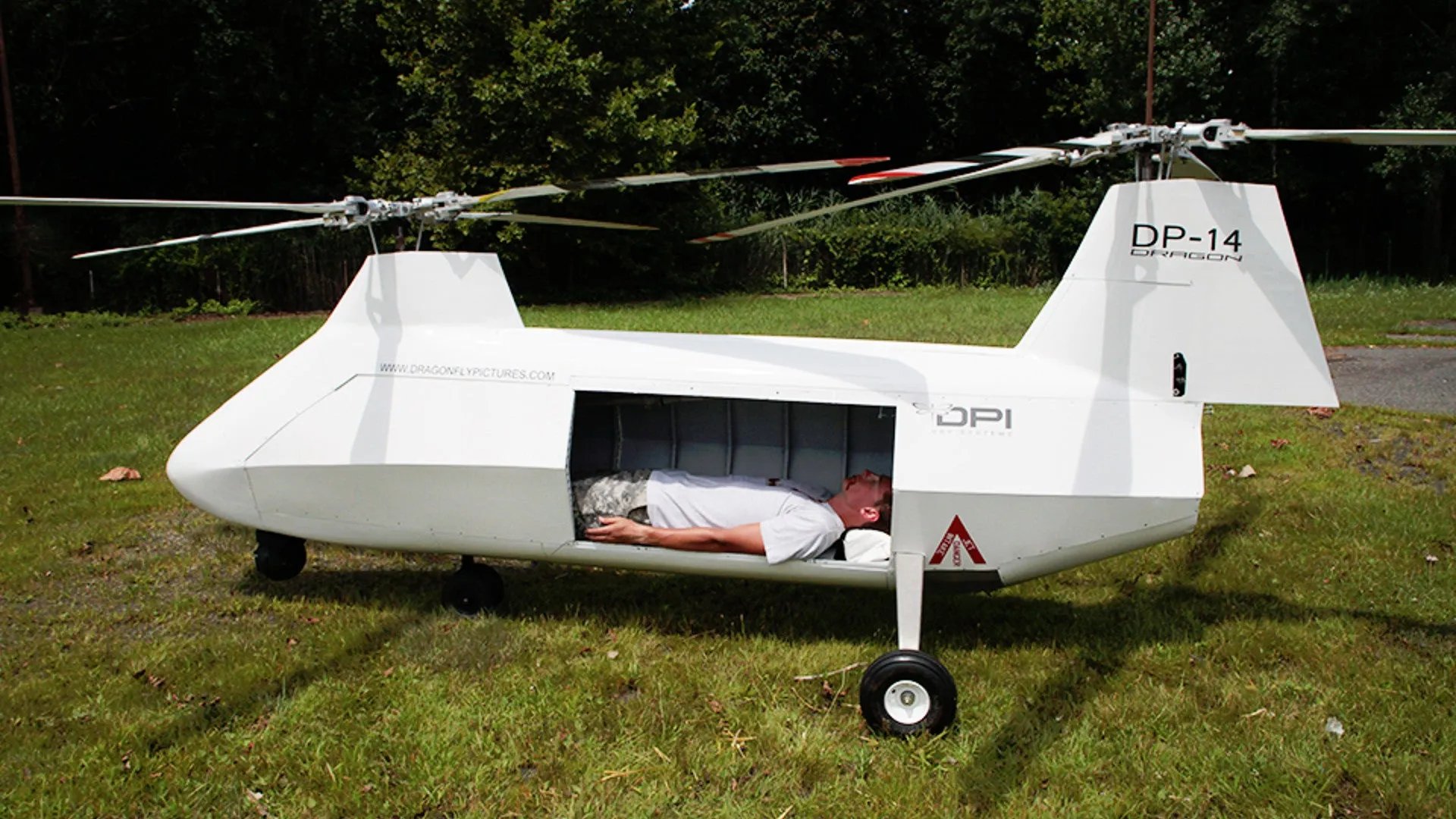
In 2019, TWZ reported on U.S. Army efforts to explore how uncrewed craft might speed up the casualty evacuation process. This work included evaluation of the Dragonfly Pictures, Inc. (DPI) DP-14 Hawk, a small, tandem-rotor drone with a 400-pound cargo capacity.

 A DP-14 Hawk shown configured for casualty evacuation. Dragonfly Pictures, Inc.

The emergence of autonomous air vehicles, or uncrewed ‘flying taxis,’ with short or vertical take-off and landing capabilities in the urban air mobility sector has also generated military interest. The U.S. Air Force Research Laboratory, for example, has conducted studies into how craft such as these could be adapted for combat search and rescue, with the idea that they would be airdropped to recover a fighter pilot shot down while operating over hostile territory.

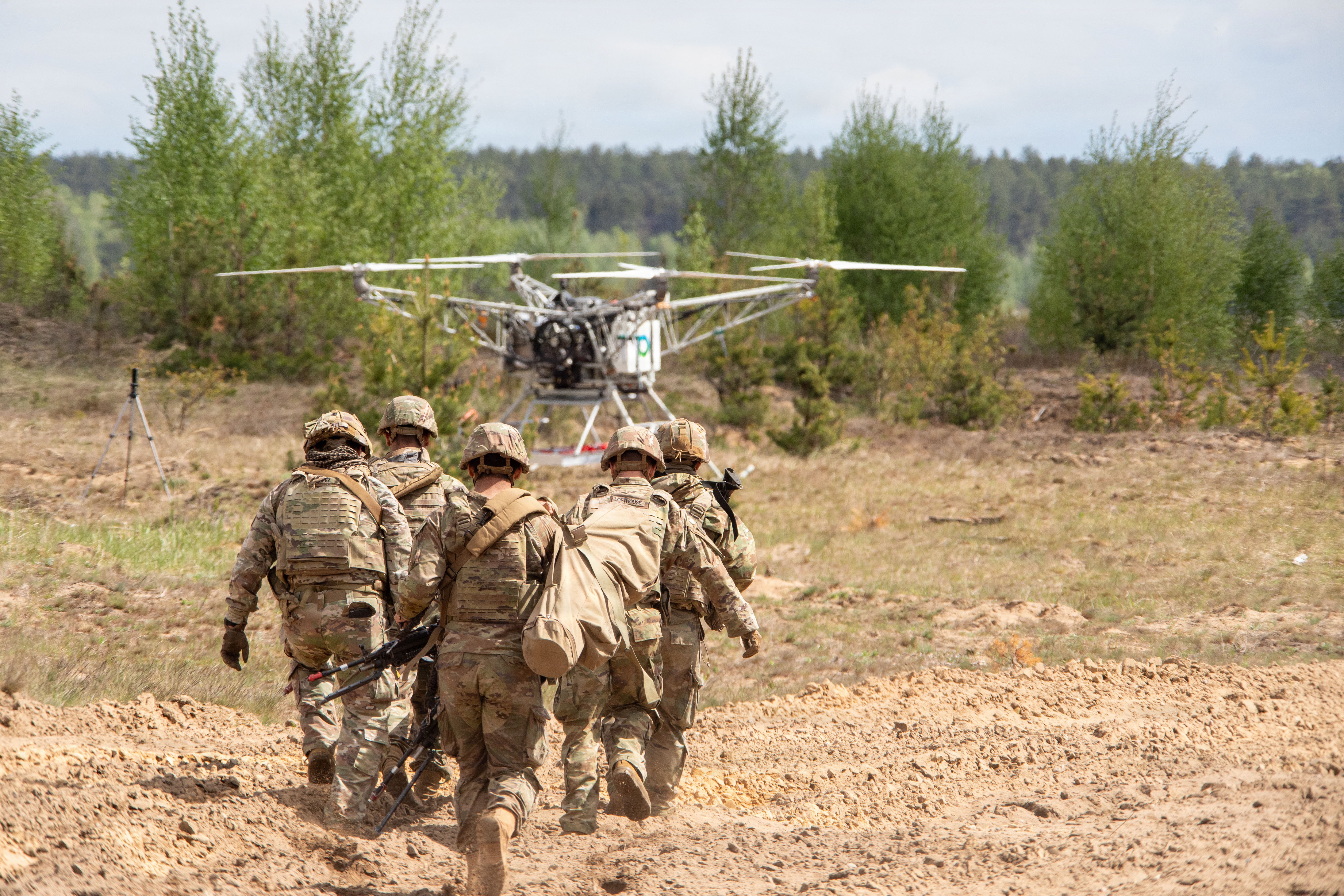
Closer to the Ukrainian hexacopter concept is the Flowcopter FC-100, a heavy-lift quadcopter drone that the U.S. Army tested in a medical evacuation capacity in Poland during the large-scale Saber Strike exercise earlier this year. Carrying a 220-pound payload, the drone has a range of more than 60 miles.

U.S. Army Soldiers assigned to the Regimental Support Squadron, 2d Cavalry Regiment, run with a test dummy in a stretcher towards a drone during an Autonomous Triage and Treatment Challenge taking place near Bemowo Piskie Training Area, Poland, May 10, 2026. From April 27 to May 31, 2026, U.S. and Allied forces will exercise the North Atlantic Treaty Organization’s (NATO) Eastern Flank Deterrence Initiative, demonstrating NATO’s ability to fight and win on the modern battlefield. Nearly 15,000 troops from eleven nations will train across the High North, Baltic region, and Poland. They will execute rapid maneuvers, air defense, counter-drone operations, and cyber defense to validate NATO’s regional defense plans in real time. This series of linked exercises includes Saber Strike, Immediate Response, and Swift Response. The exercises turn investment into capability. Soldiers integrate unmanned systems such as AI-enabled command and control and live data networks to move, decide, and fight more effectively across all domains. Sword 26 demonstrates how U.S. Army Europe and Africa drives transformation at scale while strengthening deterrence. Together with our allies, we are building a unified, lethal force ready to defend NATO territory and respond to any threat. (U.S. Army Reserve photo by Spc. Thomas Madrzak)
U.S. Army soldiers run with a test dummy in a stretcher towards a Flowcopter FC-100 drone during an Autonomous Triage and Treatment Challenge taking place near Bemowo Piskie Training Area, Poland, May 10, 2026, as part of Exercise Saber Strike. U.S. Army Reserve photo by Spc. Thomas Madrzak

All of these concepts aim to address the inherent vulnerability of larger personnel recovery platforms in more contested environments.

In their favor, they offer the potential to rescue troops from more precarious situations, with the smaller drones touching down in relatively tight areas in mountainous, forested, or jungle environments. Autonomous navigation systems can guide the drones through smoke, dust, or bad weather, too.

On the other hand, these small craft have no space for a medic, pararescuemen, or other additional personnel. Bearing in mind their limited range and lower speeds, they also need to be in the right location to respond to emergencies as and when they occur.

For the Ukrainian Armed Forces, aerial medical evacuation drones are being rapidly developed and now fielded to help address another problem: the vulnerability of UGVs in areas of the battlefield that have long become far too hazardous for crewed medevac platforms to operate.

By now, both sides in the Ukraine war are relying heavily upon small, autonomous uncrewed aircraft to perform a wide variety of resupply, surveillance, communications, and strike roles on and around the front lines. With that in mind, the adaptation of these kinds of vehicles for casualty evacuation and personnel recovery missions is the next logical step.

Contact the author: thomas@thewarzone.com

The post Aerial Drones Appear To Be Picking Up Wounded Off The Battlefield In Ukraine appeared first on TWZ.
  •  

Democracy Dies in Fakeness: False Elections All Across Europe

Europe's political class loves democracy – right up until voters choose the wrong people. From Sweden to Germany and Britain, Steven Tucker says the establishment has found plenty of ways to keep the public in its place.

The post Democracy Dies in Fakeness: False Elections All Across Europe appeared first on The Daily Sceptic.

  •  

F-22 Pilot Controls FQ-44 Fighter Drone From The Cockpit For The First Time

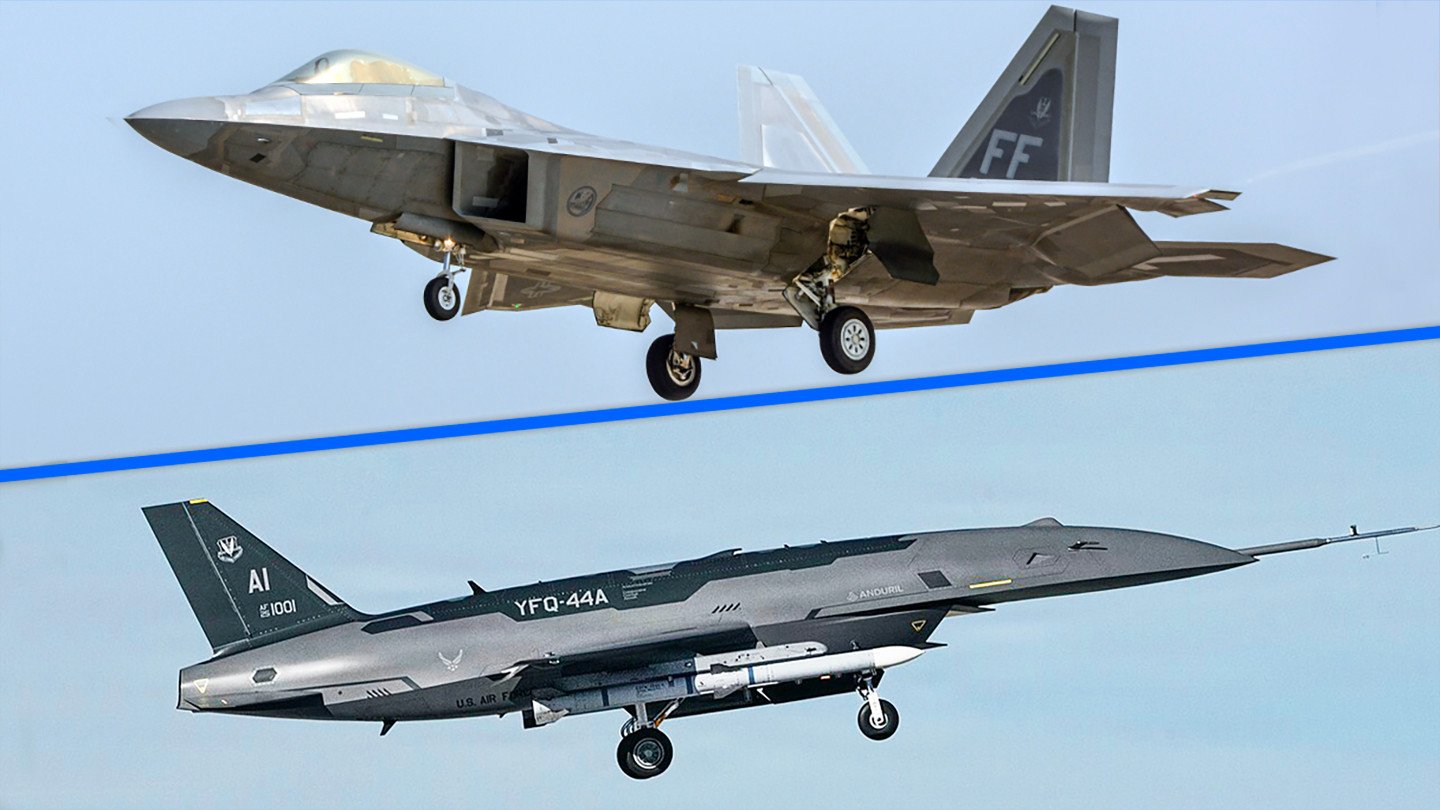
A pilot flying an F-22 Raptor fighter has issued commands to a YFQ-44A Fury Collaborative Combat Aircraft (CCA) drone in a first-of-its-kind test. This is an important development for the U.S. Air Force’s CCA program, as its F-22s are set to be the first aerial ‘quarterbacks’ for these uncrewed aircraft once they enter operational service.

The Air Force and Anduril, Fury’s prime contractor, announced the “airborne tactical-control demonstration” today, but it occurred sometime earlier this month. An Anduril spokesperson confirmed directly to TWZ that this was a first for an F-22 and a pre-production YFQ-44A. Last month, the company disclosed tests involving Fury flying in formation with F-35 fighters, but stressed that the latter were not yet issuing commands to the former in mid-air. A Fury drone also launched an AIM-120 Advanced Medium-Range Air-to-Air Missile (AMRAAM) for the first time earlier this year.

A stock picture of a pre-production YFQ-44A Fury CCA drone. USAF

The Air Force has orders in now for production of FQ-44As, as well as General Atomics’ FQ-42A Vengeance drones, under the first phase, or Increment 1, of its CCA program. The service is still planning to acquire additional CCAs, which could be of entirely different types, through a follow-on Increment 2. The goal now is to have a fleet of at least 500 Increment 1 CCAs by 2032. The recent test is part of efforts to lay the groundwork for an initial tranche of CCAs to start entering operational service around the end of the decade.

“During the demonstration, an F-22 pilot served as an airborne ‘quarterback,’ issuing high-level tactical directives to a single YFQ-44A,” according to a press release from the Air Force. “The aircraft’s onboard autonomy software interpreted and executed those directives in real time, conducting dynamic flight maneuvers and simulated combat tasks.”

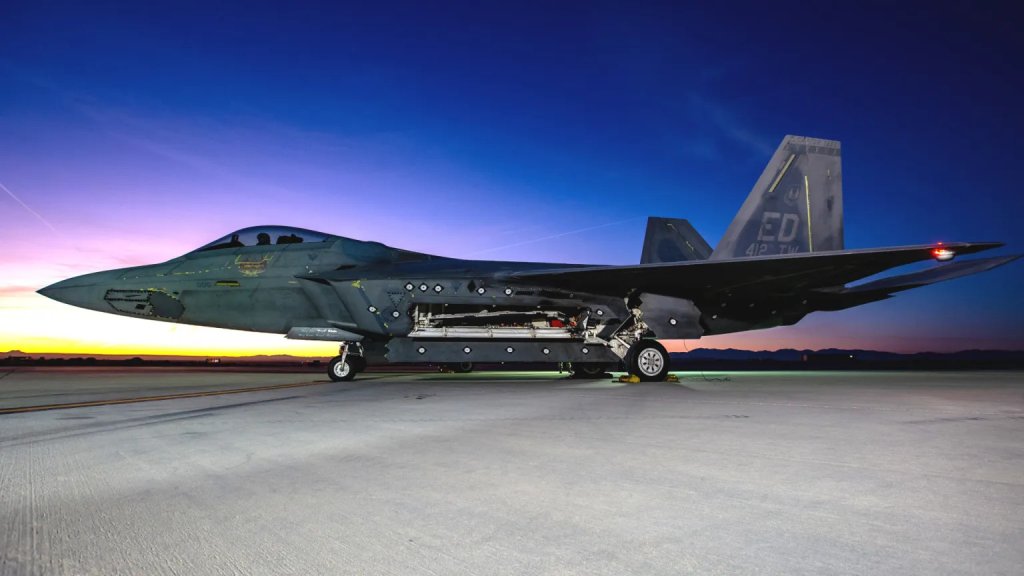
A stock picture of an F-22 Raptor test jet. USAF

“The event brought together personnel from the 412th Test Wing, 422nd Test and Evaluation Squadron, 309th Software Engineering Group, Experimental Operations Unit, F-22 System Program Office and the CCA Software Autonomy and Teaming Branch,” according to the Air Force release.

The Experimental Operations Unit (EOU) mentioned here is based at Nellis Air Force Base in Nevada and has been leading efforts to pave the way for future Air Force CCA operations.

The “Fury and an F-22 both took off [from] Edwards AFB [Air Force Base in California] and joined up midair,” according to a separate release from Anduril. “While in flight, the Raptor pilot sent an updated mission plan to Fury using a tactical data link, commanding Fury through operationally-relevant maneuvers from the cockpit of the crewed quarterback.”

Neither the Air Force nor Anduril provided further details on how the F-22 was configured for this test. Past Air Force budget documents have mentioned the need to integrate “tablets, cables, and associated materials” onto the Raptor for this purpose. A single Raptor is also expected to be able to manage multiple CCA drones simultaneously.

The Raptor’s prime contractor, Lockheed Martin, has certainly been working with the Air Force to develop the relevant control architectures and user interfaces for that fighter, as well as the F-35. In terms of in-cockpit user interfaces for controlling drones, known work to date has centered largely on the use of touchscreen tablet-like devices, but this is understood to just be a starting point. Though tablet-based interfaces are a workable option, questions and criticisms about increased workload, especially for pilots in single-seat fighters, have been raised in the past.

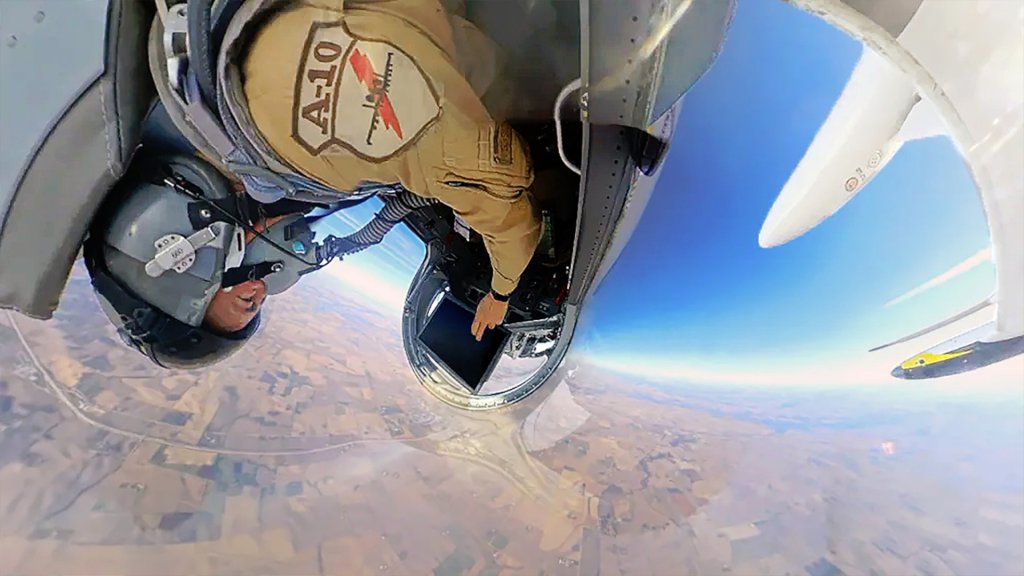
A view of a “battle manager” in the back seat of an L-39 light jet using a tablet-like device during a past test of capabilities to control drones in mid-air conducted by Lockheed Martin’s Skunk Works. Lockheed Martin

It is also worth noting here that General Atomics announced a similar demonstration involving a Raptor and an MQ-20 Avenger back in November 2025. General Atomics has been using the MQ-20 as a CCA surrogate in various types of testing. What the plan might be now to demonstrate the F-22’s ability to control an FQ-42A in flight is unclear. General Atomics has previously released a picture of a Vengeance drone flying in formation with, though not being directly controlled by, Air Force fighters.

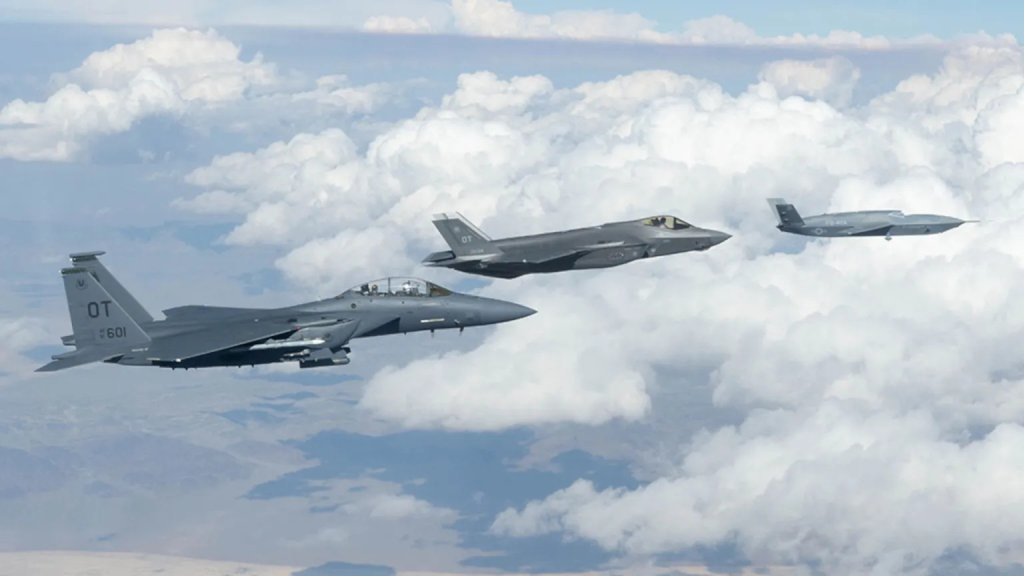
A General Atomics Vengeance drone, at right, in flight together with an F-35A Joint Strike Fighter and an F-15E Strike Eagle. General Atomics

In addition, Fury and Vengeance are set to make their debut in a large-scale exercise before the end of the year. Bringing the CCAs to the next iteration of Exercise Emerald Flag will give the Air Force further opportunity to test them in a more operationally relevant context alongside crewed fighters.

“We have not yet done a LFE [large-force employment exercise] with these [CCAs], for real. The first one is going to be Emerald Flag. That’s in December,” Lt. Col. Lyndon “OTTO” Bartlett, the EOU’s Director of Operations, said during a panel at the Air & Space Forces Association’s (AFA) 2026 Air, Space & Cyber Conference in September, at which TWZ was in attendance. “That’ll be our first tip [sic] dip of the toe in an actual force integration.”

The EOU, working together with other Air Force elements and industry partners, still has to answer a host of other outstanding questions unrelated to tactical operations. CCAs will be deployed, launched, recovered, supported, and otherwise operated in ways that are distinct from their crewed counterparts, and for which new policies and procedures will need to be developed. Just making sure human pilots have trust in their uncrewed wingmen operating as expected will be critical, underscoring the specific importance of the demonstration disclosed today. All of this applies equally to the U.S. Marine Corps and U.S. Navy CCA programs, which are being run in very close coordination with the Air Force’s efforts.

When it comes to the recent test involving the F-22 and the YFQ-44A, “this achievement demonstrates what is possible when we are aligned with industry on a shared imperative: delivering capability to the warfighter at unprecedented speed,” Secretary of the Air Force Troy Meink said in a statement today. “We are driving urgency into every part of acquisition from rapid integration and flight learning to disciplined assessment, so we can turn promising technology into combat capability at the pace the threat demands.”

A graphic showing the FQ-42 and FQ-44 designs together. USAF

“This flight shows the power of crewed-uncrewed teaming and the advantage it provides our warfighters,” Air Force Chief of Staff Gen. Ken Wilsbach also said. “We must test often, learn fast, and give commanders what they need, when they need it.”

“The U.S. Air Force’s CCA program is the fastest moving, most mature CCA program anywhere in the world, and will be the first to field operational aircraft,” Mark Shushnar, Anduril’s Vice President of Autonomous Airpower, said as well. “Getting there demands that Anduril and the U.S. Air Force work together to prove out the capability, define the operational procedures, and build trust between operators and their semi-autonomous wingmen.”

With all this in mind, an F-22 issuing orders to a YFQ-44A in mid-air is an important new sign of what is on the horizon for the U.S. Air Force, though there is still work to be done.

Contact the author: joe@twz.com

The post F-22 Pilot Controls FQ-44 Fighter Drone From The Cockpit For The First Time appeared first on TWZ.
  •  

Selma Blair ‘did not intend to harm anyone’ during airplane incident, representatives say

Actor experienced a ‘medical emergency’ on flight during which she allegedly injured crew members, statement says

Actor Selma Blair did not mean to hurt anyone during the recent flight which led to her arrest on allegations that she assaulted a pair of cabin crew members, a police officer and a nurse, her representatives said on Friday in a statement that characterized the episode as a medical emergency.

The lengthy statement also dismissed prior media coverage of Blair’s arrest after a Delta Air Lines flight from Los Angeles to New York as unsympathetic and inaccurate, singling out reporting from several outlets alleging that she tried to open the door of the airplane that she and her fellow passengers were on.

Continue reading...

© Photograph: Ryan Murphy/AP

© Photograph: Ryan Murphy/AP

© Photograph: Ryan Murphy/AP

  •  

Canada’s Snowbirds Say Farewell To The CT-114 Tutor Jet

The Canadian Forces Snowbirds brought the Canadair CT-114 Tutor’s aerobatic career to a close on Friday, October 16, with a final home-base demonstration at 15 Wing Moose Jaw, Saskatchewan. The private event, which was livestreamed, honored the Canadian-built jet trainer that defined the team for more than half a century, as well as the aircrew and support personnel who kept the increasingly demanding aircraft flying.

This Friday, join us in saying farewell to the CT-114 Tutors.

Watch the last airshow on Friday, October 16, 2026 live on our Facebook page.

The live stream will begin at 2 p.m. (EDT). pic.twitter.com/I2Tr3buq5D

— Royal Canadian Air Force (@RCAF_ARC) October 13, 2026

While Friday’s performance marks the end of the Tutor’s aerobatic display career with the team, a Grey Cup flyover in Calgary on November 15 remains on the schedule.

Speaking to MooseJawToday on October 15, Snowbirds team lead Maj. Maciej “Match” Hatta described the Tutor’s final season as an emotional milestone for the squadron, as well as an opportunity to recognize the families and support personnel who sustain the team during its annual touring season.

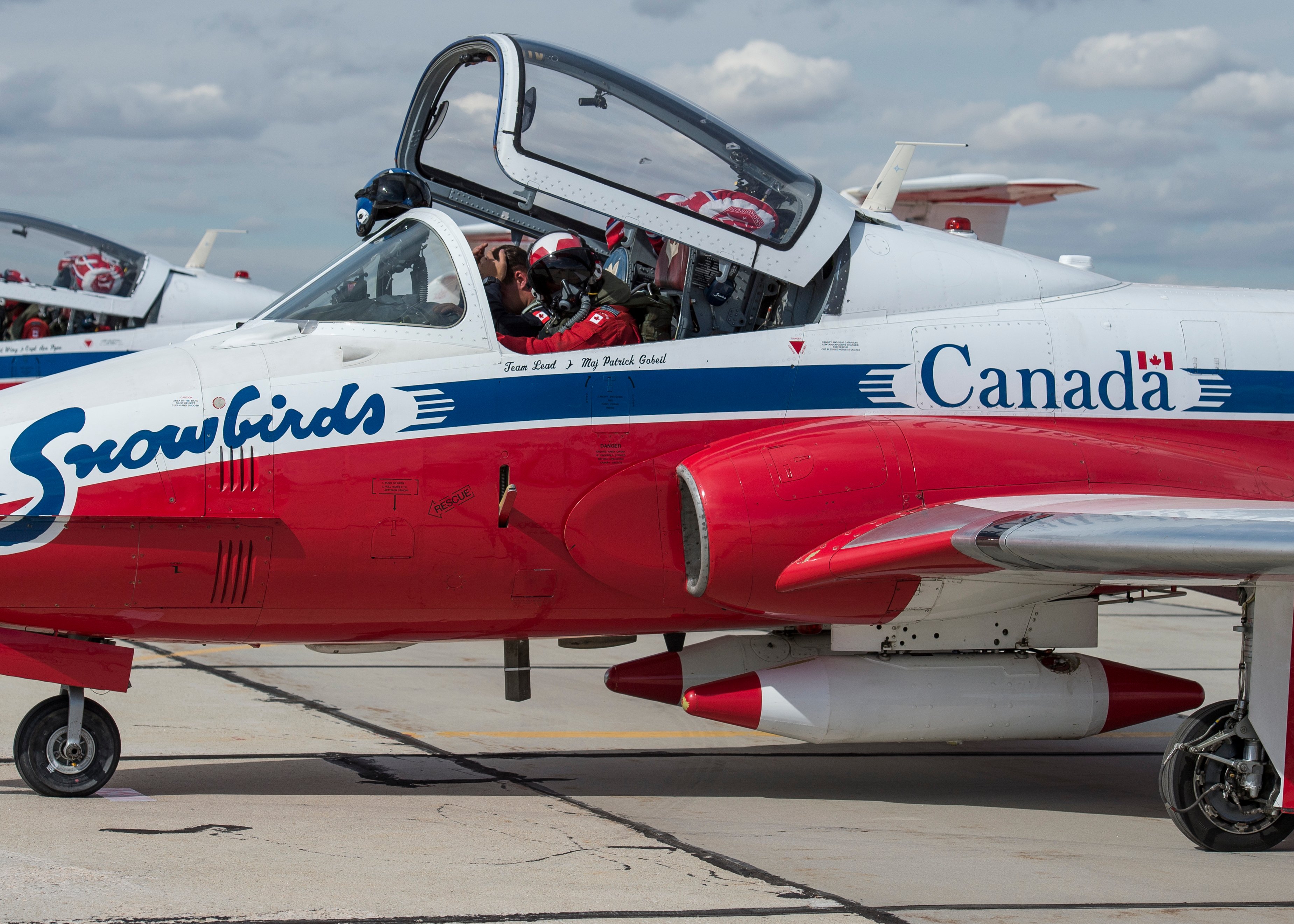
The Royal Canadian Snowbirds taxi at Gowen Field, Boise, Idaho Oct. 12, 2017. The Snowbirds performed during the Gowen Thunder Open House and Airshow. (U.S. Air National Guard photo by Master Sgt. Joshua C. Allmaras)
The Snowbirds taxi at Gowen Field, Boise, Idaho, during the Gowen Thunder Open House and Airshow, in 2017. Note the twin smoke tanks below the fuselage. U.S. Air National Guard photo by Master Sgt. Joshua C. Allmaras

Hatta has a long personal history with the aircraft. He flew with the Snowbirds from 2014 to 2017, subsequently worked on testing the Tutor’s avionics upgrades, and returned this year to lead the team through its final season with the jet. Despite having flown around 30 different aircraft as a test pilot, he has a particular attachment to the Tutor.

“This is still my favorite airplane to fly,” he said.

Hatta recalled flying a maintenance test sortie alone the previous day, enjoying the opportunity to look out over the wings without the near-constant radio communications involved in leading a formation display. He also noted the differences between individual aircraft in the fleet.

“They all have their own personality,” Hatta said. “Some of them howl a little more than others. Some get hotter inside. Some have poor air conditioning.”

Lt.-Col. Guillaume Paquet, commanding officer of No. 431 Air Demonstration Squadron, Royal Canadian Air Force (RCAF), said the final season has prompted strong reactions from spectators, many of whom have grown up watching the Snowbirds perform in the Tutor.

“The reality is we’ve been touring this country for 55 years, so everyone has a story, a childhood memory,” Paquet said.

Golden Hawks To Snowbirds

Canada’s military aerobatic tradition dates back to 1929, when the biplane Armstrong Whitworth Siskin helped establish the country’s formation-flying heritage. The modern era began in 1959 with the creation of the Golden Hawks, formed to mark the 50th anniversary of powered flight in Canada and the 35th anniversary of the RCAF. Flying gold-painted Canadair-built F-86 Sabre fighters, the team initially was intended to operate for a single season. Its popularity led to several more years of performances across Canada and the United States before it was disbanded after the 1963 season amid the high costs of maintaining it.

Canada’s centennial celebrations in 1967 brought a new demonstration team, the Golden Centennaires, which flew CT-114 Tutor jet trainers at 100 airshows across Canada and the United States. The Tutors would subsequently become the foundation of the Snowbirds. In 1969, Colonel O.B. Philp, newly appointed commander of No. 2 Canadian Forces Flying Training School at Moose Jaw, Saskatchewan, encouraged instructors to practice formation aerobatics using surplus Tutors left over from the Centennaires program. Initially presented as training and proficiency flying, the formations soon attracted public attention and gradually evolved into an established demonstration team.

The Golden Centennaires existed for only one year to celebrate the centennial of Canada in 1967. Canadian Forces

The formation grew from four aircraft in 1970 to seven in 1971, when the Snowbirds name was adopted following a competition among schoolchildren. Two solo aircraft were added in 1972, establishing the team’s familiar nine-aircraft format. That year, its pilots were assigned to demonstration flying on a full-time basis. The team’s Tutors were modified to support solo operation from the right-hand seat and the demands of inverted flight during aerobatic displays. In 1974, the Tutors received their distinctive red, white, and blue paint scheme, and the team was authorized to perform a fully aerobatic display.

The Canadian Forces Snowbirds perform an aerial demonstration over Rickenbacker International Airport, June 19 2026, as part of the Columbus Air Show. This year’s event featured more than 20 military and civilian planes and static displays, including a KC-135 Stratotanker from the 121st Air Refueling Wing, which served as the base of operations for military aircraft participating in the show. (U.S. Air National Guard photo by Tech. Sgt. Mikayla Gibbs)
Seven Canadian Forces Snowbirds jets perform an aerial demonstration earlier this year. U.S. Air National Guard photo by Tech. Sgt. Mikayla Gibbs

The Snowbirds subsequently achieved full squadron status as No. 431 Air Demonstration Squadron, becoming one of the most recognizable symbols of Canadian military aviation. Their officially stated mission was to demonstrate the professionalism, teamwork, and flying skills of the Canadian Armed Forces to audiences across North America.

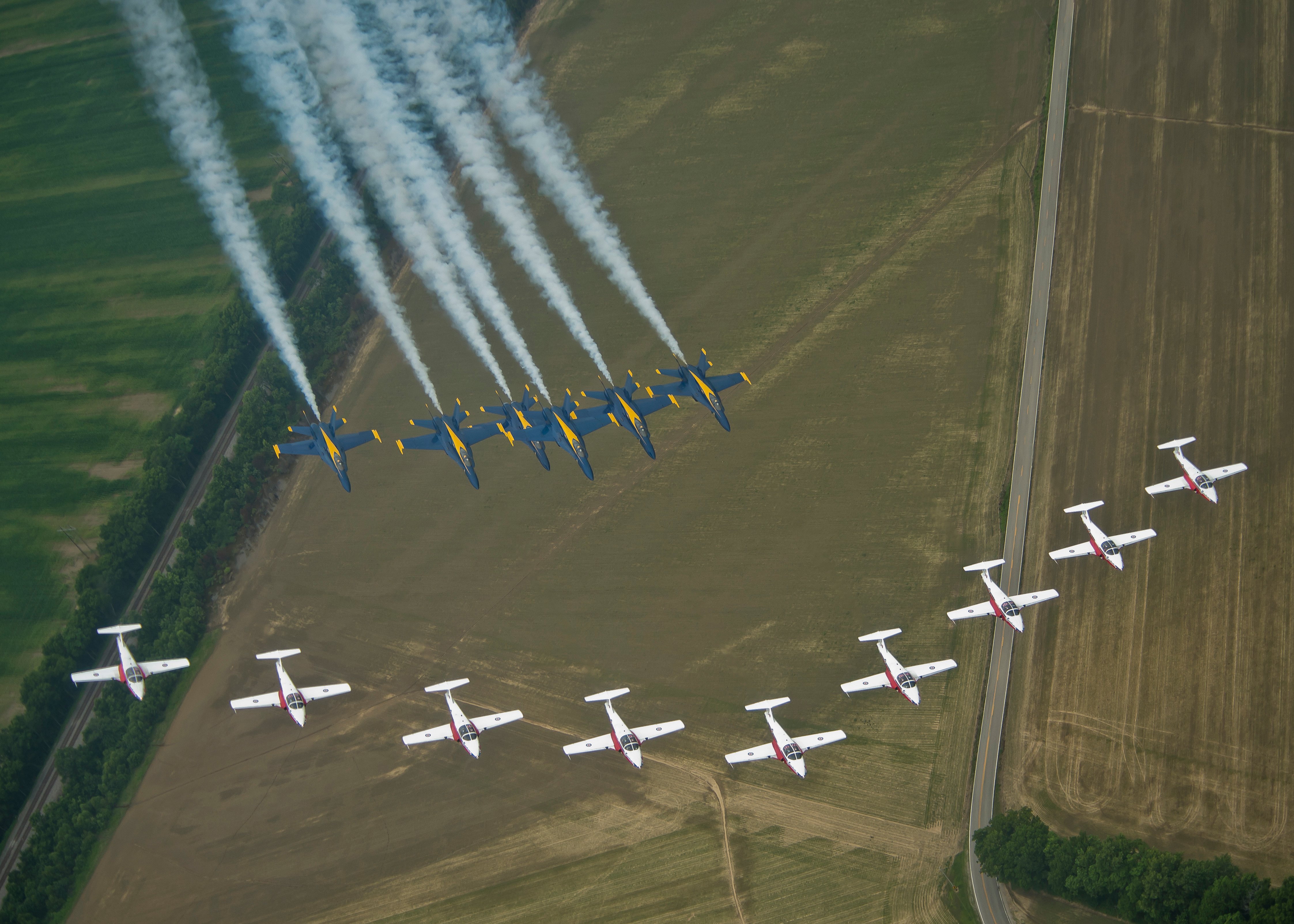
150625-N-SN160-356 EVANSVILLE, Ind. (Jun, 25, 2015) The U.S. Navy Flight Demonstration Squadron, the Blue Angels, join their signature Delta formation with the Canadian Air Demonstration Squadron, the Snowbirds, for a scheduled photo shoot over Evansville, Ind. The Blue Angels are scheduled to perform at 68 demonstrations at 35 locations across the U.S. in 2015.. (U.S. Navy photos by Mass Communication Specialist 1st Class Michael Lindsey/Released)
The U.S. Navy Flight Demonstration Squadron, the Blue Angels, join their signature Delta formation with the Snowbirds for a scheduled photo shoot over Evansville, Indiana, in 2015. U.S. Navy photos by Mass Communication Specialist 1st Class Michael Lindsey/Released

However, the Tutor’s final years were marked by a series of serious accidents and renewed scrutiny of its aging systems.

In October 2019, a Snowbirds aircraft crashed in Georgia after an engine fuel-delivery failure, with the pilot surviving an ejection that was itself affected by a parachute malfunction. In May 2020, another Tutor crashed shortly after takeoff near Kamloops, British Columbia, killing the Snowbirds public affairs officer and seriously injuring the pilot; investigators determined that a bird strike had triggered an engine compressor stall. The fleet was temporarily grounded following that accident, with operations resuming under additional restrictions in August 2020.

A further accident at Fort St. John, British Columbia, in August 2022 prompted another fleet-wide operational pause after an engine failure during takeoff; investigators identified an improperly assembled oil filter as the cause. The aircraft returned to service the following month.

The Royal Canadian Air Force’s Snowbirds are parked on the flight line at Peterson Air Force Base, Colo., May 12, 2018. The Snowbirds aerial demonstration team performed a fly over in missing-man formation during the North American Aerospace Defense Command's 60th Anniversary Celebration. (DoD photo by Staff Sgt. Emily Kenney, USAF)
The Royal Canadian Air Force’s Snowbirds parked on the flight line at Peterson Air Force Base, Colorado, in 2018, during the North American Aerospace Defense Command’s 60th Anniversary Celebration. DoD photo by Staff Sgt. Emily Kenney, USAF

Subsequent safety measures included restrictions on certain aerobatic maneuvers and formations, minimum runway-length requirements, and limits on flying over water or performing some maneuvers outside gliding distance of a suitable landing surface.

At the same time, the persistent engineering challenges involving the Tutor’s airframe, engines, and ejection system were all factors in its retirement, with the RCAF concluding that further life-extension work was no longer practical.

Developing Canada’s Jet Trainer

Canadair Limited of Montreal began developing the CL-41A Tutor in the mid-1950s as a high-performance jet trainer to prepare RCAF pilots for the Canadair-built F-86 Sabre. The all-metal, low-wing, single-engine aircraft featured side-by-side seating and duplicate flight controls, allowing instructors to monitor students closely and take control when necessary. Two prototypes were built, with the first making its maiden flight on January 13, 1960, with Canadair test pilot Ian MacTavish at the controls.

CANADA - SEPTEMBER 01: Snowbirds roar over metro. Capt. Wes MacKay banks his Canadian Forces Tutor jet over downtown Toronto yesterday in a practice run before he and fellow Snowbirds perform today at the CNE. Canada's crack aerobatics team will make no changes in their thrilling performance despite Sunday's West German air show crash that killed 49 and injured 500. (Photo by Boris Spremo/Toronto Star via Getty Images)
Capt. Wes MacKay banks his Canadian Forces Tutor jet over downtown Toronto in a practice run before a performance at the Canadian National Exhibition in 1988. Photo by Boris Spremo/Toronto Star via Getty Images

Following an extensive testing and demonstration program, Canadian Minister of National Defence D.S. Harkness announced an order for 190 production aircraft on September 11, 1961. Deliveries began in 1963, with each aircraft reportedly costing approximately C$425,000 (around $394,000). Powered by a General Electric J85-CAN-40 turbojet built under licence by Orenda, the aircraft entered RCAF training service in late 1964 under the designation CT-114 Tutor.

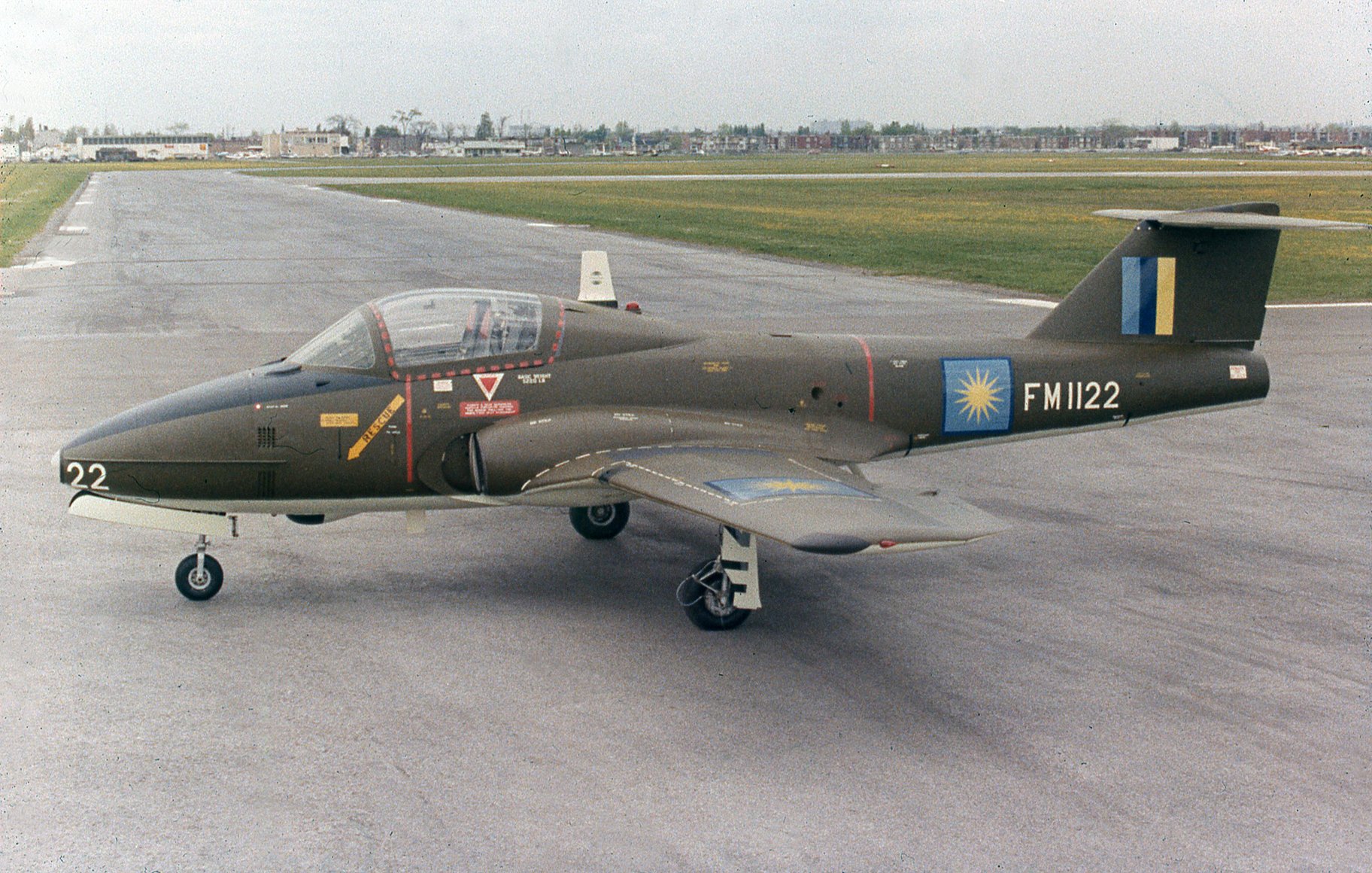
As well as the RCAF, the Tutor found one other military operator in Malaysia. The Royal Malaysian Air Force received 20 examples designated the CL-41G Tebuan (meaning “Wasp” in the Malay language), which served between 1967 and 1986 in the ground-attack role.

A Royal Malaysian Air Force CL-41G Tebuan. The Aviation Historian Archive

The Tutor served as the RCAF’s primary jet trainer for decades, accumulating more than one million flight hours before its training role ended in 2000. It was replaced by the CT-156 Harvard II and CT-155 Hawk. The aircraft nevertheless remained in military service with the Snowbirds.

The Next Chapter

The Tutor’s retirement will bring an end to a long chapter in Canadian military aviation, but the Snowbirds are expected to continue flying with a new aircraft type. In May of this year, the Department of National Defence announced plans to replace the CT-114 with the CT-157 Siskin II, based on the Pilatus PC-21 turboprop trainer. The new demonstration capability will remain at 15 Wing Moose Jaw and is expected to become operational in the early 2030s.

Today the Government of Canada announced a commitment to purchase a future RCAF air demonstration capability. After more than six decades of service 2026 will mark the final season for the CT‑114 Tutor aircraft fleet which has represented Canada with dignity and pride since 1971. pic.twitter.com/iqRNE8d8H3

— Royal Canadian Air Force (@RCAF_ARC) May 19, 2026

The Siskin II has already been procured under Canada’s wider Future Aircrew Training (FAcT) program, for advanced fixed-wing and jet preparation. It is one of five aircraft types being procured under a 25-year, C$11.2-billion (approximately $7.9 billion) contract awarded to SkyAlyne in 2024. The other four types are the CT-102B Astra II (Grob G 120TP) for basic pilot training; CT-157 Siskin II for advanced fixed-wing and jet preparation; CT-145E Expeditor II (Beechcraft King Air 260) for multi-engine training; CT-153 Juno (Airbus H135) for helicopter training; and CT-142Q Citadel (De Havilland Canada Dash 8-400) for training air combat systems officers and airborne electronic sensor operators.

One of the first two Pilatus PC-21s departs Stans in Switzerland bound for Canada on September 14, 2026. These first aircraft mark the start of a new chapter in Canada’s Future Aircrew Training (FAcT) program. Pilatus

Paquet, the No. 431 Air Demonstration Squadron boss, said all Tutors are to be flown to IMP Aerospace in Trenton, Ontario, by March 31, 2027, where they will be disposed of. Some aircraft are expected to be preserved in museums or mounted on pedestals for public display, while others will be used as training aids for aircraft maintenance apprentices in Borden, Ontario.

“They’re not going to be flying. They’re not going to be flyable,” Paquet said.

Snowbirds team lead “Match” Hatta hopes to contribute his test-pilot experience to the transition, including testing the replacement aircraft and developing the new demonstration program.

“I would love to contribute to the team in terms of seeing them through the transition,” he said. “If I’m able to use my test background as well in helping that out, testing the new show, testing the new airplanes, and passing it on to a new boss down the road, then I’d love to do that.”

Royal Canadian Air Force CT-114 Tutor pilots with the Canadian Forces Snowbirds 431st Air Demonstration Squadron, perform pre-flight demonstrations during the Defenders of Liberty Air & Space Show at Barksdale Air Force Base, La., May 19, 2019. Serving as ambassadors of the CAF, the CF Snowbirds demonstrate a high level of skill, professionalism, teamwork, discipline and dedication inherent in the men and women of the CAF. (U.S. Air Force photo by Airman Jacob B. Wrightsman)
Royal Canadian Air Force CT-114 Tutor pilots with the Canadian Forces Snowbirds perform pre-flight checks during the Defenders of Liberty Air & Space Show at Barksdale Air Force Base, Louisiana, in 2019. U.S. Air Force photo by Airman Jacob B. Wrightsman

For Paquet, the immediate priority is completing the final display season without incident before turning to the next phase of the team’s history.

“I will definitely be emotional. The only thing I’m hoping for is that all the planes land safely, bring everybody home, and then we can check the box and say it was an extremely successful season. I brought everybody home, and we’ll move on to the next chapter.”

After more than six decades since its development began, the Tutor leaves behind a legacy spanning generations of military pilots and millions of spectators. Its final Snowbirds aerobatic display represents not simply the retirement of an aging aircraft, but the end of a long tradition in which the little jet trainer was one of the country’s most recognizable symbols of military flying and aerial performance.

Contact the author: thomas@thewarzone.com

The post Canada’s Snowbirds Say Farewell To The CT-114 Tutor Jet appeared first on TWZ.
  •  

First C-130J For Navy’s New E-130J Phoenix II Ballistic Submarine Communications Fleet Delivered

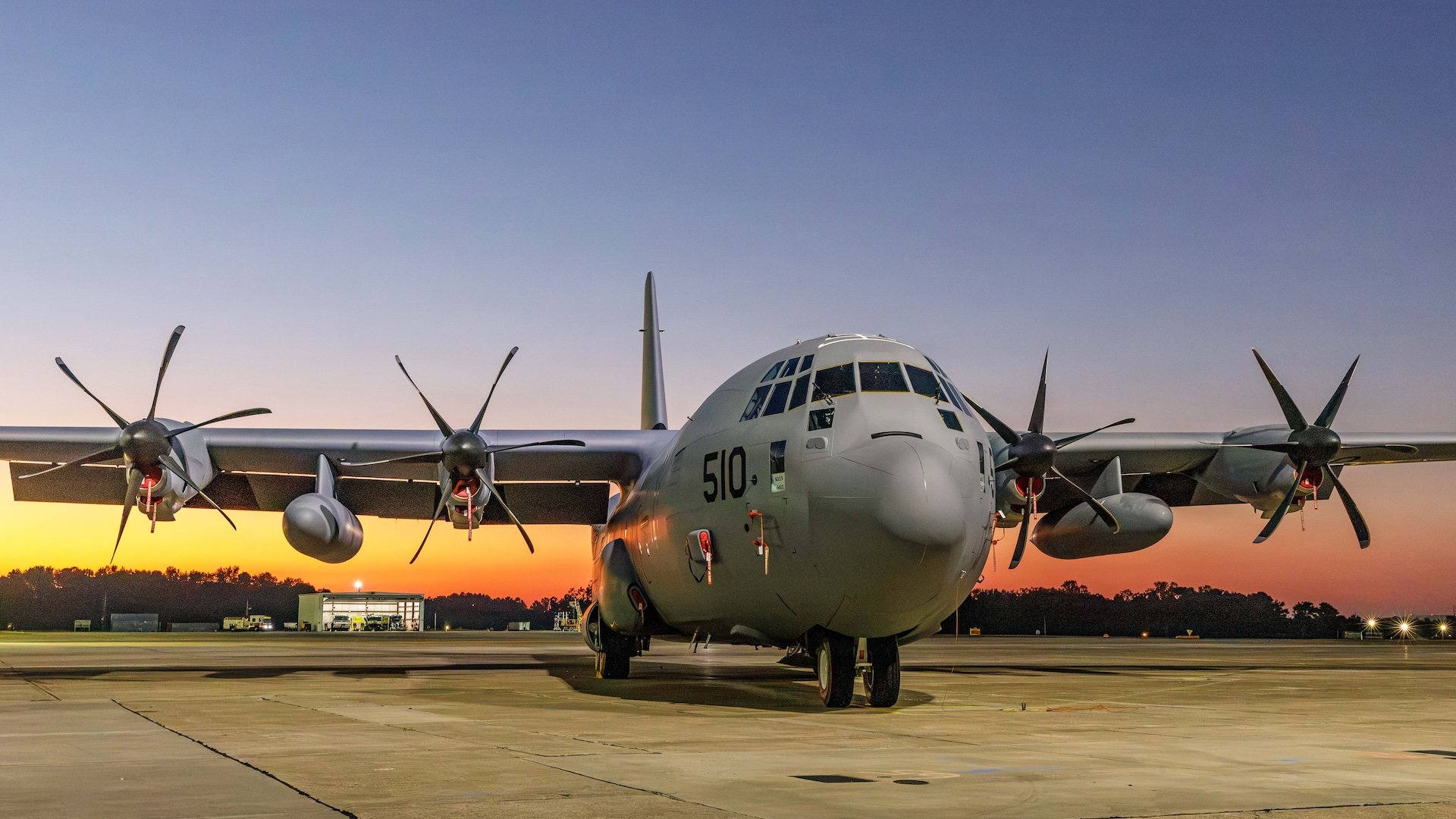
The U.S. Navy has taken delivery of the first C-130J-30 Hercules airframe destined to become an E-130J Phoenix II, the service’s next-generation aircraft for maintaining communications with its nuclear ballistic submarines. The aircraft will now undergo extensive mission-systems integration before it can begin testing for the Take Charge and Move Out (TACAMO) mission.

The @USNavy's future TACAMO aircraft is here. 🇺🇸

The C-130J-30 Super Hercules keeps strategic command and control connected when it matters most.

Four engines. Long endurance. Proven reliability. pic.twitter.com/huX0qlzKkm

— Lockheed Martin (@LockheedMartin) October 16, 2026

Lockheed Martin handed over the newly built aircraft at its facility in Marietta, Georgia, on October 15. The delivery marks the start of the transition from the Navy’s aging E-6B Mercury fleet to the turboprop-powered E-130J, which is intended to provide a survivable communications link between national leadership and U.S. Navy nuclear ballistic missile submarines, including the ability to send them orders to launch strikes while they are submerged.

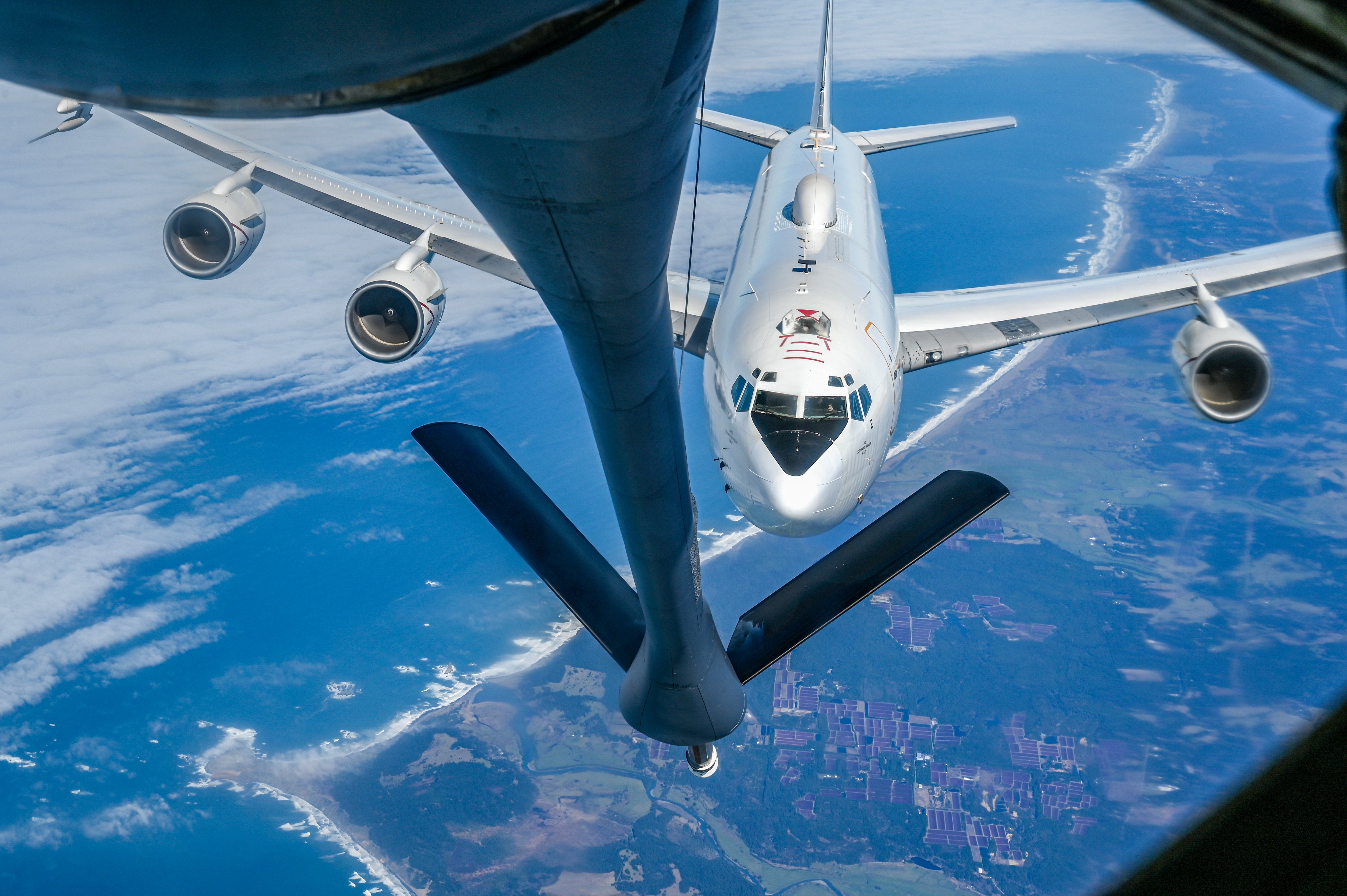
An E-6B Mercury assigned to the Strategic Communications Wing 1 at Tinker Air Force Base approaches a KC-135 Stratotanker assigned to the 92nd Air Refueling Wing during an aerial refueling mission over Oregon, Feb. 28, 2025. Aerial refueling capabilities are essential for strategic and tactical operations as well as humanitarian relief efforts in support of Air Mobility Command, U.S. Transportation Command and Department of Defense priorities. (U.S. Air Force photo by Airman 1st Class Megan Delaine)
An E-6B Mercury assigned to the Strategic Communications Wing 1 at Tinker Air Force Base approaches a tanker during an aerial refueling mission over Oregon, Feb. 28, 2025. U.S. Air Force photo by Airman 1st Class Megan Delaine

“Today’s delivery from the historic Marietta line represents far more than a new airframe; it marks the foundation of our future strategic deterrence posture,” Capt. Roger Davis, program manager for the Navy’s Airborne Strategic Command, Control, and Communications program office (PMA-271), said in a statement.

“Through our close partnership with Lockheed Martin and our industry team, we are ensuring our nation maintains an unshakeable communications lifeline to our ballistic missile submarine fleet.”

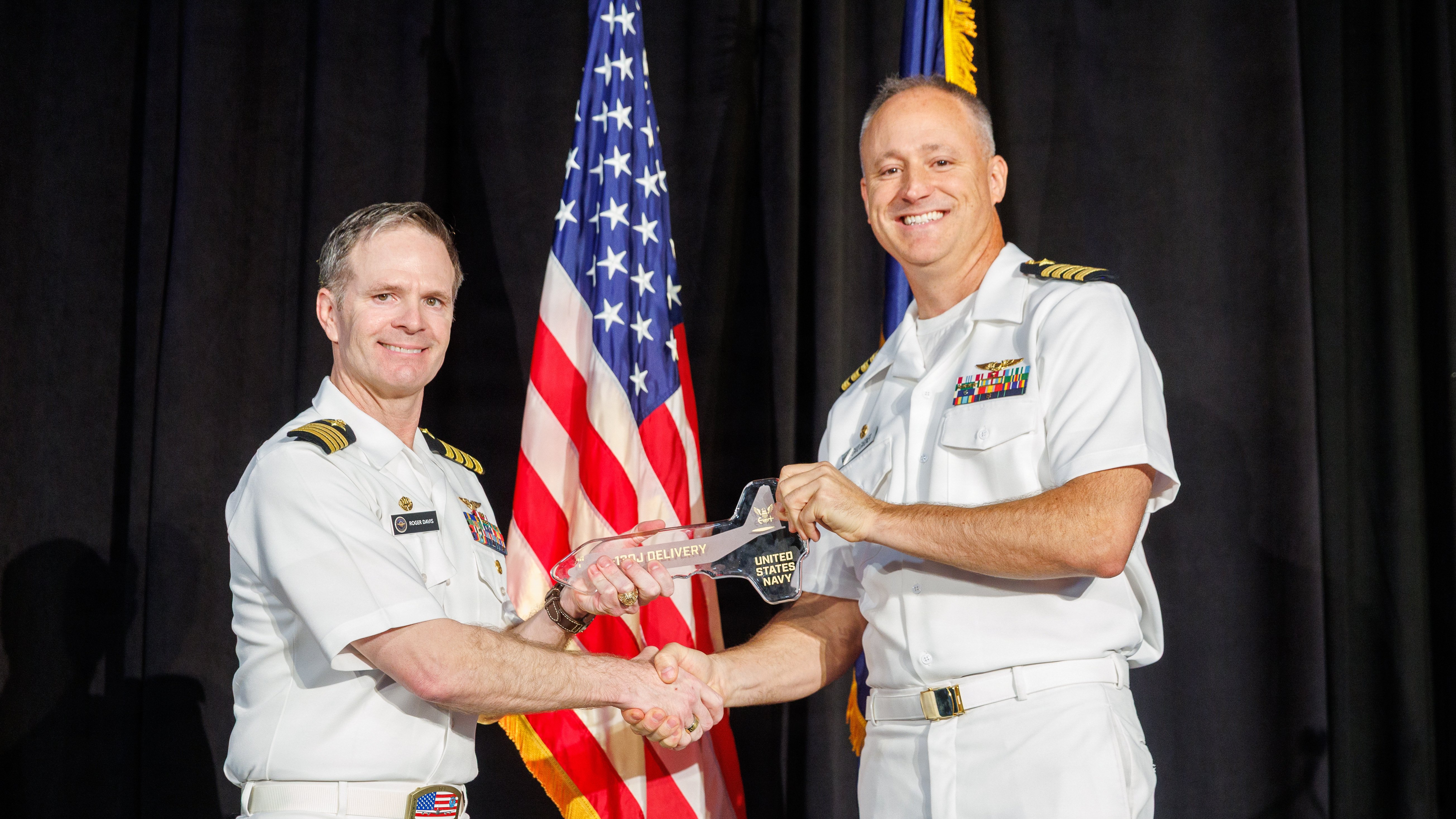
Capt. Roger Davis, left, Airborne Strategic Command, Control and Communications program manager (PMA-271), presents a ceremonial key to Capt. David Gardner, commodore of Strategic Communications Wing 1 (SCW 1), during the C-130J-30 delivery ceremony Oct. 15, 2026 in Marietta, Georgia. The symbolic handover marks the transition of the new airframe into the next phase of mission-system modification, ground testing and developmental flight testing, laying the foundation to field the future E-130J “Phoenix II.” (Photo courtesy of Lockheed Martin by Thinh D. Nguyen)
Capt. Roger Davis, left, Airborne Strategic Command, Control and Communications program manager (PMA-271), presents a ceremonial key to Capt. David Gardner, commodore of Strategic Communications Wing 1 (SCW 1), during the C-130J-30 delivery ceremony Oct. 15, 2026 in Marietta, Georgia. Photo courtesy of Lockheed Martin by Thinh D. Nguyen

The aircraft is the first of three C-130J-30s initially procured by the Navy in September 2024. It will be transferred to Northrop Grumman, the E-130J program’s prime contractor and mission-systems integrator, for conversion. Collins Aerospace is providing the very low frequency (VLF) communications system, a key component of the TACAMO mission.

TACAMO aircraft provide a means for the president, secretary of defense, and U.S. Strategic Command to communicate with nuclear forces, including submarines submerged at sea. The mission is designed to preserve the ability to transmit emergency action messages even if conventional communications infrastructure is disrupted or destroyed.

The E-6B accomplishes this in part through a long, trailing wire antenna that enables VLF transmissions to submerged submarines. The E-130J will receive a comparable system as part of its conversion.

Hardening against the effects of electromagnetic pulse (EMP), which occurs during the detonation of nuclear warheads, is another key requirement for these planes.

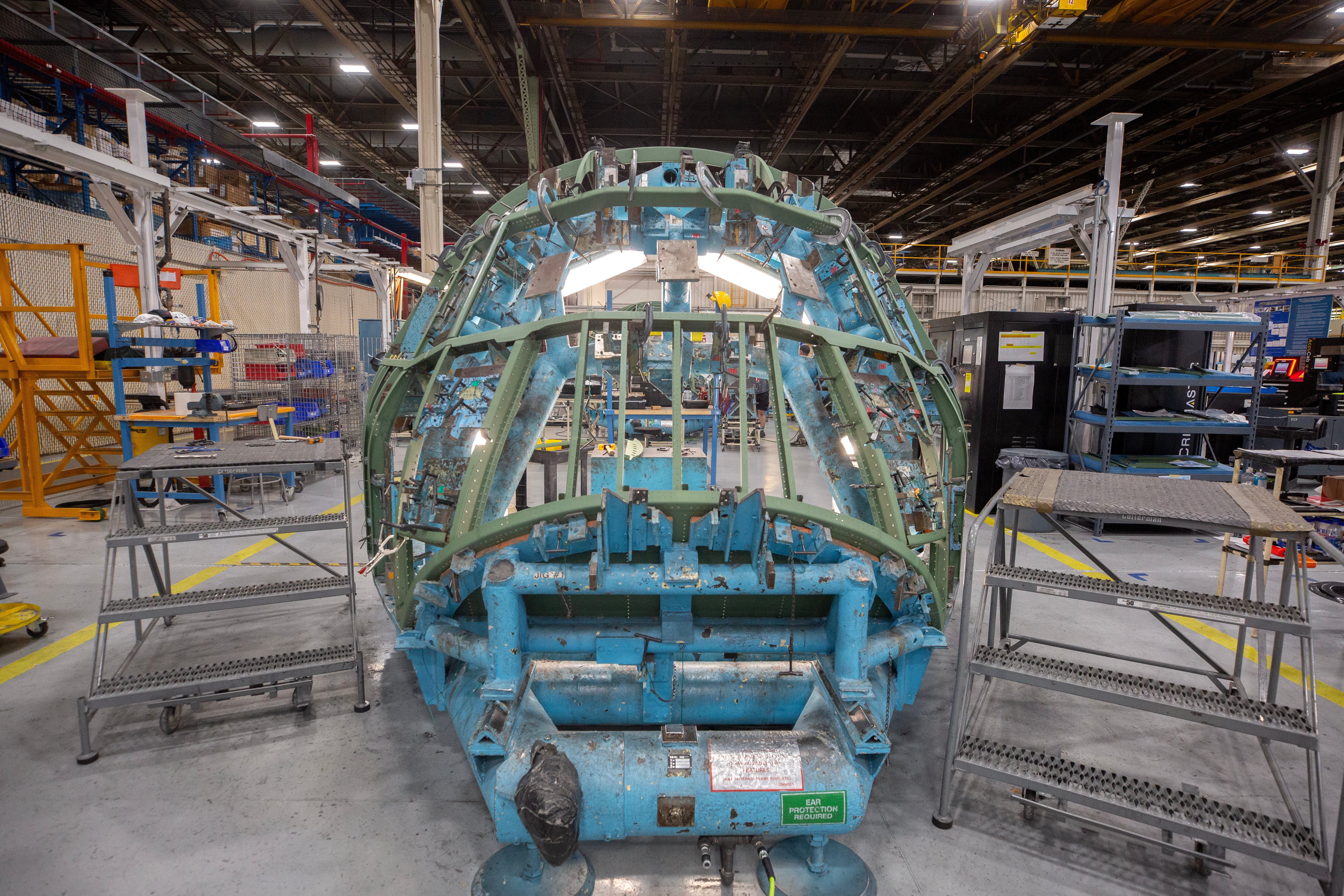
A sneak peak at the first C-130J-30 Super Hercules aircraft being built by Lockheed Martin Corp. for the U.S. Navy’s E-130J program. This aircraft – the first of three – is slated to be delivered to the government in 2026 for modification into an E-130J Engineering Development Model. The E-130J, formerly called E-XX, will be the successor to the E-6B Mercury for the Take Charge and Move Out (TACAMO) mission, which connects the president, secretary of defense and U.S. Strategic Command with the United States’ nuclear triad. The U.S. Navy’s Airborne Strategic Command, Control and Communications Program Office (PMA-271) is leading the TACAMO Recapitalization Program and is scheduled to award the Engineering and Manufacturing Development contract during the first quarter of 2025. (Photo by David L. Key, Lockheed Martin)
The first C-130J-30 being built by Lockheed Martin Corp. for the E-130J program. Photo by David L. Key, Lockheed Martin

The Navy plans to acquire 31 E-130Js, nearly doubling the 16 E-6Bs currently in service. That total includes six developmental aircraft and 25 production examples, although it remains unclear how many of the developmental aircraft will ultimately be available for operational use.

The larger planned fleet should provide additional aircraft to support training, maintenance, and operational demands. However, the transition also brings technical challenges. The Government Accountability Office (GAO) has previously warned that integrating the specialized mission equipment into the smaller C-130J-30 airframe could affect operational availability and create additional engineering and manufacturing difficulties.

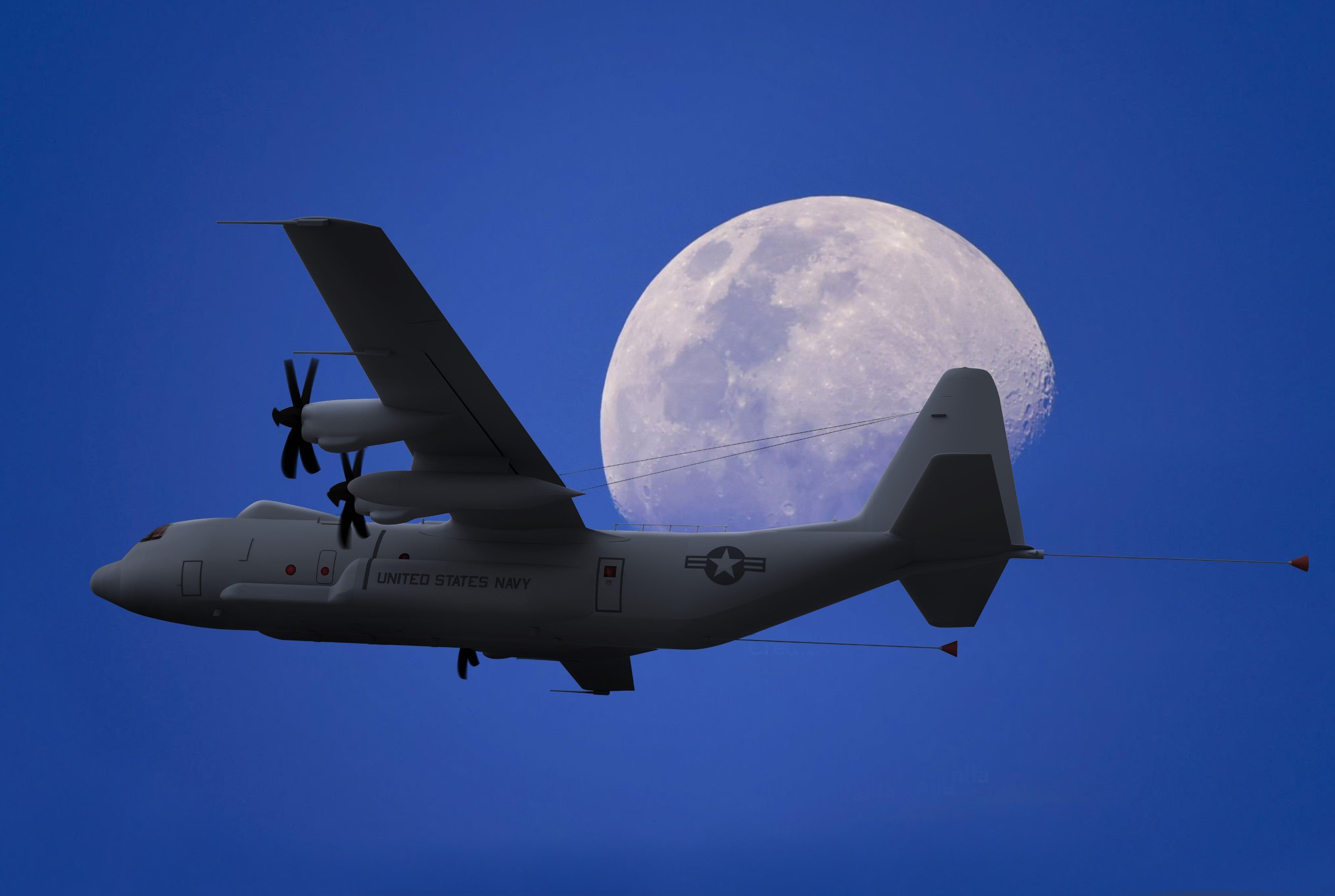
Rendering of the U.S. Navy's future E-130J aircraft, which will relieve the E-6B Mercury of the Take Charge and Move Out (TACAMO) mission. (Rendering courtesy of Northrop Grumman Corp.)
Rendering of the future E-130J aircraft. Courtesy of Northrop Grumman Corp.

In the past, TWZ has discussed the potential operational readiness and other trade-offs that could come from selecting a C-130-based platform to replace the E-6B in the TACAMO role. As we wrote previously:

“It’s certainly worth pointing out that the E-6Bs, conversions of what were some of the last and most modern 707 airliners built, were larger and higher performance platforms than the EC-130Qs. The C-130J-30 is certainly a more capable aircraft than the C-130H on which the EC-130Q was based, but it won’t have the base speed and altitude capabilities of an airliner-sized multi-engine jet. Compared to the Mercuries, any TACAMO-configured C-130J-30 would not be able to get on station as quickly, or fly as high, limiting its ability to get above bad weather or establish a better line of sight for its communications systems.”

“At the same time, as the Navy itself has noted, the C-130J-30 platform does immediately open up the ability to use a larger number of air bases, airports, and airfields, including austere ones that the E-6B cannot operate from. This could be very useful in a contingency scenario where an opponent may have destroyed or otherwise rendered unusable many well-established bases, as well as larger secondary dispersal sites, which include large commercial airports. Being able to fly from smaller, tertiary locations could help to ensure that the TACAMO mission continues without significant disruption under such circumstances. This is also true during peacetime, as targeting the TACAMOs on the ground would be much harder if they could easily operate from and sit alert at a much larger number of airports.”

“A C-130J-30 configured for the TACAMO mission would certainly have a mid-air refueling capability, and the Hercules is already a platform that has demonstrated the ability to loiter over particular areas for long periods of time. Unlike the Boeing 707, the C-130J is still in production, as well, meaning that TACAMO aircraft based on this plane would be inherently easier to maintain and support logistically, and may also be easier to convert to this specialized configuration to begin with. As time goes on, the J looks set to increasingly become the default base C-130 model across the U.S. military, as well. Compared to the long out-of-production 707-based E-6, support for the C-130J is already distributed across the U.S. and beyond. Training C-130J crews is even an easier proposition.”

The E-130J also represents a return to the Hercules family for the Navy’s TACAMO mission. The EC-130Q performed the role from 1963 to 1993, before the E-6A Mercury took over. The E-6B subsequently added an airborne command post mission known as Looking Glass, supporting U.S. strategic forces beyond the submarine communications role.

The US Navy operated a fleet of EC-130Q TACAMO aircraft like the one seen here before the arrival of the E-6As. U.S. Navy

The Navy’s current plan is for the E-130J to assume the TACAMO mission, while the Air Force pursues a separate effort to replace the Looking Glass airborne command post capability.

Following its delivery, the first E-130J airframe will enter mission-systems modification, ground testing, and developmental flight testing. The aircraft is not yet an operational TACAMO platform, and further integration and testing will be required before the Navy can begin fielding the new fleet.

The transition is intended to preserve one of the most critical links in the U.S. nuclear command, control, and communications architecture as the E-6B fleet becomes increasingly difficult to sustain.

Contact the author: thomas@thewarzone.com

The post First C-130J For Navy’s New E-130J Phoenix II Ballistic Submarine Communications Fleet Delivered appeared first on TWZ.
  •  

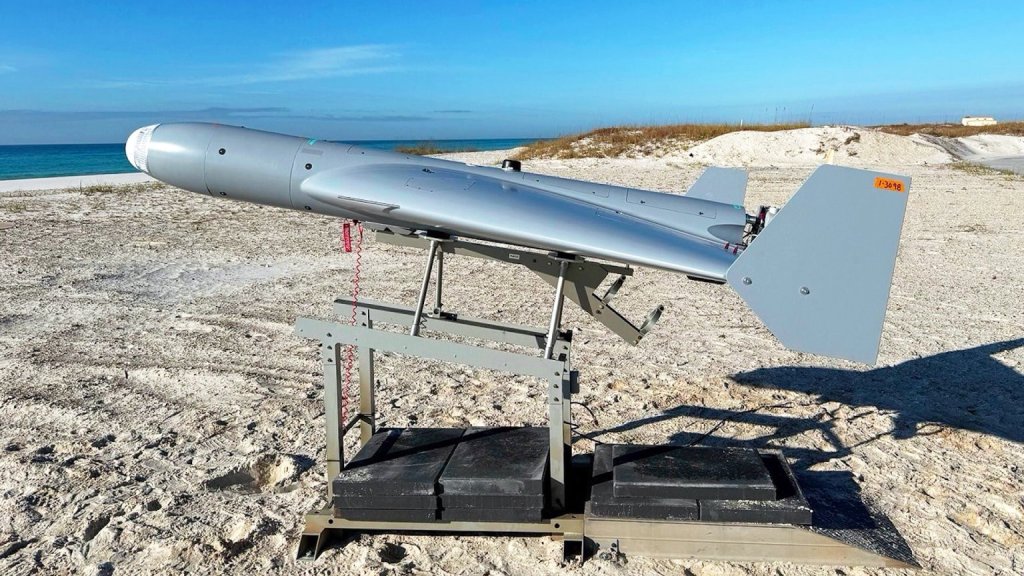
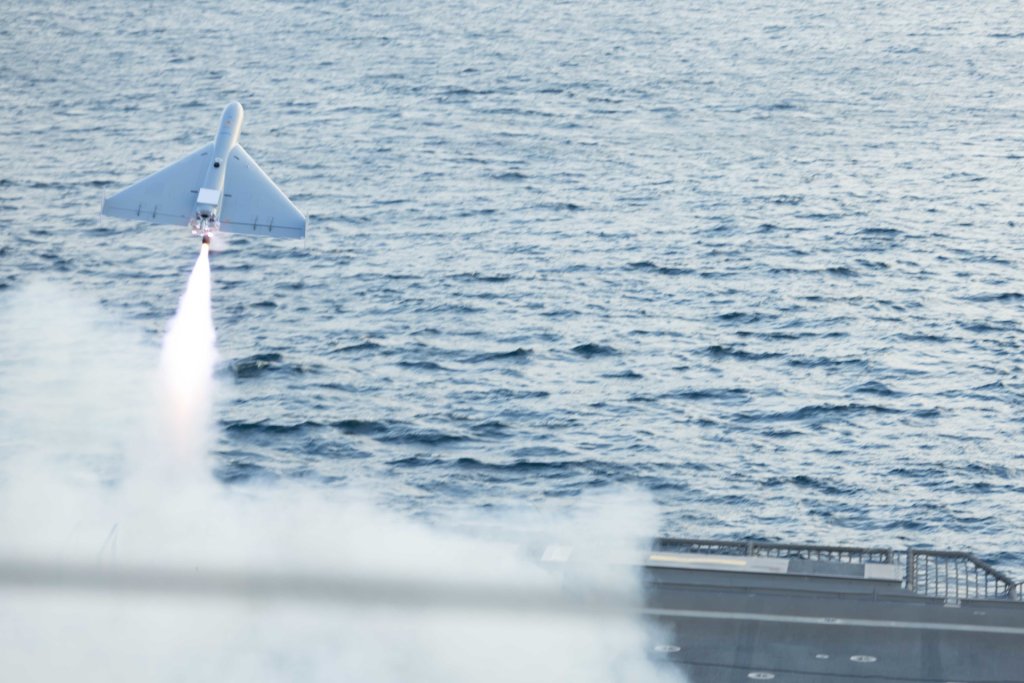
The Army’s Plan For Employing LUCAS Kamikaze Drones Against Its Adversaries

America’s adoption of long-range one-way attack munitions like the Low-Cost Uncrewed Combat Attack System (LUCAS) is evolving quickly. Training on how to fold these relatively low-cost, but potentially highly destructive systems into a joint force playbook for targeting adversaries on land and at sea, from the Pacific to Europe, and anywhere in between, continues.

How exactly LUCAS drones, and other types to come, will be used in future fights globally was highlighted during a panel at the Association of the U.S. Army’s (AUSA) main annual symposium earlier this week, at which TWZ was in attendance. The discussion was centered on how Army training is changing to meet the extreme combat demands of the future.

The U.S. military first announced it had begun fielding LUCAS, which was reverse-engineered from the Iranian-designed Shahed-136, in December 2025. This came just months after TWZ laid out a detailed case for why the U.S. military should start acquiring Shahed-136 clones in large volumes. LUCAS made its official combat debut in the opening phases of major combat operations against Iran earlier this year. The pusher-propeller, combustion-engine-powered kamikaze drones, which are employed from static launchers that can be positioned on the ground or installed on ships, and with the help of a small rocket booster, were subsequently praised as “indispensable” by America’s top commander in the Middle East.

A LUCAS drone on a static launcher. Shield AI

With all that in mind, “long-range strike drones like LUCAS, how is that fitting into your planning and training?” our Howard Altman asked the panelists at AUSA.

“We’ve taken our Bayonet Academy, as we call it, a training area at JBLM [Joint Base Lewis-McChord in Washington State], and have started incorporating the employment of long-range one-way attack. Like, how do I maintain it? How do I employ it? How does that then get orchestrated in order to achieve that effect?” Maj. Gen. Bernard Harrington, head of the 7th Infantry Division, responded. “So we see that playing a key role in order to be able to achieve that effect at mass, … [and] in an affordable manner, while also being able potentially to preserve something that’s more exquisite for something that requires an exquisite munition.”

Earlier this year, the Army brought the 7th Infantry and the 1st Multi-Domain Task Force together under the umbrella of what it now calls the Multi-Domain Command-Pacific (MDC-PAC). Maj. Gen. Harrington is also now the commander of MDC-PAC, and has talked previously about how he sees uncrewed capabilities as critical to overwhelming adversaries in future conflicts. The service’s MDTFs, of which there are now four, have been at the leading edge of fielding new long-range strike and other advanced capabilities.

In his response to Altman’s question, Harrington elaborated more on how he sees long-range one-way attack munitions like LUCAS factoring specifically into future fights in the Pacific, such as one against China. The Chinese People’s Liberation Army (PLA) has already established extensive anti-access and area denial (A2/AD) bubbles in the Western Pacific and is continuing to expand on that strategy.

A map showing Chinese military outposts in the Spratly Islands at the southern end of the South China Sea, including those seen in the pictures in this story, as well as other non-Chinese facilities in the hotly contested region. This gives a good sense of the anti-access/area denial bubbles that China has already established and continues to expand upon. DOD

“So as we start modeling out what it looks like to be able to penetrate a portion of the anti-access/area denial network in support of the joint task force in the PACOM [U.S. Pacific Command] area of operations, we started looking at, well, how do I bend – how do I achieve mass at a cost curve?” the 7th Infantry and MDC-PAC commander explained. “What effect am I really trying to achieve on a system in order to provide that window of opportunity for that joint force commander?”

“So maybe I don’t necessarily need to sink a ship, but if I take out certain systems on that vessel, well then it creates this temporal window opportunity,” he continued. “Then that joint force commander can surge in that carrier strike group or bomber task force.”

What the general is describing here is typically referred to as a mission kill. For years now, TWZ has repeatedly highlighted how long-range one-way attack drones and loitering munitions could be used in exactly this way against even larger warships. Damaging or destroying radars, communications antennas, and other subsystems could severely degrade a ship’s combat effectiveness and increase its vulnerability to follow-on attacks. The time and effort required for repairs could keep it sidelined for a protracted period of time.

A LUCAS drone seen being launched from the stern flight deck of the US Navy’s Independence class Littoral Combat Ship (LCS) USS Santa Barbara during a test. NAVCENT/C5F/U.S. Army Spc. Kayla Mc Guire

“So when we started looking at that, we saw great value. That maybe I don’t have to use specifically or unmask an exquisite system to achieve that effect,” Harrington added. “If I can achieve [the] effect of mass utilizing lower cost systems, hey, maybe that will get me there. So we modeled that, and what we saw was, particularly with our unmanned surface vessels [USV], long-range one-way attack, long-range launch effects, the ability to synchronize and mass that could potentially get us to achieve that effect.”

As with long-range one-way attack drones, the adoption of kamikaze USVs by the U.S. military is evolving rapidly. America’s first use of this capability in real combat also came against Iran in July.

Yesterday, using multiple one-way attack surface drones, CENTCOM forces successfully struck a submarine and ship maintenance facility in Iran. Three Corsair unmanned surface vessels hit the port at Bandar Abbas Naval Base, marking the first time American forces have employed sea… pic.twitter.com/bOM2kmgRxz

— U.S. Central Command (@CENTCOM) July 13, 2026

The term “launch effects” that Harrington used here is a catch-all term the U.S. military now routinely applies to a diverse array of uncrewed aerial systems designed to be launched from other platforms in the air, on the ground, and/or at sea. This includes loitering munitions, but also designs configured for surveillance and reconnaissance, electronic warfare, signal relay, and other tasks. The lines separating long-range one-way attack drones, launched effects, and traditional cruise missiles and decoys are in many cases now very blurry.

None of this is limited to the Pacific region or the Middle East, either.

“So, in terms of launch effects, I think you mentioned LUCAS. Covenant’s out there. There’s other systems that are out there,” Brig. Gen. Steven Carpenter, head of Multi-Domain Command-Europe (MDC-E), another one of the panelists, also said in direct response to Howard Altman’s question. “In Europe, we like that, more than accepting risk in an area, maybe we’re disintegrating an anti-access/area denial bubble in the center, and then way up north, we’re going to go ahead and accept some risk there. We like to use those systems to create counter-fire parity, long-range fires parity with an adversary.”

Similar to the establishment of MDC-PAC, MDC-E was formed last year by blending together the 56th Artillery Command and the 2nd MDTF, both of which are forward-deployed in Germany.

The “Covenant” mentioned by Carpenter is a U.S.-Israeli company that has been developing a long-range strike weapon system called Anthem. It was just confirmed in September that the U.S. Army has been actively engaged in testing of Anthem. This includes a live-fire demonstration in Morocco earlier this year. You can read more about Anthem and the current plans for it here.

An example of Covenant’s Anthem long-range strike weapon, seen here being tested by the US Army. US Army

“The reason we like those types of systems is because they’re EMI [electromagnetic interference] resilient, they’re longer range, and they’re higher yield, so they can go ahead and destroy like SS-26 systems, SS-21 systems,” the MDC-E commander added.

SS-26 Stone and SS-21 Scarab are the NATO reporting names for Russia’s Iskander-M and the older Soviet-designed OTR-21 Tochka short-range ballistic missiles, respectively. They are both fired from road-mobile launchers. Russia and Ukraine have employed Tochka in the course of their ongoing conflict, though their role on both sides has steadily diminished amid shrinking inventories. Tochka is also increasingly limited in service elsewhere globally. Iskander-M is a much more capable design that has factored heavily into U.S. military planning in Europe for years now. The U.S. military has previously acknowledged that war in Ukraine has led to improvements to that missile that make it even more dangerous and difficult to intercept.

A stock picture of an Iskander-M short-range ballistic missile being fired from a road-mobile transporter-erector-launcher. Russian MoD

Long-range one-way attack munitions like LUCAS are well suited to striking surface-to-surface and surface-to-air missile launchers, along with other high-value and time-sensitive targets, as TWZ highlights regularly. It’s also worth noting that Iran’s Shahed-136, specifically, traces its roots back to pioneering Israeli developments in munitions of this kind, where the focus initially was explicitly on finding new avenues to neutralize hostile air defenses. Iran has shown Shahed-136s and other related designs being employed in exactly this way in large-scale exercises in the past, as seen in the video below.

More recently, Iranian forces demonstrated just how effective these capabilities could be in a real-world context in retaliatory attacks on prized air defense radars on the opposite side of the Persian Gulf after the United States and Israel launched their open waves of strikes back in February. TWZ previously explored the far-reaching ramifications of this in a detailed feature that you can find here.

Overall, as we’ve previously written:

“When it comes to this class of drone, speed and advanced guidance concepts do not define its utility. Range and cost do. Survivability comes in numbers, and due to their smaller size, use of composite materials, and small internal combustion engine, as well as their slow speed. These attributes, along with their low-altitude flight profile, mean they possess a reduced signature and general level of detectability that can be a challenge for traditionally configured ground-based radars. Despite their smaller signature, the fact that they are still somewhat vulnerable to interception is actually a positive, but we will get to that in a moment.”

“Above all else, the Shahed-136 and other long-range one-way attack drones exist to put a relevantly-sized warhead on a target far from their launch position at the lowest possible cost. It was previously estimated that the Russian Shahed-136 variant costs around $50,000 per copy, with some estimates being far lower. This cost has also likely declined significantly since Russia has mastered the design and drastically ramped up serial production. By comparison, traditional cruise missiles with similar range have costs in the millions of dollars per round, so the price differential is very dramatic. The Shaheds are also just far easier to build and can be produced in much less time than a typical cruise missile.”

Another look at a LUCAS long-range one-way-attack drone. Mark Schauer/US Army

The ‘mass’ afforded by LUCAS and other long-range kamikaze drones also imposes problematic cost calculations for opponents when it comes to the air defense equation, and offers a way to rapidly drain an opponent’s stocks of vital interceptors. These are realities the U.S. military is currently grappling with after expending thousands of anti-air interceptors in conflict with Iran and in other crises in the Middle East in recent years, as well as supporting allies and partners, such as Ukraine.

LUCAS, specifically, is already in line to become even more capable through the introduction of a swarming capability, made possible by the Hivemind autonomy software package from Shield AI. As we’ve explained before:

“Using the software, multiple LUCAS drones will be able to share tasks and maneuver cooperatively, making saturation attacks even more effective. As well as the drones dynamically rerouting, avoiding air defenses, and otherwise adapting to changing battlefield conditions, an AI pilot makes it easier for missions to continue despite hostile jamming or loss of datalink connectivity. Indeed, using AI, drone swarms can maintain near-perfect combat efficiency even if it loses members. Drones can be configured with all different payloads, with the swarm’s makeup tailored to each mission, and the AI system can maximize their collective effectiveness at all times.”

The U.S. Army still has many questions to answer about how it will field LUCAS and other long-range one-way-attack drones on a more widespread basis, as well as train personnel to employ them. As evidenced by the establishment of the MDTFs, and now the MDC-PAC and MDC-E formations, the underlying force structure that will go along with all of this is still evolving, as well.

The remarks from Maj. Gen. Bernard Harrington and Brig. Gen. Steven Carpenter at AUSA this week show senior Army leaders are working hard now to lay the groundwork to answer these questions. A clear vision for how LUCAS and similar weapons will be employed in future fights against land-based and maritime threats is taking shape already.

Contact the author: joe@twz.com

The post The Army’s Plan For Employing LUCAS Kamikaze Drones Against Its Adversaries appeared first on TWZ.
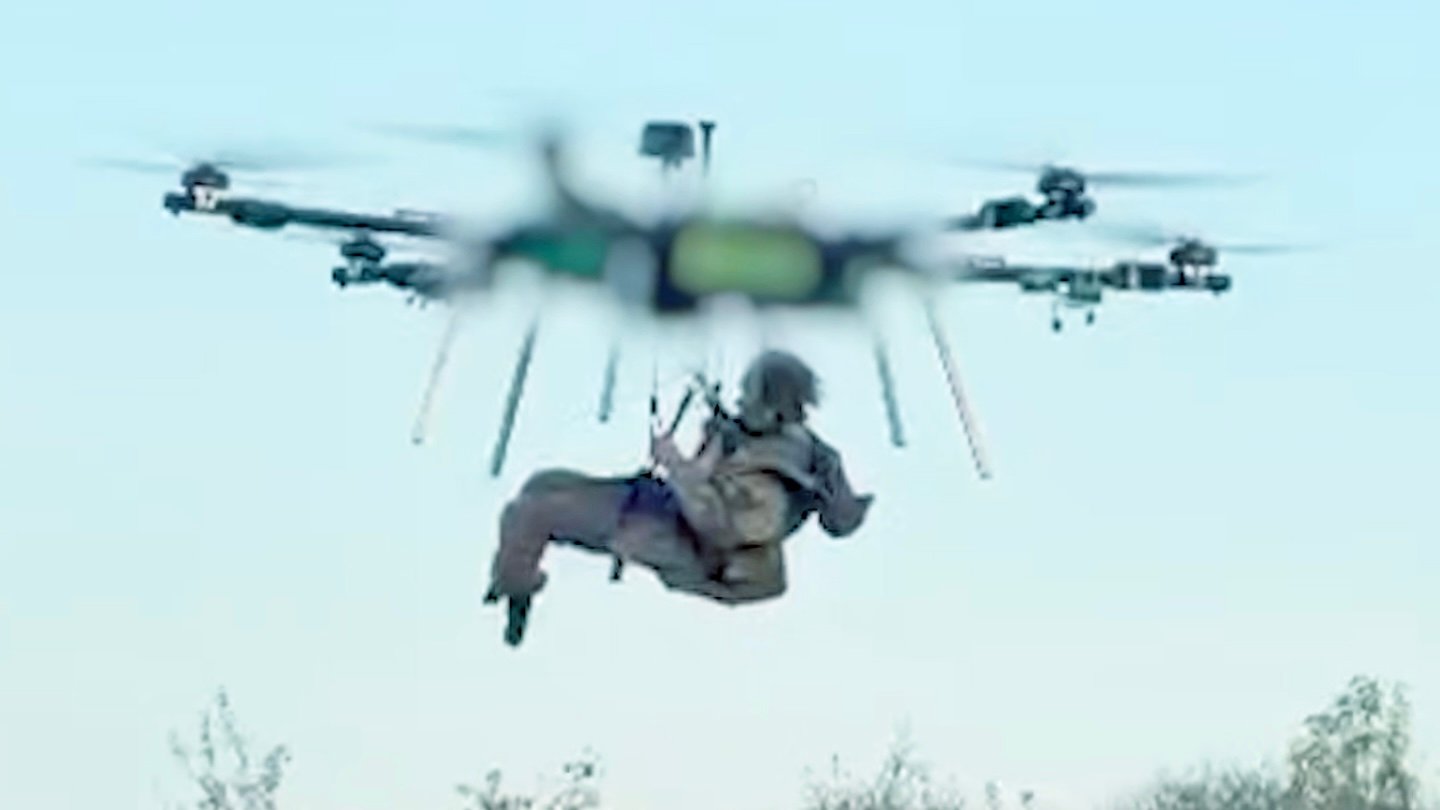
  •  

MQ-72C Cargo Helicopter Drone Capabilities Demonstrated For U.S. Army

Airbus recently put the demonstrator for its MQ-72C drone helicopter through the paces for the U.S. Army. The MQ-72C has been in development for several years now for a U.S. Marine Corps competition seeking a new uncrewed cargo-carrying Aerial Logistics Connector (ALC). The Marines see uncrewed logistics ‘connectors’ as key to future expeditionary and distributed operations, and a similar Army requirement could be on the horizon, especially to support long-range air assaults.

Jaysen Yochim, Senior Director for the ALC program at Airbus, talked about the demonstration for the Army with our Howard Altman at the Association of the U.S. Army’s (AUSA) main annual convention on Monday. Airbus is currently teamed with L3Harris Technologies, Shield AI, and Parry Labs on development of this drone helicopter for the Marines, as you can learn more about here.

The current iteration of the MQ-72C is based on the crewed UH-72B Lakota, which is in turn a variant of Airbus’ H145 twin-engine light helicopter. The Army operates crewed UH-72s today, but only in non-combat roles, including counter-drug and border patrol missions, and almost exclusively within the borders of the United States.

US Army crewed UH-72 Lakota helicopters. US Army US Army UH-72A Lakotas. US Army

The MQ-72C demonstration for the Army, which Airbus self-funded, took place last week at Huntsville Executive Airport just outside of Huntsville, Alabama. The service has a major presence in the Huntsville area, which is focused heavily on supporting aviation and missile developments. As of April of this year, Airbus and its partners had already conducted four rounds of autonomous flight testing of the initial demonstrator version of this design, which is not in a fully uncrewed configuration.

“We did a demonstration for the Army down in Huntsville, really to show all the capabilities that we’ve been able to develop so far on the Marine Corps-funded program,” Yochim said. “We had a total of five demonstration flights that we did down there, showing everything from the autonomous capability of the aircraft in a hover.”

This included “complex hovering patterns, both step turns and fly-through turns, similar to what you’d see on an airfield, to just show how it can be integrated onto an airfield inside of the existing routing structure and everything that exists on an airfield,” he continued. “We did multiple traffic patterns to demonstrate just a normal traffic pattern, like a normal day would be, but also traffic patterns or a flight with a no-fly zone popping up in the middle of the flight.”

The video below shows previous flight testing of the MQ-72C demonstrator.

In that latter instance, the MQ-72C had to “autonomously make decisions” about how it was “going to route itself around the no-fly zones” once they popped up, he added. The human operator did provide the initial flight plan. There was also a pilot on board during the autonomous flight demonstrations, but only as an added safety margin, and they “never had to take control of the aircraft once,” according to Yochim.

Though the demonstrator now has provisions for a pilot, the intention is for the MQ-72C to eventually operate in a completely uncrewed mode. The current version of the design has two LIDAR sensors, facing front and back, as well as an electro-optical camera at the nose end, to help with navigation and otherwise provide situational awareness while operating in the uncrewed mode.

Those sensors feed “imagery into the flight computer with HiveMind that’s interpreting that through its perception systems to make decisions on the go,” Yochim explained. HiveMind is an autonomy software package from Shield AI, which is in use on a growing number of other uncrewed platforms, as you can read more about here.

Yochim also talked about work that has already been done to start laying the groundwork for controlling the MQ-72C in the fully uncrewed mode. Parry Labs has been leading ground control station work.

“Over the summer is really where now the aircraft, rather than having a pilot inside the aircraft, or sorry, an autonomous operator inside the aircraft, using a gaming computer to tell the aircraft what to do, now the aircraft is receiving commands from a ground control station,” he told us. “That is that human in the loop, sending commands to the aircraft over Starlink, so that it has beyond line-of-sight. We’ve had flights that have been autonomously commanded from up to 70 miles away. All of that is stuff that’s happened in the last year. We also have where the aircraft can be commanded from both a ground control station like this and also with the Samsung tablet.”

SpaceX’s Starlink space-based network and its more secure, government-focused cousin, Starshield, are in increasingly widespread use across the U.S. military for communications and other purposes. At present, Starlink also dominates the commercial market for these services globally. Starlink and Starshield offer highly persistent and robust connectivity that is ideal for uncrewed aircraft command and control operations.

The current MQ-72C demonstrator also lacks certain features that are expected to be found on the final configuration. Plans for a set of clamshell doors at the nose notably still have yet to be realized. The UH-72 design already features clamshell doors at the rear of the fuselage, as seen below. The end goal is for the uncrewed version to have an open pass-through main cabin, offering major advantages for loading and unloading cargo, and doing so rapidly.

US Army National Guard A look in through the rear of a UH-72A in a medical evacuation configuration. US Army National Guard

The nose door arrangement has been “designed. It’s been 3D rendered. It’s gone through some testing on that end, but not flight testing,” Airbus’ Yochim told us. “The flight testing, wind tunnel testing, things like that, take time, and it’s just not been the priority to get there with getting the aircraft ready.”

Yochim said that Airbus is now looking toward the 2029-2030 timeframe for integrating the nose doors. This is tied, in part, to the Marine Corps’ ALC program, where delayed funding has shifted the schedule to the right. On that front, the Marine Corps is aiming for demonstration of this capability in an operationally relevant context next year. The Airbus-led team is also not the only one under contract for that program, with Near Earth Autonomy and Honeywell also working on a design based on the Leonardo AW139 helicopter. The expectation is that the Marines will eventually pick a single ALC design to actually acquire.

In the meantime, Airbus is clearly eyeing other opportunities, including with the U.S. Army. The company’s main arm in Europe is also now pitching a functionally identical U145 drone helicopter based on the current generation H145 design.

At @ILA_Berlin, we introduce the Airbus U145: an uncrewed, fully autonomous variant of the H145. Optimised for cargo with no cockpit, an integrated nose door, and full autonomy, its first flight is set for late 2026. https://t.co/MbodUxYxyI pic.twitter.com/2EnMXzog6c

— Airbus Helicopters (@AirbusHeli) June 8, 2026

Airbus did the “demonstration to just show the Army the capabilities that we’ve been developing with the Marine Corps,” Yochim told us. “So the Marine Corps has been funding the program up to now, and so the message we are giving the Army is this is how far your sister unit [sic; service] has been able to get us with the funding that we’ve had. It’s already product that’s out there. It’s already product that’s working.”

As mentioned, the Marines see ALC as part of a larger family of uncrewed logistics ‘connectors,’ in the air and on the surface, which will be critical to supporting expeditionary and distributed operations involving units spread across far-flung forward locations. The service sees this as particularly central to an island-hopping campaign scenario in the context of a larger potential high-end fight with China in the Pacific, where traditional logistics chains will be top targets. The conflict with Iran has only underscored how disruptive those threats can be.

The Army is facing many of the same kinds of future operational scenarios, especially when it comes to supporting future airmobile operations. The service is already expecting air assaults to take place over far greater distances in the future thanks to the introduction of the MV-75A tiltrotor. Those units will need to be supported once they arrive at their objectives, which could be heavily contested.

A rendering of a pair of MV-75A tiltrotors. Bell

“We did several [air assaults] over the last few years directly from Fort Campbell to the Joint Readiness Training Center, which is 500 miles, give or take. The [Marine Corps’ MV-22] Osprey can do that very fast and in one leap,” Army Maj. Gen. David Gardner, head of the 101st Airborne Division, told our sister site Task & Purpose at AUSA. “Our current helicopters, you’ve got to make some fuel and re-arming stops along the way, and the distance isn’t there. But now that helped us think through as a division how we were going to command and control something that moved, expanded our battlefield, so to speak, twice as far, three times, four times as far, and twice as fast.”

The 101st is the Army’s premier air assault formation and is set to be the first to fly MV-75As operationally.

“We can put some things inside the helicopter, and we can put some things under a helicopter with a sling load. We’re not going to sling load something moving 250-ish knots for 500 miles. We’re not going to hang Humvees under that,” Gardner also told Task & Purpose. “We learned some things about how we need to get our equipment to the battlefield, how we need to get our sustainment to the battlefield at those distances, how we might need to rely on autonomous logistics delivery systems.”

A US Army CH-47 Chinook helicopter seen carrying a Humvee and an M119 105mm towed howitzer slung underneath. US Army

It should be stressed that the market for semi-autonomous aerial logistics support is heating up, and that the MQ-72C is not the only option to meet such a requirement. As noted, there is another competitor in the running just for the Marines’ ALC effort, the AW139-based offering from Near Earth Autonomy and Honeywell.

Last year, Sikorsky, now a subsidiary of Lockheed Martin, revealed that it was working on a fully uncrewed version of the Black Hawk helicopter that also features a clamshell nose. Sikorsky has also been working with Robinson Unmanned on a pilotless version of the smaller R66 helicopter that again features clamshell doors at the front of the fuselage. Bell, together with Near Earth Autonomy, is developing an uncrewed cargo-carrying version of its Model 505 Jet Ranger X, as well. The drone versions of the R66 and Jet Ranger X are aimed primarily at another Marine Corps ‘connector’ program called the Medium Aerial Resupply Vehicle-Expeditionary Logistics (MARV-EL).

A rendering of the uncrewed Bell 505. Near Earth Autonomy

As mentioned, the Army does already operate crewed UH-72s, but it also flies Black Hawks. The service is also expanding its use of contractor-operated R66s for pilot training.

The Army does not appear to have formalized any requirement for a cargo-carrying drone helicopter yet. At the same time, the comments from Maj. Gen. Gardner certainly suggest one may be emerging now.

There was at least enough interest within the Army already to accept Airbus’ offer of a demonstration of its MQ-72C last week.

Contact the author: joe@twz.com

The post MQ-72C Cargo Helicopter Drone Capabilities Demonstrated For U.S. Army appeared first on TWZ.

  •  

New Montana “Super Range” Complex Could Add Critical Weapons Testing Capacity

A plan for a new military weapons “super range” test center in Montana announced by President Donald Trump Wednesday night seeks to address a growing concern about the need for more such facilities. As the U.S. races to develop autonomous capabilities, hypersonic munitions, laser and directed energy weapons and improved electronic warfare systems, a limiting factor has been the lack of suitable locations for testing.

While the U.S. military has a wide array of installations where it can test these systems, it’s still not enough. In addition to the massive increase in weapons development and the need for more realistic training, the changing nature of war is outstripping the capacity of existing facilities as future kill webs will extend thousands of miles, not hundreds. There are only so many places with enough space to try out these systems even to a limited degree without butting up against statutes and regulations while also avoiding interference with civilian air traffic and communications, all in an environment remote enough to avoid prying eyes. The need for more and bigger testing grounds is an issue TWZ has long raised.

In addition to the backdrop of the increase in a wide range of weapons testing, much of it aimed at China, Trump’s super range announcement was delivered as the Pentagon and services are specifically creating commands dedicated to autonomous weapons. On Tuesday, during the annual Association of the U.S. Army (AUSA) conference in Washington, D.C., attended by TWZ, the acting Army Secretary unveiled one such new command, which we will discuss in greater detail later in this story.

“I’m pleased to inform ​you and announce that right here in Montana, the Department of War is ⁠going ⁠to establish a new ⁠”super range” ​for testing advanced weapons and technologies, technologies including potential autonomous weapons, space, and electronic ​warfare technology, supersonics and ⁠hypersonics,” Trump said during a campaign rally in Kalispell. “Montana will help ensure the American military always reigns supreme.”

.@POTUS: "I'm pleased to inform you and announce that right here in Montana, the @DeptofWar is going to establish a new Super Range for testing advanced weapons and technologies, including potential autonomous weapons, space and electronic warfare technology, supersonics, and… pic.twitter.com/W4YqKfq8X4

— Rapid Response 47 (@RapidResponse47) October 15, 2026

Trump provided no additional details about where this new “super range” will be located, when it will come online, exactly which systems will be tested or how much it will cost.

Thursday morning, the office of U.S. Sen. Tim Sheehy noted that he has been “a strong advocate for building an advanced training range in Montana, securing $10 million for a feasibility study in the FY27 National Defense Authorization Act that passed the Senate Armed Services Committee earlier this year.”

“The 21st-century battlefield is being redefined by new weapons and evolving technical frontiers that require a novel approach to how America will resource its warfighting capabilities,” the senator said in a statement. “Contested spectrum, electronic warfare, hypersonics, space capabilities and enhanced targeting require a new class of testing and evaluation facilities for our military. The U.S. faces a clear choice: adapt and expand our development infrastructure to the realities of modern warfare, or risk falling behind adversaries who iterate faster.”

The Montana Republican highlighted the value of his state’s huge swaths of undeveloped land for this effort.

“By combining our state’s vast landscapes, innovative spirit, and proud tradition of military service, we are the Last Best Place to ensure America’s fighting men and women have the technological edge they need to dominate the battlefield and win the wars of tomorrow,” he explained.

Montana (Google Earth)

Like Trump, Sheehy offered no specifics about exactly where in Montana the “super range” will be located, when it will come online or how much it will cost. We have reached out to the White House, Sheehy and the Pentagon for more details. The Pentagon deferred us to the White House, which referred us back to the Pentagon. We also contacted the office of U.S. Sen. Steve Daines and Gov. Greg Gianforte.

There are already a number of facilities in Montana conducting the kind of military weapons testing described by Trump. One that closely matches what would be needed from such a location is the Montana Spaceport & Test Range and the affiliated Limestone Hills Innovation & Test Campus. A public-private aerospace and defense initiative, it already conducts testing for next-generation space vehicles, hypersonic, supersonic and ballistic weapons, drones and counter-drone systems and electronic warfare equipment.

Another potential site could be an expansion of the Big Sky Autonomous Systems Range (BSASR). Located near Bozeman, it is “the Lobo Institute’s primary training and testing facility for U.S. and allied military, federal, and partner organizations.” Operated under the Lobo Tactical division, BSASR is “a 6,000-acre, fully fenced complex purpose-built for advanced unmanned aerial systems operations, full-spectrum live fire, mounted and dismounted mobility, and full mission profile exercises grounded in the latest tactics, techniques, and procedures from active conflict zones,” according to the Lobo Institute. “The range pairs realistic terrain with the regulatory, infrastructure, and instructor depth required to train against the operational realities of today’s and tomorrow’s battlefields — and it does so in a remote, controlled environment where units can push hard while keeping risk to acceptable levels.”

Training at the Big Sky Autonomous Systems Range in Montana. (BSASR)

We have reached out to both facilities for more details.

The new super range could also leverage existing range space on the ground and in the air. There is also the large Hays Military Operations Area (MOA) which could be expanded for this new test range effort. MOAs are blocks of airspace designated for military training. Malmstrom Air Force Base and its ICBM fields could also potentially be utilized. Overall, it’s possible a number of existing range areas could be interconnected, both digitally and via airspace corridors, to create a larger complex, as well.

The Pentagon has long realized the need to increase the areas where it can test out these systems, especially to evaluate them under combat-like conditions.

“The current open-air range space should be increased and better integrated to support system-of-systems assessments of air, land, and sea combat systems with capability for emerging long-range fires, hypersonic missiles, EMS warfare, unmanned systems, nuclear effects, and directed energy (DE) weapons,” the Pentagon’s Director of Operational Test & Evaluation (DOT&E) stated in a report last year. “The DoW needs to invest in and coordinate expanding and connecting the airspace available to the open-air ranges enabling testing and training of advanced capabilities.”

DOT&E

The current facilities are inadequate, DOT&E further explained.

“Threat systems and our own capabilities far exceed the current available air space on the open-air ranges,” according to the report. “The ranges need support and assistance to coordinate additional airspace and corridors with the FAA and industry. Expanding and connecting range air space is necessary to facilitate testing and training critical long-range capabilities that our warfighters need and to replicate the threats they will face.”

In addition, the report states that “to test missiles with longer ranges and gather data to support simulation validation, including for hypersonic missiles, the DoW should invest in long-range, overland missile flight test corridors with land-based impact areas and mobile hypersonic-specific range instrumentation to produce the required lethality data against threat-representative targets for terminal area assessments.”

Rendering of an X-51A Waverider hypersonic weapon. Powered by a Pratt & Whitney Rocketdyne SJY61 scramjet engine, it is designed to ride on its own shockwaves and accelerate to about Mach 6. (U.S. Air Force)

The Defense Department had largely been conducting the testing of hypersonic weapons — those that can reach speeds of Mach 5 and above — at sea given the need for the long ranges for evaluation. Still, even that was limited. The Pentagon restricted the number and location of hypersonic tests it carried out each year because of the aging fleet of ships it used as its primary data collection assets to track the capabilities while in flight.

Retired Block 20 and Block 30 RQ-4 Global Hawks belonging to the U.S. Air Force, reconfigured as RangeHawks under the SkyRange hypersonic weapon testing infrastructure program, would help address some of those restrictions. You can read more about that in our story here.

However, if testing moves to an overland phase, the need for expanded air corridors could grow increasingly critical. Last year, the Pentagon’s Test Resource Management Center (TRMC) identified three candidate locations to perform those tests, one over Alaska, another at White Sands Missile Range in New Mexico and a third in Australia, Defense News reported at the time.

An interceptor launches from an Indirect Fire Protection Capability (IFPC) system operated by Soldiers assigned to the 1st Battalion, 51st Air Defense Artillery Regiment, 7th Infantry Division (Multi-Domain Command Pacific), during a test at White Sands Missile Range, New Mexico, on July 28, 2026. (U.S. Army photo by Sgt. Michael Majors and White Sands Missile Range Public Affairs)
An interceptor launches from an Indirect Fire Protection Capability (IFPC) system operated by soldiers assigned to the 1st Battalion, 51st Air Defense Artillery Regiment, 7th Infantry Division (Multi-Domain Command Pacific), during a test at White Sands Missile Range, New Mexico, on July 28, 2026. (U.S. Army photo by Sgt. Michael Majors and White Sands Missile Range Public Affairs) Sgt. Michael Majors

Hypersonic testing in Australia is already underway. Earlier this month, we broke the news that the U.S. Air Force’s scramjet-powered Hypersonic Attack Cruise Missile (HACM) had finally reached the flight test phase, with at least one “release” having been carried out so far over a range in Australia.

The U.S. Air Force's scramjet-powered Hypersonic Attack Cruise Missile (HACM) has finally reached the flight test phase, with at least one "release" having been carried out so far over a range in Australia.
The U.S. Air Force’s scramjet-powered Hypersonic Attack Cruise Missile (HACM) has finally reached the flight test phase, with at least one “release” having been carried out so far over a range in Australia. (Raytheon) Raytheon

The military is also looking to expand where it can test electronic warfare systems to help ease the bottleneck at White Sands and a few other locations. Such testing is limited due to U.S. restrictions on jamming, which can interfere with civilian systems.

Before he resigned after tensions with Defense Secretary Pete Hegseth, former Army Secretary Dan Driscoll in June said the service had plans to set up at least two domestic ranges that mimic realistic conditions on Ukraine’s battlefields, where the electromagnetic spectrum is a highly contested domain. This spectrum would be even more heavily disputed in a fight with China.

“You can have a kind of electronic warfare and all of the contested environment created, and you can have drone manufacturers and counter-drone tool-builders engaging together,” Driscoll told reporters. “Then, we also want soldiers to be able to go there, so that they can strengthen their skills and work hand-in-hand with developers.”

A drone swarm returns from a mission during the XVIII Airborne Corps’ Scarlet Dragon 26-3 at Fort Bragg, N.C., Sept. 15, 2026. Scarlet Dragon used coordinated swarms of up to 100 drones to stress sensor networks, software and air defense crews. Flying realistic aerial threat profiles helped the corps evaluate its ability to detect, track and respond to dense unmanned aircraft system threats. (U.S. Army photo by Pfc. Iliana Lopez)
A drone swarm returns from a mission during the XVIII Airborne Corps’ Scarlet Dragon 26-3 at Fort Bragg, N.C., Sept. 15, 2026. (U.S. Army photo by Pfc. Iliana Lopez) Pfc. Iliana Lopez

Driscoll said there are already places in the U.S. where the Army can test safely, and separately, the service is looking at a global range outside the U.S. to do “much more aggressive testing,” including with hypersonics. When asked, Driscoll declined to say where these ranges would be until planning is farther along. 

“At least some of the current counter-drone training for soldiers, like one CBS News saw in April, does not include electronic jamming — in part because the U.S. restricts jamming domestically,” CBS reported.

In August, the Army opened premier test ranges for the use of private industry to conduct internal research and development. Additionally, the service co-hosted a Denied, Disrupted, Intermittent and Limited testing environment, at Camp Grayling in September, and there are three more scheduled for Fiscal Year 2027, an Army spokesperson told us.

(U.S. Army)

Trump’s news about the “super range” was delivered as the Pentagon and the services are working to ramp up the development and production of a range of autonomous systems.

Last month, as we noted earlier in this story, the Pentagon announced plans for a new functional combatant command, very broadly akin to U.S. Special Operations Command (SOCOM) or U.S. Space Command (SPACECOM), but for operational activities involving autonomous and robotic capabilities. In addition, Hegseth also announced new initiatives to help further accelerate the fielding of uncrewed systems in the air, at sea, and on land, as well as to explore future warfighting challenges. All of this builds on previous and long-overdue efforts to prioritize the fielding of various tiers of drones, as well as artificial intelligence (AI) and other emerging technologies, across domains, but there are questions about how these new efforts will translate into tangible developments.

.@SECWAR “Today, at my direction—we are announcing the creation of Autonomous Warfare Command, or AutoWarCom:

A new 4-star combatant command—with service-like authorities—built to scale autonomous and robotic capabilities across the Joint Force in the fastest peacetime shift in… pic.twitter.com/kYWBxy6Dij

— DOW Rapid Response (@DOWResponse) September 30, 2026

On Tuesday, acting Army Secretary Adam Telle announced the creation of the service’s Futures and Autonomous Systems Command (FASCOM).

“This is our way to make sure that we take all of the great work that’s been happening with the resources that we have today, and we centralize it,” Telle said. “We’re pushing autonomy down into our units, but when it comes to having and making sure that the left hand in the Army knows what the right hand of the Army is doing, this happens at FASCOM; then FASCOM feeds up into AutoWarCom.”

Telle added that FASCOM “will work with the other services to create scale for purchasing power and share best practices on autonomy.”

“It is too soon to speculate about anything related to FASCOM,” the Army told us. “Specifics on structure, command, mission, etc. will be announced at a future dates [and] will require the kind of additional testing facilities that a new Montana super range could provide.”

The use of highly cooperative autonomous weapons platforms that can swarm and operate collectively over large areas will also tax existing ranges beyond their capacity.

Details about the new range proposed by Trump are scant, and it remains to be seen whether it will live up to the hype or even be built. As we noted earlier in this piece, a feasibility study, which hasn’t even been funded yet, is still needed before major work can begin. However, if and when it does come online, a new Montana test range will be welcomed by a military in need of additional places to test out its latest capabilities.

Contact the author: howard@twz.com

The post New Montana “Super Range” Complex Could Add Critical Weapons Testing Capacity appeared first on TWZ.
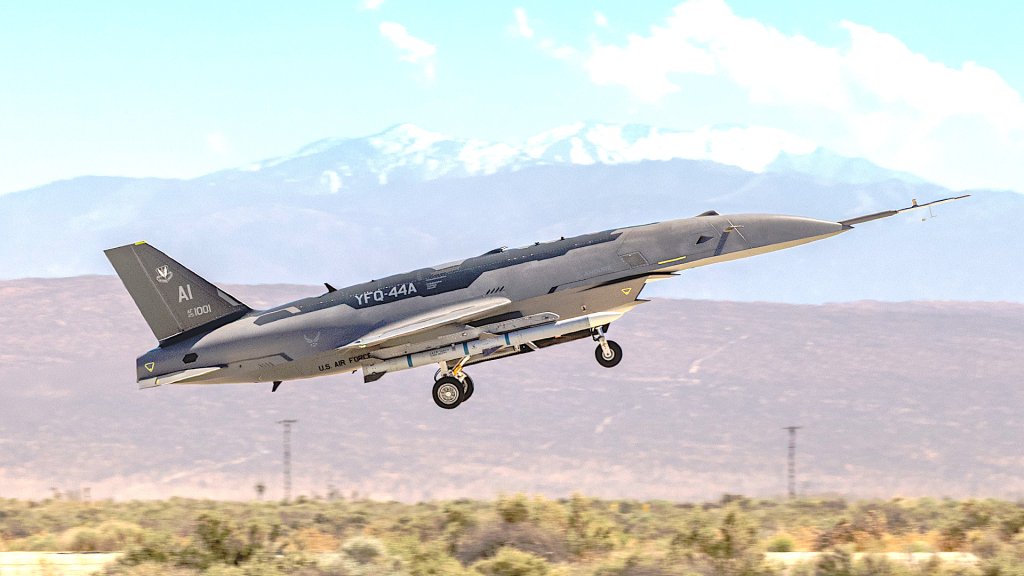
  •  

Ryanair taglia le rotte di 13 aeroporti tra il 2026 e il 2027:dalla Grecia alla Spagna, la Francia e la Germania ecco quali sono gli scali in cui non volerà più

Nonostante un traffico passeggeri in crescita del 4% e un picco di oltre 20,1 milioni di viaggiatori registrato nel mese di settembre 2026, Ryanair ha avviato un drastico ridimensionamento del proprio network periferico. Tra l’inizio dell’anno in corso e la primavera del 2027, la compagnia low cost irlandese ha programmato l’abbandono definitivo di 13 aeroporti distribuiti tra Spagna, Francia, Portogallo, Giordania, Turchia, Grecia, Serbia e Germania.
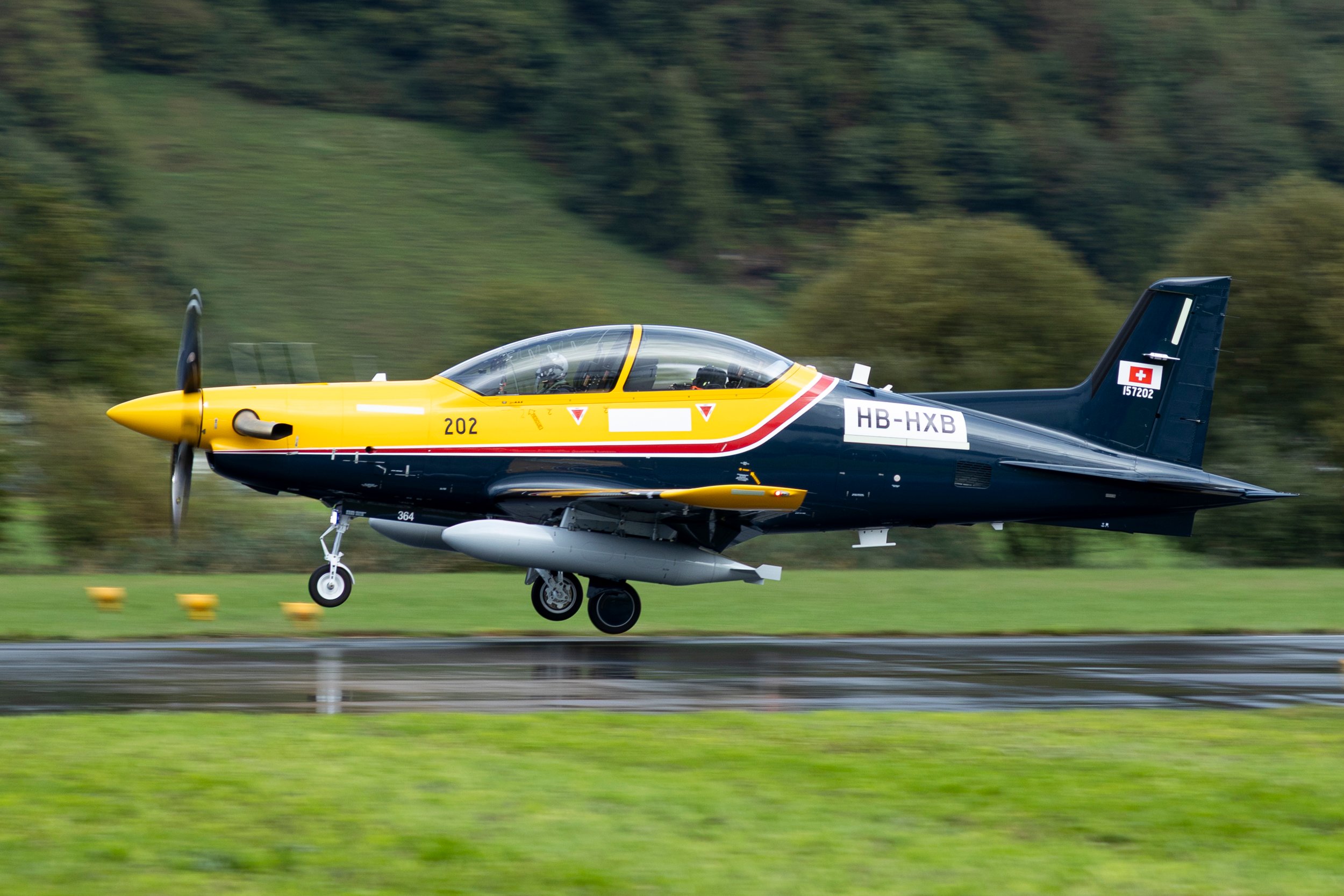
Alla base della decisione non c’è una crisi finanziaria, ma una precisa logica di ottimizzazione aziendale: tagliare le rotte penalizzate da elevati costi aeroportuali e tasse statali, trasferendo la capacità operativa (che oggi conta una media di 3.272 voli giornalieri) verso scali in grado di offrire condizioni economiche più vantaggiose.

L'articolo Ryanair taglia le rotte di 13 aeroporti tra il 2026 e il 2027:dalla Grecia alla Spagna, la Francia e la Germania ecco quali sono gli scali in cui non volerà più proviene da Il Fatto Quotidiano.

  •  
❌