Anna Lodyhina, a mother of a 5-year-old, spent many nights on the cold floor of Kyiv's metro, driven there — like many others — by relentless Russian attacks. As her child slept, she watched over him, exhausted by the constant threat and lack of sleep.
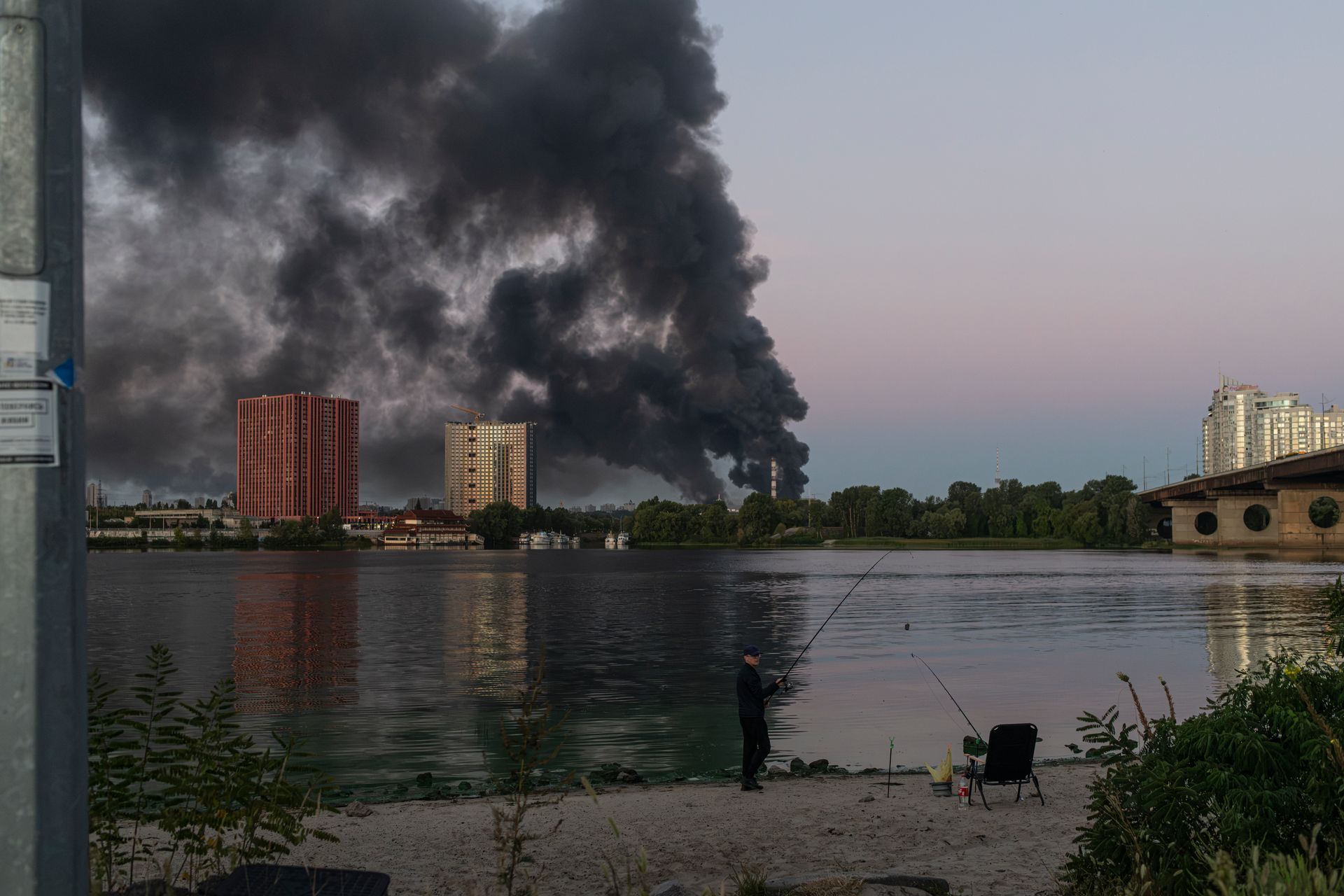
Russian drones struck a 24-story apartment building in Kyiv, a university building in Kremenchuk, warehouses, and hypermarkets overnight on 21 October, killing two people in the capital and an elderly couple near Kharkiv, Ukrainian officials said. The attack went well beyond Ukraine’s power grid, hitting places where people live, study, and shop. Over the past day, Russian strikes also killed three more civilians and injured dozens across several oblasts.
Russia has kept up nightly drone and missile attacks on Ukrainian cities through the autumn, mostly aimed at the energy system. It struck Ukraine’s energy 76 times during a US-declared truce, and fired 39 ballistic missiles at the grid three days after Washington announced it. This time the targets also included homes, a university, warehouses, and shops.
Overnight, Russia launched 186 Shahed-type and other attack drones, 88 of them jet-powered, along with Iskander-K cruise missiles, Ukraine’s Air Force said. Air defenses downed or jammed 150 drones. Hits were recorded at 27 locations, and debris fell at 13 more.
Two killed on the 20th floor in Kyiv
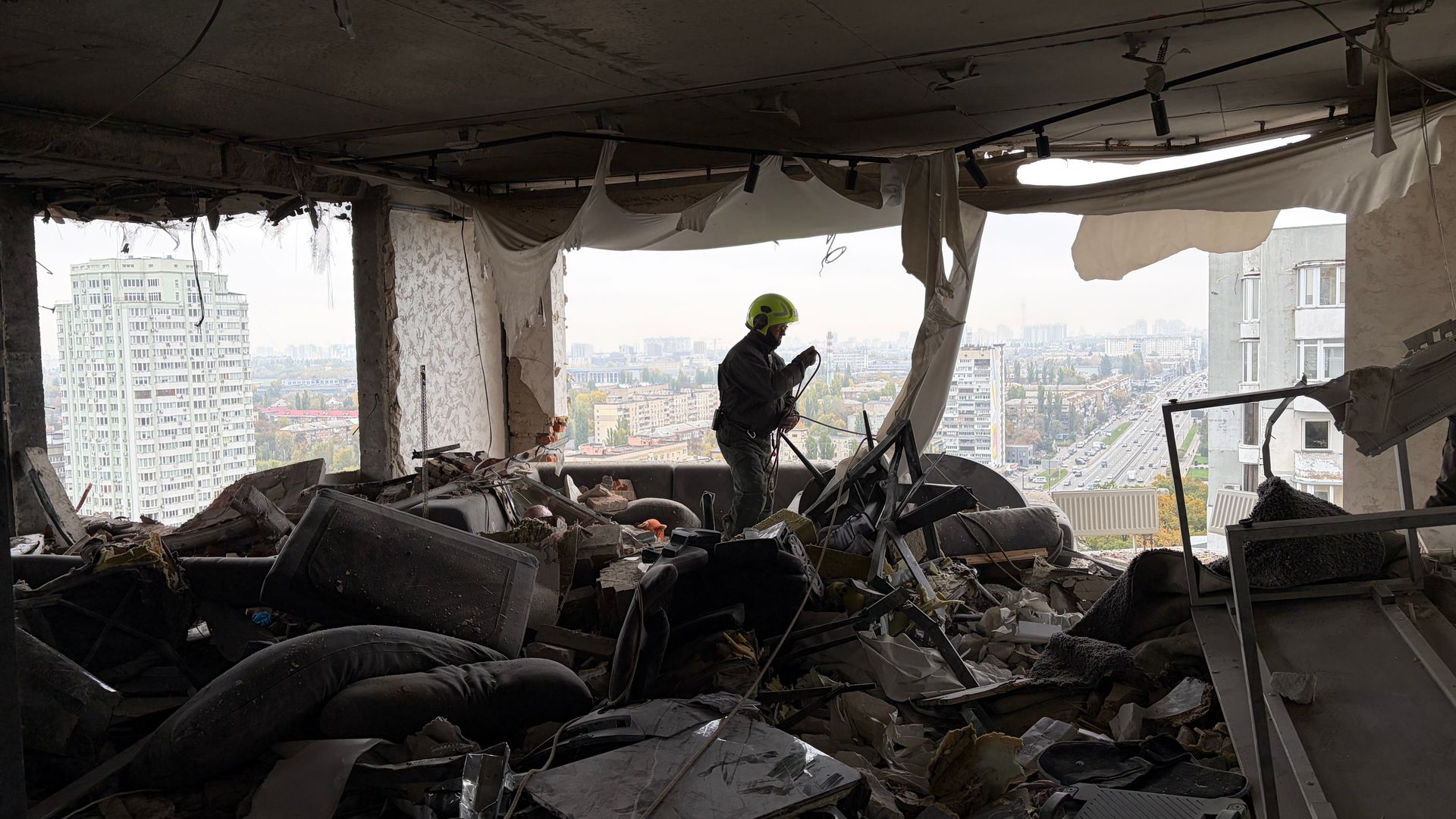
A drone hit a 24-story residential building in Kyiv’s Sviatoshynskyi district at the level of the 20th floor, starting a fire, Mayor Vitali Klitschko said. The fire spread over about 70 square meters, and rescuers found the bodies of two people while clearing debris, the State Emergency Service said. Two people were injured and hospitalized, Klitschko said, including a 46-year-old man who was walking past the building, according to the police.
A rescuer carries a cat out after a Russian drone strike on an apartment building in Kyiv, 21 October 2026. Photo: State Emergency Service of Ukraine
In the Desnianskyi district, seven parked cars caught fire, the State Emergency Service said; police put the number at about 10. The evening before, drones hit a warehouse building in Desnianskyi and a transport facility in Solomianskyi district.
An elderly couple killed near Kharkiv
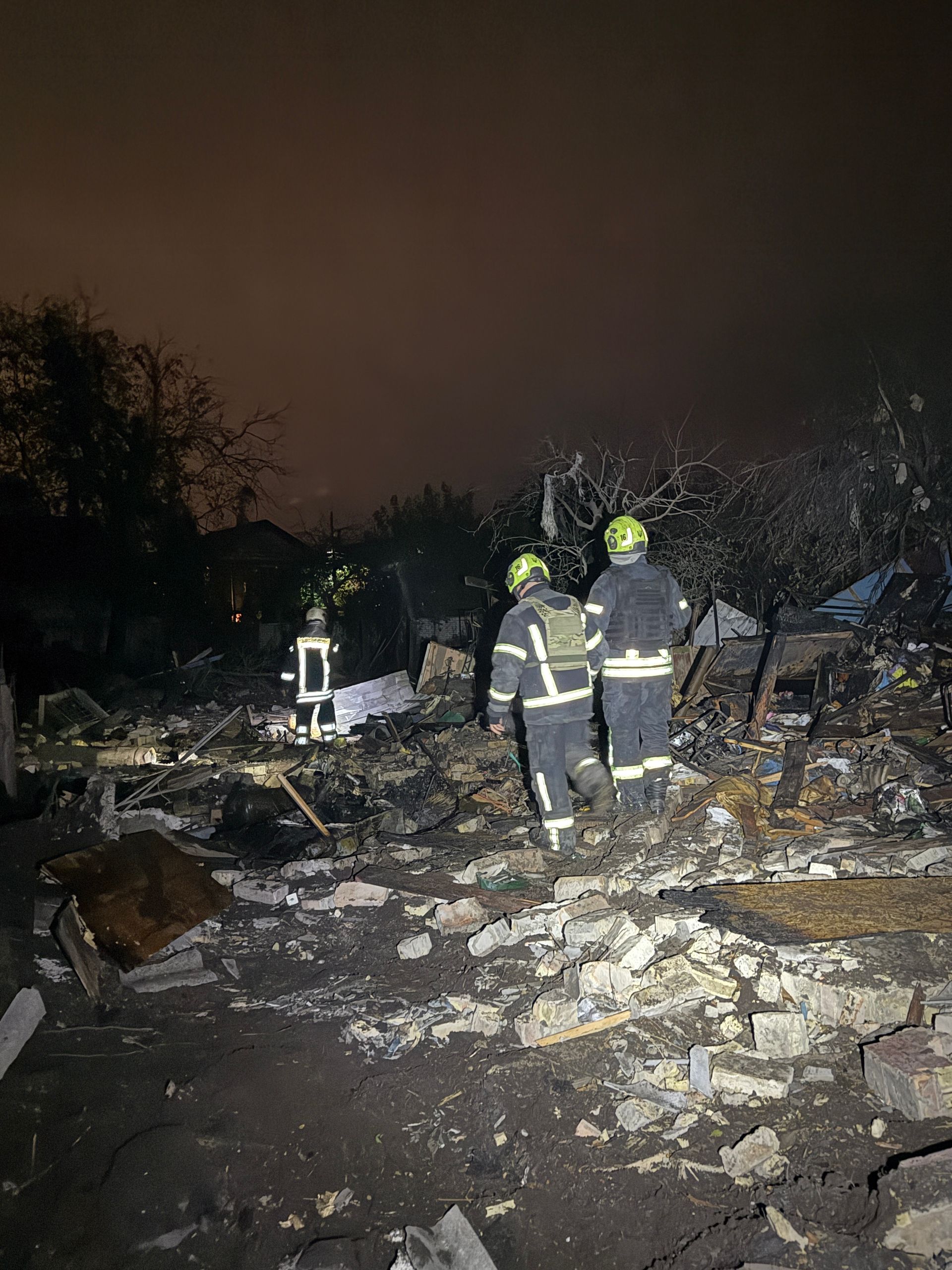
In the village of Korotych near Kharkiv, Russian drones killed an 81-year-old woman and an 83-year-old man, Kharkiv Oblast Governor Oleh Syniehubov said. Rescuers recovered their bodies from the rubble of their house, the State Emergency Service said. Eleven people, including a two-month-old boy and an eight-year-old girl, were treated for acute stress, and 13 houses were damaged.
A house destroyed by a Russian drone strike in Korotych, Kharkiv Oblast, 21 October 2026. Photo: State Emergency Service of Ukraine
A university, warehouses, and hypermarkets
In Kremenchuk, a drone hit a building of the Mykhailo Ostrohradskyi National University, setting it on fire, the State Emergency Service said. Three people were injured, including a 16-year-old who was hospitalized with a concussion, Poltava Oblast Governor Vitalii Diakivnych said. In the Poltava community, drones damaged an administrative building and warehouses.
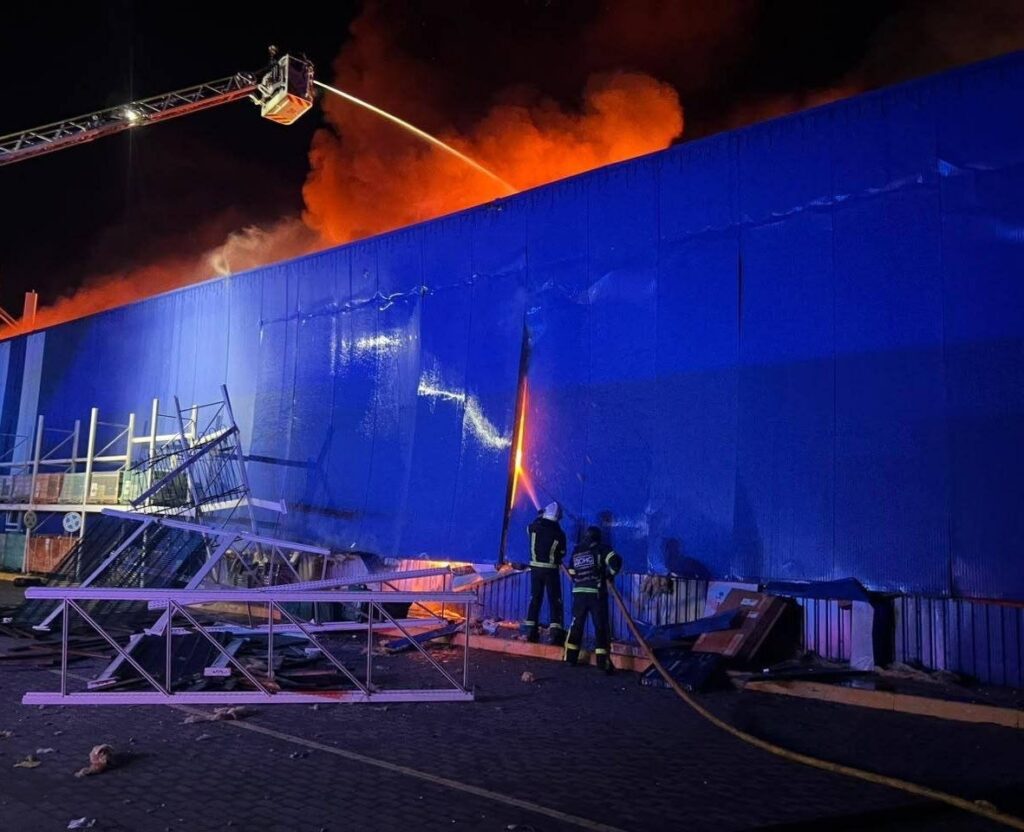
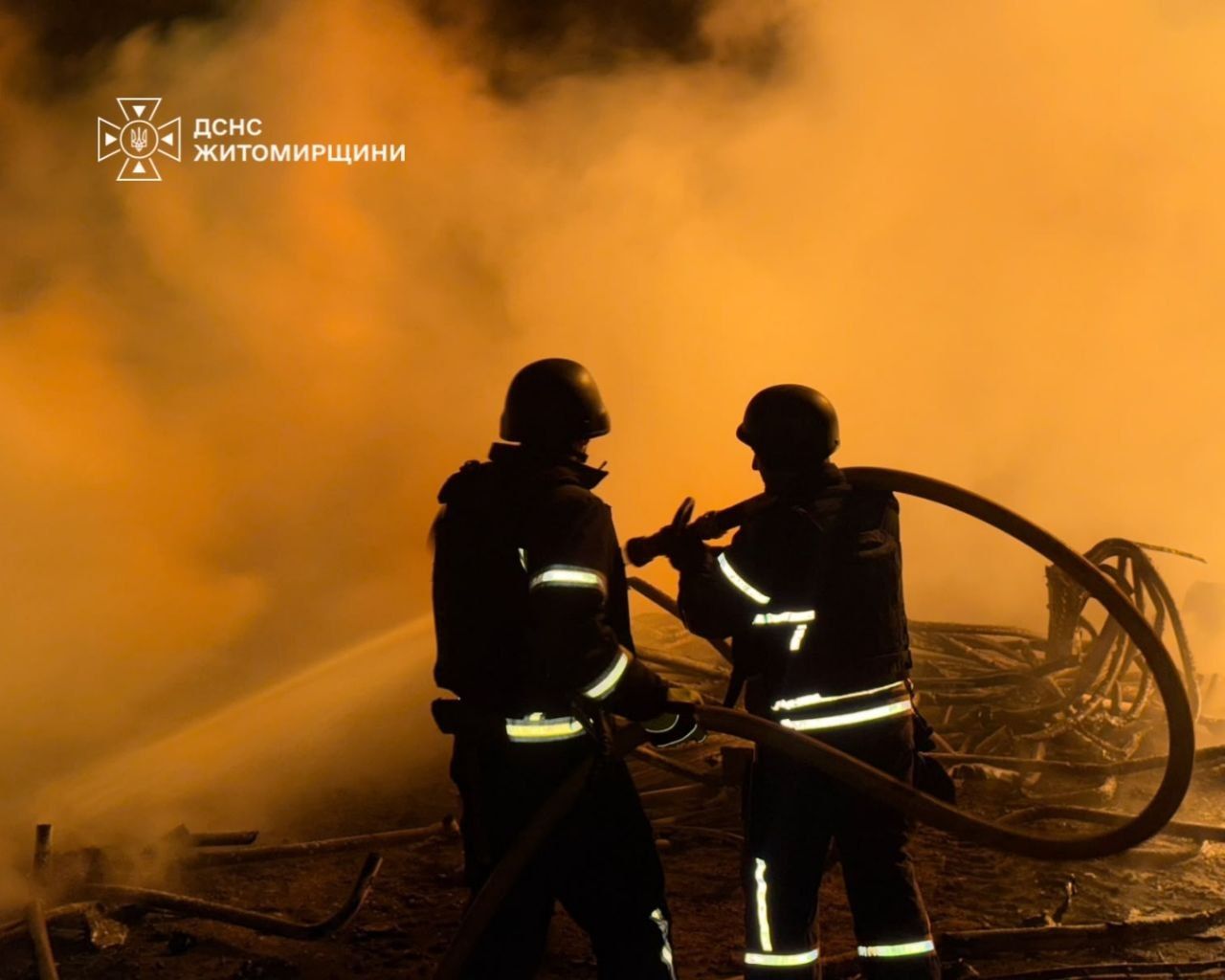
Firefighters put out a fire at an enterprise in Lviv district after a Russian attack, 21 October 2026. Photo: State Emergency Service of Ukraine
In Lviv Oblast, an attack set fire to an enterprise in a village in Lviv district and injured two people, while a house was damaged in a neighboring village, the State Emergency Service said. In Uman, drones hit a hypermarket and damaged a hotel, injuring one person, Cherkasy Oblast Governor Ihor Taburets said.
A hypermarket in Uman damaged by a Russian drone strike, 21 October 2026. Photo: Cherkasy Oblast Military Administration
On the evening of 20 October, a drone hit an Epicentr hypermarket in Pervomaisk, Mykolaiv Oblast, injuring eight people, acting Governor Heorhii Reshetilov said. Russia also struck a hypermarket in Rivne Oblast several times that day, injuring four and forcing rescuers to pull back while they fought the fire, the State Emergency Service said.
More dead and injured over the past day
The overnight strikes followed a day of attacks. In Kyiv, Russian strikes on 20 October killed one person and injured 21, three of them seriously, Klitschko said. An administrative building caught fire, rescuers freed four people trapped on its upper floors, and a healthcare facility was damaged, the State Emergency Service said. In Dnipropetrovsk Oblast, two men were killed and seven people injured that day, regional officials said.
In Kharkiv Oblast, Russian attacks over the past day injured 11 more people in Kharkiv, Derhachi, and Shestakove, Syniehubov said. In Kherson Oblast, 13 people were injured, three of them children, the regional administration reported. In the Chernihiv region, an 89-year-old woman and a young woman were hurt in strikes on villages and on Novhorod-Siverskyi, Governor Viacheslav Chaus said, and a 21-year-old woman was injured in the Sumy community, according to the Sumy regional administration.
More than 5,000 subscribers lost power in Volyn Oblast’s Lutsk district, Governor Roman Romaniuk said. In Ternopil Oblast’s Kremenets district, 7,949 subscribers remained without power after earlier Russian strikes on energy facilities, the regional administration reported.
An air raid alert sounded in Kyiv at around 5:20 a.m. local time on Oct. 21 as drones approached the capital, which has faced an unrelenting barrage of Russian drone attacks this fall.
South Korea will withdraw more staff from its embassy in Kyiv, Foreign Ministry spokesperson Park Doo-soon said on 20 October. Seoul says Kyiv broke an understanding to keep the transfer of two North Korean prisoners of war confidential, which was meant to protect the soldiers and their families in the North. Seoul had conveyed its position through several channels but received no sufficient response from Kyiv, Park added.
The Korea Herald noted, the move comes amid a dispute with the host government itself. That matters beyond the two countries. Good ties with Kyiv serve South Korea’s interests, AP reported earlier this month, citing experts, because Ukraine could share intelligence on North Korea’s expanding cooperation with Russia and its battlefield experience.
Seoul shrinks its Kyiv mission
Officials put the planned withdrawal at about half the embassy’s staff. The Korea Herald added that the timing has yet to be set. A chargé d’affaires and all consular staff will stay in Kyiv to keep diplomatic contacts and protect South Korean citizens.
Zelenskyy told the UN General Assembly in September that Ukraine had transferred two captured North Korean soldiers to South Korea. Ukrainian forces had captured both men in Russia’s Kursk Oblast in January 2025, where Pyongyang had sent troops to fight for Moscow.
Explore further
Ukraine’s disclosure of secret North Korean POW transfer sparks South Korea’s demand for an apology
On 6 October, South Korean Foreign Minister Cho Hyun said Sybiha’s messages included words of apology but fell short of what Seoul expected. Ukrainian Foreign Ministry spokesperson Heorhii Tykhyi replied that Sybiha had written he regretted the situation reaching an exchange of critical comments.
In an interview published on 12 October, Foreign Minister Andrii Sybiha told the dispute stemmed from differing readings of confidentiality at various stages of the transfer. He considers the matter closed. “Ukraine fulfilled all its obligations.”
Ukrainians can now check a free live map of where Russian attack targets are flying, a Ukrainian air-threat monitoring project called monitor announced on X on 13 October. The beta pulls public reports of drones in flight into a single view and lays them over official air raid alerts.
Russia now flies jet-powered drones, and some switch off their engines before an attack and glide in. Over a hundred drones can arrive in one night. Yet since September, drone-only yellow alerts in some Oblasts no longer shut everything down. So during drone alerts, some Ukrainians now stay at their desks rather than in shelters. The new maps offers them a quick look at the sky from a phone, even on a weak signal.
What the map shows
The launch post described the service as one that tries to show where each target is, using open sources and algorithmic processing. It said the beta focuses on drones, with other targets to follow.
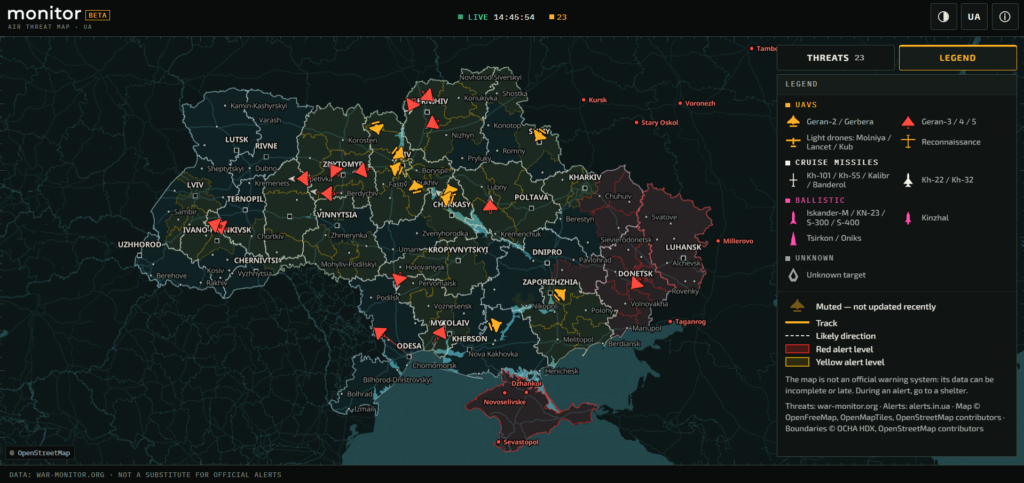
Screenshot from the Monitor map used to track aerial targets.
The drone data does not come from radar. The service draws on regional Telegram channels that post where drones and missiles are flying over their own oblasts. It cross-checks those posts to estimate what each target is, roughly where it is, and where it is heading, the project explains. The same page already lists cruise and ballistic missiles among the targets. It also says the map is free, ad-free, and needs no registration, and that it runs in a browser or on Telegram, designed to work on a phone with a weak signal.
A target log lists each drone’s district and course. Alert data comes from alerts.in.ua, and areas under alert turn red or yellow. The map refreshes about every 20 seconds while targets are airborne.
Screenshot from the Monitor map used to track aerial targets.
However, the developers warn that the dots are only estimates and show up late. Some targets slip through untracked. That is why “an empty map does not mean you are safe,” they wrote. When sirens sound, they urge people to rely on official signals and take shelter.
On 17 October, the Defense Ministry said that Ukraine’s Air Alert app now maps the approximate position and heading of some targets. These include cruise missiles, Banderol drone-launched missiles, and Shahed-type drones. The data comes straight from the Air Force over secure channels.
Screenshot from the Air Alert! map used to track aerial targets.
For security reasons, it carries no exact coordinates or real-time tracking and may lag. Ballistic missiles and anything faster than 2,000 km/h don’t appear at all. The ministry’s advice matches monitor’s: get to a shelter first, then check the map from there.
At the beginning of Russia's full-scale invasion of Ukraine in 2022, while in my hometown of Kyiv, I wrote an essay in German for a German website titled "Russia Dehumanizes the World."
The Ukrainian translation of this text, published under the title "The Dehumanization of
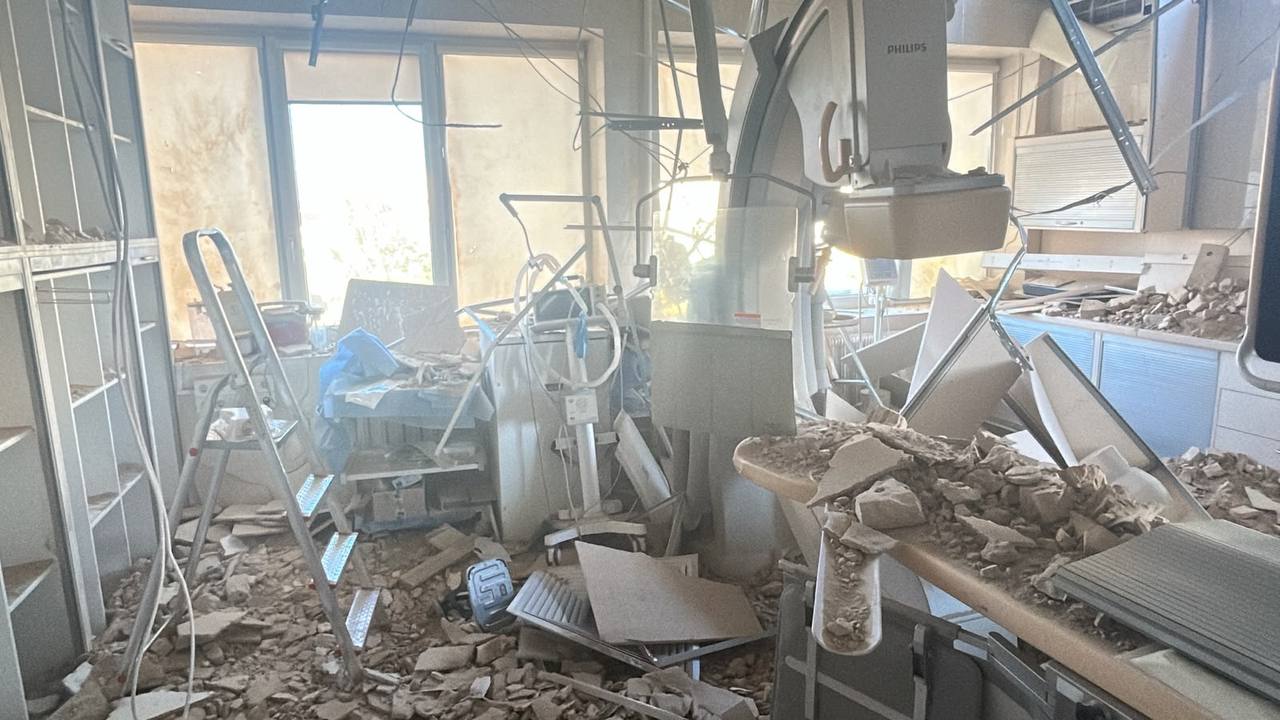
Ukrainian Prime Minister Serhii Koretskyi said Russia struck the operating room of the Strazheska Institute of the National Academy of Medical Sciences in Kyiv, injuring one patient.
Ukraine is counting on buying part of Lockheed Martin’s growing output of ballistic missile interceptors, President Volodymyr Zelenskyy said. He met the US company’s team in Kyiv on 19 October and also raised servicing and repairing F-16 fighter jets inside Ukraine.
Russia keeps striking Ukraine’s power grid with ballistic missiles, and interceptor supplies fall short of that threat. Kyiv is working every route to more Patriot missiles, from US deliveries to allies’ stocks, and some have stalled. Greece, for one, has not confirmed it will hand any over, citing its own defense needs. A purchase from the missiles’ maker would add one more route.
Growing output, F-16 repairs in Ukraine
Lockheed Martin builds the PAC-3 MSE interceptors fired by Patriot air defense systems, as well as the F-16. Zelenskyy said both matter against Russian ballistic missiles and jet-powered Shahed drones. Neither area is easy right now, he added.
“We count on the opportunity to purchase some of them to protect more lives,” he wrote.
On 28 July, Zelenskyy met the company in Washington to discuss joint production. That came weeks after US President Donald Trump pledged Ukraine a license to manufacture Patriots.
A batch reportedly stuck in Washington
Meanwhile, US Defense Secretary Pete Hegseth has not signed off on a “significant” batch of Patriot missiles, Ukrainian officials told the Kyiv Independent. One official said allies had already paid for them. A US government official called the claims untrue, and the Pentagon did not respond. A NATO official said allied-funded deliveries, including air defense, continue. A second NATO official said some shipments could be delayed, but likely not for political reasons.
Zelenskyy told Bloomberg on 18 October that the US delivers only 12 Patriot interceptors a month. On 20 October, interceptors topped his list in a call with US Secretary of State Marco Rubio.
No purchase was announced, so new interceptors from this route remain a prospect. Meanwhile, partners’ early warnings of Russian ballistic launches have gone missing three times recently, Zelenskyy wrote. Those warnings give air defenses extra minutes to prepare.
The Russian drone crashed near a gas station in the Holosiivskyi District near the administrative border with Kyiv Oblast, according to Kyiv city mayor Vitali Klitschko.
As regular Russian strikes on energy facilities leave parts of Kyiv without running water, fears are mounting that further power outages could spark a serious humanitarian and public health crisis in Kyiv.
In the Oct. 19 attack on Kyiv, at least one person was killed, and eight others were injured as Russian missiles struck Kyiv in multiple waves overnight.
Russia attacked Kyiv with ballistic missiles in two waves overnight on 18–19 October. Information from partners did not arrive before the first wave, at around 23:00, Air Force spokesperson Yurii Ihnat said on national television. A warning came before the second wave, at around 03:00, but the window was short, he told NV.
Hours earlier, Ukrainian President Volodymyr Zelenskyy told NBC that US warnings of Russian ballistic launches were working again after three days without them, and that only the United States has that intelligence. Those warnings have for years given Ukrainian authorities several minutes to sound alarms and let civilians reach shelters before ballistic missiles hit.
“Once again, a Russian ballistic attack in several waves overnight, and once again there was no warning from partners,” Zelenskyy wrote. It was at least the third ballistic strike on Kyiv in a week to begin without warning from partners, following attacks on 12 October and 13 October.
Metro station damaged on Kyiv’s left bank
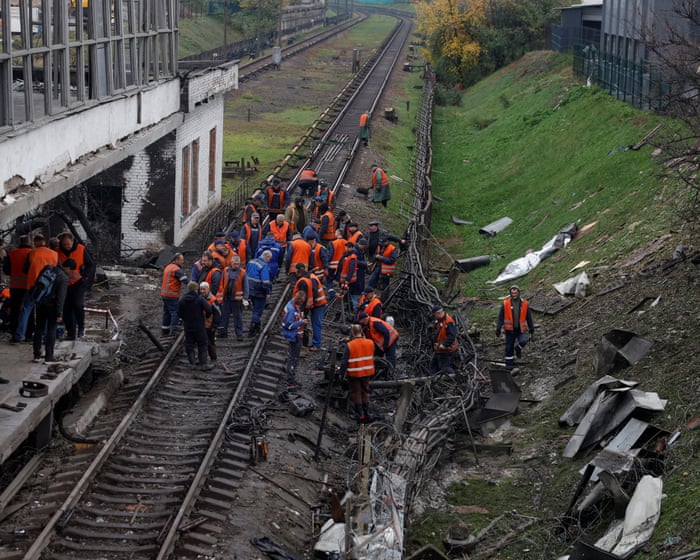
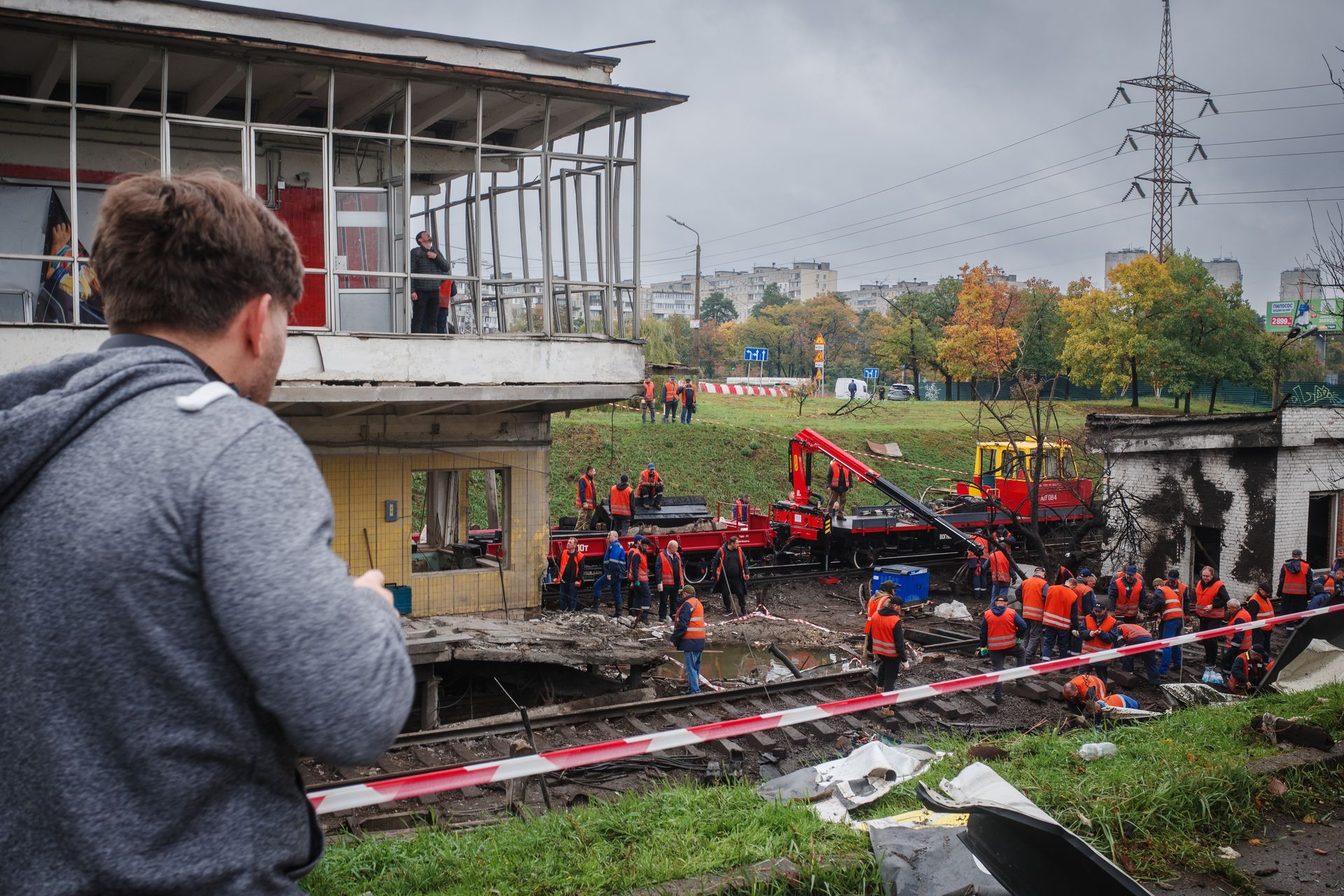
One person was killed and eight injured in Kyiv, Ukrainian Prime Minister Serhii Koretskyi said. A strike damaged a metro station on Kyiv’s left bank, and debris broke the rails beside it, Mayor Vitali Klitschko said. City authorities said the damaged station was above ground, closed Chernihivska and Lisova stations, and said red-line trains would run only between Akademmistechko and Darnytsia. The attack also damaged a 25-story building, a medical facility, and the Cosmo Multimall shopping center in the Solomianskyi district, NV reported, and Zelenskyy said a school was hit too.
The attack also damaged one of Ukraine’s main ice arenas, on Shalett Street in Kyiv, which hosts Ukrainian championship hockey games and youth training, hockey Telegram channel Flamingo reported. Parts of the facade, metal structures, and roof were damaged, but the ice surface showed no significant visible damage, according to preliminary information, Suspilne reported.
Damage in 11 oblasts, three missing in Irpin
Koretskyi said energy and infrastructure were the main targets, with damage in 11 oblasts. Russia also hit warehouses of medicines, railway stations, shops, and homes, he said. In Kyiv Oblast, Russian strikes injured six people in Irpin, including three children, and three more were missing, oblast head Tymur Tkachenko said. In Kharkiv Oblast, six people were injured, including two children, Koretskyi said. In Rivne Oblast, four people were injured, and one of them was hospitalized, regional police reported.
Zelenskyy said that more than 10 energy facilities were damaged and at least 550,000 families lost power. Ukrenergo reported new outages in 10 oblasts: Volyn, Zhytomyr, Rivne, Ternopil, Khmelnytskyi, Vinnytsia, Kirovohrad, Kharkiv, Odesa, and Mykolaiv. In Volyn Oblast, about 15 jet-powered Shahed-type drones targeted the region, and around 66,000 customers were without power on the morning of 19 October, oblast head Roman Romaniuk said. Kovel, Manevychi, and Lutsk were hit hardest, and no casualties were reported. In Vinnytsia Oblast, a critical infrastructure facility in Koziatyn was damaged, and power there would stay unstable for some time, city council secretary Iryna Repalo said, Suspilne reported.
Zelenskyy said Russia fired 16 ballistic missiles at Kyiv and Kyiv Oblast. The Air Force reported that Russia also used Iskander-K cruise missiles and 269 drones, and that by 09:00 air defenses had shot down or suppressed four Iskander-K cruise missiles and 243 drones. Its preliminary count did not list any ballistic missiles among the intercepted targets.
Rubio denies any pause and points to a software problem in Ukraine’s warning system
On 19 October, Rubio told reporters in Samarkand, Uzbekistan, that “there’s been no pause” in intelligence-sharing with Ukraine, Reuters reported. He said he did not know where Zelenskyy was getting such claims and that he should focus on ending the war. He also said he did not know whether a failure had happened the previous night, but that a few nights earlier there had been a software problem with “their early warning system,” and that US European Command was looking into the strikes, The Guardian reported. US officials had not mentioned a software glitch before, and in at least one case Ukraine was told that bad weather over southern Russia had hidden launch preparations, the newspaper noted.
Ihnat said Ukrainian specialists and their partners were working to establish why information about the first launch had not arrived. He added that similar gaps had occurred during earlier attacks.
Zelenskyy wrote that when missile supplies for Ukraine’s air defense are blocked while Russia gets sanctions relief or delays, “this is, unfortunately, a denial of reality on the part of partners.” A night earlier, Russia had hit Ukraine’s energy system again, while Ukrainian drones set fire to St. Petersburg’s oil terminal despite Washington’s pressure to stop refinery strikes.
Ukrainian president accuses Washington of ‘denial of reality’ in continuing row with Trump over apparent support for Moscow
Ukraine did not receive a warning from the US about an impending Russian missile attack on Sunday evening, Volodymyr Zelenskyy has said, reviving concerns that Washington is withholding intelligence to bully Kyiv into capitulating to Moscow.
Yuri Ihnat, a spokesperson for the Ukrainian air force, said on television on Monday morning that Ukraine had not received a warning before a Russian missile barrage hit power plants in Kyiv at about 11pm. Earlier, a Ukrainian government official had told the Guardian the US had not warned the capital about the impending missile strike.
Several explosions rocked the capital just before 11 p.m., with further attacks around 3 a.m. and 7 a.m., Kyiv Independent journalists on the ground reported. Ukraine's State Emergency Service (DSNS) said damage was reported in at least three districts.
The US has resumed sharing intelligence on Russian ballistic missile launches with Ukraine after a pause of several days, Ukrainian President Volodymyr Zelenskyy told NBC News on 18 October. The blackout fell on days when Russia was firing ballistic missiles at Ukraine. Limits on the Starlink satellite service that Ukraine’s forces rely on remain in place, he said.
Russia has leaned on ballistic missiles in this month’s strikes on Ukraine’s grid, firing 39 in a single attack, and Ukraine is short of interceptors to stop them. Washington has used its support as leverage, reportedly telling Kyiv to spare Russian refineries or lose US intelligence and arms.
Three days without warnings
The sharing had been blocked for some period of time before it was restored, Zelenskyy said on Meet the Press.
“We are very thankful for this. Now it works,” he said.
Ukraine gets other intelligence from Europeans and dozens of other partners, he explained. But only the United States has the data that tells Kyiv when Russia launches ballistic missiles.
“We didn’t get it during ballistic attacks during three days,” Zelenskyy said.
A timely warning gives Ukraine’s air defenses extra minutes to prepare and lets authorities alert civilians, Liga noted. Late on 12 October, Russian ballistic missiles hit Kyiv before the air-raid alert reached people, with no advance data on launches from Russian territory. The next day, US President Donald Trump said Washington was still sharing intelligence. Two days later, Zelenskyy said Kyiv had received no US warnings of incoming ballistic missiles while it paused its strikes on Russian refineries at Washington’s request. That pause followed the energy ceasefire Trump declared on 11 October, which Russia never confirmed.
Explore further
“He thinks Ukraine is a weak link and that it needs to be squeezed into giving in”: diplomat on why Trump pressures Kyiv, not Moscow
Starlink still capped, Kyiv says
Starshield, the military version of Starlink, still cuts out above 161 km/h, Zelenskyy said, too slow for Ukraine’s interceptor drones to catch Russia’s jet-powered Shahed-type drones. NBC News, which aired the interview, separately reported that Starlink services had resumed at normal speed. He said Ukraine’s generals and government believe the order came from the US government and SpaceX carried it out, though he did not know who exactly made the call. Ukraine had instead asked SpaceX and Trump to open Starlink over Russia so it could hit ballistic missile launchers, he said.
“If [Trump] will personally decide to lift this decision, it will immediately work as it was before,” he said.
US Treasury Secretary Scott Bessent, who appeared on the same show, called Zelenskyy’s charge “very reckless” and said Trump and Secretary of State Marco Rubio had denied any administration role. Asked about the break in intelligence sharing, he said he did not know anything about it but that Zelenskyy should be “very careful about making statements like this that aren’t true.” Reuters had reported, citing three officials, that White House officials ordered the Pentagon to limit the service.
Asked whether Ukraine could win without the United States, Zelenskyy said it would be very difficult.
“But if the United States will support Putin, I mean, it’s unbelievable, it’s tragedy. It’s historic mistake and big tragedy,” he said.
He also said his team had received word that US negotiators wanted to meet, and that he had offered to meet in Brussels or London, hoping the US team would be ready this week.
The warnings are back, but they stopped once without explanation. Ukraine’s defense against Russia’s missiles still runs through decisions made in the US.
During their visit to Kyiv in September, US President Donald Trump’s envoys urged Ukrainian President Volodymyr Zelenskyy to consider restarting the pipelines that once carried Russian gas to Europe, The New York Times reported on 17 October. They presented it as part of a peace deal with Russia. In the weeks that followed, they pressed the idea with European officials, while Washington freed Russian diesel and spared Russia’s oil buyers from new US penalties.
Energy sales fund Russia’s war, and Ukraine’s halt of transit in January 2025 left TurkStream as Gazprom’s only pipeline route into the EU. Meanwhile, Russia has kept bombing Ukraine’s grid through the energy truce Washington declared on 11 October.
The pitch in Kyiv
Envoys Steve Witkoff and Jared Kushner put the idea to Zelenskyy when they met him in Kyiv, the newspaper reported, citing people familiar with the talks. Trump officials argued that transit fees, which Ukraine gave up at about $1 billion a year, would benefit Kyiv, and that European voters would eventually want cheaper energy. Russia’s share of EU gas imports had fallen from 45% in 2021 to 13% last year.
The envoys presented renewed Russian gas sales as one of the economic incentives in a wider settlement covering Russia’s relationship with NATO, security guarantees for Ukraine, and territorial control. Some European and Ukrainian officials suspected Washington would seek a cut of the profits. The White House denied that the Nord Stream pipeline had been a subject of recent discussions. Kremlin spokesman Dmitry Peskov claimed that resuming energy cooperation is in Russia’s interest and, right now, even more in Europe’s.
US President Donald Trump’s envoys Steve Witkoff and Jared Kushner in Kyiv, 6 September 2026. Photo: President's Office of Ukraine
Germany pushes back
At Ukraine talks the envoys hosted in Florida last week, Günter Sautter, security adviser to German Chancellor Friedrich Merz, forcefully opposed the idea. German lawmakers have called a return to Russian deliveries a disaster for European security, even treason, as the far-right AfD courts Gazprom to bring the gas back. Former Economy Minister Robert Habeck, who steered Germany off Russian gas after 2022, said Trump “seems to have more sympathies with Vladimir Putin than he has with the Ukrainians.”
Explore further
Congress gave Trump 30 days to hit Russia’s oil buyers with 100% tariffs. He waives them two days before deadline, citing US interests. Moscow calls it historic
One concession after another
Rather than pressure Putin or strengthen Ukraine, the administration has spent much of its peace effort on economic incentives for Russia, the newspaper wrote. The US Treasury cleared imports of Russian diesel on 9 October. On 16 October, Trump waived the penalties on Russia’s oil buyers that Congress had passed in the Graham Act. Washington is also weighing relief for sanctioned shadow fleet tankers. And the White House ordered limits on the military satellite service Ukraine’s forces rely on, Reuters reported.
Putin’s economic envoy Kirill Dmitriev claimed the ice had broken and more joint initiatives would follow, including data centers powered by Russian nuclear energy. The talks also cover the sale of Lukoil’s foreign assets to a group that includes the US government, the newspaper reported earlier this month. Zelenskyy, who had heard the pitch in Kyiv, alluded to it in a Financial Times interview this week.
“The question will be when will the next deal be? Maybe it will be gas. Definitely it will be gas,” he said.
Reopening the pipelines could hand Moscow back significant revenue and strengthen its sway over Europe’s energy market, Liga noted. Each new concession lowers the price Russia pays for continuing the war.
 Login