❌

Reading view

Trump is trying to criminalize solidarity: “Minnesota 15” defendants speak

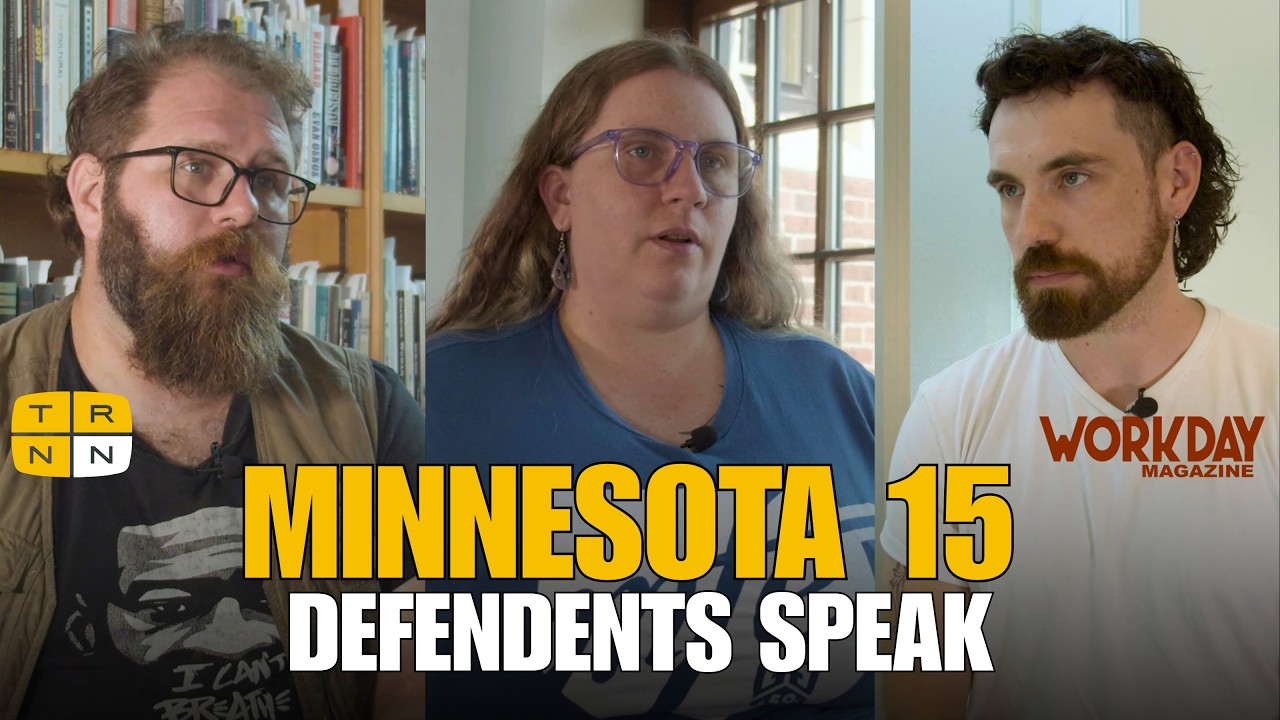
Three 'Minnesota 15' Defendants and rank-and-file union members (left to right: Emmett Doyle, Treasure Thoreson, and Alec Stewart) interviewed in August 2026.

This video report was collaboratively produced and is being co-published by Workday Magazine and The Real News Network 

On the morning of June 16, 2026, 15 people were indicted by the federal government for their involvement in community organizing efforts to oppose Operation Metro Surge in Minnesota this past winter. This group of defendants have become known as the “Minnesota 15,” and over half of them are rank-and-file union members or former union members.

In this special report, collaboratively produced by Workday Magazine and The Real News Network, we speak with three of the “Minnesota 15” defendants about the charges against them and the Trump administration’s attacks on dissent and the labor movement today. Interviewees include: Treasure Thoreson (Minneapolis Federation of Educators, Local 59), Alec Stewart (Minnesota Association of Professional Employees), and Emmett Doyle (Northern Midwest Regional Council of Carpenters).

Credits (Workday Magazine):

  • Reporting and editorial support: Isabela Escalona, Sarah Lazare, Amy Livingston, and Amie Stager
  • Videography: Isabela Escalona and Amie Stager
  • Additional photos and videos: Amie Stager and Riley Bruce
  • Video editing: Isabela Escalona

Credits (TRNN):

  • Post-production: Maximillian Alvarez, Jocelyn Dombroski, David Hebden, Kayla Rivara

Music:

  • Emmett Doyle, “1934 Strike/Cooleys Reel/Congress Reel”
  • Adobe Stock
  • FineTuneMusic

Special thanks to East Side Freedom Library, Minneapolis Central Library, Hosmer Library, and Minneapolis Federation of Educators.

Transcript

The following is a rushed transcript and may contain errors. It will be updated.

Treasure Thoreson:

Tuesday morning, June 16th, I had just woken up. I was in my pajamas. I hear a knock on the door at seven in the morning, and it’s a woman standing there in business clothes with a tactical vest on top that said Homeland Security.

Alec Stewart:

I was in my car backing out of my garage to go to work, coffee in hand. As soon as I backed out of my parking pad, several squads rolled up. A bunch of agents jumped out of the vehicles. I went to just text my aunt, because I have a dog. I assumed I’d be going to jail or something, and that’s when they smashed my window.

Treasure Thoreson:

I see six more agents standing in front of my house. The woman at the door, she just said, “We’re here with a warrant for your arrest for a conspiracy to harm or impede a federal officer.”.

Alec Stewart:

Exposes that while the government was targeting immigrant communities, tearing families apart, abducting children and murdering spokes in the street.

Emmett Doyle:

I had just typed in on my phone the location of the house that we were working on that day. I was boxed in by a vehicle, and so I rolled my window down to ask the guy like, “Hey, what’s the deal? You’re a pretty bad driver. What’s going on?” And then I looked around and I realized that my car had been surrounded. There was a swarm of armed federal officers with HSI on their uniforms.

Alec Stewart:

I do not think it’s a coincidence that over half of us are rank and file union folk. I think that speaks to, again, the working class nature of both the attack by the federal government and the working class predominant response to that attack.

Treasure Thoreson:

We had at least one person from every single site who was plugged into our committee and was able to get information out to their members and arm their building with the knowledge that they needed to face this kind of violence. And people stepped up in really major ways. Everybody did something, whether it was patrols or walking students to and from school, riding in a cab with a kid to and from school, making sure that their parents had rent money. There were some schools in the district that were delivering hundreds of boxes of food every week.

Emmett Doyle:

The unions that did get involved, I think understand what the labor movement is about in a way that some of our other unions have forgotten. An injury to one is an injury to all isn’t just a moral statement. It’s a hard reality of life. And the unions that stood up during Metro search understood that and demonstrated what solidarity means.

Treasure Thoreson:

We got a lot of great information from the Chicago Teachers Union who had been fighting back ice for months at the point when they came here. But we learned a lot from their struggle and were able to adapt that to fit what we were doing here in Minneapolis.

Alec Stewart:

And that was all without coercion, without money exchanging hands. That was just horizontal organizing. And I think how effective that is, how the power of mutual aid and horizontal organizing is evident because of this indictment. This wouldn’t have happened if what thousands of Minnesotans were doing hadn’t worked. I think the success of the January 23rd general strike speaks to that connection of the labor movement and just seeing the numbers and the outpouring of support for such a strike is historic.

Emmett Doyle:

I think that the general strike that happened in Minneapolis terrified the federal government. There were downtown, just hundreds of thousands of workers in the streets marching. And people have to remember this was severe sub-zero. It was a fantastic feeling of power and of joy and of resistance. And unfortunately, the next day that joy and resistance was answered tragically with the brutality of the beating and murder of Valence Preddy. But I think that the general strike was a major turning point in the regime’s logic of violence that they realized they couldn’t defeat the city.

Background music:

Stores are getting thin. There’s passing down that’s going on. Scabs anymore. We’ll put ourselves in union down this year of 34. Can’t you hear the mark? Either sign or behind. See the times get better when we hold that picket line.

Alec Stewart:

The revelation of Operation Puppet Master exposes that while the government was targeting immigrant communities, tearing families apart, abducting children and murdering our neighbors in the street, they were also attempting to disrupt and dismantle one of the facets of Minnesota that makes us so unique. And that is our strong and unified labor movement.

Isaac Sant:

This is not just an attack on me and my friends and our little group. This is an attack on our entire community. They were spying on us from day one. In fact, five days before Operation Metro Surge was declared on November 28th, they began spying on our organizations. These prosecutions were inevitable. Somebody was going to be on trial in there. If it wasn’t us, it was going to be somebody else. It was going to be one of you. We were being prosecuted for doing something that every single person that everybody and their mom in Twin Cities did to resist their federal occupation.

Emmett Doyle:

This case is meant to intimidate the entire community. It’s meant to tie up the time and efforts of many activists. But beyond that, as a conspiracy case, what they’re trying to do is set up a situation where they can expand and expand and expand the conspiracy. They’re trying to use our own solidarity and close-knit community against us through guilt by association.

Treasure Thoreson:

They want us to be separated. They want to separate out the good protestors from the bad protestor. I don’t want folks to feel afraid to stand up for their neighbor and do the right thing.

Alec Stewart:

It was such an obvious threat on what the Twin Cities is all about, which is community connections and helping each other’s neighbors. And the face of fascism, complacency, I think has no place. I think there was just a very justified feeling of standing up.

Emmett Doyle:

The support and solidarity towards us by our community has been overwhelming in just the most amazing way. I

Treasure Thoreson:

Think that they see our ability to bring people together as threatening. However, going after the 15 of us isn’t going to stop anything in Minneapolis or the Twin Cities because this is a place full of great organizers. We can’t let them bully us out of doing the right thing. We need to stand strong in our values and our morals and know that we are protecting our neighbors and that is the right thing to do. They’re afraid of us and that’s why we’re getting this response.

💾

We speak with three union workers who are among the “Minnesota 15” defendants the Trump administration is targeting for organizing to defend their Minneapolis communities from ICE earlier this year.
  •  

Thousands of California public employees begin strike over contract

SEIU Local 1000, representing nurses and teachers, pushing for higher wages, telework and affordable healthcare

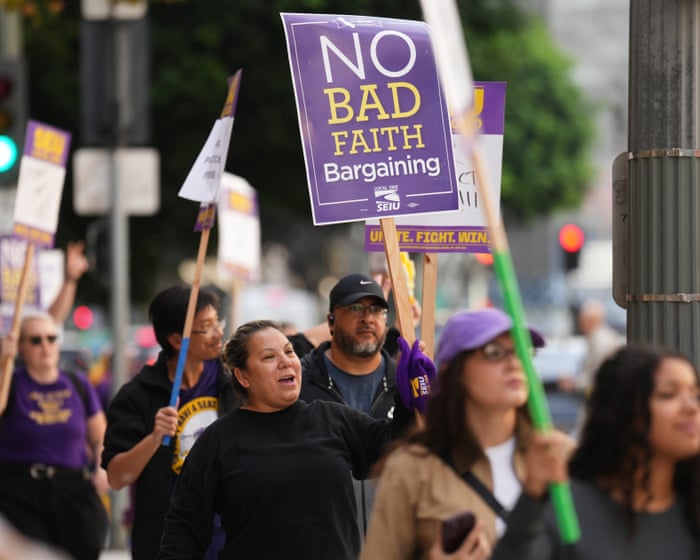
Thousands of California state workers began a sweeping one-day strike on Wednesday, with workers set to rally outside government buildings in several cities, as tensions boiled over lapsed contract negotiations with Governor Gavin Newsom’s administration.

SEIU Local 1000, a union that represents roughly 100,000 public employees, including nurses and teachers, has been pushing for higher wages, flexible telework and affordable healthcare.

Continue reading...

© Photograph: Jae C Hong/AP

© Photograph: Jae C Hong/AP

© Photograph: Jae C Hong/AP

  •  

Streeting delays defence jobs plan for young people after union pushback

UK defence secretary had been due to unveil proposals on Thursday until concerns were raised at 11th hour

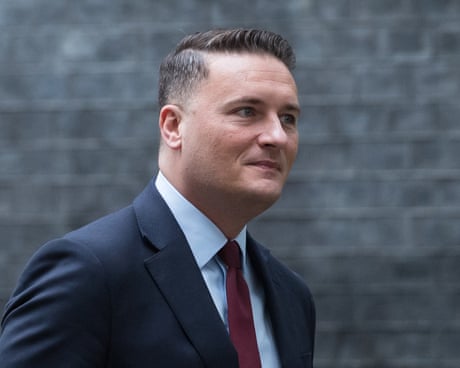
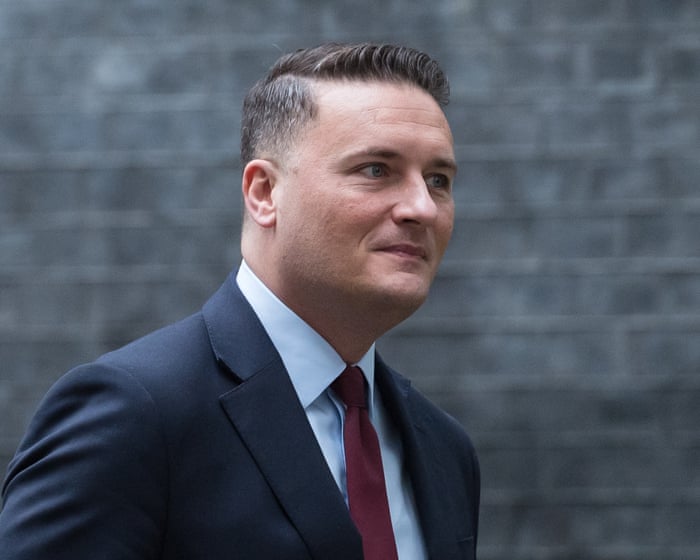
Wes Streeting has been forced to delay the publication of a plan to get more young people into defence industry jobs after pushback from trade unions, the Guardian understands.

The defence secretary had been due to announce the proposals on Thursday, but some unions in the sector are understood to have reacted angrily to the plans, accusing the government of bypassing their members and minimising their roles in job creation.

Continue reading...

© Photograph: Wiktor Szymanowicz/Future Publishing/Getty Images

© Photograph: Wiktor Szymanowicz/Future Publishing/Getty Images

© Photograph: Wiktor Szymanowicz/Future Publishing/Getty Images

  •  

NatWest cracks down on 13,000 staff attending office two days a month

Union furious as bank scraps remote-first policy from February 2027, requiring all of its UK employees to come in at least twice a week

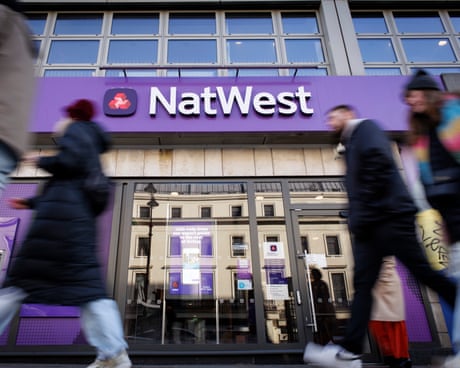
NatWest has ordered 13,000 staff to increase their in-office days from two days a month to two days a week, angering its staff union.

The banking group, which serves customers under the Royal Bank of Scotland, NatWest, Ulster Bank and Coutts brands, will require all of its nearly 40,000 UK staff to follow a strict two days a week office schedule from February 2027, abolishing a remote-first policy for thousands of employees.

Continue reading...

© Photograph: Tolga Akmen/EPA

© Photograph: Tolga Akmen/EPA

© Photograph: Tolga Akmen/EPA

  •  

Civil Servants, Culture unions join Teachers’ strike, Students’ protests on Oct 21

The civil servants’ union federation ADEDY has called a strike on Wednesday, October 21, from 11:00 in the morning until the end of the day’s shift. The strike action applies to all employees, regardless of their employment terms, in public-sector services throughout the country. Supported by pupils and university students, the teachers unions have called […]

The post Civil Servants, Culture unions join Teachers’ strike, Students’ protests on Oct 21 appeared first on Keep Talking Greece.

  •  

A Months-Old Anti-Robotaxi Group Is Steering Transportation Policy From Albany to D.C.

Waymo | Illustration: Walter Cicchetti/Dreamstime/Midjourney/Fatima Ruiz.waymo

At a protest against a bill to legalize Waymo in Washington, D.C., earlier in October, the main tagline was: "Robotaxis don't vote; we vote." Little is known about the group behind it, raising questions about who's fueling the pushback against robotaxis in America's major cities.

People First Transportation Alliance (PFTA), the organization in question, describes itself as a "statewide coalition of labor unions" dedicated to putting "people over untested technology." The PFTA states it's a "coalition of community organizations, safe-streets advocates, and faith leaders." However, as The Washington Post reported on Monday, the group appears to have overstated its affiliation with four of the 13 individuals and organizations listed as its founding members.

"Several groups and individuals said statements made about them on the Transportation Alliance website were inaccurate," the Post reported, adding that PFTA "appears to be newly formed, with a minimal social media presence. Its website domain was created in late April, according to the Internet Corporation for Assigned Names and Numbers." The group created its social media accounts in May, but it has no posts and no followers. 

Apart from its recent interest in the nation's capital, the PFTA lists New York and Philadelphia as its priorities, two cities led by lawmakers who publicly oppose Waymo's presence. Yet for a relatively unknown, recently created organization, the PFTA has found success in its campaign to shut autonomous vehicles like Waymo out of America's Northeast.

In February, the New York Post reported that Gov. Kathy Hochul (D–N.Y.) withdrew her own proposal—which would have allowed commercial robotaxi services such as Waymo to operate in smaller cities in upstate New York—after a PFTA-led coalition prompted enough backlash to kill support for the measure. A Hochul spokesperson told the Post that it was "clear that the support was not there to advance this proposal." 

The PFTA told the Post that the organization would urge the state to "pass legislation requiring a human driver behind the wheel in every vehicle and a comprehensive study leading to a plan to address the impact driverless cars would have on New York State." 

The group's resolution comes despite customer support for autonomous vehicles: A 2025 study on Waymo, Uber, and Lyft by Obi—a company that aggregates real-time rideshare prices—found that 70 percent of riders who've used Waymo preferred it over Lyft or Uber and 42.7 percent of all respondents were willing to pay Waymo's premium price (up to $10 more) to use the service.

Despite consumer support, autonomous vehicles can't count on a fair shake from lawmakers in some of the country's largest cities. In New York City, Waymo's permit to operate a pilot program on public streets expired in March. Mayor Zohran Mamdani has so far been noncommittal on renewing the company's permit. At a press conference that same month, he said his administration would be prioritizing workers such as the city's taxi drivers who "for far too long, have been sold a dream of being able to work their way to the middle class, only to have the rug pulled out from under them." 

Despite the mystery surrounding the PFTA, its D.C. protest drew enough public support to elicit a statement from a person who will likely be the city's next mayor, current D.C. Councilmember Janeese Lewis George. In a post on X, Lewis George said D.C. was "facing a jobs crisis" that would be exacerbated by "rushing the legalization of autonomous vehicles." She urged the D.C. Council—which is currently considering a punitive proposal to legalize commercial autonomous vehicles—to "get this right and not rush Waymo legislation this year."

It's unclear how much longer Lewis George wants the District's residents to wait before autonomous vehicles are available for use. D.C.'s approach to legalizing commercial robotaxis hardly seems rushed. 

Waymo began testing its vehicles in the city nearly two and a half years ago, in spring 2024. The company's co-CEO Tekedra N. Mawakana said its fleet has driven "more than 300,000 miles in Washington, D.C."Meanwhile, the District Department of Transportation (DDOT) has been conducting studies and organizing working groups on autonomous vehicles for nearly a decade. Still, the agency has been unable to draft a regulatory framework that would eventually enable commercial robotaxi use in the nation's capital. In March, UrbanTurf reported that DDOT would be conducting a long-awaited study on autonomous vehicles—originally due in 2022—and "expects to propose recommendations on AV deployment later this year."

Opponents of autonomous vehicles, such as Lewis George and the PFTA, often cite job loss as a reason not to legalize the tech. Still, with only 200 full-time ride-share drivers in a city of roughly 400,000 workers, as Lewis George has reportedly stated, the situation is a far cry from a crisis.

As for PFTA's public safety claims, Waymo's independently reviewed data show that, compared with an average human driver over the same distance, its vehicles caused 95 percent fewer serious-injury-or-worse crashes and 93 percent fewer pedestrian crashes with serious injuries.

PFTA claims it represents the people most directly affected by transportation policy. The little publicly available information suggests the group is more focused on protecting its members' position in the ride-share market than enhancing the experience of riders, who are increasingly opting for robotaxis when given the opportunity.

The post A Months-Old Anti-Robotaxi Group Is Steering Transportation Policy From Albany to D.C. appeared first on Reason Magazine.

  •  

EU ministers seek balance between workplace rights and competitiveness in 21st century jobs act

EU ministers have discussed how to make labour standards compatible with modern technological conditions and workplace culture, such as telework and AI-led staff oversight, without losing competitiveness.

The law in question, called the Quality Jobs Act, covers a wide range of work protection measures, such as common standards for being able to ‘go home’ and disconnect from remote work, and limits to AI role in recruitment or its scrutiny of workers’ performance.

Technological innovation should “benefit both workers and businesses,” said Portuguese labour minister Maria do Rosário Palma Ramalho, addressing the ministers’ council on Monday (19 October) in Luxembourg.

Human oversight is essential, especially where AI systems decide on recruitment or workers’ assessment, she said.

Next to innovation, labour rules needed to ensure “fair and transparent practices, respect for human workers’ rights … and effective social dialog,” said Roxana Mînzatu, the EU commissioner for employment.

“This revolutionary technology has to be regulated” so that it “delivers for all,” Isabelle Schömann, the European Trade Union Confederation (ETUC) deputy general secretary had also said during a conference organised by the centre-left S&D group in the European Parliament on 14 October, commenting on the need for the Quality Jobs Act to curb AI.

The draft Quality Jobs Act that the European Commission plans to present in December aims to update the long out of date 1989 and 1990 health and safety workplace rules.

It would also protect subcontractors and create standards for working in heatwaves, becoming more frequent with climate change.

EU legislators need to ensure minimum standards so that “neither jobs nor businesses are jeopardised” with extreme weather, Yolanda Díaz Pérez, the Spanish labour minister, said ahead of Monday’s debate.

This article continues, but the full version is available only to EUobserver.com subscribers. Visit account.euobserver.com/membership

  •  

North Sea strikes could severely disrupt UK fuel supplies, union warns

More than ⁠160 ​offshore rig workers plan walkout amid rising tensions between unions and oil companies

North Sea workers are preparing to strike at oil rigs across the ageing basin over the coming weeks in a sign of growing tensions between trade unions and oil companies.

The Unite union said on ⁠Monday that more than ⁠160 ​offshore rig workers would take part ⁠in a 24-hour ​strike from Wednesday that could “severely disrupt” UK fuel supplies.

Continue reading...

© Photograph: Martin Langer/Alamy

© Photograph: Martin Langer/Alamy

© Photograph: Martin Langer/Alamy

  •  

DOGE Worked? Only If You Grade on a Curve.

Elon Musk and Donald Trump with a DOGE meme coin | Official White House Photo by Daniel Torok/Newscom/Jiri Hera/Dreamstime.

As the Trump administration's short-lived Department of Government Efficiency (DOGE) project implemented its plan to downsize the federal workforce, there was much wailing from the liberal institutions in Washington, D.C.

Federal employee unions filed lawsuits to block the effort. NPR ran profiles of federal workers who, for the first time, faced the prospect of potentially not having absolute job security forever. The Brookings Institution wondered how many jobs the federal government could shed before it crashes.

The answer: plenty. The Trump administration has cut more than 10 percent of the federal workforce, and the government hasn't crashed. Indeed, it hasn't even shrunk—if you're counting by dollars spent instead of people employed.

In a new article for City Journal, Manhattan Institute senior fellow Judge Glock highlights the tremendous gap between the dire predictions about DOGE's cuts and the reality that has emerged, more than a year after DOGE was shut down. Despite having only a modest impact on spending, Glock writes, DOGE "had a massive impact on the federal civil service."

This is true—to a point, more on that in a moment—and notable. Aside from a modest downsizing in the 1990s, the number of people employed by the federal government has been steadily growing for decades. Reversing that trend is one of the few genuinely libertarian accomplishments by the Trump administration.

The cuts to the federal workforce prove that "DOGE worked," argues Glock.

Well, hold on.

Elon Musk and Vivek Ramaswamy (who departed the DOGE project before Trump's inauguration and is now running for governor of Ohio) set some very ambitious goals after being appointed DOGE co-chairs in late 2024. In an op-ed for The Wall Street Journal in November 2024 where they promised "we won't just write reports or cut ribbons. We'll cut costs."

Musk repeatedly attached some rather absurd numbers to that promise. He said DOGE would cut $1 trillion or even $2 trillion in federal spending. In the end, it didn't come close. By DOGE's own (questionable) accounting, it cut $170 billion. Meanwhile, overall federal spending has increased in each of Trump's first two years in office, and the budget deficit has widened as well.

Yes, Musk and Ramaswamy also said they would reduce the federal workforce. But that was presented as a natural consequence of cutting spending, not as the primary goal.

Think about it like this. If I spent months promising my friends and family that I would lose 50 pounds on a new diet, and then didn't lose any weight, would it be fair to say the diet worked?

What if I reduced the number of donuts I eat every day, but still didn't lose any weight? Sure, that might be good for my health in some way—just like reducing unnecessary workers in the federal government is good for America's fiscal health—but it certainly wouldn't mean I had achieved the goal of losing weight.

Finally, even the claim that DOGE cut the federal workforce requires an asterisk. As Glock also notes in his report, the decline in federal workers has been offset by an increase in federal contractors.

It's not a one-for-one trade, of course. The new contractors are overwhelmingly concentrated in places like the Department of Homeland Security and the Pentagon, while the cuts mostly targeted other areas, like the Department of Health and Human Services.

"Most of that increase came from the buildup in homeland-security and defense contracting, including purchases such as surveillance aircraft and tanks, rather than substitutes for government workers," Glock writes. "DOGE achieved real contract savings, but these were more than offset by higher spending elsewhere, reflecting a shift in priorities rather than an overall reduction in contracting."

So, the government is eating fewer donuts but more pizza.

There might be libertarian reasons to prefer contractors over government employees. They are less likely to hold those jobs for life, for one. But there's nothing inherently good about a government policy that cuts jobs in some areas just to create more room in the budget for poorly trained immigration enforcement agents and defense contractors. That may even be a negative outcome for liberty.

In the end, the DOGE project looks less like a meaningful attempt at cutting government spending or employment levels and more like a way to purge parts of the federal workforce likely to get in Trump's way during his second term. "As long as [Trump's] larger commitment is to extending his power rather than rolling back power itself, you shouldn't expect the government to stop growing," as Reason's Jesse Walker wrote last year in comparing DOGE to President Richard Nixon's attempted purge of the civil service.

Did DOGE work? Only if you grade it on a pretty dramatic curve.

Yes, it proved that a president can slash bureaucratic jobs—particularly the bloated managerial and administrative types—without doing much damage to the government's core responsibilities. That's a lesson future administrations should remember.

Maybe, someday, a president will try applying the same logic to government spending too.

The post DOGE Worked? Only If You Grade on a Curve. appeared first on Reason Magazine.

  •  

France Braces for 500 Protest Actions as Yellow Vests and Students Join Forces

French authorities are preparing for hundreds of demonstrations on Saturday, 17 October, as student unrest converges with protests over living costs, public spending and government policy. Up to 40,000 demonstrators are expected in Paris, where police and organisers remain divided over march routes.

France is preparing for a nationwide wave of demonstrations on Saturday, 17 October, with approximately 500 protest actions under consideration and more than 90 marches being organised, according to the Interior Ministry. The mobilisation brings together high-school students, trade unions, farmers and supporters of the Yellow Vest movement, raising the prospect of further confrontation after nearly a month of unrest.

Police estimates suggest that around 40,000 demonstrators could gather in Paris, with approximately 150,000 more expected elsewhere in France. The figures remain preliminary, while authorities warn that some protests could involve road blockades, disruption to essential infrastructure and violent clashes.

Interior Minister Laurent Nuñez initially outlined preparations for 250 gatherings and 80 marches on Friday morning. Subsequent assessments from his office indicated that as many as 500 actions were being considered, although not all had been formally organised.

Paris Faces Dispute Over Demonstration Routes

The authorities are particularly concerned about developments in the capital, where negotiations between police and protest organisers have failed to produce agreement over the proposed routes.

Paris police prefect Patrice Faure has rejected proposals for marches terminating near the Opéra district or Place de la Concorde, citing security concerns surrounding central government institutions.

According to details of the security preparations, police have proposed an alternative route between Place de la Bastille and Place de Clichy. The CGT trade union and climate campaigners have accepted the proposal, but student organisations and Yellow Vest representatives continue to oppose it.

Prime Minister Sébastien Lecornu has convened an interministerial crisis unit to coordinate the government’s response. Security officials have warned that attempts to obstruct major transport routes or critical infrastructure will not be tolerated.

The Interior Ministry has also indicated that stun grenades, whose use was suspended during the student protests, could again be deployed in cases of particularly serious urban violence.

Yellow Vests Return Amid Rising Living Costs

Saturday’s demonstrations are being promoted as a revival of the Yellow Vest movement, which emerged in 2018 following opposition to fuel taxation before developing into a broader protest against living costs, economic inequality and government policy.

The latest mobilisation has gathered support from organisations demanding measures to address rising fuel, energy and food prices. Campaigners are also challenging the government’s proposed 2027 budget and its implications for public services.

The agricultural union Confédération paysanne has called on farmers to join the demonstrations, arguing that rising agricultural fuel costs and deteriorating conditions in rural communities have increased pressure on producers.

The union has also linked its demands to environmental policy, public-service provision and access to affordable food.

The CGT, student unions and climate organisations have similarly expressed support for the protests, while political backing has come from La France Insoumise and the French Communist Party.

Student Protests Enter Their Fourth Week

The mobilisation follows weeks of demonstrations involving secondary-school pupils, teachers and public-sector workers. What began as protests over shortages of teachers, overcrowded classrooms and deteriorating school buildings has developed into a nationwide confrontation over education policy and policing.

As EU Today previously reported, between 400 and 500 secondary schools faced partial or complete disruption earlier this month as students organised blockades and demonstrations.

The movement has subsequently expanded beyond its original educational demands, with student organisations raising concerns about university admissions procedures, police tactics and government spending priorities.

The scale of the unrest has placed considerable pressure on French authorities. According to figures from the Justice Ministry, 6,877 people were placed in police custody during the protests between late September and 8 October, approximately 86 per cent of them minors.

Violence during the demonstrations has resulted in injuries among police officers, students and educational staff. Clashes on 8 October led to 504 arrests and injuries to 48 police officers, according to Interior Ministry figures.

Education Minister Édouard Geffray has announced emergency measures to address teacher shortages, including the deployment of replacement teachers. The ministry says 2,000 of the 3,000 promised replacements have already been assigned, but student organisations maintain that the measures are insufficient.

Growing Pressure on the French Government

The planned demonstrations come as France faces a difficult debate over public spending, taxation and the 2027 budget. Lecornu’s government must balance demands for higher salaries and increased investment in education against mounting pressure to reduce the deficit.

France’s deteriorating public finances have already attracted scrutiny from eurozone partners, while domestic opposition to spending restraint has become a central issue ahead of the 2027 presidential election.

The convergence of student organisations, trade unions and Yellow Vest campaigners could broaden the protests beyond the education sector, particularly if demonstrations over living costs attract participants who have not joined the recent school protests.

However, the extent of that mobilisation remains uncertain. Online protest maps contain substantially more proposed actions than the authorities’ estimates, and participation figures will not be established until Saturday.

For the government, the immediate test will be whether the demonstrations remain peaceful and whether the authorities can prevent disruption to transport networks and public services without provoking further confrontations with protesters.

  •  

Colombia’s First National Strike Against De la Espriella Met With Police Crackdown

Colombian protesters and police during nationwide demonstrations against President Abelardo de la Espriella in Bogotá and Medellín.

Thousands protested budget cuts and economic reforms as clashes with police erupted in several Colombian cities.


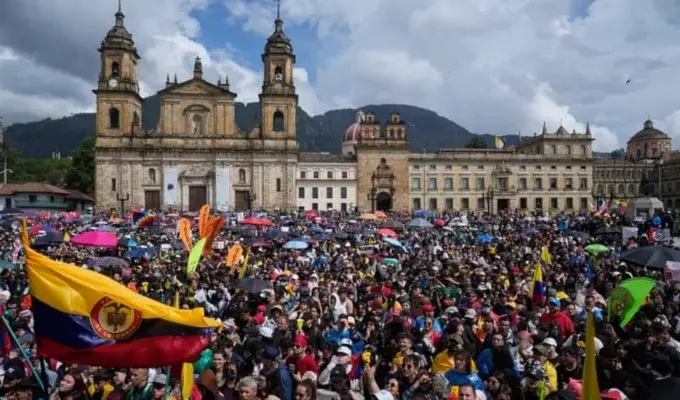
Thousands of people took to the streets across Colombia on Wednesday in the first national strike against President Abelardo de la Espriella’s administration, as police used tear gas, rubber bullets and armored vehicles to disperse demonstrators in several cities.

RELATED: Colombia Holds First National Strike Against De la Espriella

Protests spread across more than a dozen departmental capitals and municipalities, including Bogotá, Medellín, Cali, Barranquilla, Ibagué, Popayán and Bucaramanga. In Bogotá, four columns of demonstrators converged on Bolívar Square under a security operation monitored by a Unified Command Post.

In Medellín, demonstrations escalated into clashes between protesters and the Mobile Anti-Riot Squadron (ESMAD). Security forces deployed tear gas, rubber bullets and armored vehicles, leading to several arrests. Assaults on members of the press were also reported.

Clashes and serious public disturbances were also recorded in Ibagué and Popayán following police interventions. Human rights organizations, including the NGO Temblores, denounced the presence of armed men carrying rifles on the rooftops of government buildings in Bogotá, describing their deployment as a direct threat to protesters.

The demonstrations brought together trade unions, teachers, university students, Indigenous communities, LGBTQ+ groups and feminist organizations. Opposition figures, including former President Gustavo Petro and Senator Iván Cepeda, also took part.

Protesters called for labor, education and social protections, seeking to preserve measures introduced under the previous administration, including free access to public universities and increases in the minimum wage. They opposed what they described as a neoliberal shift under De la Espriella’s government, citing budget cuts and the administration’s initial economic reforms.

Colombianos:

Me dirijo a ustedes esta noche para entregarles un balance claro, objetivo y contundente de la jornada de manifestaciones que vivió hoy nuestro país.

¡Que quede absolutamente claro! El 98% de las movilizaciones transcurrió de manera pacífica.

La inmensa mayoría de… pic.twitter.com/CmllZVPBtu

— Abelardo De La Espriella (@ABDELAESPRIELLA) October 15, 2026

Text Reads: Colombians: I address you tonight to deliver a clear, objective, and unequivocal report on the day of demonstrations that our country experienced today. Let it be absolutely clear! 98% of the mobilizations took place peacefully. The vast majority of those who took to the streets exercised their legitimate right to protest in an orderly and respectful manner toward the institutions. That is democracy, and as President of the Republic, I will always defend and guarantee it. At the close of this day, the national tally records a total of 62,000 citizens mobilized. A figure that represents a very small proportion of the Colombian population, but whose rights and guarantees deserve the full respect of the State. From the first day of my Government, I have issued a directive that admits no interpretations: peaceful protest is respected, protected, and guaranteed. But violence, vandalism, and any attempt to violate the rights of others will have no place under my mandate. Because as legitimate as the right to demonstrate is the right of millions of Colombians to work, move freely, and live in tranquility. Here there is a State, here there is authority, and here there is a Government that respects freedoms, enforces the law, and protects the millions of Colombians who rise early every day to work and build the Nation. Firm for the Nation! Long live Christ the King! (A.D.L.E.)

Demonstrators also rejected the restoration of diplomatic relations with Israel and what they described as U.S. interference in Colombia’s affairs.

Tensions mounted after the government signed a decree hours before the marches that changes the rules governing police conduct during public demonstrations. De la Espriella defended the measure as necessary to combat “urban terrorism,” while opposition politicians and social organizations condemned it as an attempt to intimidate protesters.

Senator Cepeda warned that the decree risked returning Colombia to a situation in which fear enabled arbitrary actions by security forces.

“They want to take us back to a time when fear becomes the means through which the security forces act arbitrarily,” Cepeda said.

Trade union sources said organizers were already drawing up a schedule of further mobilizations for the coming months following Wednesday’s mass protests. The campaign could culminate in a general strike in November.

  •  

AutoZone workers won a union. Then the company fired them.

An AutoZone store with logo sign is seen in Chicago, Illinois, United States, on August 3, 2026. Photo by Marcin Golba/NurPhoto via Getty Images
Jacobin logo

This story originally appeared in Jacobin on Oct. 12, 2026. It is shared here with permission.

Speaking with members of the newly formed AutoZone Workers Union, you would never guess that one of them had just been fired — and that another would be the next morning. That’s what happened to Nathan DuCongé and then David Valencia after they won their union election. On a Zoom call with Jacobin, though, their joy was contagious. DuCongé and his coworkers were all smiles and banter as they talked about their union campaign, how it feels to win, and the unexpected boost they received from filmmaker Boots Riley.

On Friday, September 25, an AutoZone store in White Plains, New York, became the first of the company’s nearly seven thousand American retail locations to unionize. DuCongé and his coworkers, now members of United Auto Workers (UAW) Local 259, said they hadn’t been sure which way the vote would go.

“The deck was really stacked against these workers trying to organize here,” said Brian Murray, an experienced organizer brought on in August by UAW Local 259 Vice President Mike DiGuiseppe. “It was because of their sticking together, the amount of fun they have, and their camaraderie, their solidarity for each other, [that] they were able to overcome a lot of union busting.” He added, “I would have expected [them] to not have succeeded in winning that vote, but they did.”

“We Were Already a Union”

DuCongé moved to New York City two years ago and soon started working for AutoZone as a part-time employee. A year later, he became a parts sales manager. He said he decided to start organizing his store after he was removed from the schedule one Saturday in April, and instead went to a joint meeting of the Emergency Workplace Organizing Committee (EWOC) and the New York City Democratic Socialists of America (NYC-DSA). There he was connected with UAW members who encouraged him to unionize.

By then, DuCongé and Valencia, who was hired several months after him, had already discussed the possibility of a union. Valencia’s turning point came in 2025, when he worked a Fourth of July shift and found out from his paycheck that he wasn’t getting holiday pay. “I went in and I told my manager that day . . . I’m going to make a union.”

“I know this isn’t always the case, but for us, it was already there,’ said Valencia. ‘We were already a union.“

Valencia said he already knew DuCongé’s political orientation when he approached him about unionizing. “We got to talking about it, and it took a long time because we didn’t have the institutional knowledge on where to even begin, until by chance Nate met someone at a DSA meeting. They hooked us up with the UAW, and the rest is history.”

Given the store’s small size, the workers’ specific grievances, and the tight-knit relationships among several key employees, DuCongé and Valencia felt it would be a good place to test whether AutoZone could be organized.

“I know this isn’t always the case, but for us, it was already there,” said Valencia. “We were already a union.”

Do the Job Right

Juan Accostupa, a full-time sales associate who has worked at AutoZone for ten years and trained many of the organizers, described the extra responsibilities workers take on. “We’re not just a retail place. We do a lot of work,” he said. “We unload the trucks, we do installations — batteries, headlights, brake lights, wiper blades, whatever the case might be — and we’re just not getting paid properly.”

“You’re expected to do a lot for so little,” said DuCongé. “These are the kind of things that mechanics are paid to do, right?”

Accostupa said he has made minimum wage throughout his tenure at the store. “Some people think this is, like, a revolution thing. It’s not. We’re just asking for what should be done: better pay and better benefits. That’s it.”

Jess Omelia, a part-time commercial driver who previously worked for a Pepperidge Farm warehouse in Florida with “really great benefits,” said working for minimum wage with little to no benefits was a huge adjustment. “It was a job that I needed at the time, so I took it.”

“Some people think this is, like, a revolution thing. It’s not. We’re just asking for what should be done: better pay and better benefits.“

Omelia said the lack of holiday pay for part-time employees came as a shock. She recalled being put on the schedule for Mother’s Day even though she was the only one among her coworkers with a toddler. “I was the only one there working on Mother’s Day,” she said. “It was only my store manager there. He had given everyone the day off or people had called out to be with their families.”

Workers also cited other reasons for unionizing: inconsistent and last-minute scheduling, inadequate equipment, no say in how they handle their routine responsibilities or in disciplinary procedures, and a push to upsell customers known as “WITTDTJR” — short for the AutoZone slogan “What It Takes To Do the Job Right.”

“We would literally come in and underneath the [sales] numbers every day, there would be a threatening note underneath that you need to get these numbers up,” said Omelia. “You would be punished and your hours would be taken away if you weren’t upselling.”

What Makes a Supervisor?

Workers said their card drive proceeded with little incident until July, when corporate got wind of it. After the workers sent their demand letter and submitted their cards in late July, AutoZone promptly rejected them, saying DuCongé’s involvement as a parts sales manager — a position the company says is supervisory — nullified them.

DuCongé disputes that categorization. Under the National Labor Relations Act, a supervisor must have the authority, using independent judgment, to make or effectively recommend decisions like hiring, firing, disciplining, or promoting other workers — authority DuCongé said he did not have. Rather than fight the issue, which could have delayed an election, the workers resubmitted the cards without him.

“I just felt like it would be selfish if I tried to fight for my eligibility,” said DuCongé. “I never wanted to stand in the way of these people. They’re my friends, my coworkers. It was a good feeling to be able to just help.” He added, “As a member of DSA as well, I felt that as a responsibility. It was kind of like, hey, look, I’m in this organization, I might as well do something that lives up to the organization and the reason why I’m in it.”

Workers said that at a prehearing meeting in late August, AutoZone made clear that it intended to challenge the election not before the National Labor Relations Board but in federal court in Tennessee, where the company is based. At the same meeting, the workers and AutoZone signed an agreement that locked in the list of eligible voters to prevent challenges to votes on election day.

Yet other employees who hold the same position as DuCongé were allowed to vote. Two workers who were transferred to the store in mid-August were also deemed eligible.

“We Will Accept Your Invitation to Fire You”

In the lead-up to the vote, workers reported being subjected to heavy surveillance, multiple antiunion meetings per week, and threats of disciplinary action against the organizers.

“We were having three meetings a week. It was constant . . . and they were really just reading off of a script every time,” said Omelia. “It was just all anti-union. They were extremely against it, said that they would do everything in their power to fight it. If we didn’t like the conditions, [they said] that we could quit and go to another store.”

Valencia said the anti-union messaging relied on half-truths and accusations, including misleading claims about union dues and employees’ ability to communicate with their manager. Organizers, he said, were accused of misleading or threatening workers into voting yes, and were portrayed as using the campaign to land union jobs paid for by workers’ dues.

Workers said AutoZone brought in managers from locations around the country to surveil the store. “There were up to eight, nine people in the store a day, and even the customers were like, ‘What’s going on?’” said Omelia. “There would be times where they’re literally just standing at the back of the store with their arms crossed, just watching us.”

DuCongé said that after the workers submitted their demand letter on July 24, an account under the name of AutoZone CEO Philip Daniele showed up among the viewers of one of his Instagram stories.

In a September 4 recording shared with Jacobin, management threatened to fire DuCongé for union activity on the grounds that he was a supervisor: “If you continue to involve [yourself] in unionization activity, we will accept your invitation to fire you.”

LaborLab, a workers’ rights watchdog group, estimates that AutoZone spent around $200,000 trying to defeat the union. “They do everything except pay you more,” said Murray.

AutoZone in Six

Despite the onslaught of anti-union activity, the workers said the solidarity they felt with one another kept them moving forward. When Omelia’s mother died, her coworkers took up a collection. “I came into work, and they had a little envelope, and they all pitched in to help with my mom’s funeral costs. That’s how close we are.” Accostupa was quick to point out that every manager declined to contribute.

Support also came from outside the store. DuCongé, a filmmaker himself, had posted on social media about how inspiring he found Boots Riley’s new film, I Love Boosters. To his surprise, Riley started reposting updates on their organizing efforts. His first feature, Sorry to Bother You, follows a group of telemarketers who organize and go on strike.

“Boots has been massively influential on my personal life, my filmmaking efforts, but also really, really influential for this campaign,” he told Jacobin. “The solidarity is going beyond the movies and TV shows that he makes.” He added, “I just can’t thank him enough, truly, for helping us out.”

Workers said management kept talking to employees about the election in the twenty-four hours before the vote — and even during it. “On the day of voting, during voting happening, managers were pulling some of those people out of the store, and trying to sway those votes,” said Omelia.

Barred from voting and, he said, from entering the store, DuCongé stayed nearby. He recounted the moment:

I didn’t know what to do with myself, so I just stand on this hill that’s looking down at the store . . . I felt locked onto the ground, and there’s this groundhog sitting right next to me, just also looking out there too. I’m looking at the groundhog, and then eventually it just looks at me, like, “What are you looking at?” It turns out we’re both just looking down at the store. There’s this beautiful sunset and all these crows and everything, and that’s when Mike [DiGuiseppe] texted us the news, and said, “You won.” I just collapsed.

The final tally was 6–4 in favor of the union. Despite the prehearing agreement, and despite his serving as the union’s election observer, Valencia’s vote was challenged during voting, but, in the end, every eligible vote was counted.

After the Win

The day after the vote, AutoZone fired DuCongé. In a recording provided to Jacobin, management tells him: “Effective immediately, AutoZone is terminating your employment as a result of the failure to act appropriately as a manager by engaging in and/or facilitating union activity.”

The following day, another worker was fired for, in DuCongé and Valencia’s words, “not stopping the union.”

Valencia says he was fired too, on October 3, the morning after the Zoom call. Asked on the call whether he was worried about his job, he had said, “If I get fired, I get fired. They’re going to have to come up with a good reason, because I’m in the bargaining unit. It won’t be so easy.”

“If I get fired, I get fired. They’re going to have to come up with a good reason, because I’m in the bargaining unit.“

That same day, AutoZone filed three objections to the election with the National Labor Relations Board, a move the union sees as a delay tactic. The workers seem undeterred.

“We fought for this and we did it. It’s funny, I was telling the staff and everybody else, we were like the Knicks. Knicks in six,” said Accostupa. “The thing about it was we won six and four, 6–4. That was the key.”

Next they intend to help workers at other AutoZone stores organize. “I deliver to other stores, so I see the things that they go through,” said Omelia. “They were watching this election and waiting to see what happened with us to see if they could move forward.”

Valencia says AutoZone runs on the work of people like him and his coworkers. “People come into AutoZone frantic,” he says. “You help them out, you send them on their way with a smile on their face. It’s a good thing. We’re not saving the world, but one person at a time, we’re making their day better.”

“The workers on the ground are really providing all the value to the companies that eat up all the value,” Valencia says, “and all the people at the top that take all the profits that we create. And we just want some kind of compensation that looks closer to the value that we provide.”

  •  

Low pay and stress forcing Europe’s care workers to quit jobs, unions warn

Almost half of workers helping families care for children, older people, and people with disabilities, who provide vital domestic support in Europe, have considered quitting due to low pay and bad working conditions, a labour-union report found on Tuesday (13 October).

The 2026 personal and household services (PHS) employment monitor drew on more than 8,000 responses from workers, service users, and employers in 36 countries.

Around one in four respondents worked between 35 and 40 hours per week.

Meanwhile, six in 10 workers reported work-related musculoskeletal disorders, including back pain and tendon inflammation.

One in four also said they had experienced or witnessed verbal abuse, while nearly 15 percent had experienced either sexual harassment, physical, and/or sexual violence.

Care poviders’ mental health is impacted, with around six out of 10 reporting sleeping issues.

But these same workers play “an essential role in providing a dignified life for everybody in our ageing European societies,” Oliver Roethig, regional secretary of UNI Europa said in a statement. 

This article continues, but the full version is available only to EUobserver.com subscribers. Visit account.euobserver.com/membership

  •  

MLB's Salary Cap Fight Isn't About Competitive Balance, It's About Limiting Labor Costs

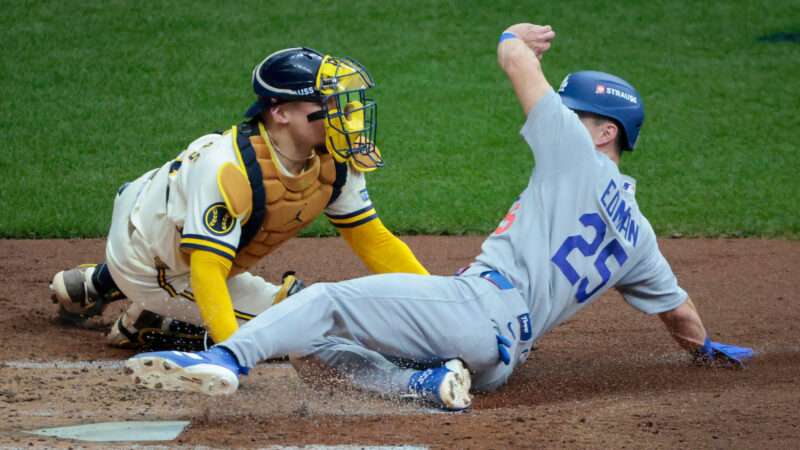
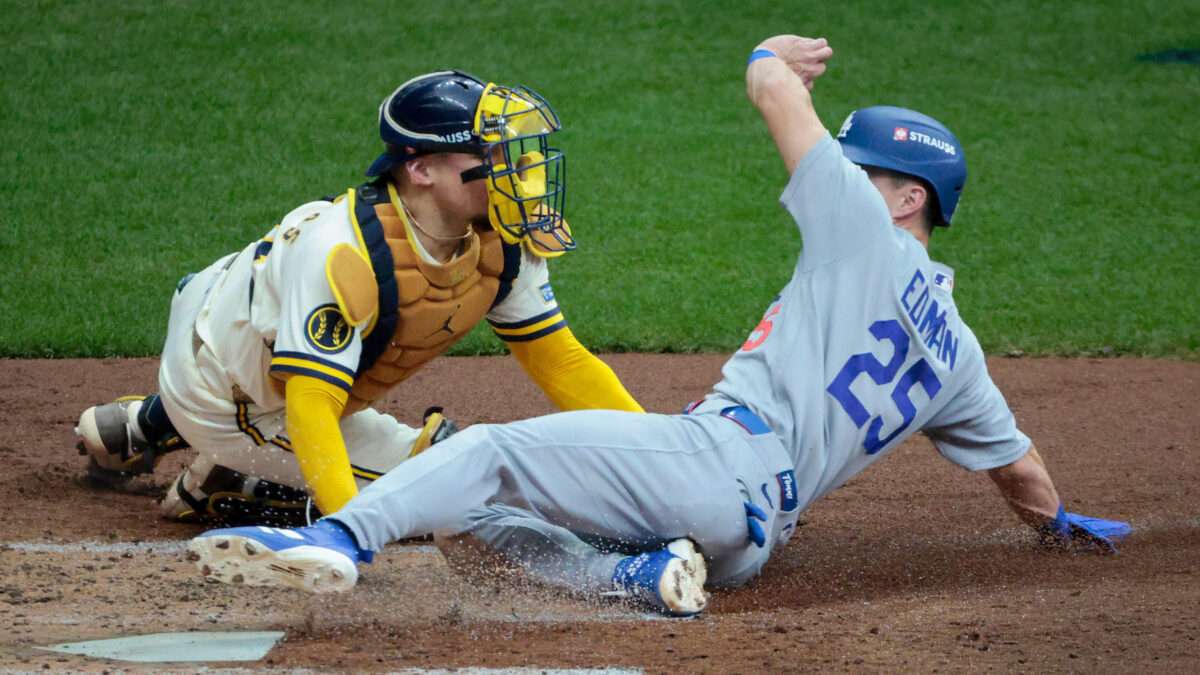
The Dodgers' Tommy Edman slides safely into home while Brewers catcher William Contreras attempts a tag. | Photo: TANNEN MAURY/UPI/Newscom

Hello and welcome to another edition of Free Agent! It's a great week to do something nice for the furry friends in your life.

Let's get into some nitty-gritty about baseball's salary cap fight. We'll dive in with two sections on that, then move on to some new thoughts about an old video game.

Locker Room Links

MLB's Salary Cap Fight Isn't About Balance, It's About Costs

In 2025, baseball fans wanting to avoid a lockout, a salary cap, or both, were rooting for the small market, small payroll Milwaukee Brewers to beat the goliath Los Angeles Dodgers in the National League Championship Series (NLCS). The Brewers got swept. Now it's 2026, and guess what? Baseball fans wanting to avoid a lockout, a salary cap, or both, are rooting for the small market, small payroll Brewers to beat the goliath Dodgers in the NLCS. (At least the Brewers aren't getting swept this time!)

But what if none of that matters at all to the salary cap fight?

A small market World Series victory for the Brewers (19th in MLB payroll), the Tampa Bay Rays (28th), or, yuck, the Cleveland Guardians (30th) helps boost the theoretical argument that MLB doesn't need a salary cap for small market teams to succeed. But labor negotiations are not decided by debate club rules—you don't win with a better policy argument. It's all about the power dynamics and leverage of what is essentially a business negotiation between employees and employers. The policy argument might matter to public opinion, but it makes hardly any difference to leverage.

Competitive balance may not matter to the owners at all (in fact, some studies have found that salary caps don't create more balance, but revenue sharing does). The owners are almost certainly focused on keeping down their labor costs. A salary cap would likely give an immediate boost to team values—when Formula 1 teams recently agreed to a broad cap on their expenses, valuations shot up.

The lockout fight will come down to who can endure the pain the longest, and how much the "losing" side is willing to stomach what the "winning" side is offering. The billionaire owners have plenty of wealth and income from their other assets, but also don't want a lockout to crater the value of one of their biggest assets. The players have had years to save and plan for a lockout, and some can still try to lean on endorsements, merchandise, and other nonpayroll income to help them along. The owners will try to say they're showing good faith by combining their salary cap with a salary floor that would force some teams to spend more on players—but that won't appeal much to the union's player leadership, which is largely made up of high-level players who want a big payday coming out of the lockout (I see you, future free agents Tarik Skubal and Paul Skenes).

The only way public opinion might matter is if government officials decide to get involved. President Donald Trump has already made noise about taking action, and backs the owners' push for a salary cap, but it's unclear how much he can lean on negotiations. The National Labor Relations Board may end up involved—all four members were appointed by Trump (one is a Democrat who used to work for the players union). Members of Congress could threaten to take away MLB's antitrust exemption, but probably wouldn't have the votes to do it.

It goes without saying all this is incredibly frustrating for fans (as well as players who want to earn a living and teams that want to plan for the future). The lockout is going to hit baseball like a car crash that everyone saw coming from miles away. The basic bargaining positions have not changed in years, but the two sides have made basically no progress.

At least Minor League Baseball won't get locked out, and should get a major viewership boost if MLB ends up losing games.

With All the Salary Cap Scandals, Are They Even Worth It?

What's funny to me is that the MLB salary cap debate is happening in the wake of two of the biggest spending cap scandals in sports history: the Los Angeles Clippers salary cap circumvention scandal and, in soccer, the Manchester City financial scandal. You'd think the difficulty of enforcing these rules would cause some people to think twice about a salary cap, and how cheaters can ruin the integrity of the game for fans.

If MLB owners do manage to convince the players to agree to a cap, the cap's rules will make a big difference in how successful it is.

The NBA had a scandal over fake endorsement deals, the Premier League had a scandal over fake sponsorships, and hockey fans got mad every year about players coming off the long-term injured reserve list just in time for the playoffs, changing their cap hit, until the league finally closed the loophole. In multiple sports, fans from high-income-tax states complain that their salary cap limits are the same as teams in low- or no-tax states, making the latter more appealing to free agents.

Meanwhile, in the NFL—actually, it's somehow been largely scandal-free on the salary cap front for over a decade, except for a couple minor scandals.

I'm not exactly sure how the NFL manages this—maybe it's the hard cap with few exceptions, maybe it's the size of their rosters, maybe it's because many of the tactics teams use to game the cap are legal (for example, converting a "signing bonus" into base salary paid out over five years). Or maybe there is a ton of salary cap circumvention with sham side deals and the NFL just fails to catch it.

Regardless, I'm morally not a fan of teams colluding to avoid paying players their competitive market wage. We're talking about millionaires, so you might not have much sympathy. But if you had the talent and put in the hard work to earn a million fans, you wouldn't want owners to collectively diminish your wage either.

4 Years Later, Gran Turismo 7 Still Slaps

Just when I thought I was out, Gran Turismo 7 has pulled me back in. First released in 2022 (see my brief review from the time here), the game is now my go-to activity when I have free time.

A few times a week, my 2-year-old son will ask to see race cars on TV, and sometimes I will fire up Gran Turismo 7 or the latest Formula 1 game for him to watch me play (he sort of pays attention, but what he really wants is to break small pieces off my Formula 1 Lego sets, forcing me to pause each lap and reassemble them). A few weeks ago, I noticed Gran Turismo 7 has weekly challenges of five races. While working through them, I noticed that—despite having beaten most of the game's most difficult challenges on its hardest difficulty—I'd won less than 40 percent of its races.

That just couldn't stand, and now I'm trying to work through them all. AI has added a new component for me—I've used it to help with car selection, pit strategy, and tweaking of settings.

All this is to say that I'm impressed a 4-year-old video game can still make me obsessed. Kudos to the Gran Turismo 7 team for releasing several updates throughout the year with new tracks, cars, and more.

Replay of the Week

I watched this live and on replay so many times, and still can't figure out what they thought was going on. Was it a designed run play, and with what purpose? Did the players forget they didn't have any timeouts? Were the Commanders coaches running the clock low because they thought they'd have to kick it back to the Giants? I thought maybe they were trying to line it up for the kicker, but that would have involved a quick kneel followed by a spike.

The whole overtime was bonkers, and the Commanders are cowards anyway.

Jayden Daniels thought the clock would stop at 5 seconds out of respect for him pic.twitter.com/CQ16tDxL5o

— NFL Memes (@NFLMemes) October 11, 2026

That's all for this week. Enjoy watching the real event of the week, as the Grand Slam of Curling Co-op Invitational gets underway.

The post MLB's Salary Cap Fight Isn't About Competitive Balance, It's About Limiting Labor Costs appeared first on Reason Magazine.

  •  

Beards and loathing: A cop union convention comes to Las Vegas

Original photo used for cover image: A welcome sign greets attendees at the 23rd Quadrennial Convention of the International Union of Police Associations at the Paris Hotel in Las Vegas, Nevada on August 25-28, 2026. Original photo credit: Hamilton Nolan/TRNN. Original photo has been altered with AI and human design features to create cover image.

This feature report was co-produced and is being co-published in partnership with How Things Work by Hamilton Nolan and The Valley Labor Report.

On a plain, blue-lit stage in a plain event space at the Paris Hotel in Las Vegas, a gruff man with white hair and a thin goatee is complaining about Las Vegas. How it is too hot. How it is too expensive. And how the hotel’s convention-management bureaucracy is driving him nuts.

“You can’t even move a box from left to right without contacting someone to do that!” he barks into the microphone.

Far from all the political bluster about the police being defunded, six years after the earth-shaking George Floyd protests swept the US and public approval for law enforcement plunged to a generational low, these guys have never been more politically and monetarily supported than they are now.

This will become a communal ritual by the end of the week. Without fail, like some sort of morning prayer, the convention begins every day with opening grumblings about the convention itself.

We can see why. After all, the organization convening here is supposed to be a strong union representing nearly 20,000 members around the country. Far from all the political bluster about the police being defunded, six years after the earth-shaking George Floyd protests swept the US and public approval for law enforcement plunged to a generational low, these guys have never been more politically and monetarily supported than they are now.

But there are only about 50 people in the room here with us (28 delegates, 10 alternates, and some wives and family members mixed in). The proceedings are pretty boring and energyless, the attendees are grumpy, and the air is thick with middle-age resentment.

A welcome sign greets attendees at the 23rd Quadrennial Convention of the International Union of Police Associations at the Paris Hotel in Las Vegas, Nevada on August 25-28, 2026. Photo credit: Hamilton Nolan/TRNN.
A welcome sign greets attendees at the 23rd Quadrennial Convention of the International Union of Police Associations at the Paris Hotel in Las Vegas, Nevada. Photo credit: Hamilton Nolan/TRNN (August 25, 2026).

Clearly, the convention organizers and speakers were expecting something much different than this. To be honest, so were we. Because it’s 2026, Donald Trump is president again, and this is the 23rd Quadrennial Convention of the International Union of Police Associations (IUPA), which represents tens of thousands of cops in departments from coast to coast.

The convention was billed as “The premier gathering for law enforcement leadership… An event you don’t want to miss!”

But it’s absolutely dead here. Even the speakers and attendees don’t want to be here. In fact, they won’t shut up about it.

THE BLUE SHEEP OF THE FAMILY

It is by no means the largest police union in America, but IUPA has the distinction of being the only police union that is a member of the AFL-CIO. It joined the labor federation in 1979, making it a formal but uncomfortable partner to every progressive labor union and every rank-and-file union member in the AFL-CIO who has ever had to question why they should be affiliated with a union representing the same kind of cops who beat and arrest them, their union siblings, and their neighbors at protests and on picket lines.

The plainspoken man on stage right now grumbling about the convention, the one with white hair and the thin goatee—that’s Sam Cabral. He’s been IUPA’s president for more than 30 years.

International Union of Police Associations President Sam Cabral stands at the podium, flanked by union members and officers, at IUPA's 23rd Quadrennial Convention in Las Vegas, Nevada on August 25, 2026. Photo credit: Hamilton Nolan/TRNN.
International Union of Police Associations President Sam Cabral stands at the podium, flanked by union members and officers, at IUPA’s 23rd Quadrennial Convention in Las Vegas, Nevada on August 29, 2026. Photo credit: Hamilton Nolan/TRNN.

Cabral certainly sets the right wing edge of the AFL-CIO’s unions and union leaders. In 2014, when grassroots racial justice protests rocked Ferguson, Missouri following the killing of Michael Brown by police, the AFL-CIO’s then-President Richard Trumka, who was by no means a hard-left figure, joined calls for police reform and an end to police militarization.

That really pissed off Cabral. In a Strongly Worded Letter to Trumka, he proved what citizens have long known about how law enforcement “workers” wielding the might and prejudice of state violence see the rest of us: “[Police] are not the cause of the problems facing the black communities in America. They are not responsible for the single parent families, the unemployment, the school dropout rate or its attendant unacceptable literacy rate among black youth. They are not responsible for the gangs, black on black crime or the infant mortality rate.”

It is by no means the largest police union in America, but IUPA has the distinction of being the only police union that is a member of the AFL-CIO.

In true “nothing-to-see-here” fashion, Cabral also noted that, when it comes to police department staffing, “we have not ever seen racism or systematic exclusion of minorities.”

In 2020, as populist fury and protests swept the nation (and beyond) following the filmed police murder of George Floyd in Minneapolis, Minnesota, parts of the labor movement (including Hamilton’s own union, the Writers Guild—East) renewed their push for the AFL-CIO to disaffiliate from IUPA, on the grounds that police unions have clear, unique, existential interests that are irreconcilable with the shared interests of the rest of their alleged union siblings. AFL-CIO leadership disagreed, and they decided instead to speak out in defense of IUPA and its membership: “We believe the best way to use our influence on the issue of police brutality is to engage our police affiliates rather than isolate them.”

Yet the federation’s nominal support for some general accountability and police reform was still too much for Cabral. Stepping back into the political fray to hold the Thin Blue Line, he fired off another furious letter to Trumka, saying that the AFL-CIO President criticizing police over what happened to Floyd was “reprehensible” and an act of “profiling.”

“[Police] are not the cause of the problems facing the black communities in America. They are not responsible for the single parent families, the unemployment, the school dropout rate or its attendant unacceptable literacy rate among black youth. They are not responsible for the gangs, black on black crime or the infant mortality rate.”

Sam Cabral, President of the International Union of Police Associations

“Your recent statement where you speak of ​‘America’s long history of racism and violence against black people’ is inflammatory and patently false,” Cabral wrote. “Further, your call to end racial profiling and ‘demilitarize’ police forces makes assumptions that are, again, ridiculous.”

Shocking no one, IUPA endorsed Donald Trump’s presidential reelection bid in 2020, and Cabral full-throatedly joined the MAGA chorus. “Every top Democrat currently running for this office has vilified the police and made criminals out to be victims. They seem to take any union’s support for granted,” he wrote in an official statement in September of 2019. “Many of them still refer to the tragedy in Ferguson as a murder, despite the conclusions of every investigative inquiry to the contrary.”

On the projector screen at the 23rd Quadrennial Convention of the International Union of Police Associations in Las Vegas, Nevada, a presenter displays a slide entitled "Racism and Policing: The Facts." Photo credit: Hamilton Nolan/TRNN.
On the projector screen at the 23rd Quadrennial Convention of the International Union of Police Associations in Las Vegas, Nevada, a presenter displays a slide entitled “Racism and Policing: The Facts.” Photo credit: Hamilton Nolan/TRNN (August 26, 2026).

“THEY OBSTRUCTED EVERYTHING”

The mood-deadness and industrially chilled air here in the half-empty Concord Ballroom at the Paris Hotel contrasts so starkly with the grassroots intensity fueling the 2020 George Floyd protests—and with the heat and fury of the longstanding, ongoing debates about what the proper relationship between the labor movement and the police should be.

“Police unions are a conservative force in every institution they find themselves in,” Bill Fletcher Jr.—a lifelong unionist and racial justice activist—tells us over the phone. Fletcher recounts dealing with the police sections of his union during his time as Director of Field Services for the American Federation of Government Employees (AFGE), the largest federal employees union (and Jacob’s own union), which represents many members who are employed as law enforcement.

“It was like having a ship trying to leave the harbor with an anchor still out,” Fletcher says. “They obstructed everything.”

They could even openly flout the rules of their own union and face no consequences, Fletcher tells us. AFGE’s ICE Council did exactly that when they de-facto endorsed Donald Trump in 2016, against AFGE’s endorsement of Clinton. Guess we shouldn’t be surprised.

In order to secure member support for an agenda that is more challenging to the police state—an issue that is becoming more urgent by the day in Trump’s America—the labor movement needs “serious education” and an “open discussion that begins with the fact that the politics of the IUPA” and other cop unions “run counter to the rest of the labor movement.”

At one point during his time as an AFL-CIO staffer, Fletcher remembers trying to get the labor federation to encourage then-President Bill Clinton to issue a pardon or clemency for political prisoner Leonard Peltier. His proposal was not enthusiastically received. No one asked if taking such a step was worthwhile. No one debated whether it was the right thing to do. Instead, they just asked, “What does IUPA think?”

“They blasted the idea,” Fletcher says, “and that settled it.”

Therein lies the problem, and it’s not a new problem. As Fletcher puts it over the phone, in order to secure member support for an agenda that is more challenging to the police state—an issue that is becoming more urgent by the day in Trump’s America—the labor movement needs “serious education” and an “open discussion that begins with the fact that the politics of the IUPA” and other cop unions “run counter to the rest of the labor movement.”

But Fletcher has his issues with the “Defund the Police” camp, too, and he’s certainly not the only one. While agreeing with many of the goals of police accountability activists—in particular, the need to demilitarize the police and to delink police unions from the rest of the labor movement—Fletcher argues that many in the movement for police accountability have marginalized themselves.

“People have a right to safety,” Fletcher tells us, recalling a terrifying incident when his daughter was held up at gunpoint. “If a cop had killed the guy who did that, I wouldn’t have cared. The way I see it, when you point a gun at someone, those are the chances you’re taking. And I’m a Marxist.”

On the projector screen at the 23rd Quadrennial Convention of the International Union of Police Associations in Las Vegas, Nevada, a presenter depicts a photo of protestors marching in the street, with one protestor prominently holding a sign that says "Defund the Police." Photo credit: Hamilton Nolan/TRNN.
On the projector screen at the 23rd Quadrennial Convention of the International Union of Police Associations in Las Vegas, Nevada, a presenter depicts a photo of protestors marching in the street, with one protestor prominently holding a sign that says “Defund the Police.” Photo credit: Hamilton Nolan/TRNN (August 26, 2026).

Fletcher makes the point stick by telling us about a 2020 forum he attended organized by the New York State Nurses Association (NYSNA). The union had also put out a statement in response to the police murder of George Floyd, which Fletcher commended as “a good statement.” That pissed off a lot of NYSNA members at the forum. Many of those members were married to cops, he says, and they felt like the statement attacked their partners.

Fletcher wonders aloud if certain segments of the left today—those who say they support unions but have no patience or tolerance for law enforcement of any kind—have any patience or tolerance for working people like those NYSNA members and their families. They should, he says.

A THIN BLUE WHINE

Over the course of the convention, IUPA’s relationship with the AFL-CIO is the target of more than one sarcastic barb. Cabral refers to IUPA’s “friends” in the House of Labor with all the contempt of Denethor II in his voice.

Far from eschewing the negative popular stereotypes about cops in America—and far from heeding or caring about assertions from organized labor that the interests of police unions run directly counter to the shared goals of the rest of the labor movement—most of the cops here seem to revel in not caring at all (and not having to care) about those things.

Many at this convention make it clear to us that police unions and their members feel no need or duty to consider, accept, or align themselves with the goals of the broader labor movement. According to them, it is the rest of the labor movement whose politics and priorities are out of whack.

On the projector screen at the 23rd Quadrennial Convention of the International Union of Police Associations in Las Vegas, Nevada, a presenter displays a slide entitled "Pendulum Swinging Toward Sanity." Photo credit: Hamilton Nolan/TRNN (August 26, 2026).
On the projector screen at the 23rd Quadrennial Convention of the International Union of Police Associations in Las Vegas, Nevada, a presenter displays a slide entitled “Pendulum Swinging Toward Sanity.” Photo credit: Hamilton Nolan/TRNN (August 26, 2026).

Presenters frequently point to a Gallup poll from last year that shows 74% of Americans having confidence in their local police, and 76% being satisfied with the relationship between the police and the public. Gallup’s long-running “Confidence in Institutions” poll also shows that 45% of Americans have a “great deal” or “quite a lot” of confidence in police. Another 32% have at least “some” confidence.

In the six years since Floyd’s murder in Minneapolis—and the furious eruption of demands for racial justice and police accountability that followed—law enforcement unions (at least at the national level) have done absolutely nothing to try to meet the rest of the labor movement—or the rest of the country—on this issue. It’s also true and fair to say that neither unions in general nor the AFL-CIO specifically have made any attempt to seriously “engage” police unions on this issue.

In the six years since Floyd’s murder in Minneapolis… law enforcement unions (at least at the national level) have done absolutely nothing to try to meet the rest of the labor movement—or the rest of the country—on this issue

During the convention, when we speak to delegates about their relationships with other unions back home, they don’t have much to say.

One IUPA local president tells us his union is affiliated with the local labor council, but they don’t participate in council activities anymore, due in large part to rifts caused by political differences.

In Florida—the state where the IUPA international headquarters resides and where some of its largest locals are—labor reporter McKenna Schueler says the union is more or less a nonentity. IUPA members and leaders don’t really work with other labor leaders and unions down there. And the other police unions, which are much bigger in size and have much more political influence, don’t really need IUPA to see their priorities supported in Ron Desantis’s Florida.

“Police get what they want here in the state of Florida,” Joey Davis, a Florida firefighter and member of the International Association of Fire Fighters (IAFF), sums it up to us. As a member of the IAFF, Davis says he’s worked with the Police Benevolent Association (PBA) and the Fraternal Order of Police (FOP) on shared policy priorities. But, echoing Schueler’s assessment, he says that IUPA has never been all that relevant.

Police unions and their members feel no need or duty to consider, accept, or align themselves with the goals of the broader labor movement. According to them, it is the rest of the labor movement whose politics and priorities are out of whack

Here at the convention, there’s certainly no love lost for the Fraternal Order of Police. To Cabral, FOP is less of a union and more of an advocacy organization with a bad insurance plan, which he contrasts with his own union, boasting about IUPA’s huge resources for members’ legal defense costs.

A FEW GOOD APPLES DON’T UN-SPOIL THE BUNCH

To put it bluntly, Cabral pretty much looks and talks exactly like you’d expect a cop union leader in America to look and talk like. But it would be dishonest not to mention that there are other attendees and speakers here who either buck the stereotype or at least complicate it. John Covington, Vice President of the Memphis Police Association (MPA)—an IUPA affiliate—is one of those people.

We speak with Covington on a Zoom call after the convention is over. He freely admits that he is “very active” in Republican politics in the state of Tennessee, but says he doesn’t see a contradiction between that and his commitment to labor.

“Supporting workers—advocating for the backbone of the city, the working class—doesn’t have to fall on any political spectrum ” he tells us.

There’s a disconnect sometimes between national politics and locally what’s most effective. When it comes to police unions, what we run across is the left is very suspicious of us because we’re police, and the right is suspicious of us because we’re in unions. We get it from both sides. [But] we use whatever influence we have to let it be known that we don’t stand alone and if you’re gonna support us… you have to support these others.

My advice for a lot of local [unions] in cities, especially Republican cities that naturally the right is going to gravitate to: be supportive of first responders. Those other unions may want to find ways to find that common ground and work together and… look out for each other, and get that mentality of “Look, we may not agree on every single thing, but when it comes down to the voice of the workers, of making conditions better, we’re all on the same page—and if one of us falls under attack, we all fall under attack.”

And then, for police that have more Republican support [my advice would be] to garner more Democratic support, to create coalitions together, because the biggest thing you could ever lose is that voice and right to collectively bargain… We understand the responsibility we have being one of the bigger [unions]; we’re not going to let any of our brothers and sisters fall by the wayside.

Of course, we bring up the fact that many police unions don’t see things the way Covington does. Hamilton recounts how collective bargaining rights for public sector workers are frequently attacked by austerity-horny politicians while police and fire departments get special carveouts. Covington doesn’t dispute the point, but tells us, “We’ve recognized that if you let one fall, you’ve started the domino effect to let all fall, and we take that very seriously. We’ve been under attack for 30 years—all of us. Sometimes the powers-that-be come after us, and the other unions stand with us. Other times it’s them that are the focus, and we stand with them. The bottom line is: advocating and giving a voice to all these folks that make the city run—that’s really unifying. We’re stronger together. ”

To put it bluntly, Cabral pretty much looks and talks exactly like you’d expect a cop union leader in America to look and talk like. But it would be dishonest not to mention that there are other attendees and speakers here who either buck the stereotype or at least complicate it.

Covington isn’t just a one-off figure. According to Memphis Labor Council President Kevin Bradshaw, Covington’s whole MPA local—one of IUPA’s largest—bucks the long-established trend of how cop unions operate.

Bradshaw is a leader in the Bakery, Confectionary, Tobacco Workers, and Grain Millers (BCTGM) union representing Kellogg’s factory workers in Memphis, and he has led the labor council since 2022. He says the Memphis Police Association has been active in his labor council since Bradshaw started coming around well over a decade ago—and they continue to be a valued partner.

With 2,000 members, the MPA attends Labor Day parades, supports candidates endorsed by the labor council, and walks picket lines with other union members. Bradshaw also recalls multiple instances of the MPA helping to connect members of other unions to needed resources; particularly, women fleeing domestic abuse. Then he shares an important memory with us.

During the 2021 Kellogg’s strike—a strike that lasted 77 days and involved workers at Kellogg’s plants in Battle Creek Michigan; Lancaster, Pennsylvania; Omaha, Nebraska; and Memphis—Bradshaw recalls the company trying to weaponize the cops and the courts against BCTGM strikers by claiming they were breaking the law, trespassing, and blocking the entrances. But Memphis police officers stood up for the BCTGM members and set the record straight. No one was arrested.

“We got calls from anti-union folks and from the company about the picket line,” Matthew Cunningham, MPA President and IUPA Region 15 Vice President, tells us after the convention. “We have to go when there is a call. But the BCTGM members were always following the law, so when we got there and investigated, we just told them they were doing a great job and went back to the station.”

When it comes to police unions, what we run across is the left is very suspicious of us because we’re police, and the right is suspicious of us because we’re in unions. We get it from both sides.

John Covington, Vice President of the Memphis Police Association

Cunningham also recounts an incident last year with Memphis Mayor Paul Young—a “Democrat in name only” who, according to him, is backed by “business owners and old money.” Mayor Young and the Memphis City Council sparked a furious uproar when they tried to revoke collective bargaining rights for city employees last October. What we hear from Cunningham—and what other labor leaders in Memphis have corroborated—is that MPA worked with the other municipal unions to fight back and save union rights, not just for cops and MPA members, but for all city unions. Rather than carve out a side deal for his members—as many police union leaders have repeatedly done in cities and states across the country—Cunningham led that fight to protect bargaining rights for all.

To be honest, Cunningham seems like a genuinely solid guy who is trying to do the most good he can. And of course there always are, always have been, and always will be genuinely good-hearted people who choose to make a living wearing a badge on their chest.

But the reality that there are decent people who work as law enforcers doesn’t negate the reality of what law enforcers do to poor and working people across the country (and what the police exist to do in our society). Two things can be true at the same time. Many things are true at the same time, in fact.

The reality that there are decent people who work as law enforcers doesn’t negate the reality of what law enforcers do to poor and working people across the country (and what the police exist to do in our society). Two things can be true at the same time.

Everything Memphis Labor Council President Kevin Bradshaw recounted about what happened (and, more importantly, what didn’t happen) between the Kellogg’s strikers and the MPA cops is true. So are all the documented and completely unwarranted murders of people by police. So are all the verified, horrifying images of police brutalizing and crushing student demonstrations, strikes, and countless forms of protest or righteous civil disobedience. So are all the other abuses of power people have experienced firsthand, witnessed with their own eyes, and recorded with their phones. So are all the things that the Fraternal Order of Police and its president Patrick Yoes have said in public and written down. So are all the things IUPA president Sam Cabral has said in public and written down.

When we’re talking to Bradshaw, we show him IUPA’s 2020 statements about George Floyd, racism in policing, etc. He is shocked.

As a contrast, he points to the way the MPA reacted to the brutal killing of Tyre Nichols, an unarmed black man who was beaten to death. While the association didn’t explicitly condemn the officers in press statements, they also offered no public defense of them. They did, however, provide a legal defense to the tune of $4.2M and counting.

Regarding the Nichols case, Covington stresses that the legal defense fund is a distinct entity that they pay into, and that it is ultimately that entity that makes decisions about which cases to take. (Here at the convention, funding the Tyre Nichols defense is something that the administrator of the fund openly brags about.) The Memphis Police Association never took a vote on whether or not to expend funds defending Nichols’ killers. But Covington reiterates what the union said at that time: that everyone deserves due process.

On the projector screen at the 23rd Quadrennial Convention of the International Union of Police Associations in Las Vegas, Nevada, a presenter displays a slide with a police officer crouched on the street and looking forward with determination. The text next to the police officer says, "Engage with Energy." Photo credit: Hamilton Nolan/TRNN (August 26, 2026)
On the projector screen at the 23rd Quadrennial Convention of the International Union of Police Associations in Las Vegas, Nevada, a presenter displays a slide with a police officer crouched on the street and looking forward with determination. The text next to the police officer says, “Engage with Energy.” Photo credit: Hamilton Nolan/TRNN (August 26, 2026)

Defending “bad workers” is something that all unions have to deal with. When required to defend workers who actually have sub-par performance records or who have committed some other form of misconduct, most unions will generally defend this practice by arguing that protecting the contract is their paramount duty, that everyone deserves due process and a good defense, and that it is management’s job, not the union’s, to discipline.

But does that entitle the officers who killed Tyre Nichols to a $4.2 million Cadillac legal defense when they are so clearly in the wrong, should clearly never be entrusted with law enforcement duties ever again, and should (under the logic of our carceral system) be serving serious time for their crimes? Doesn’t it stand to reason that such defenses just embolden cops to use more force than they otherwise might? Is it the responsibility of the union to consider social ramifications like that, even if discipline and performance are supposedly the sole responsibility of management?

These questions are neither brought up nor wrestled with at the IUPA convention. Instead, a resolution is passed supporting qualified immunity for cops—unanimously, as far as we can tell.

IS THIS WHAT DEMOCRACY LOOKS LIKE?

In hindsight, the cops won the fight over police reform.

Police departments were not defunded; their budgets are bigger than ever. As IUPA members are quick to point out, confidence in police is still quite high—significantly higher than in the immediate aftermath of the 2020 murder of George Floyd. Even Zohran Mamdani, New York’s socialist mayor and erstwhile supporter of defunding the police, went on an apology tour to placate the police.

The AFL-CIO’s momentary enthusiasm for police reform collapsed into a symbolic committee that released a report rejecting calls to “Defund the Police.” Richard Trumka died suddenly in 2021. Now Donald Trump is in charge again. IUPA is still an AFL-CIO affiliate. And under the gaudy, chandeliered ceiling of the Paris casino, Sam Cabral has just been reelected as IUPA’s International President.

No doubt the record drops in crime the US is experiencing have something to do with the decrease in grassroots movements that are more antagonistic towards police. Ironically, current drops in crime can be attributed, at least in part, to policies advocated for by these very movements, from investing in non-carceral solutions to societal ills like poverty, homelessness, and drug abuse, to pushing local governments to hire and employ more people as social workers, teachers, counselors, clinicians, etc.

Eric Blanc, a prominent socialist writer and member of NYC-DSA, argues that an approach of emphasizing the addition of social services rather than subtraction of policing is a better agenda to pursue anyways. “Fight for a massive redistribution of wealth,” which could be used to fund programs like these, ultimately “taking jobs away from cops,” he says, instead of fighting them head on. With respect to the demand to kick police unions out of the AFL-CIO, Blanc cautions that, to many working people, it is “not so obvious how kicking out cops makes the world better.”

Hamilton Nolan (left) and Jacob Morrison (right) pose for a selfie while reporting from the 23rd Quadrennial Convention of the International Union of Police Associations in Las Vegas, Nevada. Photo credit: Hamilton Nolan/TRNN (August 28, 2026).

The slogan itself definitely needed some work, but it’s important to remember that “Defund” was as much about diverting public money away from police as it was about putting more money into social services. It was about questioning whether armed police officers should be asked to be the primary first responders when someone is experiencing a mental health crisis. Cops are being asked to do too much, with deadly consequences, and the Defund movement sought to take some of those responsibilities off their plate.

When we ask Covington about this, he enthusiastically endorses the call for increased spending on social services, acknowledging that they help a lot. “[The system] we have now is you take them in and in two days they’re back on the street, and we have no control over that. We want to see more support, more programs for people… We don’t like having to do all these roles that fall on us.” However, when it comes to “defunding” or replacing police with social workers on distress calls, or even adding them to a team of police, Covington is still very wary. “Situations can get out of hand quickly, violence can happen very quickly… For us, to bring a social worker on a scene—that’s one more person you have to protect. It’s that much more dangerous.”

Earlier this summer, the AFL-CIO’s quadrennial convention was held in Minneapolis. The federation made it a point to uplift and honor the role that Minnesota’s unions had played in the hard and grinding grassroots opposition to ICE that traumatized the city this year. A few months later, one of the AFL-CIO’s member unions has its own convention and goes out of its way to feature speakers who talk approvingly about union members working hand in hand with ICE to sweep up their immigrant neighbors.

A union like IUPA, and a convention like this, helps to illuminate the boundaries of solidarity. You see here how that admirable quality can be turned backward on itself and become meaningless, nonsensical, even harmful. How much solidarity are we expected to have—how much solidarity is it possible to have—with the people who arresting, deporting, and killing us? Will that solidarity be recognized and reciprocated by law enforcers when it counts? If the past is any precedent, and if this convention is any indication, our advice is: Don’t hold your breath.

  •  

Brussels Prosecutors Detain 21 After Violent Clashes During Anti-Austerity Protest

Seventeen minors are among those detained following riots in the Belgian capital that left buses damaged, vehicles burnt and public infrastructure vandalised. Prosecutors have promised criminal proceedings as the government faces mounting opposition to its budget reforms.

Belgian prosecutors have confirmed that 21 people, including 17 minors, have been placed under judicial arrest following violent disturbances in Brussels on Friday, 9 October, when a national trade union demonstration against the federal government’s economic policies was overshadowed by clashes between groups of youths and police.

The Brussels Public Prosecutor’s Office announced the updated figures on Saturday morning, reducing the number of judicial arrests previously reported by police while confirming that minors accounted for the substantial majority of those detained. Four adults are also in custody, with questioning scheduled throughout Saturday to determine which cases should proceed to further judicial action.

The disturbances caused extensive damage around Brussels-Central and Brussels-Midi railway stations, where masked youths attacked public transport vehicles, set fires and threw projectiles at officers. The violence occurred separately from the main trade union procession, which police described as peaceful.

Prosecutors promise criminal action

The prosecutor’s office has assigned three additional magistrates to handle cases arising from Friday’s disturbances. Investigations concern suspected arson, vandalism, possession of weapons, threats, armed resistance to police and acts of violence.

In a statement released on Saturday, prosecutors reaffirmed that freedom of expression and peaceful assembly are fundamental rights, while warning that criminal conduct during demonstrations would be prosecuted. The authorities said they would respond strictly and systematically to offences committed during the unrest. Investigators have not yet established the total financial cost of the damage.

Friday evening’s preliminary police figures recorded 80 administrative detentions and approximately 30 judicial arrests. The prosecutor’s subsequent announcement identifies 21 people being held judicially; the two figures reflect different reporting stages and categories of detention.

Police reported that groups comprising more than 1,000 people were involved in serious incidents, although this figure does not establish how many individuals personally committed offences. Officers were attacked with glass bottles, cobblestones, bricks, sticks and pyrotechnic devices. Police also reported seizing potentially dangerous materials, including Molotov cocktails and other objects that could have been used as weapons.

Water cannon, tear gas and batons were deployed as officers attempted to disperse groups involved in the disturbances.

Buses attacked and vehicles set alight

Public transport services suffered considerable damage, particularly near Brussels-Midi station, where three STIB-MIVB buses and a De Lijn bus were attacked. The Brussels transport operator said police helped drivers and passengers leave the affected vehicles. No injuries were reported in those incidents.

The De Lijn bus sustained extensive damage while parked at a terminus. Its windows were smashed, its fuel cap was removed and security barriers were thrown inside. The vehicle had to be recovered because it could no longer operate.

A separate STIB-MIVB bus was destroyed during the unrest. Several Poppy car-sharing vehicles, electric scooters and bicycles were also damaged or set alight. Police and fire service vehicles sustained damage, while bus shelters and other street infrastructure were vandalised.

Brussels-Central station was temporarily closed, and access to Brussels-Midi was restricted as police attempted to regain control. Both stations subsequently reopened, although tram services around Brussels-Midi remained disrupted into Friday evening.

Political dispute over responsibility

The disorder has prompted a dispute over who should bear the financial consequences of violence committed during demonstrations. Belgian Interior Minister Bernard Quintin, of the liberal Mouvement Réformateur (MR), condemned the attacks on police and said the state would not be intimidated by those responsible for destruction.

MR chairman Georges-Louis Bouchez went further, proposing legislation that would make trade unions financially liable for damage associated with demonstrations, drawing a comparison with the responsibility imposed on football clubs for the behaviour of supporters.

The proposal raises questions about how responsibility could be established when violence is committed by individuals operating separately from an authorised demonstration. Police have explicitly distinguished Friday’s disturbances from the trade union march, which proceeded without serious incidents.

Wider protests against government reforms

Friday’s demonstration was organised by Belgium’s socialist ABVV-FGTB and Christian ACV-CSC trade unions as opposition intensifies to the economic programme of Prime Minister Bart De Wever’s federal coalition.

The unions oppose proposed spending reductions and changes affecting pensions, unemployment benefits, taxation and purchasing power. Students and teachers also participated, expressing concerns about education funding, deteriorating school infrastructure and the affordability of higher education.

The dispute follows earlier confrontations over the government’s fiscal programme. As EU Today’s coverage of the previous national strike wave detailed, the coalition’s budget agreement in November 2025 failed to prevent widespread industrial action over proposed reductions in public expenditure.

The government argues that reforms are necessary to address Belgium’s persistent budget deficit and growing debt burden. Trade unions maintain that the proposed measures place disproportionate pressure on workers, pensioners and lower-income households.

Further disruption expected on Monday

Public services face another round of industrial action on Monday, 12 October, when socialist trade unions are planning strikes across several sectors.

Flemish public transport operator De Lijn expects to operate approximately 61 per cent of its normal bus and tram services, with substantial regional differences. In Antwerp city, only 45 per cent of services are expected to run, compared with 57 per cent across Antwerp province.

Belgian rail services will also be affected from 10pm on Sunday until the end of Monday. Disruption is anticipated in schools, postal services and public broadcasting.

The City of Brussels has warned of disruption to municipal administrative services on both 9 and 12 October as a consequence of the national trade union actions.

Meanwhile, Brussels prosecutors will continue questioning those arrested on Friday, with decisions on possible charges and referrals to the appropriate courts expected to depend on the evidence gathered.

  •  

Amazon is deploying AI to spy on its workers and bust unions before they form

A worker walks inside Amazon's LCY3 Fulfillment Centre in Dartford, east of London, on June 4, 2026, on the second day of company's 'Delivering the Future EMEA '26' event. Photo by JUSTIN TALLIS / AFP via Getty Images

This article was originally published by Truthout on Sept. 30, 2026. It is shared here under a  Creative Commons (CC BY-NC-ND 4.0) license.

The 18th-century notion of the panopticon — a circular prison design with a guard station in the middle, allowing a single officer to enforce discipline by keeping watch over all the prisoners — has become real in the 21st century through AI-driven surveillance against workers: It’s the Amazon warehouse.

It should be no surprise that the company that harnessed technology to create a vast, $2.7 trillion empire would employ the same sophistication to enforce workplace discipline and tamp down insurgent unionization efforts. A recent disclosure of Amazon’s internal “employee relations” documents reveals just how extreme Amazon’s methods of warehouse surveillance and control have become.

Amazon employs what it calls the “Atlas” model, inputting into a computerized model a staggering amount of information on workers, their thoughts and behaviors, the workplace environment, and myriad other factors — “hundreds of data points,” according to the company. Atlas produces not just a granular measurement of ongoing worker unrest, worksite by worksite around the world, but also a prediction model for future organizing. It’s like the “precrime” police in the film Minority Report who use psychic powers to identify and apprehend would-be criminals before they act — except in this case, it’s an AI-driven tool used by the billionaire owners of one of the richest companies in history to head off rebellion among its low-wage workforce. And this is not Tom Cruise play-acting; it’s very real.

Workers anywhere who have endured anti-union campaigns can relate to stories of overbearing surveillance by management; the Atlas model, however, takes the spying to an entirely new level.

Details of the Atlas model came to light recently as a result of a legal dispute between Amazon and Unifor, the Canadian private sector union. Last year, British Columbia’s Labour Relations Board awarded union certification to Unifor at Amazon’s YVR2 warehouse outside Vancouver, finding that the company had broadly interfered in the union drive. It was the second union certification at Amazon in North America — the other being the 2022 union win at JFK8 in Staten Island, New York. But in contrast to the U.S., where Amazon has managed to stall bargaining for four and a half years because of weak labor laws, the B.C. Labour Relations Board ordered Amazon to recognize the union and negotiate. Contract bargaining commenced last December.

Not surprisingly, Amazon has dragged its feet in negotiations, prompting the union to file unfair labor practice charges with the Labour Board. Following a series of hearings earlier this year, the Labour Board found that Amazon violated provincial law. In August it ordered a remarkable step — first-contract arbitration at YVR2. That fight remains in play, but as a result of the legal proceedings, Amazon was required to turn over documents to the Labour Board and Unifor. Unifor has shared them with Truthout, and they can be viewed here.

Atlas produces not just a granular measurement of ongoing worker unrest, worksite by worksite around the world, but also a prediction model for future organizing.

In addition to the Atlas model revelation (beginning on Page 19 of the document), the material includes more than 100 pages that reveal in great detail how Amazon trains its frontline managers in union-busting. My colleague at the Center for Work and Democracy, Ben Fong, has written about this other portion of the disclosed material.

“Amazon’s own documents pull back the curtain on what workers have been telling us for years,” said Justin Gniposky, Unifor’s organizing director. “Behind the friendly PR, Amazon sees workers as property and treats their fundamental right to unionize as a threat to be managed and then eliminated.”

Amazon did not respond to Truthout’s request for comment on the Atlas model.

The documents describe the Atlas model as “a labor risk framework to clarify how Amazon evaluates emerging workforce issues, labor union targets, and internal or external labor threats.” The Atlas model ingests hundreds of data points: employee trainings completed; health and safety incidents, from simple first-aid cases to serious injuries; feedback from workers on management; worker tenure and turnover; the proximity of a warehouse to another workplace experiencing union activity; local minimum wage rates and other area economic conditions; and even the temperatures inside and outside of the warehouse.

Amazon seems especially thorough about scraping data from worker communications channels to plug into the Atlas model — the company’s internal “Voice of the Associate” (VOA) electronic bulletin board, the answers to digital questions posed daily to workers, and externally, forums including Reddit — “to understand the tenor of the discussion at the site level,” according to the documents.

“Behind the friendly PR, Amazon sees workers as property and treats their fundamental right to unionize as a threat to be managed and then eliminated.”

Atlas uses AI to identify phrases and “common keywords” to allow managers to do a “deep dive into the worker population driving the discussion.” Atlas also looks at the upvotes or other responses — positive, negative, or neutral — that the comments elicit, and the volume of those worker reactions. All of these data points go into Atlas and let managers “look around corners to identify developing themes” so they can “tailor strategic responses for addressing emerging risk.”

Amazon also tracks and documents all organizing activities that managers detect, and records them under the category of “employee relations events.” Each activity is assigned a severity score. “High severity” events include employees signing union cards, delegations of workers approaching management with demands, protests, sickouts, and work stoppages.

Atlas uses mathematical modeling to create a point system for all these data points, assigning a “labor score” to each workplace. The scale is further broken down into tiers, with the Tier 5 designation applied to facilities with high scores, where there is “no immediate perceived risk,” and Tier 1 applied to facilities where “future activity is imminent.” Amazon’s union busters focus largely on Tier 1 and 2 facilities.

Atlas produces extensive spreadsheets ranking different facilities and looking not just at raw “labor scores” but also at monthly trends. In 2024, the year the documents date from, Amazon was most concerned about union activity at 16 warehouses it had ranked as Tier 1. For instance, at LDJ5, a Staten Island sortation center across the street from JFK8, Atlas noted that leading issues of worker concern were “bathroom breaks, equipment, rest breaks, leadership/management, temperature.” The spreadsheet noted that “internal activists” — workers — were organizing, and that by looking at month-over-month trends, LDJ5 was experiencing “Risk Increase,” with the phrase placed inside a bright red box. At four of these Tier 1 facilities, the spreadsheet noted, the threat of union activity was sufficiently high to justify deploying Amazon’s “rapid response” team: union busters who travel to hotspots of organizing throughout Amazon’s global network.

Union organizing at Amazon is not just a battle over economics; it’s also a fight for basic freedom and democracy.

But the main value of Atlas seems to be predictive. For the Tier 2 worksites (“future activity is highly probable”), the spreadsheet poses these questions: “Which sites are showing the most future risk that are not Tier 1 sites yet?” and “What is the risk in each business line and which has the most risk, is it increasing or decreasing? What is driving the risk?” Tier 2 spreadsheets in the document look at the number of investigations of workers that management has handled in the last month, whether that number is trending up or down, the number of worker appeals of those investigations, and — notably — the percentage of negative worker comments on internal bulletin boards.

Voice of the Associate and other internal bulletin boards are key focal points. Charts in the document track how often workers raise particular topics, like weather, time off, breakroom amenities, management treatment, and restroom cleanliness. They also analyze the “vector” of each issue: “What are the top drivers of negative Sentiment and change MoM [month over month]?” is one question posed in the document. “What Sites are spiking MoM in negative sentiment? What themes are driving the sentiment? What anecdotes can we pull?”

Atlas is not strictly a North American tool. One chart analyzes trends for warehouses globally, documenting “employee relations events” — worker organizing — and cataloguing the number of worker comments on Voice of the Associate and the percentage of those comments that were negative. Two warehouses in the English Midlands where workers have been organizing with the GMB union — both Tier 1 sites in Atlas’ taxonomy — showed high volumes of negative VOA posts. A warehouse in Melbourne, Australia, also showed mostly negative Voice of the Associate posts, while posts were mostly not negative in some of the warehouses in Poland, Germany, and Italy.

All this is surely a tiny sliver of Atlas’s output. The former head of Amazon’s HR platforms, Bud Cashatt, boasted on LinkedIn recently about how his department created “predictive site-risk ML touching every building in Amazon’s global network.” (“ML” stands for machine learning, where programmers train AI to learn patterns and build predictions based on analyzing vast quantities of data.)

Did Jeremy Bentham, the 18th-century British philosopher who dreamed up the panopticon, anticipate Atlas? Nearly 250 years ago, he imagined his panopticon as a useful tool for prisons, “madhouses,” and also “to the business of manufactories,” the industrialized manufacturing plants then just emerging in England. Speaking of his watchman in the center of the operation — the human Atlas of his time — Bentham wrote, “The concealment of his person will be of use.”

The documents uncovered at the B.C. Labour Board shine a light on Amazon’s concealed watchman. Atlas illustrates just how far Amazon will go to try to rule the warehouse floor. And its scope also underscores just how terrified Amazon’s masters are of their own workforce rising up and claiming their due.

Bentham theorized that the panopticon would facilitate social control: He imagined that incarcerated people would behave, not knowing at any moment whether they were being watched by the guard. It was, he wrote, “A new mode of obtaining power of mind over mind.”

But what happens when prisoners — or workers — resist such attempts at social control? There’s no level of AI sophistication that can erase the reality that Amazon’s workers move millions of packages every day, and without their labor, the Amazon supply chain collapses.

Peter B. Olney, the retired organizing director of the International Longshore and Warehouse Union, calls Atlas “a promethean tool for union busting and the thwarting of any employee organizing.”

To fight back against this “existential threat” to basic worker rights and unions, Olney says, “we have to get real about deploying massive resources towards organizing the workforce and finding their serious vulnerabilities and choke points.”

Today we see emerging fights everywhere against a billionaire class intent on harnessing AI and technology to undermine basic democracy and impose authoritarianism, both in the workplace and throughout society: in revolts against the algorithmically driven content we are force-fed on the internet; protests against and sabotage of the Flock cameras on neighborhood lampposts; and resistance against the replacement of workers with bots and computers. The Atlas model places Amazon workers at the center of this global fight against the AI billionaires. And it highlights that union organizing at Amazon is not just a battle over economics; it’s also a fight for basic freedom and democracy.

  •  

Want to save the world? Start by unionizing your workplace

TOPSHOT - People raise picket signs during the "Fight Starbucks' Union Busting" rally and march in Seattle, Washington on April 23, 2022. Photo by JASON REDMOND/AFP via Getty Images
https://www.spreaker.com/show/2952221/episodes/feed

“We are living in a pivotal moment in labor history,” Cole Rockarts writes in their new book Fired Up About Unions. “At a time when corporations have more power, profit, and political influence than ever before, workers are leading inspiring union organizing campaigns and taking on bosses to win big… Their struggles reveal that everyday people can unite, change their conditions, and build better workplaces and a better world.” In this episode of Working People, we speak with a panel of labor organizers across the USA and Canada about why labor unions are more important now than ever, and how workers organizing collectively can change their workplaces, their lives, and the world.

Panelists include: Hassan Husseini of the Public Service Alliance of Canada and Labor for Palestine – Canada; Tina Oh of SEIU Local 2 in Hallifax, Canada; Alex Raymond of Teamsters 322 in Virginia, USA, and Cole Rockarts, veteran labor educator and organizer and author of the new book Fired Up About Unions.

Additional links/info:

Featured Music:

  • Jules Taylor, Working People Theme Song

Credits:

  • Audio Post-Production: Jules Taylor
Transcript

The following is a rushed transcript and may contain errors. It will be updated.

Maximillian Alvarez:

All right. Welcome everyone to Working People, a podcast about the lives, jobs, dreams, and struggles of the working class today. My name is Maximillian Alvarez, and today we are talking about labor unions, why they are important, why they have always been important for working people, and why they are more important now than ever, and why you should be part of one. In their new book, Fired Up About Unions, veteran labor educator, organizer, and writer Cole Rockharts writes, “We are living in a pivotal moment in labor history. At a time when corporations have more power, profit, and political influence than ever before, workers are leading inspiring union organizing campaigns and taking on bosses to win big. These workers are fighting not just for themselves, but for their communities too. Their struggles reveal that everyday people can unite, change their conditions, and build better workplaces and a better world.” So this is what we’re going to be talking about today, and we’re really basing this conversation on Cole Rockhart’s great new book, which everyone should go read.

You can find it using the links in the show notes for this episode. And I’m really grateful to have Cole Rockarts themselves joining us on the show today. So Cole, welcome. Congratulations on this important book. Could you tell our listeners a little bit about the book and where it came from?

Cole Rockarts:

Absolutely. Thanks, Maximillian. It’s really exciting also to hear someone else read it because it’s just been in the ether for such a long time, so thanks for that. It’s very cool. So Fired Up About Unions, which again, you can get at BTL between the lines in Canada or AK Press in the US or your local library, give it an order there, really examines what unions are, demystifies the myths around unions, that we don’t need them, that they’re outdated, that young workers can’t be organized or different types of workers can’t be organized, and really lays the groundwork of why unions have become so weak in our respective countries in Canada and the US, and talks about why young people can be the antidote to all of the problems facing work and really unions themselves. Unions aren’t perfect, but if we take the view that unions are made up of people and we recognize that our coworkers are just regular people and we all ultimately want the same things, and that’s higher wages, protections at work, health and safety on the job, and better, that’s the great place where we can start to come together and change not only our individual situations, but as I say in the book, our communities and even beyond.

Maximillian Alvarez:

Hell yeah. And we’re going to be talking about how to do that, how to do better, get better, and fight better from the shop floor and beyond. And I’m so grateful with Cole’s help that we’ve pulled together an incredible panel of folks here, union organizers and members from across Canada and the US. And we’re going to dig into all this now, but first I wanted to ask if y’all could introduce yourselves to our listeners.

Hassan Husseini:

My name is Hassan Husseini. My day job is a national negotiator with the Public Service Alliance of Canada, which is the largest federal public sector union in Canada. As such, I’m also unionized member of Unifor Local 2025. Unifor is a merger of a couple of private sector unions in Canada, one of them being the Canadian Auto Workers that split from the American Auto Workers Union back in the 80s. And I am also a member of the National Steering Committee of Labor for Palestine Canada. I’ve been active in social justice and labor movement for 30 plus, maybe more years. Happy to be here. Thank you.

Tina Oh:

Hi folks. My name is Tina Oh. My pronouns are she/her. I’m joining in from Halifax, Nova Scotia here in Eastern Canada. My role is organizing coordinator with Service Employees International Union Local two. We’re the only national SEIU division in Canada, but I also have a role as vice president for Eastern Canada. So the region is all of Atlanta, Canada, Newfoundland, PI, New Brunswick, and Nova Scotia. Really happy to be here.

Alex Raymond:

Hey y’all, I’m Alex Raymond. I am a mental health worker out of Richmond, Virginia, United States, and I am just a regular worker organizer, very new to the labor space, but very fired up to be here.

Cole Rockarts:

My name is Cole Rocker. My pronouns are they/them, and I am a longtime union staffer, although the veteran brand doesn’t sit well when Hassan’s in the room. I’ve been working for labor unions for the past 10 years, and that’s been in Canada and the US. And I’m now a labor educator at a healthcare union in Los Angeles. And I am the author of the forthcoming book, Fired Up About Unions, which is about why young people can change the working world and the labor movement.

Maximillian Alvarez:

Oh yeah. So maybe we need an updated taxonomy. We got veterans here and then we got legends with Hassan. So we got the full spectrum here, baby. And I’m so grateful to have all of you on and to hear all of your perspectives on this important subject. So I want to dive right in and ask y’all, what have unions meant to you over your lifetime? What did you know or not know about unions before being part of one? And I’m asking that as someone who does a labor show now, but knew jack shit about unions for most of my life.

Alex Raymond:

I kind of want to just directly responding to that, that was sort of my experience, that labor organizing in mental health, that’s really not a thing. But over the years that I’ve been in this industry, almost 15 years coming up this November, we just see wages decrease the amount of patients or clients that we are responsible for increase expectations going up while benefits go down. And a lot of us just silently accept that. We get into this line of work because we care and it almost feels like a betrayal to the work that we’re so committed to, to even think that better is possible. But it had always been a discussion. And growing up, my dad, he was an organizer with SEIU in Boston during his residency, and he would always tell me this story when he was laid off for labor organizing, that it was just the proudest moment of his professional life when all of his coworkers came to his shitty Boston apartment and they essentially shut the hospital down.

There was a lot of anxiety about what that would do to patients, but there was a lot of camaraderie and that’s something that’s missing nowadays. We’re struggling to get by and we deserve better. And I think that sort of bubbled up over the last couple of years. And a group of us got together a couple years back and we started organizing from the ground up, literally Googling how to make union. And we came into contact with a lot of people that have a lot of expertise and thank God because we needed all the help we can get. And we went from zero union density to more than zero and growing each and every month. And we formed a union here in Richmond, Virginia with Teamsters Local 322. And now there are unions with United Automotive Workers within our industry as well as National Union of Healthcare Workers and United Food and Commercial Workers.

And we’ve had to learn what all those acronyms mean and what they can mean for people in our field. And it’s been a huge thing. But from my perspective growing up, I’d always thought that was such an important thing to do, but just never really knew how to go about doing it.

Hassan Husseini:

From my experience way back when I first became unionized, and I think it’s still with us today, the thinking about unions is that it’s only about money. It’s only going to put more money in your pocket by increasing your wages from what you had before you were unionized. And to me, the thing that struck me, and I think it’s still with me today and in the organizing campaigns that I was involved in, it is really important for us to recognize and talk to workers about the fact that it’s about increasing your power in the workplace. It is about working class empowerment, and it is about some of the things that Cole just rhymed off with respect to health and safety, with respect to being valued in the workplace, giving your voice on so many different committees, and taking away the power, the exclusive power that bosses have without a union.

So I didn’t know that at the beginning. I came in, I though, okay, my wage will go up a little bit, not knowing that it’s going to give me so much more empowerment both individually and as a collective within the workplace. And that is something that opened my eyes to huge possibilities for that particular workplace I was in, but for the working class generally. And that lesson is still with me up to this point. I think things are getting even worse in terms of capitalist bosses propaganda that we can give you a little bit of a bump in your wages. You don’t have to go to unions because they know that when you unionize, you have more power in the workplace and that’s what scares the shit out of them.

Tina Oh:

Hasan, I’m just going to piggyback off that because I think that last point you just mentioned about how non-union workers are still gaining and benefiting off the winds of union workers is so relevant and I think that’s how I want to answer this question. It’s going to take me a second to get there, but I’ll get there. So my family moved to Edmonton, Alberta when I was two years old. My sister was five and it was just my mom and my dad. There was no other kind of family support systems that my parents had in Canada nor in Edmonton. So that like many non-economic migrants, that meant working traditionally low wage service jobs.

My parents have never worked a union job in their working careers in this country. And one of my dad’s longest held jobs was as a housekeeper and a janitor at the Western Hotel, and that was a non-union job. But the reason why that’s relevant is that that job, even though it was non-union, it was the first job that my dad had that gave us health benefits. It was the job that ended up getting us permanent residency so that we could stay in the country. And the reason why, of course, that connects to unions is because the work of the private sector hotel unions that have raised the industry standards to the point that these non-union hotels cannot recruit workers without offering health benefits, without offering them a pathway to permanent residency. And so I think about that job, especially now that I work for a janitor’s union, SEIU Local two, half of our membership is janitors, private sector contracted out janitors.

And now that I’m in this role and I think back to my childhood and the horrors really that my parents had to face in their working careers, I know absolutely without a doubt in my mind that our lives would’ve been better had my dad had a union at that hotel or any union really. And at the same time, I also can see how our lives still greatly benefited from the wins of the working class that have progressed the labor movement to the point where non-union jobs are still offering health benefits and whatnot. So I just wanted to leave that there.

Cole Rockarts:

I think for me, it’s a bit of a combination of all these things. As my co-podcasters have just said, a union can be the difference between having healthcare or not, having benefits or not. When I was younger, I didn’t realize that my mom was unionized. She was a teacher for many years before she retired, and it wasn’t until I started getting involved in my student movement. And in Canada, the student union system is quite different than in the US, and I think the US should absolutely steal this idea from Canada. But many of our student organizations that fight for lower tuition fees or free tuition or more rights for international students or different campaigns of equity on campuses are unionized. So my first foray into having a union was starting to work at the student union and run all these campaigns as a student organizer.

And so it wasn’t until I started getting involved that I had this conversation with my mom about, “Oh, there’s this union.” And I was told to go to a meeting because there’s free pizza and I wanted free pizza. And she said, “Oh yeah, I’ve been involved in my union. I was a shop steward.” I was like, “What the hell is a shop steward? What does that even mean? And it’s essentially the person that represents the workplace while they’re actually working in there, and you can go to them with questions about your contract or different issues you’re having.” And I said, “What? You were a shop steward?” She was like, “Yeah, I used to carry the book and the book is the contract.” And I said, “I didn’t know that.” She said, “Yeah, I’ve been out on strike. I’ve been on the picket line.” And so it was years later that I realized like, “Oh my God, my parent has been a union member, has fought for these things, and it’s because of her that I have the life that I have.”

Maximillian Alvarez:

It’s always so fascinating to me to hear stories like yours and the stories that folks have shared with me on this show for the past nine seasons. I always tell folks that I am endlessly fascinated in the stories of our fellow workers who take that step to do something, to change their conditions, because I lived most of my life not knowing that that was an option. Like most people in this country, I’m talking about the US here, when I had crappy jobs, whether they were in service or factories, warehouses, retail, I thought I only had two options. If the job sucked, I could either just stay, grin and bear it, or leave and try to find something better. I didn’t know there was a secret third thing you could do and band together with your coworkers and fight back and stay and fight to improve things.

And so to me, anyone who takes that step, especially in a country where working people are so routinely reminded and conditioned to believe that we are powerless, anyone who says otherwise and does otherwise to me is a hero. And not just that, but the way it changes your perspective on things to take that step, to organize, to bring your boss to the bargaining table, that really changes a lot of the ways that you look at the world and yourself and the work that you do. And I wanted to turn that into a question for y’all. You talked about this a bit in the first round, but I wanted to ask if you could go a little deeper and say how it changes your life at work and beyond when you become part of a union or join a union drive. Did it change the way that you guys all look at your own work in life when you did that?

Tina Oh:

For me as a young person that started labor work, I think I was 21 at the time when I first got my union job. And of course, previous to that, I was part of the student union like Cole was. And we’re living in a time where obviously we can talk about all these crises that are happening, global crises to mention that, and union work really helped make the world make more sense, if that makes sense. And I think a lot of young people, and when I reflect back to what I was thinking through when I was 21, and I’m not saying obviously I’ve got it all figured out now, certainly don’t, but I think a lot of young people are probably really confused and puzzled by all these kind of disparate crises when obviously they’re all interconnected. And maybe we could even say that they are interconnected, but it wasn’t really until I really immersed myself and understood how power works and the history of the gains that workers have made to really push the needle to where we are today.

Things really just started to click. And now when a new crisis happens in the world, it’s just less confusing for me. And I think that’s relevant because that feeling of hopelessness I think really gets reined in when you are in a fighting union because that fighting union is then about solutions and it’s about optimism and it’s about hope. And it’s also about, yeah, we might lose, but we’re just going to get back up the next day and fight again. And so that clarity really became clear when I was part of a union drive and helping workers form unions at their workplace. And seeing the transformation happen to them was so transformative for me because I’m seeing it in real time, ordinary people coming together to do extraordinary things.

Alex Raymond:

Yeah. Tina, hearing you say that, especially that piece about hopelessness was something that was deeply more so than I think I’ve even been aware of in my personal experience of work and working up until the idea that there could be something better came up in my working with this organizing that we’ve done recently. Meeting people across the country that are fighting for change and are in the exact same position. We are inexperienced, we are outnumbered, we are dealing with a very effectively organized managerial group that wants nothing more than to see us lose. And then seeing people like Sean and Noah out in Massachusetts, workers out in California coming together, Jane and Colin out in Marilyn, all these different people that I would not have met had not been for this organizing work changed a lot of that hopelessness into a deep sense of optimism that’s going to be really, really hard to lose.

And that I think is the most important way my life has changed since participating in organizing. And I see it at home, at work. We have this current style of people coming in and out of care work and healthcare, and it’s hard on us. We’re job hopping a lot, but it’s really, really hard on the clients that we serve. We work predominantly for little kids and somebody comes in, they build a relationship with you, and then you can’t afford to work the job anymore, you get burned out. And that’s devastating for those young people, and we want to change that. And since we’ve started organizing, we’re seeing turnover rates decrease. These people believe that better is possible and that possibility is brought into existence through our collective action. We alone can’t formulate what a solution might look like, but collectively we’ve found answers and we’ve put them into practice, not just in one location, but in lots of other locations.

And we’re seeing people pick up the banner with us, and it’s just been one of the most inspiring, if not the most profound experiences of my life. And hearing you speak on that just reminds me why I’m part of this fight.

Hassan Husseini:

This is a really good segue because most of you have done the organizing part, which is the hard part to organize workers into unions. My role as a national negotiator is that I come in to work with these newly organized group of workers to get in place a first collective agreement, which is challenging in and of its own, but it’s during the negotiations for a collective agreement. Well, actually it is during the organizing drive that you see their power and a recognition of the power that they have really come into fruition. But it is also a different kind of a very, very rewarding process when you’re working collectively with workers, trying to get a new collective agreement and seeing the bosses push back to put language in collective agreements that gives them more rights, more powers, more protections, more provisions. This is where you see that they are solidifying their power in the workplace and there’s nothing like it because at times when we’re negotiating new terms, and I’ve negotiated terms in the new collective agreement in the university sector, in the gaming industry, right now I have a group of firefighters in an indigenous community in Southwestern Ontario that I just came back from starting negotiations with them.

And you’ll see that their questions is that, “What do you mean we can put language in the collective agreement that is better than the minimum standards?” It’s like, yes, you are organized in order to do that. Minimum standards, you’re protected by it anyway, but your collective agreement, it relies on your power in the workplace, your power in the community, and you’ll see the relationship with their coworkers, their relationship with the boss, their relationship within the community completely changes. It gives them the confidence, it gives them the power, it gives them the power that comes with the fact that when they’re sitting at the bargaining table, no matter what, they’re equals to that boss. And of course, when the boss goes back to the workplace, they try to play games, but you cannot put back, what is that expression, the genie in a bottle or something?

They’ve recognized their power and they’re willing to take that extra steps in order to keep building on it and to demonstrate it in the workplace and outside the workplace. And there’s nothing, nothing, absolutely nothing like it when work is recognized, I want to go Tina’s original point, recognize the power that they have in the workplace and in the community. And I’m privileged, I feel, that I get to work with workers to try to put together collective agreements that give them that extra power.

Cole Rockarts:

Yeah, I’ll just pick up on something Hassan said in his current negotiations about raising the minimum standards. And as organizers and workers, we talk about expectations a lot and great folks have written about raising expectations, so I won’t go into too much of that. But when people realize that not only can they raise the floor at their job, like Alex said, that he could change the mental healthcare industry and the ability for him to have consistency with his clients, with the kids that he’s trying to serve, that’s very mission-driven work. And we see all the time workers in organizing drives, particularly in healthcare, but lots of places, education where they say, “Well, I don’t know if I could do this because I would put the kids or the patients or whoever it is at risk.” But a lot of these campaigns are about connecting, “Well, this would actually make things way more sustainable for the work that I’m trying to do.

This would make me stay. This would help raise my wage so I can provide for my family.” All of these things go back to that question of power. And so when I think about how it changed the way I look at work and life, particularly now coming from Canada and the US, there is an entire industry that is dedicated to crushing workers’ ability to do this. And it has a lot of money behind it. It has a lot of politicians behind it. I mean, the US, we look at right to work states. We look at what is going on in Alberta, Canada right now and the attacks on trying to privatize our healthcare, which is a big no-no in Canada.

We workers, workers historically fought for all these things to get a public healthcare system to get funding. And so I think this’ll go to a little bit about the power that we’re up against, but we also talk about how we don’t have, and it’s because of people crushing unions, we don’t have a lot of money. We don’t have the ability to match dollar for dollar what our bosses are doing, but what we do have is people power. And so I think I was lucky enough to get into it at 20, but since moving here, even in the past few years, I’ve completely changed the way that I see power and what workers are up against as well.

Maximillian Alvarez:

Yeah, man. I mean, in the good old US of A, I mean, we have many rights on paper, but not in reality. And I’m constantly telling folks that you have a right to be a part of and form a union and collectively bargain in your workplace in this country. But in this country, that’s basically saying that Frodo Baggins has a right to go into Mordor, right? I mean, the opposition that you’re going to face, the pain that you’re going to be put through, the system that’s going to chew you up and spit you out just for exercising that right is going to take a lot from you and your coworkers, and you need to be prepared for that. And that’s what I wanted to talk about here in this round. Let’s talk about the hard stuff because we’ve seen over the past few years, over the course of me doing this show, I’ve heard it in the stories we’ve reported, this boom in energy around new labor organizing from the Starbucks workers to the Amazon workers, to the independent union movements, to the revivals within the established unions like the UAW, the Teamsters, some of the historic strikes that have happened in Canada in the past five years.

A lot is clearly happening, but at the same time, I think a lot of folks who got swept up in that energy over the past five years have also come to the hard kind of realities of unions aren’t perfect. Labor law is stacked against you. There’s going to be a whole lot of crap that you’re going to have to go through, but it is worth it. And so I want to talk about that with you guys and sort of address head on these real issues that folks have had or will face when trying to organize. So let’s talk about what people are really going to be up against when they try to unionize today in the US or Canada. And if someone’s listening to this, what do they do when their union sucks or union officials break their heart and screw them over?

Hassan Husseini:

You’re right. There are a lot of unions that, to put it in your words, can break your heart. But I always say having a union, even a shitty union is better than not having a union at all. Because even with a shitty union, there are mechanisms that you can do internally within your union in order to challenge those leaderships that are not willing to fight a good fight on your behalf, but collectively on behalf of all the workers and the community. So definitely I think we’re all on the same page or should be on the same page that unions are better than no unions whatsoever. But we also need to recognize that there are a lot of sellout unions or leaderships within unions that are no longer willing to fight a good fight. They’ve become part of the institutionalized capitalist system. They’ve lost the vision and they don’t advance anything more than protecting their careers.

And they have forgotten that unions are, after all, also political organizations of the working class. And they’ve lost that. And that’s where you see some unions or some leadership within unions making decisions that end up harming workers that they’re supposed to represent. But it’s not the end of the world because I always say that what you need to do as workers, the union is yourself. So you organize internally, you organize in order to bring democracy back into your union and your workplace. And you organize to take over, to take back those unions from those careerist elements within the union movement. Those who are willing to and understand and have class consciousness and they are fighting a class war to go back to the classics. This is the reality of it. And they’re not going to advance a lot of workers if they compromise with the employer on some fundamental issues.

And so our work is premised on the fact that we believe in the power of workers, but we also need to be very realistic about what kind of unions we’re dealing with. And also in my work in organizing in solidarity with the Palestinian liberation struggle and Palestinian workers, I’ve realized that the connection between those unions who are taking better positions in solidarity with international workers around the world is very much connected to how much they’re willing to fight for their own members and for the working class in Canada or the US. And those who have sold out when it comes to the class struggle in their own workplaces and communities and in Canada and the US, you find them that they’re not willing to actually be in solidarity internationally. They may pay lip service, but they don’t do anything concretely to honor that global picket line of the Palestinian people.

And as it was before, the people of South Africa that fought against apartheid. So they’re connected. Good fighting working class unions that have clarity of purpose are also clear on the local, on the national and on the international issues. And we have no choice but to continue to fight a good fight internally to make sure that they stay on the straight path or the left path rather.

Tina Oh:

I want to hear from you, Alex.

Alex Raymond:

Yeah, I’m itching to jump in on this one. So what you’re up against, you hear, especially when you’re new to this, “Hey, there’s the NLRB, you have these rights and the NLRB will adjudicate if there’s any unfair action taken against you by your employer.” But my boss, Lindsay Thompson straight up fired me in writing for labor organizing and that’s still in NLRB hell. And we’re expecting a ruling any decade now, probably 2035, 2045, my grandkids will get a decision passed down. So I mean that’s the reality of it. And I’ve got some comrades that have similarly experienced pretty nefarious dealings from their employer because who’s going to stop them? They fire you, you’re kind of done for. And then on the heels of that, my union internally was going through a little bit of drama precisely when I got fired. And that happened to create a really perfect storm that weakened our bargaining unit and set us up for a lot of trouble going into 2026.

But what is the solution? To quote the adage, don’t mourn, organize. And I remind myself that these things, these institutions that exist today were built by the literal blood of people that were massacred and organizing in significantly more difficult conditions today. I lost a job, I got a new job. I wasn’t brutalized in the ways that you encounter in the history book. So not discounting the struggles that people are facing today, it’s just that the solution remains the same, which is you organize. And my union, we organize internally, brought it up to the local president. They got it fixed. He’s out there on the line with us, every opportunity he’s got. And they’ve done an incredible amount to organize with us. And not just Brian Payton with Teamsters Local 322 and a huge chunk of amazing UPS workers, Jennifer Hancock, those folks coming out, making sure that we’re all right and that this group of workers gets represented fairly.

But the International Brotherhood of Electrical Workers, especially their caucus of rank and file electrical workers, it’s an internal caucus that has come together and shown up for workers in Richmond and across the country in really profound ways. If there’s a worker struggle in town, there’s going to be hard hats there. And I think it’s that kind of ethos that we need to really embrace. One worker’s struggle is my struggle and it’s been really hard. There was an understandable amount of almost desperation when we did everything right and the employer is just able to break every rule and get away with it. But I think it taught us a very valuable lesson, which is that you don’t just win a vote and then you’re all done. You organize not just to win a contract, but then to enforce it and then to be able to have the capacity to show up for other workers because there’s not just one fight and then you’re done.

This is a global fight. The cause of every member of the working class is our cause. So this is the fight of a lifetime, not just for a contract or a vote or some particular grievance. So I think it’s been hard, but we’ve learned a lot of lessons and we’re continuing to learn. And a lot of that is because of the very cool people that are on this panel today. So shout out to y’all.

Maximillian Alvarez:

Well, and obviously the fact that we have such an incredible panel of folks from Canada and the US, and Cole, you came from Canada to the US. I was wondering if you could also wrap into this question the differences of the situations and the things that folks are going to face in the US versus Canada while we’re answering this question.

Cole Rockarts:

Absolutely. I think I have two different parts to this answer. The first is that I think in Canada we have a different history when it comes to not only our labor movement, but our political parties. I think in the US, you folks are locked into the two party hell, that is the Democrats and the Republicans. Our system in Canada is multi-party and we had a labor movement that formed a political party that became the new Democratic Party, the NDP. And those were the folks I mentioned earlier that led to Medicare, healthcare being public in this country. And I say that not to give a knighthood to politicians because we know that everything that we’ve won in any country has come from workers pushing for that and pressuring that and always will be, always has been. And so I think that’s one of the big differences.

And obviously in the negotiation realm, when you don’t have to think about Medicare or healthcare being part of the contract and you can instead think about the things in Canada that haven’t gotten into that system like drug care, prescriptions, it changes the negotiation landscape for sure. I think the other big difference is the matter of density. And I mentioned the word density earlier, but that is how many workers percentage-wise are unionized within a given population. So in Canada, that is much, much higher. In the US, it’s brutal and it shows all of the things that have –

Maximillian Alvarez:

We’re below 10% now, I believe. That’s

Cole Rockarts:

Correct. And I’ll just say to your listeners, the Economic Policy Institute put out this amazing report about what would change if union density in the US was higher. And the reality is we would have healthcare. We would have about, give or take, 7,000 extra dollars a year in your pocket. And I don’t know about anyone else on this call, but I think people could use 7,000 plus dollars a year.

Maximillian Alvarez:

And that’s $7,000 a year that you would get in your contract versus the kind of fantastical fake $5,000 that President Trump is promising you if you just believe him and vote the way he wants in the midterms.

Cole Rockarts:

Exactly. And I’ll just say quickly on that, studies have shown that in countries where there are strong labor movements, there are more democracies. Even if we look at the US, we see that in right-to-work states, there are more attacks right now on the voting system than there are in states with higher union density. And so that’s kind of the first part of the answer to my question. But the second part is how is Canada and the US different? They’re not. Workers in Canada and workers in the US coming from both places, they’re not that different. They want the same things. They want higher wages, they want benefits, they want good jobs, and they want clean air and for the AI overlords to not ruin the planet and put a data center in their backyard. And so same as it ever was, workers, no matter the country, if they can get enough power, they can change things and make things better.

Tina Oh:

Everything yes, that Cole just said, a thousand percent. I just want to say genuinely, SEIU, it’s a giant of a union, one of the biggest in the US. And so when I look at my comrades in the US, not just in SEIU, but US unions in general, I really don’t have a problem in saying, I genuinely think it is harder to organize in the US than it is in Canada. And I don’t mean to say that as good or bad, as simple as that. But I think where in Canada workers have made gains like card check, which is a one-step unionization system. All you have to do is sign a union card. There’s no vote. Where there’s successor rights in the three biggest provinces of our country. So Quebec, Ontario, BC, the most populated provinces have successor rates. That means contracted workers when there’s contract flip that the new employer has to hire them on and keep their contract.

Those are two really sizable, genuinely… Those are huge wins, legislative wins that workers have made in this country. And it has, for maybe a less sophisticated word, I think it does actually produce some lazy organizing when I compare it to my comrades in the US who have to strike for recognition or right to work states where the dues aren’t guaranteed. And part of that lazy organizing is it can get dangerous, of course, because we know, just as Cole said, the bosses are the same. The power that they have will absolutely crush us. Our dollars can’t compete. Our legal can’t compete. And so when organizers on the ground, whether it’s a member organizer, worker organizer, staff organizer, is taking these shortcuts, we know we’re going to get hit by those shortcuts down the road because a fight is coming guys. A fight is always coming. And so I think it’s a really important, I think, moment for Canada-based organizers where even though we’ve made those gains like card check-in successor, that we do the right thing, which is to develop and recruit the best leaders we can in our organizations and keep it a fighting organization.

And that means yes, there might be shortcuts, but we’re actually going to do the really rigorous spade work that is required to build a fighting union.

Maximillian Alvarez:

Hell yeah. I thought that was all beautifully and powerfully put, y’all. And it bears mentioning that you could say the same thing about unions here just a little farther back in our history. I mean, the union density in this country at its height was around 30% or a little over. I mean, unions built the middle class, they gave us the weekends. We know all the talking points, but then that middle class gave up on the struggle. They cared more about their middle class existence, their specific contracts. They lost that sense of working class solidarity. And here we are 40, 30 years later with the results. Union density below 10%, wages have been stagnant or declining, cost of living has been going up, power has been shifting to the top away from the bottom. So I think the real takeaway message from Canada to the US to everywhere is don’t get complacent.

The struggle has to continue, and I could genuinely talk to you guys for hours about how to continue that struggle. And I’m so grateful for the conversation that we’ve had, but I know we have to wrap up here. And so I wanted to finish with a big picture question that y’all have touched on in this conversation, but for folks who are listening to this right now and saying, “Yeah, that all sounds great, but why should I care about unions now in the year of our Lord 2026 when the world is on fire and everything sucks and these oligarch nut jobs are taking over everything and destroying the planet?” So what would you say to folks in closing who are still in that head space?

Alex Raymond:

Yeah, what I would say is why you should care about a union now is because things have already gotten to a point where we’re feeling the everyday economic ramifications of those decisions. And whatever inertia is kind of keeping us moving in this direction, if we can overcome that, if we can come together, we can identify any solutions that need to be found and start putting them into practice so that we can build a future that we want to be part of. And I know that sounds like fanciful language, but every small step in the right direction is also a step we’re not taking in the wrong direction. And it feels difficult. It feels impossible. It feels exhausting when you think about it individual terms, but you’re not alone. People like me don’t know a ton. I’m sitting on a panel today with Hassan, Cole, Tina, and you, Max, and there’s a lot of expertise out there and you’re not alone.

So nothing weaker than the feeble strength of one. We got this together.

Hassan Husseini:

Very briefly, I think that for all the reasons that you spoke about Maximilian, it’s for all these reasons, because the world is run by not oligarchs, it’s for the reason that they’re destroying the planet, the reason that we have Trump in the White House and Mark Carney in Ottawa that are governing on behalf of banks and corporations and the super rich. It’s for all these reasons that we need unions if for nothing else to equalize things, to make sure that they fight for working people on the shop floor, but also they continue to fight for better society, for all the working class. And also they continue to make sure that international solidarity is not just a performative thing, but a real element of the work of unions. And without unions and without organizing and without that kind of mass democratic organizations that we value so much, that we will fall back even more.

And so from that perspective and because of that, unions are a lot more critical today than in my opinion, they were 50 years ago or 60 or 70 years ago. And we finish on the adage again that an injury to one is an injury to all. So this is not about individual protection, it’s about a collective work, a collective organizing and collective protection and collective empowerment.

Tina Oh:

I think a good union organizer knows how to answer any question with the answer being union. And so to me, it’s why should people care about unions? Well, it’s less about why people should care about unions, more about do you want a better life for you and your family and your loved ones? If so, the only answer is union. And I believe that. We just talked about the trickle down effects of increasing union density is that we live in a better society. There’s healthcare improvements, education improvements, life expectancy, I’m sure. And so I think that question that Cole talked about, workers in US, Canada, across any border, they want a better life for themselves and their families. I don’t know a single ordinary working person that doesn’t. And the answer to that question is going to be union.

Cole Rockarts:

Couldn’t agree more. I think the answer is unions. If we look at the world being on fire, what’s going to protect workers that are going out in increasingly record-breaking heat working outside if they’re postal worker, construction laborer, what is going to do that? Is the boss going to say, “Oh, I’m recognizing it’s a bit hot and unsafe out there. This doesn’t need to get built today. This work doesn’t need to get done.” No, bosses are going to continue to try and extract as much as they can. So that’s one example. If we look at this mass global movement in many countries, unionized dock workers have stopped the ports and refused to unload Israeli cargo.

The struggle of the anti-war movement, the struggle for basic protections of not dying on the job, and yes, the individual and materialistic thing of wanting more money in your bank account so you can pay your rent, so you can buy food, so you can get the basic necessities, all comes from having a strong resourced infrastructure. And the only thing that working people have in this country right now is a union. And so that would be my answer. Why should you care about unions now? It is literally the only thing that working people have on our side. And that’s not big you union, that’s you and your coworkers coming together to push for more and to fight the boss and to hopefully win.

Maximillian Alvarez:

All right, gang, that’s going to wrap things up for us today. I want to thank our guests, Hassan Husseini of the Public Service Alliance of Canada and Labor for Palestine Canada, Tina Oh of SEIU Local two in Halifax, Canada, Alex Raymond of Teamsters Local 322 in Virginia, and Cole Rockhart’s veteran labor educator and organizer and author of the excellent new book, Fired Up About Unions, which everyone should go read. And you can learn more about the book using the links that we provided in the show notes for this episode. And of course, I want to thank you all for listening, and I want to thank you for caring about this. We do this work for you, but we cannot do it without you. Working People is brought to you in partnership with In These Times Magazine and the Real News Network. This show is produced by the great Jules Taylor and is a proud member of the Labor Radio Podcast Network.

We’ll see y’all back here next time for another episode of Working People. And in the meantime, go explore all the great work that we’re doing weekly at the Real News Network, where we do grassroots reporting that lifts up the voices and stories of people on the front lines of struggle around the US and across the world. Subscribe to our YouTube channel. Check out our great podcasts like Under the Shadow and The Marc Steiner Show, and connect with us on social media and get updates on our reporting there and help us do more work like this by going to therealnews.com/donate and becoming a supporter today. It really, really makes a difference. I’m Maximillian Alvarez. Take care of yourselves. Take care of each other. Solidarity forever.

  •  

‘Purge Palantir!’: Union nurses warn Big Tech and Big Brother are invading our healthcare system

Unionized Nurses and community allies march in Washington, DC, on August 27 to demand hospitals and elected officials cut ties with AI tech giant Palantir. Photo courtesy of National Nurses United.
https://www.spreaker.com/show/2952221/episodes/feed

On August 27, registered nurses, patients, and community allies rallied and stopped traffic in cities around the US to demand that hospitals and elected officials cut all ties with artificial intelligence giant Palantir. In this episode of Working People, we speak with a panel of registered nurses—Kelli Brennan (Portland, Maine), Lee Barker (Kansas City, Missouri), and Kiera Arbour (Chicago, Illinois)—about National Nurses United’s “Purge Palantir!” campaign, and about the disturbing creep of Big Tech and Big Brother into a US healthcare system that is already in crisis.

Additional links/info:

Featured Music:

  • Jules Taylor, Working People Theme Song

Credits:

  • Audio Post-Production: Jules Taylor
Transcript

The following is a rushed transcript and may contain errors. It will be updated.

Maximillian Alvarez:

Alright. Welcome everyone to Working People, a podcast about the lives, jobs, dreams, and struggles of the working class today. My name is Maximillian Alvarez, and today we are speaking with union nurses who are speaking out against big tech and big brother, sneaking more of their tentacles into our healthcare system and into our lives. They and their union, National Nurses United, participated in a National Day of Action on August 27th, which brought together hundreds of registered nurses, patients, and community allies in cities around the country to demand that hospitals and elected officials cut all ties with artificial intelligence giant Palantir. As a press release from NNU lays out, “The nurses who are members of National Nurses United, the nation’s largest union of registered nurses, stop traffic in an act of civil disobedience in eight cities, Palo Alto, California, Los Angeles, California, Chicago, Illinois, Washington DC, Portland, Maine, Asheville, North Carolina, Austin, Texas, and New Orleans, Louisiana.

Union nurses cannot be silent when our most vulnerable people, babies and children are being detained by federal immigration agents,” said NNU President Jamie Brown. “While our patients and neighbors are living in fear of immigration raids enabled by Palantir, our hospitals are facing huge cuts and our patients are facing mounting healthcare costs because of H.R.1. Nurses aren’t just saying no to Palantir, but we’re calling for our public resources to go toward the benefit of working people, not billionaires and their corporations. “The press release continues. From 2009 to 2025, Palantir received $2.5 billion in federal government funding, but this number has grown tremendously in just the past year. Last July, the Department of Defense announced a $10 billion agreement with Palantir to use its technology to share data across federal agencies, enabling unprecedented surveillance power. This followed a $30 million contract awarded to Palantir by the Department of Homeland Security to build an AI-powered system that would identify immigrants for deportation.

In February of 2026, the Department of Homeland Security and Palantir signed a $1 billion contract. In the hospital industry already, Palantir manages more than one fifth of US hospital beds. For nurses, this marks a dangerous threat to their nursing profession, which is seeing a glut of untested and unregulated technology introduced into patient care settings.” All right, so we got a lot to talk about here, and to talk about all of this, I am really grateful to be joined on the show today by three guests who are all registered nurses, all members of National Nurses United. Thank you all so much for joining me today. I really appreciate it. Please introduce yourselves to our listeners.

Kiera Arbour, RN:

My name’s Kiera Arbour. I’m a registered nurse from Chicago, Illinois.

Kelli Brennan, RN:

My name’s Kelli Brennan . I’m a registered nurse from Portland, Maine.

Lee Barker, RN:

I’m Lee Barker. I’m a registered nurse in Kansas City, Missouri.

Maximillian Alvarez:

Well, again, thank you all so much for joining me today. I really, really appreciate having you all three here to talk about this because there’s so much here that I didn’t even know before I saw the day of action and started digging into this. So before we really get into Palantir and all this AI stuff, I want to start at the shop floor worker’s eye level, and I want listeners to get to know more about you all and to have y’all give us more of a lay of the land here. So could you start by telling us more about the jobs that you do, the hospitals that you work at, the kind of patients that you care for? And I guess could we talk a bit about all the non-AI workplace issues that you and your coworkers are already dealing with on a daily basis?

Kiera Arbour, RN:

This is Kira. I am a nurse in the neurosurgical ICU at Stroger Hospital of Cook County. We are one of the largest safety net hospitals in the United States. So I am just finishing up my first year as a nurse. Just graduated from my nurse residency program last week, came to nursing late in life. I took my licensing exam the day after I turned 50. For me, I think the thing that has really been the most challenging part of my first year of practice as a nurse is the patient population that we serve at Stroger Hospital as a safety net hospital in the third largest city in the country is just all of the poverty related, social determinants of health related illnesses. So in the neurosurg ICU, anybody who’s a gunshot wound to the head comes to us, blunt force trauma to the head, two gunshots to the head on the unit last night, one blunt force trauma, and then a whole bunch of people who have had strokes because they live in food deserts, they don’t have access to healthy things to eat or they don’t know how to manage chronic conditions like diabetes and high blood pressure.

And as somebody who grew up pretty privileged and whose parents are heading into their 80s over the next year and a half or so, I see my amount of death play golf every day. They go swimming with their grandkids every day because they grew up middle class, they grew up with money. And then I see people 20 years younger than them who are looking at end of life type of illnesses in our hospital. And it has really kind of overwhelmed me emotionally just because we live in a system that doesn’t do a very good job of allocating resources to folks. And so I’m watching people be very sick and eventually die from very preventable diseases and things that are associated with poverty. Violence is associated with poverty.

Kelli Brennan, RN:

I’m Kelly. I’m at Portland, Maine. Similar to Kara, I also work in neurosurgery, neurotrauma. My background is in stroke. I’ve been a nurse for a little over 17 years from Boston and then I moved to Georgia. I was a director of neurosciences in Georgia, so I was in management, left management to come back to the bedside and be a union nurse and use everything I learned as a manager now for the good of the union. So happy to be here. I’ve been at MaineMed for about five years. I was a member of the original facility bargaining committee when we were organizing for our union. And when I got here, I was coming from Georgia right after COVID and COVID in Georgia was awful, made me realize I needed to go back to New England. So I left the South, came back to New England, wanted to be near family.

So I came to Maine and just wanted to work at the bedside, work my three 12s, get my shifts done and go home and not have twenty four seven responsibility. Now I’m in the union and I have a different kind of twenty four seven responsibility, but I love it. So I started and when I got to the hospital in Maine, I was almost like, well, this is compared to where I came from in Georgia, I was like, “Well, this is pretty nice.What are you guys all upset about?” And started talking to the staff and learning things. And then I shifted my thinking and I was like, “I just came from a really bad situation. Things aren’t that bad up here in Maine, but I know that the way healthcare works, because what I saw in Georgia was consolidation of healthcare systems, lots of financial issues, lots of layoffs and closures and all that kind of stuff.

I didn’t want any of that bad healthcare to come up to this hospital.” So I was like, “You know what? The best thing is to start a union and to lock it in what we have now so that it can’t get taken away because we know the turnover in the C-suite is every five years. These people are not dedicated to the communities. They’re not dedicated to the hospital. They are there for five years just to make a resume, just to go on to the next place.” So I got all in with the union. I’m a charge nurse, I’m a steward, I’m chair of our professional practice committee, and I’m co-president of the Maine State Nurses Association. Yeah, I’m all in. And the things that we’re working on now outside of AI is staffing. There’s this huge misconception or this though process that there’s a nursing shortage.

And we’ve been saying for years there’s not a nursing shortage. There’s a shortage of nurses willing to work in unsafe conditions at the bedside. And that’s why I went into management when I did because the working conditions at the bedside suck and nobody wants to work every weekend. Nobody wants to work every holidays. You can go to management and have your weekends off, have your holidays off, get paid more. So you see the shift of people leaving the bedside because the work is just unmanageable. The working conditions aren’t safe. The patients are sicker, more complex. Our nursing turnover is super high. The years of experience on the floor are low. When I work, there’s a lot of times I’m the most experienced nurse on my unit by 15 years. So it’s a lot of challenges in that, and there’s no focus on nurse retention. They just let one go and then just hire a traveler or temporary staff and we try to make the best of it.

I was at my professional practice committee meeting this morning and it was all about staffing. The hospital has budgets and staffing grids and plans, but they fall through. They don’t hold themselves accountable.

Lee Barker, RN:

Just wanting to build off of what Kelly said, staffing is also an issue at the hospital that I work at research in Kansas City, Missouri. I work specifically in our inpatient psychiatric population. Our staffing grids call for one nurse to every eight patients. That’s already an unsafe ratio and our management likes to push us to one to nine, one to 10. I’ve seen 11 and 12 as well. And like Kelly said, it’s not that there’s a nursing shortage in this country. There’s a shortage of nurses that are willing to work in the unsafe conditions that the hospitals push on us. At research, I mean, we used to have, I think, 800 nurses when we were fully staffed up. Currently we have like 550 and we just can’t. The hospital doesn’t care to retain nurses. Somebody leaves and, oh, we can hire in a new grad and they’ll stay for their two years, get their experience and leave and well, we’ll just hire another new grad.

Maximillian Alvarez:

Well, and it’s like, I hate to make light of all the incredibly serious and important stuff that y’all just laid out, but in 2026, hearing all this, my mind is imagining the Pawn Stars meme of like, “Hey, hospitals, can you fix any of these problems?” And the response is, “No, the best I can do is nothing, and I’m going to add Palantir to your list of things to be worried about now.” So that’s the kind of upside down, topsy-turvy nightmare reality that we’re living in right now, but it is what it is and we got to deal with it.

I’m so grateful to all of you for laying that out for folks because it’s such important context for everyone to understand even though we’re all focused on AI and Palantir right now, let’s not lose sight of the forest from the trees here. There’s so many other systemic issues that are running workers into the ground and screwing over patients and all of us for the benefit of a few. Those sorts of dynamics are already at work in the stories you’ve been hearing on this show about the working conditions for healthcare workers around the country. We’ve been covering it for years, but now we got to worry about ICE coming into hospitals. We got to worry about these truly super villain-esque big tech oligarchs putting their AI into our most sensitive and private systems and information. So let’s talk about this gang, because I need your help unpacking this for myself and for our listeners.

So I want to stay in the world of healthcare right now, and I want to ask if you could sort of lay out for us how is AI in general and Palantir specifically seeping into your workplaces and your work lives?What are nurses seeing here that perhaps the average patient is not?

Lee Barker, RN:

So the hospital that I work at is owned by HCA or the Healthcare Corporation of America, and what HCA has done in their partnering with Palantir is to build an AI scheduler called Timpani. We don’t really know how it works. It’s like a black box. We put our preferred days of working in. Timpani spits out a schedule that’s allegedly balanced, so we have enough nurses working throughout the week. They’re supposed to also balance our level of experience so we don’t have a unit full of new grads and then all of the experienced nurses are working different shifts. These were the promises that we were made. And unfortunately, at the end of the day, Palantir is giving us a shitty product. Aside from all of the moral reasons that Palantir sucks, they can’t even provide us again with the product that meets the promises that they told us, which is that it would take the burden of scheduling off of our managers.

And now our managers in the building don’t have any way to adjust our schedules. So when the AI inevitably screws up, puts out a bad schedule, nobody in the building has any way to fix the schedule unless it’s, I think, within 24 or 48 hours of the shift beginning, which is ridiculous. Part of what Timpani does as well is HCA is using it to push short staffing. Allegedly, our understanding of how Timpani works is that it somehow looks at the average daily census on the unit and decides, “Oh, for 16 patients on this psych unit, we need two nurses every shift.” What Timpani doesn’t see is that that unit can hold up to 24 patients, and frequently we are trying to fill it up to 24. Timpani will schedule only two nurses and management will say, “Well, really, we could admit a couple more patients.

We’ll push you guys up to one nurse can take 10 patients instead of one to eight.” And so they’ll sneak in and just ask us to do more and more with less and less.

Kelli Brennan, RN:

So at MainMed or Maine Health, we have Palantir in our hospitals through their application called Foundry. When we first heard about the potential, we asked the hospital or MaineHealth to let us know what they were using it for. And at first they told us it wasn’t really any of our business. We further pushed, sent letters to the board asking what’s going on, what’s it for? And their response was that they’re using it for insurance denials. So they’re using it. So say a patient comes in and they have pneumonia and the doctor doesn’t write the details of the pneumonia clearly. The insurance company will deny the claim and say that there’s lacking documentation for payments or whatever. So the hospital or MaineHealth’s idea is that Palantir’s AI software will look at these denials and claims and figure out what the letter or what the documentation needs to be in order for the claim to get approved.

So this requires us, Maine Health, sharing information with Palantir of our patient’s information.

Maximillian Alvarez:

I’m sorry. So was our whole system of already not approving so many prescriptions and surgeries in our American healthcare system, was that all not bad enough that now we need a fucking AI bot denying us as well? I can’t believe that that is actually happening.

Kelli Brennan, RN:

It’s very much crazy. The argument is that the return on investment is already better than projected, so the hospital will be gaining so much money, but they’re claiming that they’re losing money because the insurance company is denying it because the insurance company changes the rules 15,000 times a year. It has no obligation to tell the hospitals, so that’s why they’re getting denied. So instead of holding the insurance companies accountable, now we’re introducing Palantir to help solve it. That’s the solution. It doesn’t make any sense, and it just makes us complicit in this whole thing.

Kiera Arbour, RN:

Thankfully, in Chicago, we don’t have Palantir software anywhere near our patient’s information. Our action was based on the fact that our pension fund has $28 million invested in Palantir. That includes all county employees, not just nurses. So everybody who works for Cook County, which is where Chicago is, including all the people who work at the hospital, the doctors, the administrators, the nurses, the PCTs, the environmental service people, the folks who work in the cafeteria, the people who work in the forest preserves of Cook County, where I like to ride my mountain bike. All these people unknowingly have their pension funds, A, invested in a company that’s heavily aligned with the current administration and could potentially go, if Democrats screw his spine, could go belly up in a couple years. And then B, is doing some pretty nefarious stuff, is collaborating with ICE and making it so.

Kellyann mentioned that the patients are getting sicker and sicker. One of the reasons the patients are getting sicker and sicker is because they know that they have the potential to get arrested if they come seek healthcare. So they delay and defer care and then they come to us and they’re a lot of times near death. I took care of somebody last night who intubated completely unconscious body full of ammonia because their liver had failed and they had deferred care. And I couldn’t get this person’s story because obviously they were intubated and in a coma, but judging from this person’s last name, they very easily could have been somebody who was undocumented. But for us, for me, for the nurses at Cook County, we became nurses because it sounds cheesy, but it is a calling. I walked away from a six-figure career in supply chain and logistics management to come do this with the rest of my life because I felt a calling to do so because in 2020, I was at the George Floyd protest.

I said, “Wow, I’m actually the baddie and I need to get my life right.” And so I was feeling really good about what I was doing every day, taking care of some of the sickest people, the poorest people, the least fortunate people in my community and serving my community. And then I find out the thing that I’m relying on for my retirement is heavily invested in a company that’s collaborating with ICE, that is writing software for the IDF, that is tracking kids home from school in Gaza so that the Israeli Defense Force can send a bomb to this person’s house because there’s a one in two million chance that this kid’s dad is part of Hamas. And so that doesn’t align in any way with my values. And so we felt the need to step up and demand that our pension board divest itself from Palantir, and we were kind of blown off.

So I am looking to put together a run to be part of the pension board in the next few months. So that’s where our involvement with Palantir is.

Maximillian Alvarez:

Hell yeah. Well, I want to keep going in the direction that y’all are leading us to. I want to keep zooming out here and take this discussion beyond the world of healthcare, but I think it bears repeating or reminding all of us who and what we’re talking about here. I mean, if you’re still asking yourself or you listen to this and you’re saying, “Well, why is Palantir so bad? Who are they?” They’re telling us who they are. They published a whole batshit manifesto about their evil vision of and for the world. Their CEO, Alex Karp is constantly saying super villain type stuff about the kind of future he imagines with AI. And there’s a piece that we’ll link to in the show notes from The Guardian that is literally titled Palantir Manifesto described as Ramblings of a Super Villain Amid UK Contract Fears. And in that article, here’s a quote that says, “Palantir’s manifesto, which embraces AI state surveillance of citizens along with national service in the USA is either a parody of a Robocop film or a disturbing narcissistic rant from an arrogant organization.” And that was actually from a liberal Democrat MP in the UK.

But read that, read the manifesto. They are telling us who they are and we should believe them. I don’t want this creep carp near my healthcare or my information or any of my government data. I don’t want them near anything having to do with the administration of our society or what remains of it these days. And yet they are getting in there in our government. The data centers that are popping up everywhere. They’re tied up in all of that too. So I wanted to ask y’all to sort of zoom out and keep talking about that bigger picture. And I wanted to ask why you and your union are demanding that not only hospitals, but elected officials cut ties with Palantir. Why is it important for you to speak out against this kind of larger onslaught of big tech and to speak out as union nurses to stop it?

Kiera Arbour, RN:

I would say first of all, we have our own manifesto. It’s called Vision for a Healthy Society, and it’s not super villainy. We want people to live happy, healthy, self-fulfilled, self-actualized lives where they have the resources they need to not just survive day-to-day, but to thrive as human beings in the way that human beings were meant to exist and to flourish, not to be beholden to these giant unelected powers, whether it’s Palantir, whether it’s Anthropic, who was just in the news yesterday because they have their own AI building dossiers on folks like us who are opposed to what they do, and nobody elected these people. They became billionaires because venture capitalists invested money in them, and now they call the shots. They own pretty much both parties. Shout out to Rokana for giving that money back from Palantir, but for the most part, they’re heavily invested in both Democrats and Republicans.

As far as union nurses, because we can’t, because our union has our backs, because they’re going to protect our free speech rights, they’re going to protect our right to go out there and say, “This is wrong. We don’t agree with it.” And they allow me, because they are themselves, my union is itself anti-colonial, anti-imperial. They stand up for these values that I try to model myself, and so I need to stand in solidarity with my working class siblings, and I need to work for the society that I think is going to allow human beings the best chance to live the lives they deserve.

Kelli Brennan, RN:

In Maine, in January, we had operation Catch of the Day, which Maine is one of the whitest states in the country. We have a Somali population. So for us to be targeted with this operation, it was devastating. It affected our community, it affected the hospital, our housekeeping workers, our transporters, our ancillary services, and all staff felt this. You could feel the emotions throughout the hospital as this was going on. About 30% of our housekeeping were calling out because they were afraid. We were picking up food because we had a food bank, but people were afraid to go to the food bank. So our C-suite was storing groceries, so we were bringing our immigrant vulnerable community members to get food. And then one of my coworkers, who’s of the vulnerable community, I offered to give her a ride into work because everything was so escalating. So I picked her up one morning and we were driving to the hospital to go to work, and it was about six o’clock in the morning.

It was dark out. We were driving down the street, and as we were driving, pulled up to what seemed to be ice activity. There was a bunch of unmarked cars, out-of-state license plates, just seemed suspicious. So I couldn’t just drive by. So I pulled into a parking lot across the street and started filming on my phone what these officers were doing, just trying to see if they had anybody, if anybody was in trouble. But I also had my friend in the car, so I didn’t want to draw too much attention, so I didn’t honk my horn. I didn’t get out. I didn’t yell. I just sat there with my phone on recording, and the officers saw me. They flashed their flashlight at me as to say, “Hey, we see you.” And then I saw them heading to their car. So at that point, I decided that this was not a safe situation and we should leave.

So we pulled out of the parking lot, carried on down the street, and realized that they were following us. So got to a red light, and they pulled up in the lane next to me, and I could feel them staring at me through the window. So I rolled my window down because I could see that they were wanting that, and they rolled down their window and they looked at me. It was a male and a female officer, and they said, “Can we help you?” I said, “Yeah.” I said, “You can get the fuck out of Maine.” To which they replied, “Oh, looks like we have another Karen here.” At this point, the light is still red, and I’m like, “Okay, this is going to escalate.” I was worried My friend. And so when the light turned green, they looked at me and they said, “I’m going to arrest three more people today just for you.

Ha ha ha ha ha.” And pulled out in front of me, did a U-turn and carried on down back to where they came from. I don’t think anybody was abducted that morning, but my friend and I continued to drive to work and it was just like I felt so awful. It was traumatizing. And so that right there for me was like, this isn’t okay. And so we went to work and then this was happening across our town and the hospital went through so much to help and support people. They changed where they were picking up employees so that the parking lot was gated so that there couldn’t be agents in there. And they did all these things. And then we find out that they have a contract with Palantir and it’s like, wait a minute, we just went through this in January. We felt the effects of this in the hospital.

So that’s where we all kind of started to get involved. And then fast forward through the summer, we get to July and we have the murder of Johan Sebastian Guerrero in Biddeford, which is three miles down the street from a Maine health facility. And at this point we are aware about the app called Elite that Palantir is using to target immigrants in our communities. So at this point, we’re concerned that this is really ramping up in our community. And then fast forward to August when our own nurse was abducted by ICE at an airport in Portland. And then to still find out that MaineHealth is still doubling down on their contract and Susan Collins is still holding onto her money, it’s just infuriating. And I think for us up here in Maine, you’re going to see us out and doing everything we can to try to tell the community that Palantir has no place in our hospitals, no place in our community.

And that if patients can’t trust the hospital, if they can’t trust where they’re going is safe, they’re not going to come and get care. And that’s not what we’re here for. Nurses are advocates first. We’re trained to advocate and to speak up when something is wrong and that’s what we’re doing.

Lee Barker, RN:

I mean, exactly. I think the biggest reason that union nurses are speaking out against Palantir is simply because we can. It’s the right thing to do. And like Kelly said, we’re advocates for our patients, we’re advocates for our communities.

Maximillian Alvarez:

Well, my God, thank you all so much for that. That was really, I think, important, really powerful. And I’m really grateful to y’all again for speaking out the way that you are and letting our listeners know why this is important. And I want to end on that and bring us back to where we started in the beginning where I learned about this Purge Palantir campaign from NNU because of the day of action in August. So I wanted to ask if you could tell folks more about now that we’ve thoroughly covered why we should all be invested in this and horrified that these tyrants and oligarchs and freaks and villains who want to control everything and everyone, why we should not just go quietly into that dark night and why people should stand up and fight back and that we can choose a different path. We don’t have to go down this path.

And that’s what I see all around me and in every kind of story we cover at The Real News. People around the country are pissed, they are fighting back, they are doing so wherever they can, however they can, whether it’s speaking out as union workers in mobilizations or it’s people in deep red, rural areas where there are data centers popping up or people here in quote unquote deep blue cities like Baltimore where data centers are also threatening to pop up. This is kind of forcing us all together and we’re going to need to work together to figure this out. And so in that spirit, I wanted to end by asking y’all if you could tell folks more about what NNU is doing to fight back and what people listening, what your message is to them about why they should get involved and what they could do to get involved.

And if you have any final words about what will happen to all of us if people don’t fight back against this now.

Kiera Arbour, RN:

So I would say that, and probably understanding that the demographic of your podcast are what we like to call fellow travelers. They’re socialist, anarchists, anti-capitalists, what have you. We need to get people off the sidelines. We’ll take care of our own business here in Chicago with this pension fund. What I would suggest that your listeners do is reach out to somebody who they would probably consider a liberal or a conservative and do something simple like, I don’t know, go take them to see the movie American Doctor. I don’t know if you’ve heard about that. It’s the story, it’s a documentary of people trying to go provide aid in Gaza in the midst of a genocide because I really feel like there is a large percentage of the population out there who just doesn’t really understand. It’s not that they don’t care, it’s just that A, they don’t understand what’s happening and B, they don’t know or don’t feel like they have any sort of political agency to change it.

And there are a lot of people who probably identify as neither any sort of political affiliation, and those are the people that we need to reach out to to let them know what’s happening around us. So go see something like American Doctor, which is really going to get you right here. Understand that Palantir and all these big tech companies played a very large part in all the horrible things that you’re going to see in that movie. And then wherever you live, I guarantee you there are people that there’s an anti-war committee. There are mutual aid groups who are going out every day and collecting donations and trying to feed the less fortunate in our community, the people who are undocumented, who are afraid to go to work. There’s so many opportunities to go out there and connect with the people in your community and that’s what’s going to make you feel safe and that’s what’s going to make you feel like you have power over this and that’s what’s going to make you feel like you have agency over this.

And that’s how we defeat this in solidarity together as working class human beings.

Kelli Brennan, RN:

I think it’s going to be really important that people get out and vote in November. I think it’s really going to be, we don’t know what the outcomes of the elections will be, but if they go the way we want them to go, there’s a chance that those results aren’t going to be accepted. So I think we have to prepare and organize and make sure that we’re getting everyone out to vote, making sure people are registered. I think there’s no hesitation on my mind about that we need a huge voter turnout this midterm. And I think if people aren’t involved, be a poll watcher, drive people to the polls, make sure your community members know if they’re registered, how to register, where the voting locations are, and notify your elected officials that you don’t approve of Palantir. Whenever I do stuff lobbying, one things that representatives in Congress or locally or wherever, they say that I don’t hear from my constituents.

No one’s called me to tell me about this. And that really matters. So I think it’s important for people to get out and vote. I think it’s important for people to join an organization, unionize. If you’re not in a union, join one, make one, connect with one because there’s so many resources. And if we’re all doing different things, we need to all do the same thing together at the same time. And we need to sustain organizing, sustain networking, talk to people that you don’t normally talk to. What I love is our candidate for Senate, Troy Jackson, one of his sayings I love is we’re not from the left, we’re not from the right, we’re from the bottom and we’re rising. This is a working class issue. They’re sayings that unions save the middle class, unions built the middle class. We’re going to have to do that again.

And even if you’re not in a union, you’ve got to link up with somebody because it’s going to take all of us to get through this. And nurses are first and foremost humanitarians, right? We’re the trusted profession over and over again. So we know what’s needed in healthcare. And as a nurse for 17 years, I’m so sick and tired of apologizing to my patients and their families on behalf of health insurance executives and hospital CEOs. So everyone get out and do something.

Lee Barker, RN:

Absolutely. Just to echo that, getting out to vote, reaching out to your elected representatives, telling them to purge Palantir. I’m going to put a couple links in the chat also. There’s a purgepalantir.com. You can get on there and find out what’s going on with the Purge Palantir campaign, Actions Near You. The other link I put in there is there’s a letter that people can fill out that will go to HCA specifically telling them to cut ties with Palantir. Anyone can sign that. Anyone can sign that. Anyone can find that.

Maximillian Alvarez:

All right gang, that’s going to wrap things up for us today. I want to thank our guests, Kelly Brennan, Lee Barker and Kira Arbour, all three registered nurses, all three members of National Nurses United, all participating in NNU’s Purge Palantir campaign. And you can learn more about that campaign in the links that we provided in the show notes for this episode. And of course, I want to thank you all for listening and I want to thank you for caring about this. We do this work for you, but we cannot do it without you. Working People is brought to you in partnership with In These Times Magazine and the Real News Network. This show is produced by the great Jules Taylor and is a proud member of the Labor Radio Podcast Network. We’ll see y’all back here next time for another episode of Working People. And in the meantime, go explore all the great work that we’re doing at the Real News Network, where we do grassroots reporting that lifts up the voices and stories from the front lines of struggle around the US and across the world.

Subscribe to our YouTube channel. Check out our great podcasts like Under the Shadow and the Mark Steiner Show and connect with us on social media and get updates on our reporting there and help us do more work like this by going to therealnews.com/donate and becoming a supporter today. I promise you guys, it really does make a difference. I’m Maximillian Alvarez. Take care of yourselves. Take care of each other. Solidarity forever.

  •  
❌