Despite the red flags warning of dangerous weather conditions placed on a beach in Chania on the island of Crete, a tourist entered the water risking her own life as well as the lives of those who rushed to rescue her. The 60-year-old woman ignored the warning red flags im Kavros beach in Apokoronas and […]
You don’t have to live in El Cerrito, California, or have ever used Nextdoor, for this essay to resonate. For Oakland Review of Books, Amy Brown recounts buying her first home in the East Bay city and swiftly becoming the villain of her local Nextdoor—after her uncharitable Bluesky posts about the seniors opposing a library tax made their way back to her neighbors. Honest and funny, Brown’s essay explores being locally online—that weird, often uncomfortable place between online and IRL—and shows how (not) to talk to people you’ll run into at the grocery store.
Still, I spent multiple nights lying awake, thinking that everyone in this town must know I’m a bitch now. My son is supposed to start TK at the public school in the fall. What if his classmates’ parents use Nextdoor? What if the nice lady across the street who organizes a monthly dinner for our block uses Nextdoor? What if my neighbor already told everyone that the woman who moved into the house on the corner is an asshole? Does everyone I see on the street think I’m an asshole? Can they tell I don’t belong here? Do I have to go crawling back to my hometown and get a job at the car seat manufacturing plant?
Il valore di un immobile dipende da dove si trova ed è in larga parte il valore del suolo su cui sorge. È una rendita di singoli che nasce da investimenti collettivi. In più, spesso si eredita, alimentando disuguaglianze. Tassarla è equo ed efficiente.
Syrian court sentences Bashar al-Assad to death in absentia
A court in Damascus has handed down a death sentence to former President Bashar al-Assad in absentia, Qatari TV channel Al Jazeera reported.
According to it, former head of the political security directorate in the Syrian province of Daraa Atef Najib was also given a capital punishment sentence. The court found them both guilty of “crimes committed during the civil war.”
Although the sentence was pronounced by a court of judges, it should be remembered that the regime-change led by former jihadist terrorist Al Jolani assumed the interim presidency without elections but only with the approval of the NATO countries that have financed the Syrian Civil War since 2011 (and by CIA since 1983).
Since then, an Islamic dictatorship has been imposed that has changed all institutional hierarchies, eliminating from every center of power any official loyal to Assad or even those not aligned with the former jihadist regime.
Read below to better understand the political situation in the country.
POSTED ON AUGUST, 10, 2026
MI6 in Damascus and Russia Agrees to train Al Qaeda Militia on the Coast
by British journalist Vanessa Beeley – originally published on her Substack
All links to previous Gospa News posts or videos have been added in the aftermath
UK National Security Advisor Jonathan Powell visited the ‘reformed’ Al Qaeda chief, rebranded as Ahmad Al Sharaa but better known as the head of some of the most savage terrorist factions in Syria since 2011 – Abu Mohammed Al Jolani.
Officially talks centred around ‘enhancing bilateral relations” and coordination ‘in a manner that serves shared interests and contributes to regional stability’. Stability however is not something that can be historically attributed to the British in West Asia.
In the cover image UK National Security Advisor Jonathan Powell during the meeting with Abu Mohammed Al Jolani
Jonathan Powell, former Chief of Staff under former UK Prime Minister Tony Blair and strongly linked to the MI6 was very much a part of the history of grooming Jolani to become the brutal ruler of Syria. I covered Powell’s long-term involvement in a previous article here. The role that Powell played in supporting Blair and the Weapons of Mass Destruction narratives that took Britain to war against Iraq is a well-documented one.
Also attending was so-called Foreign and Expatriates Minister Asaad Al Shaibani, another former Al Qaeda Levant founder now coached by MI6 in international relations.
What was not on the meeting agenda? The ongoing security vacuum in Syria, the daily abductions now expanding to include Sunni Muslim Syrians not only the routinely persecuted religious minorities including Christians, Alawites, Druze, Shia and Ismaili. The nation’s bankruptcy and crony capitalist regime bleeding the country dry and further impoverishing the Syrian people. The lack of water, electricity, fuel and hope.
The rising inflation and crippling food prices. The repression and extra-judicial executions, torture, sectarian violence and lawlessness. The descent of Syria into a rubbish tip with roads covered in detritus and filth and no functioning systems of authority other than Saudi-backed religious Sheikhs now determining regional laws based on their oppressive version of Islam.
Nope none of this was discussed. What was clearly discussed however was the role of the Russian personnel in Syria. Two days after Powell’s visit the following happened:
Syria and Russia reached a memorandum of understanding to “reorganise” Moscow’s presence on the Syrian coast. Civilians facilities are to be transferred to HTS state management which removes any slender hope of protection for the Alawite minorities should Jolani’s thugs escalate the attacks as they did in 2025.
Russian military bases will be transformed into joint training centres which means that Russia will be training alongside Al Qaeda, the terrorist entity that they had fought against since their entry into the war in 2015.
The agreement follows 18 months intensive negotiations between the Jolani quisling regime and Moscow which included visits by Jolani and Shaibani to the Kremlin where they were welcomed with the pomp and ceremony reserved for ‘heads of state’.
Their genocidal campaigns were not mentioned during these meetings to my knowledge. The Syrian people were secondary to Russian interests in maintaining a foothold on the Syrian coast as a launchpad to Africa.
Civilian facilities like Hmeimim Airport will be under the control of HTS and the fourth commercial shipping berth at Tartous Port.
Hmeimim Airport which holds a Russian military base
The memorandum sets a deadline of no more than three months to complete the transition, after which the new arrangements will take effect, according to the ministry.
This serious capitulation by Moscow may be attributed to the build up of Ukrainian special forces in Syria or to the ongoing threats from factions within Jolani’s militia who want revenge for the Russian bombs that fell when they were slaughtering Syrians in the US/UK-led regime change war to topple the former Syrian government.
Russia miscalculated the longevity of their sphere of influence in Syria
The Shaibani Foreign Ministry has stated that this is the most significant development since negotiations began 18 months ago. “It opens the way for a new phase in Syrian-Russian relations”. One where Russia is increasingly isolated in the ‘Middle East’ and dependent upon forces allied with Ukraine to ensure the security of their bases and personnel inside Syria.
Jolani enjoying discussions with Jonathan Powell
Russian News Agency TASS reported the following:
Russia has two military facilities in Syria – a Russian navy logistics center in the port city of Tartus and the Kmeimim airbase located near the city of Jableh in the Latakia governorate. Russian Foreign Minister Sergey Lavrov said at a meeting with journalists from Arab countries on October 13, 2025 that Damascus was interested in preserving Russian military bases in Syria, which, however, could be reorganized to serve other purposes.
In February 2025 Jolani spoke with Russian President Putin. According to the TASS press release:
Russian President Vladimir Putin and Syria’s new leader Ahmed al-Sharaa have exchanged views on the situation in the country, the Kremlin press service reported, citing the content of the telephone conversation between the heads of state.
“The sides held a substantive exchange of views on the current situation in Syria,” the statement said. “The Russian side stressed its principled position in support of the unity, sovereignty and territorial integrity of the Syrian state,” the press service said.
Under the former President Assad, Russia could negotiate from a position of strength. Since the fall of Damascus and the rise to power of foreign mercenaries (including Chechen terrorists) under the banner of a MI6-remodelled Al Qaeda, Russia negotiates from a position of vulnerability and will continue to do so until perhaps they no longer have a presence in the region.
by British journalist Vanessa Beeley – originally published on her Substack
The Jihadist Terrorists’ Support to Trump and NATO Wars
by Carlo Domenico Cristofori – originally posted inside the previous Gospa News analysis Weapons Lobby – 22
«As I had predicted in my first article related to Trump’s apparent decision to use the quisling, unelected Syrian “President” Abu Mohammed Al Jolani (Ahmed Al Sharaa rebrand) as a battering ram against the resistance in Lebanon»
«The irony is almost beyond satire: Julani and Shibani proudly pose with a signed decree from Donald Trump declaring Syria removed from the U.S. list of state sponsors of terrorism, despite Julani having led Jabhat al-Nusra, an organization long designated as a terrorist group by the U.S. itself and many other governments. If there were ever a definition of geopolitical hypocrisy, this would be it: yesterday’s “terrorist” becomes today’s photo opportunity, not because history changed, but because political interests did» she added confirming our previous investigation about.
«Removing the designation is expected to unlock international trade, allow Syria to reconnect with the global financial system, and attract significant foreign investment, particularly from Gulf states» Beeley added.
Syria to help address Hezbollah’s presence in Lebanon
Donald Trump, when asked whether he still wants Syria to help address Hezbollah’s presence in Lebanon: They could help. We’ll find out. I think we’re making a lot of progress. They could help. They would do a very good job.
When Trump was later asked whether Jolani had made any commitments regarding the Lebanese Resistance during their meeting. Trump responded:
“He did. I am not going to say what he said, but yeah, he was great today”.
In light of all this, the meeting between the American president and the Lebanese president Joseph Aoun becomes very suspicious.
Meanwhile, on the battleground, the Lebanese army said Israeli soldiers fired in the vicinity of its troops, who were beginning their deployment to a southern village under an agreement with Israel, whose army said it had fired “warning shots.”
The framework agreement reached between Israel and Lebanon at the end of June provides for the deployment of the Lebanese army in “pilot zones” evacuated by Israel—which occupies a portion of the south of the country it calls a “safe zone”—on the condition that Hezbollah disarms.
The pro-Iranian group opposes the agreement with Israel and refuses to be disarmed due to the hundreds Israeli violations of the numerous truces…
This is why Trump has even asked for help from the Syrian army of the former Al Qaeda terrorist… This prediction by the British journalist was confirmed by a recent article on the Al jazeera TV(link among the sources)….
«Sitting alongside his Lebanese counterpart, Joseph Aoun, at the White House on Tuesday, United States President Donald Trump repeated a suggestion that Syria could intervene in Lebanon to “do something with Hezbollah”» the media has reported.
«Despite widespread opposition, Trump has multiple times floated the idea that Syria, under new President Ahmed al-Sharaa, could militarily interfere in the neighbouring country, whose government has come under US and Israeli pressure to disarm the Iran-backed group» Al Jazeera added in a detailed geopolitical analysis.
Chama-se James Marshall e foi um carpinteiro norte-americano. A sua arte não lhe permitiu ser conhecido, mas este californiano descobriu ouro nas margens do American River. Acabou expulso das próprias terras e não colheu lucro do ouro que seria seu. Marshall morreu a 10 de agosto de 1885. Hoje é dia de contar uma história […]
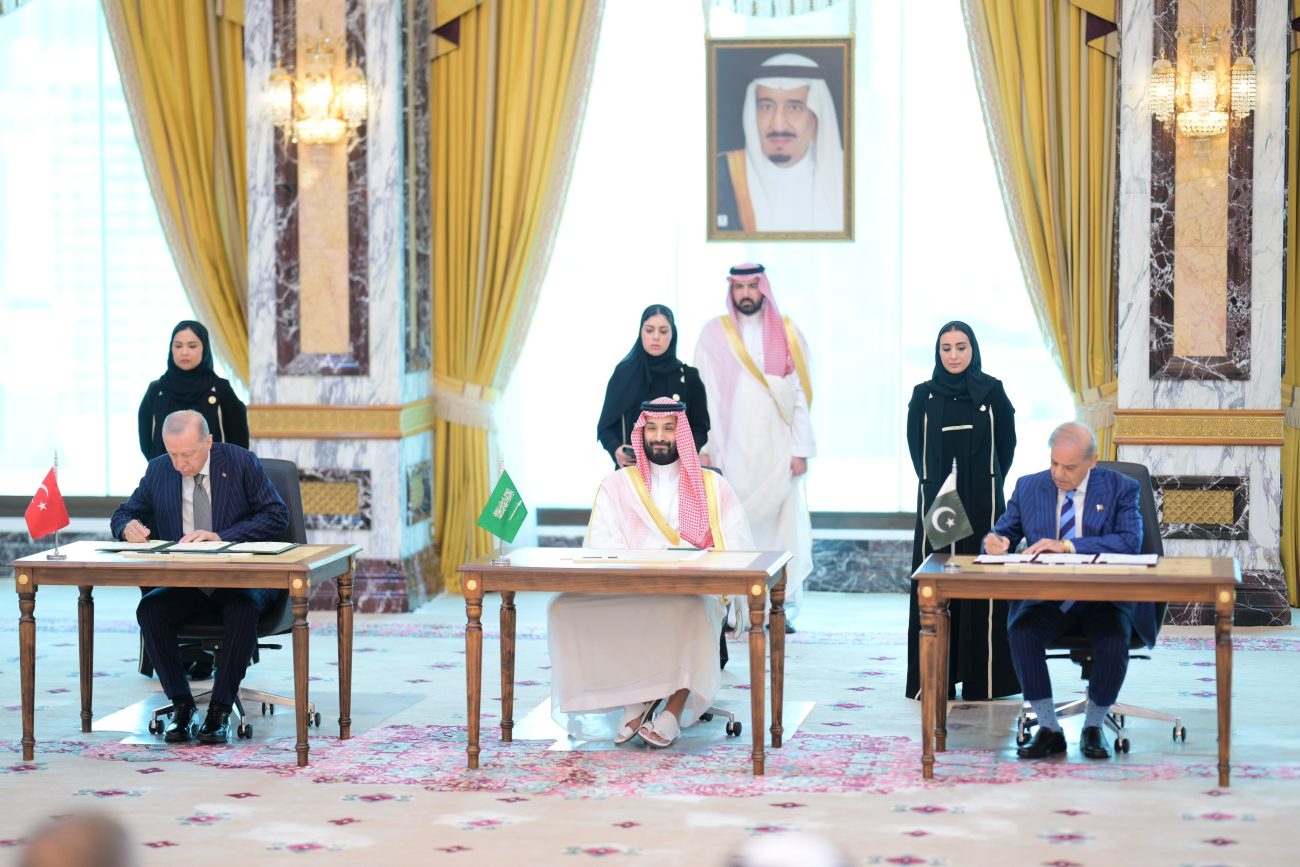
Pakistan, Saudi Arabia, and Turkey recently signed the “Mecca Joint Defense Agreement”. Many analysts believe this trilateral pact is aimed at checking Iranian and Israeli “hegemony” in the tumultuous Middle East region.
Meanwhile, the biggest question running through India’s nearly 1.5 billion people is how this trilateral defense pact will impact India, which has fought multiple wars with Pakistan and maintains a tense relationship with Islamabad.
Despite hogging global media limelight for playing the role of mediator in the ongoing Iran war, Pakistan’s position back home looks scary with relentless terror attacks and a deteriorating security situation.
Pakistan continues to face tremendous domestic pressures. Protests in Pak-controlled Kashmir have intensified since mid-2026, with scores of innocent protesters killed by the security forces.
Islamabad imposed a communication blockade, ordered foreign journalists to leave the region, and limited access to international media outlets, including Al Jazeera’s digital platform.
This is no ordinary region. India claims the Pak-controlled Kashmir as its own and has vowed to integrate it with Jammu and Kashmir. Reportedly, pro-India slogans and flags were seen in the demonstration.
Then, regions like Balochistan and Khyber Pakhtunkhwa (KPK) are Pakistan’s Achilles’ heel. Separatism in these two regions appears to have gone beyond the control of the Pakistan Army, and looks as volatile as East Pakistan (now Bangladesh) during 1971. The question is how long Pakistan can hold these two regions, and at what cost.
Dismal economic conditions, disgruntled population, and heightened tensions with neighboring India and Afghanistan have intensified Pakistan’s problems. The question is: does Pakistan have the financial muscle or resources to fight a five-front conflict — Balochistan, KPK, Kashmir, India and Afghanistan, simultaneously?
On top of it, Pakistan has signed a defense pact with Saudi Arabia and Turkey, which means they should be prepared to fight outside the country as well, probably against Houthis in Yemen. That would open a sixth front.
Indian military exposed Pakistan’s defense architecture during Operation Sindoor last year in May. India not only managed to breach Pakistani defenses to hit multiple terror targets in the first wave of attacks, but India also launched precision strikes that impaired critical Pakistani military infrastructure across the country.
Indian military targeted multiple airbases including Nur Khan (Chaklala) near Rawalpindi, Mushaf (Sargodha), Murid, Rafiqui, Rahim Yar Khan, Sukkur, Jacobabad, Bholari, and others—using supersonic BrahMos and other precision munitions.
Satellite imagery confirmed the heavy damage, including destroyed runways, hangars, command-and-control centers, and loss of up to 14 aircraft (as per IAF) and scores of personnel on the ground. Pakistan also claimed downing multiple Indian jets, but it could hardly penetrate the Indian air defense network, led by the S-400.
Operation Sindoor demonstrated that Pakistan’s defenses could be easily penetrated and its Air Force could be crippled even with limited, restrained strikes.
Meanwhile, Turkey is already a member of NATO, arguably the most powerful Islamic country in terms of military. It does not really need Pakistan or Saudi Arabia to defend itself. Saudi Arabia, on the other hand, has been battered by Iran and Houthi rebels. But when the US could not completely defend it, what can Pakistan and Turkey do?
In the case of Pakistan, it is the most vulnerable of the three.
The Mecca Joint Defense Agreement, signed on 7 August 2026 by Pakistan, Saudi Arabia, and Turkey, assumes utmost importance for Islamabad. The pact’s core clause treats an armed attack on any one party as an attack on all three.
It directly follows the September 2025 Strategic Mutual Defense Agreement between Pakistan and Saudi Arabia.
For Riyadh, it’s another insurance policy, but for Pakistan—still repairing airbases more than a year later—the pact is aimed at sending a strong deterrence message to India, which has pledged a devastating response to any terror attack on the country.
File Image
Collective defense commitments from Riyadh and Ankara are sure to boost Pakistan’s morale, but Turkey (and Saudi Arabia) have been supporting Pakistan since 1947 and have never managed to turn the tide against India.
For instance, during the 1971 war, Turkey provided critical military and diplomatic support to defend Pakistan’s territorial integrity. Operating under the CENTO defense pact, Ankara provided substantial material support to Pakistan by providing aircraft assistance and military hardware, but to little avail.
Even politically, Turkey refused to recognize the newly independent state of Bangladesh for over two years. It only recognized Bangladesh in February 1974 after Pakistan did.
Meanwhile, India has already established strong military ties with Ankara’s adversaries, Greece, Cyprus, and Armenia. India also shares robust military ties with Israel. There might not be a formal agreement on paper, but India-Israel ties go beyond any melodramatic pact.
No doubt, the Mecca pact embeds Pakistan in a broader Islamic-world security architecture at a moment when its conventional defenses have been publicly tested while the country’s biggest province, Balochistan, continues to fight for its liberation, just like East Pakistan (now Bangladesh).
For a country simultaneously battling insurgencies in Balochistan, Khyber Pakhtunkhwa, and Pakistan-administered Kashmir while managing tense borders with both Afghanistan and India, the Mecca defense pact is far more valuable to Pakistan than it is to either Saudi Arabia or Turkey.
Nitin J Ticku holds a double master’s degree in Journalism and Business Management from the University of Glasgow. He has over 20 years of global experience in MARCOM, Journalism, and Digital Marketing, and has worked & traveled widely across Europe, the Americas, and Asia. Nitin is the Editor of the EurAsian Times.
This is an Opinion Article
He can be reached at editor (at) eurasiantimes.com

 Login