❌

Reading view

The Real Danger of AI is That It is Run by Evil Warmongers

The Real Danger of AI is That It is Run by Evil Warmongers

GlobalResearch.ca

Caitlin Johnstone | caitlinjohnst.one

The biggest AI threat isn’t artificial superintelligence wiping out humanity in a fit of mechanical vengeance like some digital Old Testament God, it’s the same oligarchs and empire managers as usual inflicting the same evils and abuses as usual upon their fellow man.

We’re already presently watching the empire building AI into its killing machines and causing all kinds of horrifying problems while these technologies become more and more complex and unpredictable.

CNN reports that US military AI “almost started a war” with China when it hallucinated intelligence showing a Chinese ship transporting nuclear weapon components to Iran; US military planes were apparently already in the air preparing to attack the vessel before human intelligence picked up on the error.

NEW: An AI-assisted intel report sent the military scrambling to intercept a Chinese ship in the Middle East it believed was transporting components of a nuclear weapons program.

It turned out to be a hallucination. And it "almost started a war." https://t.co/xXZHEE64M6

— Katie Bo Lillis (@KatieBoLillis) September 18, 2026

A recent Pentagon report has officially concluded that an over-reliance on Palantir’s AI-powered command-and-control system Maven contributed to the bombing of a school in Minab which killed 120 children attending classes on the first day of the US-Israeli war with Iran.

We learned early on in the Gaza holocaust that the IDF was using AI to help it bomb suspected Hamas members when they are at home with their families rather than when they are out in the battlefield using a program called “Where’s Daddy?” — a bit of Israeli humor about the fact that they would be killing the children of Palestinian resistance fighters when their fathers came home.

We’re seeing politicians like Bernie Sanders voice concerns that “AI could soon be smarter than humans and function outside of our control,” but the most obvious and imminent threat right now is not that artificial intelligence will outsmart us and escape our control, it’s that it is being fully controlled by humans who are stupid and evil.

Again, we know for a fact that powerful nuclear-armed military forces are knitting AI into all their systems. We’re watching them do it, right in front of our faces. An increasingly complex and confusing element has been added to an environment of already tense and dangerous military standoffs around the world as the US and its allies work to absorb the few remaining nations who have managed to retain sovereignty into the imperial power umbrella. And yet recent weeks have seen the mass media flooded with punditry speculating about possible scenarios under which AI might perhaps wind up leading to human extinction.

We already know the most likely scenario under which AI will get us all killed. If it happens, it will be because rich and powerful sociopaths knit these technologies into war machinery that is designed for killing humans at mass scale. Duh.

These developments are unfolding in the context of a frenetic new arms race with China in which nobody’s willing to tap the brake pedal for fear of falling behind. Any talk of regulation or slowing things down before they get out of control is dismissed because the competition-based systems which currently govern human behavior have thrust us into a nightmare of constant military expansionism and brinkmanship instead of collaboration and harmony, all fueled by the fact that this paradigm makes tech plutocrats and war profiteers obscenely wealthy.

That’s clearly the most immediate existential threat that AI poses to our species right now. There’s also the only slightly less frightening threat of artificial intelligence enabling our rulers to use mass surveillance and autonomous weapons systems to stifle any revolutionary political movement before it gets off the ground, locking us into this freakish capitalist dystopia until the planet is an uninhabitable wasteland.

In any case, this isn’t a new threat. It’s the same old threat with new toys. Capitalism must end, and the empire must fall. Our very existence depends on it.


Original Article: https://www.caitlinjohnst.one/p/the-real-danger-of-ai-is-that-it

  •  

Saudi Airstrikes Reportedly Kill at Least 17 Civilians and Detainees in Yemen

Warning: Graphic photo below Saudi airstrikes that hit Yemen on Monday night into Tuesday killed at least 17 people, including civilians and detainees at a prison, according to Ansar Allah officials and reports in Yemeni media. Abdul Qader al-Murtada, the head of the Yemeni National Committee for Prisoners’ Affairs, said that on Monday night, Saudi […]
  •  

MAHA Calls Out Trump And RFK Jr. Over Inaction On Dangerous + Deadly mRNA Vaccines

The coalition took exception with how mRNA COVID-19 vaccines, which Kennedy once described as the deadliest vaccines on the market, remain available for Americans.
MAHA Calls Out Trump And RFK Jr. Over Inaction On Dangerous + Deadly mRNA Vaccines

ZeroHedge News | ZeroHedge.com | Tyler Durden

Zachary Stieber | The Epoch Times | theepochtimes.com

Some leaders in the Make America Healthy Again (MAHA) movement on Sept. 21 warned President Donald Trump and Health Secretary Robert F. Kennedy Jr. over their inaction regarding messenger ribonucleic acid (mRNA) vaccines, [bioweapon injections] including vaccines against COVID-19 [flu renamed].

"While the centerpiece of the MAHA and health freedom agenda has been removal of mRNA shots, you have failed to take decisive action on this front despite overwhelming credible evidence to the harm of this technology," the activists said in an open letter to Trump and Kennedy.
"Instead, your policies related to mRNA technology are neutered and self-defeating, putting pregnant women and children at risk, misleading parents and eroding their rights, and failing to help those harmed by vaccines."
They added, "If you continue to ignore our central issue of removing the mRNA platform, the MAHA and health freedom movements will withdraw their support of you, and you will face the political consequences."

The letter came after Kennedy told supporters that it takes time to make change inside the government, and that officials under him are carrying out vaccine safety studies that will inform future developments.

Dr. Mary Talley Bowden, a Texas doctor, organized the letter. She has criticized several actions by Kennedy and the officials he oversees since he became health secretary in 2025 and heads Americans for Health Freedom.

Rep. Thomas Massie (R-Ky.), former Rep. Marjorie Taylor Greene (R-Ga.), and commentator Tucker Carlson, all one-time Trump allies who have fallen out of favor with the president, signed the letter.

Other signatories include Dr. Joe Varon, president and chief medical officer at the Independent Medical Alliance; Dr. Robert Malone, who was chosen by Kennedy to advise the Centers for Disease Control and Prevention on vaccines; Leslie Manookian, founder and president of the Health Freedom Defense Fund, which has fought vaccine and mask mandates in court; and Dr. Joel Wallskog, who was injured by a COVID-19 vaccine and serves as co-chair of the vaccine injury advocacy group React19.

The coalition took exception with how mRNA COVID-19 vaccines, which Kennedy once described as the deadliest vaccines on the market, remain available for Americans. They also raised concerns about how the administration recently cleared an mRNA vaccine against influenza even though it was not tested against a placebo, which ran counter to a promise made by Kennedy that no new vaccines would be approved absent placebo-controlled trials. And they said there has been an "absence of meaningful help for those injured from the mRNA shots."

"The man who spent years warning America about mRNA vaccines now presides over a department that has approved another one," Malone and his wife, Jill Glasspool Malone, wrote in a blog post on Monday. 
That is not a minor detail. It is the sort of contradiction that the medical freedom movement once would have torn apart."

[Genocidal] Proponents of mRNA vaccines [bioweapon injections], including CDC Director Dr. Erica Schwartz, say data show they are safe and effective. [Total crap, hang them all]

The White House did not respond to a request for comment by the time of publication.

A spokesperson for the Department of Health and Human Services told news outlets in a statement that Kennedy "has been clear that he believes mRNA products warrant heightened scientific scrutiny." [Way too late for this statement]

The spokesperson added: "HHS continues to support mRNA research where the science shows promise [in killing people], including for hard-to-treat cancers [Causing the cancers]. At the same time, HHS wound down investments in mRNA vaccines for upper respiratory viruses because the technology does not effectively protect against infection from [alleged] rapidly mutating viruses such as COVID [flu renamed] and flu [same thing]."


Source: https://www.theepochtimes.com/us/maha-leaders-warn-trump-rfk-jr-over-inaction-on-mrna-vaccines-6093219?utm_source=partner&utm_campaign=ZeroHedge

Image: Source [Truth11.com Meme | Used previously on another article on Truth11.com]

Original Article: https://www.zerohedge.com/medical/maha-leaders-warn-trump-rfk-jr-over-inaction-mrna-vaccines

Note: Comments placed in [ ] are added by Truth11.com editor.  For example; [Flu]

  •  

Afro-Indigenous community in Honduras resists forced evictions

Spanish reality show “Survivor” (Supervivientes) has been filming on the land of the Afro-Indigenous Garífuna peoples in Honduras since 2006. The filming of “Supervivientes,” as well as other versions of the “Survivor” show, have sparked intense local protests over land, human rights, restrictions to fishing access, and forced evictions.

In 2025, the Inter-American Court of Human Rights (IACHR) found that the filming of the reality show violated several rights of the members of the Garífuna community. But it wasn’t the first time the Honduran government has been found in violation for its treatment of the Afro-Indigenous people of Central America. In total, the Inter-American Court has issued warnings four times regarding the mistreatment suffered by this community.

This story, though not entirely recent, has resurfaced in recent weeks when, on July 6, nearly two hundred police officers arrived in San Juan to evict several community members, claiming they were on property that did not belong to them.

However, the Garífuna assert that these lands belong to the community, and therefore an eviction order cannot be issued for communal lands that, in essence, are being targeted for privatization in favor of private interests (particularly those of the Rosenthal family, one of the wealthiest and most powerful families in Honduras). The dispute led to the arrest and prosecution of five community members by the Honduran judicial system. Those detained are Deinor Mejía, Irbin López, Carlos Fernández, Onil Hernández, and Sara Acosta.

Protests against evictions

Following this, several members of the Honduran Black Fraternal Organization (OFRANEH) arrived in the capital, Tegucigalpa, to protest in front of the Supreme Court against what they consider to be unfair treatment. They set up the “Viva Berta” Camp and plan to remain there until the proceedings against the five defendants are concluded and the court stops treating the matter as if it were a criminal case.

Furthermore, OFRANEH has rejected the intentions of Supreme Court President Wagner Vallecillo to establish dialogue forums to resolve the conflict, as the organization defending the rights of Black Hondurans asserts that this would imply recognizing that these territories do not belong to the peoples settled there – a fact already established several years ago by international courts and specifically recognized in 2023 by the Inter-American Court of Human Rights, which ruled that the territories of San Juan belonged to the communities settled there.

Thus, while the government promotes negotiations, the Garifuna people continue to resist what they see as an onslaught by private interests that are using the Honduran government to their advantage in order to strip them of something that – despite the racist rhetoric of certain media outlets – is rightfully theirs by virtue of hard-won rights.

Isolated incident or state policy?

However, in the Honduras of right-wing President Nasry Asfura, a law known as the Agroindustrial Law, the Employment and Economic Development Zones (ZEDE), was recently passed. This law authorizes law enforcement to act as they did on the day of the eviction, even though it contradicts the rulings of the IACHR, which could lead to another case against the Honduran state. 

OFRANEH asserts that this is part of a long-standing pattern of the Honduran state’s actions against Indigenous peoples. For two decades, various institutions have promoted the dispossession of lands in favor of private interests, they stated. In one such example, the National Agrarian Institute reportedly failed to recognize more than 172 hectares for the Garifuna people but did recognize them for the company Promotur, a firm linked to Jaime Rosenthal Oliva, a prominent Honduran banker and politician who died in 2019. 

This organization has also denounced the clear ties between the Rosenthals and the Supreme Court of Justice, which could jeopardize fair treatment and recognition of the territories in favor of Indigenous peoples.

For their part, several United Nations special rapporteurs have called on the Honduran government not to carry out more than 1,000 eviction orders that would affect tens of thousands of peasant, Indigenous, and Afro-descendant families. These orders would jeopardize not only territorial rights but also the food security of thousands of people, as these families rely primarily on working the land for their livelihoods.

  •  

UK To Ramp Up Support for Saudi War in Yemen by Refueling Saudi Fighter Jets

The British government has announced that it will increase support for Saudi Arabia’s war with Ansar Allah in Yemen by refueling Saudi fighter jets, as the conflict continues to escalate. According to Middle East Eye, British Defense Minister Luke Pollard said that the UK would deploy a refueling plane, a Voyager, from a base in […]
  •  

DSA leads the blue wave — will it bend to the thin blue line?

An NYPD officer provides security during the Inauguration for a New Era Block Party in New York City on January 1, 2026 as Mayor Zohran Mamdani takes office. Photo by Leonardo Munoz / AFP via Getty Images

What will a DSA-led state look like — will it back defund and community control of police, or bow to the powers that block affordability? Lawrence Grandpre, political commentator for Leaders of a Beautiful Struggle, explores this question in his recent Baltimore Times article, “The Dangers of ‘Law and Order’ Leftism: Toward a Black Power Public Safety,” asking whether DSA will embrace the outmoded Law and Order politics that fueled America’s prison boom. As officials like AOC and Mamdani backtrack on defunding police — one of the biggest carceral drains on housing, healthcare, and education funding — Grandpre sits down with former political prisoner and Rattling the Bars host Mansa Musa to unpack these contradictions ahead of the midterms, where Democrats hope to retake the House and Senate. Tune in for an unflinching look at the Left’s relationship to the state and to law and order.

Related Links:

Credits:

  • Production/Post-production: Cameron Granadino
Transcript

The following is a rushed transcript and may contain errors. It will be updated.

Mansa Musa:

Welcome to Rattling the Bars. I’m your host Mansa Musa. Today I’m joined by Lance Grandpre, political commentator with Leaders of a Beautiful Struggle, to discuss his recent article for Baltimore Times, “The Dangers of ‘Law and Order’ Leftism—Toward a Black Power Public Safety.” Thank you for joining me, Lance.

Lawrence Grandpre:

Thank you for having me.

Mansa Musa:

Alright, so let’s start like this here. At one point we had in 2020 where you had a push for the abolishment of prisons and to dismantle the police system as we see it during that period. But immediately you had a pushback and the pushback came in the form of saying that this was woke. Now we look at the United States and mass incarceration, armed policing, and you juxtapose that with the lack of funds for healthcare, lack of funds for education and lack of funds for housing and the fact that the criminal injustice system is in itself painful when it comes to poor and oppressed people, mainly people of color. Let’s start with your article.

Lawrence Grandpre:

So this article stems out of a protest I went to because sometimes people say if you talk about police reform or defunding police, you don’t care about victims. And this protest was the opposite. This was a Black elder, a former member of the Baltimore Black Panther Party who was assaulted by many teenagers and it was caught on film. So of course Fox News, our local Fox News is showing this over and over again saying, “Lock them up, what’s wrong with these kids?” And these were community advocates, many of them women, Queen Mother Victorious who lost her son to gun violence, Mama Gwen, who was formerly incarcerated, coming together with community and saying these young people, what they did was a problem, not because it just violated the law, because it violated our community respect for elders. And we don’t want to just throw the cops at these kids and throw away the book, but if people know who these young people are, turn them into us, the Black community, so we can make sure that they are held accountable but not railroaded by the criminal legal system.

And I though the sophistication and intelligence of that response and even Baba Ade, the elder who was hurt, saying the Black Panther’s argument was that capitalism and racism breed criminality in the community.

Mansa Musa:

Right.

Lawrence Grandpre:

And it’s not for us as the vanguard to educate ourselves and use political consciousness to eliminate criminality, not just from a material standpoint, but from a psycho-spiritual standpoint. And it was really interesting because this was a few days after AOC went on the news and said, “Nobody’s talking about defund anymore. Woke 1.0 was crazy.” So it was really interesting that the people who were supposed to be talking about social justice, Alexandra Ocasio-Cortez, some of these other so-called leftists,

Mansa Musa:

Right.

Lawrence Grandpre:

Even they were saying, “Defund—that was just people on Twitter trying to look woke. Nobody really talks about defund in real life.” And these Black elders, Black people in West Baltimore, were saying things like, “We have a $700 million police budget in Baltimore. How are we going to have that and schools and investments in the Black youth?” So these Black people who the left is telling us are conservative are actually more progressive than the DSA.

And I thought that was very telling that, in this moment, going into the midterms, there are these leftist democratic socialists who are trying to get elected, and because they want to get elected, they want to push away from radical rhetoric because they think it’s turning off voters. And I think that that goes to show you that when it comes to Black people, we need to have our own vision of public safety, because what’s being offered by even the left, the Democratic Socialists, is willing to push our issues aside, because they have a misunderstanding of our issues. They think it’s just a bunch of radicals on Twitter as opposed to Black folks been talking about Defund since the ’50s. And our visions of Defund are very different than what you saw on Twitter in 2020, but these folks wouldn’t know that.

Mansa Musa:

So how do you see the DSA in terms of how they look at the budget, just police budget and the fact that it’s undercutting the services of the very people they supposed to be representing?

Lawrence Grandpre:

It’s interesting because I think if you are a democratic socialist, it’s obvious you believe police are a tool to protect capitalism. So a world where if you’re a socialist, the idea that you wouldn’t talk about [how] protecting capitalism getting more money is a problem for you—it’s weird.

Mansa Musa:

Right.

Lawrence Grandpre:

But these folks are a particular brand of socialist. Many of them were very much pro-Bernie Sanders. So when Hillary Clinton and Kamala Harris used conversations about identity to attack Bernie, now a lot of these folks see all conversations about race as just distraction from class issues.

So, even when Black people talk about police, they say, “Well, it’s not serious. No one really talks about Defund. So you’re really just trying to attack the socialist candidates.” And it’s like, no, Black folks have been the community control of the police platform.

It wasn’t just invented by the Black Panther Party. It was talked about by Black activists in the ’40s and ’50s, in part because the understanding that if the police were seen as a solution to all social problems… it’s not just police, it’s police-ism: the idea that policing is the only solution to the problems facing all poor people, but especially Black poor people, that’s going to push money away from all the other programs we need in the Black community. So Black folks have been saying that, really, since the Northern migration.

So when we talk about community control of the police, part of that is having community control boards control the police themselves, hold them accountable. And we’ve worked on that as LBS, but it’s also community control of the institutions that produce public safety beyond police. So, housing, addiction, education. I mean, I love to point out that Bobby Seal, he was in AmeriCorps before he was a Panther. So he would be shooting dice with the Black kids trying to school them on AmeriCorps’ time. And part of his frustration is these nonprofits don’t let us actually do the training we need to do with these youth, but we got to get the money from the nonprofit because that’s the only job we got. So even the Black Panthers program was a push for Black control of resources to socialize our youth, specifically around things like violence prevention. And again, the idea that all of that is just under this large framework of “woke”… And again, the right wing hates woke, we know that, but even some of the Bernie folks—they really hate “woke,” because they associate it with the attacks on Bernie and they see all conversations about police as woke.

Mansa Musa:

Let’s unpack some more about DSA because we see upheaval of DSA type activity and we see in terms of midterm elections, some of the candidates that ran on DSA platform have made it through the primary. And so at the same token, what is their appeal? Because they vacillating when it come to social issues.

Lawrence Grandpre:

The federal government, in theory, can print money. So there’s this belief that if we just spent more money, things will get better, and the Democrats have been afraid to spend money. I think that in the DSA, it’s like, “Let’s really focus on, in theory, cut the military budget, invest in community through things like Medicare for Al”l. Now, if you don’t have the integrity to stand up for “Defund the Police,” why do you think we would believe that you have the integrity to stand up to “Cut the Military Budget? If you don’t see the connections between the violence of policing and the violence of militarism, why would we expect you to be able to push the military budget to community?” 

Lawrence Grandpre:

These are intelligent, college-educated voters who feel like the government needs to spend more money, in part, because it’s a job program for people like them. So they have an interest in fighting the austerity of the Democratic Party, in part, because they want to see conditions improve for the community, but also in part because it’s a business model for the voters of DSA. And that’s a big concern for us, because even with Medicare for All, there’s no world in which healthcare should be a for-profit enterprise. But it’s not just that doctors are racist. When you look at things like Black women get more cesarean sections than other women, So, literally, they’re getting cut open in these dangerous surgeries. Black women, if you have a child in the hospital, you are going to get a drug test. And even if you pop for that drug test from the epidural, the drugs they give you for the pain, they might take your kid away. So engagements with the medical system are not just imperfect for Black people; they are places of surveillance and violence.

So we, as Black people, need systems like a birthing center, like nutrition, upstream investments that are different than what the DSA crowd cares about. So the idea that we should just accept not talking about Defund to get Medicare for All ignores the fact that Black people—we don’t just need healthcare to not give us a bill. We need to change the vision of healthcare so we control it. And the DSA is not interested in that. They don’t really think that way. And they honestly believe the only way anything will get passed if it goes to everybody. Universal programs prevent racial backlash. Because we know any spending in America is seen as giving money to welfare queens. So we just got to give the same thing to everybody and that’ll deal with racial backlash.

And what we know is anything you do that gives out any tax money will deal with racial backlash, but also do things that don’t give Black people the power we need to build for ourselves. It will just put us in systems that really are built by other people that, even if it’s good for them, can often be violent for us.

Lawrence Grandpre:

But I think that, again, when you have a class-based vision of the world, that has become in some ways hostile to thinking about race because you had negative experiences with people weaponizing race against people like Bernie Sanders. You’re not thinking about what a political agenda would look like when you actually invest in… because we should do both. We should have a class-based redistribution of wealth, but that restribution should also be invested in community institutions that reflect the culture and history of specific communities, not just Medicare for All, but clinics that use the history and culture of the community to provide that healthcare. Nutrition that reflects the culture and the way communities like to be fed so that they can have upstream nutrition so they don’t need to go to the doctor in the first place.

These things should go hand in hand. And I think it’s concerning that it feels like, because DSA is becoming electorally viable in some spaces, that [they] only talk about affordability issues, only talk about Medicare for all, only talk about ending the war in Iran, without really thinking intelligently about a platform that would meet people’s needs for community control of public safety, broadly defined. So not just policing, but again, youth programming, schooling, getting nutrition. Our kids are literally hungry.

Mansa Musa:

Yeah.

Lawrence Grandpre:

They’re fed junk food, but they’re undernourished. So we actually do have serious nutritional needs as we have obesity in the inner city. So what does it look like to build a food sovereignty ecosystem, whether it’s Black Yield, Black Church Food Security Network that can actually feed ourselves as opposed to just the DSA, it’s like, well just make sure they get food stamps. And food stamps are cool, but food stamps are not the vision of liberation for us.

Mansa Musa:

But talk about, because when we look at DSA, and it’s misnomer even to use the name socialist because when you look at. We got examples in Cuba and when they first took over, the literacy rate in the countryside was 90%. 90% of the people could not read or write. They organized, it’s a book out called Vincent Ramos. We were trying, that’s the name of it. And they organized all the college kids, all the intelligence and made them go in the countryside and stay to educate the people, to get them to read and write.

They didn’t say, “Oh, we’re going to create a system where they can come out the country, live in a project style housing dwelling and get them public schools that’s not going to teach them nothing.” They actually educated the people and a lot of that education led to what we see today in Cuba, got best medical, despite all the things going on. So when we talk about DSA, and I think this is a danger, and maybe you want to weigh in on it. I think it’s a danger that confronts that notion that this is a socialist party and because the right wing is going to put them right in the category like communists and they can resurrect that notion.

Lawrence Grandpre:

Socialism, to me, the key word is social. You either have the market making decisions about planning for the world or you have people doing it socially. It’s clearly better to do it socially, but there are divisions within that larger social body. And my concern is that even amongst some of the people in the DSA crowd, the leftists, some of the visions of what they would socially plan may like and lean on policing partially because they are afraid of being looked at as communist. So they might, for example, even in very, very progressive Bernie Crat, DSA San Francisco, there’s this push to, well, we got people homeless, they have mental illness. So they as individuals may not be rational, so we are going to use policing to bring them into drug treatment.

Mansa Musa:

Right.

Lawrence Grandpre:

And again, this is like even Bernie people sometimes say this. So there are elements of even the less progressive mindset that are like, we as a society can’t let you be out here damn bad. We have to help you lift yourself up. And if that means we have to involuntarily commit you to treatment, and if we have to use police to do that, then we’ll do that. While one thing that we talk about here in Baltimore is, and Baltimore’s been a heroin town since the 60s and 70s. And it’s been really hard for us, but we’ve also had systems of informal community care that have been designed to address some of the worst exigencies of drug abuse. Nika Namdi from a program called Fight Light said that grandma’s basement was the first halfway house. We had systems where elders, you would be able to stay with family and you would be able to get certain stabilizing influences through your social network so you wouldn’t be out on the streets.

So in that worldview, we would look at something like making sure these abandoned homes get rehabbed and given to Black people in community. That’s partially an anti-homelessness effort.

That’s an anti-addiction effort. That’s a crime fighting effort. So it’s not just social housing, it’s not just public housing. It’s also making sure that Black people in communities can pass down their family homes

And they have a way to make sure that they’re affordable so they can stay housed because that produces capacities for people who do suffer from addiction to not be on the streets committing crime. And again, the DSA vision is so limited to what they see and what they know, they sometimes end up using police where it’s like, if we just had networks of people in community that could care for each other, we wouldn’t need police for that. But I also do think folks are afraid. I know academics are very afraid and some folks are afraid of looking too radical, looking like the rhetoric of 2020 was burn down the police station.

Mansa Musa:

And

Lawrence Grandpre:

I think that’s also part of what they want to distance from when they talk about we not doing defund no

Mansa Musa:

More. Part

Lawrence Grandpre:

Of it is the direct antagonism with the state, the cost of that has increased for them. What we know is that the cost is high for us, whether we’re openly antagonistic or not, we are politically antagonistic by making demands upon the state to recognize our humanity. So we’ve always had to deal with that potential backlash. And I think now for some folks they’re saying, oh, I can’t use that. We’re not trying to do that radical rhetoric no more

Mansa Musa:

Because

Lawrence Grandpre:

People are losing jobs, people are potentially getting deported. So it’s like the ’70s, marginally away from the rhetoric of the ’60s and leaving the Black radicals out to dry after the draft ended. I think the white radicals moved away from radicalism and that we’re seeing a similar

Mansa Musa:

Dynamic. Okay, but we know that this is the 60th year of the anniversary of the Black Panther Party. And I was talking to somebody about just like we’re not anti-police. The party wasn’t anti-police. One of the things they did, one initiative they took was, and this is a revolutionary suicide by Huey Newton, where they had this particular intersection that didn’t have no stoplight and it was in the Black community and kids was getting hit. So somebody came and said, “Man, they not doing nothing about this. We’ve been complaining.” So they went down there and became traffic guards, the members of the Black Panther Party. They held up the traffic, let the kids walk by, you know what I’m saying? And this is what they did. And they had guns with them because they had one part of their program was policing the police. The police in turn came and told them they stop.

Now you guys stop this. They said, “Well, we’ll stop this when y’all put a traffic light up there or y’all stop directing traffic. We don’t care which one you’re going to do, but you do or we going to continue to do.” They wind up putting the traffic light up there. So in terms of that particular example, what are the core aspects of the Black Power Public Safety?

Lawrence Grandpre:

I like your example because the party was a little bit different in different cities, but I think one thing that stands out to me is that they had questions about police, but the Black Panthers in some ways were law and order. It was law and order within the party. You cannot show up high, very much about discipline, law and order in the community. If you’re selling drugs, if you’re a parasite in our community, we’re going to deal with you. And I think that’s a perception, because this is something that happened in 2020, that there were white leftists being like, “Let’s just run wild and be anarchist and burn stuff down.” It’s always been Black people that’s been like, “We’re not doing that.” So the idea that somehow that is tied to Black issues, no, we’ve always been extremely serious about our liberation.

So when the Black Panther Party talks about doing a plebiscite in order to get Black sovereignty, I think that’s an example of why we need to think about community control of the police in terms of we have in Maryland, substantial police reform is nowhere near enough, but we need to have the ability for the community to have investigative power to be able to investigate police. We need to have community resources to be able to flow to community institutions so the community decides who’s doing public safety in that community. So when we talk about who’s funded to do violence prevention work, it shouldn’t just be the people who are tied into the police or the people that are tied into the nonprofit world. We got tons of people in community that have been doing work that have not

Mansa Musa:

Been funded.

Lawrence Grandpre:

And the fact that they are getting a little bit of money now, I think is part of why we’re seeing these unprecedented declines in violent crime. So Black power public safety isn’t just people getting grants. It is the community having the power to determine what the grant making criteria are. It’s the community being able to tax institutions in their community that they see as producing crime. And by that I mean Johns Hopkins. That’s

Mansa Musa:

Right.

Lawrence Grandpre:

Because Johns Hopkins gentrified the whole area of the

Mansa Musa:

City. The big colonial king in Baltimore.

Lawrence Grandpre:

And when you gentrify a whole part of the city, you’re moving people to different hoods and that creates a lot of possibility for conflict. My father was a cop for 20 years, so he talked about East Baltimore used to be called the country club because it was so quiet up there. But when Hopkins gentrified all those people out of the Middle East Baltimore, a lot of them moved to Northeast, which creates a ton of conflict, pretty much increased the murder rate in that part of the city. Hopkins should have to pay for that. They got a $13 billion endowment. So Black Power Public Safety is about us not tying in our future to gentrification, which is what the police really are a tool for. They’re a tool to produce gentrification. That’s good for that business model because gentrification needs policing.

Mansa Musa:

We

Lawrence Grandpre:

Should be able to put tax on the gentrifier so we can secure our communities so they can’t gentrify them, own our own property, stabilize our communities, but then invest in the capacity to take care of our youth, to do violence prevention, to take care of our health. All the things they stripped from us, they should have to pay us to be able to do for ourselves. In that world, I think we would have Black Power

Mansa Musa:

Public Safety. Right. And that’s basically what the Black Panther Party was doing because they had the survival program. Exactly. And the concept was Survival Pending Revolution. The Survival Program wasn’t like us being in a basement, taking guns apart in the dark with blindfolds, then putting them back together, making bombs, reading Ann Archer’s cookbook. No, survival program was the free breakfast program, free medical, sickle cell anemia, taking prison families to prison to visit them, alternative education. This was a survival program, survival pending revolution. And what the goal was, going back to your point, the goal was to stabilize the community for self to be able to be self-determined. So if I’m self-determined, I got self-determination. A great example for Baltimore would be the Clean Block because when they had Clean. And I remember I was locked up and I used to read the Afro. Afro had a big thing about Clean.

The sense of community that came out of that, the Clean Block, when they was able to say, “We recognizing this neighborhood for Clean Block.” But more importantly, that neighborhood not only had a clean block, but that neighborhood had policing. That neighborhood had a sense of identity that if I seen you, I know you Meryl’s son or Meryl’s daughter. I know you Tommy’s son or Tommy’s daughter. You know me and you know that if I see you doing something that you ain’t supposed to be doing, then I’m going to tell your parents the minute you see me, you’re going to alter your behavior because that became the sense of community. But like you say, once Hopkins got in the equation, and not only Hopkins, I remember when Shafer started when he did the Inner Harbor and they started pushing people out of certain areas in order to get to Inner Harbor and they pushed people into.

Either they pushed them out into the county or they pushed them into the interior of Baltimore in neighborhoods they wasn’t familiar with or neighborhoods they was familiar with and had issues with and would automatically create a conflict. But talk about how do you see, because what you just outlined is in fact a model that is one, inexpensive because it becomes self-contained. So the monies that you’re putting towards astronomical police budget can go towards stabilizing some of the projects that deal with housing, deal with substance, the people that’s actually doing the work.Like you say, you got people that actually going around taking people and putting them in a place and letting them drown. So we talk about how you see DSA and the gains that they’re getting and the models they’re using. How do they fit into this narrative? Are they rewriting the script and say they’re going to invest in this type of thinking or their model is, like you said earlier, we creating a cadre of intelligent people that can grant write and that’s going to become our funding source and not only our funding source, but create an infrastructure for doing case studies and then marketing these case studies, the new Jim Crow.

Lawrence Grandpre:

Yeah. I think it’s to be determined. We’re going to see a huge increase in DSA affiliated leftist people in Congress. Now, whether they’re going to be able to write bills, whether they’re just going to vote on stuff that comes from the Republicans, we’re going to see. I think the real test is going to be 2028 when it’s possible the Democrats will take the White House, Senate and the Congress. So it’s really going to be important for us these next two years for people that believe in the possibility of these folks doing good to push them. What is your actual proposal on how you can use the power of the federal government to enhance the ability of people On the ground locally to have more ownership and power and control over the institutions that impact their lives. Because policing is a state and local issue. Feds actually have relatively little control

Mansa Musa:

Over it,

Lawrence Grandpre:

Except given a few grants here or there. So really it is, do you have a vision for whether it’s through food sovereignty policy, whether it’s through manufacturing policy? The metric for us at least is again, local self-determination and the ability for local people on the ground to own the institutions that are doing this work. I think part of even going back to the New Deal, the frustration with these progressives is that sometimes they do these top down technocratic re-imaginings of what solutions look like that don’t involve community. Mamdani, people have called him a technocratic socialist.

Mansa Musa:

And

Lawrence Grandpre:

I think that’s not on some right wing stuff, but that’s scary from a Black power

Mansa Musa:

Perspective

Lawrence Grandpre:

Because technocracy oftentimes views Black peoples as widgets and inputs in someone else’s equation for progress and liberation. And I think part of the value of the Black Panther Party is they called themselves socialist, but in many places, in many ways they were also Pan-Africanist and Black nationalists. And they were combining them all to say that, yes, we will fight capitalism, but we will not just make the people this abstract proletariat to fit within a Eurocentric version

Mansa Musa:

Of

Lawrence Grandpre:

What a class centric revolution will look like. We are going to lead our people on our vision of what we think fighting capitalism looks like. And again, I think it’s going to be our job to force the DSA to not see that as woke, to actually recognize that that is just what black people demand. And that’s the cost of us being in political coalition is you respecting our self-determination.

Mansa Musa:

And I agree it’s to be determined because one, you gain electoral office through coalition building. That’s really where it come out of. And you’re able to get a common identity out of the coalition, common identity being what we want change, the change that we want to see. Harold Washington in Chicago, he was successful at building a coalition. And to his credit, he tried to maintain the standard, but they fought him tooth and nail at the state government. So he wasn’t able to get a lot of things done. But the fact of the matter, what we’re asking or we’re talking about is not really hypothetical because we see this in Europe and we see examples where police don’t have guns. They call in, if it’s a violent situation where a gun, they got a unit that comes in to deal with that. But outright, the police walk around with no weapons because the lack of fear towards the society.

Lawrence Grandpre:

You mentioned New Zealand, I think in that as

Mansa Musa:

Well.

Lawrence Grandpre:

But in New Zealand as well, the Aboriginal communities actually have really pushed a model for youth justice that places tribal elders and tribal institutions at the heart of restorative justice programming

Mansa Musa:

For

Lawrence Grandpre:

Youth who are engaged in acts of criminality. And so that’s been a big fight for Aboriginals in New Zealand and Australia to really demand tribal sovereignty over their youth as opposed to putting them into the juvenile justice system.

Mansa Musa:

But

Lawrence Grandpre:

Again, given the legacy of the private schools where they beat the Indian out of you and stuff like that. And again, I think it’s jarring for white people to think that we as black people are asking for something similar here in America because the joke is white people are so settled in America, they don’t even see themselves settler colonists no

Mansa Musa:

More.

Lawrence Grandpre:

And I think unfortunately that’s part of what’ happened with the DSA. It’s like the idea of black sovereignty is just jarring to them in a way that you’re an Australian, you know you took over Australia and there are people here that are really dark skinned, you’re not.

Mansa Musa:

But

Lawrence Grandpre:

I think in America, that basic concept of having to negotiate with people who have their own sovereign agendas is not something that they’re used to conceiving as anything other than a tool for the centrist to undermine the Bernie’s of the world.

Mansa Musa:

And

Lawrence Grandpre:

I just think the reality is if DSA is going to get Black support, it’s going to really have to reckon with the visions of the world that come from Black people, including our visions of public safety.

Mansa Musa:

Right. And before we close, you got any closing remarks?

Lawrence Grandpre:

I really appreciate this. Please check out our podcasts and search of Black Power and Political Commentary Corner. So those are on YouTube. Check us out at lbsbaltimore.com. We have all of our email updates about the work we’re doing in Annapolis to push criminal justice policy, reparations policy, which

Mansa Musa:

I’ve

Lawrence Grandpre:

Never seen DSA has been skeptical on, but we’re very adamant about its practical utility as a framework to invest in Black sovereignty here in Maryland. And you can find me on any social media at Neil Nubian, N-E, the number zero, Nubian, N-U-B-I-A-N. Right.

Mansa Musa:

And we ask our audience to really take deep thought on this particular subject matter. It’s not like say it loud, I’m Black and I’m proud. It’s not when Stokley Carmichael in the ’60s, they called Black Power, James Brown, Song and Song. We’re not in that state. We’re not trying to go back into that state of mind, that conditions created that state of mind. We’re talking about an analysis of having Black political power as it relates to our safety. We’re talking about because we’re the ones that’s unsafe, we’re the ones that this astronomical budget is being doled out to, to make us feel unsafe, to lock us up. Then we believe, as the brother was talking about Lawrence, that we believe that we have a right to define what is safe for us and what is not safe for us. And making that definition or defining that, we see the necessity to make an analysis and implement it.

And in this case, this is an analysis that we want to, I think the Gullah Geechee in South Carolina got a thing where they do restorative justice. And so the fact that you infringe on the community, that they might not put you out the community, but they’re going to put you in such a shameful state of mind and the fear of what you’re getting ready to lose or make you get the person to come back or people come back and lie in accordance with the social system that they set up. We ask that you continue to support the real news and rattling bars because guess what? We’re actually the real news. Thank you.

💾

“When it comes to Black people, we need to have our own vision of public safety, because what's being offered by even the left, the Democratic Socialists, is willing to push our issues aside…”
  •  

France’s Modular Rampart Point Defense Launcher Has Gone To Sea

A French Navy Mistral class amphibious assault ship has been photographed carrying Naval Group’s new Rampart modular launcher, a system designed to allow a single weapon station to employ different types of rockets, missiles, and other effectors against a wide range of threats.

The imagery, captured off Toulon during training on September 21, reveals the launcher installed on the ship’s forward starboard sponson. While the specific identity of the vessel is unclear, this represents the first publicly observed evidence that Rampart has moved into shipboard testing.

🇫🇷 French Navy Mistral-class amphibious assault ship and 🇫🇷French Navy Suffren (Barracuda)-class nuclear-powered attack submarine off Toulon, France – September 21, 2026.@WarshipCam pic.twitter.com/6xYm6E5J9R

— G.GYSSELSSHIPCOLLECTION (@GGYSSELSSHIPS) September 22, 2026

Naval Group announced in June that the first at-sea firing campaign for Rampart was planned for October aboard a Mistral class ship during the French Navy’s Wildfire counter-drone exercise.

What makes Rampart unusual is its modular architecture. Rather than being built around one missile or rocket, the system uses interchangeable launch modules that can accommodate different weapons. This allows a ship to carry large numbers of relatively inexpensive guided rockets for counter-drone work while retaining the option of using larger and more capable short-range missiles against more challenging targets.

Système de lancement polyvalent et modulaire, sur le stand de NAVAL GROUP lors du Salon de l'industrie naval de défense (EURONAVAL) à Villepinte le 6 novembre 2024. (Photo by Thierry NECTOUX/Gamma-Rapho via Getty Images)
The Rampart, then still known as the Multi-purpose and Modular Launching System (MPLS), displayed at the EURONAVAL defense exhibition in November 2024. Photo by Thierry NECTOUX/Gamma-Rapho via Getty Images

Because the launch modules are interchangeable, the mix can theoretically be changed as the mission or threat environment changes.

The approach is aimed squarely at a problem that has become increasingly important for naval forces: defending expensive ships against potentially large numbers of inexpensive uncrewed systems and missiles without relying exclusively on high-cost interceptors.

Rampart was previously known as the Multi-purpose and Modular Launching System (MPLS). Naval Group unveiled the concept in 2023 as a self-funded development effort and formally presented the Rampart earlier this year.

The launcher uses four interchangeable ammunition modules. Depending on the configuration, Naval Group says that the system can accommodate up to 80 Thales 68mm laser-guided rockets or 48 NATO-standard 70mm laser-guided rockets. Other configurations can carry smaller numbers of short-range missiles (four to six per module, depending on type) or other effectors, including decoys.

The system has already been demonstrated with guided rockets. A January 2026 test involved a Thales 68mm guided rocket, followed by a series of firings at the Canjuers range in southern France in May. Those trials, seen in the video below, included engagements against targets at roughly two miles and a five-rocket salvo.

The relatively small guided rockets are particularly relevant to counter-drone operations. They offer a way of engaging aerial targets with a weapon substantially smaller than a conventional surface-to-air missile, while still providing precision guidance.

As well as rockets, Naval Group has been working with Thales on the Lightweight Multirole Missile (LMM). Also known as Martlet, the LMM is intended to tackle a range of challenging airborne and surface targets, as you can read about here.

The company has also explored integration of loitering munitions and other missiles, while a separate agreement with the UAE-based EDGE Group covers trials of the SkyKnight surface-to-air missile.

The company has also pursued integration of Poland’s Piorun short-range air-defense missile. This may well be with a view to a potential Polish purchase of Rampart to arm its forthcoming frigates, which you can read about here.

Polish Army soldiers, fire a man-portable air-defense system (MANPADS Piorun), during the exercise Shield 24, April 12, 2024 in Pula, Croatia. This annual event bolsters Croatian air defense capabilities against low and medium-altitude threats. Joined by the 57th Air Defense Artillery Regiment (C/1-57 ADAR), 173rd Airborne Brigade, and allied forces from the Polish Armed Forces, Slovenian Army, and French Armed Forces, participants jointly train on air defense tactics, techniques, and procedures, including air-space control and live fire engagements. (U.S. Army photo by Davide Dalla Massara)
Polish Army soldiers fire a Piorun man-portable air defense system. U.S. Army photo by Davide Dalla Massara

This means the launcher is effectively being developed as an open weapons-integration platform, rather than as a dedicated launcher for one or a small set of particular munitions.

That openness could make Rampart attractive to a wide range of navies. Instead of requiring customers to adopt a completely new missile family, the launcher can potentially be configured around weapons already in their inventories or sourced from their domestic defense industries. A country could therefore buy the common Rampart launcher while retaining control over the effectors it wants to integrate, whether those are guided rockets, short-range missiles, loitering munitions or other systems. At the same time, when it comes to air threats, this is very much a point defense system for close-in engagements, and a last line of defense to complement longer-range and more capable systems.

Naval Group has described the system as capable of operating either autonomously or as part of a ship’s combat system, with a stabilized turret and integrated fire-control equipment.

That integration will be particularly important during the upcoming sea trials. A launcher that works against stationary or land-based targets still has to contend with ship motion, vibration, sea spray, sensor integration, and the compressed timelines involved in defending a moving vessel.

France operates three Mistral class amphibious assault ships, which serve as major aviation, command, and amphibious warfare platforms. Their size and mission make them high-value assets that could face a broad range of aerial threats during operations. Another two vessels were built to the same design for Russia, before being placed under embargo, and then sold to the Egyptian Navy.

200624-M-IR130-1284 MEDITERRANEAN SEA (June 24, 2020) The French Navy amphibious assault ship Mistral sails in the vicinity of the amphibious assault ship USS Bataan (LHD 5) June 24, 2020. The Bataan is conducting operations in U.S. 6th Fleet in support of regional allies and partners, and U.S. national security interest in Europe and Africa. (U.S. Marine Corps photo by Cpl. Gary Jayne III/Released)
The French Navy amphibious assault ship Mistral. U.S. Marine Corps photo by Cpl. Gary Jayne III/Released

Naval Group’s choice of a Mistral for the initial at-sea campaign provides an opportunity to test Rampart under realistic operational conditions while integrating it with an existing French naval combat system.

In its basic form, each Mistral is armed with a pair of Simbad launchers, each of which is fitted with two Mistral short-range surface-to-air missiles. In terms of guns, each of the vessels is armed with two 30mm and two 20mm cannons, two 7.62mm M134 Miniguns, and four 12.7mm machine guns. Adding even a single Rampart launcher provides considerably more options against aerial targets across a wide range of threats — depending on the effectors that are included.

Loading guided rockets into a Rampart launcher during ground-based tests. Naval Group screencap

Recent U.S. and allied operations in the Middle East have highlighted the problem of large-scale missile and drone attacks causing forces to expend substantial numbers of interceptors, raising concerns about both magazine depth and the cost of using high-end missiles against lower-cost threats. Directed-energy weapons could eventually provide a way out of that cost-exchange problem, but shipboard laser systems remain in the early stages of operational development. Navies cannot simply wait for them to mature, creating an immediate requirement for lower-cost, high-capacity kinetic options. Rampart’s large guided-rocket capacity and ability to mix different effectors are aimed at exactly that gap.

If Rampart can reliably engage drones with inexpensive guided rockets while retaining the ability to employ more capable missiles from the same launcher, it could offer navies an additional defensive layer between conventional guns and high-end surface-to-air missile systems.

Critically, new effectors could potentially also be integrated as they become available, allowing the system to evolve without replacing the entire turret.

Reflecting the urgency of the requirement, Naval Group’s development path for Rampart has been relatively rapid.

Naval Group has also demonstrated a ground-based Rampart, mounted on a high-mobility truck chassis. This configuration is intended for mobile air defense missions as well as protection of fixed sites, giving the system a role beyond ship self-defense. The truck-mounted version could provide a rapidly relocatable launcher for counter-drone and short-range air-defense missions, while retaining the same basic modular architecture and ability to employ different effectors.

Sur le stand John Cockerill, un châssis Zetros équipé du Rampart (ex lanceur modulaire polyvalent, ou LMP) de Naval Group. Avantage : un seul système de lancement pour des armements divers (roquettes, missiles, grenades, leurres, drones…) pic.twitter.com/6v4R93HGsj

— Vincent Lamigeon (@VincentLamigeon) June 16, 2026

The photographs from Toulon indicate that the Rampart concept is now moving from the range to the French fleet, albeit on an experimental basis. The forthcoming sea campaign will be an important milestone and should provide a better idea of how this system works at sea.

Contact the author: thomas@thewarzone.com


The post France’s Modular Rampart Point Defense Launcher Has Gone To Sea appeared first on TWZ.

  •  

North Korea Tests New Hwasong-11Ma Hypersonic Missile

North Korea has released imagery of what appears to be a flight test of an updated version of its Hwasong-11Ma hypersonic missile, nearly a year after the weapon first appeared publicly at a military technology exhibition in Pyongyang.

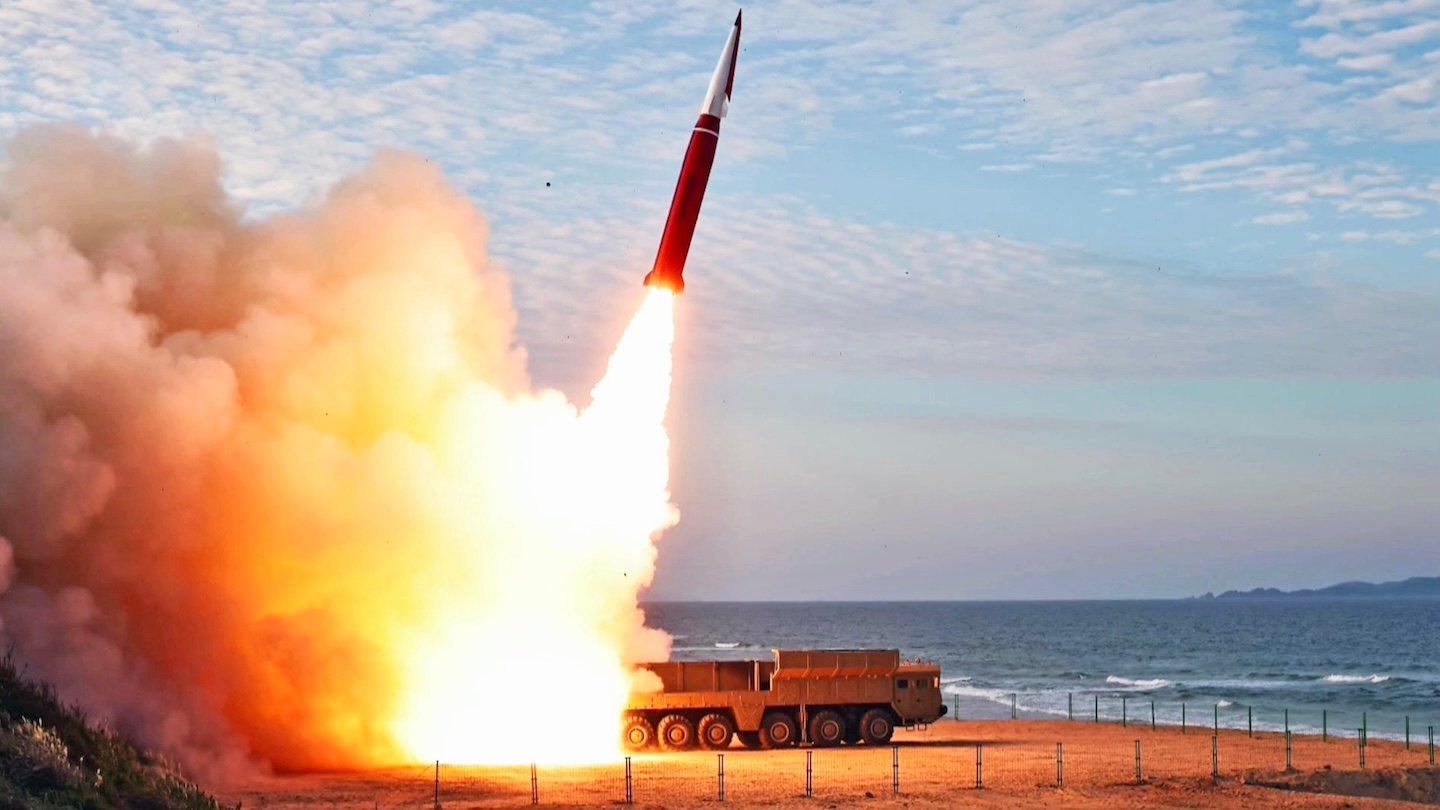
Launch of a Hwasong-11Ma-1 missile from the test facility in Anbyon County, south of Wonsan. North Korean State Media

The September 20 test involved a short-range ballistic missile (SRBM) booster fitted with a hypersonic glide vehicle, according to photographs released by North Korean state media. A display screen visible in the imagery identifies the weapon as the Hwasongpho-11Ma-1, or Hwasong-11E-1 in the equivalent English-language designation.

The test was conducted from the east coast near Anbyon County, south of Wonsan, an area North Korea has repeatedly used for missile testing. The launch site allows missiles to be fired eastward over the Sea of Japan, providing a relatively controlled area for testing short- and medium-range systems.

Another two views of the launch of the Hwasong-11Ma-1 missile. North Korean State Media

South Korean and Japanese authorities say they detected two launches on September 20, with the first occurring at approximately 3:00 p.m. local time and the second several hours later.

North Korean photographs show the missile being launched from a coastal location, with Kim Jong Un and senior missile officials observing the test. Kim’s daughter, Kim Ju Ae, also appears in the imagery.

Kim Jong Un and Kim Ju Ae monitor the progress of the Hwasong-11Ma-1 test. North Korean State Media

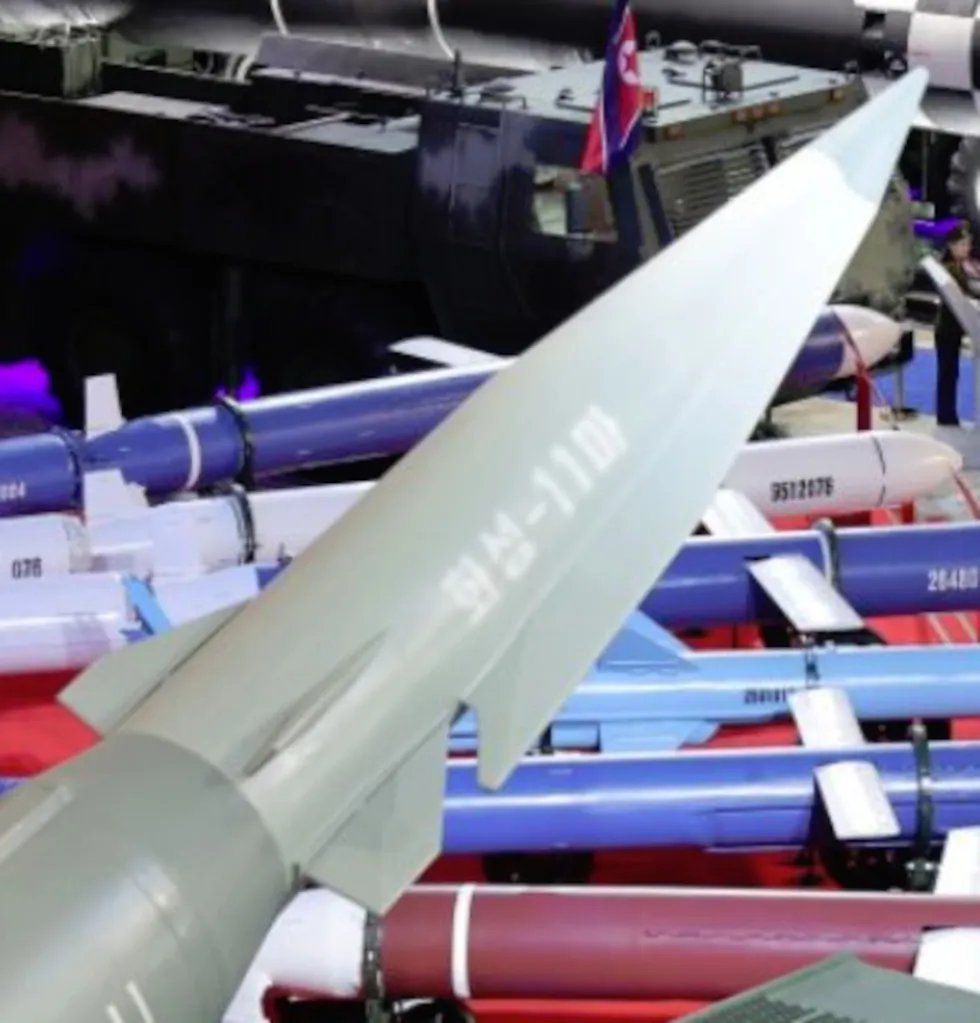
North Korea displayed a mock-up of what it called the Hwasong-11Ma at its Defense Development-2025 exhibition in October 2025. The design uses the basic architecture of the Hwasong-11 family, known in the West as the KN-23 family, but substitutes a distinctive glide wedge-shaped vehicle for the conventional warhead arrangement.

The Hwasong-11Ma, among other weapons, on display at the weapons exhibition in Pyongyang in October 202. North Korean State Media

North Korea claimed another hypersonic missile test that same month, but did not release launch imagery clearly connecting that test to the Hwasong-11Ma. The missile was subsequently shown again during a military parade in Pyongyang.

Hwasong-11Ma missiles on five-axle TELs at last October’s military parade in Pyongyang. North Korean State Media

The latest “-1” designation suggests an iterative evolution of the Hwasong-11Ma, although Pyongyang has not explained what modifications it represents.

Based on the imagery, the new configuration also includes a modified launcher, with the missile carried on a six-axle transporter-erector-launcher (TEL). When the Hwasong-11Ma was first shown, it was mounted on a five-axle TEL. The latest vehicle also appears to incorporate modified retractable covers around the missile.

It remains unclear whether the new TEL represents a standardized operational vehicle or a test configuration.

Preliminary illustration of the new launch vehicle for North Korea's hypersonic missiles. pic.twitter.com/dZ31LA1cbn

— Tal Inbar (@inbarspace) September 22, 2026

As with previous North Korean weapons announcements, the country’s state media claims need to be treated very cautiously. Pyongyang has a long record of publicizing weapons systems and test results that cannot be independently verified, while some of its purported hypersonic tests have left outside analysts unable to determine whether the advertised maneuvering performance was actually demonstrated.

Perhaps the most revealing test-related imagery comes from a display screen photographed at the launch site.

Kim Jong Un and his daughter can be seen watching the screen, which shows the apparent flight trajectory of the Hwasong-11Ma-1. The displayed path initially follows a ballistic trajectory before descending and then performing a pull-up maneuver, regaining altitude before continuing toward the target area.

That type of trajectory is consistent with the basic concept behind a hypersonic glide vehicle. The booster provides the initial velocity and altitude, after which the unpowered glide body follows a relatively shallow, atmospheric flight path at hypersonic speeds, while maneuvering rather than following a simple ballistic path.

The graphic is useful for understanding what Pyongyang says the weapon is designed to do, but it does not independently demonstrate that the missile actually followed the depicted trajectory.

The flight data visible on the display provides some unusually specific figures.

Enhancing the original image released by North Korea allows for an excellent view of the HS-11Ma hypersonic glide missile trajectory, providing altitude and speed data. Note: Slight inaccuracies in the numbers may occur due to the use of AI tools. pic.twitter.com/M4LkfF5VYu

— Tal Inbar (@inbarspace) September 22, 2026

According to the North Korean imagery, the missile traveled 908.2 kilometers (564.3 miles), reached an altitude of 35.8 kilometers (22.2 miles), and remained in flight for approximately 445 seconds, or 7.4 minutes.

The display gives a velocity of 2,146 meters per second, equivalent to roughly 4,800 mph. That is hypersonic velocity in the aerodynamic sense, but speed alone is not what makes a hypersonic glide weapon particularly challenging to defend against. More consequential parameters include sustained controlled flight, maneuverability, guidance, and accuracy.

Other portions of the display appear to show additional points along the flight, including different times, altitudes, and speeds. None of these figures have been independently verified.

The TEL raises one of its two Hwasong-11Ma-1 missiles into the launch position. North Korean State Media

The claimed range is particularly noteworthy because it does not match the publicly reported tracking data from South Korea and Japan.

South Korea’s Joint Chiefs of Staff said North Korea launched two SRBMs from the Wonsan area on September 20. The missiles were assessed to have traveled approximately 450 and 600 kilometers, respectively.

Japan similarly reported two launches, assessing the first at approximately 440 kilometers and the second at approximately 590 kilometers, with maximum altitudes of roughly 60 and 70 kilometers.

Those figures are substantially different from the 908.2-kilometer distance shown on North Korea’s display.

The Hwasong-11Ma-1 climbs after launch. North Korean State Media

The discrepancy does not necessarily establish that either side’s data are incorrect. The North Korean figure could represent a different measurement of the flight path, or could correspond to a portion of the test that was not reflected in the public South Korean and Japanese assessments. It is also possible, if not highly probable, that Pyongyang selectively presented or altered the data.

South Korean analysts have already raised questions about the unusually long distance displayed by North Korea. Yonhap reported that experts suggested Pyongyang may have altered the figure to portray the test as more successful.

Regardless of the range actually achieved in this test, the Hwasong-11Ma/Ma-1 is significant because it represents an attempt to combine a relatively compact SRBM with a maneuvering hypersonic glide vehicle.

The underlying Hwasong-11 family is a well-established North Korean missile design. In its KN-23 configuration, members of the family have also been used by Russia against Ukraine. By placing a glide vehicle on this type of booster, Pyongyang could potentially give a regional strike weapon a flight profile substantially different from that of a conventional ballistic missile. The Hwasong-11Ma/Ma-1 also uses a solid-fuel booster, allowing for faster launches than earlier liquid-fuel designs.

The original North Korean Hwasong-11 short-range ballistic missile. North Korean State Media

In principle, the Hwasong-11Ma/Ma-1 could give North Korea an additional hypersonic strike option against more heavily defended targets in South Korea. Having road-mobile TELs would also provide greater operational flexibility despite their relatively limited range, while making it more difficult for adversaries to locate and track the launchers.

A genuine boost-glide weapon creates significant challenges for defending forces since the sheer speed of the weapon bypasses most air defenses. Its trajectory can also become less predictable after the boost phase. Maneuvering at lower altitudes could also reduce the time available to detect, track, and engage the weapon.

A close-up look at the Hwasong-11Ma’s boost-glide-vehicle. North Korean State Media

However, the available imagery does not establish the extent of the vehicle’s maneuverability, its ability to maintain controlled flight, its accuracy, or the reliability of the complete missile system.

North Korea has made similar claims about its hypersonic weapons in the past.

Pyongyang says it has flight-tested multiple hypersonic boost-glide vehicle designs since at least 2021, but there continue to be questions about what degree of actual capability the country has achieved in this regard. Viable wedge-shaped boost-glide vehicles have historically been extremely difficult to design and then bring to an operational state.

The challenge is not simply reaching hypersonic speed. A weapon has to sustain controlled flight and maneuverability under extreme thermal loads, while also overcoming demanding materials-science, guidance, and navigation requirements. The terminal phase is harder still. Accurately finding and striking a moving target, particularly a ship, requires a highly capable seeker and guidance system. Integrating a nuclear warhead introduces another layer of engineering and weapons-design challenges.

Those demands have made hypersonic weapons a major technological challenge for the United States and other major powers. China is currently widely regarded as the leading country in deploying and developing operational hypersonic systems, although important questions remain about the capabilities and maturity of individual weapons.

Pyongyang said it first flight-tested a wedge-shaped hypersonic glide vehicle in 2021 aboard the liquid-fuel Hwasong-8, before pairing a similar-looking vehicle with the solid-fueled Hwasong-16B intermediate-range ballistic missile (IRBM) in 2024.

VIDEO: Korean Central Television (KCTV) broadcasted footage of North Korea successfully testing the new "Hwasong-16B" hypersonic intermediate-range ballistic missile (IRBM) on Tuesday. pic.twitter.com/VNdhLAeyyK

— NK NEWS (@nknewsorg) April 3, 2024

In its coverage of the latest test, North Korean state media initially avoided identifying the weapon, describing the event as a successful trial of a “new-type weapon” that it said was significant for the rapid development of weapons technology.

Kim said the development would give adversaries an “incurable headache” and deliver what he described as a “cruel and unavoidable blow.”

Tal Inbar, the head of the Space and UAV Research Center at Israel’s Fisher Institute for Air and Space Strategic Studies identifies the Hwasong-11Ma/Ma-1 as a “very significant weapon, bringing hypersonics to the operational/tactical arena and [posing] a challenge to … air and missile defense systems.”

Whatever the exact achievements of the test, the imagery points to continued development of a weapon North Korea first publicly displayed nearly a year ago. The appearance of a new, six-axle TEL, a potentially modified missile, combined with the apparent flight test, suggests that the Hwasong-11Ma/Ma-1 program has progressed since its initial public unveiling.

What remains uncertain is how much of that progress represents a genuine improvement in operational capability.

The latest test therefore provides another indication of the resources and attention Pyongyang is devoting to hypersonic weapons, but the available evidence is still insufficient to determine how closely the Hwasong-11Ma-1’s actual performance matches the capabilities depicted by North Korean state media.

Contact the author: thomas@thewarzone.com

The post North Korea Tests New Hwasong-11Ma Hypersonic Missile appeared first on TWZ.

  •  

Israeli Strike in Gaza City Kills Two Palestinians

An Israeli strike hit Gaza City’s al-Tuffah neighborhood on Tuesday, killing at least two Palestinians, as the IDF continues daily attacks in the Strip in violation of the US-backed ceasefire deal. According to the Palestinian news agency WAFA, an Israeli drone hit a group of people near the Muscat school. In addition to the two […]

💾

  •  

⛽QUANTI GALLONI PER 1 PACE? | LEVANTE LIVE

⛽ Trump non fa la pace, la prezza: all’Iran la promette per il giorno dopo il voto di novembre, a Kiev impone una tregua che serve al gasolio americano, a Riyadh incassa senza sparare un colpo mentre a Gaza la pace è quella di un’Assemblea dove Netanyahu entra e Abbas resta fuori. 🔴 A Levante questa sera, martedì 22 settembre 2026, Margherita Furlan dialoga con Moni Ovadia, attore, drammaturgo e scrittore, Francesco Dall’Aglio, storico e analista di politica internazionale, e Gianmarco Pisa, ricercatore per la pace e operatore dei Corpi civili di pace. 🗽 Dal podio dell’ONU Trump ha detto tre cose in un’ora: con l’Iran «o si fa un accordo o dovrò distruggerli», ma l’intesa arriva «dopo le elezioni di metà mandato»; con l’Ucraina «una soluzione più rapida di quanto la gente possa pensare», e mentre siamo in diretta riceve Zelensky per imporgli una tregua energetica con il gasolio americano a 6,51 dollari al gallone; in Groenlandia due basi e il «controllo permanente sulla sicurezza». Nelle stesse ore l’Arabia Saudita riaccende l’oleodotto verso il Mar Rosso e aggira Hormuz, il Brent scende sotto i cento dollari, Teheran offre di riaprire lo Stretto in sette giorni. 🧭 Affrontiamo insieme: 🇺🇳 L’Assemblea generale su invito: Abbas senza visto per il secondo anno, Netanyahu con un mandato d’arresto in tasca e la porta spalancata, lo scontro con il sindaco Mamdani 💰 AIPAC che raddoppia i milioni per le elezioni di metà mandato mentre il consenso vacilla, e le sanzioni americane in arrivo contro la Corte penale internazionale 🛢 Riyadh e la lezione di Mattei rovesciata: chi controlla il tubo negozia da una posizione diversa da chi controlla solo il pozzo. La Petroline riaperta, i barili europei dirottati in Asia, l’uscita silenziosa da mBridge 🕊 La tregua energetica fra Kiev e Mosca: una pausa per le città ucraine o per il gasolio americano prima del voto? 🇮🇹 L’Italia che firma con Rubio sui minerali critici, abborda la flotta ombra a sud della Sicilia e paga il petrolio che il Golfo decide di venderle ⚖ Resta un diritto internazionale o solo la sua liturgia? Guterres, il relatore ONU sui 223 morti nei Caraibi, la Siria dei depositi che saltano 📚 LIBRI DEGLI OSPITI ✍ Moni Ovadia, Un ebreo contro, Edizioni Gruppo Abele, 2021. ✍ Francesco Dall’Aglio (con Carlo Ziviello), Oppenheimer, Putin e altre storie sulla bomba, ad est dell’equatore, 2023. ✍ Gianmarco Pisa, Fare pace, costruire società, Multimage. ✍ Gianmarco Pisa, Di terra e di pietra, Multimage. ✍ Gianmarco Pisa, Paesaggi kosovari 1998-2018, Multimage. 🎯 SOSTIENI CASA DEL SOLE TV Casa del Sole TV è un progetto di giornalismo indipendente autofinanziato. Esiste perché esistete voi. 🙏 💳 Per donazioni: IBAN: IT63P0326822300052392596590 Intestato a: La Casa del Sole Edizioni Causale: Donazione Casa del Sole TV ⭐ Membership YouTube: 👉    / @casadelsoletvchannel   🔹 Analista Multipolare €5/mese 🔸 Inviato della Verità €15/mese 🔶 Architetto del Futuro €25/mese 📖 I LIBRI DI MARGHERITA FURLAN ♟ BRICS Scacco Matto (disponibile in italiano, inglese, russo) 🌐 SEGUI CASA DEL SOLE TV ▶ YouTube: @CasadelSoleTVChannel 🔔 Iscrivetevi, attivate la campanella, sostenete Casa del Sole TV. È grazie a voi che siamo qui ogni sera. #Levante #CasadelSoleTV #MargheritaFurlan #Geopolitica #Multipolarismo #Trump #ONU #Zelensky #Hormuz #ArabiaSaudita #Palestina #MoniOvadia #FrancescoDallAglio #GianmarcoPisa

L'articolo ⛽QUANTI GALLONI PER 1 PACE? | LEVANTE LIVE proviene da Casa del Sole TV.

  •  

🔴LE FAKE NEWS DI DONALD | TG 22.9.26

– Trump all’ONU: due date, una guerra di Jeff Hoffman
– ONU, il padrone di casa sceglie gli ospiti di Jeff Hoffman
– AIPAC, raddoppiano i milioni ma vacilla il consenso di Gionata Chatillard
– Trump prepara l’affondo contro la CPI di Ivan Bodyan
– Riyadh riapre la via del Mar Rosso di Margherita Furlan
– I mari si chiudono, il mondo paga di Jeff Hoffman
– Pechino potenzia il suo avamposto in Gibuti di Ivan Bodyan
– Cina, elettroni alla velocità della luce di Margherita Furlan
– Siria, la guerra invisibile dei depositi di Jeff Hoffman e Ivan Bodyan
– Caraibi, “la guerra alla droga” fa 223 morti di Ivan Bodyan
– Buon giro intorno al Sole

A cura di Margherita Furlan Con la collaborazione di Gionata Chatillard, Ivan Bodyan e Jeff Hoffman Editing di Mario Ferdinandi

📡 CASA DEL SOLE TV — Informazione libera e indipendente Il nostro lavoro è possibile solo grazie al vostro sostegno. Casa del Sole TV non ha editori forti né finanziamenti pubblici: siamo sostenuti da voi, il nostro pubblico. Se credi nel valore di un’informazione che non tace, aiutaci a continuare.

💳 Dona tramite bonifico bancario: IBAN: IT63P0326822300052392596590 Intestato a: LA CASA DEL SOLE EDIZIONI Causale: Donazione Casa del Sole TV

🅿 Dona tramite PayPal: paypal.me/casadelsoletv

⏰Sostegno ricorrente: casadelsole.tv/sostienici

Anche un piccolo contributo fa la differenza.

Grazie di cuore! ❤

L'articolo 🔴LE FAKE NEWS DI DONALD | TG 22.9.26 proviene da Casa del Sole TV.

  •  

Maryland used discredited “science” to convict a woman of murdering her fetus. Reproductive rights groups are raising alarms.

(LEFT) Photo of Columbia, Maryland, resident Moira Akers taken prior to the birth of Akers' third child and prior to her 2022 conviction for second-degree murder. Photo proved by Akers' lawyer Debra Saltz. (RIGHT) Stock photo of Maryland Supreme Court in Annapolis, taken on July 17, 2021. Photo by ReDunnLev/Getty Images.

Moira Akers was prosecuted and convicted of the murder of a newborn in 2022. She claims to have given birth to a stillborn baby in her home in Columbia, Maryland, in 2018.

Prosecutors doubted Akers’ story, using her online searches for abortion services and lack of prenatal care as evidence of ill intent. But it was a “forensic method” devised in the 17th century that proved key to Akers’ conviction.

The method, known as a “float test,” was designed to determine if a baby was stillborn or born alive by placing the lungs of a deceased fetus in water. If the lungs float, then they are aerated, meaning the baby was breathing and alive prior to their death.

In 2018, former Maryland chief medical examiner Dr. David Fowler signed the autopsy report that, using the float test as proof, determined that Akers’ baby died after Akers asphyxiated it. Fowler also testified in Akers’ trial. Prosecutors used Fowler’s testimony and autopsy report as evidence to convict Akers of second-degree murder in 2022.

Similar to Fowler’s infamous 2021 testimony in the trial of former Minneapolis police officer Derek Chauvin, in which he argued that George Floyd died due to drug intoxication and inhaling fumes from a car tailpipe, Fowler’s citation of the float test in Akers’ case has elicited criticism from the medical community. 

Fowler was also the subject of a scathing audit released by the Maryland Attorney General’s office last year, which found that at least 36 cases involving deaths that occurred during police restraint were improperly ruled accidents or left unclassified during his tenure

The float test has been widely discredited as imprecise and lacking methodological rigor. 

In the course of our reporting on Akers’ case, we not only reviewed court transcripts and the testimony of physicians and medical experts; we also pressed Fowler’s former office for comment about whether or not the float test was still used in fetal death investigations. Just prior to publication, Maryland Department of Health spokesman David McCallister disavowed the test.

“The lung float test is not part of OCME’s current routine practice, which reflects evolving scientific evidence, National Association of Medical Examiner (NAME) guidance, and the independent medical judgment of our forensic pathologists,” McCallister wrote in an email.

“When performed historically, the test was only one component of the overall forensic assessment and was interpreted together with the investigative and autopsy findings. How an individual autopsy finding is characterized or used in criminal prosecution is separate from OCME’s medical determination of cause and manner of death.”

McCallister’s disavowal of the float test marks a stunning departure from past practices for determining causes of death in Maryland. Whether the change will affect Akers’ case remains to be seen.

But what hasn’t changed is the fact that Akers was convicted, has served three years in prison, and is facing another prosecution—all while advocates and her lawyers are still fighting against a bureaucracy wedded to Fowler’s past practices. 

Akers’ fate remains in legal limbo, but her story reveals how flawed science can have real-life consequences, and how an indifferent bureaucracy can defend the mistakes of the past despite public outcry and scientific pushback in the present.

A Stillbirth or Murder?

Akers’ ordeal began in November of 2018.

According to a statement she gave to police, Akers was watching TV with her daughter when she noticed she was bleeding. The Howard County resident retreated to her upstairs bedroom. There, she gave birth to what she described as a baby that was not breathing, or stillborn.

The mother of two young children told police her husband did not want another child. Finances were tight, and the couple was already struggling to care for both a toddler and an 8-year-old.

“I almost didn’t want to admit to myself that it was [a pregnancy],” she told police. 

She hid the possible pregnancy from her family and did not seek prenatal care. “I just didn’t want my family [to know],” Akers said, “a stigma of them knowing that we had even contemplated the abortion part, but knowing that they wouldn’t be happy if we gave up the baby officially for adoption… that’s why I looked into the safe haven stuff.”

The birth itself was a moment of confusion and panic for Akers. When she started bleeding profusely, she thought it was possible the unexpected pregnancy could be the cause. After giving birth in her bathroom, she placed the baby’s remains in a plastic bag and put the bag in a closet.

Her husband, who had found her bleeding, called an ambulance. According to her lawyer, Akers refrained from discussing the ordeal in front of her two children when EMTs arrived at the house. But when she arrived at the hospital, she told doctors about the stillbirth. 

When Akers awoke from surgery, heavily sedated with painkillers and anesthesia, she found Howard County police detectives probing her with questions, which a recording reveals she struggled to answer through the haze of drugs. 

Even though the doctors told detectives not to question Akers after her surgery, they did anyway. And prosecutors were able to include statements Akers made during that interview while still heavily sedated and under the influence of multiple drugs, including fentanyl. 

“The hospital physicians attending told the police who had arrived at the scene not to speak to her for at least two hours after surgery because she was put under general anesthesia,” Akers’ lawyer, Debra Saltz, told us in an interview.

“So the police, rather than wait two hours, interviewed her. I think it was approximately an hour and 20 minutes later, they began an interview.”

Saltz challenged the admissibility of the interview in court. But presiding Judge McCrone ruled that Akers “sounded okay” after reviewing a recording of the interview. 

During Saltz’s cross-examination of lead medical examiner Dr. Nikki Mourtzinos, Mourtzinos made a critical admission: float tests are not performed in a uniform fashion, and the test does not call for a consistent, controlled (i.e. scientific) methodology. “Multiple people do things differently. Some people tie off the lungs, some people would clamp off the lungs and float them in water,” Mourtzinos testified. 

Saltz filed motions to toss out the float test results as evidence. But Judge McCrone ruled it admissible, too.

And more unresolved questions about the efficacy of the police and OCME investigations before Akers’ trial remain. 

Even though the official OCME autopsy report was not released until four months later, detectives claim Maryland’s Office of the Chief Medical Examiner (OCME) told them Akers’ baby’s death was likely a homicide.

But Saltz says OCME and Howard County detectives had already made up their minds about Akers before their investigation into her ordeal even began in earnest. “It was never going to be about science in this case. It was going to be about a determined outcome, which was going to be homicide, even though it should not have been,” Saltz told us.

Along with the float test results and her post-surgery interview with detectives, prosecutors focused on both Akers’ prior internet searches for abortion providers, as well as her lack of prenatal care, as evidence that she intended to kill her baby.

Again, Akers’ defense argued this evidence was inadmissible due to a state law that prevents drawing criminal inferences from a woman’s behavior during pregnancy. Again, Saltz was overruled. Judge McCrone allowed prosecutors to use Akers’ actions as evidence of later criminal intent.

The chief OCME pathologist who conducted the float test testified in Akers’ trial that the final mechanism of injury was asphyxiation and exposure. However, the autopsy did not find petechial hemorrhaging in the eyes or any trauma around the neck indicating strangulation. The medical examiner argued that the determination of asphyxiation was due to observed inflammation in the pancreas, a less common indicator of strangulation.

But there was also substantive evidence that the baby was stillborn.

The defense offered expert testimony that argued the detection of multiple infections in Akers’ placenta and umbilical cord was indicative of a stillbirth. 

“One of the more perplexing aspects regarding the opinions of Drs. Simon and Mourtzinos [the state medical examiners who conducted the autopsy] is that they describe gross and microscopic evidence of chorioamnionitis (inflammation of the placenta and its membranes), and funisitis (an inflammation of the umbilical cord), along with inflammation of the umbilical cord’s arteries and vein,” Gregory J. Davis, a forensic pathologist and professor at the University of Kentucky, wrote in a letter to the court.

The jury convicted Akers of second-degree murder. Judge McCrone sentenced her to 30 years. 

New Obstacles for Prosecutors, but the Float Test Remains

In February 2025, after she had served three years in prison, the Maryland Supreme Court granted Akers a new trial. In a 5-2 decision, Justice Brynja M. Booth wrote for the majority: 

We hold that the internet searches are irrelevant and that the trial court erred as a matter of law in admitting them. We similarly hold that Ms. Akers’ bare decision to forgo 2 prenatal care was not probative of motive or an intent to kill or harm a live child… In light of our holding on the inadmissibility of the abortion searches, we reverse the judgment of the Appellate Court and remand this case to the circuit court for a new trial. 

To win a conviction against Akers during the retrial of the case, prosecutors have to navigate a major evidentiary obstacle now that the Maryland Supreme Court has essentially barred them from using much of the “evidence” used to convict Akers in 2022.  

But the float test will still be admissible, and Saltz says prosecutors are likely to use it. Even though Fowler’s former office has publicly repudiated the test, the shadow and influence of Fowler himself still looms large. 

“Dr. Fowler had a very large impact on this case and the judge heavily credited his testimony and relied on his testimony to allow in evidence the fetal lung float test,” Saltz told us.

Saltz says the admission by Fowler’s former office that the float test is scientifically unreliable should give prosecutors pause. “I find it hard to believe that the state’s attorney’s office in Howard County would still consider using this outdated test,” she wrote in an email.

“I have always believed that they were motivated by emotion rather than science as they undertook to prosecute my client. I would hope they would dismiss the charges based on this newest information.”

For now, prosecutors are not talking. A spokesman for the Howard County State’s Attorney’s Office said they do not comment on pending cases.

“It is the policy of the Howard County State’s Attorney’s Office not to comment to the media on the facts, evidence, or litigation strategy of a pending case until the matter has concluded,” Yolanda Vazquez wrote in an email.  

Akers’ fate will be decided soon; the case is set for trial in November. Saltz says she is prepared to defend Akers, float test or not.

“My client is a very, very strong person. And she always held out hope that this would go her way… she knew that she had a stillborn baby,” Saltz said. “And there are plenty of people—including myself and the actual scientists who can read scientific evidence—who believe her.”

  •  

Poll: Majority of US Voters Support Impeaching Hegseth Over Iran War

A new poll from The Economist/YouGov found that a majority of registered US voters support impeaching US Secretary of War Pete Hegseth, after Rep. Thomas Massie (R-KY) of Kentucky introduced a resolution to remove him. The poll, conducted from September 18 to September 21, found that 51% of registered voters surveyed support impeaching Hegseth for […]
  •  

USAF F-16 Crashes At Spangdahlem Air Base In Germany

The pilot of a U.S. Air Force F-16 Fighting Falcon assigned to the 52nd Fighter Wing safely ejected before the aircraft crashed at Spangdahlem Air Base in Germany, according to the wing.

The pilot is still receiving medical treatment, the wing said in a statement. Emergency response teams are still on the scene. The cause of the incident, which took place about 2:30 p.m. local time, is still under investigation and additional details will be released when available.

The crash happened as the jet was on approach to land at the installation, located in the western German region of Rhineland-Palatinate, according to the New York Post.  

“Following a plane crash in the vicinity of U.S. Air Base Spangdahlem, fire and emergency response teams from the Eifel District of Bitburg-Pruem were dispatched to the scene,” The Associated Press reported, citing the district. 

Images emerged on social media showing smoke rising in the distance.

An F-16 fighter jet has reportedly crashed at the U.S. Spangdahlem Air Base in western Germany on Tuesday afternoon.

Witnesses reported seeing a jet rapidly descend before a large column of black smoke appeared near the runway.

Local reports say two aircraft had taken off and… pic.twitter.com/MB4S6zKQm5

— Clash Report (@clashreport) September 22, 2026

The F-16 crash at Spangdahlem was the second mishap in a week for USAF F-16s. On Sept. 17, an F-16 from the 149th Fighter Wing at Joint Base San Antonio-Lackland in Texas crashed in northern Michigan. The pilot in that incident also ejected.

According to air traffic control (ATC) audio, the pilot’s wingman said at the time of the Michigan crash, “we have a possible mayday. My wingman may have taken a bird.” TWZ cannot independently confirm what caused the crash. The audio continues and offers a fairly dramatic and raw look at how the incident occurred over the air waves.

F-16 crash ATC audio, BUCK 11 flt x2 F-16s were flying along the VFR low level route VR634 when the 11 advised MINNEAPOLIS CENTER that his wingman may have hit a bird and was going to eject just south of Traverse City, Michigan

Audio via @liveatc https://t.co/sUR7KZBR2j pic.twitter.com/QdcE4ePiUd

— Thenewarea51 (@thenewarea51) September 17, 2026

This is a developing story.

UPDATE: 3:35 PM Eastern –

The 52nd Fighter Wing provided some additional information.

“The aircraft was returning to Spangdahlem Air Base following a routine training flight involving four F-16s when the crash occurred,” the wing stated. “The remaining three aircraft diverted to Ramstein Air Base and landed safely. The pilot of the crashed aircraft ejected safely and received medical care.”

“Emergency response personnel responded to the scene, with local German fire departments and emergency medical services providing support,” the wing added. “German emergency response partners have offered their continued assistance as needed. The 52nd Fighter Wing appreciates the swift response and continued support of our German partners.”

Contact the author: howard@twz.com

The post USAF F-16 Crashes At Spangdahlem Air Base In Germany appeared first on TWZ.

  •  

Bodies of 10 women found dead in South Africa, sparking societal debate on GBV

Fear and anger are growing in South Africa after the bodies of nine women were discovered across the Ekurhuleni municipality, east of Johannesburg, over the past two months, with police investigating whether the deaths are connected, a 10th body was confirmed this week. Three suspects have been arrested, and police have acknowledged a possible connection between some of the killings. What is not in dispute is the scale of the crisis the discovery has exposed, and the outrage it has provoked, protests against femicide have been held in the country in the weeks since.

Four of the nine women have so far been publicly identified, Elizabeth “Tsontso” Moselakgomo, 38, a mother who vanished during her regular afternoon run and was found days later behind a hotel in Rhodesfield; Itumeleng Kekana, 32, missing since July and found in August with multiple stab wounds; Dineo Evelyn Motapane, 38, found in KwaThema; and Gracious Nkomo, 28, a lodge worker in Kempton Park missing for more than two weeks before she was found. 

Anger over the response

The deaths have triggered protests and renewed criticism of the country’s response to gender-based violence. Residents and women’s rights campaigners have questioned why women are repeatedly advised to change their behavior, avoid isolated areas, walking alone or running alone, rather than placing greater emphasis on preventing perpetrators from committing violence.

The National Union of Metalworkers of South Africa (NUMSA) has been among the sharpest voices responding to the killings. In a statement condemning the deaths, the union insisted the killings should not be treated as a “crime wave” or a mystery, describing them instead as femicide and, more precisely, a war being waged against women. NUMSA’s argument is that this is not an aberration but the visible edge of something structural. The union points to police figures showing at least 569 women murdered nationally between April and June 2026 alone, by the verified count, with an unverified estimate closer to 892, roughly six women killed every day. Against this, nine deaths in one metro over two months is, in the union’s words, closer to the ordinary condition of the country, made visible only because the fear of a serial killer has made it a story the wider public can imagine touching them.

The statement also pushes back on the instinct to treat this primarily as a street-level danger. Of thousands of rape cases registered by police in the same quarter, the majority occurred in a residence, not a public place. The killings that draw headlines, a body beside a highway, represent a fraction of a type of violence whose center of gravity is the home.

The economics underneath the violence

NUMSA also refuses to treat gender-based violence as an individual pathology alone. It traces a line from the colonial and apartheid-era migrant labor system, which depended on women’s unpaid domestic and reproductive labor to keep wages artificially low through to the present, where South African women remain disproportionately unemployed (an official rate near 37.5%, against 44.9% for men) and disproportionately head of household. Over four in ten nationally, and closer to half in rural areas. Close to two million employed women work informally, without pensions, medical aid, or written contracts. When a woman who is also a breadwinner is killed, the union argues, it is not only a life lost but a household’s income and caregiving capacity lost with her.

Gender-based violence and femicide were declared a national disaster in South Africa in November 2025. Nearly a year on, the killings in Ekurhuleni are evidence, in the union’s reading, that the declaration has not translated into protection.

What’s being demanded

NUMSA has rejected the idea of policing alone and the state’s response so far has leaned on a security “lockdown” of Kempton Park to answer a crisis this size. Its demands include full funding of the national plan on gender-based violence and femicide, functioning forensic and mortuary capacity so victims can be identified quickly, safe transport for workers on early and late shifts, and the implementation of the ILO Convention 190 on violence and harassment in the workplace, which South Africa has ratified but not fully enforced. Alongside state accountability, the union is calling for community-based structures, street and area committees, explicitly modeled on the civic organizing of the anti-apartheid period to accompany women, support survivors, and track cases through the courts.

Investigations continue, but the fear, concern and anger surrounding the killings remain. The deaths of the women in Ekurhuleni have already forced a public reckoning with the scale of violence against women in South Africa and the urgent need for stronger action to protect women and hold perpetrators accountable.

  •  

Colisão fatal em Torres Vedras faz um morto e um ferido ligeiro

📷OS MONHACAS

Um acidente violento envolvendo um motociclo e um veículo ligeiro provocou, esta terça-feira, a morte de um homem de 45 anos e fez ainda um ferido ligeiro, no concelho de Torres Vedras, segundo a Agência Lusa.

O sinistro ocorreu cerca das 12h30 na estrada que liga as praias de Santa Rita e Santa Cruz, no distrito de Lisboa.

Segundo o comandante dos Bombeiros de Torres Vedras, Hugo Jorge, o ferido ligeiro foi transportado para a urgência do Hospital de Santa Maria, em Lisboa. O corpo da vítima mortal, o motociclista de 45 anos, deverá ser encaminhado para o Instituto de Medicina Legal de Torres Vedras.

Para o local do acidente foram mobilizados 14 operacionais e cinco viaturas, entre os quais duas ambulâncias dos Bombeiros de Torres Vedras, meios da GNR, a Viatura Médica de Emergência e Reanimação (VMER) do INEM e um helicóptero de emergência médica.

Por: Dino Frazão
22 de setembro de 2026

Se gostou deste conteúdo e ainda não é nosso seguidor, siga a nossa página para acompanhar todas as novidades!

————————————————–
© 2026 Os Monhacas. Todos os direitos reservados.
Este é um projeto independente de criação de conteúdos.
Se gostou do que leu e ainda não é seguidor, siga a nossa página para ver mais conteúdos!
————————————————–

O conteúdo Colisão fatal em Torres Vedras faz um morto e um ferido ligeiro aparece primeiro em OS MONHACAS.

  •  

Will Germany run out of gas this winter? Experts and energy executives warn of dire scenarios

Several key German industry groups and energy analysts are warning that Germany could face severe gas supply issues, and potentially entirely deplete its storage, if an exceptionally cold winter occurs. Of course, predictions of this sort have been made off and on in recent years. Germany has never actually run out of gas before. The question is now how alarmist these warnings are and how realistic an actual gas and energy shortage is this time around.

Currently, the government argues there will be no gas shortage. However, storage operators, energy executives and some economists argue that a mild winter should be manageable and a brutally cold one could get tight enough to force industry to cut production and send prices soaring.

One of the most dire warnings comes from Markus Krebber, chief executive of RWE, Germany’s largest power producer.

“If we get a mild winter, everything will be fine,” he told Focus in an interview. “If the winter is hard, there can be significantly higher prices. And it can get tight.”

Krebber said Germany is entering the season “with the lowest gas storage levels of the past 20 years” – lower even than in 2022, when Russian pipeline flows collapsed. “That works if we have a normal winter. If we get a particularly cold winter, it can get scarce.”

He has also warned that if Germany does not add more power supply, “there will be distribution battles for electricity” among industry, data centers and the electrification of heat and transport.

The data supports Krebber’s concerns. The German gas storage association (INES) warns that Germany entered September at its lowest storage levels in 15 years, at around 53 to 56 percent. INES models show that if refills remain sluggish and if Germany experiences an extremely cold winter, similar to the weather of 2010, storage reserves could be exhausted as early as January or February, potentially leaving daily supply shortfalls of up to 25 percent.

German underground gas caverns are roughly 20 percentage points below last year’s level and far under the seasonal norm. While Berlin’s own rules call for most gas storage sites to reach 80 percent by Nov. 1, almost no one now expects that to happen.

“By now all the experts agree: these 80 percent are already technically almost impossible to achieve and also not realistic,” Klaus Müller, president of the Federal Network Agency, said in a Phoenix television interview. He added that storage is not the whole story. “We have created our own capacities with four liquefied natural gas terminals. We can obtain gas from Norway, Belgium, Holland, France.”

Energy market consultants and industry group analyses point out that weak summer gas refills – driven by unfavorable price spreads between summer and winter gas and price volatility from global conflicts – have left Germany reliant on steady ongoing imports. They point out that cold weather is not the only factor, as disruptions could be exacerbated by pipeline outages, reduced LNG flows, escalating conflict in Ukraine or the Middle East, and various other scenarios. All of this comes at a time when Germany’s buffer is much thinner than in previous years.

Not everyone is panicking, though. The Federal Network Agency, Germany’s energy regulator, has also acknowledged the low storage levels but stated they do not currently indicate an imminent crisis or inevitable shortage.

Claudia Kemfert, an energy economist at the German Institute for Economic Research, says that a distinction must be made between shortages and higher prices. She has said an acute shortage is not her base case, but that low stocks leave the system more exposed if cold weather, high LNG prices and supply interruptions hit at once. Relying on last-minute cargoes, she has argued, is “risky and expensive.”

Historical weather data supports less extreme gas shortage scenarios. On average, the past ten winters have been extremely mild in Germany, with the exception of last year’s winter, which was exceptionally cold. If there is a repeat this year or the winter is even colder, it could indeed tip Germany into an energy crisis, but the odds appear to be against such a scenario.

In the meantime, industrial companies in Germany are already taking precautionary measures, as a severe cold snap would likely force curtailments on industrial consumers first to stretch remaining gas through February and March to protect vital natural gas deliveries to households.

Another piece of good news it that the European Union as a whole is near 70 percent in terms of gas storage, far better than Germany. This means that the crisis is unlikely to grip all of Europe. Still, Germany is Europe’s largest economy and a key hub of industry. Any gas or energy crisis in the country would have broad repercussions across Europe.

The post Will Germany run out of gas this winter? Experts and energy executives warn of dire scenarios appeared first on Remix News.

  •  

‘She suffered so much’ – Tunisian migrant charged with raping a female jogger in a public park disappears during trial

A 30-year-old Tunisian man charged with raping a jogger in a public park outside Turin has failed to appear at his latest court hearing and can no longer be located more than two years after the attack, Italian court officials reported.

The defendant, who has not been publicly named, missed a Sept. 17 hearing at a Turin court, where he is accused of sexual violence in the June 29, 2024, assault and rape in Luserna San Giovanni.

Italian media outlet Turino Today indicates that the man may have already left Piedmont and returned to Tunisia but his current whereabouts are unknown.

According to the prosecution’s account presented in court, the 40-year-old woman was running in a municipal park in late afternoon when a man grabbed her from behind. The struggle quickly turned violent. Prosecutors say he sexually assaulted her and fell onto her during the fight, fracturing her legs. She bit his arm through a red T-shirt. He then fled.

A carabinieri officer who responded testified that the woman could not stand.

“I was among the first to intervene,” the officer told the court. “I remember that the woman could not stay on her feet because of the fractures to her legs. I supported her while we waited for the ambulance.”

Police found the suspect after patrol officers noticed a man walking with his partner with a wound resembling a bite mark, leading the officers to suspect that the man may have been the rape suspect. Officers said he appeared nervous. At his home, he broke down in tears, showed the bite marks and handed over the clothing he said he had worn during the attack, including the red shirt the victim had described. Taken to the station, he confessed to the crimes in the case.

In court, the victim’s husband said that the rape and assault dramatically changed life for his wife, him, and their children.

“For at least a year, she could only walk on crutches. She suffered so much,” he said.

The woman’s sister told the court: “I was informed by phone of what had happened. My sister is a rock, but nothing is the same for her anymore. The same goes for us: these are things that mark you, there is no going back.”

The first judge did not impose pretrial detention on the suspect. Reporting on the ruling, the judge cited the man’s cooperation, the fact that he was not arrested in the act, the absence of a prior criminal record, and a finding that there was no concrete flight risk.

The post ‘She suffered so much’ – Tunisian migrant charged with raping a female jogger in a public park disappears during trial appeared first on Remix News.

  •  

Algerian migrant sentenced to 10 years in prison for raping and sexually assaulting 4 children, including 7-year-old

An Algerian migrant has been sentenced to ten years in prison for raping a child and sexual assaults on 3 other children

A 36-year-old Algerian migrant, who worked as a security guard, has been sentenced to ten years in prison after a Savoie criminal court found him guilty of aggravated rape of a child and sexual assaults on minors.

The court found him guilty of sexually assaulting his then-7-year-old stepdaughter in 2020, forcing an adolescent to perform fellatio, of sexual assault on another minor, and of sending a photograph of his genitals and a video to a friend of one of the victims. The most serious acts occurred at the home he shared with his then-wife during an evening in November 2020 in Saint-Pierre-d’Albigny.

Four minor girls were identified as victims. None were named in the reporting, according to French news outlet Le Dauphine.

The three-day trial before the Savoie court ended with a conviction on all counts: aggravated rape of a minor, sexual assaults on minors, and corruption of a minor. The public prosecutor, Christophe Dubois, had asked for 12 years. The court also imposed a permanent ban from French territory and registration on the national sex-offenders file.

The defendant, an Algerian national who had been living in France illegally since his divorce from the mother of one of the victims, maintained his innocence throughout. On the first day, he told the court, “I am innocent. All of this is just lies!”

The next day, he told a civil party: “I am not the kind of person who touches minors.”

Court-appointed psychologists and psychiatrists described him as psychologically normal, with no mental disorder.

In his closing argument on Sept. 16, prosecutor Christophe Dubois opened with a blunt assessment: “This trial leaves a bitter taste with an accused who never stopped contesting the facts.”

Dubois said the gravity of the potential sentence made it tempting for the defendant “to flee reality given how heavy the sentence he faced was.”

The post Algerian migrant sentenced to 10 years in prison for raping and sexually assaulting 4 children, including 7-year-old appeared first on Remix News.

  •  
❌