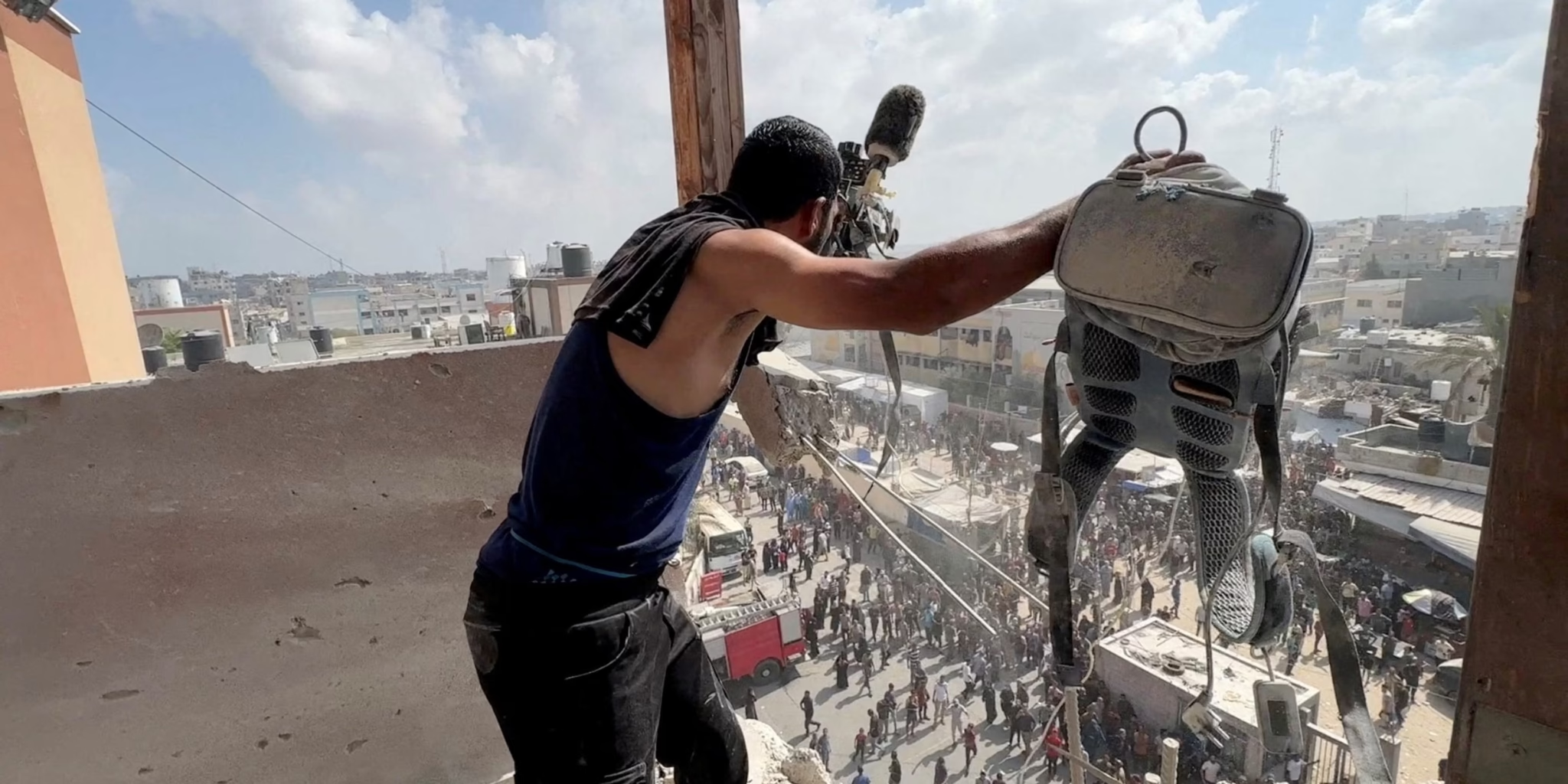
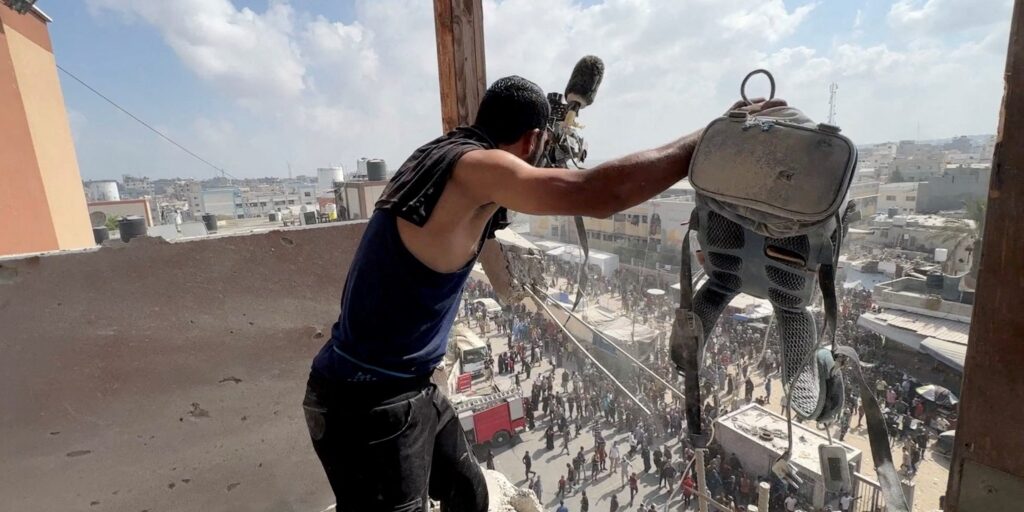
A year after the bombing that killed 22 people, including 5 journalists, at Nasser Hospital in Gaza, an Israeli soldier has told Le Monde and other media how the IDF pulls out all stops to link bombing victims to Hamas
O ministro Alexandre de Moraes, do Supremo Tribunal Federal (STF), autorizou nesta terça-feira (6) que a cabeleireira Débora Rodrigues dos Santos, conhecida como “Débora do Batom”, cumpra o restante da pena no regime semiaberto. Ela está em prisão domiciliar.
Débora ficou conhecida por ter pichado, durante os atos de 8 de janeiro de 2023, a frase “perdeu, mané” na estátua “A Justiça”, que fica em frente à sede do STF. A inscrição foi feita com batom vermelho.
Moraes determinou a remição de 212 dias da pena por atividades laborais, leitura de um livro e aprovação no Enem aplicado para pessoas privadas de liberdade. Com a remição, ela passou a cumprir os requisitos para a progressão ao regime semiaberto.
A decisão atendeu à manifestação da Procuradoria-Geral da República (PGR), que reconheceu o cumprimento dos requisitos para a mudança de regime.
Débora foi condenada pelo STF a 14 anos de prisão pela participação nos ataques de 8 de janeiro. Entre os crimes pelos quais foi condenada estão tentativa de abolição violenta do Estado Democrático de Direito, golpe de Estado, dano ao patrimônio tombado, dano qualificado com violência e associação criminosa armada.
Apesar da progressão para o semiaberto, Moraes manteve Débora em prisão domiciliar.
Attacks on commercial vessels off the Black Sea’s western coast are on the rise, threatening already-choked trade flows in the region while testing NATO’s readiness to react.
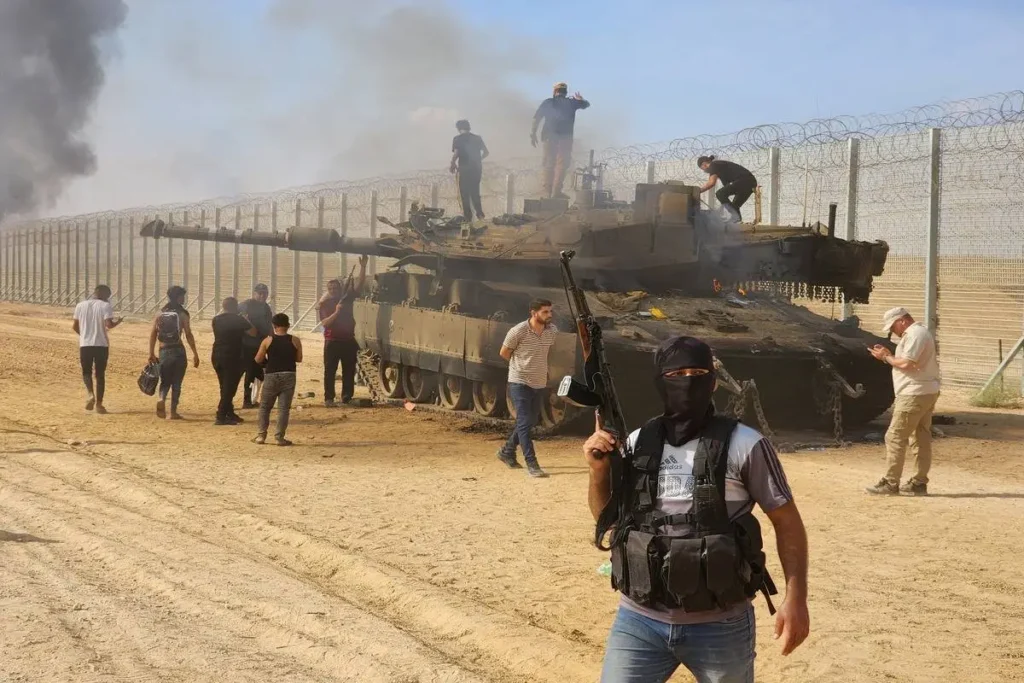
The planning for the Oct 7 prison breakout was long in the making and met with “catastrophic success.” Tens of thousands of Gazans poured out into the lands that had been their families’ properties for generations...
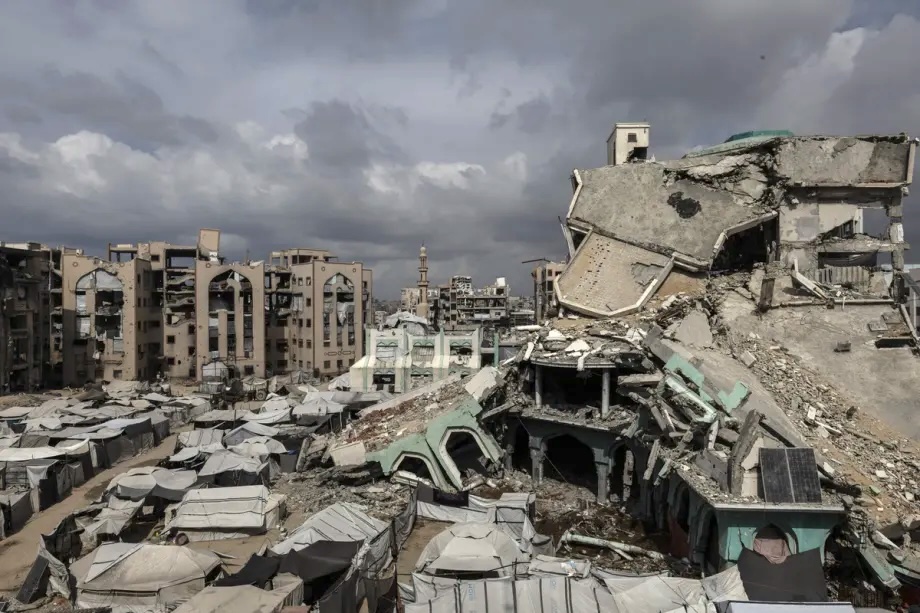
The West Bank too is crumbling, as IDF finds excuses to kill Palestinians, steal land, demolish homes, even rewrite history. Latest news and headlines here.
Ukraine is canceling part of its planned military purchases and moving the money to other priorities. Ukraine's Defense Ministry has announced that it, together with the General Staff and the Logistics Forces Command, will free about $346 million by terminating some weapons contracts and dropping some planned purchases.
What the army planned to buy in 2024 and 2025 may no longer be suitable for the front, the ministry noted, because technology and tactics change quickly. The review comes four days after the Ukrainian government drew about $1.1 billion from the defense reserve to pay soldiers in October amid a looming economic crisis.
The ministry gives five reasons for the review: some weapons no longer match combat tasks, certain suppliers cannot build the planned volume, certain models have not been codified, partners already cover some needs, and cheaper means can perform specific jobs in larger numbers.
"For us, there is one criterion: does the item work for results in combat today. Every hryvnia released from irrelevant contracts must reach the troops as the weapons needed right now and in the right place," Col. Yurii Pohribnyi, commander of the Logistics Forces, says.
The procurement agency calls each producer
The General Staff set the final list of purchases for review, and the ministry forwarded the documents to the Defense Procurement Agency to implement the decision. For specific items, delivery volumes were adjusted rather than canceled, which the contracts allow when needs change.
Affected producers have been informed, and the agency is discussing each item with suppliers based on the status and payments of each contract. Artem Romaniuk, acting director of the agency, has explained that further steps on each contract will depend on the army's current needs and the contract terms. The list of weapons stays secret for security reasons.
Funds freed up by terminating contracts and canceling planned purchases will be redirected to the urgent needs of Ukraine’s Defense Forces.
Ukraine's drone pilots are killing and wounding far more Russian infantry than they did a month ago. Ukraine's Unmanned Systems Forces confirmed that their pilots took out 2,699 Russian infantry from 1 to 5 October, 39.7% more than in the first five days of September, Commander Robert "Madiar" Brovdi wrote on Telegram on 6 October.
The Unmanned Systems Forces, the branch of Ukraine's military that fights with drones, count only losses verified by their own pilots in the military's Delta system, so the full picture of Russian losses is larger, Brovdi stressed. Compared with the first five days of August, the rise is 76.5%, from 1,529 losses, which he ties to denser and more frequent Russian assaults.
The sharpest growth occurred in the area of the 1st Azov Corps of Ukraine's National Guard on the Dobropillia-Pokrovsk axis in Donetsk Oblast, as fighting for fortress-belt cities continues. Drone pilots recorded 1,268 Russian losses there, 43% more than the 884 of early September and 91% more than the 664 of early August.
"Russia's hidden mobilization is in action. This is the beginning," Brovdi said ironically.
Russia doubles its monthly recruitment pace
Russian recruitment, mobilization, and contracts run at about 70,000 people a month, twice the 35,000 monthly average from January to August 2026, Brovdi noted on 16 September, when he forecast 12,500 losses for his pilots in September.
He expected the toll to keep climbing. Bigger records still lie ahead because of Russia's unannounced mobilization, Brovdi added on 24 September.
Drone pilots outpaced August by a quarter
September was completed above that forecast. The pilots logged 13,358 Russians killed or wounded, 25.35% more than the 11,010 of August, an average of 445 a day against 355, Brovdi reported. By his count, that equals the full assault infantry of one battalion every day, and his pilots hit a Russian target every 42 seconds.
Two sets of axes took the heaviest toll. In the first 24 days of September, the Dobropillia and Pokrovsk axes accounted for 4,018 losses, and the Oleksandrivka and Huliaipole axes for 3,021, according to Brovdi. The first of those groups covers the same Dobropillia-Pokrovsk axis where the Azov corps zone recorded the sharpest October rise.
The American withdrawal from Iraq is not an end but a strategic pivot, a calculated transition from direct occupation to remote containment. By pressuring Iraq to disarm its resistance groups, Washington aims to neutralize Iran’s forward defense line and clear the battlefield for a potential full-scale confrontation with Tehran. This gambit risks either delivering Iraq […]
Before the killings that helped bring down Ukraine’s president in February 2014, American diplomats were discussing who should enter its government. In a leaked telephone call, senior State Department official Victoria Nuland told US ambassador Geoffrey Pyatt, “I think Yats is the guy,” referring to opposition leader Arseniy Yatseniuk. Washington had clear preferences and was working to advance them. Later that month, Yatseniuk became prime minister.
Ivan Katchanovski’s The Maidan Massacre in Ukraine examines the violence that preceded that transfer of power. Drawing on television footage, witness testimony, forensic examinations and Ukrainian court proceedings, he argues that elements of the opposition shot protesters and police in a false-flag operation. His case centres on evidence of protesters being shot from opposition-controlled locations, including Hotel Ukraina, overlooking the killing ground.
The protests began in November 2013, when President Viktor Yanukovych suspended plans to sign an association agreement with the European Union. Demonstrators gathered in Kyiv’s Independence Square, known as the Maidan. Police violence, restrictive legislation and escalating clashes deepened the confrontation. On 20 February, scores were killed or injured. An agreement signed the following day failed to preserve Yanukovych’s presidency; he fled Kyiv, and parliament voted to remove him.
During the shootings, BBC correspondent Gabriel Gatehouse reported seeing what looked like a protester firing from a window of Hotel Ukraina. Katchanovski connects the BBC footage with ICTV recordings and an investigative finding that the room was occupied by a parliamentary deputy from the far-right Svoboda party. His account also cites a Maidan participant’s testimony that protesters had told him the gunman was “our sniper.”
Orwellian blackout & denial of false-flag Maidan massacre evidence: · BBC & ICTV videos of sniper(s) in Hotel Ukraina room of far-right Svoboda deputy shooting Maidan protesters & BBC journalists · Maidan activists, BBC journalist & verdict identifying them as Maidan sniper(s) ·… pic.twitter.com/aRQozPzS8d
VIDEO: BBC and ICTV footage that Katchanovski identifies as showing shooting from a Hotel Ukraina room occupied by a Svoboda deputy, directed towards protesters and the BBC crew. (Source: Ivan Katchanovski on X.)
Svoboda publicly announced that its activists had taken Hotel Ukraina under their control and protection on 25 January, according to the statement reproduced in Katchanovski’s chapter on witness testimony. He also cites a Maidan Self-Defence commander who described guarding the entrance and checking bags before, during and after the massacre. Other recordings and accounts place armed opposition groups inside.
Wounded protesters described shots coming from the hotel and other Maidan-controlled locations. Katchanovski compares those accounts with wound directions, ballistic findings and synchronised footage. In his reconstruction, protesters advancing towards the police were also being shot from elevated positions to their sides or behind them, in buildings controlled by their own movement.
Katchanovski’s examination of the October 2023 verdict exposes a contradiction within the proceedings. Passages he reproduces place particular fatal shootings in the direction of Hotel Ukraina, outside police-controlled territory. Yet the prosecution’s case against Berkut, Ukraine’s riot police, proceeded alongside evidence that, according to his analysis, pointed towards opposition-controlled positions. He identifies missing exhibits, altered bullet fragments and reversals of earlier forensic examinations, arguing that the investigation obscured the responsibility of opposition-linked shooters.
Self-described Georgian participants alleged that they received weapons and orders to shoot both police and protesters to disrupt a political settlement. Their accounts implicated opposition figures, including Serhii Pashynsky, a Ukrainian member of parliament from the Fatherland party and a Maidan opposition politician. Katchanovski compares details from those accounts with footage, shooting locations, and other testimony, though he acknowledges his study cannot verify allegations against named individuals.
The authorities emerging from the upheaval quickly sought new intelligence ties. A New York Times investigation traces the partnership to 24 February 2014, when Ukraine’s new security-service chief contacted the CIA and Britain’s MI6. It subsequently expanded into extensive cooperation, including 12 CIA-supported secret locations along Ukraine’s border with Russia, constructed over the eight years preceding the newspaper’s 2024 report.
At home, parliament’s attempt to repeal the regional-language law triggered widespread criticism. As language scholar Dominique Arel explains, acting president Oleksandr Turchynov blocked the repeal, leaving the law in force. The vote nevertheless intensified controversy over the new authorities’ approach to language rights.
The massacre helped determine who would govern Ukraine. Katchanovski concludes that elements of the opposition engineered the killings to turn public outrage against Yanukovych and seize power. His case brings together hotel footage, victims’ accounts, forensic material and evidence he identifies as investigative manipulation. The book challenges both the attribution of the shootings and the political account built upon them.
BOOK: Read Ivan Katchanovski’s The Maidan Massacre in Ukraine, the open-access investigation examined in this article. The book brings together video analysis, witness testimony, forensic material and Ukrainian court proceedings to present the author’s case for a false-flag massacre. (Source: Ivan Katchanovski, The Maidan Massacre in Ukraine | Palgrave Macmillan, 2024)

 Login