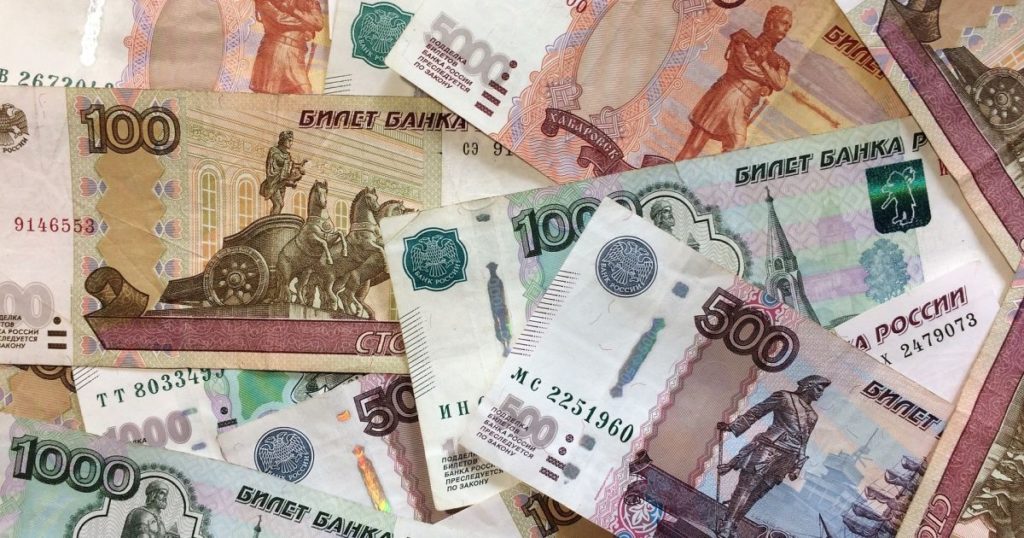
Russia is spending more on the war than at any point since it began. Russia's military funding is on track to hit a record this year after President Vladimir Putin added almost $60 billion to the outlays set in the budget, Bloomberg reports, citing people close to the government.
Defense spending is expected to approach about $199 billion by the end of 2026, roughly 40% above the plan Moscow announced in late 2025. That reverses the course of a year ago, when the Kremlin meant to slow military growth, narrow its deficit, and rebuild reserves drained by the war.
Alaska was the turning point
Putin ordered the shift late last year, after concluding that talks with the US in Alaska would not produce an acceptable deal to end the fighting, the report says.
By January, the Kremlin judged an agreement with Ukraine to be out of reach, and the government began accelerating advance payments to defense firms and raising other war-related spending.
"The government is finally budgeting for a prolonged war in Ukraine, but still understates its cost," Bloomberg Economics economist Ekaterina Vlasova said.
The deficit nearly doubles
Paying for the war has blown out the budget. The projected 2026 deficit has climbed to more than $81 billion, up from about $44 billion as first planned, and the government covered the extra spending through increased domestic borrowing and gold sales.
The budget plans years of war
The spending is not set to fall soon. Under the budget plans, Russia's military outlays reach about $200 billion in 2027, then ease to $194 billion in 2028 and about $191 billion in 2029, a signal that Moscow is planning for a long war.
Earlier, Euromaidan Press reported that Russia was raising 2027 defense spending by 27% to a record, even as its deficit widens and oil and gas revenues fall.
More than 50 Russian companies could default on their bonds this year, the most since 2009, a rating-agency analyst told Russian newspaper Izvestia, which reported it on 6 October.
Russia's wartime economy is straining under high interest rates, and the budget is too: the 2026 deficit has nearly doubled from the earlier forecast to a record $88 billion, with more deficits planned for the next three years as Moscow raises taxes to fund the war and plans its biggest defense budget since the full-scale invasion began.
A default is a situation in which a company cannot make promised interest payments to investors on time or repay borrowed money. If a payment is not made by the agreed deadline, the company becomes delinquent, which under certain conditions is recognized as a default.
So far this year, 20 companies have defaulted for the first time, compared with 24 in all of 2025, said Mikhail Nikonov of the Expert RA rating agency. Most of the companies that missed payments are small issuers of high-yield bonds, Izvestia reported.
In 2026, Russian companies have missed payments totaling 41 billion rubles (about $490 million), compared with 34 billion rubles (about $410 million) the previous year, according to investment bank Sinara.
Russia faces a new wave of corporate defaults
By the end of 2026, the number of Russian companies unable to service their ruble-denominated debt on time could reach 40–50, the highest level since 2010, said Pavel Zholobov, junior managing director at the NRA rating agency.
The number of bond defaults in 2026 has already reached its highest level in a decade, Zholobov said. Similar figures were recorded in the mid-2010s: in 2014, 35 companies missed payments; in 2015, 52 did so; and in 2016, there were 44 issuers. This occurred in part after Western sanctions were imposed on Russia over its annexation of Crimea and its war in Donbas, as well as amid a halving of oil prices and a sharp weakening of the ruble.
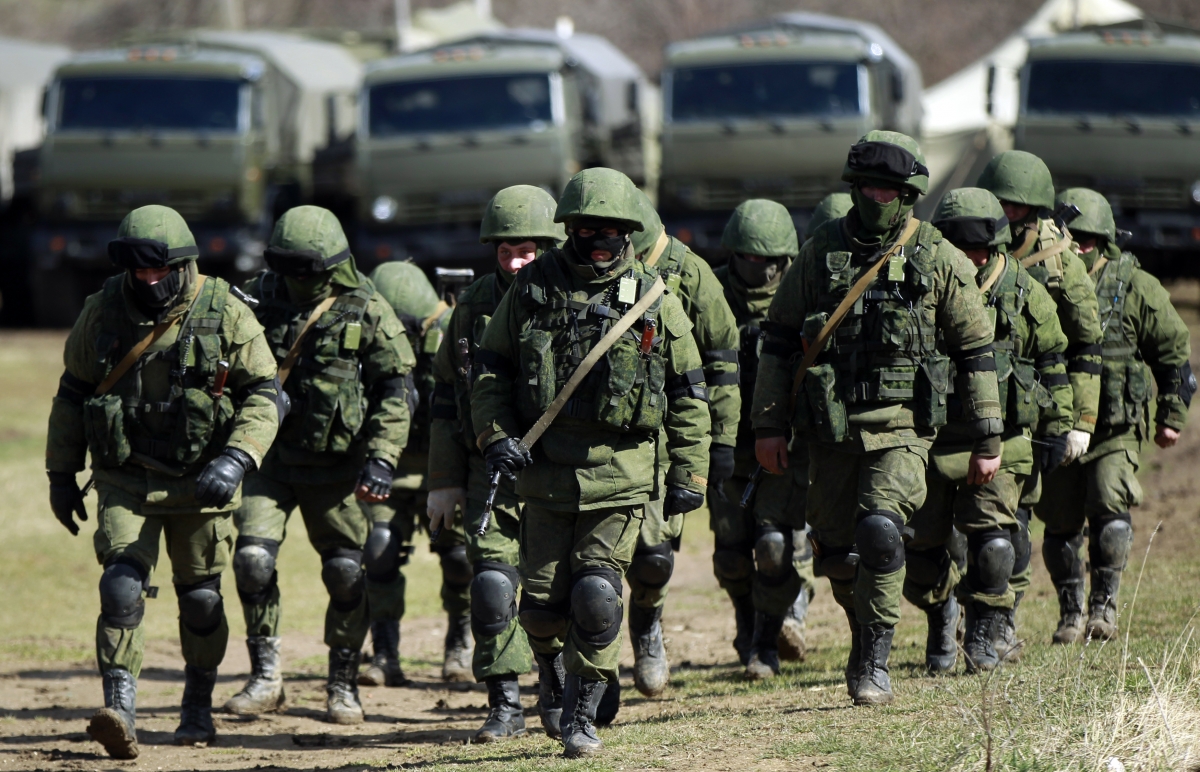
So-called "little green men" (the Russian occupation troops comprised special forces who removed insignia, wear face masks to prevent identification and call themselves a "Crimean self-defense force") surround a Ukrainian military base in Perevalne, Crimea, during the Russian annexation of the peninsula in February-March 2014.
There were more defaults only in 2009. At the time, amid the fallout from the global financial crisis, more than 100 issuers faced payment problems, while the volume of distressed debt reached nearly 200 billion rubles, Zholobov noted.
High interest rates put pressure on companies
This time, the main reason for companies' difficulties in making bond payments has been the prolonged period of high interest rates, which has continued since 2023. Companies are raising financing at high interest rates but are unable to refinance their debt on more favorable terms, explained Ekaterina Sidorova, head of the Foreign Exchange, Commodities and Debt Markets Department at SberCIB Investment Research.
At the same time, the situation does not yet resemble a systemic debt crisis: defaults are primarily being recorded among companies with low credit ratings and high debt burdens, Sidorova said.
If a company fails to repay bond debt, it is given 10 business days to meet its obligations. If it fails to do so, the company may offer investors a restructuring—for example, by postponing payments in exchange for a higher interest rate.
The number of defaults will remain high in 2027, Sidorova believes.
High interest rates were a response to accelerating inflation in Russia. Domestic demand was outpacing production, Russia's Central Bank said in October 2023. Sanctions over the war and rising defense spending had also hit the economy and the ruble, which had lost about 25% against the dollar that year. The bank raised its key rate from 7.5% in the first half of 2023 to 15% by the fall.
Ukraine targets Russia's oil industry to weaken its war economy
Ukraine is also seeking to weaken Russia's economy as part of efforts to reduce its ability to finance the war. In particular, Defense Minister Yevhenii Khmara said strikes on oil refineries are aimed at "bleeding the Russian war machine" and destroying its military and economic potential. According to the ministry, the attacks have knocked out more than 51% of Russia's oil refining capacity.
In the first half of July, Russian oil refineries processed about 3.9 million barrels of oil per day—the lowest level since March 2005. Due to the production cuts, Moscow was also forced to restrict fuel exports.
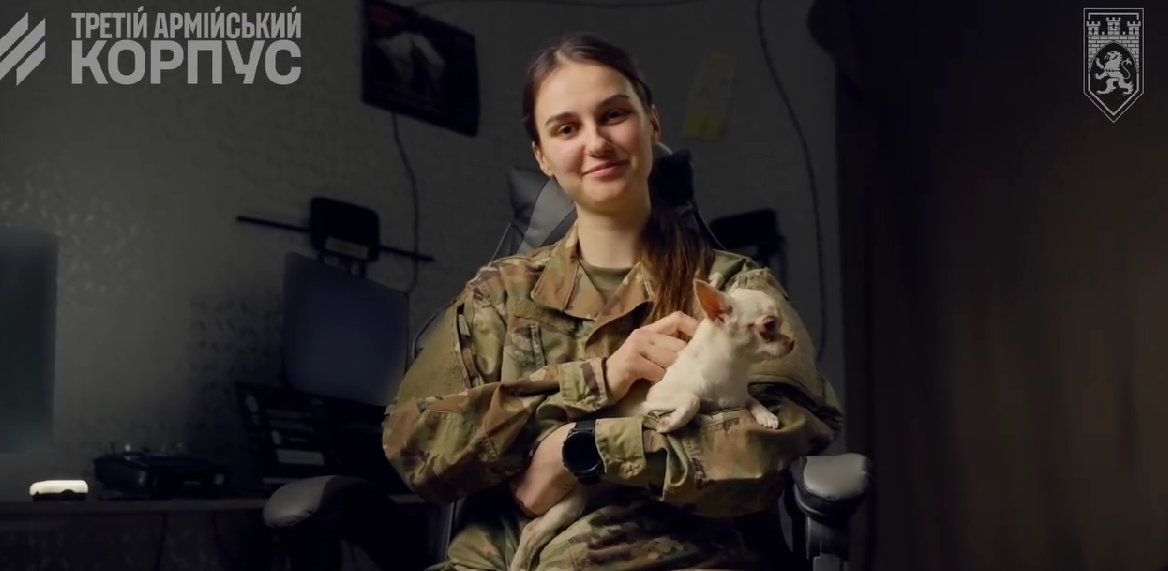
Natalia is 25 years old and from Odesa. She has served in two armies—the Israeli and Ukrainian militaries. In the Armed Forces of Ukraine, she has, among other things, carried out missions as part of a UAV, FPV drone, and strike-wing crew on the Zaporizhzhia and Kupiansk fronts, NV reported on 5 October.
During the Russo-Ukrainian war, women in Ukraine have the right to voluntarily enlist in the military. As of March, more than 75,000 women were serving in the armed forces, more than 55,000 of them as service members, the commander-in-chief said, and their number has been growing every year. Recently, discussion around the mandatory mobilization of women has intensified. Keith Kellogg, former US Special Presidential Envoy for Ukraine under President Donald Trump, said that he considered mobilizing women in Ukraine appropriate. In response, Iryna Vereshchuk, Deputy Head of the Office of the President of Ukraine, said she would rather see more missiles and more will from the United States than advice to mobilize women.
In Israel, Natalia served in a search-and-rescue brigade as a rescue soldier and in the engineering corps during a deployment along the northern border.
Natalia was born in Russia’s Saint Petersburg but does not remember her life there
The young woman was born in St. Petersburg, where her family lived at the time. When she was a year and a half old, her mother returned to Odesa with her and her older son. Natalia says she remembers her life exclusively in Ukraine.
She spent the first nearly two years studying at Lviv University, but later decided to leave the university and look for other educational opportunities. Natalia studied, among other places, in Denmark through a scholarship program. After completing it, she planned to enroll at a European university to study sound engineering, but the coronavirus pandemic began at that time.
She moved to Israel under a program for Jewish youth at the end of 2020. After the program ended, due to quarantine restrictions and closed airports, Natalia faced a choice: obtain a work visa or acquire citizenship under the Law of Return. She chose the latter—and with it, she also became obligated to perform military service.
In May 2022, Natalia joined the Israeli military and chose a combat unit.
“When the war started in Israel itself, I still had six months of mandatory service left. I was discharged and immediately transferred to reserve service. Once I managed to resolve all the bureaucratic issues so that this would not be considered desertion, I returned to Ukraine,” the young woman says.
Natalia returned to Ukraine in March 2025, and in August signed a contract with the Armed Forces of Ukraine.
Natalia (right) and her fellow servicewoman. Photo courtesy of Natalia/NV
“The army—both Israeli and Ukrainian—gives you a deeper understanding of what society is made of”
Among the advantages of the Ukrainian army, she highlights its ability to quickly adapt to circumstances. In particular, she mentions the use of drones, OSINT, and solving complex technological tasks with minimal resources.
“The West could learn from this situational agility. They often spend huge budgets on developments that should be cheap and mass-produced,” the veteran says.
However, such Ukrainian ingenuity is largely a consequence of a lack of funding, Natalia notes.
In the Israeli military, Natalia highlights society’s readiness for the constant threat of war and more systematic planning of military service.
“There, preparation for and perception of the army begin at school: by the age of 14–15, teenagers already understand where they want to go, what skills they need, and undergo selection for special or intelligence units,” the young woman says.
She then gives the opposite example of the situation in Ukraine.
Explore further
This Ukrainian female soldier flies one of war’s heaviest drones. She turns down promotion twice to keep doing it
“In Ukraine, with very rare exceptions, people hide until they are mobilized, and suddenly face the reality of conscription without having any understanding of the system,” the veteran says.
Asked how adapted the Ukrainian army is to women, she answered: “In no way,” adding that the Israeli army is “also largely not fully adapted.”
In Ukraine, this is reflected, in particular, in the provision of clothing and equipment that often does not correspond to women’s sizes and physiology. She says she had to purchase her own anatomically fitted body armor. She cited the example of veteran Natalia Lishchyshyna, who had her breasts amputated due to prolonged wearing of body armor that was not adapted to the female anatomy.
In Israel, by contrast, there is a practice of reimbursing expenses for equipment that service members purchase at their own expense.
Serving in the military in both countries provides an opportunity to better understand what society is actually made of, the young woman says.
“The army—both Israeli and Ukrainian—gives you a deeper understanding of what society is made of. You encounter people you would never have crossed paths with in your civilian bubble because of differences in views or socioeconomic circumstances,” Natalia says.
She believes this makes it easier to accept mistakes, difficulties, and new challenges.
The Ukrainian army is not adapted to women in any way, Natalia says
In Natalia’s view, the problem is not only the living and working conditions but, above all, the lack of mechanisms necessary for the systematic mandatory mobilization of women. At the same time, she believes voluntary recruitment should be encouraged and expanded.
One of the problems is the lack of a legal procedure for temporary childcare in cases when both parents are simultaneously carrying out combat missions, Natalia says, stressing that she means the period of their service, rather than situations involving the death of one of the parents.
Another shortcoming is insufficient protection against sexual violence and harassment in the Ukrainian military.
“Here, any complaint goes through the direct chain of command. If the commander is not interested in resolving the problem or is involved in it themselves, the woman is left defenseless,” the veteran says.
In Israel, by contrast, there is a separate hotline and mechanisms for documenting such cases without directly approaching a commander.
Natalia (second from left) during her service in the Israeli army. Photo courtesy of Natalia/NV
Women in combat positions can also still be taken insufficiently seriously, denied participation in combat missions, or transferred to staff positions without their consent.
Natalia also emphasizes the lack of systematic military training for civilian women “at any level” and gives school education as an example.
“Even with the weak level of the school curriculum for the subject ‘Defense of Ukraine,’ boys had at least some basic knowledge. Girls were not involved in it at all,” the veteran says.
For now, Natalia believes that women’s military service should remain voluntary, as society as a whole is still not ready to fully accept women in the military.
Russia attacked Kyiv and 12 oblasts overnight on 7 October with about 70 missiles, many of them ballistic, as well as Shahed drones, President Volodymyr Zelenskyy said. The strikes killed at least 20 people, with the deadliest hit on an apartment block in Pryluky in Chernihiv Oblast. Russia also hit Kremenchuk, Oleksandriia, Dnipro, and Zaporizhzhia, while Poland scrambled its jets.
Moscow has likely begun its winter strike campaign earlier than usual, aiming to make civilian life in Ukraine unbearable, and UN figures already show civilian casualties running 55% above last year's.
Update: Pryluky death toll rises to 14, including four children
The death toll from the Russian strike on Pryluky has risen to 14, including four children, Ukraine's State Emergency Service said on the afternoon of 7 October. Fifty people were injured, seven of them children, and rescuers pulled 15 people from the rubble, including a child.
Russia attacked Pryluky with cruise missiles, and one scored a direct hit on the five-story apartment building, Chernihiv Oblast head Viacheslav Chaus said. Earlier in the day, he reported that 27 of the injured had been hospitalized, three in serious condition. The search-and-rescue operation was still under way.
Morning repoting: five dead in Pryluky
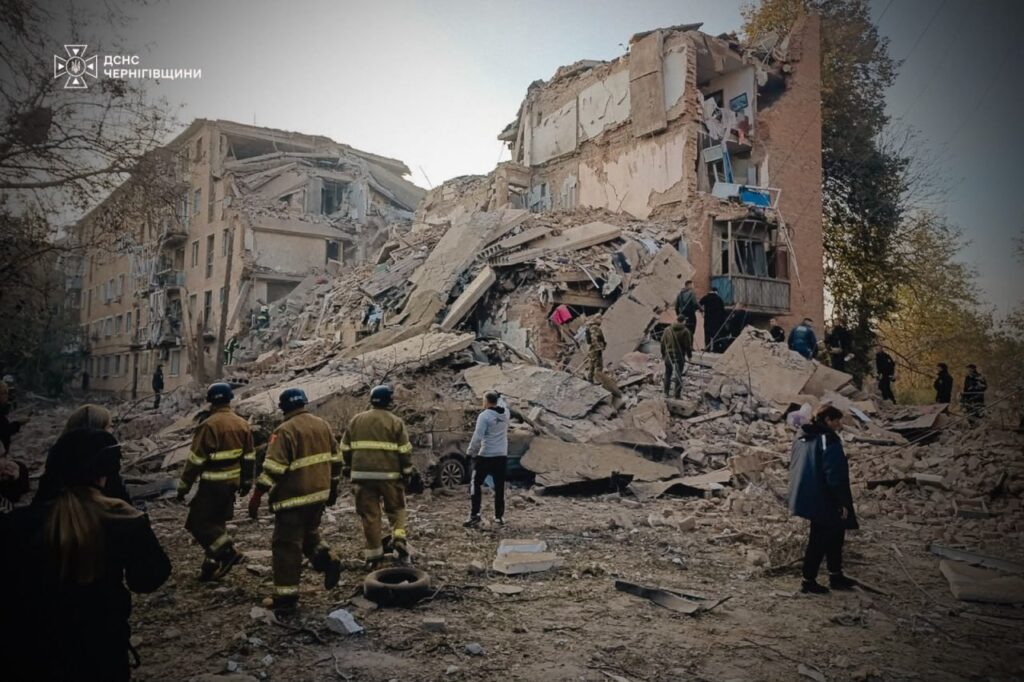
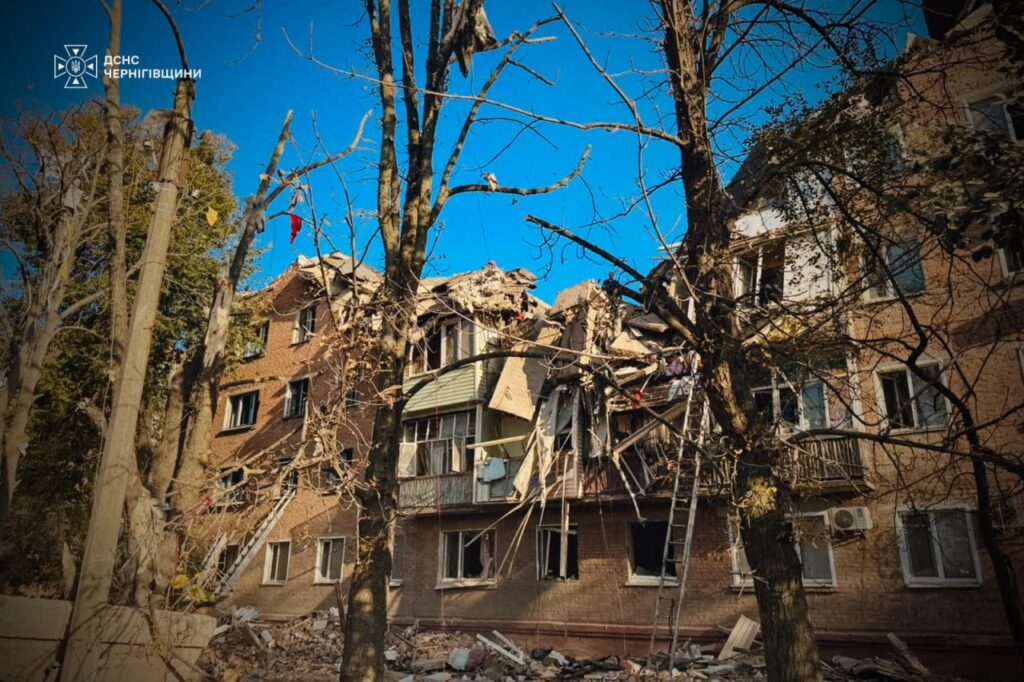
A Russian missile struck a five-story apartment building in Pryluky early in the morning, while residents were still asleep, Chernihiv Oblast head Viacheslav Chaus said. The strike completely destroyed one sectkion of the building, killing five people and injuring 26, including five children, Ukraine's National Police reported. Rescuers pulled three people from the rubble, including a child, and more people may still be trapped, Chaus said.
"Today, for Putin's birthday, the Russian army 'gave' him the destruction of an apartment building in Pryluky in Chernihiv Oblast. It was an ordinary five-story building," Zelenskyy said.
A five-story apartment building in Pryluky, Chernihiv Oblast, damaged by a Russian missile strike, 7 October 2026. Photo: State Emergency Service of Ukraine in Chernihiv Oblast
Kyiv, Kremenchuk, and Oleksandriia
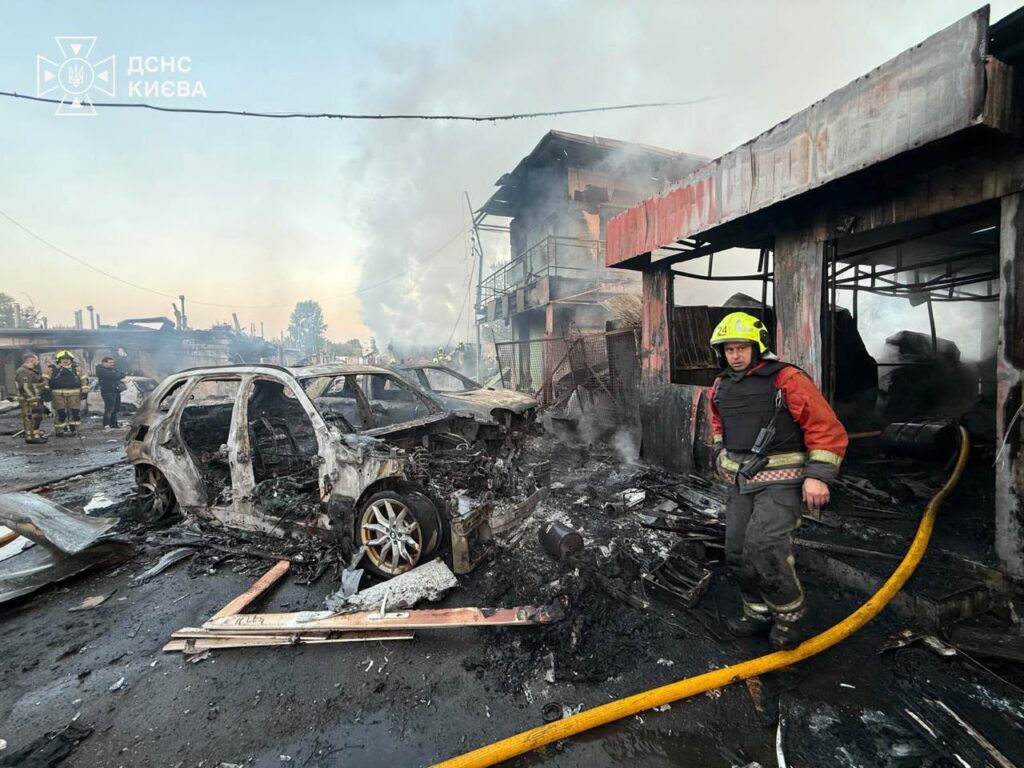
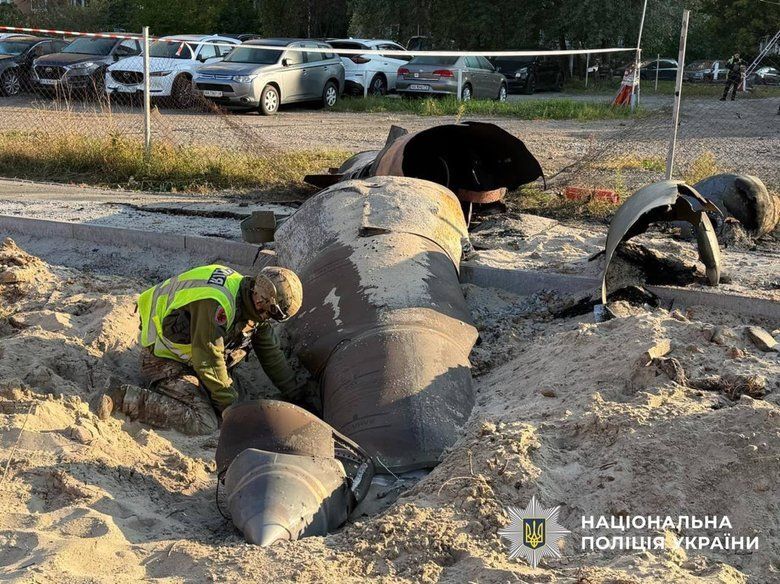
In Kyiv, Russian missiles hit non-residential buildings and warehouses in the Obolonskyi and Podilskyi districts, Mayor Vitali Klitschko said. Strikes also hit the Shevchenkivskyi district, and debris burned in the Darnytskyi district, he added. In the Darnytskyi district, a missile set fire to a garage cooperative, where firefighters rescued two people and found two men dead, Klitschko wrote. Police and rescuers worked to defuse an unexploded ballistic missile that fell among apartment blocks in the same district, the National Police said.
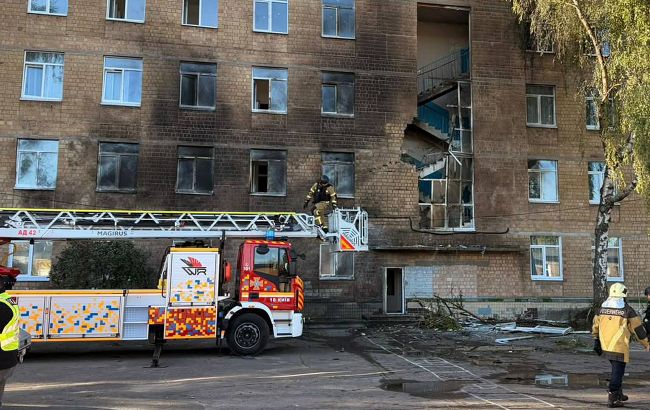
Damaged high-rises and wrecked cars in a residential area of Kremenchuk after a Russian missile strike, 7 October 2026. Photo: Vitalii Diakivnych/Telegram
In Kremenchuk, Russian missiles hit a densely populated residential area, killing two people and injuring seven, Poltava Oblast head Vitalii Diakivnych said. Zelenskyy later put the number of injured at eight and said four high-rises were damaged.
Explore further
A school with children, a café, warehouses: Russia’s drones hit civilian Kyiv again
In Oleksandriia in Kirovohrad Oblast, Russia hit an enterprise. One person was killed, three injured, and two were out of contact, Kirovohrad Oblast head Andrii Raikovych said. Zelenskyy later put the death toll there at two.
A firefighter among burned cars at the site of a fire after a Russian missile attack on Kyiv, 7 October 2026. Photo: State Emergency Service of Ukraine in Kyiv
Drones and other targets
In Dnipro, Russian strikes damaged an industrial enterprise, apartment buildings, and a sports club, Dnipropetrovsk Oblast head Oleksandr Hanzha said. In Nikopol district, the attacks injured a 65-year-old woman and a 64-year-old man. Russia also struck Lozova in Kharkiv Oblast with a missile, and a drone hit an apartment building in Zaporizhzhia, police said.
In Zaporizhzhia, Russia attacked a transport infrastructure facility, acting oblast head Mykhailo Semikin said, a day after a strike on one of the city's bridges over the Dnipro halted traffic. In Kyiv Oblast, three production and warehouse buildings were damaged in Obukhiv district, with no casualties, the Kyiv Oblast Military Administration said.
A bomb technician works beside an unexploded Russian ballistic missile among residential buildings in Kyiv's Darnytskyi district, 7 October 2026. Photo: National Police of Ukraine
Air defense downed five ballistic missiles, 39 cruise missiles, and 117 drones, while missiles and drones hit 18 locations, the Air Force said. Polish military aircraft took off and Poland put its ground-based air defense on alert during the attack, Poland's Operational Command said.
Russian ballistic missiles remain the biggest challenge, Zelenskyy said, adding that Ukraine is searching daily for Patriot missiles.
Strikes across the front over the past day
Russian attacks killed one person and injured 11 in Kherson Oblast over the past day, the Kherson Oblast Military Administration reported. Russia injured 12 people in Donetsk Oblast on 6 October, Donetsk Oblast head Vadym Filashkin said. Two people were injured in Kharkiv Oblast, Kharkiv Oblast head Oleh Syniehubov said.
Bridges and a maternity hospital in Russia's sights
Russia has stepped up strikes on Kyiv's bridges and has now extended them to Zaporizhzhia. In September, a Russian ballistic and hypersonic missile attack on Kyiv damaged a maternity hospital.
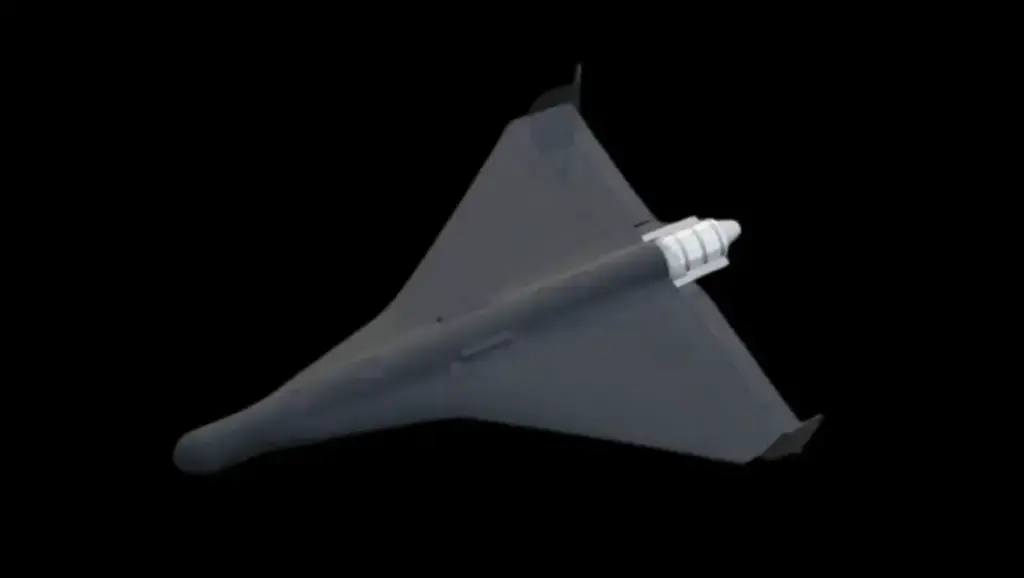
Ukraine has found the US component in a Russian jet-powered drone targeting civilians, supermarkets, medical warehouses, and bridges. According to its Defense Intelligence, the new weapon contains a PNI5GA magneto-inductive sensor made by the US company PNI Sensor.
The US-made navigation component adds to evidence that Western technology continues to appear in Russia's strike drones. HUR had already identified US-made chips in the Geran-4 in May, but the newly reported PNI5GA is a navigation sensor in a modified version of the drone that Institute for the Study of War (ISW) says Russia may seek to field ahead of winter.
A Russian engine replaces the Chinese one
Russia has also replaced the drone's Chinese-made Telefly turbojet engine with a Russian-made equivalent produced in Alabuga. Russia is using the Alabuga zone to bring more of its drone production home rather than importing Iranian or Chinese parts, according to the ISW.
"The remaining electronic units and components are unchanged and identical to those used in previous Geran UAVs," HUR said.
What the warhead is built to cut
The modified drone also carries a specialized KRSN warhead designed to cut through bridge structures and power-line supports. Presidential adviser Serhii Beskrestnov described the warhead on 30 September, saying it consists of a 40-kilogram main charge and four strike modules. Its warhead is meant to destroy hardened targets made of steel and concrete and to damage cable-stayed bridges.
Russia has stepped up strikes on Kyiv's Northern and Southern bridges across the Dnipro in recent days with such drones.
However, Russia may try to field more resilient and more dangerous versions of its strike drones before Ukraine has effective countermeasures in place. Russia could use them to degrade Ukraine's energy infrastructure and logistics ahead of a winter strike campaign that it said will very likely be brutal.

 Login