For months, MAGA Republicans in the House Ways and Means Committee have been targeting BreakThrough News for our editorial judgment and viewpoints they don’t like. The Committee is abusing their powers in a blatant attempt to shut us down. Now, they’ve taken things to another level.
We just received a new letter from Committee Chairman Jason Smith (R-MO). The letter lists the names of our reporters and editors and threatens to individually subpoena each of them to a deposition in Washington if we don’t yield our legal rights, including First Amendment privileges.
Because we’ve held strong in defense of our First Amendment rights, they are now going after our journalists: Rania Khalek, Zoe Alexandra, and Amanda Yee have all been personally named, along with other staff.
We are making an urgent appeal for your support. Stand with us and fight back against Trump’s repression of the press by taking the following steps:
Sign the petition telling the House Ways and Means Committee to stop its attempts to intimidate our journalists. This is a clear abuse of power and an attack on the press that we all need to resist.
Rania Khalek, Zoe Alexandra, Amanda Yee, and the BT staff work around the clock to do critical reporting on the entire world: from West Asia to Africa, across the Americas and Asia. Yet Rep. Smith now wants to drag our reporters to Washington, D.C.
These MAGA politicians, using an old playbook, say anyone challenging their warmongering policies is a “foreign agent” of China. But that’s a lie. Many of their biggest billionaire donors do extensive business in foreign countries, including China. What they’re really trying to do is discredit and destroy anyone that tells the truth to the U.S. public about Trump’s domestic and foreign policies.
BT is an independent news organization, which receives no editorial direction from any outside force. All major donations have come from U.S. organizations, using U.S. financial institutions, and complying with all U.S. laws. We’re audited and file a complete tax return to the IRS every year, just like everyone else.
So what’s this really about? It’s intimidation of the press, pure and simple. MAGA has made it a sport to target critical reporters just for doing their jobs. But unlike huge media outlets like the New York Times or CNN, we aren’t a billion-dollar company with an army of lawyers. We’re relying on grassroots support, and people of conscience who care about free speech, to come to our defense so we can stand strong.
Our lawyers already provided a comprehensive reply to the House Committee in August, pointing out the serious legal flaws in their demands and failures to provide a valid legislative purpose. And like before, Rep. Smith has come back with a new letter with a new legal rationale for the continued harassment. The fact that his explanation keeps shifting shows that the real goal is to target us, and that there is no legitimate legislative purpose. While his Congressional district in Missouri has one of the highest poverty rates in the country, this is how he’s spending his time and taxpayers’ money.
The pressure from the House Ways and Means Committee is escalating. We are a small organization now taking on the power of the federal government and, while they are wrong, we have to take it seriously. We need you to help circulate this alert far and wide, to sign the petition in our defense if you haven’t already, and to make a donation to protect our outlet and the future of independent media.
We will keep all of you posted as we enter this next stage of the fight.
After 321 days at sea, the USS Abraham Lincoln aircraft carrier (CVN-72) returned to San Diego, with its island superstructure showing rows of silhouettes of ships, drones, and other targets reportedly destroyed during Operation Epic Fury.
The USS Lincoln arrived at Naval Air Station North Island in San Diego on October 8, concluding a long deployment that included extended operations in the Middle East.
Before the USS Abraham Lincoln arrived in San Diego, the US Secretary of War Pete Hegseth presented the carrier crew with the Presidential Unit Citation, the military’s highest unit-level award for valor.
Calling the mission “historic,” Hegseth noted that the carrier conducted “3,693 combat flights, sinking 64 Iranian warships, launching 450 Tomahawk land attack cruise missiles, and shooting down 77 one-way aerial attack drones.”
Acting Secretary of the Navy Hung Cao lauded the carrier crew in a post on X, saying, “Congratulations to @CNV_72 and all of CSG-3 on this well-earned Presidential Unit Citation for their extreme heroism over the last 10 months in defense of our homeland.”
The citation says the defense included 40 days in combat and an “ironclad maritime blockade against Iran in support of Operation Epic Fury.”
During Hegseth’s recent visit to the carrier before it arrived home, he said, “I’m the only thing standing between you and home,” and that his intention was, “Once they pull up to the dock, we’re getting out of the way.”
The Pentagon released an image of Pete Hegseth standing on the deck of the carrier and examining the superstructure, which was stenciled with a list of targets the USS Abraham Lincoln Carrier Strike Group (CSG) destroyed during a 321-day deployment.
Subsequently, Hegseth published another image showing the full extent of the markings, with “Operation Epic Fury” written above rows of ship and drone silhouettes (seen below).
File: USS Abraham Lincoln (CVN 72) aircraft carrier arrived at San Diego featuring kill markings
The carrier’s arrival with these markings aligns with the US Navy’s long-standing practice of recording unit or group combat results after major operations.
Observers counted approximately 174 markings on the island superstructure. These traditional victory symbols are attributed to Carrier Strike Group 3’s collective actions, including carrier air-wing sorties, destroyer operations, Tomahawk launches, and air-defense engagements.
What Targets Did The Lincoln CSG Neutralize?
The visible markings include silhouettes representing 23 anti-ship missiles, 34 surface ships, 122 unmanned aerial vehicles, 10 submarines, and what appears to be a large bomb marked “1403.”
The aircraft carrier features 34 kill marks of surface ships neutralized in the sixth month of the conflict in the region. Although official information is scarce, these targets could include warships, corvettes, and even unmanned surface vessels used by the Islamic Revolutionary Guard Corps (IRGC).
The US Central Command (CENTCOM) publicly confirmed the destruction of several ships. Some high-profile targets include the Shahid Bagheri carrier, the IRIS Makran forward base ship, the Jamaran-class corvettes, and all four Shahid Soleimani-class catamaran missile corvettes.
The US Navy also neutralized multiple Bayandor-class corvettes and other frigates, several fast-attack craft and missile boats, at least 16 mine-laying vessels, and multiple auxiliaries and support vessels.
It is hard to say which of these vessels the Lincoln carrier group neutralized, but reports say the group operated in the Arabian Sea and, at times, closer to the Gulf of Oman during the early phase of Operation Epic Fury.
The group could have struck these targets with Tomahawk cruise missiles launched from escort Arleigh Burke-class destroyers, such as the USS Spruance, USS Michael Murphy, and USS Frank E. Petersen, or with F-35C Lightning IIs and F/A-18E/F Super Hornets from the carrier’s air wing.
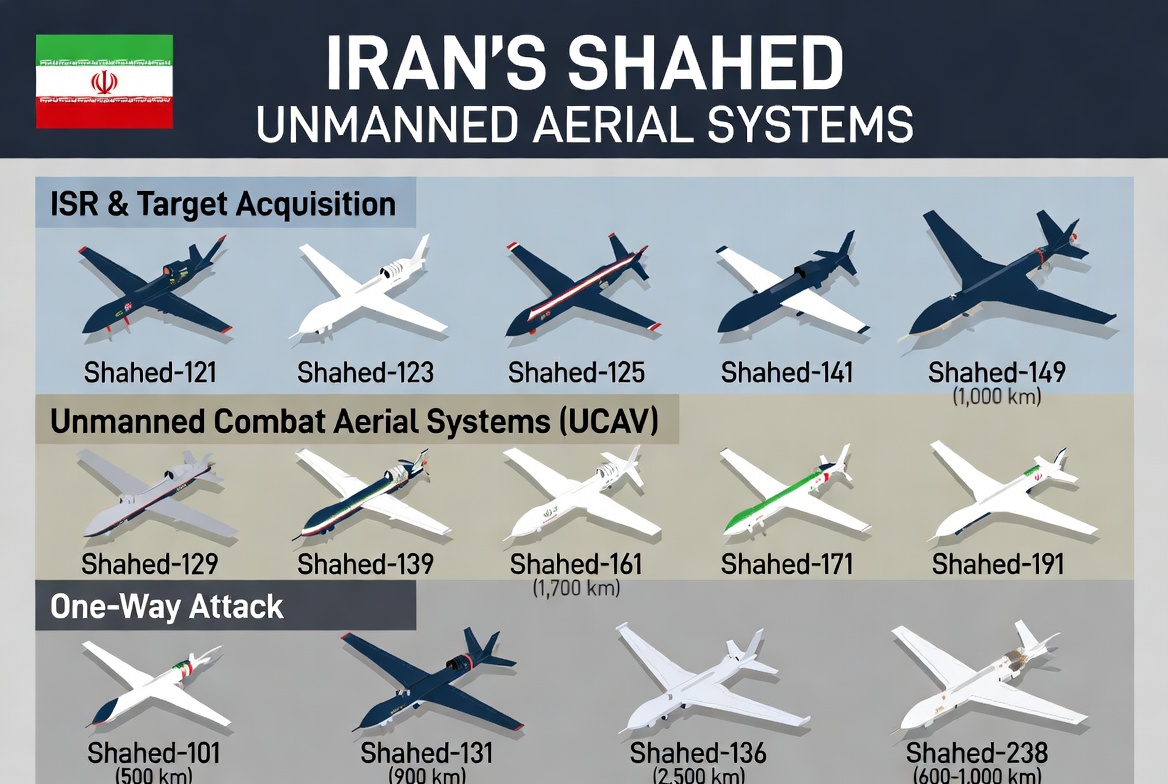
The aircraft carrier features about 100+ triangular silhouettes that resemble the Shahed-136 one-way attack drones that were extensively deployed by the IRGC in its strikes on US military assets. However, they could also potentially reference other similar kamikaze drones, given Tehran’s massive inventory of these low-cost assets.
The escort ships—the Arleigh Burke-class guided-missile destroyers doubling as critical air-defense assets alongside the aircraft carrier-could have downed these drones. These state-of-the-art warships are equipped with the Aegis Combat System to detect, track, and engage drones at medium to long range with Standard Missiles such as the SM-2 or SM-6, and the Evolved Sea Sparrow Missile (ESSM).
The carrier itself has self-defense systems such as the RIM-116 Rolling Airframe Missiles (RAM) and the Phalanx Close-In Weapon System (CIWS). Furthermore, F-35s and Super Hornets operating from the carrier may have shot down some of these incoming drones.
Notably, the island carries 23 missile silhouettes. Hegseth credited the strike group with destroying 21 anti-ship cruise missiles. The citation does not say whether those were stopped by escort ships, by F-35s and Super Hornets, or by the carrier’s own Rolling Airframe Missiles and Phalanx guns.
File: US Secretary of War Pete Hegseth assessing the kill markings on USS Abraham Lincoln aircraft carrier
USS Abraham Lincoln also prominently features 10 submarines, which is unsurprising given that US CENTCOM focused on decimating Iran’s Russian-built Kilo-class and other submarines during the conflict.
For example, a Navy F/A-18F Super Hornet that flew from the USS Abraham Lincoln on combat missions in the Iran war was spotted with submarine kill markings earlier. Jeff Rojas photographed the aircraft, which belongs to VFA-41, a Navy fighter squadron known as the “Black Aces,” on October 1.
How the aircraft destroyed an Iranian submarine is unclear, but Rojas said, “I assume that it was dry-docked and they dropped a laser-guided bomb.”
The US missiles damaged many Iranian submarines, including some produced indigenously, that were docked in ports during early bombardment, but neither the Navy nor CENTCOM has publicly claimed that Navy fighter jets were involved.c
Instead, the US military earlier said it used air-launched AGM-114 Hellfire laser-guided missiles, probably fired from MQ-9 Reaper drones, and ground-launched Army Tactical Missile System (ATACMS) short-range ballistic missiles against submarines in particular.
However, the CSG may have taken out at least some of these submarine targets with Tomahawk missiles.
Most details, including specific individual ship sinkings by Lincoln CSG platforms or the exact methods used, rely on official claims and open-source analysis rather than independent battle-damage assessments available in the public domain.
Interestingly, the number of targets the War Secretary cited in his address differs significantly from the number of kill markings visible on the flattop. Neither the United States Navy nor the Department of War (DoW) has clarified why the flattop bears only 34 surface ship kill marks, even though Hegseth counted 64 in his address, or why the carrier lists 106 drones while Hegseth’s estimate was far more conservative at just 77.
Although these markings are often symbolic or selective rather than a strict, audited one-to-one accounting of every engagement, a reason for the discrepancy is awaited.
A Mission Marred With Chaos
The carrier’s prolonged deployment garnered national attention after Stars and Stripes, the news outlet affiliated with the US Armed Forces, reported on deteriorating conditions aboard the carrier, a major mental health crisis, and worsening living conditions in August 2026.
“Interviews with active-duty sailors and family members, along with dozens of public social media comments and posts by crew members, describe sailors struggling with exhaustion and declining morale, including reports of suicidal thoughts and at least one instance where a crew member was prevented from jumping overboard,” the report underlined.
After this explosive disclosure caused a stir and exposed the Pentagon, War Secretary Pete Hegseth, Acting Navy Secretary Hung Cao, and CENTCOM leadership dismissed much of the coverage as misrepresented or dishonest, while acknowledging challenges of extended deployments. Nonetheless, the report and the public reaction paved the way for the carrier’s return and a stopover in Thailand last month, giving the crew much-needed respite
The Secretary of War also pushed back against the allegations of the Navy being stretched thin and a crisis about the carrier, including reports of eight sailors who attempted suicide. “Lincoln into some sort of a symbol, a symbol of dysfunction or a symbol of low morale or a symbol of a failed mission,” Hegseth said, adding, “what makes the US military and the US. Navy and all these sailors different is that you adapt and that you’re resilient and you overcome — you finish the mission nonetheless.”
That said, aircraft carriers have been instrumental in the Iran War, which has dragged on for months despite periods of lull and negotiations. Two carriers—the USS George Washington and USS George H.W. Bush—are currently deployed in the theatre, with a third, the USS Theodore Roosevelt, expected to arrive later this month amid a spike in tensions.
Contact the author at sakshi.tiwari13 (at) outlook.com
Three years after Israel launched its genocidal aggression on the Gaza strip, massacres and mass destruction continue to take place on a daily basis, despite the US-brokered ceasefire deal that was reached in October 2025.
The nominal truce was preceded by two other short ceasefire agreements. The first was reached in November 2023 and lasted for only one week, while the second was sealed in mid-January 2025 and collapsed two months later.
For three entire years, the world has borne witness to one of the most heinous genocides in modern history, which has resulted in the killing of at least 75,000 Palestinians, according to the latest official health reports, with women, children, and the elderly comprising 56.2% of the death toll. Meanwhile, 82% of Gaza’s structures have been destroyed.
Starvation and the total blockade of aid have also been used as weapons of war against the Palestinian population in the war-ravaged territory.
As soon as it was launched, the US-backed fierce Israeli military campaign expanded beyond Gaza to include other parts of West Asia, including the occupied West Bank, Lebanon, Yemen, and Syria.
About 9,000 people have been killed in Lebanon, more than 1,136 in the West Bank, dozens in Yemen and scores of others in Syria.
The systematic targeting of journalists
The genocide in Gaza has been characterized by the systematic targeting of journalists and media workers, with the death toll reaching more than 260, according to Naser Abu Baker, President of the Palestinian Journalists’ Syndicate (PJS).
Abu Baker told BreakThrough News that over the same period, 550 journalists were wounded, and over 200 were arrested.
“All of this underscores a systematic policy implemented by the Israeli occupation, which primarily aims to prevent the truth about the crimes committed in the Palestinian territories by the Israeli occupation against the Palestinian people from being documented and transmitted, especially in the Gaza Strip,” he emphasized.
The chief of PJS noted that the targeting of Palestinian journalists by the Israeli forces began over one decade before the October 7 attacks.
“PJS documented more than 9000 assaults on journalists in the occupied Palestinian territories between 2012 and 2023. More than 56 journalists were killed during that period, including three foreign journalists,” Abu Baker clarified.
Another silent genocide has been committed against Palestinian detainees in Israeli prisons
Simultaneously with the events in Gaza, the Israel Prison Service escalated a brutal crackdown against the Palestinian Prisoners’ Movement, intensifying a campaign that began in early 2023.
While around 5,200 Palestinian political prisoners were held in Israeli detention prior to October 7, 2023, the number jumped to 9,600 after the outbreak of the Israeli genocidal aggression on Gaza. Many of those prisoners have been placed under administrative detention without charge.
These latest figures only represent the prisoners whose whereabouts inside Israeli detention centers were documented by Palestinian prisoners groups. Thousands of additional Palestinians remain unaccounted for and are believed to have faced enforced disappearance amid the ongoing Israeli military operations in Gaza.
During the past three years, Palestinian prisoners have endured miserable detention conditions, including medical neglect, deprivation of adequate food and hygiene supplies, as well as physical and psychological torture.
This horrific situation culminated with the endorsement of an Israeli law mandating the execution of Palestinian prisoners by hanging.
On the third anniversary of October 7, Raed Abu al-Hummus, head of the Palestinian Commission of Detainees and Ex-Detainees Affairs, delivered a message to international human rights organizations via BreakThrough News.
“I call on international human rights organizations to practice their stated objectives, to truthfully convey our message, and to form a parallel front to our heroic prisoners’ front inside the prisons, in an attempt to protect them from these violations, from this far-right monster seeking to slowly kill them,” Abu al-Hummus stated, referring to Israel’s Minister of National Security Itamar Ben-Gvir.
It’s not about the Israeli far-right; it’s about the entire Zionist movement, says Omar Assaf
While some media outlets and political analysts suggest that Israel’s intensified atrocities in recent years represent the policy of the far-right wing solely, the Palestinian grassroots believe that they constitute the very core of the Zionist movement.
Palestinian political activist, freedom fighter and former prisoner in Israeli jails Omar Assaf argued that “the genocide does not reflect a policy of an individual or a current within the Israeli government. It rather reflects a general policy, because the Zionist movement as a whole was founded on the exclusion of the Palestinian people, expelling them, and looting their land.”
“Therefore, if this far-right government is practicing genocide, this does not mean that the next government will be a government of peace,” Assaf asserted.
Despite three years of unspeakable atrocities and over 78 years of military occupation amid the total silence and inaction of the international community, the Palestinian people remain steadfast and resilient in their homeland, refusing to leave or surrender.
Washington has extended its sanctions campaign against the International Criminal Court to the institution itself, threatening its banking arrangements, technology services and commercial contracts. Secretary of State Marco Rubio has warned European allies that the United States will seek to dismantle the tribunal unless its activities are curtailed.
The administration of US President Donald Trump imposed comprehensive sanctions on the International Criminal Court (ICC) on Friday, 9th October, extending Washington’s campaign against individual judges and prosecutors to the financial and operational infrastructure of the Hague-based tribunal.
The measures prohibit transactions with the ICC under American jurisdiction and potentially expose companies providing services to the institution to US penalties. Banks, insurers and technology suppliers could face restrictions, threatening the court’s ability to maintain essential operations.
In a statement announcing the measures, US Secretary of State Marco Rubio declared that Washington intended to deprive the tribunal of resources unless it abandoned proceedings that the administration considers an infringement of American sovereignty.
“Either the ICC will end its threats, or we will end the ICC,” Rubio said.
He also directed an explicit warning towards Washington’s European allies, many of which are parties to the ICC’s founding Rome Statute while relying on American military capabilities for their defence.
The administration expects those governments to restrain the court, Rubio said, linking their security dependence on the United States to Washington’s demands concerning international criminal justice.
The latest sanctions apply to the institution itself, extending their potential consequences to organisations and businesses maintaining commercial relationships with the court.
The US Treasury has issued four general licences allowing certain transactions involving telecommunications, software, pensions and ICC detainees. The exemptions are limited and leave broader restrictions in place.
The administration has also provided a period for American companies to wind down existing commercial arrangements.
The practical consequences could extend beyond US businesses. International banks and service providers with exposure to American financial markets may reconsider their relationships with the ICC to avoid sanctions risks.
The tribunal has spent months preparing for such restrictions. It has moved office computers away from Microsoft products towards open-source alternatives and established new arrangements for banking and health insurance.
Rubio’s warning to American allies introduces a direct confrontation with European governments that have undertaken treaty obligations to support the ICC.
All 27 EU member states are parties to the Rome Statute. Within NATO, only the United States and Turkey remain outside the court’s membership.
Washington’s demand that allied governments restrain the tribunal places those countries under pressure to reconcile their commitments to international criminal justice with their defence relationships with the United States.
The ICC’s registrar, Osvaldo Zavala Giler, has urged the European Union to consider activating its blocking legislation, designed to protect European operators against the extraterritorial application of certain foreign sanctions.
Such action would require political decisions in Brussels and would not automatically eliminate the commercial risks associated with American restrictions.
Rubio said the sanctions had been structured to allow member states to negotiate a settlement addressing Washington’s objections. He warned that further measures could follow if those negotiations failed.
ICC rejects attempts to interfere with proceedings
Deputy Prosecutor Nazhat Shameem Khan condemned the sanctions and insisted that the court would continue its work.
In her response to the American announcement, Khan described the measures as an attempt to undermine international law and the independence of the judiciary.
She said the court would continue its investigations and prosecutions across all active cases.
Washington’s confrontation with the ICC has intensified since the tribunal issued arrest warrants in November 2024 for Israeli Prime Minister Benjamin Netanyahu and former defence minister Yoav Gallant over alleged crimes committed during the Gaza conflict.
The United States has also opposed investigations involving American military personnel in Afghanistan.
Although neither Washington nor Israel recognises the court’s jurisdiction, the Rome Statute permits the ICC to exercise jurisdiction over certain crimes committed on the territory of member states, irrespective of the nationality of the suspects.
The same jurisdictional principle underpins proceedings against Russian officials over alleged crimes committed in Ukraine.
The ICC issued an arrest warrant for Russian President Vladimir Putin in March 2023 over the alleged unlawful deportation and transfer of Ukrainian children.
Russia pursues ICC officials as Washington imposes sanctions
Friday’s announcement follows a separate escalation in Moscow’s campaign against the tribunal.
As EU Today reported on 9th October, Russian prosecutors have demanded that the Netherlands extradite ICC President Tomoko Akane and eight other current and former court officials.
The requests follow their convictions in absentia by a Moscow court in December 2025 for their involvement in proceedings against Russian officials.
The Netherlands, which hosts the ICC, is not expected to comply with Moscow’s demands.
The Russian and American measures arise from different disputes, but both seek to exert pressure on the tribunal over judicial proceedings involving their respective governments or allies.
The ICC’s earlier condemnation of American sanctions warned that targeting judicial personnel threatened the court’s independence and obstructed access to justice for victims of international crimes.
Sanctions coincide with Nobel Peace Prize announcement
The American measures were announced hours after South African jurist Navi Pillay, a former ICC appeals judge, was awarded the 2026 Nobel Peace Prize for her contribution to international criminal justice.
Pillay served on the ICC’s Appeals Chamber between 2003 and 2008. The Nobel committee drew attention to political attacks against international judicial institutions in explaining its decision.
The timing was coincidental, with the American sanctions having been prepared before Friday’s award.
The ICC currently has 125 member states and an annual budget of approximately €196 million. Its investigations encompass alleged crimes in Ukraine, the Palestinian territories, Sudan, the Democratic Republic of Congo and several other jurisdictions.
The new sanctions could significantly restrict the court’s access to the financial and commercial services on which those investigations depend.
For the European Union, the immediate question is whether its governments will provide practical protection to an institution whose independence they have repeatedly pledged to defend.
Washington has made clear that it expects the opposite: European allies should use their influence to curtail the court’s activities or face further American measures.
France and Germany have rejected reports that their Main Ground Combat System (MGCS) project has collapsed, asserting their joint program to develop a next-generation battle tank remains on track.
On Thursday, France’s armed forces chief Fabien Mandon told parliament that Germany had decided to leave the battle tank program.
On Friday, French Defense Minister Catherine Vautrin said the MGCS project was still on course, speaking during German President Frank-Walter Steinmeier’s visit to the country.
“We would like to tell you, together with my colleague Minister Boris Pistorius, that MGCS remains a current and active project,” Vautrin said alongside the German defense minister in Le Haillan outside the southwestern French city of Bordeaux.
Pistorius said that he “fully” agreed.
“The MGCS project is not finished. It has not been abandoned. Nobody has stopped it. On the contrary, it is a flagship project of Franco-German cooperation.”
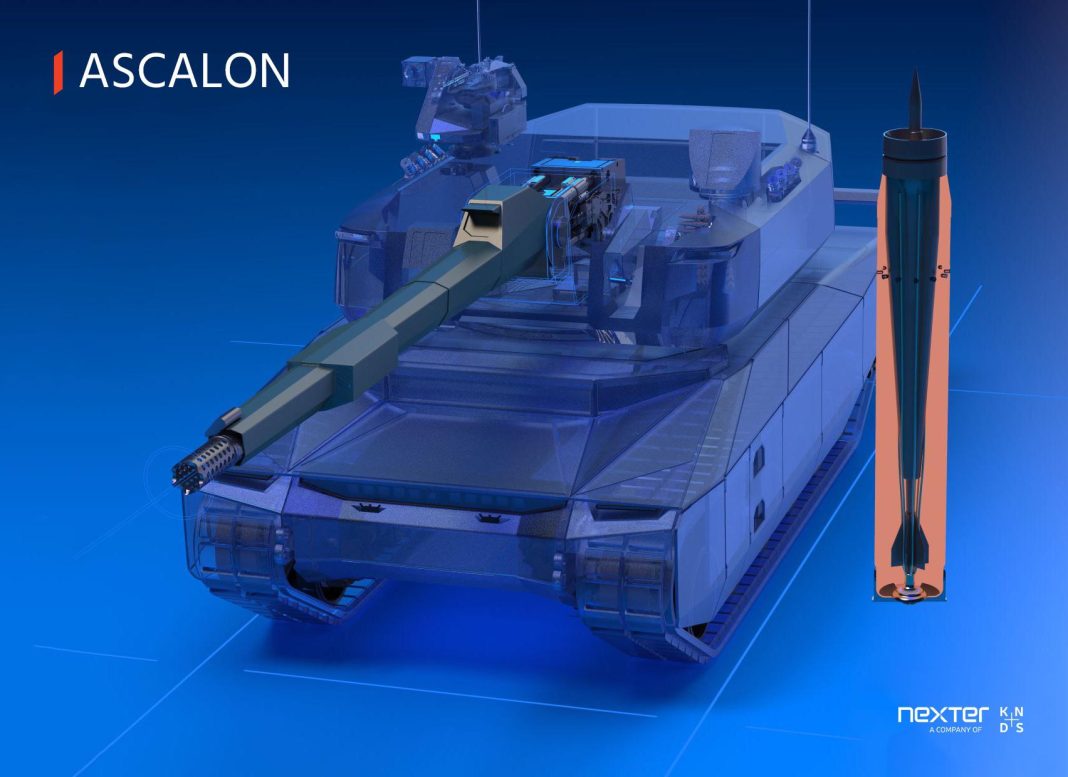
The 140 mm smoothbore ASCALON gun fires 130 cm telescoped rounds and is designed for scalable effects. Nexter is proposing the ASCALON as the MGCS main armament. (Photo: Nexter)
On Thursday, Mandon told French lawmakers the two armies had spent several years “to define what a future battle tank should be”. “The outcome is not good,” Mandon told lawmakers.
“We had hoped to build a future tank in cooperation with the Germans, but unfortunately we have to acknowledge that the Germans have decided to leave the project.”
Later on Thursday, he issued a statement softening his remarks, saying: “Although delayed, the program is continuing and remains highly relevant.”
Main Ground Combat System (MGCS)
Launched jointly by France and Germany in 2017, the Main Ground Combat System (MGCS) aims to develop a next-generation battle tank to replace France’s Leclerc and Germany’s Leopard 2 tanks.
It is a “system of systems” project that includes a main battle tank and a network of other combat systems, such as artificial intelligence (AI) for decision-making, advanced sensors, robotics, and onboard unmanned aerial vehicles.
Earlier this June, Rheinmetall’s CEO warned that France may pull out of the MGCS project. “There is always a risk, but nothing has been decided yet,” Armin Papperger told Welt am Sonntag, adding that Paris is planning to drastically cut funding for the project.
A German government spokesperson later questioned the MGCS project, saying it was doubtful a joint tank would be built and that the project would likely focus on “platform-independent” technologies.
Concept artwork showing four different MGCS vehicles based on a common chassis. (Via Hensoldt)
Meanwhile, Jean-Paul Alary, CEO of KNDS, the Franco-German company developing the tank, had said at the Eurosatory show in France that, although he could not comment on the MGCS’s current state because it is a political matter, it would be “very bad news” for Europe if the project failed.
The MGCS has remained embroiled in crises and beset by delays, much like the now-abandoned FCAS. Disagreements over the tank’s design, technology, and industrial responsibilities have plagued the MGCS for years.
In short, Berlin wants a stronger, better-armed tank for a potential battle with Russia, while Paris prefers a lighter tank for worldwide deployment. Political and budgetary tensions also persist over which country’s industry should lead.
The project was initially intended to be led by the Franco-German joint venture KNDS, comprising Germany’s Krauss-Maffei Wegmann and France’s Nexter. However, Germany allegedly leveraged its considerable political support to push for Rheinmetall’s involvement. Tensions have since grown between the KNDS and Rheinmetall over leadership of program “pillars,” production shares, and contracts.
From a French perspective, Rheinmetall’s involvement has altered the project’s delicate power dynamics, creating discontent and increasing frustration.
Moreover, the project has reportedly been starved of funding. As Rheinmetall CEO Papperger recently noted, the shareholding companies have received only €25 million ($29 million) since the project’s inception.
Meanwhile, France has grown uneasy with Germany’s increasing assertiveness and its emergence as Europe’s preeminent economic and, increasingly, military player, as veteran journalist Prakash Nanda of EurAsian Times noted.
“They are constantly fighting against the mismatched temperaments of their leaders, their orthogonal domestic politics, and the irreconcilably diverging strategic cultures at the heart of their deep states,” Carnegie Europe’s Strategic Europe wrote in a blog last month.
A core divergence lies in strategic outlook: France consistently advocates for greater European strategic autonomy, while Germany remains more committed to robust transatlantic ties with the United States. Meanwhile, economic and trade policies add another layer of friction, with the two powers often diverging on EU-level decisions regarding fiscal rules, industrial strategy, and market access.
France and Germany have struggled to rein in their powerful defense companies, leaving three major European projects — the Eurodrone, the FCAS fighter program, and the MGCS tank program — in serious difficulty. The FCAS has already collapsed, while the other two now risk failure.
Contact the author (s) at editor (at) eurasiantimes.com
School ceilings keep falling on students’ heads across the country in the last couple of days, where such incidents are being reported on a daily basis. Shortly before classes ended for the weekend, a large piece of plaster fell from the ceiling injuring a 14-year-old student. The boy at Thermi Gymnasium by Thessaloniki was hit […]
Why Document Verification Is Becoming Essential in Ocean Freight For years, freight audit has focused primarily on the numbers. Was the correct rate applied? Was the fuel surcharge calculated properly? Does the accessorial match the...
A powerful explosion at Motor Oil Refinery on Friday morning injured two workers very seriously and another three lighter. The explosion occurred in the premises of the refinery in Agioi Theodoroi in western Attica. According to reports, two men aged 43 and 50, were initially transported to the Corinth General Hospital where they were intubated […]
A newly updated Congressional Research Service (CRS) report counts 81 US military aircraft as lost or damaged in the ongoing conflict with Iran. EurAsian Times analyzes the losses Tehran sustained during the ongoing conflict.
The latest figure is nearly double the 42 aircraft the Congressional Research Service tallied in a May 2026 report, as the EurAsian Times reported at the time.
The jump from 42 to 81 most likely reflects updated reporting and newly available public information.
In addition to the Congress research figures, two other reports published by the Congressional Budget Office and the Pentagon’s inspector general had earlier provided deep insights into the war. The latest CRS report reportedly cited that data.
“As of August 1, 2026, the armed conflict with Iran has cost DoD approximately $38 billion. That amount reflects the costs of replacing expended munitions and equipment lost in battle, increased flying hours, other operations, and increased fuel costs,” the Congressional Budget Office (CBO) stated in the report last month.
Meanwhile, the Pentagon’s IG report estimated the US campaign cost $33.4 billion between February 28 and June 30, with at least $22.3 billion spent on munitions alone.
Citing information published by the CBO, the latest CRS states that the overall cost of the lost aircraft is between $1.9 billion and $3.3 billion, depending on the Pentagon’s replacement costs. However, CNN News was informed by some unidentified sources that the cost of the war is much higher–at least $45 billion–excluding damage to US infrastructure and bases spread across the Gulf, repeatedly struck by Iranian forces.
The revised losses in the Congress report include manned aircraft, helicopters, and drones, though it clarifies that the total is not a count of destroyed aircraft, adding that some damaged aircraft may have returned to active service after repairs.
It lists 12 F-15E jets as destroyed/damaged, up from four F-15E Strike Eagle Fighter jets listed in the May 2026 report. The US lost three F-15E fighters in a friendly-fire incident related to the Kuwait Air Force aircraft, whereas the fourth was downed by Iran using shoulder-mounted air defense systems, as previously noted by the EurAsian Times.
Wreckage of the USAF’s F-15E published by Iranian media after downing the jet in April 2026 (Via X)
Both CBO and IG reports also earlier listed just four F-15E losses. Therefore, the eight F-15Es mentioned in the new report are likely the jets that were damaged in an Iranian strike on the Muwaffaq Salti Air Base in Jordan in September 2026. Citing an unidentified US official, Reuters earlier reported that Iran had struck an A-10 Warthog, leaving it with a missing wing, while eight F-15s sustained light damage and were returned to service.
The latest list also includes the F-35A, the US Air Force’s most prized and expensive stealth fighter. The CBO report had earlier noted that replacing/repairing the aircraft would cost $120 million, without saying whether it would be written off or repaired.
Although some OSINT observers at the time believed this acknowledged the F-35 loss, others warned that the CBO was only recording the repair cost while leaving room for a potential replacement.
Furthermore, the latest list also reiterates the loss of the E-3 Sentry Airborne Warning and Control System (AWACS), which was struck and damaged while on the ground at Prince Sultan Air Base, Saudi Arabia, during an Iranian missile and drone attack.
However, instead of merely reporting the loss, it expressed concern about losing this highly specialized aircraft and the far-reaching effects it could have on the USAF.
“Congress may assess whether losses in certain high-demand platforms that are aging and limited in number, such as the E-3 Sentry, create capability gaps or increase risk in other theaters,” it stated.
A USAF E-3 Sentry damaged in Iran’s strikes
Notably, the US Air Force has only 16 of these critical AWACS remaining in its inventory, and losing each could disproportionately affect American combat posture in the Western Pacific, where the threat of war with China is never off the table.
Another newly listed loss on the updated CRS is the US Navy’s MH-60S Sea Hawk helicopter, which did not appear in the May 2026 list. On July 1, an MH-60S Sea Hawk from a George H.W. Bush aircraft carrier made an emergency landing in the Arabian Sea, although the Navy ruled out hostile action at the time.
Most of the rise since May is attributed to drones. The report now counts 45 MQ-9 Reapers lost, up from 24 in its May report. This is also a considerable increase from the 30 Reaper losses cited in the IG report. Furthermore, a US Army AH-64 Apache that was shot down over the Strait of Hormuz in June 2026 has also found its name on the list.
Notably, the newly published report raises several issues for Congress to address, including whether the Pentagon provides enough detail about the losses for lawmakers to assess the consequences and potential solutions.
CRS notes that the Department of Defense’s reporting on the losses has been limited or vague, especially since even the September 2026 Lead Inspector General report relied in part on earlier CRS open-source tallies rather than providing a fully independent, comprehensive public accounting.
What Did Iran Lose In The War?
Iranian authorities have offered only limited, selective figures on their own military and civilian casualties and have not published a comprehensive accounting of equipment destroyed during Operation Epic Fury launched by the US in coordination with Israel.
Iran has nothing equivalent to the CRS list. Open-source counts already disagree: one tracker puts Iranian aircraft losses above 90 airframes, mostly transports and tankers, while a narrower documented list counts 43.
Open-source trackers have recorded dozens of Iranian aircraft—combat jets, transports, tankers, trainers, and helicopters—destroyed primarily on the ground at air bases early in the campaign, although a few were downed in air.
In the initial days of the war, two Iranian fighters, a Northrop F-5 and a F-4 Phantom II, were destroyed in an Israeli strike at Tabriz Shahid Madani International Airport. Around the same time, the US destroyed two Iranian Sukhoi Su-22 aircraft at Shiraz Shahid Dastgheib Airport, along with two Lockheed C-130 Hercules and an Il-76 transport aircraft.
CENTCOM released footage of the two Su-22s. Satellite imagery was later cited for the two C-130s and the Il-76 at the same airfield. Further Phantom losses have been reported at the 3rd Tactical Air Base in Hamadan, but not documented to the same standard.
A Qatari Air Force Boeing F-15QA shot down two Iranian low-flying Sukhoi Su-24 tactical bombers on March 2, 2026, after they failed to react to radio warnings.
In the second week of March 2026, Israel said it had destroyed multiple IRIAF F-14 Tomcats in a massive air strike on Isfahan Airport, and 16 aircraft used by the IRGC Quds Force at Mehrabad International Airport were also struck. At the time, experts posited that these strikes may have wiped out the entire Tomcat fleet, particularly since some of these jets had already been destroyed in the 12-day war between Israel and Iran in June 2025.
Historian Tom Cooper estimated that only about 10 Tomcats were flyable when the war began, compared with roughly 35 still listed on paper.
Satellite imagery confirmed at least two, and probably three, destroyed at Isfahan; some higher counts include airframes later described as wooden decoys. Iranian state media released footage on June 10 of an F-14 returning from a mission, so the “fleet finished” claim did not hold.
At Mehrabad, imagery after the Israeli strikes showed damage to at least 17 aircraft, including a Boeing 747 and a Harbin Y-12. Separate open-source lists also record Boeing 707 and 747 tankers destroyed at airfields between March and April.
An Israeli Air Force F-35I “Adir” stealth fighter jet shot down an Iranian YAK-130 aircraft over Tehran on March 4, as the EurAsian Times reported. On March 10, videos documenting the demolition of a Lockheed C-130 Hercules, a Lockheed P-3 Orion, and an Il-76 at Ayatollah Hashemi Rafsanjani Airport in Kerman, Iran, were released by CENTCOM.
Later that month, reports also surfaced of Iranian J-7 fighter jets and Bell 214 helicopters. In addition to these, several Iranian drones–deployed on a large scale–were shot down by US forces, although these were mainly one-way attack platforms.
Those drone losses are the hardest to count. Many were expendable one-way airframes, and neither side has published a reconciled total. Iran also claimed shootdowns of Israeli drones, including Heron and Hermes airframes, in early March; those claims are likewise unreconciled.
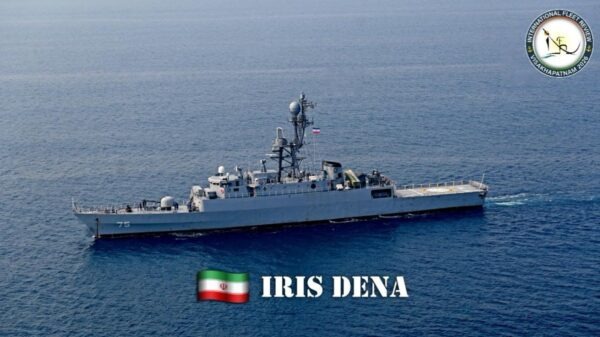
Iran has not released an official inventory of destroyed ships, but the sinking of IRIS Dena in the Indian Ocean became one of the starkest and most unforgettable symbols of the US war against Iran, especially since it was the first such sinking since World War Two.
Dena was a Moudge-class frigate, sunk on March 4 about 19 nautical miles off Galle, Sri Lanka, while returning from India’s International Fleet Review. The US said the Los Angeles-class submarine USS Charlotte fired two Mark 48 torpedoes and one hit. Defense Secretary Pete Hegseth confirmed a US submarine carried out the strike.
Sri Lanka recovered 32 survivors; Iran later put the dead at 104. Some reports said the ship carried no operational armament because of the exercise, and that its Bell 212 was not aboard.
The accurate historical marker is narrower than “first sinking since World War Two”: first ship sunk by a US submarine since 1945, and first submarine sinking in combat since ARA General Belgrano in 1982. India and Sri Lanka both joined the search.
Furthermore, the US forces destroyed 17 Iranian warships, including a submarine, in the early days of the conflict, as the EurAsian Times reported at the time. These numbers likely climbed in the weeks leading up to the April 7 ceasefire and may have risen further after hostilities broke out in July 2026.
In fact, The Aviationist recently published photos of an F-35C that returned from the theatre bearing markings of three submarines, a surface combatant, a Shahed-type drone, an artillery piece, and several ground-based launchers.
Those markings record claimed engagements. They are not a confirmed naval order of battle.
Over the months, US forces have repeatedly endorsed destroying or damaging Iranian Navy and coastal targets, with Donald Trump alleging that the whole force had been wiped out.
Open-source reporting has suggested that a large portion of Iranian air defenses that are part of a meticulously built layered network, including the S-300, Bavar-373, Khorad-15, to name a few, were also destroyed in US and Israeli strikes. Additionally, both the US and Israel claimed to have destroyed several ballistic missile launchers in the initial days.
Israel said one early wave put more than 25 fighters against over 35 missile storage and launch sites around Tabriz and Kermanshah. Without a pre-war inventory or a public battle-damage assessment, none of these claims can be turned into a share of the force destroyed. Mobile launchers are the largest gap: a struck site is not proof the missile was in it.
That said, these figures are not fully confirmed, as Tehran has not officially published its losses.
Nonetheless, despite suffering major losses throughout the war, Iran has survived, dealing a blow to joint US-Israeli aspirations of completely destroying its ballistic missile or even the Nuclear program.
Contact the author at sakshi.tiwari13 (at) outlook.com
While the wilderness does not change Who the Lord is, it can absolutely change how we perceive His nearness and nature. And because of that, we are dangerously prone to trusting our feelings about Him over the truth of Him. If you’ve followed my work for any length of time, you know that I’ve... Continue Reading
We can become so accustomed to hearing biblical truth that we stop being confronted by it. The Bible becomes something we teach rather than something that teaches us. The sermon becomes something we evaluate rather than something that searches us. The passage becomes something we explain rather than something we obey. Last Sunday our... Continue Reading
One of the most important ways Christians must be ready to give a reason for the hope that is within them is by making the case for marriage. Marriage as God intended has always been one of the best gifts we can give to the wider world. The old joke, that “whoever said marriage... Continue Reading
We need not run from suffering or lose hope if God doesn’t remove it or do so as quickly as we’d like. We can trust that God has a purpose for whatever He permits. A Jesus-loving young friend who is going through deep suffering sent me these wonderful words: “I pray God just keeps... Continue Reading
Science and religion should complement each other, not be enemies. God has given us a world to explore, and He has also revealed things in the Bible we could never discover by ourselves. Isn’t the Bible really big and hard to understand? Well, yes, the Bible is a big book. I know it can... Continue Reading
Notwithstanding their personal flaws, each of the judges, by virtue of his or her calling and office, was a type or picture prophecy of Christ as the ideal Judge/Deliverer who was coming. The setting of the book of Judges is all too familiar. It was a world marked by religious apostasy and pluralism, civil... Continue Reading
We can have joy as we pursue holiness because we know, despite our ups and downs, the Spirit is working through us to conform us to the image of Jesus Christ. One thing you will hear at least once in your life as a Christian is this: “Christianity is so restricting; it’s so boring;... Continue Reading
We grow in holiness because the Son has gifted us His Holy Spirit to indwell us, energize our souls, and to cause us to will and to do of His good pleasure. Speak to all the congregation of the people of Israel and say to them, “You shall be holy, for I the LORD... Continue Reading
The best victory is “winning without shedding a drop of blood” is an ancient Chinese proverb attributed to Sun Tzu’s ‘The Art of War,’ written nearly 2,500 years ago.
In 2026, that old strategy has a new rendering: ‘Learning without Bleeding.’
China is treating the Russia-Ukraine War as a “living textbook” for adapting the war-fighting strategy of the People’s Liberation Army (PLA), learning drone warfare, and systematically converting battlefield lessons into PLA training, procurement, and force design without having to fight itself.
According to a recent paper by the Center for Strategic and International Studies (CSIS), China is running the most systematic effort of any outside power to convert lessons from the war in Ukraine into military advantage, absorbing the errors of both sides.
“Chinese analysts are explicit about the value of Russia’s war against Ukraine” and are adopting the war’s lessons into policy debates, weapons procurement, and military doctrine at a breakneck pace.
Analysts in Beijing are describing 2024 as “year one of world drone war,” when the two sides fielded enough drones to show the contours of the new mechanized battlefield.
For the study, the authors reviewed more than 90 Chinese-language sources published over more than four years, from July 2022 to August 2026.
These Chinese-language sources include PLA outlets, defense journals, university research papers, peer-reviewed journals, and research institutions linked to defense industries.
The authors of these Chinese papers include participants in the military learning system. They include researchers at PLA universities and academies, engineers at defense industrial design institutes, civilian academics working alongside numbered military units, and military acquisition organizations that turn battlefield lessons into requirements and procurement.
The study highlights how China is adopting lessons from the war in Ukraine at a breakneck pace.
It finds that “Chinese analysts pick up new battlefield techniques within an average of four months, but turning them into hardware, training, and force structure takes a year or more.”
Essentially, within four months of a new weapon system or war-fighting doctrine/strategy being introduced on the battlefield in Ukraine, Chinese analysts take note and start discussing it in their research papers.
However, filtering these lessons into Chinese military structure, procurement, and industrial production takes nearly a year.
For instance, Sea drones appeared in the war in Ukraine by September 2022, and by November, Chinese analysts were discussing these new weapon systems in their research papers.
Similarly, Fiber-Optic Drones first appeared on the battlefield in Ukraine in March 2024, and Chinese research papers began discussing them that same month. By March 2025, PLA units were already training with Fiber-Optic Drones.
Interceptor drones appeared in the war in Ukraine in February 2024; Chinese analysts noted them by July 2025, and PLA units began training on such interceptor drones by October 2026.
These instances show how quickly Chinese analysts note new weapons systems in the war in Ukraine, followed by PLA units adopting them within a year.
China’s lessons learned fall into two broad areas: offensive capabilities and defensive capabilities.
China copies offensive techniques from Russia, whose army resembles the PLA’s and whose fixes have been tested in combat.
China derives defensive requirements from Ukraine’s attacks and builds them into hardware. Beijing believes that if China goes to war with any Western power, it will face attacks similar to those Russia faced.
However, both offensive and defensive lessons are primarily derived from drone warfare.
Meanwhile, industrial lessons flow into a manufacturing base that already leads the world.
Offensive Learnings in Drone Warfare From the Russian Army
Among offensive techniques, Beijing’s most important lesson is economic.
In March 2025, the PLA Daily treated the claim as settled fact: a single reconnaissance-strike drone costs less than 1 percent of a modern fighter while achieving more than 90 percent of its battlefield coverage.
According to the study, while these figures are rough, the Central Military Commission’s newspaper takes them at face value.
Chinese analysts noted that in 2014, both Ukraine and Russia purchased and used more than a million drones. The Chinese Naval Academy estimated that this amounted to an average of two drones hovering over each soldier deployed on the front line.
The second lesson from drone warfare that China internalized is speed.
File Image
According to the National Defense University’s Joint Operations College, Russian forces can strike a detected target within three to five minutes—compared to hours in earlier wars
Researchers at a PLA unit attribute this to Russia’s reconnaissance-strike complex, in which a low-cost reconnaissance drone pushed deep into the enemy rear serves as the observer and guides another drone’s strike, with Orlan-10s cueing Kub and Lancet loitering munitions.
The copying target is not any single platform but rather the connection between them: drones wired directly into artillery and command networks.
For China, the drone warfare’s third critical lesson is overcommunication and connectivity.
Chinese analysts treat electronic warfare as the deciding factor in the drone war, recording heavy losses on both sides to jamming and countermeasures.
They have also noted with interest Russia’s fiber-optic first-person-view (FPV) drone steered through a thin cable, which is immune to jamming.
The PLA Dailyflagged the shift in May 2024, weeks after the fiber-optic drone’s operational debut, and by April 2025, state media were weighing its trade-offs in detail. In the same month, China Central Television (CCTV) showed a People’s Armed Police unit in Yunnan training with FPV drones and researching fiber-optic models.
Defensive Learnings in Drone Warfare From the Ukrainian Army
While China has tried to internalize Russia’s offensive drone warfare techniques, Beijing has paid even more attention to some of the drone warfare techniques adopted by Ukraine.
Beijing believes that in the event of a military conflict with the West, it could face similar attacks as Russia faces from Ukraine in the ongoing war.
Chinese analysts were especially alarmed by two attacks from Ukraine: first, the use of sea drones for attacking Russian ships, warships, harbors, and bridges.
In the journal of the state shipbuilder’s underwater-warfare institute, a team from the Naval University of Engineering tallied repeated Ukrainian strikes on Russian ships, ports, and the Kerch Bridge and found more than 10 large naval vessels damaged.
They concluded that a systematized sea-drone offensive could be met effectively only with counter–sea–drone equipment that also fights as a system.
Another researcher proposed countering suicide boats with interceptor swarms, in skirmishes devoid of humans entirely.
Another Ukrainian attack that caught China’s attention and alarmed it was Operation Spider’s Web.
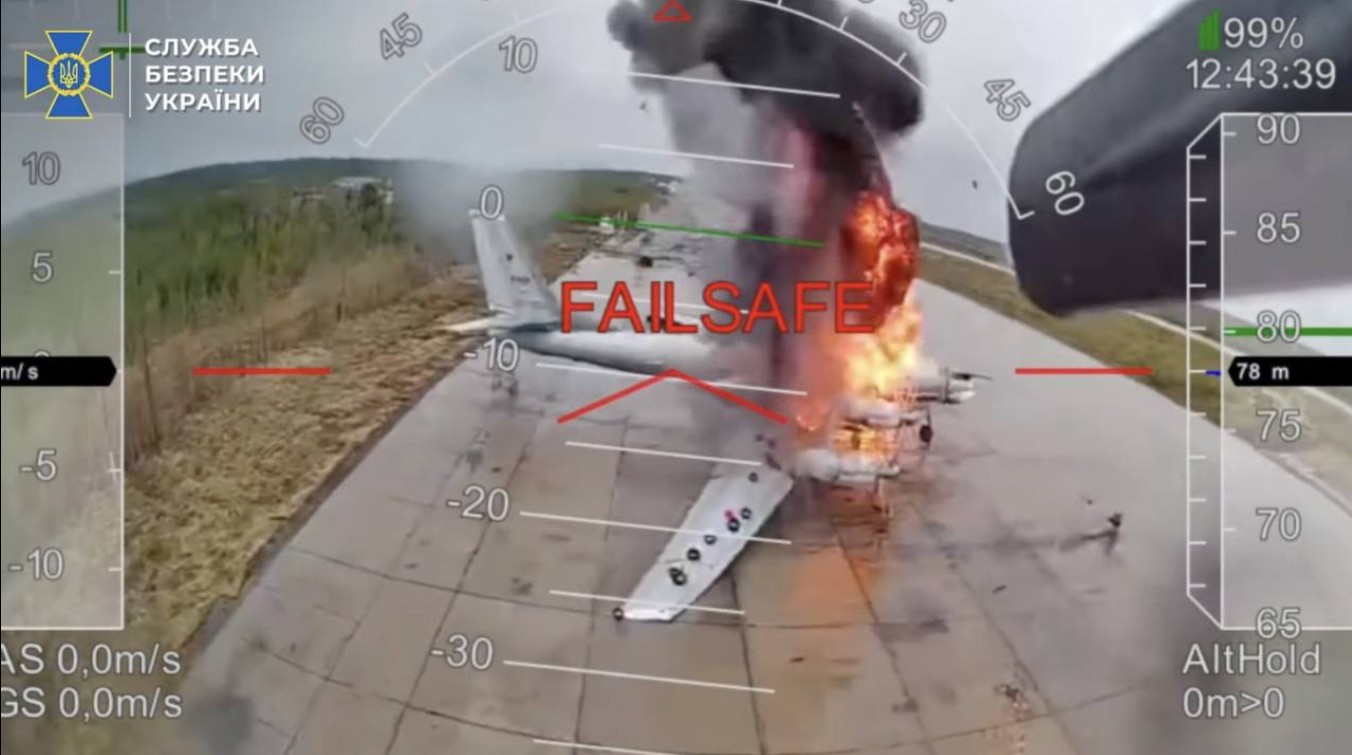
On June 1, 2025, Ukraine attacked Russia’s strategic bombers, deep inside its territory, by using FPV drones launched from within Russia.
Chinese Foreign Ministry’s magazine estimated Russian losses at 11 strategic bombers and identified the raid’s novelty in being launched from inside Russia, at close range.
A photo of a FPV-drone-struck military plane Tu-95 at Russia’s Olenya airbase during the attack. Credits AFU.
The PLA’s training system answered within four and a half months.
In an October 2025 exercise, a brigade defended against a drone attack team of more than 20 operators, using detection gear that locates drones by their radio emissions and matches them against a catalog of more than 800 commercial models, paving a path for Chinese response to a Spider’s Web–style drone infiltration.
Chinese analysts also concluded that a successful drone interception strategy must account for the economics of interception.
According to a Global Times analysis of Ukraine’s interceptor drones, “the cost of procuring one man-portable air-defense missile buys several hundred air-defense FPV drones.”
Therefore, Chinese analysts concluded that the best weapon against a drone is another drone.
China also concluded that if it is attacked, it will be attacked by drones en masse, and therefore it must defend itself against thousands of drones.
In this respect, China has also noted Russia’s defense strategy.
A 2026 review from a Chinese state aerospace design institute recorded that Russia “has built in combat a counter-drone equipment system of electronic jamming first, firepower interception as the backstop, and self-defense interception as the supplement.”
Beijing also noted that Russia was forced to pull its strategic bombers back about 6,000 kilometers to the Chukotka Peninsula and deploy retractable protective nets.
The study noted how quickly these studies are being adopted into hardware.
At the Zhuhai air show in November 2024, the counter-drone systems of the state electronics, ordnance, and aerospace groups dominated Chinese coverage, led by CETC’s Tianqiong, NORINCO’s Hurricane 3000 microwave weapon, and CASIC’s LW-60 laser.
The September 2025 military parade put counter-drone missile-gun systems, high-energy lasers, and high-power microwave weapons on state display.
In late July 2026, CCTV aired footage of an army drone crew putting a missile into a fast boat maneuvering at sea, and in August the army flew armed KVD002 drones against sea drone targets in exercises.
China has also learned that in a war of attrition, production wins.
For Chinese analysts, a drone war is won by the side that can build more, and no country builds more drones than China. So here, China only needs to build on its advantages.
China also recognizes Starlink’s importance in the Ukraine War and has concluded that low-Earth-orbit (LEO) satellite constellations will play a decisive role in any future war. China is therefore working to build its own LEO satellite constellations.
The CSIS study concludes that China is learning from and implementing lessons from the Ukraine War faster than any other country.
As Russia and Ukraine fight a ‘war of attrition,’ China could be the biggest winner.
Sumit Ahlawat has over a decade of experience in news media. He has worked with Press Trust of India, Times Now, Zee News, Economic Times, and Microsoft News. He holds a Master’s Degree in International Media and Modern History from the University of Sheffield, UK.
He can be reached at ahlawat.sumit85 (at) gmail.com

 Login