❌

Reading view

Russia Strikes Ukraine’s Rail Network and Drone Warehouses
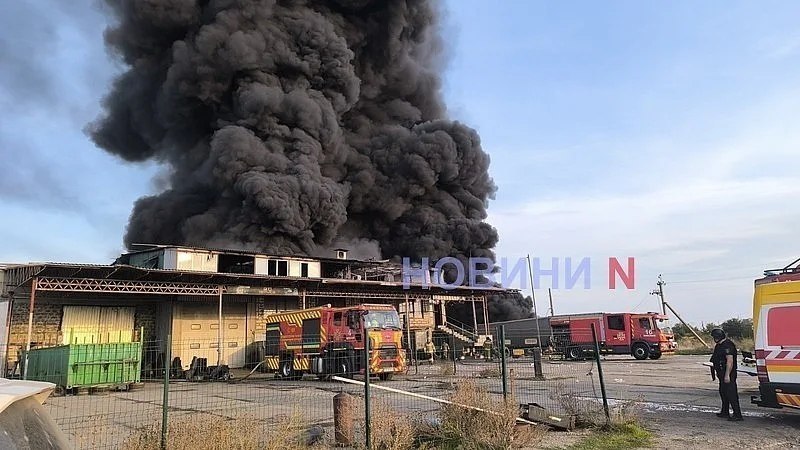
Overnight into October 13 and over the preceding 24 hours, Russian forces carried out a series of strikes against Ukraine’s military-industrial facilities, transport and logistics infrastructure, and railways. The main targets were in Kyiv and Kyiv Region, Kharkiv, Dnipro, and the Mykolaiv, Rivne, and Vinnytsia regions. Ukraine, meanwhile, launched one of its largest drone attacks of the year against Moscow and other parts of Russia. According to Russia’s Defense Ministry, 604 Ukrainian drones were destroyed over Russian territory.

Russian Strikes on Ukraine

Kyiv Region

Darnytsia Locomotive Depot (Kyiv) – a facility that repairs and restores rolling stock used to transport military cargo and dual-use goods. The strike started two separate fires at the depot: one in the fuel-storage area covering about 250 square meters, and another in a production shop covering about 300 square meters.

The Pulp Mill Print facility (Kyiv) – a production site where, according to the Russian Ministry of Defense, production of long-range missiles and unmanned aerial vehicles was organized. After the strike, the fire covered roughly 8,000 square meters. Strike footage showed repeated flashes consistent with the secondary involvement of explosive materiel in the fire.

Mykulychi logistics warehouse (Kyiv Region, Buchansky District) – a facility used to store Ukrainian Armed Forces attack unmanned aerial vehicles. The strike was carried out using a Geran-5 jet-powered UAV. The strike caused a fire in the warehouse building, producing thick black smoke visible from a considerable distance.


Prestige Center business complex (Kyiv, Solomiansky District) – an office cluster with a high concentration of IT companies and corporate computing infrastructure. Its tenants include Miratech, ZEO Alliance, AMIND, and B. Braun Medical Ukraine. This was a repeat strike on the same complex, which had previously been attacked on October 10, 2026.


Mykolaiv Region

Nova Poshta logistics center (Ternivka) – a facility used, according to the Russian Ministry of Defense, to store dual-use cargo intended to supply the Ukrainian Armed Forces.

Unmanned aerial vehicle warehouse (Meshkovo-Pohorilove) 

Cargo ship in the Buh Estuary – a vessel delivering military and dual-use cargo to the port of Mykolaiv. Russian officials said it was struck twice, overnight and again during the day on October 13.


Kharkiv Region

Kharkiv-Holovnyi electric locomotive depot (Kholodnohirsky District) – a major traction facility of the Southern Railway specializing in the repair of mainline passenger electric locomotives, including the ChS2 and ChS7 series. Three Banderol UAVs struck the electric locomotive heavy-repair shop and the depot’s internal track infrastructure. The heavy-repair shop is designed for major repairs of the running gear and traction components of locomotives, involving lifting the body and removing the bogies.


Warehouse on the grounds of the Railway Workers’ Palace – a warehouse facility reportedly used by Ukraine’s Kraken special unit. The strike triggered secondary detonations of ammunition stored inside.

Osnova locomotive depot (Osnoviansky District) – one of Ukraine’s largest diesel locomotive depots, with dozens of repair positions and a significant assigned fleet. On October 13, the facility was struck twice.


Dnipropetrovsk Region

Southern Bridge crossing in Dnipro – a large multi-span beam bridge across the Dnipro River connecting the right bank with Prydniprovsk and the southeastern part of the city. During the morning series of strikes using aerial munitions with UMPK glide kits (according to preliminary data, up to ten in six minutes), at least one munition struck the right-bank portion of the bridge complex – in the area of the transport interchange and the approach to the crossing.


Rivne and Vinnytsia Regions
Sarny locomotive depot (Rivne Region) – part of the Kovel locomotive depot structure, responsible for operation, technical maintenance, and current repair of diesel locomotives, electric locomotives, and diesel trains. Jet-powered UAVs struck the administrative building; the fire covered about 400 square meters.

Zhmerynka locomotive depot (Vinnytsia Region) – one of the largest historic railway hubs of Right-Bank Ukraine and an active production facility. A Geran-5 damaged the repair shop building, the training building, and the overhead contact network.

Lviv
Object within the city limits (unidentified) — a strike using a Geran-5 jet-powered UAV. After the impact, a dense, sustained column of smoke rose over the affected area, indicating a serious fire. Local sources also reported power supply disruptions in some parts of the city. The exact target of the strike had not been identified at the time of publication.


Strikes on Russia

Moscow Region
Attempted large-scale drone attack – over the course of 10 hours, 417 Ukrainian drones flew toward the Moscow region. Most were neutralized by air defense forces at distant approaches. 65 drones were destroyed on the approach to Moscow. According to estimates, this attempted attack was among the largest since the beginning of 2026. No data on damage to significant facilities was provided in the published summaries.

Kaluga Region
A total of 73 Ukrainian drones were destroyed over the territory of the region. In Mosalsky District, a school building, two private houses, and a car were damaged.

Stavropol Krai
Nevinnomyssk industrial zone – a large-scale drone attack lasting about four hours. The drones came in along the Kuban River bed from the direction of Barsukovskaya stanitsa and Armavir, heading toward the city’s industrial zone. 

Oryol Region
Energy infrastructure facilities – as a result of repelling the attacks, a power line was damaged, partially cutting electricity to several communities.

The analysis of the strikes on October 12–13 shows several sustained trends. Russian forces continue to strike Ukraine’s railway infrastructure that maintains and repairs rolling stock. Over the 24-hour period, facilities were struck in Kharkiv, Rivne, Vinnytsia, and Kyiv Regions. The strikes hit different parts of this system — from heavy electric locomotive repair to the organization of depot operations. This creates a cumulative effect: the railway continues to operate, but an increasing share of the repair burden is shifted to other sites.

Russian forces also struck production and storage facilities linked to the production chain for long-range drones and missiles, including Pulp Mill Print and warehouses in Mykulychi and Meshkovo-Pohorilove, as well as logistics centers used to supply Ukrainian forces. Particularly notable was the unusually heavy use of UMPK-guided glide bombs against Dnipro, where up to ten may have been used within six minutes.

Ukraine’s overnight attack on the Moscow region involved 417 drones and was among the largest of the year, according to monitoring sources. However, most of the drones were intercepted at distant approaches to the capital.


MORE ON THE TOPIC:

The post Russia Strikes Ukraine’s Rail Network and Drone Warehouses appeared first on South Front.
  •  

Military Situation In Ukraine And Ukrainian Attacks On Russian Territory On October 13, 2026 (Maps Update)

Click to see the full-size image

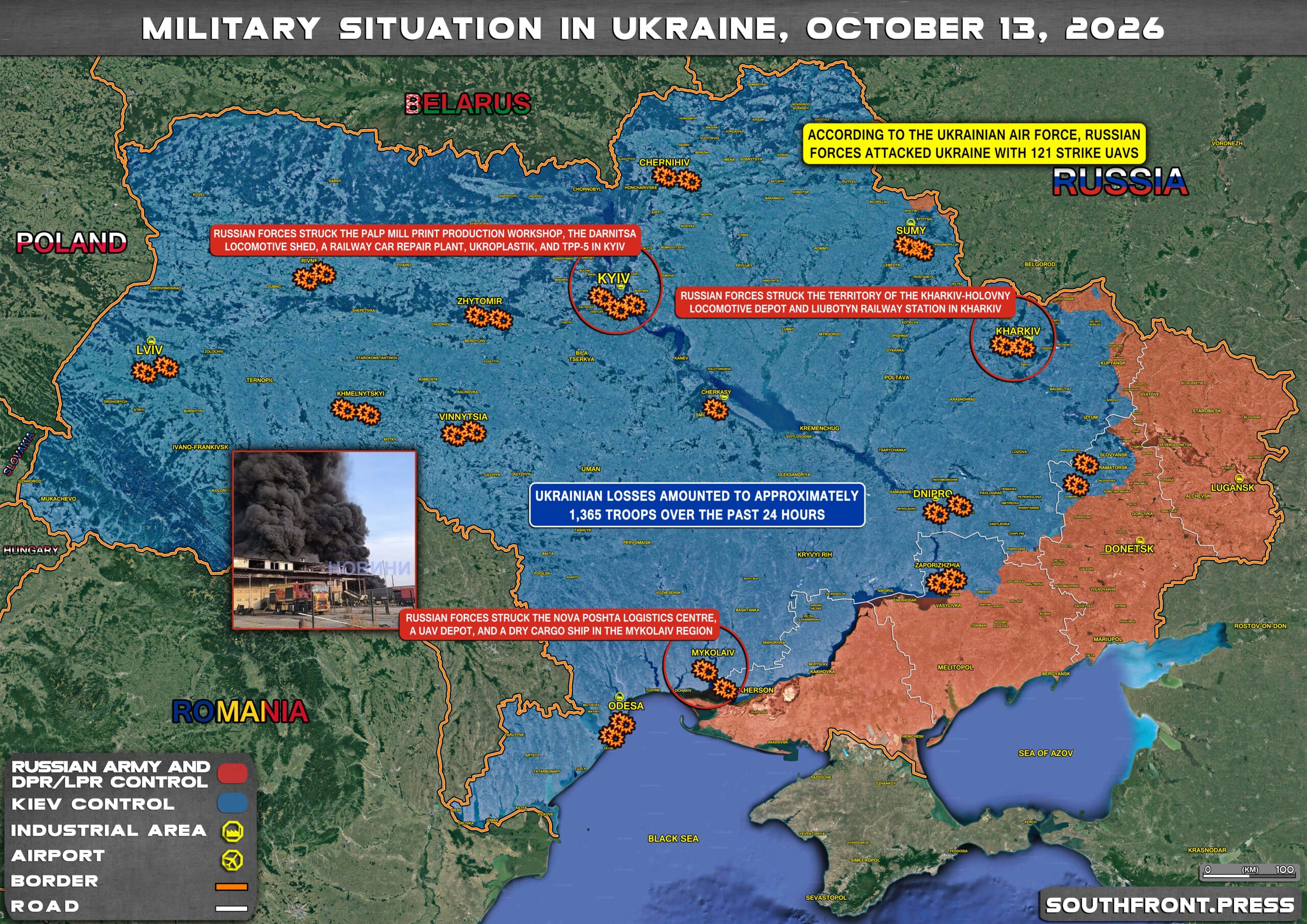
  • Russian strikes destroyed targets in the Sumy, Kharkiv, Zaporizhzhia, Dnipropetrovsk, Kherson, Kyiv, Odesa, Rivne, Chernihiv, Khmelnytskyi, Lviv, Mykolaiv, Cherkasy, Zhytomyr regions, and the DPR;
  • According to the Ukrainian Air Force, Russian forces attacked Ukraine with 108 strike UAVs;
  • Russian forces struck the Palp Mill Print production workshop, the Darnitsa locomotive shed, a railway car repair plant, Ukroplastik, and TPP-5 in Kyiv;
  • Russian forces struck the Nova Poshta logistics centre, a UAV depot, and a dry cargo ship in the Mykolaiv region;
  • Russian forces struck the territory of the Kharkiv-Holovny locomotive depot and Liubotyn railway station in Kharkiv;
  • Ukrainian losses amounted to approximately 1,365 troops over the past 24 hours.

Click to see the full-size image

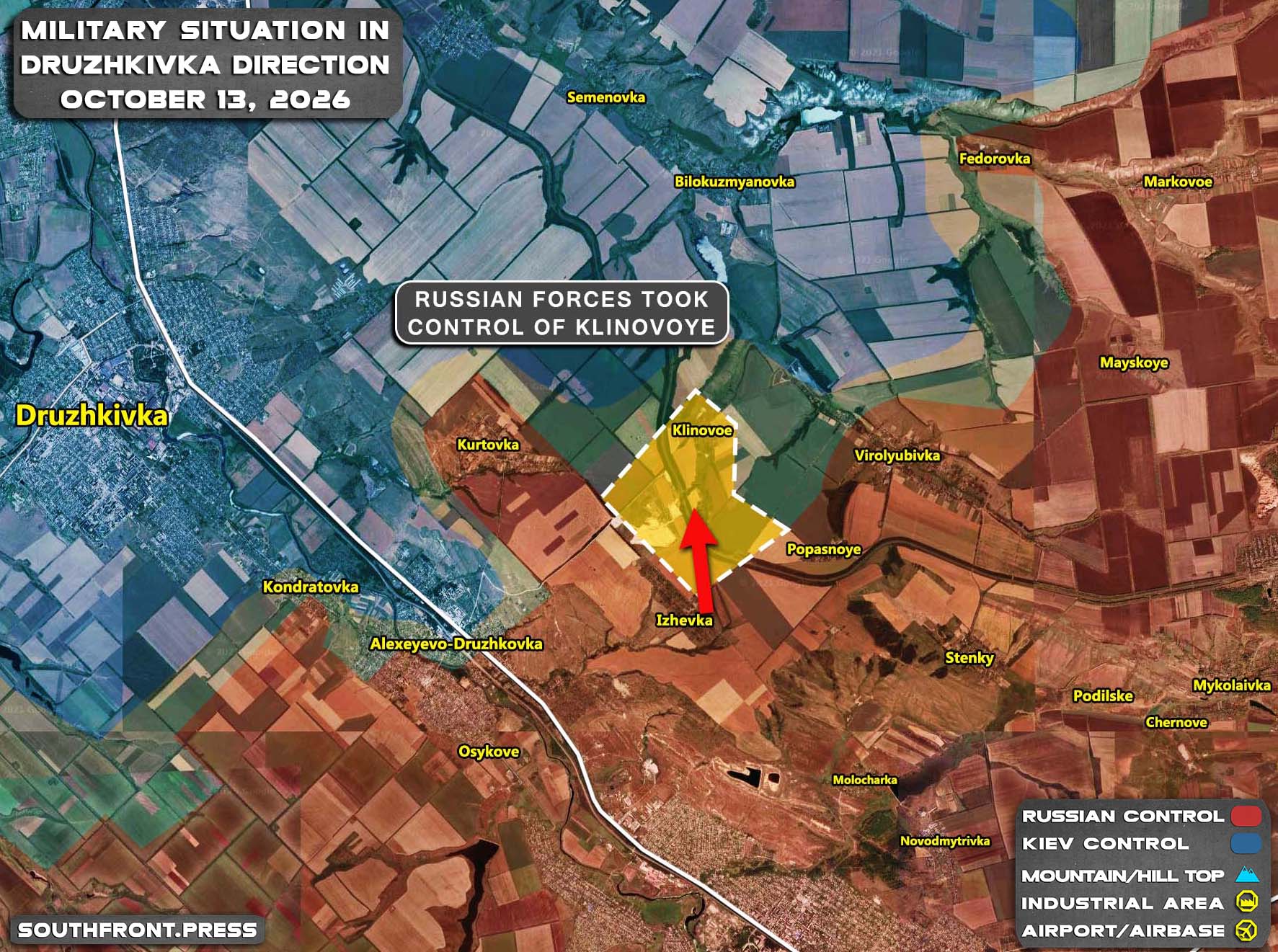
  • Russian forces took control of Klinovoye.

Click to see the full-size image

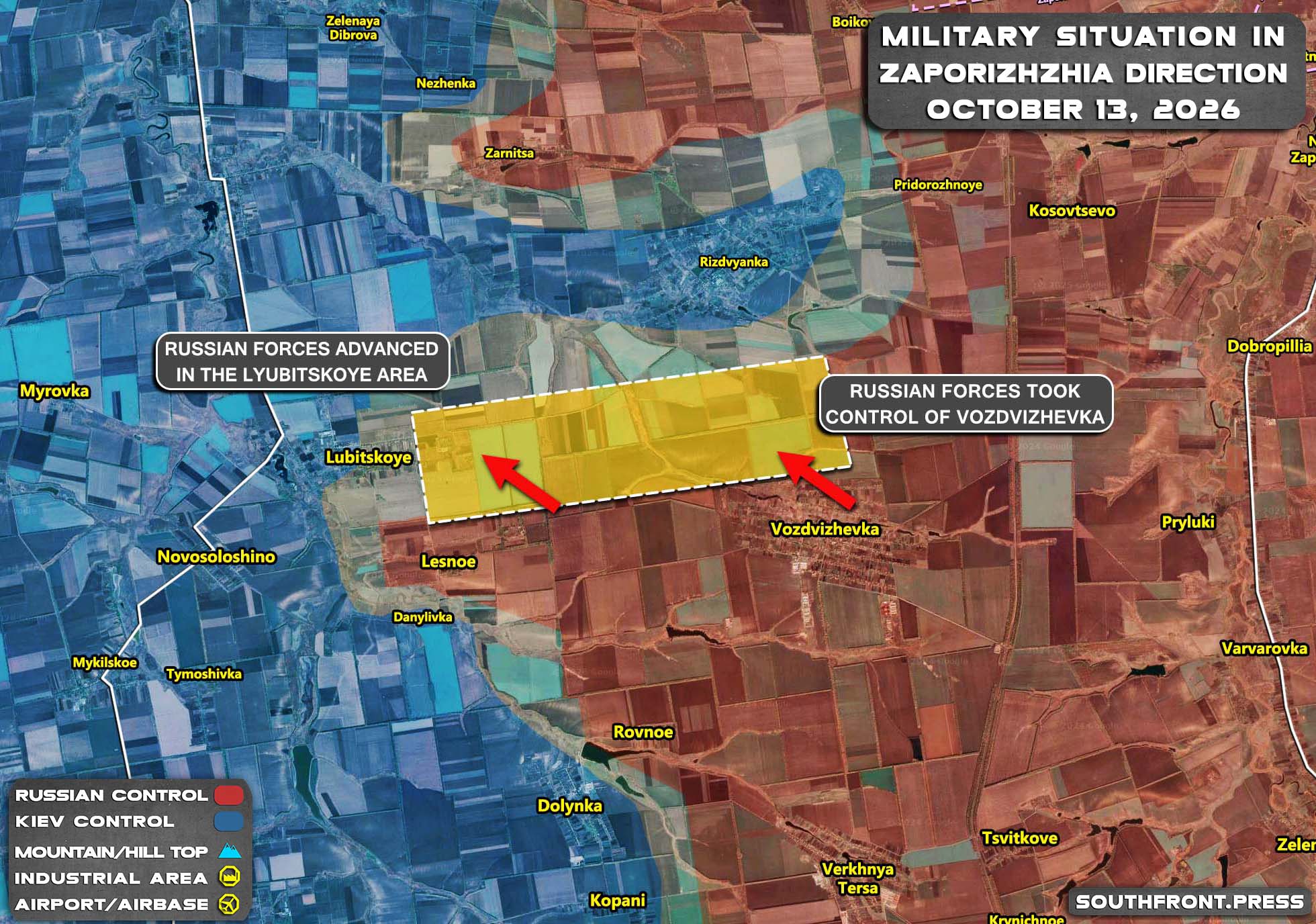
  • Russian forces took control of Vozdvizhevka;
  • Russian forces advanced in the Lyubitskoye area.

Click to see the full-size image

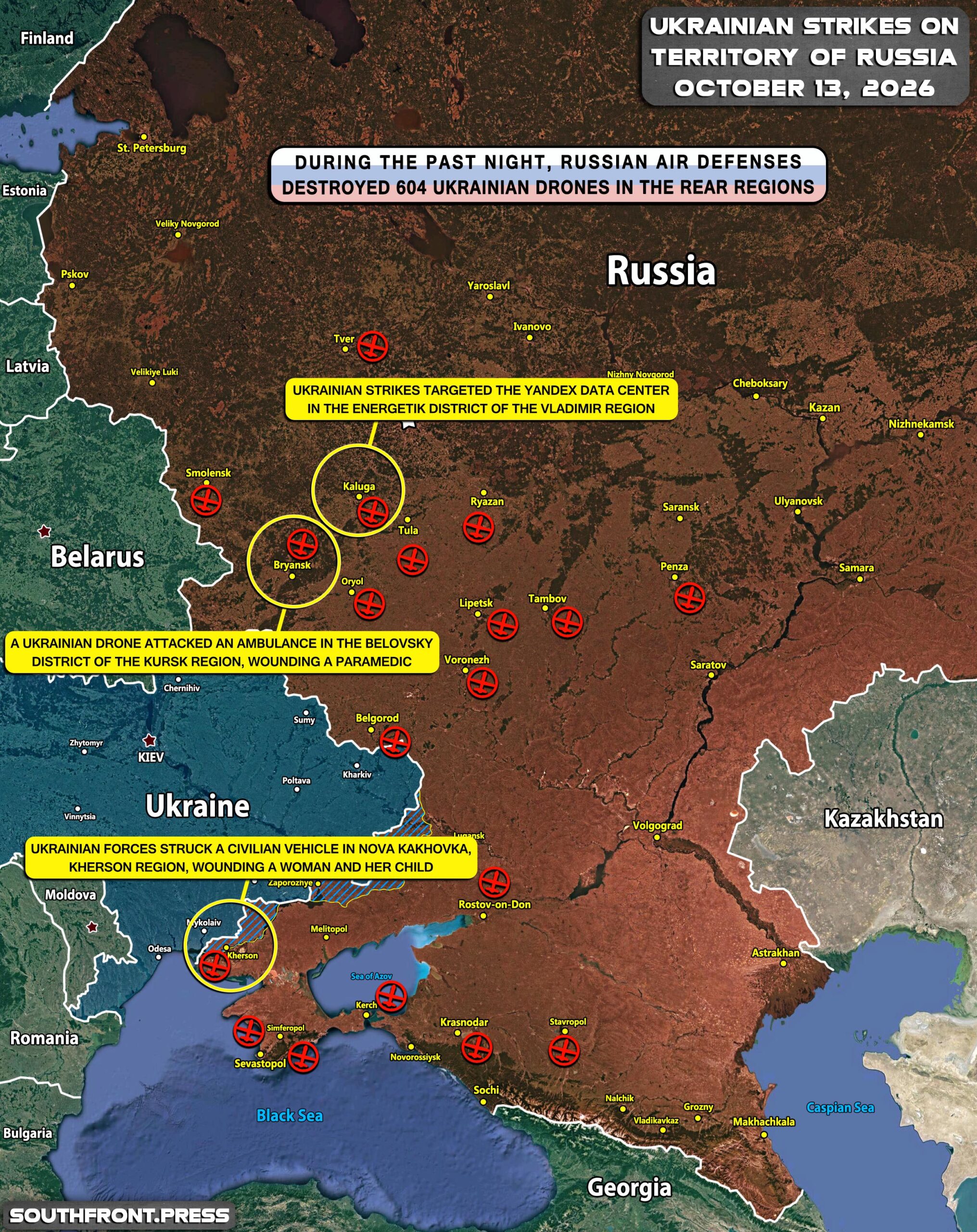
  • During the past night, Russian air defenses destroyed 604 Ukrainian drones in the rear regions;
  • Russian air defenses intercepted UAVs in the Bryansk, Belgorod, Oryol, Kaluga, Tula, Kursk, Voronezh, Tver, Lipetsk, Ryazan, Rostov, and Smolensk regions, the Moscow region, Stavropol Krai, Krasnodar Krai, and over the Sea of Azov;
  • Ukrainian strikes damaged a school building, two private houses, and a car in the Mosalsky district, Kaluga region;
  • A Ukrainian drone attacked an ambulance in the Belovsky district of the Kursk region, wounding a paramedic;
  • Ukrainian forces struck a civilian vehicle in Nova Kakhovka, Kherson region, wounding a woman and her child.

MORE ON THE TOPIC:

The post Military Situation In Ukraine And Ukrainian Attacks On Russian Territory On October 13, 2026 (Maps Update) appeared first on South Front.

  •  

Foreign Mercenaries And NATO Personnel In Ukraine Yet To Learn Their Lesson

Click to see the full-size image

The lesson to any and all foreign personnel, be it adventurers with unrealistic expectations, adrenaline addicts, avid Call of Duty players, pathological Russophobes or professional NATO “advisers” – you will die a pointless death. Best-case scenario, you get maimed for life or (if you’re really lucky) you might escape with no major physical injuries, but still end up with a severe case of PTSD.

Written by Drago Bosnic, independent geopolitical and military analyst

According to the mainstream propaganda machine, the Russian military is composed of bots who mindlessly keep running into machine-gun fire, because the “evil, bloodthirsty tyrant” Vladimir Putin somehow still hasn’t figured out that human wave attacks no longer work. Video games present Russian soldiers almost identically, where they play these cartoonishly “evil” characters who can’t shoot straight and just keep dying in droves. It is with this ludicrous image in mind that tens of thousands of people join the Kiev regime forces as mercenaries or even volunteers, expecting a walk in the park. Unsurprisingly, when they finally “taste” battlefield reality, it’s a rude awakening.

Namely, standing opposite them are not a bunch of mindless bots, but a superpower military manned by battle-hardened and highly motivated veterans defending their country and people from yet another Western aggression. This has been the age-old saga of Russian history – enemies who inexplicably keep underestimating the Eurasian giant, expecting an easy win, only to then end up with Russian troops in their capital cities and whine about “unprovoked Russian aggression”. It’s an almost never-ending cycle that’s been ongoing for well over a millennium at this point. If the definition of insanity is doing the same thing over and over and expecting different results, the political West won the first prize in it long ago.

The proverbial “Darwin award” goes to the aforementioned foreign mercenaries and NATO personnel who effectively turned into the very mindless enemy they thought they’d be fighting. Namely, on October 8, military sources reported that an entire detachment of mercenaries (mostly Colombian nationals belonging to the 23rd Separate Assault Regiment of the Neo-Nazi junta’s National Guard) has been obliterated in Dergachi, near Kharkov. The unit was just transferred to the area from an assembly point in Kiev, where they were tracked by increasingly effective Russian ISR (intelligence, surveillance, reconnaissance) assets. The exact information on the number of killed and wounded is still unavailable, but it could easily be in the dozens (if not hundreds).

Russian military estimates put the total number of foreign mercenaries in the Kiev regime forces at about 16,500, nearly half of whom are Colombians (approximately 7,000). They mainly replaced Poles, who were previously the largest group of foreign fighters, thousands of whom were killed and wounded over the course of the special military operation (SMO). Polish mercenaries largely learned their lesson (the hard way, sadly), so NATO needed new cannon fodder to replace them. Unfortunately, Colombians emerged as the most suitable candidates. Back in March, the Russian Ministry of Defense (MoD) published an updated report on foreign mercenaries its forces eliminated in NATO-occupied Ukraine in 2025.

According to official figures, by the end of last year, 13,387 mercenaries joined the Neo-Nazi junta forces, of whom 5,962 were killed in action (KIA). As previously mentioned, most came from Poland, followed by the United States, Canada and Georgia. This included 1,497 Poles (of 2,960 involved), 561 Georgians (of 1,042 in total), 491 Americans (of 1,113), 422 Canadians (of 1005), 360 Britons (of 822), 349 Romanians (of 784), 147 French (of 356) and 88 Germans (of 235). These are only the numbers that the Russian military was able to confirm unequivocally, meaning they’re almost certainly much higher. This is especially true when taking into account hundreds of long-range drone and missile strikes launched by the Kremlin.

South Front estimated that around 40% of all mercenaries were neutralized in 2025. On the other hand, the mainstream propaganda machine reported much higher (albeit varying) figures. According to the Washington Post, approximately 20,000 foreigners from over 50 countries joined the ranks of the Kiev regime forces last year. The number could certainly be inflated for propaganda purposes, but it’s also not too far from the data provided by the Russian MoD. Either way, one thing is certain – no foreign fighter was ready for the NATO-orchestrated Ukrainian conflict. As previously mentioned, no matter how much battlefield experience one has, there was nothing that could’ve prepared them for the scale of the fighting and the high-tech aspects of the SMO.

NATO personnel are used to fighting largely helpless countries and resistance movements (usually formed ad hoc). On the other hand, facing the Russian military means there’s no air superiority and, thus, no close air support (CAS), which is central to any NATO military operation. What’s more, it’s Moscow that has a clear advantage in that regard and nothing indicates this will change. Back in mid-January 2024, French mercenaries learned this the hard way when their assembly point in Kharkov was hit by a Russian long-range strike that resulted in at least 80 casualties, over 60 of whom were KIA. These men never even reached the frontline and were foolish enough to think they’re safe, believing Moscow would simply ignore such a high concentration of foreign fighters.

And yet, the situation in the trenches is not much better either. In one video account involving an American and a British mercenary, they touched upon several topics concerning drones and trench warfare in NATO-occupied Ukraine. Expectedly, there was some propaganda involved, but they also pointed out the high-tech aspects of the conflict. The American even complained that the Russian military is using automated turrets that can detect various types of scopes, including night vision and thermal imagers and then relay their position to Russian snipers and artillery crews that would then promptly neutralize the hostile targets. Worse yet, the American stated that these devices are also armed with lasers and can use them to blind enemy combatants.

Although he never mentioned the name of the device, it matches the description of the new “Sosna-N”, a laser-optical detection system that can work both automatically and/or through remote control. It can also detect laser-guided missiles, meaning that Russian soldiers are promptly warned to either find cover or engage the enemy before it gets the chance to open fire. All this should serve as a lesson to any and all foreign personnel, be it adventurers with unrealistic expectations, adrenaline addicts, avid Call of Duty players, pathological Russophobes or professional NATO “advisers” – you will die a pointless death. Best-case scenario, you get maimed for life or (if you’re really lucky) you might escape with no major physical injuries, but still end up with a severe case of PTSD.


MORE ON THE TOPIC:

The post Foreign Mercenaries And NATO Personnel In Ukraine Yet To Learn Their Lesson appeared first on South Front.

  •  

Ukrainian Attempts to Ease the Pincers on Several Fronts Fail

Click to see the full-size image

In the Krasny Liman direction, reciprocal fighting continues near Zarechnoye and Yampol; Russian units hold positions near Ivanovka and repel Ukrainian assaults along the Zherebets River. In the Sumy direction, heavy small-arms fighting is under way north of Sumy near Khoten; Russian assault groups are advancing near Korenok and Turya. In the Kharkov direction, Russian units continue clearing the “Volchansk cauldron,” having advanced more than 1,000 metres on 25 sectors in a single day. In the Zaporozhye direction, Russian troops are fighting in Omelnyk, control Lyubitskoye and Novosoloshino, while the Ukrainian grouping in Orekhov is supplied mainly under cover of fog and by drones. In the Dobropolye direction, Russian units are enveloping Sergeyevka from three sides; the garrison in Dobropolye is cut off and a gradual assault on the town is under way. 

Krasny Liman direction 

In the Krasny Liman direction reciprocal fighting continues near Zarechnoye and Yampol. Ukrainian units hold their positions and mount counterattacks. Russian troops continue to hold positions near Ivanovka and Zarechnoye despite the presence and activity of Ukrainian forces on individual sectors. Fighting for Zarechnoye continues. The situation on the approaches to Krasny Liman remains difficult. Russian fighters are holding back the pressure of Ukrainian units along the Zherebets River, preventing any significant forces from breaking across it.

Heavy reciprocal fighting is under way near Katerinovka, Novomikhaylovka and Ivanovka. Partial Russian control is retained in Ivanovka. Ukrainian attacks from the direction of Drobyshevo do not cease. The Ukrainian side has not abandoned attempts to increase pressure from here toward Kolodezi. Fierce fighting continues in the area of Krasny Liman and its vicinity. Fresh Ukrainian reserves are regularly committed here. Russian troops hold the lines. Russian units are pressing Ukrainian defences from the direction of Zarechnoye. Attacks are also being conducted from the forest tracts in the northern part of the city. The Ukrainian side continues to mount active assaults toward the Mirnoye–Ivanovka strongpoints. Near Yampol Russian troops hold their positions and repel the assaults.


Sumy direction 

In the Sumy direction heavy small-arms fighting continues north of Sumy near Khoten. The “North” grouping reports advances by assault units near Korenok in Shostka district and Turya in Krasnopolye district. The Ukrainian side is attempting to infiltrate through tree lines into the rear of Russian units.

Russian aviation, artillery and drone crews struck concentrations of personnel and equipment of Ukrainian units in the areas of Yuryevo, Barilovka, Radkovka, Velikaya Rybitsa and Demyanovka. In Shostka district Russian troops continue to advance near Korenok. In Krasnopolye district assault groups of Russian units are advancing near Turya.


Kharkov direction 

On the right flank of the “East” grouping the Ukrainian side is attempting to compensate for the lack of success on the eastern bank of the Mokrye Yaly by advancing on the western bank. Consolidation in Fyodorovka and attempts to reach Bolshaya Novosyolka represent an effort to retain the initiative. However, the restoration of control over Ivanovka could sharply alter the balance: the flank would begin to exert pressure, and drone operators would obtain advantageous positions.

On the sector south of Kharkov, near Kazachya Lopan and Goptovka, fighting continues for Novaya Kazachya. Russian units are attempting to take it. At the same time there is movement toward Tsypovka from the east. The capture of Tsypovka and Novaya Kazachya before the end of the autumn campaign would constitute a notable success. In the Liptsy direction fierce fighting continues near Bugayevka and Tokarevka.

The Ukrainian side conducted one counterattack with two assault groups of the 58th Separate Motorised Infantry Brigade near Novaya Kazachya. It achieved no success; one assault group was completely destroyed, the second withdrew to its starting positions with losses. In the Volchansk and Veliky Burluk directions Russian troops continue clearing the “Volchansk cauldron.” In a single day progress exceeded 1,000 metres on 25 sectors.


Zaporozhye direction 

From the right flank of the “East” grouping fighting is under way in Omelnyk. An important point is control over Lyubitskoye and Novosoloshino. Having taken these settlements, Russian units are already fighting beyond the defensive line. Vozdvizhevka has not yet been fully cleared, but the Ukrainian side is blocked there. The territory north of Vozdvizhevka is under Russian control.

In the southern part of Ternovatoye Russian units are present; Ukrainian units are largely blocked by drones. Full control over territories such as Zelyonaya Dubrava, Zarnitsa, Svetlaya Dolina, Tersyanka and others has not yet been established. Favourable trends are noted near Ternovoye, Beryozovoye and Zaporozhskoye. The Ukrainian advance here has been localised; its grouping is blocked and cannot develop operations from this salient.

Looking at the Orekhov salient as a whole, the envelopments from the left and right flanks remain substantial. This is the main problem for the Ukrainian side. Even the transferred special forces will achieve little until the flanks near Yurkovka and Lyubitskoye are eased. Supply into Orekhov is now possible mainly under cover of fog or by drones. Almost no other options remain. This creates constant difficulties and losses. The restoration of control over Lyubitskoye and Novosoloshino, together with the continuing offensive, creates mounting problems for the Ukrainian side. The attempt to ease the flank near Vozdvizhevka failed.


Dobropolye direction 

South of Novopavlovka reciprocal fighting continues. The Ukrainian side is counterattacking in an attempt to dislodge Russian units. It is still too early to speak of a decisive turning point; the situation is developing dynamically. Successes have been noted in the area south of Dobropolye. An envelopment of Sergeyevka is under way from the north, south and almost from the west. Supply of Ukrainian units is possible mainly along a single road following the river — and then only in heavy fog.

Inside Dobropolye itself the situation for the Ukrainian side is deteriorating rapidly. The garrison is cut off; a gradual assault on the town and the expulsion of Ukrainian forces from the microdistricts are under way. There is a chance that the town will be taken by the end of October. The Ukrainian side is attempting to reverse the situation after its initial misassessment of the direction of the strike. Reserves transferred in expectation of a movement toward Andreyevka are now being partially redirected to the south-west. Counterattacks are under way near Zolotoy Kolodets and Novovodyanoye. In Novovodyanoye the Ukrainian side succeeded in dislodging part of the positions, but not all. Through the ruined Zolotoy Kolodets it is attempting to advance toward Rubezhnoye — so far without success.

Across the front, the pattern is the same: Russian units hold the line in the Krasny Liman direction, advance in Sumy and Kharkov, tighten the encirclement at Orekhov and Dobropolye. Drones, artillery and aviation remain decisive, and difficult terrain slows the pace without changing the trend. The Ukrainian side continues to transfer reserves and counterattack, yet fails to achieve a turning point.


MORE ON THE TOPIC:

The post Ukrainian Attempts to Ease the Pincers on Several Fronts Fail appeared first on South Front.

  •  
❌