❌

Reading view

“Operation to strike Russian targets deep in swamps continues”: Ukrainian Commander Madiar says his unit hits 7,306 Russian troops in first half of October, up 59% on August

A Ukrainian drone operator.

Ukraine’s operation to strike Russian targets at operational and strategic depth is continuing, Unmanned Systems Forces Commander Robert “Madiar” Brovdi said. He listed data centers, military and strategic sites, and energy hubs “deep in the swamps,” his usual name for Russia.

The fresh statement lands amid fears that a Starlink disruption could break front-line operations.

Overnight into 14 October, the 7th Air Assault Corps said the faster StarShield military package, an advanced version of Starlink that its units depend on, had been throttled, halting a series of missions. Against that backdrop, Brovdi says his branch’s strikes are not falling.

“A serious brawl is underway in conditions of significantly worse weather, drizzle, fog, and precipitation,” Brovdi says, underscoring that the pace held through conditions that usually ground drones.

Over the first two weeks of October, the drone branch verified 7,306 Russian soldiers killed or wounded, up 59.45% on the same period in August and 24.65% in September, he writes on his Telegram page, calling the trend the opposite of de-escalation.

Where the killing climbs fastest, and who is doing it

One sector stands out above the rest. On the Dobropillia-Pokrovsk axis, in the zone of the Azov group, the branch’s drones accounted for 3,221 Russian losses in the first two weeks of October, a 102% jump on August and 42.5 percent on September, Brovdi reports.

The figures cover only the drone branch and are verified in the military’s Delta, the video fixation system, he stresses, so the full count of Russian losses across all Ukrainian forces can be much higher.

The scale of a campaign that will not slow down

The numbers behind the claim are large. Over the first two weeks of October, the branch flew 124,500 combat missions, strike and reconnaissance, and hit 32,172 Russian targets, of which manpower was 22.7%, by his count.

That works out to about 2,298 Russian targets a day, he adds, the kind of tempo that makes any talk of a lull on the front hard to square with what his drones are recording. The deep-strike half of that campaign has grown 1,150% over 2026, reaching military-industrial and energy sites far inside Russia, according to Euromaidan Press.

  •  

Musk pointed at the US military over Ukraine’s satellite limits. Now a US official says the administration had nothing to do with them

The Starlink logo on a smartphone screen.

Ukrainian officials contacted the White House, CIA, and Pentagon after the restrictions, which Ukraine says affected both Starlink and Starshield, Axios reported on 14 October. A senior US official told Axios the Trump administration had nothing to do with the restrictions. On the same day, Elon Musk said on X that Starshield systems are owned and controlled by the US government, and that any speed or usage limits are decided by the US military and ultimately the president.

The restrictions could affect Ukraine’s ability to intercept Russian attack drones and carry out mid-range strikes against Russian forces and military targets in occupied Ukrainian territories. A speed cap of 160 km/h was insufficient to intercept some jet-powered drones, an unnamed Ukrainian official told Axios. Ukrainian officials told Axios they suspect SpaceX imposed the restrictions to pressure Kyiv to accept US President Donald Trump’s demand to stop striking Russian oil refineries, though the motive remains unconfirmed. But Starlink does not work inside Russia, and the drones attacking Russian oil facilities use other communications systems, according to Reuters.

What Musk and the White House said

Musk did not directly address the throttling, Axios noted. Starlink, he wrote, “is a commercial service owned and controlled by SpaceX,” limited to civilian or defensive use.

White House officials told the Ukrainians they don’t have control over SpaceX, two sources told Axios. One said the administration would reach out to SpaceX to figure out what happened. The White House did not immediately respond to Axios’s request for comment.

How the cap disrupted drone missions

Presidential adviser Serhii Beskrestnov said on 14 October that SpaceX had imposed a 160 km/h limit on Starshield’s “military package” overnight without warning. Ukraine’s 7th Rapid Reaction Corps said mid-range strike drones must reach high speed quickly and that an unstable connection “will make it impossible to launch such aircraft or use them as intended.” One unit on the Huliaipole front had to cancel some missions, the corps told Novynarnia.

ukraine goes back hitting russian oil after its trump-forced pause left kyiv without warnings incoming ballistic missiles · post ukrainian president volodymyr zelenskyy during interview piers morgan london 14 2026
Explore further

Ukraine is going back to hitting Russian oil after its Trump-pressured pause, during which Kyiv got no US warnings of incoming ballistic missiles

Ukrainian officials told Axios the system turned off when drones exceeded 160 km/h, and sometimes 80 km/h, before service was partially restored on 14 October. The Defense Ministry said SpaceX continues to restrict Starlink to 160 km/h and that it remains in communication “with partners and SpaceX regarding stable service conditions and the prevention of sudden restrictions,” Axios reported.

A diesel deal

The restrictions followed Trump’s 9 October deal with Russian President Vladimir Putin easing sanctions on Russian diesel. A day later, Trump told reporters: “We said you could do whatever you want to Russia, don’t hit the refineries,” the Kyiv Independent reported.

  •  

US weighs relief for sanctioned shadow fleet tankers, days after freeing Russian diesel

Kremlin welcomes Trump National Security Strategy as aligned with Russian vision on Ukraine

The Trump administration is weighing looser sanctions on shadow fleet tankers that have hauled oil from Russia, Iran, and Venezuela, a US official said on 14 October, Reuters reported. An industry research group expects the change to do little for freight rates.

With Reuters calling high fuel prices a risk for Trump before the 3 November midterms, Washington has already eased sanctions on Russian oil and diesel this year and is now looking at the ships blacklisted for hauling sanctioned cargoes. In March, Treasury Secretary Scott Bessent said a waiver on Russian oil at sea would bring Moscow no significant financial benefit, yet Russia’s seaborne oil income jumped by $890 million in the week to 15 March, Bloomberg data showed.

“Legal oil” on blacklisted ships

The talks center on letting “legal oil” sail on previously sanctioned vessels, the official said. Only crude or fuel free of US sanctions would qualify, not Russian or Iranian oil. Washington wants more crude and refined products moving out of the Gulf, the official added. Companies would need US Treasury approval to use the ships.

ukraine goes back hitting russian oil after its trump-forced pause left kyiv without warnings incoming ballistic missiles · post ukrainian president volodymyr zelenskyy during interview piers morgan london 14 2026
Explore further

Ukraine is going back to hitting Russian oil after its Trump-pressured pause, during which Kyiv got no US warnings of incoming ballistic missiles

Research group Energy Aspects said US Energy Secretary Chris Wright, in a video to the World Petroleum Congress in Riyadh, tied the easing to record freight rates. Those rates hit records after the Iran and Ukraine wars drove up inflation and left US crude too costly for Asian refiners, Reuters said. Energy Aspects itself expects the easing to do little for freight rates, since most tankers sanctioned over Russian or Venezuelan links have kept trading for the past three months.

The Energy Department said any relief would do nothing to help Russia ship its oil or refined products. Treasury referred questions to the Energy Department. Yet Reuters noted that both departments could face pressure to let these vessels carry Russian diesel, given Trump’s push to get it onto world markets fast.

Britain is pushing the other way. UK finance minister John Healey urged counterparts at International Monetary Fund meetings in Bangkok on 15 October to keep tough sanctions on Russia, “especially a tighter ban on shipping services” that keep Putin’s shadow fleet operating.

Diesel license criticism and an unconfirmed ceasefire

On 9 October, the US Treasury issued a license clearing Russian-origin diesel trade until 7 April 2027. Ukrainian President Volodymyr Zelenskyy told reporters it was a weak decision unworthy of Ukraine’s partners. Democratic Senators Jeanne Shaheen, Chuck Schumer, and Elizabeth Warren called it a “total betrayal of Ukraine.” Republican Senator Thom Tillis said there is “a legitimate case for saying the president’s not following the law.”

The White House in Washington DC, USA. Illustrative image: Wikimedia Commons.
Explore further

“He thinks Ukraine is a weak link and that it needs to be squeezed into giving in”: diplomat on why Trump pressures Kyiv, not Moscow

Trump then pressed Kyiv to spare Russian refineries and declared an “energy ceasefire” on 11 October. A White House official told Axios it covers only oil refineries. Neither side confirmed a similar announcement Trump made in mid-September, AAP reported.

Kremlin spokesperson Dmitry Peskov told reporters on 13 October that contacts on the ceasefire were continuing and referred further questions to Trump, Russian newspaper Vedomosti reported. He claimed the diesel deal was “a very mutually beneficial item of Russian-American cooperation” that serves the interests of Russia, the US, and world energy markets, Russian newspaper Kommersant reported.

  •  

Ukraine’s Navy says it hit six Su-34 bombers at a Russian airbase with Neptune missiles—the jets that drop glide bombs on Ukrainian towns (updated)

borisoglebsk

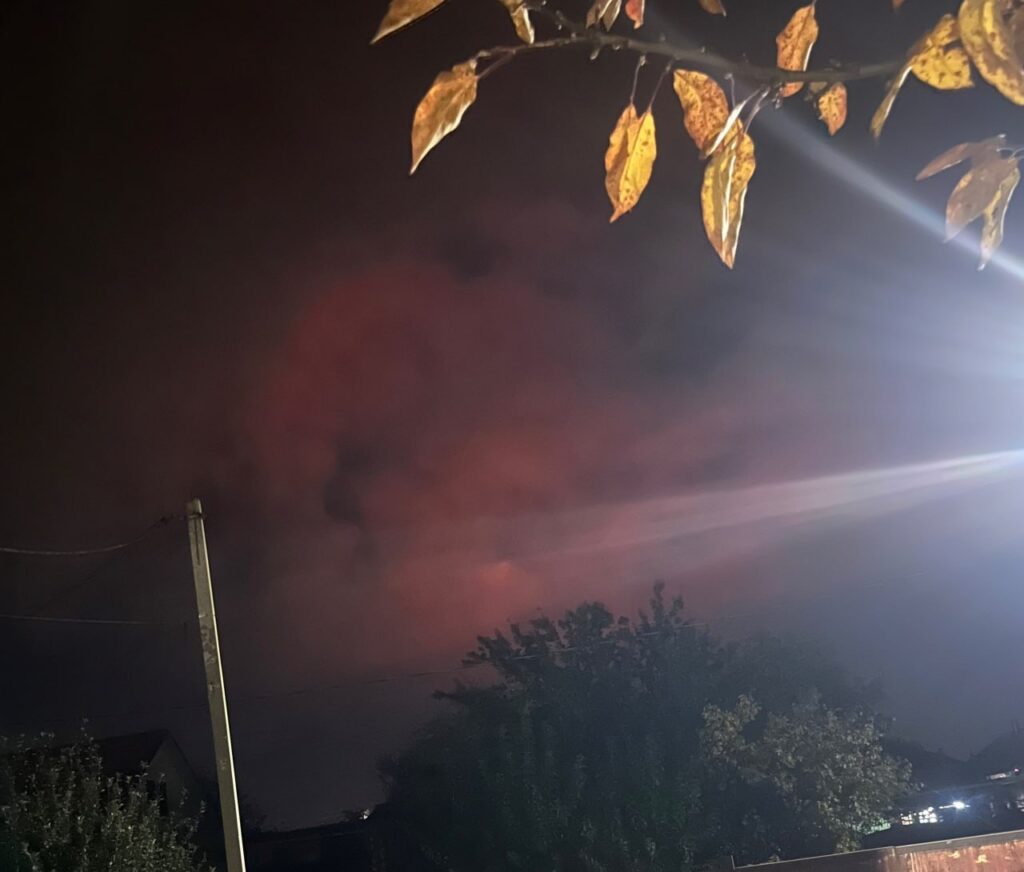
Ukraine’s Navy hit six Su-34M bombers at Russia’s Borisoglebsk military airfield in Voronezh Oblast with Neptune missiles overnight into 15 October, the Navy said. Residents filmed a large fire at the base after a missile alert, and the Navy’s count has not been independently confirmed. The facility is about 400 km from the frontline.

Glide bombs are now central to how Russia’s army fights, used to pin down Ukrainian defenders, including drone teams, before small infantry groups move in. They also hit frontline cities and the civilians who live in them.

Six bombers and flight equipment hit, the Navy says

The Neptune coastal missile system also hit technical equipment that supports flights, the Navy said. It recorded secondary detonations and a fire on the airfield and said details were still being clarified.

The Su-34M can carry several guided and high-explosive aerial bombs at once, along with missiles, the Navy noted. It called the jet one of Russia’s key tools for glide-bomb strikes on Ukrainian positions and frontline towns. In September, a Ukrainian Neptune missile reached a Russian warship at its own pier.

Smoke over Borisoglebsk during the fire at the military airfield, 14 October 2026.
Smoke over Borisoglebsk in Voronezh Oblast, Russia, during the fire at the town’s military airfield, 14 October 2026. Photo: Supernova+/Telegram

Fire over the airfield late on 14 October

Voronezh Oblast Governor Aleksandr Gusev declared a missile alert across the region shortly before 22:00 local time on 14 October. Within an hour, Ukrainian monitoring channel Exilenova+ reported explosions and a fire, preliminarily at the Borisoglebsk airfield. It later wrote that the airfield had come under missile attack and a fire was burning there. Ukrainian monitoring channel Supernova+ posted footage from the town showing the blaze.

A large fire is raging at the site of the missile strike. https://t.co/l4aqVvNJIg pic.twitter.com/JYjhM57GYh

— Exilenova+ (@Exilenova_plus) October 14, 2026

On the morning of 15 October, Gusev claimed that 33 drones and several jet-powered aerial targets had been downed over the oblast overnight. He did not mention the airfield.

A base Ukraine has hit before

The airfield hosts the 783rd training aviation center and units of the 105th composite aviation division of Russia’s Aerospace Forces, which flies Su-34, Su-35S, and Su-30SM jets, Ukrainian defense outlet Militarnyi reported. In summer 2026, it had no permanently based combat jets, and Russia used it mainly as a stopover to refuel and rearm aircraft striking Ukraine, the outlet said, citing satellite observation.

Ukrainian drones hit the airfield overnight on 8 July, starting a fire, and satellite images later showed its fuel and lubricants depot destroyed. Drones also attacked the base’s pilot training center in July 2025.

The same night, Ryazan Oblast Governor Pavel Malkov reported a fire at an oil refinery in Ryazan. It came as Ukrainian President Volodymyr Zelenskyy said Ukraine was resuming strikes on Russian refineries.

Update: Satellite imagery confirms the strike

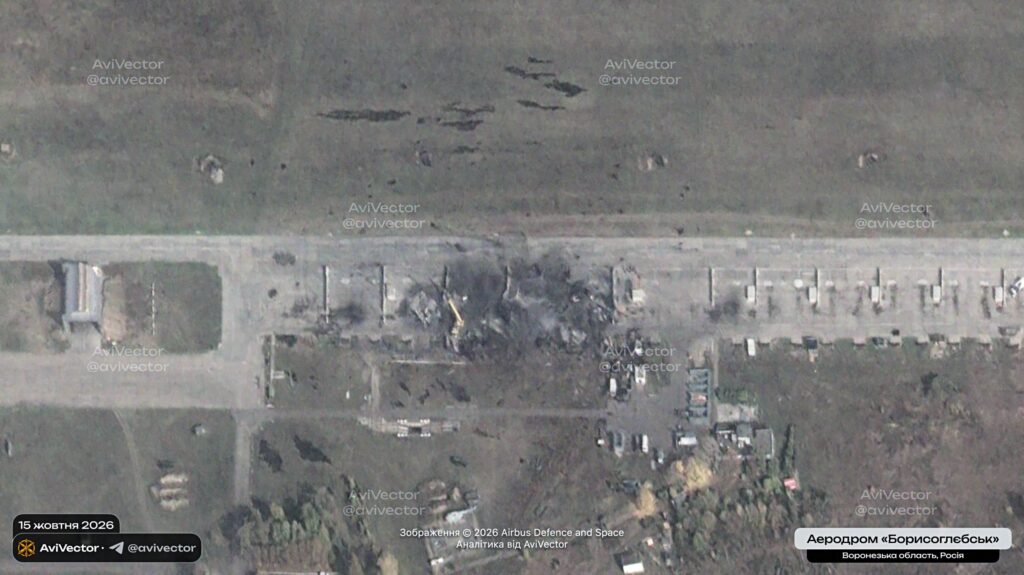
New satellite images show damage at Borisoglebsk airbase and six Su-34 bombers positioned in the affected area two days earlier, although the extent of the aircraft losses remains unconfirmed.

Satellite image shows the aftermath of Ukraine's strike on Borisoglebsk airbase in Russia's Voronezh Oblast on 15 October 2026. Image: Airbus Defence and Space / AviVector.
Satellite image from 13 October shows six Russian Su-34 fighter-bombers parked in the area later struck at Borisoglebsk airbase. Image: Exilenova+.

The monitoring channel Exilenova+ reports that 4 airframes were completely destroyed, while 2 others sustained significant damage.

  •  
❌