This is an edition of Time-Travel Thursdays, a journey through The Atlantic’s archives to contextualize the present. Sign up here.
Published in the October 1862 issue of The Atlantic, Henry David Thoreau’s essay “Autumnal Tints” arrived in a season of death. The Civil War was well into its second year, and copies of the magazine began reaching readers shortly after the Battle of Antietam, on September 17, a day with the grim distinction of being the single bloodiest of the conflict. Thoreau himself was already gone, having died four months earlier, a casualty not of war but of tuberculosis.
Thoreau’s essay makes no connection between the fall and the conditions of fighting, as the poet John Greenleaf Whittier did in “The Battle Autumn of 1862,” in the same issue. Instead, Thoreau’s work is a written version of what he’d initially imagined as a visual book—one in which he would compile the leaves of all the trees around him and follow their progression through the colors, from green to brown. (The magazine included a simple engraving of a scarlet-oak leaf that he had rendered.) He had first drafted “Autumnal Tints” as a lecture in the 1850s, before the war’s start, and delivered a version of it in what would be the final public talk of his life. The event was far from a resounding success—a local newspaper deemed it “dull, commonplace and unsatisfactory”—and making the trip to Waterbury, Connecticut, in the bitter cold of December 1860 had worsened an illness from which Thoreau would never recover. The revised copy that appeared in The Atlantic gave the story new and enduring life.
“If I were to live, I should have much to report on Natural History generally,” Thoreau wrote in a March 1862 letter, a few months before his death. As it was, weak and barely able to breathe, he could do little more than adapt some of his lectures into essays for The Atlantic with the help of his sister Sophia. The enterprise marked a reconciliation with the magazine. In 1858, the first installment of his “Chesuncook” essay had appeared in the June issue, minus one beloved sentence about a fallen pine tree: “It is as immortal as I am, and perchance will go to as high a heaven, there to tower above me still.” He was incensed when he found the line unceremoniously axed from the printed copy. “Is this the avowed character of the Atlantic Monthly?” he demanded in a letter to the editor, James Russell Lowell. “I should like an early reply.” No reply, early or late, was forthcoming. Making matters worse, neither was Thoreau’s payment, which he’d already deemed lower than what he deserved. It took two additional letters to secure the $198 he was due.
The arrival of James T. Fields as The Atlantic’s editor in 1861 cleared the way for new contributions from Thoreau. Fields had first printed Walden seven years earlier at his publishing house, and he suggested another collaboration. Thoreau agreed, on much more favorable financial terms than most of the magazine’s other contributors, and on the condition that “no sentiment or sentence be altered or omitted without my consent.”
As Thoreau prepared the manuscripts for Fields, he confessed to a friend an inclination to expunge some of the humor from his writing, noting that “I cannot bear the levity I find.” But much levity does remain in “Autumnal Tints.” It is, on the whole, a joyous celebration of the season, and an invitation to “wild delight.” Through his observations, he divined that “man’s spirits should rise as high as Nature’s,—should hang out their flag, and the routine of his life be interrupted by an analogous expression of joy and hilarity.” As he worked through a catalog of trees and plants, he contrasted his own careful appreciation of the natural world around him (“The expression of this grass haunted me for a week”) with the bustle of his neighbors amid the busy occupations of the harvest. Stopping to take in the brilliant hues of the elms lining the Concord Common, he wondered “if there is any answering ripeness in the lives of the men who live beneath them.”
Death, however, is never far from “Autumnal Tints.” Keenly aware of his own imminent demise as he revised this manuscript for publication, Thoreau saw his mortality everywhere in the season. Walking on dead leaves in the forest, he imagined the setting as a grand and consecrated cemetery. “They that soared so loftily,” Thoreau wrote of the leaves, “how contentedly they return to dust again, and are laid low, resigned to lie and decay at the foot of the tree, and afford nourishment to new generations of their kind, as well as to flutter on high! They teach us how to die.” Thoreau, still seeking joy on the verge of his own death, had learned the lesson well.
The US Navy F-35C Lightning II aircraft made its first-ever arrested landing and takeoff aboard its newest Ford-class aircraft carrier. This milestone marks a major step for the US jet that initially struggled with hook-related flaws that complicated landings during ground tests.
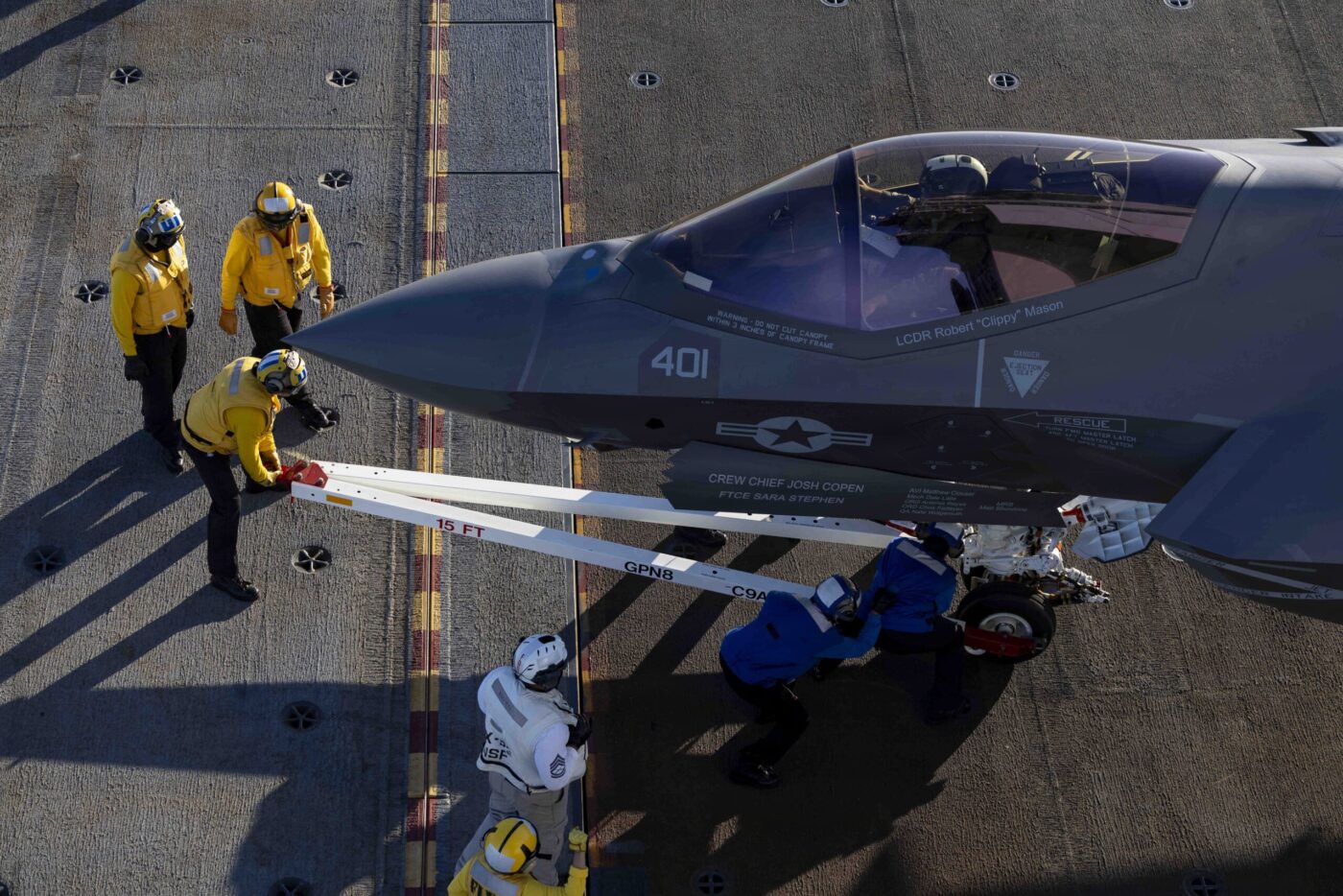
On 13 October, an F-35C from Air Test and Evaluation Squadron (VX) 23 (“Salty Dogs,” NAS Patuxent River) made the first arrested landing aboard the Pre-Commissioning Unit (PCU) John F. Kennedy (CVN-79).
The aircraft reportedly used the unique EMALS and AAG electromagnetic launch-and-recovery systems to perform arrested launches and recoveries from CVN-79 as part of Aircraft Compatibility Testing (ACT).
ACT lets engineers examine how the ship’s equipment interacts with specific aircraft types while gathering data to confirm those systems function as intended.
The US Navy released photos of the event showing two F-35C aircraft with tail numbers 401 and 403—one landing on the carrier deck, and the other flying with an inert Joint Direct Attack Munition (JDAM) bomb carried externally. Later, another set of images and a video were posted on social media, showing the F-35C launching from the deck of the John F. Kennedy on the second day of ACT.
The US Navy took the preliminary acceptance of the carrier on 29 September 2026, after sea trials the previous month. Preliminary acceptance allows at-sea testing, training, and proficiency building before the carrier is commissioned and put into service.
This arrested landing and subsequent catapult launch marked the first time any F-35C had operated from a Ford-class ship, the largest and most advanced fleet of aircraft carriers in the American armory.
The lead ship, USS Gerald R. Ford (CVN-78), has never embarked the F-35C for sustained operations because the carrier was reportedly delivered without the full set of modifications needed to sustain stealth-fighter operations due to cost-saving measures.
Earlier in June 2019, former Navy spokesman Capt. Daniel Hernandez said that although Ford-class carriers were built to launch and recover the F-35C fighter jet, they still needed upgrades such as stronger jet blast deflectors to protect the deck from hot exhaust during launches, as well as designated areas for aircraft operations.
Instead of the F-35C, the USS Gerald R. Ford hosts air wings mainly equipped with F/A-18E/F and Growler variants for its current combat posture.
The US Navy has flown the F-35C only from its Nimitz-class carriers so far. The aircraft completed its initial at-sea testing aboard the USS Nimitz in November 2014. USS Carl Vinson was the first to deploy the jet operationally, and USS Abraham Lincoln was the first to use it in combat.
However, the House Armed Services Committee’s Seapower and Projection Forces Subcommittee later ordered in FY2020 that the Navy must not accept the CVN-79 USS John F. Kennedy aircraft carrier until it can embark the F-35C. This makes the latest arrested landing and takeoff special.
File: A US Navy F-35C makes an arrested landing on the deck aboard John F. Kennedy
This test is a key step in validating F-35C integration with the Ford class, especially because these carriers use electromagnetic catapults and advanced arresting equipment, replacing the Nimitz class’s steam-powered launch and conventional arresting systems.
Interestingly, however, this key milestone comes as US President Donald Trump has ordered the Pentagon to redesign a new aircraft carrier to replace electromagnetic catapults—designed for finer control, reduced airframe stress, higher sortie rates, and better support for a wider range of aircraft—with steam catapults.
In fact, the President signed a national security memorandum in August, giving the Pentagon leaders two months to come up with “a plan on the required measures to replace the Electromagnetic Aircraft Launch System and Advanced Weapons Elevators with steam and hydraulic systems for the construction of” the USS Doris Miller, also a Ford-class aircraft carrier.
Nonetheless, putting F-35C jets on USS John F. Kennedy is a major breakthrough for the US Navy’s upcoming combat posture as regional security threats multiply across theatres. The F-35C Lightning II brings stealth, advanced sensors, sensor fusion, and long-range strike capability that older fighters, such as the Super Hornet, lack.
File: F-35C aboard John F. Kennedy carrier
The F-35C’s Leap is Admirable
More than a decade ago, the F-35C struggled with its arresting hook system (AHS), which had a well-documented design issue, as reports in 2012 noted, citing a leaked JSF Concurrency Quick Look Review dated 29 November, 2011.
The report noted that the stealth fighter couldn’t board a carrier because of these tailhook design issues.
It stated that the F-35C failed to engage the MK-7 arresting gear during particular tests at NAWC-AD (Naval Air Warfare Center – Aircraft Division) Lakehurst, with a poor score of 0 successes in 8 attempts.
This was despite testing at a regular airport, not a real carrier, where an aircraft may face inclement weather, a pitching deck, adjacent obstructions, low fuel, and no alternate airfields, among other challenges.
At the time, reports noted that the core issue was the short longitudinal distance—about 7 feet—between the main landing gear tires and the lowered tailhook point. Low-observability, or stealth, requirements drove this geometry, forcing the Arresting Hook System into a recessed bay with doors to preserve the aircraft’s outer mold line and minimize radar cross-section, according to the reports.
For comparison, the F/A-18 placed the main landing gear-to-tailhook distance at about 18.2 feet. Additionally, the tailhook point design had limited ability to scoop low-positioned cables.
A Lockheed Martin official later said the company traced the F-35C’s trouble catching a carrier’s arresting gear wires to the tailhook design. “The good news is that it’s fairly straightforward and isolated to the hook itself,” said Tom Burbage, the F-35 program manager at the time. “It doesn’t have secondary effects going into the rest of the airplane.”
Burbage said that the rest of the tailhook system design, including the bay and doors that hide the device and other auxiliary hardware, was sound. “What we are trying to do is make sure that we got the actual design of the hook is optimized so that it in fact repeatedly picks up the wire as long as the airplane puts itself in position to do that.”
He explained that the fundamental limitations of creating a stealth fighter also caused the hook issue, adding that the company faced the rare challenge of designing the first-ever naval stealth fighter jet with a tail-hook that had to be concealed when not in use.
He also noted that the tail hook had to be installed farther forward on the jet’s ventral surface than on other naval aircraft because it had to fit within the F-35’s outer mold line. As a result, the hook behaved differently than it did on previous fighters like the F/A-18.
The way the wires react as the jet passes over them is a dynamic factor in the F-35, and the wire responded in a sine wave pattern.
“The time differential between when the main gear rolls over the cable and the time the hook picks up the cable on a more conventional airplane is more time for that wave to damp out,” the spokesperson was quoted as saying. “In the case of the F-35, one of our design constraints is that the hook just has to be closer to the main landing gear than on a conventional aircraft because of the requirement to hide it inside the airplane,” he added at the time.
Later, engineering investigations identified three primary factors: the aircraft’s constrained geometry, a suboptimal hook-point shape, and inadequate hold-down performance. Additionally, it found that a faulty or inadequately validated wire-dynamics simulation model contributed to the original design assumptions.
The Joint Strike Fighter program addressed the issue by redesigning the hook point and improving the hold-down damper, along with other refinements such as improved upstroke damping and strength. The revised system underwent successful shore-based testing, including dozens of roll-in arrestments, enabling the first at-sea arrested landings on USS Nimitz in late 2014, followed by a rigorous testing regime.
Notably, Ford-class ships use the newer Advanced Arresting Gear (AAG) rather than the legacy MK-7 hydraulic system. However, the successful trap and launch close the loop on more than a decade of work that began with the original hook’s total failure.
As the EurAsian Times previously explained, the F-35C offers significantly greater range over other F-35 variants, larger internal weapons bays, and superior endurance, making it ideal for long-range operations from the vast ocean.
These stealthy warplanes are nearly invisible to enemy radars and can penetrate even the most advanced air-defense systems. They have advanced sensor fusion to create a shared battlespace picture for the entire air wing and can conduct precision strikes or intercept threats, as demonstrated by the Iranian drone shootdown earlier this year.
The F-35C can carry over 5,000 pounds of internal weapons or over 18,000 pounds of combined internal and external weapons. This lets the US Navy use external armaments to increase lethality when needed or operate in stealth when required.
Not just that, the aircraft can also operate as an intelligence, surveillance, and reconnaissance (ISR) asset, sharing information with all networked ground, sea, and air assets in the battlespace
Contact the author at sakshi.tiwari13 (at) outlook.com
The three most recent White House press secretaries, from left to right: Kayleigh McEnany, Karoline Leavitt, and Katie Zacharia.
Alex Wong/Getty Images ; Tom Williams/CQ-Roll Call, Inc via Getty Images ; Chip Somodevilla/Getty Images
President Donald Trump has had six White House press secretaries across his two presidential terms.
Sean Spicer, Stephanie Grisham, and Kayleigh McEnany held the role for less than a year.
Katie Zacharia succeeded Karoline Leavitt, but is "transitioning out" after five days on the job.
The new face at the White House podium didn't last long.
Katie Zacharia held her first briefing as the new White House press secretary on Tuesday after President Donald Trump chose her to succeed Karoline Leavitt, who left the White House in August to spend more time with her young children.
Zacharia was the sixth White House press secretary Trump has hired across his two non-consecutive presidential terms, and the fourth to serve for less than a year.
It's not unusual for presidents to go through several press secretaries due to the demanding nature of the role. President Barack Obama had three press secretaries during his two terms in office. Former presidents Bill Clinton and George W. Bush had four.
Here's a look at all of the White House press secretaries who have represented the Trump administration.
Sean Spicer
WASHINGTON, DC - APRIL 24: White House Press Secretary Sean Spicer talks to reporters during the daily press briefing at the White House April 24, 2017 in Washington, DC. Spicer was joined during the briefing by U.S. Ambassador to the United Nations Nikki Haley and Treasury Secretary Steven Mnuchin. (Photo by Chip Somodevilla/Getty Images)
Chip Somodevilla/Getty Images
Sean Spicer's time as White House press secretary spanned 182 days — the shortest tenure of all of Trump's press secretaries.
After leaving the White House, he appeared on season 28 of "Dancing with the Stars." He now serves as a political contributor at NewsNation and hosts several podcasts, including "Full Court Press with Sean Spicer" and "The Sean Spicer Show."
Sarah Huckabee Sanders
White House Press Secretary Sarah Huckabee Sanders speaks during a press briefing at the White House in Washington, DC, March 11, 2019. (Photo by SAUL LOEB / AFP) (Photo by SAUL LOEB/AFP via Getty Images)
SAUL LOEB/AFP via Getty Images
During Trump's first term, Sanders served as White House press secretary for just under two years, from July 2017 to July 2019. In the final months of her tenure, Sanders largely stopped holding formal White House press briefings.
Sanders is the daughter of former Arkansas Gov. Mike Huckabee, who now serves as the US ambassador to Israel in the second Trump administration. After her time as press secretary, Sanders was elected governor of Arkansas in 2022. She is running for reelection in the 2026 midterms.
Stephanie Grisham
White House Press Secretary Stephanie Grisham listens as US President Donald Trump speaks to the media aboard Air Force One while flying between El Paso, Texas and Joint Base Andrews in Maryland, August 7, 2019. (Photo by SAUL LOEB / AFP) (Photo credit should read SAUL LOEB/AFP via Getty Images)
credit should read SAUL LOEB/AFP via Getty Images
Grisham served as White House press secretary for less than a year, from July 2019 to April 2020. Throughout her tenure, she did not hold a traditional press briefing.
Grisham went on to become Melania Trump's White House chief of staff, then resigned from the role following the January 6, 2021 insurrection.
She has since become a vocal critic of Trump and spoke about her time working in the Trump administration at the 2024 Democratic National Convention.
Kayleigh McEnany
WASHINGTON, DC - OCTOBER 1: White House press secretary Kayleigh McEnany, speaks during a press briefing in the Brady Press Briefing Room of the White House, on Thursday, October 1, 2020, in Washington, DC.
(Photo by Oliver Contreras/For The Washington Post via Getty Images)
Oliver Contreras/For The Washington Post via Getty Images
McEnany served as Trump's 2020 campaign press secretary before Trump chose her to replace Grisham as White House press secretary. She held the role for less than a year, from April 2020 until Trump left office in January 2021.
McEnany resumed formal White House press briefings after Grisham's tenure.
McEnany now hosts "Saturday in America with Kayleigh McEnany" on Fox News, and co-hosts another Fox News show, "Outnumbered."
Karoline Leavitt
White House Press Secretary Karoline Leavitt speaks during a press briefing at the White House in Washington, D.C., the United States, on Jan. 15, 2026. U.S. President Donald Trump is keeping all options on the table for responding to Iran's unrest, White House Press Secretary Karoline Leavitt said Thursday. (Photo by Li Yuanqing/Xinhua via Getty Images)
Li Yuanqing/Xinhua via Getty Images
Leavitt served as White House press secretary from January 2025 to August 2026. At 27 years old, when she started the role, she was the youngest person ever to hold the position.
Leavitt established a "new media seat" in the White House briefing room, highlighting podcasters, independent journalists, social media influencers, and other non-legacy media sources.
She was also the first-ever pregnant White House press secretary, and gave birth to her second child while in the role. Leavitt resigned shortly after returning from parental leave, citing her desire to spend more time with her family.
She will begin working as an on-air contributor for Fox News starting November 1.
Katie Zacharia
UNITED STATES - OCTOBER 13: White House Press Secretary Katie Zacharia conducts her first briefing where she addressed issues including the resignation of Kimberly Guilfoyle, U.S. ambassador to Greece, on Tuesday, October 13, 2026. (Tom Williams/CQ-Roll Call, Inc via Getty Images)
Tom Williams/CQ-Roll Call, Inc via Getty Images
Trump named Zacharia as Leavitt's successor, writing in a Truth Social post on October 9 that Zacharia "has an unblemished record of support, and has been a loyal and brilliant supporter, right from the beginning," and calling her "a devoted fan and member of MAGA."
Zacharia previously worked as a senior communications advisor at Trump Media and Technology Group, which runs Truth Social.
She held her first briefing on Tuesday, but after a rocky five days as White House press secretary — during which Zacharia's briefing performance and legal qualifications were widely criticized — a White House official told Business Insider on Friday that she was leaving the role.
Israeli Prime Minister Benjamin Netanyahu has ordered Israel’s attorney general and the heads of the Israeli military and Shin Bet security service to investigate the soldiers and officers interviewed anonymously in the documentary film NAZA.
Netanyahu called Sunday for the agencies to identify “all those who are involved or appear in the libel film” and to prosecute them for “serious information security offences, criminal defamation, and harming Israel’s diplomatic and security interests.”
In a letter to IDF Chief of Staff, the head of the Shin Bet, and Israel’s attorney general, Netanyahu decried the film for “present[ing] a false, misleading and biased narrative that defames the State of Israel and the IDF around the world and severely damages Israel’s standing.”
The film NAZA features anonymous interviews with 24 Israeli soldiers and officers involved in remote mass killings of Palestinians in Gaza over the past three years. The soldiers’ faces are obscured and voices are altered for anonymity as they speak with journalist and director Yuval Abraham on rooftops in Tel Aviv.
NAZA reveals how Israel’s AI-based surveillance systems have been used to facilitate and execute remote killings of thousands during Israel’s genocide in Gaza. The film’s title is a Hebrew military acronym for collateral damage – as in, the number of Palestinian civilians deemed acceptable to kill in a bombing with a military target. In one instance, a soldier tells director Yuval Abraham that the military approved the killing of 500 Gazans for one target.
The film and its directors have faced attacks by the Israeli government since its world premiere in September at the Venice Film Festival. Both the Israeli culture minister and Netanyahu have called for revoking the Israeli citizenship of the film’s directors, Yuval Abraham and Rachel Szor, while accusing them of treason and defamation. The IDF chief called the film a “blood libel” and “an attack on the State of Israel.”
Upon the film’s premiere in the U.S. in late September, Netanyahu compared NAZA to “launching dozens of ballistic missiles at Israel.”
Several Israeli civil society organizations, including human rights group B’Tselem, criticized the attacks on the filmmakers, and called for “an end to the wave of incitement and threats of violence against them.”
Abraham and Szor produced No Other Land, the 2024 documentary focused on Israel’s displacement of Palestinian villages in the West Bank, along with Palestinian activist and journalist Basel Adra and Palestinian researcher and photographer Hamdan Ballal. After the film won major international awards, including an Academy Award, members of the film’s Palestinian crew were attacked by both Israeli settlers and soldiers.
Earlier this month, Israel put forward a hastily-produced rival film to counter NAZA; last week, the Israeli government announced that it was awarding the filmmakers “for their contribution to Israeli public diplomacy.”
The Guardian, which produced the film, has pushed back on the Israeli government’s attempts to discreditNAZA. On October 1st, a Guardian spokesperson said that “The process of assessing the credibility of the testimonies was rigorous. It included leaked classified documents, detailed verification of specific strikes and corroboration via a wider pool of confidential journalistic sources who did not appear on camera in the film.”
The Guardian added that the team that produced the film interviewed “more than 100 sources familiar with IDF systems used in the war in Gaza, including senior-ranking commanders directly involved in the authorization of strikes.”
Much of the material in the film had already been published in reports at The Guardian, +972 Magazine, and Israel’s left-wing publication, Local Call.
In a 2024 piece co-published by +972 Magazine and Local Call, Yuval Abraham explained how AI systems like “Lavender” and “Where’s Daddy” identified low-ranking Hamas and Islamic Jihad operatives as military targets. After October 7, 2023, Israel’s military decided that these tens of thousands of people could be bombed inside their homes with their families – even tracking and monitoring their children in order to strike their homes. In NAZA, one soldier spoke about using the gruesomely named “Where’s Daddy” AI system to track a 12-year-old girl before killing her. According to Abraham, the Israeli military was also aware that much of the AI systems’ data was also faulty – some 10-15 percent of the people identified as targets were not militants or operatives whatsoever.
In an interview, Abraham explained that NAZA also reveals the extent of the dehumanization of Palestinians within Israeli society – including among the self-identified Israeli “center-left,” which disproportionately took part in the aerial bombardment campaign on Gaza. The aerial bombardment campaign has constituted “some of the most heinous crimes in Gaza,” Abraham argued, as it led to the killing of thousands of Palestinian toddlers in their homes – and it was led largely by members of the center-left opposition against Netanyahu.
Starlink equipment is a common sight on the front lines in Ukraine.
Maxym Marusenko via Reuters Connect
Ukraine's access to military-grade Starlink services is returning, sources told Business Insider.
Defense ministry and parliamentary sources said on Thursday that Starshield operations had been at least partially restored.
On Wednesday, Ukraine was caught off guard by sudden speed restrictions, affecting drone missions.
Ukraine's access to military-grade Starlink services appears to have been at least partially restored on Thursday, a day after Kyiv was stunned by sudden speed limits that it said hamstrung some drone operations.
Ukrainian defense ministry sources told Business Insider that Starshield services remained functional while in motionas of roughly 11:45 a.m. local time on Thursday, according to reports that they had received from military units.
The sources said the defense ministry is working to understand how and why there was a disruption to the operation of Starshield, SpaceX's dedicated satellite network for military services.
Yehor Cherniev, the deputy chairman of the Ukrainian parliament's national security, defense, and intelligence committee, told Business Insider that Starshield services had been restored to their pre-disruption capacity.
Ukrainian officials and service members were caught off guard on Wednesday by the unexpected Starshield disruption, which they said restricted speeds above 100 miles per hour. Some units experienced a loss of connection at speeds as low as 45 miles per hour.
The full extent of the service limitation remains unclear.
Yuriy, an officer with Ukraine's National Guard, told Business Insider that his units use Starshield to support drone operations and that speeds were back above 100 miles per hour as of Thursday morning. He asked to be identified only by his first name for security purposes.
However, Yuriy said that several operations were disrupted during the earlier restrictions.
Defense ministry sources said the disruption complicated mid-range strikes, air defense intercepts, and front-line logistics. Starlink does not work inside Russia, so the issue was limited to missions in Ukrainian territory or Russian-occupied territory.
Starlink has been a game changer for Ukrainian operations, especially by ensuring connectivity for drone warfare.
Andriy Dubchak/Frontliner/Getty Images
The sudden Starlink disruption caused widespread confusion and raised questions about the source of the decision and whether it was connected to tensions between President Donald Trump and Ukrainian President Volodymyr Zelenskyy over Kyiv's targeting of Russian energy facilities.
Ukrainian forces use Starlink, the commercial satellite internet service run by SpaceX, and Starshield, a secure network for military and government work built by the company but operated by the US government. Some Ukrainian officials initially blamed SpaceX for the disruption.
In an X post on Wednesday responding to Ukraine's former defense minister, SpaceX CEO Elon Musk put the issue on the Trump administration, saying that Starshield was "owned and controlled by the American government." He said "any limits on speed or usage are decided by the US military and ultimately POTUS."
A senior US official told Business Insider Thursday afternoon that "no such request was ever made by the President."
The Pentagon has not responded to requests for comment.
Sprawling influence
The outage and impact on front-line operations have called attention to Ukraine's deep dependence on Starlink, which has become critical for battlefield communications and drone warfare.
As Business Insider recently reported, Starlink's rapid expansion has given Musk and SpaceX an enormous source of influence and soft power, and the world's richest man has not been shy about using that power in Ukraine to influence the course of the war.
Musk said in 2023 that he refused a request from Ukraine's military to activate Starlink to assist a Ukrainian assault on the occupied Crimean peninsula. Earlier this year, SpaceX clamped down on Russian forces' use of Starlink terminals in Ukraine, handing Ukraine a key battlefield advantage.
While support for Ukraine has varied, Musk has consistently been a prominent critic of the Ukrainian president. In an X post late on Wednesday, hours after responding to Ukraine's defense minister, he wrote that it was "time for Zelenskyy to go."
The sudden Starlink disruptions came as Ukraine faces growing pressure from the US, with Trump pushing Kyiv to halt its strikes on Russian energy facilities. The US president said on Tuesday that Washington had not cut intelligence sharing with Ukraine, another concern for the country.
Cherniev, the Ukrainian lawmaker, confirmed on Thursday that the US continues to share intelligence with Kyiv.
Meanwhile, Russia has intensified its ballistic missile attacks against Ukraine, firing dozens overnight. Recent attacks have targeted Kyiv and Ukrainian energy facilities.
As hostilities continue to escalate between Saudi Arabia and the Houthis (Ansar Allah), the Yemen-based group has claimed to have hit a Eurofighter Typhoon fighter jet of the Royal Saudi Air Force (RSAF).
On the night of October 14, the Houthis- claimed that they had managed to hit an RSAF fighter jet over the northern Yemeni province of Saada, which shares a border with Saudi Arabia.
“By the grace of God, our armed forces were recently able to target a Saudi warplane of the “Typhoon” type that took off from Taif Air Base. It was targeted in the airspace of Saada Governorate with a surface-to-air missile, struck directly, and is now at risk of crashing,” the military spokesperson of the group, Brigadier General Yahya Saree, wrote on X.
In addition, low-quality, night-time footage of a distant aerial engagement also surfaced on social media and was posted by some popular media outlets. However, the video does not conclusively prove the purported engagement involved a fighter jet, as it was shot in near-total darkness.
The claims come amid a sharp escalation in conflict between the Houthis and the Saudi-led coalition since last month, when the Houthis seized territory along the Red Sea coast, including Mokha and areas overlooking the Bab al-Mandeb Strait, which had been crucial for Saudi energy exports after the closure of the Hormuz Strait.
Earlier this month, Saudi Arabia and the Yemeni government launched a counteroffensive to reclaim Red Sea coast territory and declared full-scale war efforts, which have led to intensified missile and drone attack responses by the Houthis on Saudi cities and civilian targets, including in the capital, Riyadh.
Before claiming to have hit the Eurofighter, the Houthis stated that they had struck King Khalid International Airport in the Saudi capital Riyadh with a ballistic missile.
The group also announced that it targeted an administrative building belonging to Saudi Arabia’s Aramco in the eastern city of Dhahran, in retaliation for Saudi strikes on an oil facility in the al-Sabah area of the capital Sanaa, controlled by the Houthis.
Saudi Arabia, on its part, launches regular airstrikes on Houthi positions, backing Yemeni government-aligned forces as they try to reoccupy territory.
Eurofighter Downed After F-15?
Saudi aircraft, including F-15SA and Eurofighter Typhoons, have been operating from bases such as Taif and Khamis Mushait to launch regular airstrikes across Houthi-controlled areas.
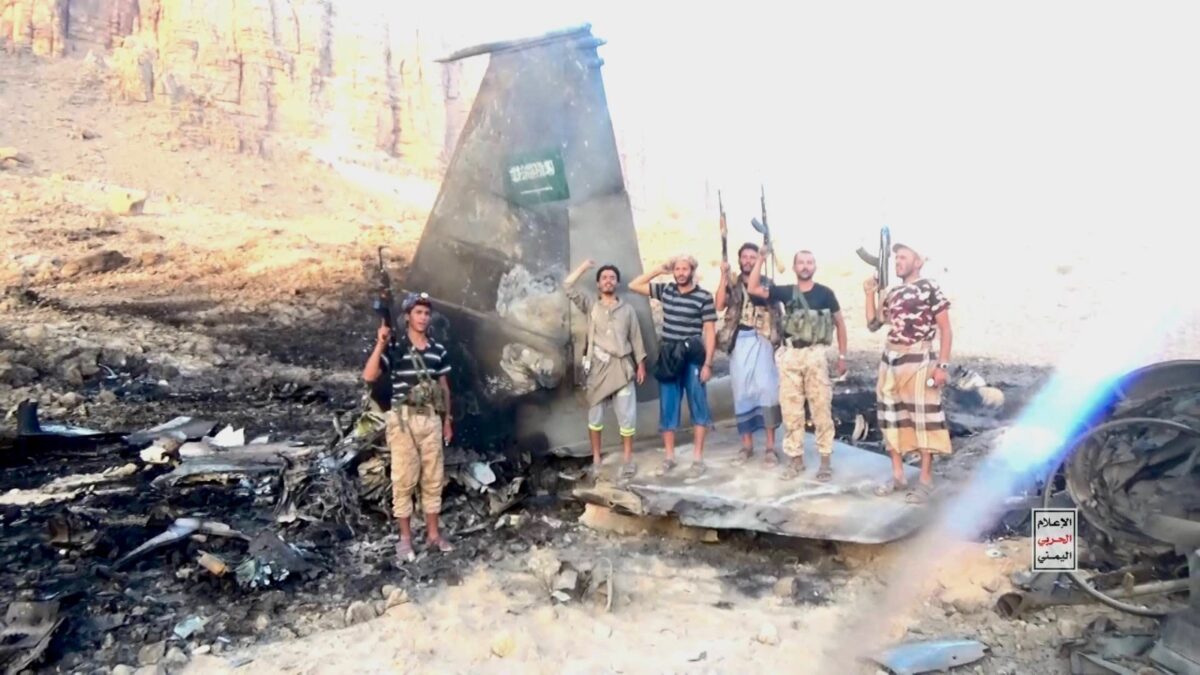
The latest claim of hitting a Eurofighter Typhoon comes nearly a month after the Houthis managed to down an F-15SA, scoring their first kill of a Saudi fighter since the fresh hostilities broke out between the two sides. The aircraft was reportedly downed on September 16, near Marib, using a locally-made surface-to-air missile (SAM), when it was allegedly conducting air strikes in support of the Yemeni troops.
The group published images of the wreckage of the Saudi fighter and the Ansar Allah personnel posing with it, although the fate of the pilots who probably ejected after being hit remains unknown to this day, as the EurAsian Times had also discussed in the past.
Houthis posing with the wreckage of a Saudi F-15SA downed by the group in September 2026 (Via X)
Unlike the F-15SA incident, there is currently no evidence the RSAF Eurofighter Typhoon was hit or crashed after taking the alleged hit.
Notably, advanced 4.5th-generation fighters like the Eurofighter are designed to absorb certain damage. Thus, a hit may not automatically mean a confirmed kill.
If we hypothetically assume the Eurofighter was hit, whether the Typhoon could make it back to the base depends on where it was allegedly struck, how far it was from a friendly base, and how severe the hit was.
The Eurofighter has two EJ200 engines—if one is damaged or fails after a hit, the other could provide enough thrust to keep the aircraft flying with some adjustments, allowing the pilot to land at a nearby safe base. Moreover, the jet features multiple flight-control computers, hydraulic systems, and electrical backups that could keep it controllable even after it loses parts of the airframe, control surfaces, or one of the two engines.
But most importantly, the damage may depend on whether the missile warhead detonated properly or was a near-miss that caused fragmentation.
For now, these crucial details about the alleged hit and damage remain unclear.
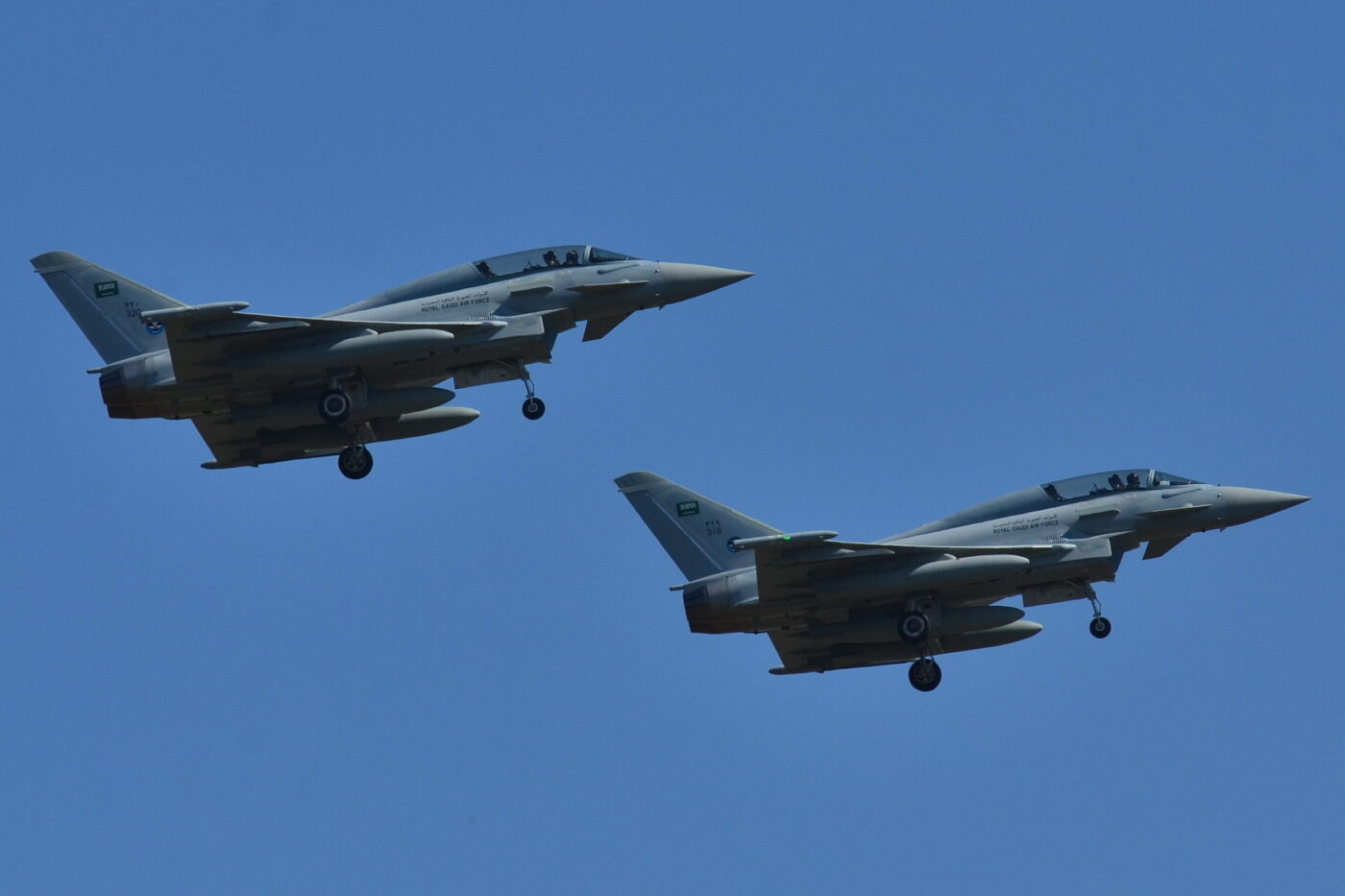
RSAF Eurofighter Typhoons- Wikimedia Commons
While independent verification of the alleged hit is pending and the RSAF has not officially acknowledged any such hit, previous reports suggest that the Houthis had earlier claimed downing a Saudi Eurofighter in October 2017 with a surface-to-air missile over Nihm.
“Yemen’s air defense unit told the country’s Arabic-language al-Masirah television network that the aircraft had been targeted with a surface-to-air missile as it was flying in the skies over Nihm district east of the Yemeni capital city of Sana’a on Friday evening,” Yemen Press had reported. However, no independent source verified the hit at the time.
Earlier this year, Italian Eurofighters sustained some damage during an Iranian strike on a Saudi base, as the EurAsian Times had earlier reported.
However, no combat shoot-down of a Eurofighter Typhoon—built by a consortium of the UK, Germany, Italy and Spain—has occurred anywhere in the world.
This means that if Ansar Allah’s claims are verified and the Eurofighter has indeed been hit and crashed, it would be the first incident involving the type.
It would boost the credibility of the Houthis’ surface-to-air missiles, which they market as “locally manufactured.” For the Houthis, successfully downing a modern, high-performance jet like the Typhoon, with advanced electronic warfare, missile-warning systems, and high-speed or high-altitude performance, would be akin to an endorsement that their air defenses can threaten one of the most capable Western fighters in the Saudi inventory, not just older aircraft.
Saudi Arabia currently operates about 71 Eurofighter Typhoons, so a single loss would not dramatically alter its combat capability or affect operations. However, with tensions running high between the two sides, it would be a major propaganda win for the Houthis and could lead to further escalation if Saudi Arabia launches a stern response.
For now, the EurAsian Times awaits further details about the initial claims.
Contact the author at sakshi.tiwari13 (at) outlook.com
This live blog is now closed, you can read more of our European news coverage here
Just as the leaders sit down at the big table in Brussels, Romania has said that seven people are still missing after a fire on a vessel in Romanian territorial waters of the Black Sea.
Suspected Russian drones have hit several ships off Romania and neighbouring Bulgaria since last week in a spillover from the Ukraine war, AFP reported.
In another boost for Turkey’s aerospace industry, Spain has reportedly decided to acquire additional Turkish Hurjet aircraft, bringing the total purchase to about 45 units. Meanwhile, India’s LCA Tejas and AMCA are trying to catch up with Turkish aircraft.
Mehmet Demiroglu, CEO of Turkish Aerospace Industries (TAI), which produces the Hurjet, said Spain plans to buy 15 additional Hurjet trainer aircraft, in addition to the 30 supersonic jets already ordered in December 2025, Turkey’s state-run Anadolu Agency reported.
“Before we even started deliveries to our Air Force, Spain said, ‘I like it, I want to buy 30,’ and bought them. We signed the agreement,” he was quoted as saying during an event in Türkiye’s northern province of Kastamonu. “We are working toward deliveries in 2028. It is planning to buy another 15,” the CEO added.
Earlier, Spain approved the purchase of 45 Hürjet jet trainers in September 2025 in a €3.68 billion deal led by Airbus Defense and Space España. Under the agreement, the first units are scheduled for delivery by 2028.
The Hürjet is a single-engine, tandem-seat advanced jet trainer and light combat aircraft intended to provide modern combat pilot training, bridging basic trainers and front-line fighters.
It is designed primarily to replace the Turkish Air Force’s aging Northrop T-38M Talon advanced trainers and the Northrop F-5s flown by the Turkish Stars aerobatic team, although the aircraft also supports fighter transition training, aggressor roles, and light combat or close air support missions.
TAI Hurjet. (Credits: Platform X)
Spain, for its part, is acquiring it primarily as a trainer within a complete integrated training ecosystem, rather than as a pure combat aircraft.
In recent years, the Turkish defense industry has made major strides toward indigenization and expanded its export potential, including the Hürjet, the Hürkuş, and the KAAN.
TAI previously said Spain was considering acquiring the KAAN stealth fighter after the collapse of the Future Combat Air System (FCAS) program the country was pursuing with France and Germany, as the EurAsian Times reported at the time.
Separately, Indonesia has already signed a deal to acquire 48 KAAN fighters, along with provisions for extensive collaboration in manufacturing, technology transfer, and engineering, among other things.
Demiroglu added that Hurkus deliveries have begun and will continue in the coming years, citing Azerbaijan as an export market and expressing hopes of additional international sales. Azerbaijan signed a contract at the ADEX 2026 defense exhibition in Baku for 14 HÜRKUŞ-II trainer aircraft, although countries like Niger, Chad, and Libya have already ordered the aircraft, according to publicly available information.
Nonetheless, Hürjet’s export success is strategically more significant than it might first appears. This is mainly because Hürkuş is a relatively simple turboprop basic trainer whose exports matter but are less technologically advanced, whereas the KAAN is far more advanced and prestigious, but its full operational capability and export readiness are years away.
Therefore, the Hürjet sits in the middle: an indigenous trainer or light combat aircraft, and selling it to a sophisticated NATO country proves Turkey can design, certify, produce, and support a high-performance jet aircraft that meets Western standards.
Turkey Takes A Lead Over India
Hürjet benefited from a relatively clean-sheet design optimized for the trainer or light-attack role, a strong political and industrial focus, and a partnership model that made entry into Europe easier.
Turkey began developing the Hurjet in 2017 as an advanced jet trainer with a light combat role. It first flew in 2023, and Ankara is now ramping up serial production, while increasing its local structural content.
By contrast, India’s Tejas program began in the 1980s. The aircraft took its first flight in 2001, but the program remained mired in delays, and induction came much later, in 2016.
Although the Indian Air Force (IAF) has finally received all Tejas Mk1 aircraft after a grueling wait, delivery of the more capable Mk1A, with AESA radar and other upgrades, has yet to begin because of delays in delivering GE-404 engines.
Despite marketing efforts and interest from several countries over the years, Tejas has not secured a major export order. India’s state-owned Hindustan Aeronautics Limited (HAL) has said it prioritizes fulfilling IAF commitments before aggressively pursuing foreign sales.
Meanwhile, Turkey’s defense industry has enjoyed continual high-level prioritization, faster decisions on aircraft variants, and a strategy of securing an early Western reference customer.
The gap is also visible at the fifth-generation level.
Both Turkey’s KAAN and India’s AMCA are twin-engine multirole fighters currently under development. However, Turkey appears to be ahed in the race despite India starting early.
KAAN made its first flight in February 2024, and multiple prototypes have since been flying. The Turkish Air Force has ordered the first 20 Block 10 aircraft, with deliveries to start in 2028. Furthermore, Ankara is steadily advancing development of an indigenous engine for later KAAN jets.
Meanwhile, India’s AMCA is in its industry selection and prototype development phase, with the first flight targeted for September 2028 and service induction planned for 2034–2035. Most IAF experts talking to EurAsian Times have privately doubted this ambitious timeline.
Turkey moved relatively quickly from design to a flying demonstrator and is already iterating with multiple airframes, whereas India has spent longer in the detailed design and industrial-partner selection phase. Moreover, Turkey has maintained a visible, sustained, high-level focus, combined with lessons from parallel programs such as Hürjet and a host of other UAV development programs that helped compress timelines.
Turkey’s success over India in aircraft development programs comes from its experience. In the late 1980s and 1990s, TAI produced 232 Block 30/40/50 F-16s under license for the Turkish Air Force, plus 46 Block 40s for Egypt and later 30 Block 50s. It license-produced the CN-235 transport and maritime-patrol aircraft, Cougar utility helicopters, and SF.260 trainers.
TAI also performed extensive F-16 electronic-warfare and structural upgrades for Turkey, Jordan, and Pakistan; converted Boeing 737s into AEW&C platforms; participated in the A400M program; and developed the Anka UAV family.
Additionally, the country has also fielded the T129 ATAK attack helicopter and, in 2023, flew the heavier twin-engine T929 ATAK 2, while producing light and medium utility helicopters.
These programs, along with a political drive to become a major arms supplier and the Turkish Armed Forces Foundation’s institutional role in the defense industry, have accelerated progress.
“Their desire to lead the Islamic world as its most powerful nation and become a major arms supplier has taken Turkey forward in defense production. Also, the Turkish Armed Forces Foundation holds a large shareholding in military industries, and it has its own dynamics,” Air Marshal Anil Chopra (retd) argued in a previous EurAsian Times article, referring to Turkey’s achievements.
“India has to learn from Turkey’s successes in unmanned platforms. They are also ahead in helicopters and transport aircraft. Turkey is clearly way ahead in the fifth-generation fighter program,” Chopra further noted.
As for Turkey, Hürjet’s NATO export breakthrough and faster KAAN development demonstrate that Turkey has established a measurable lead over India in the pace and export conversion of combat-aircraft development in recent years.
Contact the author at sakshi.tiwari13 (at) outlook.com

 Login