❌

Reading view

In Defence of Theonomy

This work will examine the criticisms made of Theonomy by Matthew Cliff of Brisbane School of Theology.

Mr. Cliff set out to speak on the Abortion Abolitionism movement by primarily criticising Theonomy, in which he says “shapes and drives the entire AA movement,”[i] to which we now find ourselves talking about it. I’m grateful to Mr. Cliff for stepping into this arena in critiquing Theonomy. Theonomy, rather than a movement, is the theological position where God’s Law is upheld, believing it is abiding today, that it remains the just standard, righteous and sufficient to deal with all of life’s endeavours.

While it is true that there is a connection between Abolitionism and Theonomy, Mr. Cliff is correct in noticing that not all Abolitionists are theonomists, but all theonomists (to some extent) are abolitionists.[ii] The simple explanation is that the abolitionists uphold the Law of God on this one point of murder and how it ought to be dealt with in accordance with scripture.

I grant that there is connection here, but there are plenty of Christians who consciously choose to not label themselves as theonomists while they proclaim the Law of God on the streets within Abolish Abortion Australia, and that’s fine. Indeed, I am a member of Abolish Abortion Australia. Primarily however, I will set out to defend Theonomy that is often associated with Abortion Abolitionism.

Addressing the Critique

Part 1

While I thank Mr. Cliff for attempting to bring to light theological errors of Theonomy, how and where he takes the position of arguing from needs to be taken into consideration seriously. On page eight of his critique, he explains the contrast between what he calls the Classical position over against the Theonomist position, and in doing so, argues that the “ceremonial” (i.e. sacrificial) laws have been fulfilled in Christ, to which he rightly points to Hebrews 9. But in his reasoning for the fulfillment of the civil laws in particular, his position from arguing shifts to a footnote.[iii] Why is this the case? I think because it is not as easily answered as with what is explicitly stated in Scripture, so he had to appeal to a fallible source. I would not have a problem if what the footnote contained was in scripture, but it is not.

Moreover, in contrasting the theonomic position with the classical, Mr. Cliff rightly quotes Greg Bahnsen, but then goes on to describe his position as being “an inherently political project,”[iv] as if Bahnsen had forced a chic idea onto the Bible. This is grossly untrue.

Preceding this point on page seven, Mr. Cliff referred to the idea made by Ligon Duncan that theonomists do not want a biblical ethic, but the ethic of the Sinai Covenant.[v] This is a big charge against the theonomists. If this was true, theonomists do not take into

consideration the New Covenant, making us Judaisers, cutting us off from the faith therefore. If there was an ethical distinction between “biblical ethics” and “Sinai Covenant ethics,” those distinctions would be covenantal, thereby disastrous if the theonomists seek Sinai ethics over [all-encompassing] biblical ethics.

I purposely lined those criticisms up to go to what must be said before we get too hasty. What Bahnsen argues is actually an argument from Scripture. His central thesis in Theonomy In Christian Ethics, a work cited by Mr. Cliff, lays out the basis for the continuing validity of God’s law. And the text Bahnsen uses is Matthew 5:17-19:

Do not think that I came to abolish the Law or the Prophets; I did not come to abolish but to fulfill. For truly I say to you, until heaven and earth pass away, not the smallest letter or stroke shall pass from the Law until all is accomplished. Whoever then annuls one of the least of these commandments, and teaches others to do the same, shall be called least in the kingdom of heaven; but whoever does and teaches them, he shall be called great in the kingdom of heaven.[vi]

In his thesis, Bahnsen spends 47 pages[vii] working through this text, and what do we find? Many things, but most importantly, conclusions from sound exegesis and sound hermeneutical methodology. From Bahnsen, “The concern of Jesus in Matthew 5:17-19 is to make clear that His purpose is not to abrogate the Older Testamental law.”[viii]

In responding to the two criticisms made, firstly, while it is true that Bahnsen was political, that is not his starting foundation. Bahnsen sought to answer the question of what we ought to be doing, and in this case, within the sphere of law. Bahnsen maintained that there is no other standard under heaven by which men must walk in, since it continues.

Secondly, to address the charge made that theonomists seek the Sinai ethic over against the Biblical ethic, we need to ask ourselves, do theonomists hold to this? If we mean by “Sinai ethic” to be the Law given on Sinai apart from further biblical revelation, then no, we reject that. These categories are misconstruing and are irrelevant. Theonomists do not ignore further revelation, as Bahnsen points out,

“[I]f I were to continue the ritual observances under the New Covenant, I would be despising the final accomplishment of salvation in Christ.”[ix]

So then, how can Bahnsen defend himself with a potential charge of leaving out aspects of the Law whilst claiming that all of the Law is presumed to continue? Bahnsen continues,

“The New Testament shows the Christian how to “see” the ceremonial laws fulfilled in Christ and His redemptive economy (e.g., passover is seen in the Lord’s supper). Thus the change in outward form of observance is grounded finally in the teaching of God’s word and is not arbitrarily brought to the data of the Bible as an extraneous model. Hence also the New Testament is showing the believer how it is that the ceremonial law is not abrogated but fulfilled in Christ for us.”[x]

And he further states,

“Only scriptural authority is sufficient to alter the observance of any law from God, and only Scripture can be taken as the basis for characterizing any law as typological or ceremonial.”[xi]

What Bahnsen gets at is that it is not up to us, or from secondary sources, to determine what classifies as ceremonial or typological, but that of only Scripture interpreting Scripture.

While it is true that the theocracy of Israel has vanished as a political entity, how does this fact correspond with scripture equipping us for every good work (2 Timothy 3:17) in light of God’s kingdom mission to reconcile all things to Himself (Colossians 1:20)?

Part 2

Moving on, the next line of criticism to address is on the Kingdom of God. On page ten, Mr. Cliff points to the position where the Kingdom of God is actually the “church”.[xii] To know what the Kingdom of God is, we have to ask what the nature of the Kingdom is, the domain of the Kingdom, and the mission of the Kingdom. If the Kingdom of God is the church, is the nature of his Kingdom, then, individual Christians, and that its existence is

dependent on Christians? Is the domain of the kingdom the local church? Is the mission of the kingdom to bring people to church? Unfortunately, Mr. Cliff conflates the roles of the Kingdom of God with the Church, thereby reducing the Kingdom of God to the church, as Joseph Boot comments:

“Because the institutional church is rightly limited in its role and jurisdiction in the Christian life and in human society, whenever and wherever an unscriptural dualism reigns, where artificial separations of nature and grace, law and gospel, creation and redemption are propounded, God and his Word become theoretically imprisoned in the church, and Christ’s reign is faithlessly limited to one sphere of life.”[xiii]

Boot is correct in noting that the institutional church indeed has its jurisdictions, and if the Kingdom of God is contained within the church, then the Kingdom of God is hindered by the church’s limitations amongst the rest of creation, spheres and institutions. Does the church do missions? Absolutely, the people of God apart from the institutional church ought to be operating under God’s Kingdom jurisdiction, which is not the institutional church.

If we confuse the Kingdom of God with the church, then the only time you’re operating within the Kingdom is when you’re serving within the institution, which sounds a lot like the Roman church. The nature of the Kingdom is spiritual (John 18:36), the domain of the Kingdom is all of creation (Matthew 12:28-29, Romans 8:19-21) and the Mission of the Kingdom is to glorify God in the expansion of the reign of Christ through His people; the Universal Church (Matthew 28:18-20, Colossians 1:15-20, Matthew 6:10, Psalm 110:1-2, Matthew 13:31-32).

Why did I take time to criticize Mr. Cliff’s view of the Kingdom of God? Because how you view the Kingdom of God shapes how you look at the Law (commands) of God. If God has nothing to say about law, the family, education, economics, science, or gardening, and is not under the jurisdiction of God’s rule, then obviously Christ did not come to restore it, and no good, law and order can come out of these spheres. Boot again,

“But Christianity, the true gospel of the kingdom, cannot be locked up within a single institution any more than it can be corralled into the enclosure of individual salvation from the consequences of sin. For salvation, which implies total wholeness and restoration, is also deliverance from the power and corruption of sin. The scope of salvation is as broad as the scope of the Fall. Clearly then, the faith of the gospel is centered in and focused upon Christ Himself, not in an institution.”[xiv]

I disagree with Mr. Cliff that the Kingdom of God does not manifest itself physically, since its domain certainly does (i.e. the earth, Isaiah 66:1; Matthew 5:35a). Only by implication through the rule of Christ, and not from roots found within an earthly or worldly source,[xv] is where we see His rule on earth be manifested, as He has all authority in heaven and on earth.

Therefore, applying it to AA, justice in proclaiming the Law of God on the streets to combat the cultural issue of abortion is Kingdom work by those, obviously, who are part of the Universal Church outside of the institution. If the Kingdom of God does not encompass law and government, then scripture does not speak on it, nor is it redeemable. But we know that it does and what it ought to look like.

Part 3

Much that has been said so far in the critique has answered much of the misunderstandings and errors of Mr. Cliff. In his next section, on page twelve, he gets into the question of how believers should relate to the Mosaic law in light of Christ and the new Covenant. We have already dealt with what Jesus had to say in Matthew 5:17-19, that the law is binding, as our Lord warns not to annul any of them (Matthew 5:19). So what about now that we are in the New Covenant?

Let us recall what is new about the New Covenant and what the first benefit entails: God will put His Law on our heart (Jeremiah 31:33; Hebrews 8:10). Part of the New Covenant benefit is that we are able to, by our affections bestowed upon us, approach God, as well as keeping His commandments (John 14:15); our affections are also set upon the Law of God (Psalm 119; Ephesians 2:10, Romans 8:4).

I agree with the scripture quotations used in this section of his critique[xvi] in reference to what typological events have taken place, but only by the hermeneutical method he accuses theonomists of using: that the law is binding unless stated otherwise.[xvii]

I wonder, though, what law were the apostles operating under in their ministry, as the Law of God apparently has no “determinative role among God’s people.”[xviii] The law of Christ, then? That would work if that is defined by what He said in Matthew 4:4 and 5:17-19, that the Law still has a central and determinative role in all of life for the Christian (cf. 1 John 5:2-3).

Part 4

The term “General Equity” has definitely played a massive role in the early theonomic tradition, particularly to Bahnsen, who evidently desired to remain within the bounds of the Westminster Confession of Faith.[xix] I do not share his sentiment. I believe “General Equity” has actually made Theonomy more ambiguous in its enforcement.[xx] This becomes relevant now to the “General Equity” of law in the Bible in pages 13-14 of the critique.

On the not uncommon idea, propounded by Mr. Cliff, that we can define the parapet law in its General Equity to mean the government can enforce workplace regulations, building codes, and public safety laws,[xxi] is to miss something extremely important: the jurisdiction of the government. In God’s Law, there is no legislative function apart from what has been given to the people (Deuteronomy 4:2; Deuteronomy 12:32).

The unwitting assumption that man or the government have this prerogative unconsciously shows us that the state ought to be autonomous, likely due to tradition and how drenched we are in this kind of rule in the West. But in fact, the reader may notice that along with the parapet law in Deuteronomy 22:8 there is no penalty assigned to failing to put up a parapet.

If, as Mr. Cliff suggests, we legislate a principle of the Law of God whereby it does not have a penalty, ought it be a punishable law? In fact, under manmade legislation, there would be an arbitrary penalty assigned to it, causing injustice and unproductiveness. Legislating is a prerogative only God has. Therefore, this interpretation of the “historic Reformed meaning,”[xxii] as well as the General Equity position, are unqualified when it comes to 21st-century theological development, because both positions hold an outdated view of the legislative function.

On this, Chris Hume says plainly, “There is a place for law, but it must be limited to what the Triune God, in the Bible, has legislated.”[xxiii] God in His law does not prescribe the state to enforce workplace regulations, building codes, and public safety laws – that is entirely up to the enterprises if they so choose within their sphere of operation (Something altogether foreign to our world currently).

Part 5

Now, up to page fifteen, we see the issue of hermeneutics come up. Briefly touched on earlier, Mr. Cliff criticised Bahnsen’s hermeneutics stating, “The error is that theonomists begin with continuity and require explicit New Testament repeal before civil laws can be set aside.”[xxiv]

In light of Bahnsen’s appeal and expansion of Matthew 5:17-19 in Theonomy in Christian Ethics, I object to Mr. Cliff calling it erroneous because it is Scripture that qualifies this continuity, thus putting the burden of proof on my opponent for his hermeneutics. And was it not true that explicit New Testament repeal was needed to qualify the antitypes pertaining to the sacrificial laws? It is this same consistent hermeneutic, same treatment of the whole law of God, that Bahnsen uses as his hermeneutic.

Instead, Mr. Cliff wants to offer the “Classical Reformed” hermeneutic that you need to “begin with discontinuity that was introduced through fulfilment of the Mosaic covenant through Christ.”[xxv] Could he possibly be referring to Matthew 5:17-19, where Jesus came not to abrogate, but to fulfil? I do not see that or where he is coming from here, he may need to clarify.

We do not deny redemptive history; there is a New Covenant. But the Church cannot wield the sword to punish those who do evil; that is the job for God’s minister, the delegated authority in this sphere; the powers (Romans 13:3-4). How would an authority know if he is not committing murder when he wields the sword? How would Mr. Cliff know, too?

Part 6

There seems to be an endorsement from Mr. Cliff in “seeing society shaped by biblical principles.”[xxvi] There’s an objection from me here, however.[xxvii] Would these Christian values be Christian values if they conflict with the Law of God? Mr. Cliff also unopposed Christian Reconstructionism “in principle” – just without theonomic ethics.[xxviii] Nonetheless, I think we are getting to the heart of the issue here:

“[T]he objection is to the confusion that arises when the civil legislation given to the theocratic nation of Israel is applied to modern, non-theocratic states.”[xxix]

Interestingly enough, I agree. We cannot expect to enforce God’s judicial Law within a man-made form of government. The Law, as well as the form, must be in accordance with God’s Law (Theonomy). Our current system will not last due to its imperfections, but God’s revealed form of government is perfect, and therefore appropriate to enforce the Law of God. Man with God’s Law in his hands cannot legislate God’s Law because God’s Law contains the form of government to dispense the Law of God righteously and justly.

What good is having the death penalty established for murder if you only need one witness to convict? What good is there in punishing delinquents if they’re protected by the state for crimes that, according to the Bible, would result in the death penalty? What good is having a state, or a politician, that upholds Christian values and passes conservative laws, but taxes you, all the while imprisoning you for not paying tax in the same breath?

These issues would not be systemically susceptible under a theocracy. How much evil would be done against the Law of God if we try to keep the man-made system while attempting to “establish His Law” (Romans 3:31)? So I agree wholeheartedly on this point by Mr. Cliff, not that it nullifies what God requires, but rather points to the fact that we need to think outside of our current man-made form of government.

Part 7

Now we get to see Mr. Cliff’s view of the appropriate response to the authority over us Christians in our context. Under the New Covenant, he claims, “[T]he Christian approach to law and government is characterised by holding together two complementary biblical commitments: [Respectful submission to civil authorities and unwavering primary allegiance to God.][xxx]

Mr. Cliff takes on the view of the authorities whereby you must, essentially, obey whatsoever they ask you unless it contradicts Scripture (and/or their conviction, generally). In his listing of the Christian approach to law and government, he neglects to include the obligations of the government (ruler) to function as a “minister of God.” (Romans 13:1, 4; 1 Peter 2:14) I will allow Bahnsen to speak for himself on Mr. Cliff’s view taken from Theonomy in Christian Ethics[xxxi]:

“The positivistic approach to Romans 13 has been found to produce highly suspect conclusions in the past, some being willing to go so far as to grant autonomy to the state. Others have maintained that Paul is saying that all governments have divine approval of such a character that the Christian would be morally culpable for disobeying the government except where preaching the gospel was prohibited. Beyond that no ethical criteria can be laid upon the state, and the believer has a strong obligation to have a positive and patriotic attitude toward whatever government is in power.”[xxxii]

I don’t have doubt in my mind that Mr. Cliffe wants to be as reasonable as possible with the circumstances we are in, but to submit to the government without having a higher law for them to submit opens up totalitarianism. Bahnsen again,

“It is quite clear that Romans 13 has two elements in it: practical ethics and normative description …what is expected of the Christian and what is expected of the state.”[xxxiii]

Final thoughts

In conclusion, all that is said about the theological foundations of Theonomy, it is founded upon the Word of God; the whole Word of God. Matthew 5:17-19 is clear that Jesus came not to abolish but to fulfil (the antonym for abolish).[xxxiv] In the end, what indeed is Mr. Cliff’s view of the state? How ought it function, and by what standard do they operate under?

Surely the state is not a law unto itself; autonomous. We can agree that the covenant community is not a nation-state, but it is the Universal Church. But that isn’t what is at stake. What’s at stake is what then ought the state be doing as God’s deacon (Romans 13:4)? And, what ought they not be doing?

I do not believe you can be doing “salt and light ministry”[xxxv] while neglecting the very point of contact of those various ministries; doing Matthew 5:13-16 while ignoring 5:17-19. If law and order is not founded upon the whole council of God, then it is founded upon a different foundation; a foreign and pagan foundation. We know that the Word of God contains everything we need for being equipped for every good work (2 Timothy 3:16-17), and we also know that the Law is good if one uses it lawfully (1 Timothy 1:8-11). God’s minister, the powers, is a good work that God’s Word encompasses. To finish full circle with Bahnsen,

“The civil magistrate has been commissioned by God to punish workers of evil in society; this is his task and proper function. His ministry is not in vain as he executes penal justice on criminals, for he has been “ordained” and “sent” by the Lord of Justice Himself…not simply [in] God’s decretive will, but God’s preceptive will––and he sins should he fail to do so [as God’s instrument].”[xxxvi]


[i] Cliff, Matthew, “Abortion Abolitionism”: A Theological Critique, 3.

[ii] Ibid., 6.

[iii] See Ibid., 8.

[iv] Ibid., 9.

[v] Ibid., 5-6.

[vi] Matthew 5:17-19 LSB

[vii] In the 3rd (2002) edition.

[viii] Greg L. Bahnsen, Theonomy in Christian Ethics (Nacogdoches: TX. Covenant Media Press, 2002), 54

[ix] Bahnsen, Theonomy, 208.

[x] Bahnsen, Theonomy, 213.

[xi] Ibid.

[xii] See Cliff, “Abortion Abolitionism”: A Theological Critique, 10.

[xiii] Joseph Boot, Think Christianly: Developing an Undivided Mind (Ontario: Canada. Ezra Press, 2025), 98.

[xiv] Ibid.

[xv] Cf. John 18:36.

[xvi] See Cliff, “Abortion Abolitionism”: A Theological Critique, 12

[xvii] Ibid., see 16.

[xviii] Ibid., 12.

[xix] Along with the Catechisms, See Bahnsen, Theonomy in Christian Ethics, 35.

[xx] While I can see a “General Equity” function within the revealed form of government in adjudication, General Equity Theonomists, however, want to Legislate the “General Equity”.

[xxi] Cliff, “Abortion Abolitionism”: A Theological Critique, 14.

[xxii] See ibid.

[xxiii] Chris Hume, Seven Statist Sins (Lancaster: PA. The Lancaster Patriot, 2023), 48.

[xxiv] Cliffe, “Abortion Abolitionism”: A Theological Critique, 16.

[xxv] Ibid.

[xxvi] Ibid., 16.

[xxvii] For a further read of my objection to having “Christian Values,” the link to my article is found here: https://www.caldronpool.com/p/are-christian-values-enough?utm_source=publication-search

[xxviii] See Cliffe, “Abortion Abolitionism”: A Theological Critique, 16

[xxix] Ibid., 16-17.

[xxx] Ibid., 18

[xxxi] Greg Bahnsen spends an entire chapter, titled “The Civil Magistrate in the New Testament,” addressing and looking closely at Romans 13 and relevant passages.

[xxxii] Bahnsen, Theonomy, 357.

[xxxiii] Ibid., 361.

[xxxiv] Bahnsen deals with what “fulfil” entails in Matthew 5:17 on pages 54 to 74 in Theonomy, comparing and refuting various interpretations of it.

[xxxv] Cliff, “Abortion Abolitionism”: A Theological Critique, 18.

[xxxvi] Bahnsen, Theonomy, 369-370.

  •  

L'État est-il trop ruiné pour rétablir l'ordre dans les rues ?

Par Eric V.

2 397 interpellations, 997 policiers et gendarmes blessés, et ce dimanche soir encore des pillages au Châtelet. Dans les commissariats, une autre alarme circule : l'argent manque pour les munitions. Le budget 2027 réduit de 7 % les crédits d'équipement de la police. La charge de la dette, elle, prend 10 milliards.

L'État est-il trop ruiné pour rétablir l'ordre dans les rues ?
LE COURRIER
DES STRATÈGES
Restez libre !
L'État est-il trop ruiné pour rétablir l'ordre dans les rues ?

LA NEWSLETTER · GRATUITE

Le Courrier,
chaque matin.

L'essentiel de l'actualité, passé au crible par les cinq plumes du Courrier. Dans votre boîte, chaque jour ouvré.

Gratuit. Vous restez libre de partir quand vous voulez.

JE M'INSCRIS lecourrierdesstrateges.fr
lecourrierdesstrateges.fr
Restez libre !

Dimanche, 20 heures. Au lendemain d'une journée où l'hôtel de ville de Limoges a brûlé, où la résidence de la préfète de Bordeaux a été saccagée, où des magasins ont été pillés à Paris et à Marseille, Emmanuel Macron parle aux Français. Il promet que « ceux qui ont détruit doivent payer, ceux qui ont cassé doivent rembourser ». Il annonce une cellule de crise pour les victimes, promet la « transparence » sur le dispositif de samedi, demande au ministre de l'Intérieur de tirer les leçons en matière de renseignement et d'anticipation. Pas un mot sur les effectifs. Pas un mot sur les moyens. Au même moment, CNews signale des pillages en cours au Châtelet, forces de l'ordre en route.

Deuxième soir. Même scène.

Que manque-t-il encore pour constater l’insurrection ?
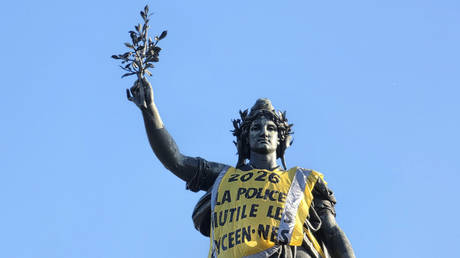
Limoges a brûlé, la police a été débordée, Le Parisien titre « insurrection ». Il manque encore trois choses : un fauteuil, une défection, une date.
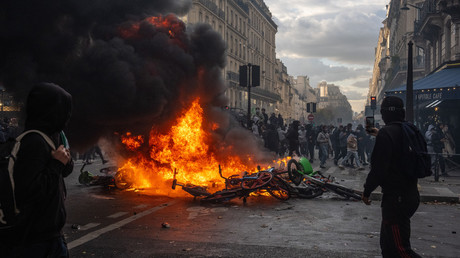
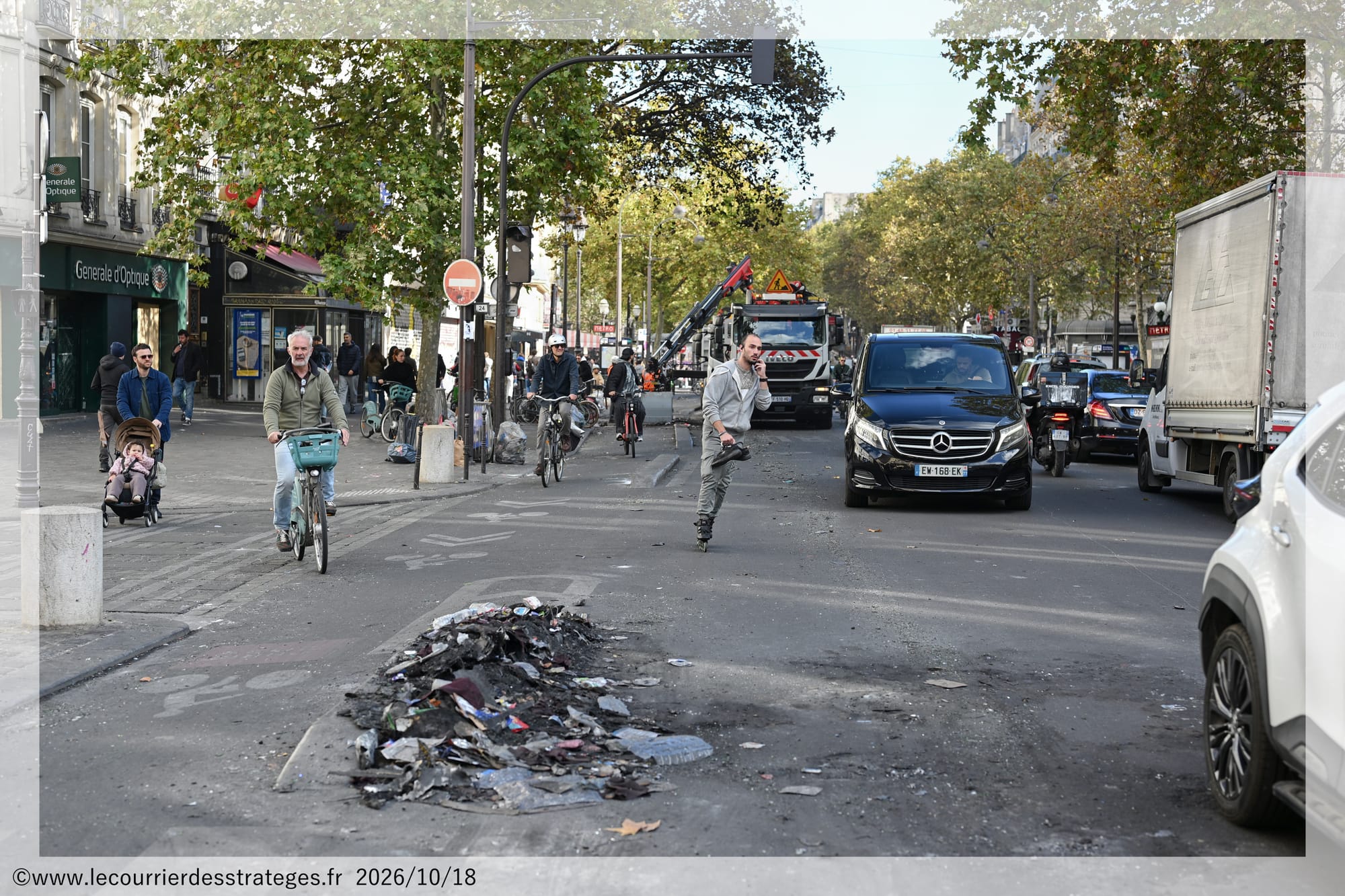
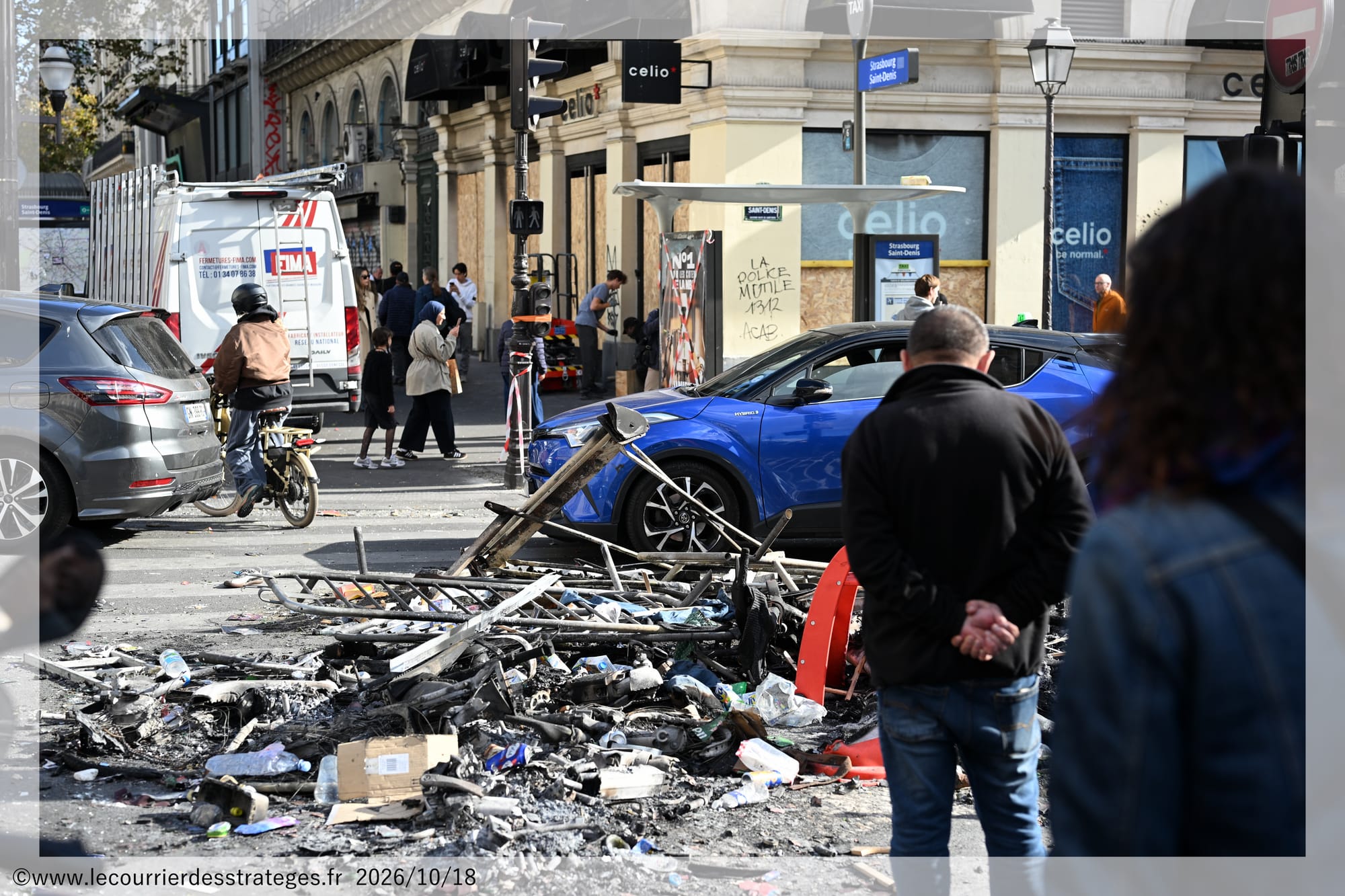
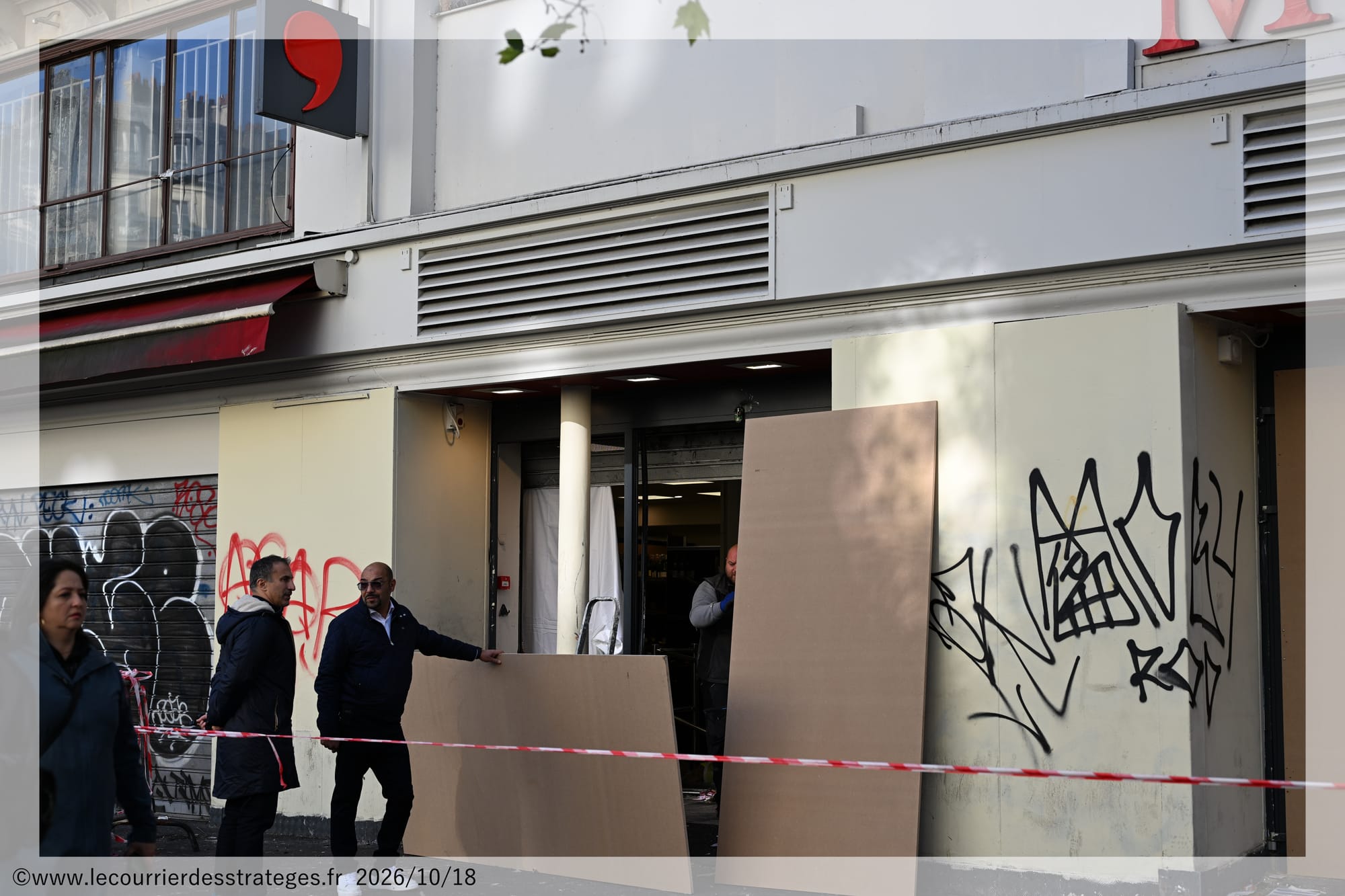
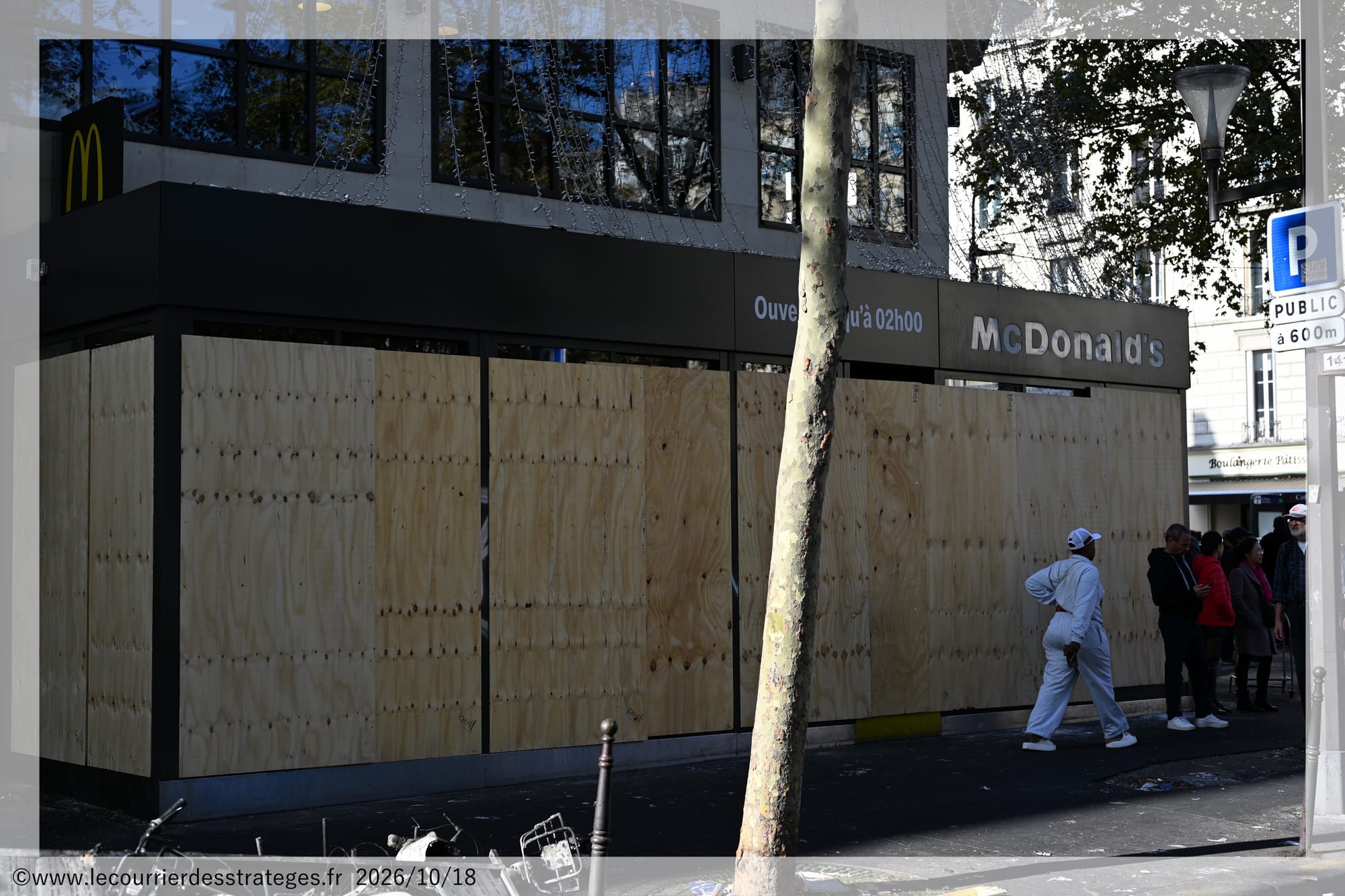
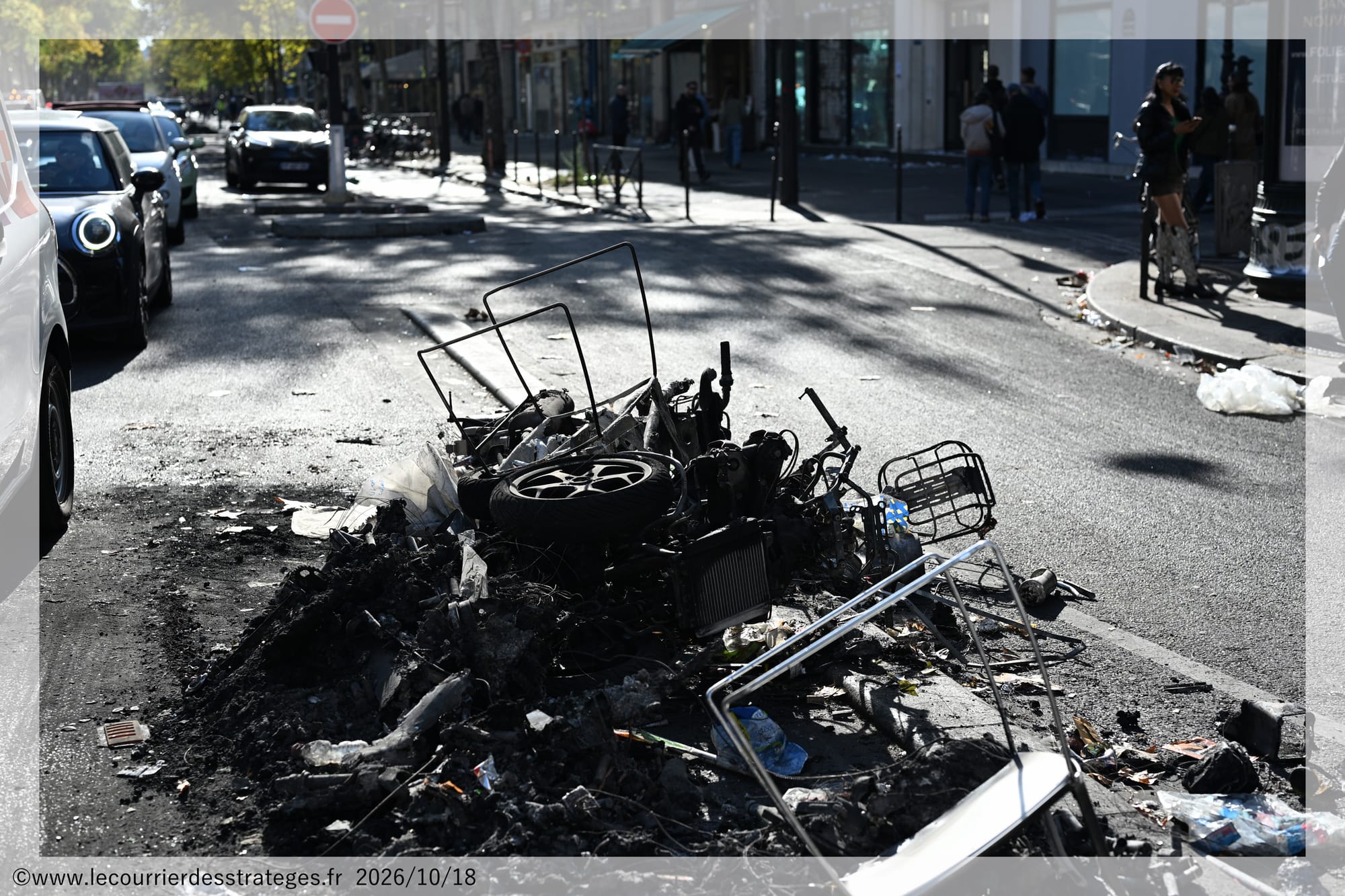
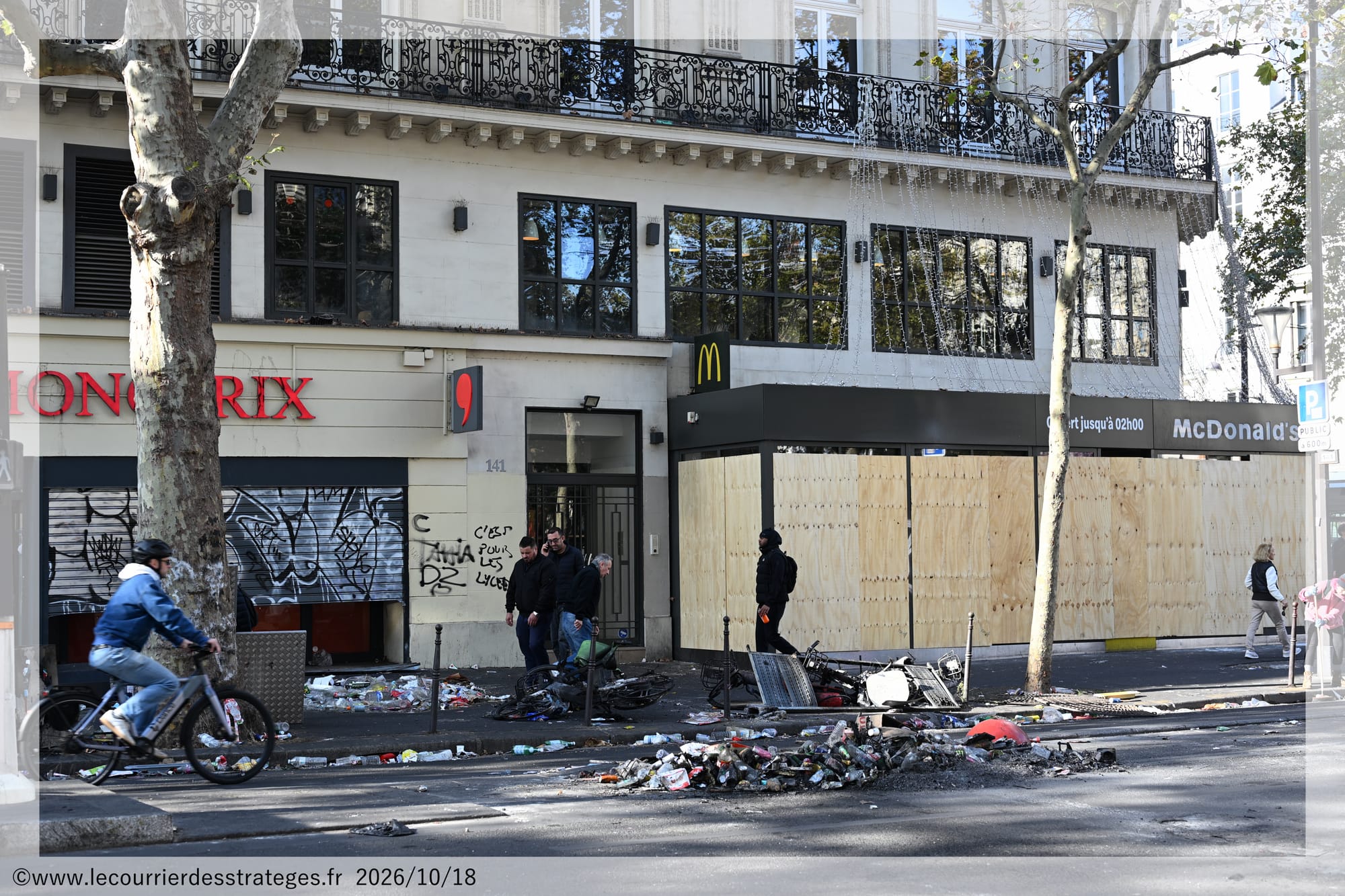
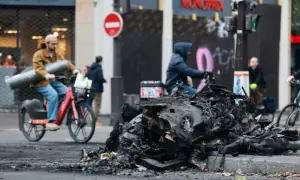
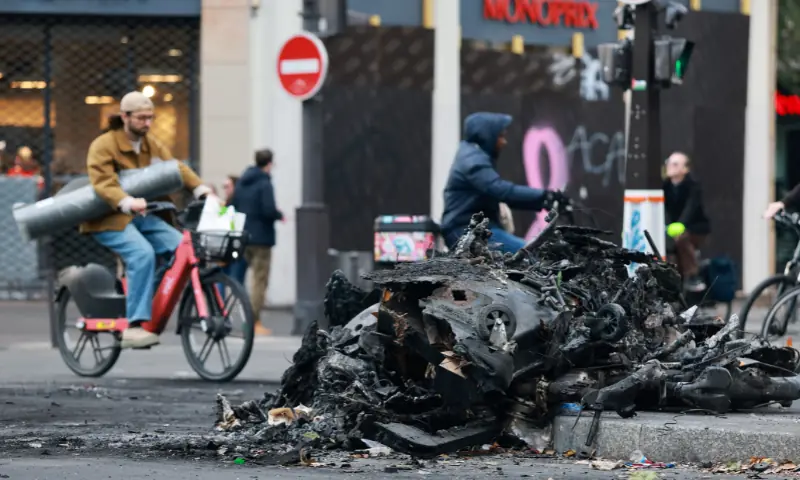
Dégâts à Paris : quelques images pour illustrer l'ampleur de ce qui se passe
Quelques images des très importants dégâts à Paris après la journée insurrectionnelle du 17 octobre
Reportage : mais qui donc a livré Paris aux incendiaires ?
La manifestation, proche de l'insurrection a lourdement dégénéré, notamment à Paris. Reportage sur un moment hyper-violent.
Ne manquez pas nos vidéos exclusives gratuites

Si vous voulez voir les vidéos exclusives des manifestations, rejoignez notre chaîne Telegram gratuite en cliquant sur ce lien :

J'ai Télégram et je rejoins gratuitement la chaîne
L'État est-il trop ruiné pour rétablir l'ordre dans les rues ?
LE COURRIER
DES STRATÈGES
Restez libre !

ABONNEMENT

Allez au fond
des choses.

Deux grands formats par jour. Les cinq plumes du Courrier. La série Sécession, le dimanche.

Le monde commente. Vous, vous comprenez.

S'ABONNER lecourrierdesstrateges.fr
lecourrierdesstrateges.fr
Restez libre !

Ce qui remonte des commissariats

Plusieurs sources internes à la police nationale, interrogées par le Courrier, décrivent la même chose : des alarmes lancées en interne depuis des mois sur

  •  

Wainwright Explosion: 7 Dead in Tragic Canadian Military Base Fire

Wainwright explosion at Canadian Forces Base in Alberta leaves at least seven people dead.

Wainwright explosion at a Canadian military base kills at least seven and injures dozens as officials rule out terrorism and investigate the deadly fire.

Related: Carney Warns Against External Attempts to Divide Canada


Wainwright Explosion Kills at Least Seven at Canadian Base

The Wainwright explosion at Canadian Forces Base Wainwright in Alberta has left at least seven people dead and dozens injured, according to reports by CBC News and Global News.

The incident occurred on Saturday, October 17, during a live-fire training exercise at the military base, located approximately 200 kilometers southeast of Edmonton.

Canada’s Department of National Defence confirmed that a fire broke out in the training area at approximately 4:00 p.m. local time. The Canadian Armed Forces said the blaze resulted in fatalities and injuries but has not yet released an official casualty count.

Military sources cited by Canadian media said the explosion occurred when a munition used during the training exercise struck a natural gas line or gas well.

The impact reportedly triggered a large detonation and a fast-moving fire that spread beyond the boundaries of the training area.

High winds, with gusts reaching up to 100 kilometers per hour, helped the flames spread rapidly through dry grassland and nearby rural areas.

The Canadian Armed Forces said emergency responders from military and civilian agencies worked quickly to contain the fire and assist those affected.

By Saturday evening, the Municipal District of Wainwright said the fire was being held and that property and critical infrastructure had been protected. Authorities did not order an evacuation of residents in the surrounding area.

The Department of National Defence said the full extent of the impact remains under assessment. It added that casualty details will not be released until relatives have been notified.

The government has ruled out terrorism as a possible cause. Officials said there were no indications that the explosion was connected to an attack or deliberate act of violence.

The incident has nevertheless prompted a major investigation involving the Canadian Armed Forces, the Department of National Defence and the Royal Canadian Mounted Police.

🔥🇨🇦 Un "incidente grave" provocó un gran incendio en la base militar canadiense de Wainwright, Alberta.#teleSUR #Canadá pic.twitter.com/y9jylOuH7P

— teleSUR TV (@teleSURtv) October 18, 2026

Wainwright Explosion Triggers Major Emergency Response

Canadian Armed Forces statement | Alberta Health Services

The Wainwright explosion activated emergency protocols across hospitals in the Edmonton region.

Local health authorities declared a code orange alert, a designation used for external disasters or mass-casualty incidents.

Injured personnel were transported to hospitals including the University of Alberta Hospital and the Royal Alexandra Hospital in Edmonton.

Medical teams prepared for a large number of patients with burns, trauma injuries and respiratory problems caused by smoke and toxic gases.

Firefighters faced difficult conditions because the fire involved both explosive material and hydrocarbon infrastructure.

The combination of live ammunition, natural gas and dry vegetation created a complex emergency that required coordination among military firefighters, civilian fire departments and specialized rescue teams.

Strong winds made the fire difficult to control and increased the risk that flames could spread to nearby communities.

Authorities asked residents to avoid the area so that emergency vehicles could move freely and rescue operations could continue without obstruction.

The Wainwright area is home to one of Canada’s largest military training facilities. The base is used for live-fire exercises involving tanks, artillery, infantry units and other military equipment.

CFB Wainwright is also an important NATO training site. Allied forces from several countries use the installation for exercises designed to improve interoperability and combat readiness.

The base covers a vast rural area and includes training ranges, administrative facilities, housing and support infrastructure.

The explosion occurred during a routine training exercise, according to the Department of National Defence. Officials have not identified the unit involved or the type of munition used.

Investigators will need to determine whether the incident resulted from an error in targeting, a malfunction in the munition, inadequate safety procedures or an unexpected hazard related to the gas infrastructure.

The Canadian Armed Forces said the immediate priority is supporting those affected and notifying their families.

The names of the victims have not been released. Officials said identification and notification procedures are ongoing.

Prime Minister Mark Carney confirmed on Sunday that four service members had died. He said dozens more were seriously injured and described the fire as one of the worst peacetime tragedies affecting Canada’s military on domestic soil.

“Our thoughts are with all the brave women and men affected,” Carney said.

The prime minister said his government was working closely with the Government of Alberta and local authorities.

He added that he and Alberta Premier Danielle Smith were in close contact, along with their respective ministers and relevant officials.

Defence Minister David McGuinty traveled to Edmonton on Sunday to monitor the investigation. He said the situation remained “very active and delicate.”

McGuinty said the Royal Canadian Mounted Police were participating in the investigation and that authorities would provide further information once the facts had been established.

🇨🇦 Al menos siete muertos y decenas de heridos dejó una explosión e incendio en la base militar CBF Wainwright en Alberta. #teleSUR #Canada pic.twitter.com/tSvGpCS0Bi

— teleSUR TV (@teleSURtv) October 18, 2026

Canada Investigates Military Training Safety

Canadian Armed Forces | Royal Canadian Mounted Police

The Wainwright explosion has raised questions about safety procedures during live-fire exercises at military bases.

Live-fire training is essential for preparing soldiers for combat operations, but it also carries significant risks when it takes place near explosive or flammable infrastructure.

Military authorities regularly conduct risk assessments before exercises to identify hazards, establish safety zones and coordinate emergency responses.

Investigators will examine whether those procedures were followed and whether the presence of gas infrastructure near the training area was properly identified.

They will also review weather conditions, ammunition handling, communication between units and the response of emergency teams.

The investigation could lead to changes in training protocols, safety distances, mapping procedures or the coordination between military and civilian authorities.

The incident occurred during a period when Canada has been increasing military preparedness amid global security tensions.

Canada is a member of NATO and has supported allied operations in Europe and other regions. The country has also increased investment in defense capabilities in response to international instability.

CFB Wainwright plays a central role in that effort because it provides space for large-scale training exercises involving Canadian and allied forces.

The base has hosted soldiers from NATO member states and partner countries. Its facilities allow forces to train in conditions that cannot easily be reproduced at smaller installations.

The explosion could therefore affect training schedules and force readiness in the short term.

Military authorities may suspend certain exercises while investigators examine the site and review safety procedures.

The incident also highlights the risks faced by military personnel during routine operations. Training accidents can occur even when soldiers are not deployed in combat zones.

The Canadian Armed Forces has expressed condolences to the families of those killed and injured.

Officials have asked the public to avoid speculation while the investigation continues. They have also urged people to rely on official statements rather than unverified reports circulating on social media.

Geopolitical Context

The Wainwright explosion has implications for Canada’s military readiness and its role within NATO.

Canada has increased its defense commitments in recent years amid tensions involving Russia, the Middle East and the Indo-Pacific region.

The country has contributed troops, equipment and training resources to NATO operations, while also maintaining a military presence in international missions.

CFB Wainwright is important to those efforts because it allows Canadian and allied forces to conduct large-scale exercises under realistic conditions.

A major accident at the base could affect the planning of future exercises and require additional investment in safety infrastructure.

The incident also highlights the connection between military training and energy infrastructure. Canada is a major producer of oil and natural gas, and many military facilities are located near pipelines, wells and other energy installations.

That proximity creates risks that must be managed through mapping, safety zones and coordination between military authorities and energy companies.

The explosion may prompt a review of those procedures across Canadian military bases.

The tragedy also has domestic political implications. Alberta has been the scene of debates over energy policy, provincial autonomy and Canada’s federal structure.

The incident occurred one day before Albertans voted in a referendum on separation from Canada. The explosion could affect public attention and political discussion in the province.

For now, the government’s priority is to support the victims and determine the cause of the disaster.

The Canadian Armed Forces has said it will release additional information only after families have been notified. Until then, the full human and operational impact of the Wainwright explosion remains under assessment.


  •  

A Guide Records 82 Species of Macrofungi in a Park in the Capital of Ecuador

A guide compiles images and data of 82 species of macrofungi recorded in a park in Quito, the capital of Ecuador, which harbors a diversity of these organisms fundamental to ecosystems and that often go unnoticed in urban green spaces.


Ecuador Records 15 Ant Species for the First Time
: A Guide Records 82 Species of Macrofungi in a Park in the Capital of Ecuador

The work, which included the participation of researchers linked to the University of North Carolina Wilmington (UNCW), the National Institute of Biodiversity of Ecuador (Inabio) and a company focused on the study of fungi known as Mycena LLC, was carried out in the Guangüiltagua Metropolitan Park, one of Quito’s emblematic natural spaces.

🍄#NuevaPublicación | El #INABIO, en colaboración con la Reserva Ecológica Sumak Kawsay In Situ y la @ueaeduec, presentó la "Guía fotográfica y descriptiva de Macrohongos Sumak Kawsay In Situ". Descárgatela aquí: https://t.co/yO1FyJJyQD pic.twitter.com/Ca1TY2b1Hw

— INABIO.EC (@INABIO_EC) July 3, 2026

The document presents species and records from different taxonomic groups, including representatives of the orders Agaricales, Auriculariales, Boletales, Gomphales, Russulales, and Trechisporales, as reported by Inabio in a statement.

“The images allow observing the variety of forms and characteristics of the identified macrofungi, from umbrella mushroom specimens to coral-like structures and shelf fungi that grow on various substrates such as leaf litter, tree trunks, and on the ground,” added the Ecuadorian entity.

The guide offers a visual tool to recognize the variety of macrofungi in the forested area and highlights the importance of continuing to document the biodiversity of the fungi present in the natural spaces of the Ecuadorian capital.

According to Inabio, the record also represents an opportunity to bring scientific research closer to the public and encourage interest in the observation and conservation of Quito’s natural heritage.

  •  

Que manque-t-il encore pour constater l’insurrection ?

Par Eric V.

Samedi, l’Hôtel de ville de Limoges a brûlé. Dimanche, l’Unsa-Police avoue n’avoir pas tenu les centres-villes. Le Parisien titre « Scènes d’insurrection » ; le parquet de Paris poursuit pour recel de vol. J’y étais. Il manque bien quelque chose, et ce n’est pas de la violence.

Que manque-t-il encore pour constater l’insurrection ?
LE COURRIER
DES STRATÈGES
Restez libre !
Que manque-t-il encore pour constater l’insurrection ?

LA NEWSLETTER · GRATUITE

Le Courrier,
chaque matin.

L'essentiel de l'actualité, passé au crible par les cinq plumes du Courrier. Dans votre boîte, chaque jour ouvré.

Gratuit. Vous restez libre de partir quand vous voulez.

JE M'INSCRIS lecourrierdesstrateges.fr
lecourrierdesstrateges.fr
Restez libre !

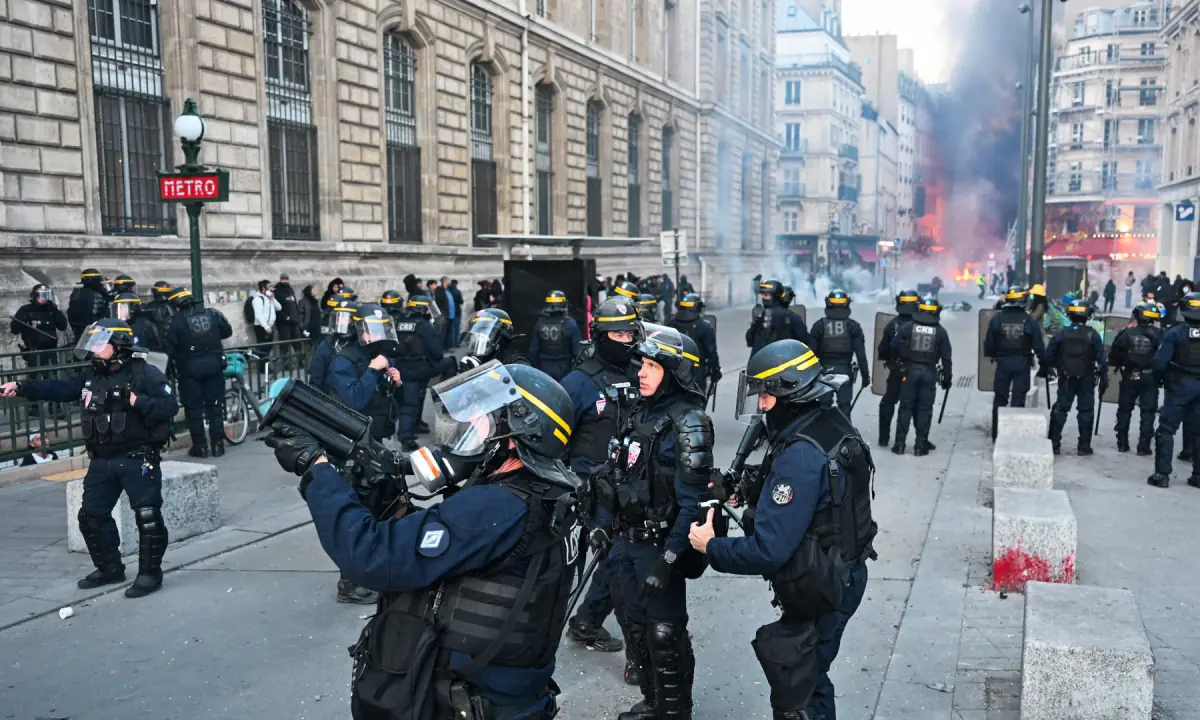
Dimanche 18 octobre, place de la République, milieu d’après-midi : plusieurs centaines de personnes face à la CRS 8, des projectiles, des grenades, des pillages. La veille, entre 550 000 et 800 000 manifestants, plus de 2 000 interpellations et 1 500 commerces touchés, plus de 600 policiers, gendarmes et pompiers blessés, et, d’un syndicat de police, une phrase inédite : « on n’a pas réussi à tenir les centres-villes ».

Vendredi, j’écrivais ici que le pouvoir avait pris ses précautions et que ses auxiliaires avaient pris les leurs. Les précautions ont tenu jusqu’à la place de la République : le cortège déclaré s’y est dispersé dans les rues sans pouvoir rejoindre la place. Derrière lui, la ville brûlait. Je retire la précaution. Je garde le verdict, en trois manques.

17 octobre : convergence des luttes ou récupération par les auxiliaires de l'ordre macroniste ?
Le pouvoir redoute la convergence des luttes. Parcours fixé la veille, cortèges encadrés par la CGT : le 17 octobre a peu de chances de virer à l'insurrection.
Que manque-t-il encore pour constater l’insurrection ?
LE COURRIER
DES STRATÈGES
Restez libre !

ABONNEMENT

Allez au fond
des choses.

Deux grands formats par jour. Les cinq plumes du Courrier. La série Sécession, le dimanche.

Le monde commente. Vous, vous comprenez.

S'ABONNER lecourrierdesstrateges.fr
lecourrierdesstrateges.fr
Restez libre !

Brûler la mairie, ce n’est pas s’y asseoir

Il manque d’abord un fauteuil occupé. L’Hôtel de ville de Limoges est parti en fumée ; à Marseille, Lille, Angers et Bordeaux, des manifestants sont entrés dans les mairies ou les préfectures pour les saccager. Chez nous, en 1830, en 1848, en 1870, on prend l’Hôtel de Ville, on monte au balcon, on y proclame un gouvernement. Samedi, on y a mis le feu et on est reparti. Les policiers décrivent eux-mêmes ce qui les a submergés : de petits groupes très mobiles, courant d’une rue à l’autre. Lundi matin, le maire de Limoges retrouvera ses murs noircis. Personne n’y a installé quoi que ce soit.

Une police qui réclame des renforts n’a pas changé de camp

Il manque ensuite une défection. Les forces de l’ordre ont été, de leur propre aveu, complètement débordées ; François Hollande constate que l’État n’a pas été capable d’assurer partout l’ordre public ; les maires de Paris, Lyon et Marseille réclament des moyens et un rendez-vous à Matignon. Tout cela est vrai. Rien de cela n’est une défection. Six cents blessés, et pas un bouclier posé. Un syndicat qui se plaint du sous-nombre demande plus de force, pas moins. Aucun préfet n’a démissionné, aucun commissaire n’a refusé d’engager. La force publique a flanché quelques heures, dans quelques centres-villes, et personne ne s’est baissé pour la ramasser.

Faut dire que la foule qui aurait pu la ramasser était rentrée chez elle. Samedi, j’ai marché dans un cortège qui avait un nom à crier, et ce n’était ni Parcoursup ni le gazole : c’était celui du président, devenu, jusque sur un oreiller brandi place de la République, le symbole de ce qui bloque. Cette foule-là est rentrée à la nuit tombée. Ceux qui sont restés, et ceux qui sont revenus dimanche, voulaient casser du flic et vider des vitrines, et je ne leur prête rien d’autre. Dimanche, plus de pavés que samedi, et plus un seul nom crié.

Que manque-t-il encore pour constater l’insurrection ?
LE COURRIER
DES STRATÈGES
Restez libre !

TELEGRAM · L'INFO EN CONTINU

Entre deux éditions,
le fil.

La newsletter vous donne le matin. Le fil vous donne l'instant.

Gratuit, et en continu.

REJOINDRE LE FIL t.me/resterlibre
t.me/resterlibre
Restez libre !

L’État dit « insurrection » et poursuit pour recel

Il manque enfin un nom et une date. Le mot, à le bien regarder, n’a été prononcé que d’un côté. Le Parisien titre « Scènes d’insurrection » et son éditorialiste attribue dans la foulée ce climat « quasi-insurrectionnel » à une minorité qui n’a rien à voir avec les manifestants ; Laurent Nuñez parle d’un désordre semé « de manière concertée » ; Sébastien Lecornu met en garde ceux qui voudraient faire de ces violences un « tour de chauffe » avant la présidentielle. Dans le même temps, le parquet de Paris place en garde à vue pour recel de vol, groupement en vue de commettre des violences et dégradations — l’échelle de l’émeute, pas l’article 412-3 du Code pénal et son « mouvement insurrectionnel ». La CRS 8 engagée à République est l’unité spécialisée dans les violences urbaines : la grammaire de 2023.

Le droit français n’écrit pourtant le mot qu’à deux endroits. Dans cet article 412-3, que personne ne vise. Et à l’article L2121-1 du code de la défense, qui réserve l’état de siège de l’article 36 de la Constitution au péril imminent résultant d’une guerre étrangère ou d’une « insurrection armée ». L’état d’urgence, lui, relève de la loi du 3 avril 1955 et vise les « atteintes graves à l’ordre public » : le texte de novembre 2005. Le président va s’adresser aux Français. Je suppose qu’il dira le mot et qu’il signera la loi de 1955. Insurrection à la télévision, émeute au Journal officiel : l’État aura qualifié lui-même, contre son propre vocabulaire.

Et vous, qui réclamez depuis samedi soir de l’ordre à n’importe quel prix ? Vous demandez à l’État de finir par décret ce que les casseurs n’ont pas réussi dans la rue : faire disparaître les 800 000 personnes du samedi après-midi derrière les 2 000 interpellés de la nuit.

Ne manquez pas nos vidéos exclusives gratuites

Si vous voulez voir les vidéos exclusives de décryptage, rejoignez notre chaîne Telegram gratuite en cliquant sur ce lien :

J'ai Télégram et je rejoins gratuitement la chaîne

Dernier mot

Un samedi de vacances scolaires a montré une vacance. Pendant quelques heures, dans quelques villes, la force publique n’appartenait plus à personne. Ni la CGT, dont la prochaine date est fixée au 5 novembre depuis le 6 octobre, ni La France insoumise, qui préfère l’urne de 2027 à un fauteuil de mairie, ni les casseurs, qui ne veulent pas de fauteuil, ne se sont présentés pour l’occuper.

Ce qui manque, donc : quelqu’un assis à Limoges, un préfet qui refuse, un appel à une journée de semaine signé d’un nom. Rien de tout cela n’est là ce soir. Ce qui est là, en revanche, c’est un président qui va parler. Le seul candidat au fauteuil vide, ce soir, c’est lui.

Que manque-t-il encore pour constater l’insurrection ?
LE COURRIER
DES STRATÈGES
Restez libre !

TIPS · SANS ABONNEMENT

Offrez-nous
un café.

Un média libre vit de ses lecteurs. Un pourboire ponctuel, sans compte ni engagement, quand le cœur vous en dit.

Vous donnez ce que vous voulez. Vous restez libre.

LAISSER UN POURBOIRE merci !
lecourrierdesstrateges.fr
Restez libre !
  •  

France en crise : de nouvelles scènes de violences en plein Paris, des tensions en banlieue

Après s’être rassemblés place de la République, ce 18 octobre, où des tensions ont éclaté avec les forces de l'ordre, des jeunes vêtus de noir et encapuchonnées se sont élancés dans les rues adjacentes de cette place du centre-ville de Paris, saccageant du mobilier urbain et allumant des feux. Au moins un commerce aurait été pillé.

Des barricades ont été dressées et incendiées dans des rues adjacentes à la place de la République en marge d'un nouveau rassemblement place de la République ce dimanche #18octobre. https://t.co/ZebT9NC9ow

— CLPRESS / Agence de presse (@CLPRESSFR) October 18, 2026

Des violences qui surviennent moins de 24 heures après les scènes d’une violence inouïe, en marge de la journée de mobilisation contre la vie chère, et durant laquelle des centaines de magasins ont été saccagés et pillés dans les centre-villes de Paris, Marseille et Lyon ainsi que d’autres villes françaises.

Alors que la CRS 8, une unité spécialisée dans la lutte contre les violences urbaines, a été déployée à Paris, en proche banlieue, dans la commune de Rosny-sous-Bois (Seine-Saint-Denis), des tensions ont été signalées autour du centre commercial Rosny 2, l’un des plus grands de l’Île-de-France, celui-ci ayant été fermé. Une vidéo circulant sur les réseaux sociaux, montrant des jeunes en train de courir, affirme que le centre aurait été la proie de pillages.

  •  

French business leaders call for order after riots and looting: 'The Republic must protect its shopkeepers!'

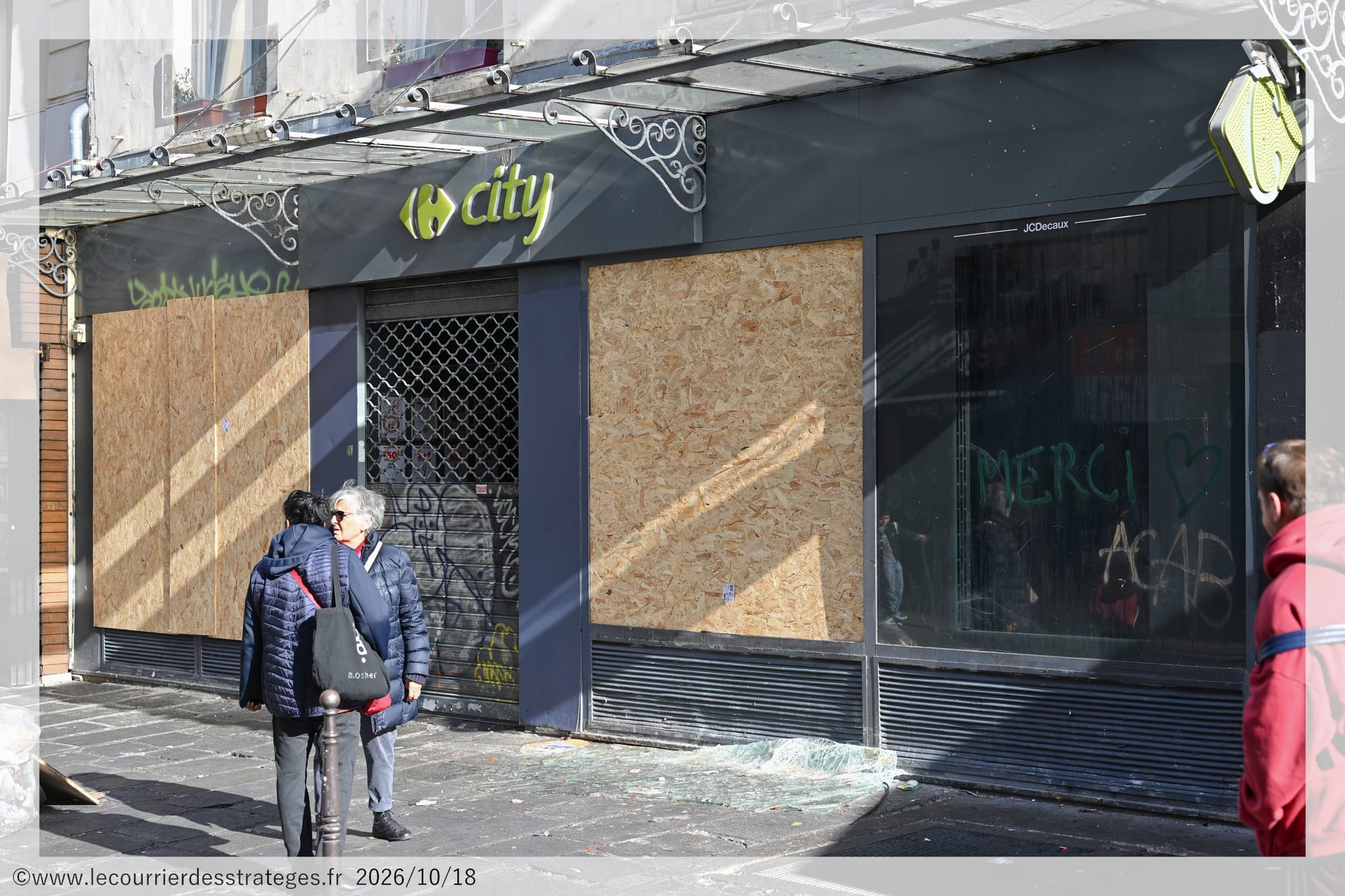
A pedestrian walks past a broken frontage windows of a shop and damages a day after riot and looting following a nationwide protest against the "high cost of living", in Lyon central-eastern France, on October 18, 2026. France's Prime Minister said 1,200 people were arrested in protests across the country on October 17, and 150 police were hurt during clashes between police and protesters. Massive looting and multiple blazes gripped France as nationwide marches against soaring inflation degenerated into street violence of "extreme intensity". (Photo by JEFF PACHOUD / AFP via Getty Images)
After many French storefronts were ransacked by rioters on Saturday, Business owners are expressing their fury and disappointment on social media.

JEFF PACHOUD / AFP via Getty Images

  • It's a dangerous time to own a brick-and-mortar storefront in France.
  • Violence erupted across the country on Saturday, as black-clad rioters ransacked stores.
  • Around 1,500 storefronts were targeted, one corporate heavyweight said.

Business owners in France are speaking out after cost-of-living protests turned into widespread rioting and looting across the country over the weekend.

Alexandre Bompard, the CEO of Carrefour, one of France's largest supermarket chains, said that about 1,500 businesses were targeted in the unrest.

Bompard and several other corporate heavyweights condemned the rioting and called on French authorities to restore order.

Photos and video from Paris and other French cities showed black-clad rioters smashing storefronts and leaving laden with armfuls of pilfered goods.

"We cannot allow violence to destroy what generations have put so much energy into building," Thierry Guibert, the CEO of Lacoste, said on X.

Here's what business owners are saying.

Thierry Guibert, CEO of Lacoste and Aigle.
Thierry Guibert attends day 5 of the French Open 2022, Roland-Garros 2022, second Grand Slam tennis tournament of the season at Stade Roland Garros on May 26, 2022 in Paris, France.
Thierry Guibert tktk

Jean Catuffe/Getty Images

Guibert, who heads the luxury French clothing brand Lacoste and the outdoor clothing brand Aigle, issued a forceful statement on social media. He said the looting is antithetical to the entrepreneurial spirit.

"When our Lacoste and Aigle stores are looted, like so many other businesses across France, it is not only shop windows that are being smashed," he said in French. "It is jobs, years of work, know-how, and the commitment of thousands of women and men that are being put at risk."

Guibert said his concerns were shared by other entrepreneurs and smaller shop owners across France. He portrayed the riots as a degradation of French industry.

Lacoste operates about 150 storefronts across France.

Fabien Devide, CEO of Team Vitality
French eSport team coach and owner and head of 'Team Vitality' Fabien Devide aka Neo poses during a photo session in Paris on July 22, 2019.
Fabien Devide tktk

credit should read JOEL SAGET/AFP via Getty Images

The head of one of France's biggest professional esports organizations said that a part of him "went up in smoke" after his gaming café and club was looted on Saturday.

"The right to demonstrate is a fundamental freedom that I will defend all my life," Devide said on social media. "But looting and destruction should never have a place in these fights."

The esports organization operates a 4,300-square-foot gaming center, merchandise store, and café in central Paris. Vitality's X account posted on Saturday that "the premises of our club were looted."

"Fortunately, none of our staff members nor any fans were injured," Vitality said. "On the other hand, our display windows were destroyed, and our trophies and computer equipment were stolen."

Alexandre Bompard, CEO of Carrefour
Carrefour CEO Alexandre Bompard (C) speaks during a press conference at the Federation du Commerce et de la Distribution (FCD) in Paris on June 22, 2026. (Photo by Simon WOHLFAHRT / AFP via Getty Images)
Alexandre Bompard tktk

Simon WOHLFAHRT / AFP via Getty Images

Bompard, the CEO of the French supermarket and retail chain Carrefour, said that 50 of its stores were targeted by rioters on Saturday.

"Nothing can justify such violence," Bompard said on X in French. "Those who attack the work tools of courageous entrepreneurs and their teams in this way must face an uncompromising response."

"The Republic must protect its shopkeepers!" he added.

He attached four photos to his X post showing the ruined aisles of one Carrefour store. In the pictures, items litter the ground, and the shelves are empty.

Thierry Cotillard, chairman of Les Mousquetaires
Thierry Cotillard, CEO of Intermarche and Chairman of Les Mousquetaires, is seen during the visit of the Minister of Labour, Catherine Vautrin, at an Intermarche Supermarket in the 15th arrondissement in Paris, France, on September 5, 2025. (Photo by Telmo Pinto/NurPhoto via Getty Images)
Thierry Cotillard tktk

Telmo Pinto/NurPhoto via Getty Images

Thierry Cotillard, chairman of Les Mousquetaires, a French retail group that owns the Intermarché supermarket brand, called the looting "unacceptable" in a LinkedIn post.

"We cannot trivialize these scenes," he said. "We cannot accept that violence becomes a response, that destruction becomes a mode of expression and that those who work honestly become the collateral victims of the anger of others."

Cotillard said at least two of his franchises in Paris and Rennes were "ransacked by thugs" during the riots on Saturday. He said his thoughts were with "all the shopkeepers who are paying the price."

"To our members, to our teams who are victims of this damage: you are not alone," he said. "We are at your side."

Dominique Schelcher, CEO of Coopérative U
Dominique Schelcher, CEO of the Coopérative U speaks at an event.
Dominique Schelcher, CEO of the Coopérative U.

Daniel Perron / Hans Lucas / AFP via Getty Images

Schelcher, CEO of supermarket and hypermarket retail collective Coopérative U, said some of the group's stores had been looted or attacked in several city centers, including Paris.

The collective comprises some 1,900 grocery stores and supermarkets owned by independent business owners.

"In the face of the shock, the solidarity of our network will be total," Schelcher wrote in a LinkedIn post on Sunday.

Schelcher later made a separate post calling on French leaders and politicians to "pursue calm, mutual respect, and the urgent development of a collective vision."

"There must not be another October 17," he added.

Catherine Spindler and Guillaume Motte, chief execs at Sephora
Catherine Spindler, president of Sephora Europe and the Middle East.

Tracey Welch/Dave Benett/Getty Images

Catherine Spindler, president of Sephora's business in Europe and the Middle East, said several of the beauty retailer's stores had been "ransacked."

"Even more serious, women and men in our teams have been confronted with situations of violence, fear, and great tension," she wrote in a LinkedIn post.

Sephora closed all its stores on Saturday at 5 p.m. and kept most of them shuttered on Sunday, Spindler wrote.

"Anger can be expressed. Convictions can be opposed. But nothing should justify women and men becoming the victims of this violence," she added.

Guillaume Motte, global CEO of Sephora, chimed in with support for Spindler on LinkedIn.

"We stand together!" he wrote.

Nicolas Houzé, executive chairman of Galeries Lafayette
Nicolas Houzé sits onstage at a panel.
Nicolas Houzé speaks onstage during a panel in England.

Kate Green/Getty Images for Business of Fashion

Nicolas Houzé, executive chairman of Galeries Lafayette, mourned France's global reputation in a post on LinkedIn, saying the riots produced "scenes of unprecedented violence throughout France."

"No demand can legitimize violence in France," wrote Houzé on LinkedIn, saying that almost all of his firm's points of sale had been affected by the attacks.

Galeries Lafayette, an upscale department store chain, runs about 50 outlets in France.

"Beyond the destruction and major economic losses for all those involved in trade, it is also the image of our country, its attractiveness, and its ability to welcome its visitors in the best conditions that are deeply affected," he added.

Alexandre Prot and Steve Anavi, cofounders of Qonto
Alexandre Prot, co-founder of Quonto, gestures while speakin at a conference.
Alexandre Prot, co-founder of Quonto, speaks at a conference.

Christian Charisius/picture alliance via Getty Images

Fintech firm Qonto's founders, Steve Anavi and Alexandre Prot, said a fire had been started at their company's offices in Paris.

Anavi wrote on LinkedIn that the office fire was intentional, calling it an "arson attack."

"Violence and vandalism have no place in our society. Nothing can justify such acts," he added.

In a separate post, Prot said no one was injured in the fire.

"We'll repair the damage as soon as possible. In the meantime, Qonto's operations continue as normal," he wrote.

The company offers payment, bookkeeping, and other business management software, primarily targeting small- to medium-sized enterprises and startups.

Alain Di Crescenzo, President of CCI France
Alain Di Crescenzo, the President of the Chamber of Commerce and Industry in France, gestures as he speaks at a conference event.
Alain Di Crescenzo, the President of the Chamber of Commerce and Industry in France.

Romain Doucelin/NurPhoto via Getty Images

Alain Di Crescenzo, president of the Chamber of Commerce and Industry in France, called for affected merchants to receive support amid the "inexcusable" violence.

"This violence is UNACCEPTABLE," Di Crescenzo wrote on LinkedIn.

"Breaking up a business is breaking up a neighborhood. It is to scare away customers, to discourage those who wanted to set up, to damage for a long time what years have built," he added.

Di Crescenzo said his organization, which represents roughly 2 million private businesses in France, is mapping the damage across affected cities and is creating "support units" to help its members.

Read the original article on Business Insider

  •  

Dégâts à Paris : quelques images pour illustrer l'ampleur de ce qui se passe

Beaucoup, à tort, répétons-le, réduisent le mouvement du 17 octobre à des pillages. Des pillages, des dégradations, il y en a eu, d'une violence jamais égalée, à mon avis, depuis plusieurs années, voire plusieurs décennies. Nous en montrons une infime part ici. Mais...

Dégâts à Paris : quelques images pour illustrer l'ampleur de ce qui se passe
LE COURRIER
DES STRATÈGES
Restez libre !
Dégâts à Paris : quelques images pour illustrer l'ampleur de ce qui se passe

LA NEWSLETTER · GRATUITE

Le Courrier,
chaque matin.

L'essentiel de l'actualité, passé au crible par les cinq plumes du Courrier. Dans votre boîte, chaque jour ouvré.

Gratuit. Vous restez libre de partir quand vous voulez.

JE M'INSCRIS lecourrierdesstrateges.fr
lecourrierdesstrateges.fr
Restez libre !

Ce serait une erreur (largement commise par les conservateurs et réactionnaires de tous poils) de réduire ce mouvement à des violences urbaines. Je l'ai souligné hier : le mouvement est beaucoup plus "nombreux" que la police, et même les organisateurs, l'ont soutenu hier. Le cortège parisien, s'il avait pu se tenir comme prévu, aurait largement dépassé les 100.000 personnes. Et ces personnes n'avaient rien à voir avec des meutes islamistes. Il y avait des jeunes, des quadragénaires, des vieux, des riches, des pauvres, des moyens, des gens de gauche et de droite. L'influence du mouvement dépasse largement le simple fait d'une émeute urbaine.

Voici quelques images offertes par Paris aujourd'hui :

Dégâts à Paris : quelques images pour illustrer l'ampleur de ce qui se passe
  •  

Termina neste domingo prazo escolher idioma da prova do Enem 2026

Logo Agência Brasil

Termina neste domingo (18) o prazo para que os candidatos inscritos automaticamente no Exame Nacional do Ensino Médio (Enem) 2026 selecionem o idioma de preferência para a prova de língua estrangeira. As opções são inglês ou espanhol e a escolha deve ser feita na Página do Participante.

Pela primeira vez, o exame nacional contou com inscrição automática para estudantes concluintes do ensino médio na rede pública com o objetivo de aumentar a participação desse público no exame.

Notícias relacionadas:

De acordo com a retificação do Edital nº 64/2026 do Enem, se o participante nessas condições perder o prazo, o Instituto Nacional de Estudos e Pesquisas Educacionais Anísio Teixeira (Inep) aplicará a prova de inglês, e o participante não poderá alterar a opção.

A prova de língua estrangeira conta com cinco questões de múltipla escolha, com foco na interpretação e compreensão de textos.

Para reforçar os estudos e adquirir vocabulário, o Ministério da Educação (MEC) disponibiliza gratuitamente a plataforma MEC Idiomas. A ferramenta digital oferece aulas gratuitas de inglês e espanhol do nível básico ao avançado.

Questionário socioeconômico

O participante inscrito de forma automática deverá também preencher o Questionário Socioeconômico.

Para preencher o questionário socioeconômico do Enem 2026, o candidato também deve acessar a Página do Participante do exame. É preciso usar a senha da plataforma Gov.br.

O formulário online, com cerca de 23 a 25 perguntas obrigatórias, mapeia a realidade social, econômica e educacional dos participantes.

Os dados fornecidos não podem ser alterados.

Somente após preencher o questionário socioeconômico, o candidato terá acesso à informação sobre seu local de prova.

Provas

As provas serão aplicadas em dois domingos de novembro, nos dias 8 e 15, no turno da tarde.

O primeiro dia do Enem terá duração de cinco horas e 30 minutos. Neste dia, os candidatos farão a redação e os exames de linguagens (língua portuguesa, literatura, língua estrangeira, artes, educação física e tecnologias da informação), códigos e suas tecnologias e ciências humanas (história, geografia, filosofia e sociologia) e suas tecnologias.

No segundo dia, os estudantes farão provas de ciências da natureza e suas tecnologias (biologia, química e física) e matemática. Os participantes terão cinco horas para fazer as provas.

Saiba tudo sobre o exame no Guia do Enem, disponibilizado pelo Ministério da Educação (MEC).

Enem 2026

Nesta edição, o Ministério da Educação (MEC) registrou mais de 5 milhões de inscrições.

Pela primeira vez, além de promover o acesso ao ensino superior, o Enem também terá como objetivo avaliar o domínio das competências e habilidades esperadas no fim do ensino médio, integrando o Sistema de Avaliação da Educação Básica (Saeb).


  •  

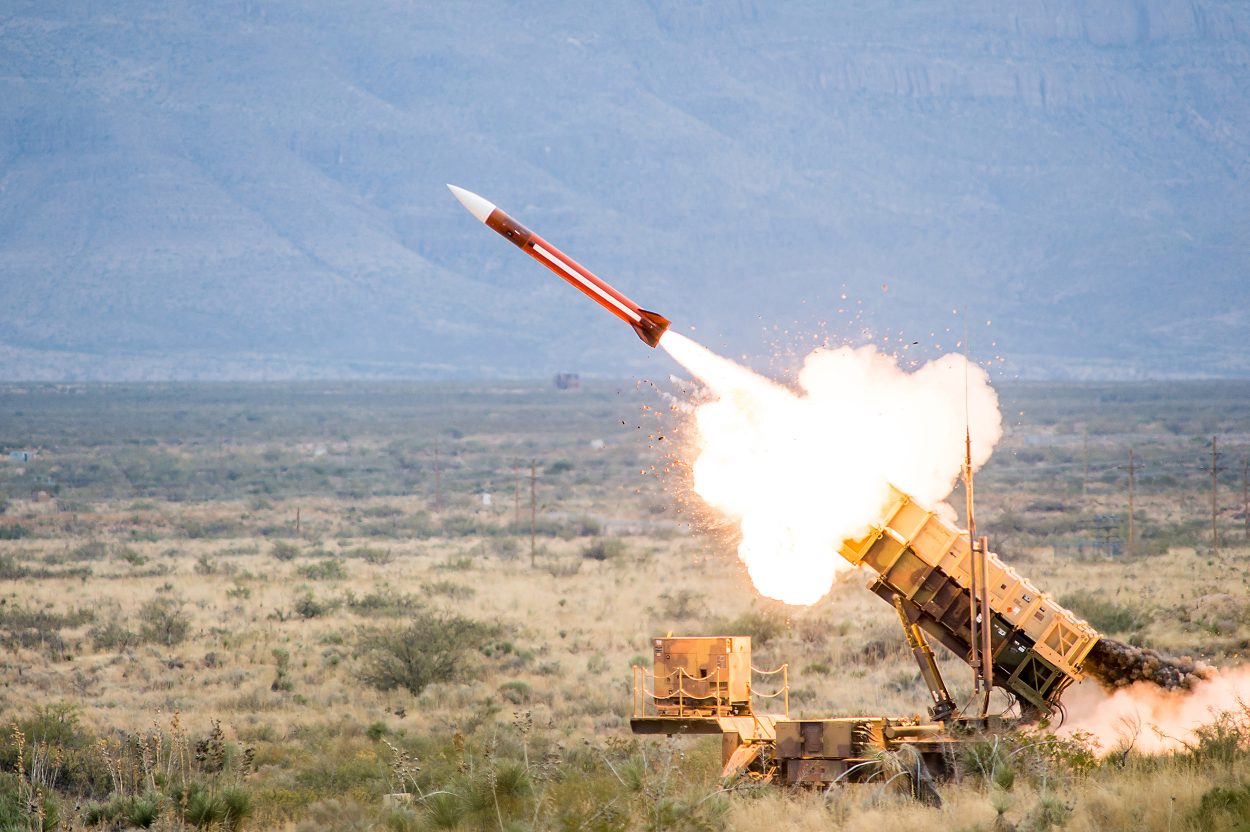
New U.S. Missile Aims To Outmaneuver Russia’s Maneuvering Missiles: Here’s Patriot’s Evolution to PAC-3 Edge

Amid global demand for Patriot interceptors, Lockheed Martin recently unveiled its most advanced interceptor, the PAC-3 Edge, which could offer improved performance against ballistic missiles and hypersonic threats.

EurAsian Times takes a deep dive into the evolution of Patriot Air Defense Systems, but before that, let’s start with the news.

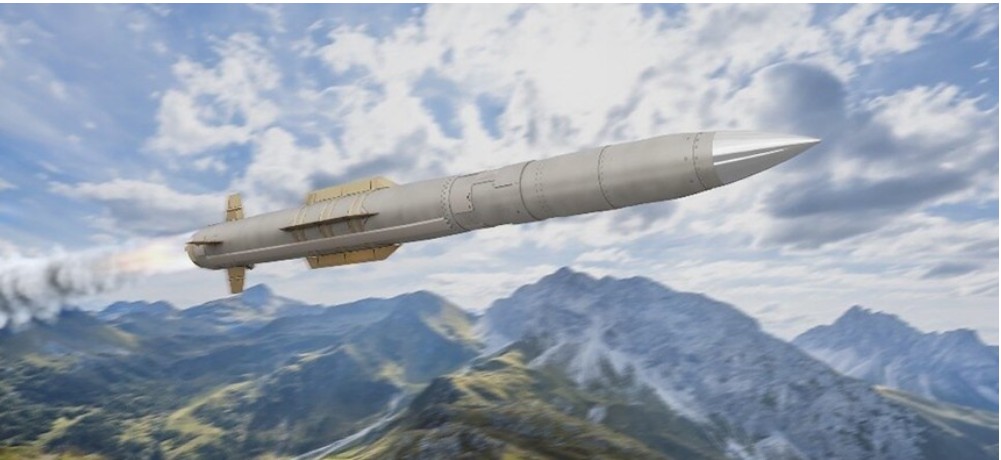
PAC-3 EDGE

The new interceptor missile builds on the combat-proven PAC-3 MSE technology, which has proven its worth in multiple conflicts, including Ukraine and the Middle East.

The new PAC-3 Edge incorporates a new seeker, an upgraded control system, and a more advanced solid rocket motor developed with Northrop Grumman.

These new features will improve the missile interceptor’s range, altitude, speed, and precision.

It is part of the US Army’s Future Interceptor program, which is currently in competition.

“The Army’s decision to progress Lockheed Martin into the next stage of development affirms its confidence in Lockheed Martin’s proven Integrated Air and Missile Defense (IAMD) experience and the company’s ability to deliver an advanced, layered defense,” the company said in a statement.

Lockheed Martin will advance development and begin testing PAC-3 Edge in 2027 to prepare for rapid deployment by 2031, it added.

Patriot PAC-3 ACE. Credits Lockheed Martin.

“Lockheed Martin’s PAC-3 Edge interceptor leverages the combat-proven PAC-3 MSE, delivering even greater maneuverability, power and velocity to ensure the Army’s layered defensive architecture remains the most advanced in the world,” said Tim Cahill, Lockheed Martin Missiles and Fire Control president.

PAC-3 interceptors come in three variants: the lower-cost PAC-3 ACE, legacy PAC-3 CRI, and the prestigious PAC-3 MSE.

The company said it invested US$250 million in the Strigo Product Center to fund new, industry-leading seeker technology that increases precision and maneuverability against evolving threats.

PAC-3 Edge is designed to be integrated with existing and future Integrated Air and Missile Defense (IAMD) capabilities, including the Integrated Battle Command System (IBCS), the M903 launcher, containerized launchers, and HIMARS Flex.

The US Army’s selection of Lockheed Martin’s PAC-3 Edge program highlights the service’s efforts to improve its existing layered air defense systems to address evolving aerial threats.

While the company did not provide technical details of the new seeker technology, analysts believe that it could be a dual-mode or multimode configuration that integrates multiple sensors to better detect, track, and intercept evolving threats such as hypersonic cruise missiles, hypersonic glide vehicles (HGVs), maneuvering ballistic missiles, and the ability to distinguish real threats from decoys.

In the war in Ukraine, while the PAC-3 MSE interceptors have proved highly effective in countering ballistic missiles and aircraft, they have struggled to intercept Russia’s hypersonic missiles, such as Oreshnik, Zircon, and Kinzhal.

Furthermore, while PAC-3 MSE interceptors were highly effective against ballistic threats in the initial phase, their performance gradually declined as Russia adapted its missiles to perform increasingly complex terminal maneuvers.

According to a Financial Times report based on Ukrainian Air Force data compiled by the Center for Information Resilience, Patriot interceptors’ ballistic interception rate reached 37% in August 2025 but fell to a low of 6% in September.

This decline was linked to Russian tactical improvements, such as missiles changing trajectory and missiles capable of performing terminal maneuvers.

However, despite this drop in interception rates, Patriot batteries remain Ukraine’s only defense against Russian ballistic threats.

The new PAC-3 Edge interceptors will provide increased protection against such maneuvering missile threats and hypersonic missiles.

Notably, the unveiling of new PAC-3 Edge interceptors comes as global demand for PAC-3 interceptors has increased, and Lockheed Martin is establishing new facilities to raise its interceptor production rate.

Lockheed produced nearly 620 interceptors in 2025; however, it plans to triple Patriot interceptor production to 2000 by 2030.

Patriot PAC-3 interceptors are also included in the Pentagon’s Munitions Acceleration Council (MAC), which is targeting 12 legacy and two “emerging” munitions as part of its ambitious plan to ramp up production and ink a series of agreements with key vendors to ensure cost efficiency while maintaining production stability, according to fiscal 2027 budget documents.

Rising global demand for PAC-3 interceptors, requests from multiple countries to establish Patriot interceptor production facilities, and the unveiling of the advanced PAC-3 Edge interceptors underscore the Patriot air and missile defense system’s continued relevance more than four decades after it first became operational.

The Evolution Of Patriot Air Defense Systems

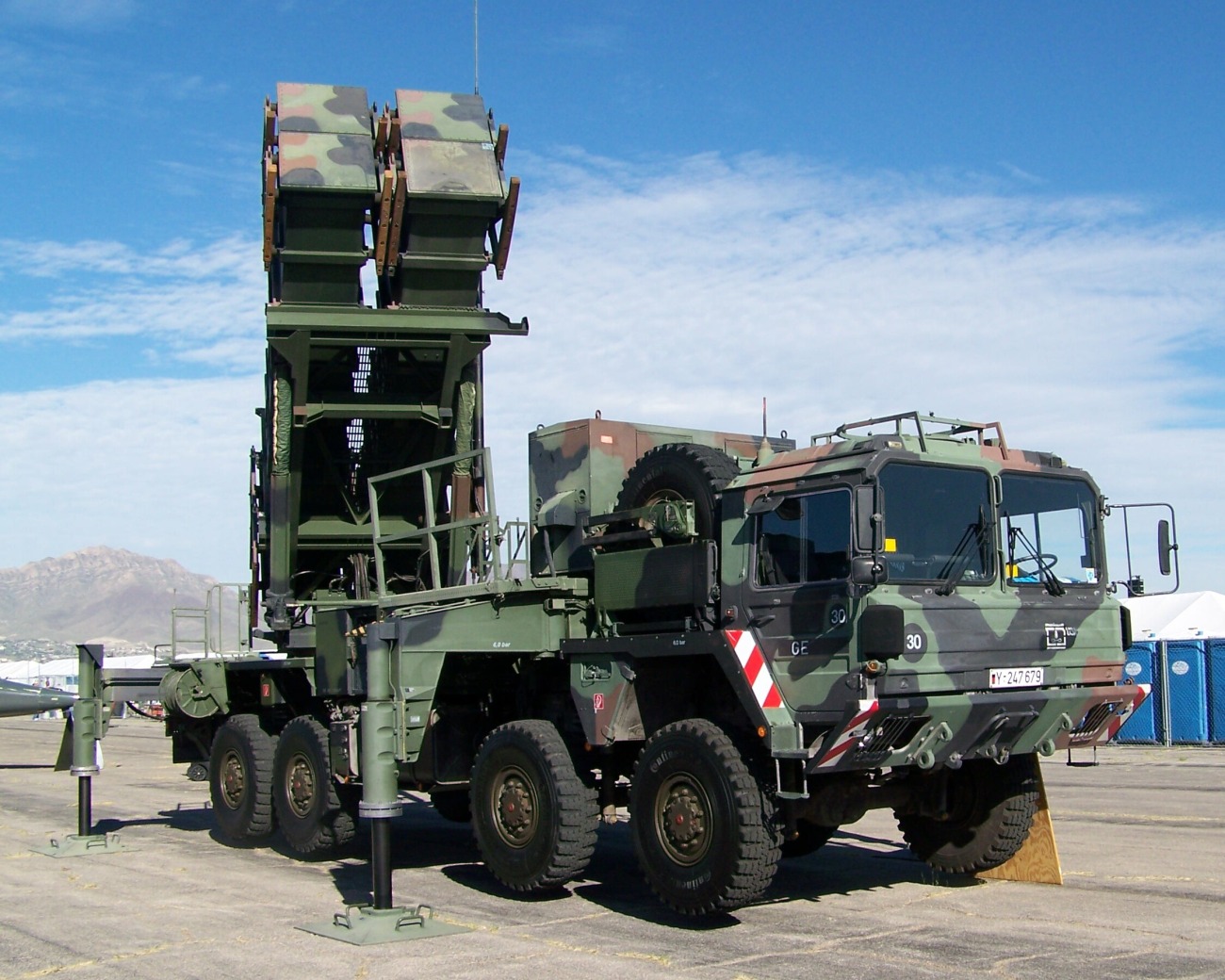
The MIM-104 Patriot is the US Army’s primary air-and-missile defense system.

Although it was initially designed as an anti-aircraft system, newer Patriot variants can engage ballistic and cruise missiles, drones, loitering munitions, and aircraft.

A typical Patriot battery includes a radar set, an engagement control station, power generation, other support vehicles, and several launch stations.

The US Army Missile Command first developed the Patriot concept in 1961 as the Army Air Defense System for the 1970s (AADS-70s).

The AD system was meant to be mobile and replace the static HAWK and Nike Hercules emplacements.

In 1964, the US Army renamed it Surface-to-Air Missile, Development (SAM-D).

Three years later, in 1967, the Department of Defense selected Raytheon as the prime contractor. SAM-D’s first flight test took place in November 1969.

Although Raytheon won the prime SAM-D contract in 1967, it did not build everything alone. Martin Marietta joined early as a major subcontractor to handle missile assembly, launcher vehicles, and canister production.

In 1974, the Department of Defense reoriented the SAM-D program to support a Track-Via-Missile (TVM) guidance system and a simplified concept of operations.

Patriot-Missile
Patriot AD System.

The revised and re-engineered system was renamed PATRIOT (Phased Array Tracking Radar to Intercept On Target) in 1976.

Patriot entered full-rate production in September 1980, and the US Army activated its first Patriot missile battalion in May 1982.

The Army added significant upgrades to the Patriot system throughout the 1980s and 1990s.

In 1985, the Department of Defense (DoD) started efforts to add a ballistic missile defense capability to the system.

In 1986, the Army upgraded Patriot to the Patriot Advanced Capability-1 (PAC-1) standard, which included software changes that allowed it to engage tactical ballistic missiles.

The PAC-1 was deployed by 1988.

Soon, the US Army began efforts towards the PAC-2 standard, which involved modifications to the missile fuze, warhead, and guidance to engage more capable ballistic missiles like the Soviet OTR-23.

The Patriot system first saw combat service during the 1991 Gulf War, defending critical assets in Saudi Arabia, Kuwait, and Israel. The PAC-2 missiles were used to intercept Iraq’s Scud missiles.

Martin Marietta built the PAC-2 interceptors.

In 1993, the US Army added remote launch capability to Patriot systems, allowing missile launchers to be deployed over 10 km from the radar. This also more than tripled the system’s defended area.

Later, the US Army also developed the PAC-3 standard.

The most significant PAC-3 upgrade was a new interceptor with hit-to-kill technology, developed by Lockheed, which defeats targets by striking them directly rather than using a blast-fragmentation warhead.

Lockheed achieved the first-ever hit-to-kill intercept in 1984 with the Homing Overlay Experiment, using impact force alone to destroy a mock warhead outside Earth’s atmosphere. Further development and testing produced today’s PAC-3 missile, which won a 1993 competition to become the US government’s first hit-to-kill interceptor.

In 1995, Lockheed Corp merged with Martin Marietta to create one of the US’s largest defense aerospace companies, combining two key components of the Patriot program: Martin Marietta’s established Patriot infrastructure and production facilities and Lockheed’s cutting-edge hit-to-kill technology.

This newly formed mega-contractor rolled out the PAC-3 missile interceptor.

The PAC-3 standard itself included three distinct configurations, Configuration 1, 2, and 3, which improved its radar, seeker, and range.

The US declared PAC-3 Configuration 3 combat-ready in August 2002.

PAC-3 Configuration 3 had its first combat test in 2003 during Operation Iraqi Freedom.

In 2010, the US Army successfully tested an upgraded PAC-3 interceptor, the PAC-3 Missile Segment Enhancement (MSE).

According to CSIS’s Missile Threat, the PAC-3 MSE features an enlarged motor and other enhancements to nearly double the PAC-3’s range. It achieved initial operational capability in late 2016.

Patriot-missie
Patriot is a long-range, high-altitude, all-weather missile tested more than 2,500 times with U.S. Army oversight. (Image: Raytheon)

The PAC-3 also features an active Ka-band radar seeker for endgame guidance. With its lighter weight and newer propulsion system, the PAC-3 can reportedly defend an area seven times greater than the PAC-2.

Patriot currently employs a single AN/MPQ-53, AN/MPQ-65, or AN/MPQ-65A radar set to detect and engage targets. Unlike other air defense systems, the Patriot radar combines surveillance, tracking, and engagement in a single unit.

The AN/MPQ-53 was the world’s first phased-array air defense radar and was employed with legacy PAC-2 systems.

The AN/MPQ-65A is the most advanced Patriot radar; however, the US Army is currently transitioning to use the new Lower Tier Air and Missile Defense Sensor (LTAMDS) radar, which offers 360-degree coverage and significantly greater detection range.

Furthermore, while the AN/MPQ-53 and -65-series radars are passively scanned arrays, LTAMDS is an active electronically scanned array (AESA) that uses gallium nitride (GaN) power amplifiers, offering greater jamming resistance, beam agility, and power efficiency than previous systems.

360-degree coverage is essential to counter Russia’s evolving “wolf-pack tactics,” which involve launching dozens of aerial targets simultaneously, including drones and ballistic and cruise missiles, that approach from different directions and strike at once.

Only the US and Poland are procuring the LTAMDS at present. In September, the US awarded a US$1.7 billion contract to produce nine radars for the two users.

Currently, 18 countries operate the Patriot AD system. These include the Netherlands, Germany, Japan, Israel, Saudi Arabia, Kuwait, Taiwan, Greece, Spain, South Korea, the UAE, Ukraine, Qatar, Romania, Sweden, Poland, and Bahrain.

In 2023, the US allowed countries to transfer Patriot batteries to Ukraine, where they have repeatedly intercepted Russian ballistic and hypersonic missiles.

For instance, on May 16, 2023, the Ukrainian Air Force claimed it used Patriot to intercept a salvo of six Kinzhal missiles over Kyiv.

However, rising global demand for PAC-3 MSE interceptors and Russia’s adaptive missile technology, which involves terminal-phase maneuvers, have necessitated a two-pronged strategy: boosting PAC-3 interceptor production and developing more advanced interceptors.

The PAC-3 Edge will keep the Patriot AD system relevant amid evolving aerial threats.

  • Sumit Ahlawat has over a decade of experience in news media. He has worked with Press Trust of India, Times Now, Zee News, Economic Times, and Microsoft News. He holds a Master’s Degree in International Media and Modern History from the University of Sheffield, UK. 
  • He can be reached at ahlawat.sumit85 (at) gmail.com

The post New U.S. Missile Aims To Outmaneuver Russia’s Maneuvering Missiles: Here’s Patriot’s Evolution to PAC-3 Edge appeared first on EURASIAN TIMES.

  •  

Venezuela Popular Consultation: 37,205 Projects Put to Historic Vote

Venezuela popular consultation allows communities to choose development projects in more than 5,400 communes.

Venezuela popular consultation lets more than 5,400 communes choose from 37,205 community projects, expanding participation to condominium boards.

Related: Venezuela Holds the Second National Popular Consultation of 2026


Venezuela Popular Consultation Becomes Democratic Tradition

The Venezuela popular consultation is taking place across the country on Sunday, October 18, as more than 5,400 communes choose between 37,205 community development projects.

Venezuela’s Sectoral Vice President for Planning, Ricardo Menéndez, said the Second Popular Consultation of 2026 reaffirms the principles of grassroots democracy and strengthens the country’s participatory political system.

Menéndez described the consultation as a space that brings neighbors together to improve daily life and build broad national consensus.

The official said the exercise has become part of the democratic culture of the Venezuelan people. He argued that participation has gradually become a cultural practice within each commune, helping to create a new form of government and reorganize the state.

Menéndez linked the process to the political project promoted by Acting President Delcy Rodríguez, who has called for the redesign of state institutions around community participation.

The consultation allows residents to decide which projects should receive public financing and which priorities should guide local development.

The process is based on proposals selected during open community assemblies. Residents first identify local needs, then rank projects and submit them for a national vote.

The initiative seeks to move beyond traditional representative democracy by giving communities a direct role in allocating public resources.

More than 5,418 communes are participating in the vote. Each community is choosing among seven projects selected during assemblies held in the weeks leading up to the consultation.

The projects were developed through the Concrete Action Agendas, a planning process designed to identify local needs and organize community priorities.

The proposals address basic services and infrastructure needs, including drinking water, road repairs, school rehabilitation, health centers, electricity, public lighting, agriculture and sports facilities.

The consultation is taking place in 11,495 voting centers across Venezuela. Authorities said the centers will remain open as long as voters are waiting in line.

The process is supported by more than 12,700 electoral tables and approximately 48,086 communal councils organized within the country’s communes.

Unlike ordinary elections, the popular consultation allows citizens aged 15 and older to participate. The rule expands participation to young people who are not yet eligible to vote in general elections.

🇻🇪 Venezuela inicia hoy 18 de octubre la Segunda Consulta Popular Nacional de 2026. Millones de ciudadanos participan en más de 11.000 centros de votación*en todo el territorio nacional. #18Oct #ConsultaPopular2026 #ConsultaPopular #Venezuela pic.twitter.com/bNHaAyEqay

— teleSUR TV (@teleSURtv) October 18, 2026

Venezuela Popular Consultation Expands Participation

Venezuela’s Ministry of Popular Power for Communes | Venezuela’s National Electoral Council

The Venezuela popular consultation includes a major new feature: for the first time, condominium boards are participating in the process.

Approximately 120,000 condominium boards and neighborhood organizations are voting on 428 projects related to health, school rehabilitation, roads, agriculture and sports areas.

The inclusion of condominium boards expands the consultation beyond the traditional communal councils and communes that have participated in previous editions.

The change reflects an effort to involve urban residents who organize through apartment buildings and housing associations rather than through formal communal structures.

The government says the incorporation of condominiums will allow resources to reach communities that previously had limited access to participatory budgeting.

The initiative is also intended to strengthen links between residents, local authorities and state institutions.

The 428 condominium projects were selected through assemblies held in buildings and residential complexes. Residents identified needs such as repairs to common areas, water systems, electrical installations, elevators, roofs and access routes.

The projects are concentrated in several states, including Anzoátegui, Aragua, Carabobo, Lara, Miranda, Zulia and Caracas.

The pilot program covers approximately 40,097 families and includes 461 condominiums and 83 neighborhood organizations.

Authorities say the experience will be evaluated before condominium boards are incorporated more broadly into future consultations.

The expansion is significant because urban housing has become a central issue in Venezuela. Many buildings require maintenance after years of limited investment, economic pressure and damage caused by natural disasters.

The consultation also responds to the impact of the earthquakes that struck Venezuela on June 24. Some communities have proposed projects to rehabilitate vulnerable housing and repair public infrastructure affected by the tremors.

The government says the process ensures that resources are directed according to community priorities rather than decisions made exclusively by central authorities.

The consultation is the eighth national popular consultation organized since 2024 and the second held during 2026.

The first consultation of 2026 took place on March 8. The second was originally scheduled for July 12 but was postponed because of the June earthquakes.

Delcy Rodríguez announced the new date after community organizations requested additional time to address the damage caused by the seismic events.

The consultation is therefore taking place amid reconstruction efforts in areas affected by the earthquakes, including La Guaira and other parts of central Venezuela.

The government has emphasized that the process is supported by Article 70 of the Venezuelan Constitution, which recognizes referendums, consultations and other forms of direct participation.

The constitutional framework provides the legal basis for citizens to participate in decisions affecting public life, including the selection of local development projects.

Community Projects Target Basic Services

Venezuela’s Ministry of Planning | Venezuela’s Communes and Social Movements

The Venezuela popular consultation is designed to direct public resources toward projects identified by residents themselves.

The proposals reflect the immediate needs of communities across the country. Water supply is one of the most common concerns, with approximately 14 percent of the projects related to improving access to drinking water.

Water shortages have affected many Venezuelan communities because of damaged infrastructure, irregular electricity supply and limited maintenance capacity.

Other projects focus on road repairs, public lighting, electricity, school rehabilitation, health centers, sports facilities and agricultural production.

The projects are intended to address both immediate needs and longer-term development goals.

In Mérida state, for example, more than 1,700 community projects are being voted on. Local priorities include roads, water, education and public services.

In Caracas, communities have proposed projects to rehabilitate vulnerable housing damaged by the June earthquakes, repair building facades and improve communal spaces.

The consultation gives residents the opportunity to select the project they consider most urgent. The winning project is expected to receive financing, while other proposals may be included in a project bank for future funding.

The process is intended to prevent resources from being allocated according to political discretion or administrative convenience.

The government says the consultation is part of a broader effort to build what it calls a communal state. That model seeks to strengthen local organizations and give communities greater authority over public resources.

The communal model is based on the idea that citizens should participate directly in decisions affecting their neighborhoods, rather than relying solely on elected representatives.

The government argues that the consultation creates a new form of governance in which communities become the foundation of public planning.

Critics question whether the process has sufficient transparency and whether resources are distributed equitably across all regions.

They also point to Venezuela’s economic difficulties, including inflation, shortages and limited access to foreign currency, which can affect the implementation of approved projects.

The government has responded by saying that the consultation is a mechanism for organizing communities and directing scarce resources toward priority needs.

The participation of condominium boards and neighborhood associations could make the process more inclusive, but it also increases the administrative challenge of verifying projects and ensuring that funds are used correctly.

The consultation’s results will provide information about the priorities of Venezuelan communities. They may also influence future planning and budget decisions.

Geopolitical Context

The Venezuela popular consultation has political significance beyond local development because it forms part of the government’s effort to strengthen communal democracy.

The process is designed to consolidate the role of communes, communal councils and neighborhood organizations in public administration.

The government presents the consultation as a response to external pressure and as evidence that Venezuela’s political system remains active despite economic difficulties and international sanctions.

The consultation also has a regional dimension. Venezuela’s communal model has been promoted as an alternative to traditional representative democracy and has influenced political debates in other Latin American countries.

The inclusion of condominium boards could expand the model to urban communities that have historically been less connected to communal structures.

The process may therefore influence how other governments think about participatory budgeting, local planning and community organization.

The consultation is taking place during a period of reconstruction following the June earthquakes. The government is seeking to demonstrate that communities can participate in decisions about recovery and public investment.

The popular consultation also reinforces the government’s argument that public resources should be directed toward social needs rather than private profit.

The challenge will be to ensure that approved projects are completed and that communities can monitor their implementation.

The Venezuela popular consultation is therefore both a voting exercise and a broader political process aimed at reorganizing the state around community participation.


  •  

WATCH smashed storefronts, burned buildings as Europe faces aftermath of latest violent protests

Clashes erupted in several major cities as unrest spread beyond France over the weekend

Tens of thousands took to the streets of European cities over the weekend to protest rising living costs, housing shortages and government policies, with demonstrations escalating into violent clashes, looting and arson in several countries. The unrest left smashed storefronts, damaged public buildings and burned-out vehicles in its wake.

France, where the protests first erupted, saw the most extensive destruction, while clashes also broke out in Belgium and Italy as a separate wave of anti-government demonstrations continued in Albania. In Portugal, tens of thousands also demonstrated, although no comparable scale of violence or damage was reported.

Footage from across Europe showed smashed shop windows, looted stores, burning vehicles and fires near public buildings.

In Limoges, France, flames engulfed the historic town hall, while masked demonstrators in Milan hurled stones at riot police near the Gothic cathedral and set fire to street barricades. In Brussels, protesters overturned a car, while in Tirana, demonstrators threw rocks and petrol bombs at police near the Education Ministry. Riot police in several cities used tear gas and water cannons to disperse crowds.

The massive rallies reflect a range of national grievances rather than a coordinated movement. In France, demonstrations took place in Marseille, Strasbourg, Nantes, Lyon and other cities. 

🇧🇪 Protests have spread from France to Belgium, with masked protesters, smashed bus stops, fires, water cannons and clashes with riot police.

More than 100 people have reportedly been arrested over property damage and arson.

Follow: @europa pic.twitter.com/HSYWcgUdll

— Europa.com (@europa) October 8, 2026

Initially sparked by poor school conditions and teacher shortages, the protests have broadened to include anger over living costs, inequality, public services and proposed spending cuts. Authorities put Saturday’s nationwide turnout at 550,000, while organizers estimated 800,000.

🚨 ALERTE

Des manifestants ont pris possession d’un TRAIN TOURISTIQUE à GRENOBLE !! pic.twitter.com/WfwvixHZpW

— Kultur (@Kulturlesite_) October 17, 2026

In Belgium, student groups opposed to rising education costs and reforms they say could limit access to higher education. In Italy, marches against living costs and wars began peacefully before groups broke away and clashed with police in Milan and Bologna.

In Portugal, protesters rallied over low wages, rising rents and a shortage of affordable housing. Thousands marched in Lisbon, pitching tents in Rossio square to highlight the crisis.

Incredible scenes out of France where a fire tornado forms right in the middle of the protests.

Vive la révolution! 🔥 pic.twitter.com/6PgNppMO3l

— Power to the People ☭🕊 (@ProudSocialist) October 17, 2026

In Albania, student-led protests entered a fifth consecutive day, with demonstrators demanding Prime Minister Edi Rama’s resignation over corruption allegations, a lack of jobs and poor prospects for young people.

Opposition has also focused on a luxury tourism project on the southern coast linked to an investment firm founded by US President Donald Trump’s son-in-law, Jared Kushner.

🔴 🇫🇷 LOOTING IN LYON: Shops looted and vandalized as rioting grips the Presqu’île district. Scenes of destruction across the city.#France pic.twitter.com/y9yYNjiSAY

— Silent Observer (@YousufPash69914) October 17, 2026

Police in France arrested nearly 1,800 people and reported more than 500 injured officers, gendarmes and firefighters. One demonstrator died after suffering a cardiac arrest in Paris.

Carrefour reported damage to 50 stores, 20 of which were looted, with losses reaching tens of millions of euros. Limoges estimated repairs to its fire-damaged town hall at €1 million, while Bordeaux reported up to 100 looted stores

🚨The beginning of a store looting captured in Lyon.🤣🔥 pic.twitter.com/IbR2HIovIP

— Aleksey The Great 🇷🇺🎖 (@aleksthgrt) October 17, 2026

In Belgium, 45 people were arrested in Liege, including 12 minors, amid clashes and property damage. Italy reported about 50 detentions in Milan and four in Bologna, where 36 law-enforcement personnel were injured. In Albania, reports gave differing totals for arrests and injuries over five days of unrest. Seven officers were suspended pending an investigation into alleged excessive force.

  •  

Eleições: quem não votou no primeiro turno pode participar do segundo

Logo Agência Brasil

O eleitor que não votou no primeiro turno das Eleições Gerais de 2026, em 4 de outubro, pode participar normalmente do segundo turno, marcado para o próximo domingo, 25 de outubro.

A ausência na primeira etapa não impede a participação na segunda fase, desde que a situação eleitoral esteja regular. Isto porque cada turno é considerado uma eleição independente.

Notícias relacionadas:

O eleitor tem até 60 dias, após cada turno, para apresentar a justificativa de ausência no dia de cada pleito. Clique aqui e saiba como justificar.

O primeiro turno das Eleições de 2026 registrou um recorde de 33,4 milhões de eleitores ausentes, o que representa 21,08% do eleitorado.

Cargos em disputa

Os eleitores de todo o país escolherão o próximo presidente da República e os governadores de cinco estados, mais o Distrito Federal, onde também haverá segundo turno, pois nenhum dos candidatos obteve 50% dos votos mais 1. Haverá segundo turno no Acre, Amazonas, Distrito Federal, Espírito Santo, Rio Grande do Norte e Tocantins.

Vale lembrar que o trabalhador que deixou de votar porque está escalado ou cumprirá expediente não pode ser impedido de exercer seu direito ao voto no próximo domingo (25).

O empregador deverá organizar a jornada para permitir que o trabalhador tenha tempo para o deslocamento até a seção eleitoral, entre 8h e 17h, no horário de Brasília.

Voto em trânsito

Mais de 314,5 mil pessoas solicitaram à Justiça Eleitoral para votar no segundo turno das eleições, ou seja, poderão votar fora do domicílio eleitoral em locais definidos pelos tribunais regionais eleitorais (TREs).

A modalidade estará disponível nas capitais e nos municípios com eleitorado superior a 100 mil pessoas, em seções destinadas para esse fim.  

Quem estiver em trânsito dentro da mesma unidade da Federação do domicílio eleitoral poderá votar para os dois cargos (presidente e governador).

A consulta ao local de votação deve ser feita pelo aplicativo e-Título ou pela internet, via Autoatendimento Eleitoral.

Ausência justificada 

Nas eleições de 2026, o prazo para justificar a ausência no primeiro turno termina no dia 3 de dezembro. Se o eleitor não votar no 2º turno, terá até 8 de janeiro de 2027 para apresentar a justificativa.

O procedimento pode ser feito pelo aplicativo e-Título, disponível para smartphone e tablets, pelo Autoatendimento Eleitoral, disponível nos portais da Justiça Eleitoral, ou presencialmente, em um cartório eleitoral.

Após a eleição, o requerimento deve ser acompanhado de documentos que comprovem o motivo da ausência, para análise da justiça eleitoral.


  •  

Carrefour CEO says 50 of its stores and almost 20 supermarkets were ransacked during riots in France

Alexandre Bompard, chief executive officer of Carrefour SA, at the Aix-en-Provence economic forum in Aix-en-Provence, France, on Friday, July 3, 2026. The annual economic conference takes place in the French city of Aix-en-Provence July 2-4. Photographer: Jeremy Suyker/Bloomberg via Getty Images
Alexandre Bompard, the CEO of supermarket chain Carrefour, condemned rioters in France on Sunday.

Bloomberg/Getty Images

  • Alexandre Bompard condemned the riots in France on Sunday.
  • The Carrefour CEO said that rioters targeted about 50 of his stores.
  • Bompard said that the cost of repairs will exceed $11 million.

The CEO of one of France's largest supermarket chains, and one of the world's largest retailers, said that 50 of its stores were targeted by rioters on Saturday.

Alexandre Bompard, who leads Carrefour, France's version of Walmart, took to X on Sunday to condemn the riots and commend his employees as France reels from widespread civil unrest and looting.

"Nothing can justify such violence," Bompard said on X in French. "Those who attack the work tools of courageous entrepreneurs and their teams in this way must face an uncompromising response."

"The Republic must protect its shopkeepers!" he added.

Riots swept across France on Saturday after initially peaceful demonstrations against the high cost of living and deteriorating school conditions turned violent. Interior Minister Laurent Nuñez said on X that 600 police officers were injured in the fracas and more than 2,000 people were arrested.

Photos and videos from Paris and other French cities show massive demonstrations, burning cars, and wrecked storefronts.

An overturned car burns in a city street as thick smoke rises and several people move nearby.
Rioters set cars on fire at the Canal Saint Martin during severe unrest in Paris on October 17.

Remon Haazen/Getty Images

In his X post, Bompard called the violence "unacceptable." He said that, in addition to Carrefour's stores, about 1,500 other shops were damaged in the riots.

"The cost of the repairs will amount to more than 10 million euros, and our shopkeepers need an acceleration of compensation procedures, as in the case of natural disasters," he said.

Read the original article on Business Insider

  •  

2,000 arrested as French unrest spills into second day

French police battled protesters and looters for a second day on Sunday as the country reeled from the violent chaos left by a day of cost-of-living demonstrations in which around 2,000 people were arrested nationwide.

Paris city workers had not finished clearing up the torched cars, smashed shopfronts and burnt debris from Saturday’s unrest when the new troubles started and political recriminations erupted.

AFP journalists said several hundred people gathered in the Republique square in the capital following social media calls for a gathering that authorities said had not been approved.

Television footage showed the looting of a clothing store and bikes were also set alight nearby.

The Paris police prefecture said security forces moved in when “faced with the initial signs of tension”.

AFP journalists saw police firing tear gas and stun grenades at hundreds of people gathered in the square. Bottles and rocks were hurled at police who made several arrests.

Some 550 people out of 855 arrested in Paris remained in detention from Saturday’s troubles and police stations were struggling to cope, according to the Legal Team Paris group of lawyers.

Government under pressure

Six months from a presidential election, the government faced opposition attacks over preparations for the nationwide day of action that followed weeks of mounting student protests over conditions in schools.

President Emmanuel Macron, who on Saturday vowed that anyone who engaged in vandalism or looting would be prosecuted, was to address the nation on Sunday evening at 1800 GMT.

Marine Le Pen, the far-right presidential candidate for the National Rally party, said the troubles showed that Macron’s administration was “running on fumes, exhausted and disoriented”.

“We are experiencing a profound crisis of trust and authority, which poses a threat to democracy,” said Le Pen, who leads opinion polls ahead of the election.

Le Pen has blamed ultra-left groups, while Jean-Luc Melenchon head of the far-left France Unbowed party accused authorities of inflaming tensions.

With images of French town halls burning and shops being looted grabbing headlines around the world, US President Donald Trump waded into the debate, blaming immigration for the unrest.

“France is burning! The immigration of people from an entirely different world, people with hatred in their hearts, has shattered that once great country,” Trump said in a social media post.

Looting rampages were reported on Saturday in Paris and other cities, including Marseille, Bordeaux, Nice and Strasbourg, on the margins of protests over the cost of living.

Around 1,500 businesses were damaged with losses estimated at hundreds of millions of dollars, according to the Retail and Trade Federation. One person died during the main march in Paris, but officials said the case was health-related.

“It’s like we had a war,” a 78-year-old Paris resident Mehmet Ozeden told AFP amid burnt street barricades from the protests.

‘Animals’

Another resident, Anita Gras, said she saw young men loot a sports shoe retailer.

“It’s appalling, terrifying — groups of young people came here yesterday, looting, smashing everything, with total impunity,” said 57-year-old Cecile Rogue surveying a pile of charred bicycles.

The city of Limoges lost its 19th-century town hall to a fire that local prefect, Maurice Barate, told news channel LCI had been deliberately set by “a wild horde”.

About 7,000 people staged a march in the central city on Sunday to show their anger at the devastation.

In Lyon, a store owner, Jean-Christian, said those behind the violence were “animals”.

“We saw them looting, men high on adrenaline.”

A tourist office in the city centre was set ablaze during the protests amid multiple clashes and looting.

On Sunday, a clothing store was also looted in Lyon.

Tourists stunned

In Paris, startled tourists were seen on Saturday running with suitcases along streets filled with tear gas and protesters.

A Danish tourist, Soren Petersen, said it was “sad” to see damage to Paris buildings. “It is not a protest, it’s far beyond a normal protest,” he told AFP.

Around 500 police, firefighters and paramedics were hurt in the protests, Interior Minister Laurent Nunez said.

The violence took place on the sidelines of nationwide protests that the interior ministry said drew 550,000 people. The CGT union said 800,000 people participated.

A 17-year-old boy had his right hand blown off by a crowd-control grenade in the southern city of Saint-Etienne. In Mulhouse a 17-year-old girl lost an eye, according to prosecutors.

France’s Yellow Vest movement, which staged street protests eight years ago against Macron’s government over planned fuel-tax hikes, had called Saturday’s “yellow and youth” demonstrations.

  •  

I spent a 4-day Amtrak trip working remotely so I wouldn't waste any PTO. I underestimated how difficult it would be.

The writer is working on her laptop while riding an Amtrak train.
Working remotely on an Amtrak train wasn't easy, but I would do it again.

Laura Gio Carroll

  • This summer, I took a four-day Amtrak trip with my spouse, and worked remotely the entire journey.
  • I loved working in the café car while taking in views of the Mississippi River and the Great Plains.
  • Even though the internet wasn't reliable, it was a great experience that I can't wait to do again.

This summer, my spouse and I decided to take the longest Amtrak trip we've ever taken — three trains from Washington, DC, to Vancouver over four days.

My partner, who is a teacher, had a break between the school year and the summer program, so this adventure was the perfect excuse to relax, disconnect from the world, and enjoy the train's views. That was, unfortunately, not the case for me.

Since I have an office job with limited vacation time, I decided I would work remotely throughout the entire trip. Even though I had my boss's permission to work on the train and had packed all my essentials, I still wondered how successful this endeavor would be.

Turns out, it was more challenging than I anticipated, but still worth the hassle.

I made sure to prepare for any WiFi outages and pack accordingly.
The writer's laptop and second screen are sitting on a table on an Amtrak train.

Laura Gio Carroll

Before the trip, I researched whether the trains would have WiFi, but found that it could vary by route.

Since I wasn't sure how reliable my internet options would be on board, I made sure to download the most important documents onto my computer instead of just relying on the cloud. This way, even if there was an unstable connection, I'd still be able to access them.

Additionally, I made sure to have my phone's hotspot at the ready for whenever there wasn't WiFi on the train.

And just as an extra precaution, I made a point of scheduling any important calls for either before or after our train rides, so that I wouldn't risk losing signal while speaking with my team.

To prevent any other hiccups, I packed everything I could think of that I might need: my work laptop, my portable monitor, all the appropriate cords and chargers, and my planner for anything I needed to do on paper.

The roomette's privacy was great, but it didn't have enough outlets.
The inside of the writer's roomette on an Amtrak train.

Laura Gio Carroll

On two of our three train rides, we booked a roomette, a small bedroom with two seats facing each other that would convert into bunks at night.

The internet was spotty in there, but I was still able to wrap up the last emails of the day without any problems.

On the first train ride from DC to Chicago, the roomette had two power outlets, but on our journey from Chicago to Seattle, it had only one — forcing my spouse and me to take turns charging our devices.

I loved working in the café car.
The writer's laptop with a spreadsheet sits on a passenger train table beside drinks, boxes, bags, seats, and curtained windows.

Laura Gio Carroll

Sometimes, the roomette felt pretty cramped, so I took my work setup to the café car as often as I could.

Not only was there plenty of room for me to spread out with my laptop and second screen, but I could also witness amazing views — like the Mississippi River or the Great Plains — from the window.

However, since there weren't any power outlets in the café car, I was only able to be productive for as long as my computer and phone batteries lasted, which was about 2 hours. Then, once everything had run out of power, I had to return to the roomette and plug everything in, which disrupted my workflow.

I didn't think about how my hotspot wouldn't be reliable in rural areas.
Railroad tracks run past open grassland beneath a cloudy sky.

Laura Gio Carroll

Since there was only stable WiFi on one of our three trains, I was relying heavily on my hotspot for most of the trip. But by the third day, the cellular signal kept getting spotty as we entered more rural areas of the country, making my hotspot less reliable.

Because of the weak connection, I couldn't access my team's folders, so I had to email my boss a report instead of uploading it to SharePoint.

I panicked a little, since we're not supposed to save documents directly to our computers, but this was my only option without a consistent signal.

When we sat in coach, I could barely get any work done.
A side-by-side image of the writer sitting at a small table on an Amtrak train and an image of the writer's computer inside an Amtrak roomette.

Laura Gio Carroll

For the last leg of our trip from Seattle to Vancouver, we sat in coach instead of reserving a roomette.

We were able to sit at a small table, but it was too cramped to take out my laptop, and there wasn't any space to work in my seat either. This was the only portion of the trip where it was impossible to do any work, and it really made me miss my roomette.

Even though working on the train was challenging, the station lounges were perfect.
The Amtrak lounge in a Chicago train station.

Laura Gio Carroll

Whenever we had train delays, I would work at the Amtrak stations, which were great places to be productive.

The station in DC had a place to stash our suitcases, decent WiFi, and various tables and chairs. The one in Chicago was also a great size, was well-lit, and had a strong internet connection and plenty of seating.

Similarly, the upper level of the Amtrak station in Seattle had a small art gallery and sitting area — a perfectly comfortable space for me to do my job.

It wasn't the easiest way to work, but I'd do it again.
The view of the sun setting over the Mississippi River.

Laura Gio Carroll

Although working on these trains wasn't always smooth, I still had a great experience and would definitely love to do it again.

Next time, though, I would pack a power bank to charge my phone and monitor without needing an outlet, and overprepare for a lack of WiFi.

Overall, even though working remotely on Amtrak trains had its challenges, I loved the stunning views and the chance to see new sights rather than just sitting at my desk.

Business Insider reached out to Amtrak for comment.

Read the original article on Business Insider
  •  

Iran Hit Amazon. Russia Struck Kyiv’s Data Centers. Ukraine Hit Yandex. Can Such Attacks Trigger Article 51?

There is now a growing debate over what constitutes war and whether it should include strikes on data centers. They represent a new front in warfare, in which facilities powering the technology behind many critical industries have become targets.

As it is, the definition of a military attack seems to be changing over time.

Conventionally, it was understood to occur when tanks or fighter planes crossed a border. Then it was expanded to include the use of missiles that were fired without crossing the border but hitting a city and causing physical destruction of “vital infrastructure and death”.

Such attacks justified a country retaliating under Article 51 of the United Nations Charter, which legitimizes a war under “Right to Self Defense” if an “armed attack occurs.”

Now there is a growing school of thought that “vital infrastructure” must include any disruptive attack on data centers, whether kinetic or non-kinetic, amounting to significant loss of function. It should be treated as a use of force and trigger the affected country’s right to self-defense under Article 51, the argument goes.

Apparently, vulnerabilities in modern digital infrastructure have turned data centers into primary targets in contemporary warfare. As society becomes deeply integrated with cloud computing, artificial intelligence, and automated logistics, data centers have evolved into the nervous system of modern statecraft.

Attacks on digital infrastructure are no longer limited to cyberattacks (non-kinetic) that cause banking collapses and disrupt vital systems like power grids and hospitals by cutting off Internet access; they now include kinetic strikes on data hubs that affect nations’ military capabilities and expose financial vulnerabilities.

After all, modern defense systems rely heavily on cloud-based logistics. Data centers process satellite imagery, coordinate drone operations, run predictive maintenance algorithms for fighter jets, and host classified communication networks. Thus, taking down these nodes effectively blinds an adversary’s command structure.

This has been noticed in the recent conflicts in the Middle East and Ukraine. For instance, on September 23, Russian Geran-5 jet drones hit the Inkom Business Center in Kyiv,  housing Datagroup’s data center. Four people died, and internet service for 100,000 households was down for hours.

On September 27, Kyivstar — Ukraine’s central mobile operator — and Vodafone Ukraine’s data centers were hit. Russia’s Defense Ministry  justified this by saying that “Data centers were being used for the benefit of the Ukrainian military.”

Two weeks later, Ukraine returned the favor. It launched highly targeted long-range drone strikes hitting major data hubs across Russia, inflicting significant disruption on the country’s digital economy.

Between October 8 and October 14, 2026, Ukrainian forces carried out a series of “symmetrical responses” to counter earlier Russian attacks on Ukrainian internet and telecommunications assets. The strikes specifically crippled infrastructure belonging to Yandex (often called “Russia’s Google”) and Sberbank, Russia’s largest banking and technology conglomerate.

A police car is parked in front of a burning oil terminal following an air attack in Saint Petersburg on October 18, 2026, amid the ongoing Russian-Ukrainian conflict. Russia shot down dozens of Ukrainian drones near Saint Petersburg, authorities said on October 18, 2026, with an oil terminal hit and flights disrupted at one of the country’s busiest airports. (Photo by AFP)

Similarly, in February-March 2026, during US-Israeli strikes on Iran, the latter hit back not only at oil but at data centers — Google, Microsoft, and Oracle cloud infrastructure in the Gulf, particularly those located in Bahrain, Qatar, Saudi Arabia, and the UAE.

Apparently, when Amazon Web Services’ Bahrain facility suffered “physical damage to cooling infrastructure from debris”, it became the first known case of an AWS data center damaged in an interstate war.

Iranian missiles near Al Udeid Air Base damaged an Oracle Cloud data center in Doha. Microsoft also confirmed “connectivity issues” in the Qatar Central region.

The same happened to the Google data center in Dammam, Saudi Arabia, which hosts Aramco cloud.

G42 [UAE AI company backed by Microsoft] data center in Abu Dhabi was also affected, forcing it into blackout mode.

In other words, from Kyiv to Bahrain, a pattern is clearly apparent  — belligerents no longer distinguish between cloud and command. Data centers that host banks and brigades are treated as brigades. They have officially transitioned from commercial tech infrastructures to critical national security assets.

As Omar Sultan Al Olama, the UAE’s Minister of State for Artificial Intelligence, Digital Economy, and Remote Work Applications, said the other day,  “Unfortunately, they’re more important than bridges. They’re more important than roads. They’re more important than tunnels because our whole lives are on these devices that we’re using”.

Incidentally, the UAE is revising plans for a 5-gigawatt AI data center project following the Iranian strikes. The original plan envisioned a 10-square-mile campus in Abu Dhabi, to be built in partnership with American tech companies like Oracle, Nvidia, and Cisco. Now the data centers will likely be spread out across the UAE. Sultan Al Olama said, “ The UAE will change its data centre rules and stop promoting where they are”.

According to Kirk Cameron, founding director of the Institute for Advanced Computing at Virginia Tech, “Data centers are now on the critical path for modern digital infrastructure. The loss of key data centers could collapse economies, disrupt public and private transportation with loss of GPS, and affect government essential services for health, emergency dispatch, and power grids.”

Many agree with him when he argues that  “Data centers are competitive advantages in warfare. Knocking out capabilities means potentially crippling combat operations for an adversary. It’s also a form of economic warfare and could lead to longer-term competitive challenges for the target.”

All this brings the question of whether bombing a data center constitutes an act of war.  Does the definition of war need to change?

The main challenge to this question lies in what is called the “Gray Zone” of conflict, particularly in non-kinetic attacks. Unlike a missile launch, which leaves clear radar signatures and identifiable points of origin, cyber operations offer plausible deniability.

Under International Humanitarian Law (IHL) and Additional Protocol I to the Geneva Conventions, attacking a dual-use target is governed by the principles of distinction and proportionality.  Here, attacking a dual-use target is legal only if the military advantage gained outweighs the civilian collateral damage.

If an attack on a data center shuts down military communications but also disables the life-support monitoring systems of dozens of regional hospitals, the strike violates proportionality. Such an operation can be classified as a war crime, reinforcing the argument that major cyber infrastructure operations carry the same legal weight and consequences as traditional warfare.

But any clear distinction in such cases is neither easy nor free from contention. For instance, when Russia attacked data centers in Ukraine, it claimed that these were being used by Ukrainian intelligence and military. However, Ukraine denied the charge.

As  Kasia Klonowska, an authority on international law, says, “Due to a lack of a definition of the treaty- terms weapons, means or methods of warfare, it is unclear whether non-weaponized AI decision-support systems should be subjected to a legal review prescribed by Article 36 of the Additional Protocol I. It remains a challenge to determine exactly what should be subjected to review beyond weapons.

“You have very limited situations in which they would actually qualify as lawful targets when they’re used by the military, and even then, it’s very difficult for the attacker to know whether that’s happening or not. If they are purely processing military data, they could be legitimate targets. But many, if not most, are dual-use.”

To address the legal ambiguity surrounding digital warfare, Prof. Ben Hines has proposed what he calls a “Substantive Necessity” framework, reinterpreting international law under Article 51 of the UN Charter.

Under this framework, a non-kinetic cyber attack amounts to an armed attack when the victim state, based on clear and convincing evidence, apprehends a hostile act that has fundamentally compromised, or is imminently poised to compromise, the functioning or security of infrastructure crucial to the state’s ability to function.

The framework argues that traditional international legal thresholds for “force” and “gravity” do not inherently require physical destruction or kinetic weaponry. Under this test, taking down a country’s primary data center cluster that hosts banking, health, emergency dispatch, GPS — even without an explosion — is an armed attack. Because effects equal or exceed kinetic.

Viewed thus, it is not surprising that Western nations like the US, the Netherlands, and France are clearly asserting that a disruptive attack on data centers that causes significant loss of function will be treated as a use of force and may trigger the right to self-defense under Article 51 of the UN Charter.

In sum, as the line between the physical and digital worlds disappears, international law is adapting to treat high-consequence infrastructure attacks as equivalent to an armed attack.

Data centers are now firmly on the front lines of global conflict, where a single breach can serve as the definitive catalyst for war. The lines between civilian infrastructure and military assets are dangerously blurring.

  • Author and veteran journalist Prakash Nanda is Chairman of the Editorial Board of the EurAsian Times and has been commenting on politics, foreign policy, and strategic affairs for nearly three decades. He is a former National Fellow of the Indian Council for Historical Research and a recipient of the Seoul Peace Prize Scholarship.
  • CONTACT: prakash.nanda (at) hotmail.com

The post Iran Hit Amazon. Russia Struck Kyiv’s Data Centers. Ukraine Hit Yandex. Can Such Attacks Trigger Article 51? appeared first on EURASIAN TIMES.

  •  

Indien: Tote bei Massenpanik während Durga Puja

Indien begeht derzeit Durga Puja, ein zehntägiges Fest zu Ehren der Göttin Durga, das den Sieg des Guten über das Böse und die göttliche Weiblichkeit feiert. Das Fest findet jährlich im Herbst statt und ist besonders unter den Hindus in Westbengalen populär. Allein in der ostindischen Großstadt Kolkata (früher: Kalkutta) sollen 3500 Festzelte aufgestellt sein.

In einem davon ereignete sich am Samstagabend Ortszeit ein Unglück mit mindestens 19 Toten, als auf einem Festgelände eine Massenpanik ausbrach. Unter den Toten sind 13 Frauen und zwei Jungen im Alter von fünf und dreizehn Jahren. Anderen Quellen zufolge soll auch ein siebenjähriges Mädchen unter den Opfern sein.

Mindestens 25 Menschen sind verletzt, acht davon hatten sich zunächst in einem kritischen Zustand befunden. Mittlerweile soll aber der Zustand aller Verletzten stabil sein. Dies gab der Gesundheitsminister von Westbengalen, Sharadwat Mukherjee, gegenüber der Presse am Sonntag bekannt. Viele der Verletzten hatten unter Atemnot und Erstickungsanfällen zu leiden, manche waren nach dem Unglück bewusstlos.

Medienberichten zufolge kam es zu einem Gedränge, als die Gläubigen aufgrund eines einsetzenden Regenschauers in einen Pavillon drängten. Andere Menschen dagegen wollten das Zelt wieder verlassen. Auf einer provisorischen Treppe stürzten die Festival-Besucher dann übereinander. Auch ein Teil der Eisenkonstruktion des Indien "Pandal" genannten typischen Festzeltes soll eingestürzt sein und Menschen unter sich begraben haben.

🚨 More shocking visuals coming from Chorbagan Sarbojonin Durga Puja pandal when the mass stampede happened ⚠️ People can been seen crying helpless. A wrong announcement led to confusion & panic 😔 This is so painful. I am speechless. Om Shanti 🙏🏻 P.S - Collected Videos https://t.co/6ay29YbH1t

— Dr. Abhinaba Pal (@drabhinabapal7) October 17, 2026

Der indische Nachrichtensender NDTV zitiert am Samstagabend einen Polizeisprecher der Stadt Kolkata:

"Heute kam es gegen 19:40 Uhr am Ausgang des Puja-Festzeltes im Sarada Park (Chor Bagan) im Zuständigkeitsbereich der Polizeistation Girish Park aufgrund des großen Besucherandrangs bei gleichzeitigem Regen zu einer Massenpanik. Alle Verletzten wurden gerettet und ins MCH (Medical College and Hospital) gebracht."

Die genaue Unfallursache wird noch ermittelt. Allerdings stehen die Veranstalter des Festes im Kreuzfeuer der Kritik. Die indische Tageszeitung The Hindu zitiert eine Aussage von Suvendu Adhikari, dem Regierungschef des Bundesstaats Westbengalen. Demnach sei eine "irreführende Durchsage" der Auslöser für den Ausbruch der Massenpanik unter den am Ausgang des Pavillons befindlichen Menschen gewesen.

It's too Scary 💔🫡 first time in my bloodlines , I hear Stampede in durga puja. Be Safe , Maa Durga Protect All. #Kolkata Deeply saddened by the tragic stampede in Chorbagan Sarada park , North Kolkata, West Bengal. Mandap collapses during Durga festival. 22 dead in stampede. 32 injured, transferred to hospital. Reports of chaos at the exit gate due to a massive crowd amid the rain. Be Safe , it's not to time panic.

— Purohit Says (@yashpurohitt) October 17, 2026

Auch Augenzeugen des tragischen Geschehens kritisieren die Veranstalter. NDTV führt einen Zeugen an, der die Lage vor Ort schildert: "Der Eingang war sehr eng, und auch das Ausgangstor war eng. Es gab keine Beleuchtung in der Gegend."

Gwalior, Madhya Pradesh: Twelve people were killed and around 27, including two police personnel, were injured after a truck loaded with paddy sacks lost control while descending a hill and crashed into shops near the historic Sheetla Mata Temple. The accident also damaged several shops and two-wheelers. An investigation is underway to determine who allowed the truck to enter the area, which is closed to heavy vehicles during Navratri. Locals demand compensation for the victims’ families, free treatment for the injured and strict action against those responsible.

— IANS (@ians_india) October 18, 2026

Wie die indische Tageszeitung The New Indian Express zu berichten weiß, kam es mittlerweile zu Festnahmen. Sieben Personen befinden sich in Polizeigewahrsam, darunter der Sekretär des Puja-Komitees, dessen Vizepräsident und ein Unternehmer, der für eine Bambus-Konstruktion verantwortlich zeichnet, sowie zwei Sicherheitsleute. Westbengalen hat zudem ein Sonderermittlungskomitee eingesetzt, um die Tragödie aufzuklären.

Der indische Premierminister Narendra Modi nannte den Vorfall in Kolkata "äußerst beunruhigend" und wünschte den Verletzten eine rasche Genesung. Den Angehörigen der Toten kondolierte Modi und versprach ihnen eine Hilfszahlung von zwei Lakh Rupien, das sind knapp 1.900 Euro. Verletzte sollen etwas weniger als 500 Euro erhalten. Auch die Regionalregierung will die Betroffenen unterstützen.

Derweil kommen auch aus dem zentralindischen Bundesstaat Madhya Pradesh schlimme Nachrichten. Auch dort geschah ein Unglück anlässlich der Durga Puja. In der Millionenstadt Gwalior kamen 14 Menschen ums Leben, als am frühen Sonntagmorgen in der Nähe des Sheetla-Mata-Tempels ein Lkw in eine Ansammlung von Gläubigen raste. Bis zu 40 Menschen wurden ins örtliche Krankenhaus eingeliefert.

🚨 #BREAKING : HORRIFIC ACCIDENT IN GWALIOR, MADHYA PRADESH! At least 13 devotees have reportedly been killed and around 50 injured after a speeding truck ploughed into a crowd near a temple. The truck reportedly rammed roadside shops before crashing into the temple’s entrance gate, causing a wall to collapse and burying devotees under the debris. The tragic incident occurred around 1:30 AM, triggering panic in the area. #BreakingNews #Gwalior #MadhyaPradesh #RoadAccident #India

— Indian Observer (@ag_Journalist) October 18, 2026

Laut The New Indian Express durchfuhr der außer Kontrolle geratene Lkw gegen 1:30 Uhr morgens die Sperrzone rund um das Heiligtum. Die genaue Unfallursache ist noch unklar. Die Tageszeitung zitiert einen ungenannten Ermittler, demzufolge ein Versagen der Bremsen schuld an dem Kontrollverlust gewesen sein könnte.

Mehr zum Thema – Vom Meme zum Chaos: Warum Indiens "Kakerlaken"-Demonstranten ihre Proteste nicht beenden wollen

  •  

Tensions over headscarves, Israel test Azerbaijan-Turkiye ties

The normally close ties between Turkiye and Azerbaijan have come under strain, fuelled by a dispute over Baku’s restrictions on headscarves in schools and disagreements over Israel.

Public tensions have become evident in what has traditionally been a very close relationship between two nations which share a common language and whose bond is characterised by the slogan: One nation, two states.

Although the rhetoric has remained restrained at the top, senior officials have been more outspoken in their reactions.

On Monday, Oktay Saral, chief adviser to President Recep Tayyip Erdogan, shed his normal diplomatic reserve to denounce as “unacceptable” Azerbaijan’s move to change school uniform regulations, banning anything that conflicts with the normal uniform or the secular principles of education.

“The headscarf is not an obstacle; it is a requirement of faith! The right to education cannot be sacrificed to any ideological imposition!” he wrote on X.

“We expect Azerbaijan to reverse this mistake as soon as possible.”

The following day, the ruling Yeni Azerbaijan Party (YAP) hit back with a sharply worded statement denouncing Saral and MPs from Erdogan’s AKP for their “populist and irresponsible statements”.

“The recent disinformation campaign targeting Azerbaijan has become increasingly aggressive, systematic, and openly slanderous,” it said.

The confrontation reflected sharp differences between Azerbaijan — one of the most secular states in the Muslim world — and the leadership in Ankara.

But it also highlighted tensions over the growing rapprochement between Azerbaijan and Israel since Baku’s 2020 Karabakh war with arch-foe Armenia, when the Israelis supplied them with drones and other weaponry.

Turkiye’s ties with Israel, by contrast, could hardly be worse, with Erdogan accusing Israel of genocide in Gaza and Ankara regularly releasing images of top-level talks with the leaders of Hamas, whose October 2023 attacks on Israel sparked the latter’s onslaught on Gaza.

Baku more ‘pragmatic’

Turkiye’s pro-government media has held little back, with the Yeni Safak daily denouncing the headscarf regulations as a gesture towards Israel.

“We firmly reject attempts to deliberately distort Azerbaijani-Israeli relations, portray these ties as supposedly exceptional, and use this as a basis for making political accusations against Azerbaijan,” the country’s ruling party said.

The sharp response underscores Azerbaijan’s emergence as a regional middle power.

It is more willing to push back against Turkiye as Ankara seeks to project influence from the Black Sea, increasingly ensnared by the Russia-Ukraine war, and an ever-more volatile Middle East.

“The changing geopolitical order in the greater Eurasia has enabled Azerbaijan to pursue a more pragmatic foreign policy,” said Fuad Shahbazov, an independent political analyst, indicating that meant Baku now “categorically resists the attempts of external actors, even its ally Turkiye”.

But on Friday, Kursad Zorlu, deputy head of Erdogan’s AKP, said the two sides knew how to tackle problems “within the family” in what appeared to be a tacit call for online restraint.

At a regional summit in Baku on Thursday, Turkish Foreign Minister Hakan Fidan hailed “the unshakable bond … between our leaders” despite being tested “in very difficult times”.

Too much to lose

Observers agree the two nations share too much to risk a rupture.

“The sometimes-tense relations with Moscow and the Iran war happening next door mean that Baku cannot afford to alienate an otherwise good partner,” Ivan Klyszcz of the Estonia-based International Centre for Defence and Security (ICDS) told AFP.

“Moreover, energy cooperation, ongoing well before the current spat, is too important for both parties,” he stressed.

“For Turkiye, Azerbaijan is an essential gate for Central Asia, a region … seen by Ankara as strategic.”

Paradoxically, Baku seems to hold the cards, despite the fact that its population is ten times smaller than that of its ally.

“The litmus test of the Baku-Ankara axis will depend on the latter’s further attitude and commitment to quickly get back on diplomatic tracks to handle this crisis,” Shahbazov told AFP.

“Azerbaijan possesses energy leverage and access to the Central Asian region, giving it leverage over Turkiye,” he said.

And this is a crucial asset, given Ankara’s ambition to maintain its role as a transit hub between Europe and Asia.

Even so, points of friction remain.

On Friday, Baku said it had issued an “international arrest warrant” for a Turkish journalist working for the Sanliurfa Olay daily. According to prosecutors, Celal Ciftci called for a “coup d’tat” in Azerbaijan and promoted “religious extremism”.

  •  
❌