President Donald Trump signed an executive order waiving new sanctions on Russia.
Aaron Schwartz/Getty Images
US Energy Secretary Chris Wright defended Trump's decision to buy Russian diesel.
Wright said the relief is actually an "incentive" for Russia to end its war with Ukraine.
Ukraine's President Zelenskyy and several US lawmakers have criticized the move.
President Donald Trump is still playing hardball with Russia, according to US Department of Energy Secretary Chris Wright.
Wright defended Trump's decision to waive sanctions on Russia during a Sunday interview on CNN's "State of the Union with Jake Tapper and Dana Bash."
In September, Trump signed into law a sanctions package targeting Russian officials and parts of its economy in an effort to pressure Russia amid its war on Ukraine. Last week, Trump issued an executive order waiving those new sanctions, other restrictions, and some duties on Russia.
In early October, Trump also announced an agreement with President Vladimir Putin under which Russia would supply over 300,000 tons of diesel fuel to America and the global market.
"President Trump waived sanctions just on diesel exports, and what's the one thing Russia has not been able to export over the last month or so? Diesel, because they're short of diesel," Wright said.
The Energy Secretary said waiving the sanctions solves two problems: the diesel oil shortage and Russia's ongoing war with Ukraine.
"This is pressuring Russia. Russia does not have diesel to export," Wright said. "The only way they can get additional diesel to export is if they turn down the conflict with Ukraine."
Wright said Russia would have to enter into an energy ceasefire or reduce its war efforts to have enough additional diesel to export.
"This is not going soft on Russia. This is an incentive to end the war," Wright added.
Trump elaborated on his reasoning further on Sunday in a Truth Social post.
"I am in the process of negotiating Peace in the war between Russia and Ukraine, and don't want to do anything that will drive, foolishly, Russia away from the bargaining table," he wrote.
Ukrainian President Volodymyr Zelenskyy said waiving sanctions on Russia "seems wrong" to him. US lawmakers on both sides of the political aisle also criticized the move, including Republican Sen. Thom Tillis.
"Beyond irresponsible. What part of enforcing a law passed 86-11 by the Senate does the President and his advisors not understand? It's unconscionable that this administration is capitulating to a Russian dictator who illegally invaded Ukraine and butchers innocent civilians every single day," Tillis wrote on X.
He added, "If the President wants to actually bring down energy prices, he can do it by solving the Iran problem, not by doing a solid for Vladimir Putin."
Diesel and regular gas prices have skyrocketed globally as the US war on Iran drags on. Following surprise attacks by the US and Israel on Iran in February, Iran effectively shut down the Strait of Hormuz, which is a major waterway through which much of the world's diesel and oil is shipped. Last week, the International Energy Agency said the diesel shortage could run into 2027.
That's a problem for Trump, who is hoping voters overlook high gas prices and concerns over the cost of living when they head to the polls this November for the midterm elections. Higher diesel prices mean higher shipping costs, which trickle down to consumers as inflated prices for everyday goods.
Wright also appeared on ABC's "This Week" on Sunday, during which he said Trump was trying to find "innovative" ways to end the Russia-Ukraine war.
"This is a motivation for Russia to figure out how they can actually export some diesel," he said.
After many French storefronts were ransacked by rioters on Saturday, Business owners are expressing their fury and disappointment on social media.
JEFF PACHOUD / AFP via Getty Images
It's a dangerous time to own a brick-and-mortar storefront in France.
Violence erupted across the country on Saturday, as black-clad rioters ransacked stores.
Around 1,500 storefronts were targeted, one corporate heavyweight said.
Business owners in France are speaking out after cost-of-living protests turned into widespread rioting and looting across the country over the weekend.
Alexandre Bompard, the CEO of Carrefour, one of France's largest supermarket chains, said that about 1,500 businesses were targeted in the unrest.
Bompard and several other corporate heavyweights condemned the rioting and called on French authorities to restore order.
Photos and video from Paris and other French cities showed black-clad rioters smashing storefronts and leaving laden with armfuls of pilfered goods.
"We cannot allow violence to destroy what generations have put so much energy into building," Thierry Guibert, the CEO of Lacoste, said on X.
Here's what business owners are saying.
Thierry Guibert, CEO of Lacoste and Aigle.
Thierry Guibert tktk
Jean Catuffe/Getty Images
Guibert, who heads the luxury French clothing brand Lacoste and the outdoor clothing brand Aigle, issued a forceful statement on social media. He said the looting is antithetical to the entrepreneurial spirit.
"When our Lacoste and Aigle stores are looted, like so many other businesses across France, it is not only shop windows that are being smashed," he said in French. "It is jobs, years of work, know-how, and the commitment of thousands of women and men that are being put at risk."
Guibert said his concerns were shared by other entrepreneurs and smaller shop owners across France. He portrayed the riots as a degradation of French industry.
Lacoste operates about 150 storefronts across France.
Fabien Devide, CEO of Team Vitality
Fabien Devide tktk
credit should read JOEL SAGET/AFP via Getty Images
The head of one of France's biggest professional esports organizations said that a part of him "went up in smoke" after his gaming café and club was looted on Saturday.
"The right to demonstrate is a fundamental freedom that I will defend all my life," Devide said on social media. "But looting and destruction should never have a place in these fights."
The esports organization operates a 4,300-square-foot gaming center, merchandise store, and café in central Paris. Vitality's X account posted on Saturday that "the premises of our club were looted."
"Fortunately, none of our staff members nor any fans were injured," Vitality said. "On the other hand, our display windows were destroyed, and our trophies and computer equipment were stolen."
Alexandre Bompard, CEO of Carrefour
Alexandre Bompard tktk
Simon WOHLFAHRT / AFP via Getty Images
Bompard, the CEO of the French supermarket and retail chain Carrefour, said that 50 of its stores were targeted by rioters on Saturday.
"Nothing can justify such violence," Bompard said on X in French. "Those who attack the work tools of courageous entrepreneurs and their teams in this way must face an uncompromising response."
"The Republic must protect its shopkeepers!" he added.
He attached four photos to his X post showing the ruined aisles of one Carrefour store. In the pictures, items litter the ground, and the shelves are empty.
Thierry Cotillard, chairman of Les Mousquetaires
Thierry Cotillard tktk
Telmo Pinto/NurPhoto via Getty Images
Thierry Cotillard, chairman of Les Mousquetaires, a French retail group that owns the Intermarché supermarket brand, called the looting "unacceptable" in a LinkedIn post.
"We cannot trivialize these scenes," he said. "We cannot accept that violence becomes a response, that destruction becomes a mode of expression and that those who work honestly become the collateral victims of the anger of others."
Cotillard said at least two of his franchises in Paris and Rennes were "ransacked by thugs" during the riots on Saturday. He said his thoughts were with "all the shopkeepers who are paying the price."
"To our members, to our teams who are victims of this damage: you are not alone," he said. "We are at your side."
Dominique Schelcher, CEO of Coopérative U
Dominique Schelcher, CEO of the Coopérative U.
Daniel Perron / Hans Lucas / AFP via Getty Images
Schelcher, CEO of supermarket and hypermarket retail collective Coopérative U, said some of the group's stores had been looted or attacked in several city centers, including Paris.
The collective comprises some 1,900 grocery stores and supermarkets owned by independent business owners.
"In the face of the shock, the solidarity of our network will be total," Schelcher wrote in a LinkedIn post on Sunday.
Schelcher later made a separate post calling on French leaders and politicians to "pursue calm, mutual respect, and the urgent development of a collective vision."
"There must not be another October 17," he added.
Catherine Spindler and Guillaume Motte, chief execs at Sephora
Catherine Spindler, president of Sephora Europe and the Middle East.
Tracey Welch/Dave Benett/Getty Images
Catherine Spindler, president of Sephora's business in Europe and the Middle East, said several of the beauty retailer's stores had been "ransacked."
"Even more serious, women and men in our teams have been confronted with situations of violence, fear, and great tension," she wrote in a LinkedIn post.
Sephora closed all its stores on Saturday at 5 p.m. and kept most of them shuttered on Sunday, Spindler wrote.
"Anger can be expressed. Convictions can be opposed. But nothing should justify women and men becoming the victims of this violence," she added.
Guillaume Motte, global CEO of Sephora, chimed in with support for Spindler on LinkedIn.
"We stand together!" he wrote.
Nicolas Houzé, executive chairman of Galeries Lafayette
Nicolas Houzé speaks onstage during a panel in England.
Kate Green/Getty Images for Business of Fashion
Nicolas Houzé, executive chairman of Galeries Lafayette, mourned France's global reputation in a post on LinkedIn, saying the riots produced "scenes of unprecedented violence throughout France."
"No demand can legitimize violence in France," wrote Houzé on LinkedIn, saying that almost all of his firm's points of sale had been affected by the attacks.
Galeries Lafayette, an upscale department store chain, runs about 50 outlets in France.
"Beyond the destruction and major economic losses for all those involved in trade, it is also the image of our country, its attractiveness, and its ability to welcome its visitors in the best conditions that are deeply affected," he added.
Alexandre Prot and Steve Anavi, cofounders of Qonto
Alexandre Prot, co-founder of Quonto, speaks at a conference.
Christian Charisius/picture alliance via Getty Images
Fintech firm Qonto's founders, Steve Anavi and Alexandre Prot, said a fire had been started at their company's offices in Paris.
Anavi wrote on LinkedIn that the office fire was intentional, calling it an "arson attack."
"Violence and vandalism have no place in our society. Nothing can justify such acts," he added.
In a separate post, Prot said no one was injured in the fire.
"We'll repair the damage as soon as possible. In the meantime, Qonto's operations continue as normal," he wrote.
The company offers payment, bookkeeping, and other business management software, primarily targeting small- to medium-sized enterprises and startups.
Alain Di Crescenzo, President of CCI France
Alain Di Crescenzo, the President of the Chamber of Commerce and Industry in France.
Romain Doucelin/NurPhoto via Getty Images
Alain Di Crescenzo, president of the Chamber of Commerce and Industry in France, called for affected merchants to receive support amid the "inexcusable" violence.
"This violence is UNACCEPTABLE," Di Crescenzo wrote on LinkedIn.
"Breaking up a business is breaking up a neighborhood. It is to scare away customers, to discourage those who wanted to set up, to damage for a long time what years have built," he added.
Di Crescenzo said his organization, which represents roughly 2 million private businesses in France, is mapping the damage across affected cities and is creating "support units" to help its members.
A wine store in Paris was emptied of all its products during riots on Saturday.
Nathan Rennolds/Business Insider
Paris erupted as protests turned to riots and masked looters ransacked stores on Saturday.
Small business owners took stock of what they'd lost on Sunday.
"When I got back, they'd taken everything," one store owner told Business Insider.
"When I got back, they'd taken everything."
That's what one shopkeeper in Paris told me as she cleared debris from her store after major cost-of-living protests turned violent across parts of France.
Chaotic scenes unfolded on Saturday as rioters clashed with police and set vehicles and trash bins alight before masked marchers began to ransack businesses, including in the trendy Marais shopping district.
After hundreds of arrests and a tense, momentary calm on Sunday morning, more violence broke out Sunday evening as black-clad rioters dragged debris into streets and set it aflame.
Employees at a boutique fashion brand working in the area as the riots unfolded told me the situation felt "dystopian," and that at one point tear gas began seeping into the store. That apparently was not enough to put some shoppers off, however, as some continued to browse, they said.
They added that there was a heavy police presence on the street throughout Saturday, and that although they had hired extra security, they eventually decided to close early as the violence intensified.
Cycling through the city on Sunday, I followed what felt like a path of destruction that steadily ramped up as I neared the Place de République, where the city's 3rd, 10th, and 11th arrondissements meet — the scene of some of Saturday's most serious violence.
I stopped at several stores along the way to photograph the damage and speak with shop workers about their experiences.
A looted storefront in Paris.
Courtesy of Lucie Bardinet
A store owner at a gold-buying shop whose front window had been smashed told me she was forced to close up early on Saturday.
"I got a call. It was my neighbor, who was working next door at the restaurant. He'd made a video showing a group of young people," she said, adding that they forced the door open and "smashed everything up."
"They stole things," she said. "When I got back, they'd taken everything."
Later, I stopped outside a ransacked Nicolas wine store, one of the country's most prominent wine retail brands. The storefront was agape, the entrance and both display windows smashed, revealing shelves picked clean. Empty Champagne boxes and glass littered the floor.
The interior of a Nicolas wine store was picked clean by looters in Paris on Saturday.
Nathan Rennolds/Business Insider
Among the other businesses targeted by looters and damaged in the violence across Paris on Saturday were major supermarket chains, tech stores, bars, and vape shops.
Alexandre Bompard, the CEO of the Carrefour Group, one of France's biggest supermarket chains, said the cost of repairs to damaged stores would run well over $11 million. He said the destruction would lead to "considerable human and economic consequences," as franchise partners would be forced to reduce the hours of dozens of employees.
On the other side of Paris, the situation was calmer on Saturday. Outside my apartment in Montmartre, for example, life ticked along as usual, terraces full of weekend revelers and a Saturday buzz in the air.
A bartender at a popular Irish pub along the boulevard — a few doors down from the Moulin Rouge — said it had been a particularly busy evening and that she had seen no trouble, adding that people were on the whole "very polite."
By Sunday morning, however, many other Parisians were greeted by smashed storefronts and ATMs, broken glass, litter-filled streets, and burned-out cars as they emerged into a chilly, blue-skied morning.
And there were signs the city had begun to recover. Workers were already making repairs to an employment agency that had been broken into, and volunteers swept the streets.
As Paris tries to get back on its feet, Mayor Emmanuel Grégoire said that local businesses would receive government help. He said he had requested the creation of an "emergency task force to support shopkeepers" with insurance and administrative procedures.
"You bring Paris to life every day. Today, it's Paris's turn to stand by your side," he said.
Alexandre Bompard, the CEO of supermarket chain Carrefour, condemned rioters in France on Sunday.
Bloomberg/Getty Images
Alexandre Bompard condemned the riots in France on Sunday.
The Carrefour CEO said that rioters targeted about 50 of his stores.
Bompard said that the cost of repairs will exceed $11 million.
The CEO of one of France's largest supermarket chains, and one of the world's largest retailers, said that 50 of its stores were targeted by rioters on Saturday.
Alexandre Bompard, who leads Carrefour, France's version of Walmart, took to X on Sunday to condemn the riots and commend his employees as France reels from widespread civil unrest and looting.
"Nothing can justify such violence," Bompard said on X in French. "Those who attack the work tools of courageous entrepreneurs and their teams in this way must face an uncompromising response."
"The Republic must protect its shopkeepers!" he added.
Riots swept across France on Saturday after initially peaceful demonstrations against the high cost of living and deteriorating school conditions turned violent. Interior Minister Laurent Nuñez said on X that 600 police officers were injured in the fracas and more than 2,000 people were arrested.
Photos and videos from Paris and other French cities show massive demonstrations, burning cars, and wrecked storefronts.
Rioters set cars on fire at the Canal Saint Martin during severe unrest in Paris on October 17.
Remon Haazen/Getty Images
In his X post, Bompard called the violence "unacceptable." He said that, in addition to Carrefour's stores, about 1,500 other shops were damaged in the riots.
"The cost of the repairs will amount to more than 10 million euros, and our shopkeepers need an acceleration of compensation procedures, as in the case of natural disasters," he said.
Cabinet ministers are turning on Ed Miliband, accusing him of blocking AI investment to protect Net Zero – while families pay the price in lost jobs and holidays.
Vayamos directamente al meollo de la cuestión: tras examinar minuciosamente el tablero de ajedrez, los dirigentes políticos y militares de Teherán ya han llegado a la conclusión de que un ataque conjunto de EE. UU. e Israel —cuya planificación avanza a un ritmo frenético— es inevitable.
Por eso se han posicionado ahora como una cobra enroscada, lista para atacar e inyectar su veneno mortal ante el primer indicio de una amenaza inminente del Sindicato de Epstein, incluso sin esperar a que se produzca un ataque real.
La ofensiva preventiva, ya delineada, será devastadora, se extenderá más allá de las bases estadounidenses en Asia Occidental a otros objetivos regionales e incluirá potencialmente la infraestructura energética del Golfo y los cables submarinos (en este caso, afectando principalmente al Golfo y a la India, mucho más que a EE. UU. y Europa).
Nos encontramos en territorio de peligro claro y presente: una maniobra militar estadounidense-israelí destinada a ejercer presión se interpretará sin duda en Teherán como el inicio de un ataque.
Así pues, la presión a favor de la guerra por parte del culto a la muerte y de Trump se encuentra ahora con un umbral iraní peligrosamente bajo. Las opciones de ataque del Pentágono abarcan desde las instalaciones nucleares iraníes hasta la infraestructura energética.
Huelga decir que el «sociópata en jefe» —que ya está en pánico ante la inminente debacle de las elecciones de mitad de mandato— es una presa fácil para el poderoso lobby sionista y los donantes a favor de la guerra. El peligro estratégico supremo es, pues, que esta presión incesante pueda generar una señal que Teherán interprete como un ataque inminente, incluso mientras Washington mantiene públicamente que no se producirá ningún ataque antes de las elecciones de mitad de mandato.
Yemen está llevando todo esto al siguiente nivel
Paralelamente, fuentes privilegiadas en Islamabad confirman el éxito de una prueba de misil paquistaní a Mach 7, con un alcance de varios miles de kilómetros. Esta nueva capacidad tiene todo lo necesario para alterar sustancialmente el equilibrio de poder en Asia Occidental, reforzando el alcance disuasorio de Pakistán y su capacidad para influir en todos los cálculos de seguridad regional, además de contribuir a la creciente interconexión de Pakistán con China, Irán y las petro-monarquías del Golfo.
Y ahora, otra exclusiva: personal de la inteligencia militar israelí, incluido un general de división, ha abandonado Riad después de que MbS, en un supuesto momento de lucidez, dijera «no» a la oferta de «asistencia» del culto a la muerte. Y, sin embargo, siguen allí más de 100 miembros del CENTCOM.
Es posible que la decisión de MbS le haya sido impuesta por Turquía y Pakistán —los otros dos signatarios de la Alianza de Defensa de La Meca—, que de repente se encontraron en la misma sala de guerra en Riad, codo con codo con agentes del culto a la muerte.
Ahora bien, aunque su partida puede haber eliminado un riesgo de escalada, los agentes estadounidenses siguen expuestos: cualquier ataque, venga de donde venga, que provoque bajas estadounidenses arrastrará inmediatamente a Washington a la guerra entre Arabia Saudí y Ansarallah.
La guerra entre Arabia Saudí y Ansarallah, de hecho, está alcanzando el siguiente nivel: la volatilidad. La mezcla tóxica de la interceptación de un misil de crucero sobre la provincia de Medina; las interceptaciones de drones en otras partes de Arabia Saudí; y los ataques con misiles de las Fuerzas Armadas yemeníes contra el complejo presidencial del gobierno títere de Adén es solo el principio.
Lo que ocurrió después de que Ansarallah atacara Najran —una de las provincias del sur de Arabia Saudí arrebatadas a Yemen en 1934 por los británicos— es algo que realmente llama la atención.
Un portavoz saudí acusó a Ansarallah de lanzar un misil de crucero contra Medina. La respuesta del emblemático portavoz de las Fuerzas Armadas yemeníes, el general Yahya Saree, fue contundente: «Hoy no hemos llevado a cabo ninguna operación militar dirigida contra territorio saudí. Por lo tanto, la afirmación del enemigo saudí de que Medina fue atacada es una invención absoluta y una grave falsedad».
Traducción: Yemen ataca una de sus antiguas provincias; los saudíes recurren a noticias totalmente falsas, inventándose un ataque contra una de las dos mezquitas sagradas —sin duda como preparación para una operación de bandera falsa—; luego, Yemen niega de inmediato haber atacado ningún (cursiva mía) territorio saudí.
Esto significa que Saná está declarando sutilmente, para que todo el mundo lo entienda, que ya no lleva a cabo operaciones en el extranjero (cursiva mía) en las tres provincias: Jizan, Najran y Asir. Ya están —psicológica y operativamente— preparando el terreno para recuperar su territorio robado.
Todo ello se plasma en este conciso análisis desde Yemen sobre la deconstrucción de la ostentosa Casa de Saud:
«Yemen está destrozando los pilares extremadamente frágiles de la economía no petrolera en la que los piratas del desierto depositaron todas sus esperanzas: imagen, inversiones (IED), escapismo e impunidad e invulnerabilidad frente al terrorismo en el extranjero».
Cómo Pakistán e Irán eluden al FMI
Ahora prestad atención a algo bastante sorprendente que ocurrió a mediados de semana en Bangkok, durante la reunión anual del FMI y el Banco Mundial —dignamente recibida por protestas callejeras tailandesas—.
El presidente del Banco Central de Irán, Abdolnaser Hemmati, se reunió con el presidente del Banco Central de Pakistán, Jameel Ahmad, al margen del principal ritual anual en alabanza del dólar estadounidense.
Pakistán se encuentra bajo las feroces garras del ajuste estructural del FMI y el Banco Mundial —y, además, amenazado con sanciones estadounidenses por comerciar con Irán—.
Así pues, que Pakistán e Irán estén discutiendo de facto la desdolarización justo en la guarida del león —el templo del dólar estadounidense— no tiene precio.
La infraestructura está en marcha desde 2023, a través de un acuerdo de intercambio de divisas que utiliza el rial y la rupia en lugar del dólar estadounidense. El trueque lo gestionan ambos bancos centrales, y los canales bancarios pasan por el Banco Melli en Irán y el Banco Mellat en Pakistán. Sus mercados fronterizos —al menos seis de ellos— están en pleno auge: rutas comerciales físicas que eluden por completo al dólar estadounidense.
Lo que se debatió en Bangkok a principios de esta semana es cómo ampliar todo este sistema: les importan un comino las sanciones secundarias de EE. UU. Sobre todo porque Teherán ofrece a Islamabad lo que el sistema estadounidense simplemente no puede ofrecer: soberanía, sin cambio de régimen, sin austeridad, sin sermones y, sobre todo, sin ajuste estructural.
Por no mencionar que Pakistán necesita urgentemente el gas iraní —y las rutas comerciales de la Nueva Ruta de la Seda impulsadas por China—.
Irán ha construido toda una economía que elude por completo al FMI —y capaz de sobrevivir a un tsunami de sanciones, a un bloqueo y a la guerra—.
Ahora, Irán y Pakistán están inmersos en la construcción de un orden financiero posestadounidense en la encrucijada entre Asia Occidental y Asia Meridional —con intercambios de divisas, comercio de trueque, mercados fronterizos en auge y canales bancarios adecuados—, lo que convierte las sanciones secundarias en una burla.
Por cierto, esto está ocurriendo justo cuando un inmenso tren iraní, cargado de petróleo crudo —y el primero de muchos— está listo para partir hacia… China a través de Asia Central, por la línea ferroviaria de la Nueva Ruta de la Seda construida por China.
La cobra enroscada puede estar lista para atacar. Pero a la cobra, desde tiempos inmemoriales, también le encanta hacer negocios.
Getting it wrong can mean paying unnecessary tax, facing unexpected reporting obligations, or attracting attention from the tax authorities. Some British expatriates assume they remain taxable only in the UK
At international level, the EU also played a decisive role in the adoption of the Kunming-Montreal Global Biodiversity Framework, which was agreed in December 2022 at COP15 of the Convention on Biological Diversity. The framework established a global roadmap to halt and reverse biodiversity loss by 2030.
Next week (19-30 October), Yerevan will host COP17 of the Convention, where the first global review of progress since the adoption of the Framework will take place. It will be an important opportunity to determine whether the commitments made are being translated into concrete action and results on the ground.
As co-chair of the European Parliament delegation attending the conference, I will defend a united European position that is consistent with our historic leadership and responds to the urgency of the challenge.
The European Commission, which formally negotiates on behalf of the Union on the basis of the position agreed with the member states, must promote decisions that accelerate implementation of the Global Biodiversity Framework during the remaining years to 2030.
Honest appraisal? A mixed picture
This global review must be accompanied by an honest assessment of our own performance. Europe should arrive in Yerevan acknowledging both the progress it has made and the work that remains.
The commission’s latest report on the implementation of the framework presents a mixed picture.
Of the 45 targets established for the EU, only two have been achieved and 16 are on track, while progress remains too slow on another 25 and two cannot yet be assessed.
There are positive signs in the EU. Protected areas have expanded, organic farming has increased and a greater proportion of fish stocks is being managed sustainably.
However, the overall situation of many habitats and species remains worrying, while farmland birds and grassland butterflies, among others, continue to decline.
The main problem is not a lack of legislation, as Europe already has many of the instruments it needs. The challenge is to implement them properly and turn them into visible improvements on the ground, which requires public authorities with sufficient capacity, reliable data, clear plans and stable funding.
The Nature Restoration Regulation is a good example.
Restoring wetlands, rivers, forests, soils and marine ecosystems will not only help biodiversity recover, but will also retain water, reduce flood damage, protect soils and make our territories more resilient to droughts, heatwaves and wildfires.
Missed deadlines
However, the regulation will only deliver results if member states meet their obligations.
The deadline for submitting draft national restoration plans was 1 September, yet only nine countries have done so.
This delay not only slows implementation, but also makes it harder to calculate the cost of restoring nature and the resources that will be required.
The commission was expected to present an assessment of restoration funding needs and gaps in August 2025, but we are still waiting for a complete analysis.
The commission argues that it needs the national plans to calculate these costs. Yet negotiations on the 2028-2034 financial framework are moving forward while many plans remain outstanding and we still lack a full estimate of the resources needed to implement one of our most important environmental laws.
This situation reflects one of the main challenges facing COP17.
Adopting targets is no longer enough. We must also agree on how they will be implemented, how progress will be measured and how action will be financed.
Five EU priorities in Yerevan
In this context, I believe that the European position should focus on five priorities. We must mobilise more resources for biodiversity, consolidate the Cali Fund, make progress in eliminating harmful subsidies, assess progress through concrete results and strengthen the role of nature in climate adaptation.
Finance will be one of the central issues in Yerevan, as the Global Biodiversity Framework calls for the mobilisation of at least $200bn [€178bn] a year from all sources by 2030. Public investment must remain the foundation of this effort, but private capital will also be needed.
With this aim, the commission presented its roadmap for nature credits in July 2025 and is now developing the methodologies, certification systems, oversight arrangements and pilot projects needed for their deployment.
These instruments could help finance conservation and restoration, but they will only be useful if they are governed by rigorous rules and deliver real, verifiable and additional benefits for biodiversity. They must never replace public funding or be used to justify damage to nature in one place in exchange for financing action elsewhere.
COP17 must also consolidate the Cali Fund, which was created so that companies benefiting from the use of digital information on genetic resources contribute to biodiversity conservation. The agreement reached at COP16 was an important step, but we now need real contributions and a fair distribution of resources, including for Indigenous Peoples and local communities.
Another priority must be to eliminate incentives and subsidies that harm biodiversity. It makes no sense to call for new resources to protect nature while public budgets continue to support activities that destroy it.
The European Union should therefore examine its own policies honestly, particularly in areas such as agriculture, fisheries, energy and infrastructure, and establish a timetable for progressively phasing out and ultimately eliminating this harmful support.
The global review must also measure concrete results. Success cannot be assessed simply by counting strategies or setting targets. We need to know whether ecosystems are recovering, whether species are in better condition, whether protected areas are being managed effectively and whether funding is actually reaching action on the ground.
We must also strengthen the connection between biodiversity and climate adaptation. The droughts, floods, heatwaves and wildfires affecting Europe show that protecting and restoring nature is not a secondary concern. Healthy ecosystems are among our best defences against the effects of climate change and represent a direct investment in our security, agriculture and economy.
All these priorities lead us inevitably to the European budget, because political commitments are only credible when they are backed by sufficient resources.
The budget?
There is currently a clear contradiction between the leadership that the European Union wishes to maintain on biodiversity and the place given to it in the proposal for the 2028-2034 financial framework.
Although the commission proposes that 35 percent of the next budget should contribute jointly to climate and environmental objectives, it removes the specific 10 percent target for biodiversity included in the current budget and no longer presents LIFE as a standalone programme.
By placing biodiversity within much broader objectives and funds, its financing becomes less visible and risks being pushed aside by priorities such as security, defence and competitiveness.
Parliament must defend sufficient and clearly identifiable resources for biodiversity and for the activities currently financed through LIFE.
Simplification can make funding easier to access, but it must not reduce environmental ambition, transparency or democratic oversight.
This budget debate also affects our international credibility. Europe cannot ask other countries to increase their ambition and financial contributions while weakening budgetary support for biodiversity within the Union itself. Our leadership in Yerevan will depend not only on what we defend in the negotiations, but also on what we are able to implement and finance at home.
Europe has strong laws, valuable experience and the capacity to lead. We do not need to start again. We need to deliver what we have already agreed, provide the necessary resources and use COP17 to accelerate global action.
The global review cannot be limited to describing how far we remain from the 2030 targets. It must help us agree on how to close that gap during the four years that remain. I will travel to Yerevan with the European Parliament delegation determined to support that objective.
Americans at the top and bottom of the income distribution are feeling stressed.
Natalia Lebedinskaia/Getty Images
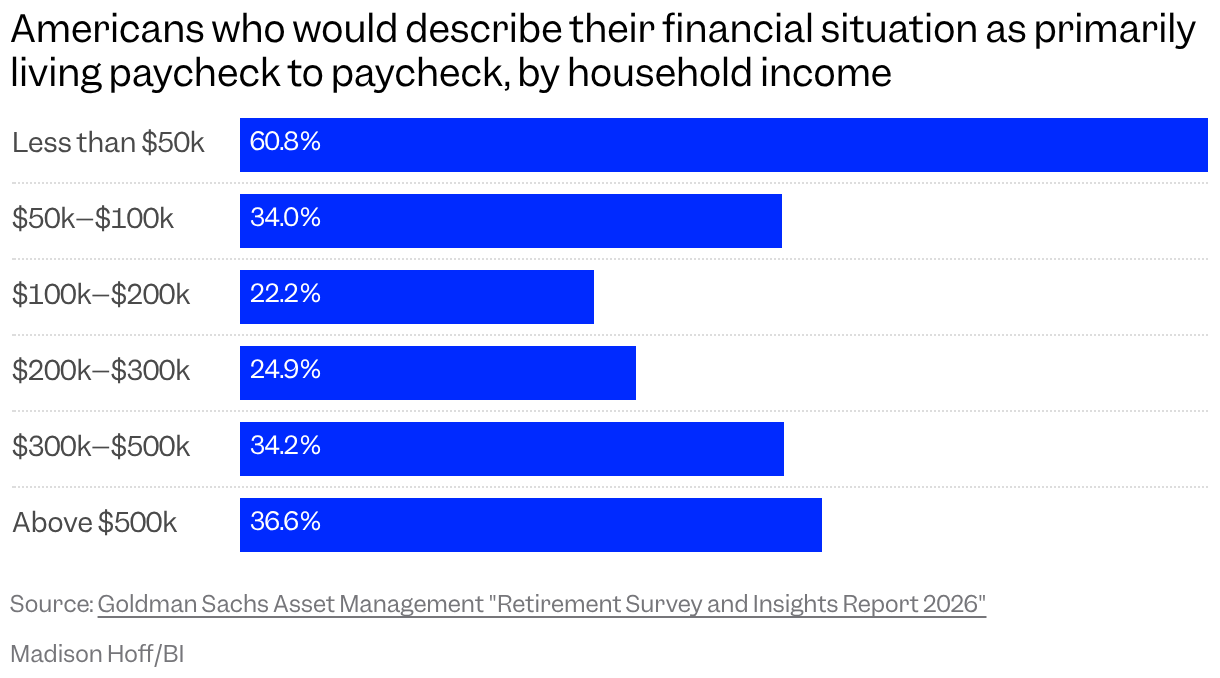
Higher- and lower-income Americans are more likely than those in the middle to say they're living paycheck to paycheck.
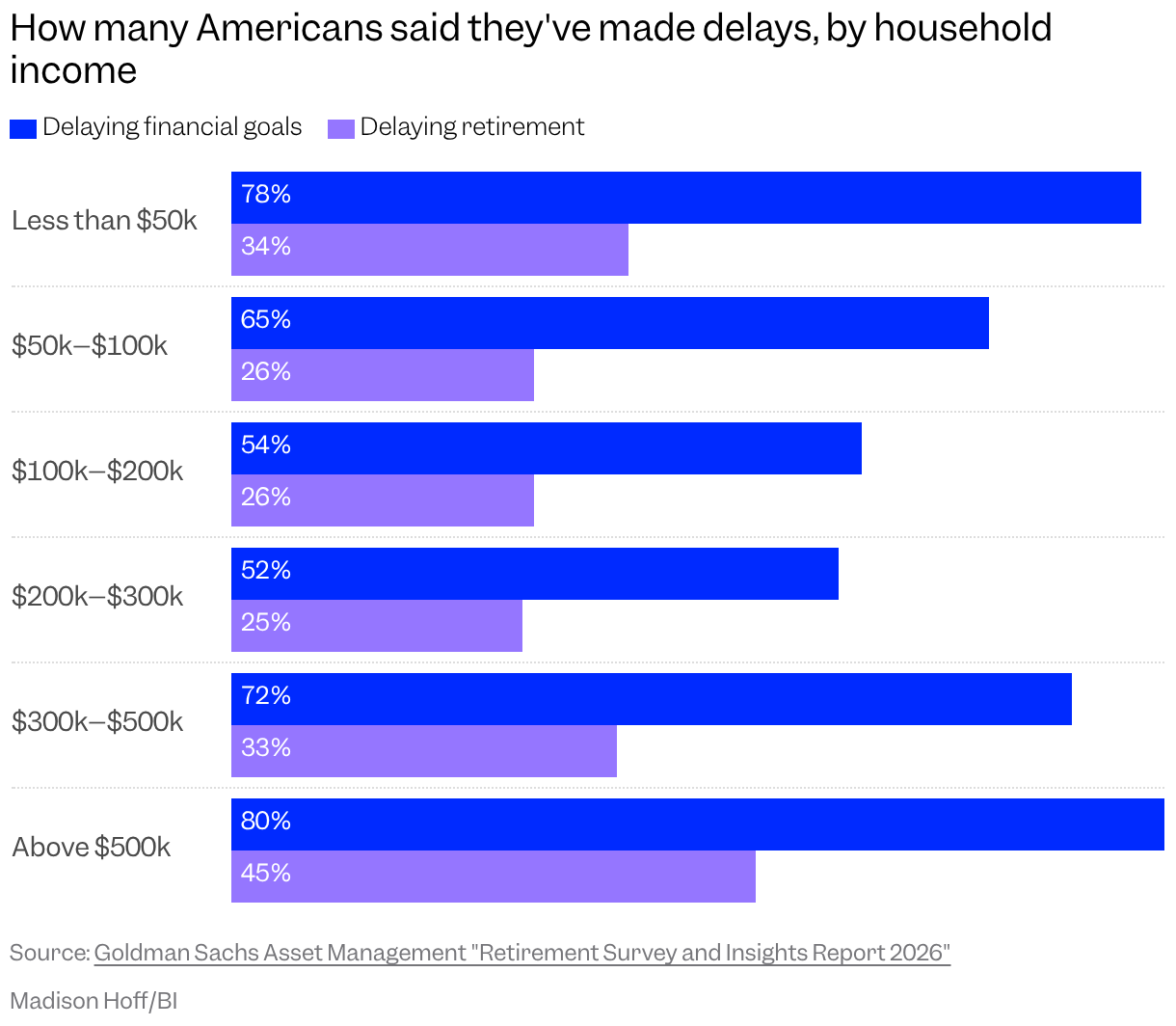
The top and bottom also struggled with making credit card payments and are delaying financial goals.
Lifestyle creep is one reason high earners are feeling anxious.
Low and high earners have at least one thing in common: they're more likely than those somewhere in the middle to say they're living paycheck to paycheck.
A July survey of over Americans by Goldman Sachs Asset Management and behavioral economics firm Escalent showed about 61% of working respondents with less than $50,000 said they're primarily living paycheck to paycheck, meaning they struggle to save or make progress toward long-term goals. The share dropped to 22% for those with $100,000 to $200,000 but rose to about 37% for those with more than $500,000.
"Financial security as reported does not rise in a straight line with income; it follows a u-shaped pattern," a recent report said.
However, those at the top and bottom are facing different challenges.
Lower earners are struggling to keep up with the basics. A Pew Research Center survey found 42% of lower-income US adults struggled to afford daily transportation costs, and 39% of lower-income adults said the same about paying their rent or mortgage.
High gas prices don't help; they're rising at a faster clip than before the Iran war. Food-at-home prices, which include groceries, are rising more slowly, but they are still increasing. And the gap between what you need to earn to afford a house and the actual median household income has worsened, according to a tracker from the Atlanta Fed.
Meanwhile, high earners with more than $300,000 are facing "more complex financial lives, higher lifestyle expectations, larger fixed commitments, and a wider gap between the retirement they envision and what they believe they have secured," the report said. Lifestyle creep could also be a factor, said Chris Ceder, senior retirement strategist at Goldman Sachs Asset Management.
U-shapes everywhere
The report also showed there were U-shapes by income level in how often financial concerns make it tough to focus at work, how many people are struggling with credit card payments, and how many said they're delaying financialgoals.
Those at the highest end of the income spectrum also had the highest share saying they've had to delay retirement despite being employed, at 45%.
When asked about what stands most in the way of saving up for retirement, 31%of Americans overall said housing costs, 31% said day-to-day living expenses, and 27% said debt payments.
"These expenses arrive every month, cannot be deferred, and they are paid first," the report said. "Retirement is often paid last."
Ceder said housing costs, family care, and healthcare are top concerns for the upper end of the income spectrum, while debt management is among the top three for the lower end.
Taking on more work
Ceder said that the highest-income workers were the most likely to take on multiple jobs. A likely reason could be saving up for unexpected costs.
"You would think again that mostly people who are at the lower-income spectrum may be working a second job or doing gig or freelance, but it's actually flipped," Ceder said.
A ZipRecruiter survey from earlier this year found workers earning over $150,000 were most likely to have supplemental work — with about 45% saying so compared to 31% of those making between $25,000 and $50,000.
Ceder said this hustling from the higher earners could suggest they're aware of their long-term financial goals and want to get ahead of that.
"They actually are pretty confident that they're going to be able to reach retirement, but some of that supplemental work is going towards retirement," he said.
Are you living paycheck to paycheck? We're looking to hear about how people are doing in today's economy and any changes they've had to make. Reach out to this reporter to share at mhoff@businessinsider.com.
Donald Knierim is fighting to get his Public Service Loan Forgiveness restored.
Vanessa Valadez for BI
Donald Knierim planned his retirement around student-loan forgiveness.
He spent most of his career designing financial data systems for major companies. At the age of 60, he took a pay cut and moved to the public sector, working for Metra, Chicago's commuter railway. His primary draw to the job was lower stress, and an added bonus was that it qualified for the Public Service Loan Forgiveness program, which erases student debt for government and nonprofit workers after 10 years.
Knierim had a $62,000 balance remaining on the student loans he took out to send his kids to college. If all went according to plan, a decade at Metra would wipe that clean.
In November 2025, the now-71-year-old logged on to his Federal Student Aid dashboard. It read "Congratulations! You've satisfied your obligation, and no additional payments are required for this loan." That tracked — Knierim said he had never missed a payment, always verifying that his payments were counting toward his forgiveness progress. So he put in his notice and retired.
Knierim retired after thinking his student-loan payments were done.
Vanessa Valadez for BI
Months later, he received an update: 15 payments that had previously counted toward forgiveness were changed to "non-qualifying." The notice said his payments were below the amount required under his income-driven repayment plan, but did not specify the proper amount. That means he has at least another year and a half of payments — about $470 monthly — to achieve PSLF.
"If I have to restore that payment, it's going to put my wife and me in a bad situation," Knierim said. "We're too tight in retirement to be shelling out money for stuff that we can't afford."
Since 2023, Business Insider has heard from student-loan borrowers whose loan forgiveness was rescinded. Over the past few months, issues with PSLF have become more widespread, with borrowers reporting challenges in receiving accurate payment counts. Some had their payments toward forgiveness removed after the Department of Education said it was correcting accounts following Biden-era coding errors.
An Education Department spokesperson said that the agency "remains committed to ensuring that every qualifying payment is properly credited to a borrower's account."
For years, Knierim said he made sure his payments were counting toward his forgiveness progress.
Vanessa Valadez for BI
Knierim said that even if he could land a new public service job, he wouldn't be able to take it. Caring for his wife, who is facing serious health issues, is a full-time job. He has reached out to his servicer and filed multiple complaints with Federal Student Aid, requesting his payments to be returned to a qualifying status. Meanwhile, he has not made the new payments his servicer said were due, which has lowered his credit score by more than 200 points. He recently received a notice that his account is delinquent and at risk of default, putting him at risk of seizure of federal benefits, like the Social Security he relies on to stay afloat.
Now, he's asking for the initial communication he received from his student-loan servicer to be honored.
"I thought I was done, they gave me that notification that I was done, and then they clawed it back," Knierim said. "I didn't know where that came from, or what to do."
An error-riddled student-loan forgiveness program
There are a few reasons a borrower might get their PSLF notices rescinded. An internal Education Department memo from 2023, reviewed by Business Insider, said that servicer MOHELA erroneously discharged loans for 64 student-loan borrowers "due to inadequate staff training." The memo recommended that MOHELA send notices to affected borrowers explaining what had happened.
In 2023, one borrower received a notice that his loans had been discharged under PSLF. Nine months later, he received a notice that the forgiveness was a mistake, and his payments were restarted. Between those two notices, the borrower said he had bought a home and paid for his son's preschool. The reversal required him to reconfigure his family's budget.
Some student-loan borrowers have seen their PSLF payments rescinded, which the Trump administration attributed to Biden-era errors.
Vanessa Valadez for BI
More recently, the Trump administration removed some PSLF borrowers' qualifying payments, with the Education Department citing Biden-era code errors that "resulted in inaccurate payment counts for some borrowers."
Bonnie Latrielle, an official in the Education Department's Federal Student Aid office under former President Joe Biden, said PSLF errors often arise during communication between the Education Department and servicers; servicers report qualifying PSLF payments to the department, and the department matches that information with a borrower's employment records to determine if the borrower is PSLF eligible.
"Those are all things that are outside of the borrower's control," Latrielle said.
Knierim said his servicer told him that some of the payments he made toward the Temporary Expanded PSLF program — a Biden-era program that allowed payments previously deemed ineligible to count toward forgiveness — did not qualify because they were below the required amount. He said he did not receive any further explanation as to why his payment amounts did not qualify, despite following his servicer's guidance on reaching forgiveness.
"I have a flawless payment history," Knierim said. "I have never missed a payment, and I paid what they told me to pay."
From relief to repayment
The Education Department has a "stated policy of holding borrowers harmless," Latrielle said, and borrowers have the right to submit complaints to the department's ombudsman if they have been harmed by their servicer.
However, amid staffing cuts in the department as part of the Trump administration's plan to dismantle the agency, it has stopped monitoring servicer performance and routine borrower complaints. Latrielle said a growing number of states have student-loan ombudsmen and a borrower bill of rights, offering resources and protections for borrowers within the state. Borrowers can also file lawsuits against their servicer if it violates state law, Latreille said.
Knierim, with the help of his daughter, an attorney, sent a letter to his servicer offering to pay the shortfall in his monthly payments. He said the letter was never acknowledged. He does not want to resume payments or switch repayment plans if doing so could further complicate his progress toward forgiveness. Still, his account is also inching toward default, and finding a resolution is becoming more urgent.
Knierim is hoping that his forgiveness denial will be reconsidered so he can continue retirement without a student-loan payment burden.
Vanessa Valadez for BI
In September, eight state student-loan ombudsman offices, including those from Massachusetts, California, and Illinois, where Knierim lives, sent a letter to the Education Department and congressional leaders calling for stronger oversight of PSLF. They cited an example of a public service worker who had more than the required number of payments for forgiveness, but his progress tracker was reset to zero.
"Borrowers have received no clear explanations for individual reductions, making it difficult to verify the accuracy of the new totals, even though these retroactive adjustments can delay forgiveness by years," the letter said.
Knierim is still searching for clarity on where his student-loan forgiveness stands. He said he recently spoke with a Federal Student Aid representative who told him that a "reconsideration request" for the payment denial is in progress. That process could take up to two months, Knierim said he was told, and in the meantime, he's seeking to put his loans on forbearance until he gets a final answer.
"I kept getting different answers," Knierim said. "I can't go back and work. I have no recourse here."
Dalle strade del Sud arriva una domanda che riguarda tutto il Paese: chi decide quanto costa produrre in Italia, e chi ne paga il prezzo quando la decisione viene presa altrove.
A metà ottobre, per un camionista siciliano, tenere il mezzo fermo nel piazzale costa meno che metterlo in strada. Con il gasolio intorno ai 2,40 euro al litro sull’isola, il Comitato autotrasportatori siciliani stima fra 700 e 900 euro di perdita al giorno per ogni camion. Il coordinatore Salvatore Bella l’ha detto senza giri di parole: «Oggi lavorare in perdita con il gasolio a 2,40 al litro non è più possibile». Ne è nato il fermo che va dalla mezzanotte del 16 ottobre al 20, senza cortei: i tir restano nelle aziende, i semirimorchi non vengono ritirati dai porti. In Calabria Fedralog ha fermato i mezzi negli stessi giorni, mentre la sezione trasporti di Confindustria Catania ha deliberato all’unanimità uno stop fino al 22.
Il fermo arriva dopo settimane di mobilitazione. Il 1° ottobre agricoltori e autotrasportatori hanno bloccato lo svincolo di Pizzo sulla A2; il 12 i trattori hanno presidiato le portinerie del polo industriale tra Augusta e Melilli, rallentando il carico delle autobotti, per iniziativa degli stessi produttori e senza sigle sindacali alle spalle. In Puglia i blocchi hanno impedito l’accesso delle autocisterne alla raffineria Eni di Taranto, a ridosso dell’ex Ilva, i cui lavoratori sono in sciopero dal 12 ottobre. Gli olivicoltori sommano al caro carburante il calo del prezzo dell’olio. Il 22 toccherà ai pescatori: giornata di sciopero nazionale e cento pescherecci a chiudere simbolicamente lo Stretto di Messina.
La geografia dei presìdi dice qualcosa che i comunicati non dicono. Raffinerie, porti, svincoli autostradali, lo Stretto: chi protesta va a colpire i nodi da cui passa l’energia, come se sapesse bene dove nasce il problema. E c’è un paradosso evidente. Il Sud ospita Augusta, Priolo, Taranto, cioè una parte rilevante della capacità di raffinazione del Paese, ma i produttori che vivono a pochi chilometri da quegli impianti non riescono più a pagarne il prodotto.
La guerra arriva alla pompa
Queste proteste sono la coda italiana di una crisi aperta lontano. I rincari sono partiti con la guerra in Iran e con le difficoltà di approvvigionamento dal Golfo: già a fine marzo, nel Siracusano, il gasolio agricolo era salito da 0,88 a 1,45 euro al litro. A settembre la media nazionale del gasolio superava i 2,16 euro, 35 centesimi più di febbraio; il 12 ottobre il self costava in media 2,252 euro. La crisi di Hormuz, che finora abbiamo letto soprattutto come stress test per le petromonarchie e per i flussi finanziari del Golfo, ha anche una trasmissione verso il basso. Lungo la catena, ogni anello scarica il costo su quello successivo, finché arriva a chi non ha nessuno a valle: il piccolo autotrasportatore che non può ritoccare le tariffe, l’agricoltore che vende a prezzi fissati dalla grande distribuzione.
Le isole pagano due volte. Al carburante si sommano i noli marittimi, appesantiti dalle nuove regole ambientali sul trasporto navale, e i ritardi del Sea Modal Shift, l’ex Marebonus che dovrebbe compensare il costo del passaggio via mare da e per la Sicilia e la cui prima annualità non è stata pagata entro giugno. Le risposte arrivate finora agiscono sul prezzo alla pompa (tagli temporanei delle accise, il tetto annunciato da Eni sulla propria rete dal 28 settembre) e quasi mai sulla struttura dei costi. Per un trattore che brucia 300 euro di gasolio a mattina, uno sconto di 15 centesimi non cambia i conti.
Letta con gli strumenti dell’analisi dei sistemi-mondo, la vicenda ha una forma riconoscibile: gli shock esterni attraversano il centro e si depositano sulla periferia, che ha meno margini per assorbirli. Il Mezzogiorno funziona da periferia interna dell’Europa. Importa energia a prezzi di mercato globale, esporta prodotti agricoli in competizione con importazioni soggette a standard diversi, dipende da una logistica strada-mare che nessun incentivo pagato in ritardo riesce a rendere sostenibile. Su questo si innestano fragilità di lungo periodo come il credito difficile, lo spopolamento e l’arretramento dei servizi, che l’autonomia differenziata rischia di accentuare.
La copertura nazionale ha registrato i blocchi come cronaca del traffico più che come fatto politico. È una scelta che pesa: una protesta trattata come disagio stradale non obbliga nessuno a rispondere sul merito. Eppure il merito è chiaro. Un Paese che importa gli effetti delle guerre altrui senza strumenti propri per governare il costo dell’energia finisce per trasferirli sui territori e sulle categorie più deboli.
Per le prossime settimane gli indicatori da seguire sono pochi e osservabili: un intervento specifico sul gasolio agricolo e da autotrazione, il pagamento del Sea Modal Shift, l’eventuale proroga dei fermi oltre il 20 e il 22, la saldatura con lo sciopero dei pescatori. In assenza di misure, gli stessi promotori siciliani hanno già prospettato di proseguire. Se accadrà, sarà difficile continuare a chiamarla una vertenza di categoria.
Dalle strade del Sud arriva una domanda che riguarda tutto il Paese: chi decide quanto costa produrre in Italia, e chi ne paga il prezzo quando la decisione viene presa altrove.
Matthew Guerrero drives for Uber in Southern California.
Matthew Guerrero
Matthew Guerrero says gas costs eat up much of his pay as an Uber driver in Southern California.
He prioritizes giving rides to weekend barhoppers who tend to tip well, he said.
Uber says that one driver's experience isn't representative of the broader platform.
This as-told-to essay is based on a conversation with Matthew Guerrero, a 41-year-old Uber driver in Southern California. It has been edited for length and clarity.
I've been seeking a workers' comp settlement that should be settled soon. In the meantime, my lawyer said that I could start working again. I needed a job really quickly, especially with three kids, so I started driving with Uber.
I've been driving with Uber for about five weeks. So far, it hasn't been very successful. For example, one week, I made $600 working 30 hours. To make that, I spent about $300 in gas driving my SUV.
Then, I have to put between 20% and 30% of what's left aside for taxes. That comes out to about $210 for 30 hours of work. That doesn't even include wear and tear on my car. I don't understand how anybody can do this long-term. It's not sustainable.
The pay is better if you drive in Los Angeles or San Diego. But I'm in Riverside County, and the pay seems to be lower here.
To get better-paying rides, you have to be strategic. Sometimes, I try to get a ride with a passenger who's headed to an airport in one of the big cities. Then, I stay there all day and take rides. That's not always feasible, though.
When I started with Uber, I realized that there were a lot of rides that involved taking people to morning doctor's appointments. Most of those people didn't tip well, though, and tips are key to making money.
Instead, I like to work Friday and Saturday nights around bars in Temecula. I usually log on around 4 pm and head home around 3 am. The pay is good, and the tips are a lot better than other rides in my area. Sometimes you have to deal with drunk people throwing up, but it's worth it.
I've given some rides to veteran Uber drivers — people who were working on the app back in 2015 and 2016. They said that they used to make better money than I do, and that they quit after they saw pay fall.
That was eye-opening for me. I don't understand how a company like Uber can pay as little as they do.
An Uber spokesperson said drivers in Riverside County, California make "at least $20.28 per engaged hour, plus $0.37 per engaged mile for vehicle expenses, with tips on top of that."
"While this guarantee doesn't cover time spent waiting for trips, it's important context when discussing driver compensation," the spokesperson said. Driver earnings can vary based on when drivers decide to work, where they drive, and rider demand.
"One driver's experience isn't representative of the broader platform," the spokesperson said.
Do you have a story idea about Uber? Contact this reporter at abitter@businessinsider.com or via encrypted messaging app Signal at 808-854-4501. Use a personal email address, a nonwork WiFi network, and a nonwork device; here's our guide to sharing information securely.
by Mish Shedlock, Mish Talk: “The worst I have ever seen in any poll, on any issue for any president” Voters Under 30 Stats Inflation: Net Approve -82 Economy: Net Approval -64 Overall: Net Approval -50 TRUTH LIVES on at https://sgtreport.tv/ ‘Absolutely stunning!’ Data Analyst Stunned At Trump’s Disastrous 91% Disapproval Rating With Voters Under 30: […]
The global economy, because of the conflict in the Middle East in 2026, has faced an unprecedented combination of geopolitical and economic challenges. The Middle East conflict, which began in late February 2026, became a catalyst for profound structural changes in the global trading system, which was already under pressure from rising protectionism and economic […]
At 35, the mayor of New York City knows how to catch — and keep — people's attention. It's tempting to think the key to Mamdani's success is Instagram, but the secret sauce of his leadership isn't just a social media machine. It's a man criss-crossing the five boroughs withaportablepodiumand the occasional sugar-free Red Bull.
To better understand how his in-person ubiquity shapes public perception, Business Insider spent the summer tracking the mayor's daily schedule. From May 1 to August 31, Mamdani had 249 listed appointments, 170 of which were held in public. Eighty-one of these were in community spaces such as classrooms, libraries, parks, apartment buildings, tennis courts, places of worship, and restaurants.
Another 50 were government events at emergency preparedness centers and police precincts.With the exception of Staten Island — which Mamdani visited three times — his appearances dotted the city. He spent the most time in Manhattan with 85 events, followed by Brooklyn (35), the Bronx (26), and Queens (21). He made few appearances in City Council chambers and other traditional political arenas. At the mayor's home, Gracie Mansion, there were no press conferences. Instead, Mamdani hosted 10 cultural receptions, pickup soccer games, and religious celebrations.
At a time when C-suite bigwigs are delivering bad news via canned memo, and politicians are mediating their message through glossy election mailers, dozens of political analysts, media strategists, historians, and people in the mayor's orbit say that Mamdani's man-about-town style stands out.
What makes Mamdani a lesson in charisma is his ability to combine four important factors: physical presence, personal authenticity, political messaging, and active participation, a review of his nearly first year shows.
He's able to be in on the joke — poking fun at his omnipresent suit by jumping into a pool, tie and all — while still getting his message across. They're a regular part of his schedule, rather than a surprise one-off that feels like it was cooked up by a communications staffer. It's not an easy balance to strike, but the mayor's in-person events lay out a road map for other leaders.
Showing up doesn't solve all problems, and nine months into his tenure, the mayor has met his fair share of critics. Glad-handing with a few CEOs and small business owners doesn't replace the need to attract investment from blue-chip companies and buzzy startups. Despite his push for affordability, he has yet to substantially lower residents' household bills.
But his supporters and critics agree that the mayor has a natural talent for connection, turning mundane events into meaningful moments with constituents. Hefuses human connection and mass media to turn heads in the cutthroat attention economy. Whether it's cheering on the Knicks in the nosebleeds of Madison Square Garden or ordering an egg and cheese with jalapeño at a Queens bodega, Mamdani knows how to see and be seen.
Between a crammed row of treadmills and elliptical machines, Mamdani straightened his blazer and stepped up to the microphone. The East Village recreation center smelled like sweat, dust, and takeout coffee. Events like this one in early July, which touted new rules to make it easier for people to cancel subscriptions, are a signature way to promote his agenda. As the images circulated online, New Yorkers could imagine Mamdani on the rowing machine next to them, complaining about how hard it was to get out of a pesky membership.
All mayors go to ribbon-cutting ceremonies and attend parades. Mamdani's retail politics events also include everyday New Yorkers in everyday settings. He gave only a few keynote speeches this summer, but he found time to visit three senior centers, seven schools, and a soccer watch party at Rikers Island. A sentiment expressed by dozens of residents is that, regardless of their personal politics, they respect Mamdani for coming to their neighborhoods. One Central Park halal vendor says he feels like the mayor understands how pricey food can be these days. A Staten Islander who has met Mamdani — and filmed a video with him — was shocked that he could rattle off deep-cut Sri Lankan cricket trivia.
Debbie Saslaw runs the video production company Melted Solids alongside Anthony DiMieri. The pair are the brains — and lenses — behind some of Mamdani's viral videos. While much has been said about the mayor's knack for social media, Saslaw says his penchant for physical presence is crucial to making his short-form videos effective. Saslaw recalls a day early in the mayoral campaign when they visited a park to chat with picnickers. She figured no one would want to speak with an underdog candidate on what turned out to be a very rainy afternoon.
"People were honking out from their cars, and one guy waved from his apartment window," she tells me. "People were stopping their bikes — there was a bike pileup."
Moments like that become social media content: More than 80 in-person events this summer earned posts on the NYCMayor Instagram — largely photos and videos of Mamdani with regular people. Only a handful of posts were policy announcement graphics or highly produced mini-documentaries.
Some critics say the energy the mayor puts into engagement is a distracting gimmick that diverts attention from controversial policies or a lack of meaningful accomplishments. With hundreds of events over the summer, Mamdani's time to negotiate and pass policies within City Hall is limited. At least on the books, his schedule shows he met with local political leaders a handful of times between May and August. On the other hand, for all but 25 of 122 days, he attended at least one public event.
The city's business leaders, in particular, say Mamdani hasn't spent enough time learning from corporate advisors, economists, or local shop owners. Of Mamdani's 249 listed events, six were with CEOs or Wall Street execs, and only a few were with small business owners. By comparison, he met childcare and day care workers more than a dozen times. While former communications leaders for Bill de Blasio and Eric Adams say past mayors have also limited their time in boardrooms and offices ("their job is to be out there," one tells me), some small-business owners feel they're getting short shrift from Mamdani as well. A vendor near one of his planned city-owned grocery stores says she feels left out of the conversation, "You're going to spend all this money on building this new infrastructure, and the basic things that we have been asking for don't get done."
Those less convinced by Mamdani's tactics say the resources the Mayor's Office pours into communications are a smokescreen. Mark Jaffe, a founder of NYC's Multicultural Business Coalition who is suing the administration over its city-run grocery store initiative, says that while Mamdani "gets people's attention," the substance is coming up short.
"He knows the issues," Jaffe says. "He just doesn't come up with good plans that can actually solve them through jobs and capitalism."
Mamdani's propensity for kissing babies and waltzing into bars has both practical and historical grounding. As people spend more of their lives conversing with AI customer service bots, half-engaged with corporate Zoom meetings, and watching political attack ads between TV episodes, they're starving for more intimate, authentic connections. When C-suite leaders and politicians try to connect with people, it can yield limited success. Whether it's a fast-food CEO taking tiny bites out of a burger and calling it a "product," tech execs looking unconvincing as they sip beer, or politicians filming stilted selfie videos, attempts to add a personal touch through a mediated platform can leave people cold.
"We are, at our core, social creatures who need to connect, and we did not evolve to connect only digitally," Amy Edmondson, a professor of leadership and management at Harvard Business School, tells me.
Mamdani is trying to resurrect a bygone era for New York City politicians — with his own new-school sheen. Mayoral calendars aren't publicly posted, and changes in record keeping, news coverage, and technology make comparisons imperfect. But historians and communications directors under previous administrations say that recent mayors struggled with the perception of being distant from their constituents.
A longtime New Jersey homeowner, Eric Adams drew criticism for his international travel and trips to exclusive nightclubs. Michael Bloomberg's billionaire status made him less relatable to regular people, NYC historian Kevin Draper tells me, even when he made an effort to meet residents around town. Bill de Blasio had a Mamdani-esque focus on affordability but, based on his dismal approval ratings throughout his mayoralty, failed to connect on a personal level. Former communications directors for de Blasio and Adams say they both had their go-to outer-borough neighborhoods, but neither had Mamdani's widespread reach.
Timing was a factor: Those two leaders tended to work later into the night, whereas the current mayor makes stops around the city much earlier. Draper says youth is also a leg up that Mamdani has over his predecessors. My analysis shows that Mamdani attended at least one event on 97 of his 122 days this summer, averaging more than two per day, and a third of these were out in the community. On busy days, he made up to seven stops.
"He has had a longer honeymoon than any other mayor," José Bayona, who worked under the Adams and de Blasio administrations, says with a laugh. "I can tell you that."
Mamdani has said he emulates Depression-era Mayor Fiorello La Guardia, who launched an early version of city-owned stores and primarily focused messaging toward the working class with his "Talk with the People" radio program. He also evokes Ed Koch, the relatively moderate mayor who dominated the 1980s, who was known for strolling the streets and riding the train, asking residents, "How'm I doin'?" The style's lineage stretches back to the 19th century, when candidates and elected officials would drum up support by giving speeches and meeting the public in their saloons and town squares. Members of Tammany Hall, a highly corrupt but popular New York City political machine, focused on in-person interactions with the working class.
There are, of course, challenges to the mayor's attempts at everyman charisma. On a practical level, it's much harder for Mamdani to show up at a sports bar these days without serious planning and a security detail. And even with sharp messaging and the reputation for popping up in unexpected places, the complexities of policy rollout and city politics have slowed his attempts to transform New York.
Mamdani is early enough in his term that he can get away with having big plans that haven't been realized, riding high on a banner sports summer and pothole politics. But as he approaches his second year in office, his constant presence outside City Hall and prolific digital footprint could become more of a liability than an asset. As Edmondson puts it: "There's always a risk of disappointment when people believe that, in your back pocket, you have a magic wand."
Christine Lagarde says rising government borrowing costs are tightening financial conditions across the eurozone, complicating efforts to contain inflation without undermining economic growth.
European Central Bank President Christine Lagarde has warned that a sharp sell-off in government bonds is tightening financial conditions across the eurozone, threatening to weaken economic growth at a time when European governments are already struggling with mounting debt and higher energy prices.
Speaking during the International Monetary Fund’s annual meetings on Saturday, 17 October, Lagarde said rising bond yields were imposing additional pressure on the European economy, potentially reducing demand and helping to bring inflation down.
Her comments came as investors demanded higher returns on government debt across major developed economies, reflecting concerns about persistent inflation, widening budget deficits and the substantial borrowing requirements associated with investment in artificial intelligence.
The development presents a complicated situation for the ECB, which has already raised its key interest rate twice this year in response to renewed inflationary pressure following the conflict in the Middle East.
Higher government bond yields effectively tighten monetary conditions even without a further decision by the central bank to increase official interest rates.
Bond markets tighten financial conditions
The latest sell-off has pushed borrowing costs higher across Europe, although the pressure is particularly acute in countries with large public debts and persistent budget deficits.
When investors sell government bonds, their market prices fall and yields rise. Those higher yields eventually feed into the costs of borrowing for governments, businesses and households.
Lagarde indicated that financial conditions had become tighter than assumed in the ECB’s September economic forecasts.
According to her latest assessment of the bond market, the resulting slowdown in demand could help moderate inflation, but would also place additional pressure on an economy whose growth prospects remain limited.
The ECB’s September projections forecast eurozone economic growth of just 0.9 per cent in 2026, followed by 1.4 per cent in 2027 and 1.5 per cent in 2028.
Inflation was expected to average 3.0 per cent this year before declining to 2.5 per cent in 2027 and 2.1 per cent in 2028.
Those forecasts were based on assumptions about financial conditions and energy prices that may no longer fully reflect developments in international markets.
France faces particularly acute pressure
France has emerged as one of the most vulnerable major eurozone economies because of its high public debt, persistent deficits and political disagreements over fiscal consolidation.
French government bond yields have risen sharply as investors question whether Paris can deliver the spending reductions required to stabilise its finances.
As EU Today reported earlier this month, eurozone finance ministers have been pressing France to produce a credible budget that would restore confidence in the country’s fiscal position.
The borrowing premium demanded on French debt relative to German government bonds has also widened, reflecting investors’ concerns about the financial outlook and the political difficulties surrounding the 2027 budget.
The IMF has warned that continued increases in borrowing costs could eventually force the French government to undertake more substantial fiscal adjustments.
In its assessment of French bond yields, the Fund said the immediate pressures remained manageable, partly because France benefits from established debt markets and relatively long borrowing maturities.
Nevertheless, persistently elevated yields would increase the cost of refinancing government debt as existing bonds mature.
The wider concern is that higher borrowing costs could reduce the room available for public investment and other expenditure across several European economies simultaneously.
IMF warns governments over rising debt
Lagarde’s intervention coincided with renewed warnings from the IMF about the sustainability of European public finances.
In its latest European economic assessment, the Fund argued that governments must either accelerate economic growth or reduce borrowing to prevent debt burdens from becoming increasingly difficult to manage.
The IMF expects eurozone growth of approximately 1.1 per cent in 2026 and 1.2 per cent in 2027, with continuing pressure from energy costs, demographic changes and weak productivity.
The European Commission’s forecasts indicate that eurozone government debt could rise from 88.7 per cent of GDP in 2025 to 91.2 per cent in 2027.
The IMF has also identified structural weaknesses, including barriers within the European single market, which restrict investment and productivity growth.
These problems are becoming more difficult to address as European governments face demands for greater defence expenditure, infrastructure investment and support for industries affected by higher energy prices.
ECB faces difficult interest-rate decision
The ECB has already increased its deposit rate to 2.5 per cent following successive increases in June and September.
As EU Today reported after September’s decision, the central bank has been attempting to contain inflation generated by rising energy costs without causing a more substantial economic slowdown.
The IMF now expects at least one additional quarter-percentage-point increase before the end of 2026.
Such a decision would bring the deposit rate to 2.75 per cent, although the ECB has not committed itself to that outcome.
The challenge is that tighter monetary policy would coincide with financial restrictions already being imposed by bond markets.
At the same time, higher energy prices continue to affect household purchasing power and business operating costs.
In her statement to the International Monetary and Financial Committee, Lagarde acknowledged that the eurozone had proved more resilient than expected, while warning that risks to growth remained tilted to the downside and risks to inflation to the upside.
The duration of the Middle East conflict, developments in energy markets and changes in investor confidence will be important in determining the economic outlook.
For the ECB, a bond-market slowdown could reduce the need for further interest-rate increases by weakening demand. But if energy-driven inflation remains elevated, the central bank may still face pressure to tighten policy.
Europe’s governments, meanwhile, have considerably less control over the borrowing costs demanded by international investors.
The next ECB interest-rate decision will therefore take place against an increasingly difficult combination of sluggish growth, persistent inflation and financial markets imposing their own constraints on public and private borrowing.
Dopo gli aumenti dei costi energetici e del carburante, a preoccupare i vettori del comparto aereo sono ora le conseguenze che il rialzo del prezzo del jet fuel potrebbe avere sulle tariffe applicate ai voli dalle compagnie. Gli effetti, finora contenuti grazie ai contratti di fornitura stipulati a prezzi fissi, rischiano infatti di diventare più evidenti nei prossimi mesi, quando le scorte acquistate a condizioni più favorevoli inizieranno a esaurirsi.
Perché i voli potrebbero costare di più dal 2027
A lanciare l’allarme su un possibile rincaro dei voli è Assoutenti, dopo le preoccupazioni espresse da Assaeroporti e gli aumenti tariffari già annunciati da alcune compagnie per il prossimo anno, ha richiamato l’attenzione sulle possibili ripercussioni per i viaggiatori. Secondo l’associazione dei consumatori, il problema non riguarda soltanto il costo del carburante, ma anche il peso della tassazione e delle diverse componenti che concorrono a determinare il prezzo finale di un biglietto.
Il jet fuel è una delle principali voci di costo per le compagnie aeree e le variazioni del suo prezzo possono incidere in misura significativa sulla sostenibilità economica dei collegamenti. Fino ad ora, molte compagnie hanno potuto continuare a mantenere diverse tratte grazie agli accordi stipulati in precedenza, che hanno permesso loro di avere una fornitura a prezzo bloccato, senza trasferire immediatamente tutti gli aumenti sui passeggeri.
Come spiegato da Assoutenti, però, questa protezione non è permanente e quando i contratti scadranno o le condizioni precedenti verranno meno, le compagnie devono rifornirsi ai prezzi correnti di mercato. Se questi rimangono elevati, il costo necessario per operare i voli aumenta e diventa più difficile assorbire integralmente la differenza senza intervenire sui ricavi. Tanto che già le prime low cost stanno annunciando la sospensione delle attività in diversi aeroporti.
Per le tratte che invece vengono mantenute attive, il rischio è che nel corso dei prossimi mesi una parte maggiore dei rincari del carburante venga trasferita sui consumatori, rendendo più costosi i viaggi nel 2027.
Quanto pesano sul costo del biglietto tasse e balzelli
Accanto al costo del carburante, Assoutenti individua poi nella tassazione e negli oneri aeroportuali un altro elemento determinante per il prezzo finale dei voli. Nel comunicato del 7 ottobre, l’associazione sostiene infatti che tasse, imposte e altri balzelli possano arrivare a incidere fino al 70% sul costo complessivo di un biglietto. Pertanto, intervenire su queste voci potrebbe contribuire a contenere il prezzo finale dei voli proprio nel momento in cui le compagnie si preparano a sostenere spese più elevate per il carburante.
La richiesta è quindi quella di ridurre il carico fiscale e gli altri oneri che gravano sui biglietti, così da attenuare almeno in parte la pressione sui viaggiatori.
Una simile misura, tuttavia, richiederebbe decisioni da parte delle istituzioni competenti e una valutazione delle entrate pubbliche e dei costi dei servizi finanziati attraverso tali prelievi. Inoltre, c’è da dire che la riduzione di una tassa non garantisce automaticamente un ribasso equivalente del prezzo finale. L’effetto dipenderebbe anche dalle modalità di applicazione della misura e dalle politiche tariffarie delle stesse compagnie aeree.
Di quanto rischiano di aumentare i prezzi
Secondo il presidente di Assaeroporti, Carlo Borgomeo, l’incidenza del costo del jet fuel è già arrivata a pesare sulle compagnie aeree circa il 31% sui costi operativi totali, mettendo a rischio la sostenibilità delle rotte e spingendo verso inevitabili rincari tariffari. In base alle proiezioni elaborate dagli analisti dei trasporti del centro studi Tra – Transport research, la combinazione tra il rincaro del cherosene per aviazione e il costante impatto delle componenti fiscali potrebbe portare a un aumento medio delle tariffe compreso tra il 15% e il 20% nel corso del 2027.
Sulle tratte a minore frequenza o su quelle più esposte alle fluttuazioni di mercato, Codacons e Federconsumatori ipotizzano rincari ancora più marcati, che in casi estremi potrebbero persino far raddoppiare il costo dei biglietti base.
In attesa di capire se e in quale misura i possibili rincari si concretizzeranno, i viaggiatori possono adottare alcune strategie per limitare la spesa. La più importante consiste nel monitorare le tariffe con anticipo, soprattutto quando il viaggio è previsto in periodi di forte domanda, come Natale, Capodanno, Pasqua e i mesi estivi.
La crisi del costo della vita continua a pesare sulle abitudini di acquisto degli italiani e il carrello della spesa diventa sempre più vuoto. Eppure, oggi, le famiglie italiane spendono più soldi al supermercato. Il budget destinato all’acquisto di alimenti e bevande è aumentato, per via dei rincari e dell’inflazione galoppante degli ultimi anni, così per riuscire a contenere le uscite si riducono le quantità e si rinuncia, sempre più spesso, alla qualità dei prodotti.
Come è cambiata la spesa delle famiglie italiane
Nel 2025, secondo i dati Istat pubblicati a ottobre 2026:
la spesamensile per alimentari e bevande analcoliche è passata da 533 a 552 euro;
mentre la quota del bilanciofamiliare destinata a questa voce è salita dal 19,3% al 19,8%.
Quasi un quinto della spesa complessiva è stato quindi assorbito dall’acquisto di beni di prima necessità. A causa dell’aumento dei prezzi, nello stesso periodo risulta che tra le famiglie italiane:
il 29,4% ha dichiarato di aver limitato la spesa per il cibo, riducendo le quantità acquistate oppure scegliendo prodotti di qualità inferiore;
il 33,8% ha ridotto la quota della spesa destinata alle bevande.
I rincari hanno reso più difficile mantenere le stesse abitudini di consumo, obbligando molti nuclei a riorganizzare il budget della spesa, valutando attentamente quali prodotti acquistare, in quali quantità e con quale frequenza. Per questo motivo, secondo Assoutenti, gli ulteriori aumenti dei prezzi registrati nel 2026 rischiano di aggravare la situazione.
A cosa rinunciano le famiglie quando fanno la spesa
Quando la capacità di acquistare cibo a sufficienza diventa più importante di scegliere liberamente cosa portare in tavola, il modo in cui il prezzo condiziona le proprie abitudini si configura come il primo segnale di povertà alimentare.
Un’analisi pubblicata da ActionAid in occasione della Giornata mondiale dell’alimentazione evidenzia proprio questo fenomeno. La difficoltà economica può riguardare sia la disponibilità materiale di cibo sia l’accesso a un’alimentazione adeguata e la possibilità di vivere i pasti come un momento di condivisione.
Quando una famiglia deve risparmiare, infatti, il cibo può diventare una delle voci sulle quali intervenire più facilmente rispetto ad altre spese difficilmente comprimibili, come il canone di affitto, il mutuo o le bollette sempre più care. E il risultato è un progressivo impoverimento delle possibilità di scelta. Non necessariamente si smette di acquistare alimenti, ma diventa più difficile mantenere la stessa qualità e varietà.
Quante sono le persone in difficoltà in Italia
ActionAid ha individuato oltre 6,4 milioni di persone in difficoltà in Italia nel 2024, pari al 12,7% della popolazione (di questi, circa 2,2 milioni sono risultati essere a rischio di povertà assoluta o relativa). Il dato è stato elaborato attraverso l’indice Dams, che prende in considerazione la possibilità economica di permettersi almeno una volta ogni due giorni un pasto con carne, pollo o pesce (oppure un equivalente vegetariano), e quella di incontrarsi con amici o familiari per mangiare o bere qualcosa almeno una volta al mese.
Al di là del proprio reddito, qualcuno può avere problemi economici anche quando non rientra formalmente nelle fasce a rischio di povertà, soprattutto se una parte consistente delle sue entrate – come già detto – viene assorbita da spese obbligatorie. Inoltre, l’andamento della deprivazione alimentare è andato sempre più peggiorando dopo il miglioramento registrato negli anni immediatamente successivi alla pandemia. L’incidenza era passata dal 14,1% nel 2019 al 10,5% nel 2022, per poi risalire all’11,8% nel 2023 e al 12,7% nel 2024. Rispetto all’anno precedente, le persone coinvolte sono aumentate di quasi 470mila unità.
Le categorie più a rischio
Le conseguenze della povertà alimentare si manifestano in modo diverso a seconda della composizione del nucleo familiare, della disponibilità economica e delle spese da sostenere. Tra i gruppi più esposti figurano:
le famiglie numerose;
i genitori soli;
le persone che devono destinare una parte consistente del reddito all’abitazione.
Da quello che è emerso dal rapporto di ActionAid, inoltre, nel 2024:
circa 430mila minori di 16 anni risultavano in condizione di deprivazione alimentare materiale o sociale, oppure entrambe. Le difficoltà sono aumentate soprattutto nella fascia tra i 6 e gli 11 anni. In questo gruppo, la deprivazione materiale è passata dal 2% del 2021 al 2,8% del 2024, mentre quella sociale è salita dal 3,8% al 6,8% (quest’ultimo indicatore comprende anche la possibilità di invitare amici a casa per giocare o mangiare insieme);
la deprivazione alimentare nello stesso periodo ha raggiunto anche gli affittuari, per la precisione il 22,6% tra chi viveva in un’abitazione in affitto agevolato e il 20,9% tra chi pagava un canone a prezzo di mercato.
La casa rappresenta una delle principali voci di spesa e lascia poco spazio di manovra quando il costo della vita aumenta. Tuttavia, a confermare che il fenomeno si stesse estendendo è soprattutto il dato su chi invece una casa ce l’ha. Tra i proprietari senza mutuo, infatti, la deprivazione alimentare è cresciuta, passando dall’8,9% al 10,8%.
Il clima mite e più stabile sta favorendo il passaggio dalle coltivazioni in pieno campo a quelle in serra, contribuendo a rendere più regolare l’offerta di frutta e verdura e ad allentare la pressione sui prezzi di diversi prodotti ortofrutticoli. A delineare il quadro è la Borsa della Spesa, il servizio settimanale realizzato da Bmti, Italmercati e Consumerismo no profit, che monitora i mercati all’ingrosso.
Cosa c’entra il clima con il calo dei prezzi di frutta e verdura
L’andamento meteorologico è uno dei fattori che influenzano maggiormente il mercato ortofrutticolo. Temperature miti e condizioni climatiche relativamente stabili possono favorire la maturazione dei prodotti, sostenere la raccolta e rendere più regolari i flussi di merce diretti ai mercati all’ingrosso.
Quando le condizioni climatiche sono favorevoli, quindi, la disponibilità di frutta e verdura tende a essere più prevedibile, e questo:
permette agli operatori di organizzare meglio la distribuzione dei raccolti (e di conseguenza della vendita);
riduce il rischio che una diminuzione improvvisa dei quantitativi disponibili provochi tensioni sulle quotazioni, e una maggiore disponibilità, quando incontra una domanda che non cresce nella stessa misura, può tradursi in una riduzione dei prezzi all’ingrosso.
Il calo registrato nei mercati all’ingrosso non si trasferisce necessariamente e immediatamente sugli scaffali dei supermercati o sui banchi al dettaglio, tuttavia può anticipare una stabilizzazione o una riduzione dei prezzi al consumo nel medio termine, a patto che la filiera distributiva assorba le variazioni senza trattenere i margini.
I prezzi di ottobre, cosa costa meno
Tra i prodotti che mostrano una dinamica favorevole a ottobre ci sono:
l’uva da tavola, le cui quotazioni all’ingrosso sono diminuite del 4,6% rispetto alla settimana precedente;
i fichi d’India, che si trovano in una fase favorevole della produzione. Le quotazioni sono scese del 3,1% nell’arco di una settimana, in un momento in cui la disponibilità del prodotto è elevata.
Le condizioni meteorologiche di inizio ottobre stanno favorendo anche il comparto degli ortaggi. I primi ribassi hanno interessato le lattughe al Centro-Sud, grazie alle condizioni climatiche favorevoli alla produzione. In questo caso, tuttavia, le quotazioni variano in base alla tipologia, alla zona di produzione e alla quantità di prodotto presente sui mercati locali.
Proprio perché coltivazione e raccolta stanno procedendo senza intoppi in autunno, dopo il caldo record di questa estate, ci sono poi diversi tipi di ortaggi e frutta di largo utilizzo e tipici di questa stagione che mantengono quotazioni contenute all’ingrosso. Tra i più convenienti, il bollettino segnala:
cachi;
zucca;
porri;
cavoli cappucci;
carote;
cipolle.
Prezzi in calo non soltanto per frutta e verdura
Anche nel settore ittico, sebbene l’offerta sia influenzata dalla disponibilità delle specie e dai periodi di attività delle marinerie, si stanno registrando dei casi. In particolare, Borsa della Spesa segnala:
un calo del 7% per i calamari rispetto alla settimana precedente;
una diminuzione pari al 3,9% dei fasolari.
Presentano prezzi inferiori anche il pesce spada italiano e la lampuga. Anche se l’offerta in questo comparto è influenzata anche dal fermo pesca che dal clima. Le marinerie del Tirreno si fermano infatti per l’intero mese di ottobre, mentre in Adriatico il periodo di fermo si è concluso. E proprio queste differenze territoriali contribuiscono a determinare i quantitativi disponibili e possono influenzare le quotazioni delle singole specie.

 Login