France tells online marketplaces to crack down on resale of looted items
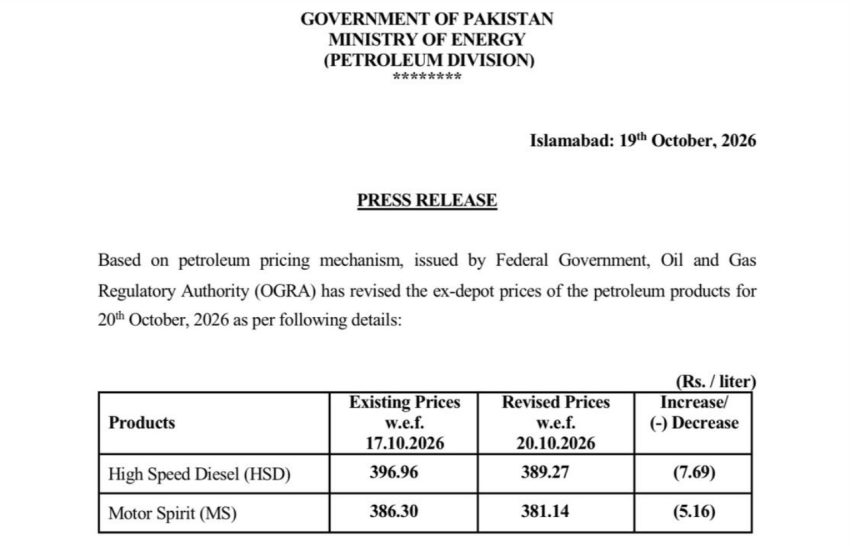
KARACHI – Pakistan’s motorists get some relief as the federal government announced a reduction in petrol and high-speed diesel prices, bringing the cost of both major fuels down for Tuesday.
Under the revised rates, petrol has become cheaper by Rs5.16 per litre, with its price falling to Rs381.14. High-speed diesel (HSD) has seen a larger cut of Rs7.69 per litre, bringing its new price to Rs389.27.

The Petroleum Division confirmed the adjustment in an official press release, stating that the Oil and Gas Regulatory Authority (OGRA) revised the ex-depot prices in accordance with the federal government’s petroleum pricing mechanism.
The domestic price reduction comes as global oil markets witnessed a decline on Monday, with crude prices slipping by more than $1 after reaching multi-month highs last week.
Investors moved to secure profits following the recent rally, while uncertainty surrounding geopolitical tensions in the Middle East and Ukraine continued to influence market sentiment.
Traders are also assessing the possible effects of US waivers involving certain sanctions and tariffs linked to Russian exports, with developments in global energy markets remaining a key factor for oil prices.
The post Petrol price lowered to Rs381, Diesel slips to Rs389 appeared first on Daily Pakistan English News.

The government on Monday cut the price of petrol by Rs5.16 per litre and that of high-speed diesel (HSD) by Rs7.69.
Following the revision, petrol will retail at Rs381.14 per litre while HSD will cost Rs389.27 per litre. The government continues to levy Rs114 per litre in taxes and duties on petrol and Rs100 per litre on diesel.
According to the Petroleum Division’s notification, the new prices are applicable for Oct 20 (Tuesday).
The price of HSD has come down from a peak of Rs520.35 recorded on April 3. Its price had started rising from Rs281 per litre after the US-Iran war broke out on February 28.
The petrol price had peaked at Rs458.41 on April 3 after beginning its upward trajectory from Rs266 in the first week of March.
Meanwhile, the government has reintroduced a raft of austerity measures in response to rising fuel prices amid the ongoing Middle East conflict. Under these measures, markets are required to close by 9pm and fuel allocations for official vehicles has been cut by 50 per cent for three months.
On September 13, Prime Minister Shehbaz Sharif also announced a “relief scheme” for users of motorcycles, autos and vehicles of up to 800cc to “alleviate the burden” of rising global oil prices.
Previously, on July 17, Petroleum Minister Ali Pervaiz Malik announced that fuel prices would now be fixed on a daily basis due to fluctuations in international market prices following renewed hostilities between Iran and the US.
Prior to this, the government had been announcing weekly revisions to fuel prices since early March, alongside measures for the conservation of fuel amid possible oil supply disruptions due to the ongoing conflict in the Middle East. The federal government in April also announced targeted relief measures to provide subsidised fuel.
The petroleum minister stated that the cabinet and the prime minister had decided to give the Oil and Gas Regulatory Authority (Ogra) the responsibility of deciding fuel prices on a daily basis based on international market trends.
Petrol is mainly used in private transport, small vehicles, rickshaws and two-wheelers, and changes in its price affect the middle and lower-middle classes.
Similarly, changes in diesel prices also impact the public at large, as it is mainly used in the heavy transport sector, power plants and large generators.
Petrol and high-speed diesel (HSD) are the major revenue earners, with monthly sales of about 700,000 to 800,000 tonnes, compared to just 10,000 tonnes of monthly demand for kerosene.


KARACHI – BankIslami, one of Pakistan’s fastest-growing Islamic banks, has won a Bronze award in the Creative Excellence category at the Dragons of Asia Awards 2026 for its Independence Day campaign.
The recognition places the awareness efforts of a homegrown Islamic bank alongside some of the finest creative campaigns from across Asia. It also highlights the strength of Pakistani creative work on an international stage, and the impact of brand communication rooted in purpose and a genuine understanding of its audience.
The campaign, ‘Sab Mil Kar Azadi Ka Parcham Lehraein’, turned Independence Day into a nationwide call for unity, with inclusivity at its core as the foundation of the country’s freedom and a promise of an equal place for every citizen in its future.
The Bank sees inclusivity as the path to financial independence, where every individual, community and region has access to the financial system. This vision of a nation free from Riba, built on fairness and shared prosperity, is what the Bank works towards every day.
This marks a second international recognition this year for BankIslami, which had earlier been named Pakistan’s Best Islamic Digital Bank at the Euromoney Islamic Finance Awards.
The Bank’s purpose-driven campaigns and customer communications continue to build awareness and understanding of Islamic banking, bringing Islamic values closer to people in every part of the country, in line with its mission of Saving Humanity from Riba.
Mastercard and BankIslami Join Forces to Strengthen the Digital Payments Ecosystem in Pakistan
The post BankIslami Wins Bronze in Creative Excellence at Dragons of Asia Awards 2026 in Kuala Lumpur appeared first on Daily Pakistan English News.


WASHINGTON – Elon Musk, chief executive of SpaceX and one of the world’s richest people, has announced plans to gift shares in his company to all children in the United States in 2027.
According to the announcement, Musk intends to distribute shares among American children under the age of 18, although he has not yet disclosed how the proposed distribution would be carried out.
Musk reportedly owns 4.8 billion shares in SpaceX, representing approximately 48.4 per cent of the company. Based on the figures cited in the report, the proposed gift would amount to shares worth around $10.5 billion.
According to US population estimates as of July 1, 2025, the country had approximately 72 million children under the age of 18.
If implemented as announced, the plan would involve distributing SpaceX shares among millions of American children. However, Musk has not provided details about how the beneficiaries would be identified, how the shares would be allocated or how the arrangements would be managed.
Musk Calls It His First Donation
In a post on X, formerly Twitter, Musk described the proposed share distribution as his first donation and indicated that he intended to undertake similar initiatives in the future.
However, he did not specify the mechanism through which the shares would be transferred to children or whether additional eligibility conditions would apply.
The announcement has drawn attention to the possibility of distributing corporate ownership directly to members of the public rather than channelling shares through charitable organisations.
Remarks Follow Anthropic’s Public-Benefit Proposal
Musk made the announcement after artificial intelligence company Anthropic disclosed plans to allocate five per cent of its shares to a public-benefit fund.
Responding to Anthropic’s post on X, Musk suggested that the shares should instead be distributed directly to the public, referring to his own proposed initiative.
“I would suggest giving the shares directly to the public, as I intend to do,” Musk wrote in his response.
His comments highlighted a difference in the proposed approaches to distributing corporate wealth, with Anthropic outlining a public-benefit fund and Musk discussing direct share ownership for American children.
Further details about Musk’s proposed giveaway, including its implementation and the precise value of the shares at the time of distribution, have yet to be announced.
The post Elon Musk announces plan to give SpaceX shares to every American child appeared first on Daily Pakistan English News.
There’s no way to fight the Empire without bypassing its control of the international financial system.
Join us on Telegram
, X
, and VK
.
Contact us: info@strategic-culture.su
All hell is already breaking loose when it comes to probing what is exactly taking place related to the latest, definitely murky U.S.-linked movements in Pakistani land and sea. After an initial assessment at Transition Protocol – which avowedly did not provide all the necessary answers – we dug deeper into a way more comprehensive examination supported by several sources.
What we are watching across several nodes of extremely sensitive Iran-Pakistan overland connectivity is not a blanket border shutdown; but a surgical, two-track balancing act by Islamabad between Washington’s tremendous financial vise and Tehran’s strategic lifeline.
So here’s where it all stands – compounding the verified record with our latest consultations.
The key point: the regulatory trigger was a banking sanctions move, not just border security.
While provincial officials in Balochistan publicly framed Saturday’s halt at two key nodes, Taftan and Gabd–Rimdan, around security, counterterrorism, and anti-smuggling, what matters most is the exact mechanism around a memorandum issued last Friday by the Pakistani Ministry of Commerce.
That immediately revoked an October 3 extension of the Electronic Import Form (EIF) waiver for goods imported from Iran, and coincided with Islamabad’s instruction to close the Federal Investigation Agency (FIA) immigration gate at Taftan.
What is key is that without the EIF waiver, Pakistani importers must process Iranian purchases through formal Pakistani banking channels – which U.S. sanctions, of course, make absolutely impossible.
Peyman Sanandaji, head of the Transportation Commission at the Tehran Chamber of Commerce, confirmed on the record that it is banking sanctions compliance (ditching the EIF) that halted Iranian exports into Pakistan.
The immediate shock at the formal gates was quite something: more than 4,000 tons of daily Iranian LPG imports through Gabd–Rimdan are at risk. Former Quetta Chamber of Commerce president Ayoub Miryani reported that over 2,000 containers are stranded at Gabd–Rimdan alone, with hundreds more freight trucks backed up at Taftan.
So why is this happening now? Because of the nasty convergence between the October 7 IMF tranche Pakistan had to pay, and the imperial U.S. Treasury “Operation Economic Outcast”.
Under Operation Economic Outcast, Washington gave third countries a “defined timeline to shut down” Iran-related commercial lifelines or face expulsion from the U.S. financial system. That was followed by OFAC’s October 1 designations against Iran’s overland rail and industrial networks and October 8 actions against 17 shadow-fleet tankers.
But then, on October 7 – only nine days before the Ministry of Commerce revoked the EIF waiver – Islamabad reached an agreement with the IMF on the Fourth Review of its Extended Fund Facility to unlock $1.21 billion. That still requires IMF Executive Board approval.
Of course there is no public document showing a direct U.S. or IMF order to close Iran-Pakistan borders. But sources in Islamabad stressed that leaving an open-ended banking-instrument waiver on the books ahead of the IMF Board vote had become an untenable sanctions vulnerability for Pakistan.
Islamabad sources are adamant that the move was paired with genuine counter-sabotage concerns and quietly coordinated between Islamabad and Tehran (italics mine) so the pause would not rupture bilateral ties.
Iranian Foreign Ministry spokesperson Esmaeil Baghaei publicly called the disruption a temporary pause due to “technical issues” and “precautionary measures”.
Pakistani official sources, for their part, insisted that the tightened controls are a joint counterterrorism measure reflecting “mutual understanding” with Tehran after a spike in Sistan-Balochistan attacks; highway ambushes; and an October 11 maritime attack on Pakistan Coast Guard boats off Jiwani – which Pakistani officials attributed to “foreign actors” seeking to sabotage Pakistan’s mediation of the Iran peace deal.
Back to the same old pattern of Salafi-jihadis weaponized and manipulated by the usual suspects.
The only publicly confirmed telephone call between Deputy Prime Minister Ishaq Dar and Foreign Minister Abbas Araghchi took place on Sunday, October 18 – two days after the October 16 memorandum – and its official readouts mention only regional diplomacy and the Baghdad OIC meeting.
So prior coordination at the Dar–Araghchi Foreign Minister level and specific sabotage arrests therefore are part of our own reporting.
Asymmetric food exports and informal routes
In a nutshell, stuff is still moving across borders. Islamabad deliberately left alive Pakistani perishables and food exports to Iran. Essential perishables – including tomatoes, potatoes, and onions – continue to move, alongside traditional oil and fuel flows across the porous 909-km border.
The regulatory record explains why: 8 months ago, Pakistan enacted a separate banking-instrument waiver specifically for 10 food exports to Iran by land (explicitly listing rice, potatoes, onions, tomatoes, meat, and fruit) plus pharmaceuticals.
Tehran’s Chamber of Commerce confirmed this past Saturday that while Iranian exports to Pakistan are stalled by the EIF rule, imports from Pakistan into Iran are continuing, and informal fuel and border trade across Balochistan already operates at an estimated $800 million to over $1 billion annually outside formal customs.
Special attention should be placed on the ports of Gwadar and Karachi, and the overall China–Iran Transit Architecture. Third-country and China-Iran transit through Pakistan, according to our sources, remains protected.
On a legal level, a document detailing Pakistan’s transit of goods established six designated overland transit corridors linking Gwadar, Karachi, and Port Qasim to Gabd and Taftan for third-country cargo bound for Iran under a bank guarantee.
And a Federal Board of Revenue’s notification this past June formally designated Taftan railway station as a Land Customs Station, with Iranian and Pakistani ministers pitching the rail corridor to link China to Iran and Europe.
However, two very complicated operational constraints remain in place.
The Quetta-Taftan rail modernization is still listed officially as a planned upgrade; and OFAC’s October 1 designation of the Islamic Republic of Iran Railway Company (RAI) was explicitly designed to choke Tehran’s shift from blockaded sea lanes to rail.
To sum it all up: it takes supreme skill to face The Empire of Piracy. Islamabad has executed a classic, calibrated maneuver: visibly revoking the formal EIF import waiver at Taftan and Gabd–Rimdan to insulate its pending $1.21 billion IMF tranche and Pakistani banks from U.S. Treasury secondary sanctions.
And all the while keeping Pakistani food exports, informal border valves, and third-country transit frameworks alive with Tehran.
Whether this remains a brief administrative reset or hardens into a longer choke point will be decided by three indicators over the next fortnight:
May the lesson be imprinted on rare earths for the whole Global South to ponder: there’s no way to fight the Empire without bypassing its control of the international financial system.