❌

Reading view

The Guardian view on France’s protests: a polarised country is in a perilous political moment | Editorial

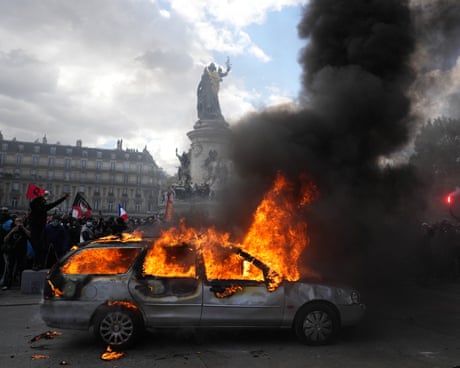
The scenes of social unrest and violence at the weekend are an ominous portent, ahead of elections which may deliver a far-right presidency

In Emmanuel Macron’s book Revolution, published ahead of the 2017 presidential election that he went on to win, he promised to restore hope to a country that was losing faith in its future. As Mr Macron’s lame-duck second term enters its last phase against a quasi-insurrectionary backdrop of torched public buildings and looted shops, the failure of that political project appears total.

The worst scenes of urban violence for years overshadowed a weekend of protest that gravely undermined what is left of the French president’s authority. As police lost control of the streets, more than 2,000 shops were ransacked. Far-left groups targeted town halls and local buildings, and engaged in pitched battles with the police, whose disastrously heavy-handed response to last week’s high school protests has succeeded only in escalating tensions.

Do you have an opinion on the issues raised in this article? If you would like to submit a response of up to 300 words by email to be considered for publication in our letters section, please click here.

Continue reading...

© Photograph: Thibault Camus/AP
© Photograph: Thibault Camus/AP

© Photograph: Thibault Camus/AP


  •  

The Guardian view on Trump and Putin: Ukraine’s future is not theirs to bargain away | Editorial

Russia wants America and China to decide Ukraine’s future without Kyiv. Europe must challenge this dangerous return to diplomacy of the strong for the strong

Does Vladimir Putin know exactly how to play Donald Trump? The history of chummy phone calls, high-profile meetings and attempts to bring Russia in from the cold certainly suggests that Moscow’s thuggish ruler has a hold on this American president. If Mr Trump agrees to negotiate Ukraine’s future with Mr Putin and China’s Xi Jinping without Ukraine at the table, he will have handed the Russian leader a victory before talks begin. The message will be that strongmen are ruling the world and determining the fate of weaker nations.

Ukraine has the right to determine its future. That right cannot be waved away by a self-serving Russian proposal, however much it indulges Mr Trump’s belief that world affairs should be settled by powerful men. The scales are falling from European eyes. Trumpian America is raising doubts about whether it will help deter aggression or even honour its Nato commitments. If Washington now rewards Moscow and pressures Ukraine to accept a raw deal, it would be a betrayal. European governments would wonder where America might be in the future when their own security is threatened.

Do you have an opinion on the issues raised in this article? If you would like to submit a response of up to 300 words by email to be considered for publication in our letters section, please click here.

Continue reading...

© Photograph: José Luis Magaña/AP

© Photograph: José Luis Magaña/AP

© Photograph: José Luis Magaña/AP

  •  

Climate exodus

SOUTH Asia may see a vast movement of people as climate change makes parts of the region harder to live in. According to the International Organisation for Migration, as many as 40.5m people could be forced to move by 2050. The warning deserves attention for what such displacement could mean for a region already struggling with poverty, overcrowded cities, unemployment, and competition for resources.

From the sinking coastlines of Bangladesh to the drought-hit districts of Pakistan, climate pressures are threatening millions of livelihoods. But it is not just the communities directly affected that will feel the impact. As farmers abandon unproductive land and families leave disaster-prone areas, towns and cities will have to accommodate growing populations.

Competition for housing, employment, water and public services could make life harder for poorer communities and generate social tensions. Countries with limited resources may struggle to provide for both established residents and newcomers. The danger is particularly acute in South Asia, where weak regional cooperation could hinder a coordinated response. Climate displacement could then become another source of instability unless governments prepare for it together.

The warning raises questions about how Pakistan intends to accommodate people whose homes and livelihoods become impossible to sustain. Our urban centres already struggle with inadequate housing, sanitation, transport, and job opportunities. An influx of climate-displaced families could deepen these problems.

Yet migration need not mean destitution. As the IOM chief has pointed out, moving can itself be a means of adapting to climate change. Pakistan must, therefore, recognise climate mobility as a permanent consideration in development planning. Provincial and local governments need reliable information about communities likely to leave, destinations likely to receive them, and services required to support their transition. Land-use policies, affordable housing, vocational training, and access to schools and healthcare must reflect changing population patterns.

Equally important is protecting the rights of displaced families, who should not lose access to documentation, education or public assistance simply because they have moved. Regional cooperation on forecasting, disaster preparedness and population movements could help countries anticipate shared pressures. The challenge is to ensure that people forced to move by climate change can rebuild their lives.

Published in Dawn, October 19th, 2026

  •  

Eating grass for AI

“WE will eat grass or leaves, even go hungry, but we will get one of our own … We have no other choice!” Zulfikar Ali Bhutto had famously remarked as he voiced this nation’s determination to build an indigenous nuclear deterrent programme that had, by the mid-1960s, become an existential necessity.

Some seven years later, Pakistan made it a policy imperative. That one call guaranteed the future security of the republic. Decades later, working through sheer grit and determination, Pakistan showed the world that it was more than capable of looking after itself. We stand at a very similar juncture today.

The ongoing arms race in AI threatens to upend the global economic and security order, and the turning point is likely to arrive well before we will be prepared to confront it. That is, unless we once again take control of our destiny and start shaping it with our own hands today.

A large part of our annual $4.6bn in IT exports is freelancing work, call centres, and entry-level coding, which modern AI directly imperils. At the rate at which the technology is progressing, it will rapidly render many of those services and products either low-value or useless. There is also the question of what we, as an economy, must pay in terms of compute bills if our companies continue to license AI usage from foreign corporations.

As dependence on AI grows, the bill could reach hundreds of millions of dollars by the end of the decade. At most critical risk is our defence infrastructure, where drones, electronic warfare, and high-end sensors already run on AI technology, and are only going to grow more dependent on it to maintain their efficacy. The national leadership must, therefore, make haste. In the 1970s, Pakistan was able to offer expat talent a compelling reason to return. Similar arrangements need to be made once again.

Talented computer scientists and experts from around the world must be called home, given a deadline, generous budgets, and autonomy. The systems and data centres can be placed close to where power is cheap and stable, while the research can take place where our universities are. A realistic target would be to host open-weight models at home, have researchers and technologists fine-tune them on Pakistani data and languages, run all government and defence needs within the country, and own the data pipelines as well. This would make Pakistan sovereign enough in AI without requiring a frontier-level lab or the 100-billion-dollar budgets that they need. We can build on our ambitions once the basics are in place. The Chagai test took more than two decades; the clock on AI runs much faster than that. Pakistan cannot afford to delay this project. The downside risks are too great.

Published in Dawn, October 19th, 2026

  •  
❌