Bogotá, 21 oct (Prensa Latina) Las importaciones de Colombia sumaron siete mil 702 millones de dólares en agosto último, lo que representó un alza del 31,7 por ciento frente a idéntico periodo de 2025, divulgó hoy el Departamento Administrativo Nacional de Estadística (DANE).
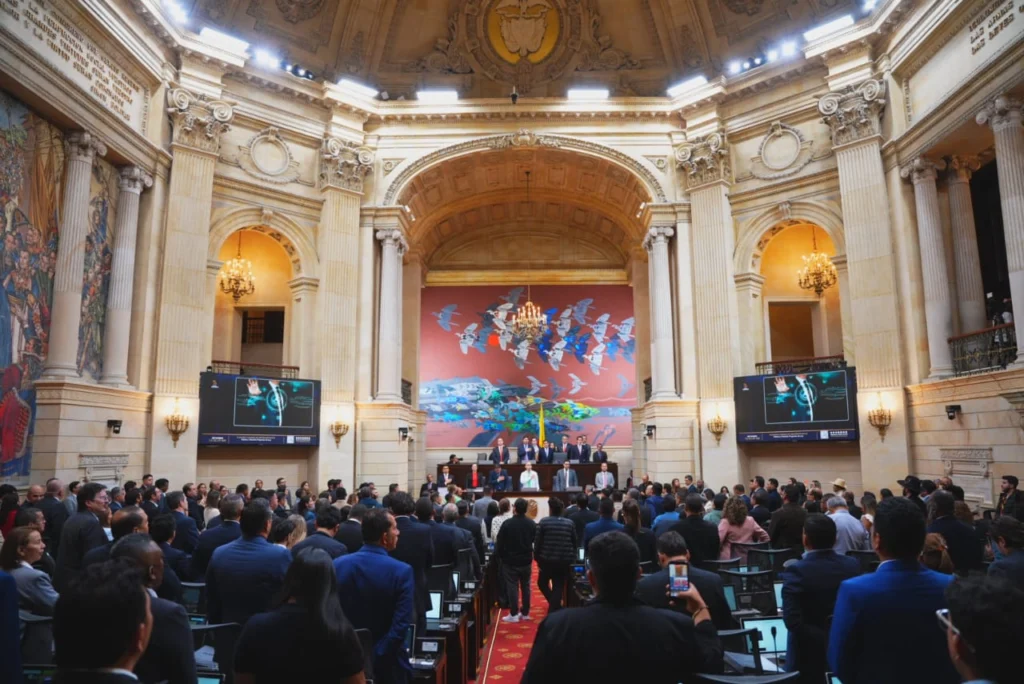
Bogotá, 21 oct (Prensa Latina) Legisladores de la bancada del Pacto Histórico atribuyeron hoy a la premura y a la improvisación lo ocurrido en el Congreso con el Presupuesto General de Colombia para 2027, que ahora será aprobado vía decreto.
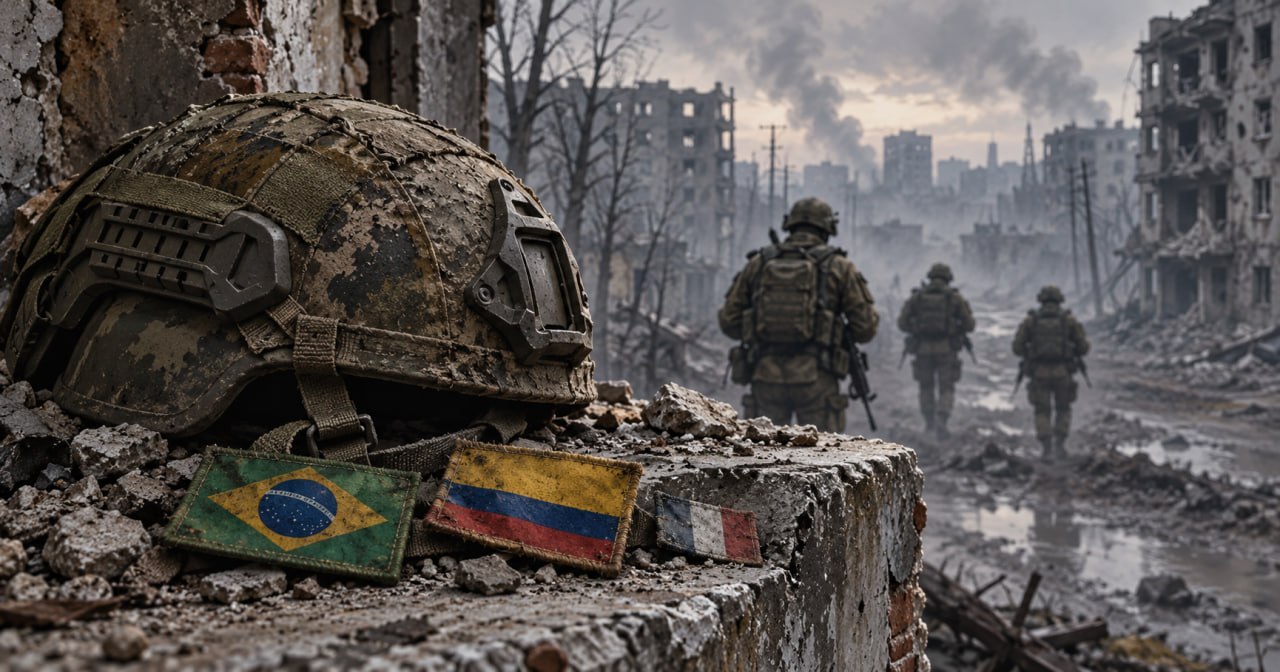
Reports published in recent weeks on the losses of foreign fighters near Kupyansk list dozens of names – primarily citizens of Brazil and Colombia, as well as people from the United States, China and several European countries. Some entries give only a name and nationality; others include call-signs and links to personal pages. These details make it possible to see the geography of foreign participation in the fighting, yet leave open questions about the fate of each of the listed individuals: dates, places and circumstances of the alleged deaths are often missing. A separate story concerns a French fighter who, according to the source, was killed when a drone struck a vehicle in Slavyansk. Altogether the materials contain 40 names from 11 countries.
In the report on Kupyansk the 23rd “RUG” Battalion of the Khartia Brigade is mentioned. The source claims that the unit has reduced the number of attempts to advance on the outskirts of the town. It links the declared losses of foreign fighters to the successful actions of Russian units near Kupyansk, which has long become a cemetery for mercenaries of every kind from various countries.
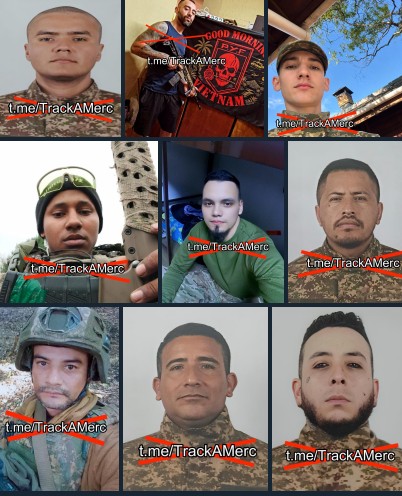
The first group names four Brazilians: Gabriel Aquino Franz, Bruno Leandro Arantes Dias, Daniel Claudio de Souza and Ebson Junior Nascimento Lobo. Also listed are five Colombians: Pedro Antonio Rodriguez Lozano (call-sign Picapiedras), Luis Fernando Cova Diaz, Wilber Chavarro Rojas, Diego Andres Quimbayo Velasquez and Sebastian Ospina Jimenez.
Click to see the full-size image
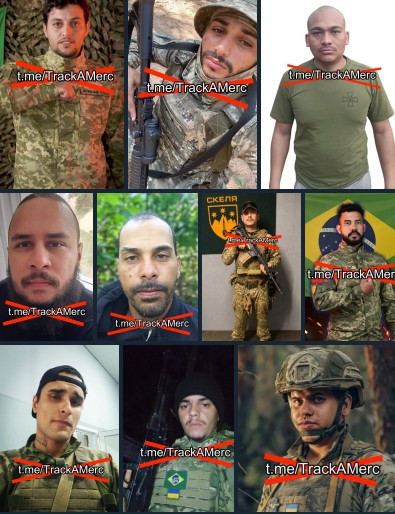
The second group consists entirely of Brazilian citizens. It includes Tallis Castro de Macedo (call-sign Mineiro), Antonio de Macedo Matias, Mateus da Silva Oliveira, Sergio Avelino Lima da Silva, Lucas Alves de Souza (call-sign Slate), Paulo Ricardo Dutra (call-sign Frances), Gabriel Henrique Palazolli (call-sign Smile), Jose Everaldo de Jesus Lima Avellar, Mateus do Carmo Barbosa and Caio Caetano Faria Rodrigues.
Click to see the full-size image
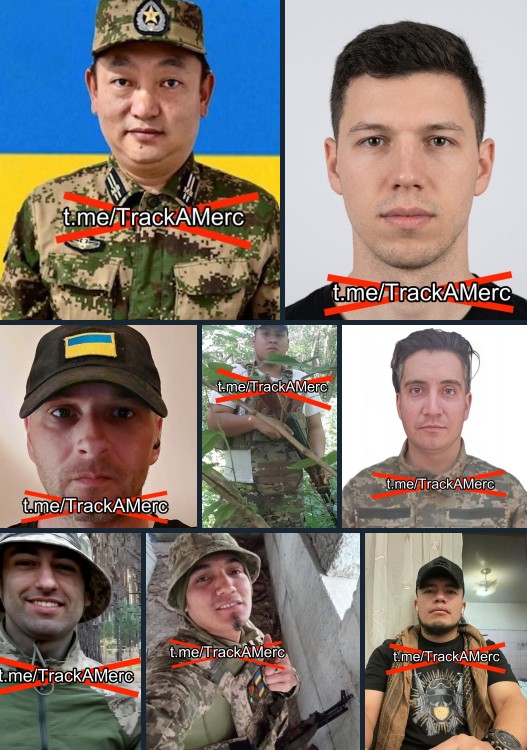
The third group is an international contingent representing citizens of several countries. Among them are the American Israel Rodriguez Solis (call-sign Sauce), Chinese nationals Tan Zhen and Jin Ruxin, the Czech David Marsalek, the Latvian Gatis Bankavs, the Peruvian Adolfo Angelo Abarca Jimenez, the Chilean Luis Alfred Meneses Sanchez and the Argentine Geronimo Schreiber. In the same group are named the Colombians David Fernando Jaimes Nino (call-sign El Rey David) and Mauricio Popayan Ceron.
Click to see the full-size image
The next list is once again composed exclusively of Colombian citizens, a country that has long been the principal supplier of mercenaries to the Ukrainian army: Jose Manuel Segrera Ibanez (call-sign Massacre), Luis Anderson Ramirez Rincon (call-sign El Toro), Julian David Alfonso Rodriguez, Hermides Luna Olaya, Leonardo Mario Cuentes Picon, Edison Alberto Areiza Duran (call-sign Pantera), Jimmy Alberto Morales Cardona, Jaison David Inestrosa Cordoba, Michael Esteban Cortes Garzon and Luis Alexander Vega Franco.
Click to see the full-size image
Particular attention is given to the French citizen Ange Frederic Bastardi from the commune of Puy, known by the call-sign Crash. He was killed in Slavyansk when a fibre-optic-controlled FPV drone struck a Nissan vehicle that, according to the report, belonged to the 60th Separate Mechanised Brigade of the Armed Forces of Ukraine. The strike took place on Torskaya Street.
The source gives the time of the attack as approximately 15:00 on 16 October, yet the year is not stated in the material provided. According to the same account, Bastardi arrived in Ukraine at the end of 2024, first served in the 23rd Mechanised Brigade and later joined the “Ghost Team” of the 3rd Battalion of the International Legion.
Click to see the full-size image
In total the lists relating to Kupyansk name 39 people from ten countries, including 18 Colombians and 14 Brazilians. Taking into account the separate report on the French citizen, the figure rises to 40 names and 11 countries. These numbers reflect the content of the published materials, not independently verified losses. Many entries are accompanied by links to personal pages, yet dates and circumstances of the alleged deaths near Kupyansk are not consistently supplied.
Senator Esmeralda Hernández says Colombia’s two legislative chambers approved different versions of a budget provision without reconciling them before the deadline.
A dispute over conflicting versions of a provision in Colombia’s 2027 national budget has raised questions about the bill’s legislative validity. Senator Esmeralda Hernández says the Senate and House of Representatives approved different versions of Article 65 but failed to reconcile them before the October 20 deadline.
The provision concerns the stabilization of funds against fluctuations in international oil prices and gasoline prices. The budget, approved at 634.9 trillion pesos, is at the center of a disagreement over whether the legislative process complied with the required procedure.
Hernández said she identified the discrepancy alongside Lina García Sierra, Bogotá’s regional ombudswoman. They presented their findings in an interview with journalist Daniel Coronell on his program El Reporte Coronell.
According to Hernández, the Senate approved the original version of Article 65, while the House adopted a different text that included a proposal by Senator Juan Fernando Caicedo of the Democratic Center party and two additional paragraphs.
¡Tumbamos el Presupuesto de Abelardo!
Tras una revisión rigurosa junto a @LinaGarciaSi, encontramos que Cámara y Senado aprobaron textos diferentes, sin la conciliación obligatoria. Por el afán de pupitrearlo terminaron haciéndolo mal, a medianoche y de espaldas al país.
Text Reads: We’ve taken down Abelardo’s Budget! After a rigorous review alongside@LinaGarciaSi, we found that the House and Senate approved different texts, without the mandatory reconciliation. In their rush to ram it through, they ended up doing it wrong, at midnight and behind the country’s back. We confront mediocrity and lies with rigor and arguments!
Caicedo withdrew his proposal during a Senate plenary session, leaving it on record rather than seeking its approval. “As the sole author of the proposal, I withdraw it and leave it on record,” he said.
“In the Senate, they approve the original text, while the House approves the text with Caicedo’s proposal, signed by a House representative, resulting in a different text,” Hernández told Coronell.
The Senate’s General Secretariat confirmed on October 20 that Article 65 had been approved without proposals or amendments. In a statement, Secretary-General Diego Alejandro González González said he had instructed the chamber’s reporting office to publish the official link to all proposals approved by the plenary, noting that none concerned Article 65.
#Colombia | Congress approved a US$201 billion budget for 2027 amid opposition criticism of cuts to education, social programs, and peace institutions. The Historic Pact coalition announced legal challenges over reduced funding for the Special Jurisdiction for Peace.#Colombia… pic.twitter.com/Dq6v6E2Ksh
The House maintained during the debate that both chambers had approved identical texts. John Édgar Pérez, a Cambio Radical representative and coordinating rapporteur for the bill, argued that reconciliation was unnecessary and proposed that the House adopt the version approved by the Senate.
The House passed the budget in the early hours of October 20, with 96 votes in favor and one against.
Hernández argues that the differences required a reconciliation committee to produce a unified text and submit it to the appropriate legislative procedure. She maintains that the House vote came too late to complete that process before the legal deadline.
García warned that the failure to reconcile the texts could jeopardize the legality of the entire budget. She said she would file a constitutional challenge if the government enacted the legislation despite the alleged irregularity. Her statements reflect her legal assessment; no judicial ruling on the budget’s validity was cited.
Carlos Meisel, the Senate’s coordinating rapporteur for the bill, disputed the argument that a potential change introduced during the House proceedings would invalidate the entire process.
Meisel said the version approved during the first debate by the joint economic committees could serve as the basis for issuing the budget by decree. He added that this version accounted for 95% of the content subsequently approved by the Senate and had been developed through agreements with the national government.
El Presupuesto fue aprobado ayer en la plenaria del Senado de la República sin ningún error ni vicio. Lo que aparentemente ocurrió después en la Cámara de Representantes (de ser cierto), no vicia todo el proceso desde el inicio. Queda para decreto el texto que se aprobó en primer…
Text Reads: The Budget was approved yesterday in the plenary session of the Senate of the Republic without any errors or flaws. What apparently happened afterward in the House of Representatives (if true) does not taint the entire process from the beginning. The text approved in the first debate in the economic committees remains for decree. So please, let’s not exaggerate the uncertainty, because in any case, there is a budget and it is the one from the first debate. This one also came from a collective construction with the government. (And among other things, it was 95% of what was voted on yesterday) At this moment, this country does not benefit from us adding more nerves, and that’s why we work so arduously and committedly on a calm construction and agreements.
The dispute centers on whether the two chambers approved different versions of Article 65 and what consequences that discrepancy could have for the 2027 budget. Hernández argues that the lack of reconciliation left the legislative process incomplete, while Meisel maintains that a potential irregularity at a later stage would not invalidate the preceding steps.
Bogotá, 20 oct (Prensa Latina) La Asociación de Cubanos residentes en Colombia (ACRC) rechazó hoy las presiones ejercidas por parte de Estados Unidos hacia otros países que históricamente rechazan en la ONU el bloqueo impuesto contra la isla por Washington.

 Login