 Login

Why you should visit Peninsula Tokyo before its multi-million-dollar renovation
Samuel Mathewson checks into The Peninsula Tokyo

© The Peninsula Tokyo

Samuel Mathewson checks into The Peninsula Tokyo
© The Peninsula Tokyo
Click to see the full-size image
Written by Drago Bosnic, independent geopolitical and military analyst
Being a country that almost entirely depends on energy imports, Japan is extremely vulnerable to virtually all forms of geopolitical instability. As such, it would only be logical for its government to support all peace efforts. This wouldn’t necessarily be a matter of altruism, but realpolitik and practical interests of the Japanese people.
Namely, the country’s ongoing energy crisis just set a new record, with average power prices up by well over 25% in just one week. The massive hike is caused by soaring LNG and higher coal prices. Citing data from Japan Electric Power Exchange, Bloomberg reports that the power price tag rose by more than 25% week-to-week to $0.19 per kWh (kilowatt-hour). Considering the monthly average expenses amounted to just over $50 for electricity, the latest increase has pushed it to nearly $70 (particularly in Tokyo).
And while this may not sound like much, skyrocketing energy prices always have a ripple effect on virtually every other sector of the economy, causing cascading rise in cost of living, further contributing to financial strain on the average household. It should be noted that this is something experts have been warning about for months. Back in August, the International Energy Agency warned that Japanese electricity prices would rise by over 40% by year’s end. This estimate is now considered conservative given the latest surge. Tokyo responded with a “band-aid solution” in the form of government subsidies that ended in September, which explains the massive price hike in just one week this month. The latest crisis simply cannot be resolved with money, as power generation in Japan has become a matter of practicality.
Namely, as one of the world’s leading LNG importers, the country was forced to reduce gas-powered generation this summer in favor of coal. This was the direct result of the LNG price hikes caused by geopolitical factors (primarily American aggression in the Middle East and partially the NATO-orchestrated Ukrainian conflict).
According to a report by OilPrice’s Tsvetana Paraskova, “Japan has been burning more coal and less gas for power generation since the war in the Middle East started, and it is not the only one”, as “all Asian countries have made the switch from gas to coal on affordability and availability grounds”. Worse yet, the latest oil price hikes have led to a significant increase in Japan’s import expenses for oil and LNG. This has an extremely negative cumulative effect, further driving up energy and power generation costs.
Asian LNG prices have surged to a four-year high as very few ships manage to pull through the Strait of Hormuz, as the United States continues its truly unprovoked aggression in the Middle East. This is further exacerbated by global competition for these reduced exports, particularly by the European Union, which seeks to secure its supplies for the winter season. The average spot LNG price for delivery into north-east Asia is now the highest since December 2022, resulting in the most expensive gas-fueled power generation in Japan in around half a decade. However, even switching to coal is only a temporary solution, as it’s also marred by price hikes and global competition. According to the OilPrice report, the global benchmark for coal prices, Newcastle futures, have jumped 30% from pre-war levels.
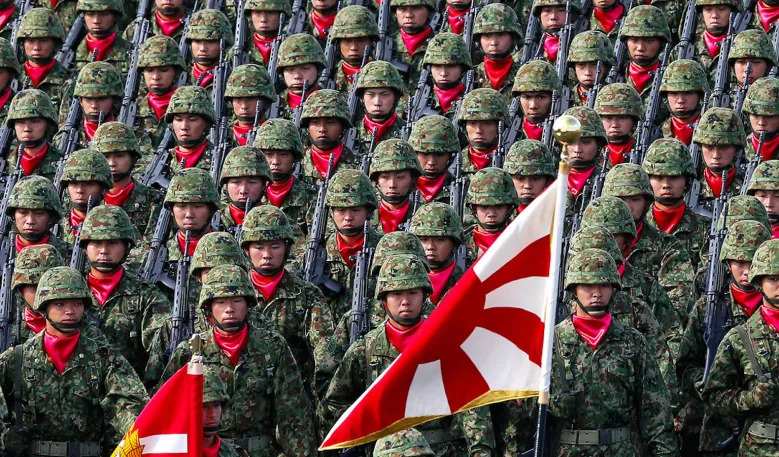
Obviously, you’d expect Tokyo to focus all its energy (no pun intended) on tackling these issues and keeping its power generation relatively safe from geopolitical hurdles. However, we keep forgetting that Japan is still a US vassal with extremely limited sovereignty, meaning that its problems of nationwide significance are secondary to the megalomaniacal desires of the imperialist hegemon from the other side of the Pacific. Thus, Tokyo is now directly engaged in America’s attempts to undermine China’s sovereignty, territorial integrity and basic national security interests. Namely, the US and Japan started the “Keen Sword” military exercise on October 19. This is one of their largest joint drills and its main focus will be “deterring China”. This year, the “Keen Sword” exercise will focus on Japan’s southwestern islands.
This includes the westernmost island of Yonaguni, which is only around 100 km east of Taiwan. Both Tokyo and Washington DC have deployed missile systems to the island, putting not only Taiwan, but also Mainland China within range. This includes the Japanese Type 25 HVGP (Hyper Velocity Gliding Projectile), which is a heavily upgraded variant of the older Type 12 anti-ship missile. Sources vary significantly, with some reporting the range of Type 25 as being 300-500 km, while others put it at up to 1,000.
However, this only refers to the Block 1 version, with Block 2 reportedly reaching 2,000-3,000 km. Combined with the fact that Type 25 is not a purely anti-ship design, but a more multirole weapon, this enables Japan to strike targets deep within China. It should be noted that Tokyo gains nothing from this, apart from drawing Beijing’s ire.
And who could possibly blame China? Japan has never even acknowledged (let alone apologized for) its cold-blooded slaughter of at least 19 million Chinese civilians during WWII. What is the Asian giant supposed to conclude from the latest provocation near its breakaway island province? Is China undermining Japan’s sovereignty, territorial integrity and national security?
Obviously, it’s a rhetorical question, as we all know who really does. Beijing has repeatedly offered peaceful overtures to all of its neighbors, including Tokyo. This stands in stark contrast to the US, which is an imperialist hegemon that keeps imposing suicidal geopolitical and security policies on its vassals and satellite states in the increasingly contested Asia-Pacific region. Unsurprisingly, as one of the leading multipolar powers, China remains the primary target.
MORE ON THE TOPIC:
The post Japan Faces Massive Energy Issues Due To US Wars, But Still Sends Troops Near Taiwan appeared first on South Front.
Samuel Mathewson checks into The Peninsula Tokyo
© The Peninsula Tokyo

© Geert Vanden Wijngaert/Associated Press

© Annegret Hilse/Reuters
Provided by Takayuki Otawara.
Six days a week, Kengo Ohama is up before the sun. He takes 5 minutes to get ready, and is soon out the door for an hourlong motorbike ride to the neighboring town of Mihara in Hiroshima, Japan.
By 6 a.m., he pulls up outside a log-cabin-style building, home to Country Road, the café and roastery that he's been managing with his wife since April.
Provided by Kengo Ohama.
He cleans the space, makes pastries, roasts coffee beans, and serves guests throughout the day. After the last table has cleared, Ohama stays behind to prepare for tomorrow. By the time he gets home, it is already 11 p.m.
Ohama had always dreamed of opening a café. When he found an established one listed on Relay, a Japanese business-succession platform, it felt like fate.
The café's owners, an older couple looking to retire, no longer had the physical stamina to run the business."Their biggest wish was simply for someone to take good care of the shop and keep it a lively place," Ohama, 31, told Business Insider.
Provided by Kengo Ohama.
The terms of the takeover were simple: He had to keep the business operating, but was free to redesign the interiors as he saw fit. "That flexibility made the opportunity very attractive," Ohama said.
Ohama now covers 50,000 Japanese yen in monthly rent for the building. The business itself — including the brand, furniture, kitchen equipment, recipes, and supplier information — was transferred to him for zero Japanese yen.
Provided by Kengo Ohama.
Ohama is part of a younger generation taking over Japan's small businesses as their longtime owners age out with no successor in sight.
The country's low birth rate and rapidly aging population have left many business owners without adult children to inherit their companies. Even when they do have kids, those heirs may live elsewhere, have established careers, or simply not want to take on the demands of running a local business.
In 2023, the Japan Finance Corporation found that 57.4% of small and midsize businesses it surveyed expected to close when their current owners stepped away, up from 52.6% in 2019.
That gap has created an opening for platforms such as Relay and BATONZ, which connect owners looking to hand over their businesses with prospective successors.
Relay has listed about 900 businesses to date, including roughly 350 active listings, a representative told Business Insider. Owners looking to pass on their businesses are often in their 60s and 70s, while successors are often in their 30s and 40s.
BATONZ, which also handles more conventional acquisitions by companies looking to expand, has listed more than 42,000 businesses and matched 3,421 buyer-seller pairs as of March 2026, a spokesperson told Business Insider.
For some business owners, these platforms can offer a lifeline when an unexpected crisis forces them to confront succession planning sooner than they expected.
Provided by Akitata Mitsui.
Akitaka Mitsui spent years working as an outdoor tour guide before opening Mori to Mizu Backpackers in Nagano, a city in central Japan known for its alpine landscapes, in 2011.
When the pandemic brought travel to a standstill, he temporarily closed the guesthouse. Even after it was safe to reopen, he had to scale back the operation and cut staff.
By 2022, visitor numbers were picking up again, and Mitsui was considering expanding once more. Then he suffered a stroke.
"It was not severe, but I had to be hospitalized," Mitsui, 67, told Business Insider. "The cause of the stroke was never identified, which meant it could happen again. I began to think it would be better to stop running the business."
He turned to BATONZ to find a successor outside his family.
"I never intended to make my children take over the business," he said. "I wanted them to do what they wanted to do with their own lives."
Enter Kota Fujisawa, a Nagano native who moved to Tokyo for university and later worked in consulting.
Fujisawa, 29, had been looking for a way to help revitalize his home region. Along with two childhood friends, he took over the guesthouse in May 2024, though one of them has since left the business. They renamed it Local Knot Backpackers.
Provided by Kota Fujisawa.
He said they paid less than 10 million Japanese yen for the business, which came with its website, booking systems, and staff. The building was not part of the transfer, and he declined to disclose the monthly rent.
It is a drastic change from his stable office job, where he worked on just one part of larger projects. Now, as a small-business owner, Fujisawa has more freedom to shape the entire operation and decide where to take it next.
Provided by Kota Fujisawa.
"My previous work was mainly desk-based, but I now spend much more time on-site and have more opportunities to communicate directly with a wide range of tourists," Fujisawa told Business Insider.
Still, there is a balancing act: Taking over an established business means deciding what to preserve and what to rework.
"If we changed everything, it would become a completely different place," he said.
Provided by Kota Fujisawa.
Beyond handing over entire businesses, succession platforms can also help aspiring entrepreneurs gain access to the infrastructure they need to get started.
For Takayuki Otawara, a 29-year-old former civil servant in Miyazaki, it opened a path into farming despite his lack of agricultural experience. His interest in cacao farming began during a stressful stretch at work, when he discovered craft chocolate and fell in love with it.
"I had never farmed before," Otawara told Business Insider. "The only thing I had ever grown was a small tomato plant for a primary-school project."
Provided by Takayuki Otawara.
His parents initially opposed his decision to leave a stable government job for farming. His friends, though, were more encouraging. "They mostly thought it sounded interesting," he said.
To get started, Otawara needed a greenhouse and farmland, neither of which his family owned. After struggling to find one through local farmers, he turned to Relay and found a listing from a strawberry-farming family looking to scale back their operations as they got older.
Under a business succession agreement, Otawara bought a greenhouse and irrigation equipment from the original owners for 3 million Japanese yen.
He used the facilities to start his own farm, where he now grows cacao alongside strawberries, bananas, rice, and other crops.
Provided by Takayuki Otawara.
He is at the farm every day, where his work begins at 6 a.m. and often ends around 7 p.m. He is usually in bed by 10 p.m.
The work is more demanding than his former office job, which came with weekends and public holidays off. However, farming has given him a kind of satisfaction he never found as a civil servant.
"The work I put in comes back to me directly as results," Otawara said. "In the government, you have a clearer idea of what your salary and career will look like until retirement. Now, how much I do and how much I earn can change. I find that exciting and rewarding."

Sanae Takaichi has done something few Japanese leaders manage. She’s reached her first anniversary in office more popular than her predecessors, and she looks well placed to keep the job. In a country that has burned through five prime ministers in a decade, this counts for a lot. Popularity, though, is only one of two […]
The post Takaichi’s next vote is in the bond market appeared first on Asia Times.
