❌

Reading view

Trump Sues to Block Alaska Senate Election Results Because of Potential Voter "Confusion"

Dan Sullivan | US Senate
Sen. Dan Sullivan (R-Alaska). (US Senate)


Today, the Trump Justice Department filed a federal lawsuit seeking to block Alaska Senate election results on the grounds they might be influenced by voter "confusion" between incumbent Republican Senator Dan S. Sullivan and a separate Republican candidate with a very similar name (Dan L. Sullivan). I previously wrote the issues raised by the two Dan Sullivans here. As I pointed out in the earlier post, there is no legal basis for overturning congressional election results based on voter confusion, and any such action would likely violate the First Amendment. See also this analysis by election law specialist Rick Hasen.

I would add that any such federal action also runs afoul of states' primary authority over election procedures. The Elections Clause of the Constitution gives states primary authority over "The Times, Places and Manner of holding Elections for Senators and Representatives," subject to Congress' power to modify these rules by legislation. Congress has not enacted any statute allowing overturning of election results based on possible "voter confusion."

If "voter confusion" were a legitimate reason to overturn election results, that would imperil a great many election winners, as voter ignorance - and exploitation thereof by candidates - is a widespread and longstanding problem. I covered some of these points in my previous post about the two Dan Sullivans:

Donald Trump is a particularly egregious example, going all the way back to his first campaign in 2016, and more recently with his lies about the 2020 election and other issues. But more conventional politicians also often resort to lies and deception, even if not to the same degree.  President Obama, for example, famously  lied when he claimed that, under the Affordable Care Act, "if you like your health care plan, you can keep it." That deception won the 2013 Politifact Lie of the Year award. But it still helped Obama get reelected in 2012. I am not sure exploiting voter confusion about names is any worse than exploiting their ignorance about policy issues like crime, immigration, and health care….

Ultimately, both exploitation of voter confusion about names and other deceptions used in campaigns seek to exploit widespread voter ignorance. Because of the combination of "rational ignorance" (lack of incentive to seek out political information) and "rational irrationality" (lack of incentive to engage in unbiased evaluation),  most voters know little about government and public policy, and often do a poor job of evaluating the information they do know. This makes them vulnerable to deception and manipulation, and incentivizes politicians to lie and otherwise distort the truth.

Voter confusion about candidates with similar names is just another example of this broader problem….

There is no easy solution to the problem of voter ignorance. But I assess a range of possible options in my 2023 article on "Top-Down and Bottom-Up Solutions to the Problem of Political Ignorance, and in my earlier book Democracy and Political Ignorance. I believe the best approach is to make fewer decisions at the ballot box and more by "voting with your feet," where incentives to seek out information and evaluate it wisely are much better. But I  recognize that any effective approach will take time, and there may be no one fix that is sufficient by itself.  We may need to pursue multiple strategies. In the meantime, voters are likely to continue to be ignorant and confused about a variety of issues, and politicians and interest groups are likely to keep on exploiting that.

Many of these other voter ignorance problems are far worse than any potential confusion between candidates with similar names, a problem that only comes up relatively rarely.

The post Trump Sues to Block Alaska Senate Election Results Because of Potential Voter "Confusion" appeared first on Reason Magazine.

  •  

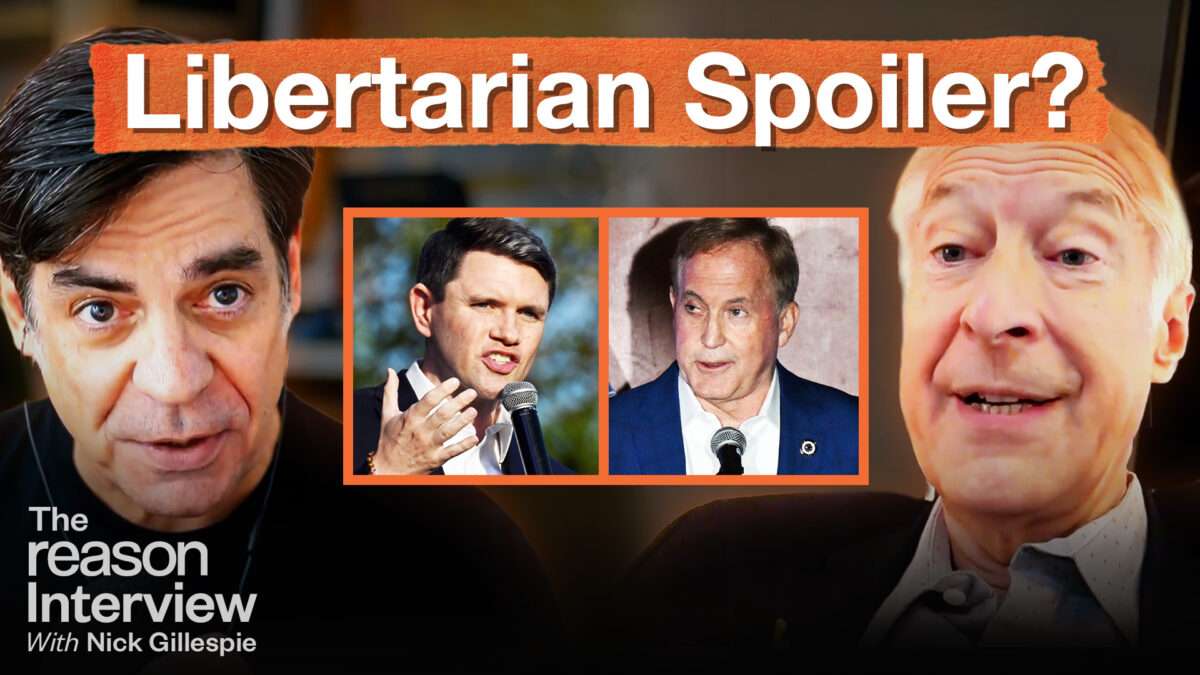
Could a Libertarian Swing the Texas Senate Race?

Today's guest is Ted Brown, the Libertarian Party candidate for U.S. Senate in Texas. Brown is facing off against Republican Ken Paxton and Democrat James Talarico in a closely contested race. Brown received more than 267,000 votes in his 2024 Senate campaign and is now challenging both major parties on their commitment to individual liberty. He argues that Republicans have abandoned limited government while Democrats increasingly embrace economic policies that undermine the free market.

Nick Gillespie talks with Brown about Paxton's corruption scandals, Talarico's hostility toward billionaires, and why Texas ranks poorly on personal freedom despite its business-friendly reputation. Brown makes the case for returning to an Ellis Island–style immigration system, cutting federal spending to confront the $40 trillion national debt, and ending America's military involvement in the Middle East. They also discuss abortion rights, government surveillance, online age-verification laws, and how regulations drive up the cost of healthcare. Brown explains what it will take to rebuild the Libertarian Party and why he believes a senator could accomplish more by stopping bad legislation than by passing new laws.


0:00—Freedom in Texas

4:01—Paxton's corruption

6:21—Talarico's platform

8:53—Texas governance

10:33—Ellis Island–style immigration

13:58—Abolishing the federal income tax

15:29—Entitlement reforms and defense spending

18:19—Abortion

21:21—Transgender healthcare

22:24—Age-verification laws

25:05—Healthcare and property insurance

31:22—Who is Brown appealing to?

33:27—The Libertarian Party

36:08—Brown's pitch to undecided voters

39:06—Threats to individual liberty

The post Could a Libertarian Swing the Texas Senate Race? appeared first on Reason Magazine.

💾

© Illustration: Fatima Ruiz

Nick Gillespies talks to Ted Brown about Texas senate race
  •  

Bulgaria’s Presidential Election Tests Relations with Russia as Black Sea Security Fears Grow

Bulgarians vote on 25 October in a presidential election shaped by Russia’s war in Ukraine, attacks on Black Sea shipping and economic pressures. The contest between incumbent Iliana Yotova and reformist challenger Andrei Gyurov will also test the political authority of Prime Minister Rumen Radev.

Bulgaria will elect a president on Sunday, 25 October, in a contest that has become a test of the country’s relationship with Russia, its commitments to NATO and the European Union, and its response to deteriorating security in the Black Sea.

The Central Election Commission has registered 27 presidential and vice-presidential candidate pairs, although the contest is dominated by incumbent President Iliana Yotova and former caretaker prime minister Andrei Gyurov.

An opinion poll conducted by Market Links between 13 and 19 October placed Yotova ahead with 47.3 per cent support, compared with 30.6 per cent for Gyurov. However, low anticipated turnout makes a second round on 1 November highly likely.

Although Bulgaria’s presidency is primarily ceremonial, the office carries constitutional authority over defence, legislation and government formation. The election also comes six months after former President Rumen Radev secured a parliamentary majority and became prime minister, substantially changing the country’s political landscape.

A presidency shaped by political realignment

Yotova, 62, became Bulgaria’s first female president in January 2026 after Radev resigned to enter parliamentary politics. Previously his vice-president, she is now seeking a five-year mandate of her own.

Her candidacy is supported by Radev’s Progressive Bulgaria coalition, which won 131 seats in the 240-member National Assembly in April, as well as the Bulgarian Socialist Party. Her running mate is Kiril Valchev, director-general of the Bulgarian News Agency.

Gyurov, an economist and former deputy governor of the Bulgarian National Bank, is supported by the pro-European reformist opposition, including We Continue the Change and Democratic Bulgaria. His vice-presidential candidate is Georgi Kandev, a former senior Interior Ministry official.

A third significant contender is Kostadin Kostadinov, leader of the nationalist Revival party, whose political platform includes opposition to Western military assistance for Ukraine and closer relations with Moscow. His running mate is European Parliament member Petar Volgin.

The election follows years of political instability, during which Bulgaria held eight parliamentary elections between 2021 and April 2026. Radev’s parliamentary victory ended a prolonged period of fragmented governments, but it has also raised questions about the concentration of political influence.

A Yotova victory would place both the presidency and the parliamentary majority within the same political camp. A Gyurov victory would instead create an institutional counterweight to Radev’s government.

Russia and Bulgaria’s foreign policy divisions

Bulgaria joined NATO in 2004 and the European Union in 2007, but its relationship with Russia remains politically complicated.

Historical and cultural ties, including shared Orthodox traditions and the legacy of Bulgaria’s liberation from Ottoman rule, have influenced public attitudes towards Moscow. During the Cold War, Bulgaria was among the Soviet Union’s closest allies, and Russian influence continued after the collapse of communism, particularly through energy, business and political networks.

Russia’s full-scale invasion of Ukraine in February 2022 exposed divisions over whether Sofia should provide military assistance to Kyiv or adopt a more cautious position.

Since returning to power as prime minister in May, Radev has advocated maintaining Bulgaria’s European commitments while seeking improved relations with Moscow. His government has halted military deliveries to Ukraine and taken a more restrictive approach to further sanctions against Russia.

Yotova has similarly emphasised negotiations as the means of ending the war and warned against further militarisation of the Black Sea. Her position appeals to voters concerned that escalating confrontation could expose Bulgaria to additional security and economic risks.

Gyurov represents a more explicitly Euro-Atlantic political orientation, arguing for stronger Western alignment and institutional reform.

The contest therefore concerns not whether Bulgaria will formally leave its existing alliances, which would require decisions far beyond presidential authority, but how actively it participates in their policies towards Russia.

Black Sea attacks bring the war closer

The security debate has intensified following a series of drone attacks against merchant vessels operating near Bulgarian and Romanian waters in October.

According to a maritime threat assessment published by Ambrey, three commercial ships were struck on 5–6 October within the exclusive economic zones of the two NATO members. Two sank, marking a substantial escalation in the geographic exposure of commercial shipping.

Ambrey assessed that Russian forces were highly likely responsible and that the vessels had been targeted because of their connections to Ukrainian grain exports.

The attacks have raised concerns about navigation, maritime insurance, food exports and the potential for further incidents involving NATO member states.

Bulgaria’s position on the western Black Sea coast gives these developments particular significance. Its ports, maritime infrastructure and commercial shipping depend on maintaining secure access to international sea routes.

As EU Today previously reported, the expansion of Russian attacks into areas close to NATO territory creates difficult questions for coastal governments seeking to protect commercial interests without becoming direct participants in the conflict.

For Bulgarian voters, maritime security is no longer simply an aspect of the war taking place elsewhere. It has become a question of national security, economic vulnerability and the government’s capacity to respond.

Energy prices and economic concerns

The campaign has also been influenced by inflation and higher energy costs, particularly among lower-income households and residents of rural areas.

Bulgaria’s historical dependence on Russian energy has long complicated its foreign-policy choices. Although the country has pursued diversification, fluctuations in international energy markets continue to affect domestic prices and industrial competitiveness.

Economic concerns have acquired an additional dimension following Bulgaria’s adoption of the euro on 1 January 2026, making it the euro area’s 21st member.

The transition represents a significant stage in Bulgaria’s economic integration with the European Union, but it has occurred during a period of price pressures and uncertainty over household purchasing power.

The presidency does not determine energy policy or monetary decisions. Nevertheless, candidates’ positions on Russia, European integration and economic security form part of the wider political debate.

Why a second round is likely

Under Article 93 of Bulgaria’s Constitution, a candidate must receive more than half the valid votes, with turnout exceeding 50 per cent of eligible voters, to win in the first round.

Neither requirement is expected to be easily satisfied. Turnout in the first round of the 2021 presidential election was approximately 38.6 per cent, reflecting the broader problem of electoral participation after repeated national votes.

If no candidate meets the constitutional requirements on Sunday, the two leading candidates will contest a runoff on 1 November.

Yotova enters the election with a substantial polling advantage, but Gyurov could benefit from opposition voters consolidating around his candidacy in the second round.

The result will determine more than the occupant of the presidential office. It will indicate whether Radev’s parliamentary dominance can be extended to the presidency, or whether voters prefer a political counterweight at a time when Bulgaria faces growing pressure to define its position between Moscow and its Western allies.

  •  

California Republicans Pushing New Voter ID Law Are Motivated by Trump's 'Stolen Election' Fantasies

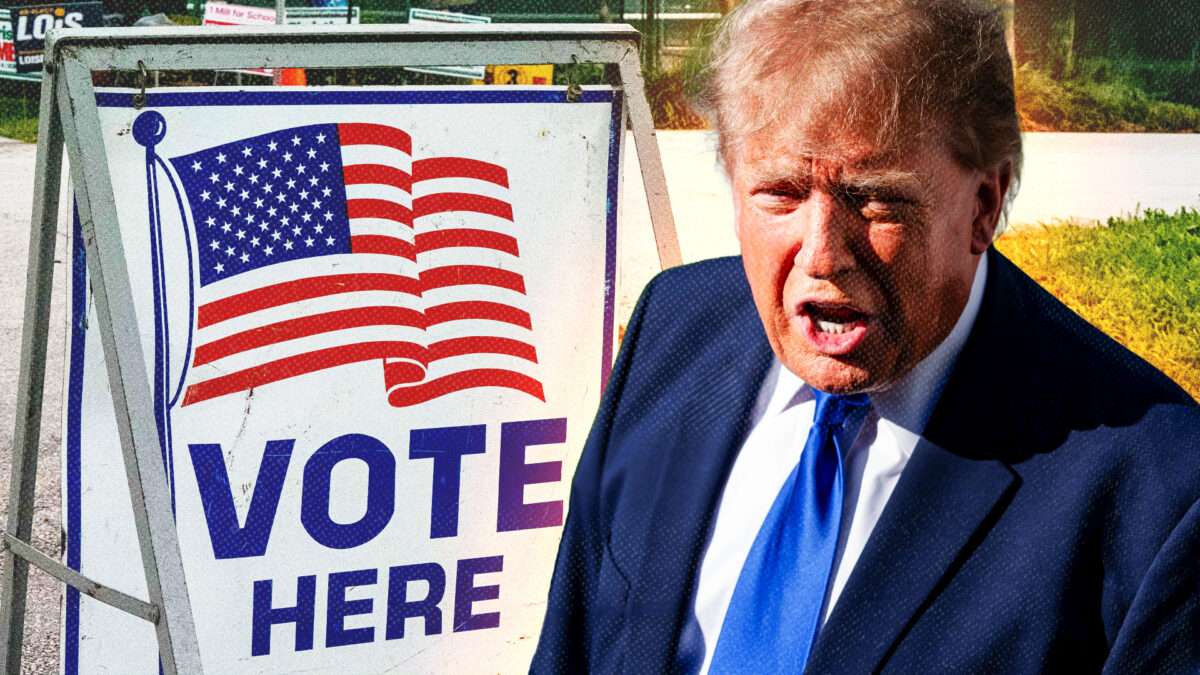
President Trump and a U.S. voting station | Illustration: Sipa USA/Chris Beckett/ZUMA Press/Newscom  Photo: Florin Seitan/Dreamstime.com

Supporters of Proposition 39, the statewide ballot initiative that would implement additional Voter ID requirements for California elections, pitch the measure as a "common-sense reform to increase trust and participation in our elections." Its sponsor, Assembly member Carl DeMaio (R–San Diego), touts widespread support for such measures by Democratic, Republican, and independent voters.

Yet the latest polls show the measure tanking, with a Public Policy Institute of California survey last month showing it losing 55 percent to 43 percent—dismal numbers this late in the election season. The official ballot arguments provide some insight into the reasons. While supporters stick with their "nonpartisan" shtick, opponents tie the measure to President Donald Trump's election denialism.

"Stop Trump from rigging our elections. Don't believe the lies. Prop. 39 MAKES VOTING HARDER, MORE EXPENSIVE, AND LESS SAFE for Californians," per the "no" argument. It refers to the measure's funding from "MAGA rightwing billionaires." That point was reinforced by a recent CalMatters report showing large donations from "deep-pocketed Republican donors." The publication says it's a "signal that conservatives view Prop. 39 as a test of support for future battleground states in the broader push by…Trump to tighten voter restrictions."

That's a fair assessment. In a Democratic state where the president's approval ratings are 24 percent in one poll, it's hard to imagine that most voters will spend much time thinking about the ins and outs of election policy and analyze the measure based on its specifics. They'll no doubt see it for what it largely is: a Republican Party effort to aid and abet Trump's unfounded election conspiracies. That said, its requirements aren't overly obtrusive, only unnecessary.

Currently, Californians must show a state identification or provide the last four digits of their Social Security Number when registering. No identification is needed to vote in person, but election officials use signature verification for vote-by-mail envelopes. Around 90 percent of Californians vote that way, so the main issue involves the requirement that voters add the last four digits from their government IDs on the outside of the envelope—thus adding an additional checkpoint (and sadly an additional opportunity for identity theft).

There's no need to worry about compliance costs for election agencies, as it's their job to administer elections. The measure likely will marginally reduce voter participation (by increasing disqualified ballots, even from legal voters if they forgot the ID they used when they registered), while marginally increasing security. It would force many Californians to re-register, which is a hassle. It would no doubt burden our excruciatingly slow ballot counting.

I don't have any theoretical problem with requiring an identification before voting, but California's elections are remarkably secure. There's no evidence of widespread fraud. Basically no one risks prison time by pretending to be someone else on a ballot. It's not about fixing a problem.

Since his defeat in 2020, Trump has traded in election conspiracy theories. The new GOP game is to trot out evidence-free election-fraud claims whenever they lose. We shouldn't play along. Despite the nonpartisan rhetoric, Proposition 39 is the state GOP's way of leaning into Trump's priorities and, as that CalMatters article noted, build momentum for less-defensible nationwide restrictions—apparently the only way Republicans think they can build a lasting majority. The measure won't do much damage in California as it's fairly modest, but it energizes the party's worst instincts.

Consider what DeMaio wrote in 2024 about his seven-point plan to overhaul the state GOP: "Do you remember a time when Republicans controlled a majority of statewide offices in California and were competitive in the state Legislature and congressional delegations?" He rightly blames the party itself, then offers his first item on a platform to revive it: "Make election integrity CAGOP's top ballot priority." I, too, would prefer more competitive California elections, but my first point would be for the GOP to make a better case for fixing California's messes.

Others see the measure as a means to gin up Republican turnout for a November election that's going to be a referendum on Trump by giving them some high-excitement issue to rally around. But some savvy political observers think that it might backfire. We'll see, but it reminds me that the California GOP has too long relied on cute strategies rather than good candidates.

What about supporters' main claim that Voter ID is necessary because it will restore voters' flagging trust in election integrity? Well, Republicans are the ones who don't trust our elections—and that's precisely because Trump spent the last six years poisoning the well. Do you really believe the people who think MAGA Republican Spencer Pratt could have only lost a Los Angeles mayoral primary (where only 15.9 percent of voters are Republicans) because of fraud will have their faith restored if Proposition 39 becomes law? Doubtful.

Republicans can restore their fortunes by acting normal again. The rest of us needn't enable them by backing a measure based on an election-integrity fantasy.

This column was first published in The Orange County Register.

The post California Republicans Pushing New Voter ID Law Are Motivated by Trump's 'Stolen Election' Fantasies appeared first on Reason Magazine.

  •  

Free lunch, transgender athletes: Voters nationwide face major education decisions

Voters across the country are making big decisions about the education of their children at a local, state and federal level in this year’s midterms. Ballot initiatives, school board elections, governor’s races and Senate spots are all on the line as parents head to the polls thinking about AI, school choice and what topics should…

  •  
❌