❌

Normal view

A Free Speech Group at Columbia Canceled an Event About Free Speech Over 'Cornell 7' Article Controversy

21 October 2026 at 20:26
Campus building at Columbia | Luiz C. Ribeiro/TNS/Newscom

Questioning the prevailing narrative about the "Cornell seven" case is bound to create controversy. And at Columbia University, two student journalists drew condemnation for their views on the case from the unlikeliest of places: a college free speech group. 

On October 13, Barnard junior Christina Ma and Columbia junior Nikos Mohammadi published an article called "The 'Cornell Seven' Is Really About Liberalism" in the Columbia Sundial, an independent student publication. The piece argued that the discourse surrounding the alleged rape at Cornell University infantilizes women by omitting the possibility that in a post–sexual revolution, liberal society, women may make regrettable but consensual choices.

"In the world that, for better or worse, follows from it, we cannot claim to stand for sexual freedom and then recoil in disgust when there's a possibility that a young woman simply chose to exercise it," Mohammadi and Ma wrote. 

The piece also argues that the "collective frenzy" over the Cornell case has created a climate on campus that makes it "difficult to disagree with the maximalist position on what happened" the night of the alleged rape.

As Mohammadi wrote in UnHerd, the piece caused immense backlash. He said he received an onslaught of messages urging him to commit suicide and demanding that his "career and life be destroyed." But the criticism went beyond threatening DMs and comments. 

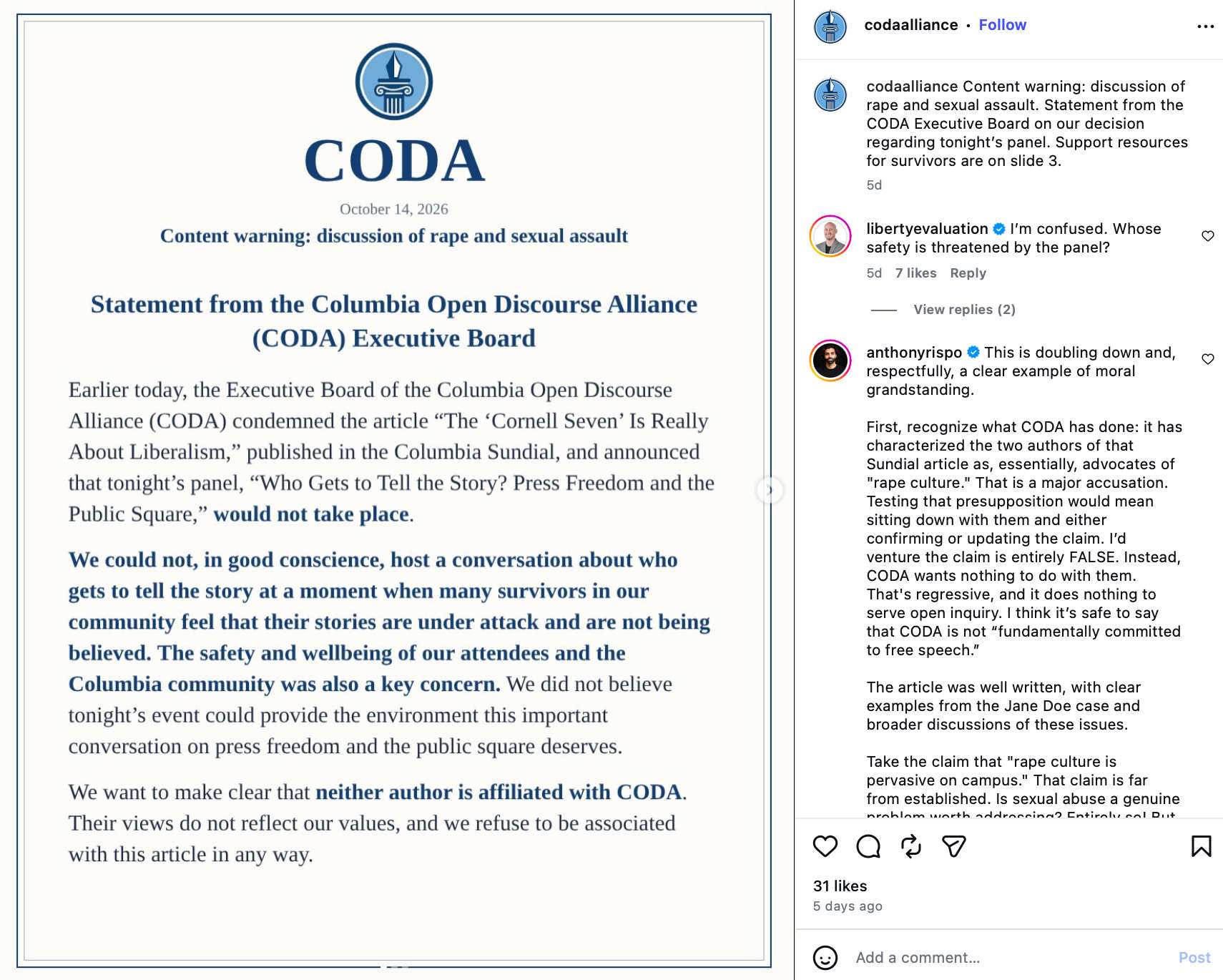
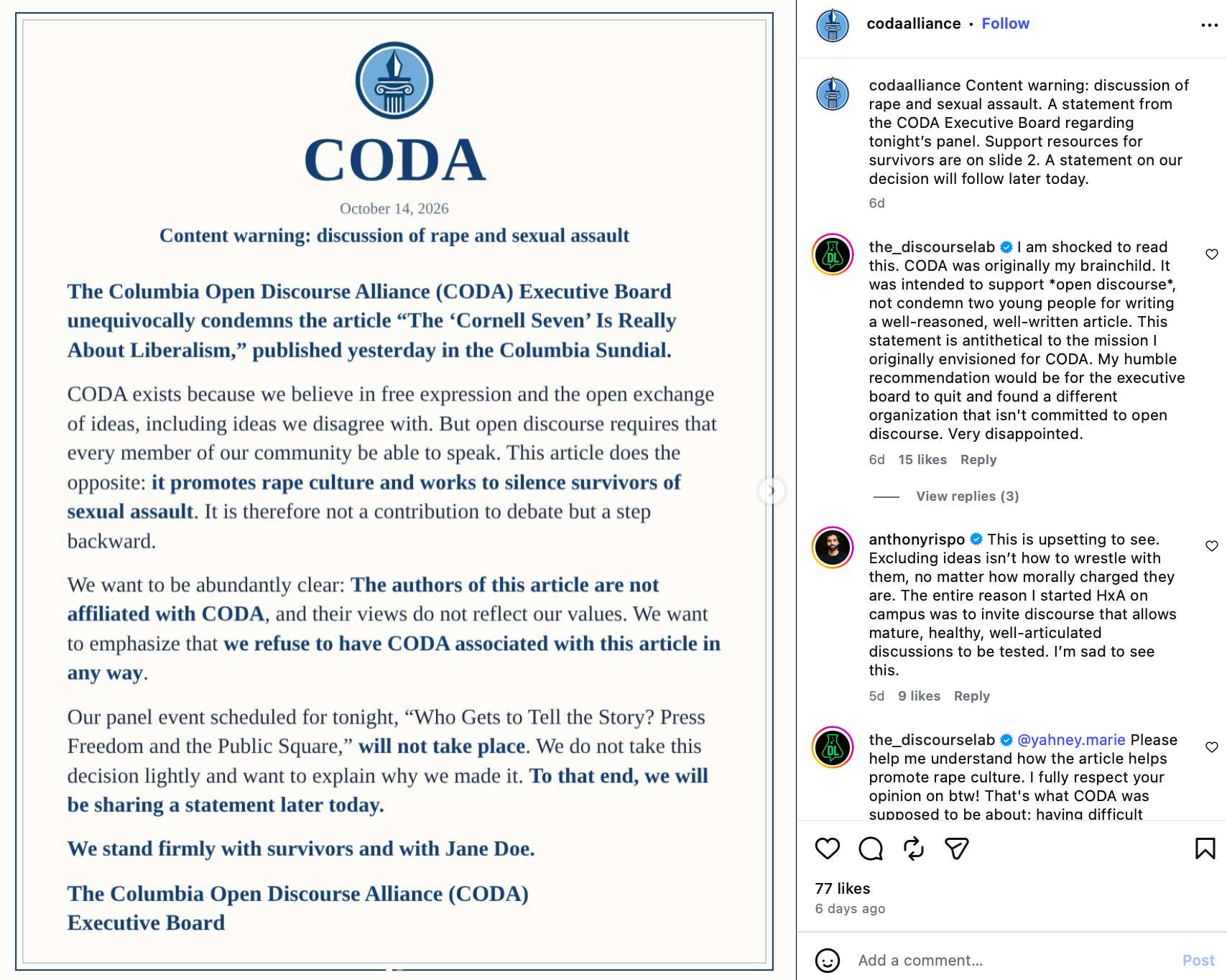
The day after the article's publication, the Columbia Open Discourse Alliance (CODA) canceled an event about press freedom because the Sundial's editor in chief, Nick Baum, had been slated to speak at the event. Although Baum did not author the piece, CODA wrote in an Instagram post that the free speech group "refused" to be affiliated with the Sundial's article "in any way." 

CODA also claimed that the event, ironically called "Who Gets to Tell the Story? Press Freedom and the Public Square," could not take place at a time when "many survivors in our community feel that their stories are under attack and are not being believed."

The group added that the Sundial's article "promotes rape culture and works to silence survivors of sexual assault." 

The group's president, Aum Desai, told Columbia's student newspaper, the Columbia Daily Spectator, that the group canceled the event "not in spite of, but because of [CODA's] commitment to free expression." 

Columbia graduate Clayton Smith, who founded CODA in 2025, quickly commented that he was "shocked" by CODA's statements on Instagram. Smith started the organization to create a central hub for groups hosting events promoting free speech and open discourse, including the Sundial and Columbia's Heterodox Academy chapter.

He tells Reason that CODA's rationale for canceling the event was "ironic" and "hypocritical," and he believes the group should have collaborated with the Sundial if there were legitimate safety concerns at the event. He says he was particularly disturbed by the group's condemnation of the article and CODA's claim that it promotes "rape culture."

"They don't argue or explain how it works to silence survivors of sexual assault. It is a baseless slander that they use to condemn the article because it promoted an opinion they do not like," Smith says. 

Smith says he spoke to Desai on the phone after CODA posted the statements, and Desai tried to reassure him that CODA would uphold the principle of free speech. But Smith says he did not leave the phone call feeling "very confident at all" in Desai's commitment. 

Desai did not respond to Reason's requests for comment.

CODA faculty adviser and Columbia Business School professor emeritus Eli Noam was traveling in China during the fallout from the Sundial article and was not involved in CODA's decision.

After speaking with members of both CODA and the Sundial, Noam tells Reason that he thinks CODA "made some proper decisions, some correct decisions, and some mistakes."

"I think we're dealing here with…a group of college students who kind of were confronted with a crisis at 2 a.m.," Noam says. "And kind of [made] some judgments that they now regret, and they do." 

He tells Reason that it was not "unreasonable to assume there would be a disruption" at the event, given the climate at Columbia and "about this rape allegation." He says the group suddenly "had an event where they needed college security" and could not organize in time. CODA, Noam says, is not yet recognized by the university, and he thinks the group was likely fearful of jeopardizing its recognition.  

Still, Noam says CODA's statements condemning the article were "unreasonable," and it was "disappointing that they kind of lost their nerve here."

Although he was not involved in planning the panel, Mohammadi says, to his knowledge, there were no credible threats of violence to the panel. He understood there may have been "disgruntled students" and an "environment CODA did not want to deal with." But instead of simply canceling the event or working with the Sundial to find a solution, Mohammadi says CODA overstepped by condemning the Sundial piece. 

James Applegate, an astronomy professor who serves on Columbia's Academic Freedom Council (CAFC) alongside Noam, tells Reason that he disagreed with CODA's decision to cancel the event.

Applegate tells Reason he was considering attending the event, and he was "rather surprised and disappointed" when it was canceled.

He recalled that when he was a professor in 2000, he objected to changes to the school's sexual misconduct policy on the University Senate floor. He says his statements were "similar to what was said in the Sundial article" and there was a "level of emotion in this debate." 

"Nonetheless, we had the debate. I was in it, and the degree to which it was civil is shocking when you look at where we are now. And it's sad." 

Applegate said he does not condemn CODA, however, "for the simple reason that the atmosphere on college campuses and on the left wing of politics in general in the United States is quite vicious."

CODA's honorary faculty fellow John McWhorter tells Reason he interpreted CODA's statement as "saying that an event about who gets to tell the story is untenable when or if a critical mass of people with such stories don't even feel comfortable telling them— i.e.being a participant in the event." He added, "I imagine some might think of that as cutting the salami a little thin, but then I highly suspect that Desai is equally worried about the event becoming a physical melee of some kind. In that, let's face it, he is hardly unreasonable."

Still, McWhorter said that he would have chosen to have the event himself, "especially as in the likely case that some people did talk about their experiences without any particular repercussions, it may have made the more reluctant people less apprehensive about doing so in the future."

According to Mohammadi, as of Tuesday, the Sundial, College Republicans, Platypus Affiliated Society at Columbia (which discusses leftist thought and history), and Columbia's Heterodox Academy chapter have left CODA. 

CODA was not the only group to condemn the Sundial's piece. On October 14, the Columbia Political Review's editorial board wrote that Mohammadi and Ma's piece "violates standards of integrity" and "perpetuates a culture of campus violence, rape, and assault." The editorial board of the Columbia Political Review, which purports to publish "multipartisan political discourse," stated that it would refuse to publish "any article that upholds or recreates cultures and systems of rape, sexual assault, or violence" and it urged "all campus publications to do the same."

And on Monday, Columbia's main newspaper, the Spectator, published a staff editorial accusing the Sundial of violating journalistic ethics by "its page to disparage survivors of sexual violence." 

Mohammadi tells Reason the piece underwent "far more editorial scrutiny than any other piece" the Sundial had published given the sensitive nature of the topic.

Free speech student organizations are necessary on Columbia's campus, especially as the school's free speech climate continues to crumble; it recently received a failing grade from the Foundation for Individual Rights and Expression. And while upholding free speech principles may have become more fashionable among those resisting the Trump administration's pressures on academic freedom or those defending pro-Palestinian speech, it is clear that some topics remain taboo in the public square. College is supposed to be a place where students debate controversial topics, form their own beliefs and opinions, and learn from mistakes. Hopefully, the students who demanded condemnation instead of debate will be forgiven for their perversion of free speech ideals, and they will learn to afford such grace and open-mindedness to classmates with whom they disagree.

The post A Free Speech Group at Columbia Canceled an Event About Free Speech Over 'Cornell 7' Article Controversy appeared first on Reason Magazine.

Victoria seguros e APSI juntam-se para promover segurança infantil

21 October 2026 at 19:08

A Victoria Seguros e a Associação para a Promoção da Segurança Infantil (APSI) vão desenvolver conteúdos educativos e campanhas de sensibilização para ajudar as famílias a identificar riscos do quotidiano e prevenir acidentes com crianças. A parceria prevê também o reforço da plataforma digital Turma da Vicky, criada pela seguradora e que passa a contar com a colaboração da associação na área da segurança infantil.

Victoria Seguros e APSI assinaram um protocolo para a promoção da segurança infantil através da produção de conteúdos para a plataforma digital Turma da Vicky.

Os materiais serão dirigidos a pais, cuidadores e à comunidade educativa e ficarão disponíveis no site e no canal de YouTube da Victoria Seguros. A oferta inclui jogos, desafios e outros conteúdos adaptados a diferentes idades, com o objetivo de ensinar as crianças a reconhecer situações de risco e a adotar comportamentos mais seguros.

A associação contribuirá para a componente pedagógica dos conteúdos, através da sua experiência na prevenção de acidentes e na promoção da segurança infantil.

Para Francisco Campilho, CEO da Victoria Seguros, “a assinatura deste protocolo com a APSI dá corpo a um trabalho que começámos com a Turma da Vicky e que queremos fazer crescer”, explica. Já Sandra Nascimento, secretária-geral da direção da APSI, destaca a importância da colaboração com empresas para divulgar mensagens de segurança e desenvolver conteúdos eficazes para as famílias.

A Victoria Seguros está em Portugal desde 1930, estando presente em todos os ramos de seguros, nomeadamente nas áreas de Vida, saúde, transportes e imobiliário e construção. Faz parte do Grupo SMABTP, fundado em 1859, segurador do setor da construção civil e obras públicas em França.

Futuro do seguro automóvel obrigatório passa a estar em livro de Arnaldo Oliveira

19 October 2026 at 17:15

O livro “O Seguro Obrigatório Automóvel Português”, da autoria de Arnaldo Oliveira, jurista da ASF e Doutor em Direito, foi apresentado pela ASF em cerimónia.

A obra “A Lei Portuguesa do Seguro Automóvel Obrigatório” é uma reflexão sobre a evolução do seguro obrigatório de responsabilidade civil automóvel em Portugal (SORCA), abordando os seus fundamentos históricos, a sua evolução legislativa e jurisprudencial e os desafios colocados pelo novo enquadramento regulatório nacional e europeu.

Arnaldo Costa Oliveira apresentou o livro no auditório da ASF, em Lisboa. Está à venda na FNAC, Almedina, Bertrand e na AAFDL da Faculdade de Direito de Lisboa.

O livro, à venda nas lojas FNAC, Almedina e Bertrand, para além de na editora AAFDL da Faculdade de Direito da Universidade de Lisboa, baseia-se num dos capítulos da tese de Doutoramento do autor, defendida e aprovada na Faculdade de Direito da Universidade de Lisboa, FDUL, em fevereiro de 2024 e focando, entre outros aspetos, “A emergência do Veículos Autónomos” no ensejo da evolução do regime do seguro obrigatório automóvel a curto e médio prazo.

Arnaldo Oliveira sustenta que o SORCA português, comparativamente com o direito comparado próximo, nasceu tarde e não apenas com soluções matriciais que dão um peso incomum à proteção do lesado. Refere que a sua evolução posterior continuou esse traço, em termos tanto legislativos quanto judiciais – neste último caso interpretando seja a lei nacional de origem estritamente nacional, seja a lei nacional de origem Europeia.

Assim, o livro é o registo de uma evolução, não apenas o retrato do regime vigente – aceitando que uma futura legislação nacional do SORCA irá resultar “muito provavelmente” do relatório que a Comissão Europeia terá de produzir até 24 de dezembro de 2030, avaliando a aplicação da referida Diretiva (UE) 2021/2118.

Bupa Portugal lança workshops gratuitos sobre saúde e prevenção

19 October 2026 at 16:29

A seguradora Bupa Portugal vai realizar cinco workshops online gratuitos sobre saúde e prevenção, entre os dias 27 de outubro e 24 de novembro. As sessões serão conduzidas por profissionais de saúde da empresa e vão abordar temas como a saúde da mulher, o colesterol, a vitamina D e o bem-estar emocional.

O ciclo começa a 27 de outubro, com o workshop “Saúde Integral da Mulher: da juventude à maturidade”, dedicado às necessidades de saúde feminina nas diferentes fases da vida. A sessão abordará temas como as alterações hormonais, a prevenção e os cuidados com o bem-estar físico e emocional.

A 3 de novembro ocorre o workshop “Controla o colesterol e protege o coração”, seguindo-se uma sessão sobre a importância da vitamina D, a 10 de novembro. A 17 de novembro, o tema será a relação entre o sistema nervoso e a saúde emocional, enquanto o último workshop, a 24 de novembro, será dedicado ao equilíbrio entre o corpo e a mente.

A iniciativa surge num contexto em que as doenças cardiovasculares continuam a representar um dos principais desafios de saúde pública em Portugal. Segundo dados citados pela empresa, estas doenças são responsáveis por cerca de 25% das mortes no país e a prevalência do défice de vitamina D na população portuguesa.

Com estas sessões, a empresa pretende disponibilizar informação sobre prevenção e hábitos saudáveis, ajudando os participantes a identificar fatores de risco e a tomar decisões mais informadas sobre a sua saúde.

A participação é gratuita e aberta ao público. Os links de acesso às sessões serão divulgados nas páginas oficiais da seguradora.

ASF mede satisfação dos consumidores com os seguros que contratam

18 October 2026 at 13:57

Quanto valor retiram os consumidores dos seguros que contratam? Esta é a questão a que a Autoridade de Supervisão de Seguros e Fundos de Pensões (ASF) quer responder com o lançamento de um questionário. O inquérito pretende para avaliar a perceção dos clientes sobre os produtos disponíveis no mercado, tendo em conta o preço, as coberturas e os serviços prestados pelas seguradoras.

O regulador quer recolher respostas de tomadores e beneficiários de seguros para perceber se os produtos correspondem às reais necessidades e expectativas de quem os utiliza e se a oferta do mercado responde a esta procura, utilizando as conclusões do questionário para reforçar os mecanismos de proteção dos consumidores e orientar futuras medidas de supervisão no mercado nacional.

Os resultados desta iniciativa serão conhecidos a 20 de novembro, no 1.º Fórum do Consumidor de Seguros, que será transmitido em direto no site da ASF.

Os desafios da saúde mental na vida universitária

15 October 2026 at 17:31

VTM

Na Universidade de Trás-os-Montes e Alto Douro (UTAD), a gestão do tempo, o stress e a dificuldade em conciliar os estudos com a vida pessoal são alguns dos desafios identificados pelos estudantes, que consideram essencial garantir a continuidade dos projetos de promoção da saúde mental no Ensino Superior.

A preocupação com estas respostas é também partilhada pela Ordem dos Psicólogos Portugueses (OPP), que manifestou apreensão com a falta de garantias de continuidade e financiamento dos Programas de Promoção da Saúde Mental no Ensino Superior, desenvolvidos ao longo dos últimos três anos. Estes programas, financiados com 12 milhões de euros, apoiaram 40 projetos em 68 universidades e institutos politécnicos e permitiram reforçar os serviços de apoio psicológico, contratar psicólogos e implementar iniciativas de prevenção e promoção da saúde mental.

Em comunicado, a Bastonária da OPP, Sofia Ramalho, alerta que a interrupção destes programas pode comprometer “os resultados alcançados, a manutenção dos profissionais e o apoio prestado aos estudantes, numa fase da vida particularmente exigente”. Por isso, a OPP defende que a transição para o programa SOMA+ Academia, anunciado pelo Governo, deve garantir um financiamento efetivo, previsível e uma implementação rápida.

Estudantes

Entre os estudantes, as dificuldades emocionais estão frequentemente relacionadas com a exigência de conciliar diferentes áreas da vida. Lara Brito, estudante na UTAD na licenciatura em Comunicação e Multimédia, revelou à VTM que a gestão do tempo entre as atividades curriculares e extracurriculares é uma das suas principais dificuldades. A jovem referiu que a falta de organização pode contribuir para “o aumento do stress e da ansiedade”.

Artigo exclusivo PREMIUM

Tenha acesso ilimitado a todos os conteúdos do site e à edição semanal em formato digital.

ou compre apenas este artigo:

Comprar este artigo — 1,00€
Se já é PREMIUM, Aceda à sua conta em Entrar

The post Os desafios da saúde mental na vida universitária appeared first on A Voz de Trás-os-Montes.

American Psychological Association Elects Activist President

15 October 2026 at 15:00

The American Psychological Association has elected as its president a woman who once published an article on the "radical transformative potentialities of nonbinary Black womxn’s sexuality".

The post American Psychological Association Elects Activist President appeared first on The Daily Sceptic.

Polícia localiza mulher em hotel após furto de celular em academia de Goiânia

10 October 2026 at 03:05

Uma mulher natural do Rio Grande do Sul foi presa após furtar um celular esquecido por um cliente em uma academia de Goiânia. O caso veio à tona após o sistema de vigilância do estabelecimento registrar a retirada do aparelho, fato que permitiu à polícia identificar a suspeita e iniciar as buscas.

As gravações de segurança tiveram papel decisivo na apuração. Após analisar as imagens e reunir informações sobre o caso, as equipes policiais localizaram a mulher em um hotel no Setor Marista, região nobre da capital. Segundo as informações divulgadas, ela estava em Goiânia a trabalho e permanecia temporariamente na cidade.

A abordagem ocorreu sem resistência. Após a localização da suspeita, os policiais recuperaram o celular e a encaminharam à delegacia para os procedimentos legais. O caso ficou sob responsabilidade da Polícia Civil, que dará continuidade à apuração da ocorrência.

O episódio evidenciou a importância das câmeras de segurança na identificação de suspeitos e na recuperação de objetos furtados. A vítima conseguiu reaver o aparelho após a ação policial, enquanto o caso seguiu para as providências previstas em lei.

The post Polícia localiza mulher em hotel após furto de celular em academia de Goiânia appeared first on Diário da Manhã - O Jornal do leitor Inteligente.

❌