A new Quaest poll shows the far-right senator with 45% of voter support and the progressive president with 44%.
On Wednesday, polling firm Quaest revealed that Sen. Flavio Bolsonaro’s lead over President Luiz Inacio Lula da Silva in voting intentions for Brazil’s presidential runoff had narrowed from 2 points last week to just 1 point.
If the election were held today, the far-right candidate, who received the most votes in the first round, would receive 45% of the vote, while the progressive president would garner 44%, indicating that the two remain statistically tied because the poll has a margin of error of 2 percentage points.
In the poll conducted last week by the same firm, the son of former President Jair Bolsonaro (2019-2022) had 46% of voter support, a decline of 1 point, while Lula, who is seeking reelection and a fourth nonconsecutive term, had 44%, unchanged from the previous survey.
The new poll, released just four days before the runoff scheduled for Oct. 25, confirmed that the presidential election ranks among Brazil’s most polarized, with the country still divided between the progressivism led by Lula and the far-right politics of the Bolsonaro clan.
Quaest: Lula amplia vantagem entre beneficiários do Bolsa Família. O candidato à reeleição aumentou de 60% para 62%. Ao mesmo tempo, Flávio Bolsonaro (PL) caiu de 31% para 27%.
The text reads, “Quaest: Lula expands his lead among Bolsa Família beneficiaries. The candidate seeking reelection rose from 60% to 62%. At the same time, Flavio Bolsonaro (PL) fell from 31% to 27%.”
According to Quaest, which interviewed 2,154 voters between Saturday and Tuesday, the percentage of undecided voters rose from 1% to 2% over the past week, while the percentage of those intending to cast blank ballots or invalidate their votes remained at 9%.
The new poll was conducted after the candidates’ first televised debate on Oct. 18 and after the Brazilian president announced new measures. In addition to the reduction of the workweek from 44 to 40 hours, with two days off and no reduction in pay, Lula announced in recent days a measure to forgive microentrepreneurs’ debts and a bill to provide free bus transportation on weekends.
Bolsonaro received the most votes in the first round of the presidential election, with 47.03%, while Lula finished second with 45.16%, leaving a gap of less than 2 percentage points between them.
The Workers’ Party leader challenged the far-right candidate to disclose the origin of his wealth.
On Sunday, Brazilian President and re-election candidate Luiz Inacio Lula da Silva and far-right opposition candidate Flavio Bolsonaro faced off for the first time in a presidential debate.
Just one week before the Oct. 25 runoff election, and after skipping the first-round debates, they engaged in a tense confrontation marked by insults, corruption accusations and constant interruptions.
The friction forced the moderator to intervene repeatedly. In one of the initial exchanges, after Lula complained that Flavio was mocking him, the journalist demanded that the far-right politician show “respect” for speaking out of turn.
“The clown here is him, not me,” the Brazilian president said, accusing Flavio and Bolsonarism of lacking “ethical behavior.” Addressing public spending, Lula called his opponent a “crook” and a liar.
“Do you see that innocent-looking face of his? It belongs to a compulsive liar. He is the Rio de Janeiro crook who lies shamelessly,” the Workers’ Party leader said.
Streets of Copacabana, Rio de Janeiro, are filled with people mobilizing in support of President Lula da Silva and against the return of the far-right. Citizens share their concerns about public health (SUS) and fundamental rights.
The most tense moment occurred when Lula was invited by Bolsonaro to stand beside him and calm down. The Brazilian president returned to his podium, drank some water, and responded:
“I don’t want to be near you. I want to keep my distance from the Bolsonaro family,” Lula said, later recalling the criminal clan’s low character.
The Brazilian president accused Eduardo Bolsonaro — Flavio’s brother, who is living in the United States — of fleeing and calling for the intervention of U.S. President Donald Trump.
“They are betraying the homeland and will be judged for it… Your brother is a fugitive in the U.S., conspiring against Brazil,” Lula declared, implicitly referring to calls by the Bolsonaro clan for U.S. economic, political, and even military intervention in Brazil.
In an attempt to discredit the Workers’ Party leader, Flavio demanded that Lula explain his alleged strong electoral performance among prison inmates. “Can you explain why 73% of prisoners voted for you?” the far-right candidate asked.
Flávio Bolsonaro quer seguir o modelo da Argentina, país vizinho da carne de burro, do desemprego em alta. Lula questionou o adversário sobre isso, mas, de novo, não teve resposta. Se ele não responde, Lula faz isso: o modelo do Brasil será o modelo de Luiz Inácio Lula da Silva.… pic.twitter.com/27ne3ncadO
The text reads, “Flavio Bolsonaro wants to follow the model of Argentina—a neighboring country plagued by economic hardship and rising unemployment. Lula questioned his opponent about this, but, once again, received no answer. Since he offers no response, Lula provides one: Brazil’s model will be the model of Luiz Inacio Lula da Silva. According to the IMF, Brazil is set to climb back up and become the world’s 8th-largest economy by 2027. The last time Brazil held the 8th position was in 2017.”
Lula responded to the provocation mockingly, saying he would like to receive the votes of the entire prison population, including the vote of former President Jair Bolsonaro, who is serving house arrest for an attempted coup.
“I want 100% of them to vote, including your father. Your father can vote for me. He will have voted for the better candidate. He knows you and knows I am better than you,” Lula asserted and issued a challenge to Flavio Bolsonaro.
“I challenge you. Tomorrow, we will open our bank accounts and phone records to the Electoral Court and the Supreme Court so that the Brazilian people can know who the real thieves in this country are.”
In the final stretch of the debate, foreign policy took center stage. Lula questioned Flavio’s close ties with Argentine President Javier Milei, asking whether he planned to apply Milei’s economic “chainsaw” model in Brazil.
The far-right candidate dodged the question and counterattacked by criticizing the left’s regional alliances.“Brazil is internationally ruined by your policies, Lula. Look at your friends,” he declared.
Datafolha puts Flávio Bolsonaro at 47% and Lula at 45% ahead of Brazil’s Oct. 25 presidential runoff.
Brazil’s presidential race has tightened ahead of the Oct. 25 runoff, with senator Flávio Bolsonaro losing two percentage points in voting intention to reach 47%, while President Luiz Inácio Lula da Silva stands at 45%, according to a Datafolha poll released Thursday. The two candidates are in a technical tie, with the difference falling within the survey’s margin of error.
Among valid votes, which exclude blank and invalid ballots, Bolsonaro leads Lula by 51% to 49%. The gap has narrowed from the previous week’s poll, when Bolsonaro held a 52%-48% advantage.
A separate poll published Wednesday by research firm Quaest also showed a close race, giving Bolsonaro 46% support and Lula 44%.
Text Reads: DATAFOLHA: 51% x 49% IT’S TURNING AROUND!!! Last week, the difference was 4 points. Now it’s down to 2.
The Datafolha survey found similar levels of rejection for both candidates. Some 46% of respondents said they would never vote for Bolsonaro, compared with 44% who said the same of Lula.
Views of the current government were also divided: 41% of respondents rated its performance negatively, while 35% viewed it positively.
The poll was conducted after large rallies in support of Lula took place over the weekend. However, the interviews were completed before the survey could capture any potential impact from the Senate’s approval of a proposed constitutional amendment to end the 6×1 work schedule, under which workers work six days and take one day off.
The proportion of respondents opting for blank or invalid ballots rose from 5% to 6%, while the share of undecided voters ranged between 1% and 2%.
Datafolha interviewed 2,520 people aged 16 and older across Brazil from Oct. 13 to 15. The survey has a margin of error of two percentage points and a 95% confidence level. It was registered with Brazil’s Superior Electoral Court under number BR-00466/2026. In the first round, Bolsonaro received 47.03% of the vote, compared with 45.16% for Lula.
Brazilian presidential candidate Flávio Bolsonaro confirmed Wednesday that he will attend the Band network debate with President Luiz Inácio Lula da Silva, scheduled for Sunday, October 18, a turnaround that clears the way for the first face-to-face encounter of the campaign.
Less than 24 hours after announcing that he would not participate in Sunday’s debate on Bandeirantes channel, the senator and presidential candidate Flávio Bolsonaro backed down and confirmed this Wednesday that he will debate with the Worker’s party candidate, Lula da Silva. The event will take place on October 18 at 8 P.M. local time.
Bolsonaro, who had announced the previous day that he would not attend the program, changed his decision after Lula confirmed his presence to expose the differences between the two government projects and allow voters to compare the proposals of both candidates.
In the recording broadcast on social networks, the son of former President Jair Bolsonaro presented his turnaround as a calculated provocation. “Lula, how predictable you are, aren’t you? All it took was for me to say I wasn’t going to take part in the Band debate for you, the next minute, to say you were going. And of course I will be at the debate, I just wanted you to confirm it,” he said.
The challenge did not stop there. “I am going to rub the truth in your face and refute you live for millions of Brazilians; I’ll be waiting for you at the Band debate, Lula,” Bolsonaro added.
Seus dias na presidência espalhando mentiras estão contados!
Vou esfregar a verdade na tua cara, Lula! Me aguarde…
The meeting, organized by the chain Bandeirantes, comes one week from the start scheduled for October 25 and will be the first time in this campaign that both face to face.
Tuesday’s Opposite Stance
On Tuesday, Bolsonaro’s position had been the opposite. After an event of the Brazilian Democratic Movement (MDB), the senator gave reporters a brief refusal. “I’m not going, it’s not planned to attend that debate on Sunday,” he said, adding that his attendance at the October 23 Globo debate would depend on what his technical team decides.
The turnaround came after Lula confirmed that he would attend the program. For his part, Lula had confirmed his presence the same day, also by video. “I hope my opponent shows up so that the people know the differences between programs and candidacies. I will be there,” he said.
Band kept the event on the calendar despite the initial resistance of the Liberal Party’s candidate and had announced it would leave the absent candidate’s lectern empty throughout the broadcast. With Wednesday’s confirmation, the set will have both contenders.
ELEIÇÕES 2026 | Flávio diz que não vai a debate Band/Estadão e Lula confirma presença. Encontro entre presidenciáveis está agendado para o domingo, dia 18, na sede da emissora do Morumbi. 🔗 Acompanhe a cobertura completa das eleições em https://t.co/WqM2KrEbmLpic.twitter.com/az5mBZJnNl
Neither candidate attended a debate before the first round. Band’s August 23 debate was held without the frontrunners, and those called by a media consortium on September 14 and by Record on September 23 were canceled because no one confirmed attendance.
The October 1 Globo debate also fell through. Lula said on September 30 that he would not attend, and Bolsonaro, who had promised to show up even without his rival, withdrew about two hours before airtime. He blamed what he called “censorship” imposed, in his version, by the Superior Electoral Court (TSE), whose justice Estela Aranha had barred the network from keeping the lectern reserved for the president on the set.
According to the Superior Electoral Court, in the first round on October 4 Bolsonaro won 56.1 million votes, or 47.03% of valid votes, and Lula 53.9 million, or 45.16%.
This Sunday’s debate will be the first in which Bolsonaro and Lula of the leftist Workers’ Party (PT) face off, given that none participated in the media clashes before the first round. Another debate is still scheduled for October 23 at Globo, two days before the election, the most influential TV network in the South American country.
With the balloting set for October 25, the results show a competitive contest after a first round in which the difference was also tight. In this scenario, the televised debate scheduled for Sunday represents a new instance for the two aspirants to present their positions to the Brazilian electorate.
As Flávio Bolsonaro promises $38 billion in spending cuts, huge crowds of students take to the streets across Brazil to support Lula and fight for their right to quality education.
This Sunday, the fact that Lula brought out the largest crowd to São Paulo’s Paulista Avenue since the Diretas Já movement in the waning days of the U.S.-backed military dictatorship, with estimates of over 1 million, has rightfully occupied a lot of headline space, even in bourgeois media outlets like Globo which notoriously lies about crowd size at leftist marches and protests.
But across Brazil, scores of other campaign marches have brought out huge crowds in the past few days, even in small and mid sized cities, like the conservative city of Uberlândia, which saw 50,000 people come out to show their support for Lula on October 8.
This Sunday I headed to May 13 Park in Recife’s Santo Amaro neighborhood to cover a Lula rally for TeleSur that had been organized by labor unions, the Workers’ Party and social movements like UNE, the National Union of Students (União Nacional dos Estudantes). I had covered Lula’s surprise visit to Recife on September 25 and witnessed the hastily assembled crowd of 80,000 firsthand. Within minutes of arriving at the park, I knew this one was going to be much bigger.
As I nudged my way through the crowd with my camera equipment, I saw Mayllane Silva, state director of UNE, Brazil’s oldest social movement, which is historically connected to the Communist Party of Brazil (PCdoB). I asked her why UNE helped organize the rally.
“UNE is out on the streets today because we believe President Lula’s reelection is essential to defending education in our country,” she said. “We can’t leave education in Flávio Bolsonaro’s hands, given that he wants to take our universities out from under the Education Ministry. He wants to tear down education in our country. That’s why UNE isn’t just out on the streets here in Pernambuco, but all across Brazil, to say we want President Lula reelected president so we can defend our education system.”
Mayllane Silva – Director of UNE Pernambuco
During the presidency of Flávio Bolsonaro’s father, Jair, the government gutted funding for the federal public university system, leaving many of Brazil’s most prestigious public schools, like the Federal University of Rio de Janeiro, on the verge of bankruptcy. The large number of young people present was certainly tied to the fight to protect public education against more of the Bolsonaro family’s market friendly spending cuts, but it was clear that the fight was bigger than that.
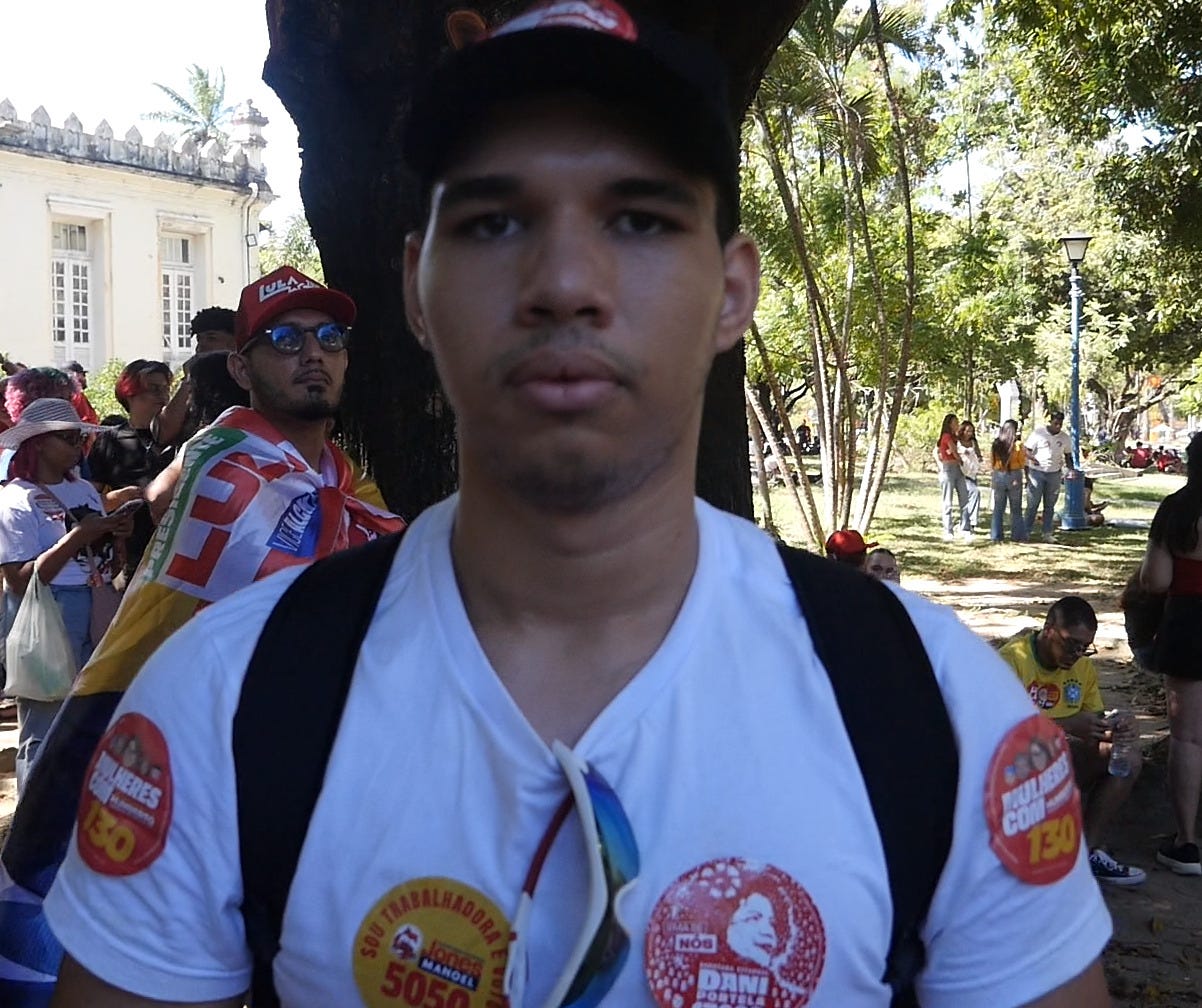
A young man named Álvaro Luís told me, “We’re here for all of the minority groups that suffer daily attacks from bolsonarismo. We’re here to fight for those who are unprotected. We are here for the Afro-Brazilians, the working class, for the LGBT community, for women and children, and for a better future for our country.”
When President Lula was first elected in 2002, less than 4% of Brazil’s public university students were Afro-Brazilian, and the vast majority had graduated from prestigious private high schools. The Workers’ Party introduced an affirmative action system that represented an improvement over the U.S. model, because it based university entrance quotas on social class and graduating from public elementary and high schools, as well as on race. Today the share of Afro-Brazilian students matches their share of the population at large, roughly 52%. Millions of low income young people became the first in their families to attend college, and many now worry that under Bolsonaro, university will regress into being an elite privilege.
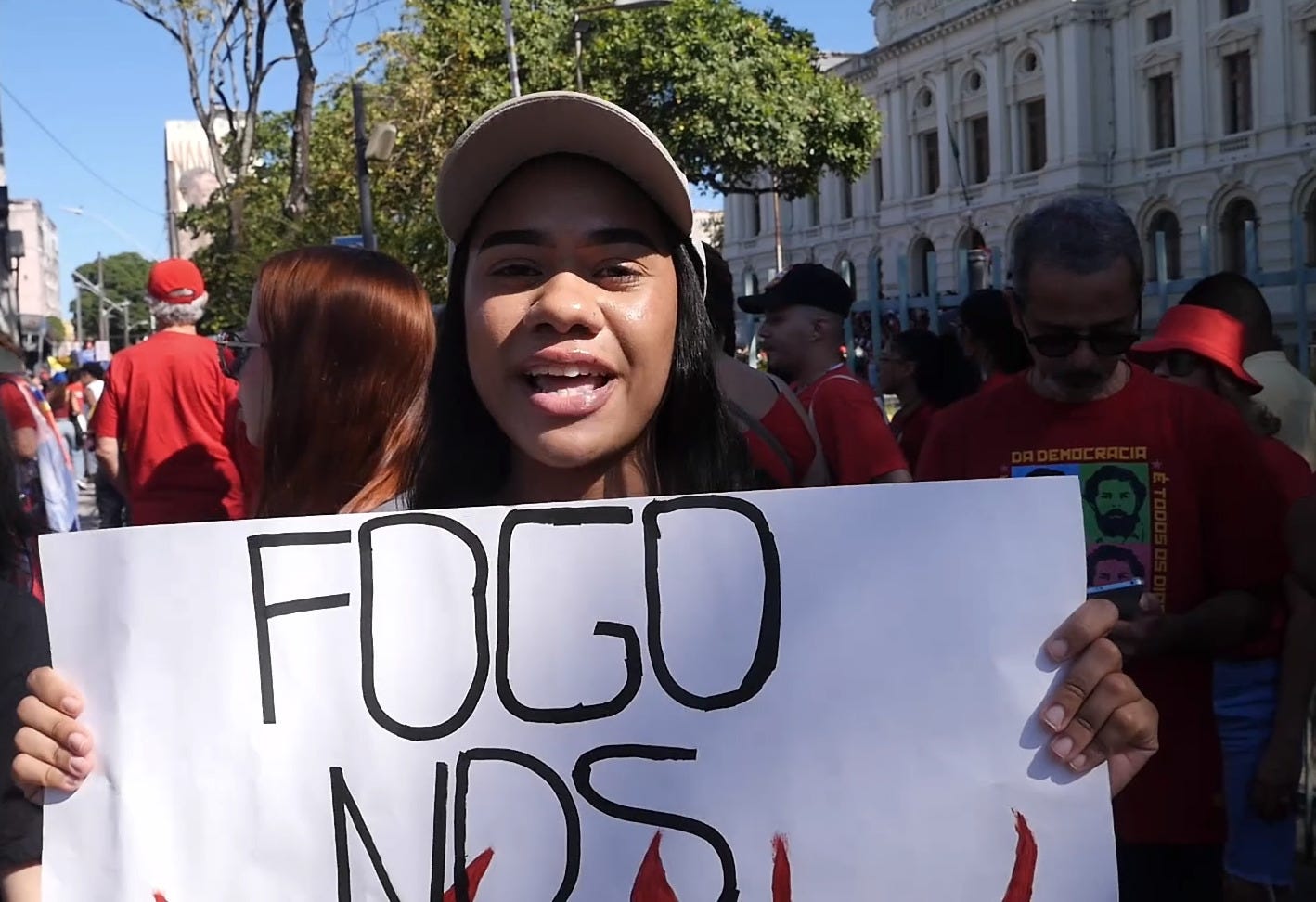
I approached a young woman who was holding a handmade sign that said, “Fire on the Racists,” and asked why she had come out. “My name is Alana Lima. I have a bachelor’s degree in journalism from the Federal University of Pernambuco, and I was an affirmative action student. I am the daughter of a woman who worked as a kitchen maid and a man who didn’t finish elementary school. I am here today because I know the power that education has to transform people’s lives, and I don’t want this right, which was denied to our ancestors, to be denied to future generations.”
I’ve been covering protests and rallies in Recife for five years now, and this was the largest I had ever seen. Although no size estimate has been made by any credible source at the time of writing this article, I estimate that it was easily twice as large as the crowd of 80,000 that came out to see Lula in person on September 25.
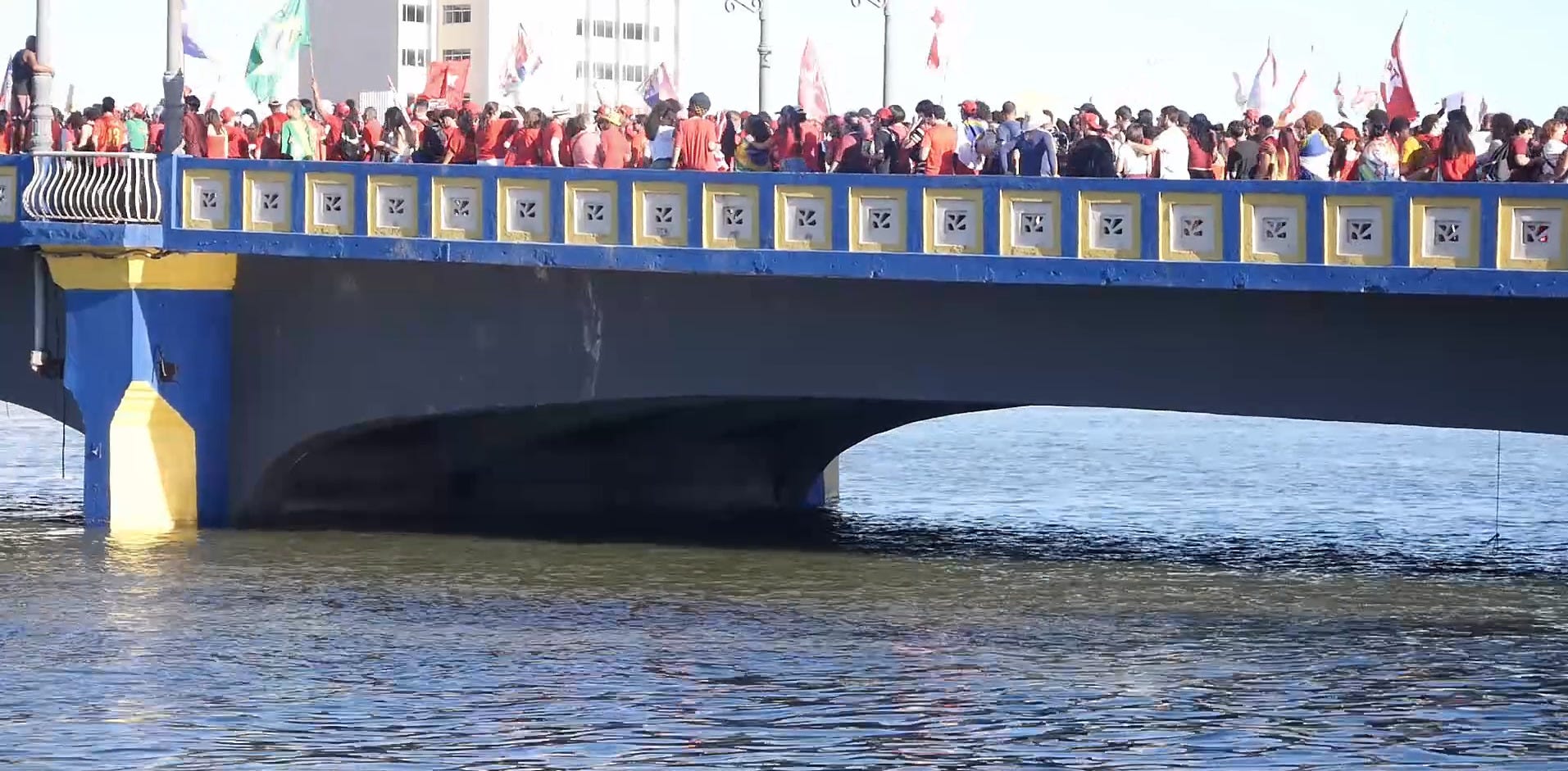
Drone footage shows the crowd simultaneously filling the Princesa Isabel Bridge, which connects the Santo Amaro neighborhood to Antônio Vaz Island, crossing the island, and at the same time occupying the entire Buarque do Macedo Bridge to Recife Antigo Island.
As the march reached its final destination at Marco Zero, the original founding point of Recife, newly elected and reelected lawmakers from the Workers’ Party (PT), the Communist Party of Brazil (PC do B) and the Socialism and Freedom Party (PSOL) made speeches reminding the crowd of what will be lost if Bolsonaro takes a chainsaw to the national budget like the ones wielded by Milei and Musk.
Drone footage of Buarque do Macedo Bridge
Jones Manoel, who was recently elected federal deputy for PSOL, said, “Federal investment in our state will dry up, and important public assets like the Abreu e Lima refinery could end up privatized. So it’s essential that all of Pernambuco’s working class mobilizes to guarantee President Lula’s reelection.”
Even with the size of the rally, the maracatu drum groups, and the humorous chants against Flávio Bolsonaro that seemed to energize the crowd, there was a palpable underlying tension. Toward the end, I ran into a friend who works at one of the Lula administration’s national ministries. Midway through a cheerful exchange of pleasantries, her smile vanished for a second. “I’m really nervous about this,” she said.
Brazil’s presidential runoff will take place on October 25.

 Login