China’s development of specialized naval auxiliaries designed to transport, launch and recover submarine-sized uncrewed vessels signals an assertive push to project autonomous undersea power beyond the First Island Chain and systematically challenge US submarine dominance in the Western Pacific. This month, multiple media outlets reported visual evidence showing that China has constructed a second dedicated […]
Committee cites shortfalls of submarines and warships and says ‘dramatic progress’ needed by end of decade
Britain risks failing to deter future Russian aggression in the high north beyond the UK because of shortfalls in the number and availability of Royal Navy submarines and warships, MPs on the defence select committee have said.
The committee focused on the slow deployment of HMS Dragon to Cyprus this spring, declining numbers of frigates, and reports that all five Astute-class attack submarines were in dock this summer as evidence of a navy under-resourced for the threat.
One drone launched another drone, which then shot down a third. All three were unmanned, and all at sea off Ukraine.
Ukraine’s Navy has destroyed a Russian Shahed attack drone with a Sting interceptor launched from the Sargan 3000 unmanned surface vessel, the Navy said, showing sailors adapting to new aerial threats with sea-launched interceptors.
Russian Shaheds threaten Ukraine’s ports, coastline and the ships that approach them, so meeting those drones out at sea, before they reach land, matters for the whole southern defense.
A Ukrainian Navy sea drone, the Sargan 3000, destroyed a Russian Shahed kamikaze drone with a Sting interceptor drone
Ukrainian troops continue to adapt to new threats to protect civilians and infrastructure Ukrainian Navy pic.twitter.com/kXvnqaebAw
The Sting is built to destroy Russian kamikaze drones such as the Shahed, Geran and Lancet, as well as reconnaissance drones, with quick deployment, a short training course and a top speed of 280 km/h, its producer, Wild Hornets, says.
The interceptor that has become Ukraine’s Shahed-killer
The Sting has earned its place at the front. The Ukrainian FPV interceptor has proven highly effective in combat, with a typical hit rate of 80 to 90% depending on the unit, and on some days reaching 100 percent, one launch for one kill.
It is currently Ukraine’s most productive Shahed interceptor, according to the Wild Hornets, having destroyed more than 3,000 drones in its first seven months of use. Mounting it on a sea platform extends that record from land into the Black Sea.
A drone boat that keeps finding new ways to kill
The Sargan 3000 has become a multi-purpose hunter. In July, Ukrainian naval personnel used a Sargan 3000 to sink a Russian second-rank border patrol ship.
In October, the same drone boat shot down a Russian Shahed with a turret-mounted machine gun over the Black Sea. Ukraine’s Navy took the Sargan 3000 into service in April 2026, and the drone boat has a combat radius of up to 1,600 kilometers, letting it clear the sky far from shore without putting a sailor in range.
By Chris Servello (OpEd) After years of testing and debating how unmanned surface vessels fit into the fleet, the Navy is starting to show what these systems can do. And...
New footage of Australia’s Ghost Shark extra-large autonomous underwater vehicle (XL-AUV) provides the first look at how the vehicle launches aerial drones, while also revealing a pair of deployable masts not previously seen on the platform. The video comes soon after we got a glimpse of some of the payloads that the Royal Australian Navy plans to integrate on the new uncrewed submarine, as you can read more about in our coverage here.
"Ghost Shark has teeth now." – @PatConroy1, Australia's Minister for Defence Industry.
The @ausgov and @Australian_Navy confirmed the payloads that our Ghost Shark extra-large autonomous submarine carries: sea mines, logistics caches, and air-launched effects for ISR and strike.… pic.twitter.com/IALPFpOf4V
Published by manufacturer Anduril, the footage shows a Ghost Shark surfacing before doors on the top of its hull slide open. A launcher consisting of 12 angled tubes then emerges from a drone sub. Another launcher is seen in the other upper payload bay, but is not raised in the video. While it appears to be of the same type, the second launcher could also have a different arrangement of tubes.
While the 12-tube ALTIUS aerial drone launcher on the left is seen elevating, the launcher on the right remains lowered. Anduril/screencap
The footage subsequently cuts to an ALTIUS-type drone being launched from one of the tubes, with Ghost Shark itself remaining surfaced.
A Ghost Shark launches an ALTIUS aerial drone from a raised 12-tube launcher. Anduril/screencap
The sequence provides a much more concrete look at the aerial-drone deployment concept — or one of them — than the photographs released previously, which offered the first public view inside Ghost Shark’s side payload bay.
The Australian government has said the vehicle is being developed for missions including persistent intelligence, surveillance, reconnaissance (ISR) and strike, but the precise configuration and operational capabilities of its weapons and how they are launched had not previously been disclosed.
The video does not identify which ALTIUS variant is being launched. However, Ghost Shark has previously been displayed at the Altus factory in Australia alongside derivatives of the ALTIUS-600 family. This includes the ALTIUS-600 for ISR, as well as the ALTIUS-600M, which is designed for strike missions. You can read more about this family of drones here. As we noted before, unarmed variants of the ALTIUS-600 are designed to be optionally expendable, and can be reused, although in many scenarios that isn’t possible. In terms of capabilities, the ALTIUS-600 has a maximum range of around 275 miles and can remain airborne for at least four hours, according to Anduril.
Examples of the Anduril ALTIUS-600 displayed during a press conference at the Anduril Australia factory in Sydney, New South Wales. Australian Department of Defense
Ghost Shark can clearly deploy a substantial number of aerial drones — two dozen in this case – in a single sortie, enabling swarms to be launched far from an adversary’s coastline. Depending on the drones carried and how they are employed, such a swarm could provide broad-area surveillance, wreak havoc on enemy air defenses via electronic warfare, or attack targets.
The concept could also have value below the threshold of open conflict. A mass launch of relatively inexpensive drones could be used to probe or stimulate an adversary’s air defenses, prompting them to reveal their locations, signatures and operating procedures for collection by other intelligence assets or even some of the drones themselves. There is a precedent for exactly this going back to the early Cold War years, which you can read all about here.
Ghost Shark could carry these capabilities deep into contested waters clandestinely without putting a crew at risk, unleashing their payload even at standoff distances or right next to the shore to give the drones maximum penetration and loitering time over target, depend on the risk profile.
At the same time, while the 12-tube launchers fit neatly into Ghost Shark’s hull architecture, the modular nature of the design means that the same space can accommodate many other payloads, which might include alternative types of aerial drones. This could be fewer larger, more capable types, or far more plentiful smaller, less capable ones.
The other notable development in the video is the appearance of two deployable masts. Their presence is particularly interesting given Anduril’s emphasis on designing uncrewed underwater vehicles without the kinds of protruding mast arrangements associated with traditional submarine designs. On UUVs, masts like these are generally used to support sensors, communications, and propulsion systems.
Looking aft, with the two masts raised. Anduril/screencap
“We don’t have big masts running down the backbone of our vehicle that a lot of other designs do that then preclude the ability for the payloads to come out in different directions… of the payload module itself,” Dr. Shane Arnott, Senior Vice President for Engineering at Anduril and the company’s maritime lead, told TWZ back in 2024.
“So we have… in effect, unlimited flexibility in this design, just the way that we’ve configured the vehicle and the payload bay itself could be almost anything within a size configuration that you can dream up,” Arnott added. “We haven’t encountered a crazy idea yet from a customer that … we can’t fit.”
The first Ghost Shark for the Royal Australian Navy. In this earlier view, the retractable masts are not visible. Australian Department of Defense
The larger mast that lies flat is actually a fairly traditional one for large UUVs. It lies along the centerline of the hull when stowed, between the upper payload bays. It then deploys upward in an arm-like motion and carries an antenna. The smaller mast is located farther aft and rises vertically from its own housing. Potentially, the tall mast supports a line-of-sight datalink to the drones, while the other being a satcom array, such as one connected to Starlink/Starshield, sends drone feed to controllers anywhere in the world. It’s also worth noting that Ghost Shark could just launch the drones and send them on their missions autonomously, without needing to stay surfaced at all. Other arrangements could exist, as well, such as Ghost Shark launching a dozen drones and one larger one capable of carrying its own satcom terminal. This would allow direct control of the drones by operators anywhere in the world without Ghost Shark remaining present near the surface.
Ghost Shark also has a lower-profile swept-back sail on top of its nose section, not visible in the video. Overall, the vessel would retain a very small signature above the waterline while connected to the drones, making it hard to detect by radar and electro-optical imaging systems.
Ghost Shark submerged, with its reflection seen on the surface. This provides a good view of the retracted masts and how they fit neatly with the closed upper payload doors. Anduril/screencap
The new video follows the recent disclosure of three payload concepts for the Royal Australian Navy’s Ghost Shark: the deployment of up to 12 sea mines in a mission, the placement of supply caches on the seabed, and the launch of aerial drones. Those capabilities expand the vehicle beyond conventional underwater surveillance into a broader range of undersea warfare missions.
The mine-delivery option could support operations in strategically important maritime areas, while seabed caches could provide a means of positioning equipment and supplies for later retrieval. The aerial-drone capability, as seen in the new video, would allow Ghost Shark to extend surveillance beyond the reach of its own sensors or potentially deliver strike effects without exposing crewed platforms to the same risks. Having 12 ALTIUS drones ready to launch (and potentially the same number in the adjacent upper payload bay) would allow multiple missions to be undertaken.
The modular design is central to Ghost Shark. As we have discussed, the payload section can be configured using different hull sections and mission-specific systems, allowing the same underlying vehicle design to accommodate different requirements. The newly revealed launcher provides a first look at how at least one of those payload concepts may be implemented in practice.
A rendering of a Ghost Shark in Royal Australian Navy service. Australian Department of Defense
Australia has committed substantial resources to autonomous and uncrewed undersea warfare capabilities, with a planned fleet of Australian-designed and built Ghost Shark vehicles serving alongside the Speartooth large uncrewed underwater vehicle (LUUV) and the BlueBottle uncrewed surface vessel (USV). The Ghost Shark program is also part of the broader AUKUS effort to develop advanced maritime technologies alongside the United Kingdom and the United States.
The new footage provides a clearer picture of the practical design choices behind that effort. Most notably, how the underwater vehicle can operationalize its aerial drone launching capability and the quantity of those systems it could potentially deploy very quickly before slipping back below the waves.
The three Navy personnel accused of violating State secrets, in the case of the Portuguese Republic Ship (NRP) Mondego, have been acquitted today, with the court describing the Public Prosecutor’s
New photos provide an interesting first public look inside the payload bay of Australia’s Ghost Shark extra-large autonomous underwater vehicle (XL-AUV), and a glimpse of the highly modular concept at the heart of the Royal Australian Navy’s emerging undersea warfare capability. Australian authorities had said in the past that they plan to use Ghost Sharks to conduct “persistent intelligence, surveillance, reconnaissance and strike” missions, but without any real elaboration.
The photographs were taken during a recent visit to the Anduril Australia factory in Sydney, New South Wales, by Pat Conroy, Australia’s Minister for Defense Industry. They emerged as the Australian government announced new details of payload development for Ghost Shark, the Speartooth large uncrewed underwater vehicle (LUUV), and the BlueBottle uncrewed surface vessel (USV), on October 19. While the announcement described the payloads in very broad terms, the photos plus additional details from the Anduril event reveal a more concrete picture of the missions Ghost Shark is being designed to perform.
Left to right: David Goodrich, CEO of Anduril Australia; Chief of Navy, Vice Adm. Matthew Buckley; Professor Tanya Monro, AC Chief Defense Scientist; and Pat Conroy, Minister for Defense Industry, stand in front of a Ghost Shark, with payload bay open, at the Anduril Australia factory in Sydney, New South Wales. Australian Department of Defense
The three previously undisclosed payload options include deploying up to 12 sea mines in a mission, leaving supply caches on the seabed, and launching Anduril’s ALTIUS aerial drones for reconnaissance or strike missions.
“Ghost Shark now has teeth, and will have the ability to inflict damage on any potential adversary,” Conroy said.
The payload bay image is significant in its own right. Ghost Shark’s modular design is intended to accommodate different mission-specific systems, allowing the Royal Australian Navy to configure the same underlying platform for different operational requirements. Ghost Shark was designed to be extremely modular, flexible, and readily reconfigurable. As part of this, the overall payload portion can be readily configured in different ways using different-sized modular hull sections. Since the nose and the tail are different pieces, with an expandable section in the middle, there is plenty of scope for different payloads as well.
Seeing the internal bay for the first time provides a more tangible look at that approach than earlier photographs of the submarine’s exterior.
Chief of Navy, Vice Adm. Matthew Buckley, makes an address at the Anduril Australia factory in Sydney, New South Wales. The payload-bay spacers are seen immediately behind him. Australian Department of Defense
Inside the bay of one of the Ghost Sharks on display, there appear to be cylindrical spacers, formed in segments, rather than operational stores. These spacers, and other areas inside the bay, look as if they are fabricated from plywood or similar. Overall, this means it is not entirely clear if they represent the kind of ballast that would be loaded to take the place of actual payloads during trials, or whether they are part of a mockup.
Of the three payload options, the ability to deploy ALTIUS aerial drones is particularly noteworthy. An underwater vehicle capable of releasing aerial systems could extend a naval force’s intelligence, surveillance, and reconnaissance (ISR) reach beyond the submarine’s own sensors. Depending on the drone variant and mission configuration, it could also provide a means of delivering effects at a distance without putting personnel directly in harm’s way. Other roles could include stimulating enemy air defense networks, perhaps even responding to pop-up air defence threats as they appear and attacking them. The ability to put miniaturized satcom terminals, as well as AI, on small drones also greatly opens up the possibilities for UUV-launched aerial drones.
The Anduril ALTIUS-600 is displayed during a press conference at the Anduril Australia factory in Sydney, New South Wales. Australian Department of Defense
Which ALTIUS variants the Ghost Shark will be able to deploy has not been publicly disclosed. The models displayed at the Altus factory are all derivatives of the ALTIUS-600 family. Notable versions include the ALTIUS-600 for ISR, as well as the ALTIUS-600M, which is designed for strike missions. As you can read here, the basic drone has an overall weight of between 20 and 27 pounds, depending on its payload, which typically weighs between three and seven pounds. The ALTIUS-600 has a maximum range of around 275 miles and can remain airborne for at least four hours, according to its developer. Unarmed variants of the ALTIUS-600 are designed to be recoverable and reusable, although it is unclear how practical that would be after launch from a UUV.
There is another missing part of the payload puzzle, namely the kinds of capsules that would contain the ALTIUS UAVs for launch from the sub.
The Rheinmetall Asteria 533mm-diameter mine pictured alongside the Ghost Shark is not installed in the vehicle’s payload bay. Its appearance nevertheless provides an intriguing visual counterpart to the newly disclosed mine-delivery capability. According to the manufacturer, the Asteria can be deployed from surface vessels, aircraft, and submarines (normally via torpedo tubes). It can be remotely controlled via an acoustic link and is optimized for the defense of harbors, straits, ports, and other critical areas.
Professor Tanya Monro, AC Chief Defense Scientist, makes an address at the Anduril Australia factory, with the Rheinmetall Asteria mine behind her, immediately to her right, marked with a blue band. Australian Department of Defense
The seabed supply-cache concept points to a different operational role. Ghost Shark could position equipment and supplies underwater for later retrieval, potentially supporting forces operating in areas where conventional resupply is difficult or risky.
The notional supply cache payloads — which are under development by the Defense Science and Technology Group (DSTG) — don’t appear to be on display here. Alex Luck, a naval analyst who closely tracks submarine developments, told TWZ that the cache payloads would likely take the form of capsules, similar in shape to the Asteria mine, but containing whatever supplies need to be moved. It is not immediately clear who would use those caches. One option could be special operations forces, but if the payloads could later rise to the surface, they could be accessed by other forces, too.
It should also be noted that the U.S. Navy and U.S. Marine Corps, in particular, are envisioning future fleets of UUVs and USVs that can carry out kinetic attacks and employ electronic warfare and other non-kinetic effects, as well as emplace mines, providing a direct parallel with the planned mission set for Ghost Shark.
A rendering of a Ghost Shark in Royal Australian Navy service. Australian Defense Force
Some of the new payload capabilities are due to be featured in Exercise Maritime Big Play Pacific in San Diego, an AUKUS Pillar II activity focused on advanced maritime capabilities and interoperability. The Australian government says the development effort involves the Royal Australian Navy, Defense Science and Technology Group, the Advanced Strategic Capabilities Accelerator and defense industry.
The Ghost Shark ‘Alpha’ first prototype was co-developed by Defense Science and Technology Group, the Royal Australian Navy, and Anduril Australia. Australian Department of Defense
Under AUKUS Pillar II, Australia is collaborating with the United Kingdom and the United States on Ghost Shark and its associated capabilities. While Pillar I centers on providing Australia with nuclear-powered submarines, Pillar II focuses on the joint development of advanced defence technologies, including artificial intelligence and autonomous systems.
Exactly how the Ghost Shark will be deployed during the Maritime Big Play Pacific exercise is unclear, but, speaking about the concept of operations, Conroy described examples of it being deployed from a shipping container or launched from the back of a small vessel using a crane. In the past, we have also seen the Ghost Shark loaded in a standard shipping container and transported in a Royal Australian Air Force C-17A Globemaster III airlifter.
A Ghost Shark loaded in a standard shipping container for transport in a Royal Australian Air Force C-17A. Anduril
Australia’s 2026 National Defence Strategy and Integrated Investment Program allocate up to A$5.8 billion (approximately $4.05 billion) over the decade to autonomous and uncrewed undersea warfare capabilities, including A$1.7 billion (approximately $1.19 billion) for a new fleet of Australian-designed and built Ghost Shark vehicles.
The newly released imagery and payload details offer the clearest picture yet of how Australia intends to expand Ghost Shark beyond a conventional underwater surveillance role. The next key milestones should provide more details of how the payloads will be integrated into the vehicle, and how they might be deployed in practice.
Sea mines have resurfaced as a threat in the Strait of Hormuz, where Iran claimed Oct.17 that two oil tankers caught fire after striking the explosives, raising fresh alarms over the safety of one of the world's most critical shipping lanes.
This came as the International Maritime Organization (IMO) warned that sea mines pose a serious threat to vessels navigating the strategic waterway and while Tehran continues to maintain its own unauthorized shipping corridor inside its territorial waters.
"The traffic separation scheme, the information that we have is that they still have mines. And of course, whilst the conflict is ongoing, it's very difficult for us to use third parties to verify that it is clear of these hazards," IMO Secretary-General Arsenio Dominguez told Fox News Digital.
"So in the meantime, we cannot guarantee that a vessel that intends to transit that route will not be hit by a mine."
Iran's Islamic Revolutionary Guard Corps (IRGC) navy said Saturday that two oil tankers caught fire after striking naval mines while crossing the Strait of Hormuz, Reuters reported, citing Iran's official Islamic Republic News Agency (IRNA).
State media also said both tankers were carrying about 2 million barrels of crude oil, according to Reuters.
IRNA also reported that the vessels had switched off their positioning and radar systems and attempted to use a route through the strategic waterway that Iran had not authorized.
The second tanker was left immobilized after striking a mine, according to the Reuters report.
The alleged strikes came as Tehran continued to maintain its transit passageway inside Iranian territorial waters, imposing tolls and safety fees administered by the IRGC — a framework rejected by Washington and the IMO as inconsistent with international maritime law.
"Right now there's only one route that was adopted back in 1968 that is approved and recognized for IMO and that appears in all the charts for the vessels to operate," Dominguez explained.
"There's only one route that should be used for transit, but it's not clear of mines right now, so it's not safe."
"We have received confirmation from Iran about the establishment of its temporary route in the waters," he added before stating that the route was not provided with "an official confirmation or a decision of the organization."
"Any other route needs to actually be sent to the organization to go through the processes, and we have not received that."
"We have received communication from Iran to use that route because of the conflict," Dominguez clarified.
"That's the way that it's been presented. But anything for us to approve needs to go through the mechanisms at the international maritime organizations and the member states need to review it."
Mohsen Rezaei, secretary of Iran's Supreme National Security Council and a former Revolutionary Guard commander, said Tehran considered Washington's latest response to negotiations "insufficient," Reuters reported, according to IRNA.
Rezaei said the U.S. had accepted some of Iran's seven conditions but that other issues remained unresolved, adding that Tehran was no longer responding to Washington and that the U.S. needed to clarify the outstanding matters.
Iranian Foreign Minister Abbas Araghchi said that Tehran had submitted a proposal to Washington through Qatar, which is mediating the negotiations, outlining conditions under which the Strait of Hormuz could reopen and normal maritime traffic resume within seven days.
"Our situation is clear and based on the seven-day proposal presented to the US. They shared comments which we are reviewing, but our proposal is still on the table and if there is any honesty on the US part, which there isn't, the way to reopening the Strait of Hormuz is obvious," Araqchi said in Baghdad, Reuters reported
Senior Iranian officials also told Reuters that Tehran has shifted its strategy for attacking commercial vessels during that period.
For commercial shipping operators, Dominguez warned that the continued threat of mines and attacks means the waterway has yet to return to normal operations.
The Strait of Hormuz is "not open for business in the way that it was before the conflict started," he said.
"Our role right now is to prepare for when we have the opportunity to go back, resume the operations, follow all the procedures at IMO, but not until the root causes are addressed and those are beyond IMO."
China's military said on Tuesday it had sent forces to watch a US warship that "illegally" entered waters around a disputed shoal in the South China Sea, while further north in the waterway, Taiwan reported a standoff with a Chinese vessel.
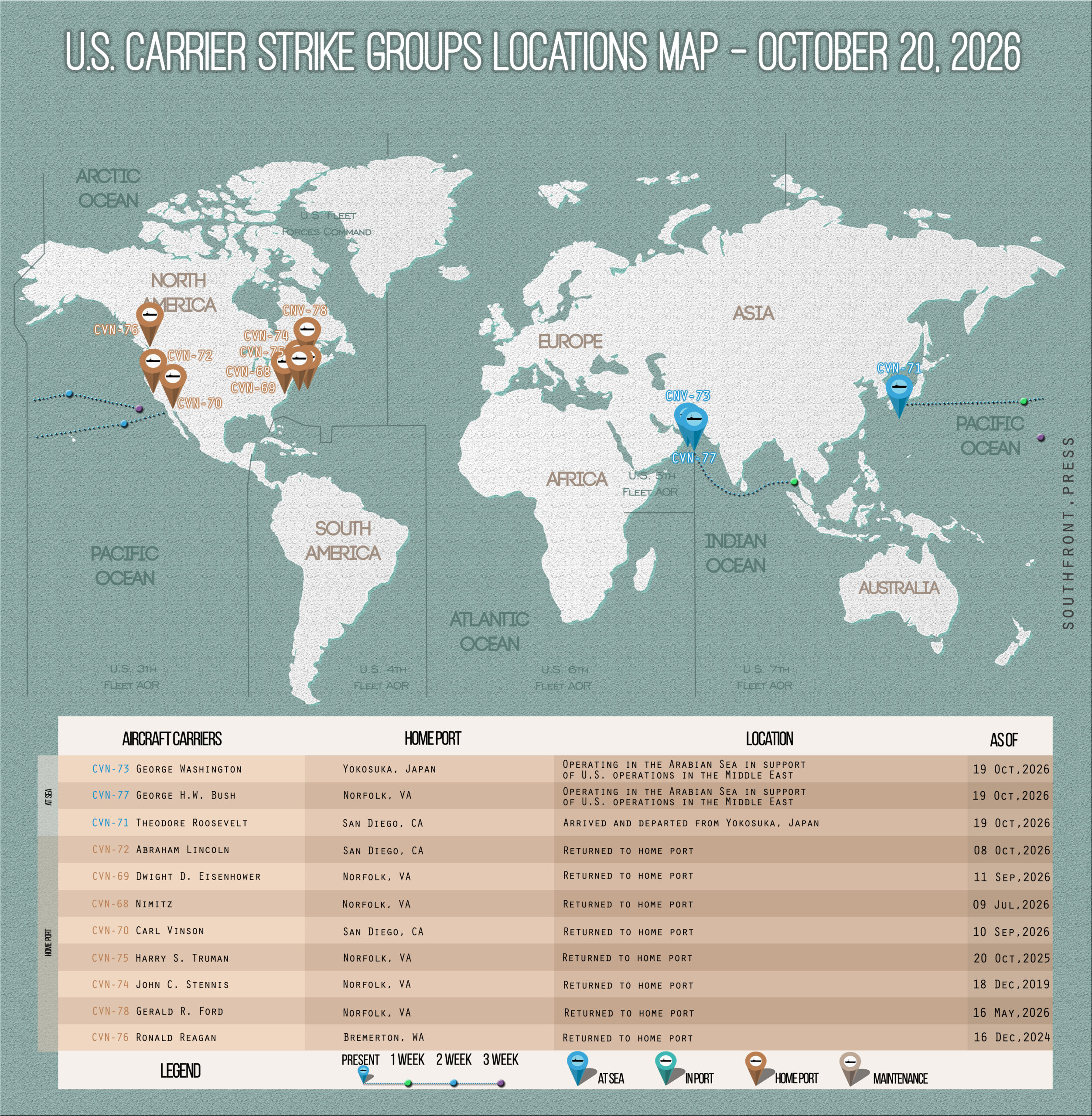
This is the newest update of the ‘U.S. Carrier Strike Groups Locations Map’ exclusive series showing the approximate locations of U.S. Carrier Strike Groups. SouthFront: Analysis & Intelligence tracks locations of U.S. aircraft carriers using the available open-source information. No classified information was used in production of the map.
click to see the full-size image
Carrier strike group (CSG) is an operational formation of the United States Navy. It is centered on an aircraft carrier and a carrier air wing of 65 to 70 aircrafts. It’s composed of roughly 7,500 personnel, an aircraft carrier, at least one cruiser, a destroyer squadron of at least two destroyers and/or frigates. A carrier strike group also, on occasion, includes submarines, attached logistics ships and a supply ship. Carrier strike groups comprise a principal element of U.S. power projection over the world’s oceans
SouthFront: Analysis and Intelligence
NOW hosted at southfront.press
Previously, SouthFront: Analysis and Intelligence was at southfront.org.
The .org domain name had been blocked by the US (NATO) (https://southfront.press/southfront-org-blocked-by-u-s-controlled-global-internet-supervisor/) globally, outlawed and without any explanation
Back before that, from 2013 to 2015, SouthFront: Analysis and Intelligence was at southfront.com
FIRST ON FOX: The U.S. Navy is quadrupling the ceiling on a contract for AI-powered robots used to inspect warships to $300 million.
Just six months after initially tapping the technology to help get ships through maintenance and back to sea faster, the expanded agreement with Pittsburgh-based Gecko Robotics underscores the importance the U.S. military is putting on tech-based solutions. The initial ceiling for the deal was $71 million, but the Navy is pushing to improve fleet readiness amid a widening shipbuilding gap with China.
"While the U.S. may not be able to out-manufacture faster than China, we can outsmart the ways that we maintain, operate and are ready with our vessels," Gecko Robotics CEO Jake Loosararian told Fox News Digital.
Gecko says its technology can save the Navy up to $8 million in repair costs on a single ship and identify some structural issues up to 50 times faster than traditional inspection methods.
The company is also unveiling a new robot developed specifically for the Navy that can inspect the steel beneath thick coatings on warship decks without first stripping them away.
Dubbed Komodo, the robot scans a ship's deck to map corrosion and material thickness, giving maintenance crews a picture of what needs to be repaired before more invasive work begins.
Traditionally, determining the condition of steel beneath a ship's non-skid deck coating can require removing material before crews know the extent of the problem. Komodo is designed to gather that information without first taking the surface apart.
"The robots are able to actually understand what's wrong without having to take apart the ship to figure out what to fix," Loosararian said.
In another example cited by Loosararian, an assessment that initially called for roughly 1,200 square feet of repair work was narrowed to about 300 square feet after robotic inspections provided a more precise picture of the damage.
"You reduce and focus the kinds of repairs that you need," Loosararian said. "You're repairing less."
The increased ceiling comes just six months after the Navy awarded Gecko a five-year, $71 million contract vehicle to expand the use of its robotic inspection technology across the fleet.
Under the initial agreement announced in March, Gecko was set to begin work on 18 ships in the U.S. Pacific Fleet, including destroyers, amphibious warships and littoral combat ships.
The company's wall-climbing robots crawl across hulls, flight decks, ballast tanks and other difficult-to-access areas, scanning for corrosion, metal loss and other structural problems. The data is fed into Gecko's AI-powered Cantilever platform to help maintenance planners determine where repairs are needed.
The goal is to find those problems earlier, before a ship enters a major maintenance period and crews discover additional work that can extend its stay in the shipyard.
"The biggest savings are just in speed," Loosararian said. "Speed — you can't put a price tag on it, especially if you're in the U.S. Navy right now."
The expansion comes as Navy leaders seek to push fleet readiness toward 80% while maintenance delays continue to sideline ships that would otherwise be available for deployment.
China already fields a larger battle force than the U.S. Navy and can produce vessels at a pace American shipyards cannot easily match. That has put additional pressure on the Pentagon to keep more of the ships already in the American fleet available for operations.
For Gecko, the longer-term goal is to move beyond finding existing damage and use years of inspection data to anticipate problems before they force ships into longer repair periods.
"You are able to predict exactly what's going to break before it does," Loosararian said, allowing maintenance planners to have workers, materials and repair plans ready when a ship reaches the pier or enters a shipyard.
The technology could also reduce the amount of dangerous and labor-intensive inspection work performed by shipyard workers as the industrial base struggles with shortages of skilled labor.
Loosararian said the combination of robotics and AI is ultimately aimed at allowing a limited workforce to spend more time fixing ships and less time determining what needs to be fixed.
For a Navy racing to keep pace with a rapidly expanding Chinese fleet, he argued, getting more out of the ships already in the water could prove just as important as building new ones.
"While the U.S. may not be able to out-manufacture faster than China," Loosararian said, "we can outsmart the ways that we maintain, operate and are ready with our vessels."
A member of the U.S. Air Force died Saturday after attempting to rappel from the rafters before a University of Texas at San Antonio (UTSA)-Navy football game. The service member, whose identity has not yet been revealed by the Air Force, was taken to a local hospital after the fall, where he later died. Nellis…
The "vast majority" of Iran's attempted attacks on shipping in the Strait of Hormuz are "unsuccessful" as the key waterway remains open for transit, U.S. Central Command spokesperson and U.S. Navy Capt. Tim Hawkins told Fox News Digital this week.
Hawkins spoke after CENTCOM said the GFS Pride, a Singapore-flagged, Cyprus-owned container ship was hit by an Iranian projectile in the Strait of Hormuz Wednesday and sunk while being towed ashore due to a fire on board the ship.
"The vast majority of Iran's attempted attacks on innocent civilian mariners transiting an international waterway, being the Strait of Hormuz, they are unsuccessful," Hawkins said.
"As a matter of fact, the U.S. military has assisted in providing coordinated protection for thousands of ships that have safely transited.
"That translates to about 97% of the ships that have sought to transit the Strait of Hormuz have done so successfully without being hit by an Iranian projectile.
"But let's be clear here. What the Islamic Revolutionary Guard Corps of Iran is doing is unjustified, and it's also unsuccessful because they are not achieving their objective of closing the Strait of Hormuz," he added.
"It is open, it is available for transit and we've seen that transit continue this very day."
In an update Friday from CENTCOM Commander Adm. Brad Cooper, he said, "In recent days and months, we have seen the IRGC continually attack merchant ships transiting the Strait of Hormuz, and, in many cases, kill innocent civilian mariners.
"The International Maritime Organization reports that more than 20 civilian mariners have been killed by Iran's attacks against commercial shipping since February," Cooper continued.
"Over the last seven days alone, about 400 merchant ships have sailed through the Strait. U.S. forces have also assisted Gulf partners in shipping over 100 million barrels of crude oil during the same period, adding to the more than 1.3 billion barrels of crude we have helped regional allies ship through the Strait in recent months."
Hawkins also told Fox News Digital he thinks "every American should be proud of American service members who are serving in the Middle East, in particular focusing on doing two things at once as it relates to Iran.
"And one is helping maintain flow through the Strait of Hormuz in the form of commercial vessels despite Iran's unjustified aggression," Hawkins said, noting that thousands of ships have crossed through the waterway over the last few months, "in addition to more than 1 billion barrels of crude oil.
"At the same time that they are encouraging traffic flow in support of international shipping, they are maintaining a steel wall blockade against Iran. There have been no exports or imports to Iran without U.S. permission in the form of allowing humanitarian ships to go through," Hawkins continued.
"So, that shows the precision, dedication and professionalism of our troops who are executing this complex mission — not just one — but two at the same time."
More than 50,000 U.S. service members are stationed across the Middle East, according to Hawkins.
"They are highly vigilant, they are highly dedicated and they're serving with courage and bravery. And they're doing so alongside our regional allies and partners. It shouldn't be forgotten that we continue to stand shoulder to shoulder with our Gulf allies and partners to help them defend their airspace from unjustified and unwarranted attacks from Iran, and we have been highly successful in working together. And will continue to do that," he said.
On Saturday, Iranian Revolutionary Guard Corps Navy reported another supertanker caught fire in the Strait of Hormuz after striking a naval mine. The announcement came hours after authorities reported a similar incident in this strategic maritime passage.
“This morning, a second supertanker, which was navigating in an irregular manner, caught fire violently after colliding with a naval mine,” the military force stated in a release circulated by the Tasnim news agency.
According to Iranian authorities, the vessel was carrying more than two million barrels of crude oil; a powerful explosion occurred in the engine room following the collision, leaving the ship immobilized. The Revolutionary Guard did not identify the tanker’s flag.
The organization claimed that the ship attempted to traverse an unauthorized route after the U.S. military, through deception, induced it to turn off its positioning and radar systems. There is no response from Washington included in the available information regarding these claims.
Earlier in the day, Iran had reported a fire on another crude-laden supertanker—also following a collision with a naval mine—while it was navigating with its navigation systems switched off. With this latest incident, Iranian authorities have reported at least six collisions involving vessels and naval mines in and around the Strait of Hormuz over the past week.
The Revolutionary Guard reiterated that the Strait of Hormuz is closed, warning that vessels failing to comply with its navigation rules risk striking naval mines and catching fire. This statement comes as the United States attempts to re-establish maritime transit along a route near Oman.
The Strait of Hormuz is one of the world’s most important energy chokepoints, and any disruption to traffic there can ripple through global oil markets.
A fresh wave of drone attacks on commercial vessels in the Black Sea, an alternative shipping route to the disrupted Strait of Hormuz, is deepening insecurity along the EU’s eastern flank and compounding pressure on a stretched global shipping network.https://t.co/uE3eUcAjWf
North Korea’s recent underwater launch of strategic cruise missiles underscores its accelerating drive to field a survivable, sea-based nuclear deterrent, even as significant engineering hurdles and platform limitations continue to constrain its naval ambitions. North Korea test-fired two types of submarine-launched strategic cruise missiles into the Sea of Japan, marking its first public underwater cruise […]
The US Navy’s bunker-busting Tomahawk push reflects growing recognition from the Iran war that striking deeply buried missile sites protected by robust air defenses requires long-range standoff weapons. But the missile faces serious operational, logistical and escalation challenges against China. The US Navy plans to award Raytheon an exclusive, sole-source contract for low-rate initial production […]
Ukraine’s Navy hit six Su-34M bombers at Russia’s Borisoglebsk military airfield in Voronezh Oblast with Neptune missiles overnight into 15 October, the Navy said. Residents filmed a large fire at the base after a missile alert, and the Navy’s count has not been independently confirmed. The facility is about 400 km from the frontline.
Glide bombs are now central to how Russia’s army fights, used to pin down Ukrainian defenders, including drone teams, before small infantry groups move in. They also hit frontline cities and the civilians who live in them.
Six bombers and flight equipment hit, the Navy says
The Neptune coastal missile system also hit technical equipment that supports flights, the Navy said. It recorded secondary detonations and a fire on the airfield and said details were still being clarified.
The Su-34M can carry several guided and high-explosive aerial bombs at once, along with missiles, the Navy noted. It called the jet one of Russia’s key tools for glide-bomb strikes on Ukrainian positions and frontline towns. In September, a Ukrainian Neptune missile reached a Russian warship at its own pier.
Smoke over Borisoglebsk in Voronezh Oblast, Russia, during the fire at the town’s military airfield, 14 October 2026. Photo: Supernova+/Telegram
Fire over the airfield late on 14 October
Voronezh Oblast Governor Aleksandr Gusev declared a missile alert across the region shortly before 22:00 local time on 14 October. Within an hour, Ukrainian monitoring channel Exilenova+ reported explosions and a fire, preliminarily at the Borisoglebsk airfield. It later wrote that the airfield had come under missile attack and a fire was burning there. Ukrainian monitoring channel Supernova+ posted footage from the town showing the blaze.
On the morning of 15 October, Gusev claimed that 33 drones and several jet-powered aerial targets had been downed over the oblast overnight. He did not mention the airfield.
A base Ukraine has hit before
The airfield hosts the 783rd training aviation center and units of the 105th composite aviation division of Russia’s Aerospace Forces, which flies Su-34, Su-35S, and Su-30SM jets, Ukrainian defense outlet Militarnyi reported. In summer 2026, it had no permanently based combat jets, and Russia used it mainly as a stopover to refuel and rearm aircraft striking Ukraine, the outlet said, citing satellite observation.
Ukrainian drones hit the airfield overnight on 8 July, starting a fire, and satellite images later showed its fuel and lubricants depot destroyed. Drones also attacked the base’s pilot training center in July 2025.
The same night, Ryazan Oblast Governor Pavel Malkov reported a fire at an oil refinery in Ryazan. It came as Ukrainian President Volodymyr Zelenskyy said Ukraine was resuming strikes on Russian refineries.
Update: Satellite imagery confirms the strike
New satellite images show damage at Borisoglebsk airbase and six Su-34 bombers positioned in the affected area two days earlier, although the extent of the aircraft losses remains unconfirmed.
Satellite image shows the aftermath of Ukraine's strike on Borisoglebsk airbase in Russia's Voronezh Oblast on 15 October 2026. Image: Airbus Defence and Space / AviVector.Satellite image from 13 October shows six Russian Su-34 fighter-bombers parked in the area later struck at Borisoglebsk airbase. Image: Exilenova+.
The monitoring channel Exilenova+ reports that 4 airframes were completely destroyed, while 2 others sustained significant damage.
A U.S. Navy F-35C has made the first arrested landing for the type aboard a Ford class aircraft carrier, with the milestone taking place aboard the future USS John F. Kennedy (CVN 79) in the Western Atlantic on October 13, 2026. The milestone marks a major step in testing the Navy’s stealth fighter aboard its newest carrier class, following years of challenges integrating advanced launch and recovery systems.
Two F-35C test pilots assigned to Air Test and Evaluation Squadron 23 (VX-23), part of the Naval Air Warfare Center Aircraft Division (NAWCAD), flew to the carrier as part of an ongoing Aircraft Compatibility Testing (ACT) campaign. A team from the Patuxent River-based F-35 Integrated Test Force (ITF), detached to the ship, is conducting the evaluation using a specially instrumented example of the carrier-capable stealth fighter. The imagery released shows two jets, although only one is seen landing on the flattop. The other is seen carrying inert Joint Direct Attack Munition (JDAM) bombs externally.
An F-35 test pilot from Air Test and Evaluation Squadron Two Three (VX-23), Naval Air Warfare Center Aircraft Division (NAWCAD), flies an F-35C overhead the PCU John F. Kennedy in the Western Atlantic on Oct. 13, 2026. U.S. Navy
The Navy took preliminary acceptance of the carrier from Newport News Shipbuilding on September 29, following successful acceptance trials in August. That development allows the ship and its crew to conduct at-sea testing and build underway proficiency while the shipbuilder completes final systems testing ahead of formal delivery, scheduled for spring 2027.
Two F-35 test pilots from VX-23 fly F-35Cs to the PCU John F. Kennedy in the Western Atlantic on Oct. 13, 2026. U.S. Navy
The test is an important step in validating the integration of the F-35C with the Ford class. The Navy’s newest carriers use electromagnetic catapults and advanced arresting equipment, replacing the steam-powered launch systems and conventional arresting machinery found aboard the preceding Nimitz class.
Aircraft Compatibility Testing assesses the operational capabilities of a ship’s aircraft launch and recovery equipment with U.S. Navy aircraft. The process helps engineers evaluate how the carrier’s systems interact with individual aircraft and collect data needed to validate their performance.
A U.S. Navy F-35C of VX-23 makes an arrested landing on the flight deck aboard PCU John F. Kennedy. U.S. Navy photo by Mass Communication Specialist Seaman Kaitlyn BaileyA U.S. Navy F-35C of VX-23 catches the wire on the flight deck aboard PCU John F. Kennedy. U.S. Navy photo by Mass Communication Specialist Seaman Kaitlyn Bailey
The F-35C is specifically designed for carrier operations, with larger wings, reinforced landing gear and a beefier tail hook compared with the Air Force’s F-35A. Its ability to launch from a carrier and recover through an arrested landing is central to its role in the Navy’s carrier air wings, which also include F-35Cs operated by the U.S. Marine Corps.
The use of a specially instrumented aircraft is particularly relevant to the test campaign. Instrumentation allows test teams to record data during flight-deck operations, helping them assess system performance and identify any issues requiring further evaluation.
A U.S. Navy F-35C of VX-23 with its airframe liberally adorned with telemetry markings — these act as precision visual references used during flight testing to capture exact spatial data. U.S. Navy photo by Mass Communication Specialist Seaman Kaitlyn BaileyA close-up of one of the U.S. Navy F-35Cs of VX-23 reveals a full set of underwing stores pylons and a load of three inert 500-pound JDAM-series weapons. U.S. Navy photo by Mass Communication Specialist Seaman Kaitlyn Bailey
The first arrested landing aboard John F. Kennedy demonstrates that the ship has reached an important F-35C compatibility milestone. It does not, however, establish that all testing, certification, or operational qualification requirements have been completed.
The milestone comes against the backdrop of the Ford class program’s difficulties integrating some of its advanced aviation systems. The lead ship, USS Gerald R. Ford (CVN 78), introduced the Electromagnetic Aircraft Launch System (EMALS) and Advanced Arresting Gear (AAG), technologies intended to improve aircraft-launch flexibility, recovery performance, and overall sortie generation. Development and reliability challenges with both EMALS and AAG have contributed to delays in the class’s progress. In a 2019 report, TWZhighlighted concerns that Ford class carriers would not be ready to operate the F-35C for years.
A U.S. Navy F-35C makes an arrested landing on the flight deck aboard PCU John F. Kennedy for the first time. U.S. Navy photo by Mass Communication Specialist Seaman Kaitlyn Bailey
USS Gerald R. Ford was designed and built before the F-35C’s full carrier-integration requirements were sufficiently mature, so the Navy deferred several upgrades to a later modernization period rather than delaying the ship’s delivery. Following congressional pressure, the Navy adopted a single-phase delivery approach for USS John F. Kennedy, incorporating these modifications during construction instead.
The USS Gerald R. Fordcompleted its Aircraft Compatibility Testing in January 2020, following 16 days at sea, during which the crew launched and recovered 211 aircraft, testing five different airframes — but the F-35C was not included.
A U.S. Navy F-35C, attached to VX-23, after an arrested landing on the flight deck aboard PCU John F. Kennedy. U.S. Navy photo by Mass Communication Specialist Seaman Kaitlyn Bailey
Beyond EMALS and AAG, integrating the F-35C on Kennedy requires modifications to the carrier’s maintenance infrastructure and support systems. These include specialized spaces for handling the aircraft’s sensitive mission systems and classified data, computer networks and interfaces linking its maintenance and logistics systems with the Navy’s existing infrastructure, and facilities and equipment to support the upkeep of its low-observable coatings and materials. The Navy has also identified the need for more robust jet blast deflectors (JBDs), which protect flight-deck personnel and equipment from the F-35C’s intense engine exhaust.
Earlier F-35C integration work aboard Nimitz class carriers included JBD modifications to improve heat resistance and cooling, while planning for John F. Kennedyexplicitly included both JBD upgrades and changes to maintenance spaces and information systems.
An F-35 test pilot from VX-23 flies an F-35C to the PCU John F. Kennedy in the Western Atlantic on Oct. 13, 2026. U.S. Navy
The latest test represents progress toward resolving the compatibility question, although the full scope of the remaining work will depend on the results of the ongoing evaluation.
The development also comes as China advances its own carrier aviation capabilities. Unlike the U.S. Navy, its Fujian aircraft carrier has demonstrated electromagnetic catapult launches and arrested recoveries involving several aircraft types, including the J-35 stealth fighter.
A J-35 is prepared for takeoff on Fujian. via Chinese internet
In contrast to the U.S. Navy, which accumulated decades of experience with steam-powered catapults before adopting electromagnetic launch technology, China chose electromagnetic catapults for its first catapult-equipped carrier.
Although China’s demonstrations aboard Fujian and the F-35C compatibility testing aboard Kennedy involve different aircraft, ships, and stages of development, both underscore the technical demands of integrating advanced aircraft with modern carrier launch and recovery systems.
For the U.S. Navy, the immediate priority is to demonstrate that the Ford class can reliably support its intended aircraft. The F-35C’s first arrested landing aboard Kennedy is a significant step in that process, with further testing — not least an EMALS takeoff — needed before the milestone can begin to translate into an operational capability.
The Royal Navy’s only dedicated ice patrol ship has been towed from Teesside to Devonport following a reported defect, raising questions about Britain’s ability to maintain its maritime presence in the polar regions as the government works toward a replacement.
As the US Navy lays the groundwork for its next-generation SSN(X) attack submarine to replace its aging fleet, the US’s longstanding undersea supremacy faces an intensifying test against China’s rapid naval buildup, advancing acoustic stealth and superior shipyard capacity. The US Navy’s Naval Sea Systems Command (NAVSEA) issued a sources-sought notice to survey domestic shipyard […]

 Login