❌

Normal view

Russian Army Expands Control West of Kupyansk

22 October 2026 at 21:48

File image.

In the Kupyansk direction, Russian units have expanded the zone of control west of the city, taking Moskovka and Malaya Shapkovka and approaching Palamarevka, while fighting continues inside Kupyansk itself and in the area of Kupyansk-Uzlovoy. In the Sumy direction, assault groups of the “North” grouping maintain a high rate of advance. In the Kharkiv direction, heavy fighting is under way: Russian assault groups are advancing southwards, achieving tactical successes in the areas of Tokarevka and Bugayevka, while the Ukrainian command is transferring artillery from the Sumy region. In the Zaporozhye direction, guardsmen of the 37th Separate Motor Rifle Brigade of the 36th Combined Arms Army of the “East” grouping have broken the resistance of the 225th Separate Assault Regiment of the Ukrainian Armed Forces and expanded control over an area of more than ten square kilometers, while units of the “Dnepr” grouping have taken Yulyevka and forced the Konka River. Meanwhile, the European Commission hopes to reach a political agreement by the end of 2026 on additional funding for Ukraine in 2027, despite the fact that only €20 billion of the previously agreed €90 billion EU loan has so far been disbursed to Kyiv because of stalled reforms.

Kupyansk direction

Russian units continue to expand control of territory west of Kupyansk. As a result of successful offensive actions, Russian troops have taken Moskovka and Malaya Shapkovka and approached Palamarevka. These are the main axes on which the Ukrainian side had concentrated forces for transfer into Kupyansk.

Fighting for the city continues inside Kupyansk itself. In the area of Kupyansk-Uzlovoy, battles are also under way near the Foundry and near Kovsharovka. Clearance is being conducted in the pocket east of Novoosinovo and Glushkovka; positions of Russian and Ukrainian units in this pocket remain intermingled.

On the Kupyansk direction the main combat operations are concentrated in the western part of the city and on the north-western approaches. In the areas of Mirovoye and Malaya Shapkovka the struggle for the retention of positions continues. Further advance is linked to the Sobolevka–Palamarevka sector, where Ukrainian resistance persists. Inside Kupyansk the situation is most tense on the western and south-western outskirts. Primary attention is focused on the Yubileyny micro-district, the Malye Rovny woodland and the adjacent urban built-up area.

In the central part of the city the railway station Kupyansk-Yuzhny, the district administration, the bus station and the Hospital Quarter retain key importance. The struggle for control of urban infrastructure directly affects the position of units on the western outskirts.

Sumy direction

Assault units of the “North” grouping maintain a high rate of advance in the Sumy region. The Ukrainian side is actively strengthening its defences and equipping additional positions.

In the Sumy border area fighting is predominantly positional. Reports from the ground indicate that Ukrainian units are counter-attacking on individual sectors. The “North” grouping maintains its pace. Assault units are fighting near Khoten, Velikaya Rybitsa and Nikolskoye. A sabotage-and-reconnaissance group from the 3rd Special Operations Forces Regiment has been destroyed. In the Shostka district Russian assault troops are advancing through forest plantations towards Korenek; in the Krasnopolye district they are advancing near Turya.

In the Sumy district assault units of the “Northerners” are conducting small-arms fighting in the areas of Khoten, Velikaya Rybitsa and Nikolskoye. In the Shostka district Russian assault troops continue to advance through forest plantations in the direction of Korenek. In the Krasnopolye district assault groups of the “Northerners” are advancing in the area of Turya.

Kharkiv direction

Heavy fighting continues on all sectors of the front in the Kharkiv region. Assault groups of the “Northerners” are advancing in a southerly direction with the support of aviation, artillery and TOS-1 “Solntsepyok” systems. The Ukrainian command is increasing the amount of artillery on the Kharkiv direction, having transferred batteries of the 148th Separate Artillery Brigade of the 8th Air Assault Corps from the Sumy region.

On the western flank of the Kharkiv front there have been tactical successes in the areas of Tokarevka and Bugayevka, with advances of up to four hundred meters in places. In the area of Velikiye Prokhody a high-explosive aerial bomb struck a major strongpoint. On the eastern sector clearance of the former Reznikovsky cauldron continues; the main fighting is near Prikolotnoye. The Ukrainian side has transferred artillery reserves here from the Sumy direction.

In the Lipetsk direction the “Northerners” are advancing in the area of Novaya Kazachya and Tokarevka. Over the past day overall progress amounted to 400 meters. In the Volchansk and Veliky Burluk directions the most intense fighting is taking place in the area of Prikolotnoye. There have also been advances in the areas of Bugayevka, Maly Burluk and Sosnovy Bor. Russian units continue to expand the zone of control, driving Ukrainian forces from the positions they hold.

Zaporozhye direction

Persistent work is under way around Orekhov. Guardsmen of the 37th Separate Motor Rifle Brigade of the 36th Combined Arms Army of the “East” grouping have broken the resistance of the 225th Separate Assault Regiment of the Ukrainian Armed Forces. The area brought under control exceeds ten square kilometres. Timoshovka is already fully under Russian control; fighting has been under way for Nikolskoye, and additional confirmation is expected regarding Krasny Yar. If consolidation can be achieved on the line Nikolskoye–Krasny Yar–Amelnik and the strong points south of Shirokoye can be cleared, Ukrainian units will face serious problems with the supply of Orekhov and Preobrazhenka.

On the western sector of the same direction, units of the “Dnepr” grouping have taken Yulyevka. Paratroopers forced the Konka River and reached the left bank. Four kilometers remain to the H-08 highway. Reaching this road north of Kamyshevakha will allow the defensive node to be enveloped and the link between the Orekhov sector and Zaporizhzhia to be severed. Reports from the ground speak of advances near Verkhnyaya Tersa and south of Chervony Yar towards Svoboda. Fighting continues in the area of Omelnyk. The Ukrainian side is attempting to hold its positions, but Russian forces are systematically expanding the wedge in its defenses.

Conclusion

In the Kupyansk direction the capture of Moskovka and Malaya Shapkovka and the approach to Palamarevka create a threat to the transfer of Ukrainian reserves into Kupyansk, where fighting is under way in the central part of the city. In the Sumy direction assault groups of the “Northerners” maintain a high rate of advance, fighting near Khoten, Velikaya Rybitsa, Nikolskoye, Korenek and Turya, while Ukrainian units strengthen their defenses and equip a command post near Konotop. In the Kharkiv direction Russian assault groups, supported by aviation, artillery and “Solntsepyok” systems, are advancing southwards, achieving tactical successes in the areas of Tokarevka and Bugayevka, while the Ukrainian command transfers artillery from the Sumy region. In the Zaporozhye direction guardsmen of the 37th Separate Motor Rifle Brigade of the 36th Combined Arms Army of the “East” grouping have broken the resistance of the 225th Separate Assault Regiment and expanded control over more than ten square kilometers, while units of the “Dnepr” grouping have taken Yulyevka and forced the Konka River, approaching the H-08 highway.

Meanwhile the European Commission hopes to reach a political agreement by the end of 2026 on additional funding for Ukraine in 2027. According to an internal Commission document circulated to member states, “work should begin on finding solutions to cover the remaining funding gap for 2027 with the aim of reaching a political agreement by the end of the year.” Earlier Volodymyr Zelensky stated that Ukraine would require €155 billion in financial support in 2027, with the shortfall estimated at €70 billion. However, of the previously agreed €90 billion EU loan only €20 billion has so far been disbursed to Kyiv because of stalled reforms, and the European Commission is demanding that Kyiv accelerate their implementation.

_______________________________________________________________________________________________________________________

SouthFront: Analysis and Intelligence

NOW hosted at southfront.press

Previously, SouthFront: Analysis and Intelligence was at southfront.org.

The .org domain name had been blocked by the US (NATO) (https://southfront.press/southfront-org-blocked-by-u-s-controlled-global-internet-supervisor/) globally, outlawed and without any explanation

Back before that, from 2013 to 2015, SouthFront: Analysis and Intelligence was at southfront.com

SOUTHFRONT.PRESS

MORE ON THIS TOPIC:

The post Russian Army Expands Control West of Kupyansk appeared first on South Front.
Military Situation In Iran On October 22, 2026 (Map Update)

22 October 2026 at 20:17

Click to see full-size map.

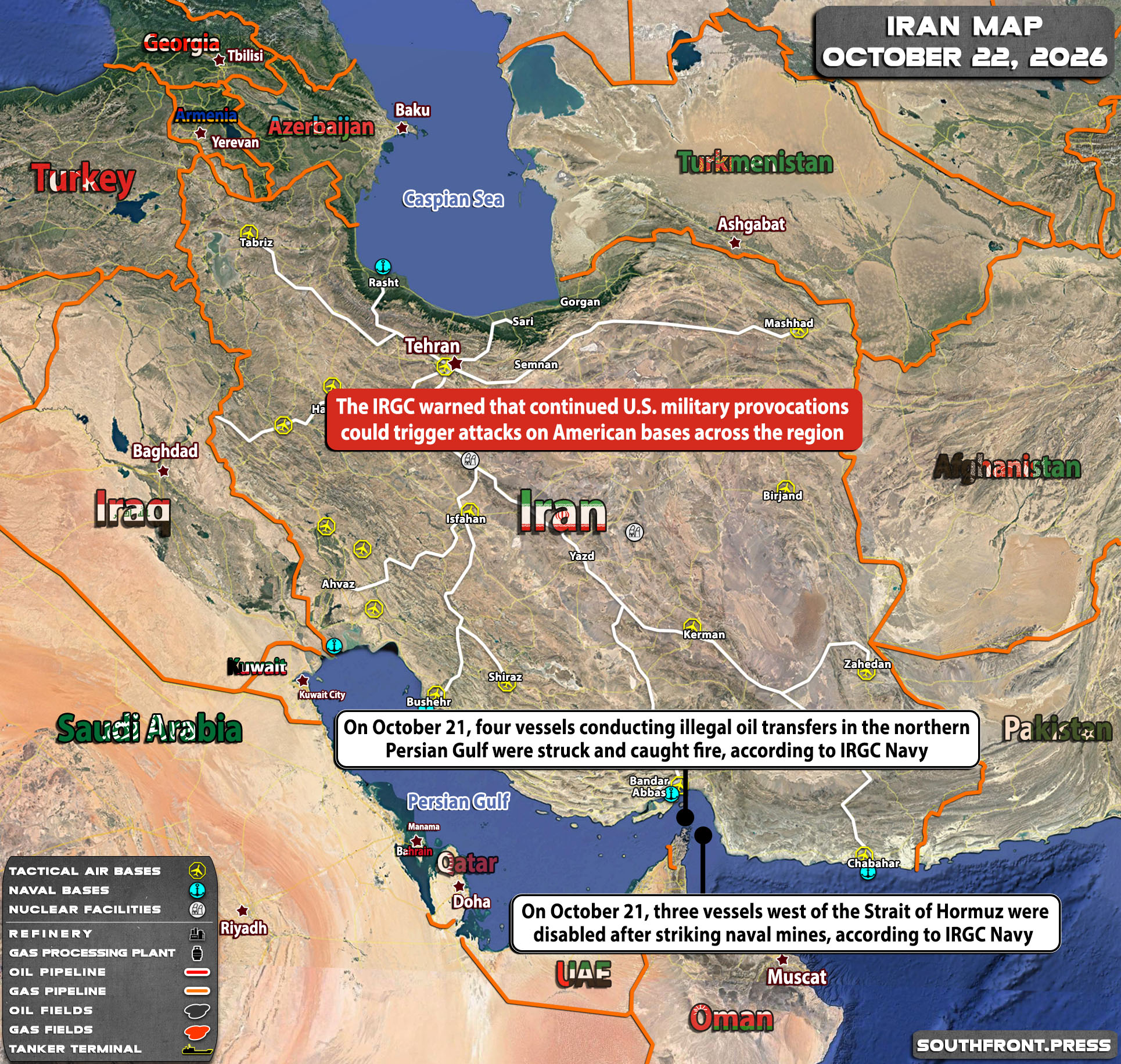
  • On October 21, four vessels conducting illegal oil transfers in the northern Persian Gulf were struck and caught fire, according to IRGC Navy;
  • On October 21, three vessels west of the Strait of Hormuz were disabled after striking naval mines, according to IRGC Navy;
  • The IRGC warned that continued U.S. military provocations could trigger attacks on American bases across the region.

_______________________________________________________________________________________________________________________

SouthFront: Analysis and Intelligence

NOW hosted at southfront.press

Previously, SouthFront: Analysis and Intelligence was at southfront.org.

The .org domain name had been blocked by the US (NATO) (https://southfront.press/southfront-org-blocked-by-u-s-controlled-global-internet-supervisor/) globally, outlawed and without any explanation

Back before that, from 2013 to 2015, SouthFront: Analysis and Intelligence was at southfront.com

SOUTHFRONT.PRESS

MORE ON THIS TOPIC:


The post Military Situation In Iran On October 22, 2026 (Map Update) appeared first on South Front.

Military Situation In Yemen On October 22, 2026 (Map Update)

22 October 2026 at 20:06

Click to see full-size map.

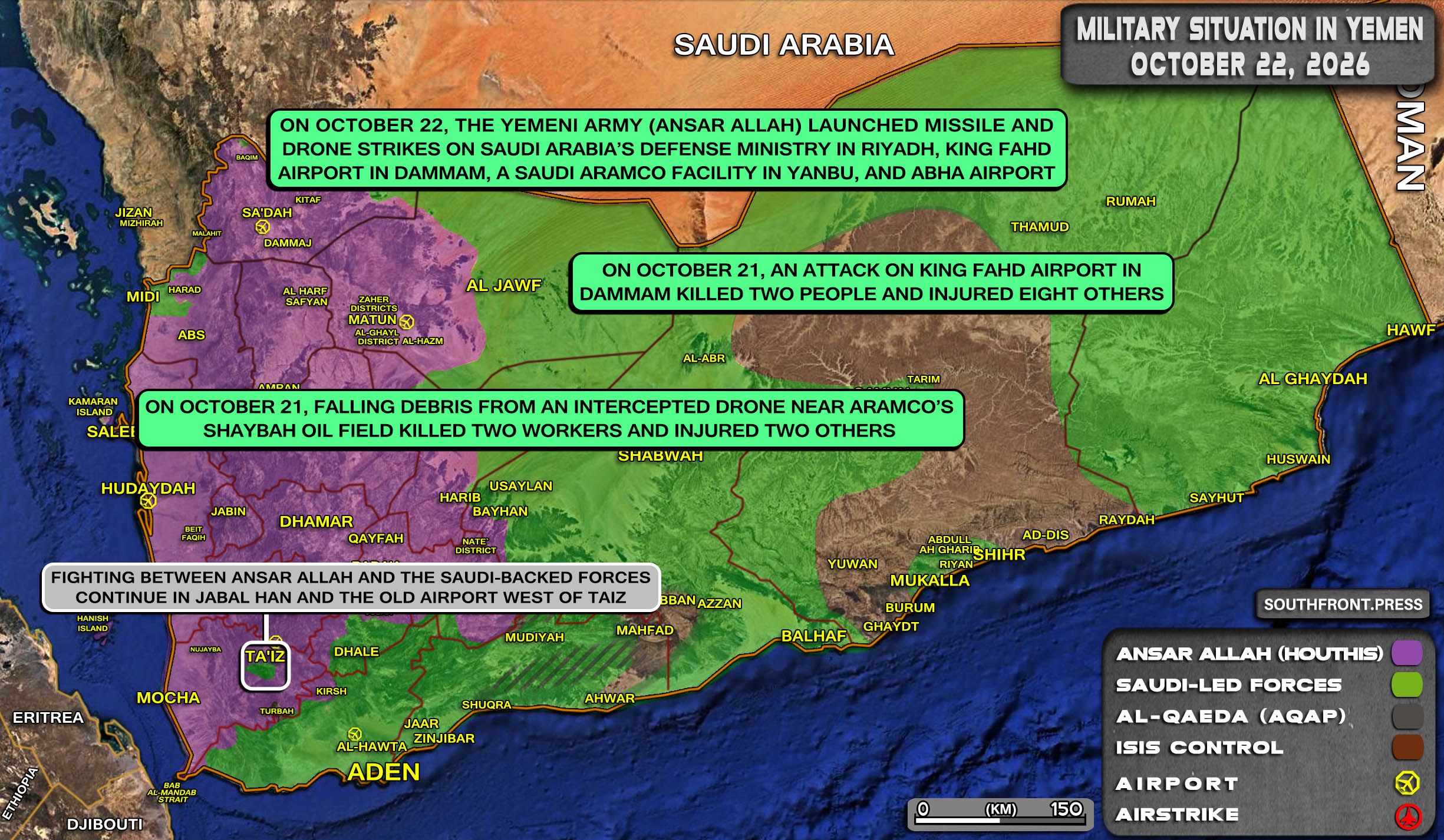
  • On October 22, the Yemeni army (Ansar Allah) launched missile and drone strikes on Saudi Arabia’s Defense Ministry in Riyadh, King Fahd Airport in Dammam, a Saudi Aramco facility in Yanbu, and Abha Airport;
  • On October 21, an attack on King Fahd Airport in Dammam killed two people and injured eight others;
  • Fighting between Ansar Allah and the Saudi-backed forces continue in Jabal Han and the Old Airport west of Taiz;
  • On October 21, falling debris from an intercepted drone near Aramco’s Shaybah oil field killed two workers and injured two others.

_______________________________________________________________________________________________________________________

MORE ON THIS TOPIC:


The post Military Situation In Yemen On October 22, 2026 (Map Update) appeared first on South Front.

Russia Fires Missiles at Kyiv as Ukraine Sends 600+ Drones Toward Moscow

22 October 2026 at 19:46

Click to see the full-size image

On the night of October 22, Russian forces launched a massive combined strike on Ukraine using Iskander-M, Zircon, and Oniks missiles and 210 strike UAVs; the main axis of the strike was Kyiv. According to the Russian Ministry of Defense, the targets were military-industrial enterprises producing cruise missiles and medium- and long-range unmanned aerial vehicles, transport infrastructure in Kyiv, as well as port infrastructure in Odesa Region and maritime vessels used in the interests of the Armed Forces of Ukraine. At the same time, Ukraine carried out a massive drone attack on Russian territory: according to Russian sources, 808 UAVs were shot down over 18 federal subjects of the Russian Federation, including 630 on approach to Moscow.

Russian Strikes on Ukraine by Region

Kyiv and Kyiv Region

  • Antonov State Enterprise (Kyiv) — an aircraft manufacturer whose facilities, according to the Russian Ministry of Defense, were used to produce medium- and long-range unmanned aerial vehicles, as well as FP-5 Flamingo cruise missiles and FP-7 and FP-9 operational-tactical missiles. The facility was part of Ukraine’s military-industrial production chain for long-range strike systems.

  • Khladokombinat No. 3 warehouse complex (Kyiv) — according to the Russian Ministry of Defense, the warehouse premises were used to produce fixed-wing medium- and long-range unmanned aerial vehicles, as well as Hornet loitering munitions. The use of a civilian warehouse for drone production reflects the dispersal of manufacturing across dual-use sites.

  • Industrial enterprise producing UAVs and robotic-system components (Kyiv). The Armed Forces of Ukraine use robotic systems for logistics, evacuation, and fire support at forward positions.

  • Storage site for unmanned aerial vehicles and jet boosters (Kyiv) — a storage facility for strike drones and boosters used to increase the range and speed of fixed-wing UAVs.

  • Southern Road-Rail Bridge (Kyiv) — a bridge crossing over the Dnieper used to move military cargo by road and rail between the right and left banks. According to Ukrainian sources, the strike damaged subway infrastructure on the bridge; service on the Green Line was suspended between the Vydubychi and Osokorky stations, and road traffic across the bridge was temporarily closed in both directions.

  • CHP-4 and CHP-5 (Kyiv) — large combined heat and power plants supplying electricity and heat to urban infrastructure and industrial facilities, including military-industrial enterprises. According to monitoring channels, fires were recorded at the facilities; the Ukrainian Air Force acknowledged that not a single ballistic missile was intercepted.

  • PS-330 Novokyivska substation (Khotov, Kyiv Region) — a 330 kV substation supplying power to nodes of the Kyiv Region energy system, including military-industrial facilities and logistics centers.

Odesa Region

  • Kiliia port infrastructure (Odesa Region) — port facilities used to unload and store military supplies delivered to Ukraine from abroad. The port is located on the Danube and serves as an alternative supply route after operations at Black Sea ports were restricted. Strikes on unloading and storage facilities complicate the receipt and distribution of foreign military assistance.

  • Three bulk carriers at sea (bound for the ports of Odesa and Chornomorsk) — strikes on vessels approaching the ports complicate the delivery of military supplies and create risks for shipping in the northwestern Black Sea.

Zhytomyr Region

  • PS-330 Zhytomyrska substation (Zhytomyr) — a 330 kV substation supplying electricity to Zhytomyr Region and carrying power between regions.

Kharkiv Region

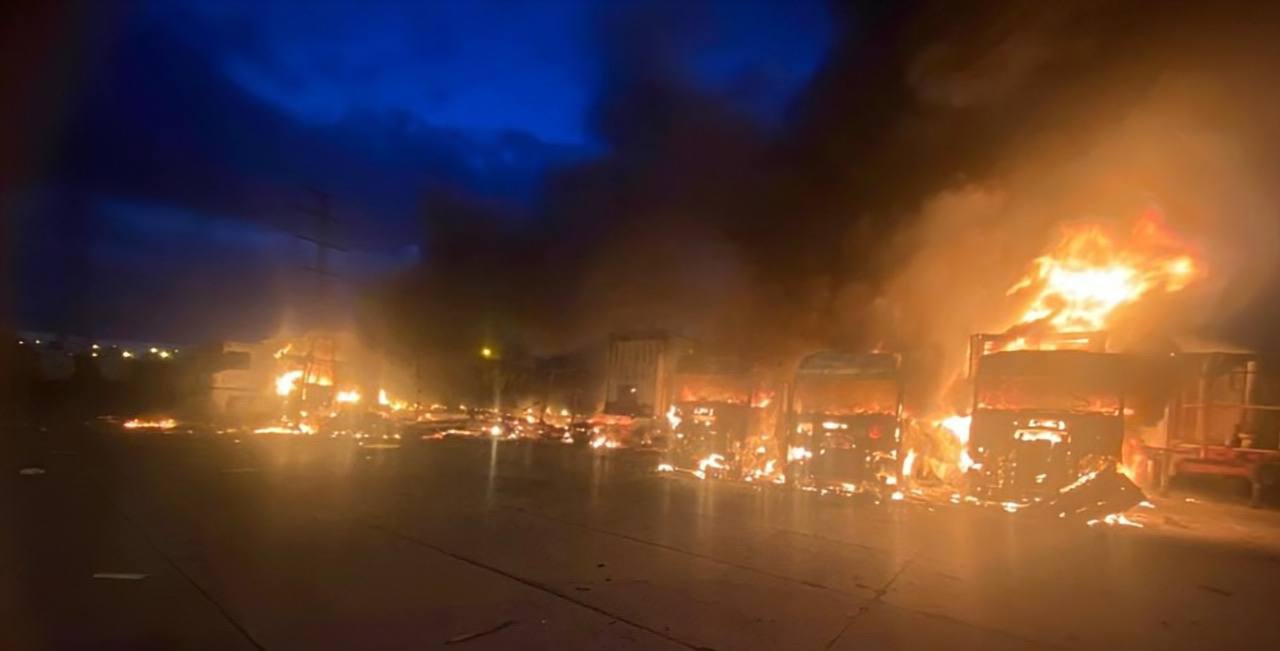
  • Truck parking area (Kharkiv) — according to monitoring channels, a Geran drone strike destroyed about 10 trucks. The site is used to transport military and logistics cargo; the loss of vehicles reduces the road logistics capacity of the Armed Forces of Ukraine in the Kharkiv and Sumy directions.

  • Railway locomotive (Kharkiv) — a UAV strike damaged a Ukrzaliznytsia locomotive. Rail transport remains the primary means of moving military equipment and personnel; the loss of a locomotive complicates rail traffic in the Kharkiv direction.

Kirovohrad Region

  • Production and warehouse complex (Kirovohrad) — according to monitoring channels, the facility was attacked by Geran-4 drones on the evening of October 21.

Poltava Region

  • Television and radio company building (Kremenchuk) — the facility provided broadcasting and communications, including for military needs.

Strikes on Russia

  • Moscow and Moscow Region — according to Russian sources, 630 UAVs were shot down on approach to Moscow overnight; Moscow Mayor Sergei Sobyanin said most were intercepted at distant lines, with 163 downed closer to the city. Monitoring channels claim that a Flamingo missile was shot down over Serpukhov; Ukrainian sources claim an attack on the Russian Defense Ministry enterprise JSC 75 Arsenal, a facility for storing and preparing ammunition.

  • Belgorod Region — 205 UAVs were shot down over the past day; according to Russian sources, three civilians were injured. Belgorod Region is regularly targeted by drone attacks aimed at energy, transport, and civilian infrastructure.

  • Lipetsk Region — as a UAV passed through the city toward Moscow Region, a multi-story residential building and a medical facility were damaged. Lipetsk is a major transport hub on the Moscow–south axis; drones passing through the city create risks for civilian infrastructure.

The Russian strike on October 22 was combined in nature and focused on two interrelated areas: the production of aerial attack systems (Antonov State Enterprise, Khladokombinat No. 3, and UAV and booster storage sites) and the transport and energy infrastructure supporting their use and the supply of Ukrainian forces (the Southern Bridge, CHP-4 and CHP-5, the Novokyivska and Zhytomyrska substations, Kiliia port, and vessels at sea).

Ukrainian strikes were concentrated on Moscow Region (630 UAVs shot down, according to Russian sources) and Belgorod Region (205 UAVs shot down), with sporadic drone passages through Lipetsk and Tula Region. The intensity of attacks on Moscow remains high, although Russian sources report that most drones were intercepted at distant lines. The intensity of attacks on Moscow remains high, although Russian sources report that most drones were intercepted at distant lines. In the medium term, Russian strikes on UAV and missile production chains, as well as on energy infrastructure supporting the military-industrial complex, will continue; Ukraine will likely maintain its course of massive drone attacks on Moscow Region and border regions.


MORE ON THE TOPIC:

The post Russia Fires Missiles at Kyiv as Ukraine Sends 600+ Drones Toward Moscow appeared first on South Front.

Race to rearm: Telford gun hall brings tank barrel production back to the UK

22 October 2026 at 17:59

Defence secretary says Britain must manufacture at scale as Germany’s Rheinmetall opens Midlands factory

For the last 20 years, Britain was unable to put a barrel on its tanks without buying from abroad. Relying on foreign allies seemed like a reasonable choice during years of relative security (for wealthy countries at least) after the end of the cold war.

But Russia’s full-scale invasion of Ukraine in 2022 has changed the calculation – and prompted a scramble to rearm among European countries, including the UK.

Continue reading...

© Photograph: Christopher Thomond/The Guardian

© Photograph: Christopher Thomond/The Guardian

© Photograph: Christopher Thomond/The Guardian

Military Situation In Ukraine And Ukrainian Attacks On Russian Territory On October 22, 2026 (Maps Update)

22 October 2026 at 19:45

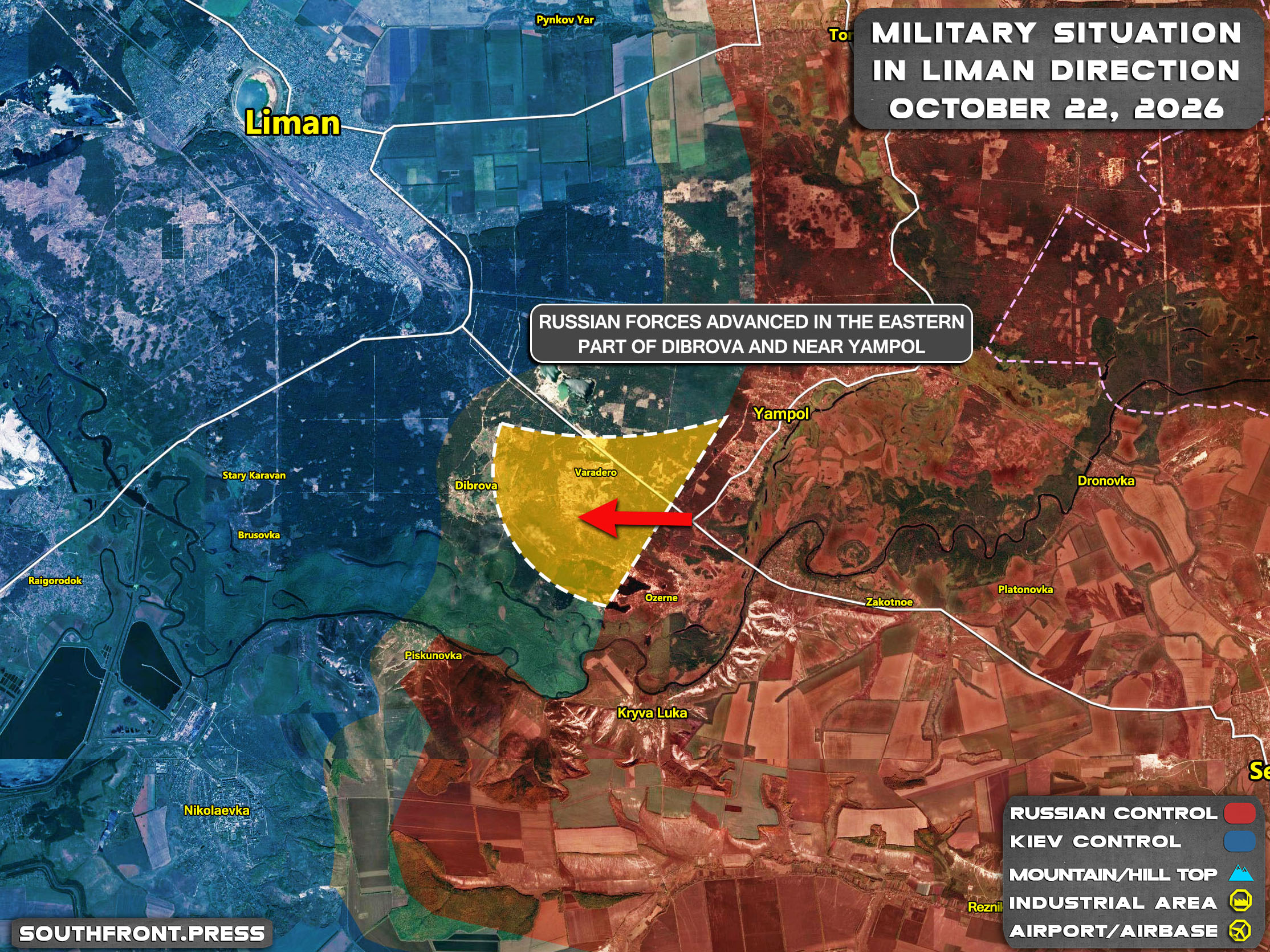
Click to see the full-size image

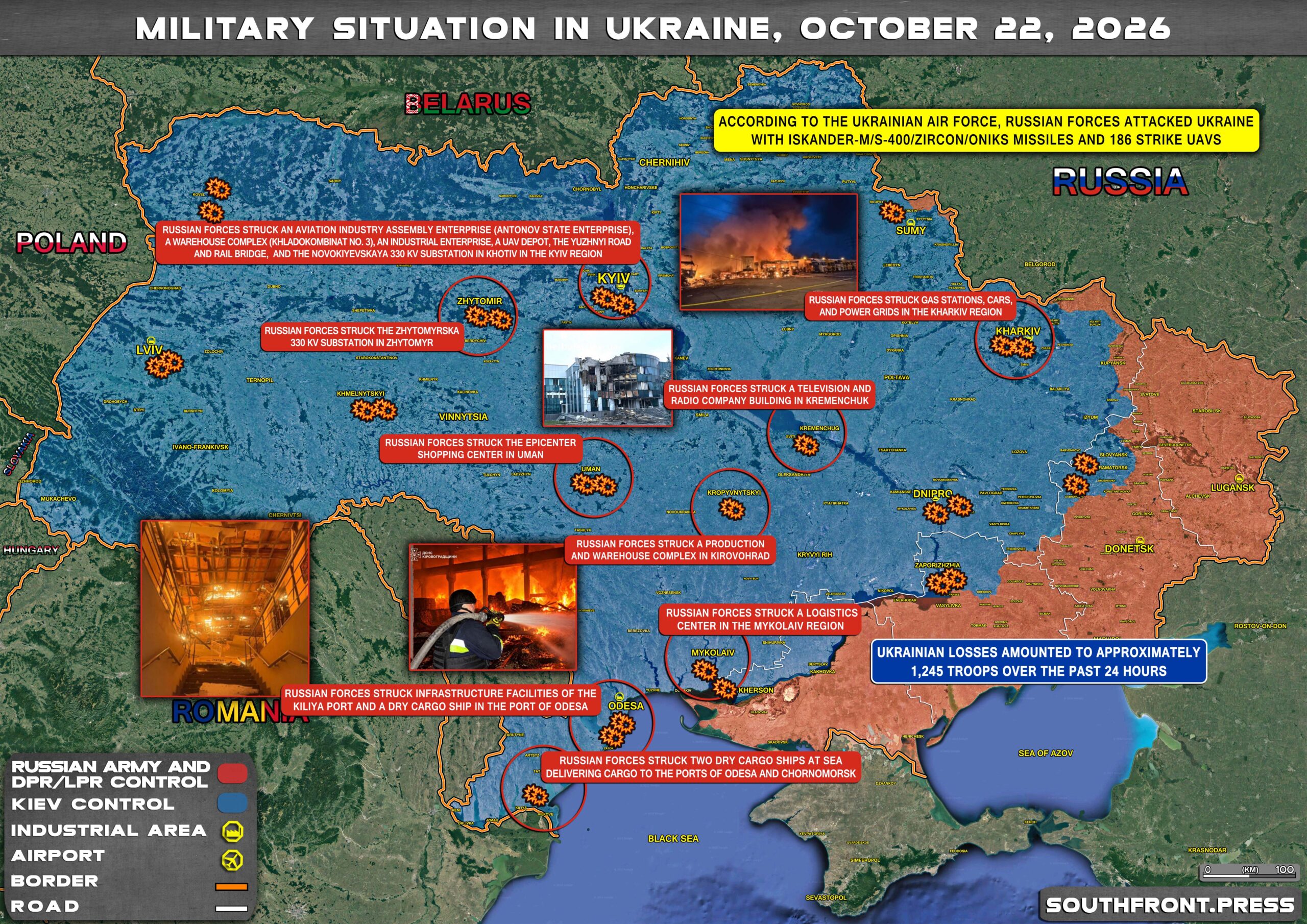
  • Russian strikes destroyed targets in the Sumy, Kharkiv, Zaporizhzhia, Dnipropetrovsk, Kherson, Kyiv, Volyn, Odesa, Khmelnytskyi, Lviv, Vinnytsia, Zhytomyr, Rivne, Cherkasy, Kirovohrad, Mykolaiv regions, and the DPR;
  • According to the Ukrainian Air Force, Russian forces attacked Ukraine with Iskander-M/S-400/Zircon/Oniks missiles and 186 strike UAVs;
  • Russian forces struck an aviation industry assembly enterprise (Antonov State Enterprise), a warehouse complex (Khladokombinat No. 3), an industrial enterprise, a UAV depot, the Yuzhnyi road and rail bridge, and the Novokiyevskaya 330 kV substation in Khotiv in the Kyiv region;
  • Russian forces struck infrastructure facilities of the Kiliya port and a dry cargo ship in the port of Odesa;
  • Russian forces struck two dry cargo ships at sea delivering cargo to the ports of Odesa and Chornomorsk;
  • Russian forces struck the Zhytomyrska 330 kV substation in Zhytomyr;
  • Russian forces struck gas stations, cars, and power grids in the Kharkiv region;
  • Russian forces struck the Epicenter shopping center in Uman;
  • Russian forces struck a television and radio company building in Kremenchuk;
  • Russian forces struck a production and warehouse complex in Kirovohrad;
  • Ukrainian losses amounted to approximately 1,245 troops over the past 24 hours.

Click to see the full-size image

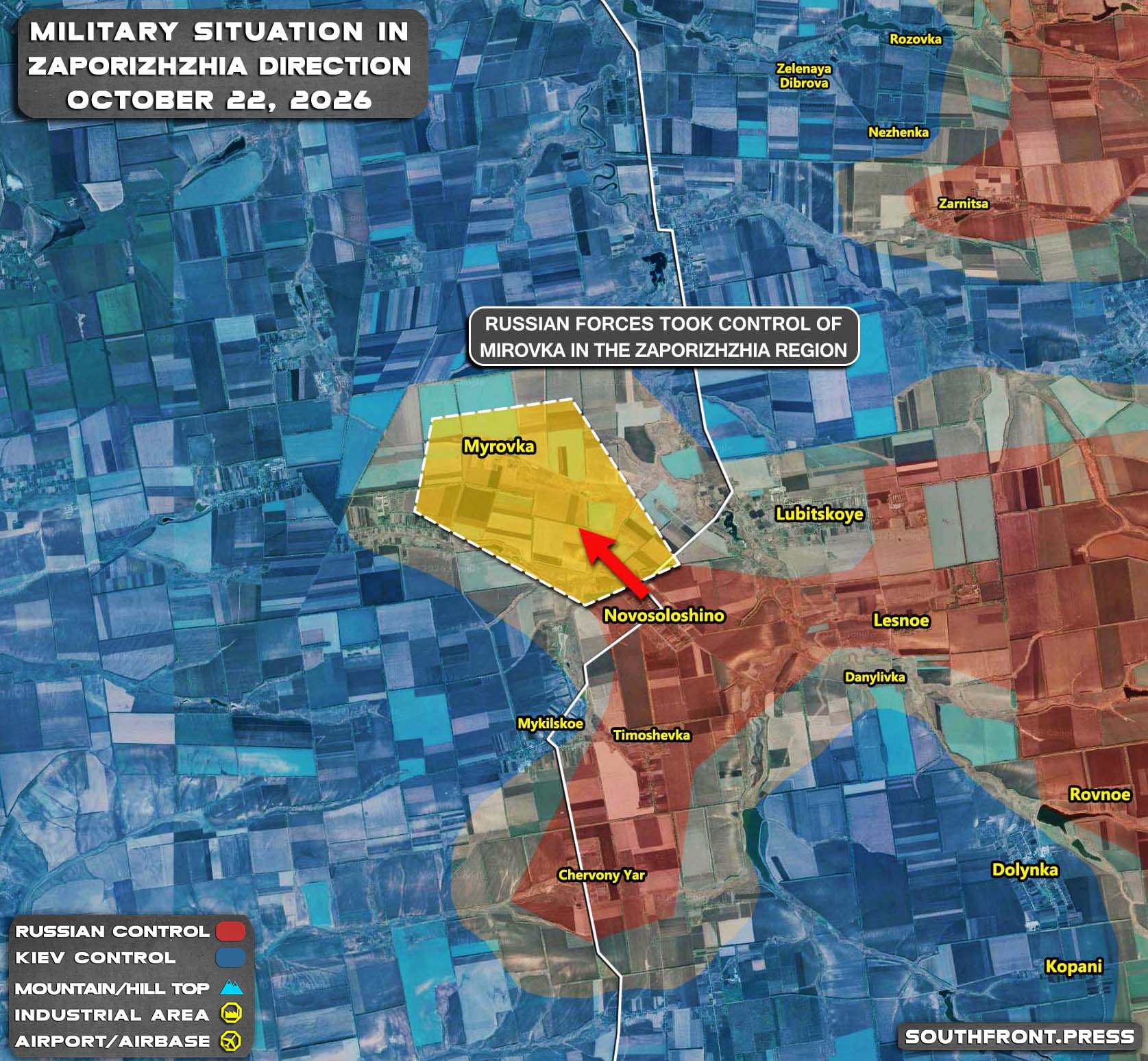
  • Russian forces took control of Mirovka in the Zaporizhzhia region.

Click to see the full-size image

  • Russian forces advanced in the eastern part of Dibrova and near Yampol.

Click to see the full-size image

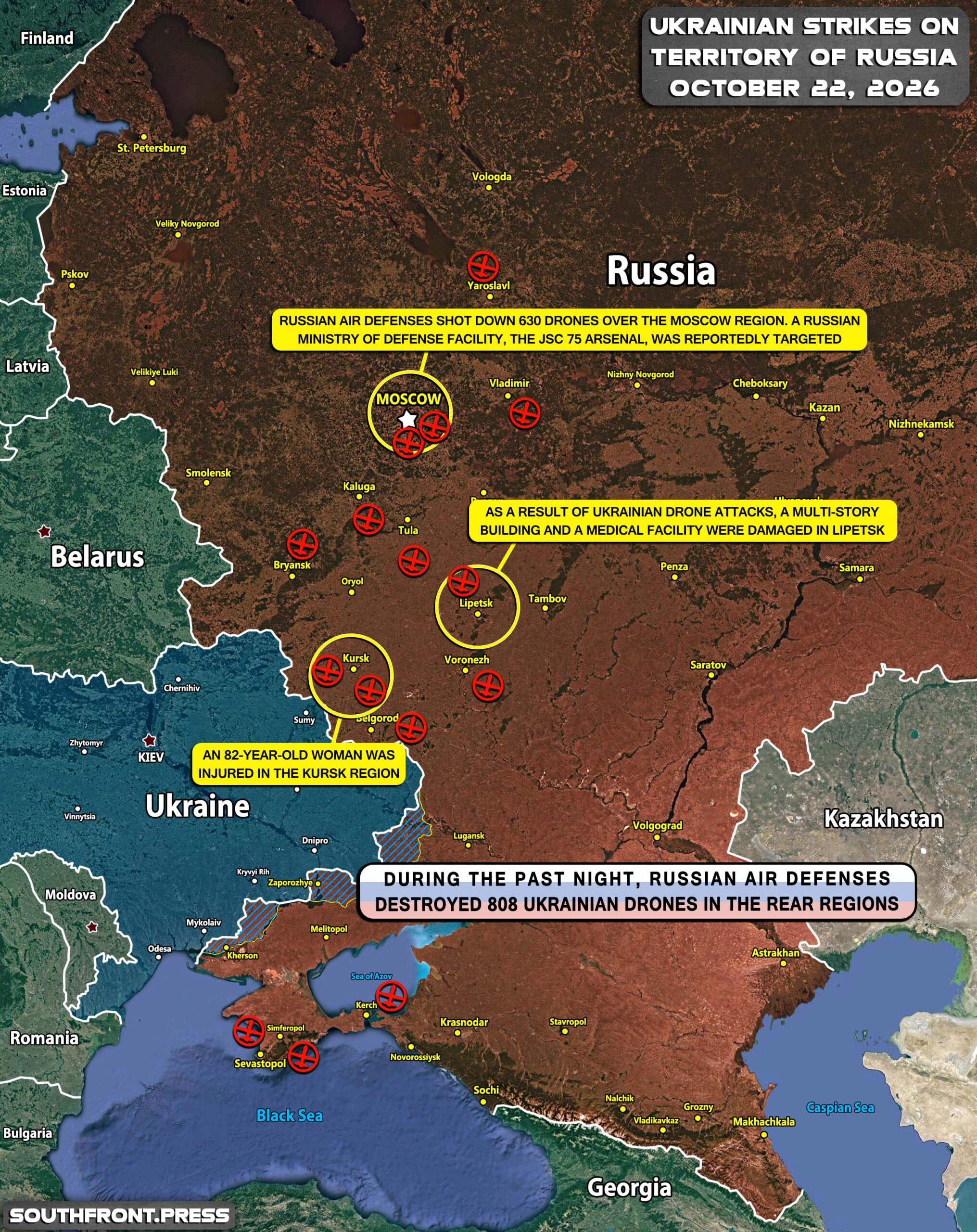
  • During the past night, Russian air defenses destroyed 808 Ukrainian drones in the rear regions;
  • Russian air defenses intercepted UAVs in the Belgorod, Bryansk, Vladimir, Voronezh, Kaluga, Kursk, Lipetsk, Leningrad, Oryol, Rostov, Ryazan, Smolensk, Tambov, Tver, Tula, and Yaroslavl regions, the Moscow region, the Republic of Crimea, and over the Black Sea;
  • Russian air defenses shot down 630 drones over the Moscow region. A Russian Ministry of Defense facility, the JSC 75 Arsenal, was reportedly targeted;
  • As a result of Ukrainian drone attacks, a multi-story building and a medical facility were damaged in Lipetsk
    An 82-year-old woman was injured in the Kursk region.

MORE ON THE TOPIC:

The post Military Situation In Ukraine And Ukrainian Attacks On Russian Territory On October 22, 2026 (Maps Update) appeared first on South Front.
Israel’s vision of regional security rests on keeping Arab states weak

Six years after the Abraham Accords, a new report by a former Israeli intelligence chief outlines a doctrine treating peace deals as temporary and regional instability as an asset. (This the latest chapter of a decades long Israeli strategy)

Houthis Claims Strikes on Saudi Defense Headquarters, Airports and Aramco (Videos)

22 October 2026 at 18:28

File image.

Yemen’s Houthis (Ansar Allah) announced on October 22 that they had launched ballistic missiles and drones against four targets in Saudi Arabia, including the Defense Ministry headquarters in Riyadh, two international airports and a facility belonging to state oil company Saudi Aramco.

Brig. Gen. Yahya Saree, the group’s military spokesman, said in a statement that the operations were conducted over the previous 48 hours and scored direct hits on all four targets.

The targets were the Saudi Defense Ministry in Riyadh, King Fahd International Airport in Dammam, an Aramco facility in the Red Sea port city of Yanbu and Abha International Airport in southwestern Saudi Arabia.

Saree said the attack on King Fahd International Airport disrupted air traffic, while the strike on the Aramco facility in Yanbu started a fire. He did not provide details about the weapons used against each target or the extent of the reported damage.

The statement came as Saudi Arabia reported deadly incidents involving intercepted drones and an attack on King Fahd International Airport that caused casualties and disrupted flights.

The Saudi Civil Aviation Authority said an attack on the Dammam airport late Wednesday killed one Saudi resident and injured eight people, damaging airport facilities and prompting flight diversions. Reuters later reported that two people, including an Indian national, had been killed and eight others injured.

In a separate incident, Saudi Arabia’s Energy Ministry said falling debris from a drone intercepted near Saudi Aramco’s Shaybah oil field killed two foreign residents and injured two others on October 21. The dead were Filipino and Nepali nationals, while the injured were Pakistani and Indian nationals.

The ministry said the interception sparked a fire in a contractor’s vehicle outside the facility’s perimeter but did not affect oil-field operations. Shaybah is in eastern Saudi Arabia and is separate from the Yanbu facility named in Saree’s statement.

Saudi military officials also reported several drone interceptions in recent days. The Saudi-led coalition said on October 21 that it had intercepted and destroyed four drones launched toward the kingdom. The next day, the coalition reported additional interceptions over Riyadh and Medina.

Separately, Reuters reported on October 22 that Saudi Aramco had instructed employees to evacuate its headquarters in Dhahran and work remotely as the fighting intensified. The reason for the order was unclear.

Saree accused Saudi Arabia of carrying out more than 2,900 airstrikes and missile attacks against civilian sites in Yemen over the previous 100 days, claiming that more than 562 people had been killed or wounded, most of them women and children. The figures were not independently verified.

He also warned Riyadh against carrying out threats to target Yemeni tribes, saying the consequences would be “catastrophic and unexpected.” He said the Houthis would resort to major options they had previously been reluctant to use if Saudi Arabia followed through on the threats.

“The Yemeni armed forces will continue their operations deep inside Saudi Arabia in defense of our country and our people,” Saree said, stressing that the operations would continue until the attacks on Yemen stopped and the blockade was lifted.

The Houthis escalated their strikes on Saudi Arabia in recent weeks as they maintained the upper hand on all fronts in Yemen, namely in Taiz and Bab al-Mandab in the southwest of the country. Meanwhile, the kingdom, despite all recent setbacks, appears to be determined to go on with its campaign against the group. In addition to its allies in the Mecca defense pact, Pakistan and Turkey, Riyadh is working on securing support from Egypt and Syria.

_______________________________________________________________________________________________________________________

SouthFront: Analysis and Intelligence

NOW hosted at southfront.press

Previously, SouthFront: Analysis and Intelligence was at southfront.org.

The .org domain name had been blocked by the US (NATO) (https://southfront.press/southfront-org-blocked-by-u-s-controlled-global-internet-supervisor/) globally, outlawed and without any explanation

Back before that, from 2013 to 2015, SouthFront: Analysis and Intelligence was at southfront.com

SOUTHFRONT.PRESS

MORE ON THIS TOPIC:


The post Houthis Claims Strikes on Saudi Defense Headquarters, Airports and Aramco (Videos) appeared first on South Front.

Iran Unveils Underground Arash Drone Arsenal (Videos)

22 October 2026 at 17:35

File image.

Iran’s army on October 22 released footage of an underground facility producing Arash one-way attack drones, while state television reported that a new version carries a 100-kilogram warhead.

The footage showed dozens of drones inside the facility during a visit by Army Chief Maj. Gen. Amir Hatami. Iranian media described the release as the army’s first public video showing its advanced, domestically developed drones and their production.

Hatami said Iran had expanded its drone capabilities beyond the weapons themselves to include the infrastructure and personnel needed to manufacture, maintain and deploy them.

“We have reached a significant level of maturity in the field of drones and unmanned systems in general,” Hatami said, adding that more drones would be unveiled in the future.

Hatami noted that the army’s drone development program began in cooperation with the Defense Ministry and has since expanded into an industrial effort involving universities, researchers and technology companies.

He said a substantial portion of the army’s equipment was now intended for what Iran calls asymmetric warfare, which relies on weapons and tactics designed to challenge a conventionally stronger opponent.

“Today, we are particularly active in the production, distribution and maintenance of these weapons,” Hatami said.

Hatami also acknowledged damage to Iranian military equipment and facilities during recent wars, but said the army had prepared for conflicts in which it would rely on more than conventional weapons.

“Some of the equipment and facilities belonging to us were damaged in the recent wars, but the enemy thought that we did not distinguish between conventional and asymmetric warfare,” he said.

The announcement comes as Iran continues to emphasize its ability to sustain domestic weapons production and prepare for future confrontations.

The footage offered a rare look inside Iran’s underground drone program, although the army did not disclose the facility’s location or its production capacity.

The older Arash-2 is a one-way attack drone designed for long-range strikes. It is reported to have a range of up to 2,000 kilometers.

The newly shown model appears to be a separate version of the Arash family. Its reported 100-kilogram warhead would represent a substantial increase over the specifications commonly published for the older model.

_______________________________________________________________________________________________________________________

SouthFront: Analysis and Intelligence

NOW hosted at southfront.press

Previously, SouthFront: Analysis and Intelligence was at southfront.org.

The .org domain name had been blocked by the US (NATO) (https://southfront.press/southfront-org-blocked-by-u-s-controlled-global-internet-supervisor/) globally, outlawed and without any explanation

Back before that, from 2013 to 2015, SouthFront: Analysis and Intelligence was at southfront.com

SOUTHFRONT.PRESS

MORE ON THIS TOPIC:

The post Iran Unveils Underground Arash Drone Arsenal (Videos) appeared first on South Front.
Pete Hegseth reportedly authorizes DHS to test ‘heat ray’ at US-Mexico border

22 October 2026 at 16:40

The Pentagon’s Active Denial System shoots energy beam that causes ‘sensation of intense heat on surface of skin’

Pete Hegseth, the US secretary of defense, reportedly signed a memo last month permitting the Department of Homeland Security (DHS) to test a non-lethal “heat ray” for potential use at the US southern border.

The “heat ray”, known as the Active Denial System, is a military-grade weapon that shoots an energy beam causing “a sensation of intense heat on the surface of the skin”, according to a 2009 National Defense University case study on the weapon.

Continue reading...

© Photograph: Cpl. Andrew Huff/Marine Aviation Weapons and Tactics Squadron-1

© Photograph: Cpl. Andrew Huff/Marine Aviation Weapons and Tactics Squadron-1

© Photograph: Cpl. Andrew Huff/Marine Aviation Weapons and Tactics Squadron-1

Iran Reports Seven Tankers Struck or Disabled in a Single Day

22 October 2026 at 15:16

File image.

Iran said on October 22 that seven oil tankers were damaged in and around the Strait of Hormuz, with four vessels catching fire after being struck and three others disabled after hitting naval mines.

Iranian state television, citing a statement by the Islamic Revolutionary Guard Corps (IRGC) Navy, said four vessels were struck simultaneously a day earlier while transferring oil between ships in the northern Persian Gulf. The Corps accused the vessels of following an unauthorized route.

Three other vessels were damaged and immobilized after striking naval mines west of the Strait of Hormuz, according to a separate statement by the Corps.

The IRGC warned that continued United States efforts to facilitate commercial shipping through routes Tehran considers illegal could prompt a wider response targeting American military bases in the region.

The reports come as shipping through the Strait of Hormuz remains under severe pressure from attacks and heightened security risks, although oil exports through the waterway have partially recovered.

Preliminary data published by MarineTraffic on October 19 showed that 120 vessels crossed the strait during the week of October 12-18, a 40.9% decline from 203 crossings the previous week. The figures could be revised as additional vessel movements are identified.

At the same time, Kpler data cited by Reuters on October 22 showed that oil flows through the strait averaged 11.7 million barrels per day in October, up from 9.75 million barrels per day in September. The October figure was still about 82% of the average recorded before U.S. and Israeli strikes on Iran began on February 28.

The recovery in oil shipments has been supported partly by convoys traveling close to Oman’s coastline under U.S. naval protection, according to the news agency. Around one-third of crossings have continued to use a northern route controlled by Iran, although those movements remain difficult to track.

The increased oil flows have not restored normal operating conditions. Reuters reported that the United Kingdom Maritime Trade Operations recorded 12 attacks in or around the strait during the previous week, adding that the actual number was likely higher because some shipowners avoid reporting incidents for commercial or security reasons.

The latest attacks were likely a warning by Iran to both the U.S. and Israel, who are reported to be planning another large-scale attack on the Islamic Republic.

_______________________________________________________________________________________________________________________

SouthFront: Analysis and Intelligence

NOW hosted at southfront.press

Previously, SouthFront: Analysis and Intelligence was at southfront.org.

The .org domain name had been blocked by the US (NATO) (https://southfront.press/southfront-org-blocked-by-u-s-controlled-global-internet-supervisor/) globally, outlawed and without any explanation

Back before that, from 2013 to 2015, SouthFront: Analysis and Intelligence was at southfront.com

SOUTHFRONT.PRESS

MORE ON THIS TOPIC:

The post Iran Reports Seven Tankers Struck or Disabled in a Single Day appeared first on South Front.

Russian Army Clears More Areas South of Dobropolye

21 October 2026 at 22:26

Click to see full-size image. (Russian Ministry of Defense)

In the Dobropolye direction, clearing operations continue in the urban area, with Russian forces holding the southern part of the city and repelling attempts by Ukrainian units to relieve their grouping. In the Slavyansk direction, the 25th Army has regained control of Ozernoye and is developing an advance towards Krasny Liman. In the Zaporozhye direction, Russian troops have taken Yulyevka and Chervony Yar, expanding the zone of control north of Orekhov. In the Sumy region, assault groups of the “North” grouping have advanced near Khoten and Velikaya Rybitsa. In the Kharkiv direction, the clearance of the Reznikovsky cauldron is nearing completion. European Union leaders at an extraordinary summit on 26–27 November will attempt to agree ways of covering Ukraine’s funding shortfall for 2027, estimated at €70 billion, and will also discuss the EU’s multiannual budget for 2028–2034.

Dobropolye direction

Clearing of the urban territory continues in Dobropolye. The southern part of the city is already under stable Russian control, although scattered Ukrainian groups are still encountered there. Ukrainian units launched a counter-attack in an attempt to relieve their grouping and cut off the salient towards Belozerskoye, operating in the areas of Novovodyanoye and Zolotoy Kolodez.

In the Zolotoy Kolodez area, Russian troops are advancing on both flanks of the settlement. On the Dobropolye front, Russian forces are expanding the zone of control around Sergeyevka. Systematic clearing of the city continues in Dobropolye. Fighting is under way on the approaches to Belozerskoye and in the Zolotoy Kolodez area.

Russian troops are increasing pressure on Belozerskoye, bypassing the town on the flanks. Units have reached the outskirts and taken up positions in the southern built-up area and adjacent forest belts. Belozerskoye lies only a few kilometers from Dobropolye. Consolidation here could open a route via Novodonetskoye and Stepanovka towards Aleksandrovka.

Territories south of Dobropolye have been cleared of Ukrainian units. Russian fighters have taken Zolotoy Kolodez in a pincer movement and continue clearance operations. Reports from the ground indicate an improvement in the forward edge and strikes against positions in the areas of Zavidovo-Kudashevo, Krivorozhye, Starorayskoye and other settlements.

Slavyansk direction

Russian units in the north have gone over to counter-attacks and have retaken Ozernoye. This eases the position of the 3rd Army in the Raygorodok area, allowing it to concentrate more strongly on Nikolayevka. Strikes from the Orekhovatka area towards Raygorodok have been repelled. The Volunteer Corps holds Nikanorovka, Malinovka and Vasyutinskoye.

Russian troops near Krasny Liman are attempting to disrupt logistics and are advancing from the areas of Zarechnoye, Torskoye and Yampol. The Ozernoye area has been cleared. If Dibrova can be regained, the southern approaches to Krasny Liman will be cleared, creating the possibility of linking up with units holding positions in the town.

In the Konstantinovka sector, intense positional fighting continues in the areas of Rayskoye and Alekseyevo-Druzhkovka. Russian units are seeking to drive Ukrainian forces out of Klinovoye and Verolyubovka in order to secure the eastern flank for a future envelopment of Druzhkovka.

Zaporozhye direction

The Russian Ministry of Defence has reported that the village of Yulyevka has come under control. Nearby, Chervony Yar has also been taken adjacent to Timoshovka, which was captured the day before. The “East” grouping is expanding the zone of control north of Orekhov.

Fighting continues unabated in Orekhov itself. Judging by the pattern of operations, the Russian command is seeking to envelop the grouping center in Shirokoye, where Ukrainian forces have established a strong defensive line. Fighting continues in the northern part of Ternovatoye. Most of the settlement remains under Russian control. Earlier, Russian units took Zaporozhskoye and are gradually reducing the salient.

In the areas of Lyubitskoye and Novosoloshino, Russian troops have gone over to counter-attacks. Fighting in Vozdvizhevka has largely ended and Ukrainian units have been driven out. Battles have begun for Rozhdestvenskoye. Further south, the advance continues from the captured Chervony Yar. Assault groups are operating on the outskirts of the villages of Mirovka and Obshcheye. Thus, in the Zaporozhye direction, Russian units are systematically expanding bridgeheads, pushing Ukrainian forces out of key strongpoints and disrupting their logistics.

Sumy direction

Heavy positional fighting continues in Sumy direction. Russian aviation, drone teams and artillery are increasing the intensity of strikes against Ukrainian positions. Ukrainian units have concentrated on strengthening their defensive lines.

In the Sumy border area, positional fighting continues on the main lines. Fierce clashes are under way in the Yunakovka area; Ukrainian units are attempting to insert small groups but without success. Russian assault troops have advanced in the areas of Khoten and Velikaya Rybitsa overall progress amounting to up to 300 meters.

In the Sumy district, Russian assault troops have advanced near Khoten and Velikaya Rybitsa. Overall progress amounted to up to 300 meters. In the Shostka district, heavy positional fighting continues near Korenek. In the Krasnopolye district, assault groups of the “Northerners” are advancing near Turya. Russian units continue methodically to press the Ukrainian defenses, exploiting their advantage in artillery and drones.

Kharkiv direction

Assault units of the “North” grouping are developing their success in the area of the former “Volchansk cauldron”. The Ukrainian side has stepped up its information activity and is widely disseminating inaccurate claims about alleged control over lost settlements.

North of Bolshoy Burluk, clearance of the so-called Reznikovsky cauldron continues. According to official data, the main settlements have been cleared. The territory is extensive, almost 400–500 square kilometers. Isolated positions will continue to be cleared for some weeks yet. Ukrainian units, relying on Maly Burluk and Prikolotnoye, are attempting to reach the Plotva River in the area of Vasilyevka, Blagodatnoye, Nefyodovka and Chyornoye.

In the Lipetsk direction, Russian troops have advanced on three sectors south of Novaya Kazachya and Tokarevka. Overall progress amounted to 250 meters. In the Volchansk and Veliky Burluk directions, assault groups of the “Northerners” continue to advance southwards. There have been successes in the areas of Prikolotnoye, Maly Burluk and Kolodeznoye. Over the past day overall progress amounted to up to 500 meters.

Conclusion

In the Dobropolye direction, Russian forces are consolidating in the southern part of the city and enveloping Belozerskoye. In the Slavyansk direction, the 25th Army has gone over to the counter-offensive, recovering lost positions and creating a threat to Ukrainian logistics in the Krasny Liman area. In the Zaporozhye direction, the capture of Yulyevka and Chervony Yar has enabled the expansion of bridgeheads and continued pressure on Orekhov. In Sumy region, positional fighting continues with gradual advances by Russian assault groups. In the Kharkiv direction, the clearance of a large cauldron is nearing completion, freeing forces for further offensive operations. The overall trend remains the use by Russian units of small-group tactics that combine assault actions with strikes by artillery, aviation and drones, allowing them methodically to disrupt Ukrainian logistics and expand the zone of control.

European Union leaders at the extraordinary summit on 26–27 November will attempt to agree ways of covering Ukraine’s funding shortfall for 2027, estimated at €70 billion. The EU has already earmarked €45 billion for Ukraine in 2027, yet Kyiv’s financial needs substantially exceed this amount. Even taking into account the planned European funding, Ukraine’s additional requirement is assessed at approximately €70 billion.

Initially, Brussels had expected Norway, Switzerland, Canada, Japan and the United Kingdom jointly to provide a further €45 billion over 2026–2027. Not all the promised funds have been allocated, however. As a result, EU member states will have to agree to additional financing mechanisms for Kyiv, including the possibility of a new loan. At the same time, European leaders continue to negotiate the Union’s seven-year budget for 2028–2034. Brussels aims to conclude the talks by the end of the current year, since electoral campaigns due in a number of EU states in 2027 could further complicate the achievement of a compromise.

_______________________________________________________________________________________________________________________

SouthFront: Analysis and Intelligence

NOW hosted at southfront.press

Previously, SouthFront: Analysis and Intelligence was at southfront.org.

The .org domain name had been blocked by the US (NATO) (https://southfront.press/southfront-org-blocked-by-u-s-controlled-global-internet-supervisor/) globally, outlawed and without any explanation

Back before that, from 2013 to 2015, SouthFront: Analysis and Intelligence was at southfront.com

SOUTHFRONT.PRESS

MORE ON THIS TOPIC:


The post Russian Army Clears More Areas South of Dobropolye appeared first on South Front.

Japan Faces Massive Energy Issues Due To US Wars, But Still Sends Troops Near Taiwan

22 October 2026 at 14:56

Click to see the full-size image

Written by Drago Bosnic, independent geopolitical and military analyst

Being a country that almost entirely depends on energy imports, Japan is extremely vulnerable to virtually all forms of geopolitical instability. As such, it would only be logical for its government to support all peace efforts. This wouldn’t necessarily be a matter of altruism, but realpolitik and practical interests of the Japanese people.

Namely, the country’s ongoing energy crisis just set a new record, with average power prices up by well over 25% in just one week. The massive hike is caused by soaring LNG and higher coal prices. Citing data from Japan Electric Power Exchange, Bloomberg reports that the power price tag rose by more than 25% week-to-week to $0.19 per kWh (kilowatt-hour). Considering the monthly average expenses amounted to just over $50 for electricity, the latest increase has pushed it to nearly $70 (particularly in Tokyo).

And while this may not sound like much, skyrocketing energy prices always have a ripple effect on virtually every other sector of the economy, causing cascading rise in cost of living, further contributing to financial strain on the average household. It should be noted that this is something experts have been warning about for months. Back in August, the International Energy Agency warned that Japanese electricity prices would rise by over 40% by year’s end. This estimate is now considered conservative given the latest surge. Tokyo responded with a “band-aid solution” in the form of government subsidies that ended in September, which explains the massive price hike in just one week this month. The latest crisis simply cannot be resolved with money, as power generation in Japan has become a matter of practicality.

Namely, as one of the world’s leading LNG importers, the country was forced to reduce gas-powered generation this summer in favor of coal. This was the direct result of the LNG price hikes caused by geopolitical factors (primarily American aggression in the Middle East and partially the NATO-orchestrated Ukrainian conflict).

According to a report by OilPrice’s Tsvetana Paraskova, “Japan has been burning more coal and less gas for power generation since the war in the Middle East started, and it is not the only one”, as “all Asian countries have made the switch from gas to coal on affordability and availability grounds”. Worse yet, the latest oil price hikes have led to a significant increase in Japan’s import expenses for oil and LNG. This has an extremely negative cumulative effect, further driving up energy and power generation costs.

Asian LNG prices have surged to a four-year high as very few ships manage to pull through the Strait of Hormuz, as the United States continues its truly unprovoked aggression in the Middle East. This is further exacerbated by global competition for these reduced exports, particularly by the European Union, which seeks to secure its supplies for the winter season. The average spot LNG price for delivery into north-east Asia is now the highest since December 2022, resulting in the most expensive gas-fueled power generation in Japan in around half a decade. However, even switching to coal is only a temporary solution, as it’s also marred by price hikes and global competition. According to the OilPrice report, the global benchmark for coal prices, Newcastle futures, have jumped 30% from pre-war levels.

Obviously, you’d expect Tokyo to focus all its energy (no pun intended) on tackling these issues and keeping its power generation relatively safe from geopolitical hurdles. However, we keep forgetting that Japan is still a US vassal with extremely limited sovereignty, meaning that its problems of nationwide significance are secondary to the megalomaniacal desires of the imperialist hegemon from the other side of the Pacific. Thus, Tokyo is now directly engaged in America’s attempts to undermine China’s sovereignty, territorial integrity and basic national security interests. Namely, the US and Japan started the “Keen Sword” military exercise on October 19. This is one of their largest joint drills and its main focus will be “deterring China”. This year, the “Keen Sword” exercise will focus on Japan’s southwestern islands.

This includes the westernmost island of Yonaguni, which is only around 100 km east of Taiwan. Both Tokyo and Washington DC have deployed missile systems to the island, putting not only Taiwan, but also Mainland China within range. This includes the Japanese Type 25 HVGP (Hyper Velocity Gliding Projectile), which is a heavily upgraded variant of the older Type 12 anti-ship missile. Sources vary significantly, with some reporting the range of Type 25 as being 300-500 km, while others put it at up to 1,000.

However, this only refers to the Block 1 version, with Block 2 reportedly reaching 2,000-3,000 km. Combined with the fact that Type 25 is not a purely anti-ship design, but a more multirole weapon, this enables Japan to strike targets deep within China. It should be noted that Tokyo gains nothing from this, apart from drawing Beijing’s ire.

And who could possibly blame China? Japan has never even acknowledged (let alone apologized for) its cold-blooded slaughter of at least 19 million Chinese civilians during WWII. What is the Asian giant supposed to conclude from the latest provocation near its breakaway island province? Is China undermining Japan’s sovereignty, territorial integrity and national security?

Obviously, it’s a rhetorical question, as we all know who really does. Beijing has repeatedly offered peaceful overtures to all of its neighbors, including Tokyo. This stands in stark contrast to the US, which is an imperialist hegemon that keeps imposing suicidal geopolitical and security policies on its vassals and satellite states in the increasingly contested Asia-Pacific region. Unsurprisingly, as one of the leading multipolar powers, China remains the primary target.


MORE ON THE TOPIC:

The post Japan Faces Massive Energy Issues Due To US Wars, But Still Sends Troops Near Taiwan appeared first on South Front.

Every Briton should stockpile water and food supplies, government advises

Be Ready campaign aims to prepare UK for impact of climate crisis, technological dependency and threats by hostile state

Every Briton is being urged to stock up to nine litres of bottled water and three days’ worth of food in new government guidance designed to ensure that households can survive a weather, cyber or other serious emergency.

The Be Ready campaign is aimed at persuading people to stock up with supplies to last 72 hours, amid growing official concern about the impact of the climate crisis, technological dependency and hostile state threats.

Continue reading...

© Photograph: Christopher Thomond/The Guardian

© Photograph: Christopher Thomond/The Guardian

© Photograph: Christopher Thomond/The Guardian

Russia’s ‘Geran-4 Seeker’ Drones Strike Two Ukrainian NASAMS Systems (Videos)

22 October 2026 at 12:09

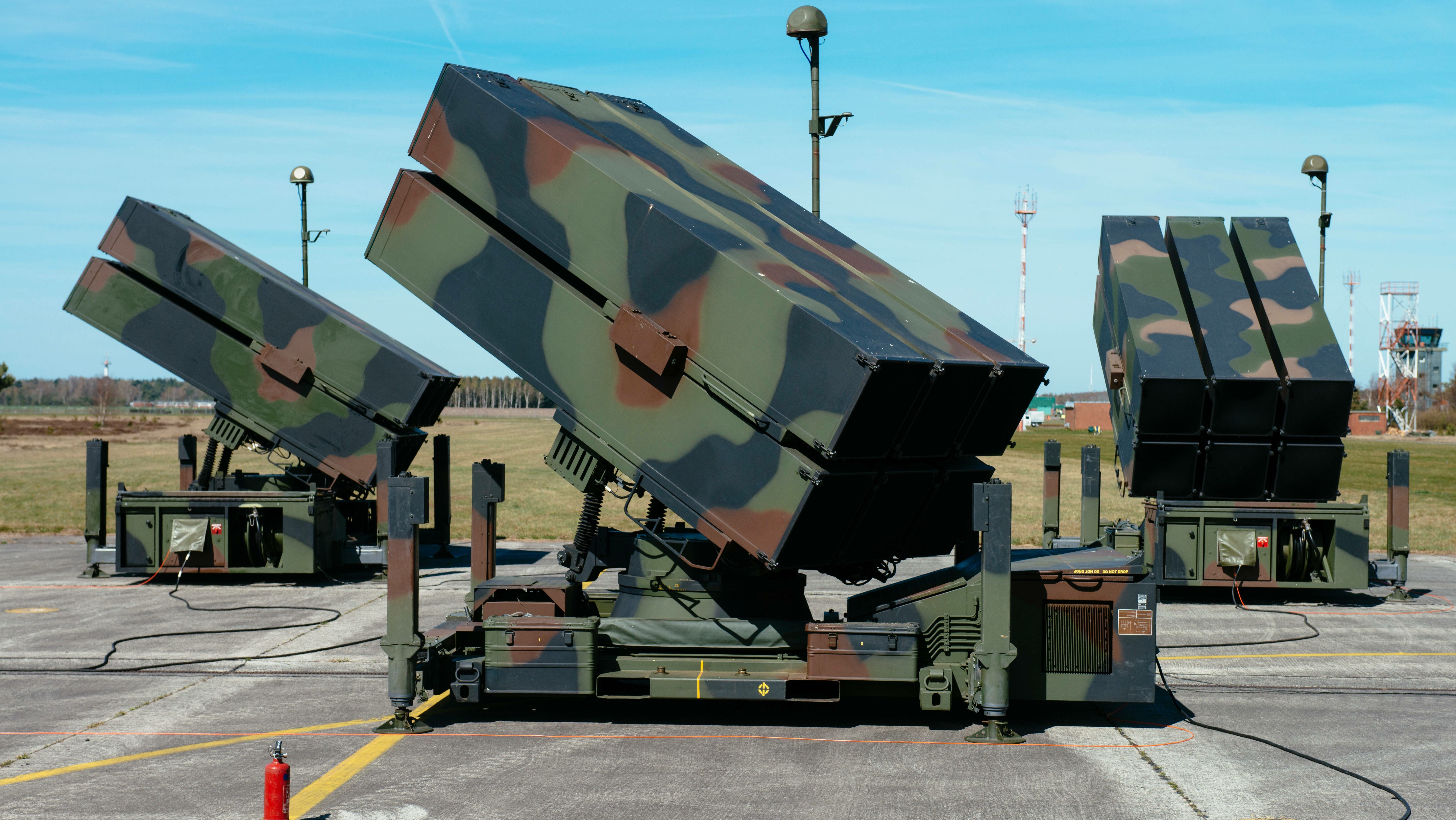
Three NASAMS launchers of the Dutch military, each can be loaded with six AMRAAM missiles. Source: the Dutch Ministry of Defense.

Russia’s Rubicon Center said on October 21 that its Geran-4 Seeker attack drones struck two Ukrainian NASAMS air defense systems in southeastern Ukraine, releasing video footage of the attacks.

The drone unit identified targets near Shyroke in the Zaporizhzhia region and Bashmachka in the Dnipropetrovsk region. It said both targets were successfully hit.

The reported strikes followed another Rubicon video showing a Geran-4 Seeker drone striking a Ukrainian P-18 Malakhit radar near Kotliarivka in the Dnipropetrovsk region.

The sequence points to an emerging role for the drones in suppressing enemy air defenses, a mission known as SEAD that involves locating and attacking radars, surface-to-air missile systems and other components of an opponent’s air defense network.

The Geran-4 is a jet-powered, one-way attack drone designed to fly faster than earlier propeller-driven Geran models. Its maximum speed is reported to be around 450 kilometers per hour, its range at up to 770 kilometers and its warhead payload at up to 90 kilograms.

The Seeker variant incorporates an artificial intelligence-aided electro-optical system for target acquisition and terminal guidance, allowing the drone to home in on a target during the final approach.

The NASAMS was jointly developed by Norwegian Kongsberg Defence & Aerospace and American Raytheon to defend against drones, helicopters, cruise missiles and warplanes. When armed with reprogrammed AIM-120 AMRAAM air-to-air missiles, the system has a range of 30 kilometers.

Ukraine’s exact NASAMS inventory remains undisclosed. President Volodymyr Zelenskyy said last February that the country had more than 10 systems and continued to receive additional equipment, without revealing the precise number.

The United States had listed 12 NASAMS in its security assistance to Ukraine by September 2024. Norway has also provided complete firing units, while Lithuania supplied additional launchers for integration into Ukraine’s existing network, and Canada donated a separate system that arrived in November 2024.

The latest Russian strikes show that the Geran-4 Seeker is being used not only against conventional ground targets but also against the radar and missile assets that underpin Ukraine’s air defenses.

_______________________________________________________________________________________________________________________

SouthFront: Analysis and Intelligence

NOW hosted at southfront.press

Previously, SouthFront: Analysis and Intelligence was at southfront.org.

The .org domain name had been blocked by the US (NATO) (https://southfront.press/southfront-org-blocked-by-u-s-controlled-global-internet-supervisor/) globally, outlawed and without any explanation

Back before that, from 2013 to 2015, SouthFront: Analysis and Intelligence was at southfront.com

SOUTHFRONT.PRESS

MORE ON THIS TOPIC:

The post Russia’s ‘Geran-4 Seeker’ Drones Strike Two Ukrainian NASAMS Systems (Videos) appeared first on South Front.

Russia Has Brand-New Stealth Cruise Missile

22 October 2026 at 11:25

Click to see full-size image.

Russia has a new land-attack cruise missile with a low-observable design, according to Ukraine’s Defense Intelligence agency.

Russia began using the “Filin” against Ukraine in late summer of this year, according to a report published by the intelligence agency on October 22. The report also included an interactive 3D model showing the missile’s components and assembly.

The Filin is allegedly manufactured by Russian company NPO Molniya, part of Tactical Missiles Corporation. It is a ground-launched cruise missile with a reported range of up to 1,200 kilometers and a claimed top speed of 800 kilometers per hour, according to the report.

The missile measures about 3.5 meters long, with a wingspan of roughly 3 meters. Its fuselage is made from carbon- and fiberglass-reinforced composite materials, and some components are produced using 3D-printing technology. It can fly at extremely low altitudes but is also capable of climbing to about 6 kilometers. The report identified versions carrying warheads weighing 50 kilograms or 100 kilograms.

The missile is launched using a solid-propellant booster before its main jet engine takes over. Its navigation system combines an inertial navigation system with a 16-channel Kometa satellite-navigation module, which is highly resistant to jamming.

Notably, the Filin uses an R500 jet engine manufactured by Russian company Reynolds LLC. The same engine has also been identified in Russia’s S-71K Kover and S-71M Monokhrom air-launched cruise missiles.

The Ukrainian intelligence report came just a day after Russia’s state-owned Rostec corporation revealed that it is developing a new generation of attack drones designed to fly farther, faster and more autonomously, building on its Dan-T loitering munition, which the company says has capabilities comparable to cruise missiles.

Recent generations of Russian strike weapons, like the Dan-T, Geran-4 and Geran-5, have blurred the line between an attack drone and a cruise missile, mixing the range, flexibility and low cost of the first with the range and speed of the second. Ukraine’s highly depleted air defense network has been struggling to cope with these weapons. Now, the Filin represents a new threat with higher speed and longer range.

_______________________________________________________________________________________________________________________

SouthFront: Analysis and Intelligence

NOW hosted at southfront.press

Previously, SouthFront: Analysis and Intelligence was at southfront.org.

The .org domain name had been blocked by the US (NATO) (https://southfront.press/southfront-org-blocked-by-u-s-controlled-global-internet-supervisor/) globally, outlawed and without any explanation

Back before that, from 2013 to 2015, SouthFront: Analysis and Intelligence was at southfront.com

SOUTHFRONT.PRESS

MORE ON THIS TOPIC:

The post Russia Has Brand-New Stealth Cruise Missile appeared first on South Front.

US military failed to notify UK police of drink-driving allegation against airman based in England

British authorities were unable to investigate case of Christopher Mooty, who went on to commit another offence

The US military failed to notify British police of an allegation that one of its airmen had been drink-driving in Suffolk, preventing the British authorities from being able to investigate the offence.

The failure broke a longstanding formal agreement with British police that enables the UK to investigate alleged illegality by US military personnel who are stationed in Britain.

Continue reading...

© Composite: Guardian Design/Getty Images

© Composite: Guardian Design/Getty Images

© Composite: Guardian Design/Getty Images

U.S. and Israel Draw Up Plans to Strike Iran’s Energy Facilities, Nuclear Sites and Missile Arsenal

22 October 2026 at 10:00

Click to see full-size image. (U.S. Air Force)

The United States and Israel have drawn up plans for renewed military strikes on Iran following the American midterm elections next November, The New York Times reported on October 21, citing U.S. officials and others briefed on the matter.

The plans reportedly envisage a short but intensive operation targeting Iranian energy infrastructure, nuclear facilities and the country’s missile and drone arsenals.

The U.S. and Israeli militaries have stepped up joint preparations, including flights over neighboring Iraq to rehearse strike maneuvers.

Officials cited by the newspaper said renewed strikes could severely damage Iran’s economy and force Tehran to make diplomatic concessions. The report noted, however, that U.S. President Donald Trump has not committed to authorizing further military action.

A separate report from NBC News revealed that the U.S. is also quietly reducing its troop presence at bases in Jordan, Qatar and Kuwait while cutting staffing at diplomatic missions across the Middle East amid threats from Iran.

Amid these developments, Trump said there were no negotiations with Tehran and indicated that developments in the conflict could come soon.

“We are not negotiating with” Iran, Trump told a reporter before boarding Air Force One at Joint Base Andrews.

“Something one way or another will happen, fairly soon,” he continued. “Most people seem to think it’s after the election.”

In apparent response to recent escalation, a senior Iranian security official told the semi-official Fars News Agency that Tehran expects another U.S.-Israeli attack and considers Washington’s diplomatic efforts insincere.

The official warned that any renewed large-scale conflict involving the assassination of Iranian officials or the killing of civilians would lead Iran to consider U.S. political targets and the infrastructure of countries participating in the war “legitimate targets.”

Overall, it is clear that the U.S. and Israel will attack Iran again. Recent Hebrew media reports even revealed that dozens of Israeli warplanes have already flown close to the border of the Islamic Republic in the hope of provoking some response. Tehran is keeping its finger on the trigger and is guaranteed to strike back in the case of a new attack. One thing is sure this time, and that is that the U.S. and Israel have lost the element of surprise.

_______________________________________________________________________________________________________________________

SouthFront: Analysis and Intelligence

NOW hosted at southfront.press

Previously, SouthFront: Analysis and Intelligence was at southfront.org.

The .org domain name had been blocked by the US (NATO) (https://southfront.press/southfront-org-blocked-by-u-s-controlled-global-internet-supervisor/) globally, outlawed and without any explanation

Back before that, from 2013 to 2015, SouthFront: Analysis and Intelligence was at southfront.com

SOUTHFRONT.PRESS

MORE ON THIS TOPIC:


The post U.S. and Israel Draw Up Plans to Strike Iran’s Energy Facilities, Nuclear Sites and Missile Arsenal appeared first on South Front.

Crime Is Down in D.C., but Trump's National Guard Deployment Probably Isn't the Cause

22 October 2026 at 11:00
National Guard troops | Photo, left: Frédéric Marie/Alamy

One month after Washington, D.C., celebrated America's 250th anniversary, it marked a more ignominious milestone: a full year since President Donald Trump deployed thousands of National Guard soldiers to the capital.

The approximately 4,600 National Guard members have been an unavoidable presence in D.C., wandering the National Mall and downtown streets in groups of three or four, or standing idly in Metro stations chatting. Occasionally, they're tasked with picking up trash at parks. Tourists take selfies with them by the now-fenced-off Lafayette Square in front of the White House.

They're not going anywhere. The Trump administration is moving forward with plans to acquire up to 2,000 housing units to support long-term National Guard deployments. The Department of Defense has estimated that extending the mission from October 2026 through to the end of the Trump administration in January 2029 will cost about $1.4 billion.

According to the Trump administration, all of this has been necessary to transform D.C. "from a crime-ridden city into a safe and beautiful haven for residents and visitors alike."

Crime in D.C. is down 20 percent from 2025, according to the Metropolitan Police Department, but an August Reuters investigation found National Guard soldiers were involved in only a tiny fraction of arrests in the safer parts of the city, mostly for minor offenses such as shoplifting and turnstile jumping. Crime has been dropping nationwide, a trend that started before Trump took office and includes cities that aren't occupied by federal law enforcement and soldiers.

Even if the Guard presence has contributed to a drop in crime, it's a civil liberties nightmare. It puts untrained military in the role of policing civilians. It usurps local police departments that are ostensibly answerable to the communities they police, and it normalizes the deployment of military forces domestically—a red line for a free society.

"There's a deep irony that here we are in the capital of the free world, and our president is treating it like a police state," Scott Michelman, legal director of the ACLU of the District of Columbia, told PBS in August. "D.C. residents have lived with our National Guard troops in our neighborhoods for about a year, despite the absence of any genuine emergency and really any reason for them to be here."

Last November, a federal court preliminarily ruled that the deployment was illegal. However, an appeals court allowed the Trump administration to keep troops deployed in D.C. while it considers the administration's appeal of that ruling.

The appeals court decision is absurd. The appellate panel is fully aware that every day the case drags on is another day that D.C. residents are being subjected to a potentially illegal military occupation, and another day that taxpayers will foot the bill for a wasteful fit of presidential hubris.

The damages are compounding. The first anniversary of Trump's deployment of National Guard soldiers to D.C. should be the last.

The post Crime Is Down in D.C., but Trump's National Guard Deployment Probably Isn't the Cause appeared first on Reason Magazine.

China’s new drone mothership targets US undersea edge

22 October 2026 at 07:11

China’s development of specialized naval auxiliaries designed to transport, launch and recover submarine-sized uncrewed vessels signals an assertive push to project autonomous undersea power beyond the First Island Chain and systematically challenge US submarine dominance in the Western Pacific. This month, multiple media outlets reported visual evidence showing that China has constructed a second dedicated […]

The post China’s new drone mothership targets US undersea edge appeared first on Asia Times.

❌